GROWTH
Reading edition
Little has been recorded concerning the growth rate of Gastrophryne or the time required for it to attain sexual maturity. Wright (1932) found that G. carolinensis in the Okefinokee Swamp region has a mean metamorphosing-size of 10.8 mm. Young thought to be those recently emerged from their first hibernation were those in the size group 15.0 to 20.0 mm., while the frogs in the 20 to 27 mm. size class and those in the 27 to 36 mm. class were interpreted as representing two successively older annual age classes. Anderson (1954: 41) thought he could recognize four successive annual age classes in the same species in southern Louisiana. He found that sexual maturity is attained at a length of 21 to 24 mm. in frogs which he believed to be late in the second year of life.
Allowing for size differences between the two species, Wright's and Anderson's conclusions regarding growth in G. carolinensis, on the basis of size groups, are largely substantiated by my own data on the growth of marked individuals of G. olivacea living under natural conditions in Kansas.
In 1954, an opportunity to investigate the early growth was afforded by unusually favorable circumstances. The population of frogs that emerged from hibernation in the late spring of 1954 included few, if any, that were below adult size; drought had prevented successful breeding in 1952 and 1953. Heavy rains in the first week of June, 1954, and again in the first week of August, resulted in the production of two successive crops of young so widely spaced that they were easily distinguishable. Some young may have been hatched after other minor rains, but certainly these were relatively few. Young from the eggs laid in the first week of August were metamorphosing during the last week of August. Growth in the frogs of this group can be shown by the average size and the size range of the successive samples collected.
Table 2. Growth in Frogs Metamorphosed in the Last Week of August, 1954.
Time of sampleNumber in sampleMean size in mm.Size range in mm.
August 27 to 312715.55 ± .07915 to 17
September 1111417.2 ± .03314 to 20
September 15 to 221218.7 ± .09016 to 20
September 27 to 303719.3 ± .05517 to 21.5
October 1 to 76220.8 ± .07217 to 24
October 12 to 174922.3 ± .09218 to 24
By mid-October, six weeks after metamorphosis, these frogs had increased in over-all length by approximately 50 percent. Having grown a little more than 1 mm. per week on the average, they were approximately intermediate in size between small adults and newly metamorphosed young.
The frogs hatched in June were present in relatively small numbers compared with those hatched in August, and were not observed metamorphosing. In late August a sample of 33 judged to belong to the June brood averaged 26.2 (22-28) mm. long. A sample of 39 from the first week of October averaged 28.1 (24.5-32) mm. Frogs of this group thus were approaching small adult size late in their first growing season. Such individuals possibly breed in the summer following their first hibernation, when they are a year old or a little more. Because recaptured frogs were not sacrificed to determine the state of their gonads, the minimum time required to attain sexual maturity was not definitely determined. The available evidence indicates that sexual maturity is most often attained late in the second year of life, at an age of approximately two years. The darkened and distensible throat pouch of the adult male probably is the best available indicator of sexual maturity.
Fig. 3. Growth shown by successive samples of young ant-eating frogs of two size groups in late summer and early fall of 1954. For each sample the mean, standard deviation, and range are shown. Lower series are those metamorphosed in late August, and upper series are those metamorphosed in late June.
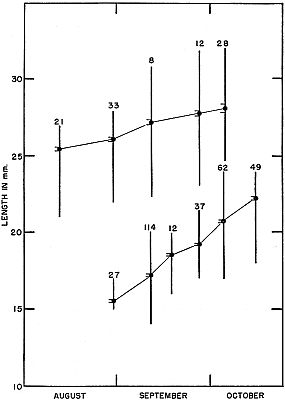
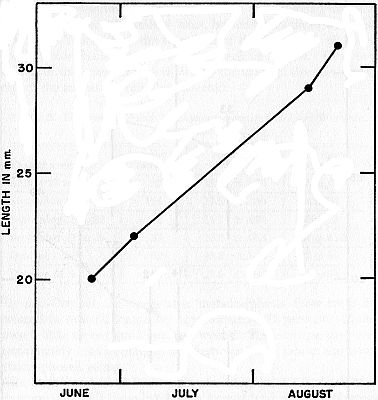
Fig. 4. Rapid growth of a young female caught in June, July, and August, 1949. Presumably this individual metamorphosed late in the summer of 1948, and at the age of approximately one year it was near small adult size.
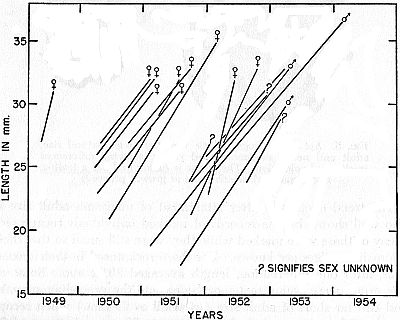
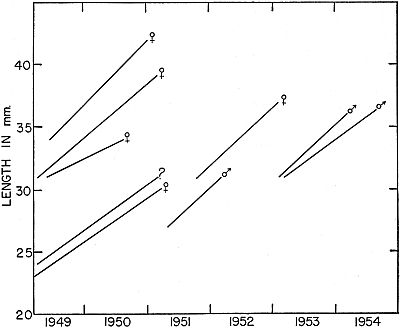
Frogs that metamorphose in late summer have little time to grow before hibernating, and still are small when they emerge in spring. The smallest one found was 19 mm. long (May 19, 1951), and in each year except 1954 many such young were found that were less than 25 mm. in length in May or early June. None of the frogs marked at or near metamorphosing size has been recaptured, but the trend of early growth is well shown by Table 2 and Fig. 3. However, many juveniles that were captured and marked within a few weeks of metamorphosis were recaptured as adults. The selected individuals in Table 3 are considered typical of growth from "half-grown" to small adult size. Growth in many other individuals is shown in Figs. 6 and 7.
Table 3. Growth in Frogs Marked as Young and Recaptured as Small Adults.
Individual and sex Dates of capture Length in mm. Probable time of metamorphosis
No. 1 ♀ August 28, 1951 21.5 Mid-July, 1951
May 5, 1952 23
July 3, 1952 32
August 31, 1952 33
No. 2 ♀ June 8, 1950 25 Late July, 1949
May 24, 1951 31
July 30, 1951 34
June 24, 1952 35
No. 3 ♂ August 31, 1951 24 Late June, 1951
May 23, 1953 32
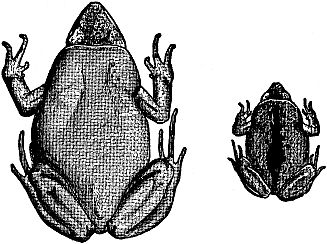
Fig. 5. Ant-eating frogs, a little less than twice natural size, adult and newly metamorphosed young, showing differences in size and coloration. The young is darker and has a leaflike middorsal mark which fades as growth proceeds.
The trend of growth after attainment of minimum adult size is also well shown by the records of marked individuals recaptured. Many of these were marked while they were still small so that their approximate ages are known. For those recaptured in their second year, after one hibernation, length averaged 30.92 mm. Some of this group were young metamorphosed late the preceding summer and still far short of adult size (as small as 23 mm.) when recaptured. Others were relatively large, up to 33 mm. A group of 22 recaptured frogs known to be in their third year averaged 33.3 mm. (males 31.9, females 35.3, excluding four individuals of undetermined sex). Fifteen other recaptured frogs were known to be in their fourth year at least, and some probably were older, as they were already large adults when first examined. These 15 averaged 36.6 mm. (males 34.7, females 37.9 mm.). Size was similar in a sample of 58 individuals intercepted en route to the breeding pond in heavy rains of June and August, 1954. The 38 males in this sample ranged in size from 30 mm. to 38 mm., averaging 34.5. The 20 females ranged from 34 mm. to 40 mm., averaging 37.65. The large average and maximum size in this sample of a breeding population may be typical after periods of drought years have prevented successful reproduction. Summer drought in 1952 and 1953 prevented breeding in those years, or, at least, it drastically reduced the numbers of young produced. One-year-old and two-year-old frogs may not have been represented at all in the sample of 58. Three-year-old frogs presumably made up a substantial part of the sample, since 1951 was a year of successful breeding.
Fig. 6. Growth in a group of frogs, each marked while still short of adult size and mostly recaptured after lapse of one or more hibernation periods. Each line connects records of an individual frog.
Differences in size between species and geographic variation in size in Gastrophryne have been given little attention by herpetologists, but if understood, would help to clarify relationships. Hecht and Matalas stated in their revision (1946: 5) that size is of no importance as a taxonomic character, as typical carolinensis, olivacea, and mazatlanensis all averaged approximately the same—26 to 28 mm.—females slightly larger than males. However, they arbitrarily classed as adults all individuals 22.5 mm. in length or larger, having found individuals this small that showed the darkened and distensible throat pouches characteristic of adult males. From the trend of my own measurements of G. olivacea in northeastern Kansas, I conclude that either many immature individuals were included in their samples, or that the populations sampled included some with individuals that were remarkably small as adults.
Fig. 7. Growth in another group of frogs that were marked as young or small adults and recaptured after intervals of more than a year. Frogs of this group were, on the average, larger than the individuals shown in Fig. 6, and they made less rapid growth.
The population which I studied may be considered typical of G. olivacea. They averaged large, including individuals up to 42 mm. in length, well above the maximum sizes for any reported in the literature. At metamorphosis these olivacea are of approximately 50 percent greater length than G. carolinensis as reported by Wright and Wright (1949: 573) and Anderson (1954: 41). Yet Blair (1950: 152) observed that in eastern Oklahoma, where the ranges of olivacea and carolinensis overlap, the latter is larger. On the basis of field and laboratory observations he tentatively concluded that one of the main barriers to interbreeding was the reluctance of the males of carolinensis to clasp the smaller females of olivacea.
That size differs in different populations, and is still poorly understood, is illustrated by the following discrepant figures from various authors.
Table 4. Size Range of Adults in Various Populations of Gastrophryne.
Species or subspeciesGeographic population sampledAuthoritySize range of adults in mm.
olivaceaDouglas Co., Kansaspresent study31 to 42
olivaceaentire rangeWright and Wright (1949)19 to 38
carolinensisentire rangeWright and Wright (1949)20 to 36
carolinensissouthern LouisianaAnderson (1954)22 to 35
areolatasoutheastern TexasWright and Wright (1949)23 to 29
mazatlanensisArizona and New MexicoWright and Wright (1949)22 to 30
mazatlanensisSanta Cruz Co., ArizonaStebbins (1951)25.2 to 31.5