MOVEMENTS
Reading edition
Freiburg (op. cit.: 384) concluded that ant-eating frogs seem to have no individual home ranges, but wander in any direction where suitable habitat is present. However, from records covering a much longer span of time, it became increasingly evident that a frog ordinarily tends to stay within a small area, familiar to it and providing its habitat requirements.
Nevertheless, in all but a few instances the marked frogs recaptured were in new locations a greater or lesser distance from the site of original capture. The movements made by these frogs were of several distinct types:
1. Routine day to day movements from shelter to shelter within the area familiar to the animal, the "home range."
2. Shifts from one home range to another; such shifts may have been either long or short, and may have occurred abruptly or by gradual stages.
3. Travel by adults to or from a breeding pond. In most or all instances these adults were regularly established in permanent home ranges, and they often moved through areas unsuitable as habitat to reach the ponds.
4. Movements of dispersal in the young, recently metamorphosed and not yet settled in a regular home range.
Usually there was uncertainty as to which types of movements had been made by the recaptured individuals. Some may have made two or three different types of movements in the interval between captures.
On many occasions individuals were found beneath the same rock on two consecutive days, or occasionally on several successive days. Rarely, such continued occupancy of a niche lasted several weeks. In 1949, a frog was found under the same rock on June 4, 6, 26, 27, and July 1, 3 and 11. This was an immature female, presumably metamorphosed late in the summer of 1948. During the five weeks period covered by the records, it grew from 27 mm. to 34 mm. In 1952, another individual was found under its home rock on June 23 and 30, July 2 and 3, and August 14 and 20. In 1952 a juvenile was found under a rock on May 30, June 4, and June 17. These three individuals were exceptional in their continued occupancy of the same niches. Among the hundreds of others recorded, none was found more than twice in any one place.
Despite the fact that field work was concentrated on small areas which were worked intensively, only eight per cent of the frogs recorded were ever recaptured, and most of those were recaptured only once. Only 13 individuals yielded series of records, well spaced, in two or more different years. These few individuals recaptured frequently may not be typical of the entire population. The low incidence of recaptures indicates that relatively few of the frogs present on an area at any one time have been taken. Because of their secretive and subterranean habits most of the frogs are missed by a collector who searches by turning rocks, or trapping with pitfalls. Therefore, even though a marked frog may survive and remain within a radius of a few hundred feet of one point for months or even years, the chances of recapture are poor.
One female was caught first as a juvenile on June 8, 1950. On April 24, 1951, when first recaptured, she had grown to small adult size, and was only 18 feet from the original location. On July 30, 1951, however, she was recaptured 750 feet away. At a fourth capture on May 21, 1952, she had shifted 70 feet farther in the same direction. At the final capture on June 24, 1952, she was approximately 140 feet from both the third and fourth locations. The sequence of these records suggests that the frog had already settled in a home range at the time of her first capture in 1950, and that approximately a year later she shifted to a second home range, which was occupied for the following year, at least.
Fig. 8. Distances between captures in frogs marked, and recaptured after substantial intervals including one or more hibernations. Distances are grouped in 25-foot intervals. For longer distances the trend is toward progressively fewer records, indicating that typical home ranges are small.
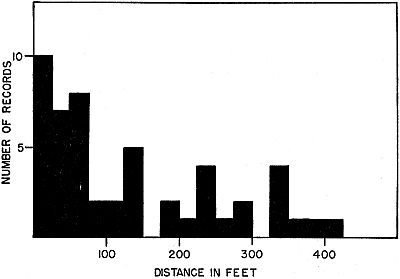
In several instances, after recaptures as far as 400 feet from the original location, frogs were again captured near an original location, suggesting that for some individuals, at least, home ranges may be as much as 400 feet in diameter.
Figure 8 shows that for movements of up to 400 feet, numbers of individuals gradually decrease with greater distance. For distances of more than 400 feet there are comparatively few records. Of the 59 individuals recaptured after one or more hibernations, only nine had moved more than 400 feet from the original location. Twenty-five were recaptured at distances of 75 feet or less. The mean distance for movement for all individuals recaptured was 72 feet. A typical home range, therefore, seems to average no more than 75 feet in radius. Of the 59 individuals recaptured after one or more hibernations, 47 were adults and probably many of these had made round-trip migrations to the breeding pond. This was not actually demonstrated for any one individual, but several were captured in each of three or four different years near the same location.
Fig. 9. Distances between captures and elapsed time in months in marked frogs recaptured. Few records are for distances more than 400 feet. There is but little tendency to longer movements in those caught after relatively long intervals.
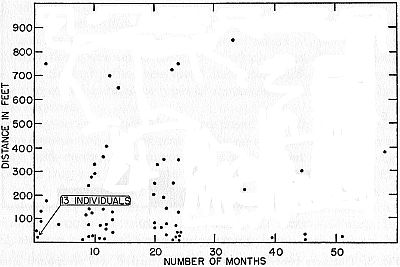
The trend of movements differed in the sexes. Males are more vagile. Of 21 adult males recaptured, none was less than 40 feet from its original location, whereas six of the 26 adult females were less than 40 feet away from the original point of capture. Of seven frogs that had wandered 700 feet or more, five were males.