LIST OF PHOTOGRAVURES (continued 14)
Reading edition
Miller, Lieut.-Colonel John Bellamy, Manufacturer (Toronto, Ont.), President of the Polson Iron Works, Limited, and Parry Sound Lumber Company, is the son of John Clausin Miller, Lumberman, Parry Sound, Ont., and Adelaide Augusta Chamberlain; was born at Farmersville (now Athens), July 26, 1862, and received his education at the Model School, Toronto, and Upper Canada College. Following his educational training, Mr. Miller entered the lumber business with the Parry Sound Lumber Co. as clerk, and while holding this position, mastered every detail of lumber manufacturing. In 1883, following his father’s death, John B. Miller took complete charge of the business and was made president of the Company, which position he still holds. He is also president of the Polson Iron Works, Limited, of Toronto, and holds a like position in the Polson Dry Dock and Shipbuilding Co. of Toronto. Added to the above Mr. Miller is president of the Consumers Box Company of Toronto, and was largely instrumental in the formation of the Canadian Lumbermen’s Association, of which he is past-president. Mr. Miller holds membership in the following clubs: National Ontario, R.C.Y.C., Rosedale Golf, Scarboro Golf, Ontario Jockey Club, Canadian Military Institute, Aero Club of Canada, all of Toronto; the Rideau Club, of Ottawa; Junior Army & Navy Club, London, Eng.; Aero Club of America, New York; Royal Colonial Institute, London; Associate of Institute of Naval Architects of London, Eng. Mr. Miller was married October 3rd, 1883, to Hannah Pollock Hunter. Mrs. Miller died in 1893. By this marriage there were two sons, John Clausin Miller and Henry H. Miller. Mr. Miller’s second marriage took place September 22nd, 1897, to Jessie Thompson, of Longford, Ont., a daughter of the late John Thompson, a prominent Lumberman of that place. One daughter survives this union, Margaret Lumsden Miller, together with Capt. H. H. Miller, son of the first marriage. Mr. Miller has the honor of being Lieut.-Col. of the 23rd Regiment of Northern Pioneers, with Headquarters at Parry Sound; is a Liberal in politics and his favorite recreations are golf, shooting and fishing; resides at 98 Wellesley Street, and has his office at Polson Iron Works.
Nasmith, Colonel George Gallie (Toronto, Ont.), who already enjoyed a high reputation throughout Canada as a sanitary expert, has won added distinction in the European War through brilliant services in his special field. He was made Lieutenant-Colonel, August, 1914 (Colonel in April, 1917), and Officer Commanding the Hydrological Corps, in which capacity he had charge of the purification of the water supply at the new Valcartier Military Camp during the mobilization of the First Contingent. He was sent to England as adviser in sanitation in charge of water purifications with the first contingent. While on Salisbury Plain, he was useful in getting the remainder of the contingent inoculated against typhoid; in installing a laboratory for the control of cerebro-spinal meningitis, and in training men in the purification of water. Colonel Nasmith was sent to France in March, 1915, as O.C. No. 5 (Canadian) Mobile Laboratory, where he conceived the idea of a mobile filter unit for purifying any water supply, which has since been adopted by the war office, and is now in general use among the British armies in France, Mesopotamia, and elsewhere. He was present at the second battle of Ypres, and saw the gas being discharged by the Germans for the first time. He diagnosed its composition correctly, and reported it to General Army Headquarters, recommending the use of masks to cover the face and nose, saturated with hyposulphite of soda to absorb the gas. These were adopted until experience enabled a more perfect type to be elaborated. Other recommendations made by him in regard to gas and water purification were also adopted. He was the representative of Canada on the War Allies Sanitary Commission which met in Paris during 1916. In January, 1916, he was mentioned in despatches, and made C.M.G. for services in the field, being decorated by the King. Colonel Nasmith is a Baptist in religion, and a Conservative in politics. He is a member of the Academy of Medicine, of the American and Canadian Public Health Associations, the Arts and Letters Club, and the Engineers Club, of Toronto. Obtained the Diploma of Public Health from Toronto University in 1918. He has published numerous general papers on foods, milk, water purification, and sewage disposal, as well as conducting researches which are embodied in the following papers:—“The Hæmatology of Carbon Monoxide Poisoning,” “Changes Induced in the Blood of Guinea Pigs in an Atmosphere of Coal Gas,” “A Simple Method of Purifying Almost any Water Supply,” “A New Type of Trickling Filter,” “A Mobile Filter of Large Capacity Suggested for Use in the British Army,” “The Chemistry of Wheat Gluten,” and “Wind Driven Currents in the Great Lakes.” He is also author of “On the Fringe of the Great Fight,” published 1918, and “Canada’s Sons and Great Britain in the Great War,” published 1919. Colonel Nasmith is greatly interested in music, painting, and the drama, as well as in horticulture and sailing. From 1903 to 1909 he was Chemist to the Provincial Board of Health of Ontario, and from 1909 to date Director of Laboratories, Department of Health, Toronto. He was born in Toronto in 1877, the son of Mungo Nasmith, of Greenock, Scotland, and Jane Morrow, of Bath, England. He was educated at Jarvis Street Collegiate and the University of Toronto, graduating as a B.A. in 1900 and as M.A. and Ph.D. in 1903, also receiving the Honorary Degree of D.Sc. in 1917 from his alma mater in recognition of his scientific work with the British Army in France. Colonel Nasmith married Mrs. Scott Roff, Principal of the Margaret Eaton School of Literature and Expression, and daughter of the late Rev. James Scott, Owen Sound, Ontario, in 1916.
Flynn, Edmund James, Judge of the Superior Court (Quebec City, Que.), is the son of the late James Flynn and Elizabeth Tostivin, and was born in Percé, Shiretown of Gaspé County, November 16, 1847. After a distinguished career at Quebec Seminary and Laval University, he graduated from the latter institution of learning in 1873 with the degree of LL.L., receiving the higher honor of LL.D. in 1878. Mr. Justice Flynn has been prominent in Provincial politics during a public life of some thirty years, during which time he was M.L.A. for the constituencies of Gaspé and Nicolet respectively, and held office successively as Commissioner of Crown Lands, Minister of Railways, Solicitor-General and Commissioner of Public Works in various Liberal-Conservative Administrations; from May, 1896, to May, 1897, he was Prime Minister of Quebec. From 1897 to 1904, he was leader of the Opposition. In 1908, he was candidate for House of Commons in Dorchester Co., but was defeated by a comparatively small majority. Between the years 1874 and 1914 when he received his appointment as Judge, Mr. Flynn was a practising lawyer at the Quebec Bar and Professor of Roman Law in Laval, of which University he is to-day Dean in the Faculty of Law; having also been Batonnier of the Quebec Bar. A Roman Catholic in religion, Judge Flynn married Augustine, daughter of the late Augustin Cote, Editor of the “Journal de Quebec,” in 1875, by whom he has had eleven children; those surviving are Amelia, wife of Lt.-Col. Chauveau, K.C., Edmund, C.P.R. Ticket Agent; Percy, Capt. Adjt., 10th Reserve Batt., C.E.F.; and Beatrice. After the decease of his first wife he married Cecile Pouliot, widow of Eugene Globensky, of Montreal, in 1912.
Willis, James E. (Whitby, Ont.), is one of the best known and progressive citizens of that town. At present he holds the position of police magistrate for the town, but has been identified with public affairs in various capacities for some years past. While still comparatively young in years, he built up a successful position in the business world, and at the time of his appointment to his legal office in 1918, filled the office of President of the Whitby Board of Trade. He has also taken an active part in municipal affairs, and held the office of Mayor of the town for two terms. Another office which he has filled with success is that of Chairman of the Public Utilities Commission of the town. It was while Mayor of Whitby that he became identified with the movement to extend the scope and usefulness of the hydro-electric system of Ontario. It was the desire of Sir Adam Beck and his chief lieutenants that the system already so widely used for manufacturing, municipal and domestic purposes should be augmented by a great network of radial railways. Under Mayor Willis’s advice, the town of Whitby was the first municipality in Ontario to avail itself of these proposals by extending municipal support to a hydro-electric radial railway linking up Toronto with the towns of Whitby, Markham and Port Perry; and it is expected that the road when constructed and put in operation will do much for the entire section immediately east of Toronto. Another local enterprise which was in the main due to Mr. Willis’s progressive spirit was the installing of a sewerage system, which was essential to the establishment near the town of Whitby of a great provincial hospital for the insane, which, during the war was turned over to the military authorities, and was the largest soldiers’ hospital in the Dominion of Canada. When the plans which Mr. Willis has done so much to promote are carried out, Whitby will have a close suburban connection by electric railway with Toronto, and it is expected will become an important residential centre for the wealthier families of that city. When the late Major Harper, who had formerly served as police magistrate, passed away in 1918, the Attorney-General of Ontario appointed Mr. Willis his successor; and the choice was applauded not merely locally, but in wider circles where the activities of Mr. Willis for the development of Whitby had rendered his name familiar. He is recognized as one of the most forceful and progressive municipal authorities in Canada. In his younger days he took an active interest in outdoor sports, such as foot racing, cricket, baseball, and was secretary of the Whitby Curling Club for many years, and took part as skip in many Tankard and friendly matches. He has been from his youth a reader, and is one of the best posted men on general and scientific subjects in his native town. It has been his policy to strongly advocate any movement that would be for the good and uplifting of the people as a whole; and he has often been heard to say: “I wish I could do some lasting good for my fellow man, and leave the world a little better than I found it. If I can do no permanent and lasting good, I feel that I have lived in vain.”
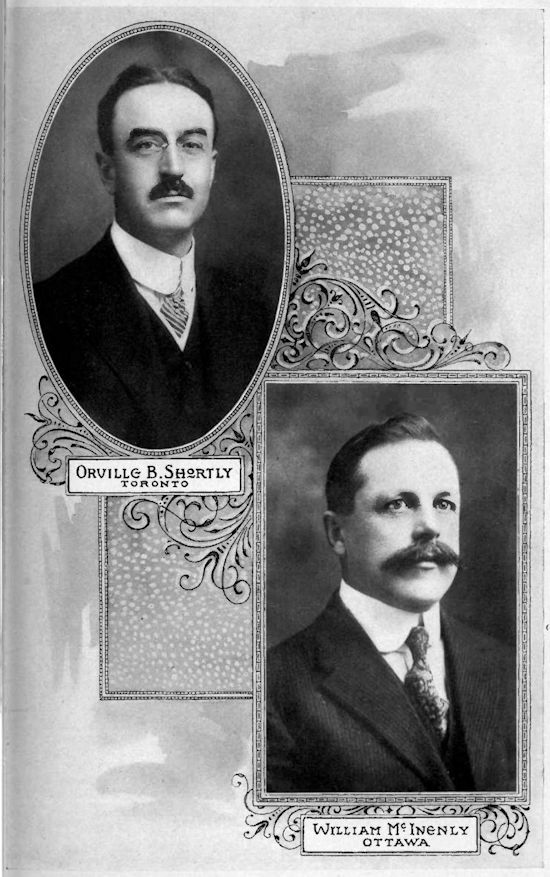
Orville B. Shortly, TORONTO William McInenly, OTTAWA
Nicholls, Lieut.-Colonel The Hon. Frederic (Toronto, Ont.), Dominion Senator; born in England, November 23, 1856. He received his education at Stuttgart, Wurtemburg, Germany, and came to Canada in 1874, where he organized the first electric company—The Toronto Incandescent Electric Light Company—which adopted the first underground system of electric distribution in Canada. Senator Nicholls was elected President of the National Electric Light Association of America in 1896, being the only Canadian to hold that honor, and has since been elected an honorary member. He was for seven years Secretary of the Canadian Manufacturers Association, and founded the “Canadian Manufacturer,” of which he was editor and proprietor until 1893. Senator Nicholls is President and General Manager of the Canadian General Electric Company, Toronto; President and General Manager of the Canadian Allis-Chalmers, Limited; President of the Canadian Sunbeam Lamp Co.; President of the Toronto & Hamilton Railway Company; Vice-President of the Dominion Coal Company; Vice-President of the Dominion Iron & Steel Co.; Vice-President of the Dominion Steel Corporation; Vice-President of the Electrical Development Co. of Ontario; Vice-President of the Sao Paulo Tramway, Light & Power Company; Vice-President of the Toronto & Niagara Power Company; Vice-President of the Toronto Power Company; Vice-President of the Toronto Railway Company; Vice-President of the Toronto & York Radial Railway Company; Director of the British American Assurance Company; of the Canadian Lake & Ocean Navigation Company; of the Confederation Life Association; of the Niagara, St. Catharines & Toronto Railway Company; of the Toronto Electric Light Co.; of the Toronto Hunt, Limited, of the Western Assurance Company, and of The United States Fidelity and Casualty Company. In 1890 Senator Nicholls was President of the Toronto Press Club; in 1893 President of the Athenæum Club; in 1911 F.R.C.L., and in 1914 gazetted Honorary Lieut.-Colonel. He is Consul for Portugal; life member of the Toronto Board of Trade; Honorary Member of the Canadian Press Association; Member of the Executive Committee Canadian Manufacturers Association; and a Justice of the Peace. Appointed to the Senate January 20, 1917, and is Chairman of the Standing Committee on Finance of the Senate. In 1875 he married Florence, daughter of Commander Graburn, who died in 1909. He had two sons on active service: Captain Walter Nicholls, who went overseas with the first contingent, served in France, and after being invalided home was Senior Supply Officer at Shorncliffe, and Lieut. Fred Nicholls, attached to the Horse Transport. Two sons-in-law, Capt. J. E. Proctor and Capt. J. B. Allen, and five nephews also served in the overseas forces. Senator Nicholls’ recreations are hunting, fishing, motoring, yachting and golf. Among his clubs are the Bankers’ Club of America, New York; the York Club, the Toronto Club, Toronto Hunt Club, Albany Club, Engineers Club, Ontario Jockey Club, Rosedale Golf Club, Toronto Golf Club, Scarborough Golf and Country Club, and the Royal Canadian Yacht Club, Toronto, Ont.; the Hamilton Golf and Country Club; Caledon Mountain Trout Club; the Mount Royal Club, Montreal; the Rideau Club, the Country Club, Ottawa; the Manitoba Club, Winnipeg. Since the outbreak of the war he has devoted himself to patriotic work, and is a member of the Executive Committee of the General Council of the Canadian Patriotic Fund; Vice-President and Chairman of the Executive Committee of the Toronto Branch of the Canadian Red Cross Society; and President of the Toronto Municipal Loan Association, a society formed to relieve distress.
Helmer, Brigadier-General Richard Alexis, C.M.G., entered the Canadian Militia in 1883 as a private in the ranks of the 43rd Regiment, D.C.O.R. Eight years later he was made a Lieutenant, and in 1896 was appointed Captain. In 1899, he was promoted to the rank of Major. In 1885, General Helmer graduated as a chemist for the Province of Ontario, and in 1886 for the Province of Quebec. He successfully practised his profession in Hull, Quebec, up to 1904, when he retired therefrom. He was energetic, popular, and progressive, and for twelve years was alderman and twice mayor (1896 and 1900) of the city of Hull. April 27, 1906, be was appointed Deputy Assistant-Adjutant-General for Musketry on the Headquarters Staff, and Assistant Adjutant-General for Musketry, October 1, 1908, which post he held until May 17, 1910, when he was appointed a Lieutenant-Colonel and Assistant-Adjutant-General. On January 1, 1911, he was appointed Director of Musketry, and February 24, 1916, Director-General of Musketry. This latter post he still holds, together with that of Acting-Director of Military Training, to which he was appointed September, 1914, and that of Commandant of the Canadian School of Musketry, to which he was appointed in 1907. General Helmer has for years been prominent in rifle shooting in Canada, and has many fine trophies to prove his skill. In 1899, he was Adjutant of the Canadian Rifle Team at Bisley. In 1903, Adjutant of the Canadian Palma Team at Sea Girt. In 1907, Adjutant of the Canadian Palma Team at Ottawa, and in 1912, Commandant of the Canadian Palma Team at Camp Perry. General Helmer is the eldest son of the late Nathaniel and Melissa (Johnson) Helmer, of Ottawa. He was born in Russell, Ontario, October 12, 1864, and was educated at Ottawa and Toronto, Ontario. He married Elizabeth I. Hannum, of Hull, Quebec. Their only child and son, Lieutenant A. H. Helmer, Canadian Artillery, was killed in action, May 2, 1915. General Helmer is in possession of the Colonial Auxiliary Forces long service medal, and for services rendered in the great war was awarded the C.M.G. in 1918. He is a member of the Laurentian Club, and resides at 122 Gilmour St., Ottawa, Ontario, Canada.
McCurdy, Fleming Blanchard, M.P. (Halifax, N.S.), Financier, began business in the service of the Halifax Banking Company, Truro, N.S., in 1890, which he left in 1901 to embark in financial business under the firm name of F. B. McCurdy & Company, which has seven branch offices at the present time. He is a Past President of the Halifax Board of Trade, was elected to the House of Commons in 1911, and was appointed Parliamentary Secretary of the Department of Militia and Defence, July, 1916. His recreations are fishing, hunting, and motoring. Among his clubs are the Halifax City; Wanderers A.A.C., of which he is an ex-President; Royal Nova Scotia Yacht Squadron; Halifax Golf; Halifax Automobile Association (ex-President); St. James, Montreal; Royal Automobile, London, Eng.; Rideau, Ottawa; and Royal Ottawa Golf Club. Mr. McCurdy was born at Old Barns, County Colchester, N.S., February 17, 1875, the son of James and Amelia J. (Archibald) McCurdy, and was educated in the public schools. In 1902 he married Florence Bridgman Pearson, daughter of the Hon. B. F. Pearson, M.P.P., Halifax, and has two sons. Mr. McCurdy is a Conservative and a Presbyterian.
Langton, Brigadier-General Joseph Graham, Paymaster-General of the Militia Department, Ottawa, is the son of Thomas Langton, a merchant, and Fannie McKim Langton, and was born at Toronto, October 14, 1868, where he received his education in the public schools and the Jarvis Street Collegiate Institute. He has had an extensive military career, and has served continuously in the active militia of Canada since 1886. He joined the Queen’s Own Rifles in May, 1886, and served continuously until December, 1896. He served for two and a half years as regimental drill instructor, and in 1895 organized the Queen’s Own Rifle Cyclist section. In 1897, he received a commission as Lieutenant in the 20th Lorne Rifles, was promoted as Captain in 1898, and held appointment as Adjutant until 1903. He was selected by Militia Headquarters to organize No. 2 Company Canadian Army Service Corps, and in 1903 at Niagara Camp commanded the first Army Service Corps unit to go under canvas in Canada. In June, 1905, he was appointed Senior Army Service Corps Officer, Western Ontario Command, on the Staff of Brigadier-General W. D. Otter, C.B., and held that appointment until June, 1911, when the tenure of appointment expired. In 1898, he instituted the first regimental system of messing at the Canadian Militia Training Camps at Niagara Camp. At the Tercentenary Celebration at Quebec, July, 1908, he was appointed as Deputy-Assistant-Quarter-Master-General, and had charge of the railway transportation of troops. A field order issued by the late Lord Roberts conveyed the congratulations of the present King, then the Prince of Wales, to the late Sir Frederick Borden on the success of the transport arrangements. General Langton instituted the first use of mechanical transport by the Canadian Militia at the Fall manœuvres at Toronto in October, 1910. He was appointed railway transport officer for mobilization of the first Canadian contingent at Valcartier in August, 1914, and in co-operation with Sir William Price had charge of the embarkation of the first contingent at Quebec in September of the same year. In December, 1915, he was appointed Inspector of Supplies and Transport for the Second Divisional Area, and by Order-in-Council, February, 1916, he was attached to the Staff of the Inspector-General and appointed as Chief Supply Inspector for Eastern Canada. In the following June he was appointed as Deputy Inspector-General. February 8, 1918, he was appointed as Paymaster-General and as a member of the Militia Council. As Deputy Inspector-General, General Langton had supervision over receipts, supplies, stores, clothing, accounting, regimental funds, mess accounts, and canteen funds. In the matter of canteens, General Langton is recognized as the leading authority in Canada on their administration. The booklet of rules for the management of canteens, regimental funds, etc., issued by the Militia Department as a text-book for the troops, was prepared by him. The branch under his administration effected a saving during the war of over one million dollars without depriving the troops of anything to which they were entitled. In his capacity as Paymaster-General he has entire charge of the finances—separations allowance and assigned pay branch of the Militia Department, etc. General Langton is Vice-President of the Military Service Department of the Young Men’s Christian Association. This department was first attached to the Canadian Military Camps at Valcartier in August, 1914, by General Sir Sam Hughes on the recommendation of General Langton. In recognition of his services General Langton has been recommended for distinguished services in Canada. Until he entered upon his duties as Deputy Inspector-General, General Langton has been engaged in banking and other financial pursuits. General Joseph Graham Langton, on Oct. 7, 1891, married Margaret J., daughter of John Pearey, contractor, of Toronto. Five children have blessed the union: Percy (deceased), Ernest Pearey (deceased), Olive V., Joseph McKim, and Florence Margaret. General Langton is a member of the Rideau Club (Ottawa) and of the Canadian Military Institute (Toronto), Ashlar Lodge A.F. & A.M., No. 249, and St. Paul’s Royal Arch Chapter, No. 65, Toronto. His recreations are curling and lawn bowling. In religion an Anglican. His address is Militia Department, Ottawa, Ontario, Can.
Graham, Hon. George Perry (Brockville, Ont.), is one of the leading public men of Canada, and a former cabinet minister. He was born on March 31, 1859, at Eganville, Ont., and is of Irish descent. He was educated at Iroquois and Morrisburg High Schools in the St. Lawrence Valley. He early became identified with journalism, and as editor and manager of the Brockville “Recorder,” made it one of the best known provincial papers in the Dominion. An earlier newspaper enterprise of his was the Morrisburg “Herald,” which he successfully conducted for eleven years; and he was for a short time associate editor of the Ottawa “Free Press.” As a young man, Mr. Graham became identified with the organization of the Liberal party in his district, and was in great demand as a platform speaker. Entry into public life was a logical outcome of his career as a moulder of public opinion. During his residence in Morrisburg, Ont., he was Reeve of the village and a member of the County Council, and in 1894 the Liberals nominated him for the riding of Dundas against no less an opponent than J. P. Whitney, afterwards Prime Minister of Ontario. At the general elections for the Legislature in 1898 he was Liberal candidate for Brockville, and was more successful, securing election by a substantial majority. He at once achieved a prominent position in the Legislature owing to his wit and skill as a debater. Those were the days when Mr. Whitney was making his long and ultimately successful fight for the overthrow of the Ross Government, and the former contestants in the riding of Dundas frequently crossed swords in debate. At the Legislative elections in 1902, Mr. Graham was re-elected for Brockville, though his party suffered heavy losses elsewhere, and on November 25, 1904, on the resignation of the late Hon. J. R. Stratton from the post of Provincial Secretary, he was called to the cabinet as his successor. At the general elections of the ensuing winter he was again returned for Brockville, but the Ross Government, of which he was a member, was defeated. On January 25, 1907, the Liberal caucus elected him leader of His Majesty’s loyal opposition, but he served in that capacity for only one session of the Legislature. In August of 1907, Sir Wilfrid Laurier induced him to abandon the provincial field, and offered him the portfolio of Railways and Canals in the Federal cabinet. He was sworn in as a member of the Privy Council on August 29, and on September 18, 1907, was elected by acclamation to the House of Commons for the Federal riding of Brockville. He continued as Minister of Railways for four years, and took an active part in the organization of his party in Ontario. In September, 1911, the Laurier administration was defeated at the polls. Mr. Graham was elected in a by-election in South Renfrew, and for the next six years continued to sit in opposition as the desk-mate of Sir Wilfrid Laurier. He did not seek re-election at the general elections of 1917, but has retained active connection with the Liberal party, and in many quarters his name was urged as the fitting successor of Sir Wilfrid Laurier in the party leadership. In addition to his journalistic and political activities, Mr. Graham is widely known in connection with fraternal insurance organizations. He was Grand Master of the Ancient Order of United Workmen for two years, and for a considerable period a member of the Finance Committee of that body. He is President of the Travellers’ Life Assurance Company of Canada, a Director of the Canada Foundries and Forging Company, Vice-President of Delaney Forge Company, and President of the “Recorder” Printing Company. In religion he is a Methodist. In 1882, he married Carrie, a daughter of Nelson Southworth, Morrisburg, Ont., and had two sons, Captain Perry M., who died some years ago, and Captain W. N., who was killed in the Great War.
Leonard, Lieutenant-Colonel Reuben Wells, Corps of Guides (St. Catharines, Ont.). Born at Brantford, Ont., February 21, 1860, son of the late Francis Henry Leonard (one time Reeve of the town of Brantford and Warden of the County of Brant) and Elizabeth, daughter of the late Captain Richard Catton. He was educated at the Brantford Collegiate Institute and Royal Military College of Canada, Kingston, from which latter he graduated in 1883, winning the Silver Medal. Lieutenant-Colonel Leonard has had a wide experience in several branches of his chosen profession of engineering, having occupied positions of increasing importance in railroad, hydro-electric, and mining development. After completing his education in 1883, he took service with the Canadian Pacific Railway as instrumentman on surveys and resident engineer on construction of the Lake Superior Division. At the outbreak of the North-West Rebellion in 1885 he was appointed Staff Officer of Transport, and served in other capacities during the uprising. After the Rebellion he re-entered the service of the Canadian Pacific as engineer of surveys and construction in Manitoba and Ontario. From 1886 until 1890, he was chief engineer of the Cumberland Railway and Coal Co., in Nova Scotia. 1890-1891 he was again with the Canadian Pacific Railway on surveys of important branch lines in Ontario, Quebec, and British Columbia. In 1891-92 he was engaged in railway contracting. In 1892-93 he was in charge of the construction of the first hydro-electric development at Niagara Falls, Ont., for the Park and River Railway Co. In 1893-94 he was engineer-in-charge of railway surveys for the Canadian Pacific Railway. From 1895 until 1899 he was chief engineer and manager of construction of the St. Lawrence and Adirondack Railway, and of the Montreal and Ottawa Short Line (C.P.R.) respectively, and consulting engineer for the Canadian Rutland Railway. His next step was again in the field of mining engineering, being engaged as engineer with the Lake Superior Corporation in developing their iron and nickel mines in the Sudbury and Michipicoten districts. In 1900, he returned to railroading as chief engineer and manager of construction of the Cape Breton Railway. From 1902 to 1904, he was engineer in charge of the construction of a hydro-electric plant at DeCew Falls, near St. Catharines, for the Hamilton Cataract Power Co., and in 1905-06 he was engaged in similar work at Kakabeka Falls, near Fort William, for the Kaministiquia Power Co. In 1905, when silver was first discovered in Northern Ontario, Colonel Leonard was one of the first prospectors in the Cobalt district and staked the Buffalo mine, and in the following year he acquired a controlling interest in the Coniagas mine, and promoted the Coniagas Mines, Ltd., of which he is President. This mine has been one of the largest and most consistent producers of silver ore in the rich Cobalt district, and during its ten years of operation has produced 25,000,000 ounces of silver, and is still one of the few silver-producing mines of Canada. In 1908 a subsidiary company—the Coniagas Reduction Co., Ltd., was formed primarily for the purpose of treating ore from the Coniagas mine, but a large custom trade has also been developed in the smelting and reduction of cobalt ores for the production of silver and lesser products. In 1911, Lieutenant-Colonel Leonard was selected by the Dominion Government for the position of Chairman of the National Transcontinental Railway Commission at Ottawa, with jurisdiction over the construction of the Government Railway from Moncton, N.B., to Winnipeg. This position he occupied, at much personal sacrifice, until the practical completion of the railway in 1914. Next to the mining industry, Colonel Leonard’s principal interest would appear to lie in the direction of the steel business, as his name appears on the directorate of several industries engaged in the manufacture of steel and steel products. He has recently promoted the organization of a new steel company, under the name of Electric Steel and Engineering Ltd., which is an amalgamation of several engineering enterprises in which he is interested, and whose different lines of manufacture he found could be co-ordinated to advantage. He is also a Director of the Toronto General Trusts Corporation. It may be said here that he is one of those men of business who are not content to be Directors in name only, but who believe in the principle that a Director should take a part in the actual direction of the enterprises with which he permits his name to become identified, and in conformity with this rule he has consistently declined to accept office as Director of commercial enterprises when he felt he was not in a position to give the necessary time and attention to the affairs of the business. Colonel Leonard has always taken a keen interest in the welfare and advancement of the engineering profession, and is an active member and past vice-president of the Canadian Society of Civil Engineers and the Canadian Mining Institute; President Engineering Institute of Canada, 1919-20. He has always been the friend of the young engineer, and ever ready to lend a hand in helping him along the road to success. He is also a past corresponding member of the Council of the Institute of Mining and Metallurgy, London, England, and a member of the American Institute of Mining Engineers. Member Institution of Civil Engineers, London, England. In spite of his many business activities, he finds time to devote to educational interests, and is a close student of all questions involving the well-being and good government of the State. He is a true Imperialist and advocate of closer unity between the component parts of the Empire; and any movement which promises to assist in attaining this end has his moral and financial support. He is a member of the Board of Governors of the University of Toronto; the Kingston School of Mining; Wycliffe College, Toronto; and Ridley College, St. Catharines, Ont. He has recently established scholarships under “The Leonard Foundation” in several of these Institutions to assist in the education and support of sons of clergymen, school teachers and officers and men of the Canadian and Imperial army and navy who require assistance in order to complete their education. His other benefactions are widely distributed and unheralded, and it is safe to say that few appeals on behalf of deserving objects are made to him in vain. A characteristic which strikes one forcibly is his ability to quickly analyse and grasp the essentials of things, and this faculty enables him to get through a large amount of work in a limited time, and also to readily appreciate the merits or demerits of things, whether in business, politics or the various public movements with which he may be asked to become identified. Since the outbreak of war, he has given much of his time and means to patriotic movements and other work tending to promote Canada’s whole-hearted participation in the war. Lieutenant-Colonel Leonard is in command of No. 2 Detachment, Corps of Guides. He is a member of the Mount Royal Club, Montreal; Rideau and Country Clubs, Ottawa; National Club and the Engineers’ Club, Toronto, and the Tourilli Fish and Game Club, Quebec. He is an ardent advocate of all outdoor sports, especially in the woods. He is an independent in politics, and in religion an Anglican. Married in 1889 to Kate Rowlands, daughter of the late John Rowlands, of Kingston, Ont.
Hare, Rev. John James, M.A., Ph.D., Principal Emeritus of Ontario Ladies’ College (Whitby, Ont.), is one of the most distinguished of Canadian educationists. He was born in Nepean township, Ontario, on October 3, 1847, the son of Robert and Barbara (Shillington) Hare. His early education was received in the public school of his district, and later he entered Victoria University, at that time situated at Cobourg, Ont., with a view to entering the Methodist ministry. He graduated in 1873 with the degree of B.A., winning first prizes in metaphysics, Hebrew, Scripture and debating, also a scholarship for highest standing in his sophomore year. In 1876, he qualified for the M.A. degree of his alma mater, and subsequently was awarded the degree of Ph.D. by the Illinois Wesleyan University. Incidentally he had served as a public school teacher for two years, and was ordained for the ministry in 1873. For one year he served as a pastor at London, Ont., but in 1874 was appointed principal of the Ontario Ladies’ College at Whitby, Ont., an institution founded for the education of Methodist young women, but by no means exclusively denominational. That position Dr. Hare held continuously for forty-one years. In 1915 he resigned, and was appointed principal emeritus. In 1879 he became governor as well as principal. In the conduct of the institution he has shown rare executive ability, and to this asset, combined with his indefatigable energy and spirit of devotion to the interests of his pupils, the great success of the college is attributable. During his regime, the institution was four times enlarged by the addition of Ryerson Hall, private residence with connecting passage, Frances Hall, gymnasium, swimming pool and hospital to provide against an outbreak of a contagious disease. By a vast number of Canadian women, some of whom are now in middle age, the name of Dr. Hare is held in honor and veneration. His educational attainments were some years ago recognized by his selection as examiner in geology by the University of Toronto. In September, 1874, he married Katherine Isabella, daughter of the late Rev. D. C. McDowell, a well-known Methodist divine, and has one son. Mrs. Hare was for some years lady principal of the college, and discharged the duties of her position with efficiency. His recreations are riding, driving and tennis; and in politics he is an independent. His permanent address is 164 Bird Ave., Miami, Florida.
Morin, Pierre Alphonse (St. John’s, Quebec), Prothonotary Superior Court, was born in St. François, Montmagny, 1st August, 1855, and educated at Montreal College and McGill University, graduating with the degree of B.C.L. He is the son of Louis Edouard Morin and Catherine des Trois Maisons, and married Rachel, daughter of the late Senator J. O. Villeneuve, ex-Mayor of Montreal, by whom he has eight children, Paul, Josephine, Louise, Suzanne, Villeneuve, Lucie, Madeleine and André. After practising as an Advocate for some time Mr. Morin became editor and proprietor of “Le Canada Français,” a Liberal paper which is still in existence, and with which he retained his connection until receiving his present appointments as Prothonotary of the Superior Court of Iberville, and Clerk of the Crown and of the Peace, and of the Circuit Court of the District of Iberville, Com. per dedimus potestatem and Commr. in Extradition. He is a Past Grand Knight of Columbus, a Roman Catholic in religion and a Liberal in politics.
Ashton, Major-General Ernest, M.D., C.M.G., is one of those Canadian soldiers who won high rank and distinction during the great war, but was originally a physician by profession. He was born at Brantford, Ont., on October 28, 1875, the son of Rev. Robert and Alice Mary Ashton. His father was formerly Principal of the Mohawk Institute, Brantford, and incumbent of His Majesty’s Chapel of Mohawks. He was educated for the calling of a physician at Trinity Medical School, and graduated in 1898 with the following degrees and honours: F.I.M.C., M.D., C.M. of Trinity University, and was medallist of both Trinity Medical School and Trinity University. On graduation he became house surgeon of the Hospital for Sick Children, Toronto, holding that position for one year, after which he was appointed superintendent of the Muskoka Cottage Sanitarium, near Gravenhurst, Ont., remaining there for two years. In 1901 he returned to Brantford, Ont., and built up a large general practice. He also entered municipal politics and served as alderman and as a member of the Board of Education. He was one of the Board of Governors of Brantford General Hospital and the Brantford Sanitarium. The volunteer militia likewise claimed much of his energy and enthusiasm, and he holds a first class school of infantry certificate. When but eighteen years of age he joined the Dufferin Rifles of Brantford as second lieutenant, and was gazetted on January 20, 1893. He became a full lieutenant in September of that year; Captain on August 7, 1896; Major, December 29, 1902; and Lieutenant-Colonel on January 8, 1907, being at that time one of the youngest militia commanders in Canada. On completing his five years’ tenure on January 7, 1912, he gave up his command, and was transferred to the Reserve of Officers of the Canadian Militia. The following year he was returned to the active list on the organization of the 13th Brigade, Canadian Field Artillery, and raised and on July 1, 1913, assumed command of the 32nd Howitzer Battery, C.F.A., with the rank of Lieutenant-Colonel. On the outbreak of the great war in the following year he at once offered his services, and on January 2, 1915, was appointed to raise and organize the 36th Battalion, C.E.F., and within six months had so effectively performed his task that he was able to proceed overseas with his battalion on June 19, 1915. On arrival in England, the organization was broken up and sent to France as re-inforcements for other battalions; and its commanding officer was appointed Brigadier of the 9th Reserve Infantry Brigade, and promoted to the rank of Colonel. On November 7, 1916, he was appointed O.C. of the Canadian Training Division, and about the same time acted as one of the Board headed by Surgeon-General Sir William Baptie to investigate the charges preferred by Colonel Herbert A. Bruce against the organization of the Canadian Army Medical Corps. On March 16, 1917, he became temporary Brigadier-General and on April 2 of that year was appointed General Officer Commanding of the 15th Canadian Infantry Brigade. His valuable services were the subject of official mention on February 24, 1917 and August 7, 1917. In the autumn of that year he was recalled to Canada, and on January 1, 1918 appointed Acting-Adjutant-General and Major-General. At the same time he received the honour of C.M.G. from His Majesty the King. On June 8, 1905, General Ashton was married to Helen Margaret, daughter of Oswald Weir, banker, of the Bank of North America, Brantford, Ont.; he has one child, Amy Corcaire Ashton. He is an Anglican in religion, and in politics a man of strongly Imperialistic leanings. He is a member of the Rideau Club, Ottawa, and the Ottawa Golf Club.
Duff, Hon. Lyman Poore, is one of the Justices of the Supreme Court of Canada, and one of the mostly widely-known of Canadian jurists. He was born at Meaford, Ontario, on January 7, 1865, the son of Rev. Charles and Isabel (Johnstone) Duff. He was educated in the public and high schools of the province and at the University of Toronto, from which he graduated with the degree of B.A. in 1887 and first class honors in mathematics and metaphysics. He also took up the study of law at Osgoode Hall, Toronto, and received the degree of LL.B. at Toronto University in 1889. For a time he was teacher of mathematics at Barrie Collegiate Institute, but was called to the Bar of Ontario in 1893, and in the same year to that of British Columbia in 1895. He first practised in Fergus, Wellington County, Ont., for two years, and in 1895 removed to Victoria, B.C., where he built up a large and important practice. He was created a King’s Counsel in 1901, and in that year represented the province of British Columbia in the famous Deadman’s Island case. In 1903, he was one of the counsel in the enquiry into the Columbian and Western land subsidies, a matter which attracted a great deal of attention on the Pacific Coast at that time. In 1903, he had the honor of being associated as counsel with the late Hon. Edward Blake, K.C., and the late Christopher Robinson, K.C., in representing the Dominion of Canada before the joint high commission on the Alaskan Boundary dispute, which sat in London, England. He received appointment as Puisne Judge of the Supreme Court of Canada in 1904, and in 1906 was elevated to his present position as one of the Justices of the Supreme Court at Ottawa. In that capacity he had made important decisions on questions of the highest moment, and in 1918 was appointed as supreme authority in connection with appeals against the operation of the Military Service Act. He is a man of strong and striking personality as well as of the highest judicial attainments, and in many quarters it has been suggested that he leave the bench to enter political life, which, however, holds out no attraction for him. When in private practice he was a Liberal, and for a time held the position of President of the Victoria Liberal Club. He is a member of the Rideau Club, Ottawa, Ottawa Country Club, Union Club, Victoria, B.C., Vancouver Club. In July, 1898, he married Elizabeth Eleanor, daughter of Henry Bird, Barrie, Ont, and resides on Goulborn Ave., Ottawa.
Hurdman, George Charles, M.P.P., is a prominent lumberman of Ottawa, and one of the representatives of that city in the Ontario legislature. He was born in Ottawa on September 23, 1870, the son of George and Agnes C. (Fraser) Hurdman. On both sides he is of United Empire Loyalist stock, and is of Irish and Scottish descent. He was educated at the public and Model schools of his native city, and as a lad of nineteen became connected with the wholesale lumber industry, with which he has ever since been identified. He first entered the service of Beull, Orr, Hurdman & Co., with which he was connected for five years; after which he was associated with the lumber firm of Shepherd and Morse, Boston, Massachusetts, for another five years. In 1899 he established the Hurdman Lumber Company, Limited, of which he is the head. He has offices in Canada Life Building, Ottawa, and conducts an extensive wholesale business. He is also Secretary-Treasurer of the Canada Quarries and Construction Co. of Ottawa. From earlier manhood, Mr. Hurdman has taken a strong interest in public affairs, and was for several years an active officer of the executive of the Liberal party in Ottawa. At the general elections for the Ontario Legislature in June, 1914, he was the candidate of his party for the riding of Ottawa West, and succeeded in defeating his opponent, ex-Mayor Ellis, a strong candidate, by a safe majority. As a member of the opposition he has proved most useful, his counsel being especially valued in committee work, and in the party caucus. He has also taken an active interest in military affairs, and as a young man served with the 43rd Regiment, Ottawa, and Carleton Rifles. When the war broke out in 1914, he decided to resume military service, and qualified as an officer in the Princess Louise Dragoon Guards, which sent many recruits to the front. He is a Methodist in religion, and a charter member of the Laurentian Club, Ottawa, and his chief recreation is horsemanship. On June 21, 1899, he married Katherine, daughter of Thomas J. Lynton, Ottawa, and has three sons, George Charles, Thomas Lynton, and Herbert Russell Hurdman. He resides at 412 Daly Ave., Ottawa.
Bates, Thomas Nathaniel, is one of the leading business men of Ottawa, and holds the position of Vice-President and Manager of the International Land & Lumber Company, of 285 Bank Street, in that city. He is also Vice-President of the British Canadian Industrial Company, Limited. He was born at L’Orignal, Ontario, in 1881, and is a son of Joseph Lever Bates. He was educated at the public and high schools of Hawkesbury, Ont., and as a lad of nineteen went into the insurance business as an agent for the New York Life Insurance Company at Ottawa. He proved one of the most successful writers of policies that this country has produced, and in 1904 made the Canadian record for his company by obtaining one hundred and seven applications for insurance in the space of thirty-five days. He was appointed Superintendent of Agencies for the company, and continued in that position until 1907. In that year the International Land and Lumber Company and the British Canadian Industrial Company were organized, and he was connected with them from their inception. Under his energetic and enterprising direction, they have developed a large and substantial business. In politics Mr. Bates is a Conservative, and in religion a Methodist. He is a member of the Laurentian Club; the Britannia Boat Club and the Canadian Club, Ottawa. On September 21, 1909, he married Maud, daughter of Thomas Askwith, Ottawa, and has two sons. Mr. and Mrs. Bates reside at 248 O’Connor Street in the capital.
Rose, George Maclean, President and Manager of the Hunter-Rose Company, Limited, Toronto, comes of a family which has been identified with the printing and publishing industry in Canada since the pre-Confederation era. He was born at the city of Quebec on October 30, 1865, the son of the late George Maclean Rose and his wife, Margaret Levack Manson, both natives of Caithness, Scotland. Sir Oliver Mowat, the famous Liberal statesman, who was for nearly a quarter of a century Prime Minister of Ontario, and held other very important public offices, was a cousin of the late Mrs. Rose. The subject of this sketch was educated at the Model School and the Wellesley School, Toronto, and later took a course at the Ontario Agricultural College, Guelph, with a view to embarking in a career of scientific agriculture, a project subsequently abandoned. He began his business career with the Williams, Greene & Rome Company, Ltd., manufacturers of men’s wear at Kitchener (then Berlin), Ont., and became secretary and a director of the company. Severing connection with the enterprise, he went to New York, and was engaged in business there for ten years, returning to Canada in 1902 to join the Hunter-Rose Company, established many years previously by his father. He acted as secretary of the company for two years, and in 1904 became President and Manager, the position he holds to-day. The Hunter-Rose Company is one of the historic commercial concerns of Canada. Its founder, the late George Maclean Rose, was a native of Wick, Caithness, who, as a young man in Scotland acquired complete familiarity with every phase of the printing and publishing business. In the middle fifties he came to Canada, and settled in Montreal, but in 1857 went to London, Ont., and in company with the late Hamilton Hunter established the printing firm of Hunter & Rose. This partnership was, however, short-lived, and in 1859, Mr. Rose joined forces with the late Samuel Thompson, of Toronto, who had received the contract to execute the printing for the parliament of Canada. This necessitated removal to Quebec, at that time capital of Canada. It shortly became necessary for Mr. Thompson to retire from business, and to carry on the work of government printing Mr. Rose formed the firm of Hunter-Rose & Company, in the ancient capital, taking into partnership Robert Hunter, a practical accountant. The completion of the parliament buildings at Ottawa in 1865 and the establishment of the government there, necessitated removal to that city, which remained the headquarters of the firm for several years. Confederation, in the meantime, having become an established fact, Hon. John Sandfield Macdonald, the first Premier of Ontario, induced Mr. Rose to establish a branch in Toronto, to take charge of the provincial printing. In 1871, Mr. Rose came to Toronto to reside permanently, and since that time the name Hunter-Rose & Company has been identified with the commercial life of Toronto. In 1877, Mr. Robert Hunter died, and Mr. Rose became sole proprietor. The firm was incorporated under its present name in 1895. Government printing ceased to be the staple of its business many years ago, and book publishing became a very important part of its activities. From its plant have been issued many reprints of the leading authors of the past and present century. Incidentally, it may be mentioned that the first volume of “Representative Canadians,” edited by the late George Maclean Rose, was published in 1886. The present head of the company, who has carried on the historic traditions of the firm, is a member of the Canadian Manufacturers Association and of the Toronto Board of Trade. As a young man, he took a deep interest in military matters, and was a Lieutenant in the 48th Highlanders of Toronto, when that regiment was first established. He was also a lacrosse enthusiast, and played with the old Ontarios of Toronto and the Crescents of Brooklyn, N.Y. His present recreation is golf, and he is a member of the Ontario Club, the Simcoe Club, the Lakeview Golf Club, and the Ontario Jockey Club. In religion he is a Unitarian, and in politics independent.
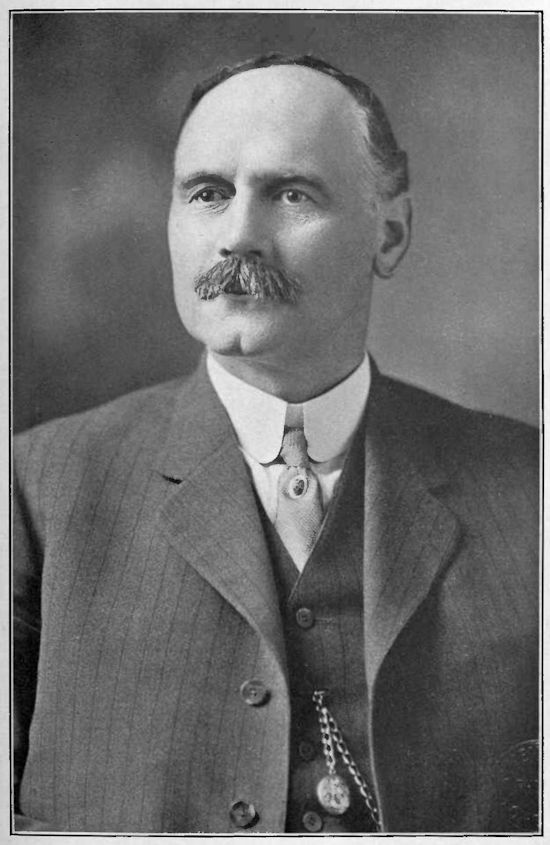
CHARLES M. BOWMAN Southampton
Blair, Lieutenant James K. (Ottawa, Ont.), who was killed in action at the Somme October 2, 1916, was born September 11, 1890, at Truro, Nova Scotia, the only son of Lieutenant-Colonel H. C. Blair, Inspector of Customs, Ottawa, and Grace Ewart Blair. He received his education in the common schools of Truro, and was a commercial traveller when he enlisted at Saskatoon as a private on the outbreak of the war. He was married early in 1916 to Dulcie, daughter of Captain Brooks of the Indian Army, and Mrs. Brooks, and is survived by one son, James K. Blair, whom he never saw. After enlisting, he trained with the 28th Battalion in Winnipeg, and on receiving a commission in February, 1915, joined the 46th Battalion at Moose Jaw, and left for England with a draft from the battalion in July, 1915. He qualified at Hythe as a musketry instructor, and was attached in that capacity to the 32nd Reserve Battalion, where he served for one year. He went to France on August 2, 1916, where he joined the 2nd Canadian Entrenching Battalion, and then went to his old battalion the 28th. The following extract from a letter written by the Commanding officer of the 28th is a tribute to Lieutenant Blair’s military abilities:—“Poor Jimmie Blair never had a chance to do more than show he had the grit to stick the worst the Boche could do. He joined us when we were on our way south, and fitted easily into the very happy family our mess then was. He did what he had to do well, and gave entire satisfaction. As our Battalion was then in a high state of efficiency, that is a good recommendation to any officer. In the big attack of September 15, we only took in half our officers, and Lieutenant Blair was left out, so he did not get the chance which two of the officers of his company got, and which resulted in the award to them of the M.C. We went in again on September 24-25, and Blair’s platoon was in the centre, and was subjected to very severe shelling during all of which he carried himself coolly and bravely, and came through in good shape. After a couple of days back we went in again on another sector to hold. Blair’s company was in Kenora trench, just where it joins Regina trench, of which so much has been said in the papers. This was really a communication trench, but had to be held on account of the command it gave us for future operations. It was, however, badly enfiladed, and we had practically all our casualties there. The battalion we relieved had just captured it, and it was subjected to a good deal of shell fire, and it was during one of these poor Blair was killed by a small shell which landed in the bay in which he was posted. I gave orders that his body be brought out for burial, but a heavy rain and resulting mud, together with the exhausted condition of our men, made this impossible. He was, therefore, given a soldier’s grave near where he fell, and on ground which should be considered sacred to Canadians, as many of our officers and men had fallen, and have fallen since, before Regina trench was finally captured. He died, therefore, as so many have, just ”holding the line,“ nothing spectacular; just a matter of duty well and bravely done under very trying circumstances. He gave promise of doing well, but he was not given the opportunity which the real attack gives. His people, however, will have the satisfaction of knowing that he did his duty well, bore himself bravely in the face of fire, and died like a soldier.” Another officer friend. Captain Quinan, writes:—“I well remember Jim when he left England for France, as full of spirits as old Allan Richardson before him, who, too, has been killed. Jim was full of life, and only asked for a chance to help to avenge his chum. He will, I assure you, always remain in my memory as ‘Jim,’ a very fine and gallant gentleman.” He was a Presbyterian and a Liberal Conservative. Lieutenant Blair was very proud of the Canadians, and in a letter to his parents, said;—“The Canadians have no black marks against them, and do not intend to have.” He had a high reputation both as an instructor and as a soldier. One of Lieutenant Blair’s ancestors, Captain William Blair, fought at the siege of Louisburg in 1745, and his father joined the militia.
Bell, Clarence A. H. (Toronto, Ont.), Clerk in Chambers, Supreme Court of Ontario, Osgoode Hall, son of Alexander Bell, M.D., whose father, James B. Bell, was for many years Registrar of the County of Lanark at Perth. Born at Oshawa, May 3, 1869, removing shortly thereafter to Lakefield, Co. Peterborough. Educated at Lakefield public school and Peterborough Collegiate Institute. He married Louise Ella, daughter of the late John Brown, of Lloydtown, June 24, 1893, and has two children, Sybil Irene and Arthur Armstrong (formerly a signaller in France). He entered the Department of Attorney-General under the late Sir Oliver Mowat, May, 1887, and was transferred to the Central Office, Osgoode Hall, 1896, receiving the appointment of Clerk in Chambers, June, 1917. Mr. Bell is an active member of many fraternal societies, being P.C., Knights of Pythias; High Chief Ranger, Independent Order of Foresters; representative on several occasions at the National Fraternal Congress of America; member of Ionic Lodge, A.F. & A.M. and St. Patrick’s Chapter; member Royal Arcanum; Chosen Friends; L.O.L. and Preceptory, R.B.K. For many years he has been active in church work (Anglican Church), being a member of the Executive Committee, Diocese of Toronto; Dominion President for several years of Anglican Young People’s Association; Secretary of Diocesan Lay Readers’ Association; President many years of Progressive Bible Class—at one time one of the largest Bible classes in Canada. He is publisher of the “Circuit Guide,” a compendium issued half-yearly for the use of judges and lawyers. To the average man, the above-mentioned associations would appear almost sufficient to occupy his spare time; but not so with Mr. Bell, whose activity seems almost infinite, for he is an enthusiastic student of astronomy and the history of ancient Egypt, upon both of which subjects he has given frequent lectures. But the safety-valve of his unusually active life is probably to be found in the even balance he maintains between mental, social, and religious pursuits on the one hand, and an ardent—always ardent and active in everything—love of wild animals, wild birds, wild flowers, camping, woodmanship and canoeing, at which he is an expert. All his available holidays are spent near nature’s heart at his summer house in the northern part of Peterborough County where he breathes in ozone, puts on tan, relaxes and strengthens his muscles, and augments his optimism in preparation for the following season of busy city life. His city residence is 563 Gladstone Avenue.
Brossoit, Numa Edouard, K.C. (Valleyfield, P.Q.), son of Thomas Brossoit, K.C., Advocate, and Rose Anne Sabourin, daughter of late Dr. Moise Sabourin of Beauharnois, P.Q. He is brother-in-law of Hon. Justice Wilfred Mercier; G. A. Marsan, K.C., Advocate; Ludger Codebecq, K.C., Advocate, and Dr. Charles Ovide Ostiguy. Was born at Melocheville on the 23rd of August 1875. Educated at the Seminaire de St. Hyacinthe and McGill University, Montreal, from which latter institution he graduated in June, 1897, with the degree of Bachelor of Civil Law. Married to Hectorine Mailloux, daughter of late Ovide Mailloux, Architect of the City of Montreal, on the 26th day of September, 1899. His wife died on the 31st day of October, 1915. Mr. Brossoit is the father of the following children: Laurette, Hermance, Irma, Pauline Eliane and Marcelle. He belongs to the Knights of Columbus Council 1180, 4th Degree Member; Catholic Order of Foresters; Canadian Order of Foresters; Alliance Nationale; Artisans; Union St. Pierre, and Union St. Joseph. He is Vice-Provincial Chief Ranger of the Provincial Court of Quebec of the Catholic Order of Foresters. He is one of the promoters—and is Vice-President—of the society, “The Fonds de Secours des Foresters Catholiques de la Province de Quebec,” organized on the 17th day of January, 1917 and duly incorporated on September 19, 1918. He is a Roman Catholic in religion and a Liberal in politics. He practised his profession with his father, the late Thomas Brossoit, K.C., from 1897 to June, 1905, and since the death of his father in that year he has practised alone. He has a large practice and is an advocate. King’s Counsel April, 1914. For many years he was one of the editors of “La Revue de Jurisprudence” and is a contributor to “Le Progres de Valleyfield.” Was Crown Attorney for the District of Beauharnois in 1907; Revisor of Electoral List for the city of Valleyfield since 1915 and Recorder of the City of Valleyfield since June 28th, 1909. His principal recreations are motoring, yachting, hunting and fishing.
Petrie, Harry David, is one of the leading barristers and financiers of Hamilton, Ont. He was born at Oakville, Ont., in 1869, the son of Adam and Margaret (Paterson) Petrie. He was educated at the Simcoe (Ont.) High School and the Ontario Law School, Toronto. He read law with C. E. Barber of Simcoe in 1888, and was called to the Ontario Bar in 1893. In 1898 he formed a legal partnership with Lieut.-Colonel Atkinson, M.P.P., at Simcoe, which continued until 1902, when he removed to Toronto, and for two years practised as partner of the late Hon. S. C. Biggs, K.C. Since 1904 he has practised in Hamilton, and has offices at 28 James Street. During his residence in Simcoe, he was a town councillor from 1900 to 1902, but has not since been a candidate for public office. His commercial and financial interests in the Hamilton district are very wide. He is Vice-President of the Ontario Yarn Company, Ltd., and also very extensively interested in real estate. He is director of the following realty companies:—Graham Land Company, Ltd.; the Oakwood Realty Company, Ltd.; the Oakley Heights Realty Company, Ltd.; Bronte Heights, Ltd.; Beechwood and Company, Ltd.; Roxboro Gardens, Ltd.; Lawrence Park, Hamilton, Ltd.; and several other land and building companies. He is a member of the Royal Arch Masons, and of the following clubs:—Commercial, Fernleigh Bowling and Athletic; Canadian (Hamilton), and Country (Burlington). In politics he is a Liberal, and in religion a Presbyterian. In 1896 he married Laura, daughter of the late Jonathan Ellis, Port Dover, Ont., and resides at 322 Queen Street, Hamilton.
Bowman, Charles Martin, M.P.P. (Southampton, Bruce County, Ont.), is one of the veteran members of the Ontario Legislature. He was born at St. Jacobs, Waterloo County, Ont., the son of Isaac Bowman, M.P. and his wife, Lydia Erb, on May 7, 1863. He is of Swiss descent, and his father represented North Waterloo in the House of Commons for several years. He was educated at the public school, St. Jacobs and at the High School, Berlin (now Kitchener), Ont. In 1880 he removed to Southampton, Ont., and engaged in the tanning business under the firm name of Bowman & Zinkan, in which he continued until 1900. From 1880 until 1890 he was also President of the Southampton Lumber Company, Limited, operating on the Bruce peninsula. He was engaged in the contracting business for twelve years, and from 1904 to 1910 was President of the Great Lakes Dredging Company, Limited, of Port Arthur, during which he carried out in the harbour of Fort William the largest contract for dredging ever awarded in Canada. He is a director of the Bell Furniture Company, Ltd., Southampton; of the Stevens Hepener Co., Ltd., manufacturers of brushes and brooms, Port Elgin, Ont., and of the Durham Furniture Co., Ltd., Durham, Ont. In 1894-5 he was a member of the Southampton Council, and afterward Reeve, and was also President of the Southampton Board of Trade, 1894-5. In 1898 he was nominated for the Legislature in the Liberal interest for the riding of North Bruce, and elected. Despite the vicissitudes of his party, he was re-elected at each succeeding election—1902, 1905, 1908, 1911 and 1914. As a member of the Standing Committees of the Legislature dealing with private and municipal measures, he has rendered much valuable service. In 1911 he was chosen Opposition whip by the Liberal caucus, a position he resigned in 1919. He was also named for the leadership of the party in the Legislature, but declined. He has long been a prominent member of the Executive of the Ontario Reform Association, and presided over the Liberal convention held at Toronto in July, 1919, at which Mr. H. H. Dewart, K.C., was elected leader. On October 20, 1886, he married Lulu, daughter of Julius Hesse, Howell, Michigan, and has one son and two daughters. He is a Methodist in religion, and a member of the A.F. & A.M., the I.O.O.F. and the Ontario Club, Toronto. His recreations are curling and bowling.
Dewart, Herbert Hartley, K.C., M.P.P. (Toronto), son of the late Rev. Edward Hartley Dewart, D.D., formerly editor of the Christian Guardian, and was born in St. John’s, Quebec, November 9, 1861. He received his education in Toronto at the Model School and Toronto Collegiate, graduating from the University of Toronto with B.A. degree in 1883. He was called to the Bar in 1887, and created a K.C., in 1899. He was for several years examiner in English at the University of Toronto, and was elected a Senator of the University in 1906. He has been counsel in many big criminal trials, and was junior counsel with B. B. Osier, K.C., in the Ford and Hyans murder trials. Later he prosecuted for the Crown, being appointed Crown Attorney for the County of York in 1891. He held this position until 1904, when he resigned to engage in general counsel work. He was engaged in many big trials, both criminal and civil. Notable among these were the defence of Carrie Davies and McCutcheon brothers. He was also retained in big inquiries, and as Liberal counsel at the small arms ammunition inquiry at Ottawa, had interesting passages with Sir Sam Hughes. He has also written and spoken on law matters. These are regarded as authoritative, and attracted much attention in legal circles. Mr. Dewart has been actively interested in politics for many years, although he has been a member of Parliament but a short time. Mr. Dewart’s first official connection with the Liberal party was in 1887, when he was President of the Young Men’s Liberal Club in Toronto. He held this position also the following year. His first attempt to get into the active arena as a member of Parliament was in 1904, when he contested South Toronto in the Liberal interest. He was defeated by A. C. Macdonell (now Senator) by a majority of 409. The next attempt was in 1911, when he was defeated in Centre York by Tom Wallace, M.P., but was successful in 1916, when he contested Southwest Toronto for the Legislature. He was a familiar speaker “on the hustings” throughout Ontario for years previous, and had taken a keen interest in Liberal organizations. As a lawyer he is famous throughout Canada, and has been in some of the biggest cases in the history of the courts. Success came in the by-election in Southwest Toronto for the Legislature in 1916. The seat had previously been Conservative by a majority of about 4,000. Mr. Dewart, running against Mr. James Norris, turned this into a Liberal majority of over 600. It was the first time in many years that Toronto had elected a Liberal. Mr. Dewart represents this riding in the Legislature at present. Since entering the House he has been one of the foremost in its affairs, and has tackled the Government on many problems. His speeches on the nickel question have received attention all over the Dominion. At the big Liberal Convention in Toronto in June, 1919, Mr. Dewart was selected as the Provincial Liberal Leader, by a most decisive majority, succeeding William Proudfoot, K.C. The new Liberal Leader is a speaker of logic and grace. His genial personality has made him many friends. He is also a good debater, as would be expected after a long and successful legal career. Mr. Dewart is senior member of the firm of Dewart, Harding, Maw & Hodgson, a Bencher of the Law Society of Canada, and also a member of the Bar of Manitoba. He married Emma Smith, daughter of the late H. B. Smith, of Sparta, Ontario. Mr. Dewart lives at No. 5 Elmesley Place, Toronto, and has a country place near Uxbridge.
Drayton, Philip Henry, K.C., Official Arbitrator and Chairman of the Court of Revision for the city of Toronto, was born in Barbados, West Indies, the son of Henry Drayton, a landed proprietor, and Jane (Holinsed) Drayton. He was educated in England by private tuition at Cheltenham College and the Royal Military College at Sandhurst, from which he graduated with honours. On leaving Sandhurst, he was appointed to a commission in the 16th Regiment, from which he exchanged into the Royal Canadian Rifles. On their disbandment by the Imperial Government, he commanded a company in the Army Service Corps at Woolwich, England. Having sold out his commission, he spent some time on his estate in the West Indies, then came to Canada and studied law with the well-known firm of Bethune, Osier and Moss. During his student career he achieved the remarkable record of winning a scholarship in each of four successive years. On graduating, he entered into partnership with the late W. B. McMurrich, who was Mayor of Toronto in 1881-2. He subsequently practised for a number of years as head of the firm of Drayton & Dunbar, and was appointed to his present position in September, 1907. He first married Margaret Coverton, daughter of C. W. Coverton, M.D., by whom he had two sons and four daughters, the eldest son being Sir Henry Drayton, K.C., formerly Chief Commissioner of the Board of Railway Commissioners for Canada, and now Minister of Finance at Ottawa. In 1907, he married Isabel Griffith, daughter of the late W. E. Griffith, of the Ontario Civil Service, the issue being one daughter, deceased. For some time he was alderman for old St. Thomas’ Ward, and for three years chairman of the Board of Health. He was six years lecturer and examiner of the Ontario Law School. He is a member of the Sons of England and of St. George’s Society, of which he is a past-president. His position as official arbitrator is very onerous and responsible. While at college and in the military, Mr. Drayton was an ardent devotee of athletics, and won many prizes in different classes of sport, still retaining his reputation as a crack shot. His recreations are fishing and shooting. The family reside at 296 St. George Street, Toronto.
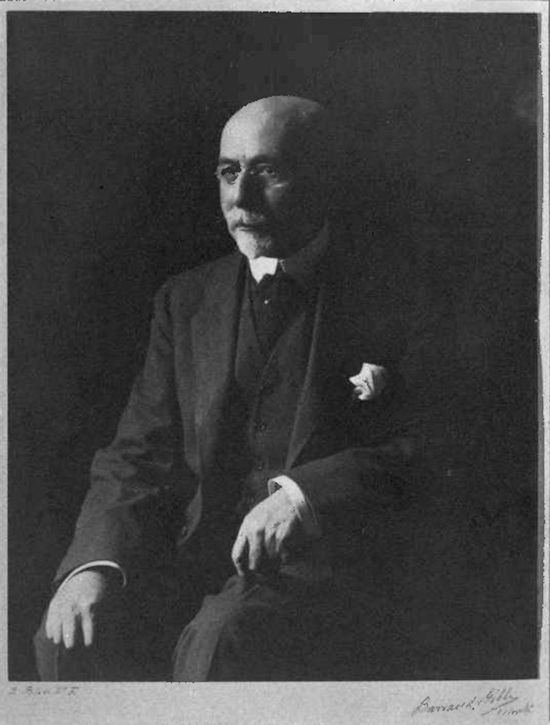
JACOB L. ENGLEHART Petrolia, Ontario
Wright, George Craig (Hamilton, Ont.), Manufacturer, was born in Hamilton, January 11, 1891, the son of H. G. Wright, manufacturer, and Kate Wright. He was educated at the Hamilton Collegiate Institute, graduating from there in 1908. In 1910 he became Lieutenant of the 13th Royal Regiment and, when the war broke out, enlisted with the First Contingent in the 4th Battalion and served continuously in France from February 11, 1915, until wounded in April, 1916. He went to the front as a Lieutenant and was made a Captain, April 23, 1915. Since July 5, 1916, he has been employed on Staff work in Canada. Mr. Wright is a member of the Barton Lodge of Masons, attends the Centenary Methodist Church, and belongs to the Hamilton Golf and Country Club.
Detwiler, Noah Bechtel (Kitchener, Ont.), was born June 3, 1858, at Roseville, Waterloo Township and County, Ontario, the son of the late Rev. Enoch R. Detwiler, preacher and farmer of that place, and Abigail Bechtel. He received his education in the public schools and then took a course in a Toronto Business College. He married, December 14, 1880, Mary, the daughter of the late Jacob Y. Shantz, manufacturer in Berlin (now Kitchener), and a pioneer in the development of the Canadian North-West in the eighties and early nineties, and has one son and three daughters—Elden, Doctor of Osteopathy, London, Ont.; Lenora and Ethel at home, and Elizabeth, the wife of Prof. Herner, of Manitoba Agricultural College, residing in Winnipeg. Mr. Detwiler is a Protestant, worshipping with the United Brethren in Kitchener. In politics he is a real Independent, favoring no party, but always for to support the right man and the right principles if fortunate enough to have the opportunity of doing so. He was an early advocate of public ownership and his brother, D. B. Detwiler, of Kitchener, is the pioneer Hydro promoter in Canada, and is President of the Algoma Power Co., Ltd., and Chairman of the Great Waterways Union of Canada, and the proud father of two sons, with the Canadian Expeditionary Force in France. Mr. Noah B. Detwiler is actively engaged as President and Treasurer of the Hydro City Shoe Manufacturers, Limited, with office and works at No. 117 Weber Street, and as Secretary-Treasurer of the Algoma Power Co., with head office in Kitchener and plant at Michipicoten, Ont. When not engaged in business, Mr. Detwiler’s pursuits lie very largely along the line of social and religious work. He has been a director of the Y.M.C.A. for many years, also for a long time Sunday School Superintendent. Is local Secretary of the Social Service Council of Canada, and has always been an advocate of temperance. His reputation for good judgment and reliability is shown by his being executor or trustee for several estates, and while Mr. Detwiler is mild and affable in manner his clear cut style shows that confidence in him will not be misplaced. The family reside at No. 105 Queen Street North, where at this point the environment is quite in harmony with its name.
Pullan, E. (Toronto, Ont.), wholesale merchant, was born at Telz, Russia, in 1866, the son of Bernard and Emily Pullan. Leaving home at the early age of fourteen, he went to England and migrated to Canada four years later, where he worked in different capacities for two years in various parts of Western Ontario, and started in his present business of dealer in paper stock and sterilized wiping rags in 1888. Mr. Pullan married Bertha, daughter of Abraham Helman, by whom he has ten children: Martha, Harry, Joel, Dora, Bessie, Jennie, Rita, Gordon, Helen, and Emmanuel. He is a Hebrew in religion, independent in politics, and a member of the Board of Trade, of the Jewish Board of Arbitration and of the United Hebrew Charities, all of Toronto.
Nicholson, Arthur Edwin, O.A.A., of 46 Queen Street, St. Catharines, Ont., is one of the leading architects of the Niagara peninsula. He was born at Buffalo, N.Y., on June 22, 1881, the son of Edwin Charles Nicholson and his wife Alice Richings. The father was a builder and contractor, and the subject of this sketch was educated at the public schools of St. Catharines. Deciding to adopt the profession of architect, he went to Toronto in 1901, and on October 14 of that year was articled for three and a half years to the firm of Gordon & Helliwell, architects of that city. His articles expired in April, 1905, and on the eighth of May in that year he was admitted to membership in the Ontario Association of Architects. Returning to St. Catharines he has built up a large and lucrative practice and designed many of the handsomest buildings and residences in his district. He is a member of the Public School Board in that city, and belongs to the Masonic order, the Independent Order of Odd Fellows, and the Sons of England. In religion he is an Anglican, and on June 12, 1906, married Viola, daughter of Archibald MacGregor, a manufacturer, of 236 St. Clarens Avenue, Toronto. He has two daughters, Alice and Viola.
Rutherford, Colonel, The Hon. Alexander Cameron, K.C., B.A., B.C.L., LL.D., Barrister-at-law (Edmonton, Alta.), is recognized as one of the chief citizens of the Province of Alberta. He was born at the village of Osgoode, Carleton County, Ont., on Feb. 2nd, 1857, the son of James Rutherford, a farmer, and Elizabeth (Cameron) Rutherford. He was educated at the Public School, Metcalfe High School, Woodstock College and McGill University. From the latter institution he graduated in 1881 with the degrees of B.A. and B.C.L. In addition he holds the honorary degree of LL.D. in three universities, McGill (Montreal), 1907; McMaster (Toronto), 1907; and the University of Alberta, 1908. He was called to the Bar of Ontario in 1885 and first practised at Ottawa as a member of the firm of Hodgins, Kidd & Rutherford. In 1895 he decided to go to the West and located in Strathcona (now South Edmonton) where he became Solicitor and Secretary-Treasurer of the Municipality, and Secretary-Treasurer of the School Board, offices he held for a considerable number of years. He was elected to the Legislative Council of the Northwest Territories in 1902 and was Deputy Speaker of that body from 1902 to 1905. In the latter year the Province of Alberta having been created he was elected to the Legislature and became the first Premier of that Province on Sept. 2nd, 1905, administering also the portfolios of Provincial Treasurer and Minister of Education. He represented Alberta at the Inter-provincial Conference of Premiers held at Ottawa in 1906, and was delegate to the Imperial Conference on Education in London, England, 1907. He was responsible for the foundation of the University of Alberta and has been a member of its Senate since its establishment; in 1912 he represented it at the Conference of the Universities of the Empire in London, Eng. On May 26th, 1910, he resigned his position as Premier owing to a division in the ranks of the Liberal members of the Legislature, although as leader he had carried the general elections of 1905 and 1909. Under his regime as Premier all Provincial institutions were established as in the older Provinces of Canada, and in addition to the University he founded a Normal college for teacher-training. He also encouraged railway expansion and the development of the agricultural and coal-mining industries, and since 1909 has been a member of the Conservation Commission of Canada. In 1916 he was appointed a Director of the National Service Board of Canada and he is also Honorary Colonel of the 194th, Edmonton Battalion, a Highland Battalion of the C.E.F. He is a member of the Edmonton Hospital Board and of the Board of Public Welfare, and a Fellow of the Royal Society of Arts, and the Royal Colonial Institute. His business interests are wide. He is Vice-President of the Great Western Garment Co., Ltd., Edmonton; and a Director of the Great West Permanent Loan Co.; Canada National Fire Insurance Co., the Imperial Canadian Trust Co., and other financial institutions. He is a Liberal in politics, a Baptist in religion, and a member of the A.F. & A.M., I.O.O.F., I.O.F., and St. Andrew’s Society. In 1888 he married Mattie, daughter of the late William Birkett of Ottawa, Barrister-at-law, and has two children, Cecil, who served overseas in the late war as a Lieutenant of artillery, and Miss Hazel Rutherford. His recreation is motoring and he is a member of the Edmonton Club and the Canadian Club of his city.
Neill, Charles Ernest (Montreal, Que.), General Manager of the Royal Bank of Canada, with Head Office at Montreal, was born at Fredericton, N.B., on May 27th, 1873, the son of James Stewart and Eliza Caroline Neill. He was educated by Dr. G. R. Parkin in the Collegiate School of his native town and graduated in 1889. After receiving his education he entered the banking business, and has risen to his present high position by promotion. He was Manager of the Royal Bank at Vancouver, B.C.; Supervisor of B.C. Branches; Chief Inspector Montreal; in 1907 was appointed Assistant General Manager, and in 1916 to his present position. To gain such rapid promotion in one of the largest banking institutions in the British Empire means something, and no person will dispute the qualifications of Mr. Neill to fill the same. He is a man with a large vision, knows business life thoroughly and has keen foresight and action. In October, 1901, he married Mary Louise Crerar, daughter of John Crerar, K.C., of Hamilton, Ont., and has no issue. Mr. Neill is a member of the following clubs:—St. James, Mount Royal, Forest and Stream, Montreal Hunt, Royal Montreal Golf, Montreal Curling, M.A.A.A., all of Montreal. Since the outbreak of the war Mr. Neill has taken an active part in all Patriotic work and has devoted much time and given freely of his money on all occasions. In religion he is a Presbyterian and resides at 503 Sherbourne St. West.
Panet, Lieutenant-Colonel Charles Louis (Ottawa, Ont.), son of the late Colonel the Honorable Charles Eugene Panet, who was for many years Deputy Minister of Militia and Defence, and one of a very distinguished French-Canadian family, which has given many distinguished soldiers, judges and legislators to the service of Canada. Born at Quebec City on December 15, 1870. Moved to Ottawa five years later, when his father, who had been a member of the Senate of Canada, resigned that position to accept the above-named office. Educated at Ottawa University, and at the age of nineteen entered the Civil Service of Canada as a junior in the Department of Militia and Defence. In 1904, Sir Frederick Borden, Minister of Militia and Defence, appointed Colonel Panet his private secretary, in which capacity he acted for seven years, attending three Imperial conferences in London, Eng., with his chief. In 1898, he became Secretary of the Canadian Defence Committee. In 1908, he was appointed Secretary of the Department. The outbreak of the war added enormously to Colonel Panet’s responsibilities, and he was officially mentioned in despatches for services rendered in Canada during the war period, 1914-1919. At present he holds the office of Secretary of Department of Militia and Defence and of President of the Pensions and Claims Board. In 1912 he was appointed President of the Board of Enquiry re claims of applicants for the Fenian Raid Volunteer Bounty. Among his brothers are Brigadier-General A. E. Panet, C.B., C.M.G., D.S.O., Royal Engineers, Imperial Army; Brigadier-General H. A. Panet, C.B., C.M.G., D.S.O., Royal Canadian Artillery; Brigadier-General E. de B. Panet, C.M.G., D.S.O., Royal Canadian Artillery; Lieutenant-Colonel A. de L. Panet, Canadian Ordnance Corps; and Lieutenant-Colonel A. H. Panet, of the same branch of the service. A. P. E. Panet, another brother, is a barrister. The subject of this sketch was married on October 25, 1899, to Muriel, daughter of Major-General Sir D. A. Macdonald, Kt., C.M.G., I.S.O., etc., and has one son. He is a Roman Catholic in religion, and his recreations are shooting, fishing, and golf. He is a member of the Royal Ottawa Golf, Ottawa Country, and Ottawa Hunt Clubs. His private address is “The Roxborough,” Ottawa.
Fielding, Hon. William Stevens, LL.D., D.C.L., P.C., M.P., one of the leading Liberal statesmen of Canada, was born at Halifax, N.S., November 24, 1848, the son of Charles and Sarah (Ellis) Fielding. He was educated in the public schools of Halifax, and at the age of sixteen entered the office of the “Chronicle” of that city as a reporter, and ultimately became managing editor, a post from which he retired in 1884. He early developed a rare talent as a public speaker, with a special aptitude for the handling of financial topics. At the Nova Scotia elections of 1882 he was elected to the Legislature for Halifax County as a Liberal, and two years later became Premier and Provincial Secretary. He was successful in carrying his party to victory in the general elections of 1886, 1890 and 1894, gaining an ever-increasing fame as an orator and administrator. When Sir Wilfrid Laurier, became Prime Minister of Canada, after the Federal elections of 1896, he induced Mr. Fielding to leave the provincial arena and become Minister of Finance in his cabinet. The new Minister was elected to the House of Commons for the riding of Shelburne and Queens by acclamation on August 2, 1896, and was re-elected at the general elections of 1900, 1904, and 1908. In 1911, he was personally defeated in the contest which resulted in the general defeat of the Laurier administration on the reciprocity issue. The great historic act of Mr. Fielding’s career as Minister of Finance was his establishment of an Imperial British trade preference in 1897, which has since become a permanent factor in Canadian tariff policies, and which won him fame throughout the Empire. In 1907, he also negotiated a reciprocity treaty in certain commodities with France; and during the fifteen years that he was Minister of Finance was a notable figure at Colonial and Imperial conferences in London. In 1910, he conducted on behalf of Canada the negotiations with President Taft to avert tariff war between Canada and the United States, and in the spring of 1911 was one of the commissioners who negotiated the reciprocity agreement with the United States, which, in the following September was rejected at the polls, and which became known as the Knox-Fielding pact. On the defeat of the Laurier administration, he re-entered journalism as President and Editor-in-Chief of the “Journal of Commerce,” Montreal. In 1917, he returned to politics as an Independent Liberal, supporting the Union Government on the question of conscription, and was elected by acclamation for his old constituency. At the National Liberal Convention of August, 1919, his election to the party Leadership was strongly urged by supporters in all parts of Canada; and despite his reluctance to accept the honour he was only defeated by the narrow majority of 38 in a poll at which more than 900 votes were cast. In religion Hon. Mr. Fielding is a Baptist, and on September 7, 1876, married Hester, daughter of Thos. A. Rankine, of St. John, N.B., by whom he had four daughters and one son. He resides at 286 Charlotte Street, Ottawa.
Nash, Charles William (Toronto, Ont.), Provincial Biologist, is an Englishman who came to this country to engage in farming, and was called to the Manitoba Bar in 1883. Since January, 1899, he has been a Lecturer in Biology of the Farmers’ Institutes Bureau, Department of Agriculture, Ontario, and is Biologist of the Provincial Museum, Department of Education. He has been a frequent contributor to Canadian Magazines, as also to “Farming World,” of which he was Associate Editor, writing regularly for many years under the title “Nature About the Farm.” Among other publications he is the author of “Birds of Ontario in Relation to Agriculture” (5th edition, 1913); “Check List, Birds of Ontario”; “Birds of the Garden”; “Ways of the Woodcock”; “Passing of the Pigeons”; “Migration of Birds”; “Humming Birds of Ontario”; “Wild Fowl of Ontario”; “The Bass of Ontario”; “Farmers’ Handy Book”; “Manual of Vertebrates of Ontario”; “Fishes of Ontario”; “Reptiles and Batrachians of Ontario”; “Mammals of Ontario”; and “Fishes of Toronto Region.” He has presented collections of Birds and Fishes of Ontario to the Provincial Museum, and is a member of the American Ornithologists’ Union; as also a Director of the Entomological Society of Canada. Mr. Nash was born at Bognor, Sussex, Eng., August 15, 1848, the son of Wm. H. and Louisa L. H. Nash, and received his education in England and the Isle of Jersey. He married Harriette B., daughter of Judge E. C. Campbell, Niagara, February, 1877, and has two daughters, Mrs. Eleanor E. Lacey and Mrs. Isabella L. Sweatman. He is an Anglican in religion, and a Conservative in politics.
Foran, Joseph Kearney, K.C., Litt. D., LL.B., Montreal and Ottawa, is one of the legal staff of the House of Commons, and also one of the leading litterateurs of Canada. He was born at Aylmer, Que., on September 5, 1857, the son of John Foran, a prominent lumberman, and his wife, Catharine F. Kearney. The latter was a lady of pronounced literary talent, and in her younger days was on the staff of the Dublin “Nation.” After coming to America, she for a time edited the “Ladies’ Literary Journal,” of Philadelphia. The subject of this sketch was educated at St. Joseph’s College, now known as Ottawa University, graduating in 1877. He then entered Laval University, Quebec, to equip himself for the practice of law, and in 1880 received the degree of Bachelor of Laws. During this three-year term he also obtained practical experience of his profession in the offices of Andrews, Caron, Andrews and Fitzpatrick, of which the late Sir Adolphe Caron and Sir Charles Fitzpatrick, formerly Chief Justice of Canada, were members. From 1880 to 1883, he practised law at Aylmer, Quebec, but in the latter year ill-health compelled him to spend three years in the woods of the north. In 1886 he was sufficiently restored in health to return to civic conditions, and for two years he acted as secretary to the Speaker of the House of Commons. He also became active as a writer of poems, essays and other forms of literary effort which were accepted by numerous Canadian and American publications, and in 1891 he became editor of the “True Witness,” of Montreal, which won an honorable place in Catholic journalism by the literary distinction of its contents and the breadth of its outlook. At the same time he began to acquire fame as a speaker and lecturer, and has been heard in many parts of Canada and the United States. His addresses are marked not only by rare eloquence, but by a spirit of toleration that makes them acceptable in all assemblages. In 1894, the University of Ottawa conferred on him the degree of Doctor of Letters, and his address on that occasion won tributes from the Earl of Aberdeen and other distinguished men who were present. He also speaks with equal facility in French and English. He has published a number of volumes, including “Obligations,” a legal treatise; “Poems and Lyrics”; “Simon the Abenakis,” a novel; “The Spirit of the Age,” an historical and philosophical essay; and “Irish Canadian Representatives.” The latter publication won high tributes from both Sir John A. Macdonald and Sir Wilfrid Laurier. He is a strong advocate of the cause of Irish freedom and in 1882 drafted the first Home Rule resolution presented in the House of Commons, for which the late Hon. John Costigan stood sponsor. In 1902 he entered the office of the Secretary of the Law Branch of the House of Commons as English translator; in 1908 he became Assistant Law Clerk; and in 1912, when the Parliamentary Counselship was created he was attached as Legal Officer to the Law Branch. In 1911 he was created King’s Counsel, and in 1914 appointed a Commissioner of the High Court of Ontario Dr. Foran is a Roman Catholic in religion; and in 1892 married Louisa, eldest daughter of the late Edwin Davis of Ottawa, who built many of the lighthouses on the Great Lakes. Mrs. Foran is a lady of literary culture who has been of great assistance to her husband in his work. They have two surviving children, Lieut. Herbert P. Foran, a student of McGill University, and Miss Ethel U. Foran.
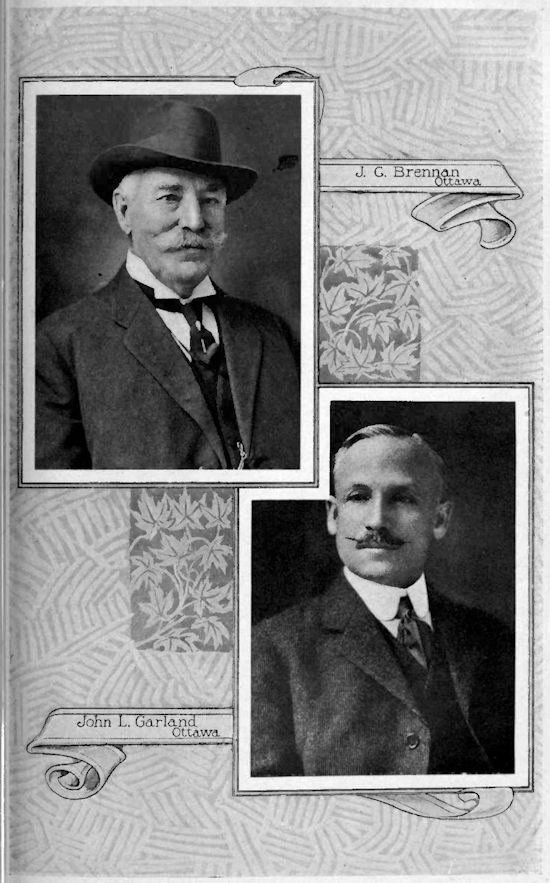
J. G. Brennan, Ottawa John L. Garland, Ottawa
Easson, Robert Henry (Toronto, Ont.), is one of the most prominent figures in the musical manufacturing industry of Canada. He is Vice-President of the Otto Higel Company, Ltd., manufacturers of piano actions and keys and pneumatic actions for player-pianos, with factories at King and Bathurst Streets, Toronto, and also Vice-President of the Otto Higel Company, Inc., of New York City, N.Y. With its Canadian and American branches, this enterprise is one of the largest industries of its kind in America. He is also President of the Canada Action & Key Company, Ltd., Toronto. Mr. Easson was born in Toronto, January 10, 1873, the son of Robert F. Easson, one of the pioneer telegraphers of this country, identified with the Great Northwestern Telegraph Company from its earliest days, and his wife, Millicent Easson. He was educated at the Toronto public and high schools, and began his business career as cashier and office assistant in the firm of M. & L. Samuel, Benjamin & Company, wholesale hardware merchants, Toronto, in 1890. He continued with this firm for ten years when he became manager of the Audit Department of Jenkins & Hardy, assignees and chartered accountants, Toronto. In 1904, he retired from that position to associate himself with the growing business of the Otto Higel Company, and became Vice-President in 1906. Since then the business of the Company has been greatly extended. The musical industries of Canada are now splendidly organized institutions for the development of music in the home, and Mr. Easson has been one of those most influential in bringing about this spirit of co-ordination. He is a member of the National Club and the Royal Canadian Yacht Club, and also of the Masonic order. In politics he is a Liberal, in religion a Presbyterian, and his recreations are bowling and motoring. On December 28, 1904, he married Winnifred, daughter of the late John Garvin, and has two sons and one daughter. He resides at 407 Palmerston Boulevard, Toronto.
Hunter, Major W. E. Lincoln, of Hunter & Deacon, Barristers and Solicitors, 2 Toronto Street, Toronto, was born in London, Ont., January 13, 1870, the son of Rev. W. J. Hunter, M.A., D.D., and Mary J. (Robinson) Hunter. He was educated at Hamilton Collegiate Institute and Osgoode Hall, graduating as barrister at the age of twenty-one. He joined the firm of Ince & Hunter, 1891, continuing this connection for four years, when he became associated with former Mayor A. R. Boswell, K.C., who is now Superintendent of Insurance for the Province of Ontario. He formed his present partnership in 1900. In 1901, he was appointed Census Commissioner for Centre Toronto. He married June 1, 1904, Mary Edith, daughter of Henry Smith, Superintendent of Colonization Roads, Toronto, and has four daughters—Kathleen, Madeline, Norah and Aileen. He is an ex-Vice-President of Centre Toronto Reform Association, and ex-President North Toronto Liberal Club. He is the author of “The Woman in Blue,” a satirical novel published in 1895. His military career began at an early age, and he was gazetted Lieutenant in the 10th Regiment, Royal Grenadiers, in 1901, became Captain in 1907, and Major 1915, being now second in command. When war broke out, he at once became active in every way at his command, speaking constantly at recruiting meetings, associating in many other military and patriotic activities. For two years he was constantly in khaki, and for nearly a year was in command of Filtration Guard, with over 300 men under him. In his patriotic work, he had a most enthusiastic associate in Mrs. Hunter, who is Regent of the Royal Grenadier Chapter, I.O.D.E., whose efforts on behalf of the boys overseas were unceasing and indefatigable. On August 18, 1919, a formal ceremony took place in the Armouries, when the colors of the Regiment were handed over to Major Hunter, who accepted them on behalf of the Regiment, from Major Andrew Duncanson, D.S.O., commander of a guard of 100 men, all of whom had been overseas. These colours were carried by the guard of honour for the Prince of Wales, Colonel in Chief of the Regiment, on his visit to Toronto in August, 1919. Major Hunter has large real estate interests in the city. He is a member of the Royal Canadian Yacht Club, the Ontario Club, Military Institute, Mississauga and Scarboro Golf Clubs, Lake Shore Country Club, Toronto, and the Junior Army and Navy Club, London, England. He is a Liberal and an Anglican. The family reside at 113 Walmer Road, Toronto.
Henry, Hon. George Stewart, M.P.P., B.A., LL.B., Minister of Agriculture for the Province of Ontario, is not only a practical farmer but an agricultural expert of wide academic training. He was born at King Township, York County, Ont., on July 16, 1871, the son of William and Louisa Henry, the mother’s parents being from Ulster, as was also his father. The subject of this sketch was educated at the public schools of Toronto, Upper Canada College and the University of Toronto, of which he holds the degrees of B.A. and LL.B. He also spent a year at the Ontario Agricultural College, Guelph, Ont., and though equipped for a professional career decided to adopt the vocation of farmer in East York, near Toronto. In this field he proved himself extremely successful, and as a young man took an active part in the public affairs of his district. He was a member of York Township Council from 1903 until 1910, holding the position of Reeve during the last four years of that interval. This carried with it membership in the York County Council, and in 1909 he was elected by his colleagues warden of York, an old and historic office. A vacancy in the Ontario Legislature for the riding of East York necessitated a by-election, and he was nominated in the Conservative interest. He was returned at the head of the poll on September 8, 1913, and at the general elections of the following June was again successful. In the spring of 1918, Sir William Hearst, Prime Minister of Ontario, invited him to enter the Ontario cabinet as Minister of Agriculture, a portfolio he had himself filled for some months after the death of the late Hon. James Duff. This necessitated a by-election in the summer of that year. Mr. Henry was again elected for East York, for the third time in five years. In that office he has pursued a vigorous progressive policy, not only with regard to the development of agriculture in the outlying districts, but in stimulating production in the older settlements. He has also been a leader in the Good Roads Movement; he is a member of the Toronto and York Roads Commission, and is Secretary-Treasurer of the Ontario Good Roads Association. He was also a prominent figure in the All-Canada Roads Conference held at Quebec under the Presidency of Sir Lomer Gouin in May, 1919. In addition to conducting a farm of a model character, Mr. Henry is President of the Farmers’ Dairy Company, Ltd., of Toronto. He is a Methodist in religion, and on January 29, 1902, married Anna Ketha, daughter of Rev. F. W. Pickett, of the Toronto Methodist Conference. He resides at Todmorden, on the outskirts of Toronto.