LIST OF PHOTOGRAVURES (continued 12)
Reading edition
Wetherell, James Elgin, B.A. (Toronto, Ont.), born at Port Dalhousie, Ont., September 20, 1851. Son of James S. Wetherell and Jane (Hilts) Wetherell, both of U.E. Loyalist descent, his mother being a sister of the Rev. Joseph H. Hilts, the well-known pioneer preacher. Mr. Wetherell was educated at the Newmarket Public and High Schools and at the University of Toronto (B.A. 1877 with medal in classics). After graduation he was Professor of Latin for two years at Woodstock College. In September, 1879, he became the first Principal of the newly created Collegiate Institute at St. Marys. In 1884 he moved to Strathroy, where in 1885 he became the first Principal of the newly created Collegiate Institute of that town. For five years he was Principal of the Strathroy Training Institute for High School teachers. He was President of the Ontario Classical Association in 1896, and President of the College and High School section of the Ontario Teachers’ Association in 1902. In 1905 he was elected a Senator of the University of Toronto to represent the High School teachers of the Province. This position he resigned in 1906 when appointed Inspector of High Schools and Collegiate Institutes for Ontario to succeed Dr. John Seath. During the ten years of his inspectorship he travelled extensively, not only in Ontario, but also in the United States and Europe. In January, 1917, he was appointed General Editor of Text-Books for the Ontario Department of Education. He has edited many High School text-books in Latin and English, as follows: Virgil, Book I.; Virgil, Book V.; Cicero, Cato Major; Cicero against Catiline; Scott, Lay of the Last Minstrel; Selections from Longfellow; Selections from Wordsworth. After visiting Tennyson’s homes and haunts he edited in 1890 the first annotated edition of selections from Tennyson in Canada—a work which called forth a letter of appreciation and thanks from the poet. He has edited also four anthologies: Later Canadian Poems (1893); Later American Poems (1896); Poems of the Love of Country (1905); and the Great War in Verse and Prose (1919). He is also the author of two books, “Over the Sea,” and “Fields of Fame in England and Scotland” (1914). He has contributed numerous articles and occasional verse to magazines and journals, and was at one time a regular contributor of unsigned articles to a Toronto newspaper. He has often lectured on educational and literary topics. Mr. Wetherell married (1) Rebecca Randle, daughter of William Nason, Weston (died May, 1912); and (2) Margaret, daughter of Henry Smith, Thorold. He has three children, two sons and a daughter. He is a member of the Canadian Club and a charter member of the Champlain Society. He attends St. Paul’s Anglican Church.
Hamilton, Frank Kent, LL.B., General Manager of the McKittrick Properties, Limited, Hamilton, Ontario, was born in Stratford, Ont., March 19, 1887, and received his education in the local public and high schools and University of Manitoba, from which he graduated with the degree of LL.B. in 1910, and in the following year he graduated as a barrister. He married October 6, 1915, Fannie Irene Moodie, daughter of Honorary Lieut.-Col. J. R. Moodie, an extensive manufacturer, of Hamilton, Ont., and has a daughter, Fannie Margaret, born February 14, 1917, and a son, Kenneth Moodie, born June 29, 1918. He is a member of the Hamilton Golf Club, the Hamilton Club, the Glendale Golf Club, and his principal recreations are golf and tennis. He is a Presbyterian, and a Unionist-Liberal. With the exception of one year, his boyhood days were spent in Stratford, Ontario. This year was spent in Syracuse, New York, where his father went in November, 1897, to go into the wholesale shoe business. He died there in June, 1898, and his widow and four daughters and son returned to live in Stratford. His widow died in November, 1913. After matriculating in 1904, Mr. Hamilton spent two years in the men’s clothing business at Stratford, and left in May of 1906 for Western Canada, where he felt the prospects were better for working his way through for law. He articled to Norman P. Buckingham, then practising at Boissevain, Manitoba. In July, 1908, he went to Winnipeg, where he studied for a short time under Lieut.-Col. A. W. Morley, and from 1909 till 1911 he studied under the firm of Aikins, Robson, Fullerton & Coyne, the senior member of the firm being Sir James Aikins, the present Lieutenant-Governor of Manitoba. Mr. Robson later became Judge of the King’s Bench of Manitoba, and is now general counsel for the Union Bank of Canada. Mr. Fullerton is now Judge of the Court of Appeal, while J. B. Coyne is one of Manitoba’s most prominent counsel. Graduating in 1911, the partnership of Coyne & Hamilton was formed in January, 1912, which firm later became Coyne, Hamilton & Martin. Successful law practice was carried on under this name until May, 1918, when Mr. Hamilton came East to accept the General Managership of the McKittrick Properties, Limited, owners of some 700 acres of land within the limits of the city of Hamilton, which is now in the course of development as a residential area. In the winter of 1904 and 1905 he was one of the members of the Stratford Junior Hockey team, which won the Junior Championship of the Province of Ontario. In 1910 he was a member of the Varsity Hockey team of Winnipeg, holders of the Championship of Manitoba. The team challenged for the Allen Cup, emblematic of the Amateur Championship of the World, then held by St. Michaels’ of Toronto, but spring came before dates could be arranged for a play-off. He also belonged to the Law Hockey team, winners of the Inter-Collegiate Championship of the University of Manitoba, and though he has given up active athletics, still bears the stamp of an athlete. He is tall, fair, active, affable and enterprising in a marked degree. The family reside at 407 Queen Street South, Hamilton, Ontario.
Barnard, Sir Frank Stillman, K.C.M.G., Lieutenant-Governor of British Columbia since 1914, is a native of the city of Toronto, but a British Columbian since early childhood. He was born on May 16, 1856, the son of the late Francis J. Barnard, who settled in that province during the Fraser River gold rush of 1859, and brought his family to permanently reside there in 1860. The elder Barnard subsequently became one of the strongest advocates of Confederation with the Dominion of Canada, and later, from 1879 to 1887, sat in the House of Commons as Conservative member for the old constituency of Yale-Kootenay. The maiden name of the mother of the subject of this sketch was Miss Ellen Stillman. He was educated at Hellmuth College, London, Ont. On returning to B.C., he, in 1879, became associated with the British Columbia Express Company of Victoria, B.C., and was promoted to the post of general manager in 1881, and president in 1882. For a considerable period he was prominent in connection with transportation interests. He was President of the Consolidated Railway Company of Vancouver, 1894-96, and Managing Director of the British Columbia Electric Railway Company, Limited, of London, Eng., 1898-1906. In 1906 he retired from active business. Despite his large commercial interests, he found time to devote to politics, and in 1886 and 1887 served as member of the Victoria City Council. In 1888, he was elected to the House of Commons for the Cariboo district as a Conservative, and continued to sit until 1896. His brother, Hon. George Henry Barnard, was also at one time a member of the House of Commons, and is now a Senator. In 1914, Sir Frank was appointed Lieutenant-Governor of the Province, a post he still holds at the time of writing, and was later created a Knight Commander of the Most Distinguished Order of St. Michael and St. George. During his term of office Sir Frank has been a leader in the patriotic activities in connection with the war, and Lady Barnard has proven a most valuable aid to him in the important social duties of his office. They were married on November 7, 1883, and prior thereto Lady Barnard was Miss Martha Loewen, daughter of the late Joseph Loewen, brewer, of Victoria. Sir Frank is a member of the following clubs: Union, Victoria; Vancouver, Vancouver; Royal Vancouver Yacht; Victoria Golf; Victoria Tennis; Royal Automobile, London, Eng.; and the Royal Canadian Yacht Club, Toronto. He has no children, and his address is Government House, Victoria, B.C.
Hodgetts, Col. Charles Alfred, C.M.G., M.D., sanitary specialist, is the third son of the late George Hodgetts, of Toronto, and a grandson of the late Lt.-Col. Thomas Hodgetts, of His Majesty’s 24th Regiment, and was born in Toronto, August 23, 1859. In 1896, Dr. Hodgetts married Elizabeth B. Salter, daughter of W. T. Salter, of St. John’s, Newfoundland. She died in March, 1909. He has two sons and three daughters. He was educated at the Provincial Model School, Toronto, and was awarded the Dufferin Medal at the Ontario College of Pharmacy, graduating with honours in 1875, at the Victoria University, graduating in 1886 as an M.D., C.M., and subsequently received the membership of the College of Physicians and Surgeons of Ontario. Dr. Hodgetts was house surgeon at the Toronto General Hospital 1886-7, and resident assistant surgeon at the Stafford Infirmary, England, 1888, and received his L.R.C.P., London, 1889. He received the first D.P.H. of Queen’s University in 1912. From 1891 to 1904 he was Medical Inspector of the Provincial Board of Health and Secretary and Deputy Registrar General of the Province of Ontario from 1904 to 1910. In 1910, he was offered the M.O.H. of the city of Toronto, but declined the appointment; subsequently he was appointed Medical Adviser of the Public Health Committee of the Commission of Conservation, with headquarters at Ottawa. Dr. Hodgetts has held the Honorary Treasurership of the St. John Ambulance Association, and is at present Honorary Secretary; also the Honorary Secretaryship of the Canadian Branch of the Red Cross Society from the time of its organization, and was most active during the war in South Africa, 1899-1900, in carrying out the work in Canada. He resigned from the office in 1910, and was elected the first Honorary Life Member. Sup. Presdt. Sons of England Ben. Soc., Canada, 1900-1; a Fellow Royal Sanitary Institute, 1905; an examiner, Royal Sanitary Institute, 1906; Fellow Royal Institute of Public Health; Fellow of the Society of Medical Officers of Health of Great Britain; Hon. Vice-President Association Public Vaccinators, Great Britain; Member, International Commission on Bovine Tuberculosis, 1909; Member, Ottawa Commission to investigate the best source of water supply for Ottawa, and to suggest a plan of sewage disposal for that city, 1911; Life Member of the British Red Cross Society. He has served as 3rd, 2nd, and 1st Vice-President, American Public Health Association; Hon. Asst., 1903, Esquire, 1910, and Knight of Grace, 1912, Order of St. John of Jerusalem; Past President, Conference Executive; Officer, State and Prof. Boards of Health, Washington; President, Canadian Public Health Association of Canada, 1911-12; gazetted Lieut. A.M.C., present rank, Lt.-Col.; a founder and charter member of the Canadian Red Cross Society, St. John Ambulance Association, and the Canadian Public Health Association; author of numerous contributions to the press and of several pamphlets on public health. Represented Canada at International Congress on Tuberculosis, Washington, 1909; International Congress on Maternity and Child Welfare, Berlin, 1911; Conference on Pollution of International Waterways, Cleveland, 1912; and British and Overseas Dominion Conference on Child Welfare, London, England, 1913. The only medical member of the Trustees holding the charter of the Toronto School of Medicine for the Ontario Government. He is credited with being one of the foremost public health authorities in Canada and, as the “Montreal Gazette” has wisely pronounced, is “regarded everywhere as an authority on all subjects dealing with public health.” He was prominent with the Conservation Commission in urging the creation of a Dominion Department of Health, and carried out a campaign for the better housing of the people and for town planning. Dr. Hodgetts is thoroughly British, and believes that the maintenance of British connection is essential for the continuance of Canada’s progress. On mobilization, at Valcartier in August, 1914, O.C. in charge of Inoculation Column. Nearly 30,000 troops were inoculated, being the largest number ever inoculated on mobilization. In October, 1914, Dr. Hodgetts was appointed Hon. Canadian Red Cross Commissioner overseas, with the rank of Colonel, and left for the front. From London he organized and directed the activities of the Society overseas in England, France and the countries of the Entente. He was elected a member of the Joint War Committee of the British Society and Order of St. John of Jerusalem for the full period of his residence overseas. In September, 1917, among the birthday honours conferred by King George at Buckingham Palace, the C.M.G. was given to Dr. Hodgetts in appreciation of his work, he having been mentioned in despatches for distinguished service. In April, 1918, he resigned the Commissionership of the C.R.C.S., and the Imperial authorities appointed him to the post of deputy Commissioner of Medical Service under the Imperial Ministry of National Services—one of the highest positions in the medical services of the Empire, and he subsequently served in Ireland as Assistant Commissioner. Dr. Hodgetts returned to Canada the following December, and was enthusiastically received by the members of the Great War Veterans’ Association, to whom he had rendered such attentive and efficient service overseas, that it had received the personal praise of the Commanders-in-Chief of the British and French armies. He received a personal letter of thanks from Queen Marie of Rumania, and the badge of membership of the Serbian Red Cross for his services to those allies. Dr. Hodgetts is a Protestant in religion, and his residence is 238 Argyle Avenue, Ottawa, Ontario, Canada. Member of the Rideau and University Clubs.
D. E. HENRY Ottawa
Macdonald, Sir Donald Alexander, the oldest Major-General in the Canadian Army, upon whom fell the work of equipping the Canadian Forces during the continuance of the war of 1914, is now on the retired list. His responsibilities covered a wide field, embracing the clothing and equipment of all branches of the service, and in addition the housing, feeding, transport, of the mounted and postal services. Having served his country faithfully and with marked ability for fifty-four years, Major-General Sir Donald Alexander Macdonald, I.S.O., C.M.G., K.B., in January, 1918, retired from active service loaded with honours, decorations and distinctions, and carrying with him the high estimation of the Canadian people and of the Empire at large. The record of his devotion to duty and his ability to do those duties that fell to his lot will ever hold a prominent place in Canada’s military history. In 1863, Major-General Sir Donald Alexander Macdonald first became a member of the Canadian Militia when he joined the Rifle Company of Cornwall as Ensign. In 1865 he became Lieutenant of the 59th Regiment, and in 1866 Captain, in which capacity he served during the Fenian raids of 1866. In 1869 he became Adjutant, and in 1870 served in the Red River Expedition, and was awarded a medal and two clasps. In 1871 he became Major, and in 1877 was promoted to Lieutenant-Colonel. Then came in 1885 the North-West Rebellion, in which he distinguished himself, and was awarded a medal. In 1900 he was promoted to Colonelcy, and, having for some time been Chief Superintendent of Military Stores, in 1903 was appointed Director-General of Ordnance for Canada, and received the honour of I.S.O. In 1904 he was appointed Quartermaster-General of the Canadian Militia. In 1908 he was promoted to Brigadier-General, and in that year received his C.M.G., for his services in equipping the South African Contingent. In 1912 he was made a Major-General, and in January, 1918, was knighted by His Majesty King George V. In addition to the other distinctions that were accorded him, Sir D. A. Macdonald holds the Long Service Decoration and the honour of being the third military member of the Militia Council. Major-General Sir Donald Alexander Macdonald is the son of the late Alexander Eugene Macdonald, Deputy Clerk of the Crown and Registrar of the Surrogate Court of Cornwall, Ontario, and was born October 31, 1845, in Cornwall, and educated at the County High School. In 1876 he married Mary, the second daughter of Hon. Justice Hugh Richardson, formerly of the Superior and Supreme Court of the Canadian North-West Territories. He has one daughter, the wife of Lt.-Colonel C. L. Panet, Secretary of the Department of Militia and Defence. He resides at the Chateau Laurier, Ottawa, Ontario, Canada.
Davidson, William McCartney, M.P.P. (of Calgary), is one of the leading editors and public men of Alberta. He was born at Hillier, Prince Edward County, Ontario, on November 12, 1872, the son of James C. Davidson, a farmer, and Sarah McCartney Davidson, and was educated at the public school of his district, Picton High School, St. Catharines Collegiate Institute, and the University of Toronto. From the latter institution he graduated in June, 1893, with the degree of B.A., and decided to enter newspaper work. His first experience was as a reporter on the staff of the Toronto “World” under W. F. Maclean, M.P. A year later he was invited to join the staff of the Toronto “Star,” then in the early stages of its career, and shortly afterward became its representative in the press gallery of the Ontario Legislature. Mr. Davidson showed a grasp of public issues beyond the ordinary, and during the seven years he remained with the “Star” made its legislative reports a definite feature of the newspaper. In 1901 the Canadian West was just on the verge of the tremendous development which has marked the first two decades of this century, and Mr. Davidson resolved to try his fortunes there. In 1902 he established himself at Calgary, then a town of about 3,000 inhabitants, and founded the “Morning Albertan.” From comparatively humble beginnings it has developed into one of the most widely known newspapers in Canada. Throughout its career Mr. Davidson has retained the position of editor-in-chief and proprietor. He soon became prominently identified with the Liberal party in the province, and at the Alberta general elections of 1917 was elected to the Legislature for the riding of North Calgary. Few members of that body have as deep a knowledge of public questions and of parliamentary procedure. Mr. Davidson has travelled extensively, and one of his favorite pastimes is mountain-climbing. He is a member of St. Andrews Golf Club, of the A.F. & A.M., and the I.O.F. He is a Senator of the University of Alberta, and a Presbyterian in religion. He has been twice married: first, on June 6, 1899, to Christiana Constance Robertson, daughter of Rev. James Robertson, D.D., of Toronto, Superintendent of Missions for the Presbyterian Church of Canada. She died in March, 1904, and on September 10, 1913, Mr. Davidson married Ethel M. Heydon, daughter of George Heydon, of Yarmouth Centre, Ontario. He has three children, James R., William M., and Marian C. R. Davidson.
Parent, Hon. Simon Napoleon, K.C., who was Chairman of the National Transcontinental Railway Commission from 1905 to 1911, is the son of Simon Polycarpe and Luce (Belanger) Parent, of Beauport, Quebec, and was born there September 12, 1855. His education was had at the Quebec Normal School and Laval University, and between 1881 and 1902 he was awarded the following degrees and honours: Laval University, LL.L., with Lorne Gold Medal and Tessier Prize, 1881; LL.D., 1902; D.C.L. (Hon.), Bishop’s College University, Lennoxville, 1902. In 1881 Mr. Parent was called to the Bar, and was created K.C. in 1899. In October, 1877, he married Marie Louise Clara, daughter of the late Ambroise Gendron. Four sons and four daughters have blessed the union. At present Mr. Parent is President of the Quebec Streams Commission for the Province of Quebec. When admitted to the Bar, Mr. Parent successfully practised his profession in the city of Quebec, and from the start was looked upon as a practical man and a good and reliable lawyer. He served as an alderman in the Quebec City Council from 1890 to 1904, and was Mayor of the city from 1894 to 1905, during which time he built the new City Hall. Largely through his perseverance and energetic work, the splendid Quebec Bridge was built, and it was he who originated the park at St. Roch, between St. Roch and St. Sauveur. Quebec city streets were improved and the finances of the city placed on a better footing. Mr. Parent sat in the local legislature for St. Sauveur in the Liberal interest from 1890 to 1905, and served in the Marchand administration as Commissioner of Crown Lands, Mines and Forests from 1897 to 1900. On Mr. Marchand’s death in the latter year, Mr. Parent was called upon to succeed him as Prime Minister of the Province, and held that position up to 1905, when he resigned at the request of the Right Hon. Sir Wilfrid Laurier to accept the position of Chairman of the National Transcontinental Railway Commission, with headquarters at Ottawa, which Commission had charge and control of the construction of the Eastern Division of the Transcontinental Railway, extending from the city of Moncton, N.B., in the east to the city of Winnipeg, Manitoba, in the west, and the operation thereof until completed and leased to the Grand Trunk Pacific Railway Company. Mr. Parent was President of the Quebec Bridge Company from 1897 to 1908, was formerly a director of the Quebec Railway, Light and Power Company and the Quebec and Lake St. John Railway. During his whole public career, Mr. Parent has held the reputation for being an honest and able man; as one of the most industrious administrators of modern times; as a man of decision, business and legal ability, and rare enterprise in public matters; unassuming, courteous, and practical. A Roman Catholic in religion, Mr. Parent has ever been a staunch Liberal, and one of the late Sir Wilfrid Laurier’s best and most influential supporters. He is a member of the Rideau, Laurentian, and Ottawa Hunt Clubs in Ottawa, and of the Garrison Club, Quebec. His Ottawa residence is at 485 King Edward Avenue.
Rutherford, John Gunion, C.M.G., V.S., Ottawa, Honorary Associate of the Royal College of Veterinary Surgeons, Commissioner, Board of Railway Commissioners for Canada (Ottawa, Ont.) born at Mountain Cross, Peeblesshire, Scotland, on December 25, 1857, son of Rev. Robert Rutherford, M.A., and his wife Agnes Gunion. In 1887, he married Edith, daughter of Washington Boultbee, of Ancaster, Ont., by whom he has three daughters. He was educated at the High School of Glasgow, and later spent several years in the practical study of agriculture in the counties of East Lothian and Selkirk. Coming to Canada at the age of seventeen, he attended the Ontario Agricultural College in 1875 and 1876, being one of the earliest students at that institution, and later gained valuable practical experience in agriculture on the famous Bow Park Farm at Brantford, Ontario. In 1879 he graduated from the Ontario Veterinary College with honors, winning the gold medal for the best general examination, and numerous other prizes. He practised veterinary medicine for several years in Ontario, the United States and Mexico, and returning to Canada in 1884, settled at Portage la Prairie, Manitoba, where he engaged in general practice and horse breeding operations. He served as Veterinary Officer with the North-West Field Force under General Middleton during the Riel rebellion in 1885, and holds medal and clasp for that campaign. During his residence in Portage la Prairie he was for several years President of the Horse Breeders’ Association of Manitoba and the North-West Territories; President of the Manitoba Veterinary Association; President of the Manitoba and Lakeside Agricultural Society; the Island Park Racing Association, and the St. Andrew’s Society of Portage la Prairie. In 1884 he was appointed Veterinary Inspector for the Manitoba Government, an appointment which he held until 1892, when he was elected to represent the constituency of Lakeside (Portage Plains) in the Manitoba Legislature, in which body he was Chairman of the Committee on Agriculture. He was re-elected by acclamation in 1896, but after one session resigned to enter Dominion politics as representative for the constituency of Macdonald, which then comprised over one-sixth of the province of Manitoba. He sat as member for this constituency in the Dominion House until 1900, and in 1901 went to Great Britain as special Quarantine Officer for the Canadian Department of Agriculture. In 1902, he was appointed Chief Veterinary Inspector, and in 1904, after organizing the Health of Animals Branch, he became Veterinary Director-General. In 1906, he also took over the office of Live Stock Commissioner, and in the same and the succeeding year organized the present Meat and Canned Foods Inspection Service. During his tenure of office many original and radical departures were made in connection with the control and eradication of contagious diseases among the live stock of the Dominion, the results achieved being eminently satisfactory. Under his direction, the work of the Live Stock Branch was very considerably extended, and brought into close correlation with that of the Health of Animals Branch, joint supervision over the work of both branches being in a number of cases exercised by the same officers, especially in those provinces farthest from Ottawa. In 1908, he went twice to Rome as delegate for Canada to the International Institute of Agriculture, and in the same year was appointed to represent the Dominion at the International Congress on Tuberculosis at Washington, D.C. He was President of the American Veterinary Medical Association in 1908-09, and Chairman since its inception of the International Commission on the Control of Bovine Tuberculosis. He was for several years President of the St. Andrews Society of Ottawa, and from 1909 to 1911 President of the Civil Service Association of Canada. He was created a C.M.G. in 1910. In May, 1911, he resigned from the Dominion service, but at the request of the Government retained office until March, 1912. Immediately thereafter, he was engaged by Lord Shaughnessy, then President of the Canadian Pacific Railway Company, to undertake a campaign for the general development of the live stock industry and the encouragement of mixed farming in the three prairie provinces. In the organization of the campaign he found it advisable to co-ordinate this special work with that of the Company’s Department of Natural Resources at Calgary, Alberta, and in the following spring (1913) he was appointed Superintendent of Agriculture and Animal Industry, a position involving full responsibility for all the agricultural operations of the Company, including the educational and experimental activities in connection with its irrigation projects in Alberta. From 1913 to 1919, he was President of the Western Canada Live Stock Union, an organization in the creation of which he was largely instrumental, and which comprises in its membership all live stock associations and other bodies interested in the production of live stock in the four Western Provinces. In December, 1918, his portrait in oils was added by the live stock men of Canada to the collection of similar pictures of live stock celebrities in the Saddle and Sirloin Club of Chicago. He was a member of the Dominion Economic and Development Commission, as also a member of the Saskatchewan Royal Live Stock Commission, and has since its inception been Chairman of the Joint Committee on Commerce and Agriculture. While resident in Alberta he was Vice-Chairman of the Provincial Board of Agricultural Education, as also President of the Alberta Thoroughbred Horse Breeders’ Association, besides holding office in numerous other live stock and kindred organizations. He has had exceptional opportunities of acquiring a practical knowledge of Canadian agriculture, having actually farmed, more or less extensively, in every province of the Dominion except Prince Edward Island, his own farm being situated in the Chilliwack Valley in British Columbia. He was appointed to the Board of Railway Commissioners for Canada in November, 1918, and assumed office in February, 1919. Dr. Rutherford is a member of the following clubs: Ranchmen’s (Calgary), Rideau (Ottawa), University Club (Ottawa), Royal Ottawa Golf Club (Ottawa), and his home address is 218 MacLaren Street, Ottawa, Ont.
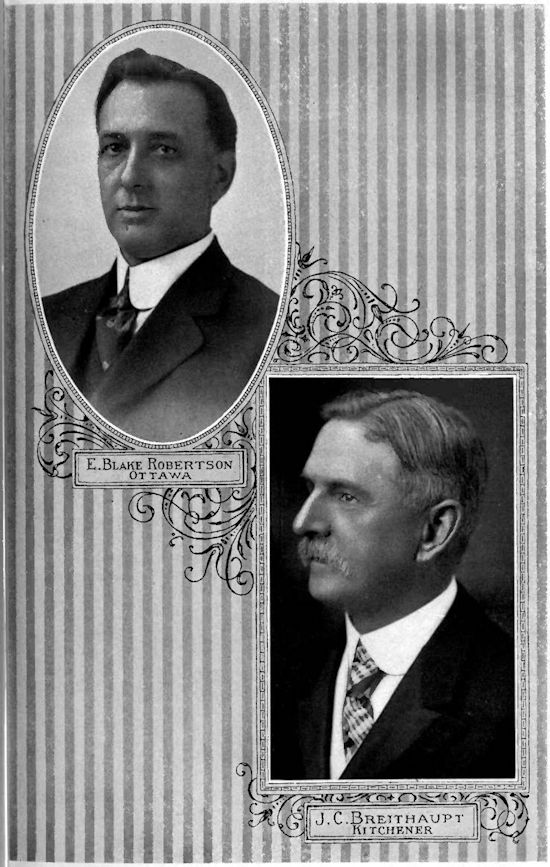
Breithaupt, John C., of Kitchener, Ont., is one of the most widely known business men of Canada, and has been particularly identified with the leather industry. He was born at Buffalo, N.Y., on February 27, 1859, the son of the late Louis and Catherine (Hailer) Breithaupt; but his parents removed to Kitchener, then known as Berlin, Ont., when he was very young. He was educated in the public and high schools of that thriving manufacturing city and later at the North-Western College, Naperville, Ill., of which despite his Canadian citizenship, he has in later life been a Trustee for upwards of twenty years. In Berlin, Ont., he became associated in the tanning business of his father, which of late years has grown to great dimensions. He is Secretary of the Breithaupt Leather Company, Ltd., with tanneries at Kitchener, Penetanguishene and Woodstock, Ont., and President of the Hastings Tannery Company, Ltd., with head office at Kitchener and tannery at Hastings, Ont. In addition to his widespread commercial interests Mr. Breithaupt has shown unselfish activity in public affairs. While his city was still known as Berlin he was a member of the Municipal Council for six years, first as Councillor, then as Reeve, and later, in 1896-7, as Mayor. He has been a member of the Board of Water Commissioners of the city since 1899 continuously, and Chairman for every year of that period but one. He held the office of President of the Local Board of Trade for a term, and is also a member of the Toronto Board of Trade, with which he has been connected since 1891. In all municipal movements for the betterment of civic government he has been a leader, and his voice has frequently been heard in the cause of progress in the province at large. He was President of the Berlin and Waterloo Hospital for several years and takes a deep interest in religious matters. He is a member of the Evangelical Association, and has been a member of various Boards and Commissions of the Church, having been delegate to the General Conference in 1911 and again elected in 1919 in a similar capacity. He is a member of the following clubs: Lancaster, Grand River County and Golf, and Ontario Club (Toronto). In 1892 he married Caroline C., eldest daughter of the late J. S. Anthes, furniture manufacturer of Kitchener, and has six children: John Edward, chemical engineer of the various Breithaupt tanneries; Louise Catherine, Carl Louis, who early in 1919 returned from overseas after two years’ service with the Canadian Engineers in France; Freida Caroline, Walter Hailer, and Helena Esther Breithaupt.
Cronyn, Hume, M.P., who represents the city of London, Ont., in the House of Commons, was born in London on August 28th, 1864, the son of Verschoyle Cronyn, LL.B., K.C., and Sophy Cronyn. The latter was a daughter of the late Hon. William Hume Blake, and a sister of the late Hon. Edward Blake, formerly leader of the Liberal party in the Canadian House of Commons, and later one of the ornaments of the British House of Commons as member for Longford, Ireland. The subject of this sketch was educated at Dr. Tassie’s famous grammar school, Galt, Ont., and at Toronto University, from which he graduated with the degree of B.A. He qualified for the law, and in 1889 received the degree of LL.B. from the same institution, and in that year was called to the Bar. He at once commenced the practice of law at London, and continued therein for the next eighteen years. In 1907 he gave up practice to take up the post of General Manager of The Huron and Erie Mortgage Corporation, a position he still holds in combination with the office of Vice-President. He is also General Manager of the Canada Trust Company, London, and a Director of the Mutual Life Assurance Company of Canada. Though long identified with the Liberal party, both from conviction and family association, Mr. Cronyn always declined public honors until the political crisis attendant on the adoption of the policy of conscription by Sir Robert Borden arose in 1917. Mr. Cronyn was one of many Ontario Liberals who decided to support the Prime Minister in forming a Union Government to carry out that policy, and when the general elections were announced on this issue, accepted the nomination as a Unionist candidate for the riding of London. The Laurier Liberals decided to make London one of the chief arenas of their battle against conscription, by nominating Mr. George S. Gibbons who had also been prominent in the politics of that city. After one of the most hotly contested campaigns of that momentous election, Mr. Cronyn was elected by a majority of over 4,000. In his younger days, he had been prominent in military circles; while a student at Toronto University he had enlisted in the Queen’s Own Rifles and served with that famous regiment in the North-West Rebellion of 1885, taking part in the engagement of Cut Knife Creek, for which he holds the medal and clasp. On returning to London, he joined the 7th Fusiliers, and served as Major in that battalion from 1899 to 1907, when he retired. During the late war he was active in promoting all patriotic causes. He is a member of the following clubs: London; London Hunt and Country; Toronto; Rideau (Ottawa); Royal Societies and the Zeta Psi fraternity. In religion he is an Anglican, and on September 6, 1892, married Frances A., second daughter of John Labatt, of London. He has three sons and two daughters, and his residence is at 580 Dundas Street, London, Ont.
COL. H. A. C. MACHIN Kenora
Davis, Albert Mayno, President of the McAuliffe-Davis Lumber Company, Limited, lumber manufacturers and dealers, with head office on Duke Street, Ottawa, and a capital of $300,000, has been in the lumber business in Ottawa for over twenty years, first with the Export Lumber Company, later as manager of the Chaudiere Lumber Company, and for seven years as manager of the McAuliffe-Davis Lumber Company, Limited, of which he is now President. Mr. Davis is not only recognized as one of the leading retail lumbermen of eastern Ontario, and one with entire knowledge of trade conditions in Ottawa and throughout the valley, but is known to be one of the leaders among the younger business element in the city. In the Company, Mr. Davis has associated with him Mr. W. Allen Taft, Jr., of Boston, Vice-President, who is also President of the Export Lumber Company; Mr. W. J. Armstrong, Secretary-Treasurer; and the following constitute the Board of Directors: Messrs. Albert Mayno Davis, W. H. McAuliffe, George I. Dewar, W. A. Taft, and W. Allen Taft. Mr. Albert Mayno Davis is the son of C. W. Davis, Burlington, Vermont, and Jennie Taft, of the same place, and was born at Burlington, October 3, 1878. He was educated at the Burlington High School and the University of Vermont. June 23, 1903, he married Adele Sylvain, daughter of L. P. Sylvain, of Ottawa, Chief Clerk in the Library of Parliament, with which he has been connected since 1878. Two daughters and one son—Margaret, Philip, and Adele—add joy and lustre to the home. Mr. Davis is a member of the Laurentian, Royal Ottawa, Rivermead and Rideau Tennis Clubs. His recreations may be classified as outdoor sports. His residence is at 24 Clemow Avenue, Ottawa, Ontario, Canada.
Bâby, Wolstan Alexander Dixie, Collector of Inland Revenue for the Division of Hamilton (Ontario), is one of the most widely known and respected of Federal Government officials. Moreover, he comes of one of the oldest of all Canadian families and his ancestry dates back almost to the beginnings of white settlement on the continent of North America. He is the son of the late William Duperon Bâby, attorney-at-law and sheriff of the County of Essex, Ont., and Christina Jane Wilson, daughter of Captain John Wilson, of H.M. Canadian Militia, Amherstburg, Ont., and was born at Sandwich, Ont., on April 13, 1858. As a matter of record it is important to say something of the ancestry and family history of Mr. Bâby. His forefathers came from France in the earlier years of French settlement, and settled at Fort Detroit in what is now the State of Michigan, but then part of the French domain of Canada. Later they moved across the Detroit River, and took up land in what is now the town of Sandwich, Ont. The founders of the family on this continent were Jacques Bâby de Rainville and his wife, Isabeau Robin, of Monteton, in the Bishopric of Agen, France. Jacques was an officer in the famous Carignan Regiment and with it came to America in the seventeenth century. Subsequently, in 1670, he was married a second time to Jehanne Dandonneau de Sables, of which union were born nine children. The eldest grandson of this couple was Hon. Jacques Duperon Bâby, who was born in 1731, and lived until 1796. While he was still a young man, the British conquest of Canada occurred, and Detroit falling into British hands in 1760, Jacques Duperon Bâby and his wife, Suzanne de la Croix Rheaume (who lived until 1812), became British subjects. In all they had twenty-two children. The name of Hon. Jacques Duperon Bâby is intimately interwoven with the history of the Essex peninsula. He played a prominent part in the defence of the Detroit district during the conspiracy of the Indian chieftain, Pontiac, in 1760. He was a man of great worth and integrity, who enjoyed the confidence alike of the French, English, and Indian population, and consequently was able to be of great assistance to the British government in the establishment of the new regime. Hon. Jacques Duperon Bâby was the eldest of his many children. He was born in 1762 and died in 1833, and held positions of honour and influence in the young colony of Upper Canada. Jean Baptiste Bâby, grandfather of the subject of this sketch, was a younger brother, and served as Treasurer of the newly-organized County of Essex. Two other brothers entered the British army, one, Daniel, rising to the rank of Major-General; while four of his sisters married British officers, one of whom was Lord Bellingham. The eldest son of Jean Baptiste Bâby was William Duperon Bâby, afterward sheriff of Essex, born at Sandwich in 1819; and the subject of this sketch was William’s sixth child. Since most of the various generations had large families, the Bâby family connection in Western Ontario, and indeed throughout America is literally enormous, and all have preserved the high tradition of “noblesse oblige.” Mr. Dixie Bâby was educated at the Separate Schools and at Assumption College, Sandwich, Ont., and at the Christian Brothers’ School, Toronto, in 1876. At the age of eighteen he was appointed to the Inland Revenue service, and detailed to Rae’s distillery as assistant officer to the late Pierre Ramon. He qualified himself so well as a vigilant watcher of the government interests in connection with the important revenue derived from excise that he has since served in many parts of Canada, including Paris, Woodstock, St. Catharines, Belleville, Brantford, Portage la Prairie, and Berthierville, Que. He was first stationed at Hamilton in 1886 as second officer to the late William Donaghy, and in 1890 transferred to Berthierville. In 1892 he went back to the Hamilton distillery, and was appointed officer in charge in October, 1898. On November 21, 1914, he was appointed Collector of Inland Revenue in charge of the entire Hamilton division. His duties have always been of a character which required expert knowledge as well as rigid probity, and during his forty-three years’ service he has won the unfailing confidence of the Department, no matter which party was in power. In December, 1880, he married Mary McDougall, of Belleville, Ont., who was born April 7, 1861. He has had seven children: Christina Caroline, deceased; Julia Fortier and Mary Louisa (twins, also deceased); Frances Jeanette, wife of Henri Bâby, notary public, Lachine, Que.; John Dixie; George Raymond; and Madeline Cecilia. Capt. George Raymond Bâby, M.D., C.M., who was born at Berthierville on April 1, 1892, went to France with the McGill University 1915 unit, Canadian Army Medical Corps, and was awarded the Military Cross for bravery and devotion to duty during the great British advance which began August 8, 1918, and only ended when the armistice was signed. The other son, John Dixie Bâby, is a civil engineer by profession, who assisted in building the Canton Hankow Railway, China.
Bell, Hon. George Alexander, Chairman of the Local Government Board for the Province of Saskatchewan, is one of the pubic administrators of the Canadian West, and in an unusual degree the architect of his own fortunes. He was born on a farm in Brant County, Ontario, on August 3, 1856, the son of David and Agnes (Melrose) Bell. He was educated in the public schools of Huron County, and continued on the farm until he was twenty years old, after which he learned the trade of blacksmith, which he followed for the next twelve years, four in Ontario and eight in Manitoba. He moved to the latter province in 1880 on the opening up of that province by the Canadian Pacific Railway. In 1888 he engaged in the agricultural implement business as agent for the Massey-Harris Company, and continued therein for the next thirteen years. In 1903, because of his exceptional knowledge of the country he was appointed by the Dominion Government Homestead Inspector for the Land District of Estevan, Saskatchewan, a position he resigned in 1908 to become a candidate for the Saskatchewan Legislature, and was elected as a supporter of the Liberal administration of Hon. Walter Scott. He was re-elected for Estevan in 1912, and called to the Cabinet and sworn in as Provincial Treasurer on August 19 of that year. The Government had established a system of Government-owned telephones, and this portfolio was shortly combined with his duties as Treasurer. In his second capacity of Minister of Telephones he was sworn in February, 1913, and continued to administer both offices until May, 1918, when he resigned from the Cabinet and Legislature to accept the post of Chairman of the Local Government Board, an important office, for which his administrative capacity and thorough knowledge of Western conditions eminently fit him. Mr. Bell is a Liberal in politics, and a Presbyterian in religion. He is a member of the Wascana Country Club, Regina (his favorite recreation being golf), and of the following societies: A.F. & A.M., I.O.O.F., and C.O.F. On December 6, 1883, he married Elizabeth, daughter of Johnston and Rachel (Cosgrove) Smith, of Elmwood, Bruce County, Ont., and has seven children, George Melrose, Ella Mabel, Gordon, Ethel, Grace Agnes, Lorne David, and Harold Alexander Bell. Mr. and Mrs. Bell reside at Regina, Sask.
Martin, Hon. William Melville, K.C., Prime Minister of Saskatchewan, is a native of the village of Norwich, Oxford County, Ont. He was born on August 23, 1877, the son of Rev. William M. and Christina (Jamieson) Martin, both his parents being natives of Scotland. While he was very young his parents removed to Exeter in Huron County, where his father served as Minister of the Presbyterian Church for twenty-six years. The subject of this sketch was educated at Exeter Public School, Clinton Collegiate Institute, and the University of Toronto, from which institution he graduated with the degree of B.A. and honors in classics. He also attended the Ontario School of Pedagogy to qualify as a High School teacher, and subsequently acted as Classical Master at Harriston High School for two years, 1899-1901. This however he regarded but as a stepping-stone to the practice of law for which he qualified at Osgoode Hall, Toronto. On being called to the bar he went to Regina, Saskatchewan, and commenced practice in July, 1903. He developed great talent not only as a lawyer but as a public speaker, and soon became prominent in the Liberal party. In 1906 he was offered the Liberal nomination for the House of Commons, for the old riding of Western Assiniboia, in succession to Hon. Walter Scott (who had resigned his Ottawa seat to become the first Prime Minister of the newly organized province of Saskatchewan), but declined. At the general elections of 1908, however, he yielded to the requests of his friends and accepted nomination, being elected by a majority of 708. At the general elections of 1911, despite the fact that the Liberal party as a whole met defeat, he was elected by the increased majority of 1,730. In all he sat in the House of Commons at Ottawa for eight years and although one of its youngest members was regarded as one of the most brilliant. In 1916 Hon. Walter Scott was obliged to resign the Premiership of Saskatchewan owing to ill health and Mr. Martin’s party friends in the West urged that he resign from Federal politics and accept the Premiership. He assented and at a by-election on November 13, 1916, was returned for Mr. Scott’s seat, Regina City, by acclamation. He reorganized the cabinet and framed a programme of progressive legislation which proved so acceptable to the electorate that at the general election of 1917 his administration was sustained by a very handsome majority. In addition to the offices of Prime Minister and President of the Council he administers the portfolios of Minister of Education and Minister of Railways. His educational reforms, covering as they do many problems of extreme moment, have been very important, and have attracted wide attention throughout Canada, and in the United States as well. Generally speaking Saskatchewan legislation under his regime has won fame for progress and effectiveness. So widespread is his reputation that on the death of Sir Wilfrid Laurier, early in 1919, many, both in the East and West, suggested him as the best available successor to the Federal Liberal leadership. Many of his friends still predict a Federal career for him, although Mr. Martin himself prefers to see his own programme of legislation for Saskatchewan carried out before aspiring to a wider arena. He is a Presbyterian in religion and a member of the Wascana Country Club and the Assiniboia Club. On Sept. 26, 1906, he married Violet Florence, daughter of the late Walter Thomson of Mitchell, Ont., and has two sons, Walter M. and Douglas Martin. His home is at 2042 Cornwall St., Regina, Sask.
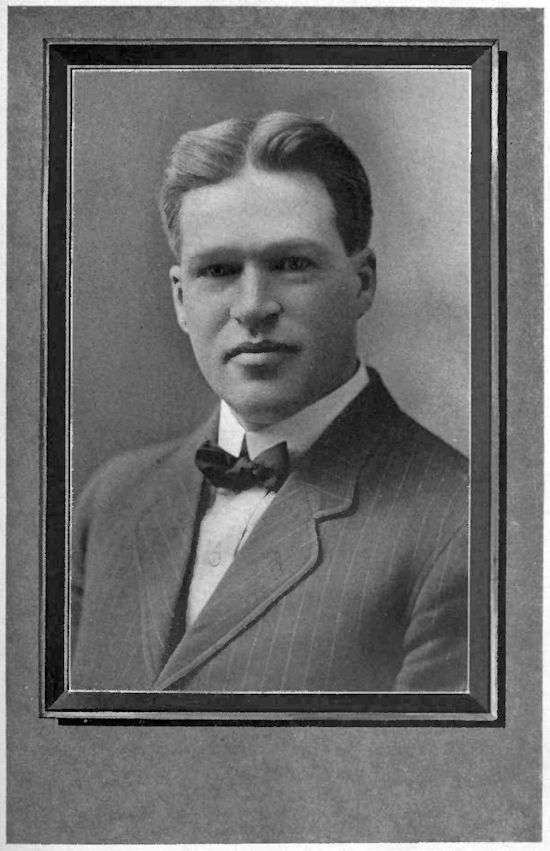
Henry, David Edouard, founder of Henry’s Shorthand School, 209 Sparks Street, Ottawa, on January 2, 1913, was born at Clarence Creek, Russell County, Ontario, April 24, 1874, his parents being Jacques Henry, a farmer, and Aurelie Laviolette. He was educated in Ottawa at the Grey Nuns’ Convent and the Christian Brothers’ School. Building it on a sure foundation—according to the laws of economics, well equipped, and capably managed by experts—Mr. Henry made his school an enviable success. At the opening in 1913, the school was located at the corner of Bank and Gloucester Streets, and within three months, having outgrown its original premises it was removed to its present premises on the corner of Sparks and Bank Streets—the Capital’s busy corner—which from time to time have been enlarged as the requirements of increased attendance demanded until to-day they are some five times the original size, and are likely to be enlarged still further at an early date, although his school is to-day the largest in Eastern Ontario. When the school was transferred from the corner of Bank and Gloucester Streets to the corner of Bank and Sparks, Mr. Henry had but 40 day pupils. In 1918, the number had increased to 562, which students are to-day holding good positions in the Dominion Government offices, manufacturing and wholesale establishments, banking houses, etc., all of which bears tribute to the high standard of efficiency of the school. For eleven years before Mr. Henry went into business for himself, he was in charge of the shorthand department of the Willis Business College in Ottawa, when S. T. Willis was proprietor. In his school, his staff consists of experts in shorthand, typewriting, business penmanship, practical English, spelling, punctuation, transcription, correspondence, etc., etc., and those who receive instruction in any one of these receive the best that can be had. At the age of 16 years, Mr. Henry was awarded a Fourth Form Certificate and honours for composition, spelling and penmanship. He acquired a systematic course of self-instruction, studied shorthand (French system) and afterwards English, and made himself proficient in the Isaac Pitman, Ben Pitman, Graham, Munson, Scott-Browne, Beale, Calligraphy (a Canadian production), and the Gregg systems. He studied French, English, German, Greek and Latin, and received special study in penmanship at the Zanerian College, Columbus, Ohio. To acquire a practical business education, he had experience as stenographer and bookkeeper with big business firms such as Perkins & Fraser, barristers; Alexander Mutchmor, auditor, etc. From 1894 to 1896, Mr. Henry made a special study of scientific methods for imparting shorthand and typewriting, and during 1895-6 taught shorthand at the Capital City Business College, at Ottawa, and had charge of the Y.M.C.A. classes for several months. In 1896, he attended the Rochester, New York, Business Institute, to acquire a greater qualification for teaching, and, in 1899, established a shorthand school, which later he closed to join the staff of the Metropolitan Business College at Ottawa. For two years, he attended Rev. Dr. McMeekin’s “Ottawa College of Oratory,” and gave several successful recitals in the Albert Hall. In 1899, Mr. Henry corrected a text book on Pitman’s shorthand for Messrs. Powers and Lyons, of Chicago, Illinois. Mr. Henry is a graduate of the New York College of Phonography; the Phonographic Institute, Cincinnati, Ohio; and is the only personal graduate in Canada of the well known Gregg School of Chicago. He holds the Scott-Browne’s Certificate. In his examination for the Phonographic Institute Teacher’s Certificate, he made the highest record, viz., 97.2 per cent., thereby defeating more than 700 candidates. Mr. Henry is a member of the Gregg Shorthand Association of America, and is the author of two standard works in shorthand. Mr. Henry is a Roman Catholic in religion, a Liberal in politics, and, for recreation, spends his time motoring. He resides at 205 O’Connor Street, Ottawa, Ontario.
Gibbon, Arthur Playford, Principal of the Central Business College, Hamilton, Ont., is one of Canada’s leading commercial educationists. He was born on April 7, 1871, in a log house in the township of Nichol, Wellington County, Ont., the son of William and Susan (Reynolds) Gibbon. His early education was received in the rural school of his section, and later he walked four miles night and morning to attend the High School and Model School at Elora. From January, 1892, to July, 1894, he taught in rural ungraded schools, after which he returned to the farm for five years to care for his father and mother. Deciding to equip himself as a commercial teacher he took a course at Stratford Business College, and after graduation taught in that institution for six months. In 1901, he went to Woodstock, Ont., to take the post of junior commercial teacher, and after one year became senior in these subjects. In 1904, he became Principal, and under his guidance built up the institution into one of the most important of its kind in Western Ontario. In Woodstock he also took an active part in public and business affairs. He acted as auditor for several large commercial houses, and sat in the municipal council as alderman. In the latter capacity his business acumen and sound judgment made him one of the most useful of public servants. His faculty for acquiring knowledge of every detail of civic business made him very valuable in the consideration of measures for the city’s welfare, so that when in August, 1909, he decided to leave Woodstock, expressions of regret were universal. In Woodstock, also, he became very active in the temperance cause, and served as Secretary-Treasurer of the North Oxford Prohibition Association. As Treasurer of the local branch of the Y.M.C.A., he rendered very important service in connection with the erection of new buildings, and he was very prominent in church work as a member of the Methodist body. In 1909, he sold his interest in Woodstock Business College, and bought Clark’s Business College at Hamilton, Ont. When he took charge on January 1, 1910, the attendance at the institution was but 34 day and 28 night students. He changed the name to the Central Business College, and within a few years his powers of organization had built up the attendance to five times the original figure. Mr. Gibbon’s chief hobby is Sunday School work, and he has served as a religious teacher of the young for over thirty years, in the various places where he has lived. His spirit of enterprise and attractive personality make him an ideal influence on youth. He is a member of the Kiwanis Club, Hamilton, and of the following fraternal societies, I.O.O.F., A.F. & A.M., Royal Templars of Temperance, and the Orange Order. On November 6, 1901, he married Margaret H. Lacey, and has two children, Playford Sutherland Gibbon and Ada Margaret Gibbon.
E. Blake Robertson, Ottawa J. C. Breithaupt, Kitchener
Webber, John A., Assistant Postmaster, Hamilton, Ont., was born in the township of Binbrook, Wentworth County, December 10th, 1861, the son of Esau Webber, contractor, Hamilton, Ont., and his wife Isabella (Ledmon) Webber. He was educated at the Hamilton Public Schools and Hamilton Collegiate Institute, was appointed to the Civil Service as a clerk in the Hamilton Post Office, October 24, 1881, advancing steadily till, in June, 1918, he was appointed to his present position by the Civil Service Commission, an appointment received with general satisfaction by the press and business men of Hamilton, and one of the earliest important promotions made by the Civil Service Commission. He married on June 1, 1886, Helena S. Murray, daughter of John J. Murray (M.D. Trinity College, Dublin), of Waterdown, and has two daughters, Ada A., wife of R. H. Moore, Cleveland, Ohio, and Charlotte I. Mr. Webber is a member of the Canadian Club, President Hamilton Horticultural Society, Vice-President Hamilton Garden Club, Director of Ontario Horticultural Society, representing Niagara District, member of the Executive Council Hamilton Scientific Association, member of the Canadian Order of Foresters, life member of Canadian Red Cross, and a sustaining member of the Hamilton Health Association (Mountain Sanitary). He is an Anglican, and a member of the Executive Board of St. Thomas Church. Outside of his agreeable manner, intense activity is Mr. Webber’s outstanding characteristic, and his principal recreation seems to be in always doing things, and doing them well and cheerfully. Alluding to his appointment, “The Civilian” (organ of the Civil Service), says: “In the appointment of Mr. John A. Webber as assistant postmaster at Hamilton, we have another instance of the application of the merit system as inaugurated by the Civil Service Commission. He was appointed to the staff on October 24, 1881, and has risen from junior clerk to almost head by efficient work, his standing in all Departmental examinations being very high. For ten years before his present appointment, he acted as Superintendent of the office, filling the assistant postmaster’s place during Mr. Matthews’ absence, and while in these positions his courteous and prompt attention to the needs of the public made him a host of friends in the business world with whom the appointment is very popular. As to the staff, the appointment is equally popular, every man knowing that under Mr. Webber any grievance is sure of a fair hearing and a just decision in the matter.” Mr. Webber’s father was a prominent contractor in the 50’s, 60’s and 70’s, during which period he erected many public buildings and business blocks, among which were St. Mary’s Cathedral, Centenary Church, Masonic Hall, Lester Block and hundreds of stores, hotels and private dwellings. While carrying on the contracting business during the period of food shortage, following the Crimean War, he bought and operated a 200-acre farm in the county on which the subject of this sketch was born but only remained during infancy. During the Great War Mr. Webber took an active part in patriotic, Red Cross and Relief Work, and in his long connection as director, and for several years in succession President of the Hamilton Horticultural Society. Has contributed not a little to the beautifying of home surroundings throughout the city. In his connection with the Gordon Club and in the eight counties under his jurisdiction as director of the Ontario Horticultural Society he did much to stimulate the production of vegetables and other foods throughout the district during the war. His efforts in the direction received commendation from the President of the National War Garden Commissioner, Washington, D.C., for adding to the world’s supply of food during the war. Mr. Webber lives at 130 Stinson Street, where he delights in Horticulture.
Irwin, William Nassau (Toronto, Ont.), only son of Francis Irwin (Irish), for many years Treasurer of the town of Orangeville, county town of Dufferin, and Jane (Taylor) Irwin (Canadian). Born at Orangeville, Ontario, on November 14, 1863. Educated in the Public and High Schools of Orangeville, and Trinity College, Toronto. Studied law in office of McCarthy and Walsh, Orangeville, and afterwards with Mowat, Maclennan, Downey and Langton, and Maclaren, Macdonald, Merritt and Shepley, Toronto, graduating from Osgoode Hall, and called to the Bar in September, 1886. A member of the legal firm of Henderson, Irwin and Ungaro, Toronto. Married in September, 1893. His only son, James Carter Irwin, member of the Princess Patricia Canadian Light Infantry, wounded in action in Flanders, died at King George Hospital, London, England, July 31, 1916, from effects of his wounds, in his 18th year. Mr. Irwin was interested in bicycling, when that sport was at the height of its popularity, being President of the Athenaeum Cycling Club, and member of the Canadian Wheelmen’s Executive for several years. Member of the Church of England and the Orange Order. Interested in journalism. A Liberal-Conservative.
Sinclair, Robert Victor, K.C., Barrister and Solicitor, the son of Robert and Elizabeth Morrison (Colville) Sinclair, was born in Forestville, New York, May 24, 1861, and at an early age came to Canada with his parents and settled in Ottawa, where he received his education in the Ottawa Collegiate Institute. He read law with Stewart, Chrysler & Gormully from 1880 to 1885, and was called to the bar in the latter year, when he went into partnership with Mr. Gormully under the title of Gormully & Sinclair, and remained there until 1894, when he retired to practise alone. In 1900, he formed a partnership with the late Sir Adolphe Caron, the firm being known as Caron & Sinclair, and remained there until 1907, when he again retired to practise alone. In 1908 he was created a K.C. Mr. Sinclair is recognized in the Ottawa legal fraternity as one of the Capital’s most successful barristers. In 1907, Mr. Sinclair was elected a member of the Ottawa Stock Exchange. August, 1887, he married Daisy King, daughter of James W. King, ex-M.P., Director of Penitentiaries. He has one son and three daughters. He is a member of the Rideau Hunt Club, and was a member of the executive committee in 1907. In religion he is an Anglican, in politics a Conservative, and he resides at 237 Wilbrod St., Ottawa, Ontario.
Campbell, William Brough. The late W. B. Campbell, of Toronto, insurance publisher and editor, was of Scottish extraction and was born in Shannonville, Ontario (then Canada West), on July 17, 1854. He was the eldest of four children who reached maturity. While he was still a child, his parents removed with their family to Toronto, where he continued to reside until his death. He was educated in the public schools, and went to work while still only a lad, serving under his father, who held an administrative position in the Toronto office of the old Lancashire Fire Insurance Company. About 1880 he joined his father in the publication of a monthly insurance journal called “The Budget.” From its first issue the new paper was independent in policy and aggressive in tone, and its strictures upon some of the loose practices of insurance companies, and especially its denunciations of wild-cat concerns carrying on a business of plunder in the name of insurance, made it a power in its field. A fairly extensive printing business was developed as a side line of the business, but ultimately this proved too complex a load for the periodical to carry. The result was that other people acquired the rights in “The Budget.” But the Campbells, father and son, at once came out with a new venture, “The Bulletin,” virtually a continuation of the old. In 1905, feeling the need of greater freedom in editorial and business policy than his surroundings permitted, Mr. Campbell dissociated himself from his father, and began the publication of “Office and Field,” a weekly—in its time the only weekly journal in the world wholly devoted to life insurance. The world-wide upheaval in life insurance business arising from the investigation by a committee of the legislature of the State of New York in 1905 threatened the new venture with early extinction, but by daring and skilful guidance Mr. Campbell brought his craft to success. He demanded and insisted upon service of the public as the one justification for life insurance. It was largely through his influence that the life insurance agents were organized as the Life Underwriters’ Association of Canada, an institution which, carrying out the policy which he and other leaders laid down, has achieved a splendid success. His work, both as editor and propagandist was a distinct factor in making life insurance in Canada the great financial and social force it has become. Mr. Campbell was married in September, 1887, to Jessie G., eldest daughter of the late George Maclean Rose. Of this union there were born two daughters and a son. The son, Wilfrid Maclean Campbell answered the call to the colours, and served as a private in France and Flanders from February, 1916, to the end. He was one of the glorious Canadians at Vimy Ridge, was wounded at Hill 70, but returned to the ranks, and was among those who marched as victors into Germany. Too great devotion to business broke down Mr. Campbell’s health, and after a short illness he died in June, 1914, in his sixtieth year.
Henderson, Alexander, B.A., K.C., is one of the most prominent members of the British Columbia Bar, and practises at Vancouver. He was born at Oshawa, Ont., in 1861, the son of Alexander Henderson, a native of Caithness, Scotland, and Grace (KilPatrick) Henderson, a native of Paisley, Scotland. His father, after coming to this country, became mechanical superintendent of one of Oshawa’s leading industries, and the subject of this sketch was educated at the public and high schools of his native town and at the University of Toronto. He graduated from the latter institution in 1884 with the degree of B.A., and subsequently qualified for the law. He was called to the Bar of Ontario in 1889, and two years later decided to take up his residence in New Westminster, B.C. He was called to the British Columbia Bar in 1892, and has ever since pursued an active legal career. In 1896, he was appointed agent for the Minister of Justice of Canada on the mainland of British Columbia. In 1898, he was elected to the Provincial Legislature as member for the city of New Westminster, and sat for two years. In 1899, he became Attorney-General for British Columbia, and in 1901 was appointed judge of the County Court of Vancouver, an office he held until 1907, when he was appointed Commissioner of the Yukon Territory. For four years he lived at Dawson City, and won distinction by his wise and able administration. In 1911, he resigned, and resumed the practise of law at Vancouver, where he has a large and lucrative practice. He has taken an active interest in military affairs, and was formerly major of the 6th Regiment, Duke of Connaught’s Rifles, and was placed on the Reserve of Officers in 1907. His recreation is rifle shooting, and he accompanied the Canadian Bisley Team to England in 1901, acting as adjutant. He is a Presbyterian in religion, a Liberal in politics, and a member of the Vancouver Club. On September 14, 1895, he married Susan Crawford, daughter of William McCraney, of Oakville, Ont., and Vancouver, B.C. The latter was a very prominent lumberman, and formerly represented Halton (Ontario) in the House of Commons. Mr. and Mrs. Henderson have one daughter, Grace Kilpatrick Henderson, and reside at 1424 Burnaby Ave., Vancouver.
Russell, Adam Lothian, of Vancouver, B.C., is one of the leading commercial figures of the Coast province. Like so many others who have made their mark in Canada he is a native of Scotland, and was born at Alexandria, Dumbartonshire, on March 27, 1864, the son of James and Annie (Knox) Russell. He was educated at Glasgow High School and Glasgow University, and his business training began in 1882 with the firm of Rutherford Bros., in the Scottish commercial metropolis. With this firm he remained three years and in 1885 became Manager of the firm of Taylor Bros., in Glasgow, in which capacity he remained until 1891. His Glasgow training had rendered him familiar with international shipping, and in 1891 he decided to come to Canada and establish himself at Vancouver as a Ship Broker and Commission Agent. In this capacity he continued until 1901, after which he acquired his present interests. He is now Vice-President and Managing Director of Evans, Coleman & Evans, Ltd., Vancouver; and Vice-President of Clayburn, Ltd., in the same city. His business offices are 301-304 Credit Foncier Building, Vancouver. He is a member of the following clubs: Vancouver, Union (Victoria), Jericho Country (Vancouver), British Columbia Golf, Vancouver Athletic, Shaughnessy Golf Club, and Royal Vancouver Yacht Club. His favorite recreation is golf; he is a member of the Masonic Order and a Presbyterian in religion. In 1898 he married Rosamund Bickford of Newcastle, England, and has one daughter, Sheila. Mr. and Mrs. Russell reside at 1306 Burnaby St., Vancouver.
Shillington, Lieut.-Col. Adam Tozeland, M.D.C.M., M.C.P. & S., F.A.C.S., Surgeon, of Ottawa, was born in Prospect, Lanark County, Ontario, August 12, 1870. He is the son of Samuel Kerfort and Ann Eliza (Poole) Shillington, whose ancestors came to Canada from Ireland in 1812 and settled in Goulbourn, Carleton County, Ontario. Col. Shillington was educated in the public and high schools of Kemptville, Ontario, McGill University, Montreal, where he attained the degrees M.D., C.M., M.C.P.& S., F.A.C.S., Post Graduate Course, London, England, 1902. Col. Shillington has practised in Ottawa since 1894, and was appointed to the Medical Board of St. Luke’s General Hospital in 1901, and gynaecologist in that hospital in 1913; consulting physician in the Ottawa Maternity Hospital, a member of the Canadian Medical Association, and was chairman of legislation at the time the Association was incorporated, a member of the Ontario Medical Association, and was First Vice-President in 1913-1914; Association of Officers of the Medical Service of Canada, of which he was President in 1913; Ottawa Medical Society, of which he was President in 1903; Ottawa Medico-Chirurgical Society, of which he was President in 1918; National Geographical Society; Clinical Congress of the American College of Surgeons; Fellow, Royal Society of Medicine, London, England; Fellow, American College of Surgeons, 1914, and a Justice of the Peace for the County of Carleton. Col. Shillington served as Lieutenant in the Canadian Army Medical Corps in 1901, as Captain in 1902, Major in 1904, and as Lieutenant-Colonel in 1911. From 1904 to 1910 he was Officer Commanding No. 2 Field Ambulance; Administrative Medical Officer, M.D. No. 4, in March and April, 1911; represented Army Medical Corps of Canada at the Convention of the Military Surgeons of the United States at Milwaukee in 1911; was A.D.M.S. at Barriefield Camp in 1913. September 22, 1914, Colonel Shillington went overseas with the First Canadian Expeditionary Forces in command of No. 2 Canadian Stationary Hospital, and the following November (8th) established the First Canadian Military Hospital to be opened in the war zone. This hospital unit was the first Canadian unit to reach France. On November 27, 1915, Colonel Shillington was appointed A.D.M.S., of the Canadians at Bramshott, England, and in May, 1916, was appointed A.D.M.S., A.M.D.I. to the D.M.S. office. On October 25, 1916, he was appointed A.D.M.S., C.T.D., at Shorncliffe, England, and March, 1917, Officer Commanding at the Kitchener Military Hospital, Brighton, England. February 9, 1918, Colonel Shillington, having served overseas for three years and five months, during which time he was mentioned in despatches and awarded the “Mons Star,” returned to Canada, and was transferred to the C.E.F. Reserve of Officers. Colonel Shillington was married to Ethel Florence Jones, daughter of John Henry Jones, of Montreal, July 31, 1899, and has two sons and one daughter: John T., James G. K., and Ethel Maud. Clubs: Rideau, Royal Ottawa Golf, Wawa Keshi Fish and Game, Army and Navy of London; Societies: A.F. & A.M. and I.O.O.F. In religion a Methodist, in politics a Conservative, he resides at the Bedford House, 281 Gilmour Street, Ottawa, Ont.
White, James, F.R.G.S., F.R.S.C., M. Eng. Inst. Can., E., is the Assistant to Chairman and the Deputy Head of the Canadian Commission of Conservation, with headquarters in the Temple Building, Metcalfe Street, Ottawa. He is the eldest son of David White and Christina, daughter of George Hendry, and was born February 3, 1863. In 1888, he married Rachel, daughter of Thomas Waddell, and has two daughters. He was educated at the Royal Military College, Kingston, Ontario. In January, 1884, he was appointed topographer on the staff of the Geological Survey of Canada, and made surveys in the Rocky Mountains during 1884-5. In 1886, he made surveys in the Madoc, Ontario, gold district; in 1887-90, in the Ottawa County, Quebec, phosphate district; and in 1891-93, in the Kingston and Pembroke, Ontario, district, and in the latter year was employed on the Alaska Boundary Commission. In 1894, he was appointed Geographer and Chief Draughtsman to the Geological Survey. In 1899, he was appointed Chief Geographer of the Department of the Interior, in which branch he organized the map work. In 1907 he made investigations respecting fast Atlantic passenger steamships (the All-Red Line), and in 1909 was appointed Secretary to the Commission of Conservation and Assistant Chairman and Deputy Minister in 1913. The following valuable publications are to his credit: 1901 and 1915, Altitudes in Canada, 1st and 2nd editions; 1903 and 1916, Dictionary of Altitudes, 1st and 2nd editions; Maps and Mapmaking in Canada; Derivation of Place-Names in Northern Canada, of Quebec, of Thousand Islands, of Rocky Mountains, and of Georgian Bay; Treaties and Boundaries affecting Canada; Fuels of Western Canada; various other articles, etc.; 1906, Atlas of Canada. For recreation, Mr. White takes pleasure in travelling, and he belongs to the Authors and the Rideau Clubs. He resides at 450 Wilbrod Street, Ottawa, Ontario, Canada.
Dunlop, Edward Arunah, M.P.P. (Pembroke, Ont.), born at Pembroke, Ont., October 26th, 1876, son of Mary Deacon and Arunah Dunlop, ex-M.P.P. Began his business career as clerk for Dunlop & Chapman, hardware merchants, Pembroke, in 1892, and in 1897 took charge of the business, changing the name to Dunlop & Company. In politics he is a Conservative. Declined nomination to the Ontario Legislature for North Renfrew in 1899. Was elected at the by-election December 26, 1903, by a majority of 598, after a contest of nineteen months, during which time the constituency was unrepresented in the Ontario Legislature. This is said to be the longest vacancy in the parliamentary records of Canada. Was re-elected 1905. Declined nomination in 1908. Re-elected by acclamation in 1911, and re-elected in 1914. Was a member of the Town Council of Pembroke from 1908 to 1913 inclusive. Is connected with many commercial concerns, being President of the Pembroke Lumber Company, Steel Equipment Co., Ltd., Pembroke Electric Light Co., Ltd., and MacFarlane Neil Mfg. Co. of Fredericton, N.B.; also a director of the Pembroke Woollen Mills, Ltd., Massey Lumber Co., Ltd., Pembroke Southern Railway, Pembroke Iron Works, Ltd., Superior Electrics, Ltd., Victoria Foundry Co., Ltd., Ottawa, and other companies. Is First Vice-President of the Canadian Electrical Association for 1919. He is a member of the Rideau and Country Clubs of Ottawa and the National and Albany Clubs of Toronto. Is a member of the Methodist Church. On June 17, 1908, he married Mabel Ferguson, daughter of Donald Ferguson, of Beamsville, Ont., and has three daughters.
Reid, William Brown, President and Managing Director of United Cigar Stores, Ltd., of Canada, with head office at 284 King Street West, Toronto, Ont., was born in Rothes, Scotland, April 7, 1866, the son of Alexander and Helen (Simpson) Reid. His father was an extensive and prosperous farmer, and this afforded the subject of this sketch the opportunity of exercising in his boyhood his innate love of horses which he still retains. While afforded, like other members of his family, all the facilities for pursuing the highest educational course, he was satisfied with that of the common schools which have produced so many successful Scotchmen. He served with the Rothes (Elginshire) Volunteers from 1882 till 1888, when he came to Canada, and shortly afterwards joined the 48th Highlanders, serving for five years. After leaving school he pursued his own inclinations, and before coming to Canada had gained practical experience in a general way, besides having considerable knowledge along useful technical lines as a reserve to fall back on. In 1888, he became connected with the Empire Tobacco Co., with which he remained as Toronto representative till 1897, when he established in Toronto the wholesale tobacco and Cigar firm of W. B. Reid & Co., which was the foundation of the present extensive corporation of which he was the originator, and has always been the head and controlling genius. The firm was incorporated as the United Cigar Stores, Limited, in 1902, with a capital of $20,000, and opened several cigar stores in Toronto. In May, 1914, the company’s capital stock was increased to $250,000, and the number of stores largely increased and extended to outside cities. A year later, United Cigar Stores, Limited, of Canada was incorporated with a capital of $3,800,000, with Mr. Reid still in full control. The Company now has 164 stores, extending from Quebec City to Port Arthur, including 39 in Toronto, 13 in Ottawa, 11 in Hamilton, and one or more in almost every important town in the province. Remarkable as this achievement is in so short a time, it falls far short of the goal set by Mr. Reid, who intends to have stores in every city and town of consequence in the Dominion, and no doubt would have already made this goal an established fact before now if the war had not put a temporary stop to further expansion. Besides operating this great chain of stores, the company has two large cigar factories, and as a holding company, also controls a chain of Drug Stores with about a dozen branches, and a constantly and rapidly increasing business. The annual turnover of the cigar stores and cigar factories is between $3,000,000 and $4,000,000, all directed by Mr. Reid personally from the head office. This immense volume of business enables the company to buy goods in such large quantities that it obtains better terms than are available by small purchasers, and at the same time minimizes the percentage of overhead expenses. Mr. Reid married Edith E. Rogers, daughter of A. C. Rogers, Newmarket, Ont., November 8, 1896. He is a member of the Toronto and Montreal Boards of Trade, of the Scarborough Golf Club, Lakeview Golf, Mississauga Golf and Ontario Clubs; member of the A.F. & A.M., a Presbyterian, and independent in politics. His chief recreations are bowling and golf. He resides at 42 Lakeview Ave., Toronto. Mr. Reid is genial in manner, a systematic organizer, with sufficient of the imaginative faculty to prompt enterprise and enough determination and reserve force to ensure the carrying out of anything to which he lays his hand. He was the first man in the province of Ontario to place on the market the product of Canadian grown tobacco, and the expansion of this business has proven his foresight beyond question. The great war made heavy drafts on the staff of the Company, but Mr. Reid is too good a Britisher to complain of that; in fact, in addition to contributing thousands of dollars to patriotic purposes, so strong along this line is he that he never has allowed any foreign element to obtain a footing in his company, which he says will be strictly Canadian, without outside influence, so long as he is at its head—and that means as long as he desires to remain in active business.
Johnson, Hon. Thomas Herman, B.A., LL.D., Attorney-General of Manitoba, is a type of those Icelandic Canadians who, going into the West in the early days, have done so much for its development. He was born in Iceland on February 12, 1870, the son of John and Margaret Johnson. When he was a boy of eight years old his father resolved to try his fortunes in the virgin country of Western Canada, and settled in Manitoba as a farmer, bringing his family with him. The subject of this sketch was from early boyhood bent on a professional career. He attended the public schools of Winnipeg, and later took a course at Gustavus Adolphus College, Minnesota, from which he graduated in 1895 with the degree of B.A. As a youth he taught school during the summer in the Glenboro district to secure funds to continue his studies during the winter. After obtaining his degree he entered the legal offices of Richards (afterwards Mr. Justice Richards) and Bradshaw, with a view to qualifying himself for the law. He was admitted to the Manitoba Bar in 1900, and immediately commenced practice at Winnipeg. His abilities and knowledge of the different races of Manitoba were such that in 1901 the Laurier administration appointed him census commissioner for Manitoba to take the decennial census of that year. In 1904 he was elected as member of the Winnipeg School Board, and continued to act until 1907, when he resigned to stand as Liberal candidate for the Legislature in the riding of West Winnipeg. He was successful, and was also re-elected in 1910. At the general elections of 1914 he was Liberal candidate in Centre Winnipeg, and was again successful. As a prominent member of the opposition, he took an active part in the campaign which resulted in driving the Roblin administration from office. In 1915, when the Liberals, under Hon. Mr. Norris, came into power, he was again elected for Centre Winnipeg, and on the formation of the Norris government was offered, and accepted, the post of Minister of Public Works. Subsequently, he was transferred to the more important portfolio of Attorney-General. Mr. Johnson is a fine public speaker, and his shrewdness and judgment on all public questions are highly esteemed by his fellow citizens and colleagues in the Legislature. He is a Lutheran in religion, and his chief recreation is golf. On June 21, 1898, he married Aurora, daughter of F. Frederickson, merchant, Glenboro, Manitoba, and has three children, M. Ethel, Elswood B., and Cecil F. Johnson.
Farrow, Robinson Russell, Assistant Commissioner of Customs, was born at Bluevale, Huron County, Ontario, March 7, 1864, and was educated at the public schools in Huron. He is the son of Thomas Farrow, (who came to Canada from England in 1849, and for years was Superintendent of Schools for Wawanosh, Morris and Turnberry, and who, establishing himself in business, made progress and prospered as the country advanced in population, industry and wealth), and Mary Macdonald, of London, Ontario. His father also became popular in the County of Huron, and at the general election in 1872 was chosen to represent North Huron in the House of Commons. He was re-elected at the general election in 1876, and again at the general election in 1882 was the successful candidate for East Huron. June 1, 1881, Mr. Farrow first entered the Civil Service of Canada in the Customs Department, and May 8, 1907, was appointed Assistant Commissioner. In lawn bowling and curling, Mr. Farrow holds a prominent station for competency, and is ever sought when championship contests are listed. He usually carries his team to victory. He is honorary President of the Ontario Lawn Bowling Association; member of the Executive of the Dominion Lawn Bowling Association; Past President of the Ottawa Lawn Bowling Club; and a member of the Finance Committee of the Ottawa Curling Club. In his official capacity as Assistant Commissioner, he is one of the busiest men in the Civil Service, and one of the most competent, coupled with which there is an ever evident promptness in action and courtesy in manner. January 5, 1887, Mr. Farrow married Miss R. J. Bradley, daughter of Samuel T. Bradley, a mill owner, and Margaret Alexander, of Huntley, Ontario. Mr. Farrow has one daughter—Ethel, B.A. (now Mrs. C. H. Bland), whose son, Corpl. C. H. Bland, B.A., served during the world war in the 20th Battery, Overseas Forces, and was with the army of occupation in Germany; and Bombdr. Russell Farrow, who, with the 20th Battery, C.E.S., served in France, Belgium, and with the army of occupation in Germany. Mr. Farrow belongs to the Laurentian Club, and is a member of the following societies: Scottish Rite Masons; A.F. & A.M.; Oddfellows; A.O.U.W.; Canadian Order of Foresters; Sons of England. He resides at 7 McLeod Street, Ottawa, Ont., and he attends the Methodist Church.
Veale, Philip Henry, Assessment Commissioner for the City of Ottawa, was appointed to that position February 5, 1917. He is well known among Canadian municipal officials and civic legislators as a reliable authority on assessments, both as to the application of the Ontario Assessment and Local Improvement Acts, and as to land values, of which he has been a close student. Prior to his appointment as Assessment Commissioner, there were, besides the Commissioner, an Assistant Commissioner; and when Mr. Veale was appointed the latter position was abolished, the civic government considering that in the new appointment they had secured a man who was competent to perform the duties alone, although the responsibilities and duties of the office had increased considerably, and were daily increasing. That they were not mistaken is amply proved by the fact that the affairs of the Assessment Commissioner’s office were never working in such regular clock-like form as they are to-day. When Mr. Veale first became an employee in the Assessment Commissioner’s Office in 1892, the taxable assessment of the city of Ottawa was but $18,236,160, and the population only 43,942. In 1919—twenty-seven years later—the taxable assessment had increased to $114,392,261, and the population to 104,007; and, strange to say, of all the aldermen who were in the city council at that time, but one man, Alderman (now Controller) Napoleon Champagne, is still in civic life, and most of the others have crossed the line and joined the great majority. Mr. Veale has contributed largely to newspapers and magazines on assessment and other like important subjects, and few, if any, are better able to handle such subjects in newspaper discussion than he. It was in the re-organization of the civic assessment department in 1892 that Mr. Veale was appointed to a clerkship. It was not long before he was appointed chief clerk, and then Assistant Commissioner; and when Mr. William Stewart retired in 1917, Mr. Veale was called upon to assume the duties and responsibilities of both offices. Besides being an authority on real estate values, Mr. Veale is well known in Eastern Ontario as a breeder of White Wyandotte chickens, as a consistent exhibitor and prize-winner. At his summer home. River Park, every year he raises hundreds of thoroughbred fowl. Mr. Veale is the son of Philip Veale, who for many years was manager of the Dominion Fisheries at Ottawa, and Jane (Smith) Veale. He was born at Merrickville, Ontario, January 7, 1865, and was educated in the public school, New Edinburgh, now a portion of Ottawa. On April 27, 1887, Mr. Veale married Emma M. Payne, daughter of Abraham Payne, civil servant, Ottawa, resulting in a fine family of nine children—seven girls and two boys—Ethel Alberta, Mabel Mildred, Kathleen Gwendeline, Philip McDougal, Beatrice Jean, Albert Newell, Annie Edna, Lois Evelene, Constance Winifred. Mr. Veale is a member of the following clubs and societies: St. George’s, Sons of England, Knight of the Maccabees, and St. Matthew’s Church Men’s. In religion he is an Anglican, in politics a Conservative, and his recreations are fishing, and amateur gardening. His residence is at Woodroffe, Ont.
Finlayson, George Daniel, B.A., A.I.A., is the son of Edward Finlayson, a farmer who was born at Merigomish, N.S., and Catherine (Smith) Finlayson, and a brother of Professor J. N. Finlayson of Dalhousie University, Halifax. Mr. Finlayson was born in Merigomish, Pictou County, Nova Scotia, December 31, 1882, and received his education in the country school, Merigomish, Pictou Academy, and Dalhousie University, graduating in 1907 with B.A. and great distinction. On May 6, 1907, Mr. Finlayson entered upon his duties in connection with the Dominion Insurance Department, and at once became a valuable acquisition to the staff of that branch of the Civil Service. It was not long before his great ability as an authority on, and his general knowledge of, all phases of insurance brought him prominently to the notice of the Ottawa authorities and the heads of insurance companies throughout Canada, and his promotion, as a consequence, was rapid. Seven years later, from the time he entered the service on September 1, 1914, and at the early age of 32 years, he was appointed to the highest position in the Insurance Department, viz., that of Superintendent, which position he holds to-day. In the execution of his duties, he is noted for his courtesy to all who seek information from him. In 1914, Mr. Finlayson married Isabel M. Grant, daughter of A. M. Grant, of Moncton, New Brunswick, and has one daughter, Catherine Smith Finlayson, and one son. Mr. Finlayson is a member of the Canadian, University, and Riverside Golf clubs. For recreation he indulges in tennis, golf and walking. He is a Presbyterian in religion, and his residence is 200 Carling Avenue, Ottawa.
McLean, Angus Alexander, LL.B., K.C., Ex-M.P., Controller of the Royal North-West Mounted Police, since 1917, was born December 17, 1854, at Belfast, Prince Edward Island, and received his education at the Prince of Wales College, Charlottetown, P.E.I., and Harvard Law School. He is the son of William and Flora McLean, both of Prince Edward Island. Having read law in the office of the late Chief Justice, Hon. Sir William Sullivan, Mr. McLean was called to the bar in 1876, and became a partner in the law firm of Sullivan, McLean & Morsen. Afterwards he was senior member of McLean & McKinnon, barristers and solicitors, Victoria Row, Charlottetown, P.E.I. In June, 1894, he was appointed Q.C., and revising officer for East Queen’s, and was elected President of the P.E.I. Law Society. For eight years, Mr. McLean was law clerk for the P.E.I. Legislature, and was Official Assignee under the old Dominion Insolvent Act for five years. During 1888, 1889 and 1900, Mr. McLean represented the constituency of Belfast in the P.E.I. Legislature. He was a candidate at the by-elections of 1902 and 1904 for the House of Commons, and was elected at the General Election of 1904. In the General Election of 1908 he was defeated, but in 1911 was elected by a large majority. October 15, 1917, he was appointed controller of the Royal North-West Mounted Police. In June 14, 1882, Mr. McLean married Leah Yeo, daughter of the late John Yeo, of Charlottetown. She died in 1897. In 1898, he married Frances H. Longworth, daughter of the late Henry Longworth, of Charlottetown. He has two sons, both of whom served with distinction in the Overseas forces during the great world war. In religion Mr. McLean is a Presbyterian, in politics a Liberal-Conservative, and he is a member of the A.F. & A.M.; the I.O.O.F.; and the S.O.S. Societies. He resides at 312 Cooper Street, Ottawa, Ontario.
Robertson, Hon. Gideon Decker, P.C., Federal Minister of Labor, was the first actual representative of organized labor to be called to either the Dominion Cabinet or the Senate of Canada, He was born at Welland, Ont., on August 26, 1874, the son of Gavin E. Robertson and Laretto Goring, both native Canadians. His paternal grandfather was a native of Scotland, who became a member of the bar and later went to Jamaica, where he took an active part in the agitation for the abolition of slavery, which became a fully accomplished fact in 1838. In this movement Robertson was in correspondence with Clarkson, Macaulay (father of Lord Macaulay), Wilberforce and others active in freeing the British Empire from this reproach. Later, he came to Canada, where Gavin Robertson, father of the subject of this sketch, was born, and where he became a farmer and school teacher on the Niagara peninsula. Gideon Decker Robertson was educated at the public and high schools of Welland and as a youth took up telegraphy in connection with railroad work. A strong believer in trades unionism, he soon became active in the Order of Railroad Telegraphers, an international body, of which he was some years ago elected Vice-President, an office he still holds. His duties brought him in contact with the chiefs of organized labor on this continent, and he won a high reputation for clear thinking and executive ability. In 1917, when Sir Robert Borden decided to abolish party lines and form a Union Government, he offered Mr. Robertson a position in the Senate and a seat in his Cabinet. The offer was accepted, and in the autumn of that year he was sworn in as a member of the Privy Council and a Minister without Portfolio. In May, 1918, he was appointed Chairman of the sub-Committee of the Council on Labor Problems, and also Chairman of the National Registration Board in connection with the war. On November 7, 1918, he was sworn in as Minister of Labor in succession to Hon. T. W. Crothers, who had announced his intention of retiring some months previously. The appointment was made just at the psychological moment, for the armistice, which had been signed just one week previously, created a host of labor problems more serious than Canada had ever previously been called upon to face; and only a statesman enjoying practical knowledge and the confidence of organized labor could have dealt with the situation. In the spring and summer of 1919 he was called upon to combat a conspiracy affecting all Canada to introduce a modified form of Russian Bolshevism, fathered by the Industrial Workers of the World, known as the “One Big Union.” The aim was to unite all existing labor organizations in one body, and by sympathetic strikes and a policy of terrorism destroy capitalism, and reduce all other classes to subjection. This movement came to a head with a general strike called in Winnipeg early in May, on the pretext of a dispute between the metal workers and their employers. Winnipeg was chosen as a strategic point, because of its peculiar geographical position as the chief divisional point of three transcontinental railways. The aim was to cut Canada in two in the matter of communications, and then by broadening the strike Eastward and Westward secure complete control of Canadian transportation and industry, after which the movement was to be carried into every section of the United States. Senator Robertson himself went to the scene of operations, and by his fearless, though moderate handling of the situation, and his influence with the saner labor elements, rendered the conspiracy abortive so far as the rest of Canada was concerned, and fruitless in Winnipeg. He thus secured a triumph for legitimate trade unionism, of which he is the chief sponsor in Canada. He is a Freemason, a Presbyterian, and in politics a member of the Independent Labor Party. On June 10, 1896, he married Mary Berry Hay, daughter of Alexander Hay, Watford, Ont., and has six children—Edwin J., John McElroy, Gain Elliot, Alexander Lorne, Mabel Letitia, and Alma Lauretta. He formerly resided at Welland but his home is now at Ottawa.
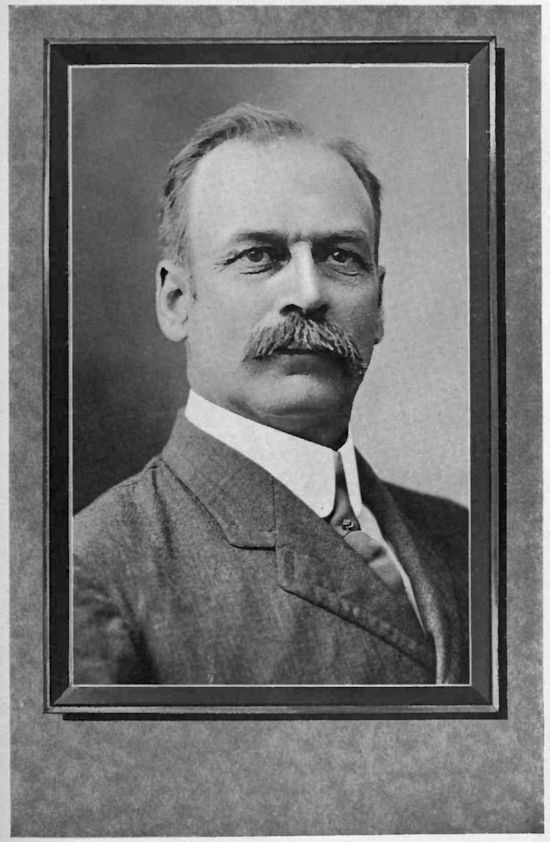
W. H. DWYER Ottawa
Hutchison, Col. William (Ottawa, Ont.), the subject of this sketch, was born in New Edinburgh in 1843, a suburb of the city of Ottawa. He was educated in the Public and Grammar Schools. When about seventeen years of age Col. Hutchison commenced to learn the Milling business with his uncle, the late Thos. McKay, who was then owner of the McKay Mills at the Chaudiere and also a partner in the New Edinburgh Mills. At the age of twenty Col. Hutchison left for the United States where he followed the milling business for several years. On his return he took charge of his uncle’s business and shortly afterwards was made a partner. In 1885 he was elected to City Council, and served for seven years. It was during Col. Hutchison’s service in the City Council that the question of the proper drainage of the city attained its greatest importance, and it is owing to his keen foresight and wise counsel and persistence that Ottawa to-day has the excellent drainage system of which it now boasts, and that is but one of the many happenings for the benefit, progress and beautification of Ottawa that were brought into existence through his instrumentality during his term of office in the City’s Civic affairs. From 1888 to, and including the year 1905, a period of eighteen years, Col. Hutchison was a member of the Board of Directors of the Central Canada Exhibition Association, and from 1895 to 1905, 10 years, he was President. On retiring in 1906 he was elected Honorary President of the Association and has been re-elected to that position every year since. Col. Hutchison, with the assistance of Messrs. Ahearn and Topper, was instrumental in converting the old horse car line to electric, giving Ottawa one of the best street car services on the continent. He ran for the Dominion House in 1896, with the result that both he and his French colleague, Napoleon A. Belcourt, were elected by a sweeping majority. At the time the Conservatives felt that they had a serious grievance, but ere long the good-hearted, good-natured and genial new Member became the friend and companion of both Liberals and Conservatives in the House of Commons. In 1901, when Sir Wilfrid Laurier needed a competent man to travel to all parts of the world to exhibit Canada’s mineral, cereal and industrial resources, Col. Hutchison was asked to accept the position of Canadian Exhibition Commissioner. He accepted and since his appointment he has had charge of Canada’s exhibits at the following times and places:—1901, Buffalo, U.S.A.; 1902, Osaka, Japan; 1903-04 St. Louis, U.S.A.; 1905, Liege, Belgium; 1906, Milan, Italy; 1907, Dublin, Ireland; 1908, Shepherds Bush, London, England; 1909, Seattle, U.S.A.; 1910, Brussels, Belgium; 1911-12, Crystal Palace, London, England; 1913, Ghent, Belgium; 1914-15, San Francisco, U.S.A.; 1916-17, San Diego, U.S.A. The great world war has caused a cessation of the valuable exhibits, but the whole display is located in commodious quarters on Wellington St. in Ottawa, under Col. Hutchison’s special care, waiting and ready to be shipped at a moment’s notice. In 1902 Col. Hutchison was decorated by the Emperor of Japan with the Order of the Rising Sun (with rank of Colonel in the Army). In 1905 he was decorated by the late King Leopold II. of Belgium, with the Order of Leopold, and in 1906 by the King of Italy with the Order of the Crown of Italy, in 1910 he was made Commander of the Order of the Crown of Belgium by King Albert I. Col. William Hutchison is the son of the late Robert Hutchison of Ayrshire, Scotland, who came to Canada in 1830 and in New Edinburgh married Mary McKay, niece of the late Hon. Thos. McKay, who was born in Edinburgh, Scotland. In September, 1874, he married Electa Blanche, daughter of S. T. Willett of Chambly, Quebec. Two sons have blessed the union. In religion he is a Presbyterian, and in politics a high tariff Liberal. He is also a member of the Rideau Club, Ottawa, and his residence is 443 Albert St., Ottawa.