LESSON XLIX. The Art-Song. Oratorio after Mendelssohn.
Reading edition
Development of the Art-Song Idea.—A most significant phase of musical activity is that centred around the art-song for solo voice. In the period before the opera, choral singing was the principal medium for vocal music. With the Opera came a style of composition from which was developed the principle of the Aria, the latter dominating both Opera and Oratorio for many years, as the form for an art-song for a solo voice. In this form, as we have seen, the production of vocal effects, the making of attractive melody, and the opportunity for virtuosic display were sought first of all. It was not until the beginning of the 19th century, when Schubert’s peculiar genius asserted itself, that we meet what can be truly called the art-song, a form of composition without the artificiality of the operatic aria and with higher musicianly and artistic qualities than those that mark the people’s song. Several tendencies contributed to bring this about. Gluck’s theories and practice led both composers and people to pay closer attention to the text and to its delivery. The development of instrumental music, particularly the principles of thematic treatment, led composers to the inventing of new melodic and rhythmic figures that should serve as the basis of accompaniments of higher artistic quality than those founded on some variation of the Alberti bass figure. Piano technic had greatly improved, and so had the instrument. And it may also be said that the verse of this period was better suited for a dramatic musical setting than the formal, often stilted and artificial lyrics of earlier days, with their shepherds and shepherdesses and constant reference to pastoral and classical life.
Italian, French and English Forms.—A study of musical conditions in Italy, France, Germany and England shows a different style of the solo song in each country, each having some distinctive feature that maintains today, and one that may be said to characterize the song-idea of that people. The Italians were so taken with the opera and in the course of its development it so fully embodied the national love for sweet, graceful melody that a species of art-song apart from the opera had little or no chance to shape itself. The French Chanson has never yielded place to the methods which distinguish the modern art-song. The French language has certain qualities which seem to call for a treatment that centres the attention in the voice part rather than on the song as a whole, according to the German idea. Yet French composers have produced and still make most beautiful and charming songs which unmistakably embody the national characteristics, clearness, polish and an effective singing melody. The old English Ballads are pieces of narrative verse; but the term has been used so freely and for almost every kind of verse that it is not possible to give it a precise definition. Thomas Morley, in a work on music, which he published in 1597, mentions “songs which, being sung to a dittie may likewise be danced”; in 1636, in a book called “The Principles of Musicke,” the author, Butler, refers to “the infinite multitude of Ballads set to sundry pleasant and delightful tunes by cunning and witty composers, with country dances fitted to them.” The principles of musical construction and the character of the text are such that we do not find in the English ballad the true germ of the art-song.
The German “Lied”, a poem intended for singing, as it came from the hands of the great poets, such as Goethe and Heine, seems to have afforded to composers the inspiration to the making of a style of song that should have the value of a musical setting in full consonance with the character of the text. As instrumental music developed, the Volkslied, the people’s song, the natural medium for expression, gradually disappeared. Yet composers made use of it as a medium, such masters as Haydn, Mozart, Beethoven and Weber giving attention to it, although the demand for a simple, clear melody, due to the dominance of the Italian opera, and for an accompaniment that was always much subordinated, prevented the art-song (Kunstlied) from taking a high place. Since then the accompaniment has been given more and more prominence, less attention being paid to pure melody and more to the value of harmony and rhythm as the means for characteristic color and expression. Melody, which is made up of a succession of phrases, cannot furnish a sequence of sharp effects so readily as can well contrasted chords; hence the old idea of tune changed as harmony became better understood. The methods of song composers vary, and a classification is made by German writers: A song that has simple form and tune akin to that of the Folk-song is called “Volksthümlich”; one that has the same tune to the different stanzas is called strophic; one that is carefully worked out, the music illustrating every shade of meaning and emotion is called “Durchcomponirt”; a narrative song is called a “Ballad” or “Ballade.” The great masters in song composition are Schubert, Schumann, Franz and Brahms.
Schubert as a Song Writer.—A consideration of Schubert’s education and his general make-up shows clearly why he should seek outlet for self-expression in song rather than in the large instrumental forms. We find that he was not systematically educated in musical science, like Mozart, Beethoven or Weber, and that he was by nature very spontaneous and amenable to external influences. Such a composer is particularly open to the effect of a poem and will turn to the small song form rather than to the elaborate instrumental forms. Many of Schubert’s songs were written on the spur of the moment in response to an impulse from reading a chance bit of verse. The first reading of the poem usually gave the complete idea, both tune and accompaniment; whether it should have the simple folk-song character, a more declamatory style, strophic or the more elaborate form, depended upon the character of the text. It is fortunate for music that he was brought into contact with some of the finest lyrics in the field of poetry, such as called forth his highest powers in melody, harmony, rhythm, modulation, declamation and recitative, for he aimed to the very fullest extent possible to heighten the thought of the text by the emotional power of music. It is a phase of Schubert’s genius that some of his finest songs were written before he had reached his majority.
Schumann and His Songs.—Schumann brought to song writing a different type of mind from that of Schubert, more poetic, more gloomy, more emotional, a fine literary training, a faculty for expression in word as well as in tone, a fund of new forms of expression in instrumental music, particularly the piano, so that we find in his songs certain elements that indicate development toward a more highly organized structure. Schumann was highly intellectual, hence we find in his songs a close union of voice and instrumental parts in working out the fundamental conception of the poet’s meaning; and so deeply does he carry out this plan that the accompanist must enter most thoroughly into the singer’s part, and vice versa, that the full effect be brought out; as compared with the songs of Schubert and Mendelssohn we can say that the latter are the “verses set to tunes, while Schumann’s songs are poems in music.” The piano part of a Schumann song contains the atmosphere of the poem, is an attempt to heighten the meaning by suggesting thoughts and feelings which the words, spoken or sung, cannot express; sometimes it is an entirely independent composition, and carries out to a final close the thought left unfinished by the voice, thus avoiding the conventional ending, by the singer, on the tonic chord. Schumann’s effort was to express his own reading of the poet’s lines by the musical means that seemed to him best suited to the purpose. To this end he refused to allow himself to be bound by conventional treatment, either of voice or instrument.
Robert Franz (1815-1892) combined in his songs the romanticism and general methods of Schumann, with a polyphonic treatment inspired by his deep study of Bach. He wrote to various styles of verse, hymns, love-songs, lyrics of the field, the forest, the hunter, the soldier, and though his songs lack the tender, passionate, melodious quality of Schubert’s and the deep poetic feeling of Schumann’s, they are nevertheless models of perfect, even elaborate workmanship in which the composer follows with great faithfulness the mood of the poet; Schumann, on the contrary, seems to project his own interpretation of the poem into his music, while Schubert seems to grasp the emotion at its highest moment and the song pours out as the spontaneous expression of the singer.
Three Modern Writers.—Of modern writers, those who contributed most to the development of the art-song are Wagner, Brahms and Richard Strauss, the first-named by his style and treatment of the voice and the instrumental part rather than by his songs, which are few in number. Brahms wrote nearly two hundred songs, varying in character and quality, and using a highly-developed accompaniment, often intricate in its construction, complicated in rhythm and restless in harmonic support, employing all the resources which his mastery of chromatic harmony placed at his disposal. He frequently wrote in the style of the Folk-song, making use of its simple melodic quality, enriching it, however, by his great skill in elaboration in the accompaniment. Brahms’ songs are great favorites on concert programs. Richard Strauss (b. 1864) is the leading composer of today, and has used in his songs the principles that distinguish his large works. These songs are very difficult, both for voice and accompaniment, and are full of tonal coloring, for Strauss has adapted to the miniature form of the song the means of harmonic and rhythmic effects which he uses so powerfully in his orchestral scores. When well sung and well played, the hearer cannot but be absorbed by the wealth of musical effects of the highest emotional and picturesque quality displayed in Richard Strauss’ songs. In a full study of songs and song writers, many more names would be mentioned; those selected for consideration in this lesson represent those who have contributed most significantly to the development of the modern art-song.
Oratorio Composers after Mendelssohn.—The later history of the Oratorio requires some consideration at this point. After Mendelssohn, many of the leading composers of Europe turned their attention to this form of composition, influenced, in many instances, by the splendid opportunities for production offered by the strong choral organizations and festival associations of Germany and England, as well as by the great advances made in orchestral playing, which gave to composers resources far beyond those at the hand of Mendelssohn and his predecessors. We may mention, among the Germans, Schumann, whose “Paradise and the Peri” was produced in 1843; Liszt, who was much attracted to sacred subjects, wrote two oratorios, “The Legend of St. Elizabeth” and “Christus”; Rubinstein, who used his great skill in tone painting with orchestral masses in “Paradise Lost” and in his sacred opera “The Tower of Babel”; Brahms, whose “German Requiem” is a standard work to be done well only by thoroughly disciplined vocal and instrumental forces; and Dvořák, who has shown great power in his “Stabat Mater.” Among the French writers most prominent in this form of composition are Berlioz, whose “Requiem” is a colossal work in which he drew upon all the resources of the orchestra to heighten the powerful, dramatic character of the text; Gounod, who wrote his remarkable works, “The Redemption” and “Mors et Vita” for English production; Saint-Saëns, whose “Noël,” a Christmas work, is oratorio in style and construction, although small in dimensions; and César Franck, the most modern of all, whose “Beatitudes” has been made the subject of much discussion. English composers, following the lead of Handel and Mendelssohn, have given great attention to this form. Bennett, the friend of Mendelssohn, produced a beautiful work, “The Woman of Samaria”; Costa, an Italian by birth, spent a great part of his professional life in England; hence his oratorio, “Eli,” may be classed with English works; Sullivan wrote two oratorios, “The Prodigal Son” and “The Light of the World”; Macfarren’s “St. John the Baptist” and Mackenzie’s “Rose of Sharon” can be classed among oratorios. The most eminent in this form at the present day is Elgar, “The Dream of Gerontius” and “The Apostles.” Young Italy has lately shown interest in this form, the most noteworthy being the Abbé Perosi, who is under the patronage of the Pope. In the United States the leading representatives are J. K. Paine, of Harvard University, with the oratorio “St. Peter,” Dudley Buck, “Golden Legend,” and H. W. Parker, “Hora Novissima.”
The Cantata.—More popular even than the Oratorio with choral societies is the Cantata, both sacred and secular, and the great increase in strong choral organizations, particularly in England, Germany, France and the United States, has resulted in the production of a number of splendid works which show dramatic power and the highest skill in handling voices and instruments. These works contain opportunities for the use of the finest quality of melody, variety of rhythm, solid harmonic or the more fluent polyphonic style, richness of harmonic coloring and every accessory in the way of tone painting by the orchestra, which such masters as Berlioz and Wagner pointed out. The important works are too many to be mentioned here; only the composers’ names can be given. In Germany, Brahms, Bruch, Dvořák, Gade, Goetz, Hiller, Hofmann, Rheinberger; in France, Berlioz and Massenet; in England, Bennett, Corder, Cowen, Macfarren, Mackenzie, Smart, Sullivan, Coleridge-Taylor among the younger men; in the United States, Buck, Foote, Chadwick, Gilchrist, Paine, H. W. Parker, and Carl Busch.
References.
Finck.—Songs and Song Writers.
Grove’s and Riemann’s Dictionaries.—Articles on composers mentioned,
on Song, Lied, Volkslied, Chanson, Oratorio and Cantata.
Parry.—Evolution of the Art of Music, Chapter XIII.
Upton.—Standard Oratorios. Standard Cantatas.
Questions.
Compare the Aria and the Song.
Mention the characteristics of the Italian, French and English people’s songs.
What are the characteristics of the German Lied?
Give a sketch of Schubert as a song writer.
Give a sketch of Schumann as a song writer.
Compare the two.
Give a sketch of Franz as a song writer.
Compare him with Schubert and Schumann.
Who are eminent among modern song writers?
Mention the special characteristics of each.
Name the leading composers of Oratorio after Mendelssohn, and their works.
What is the difference between an oratorio and a cantata?
What composers have done successful work in this line?
Songs of the leading composers, classic and modern, should be studied. The lessons on Schubert, Schumann, Liszt, etc., mention notable songs. Analyze an oratorio by one of the composers mentioned in this lesson, also one or more cantatas.
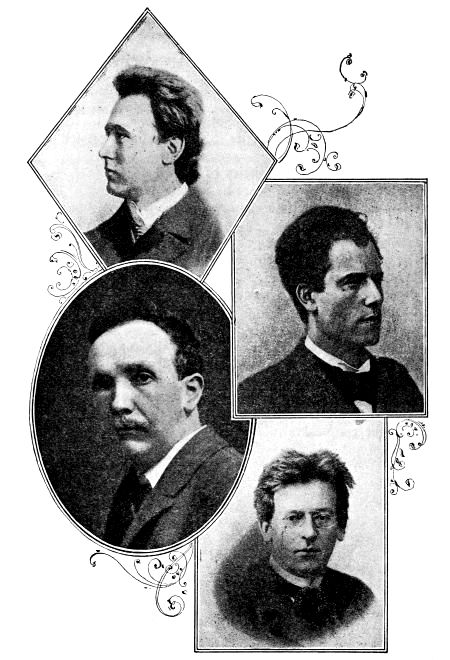
Felix Weingartner. Gustav Mahler. Richard Strauss. Siegmund Hausegger.