LESSON LI. German Opera Since Wagner.
Reading edition
Goldmark.—Among those opera composers who are not direct imitators of Wagner, Carl Goldmark (Keszthely, Hungary, 1830) is the most noted. Son of a cantor in a synagogue, he showed decided musical taste while still a child, and at twelve played the violin in public. After a few conservatory lessons at Vienna, he was forced to make his own way, and live on the small salary obtained in theatre orchestras. He taught himself piano and singing, and was soon able to teach others also. He trained himself by reading the scores of the great master-works. In purely orchestral composition, his first success came with the “Sakuntala” overture, inspired by the story of the Oriental nymph of that name, who is wooed, forgotten, and found again by the Indian king, Dushianta. Later overtures are “Penthesilea,” “Spring,” “Prometheus Bound,” and “Italy.” Goldmark wrote two symphonies, the first (“Rustic Wedding”) resembling a suite of tone-pictures, while the second is in stricter form. He has also published a violin concerto, some chamber works, and vocal pieces. His music is marked by richness of harmony and warmth of instrumental coloring.
Goldmark’s Operas.—His first opera was the “Queen of Sheba,” dealing with the infatuation of Assad for that queen, at the court of King Solomon. Its scenes of splendid festivity and dramatic power, and its delightful music, won it an immense success, and Goldmark was nicknamed “Court Composer to the Queen of Sheba.” “Merlin,” his next work, is based on that wizard’s love for Viviane, in the days of King Arthur. It contains much noble music, but the libretto is weak and confused. “Heimchen am Herd” is an example of the style of Folk-opera introduced by Humperdinck. It is a setting of Dickens’ “Cricket on the Hearth,” and its music shows a most delightful freshness and charm. “Die Kriegsgefangene” treats the story of Achilles and Briseis with much expressive power, while “Götz von Berlichingen” is a setting of Goethe’s novel of that title. “Der Fremdling” (The Stranger) is a manuscript work.
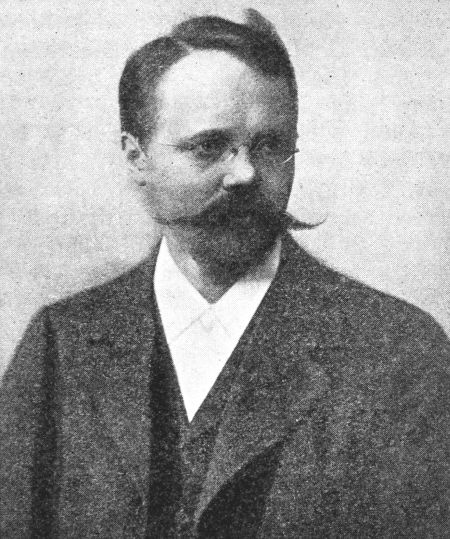
Engelbert Humperdinck.
Humperdinck.—Engelbert Humperdinck (Bonn, Germany, 1854) won a remarkable success with his Folk-opera “Hänsel and Gretel,” a work which has almost founded a new school in Germany. Humperdinck studied architecture at first, but at Hiller’s advice took up music. “Hänsel and Gretel” is the story of two poor children who are left in the woods by their stepmother. They find a gingerbread house, inhabited by a witch who wishes to eat them; but Gretel pushes her into her own oven, and frees all the children previously under her spells. The greatness of this work, like that of Weber’s operas, in their day, lies in its union of the popular Folk-song style with the richness of modern orchestration. The music is fresh and tuneful, with an appealing sincerity that carries it directly to the heart. At a period when other composers seemed able to produce nothing but weak imitations of Wagner’s operas, this work won universal recognition. Humperdinck has produced several other fairy operas, such as “Dornröschen,” “Die Königskinder,” “Saint-Cyr,” and “Die Sieben Geislein,” but none of them has gained any lasting success.
Kienzl.—Another composer of originality is Wilhelm Kienzl (Waizen-Kirchen, Austria, 1857). He studied at Graz, Prague, Leipzig, and, finally, with Liszt, at Weimar. He, too, served as conductor in small theatres. His first opera, “Urvasi,” is based on an East Indian subject. Its music is brilliant, but lacking in dramatic effect. “Heilmar der Narr” deals with the magic healing qualities of a seventh son, who forfeits his power if rewarded; he cures his sweetheart, but loses his gift because he wins her, whereupon she sacrifices herself to bring back his skill. Kienzl’s greatest work is “Der Evangelimann,” treating of a true story of two brothers in a small Austrian hamlet. Both love the same girl, Martha, but she prefers Mathias. Johannes, out of jealousy, sets fire to a house where the lovers are meeting, and denounces Mathias as the incendiary. Martha tries in vain to save him, and he is imprisoned for twenty years. At the end of this term, Johannes, who has been prosperous and respected, is confronted on his death-bed by Mathias, who forgives him. This opera has been given in many countries, and translated into several languages. Its music shows much dramatic force, and goes far to redeem those scenes in the libretto that are lacking in action. A fourth opera by Kienzl is the tragi-comedy “Don Quixote.”
Schillings.—Among the composers who have modelled their works on those of Wagner is Max Schillings (Düren, Germany, 1868). He studied law at first, like Schumann, but soon turned to music, and became one of Wagner’s active assistants at Bayreuth. His “Ingwelde” is one of the many Viking operas that have followed in the lead of “Tristan and Isolde,” and aimed at effects of dramatic power. Ingwelde is forced by a careless oath to follow Klause, enemy of her husband, Gest. Bran, Klause’s brother, loves her also, and kills Klause. She returns to Gest, but Bran follows and kills him too, after which the pair die together. “Der Pfeifertag,” a later work, is evidently inspired by “Die Meistersinger.” It is a confused account of various adventures on “Pipers’ Day,” a mediæval festival. The chief episodes are the reduction of an excessive toll paid by the pipers, the pretended death of one of that Guild, who thus obtains a eulogy from a rival, and the union of two pairs of lovers. The music, though worthy, can hardly stand comparison with that of the great work upon which the opera was modelled.
Cyrill Kistler (Augsburg, Germany, 1848) was at one time thought to be Wagner’s real successor, but nearly all his works are now laid aside. They show an evident striving after musical grandeur, but are not wholly successful in attaining that effect. Kistler studied with Lachner and others at Munich, but became a Wagner enthusiast in spite of their formal training. In his first opera, “Kunihild,” the heroine is wooed by one of three brothers, who is successful in the magic ride necessary to win her. But there has been a feud between the houses, and another brother, to prevent the marriage, kills the bridegroom. A comic opera, “Eulenspiegel,” preceded by ten years the symphonic poem of Strauss. “Baldurs Tod” is based on the beautiful Norse Saga of the Sun-God. “Im Honigmond” is a smaller work, in romantic style. A more important production in the same vein is “Röslein im Hag,” which bids fair to be successful. “Der Vogt von Mühlstein” is a work of still more recent date.
August Bungert (Mühlheim, Germany, 1846) studied at Cologne and Paris, taking up composition at Berlin under the renowned Fr. Kiel. He has produced a light opera, “Die Studenten von Salamanca,” a “Tasso” overture, and the symphonic poem “Auf der Wartburg.” But his life-work has been the composition of a Hexalogy, or set of six operas, on Homeric subjects. The first two, “Achilles” and “Klytemnestra,” are from the Iliad, while the Odyssey furnishes the material for “Kirke,” “Nausikaa,” “Odysseus Heimkehr,” and “Odysseus Tod.” The abiding beauty of the old Greek poems has been faithfully preserved in the librettos, and the music has reflected, to some degree, the noble dignity of these epics. The first three works of the Odyssey cycle have been given, and have produced an excellent impression on the critics.
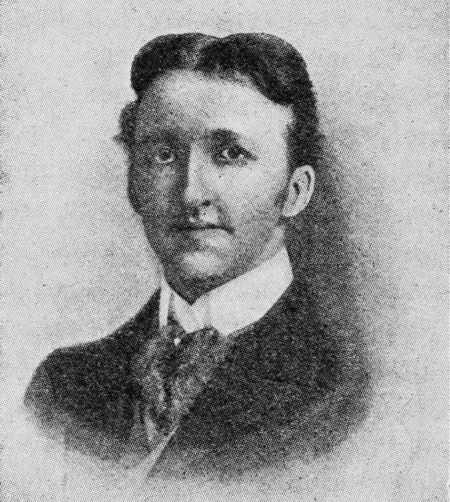
Siegfried Wagner.
Siegfried Wagner (Triebschen, Switzerland, 1869), son of the immortal Richard, has an undoubted right to carry on the family traditions. He studied with Kniese and Humperdinck, and became a very energetic conductor. His first opera, “Der Bärenhäuter,” is the story of a mediæval soldier who sells himself to the devil, but is redeemed by finding a sweetheart who will remain true during three years of absence. “Herzog Wildfang,” the next work, treats of a fiery duke who is made unpopular and supplanted by his crafty adviser, Mathias Blank. Mathias is afterward caught in trying to win the beautiful Osterlind by trickery, and his dishonesty in office is also exposed; whereupon the rightful duke comes to his own again, and Osterlind marries her real lover. “Der Kobold,” a third work, treats of the legend that the souls of murdered children wander about as kobolds until released by the sacrifice of the last of their race. “Bruder Lustig,” the fourth opera, is based on an Austrian subject.
D’Albert.—In Eugen d’Albert (Glasgow, Scotland, 1864), we find a man of real musical gifts. He studied under such men as Stainer and Prout in England, but he claims that his true musical education began only in later days, under Richter and Liszt. He has won international fame as a pianist, and has shown real musicianship in his purely orchestral works. These include two concertos for piano, one for violoncello, the “Esther” and “Hyperion” overtures, and a worthy symphony; all showing harmonic beauty and richness of color, without any inflation or exaggerated effects. His first opera, “The Ruby,” tells of a princess imprisoned in the form of that magic gem, but released by a poor young man who wins her. “Ghismonda” deals with the love of a princess for a young man of low degree, but noble character. On being surprised with the princess, he dies rather than reveal her love for him, but she proclaims his chivalry to the world. “Gernot” is an elfin opera, with much delicate music. “Die Abreise” shows the reconciliation of a married couple who have begun to drift apart, and the departure of the over-amorous cavalier who tried to widen the breach for his own purposes. “Kain” is a weirdly effective one-act drama, of the realistic school. “Der Improvisator” has for its libretto a rather weak arrangement of Hugo’s “Angelo, Tyrant of Padua,” while “Tiefland” is founded on a Spanish tale, in which true love triumphs over the schemes of a wicked Alcalde.
Hugo Wolf (Vienna, Austria, 1860—Vienna, 1902) had a constant struggle with poverty, and enjoyed but a short period of fame before yielding to insanity and death. His opera, “Der Corregidor,” is a delightful work, in comic vein, and the humorous scenes on the stage are treated with remarkable animation and skill in the orchestra. The Corregidor is a Spanish magistrate, who is too much smitten with Frasquita, the beautiful wife of the miller, Tio Lucas. The pair play him many tricks, and the opera ends with his discomfiture before his own consort. Wolf’s fame is much increased by the rare power and beauty of his many songs. Especially worthy of note are the “Feuerreiter,” “Gebet,” “Gesang Weylas,” and the “Italienisches Liederbuch.” His symphonic poem, “Penthesilea,” is another important work. His style is sometimes bizarre and involved, but his themes are always effective and significant.
Other Composers.—Max Bruch (Cologne, Germany, 1838) studied under Hiller, Reinecke, and Breuning. His chief opera, “Hermione,” is not important, but he has won lasting fame by the breadth and nobility of his epic cantatas, such as “Frithjof,” “Odysseus,” “Arminius,” and others. His concertos and serenade for violin are favorite works with soloists. Ludwig Thuille, a friend of Strauss, is given high praise by musicians, and his new opera “Gugeline” has been well received. Heinrich Zollner has won a popular success by his setting of Hauptmann’s delicate play, “The Sunken Bell.” Hans Pfitzner has produced an excellent work in his romantic forest-opera, “Die Rose vom Liebesgarten.” Leo Blech’s “Alpenkönig und Menschenfeind” has received numerous performances, while E. Klose’s fairy opera, “Ilsebill,” is a worthy example of its school.
Opera in Germany.—Since Wagner’s time, there has been no striking development in German opera, and his works still remain by far the most important in that field. None can rival him in the power, variety, and expressive qualities of his music. Strauss surpasses him in intricacy and novelty of instrumental effects, but Wagner himself first cleared the path in which Strauss was to follow. The greatest successes of Goldmark are those of twenty and thirty years ago. Humperdinck’s one chief work is frankly popular in style, and its attractiveness cannot fairly be compared with the grandeur of the music-dramas, even though it should found a school of its own. Bungert’s works, though well received, have not been given many performances, while many of those who have tried to imitate Wagner have echoed merely his outward mannerisms, and not the inward greatness of his works. It must be remembered, however, that a world-genius like that of Wagner does not appear in every country or every century, and that his importance prevents his successors from gaining their full meed of appreciation.
References.
Maitland, J. A. Fuller.—Masters of German Music.
Elson, Arthur.—Modern Composers of Europe.
Questions.
Give a sketch of Carl Goldmark and his works.
In what style of opera has Humperdinck been most successful?
Give an account of Kienzl and his most important works.
Whose works seem to have furnished models for Max Schillings’ operas?
Give an account of the works of Kistler.
What is the great work of August Bungert?
Give the stories of Siegfried Wagner’s operas.
Give an account of Eugen d’Albert and his works.
Give an account of Hugo Wolf’s works.
What other composers have done important work in this field?
Summarize the work of the leading composers mentioned in this lesson.
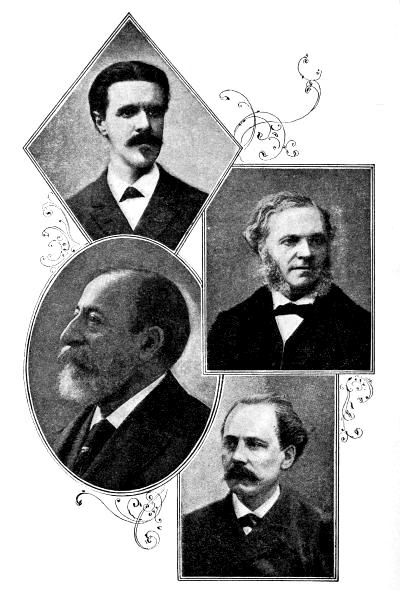
Vincent D’Indy. César Franck. Camille Saint-Saëns. Jules Massenet.