LESSON LII. Old and New Schools in France.
Reading edition
Saint-Saëns.—The end of the 19th century in France has been marked by a decided contrast between the old and the new, Saint-Saëns and Massenet writing in the older style, while the pupils of Franck have striven after novelty in effect. Charles-Camille Saint-Saëns (Paris, France, 1835) witnessed the rise and fall of Meyerbeer, and the triumphs of Gounod, and was himself famous before the influence of Wagner reached France. His style is marked by great diversity, and displays equal skill in many different veins; but his music always shows the utmost facility of expression, a mastery of the technic of composing, and a remarkable ease and fluency. His has been a true musical development, founded on rational lines. He was always a warm admirer of Bach, Beethoven, and the Classical school, and while he appreciated Liszt, Wagner and other modern masters, he did not abandon the old ideas of form and melody. His works show the most exquisite symmetry of detail, like that of a finely-carved monument enriched by delicate tracery.
His Works.—Saint-Saëns studied at the Conservatoire, under Stamaty, Halévy, and Benoist. Though he failed in trying for the Prix de Rome, he produced a worthy symphony when only sixteen. In opera, his first success was the Biblical “Samson and Dalila,” a work of expressive power and vivid coloring. “Le Timbre d’Argent” and “La Princesse Jaune” are of earlier date. “Le Deluge,” is an operatic cantata. “Etienne-Marcel” won some success in Paris, while “Henry VIII” is a skilful blending of old and new styles. “Proserpine” and “Ascanio ” followed, while “Phryne” is a dainty example of opéra comique. “Parysatis,” “Déjanire,” and “Les Barbares” introduce grandiose effects for open-air performances. “Helène” is a shorter work, again on a Grecian subject. The composer’s versatility and smoothness of style prevent him from obtaining the highest dramatic intensity, but his music is always excellent. In the orchestral field, he has produced four later symphonies, five piano concertos (that in G minor being the favorite), and two suites. His symphonic poems include “Le Rouet d’Omphale,” a delicious orchestral spinning-song; “Phaeton” and “La Jeunesse d’Hercule,” also on mythical subjects; and the weird “Danse Macabre.” His violin concerto in B minor is a great favorite.
Massenet.—Jules Emile Frederic Massenet (Montreaux, France, 1842) is another Conservatoire pupil. Rejected at first by Bazin, as lacking talent, he worked steadily onward, and from a player in small cafés became one of the foremost figures in French music. His first great triumph came with “Marie Madeleine” and “Eve,” which are not strictly oratorios, but are more properly called sacred dramas. “La Vierge” and “La Terre Promise” are of later date. These works treat their subjects with modern spirit and passion, instead of the more classic oratorio style. Massenet is hardly the equal of Saint-Saëns in orchestral work, but his “Phedre” overture and his suites of tone-pictures are remarkably attractive. In opera, he won his spurs with “Le Roi de Lahore,” a spectacular Oriental subject. “Herodiade” is a sacred work, while “Manon” is a graceful setting of Prevost’s novel of that name. “Le Cid” is not so strong a work, for Massenet’s style is sentimental and passionate rather than heroic. “Esclairmonde,” with a romantic and legendary plot, displays remarkable beauty and richness of effect. “Werther,” based on Goethe’s novel, is another success. “Le Mage,” an Oriental subject, and “Thais,” with an Egyptian plot, were comparative failures. “La Navarraise,” with its love amid battles, is an echo of Italian realism. Massenet’s tender feeling and vivid emotion show at their best in his later works for the stage—“Le Portrait de Manon,” a delightful love-idyl, “Cendrillon,” a fairy opera, “Griselidis,” an old legend of wifely constancy, and “Le Jongleur de Notre-Dame.” The last is a touching story of a despised minstrel who wins favor with the Holy Virgin by his earnest desire to do something in her name, even if it be only to amuse her with his juggling tricks.
French Opera.—Among other French composers for the stage, Meyerbeer, Gounod and Bizet belong to a previous generation. Delibes won some notice with “Le Roi l’a Dit” and “Sylvia,” but his best work is “Lakmé,” another example of rich Oriental warmth and color. Ambroise Thomas is known chiefly as the composer of “Mignon,” a remarkably graceful setting of a libretto from Goethe’s “Wilhelm Meister.” “Le Songe d’un Nuit d’Été,” an earlier work, has also met with deserved success, but “Hamlet” is a ridiculous perversion of Shakespeare, and “Françoise de Rimini” failed to attain real tragic grandeur. Guiraud is known by his comic opera “Piccolino”; Poise set many of Molière’s plays; Lalo’s only notable work is “Le Roi d’Ys”; Godard’s dainty “Vivandière” is frankly light in style; while Salvayre’s ambitious “Dame de Monsoreau” is not a great success. Reyer’s “Erostrate” and “La Statue” were praised in their day, but he is better known by two later works—“Sigurd,” on the subject of “Die Götterdämmerung,” and “Salammbô,” a setting of Flaubert’s story of Carthage.
Franck and His Influence.—The new French school is almost wholly due to the work of one man, César Auguste Franck (Liége, Belgium, 1822—Paris, 1890). He settled in Paris, and studied at the Conservatoire. Modest and retiring by nature, “le bon père Franck,” as he was called, divided his time between teaching, composing, and playing the organ of the Ste. Clotilde Church. His simple faith and earnest work recall the spirit of the old mediæval artists, who devoted their lives and their music to the glory of the Lord. Franck’s works show a mastery and power that his pupils are scarcely able to equal, and his compositions have fairly won the esteem that was denied to them during the composer’s lifetime. Among them are the great D minor Symphony, the oratorios “Ruth,” “Rebecca,” and “The Redemption,” the opera “Hulda,” and the symphonic poems “Psyche” (with voices), “Les Djinns,” “Les Eolides,” and “Le Chasseur Maudit.” But Franck’s most notable work is “Les Beatitudes,” an eight-part oratorio treating the Sermon on the Mount. Franck’s style is radically different from that of Saint-Saëns or Massenet. It is harmonic rather than melodic, and extremely modulatory in effect. His progressions remind the hearer of Wagner; but they do not always possess the broad simplicity that underlies Wagner’s most intricate passages. Franck’s pupils have often fallen into the error of imitating his weakest points, and have brought about a style of harmonic vagueness that seems meaningless to many modern critics.
D’Indy.—Vincent d’Indy (Paris, France, 1852) is the greatest of Franck’s pupils, and the leader of the modern French school. As conductor, he has been an ardent champion of new and little-known works. His own compositions include many forms, and have all attracted attention. His first great work to reach the public was the “Piccolomini” overture, a part of his orchestral trilogy based on Schiller’s “Wallenstein.” Two important vocal compositions are “La Chevauchée du Cid,” for baritone, chorus, and orchestra, and “Le Chant de la Cloche,” a dramatic legend that won the prize given by the city of Paris. In the orchestral field, “Antony and Cleopatra” is an early work, as is also the “Jean Hunyadi” symphony. Of d’Indy’s two later symphonies, the first, based on a mountain air, contains many passages of sweetness and purity, while the second is more involved and modulatory in style. His earliest symphonic poem, “La Forêt Enchantée” is a delicate tone-picture based on a ballad of Uhland; “Saugefleurie” is founded on a story by de Bonnières; while “Istar” is inspired by parts of the old Assyrian epic “Idzubar.” D’Indy’s music is hardly popular in style, for its themes are not definitely melodic; but his skill in weaving them into an orchestral tissue is admired by all musicians. In opera, “Les Burgraves” and the lighter “Attendez-Moi Sous l’Orme” are youthful works, while “Fervaal” is a music-drama (action musicale) on a Druidic subject, and “L’Etranger” is symbolic in style. He has written some important works in musical literature and theory.
Charpentier.—Gustave Charpentier (Dieuze, France, 1860) was a Conservatoire pupil. The Prix de Rome took him to Italy, and his life there resulted in the pleasing orchestral suite “Impressions d’Italie.” This consists of five tone-pictures, entitled, “Serenade,” “At the Fountain,” “On Muleback,” “On the Summits,” and “Naples.” On his return he lived among the working-people of Montmartre, and their life is reflected in his later works. “La Vie du Poète” is a symphony-drama, giving episodes in the life of an unsuccessful genius. In the beginning, all is aspiration and enthusiasm. Then doubt follows. At first the poet is consoled by the serene beauty of the summer night, but his fears gain the upper hand. Then comes a picture of impotent raging and vain anger against fate, after which the poet tries to blot out his sorrows in the cheap gayety of the city. “La Couronnement de la Muse” is a pantomime, written with the idea that a working girl in each town or city should annually be chosen and crowned amid festivities. The composer’s greatest work, however, is the opera “Louise.” This tells the story of a poor working girl, whose parents forbid her to marry the somewhat wayward Julien. At the latter’s persuasion, she finally flies with him. Her parents try to reclaim her, but again she is drawn away, and her father is left shaking his fist at the terrible city that entices young girls from their homes. The music of “Louise” is full of power and realism, and even the street cries of Paris are echoed in its measures.
Bruneau.—Operatic realism has found a more prolific, if less successful, champion in Alfred Bruneau (Paris, France, 1857), another Conservatoire pupil. He has confined himself to librettos drawn from the novels of Zola. “Le Rêve,” an early work, is a psychological study of love, in the person of the dreamy Angelique, who dies from excess of happiness when her wedding is completed. “L’Attaque du Moulin” is a spirited story of the Franco-Prussian war, set in a more melodic and popular style. “Messidor” is again symbolic in style, the theme being a contrast between greed for gold and the simple pleasure of honest toil. “L’Ouragan” deals with the tempests of human passion and jealousy, as well as the hurricanes of nature. “L’Enfant Roi,” and the music to “La Faute de l’Abbé Mouret,” are more recent works. Bruneau is sincere and earnest in his efforts at realism, but his music is often heavy and uninspired. He has produced works in other fields, among them being a great “Requiem,” a “Heroic Overture,” and the symphonic poem “Penthesilée,” for voice and orchestra. His three books on French composers, and his many criticisms, have made him known in the domain of musical literature.
Debussy.—The new school of French music finds its most radical expression in the compositions of Achille Claude Debussy (Paris, France, 1862). A musician of great gifts, he chooses to imbue his music with a studied vagueness of effect, and wanders through a maze of changing keys and harmonies. Many persons find the result wholly incomprehensible at first, but on repeated hearing his works show a weird, elusive beauty that is worshipped by his adherents as the acme of musical expression. He, too, was a Conservatoire student, and won the Prix de Rome with the cantata “L’Enfant Prodigue.” Two lyric scenes, “La Demoiselle Élue,” and “Chimène,” first drew attention to the young artist. Then came the orchestral prelude to Mallarmé’s “L’Après-Midi d’un Faune,” a delicately-woven rhapsody, with much beauty and much weirdness in its harmonies. The Nocturnes, entitled, “Nuages” and “Fêtes,” are described by De Bréville as possessing the ethereal charm of a perfume that pervades the air, but defies analysis. A string quartet is in stricter form, but the “Proses Lyriques,” on subjects of Beaudelaire, also the “Chansons de Bilitis” and “Les Estampes” for piano, again show the free style. Debussy’s most ambitious work is “Pelleas et Mélisande,” an opera based on Maeterlinck’s play of that name. The poet’s words offer the same shadowy suggestions that the composer gives in music, and the harmonic effects of vague mystery are entirely in place here.
Chausson.—Ernest Chausson (Paris, France, 1855—Limay, 1899) proved himself a composer of real greatness, and was still in the prime of life when he met with a fatal bicycle accident, in 1899. Trained for law, he turned to music from choice, as Schumann did before him. A pupil of Massenet and Franck, he combined the direct expression of the former with the harmonic style of the latter, and produced works of a most attractive orchestral coloring. Among his compositions are a worthy symphony, the beautiful symphonic poem “Viviane,” the orchestral pictures “Solitude dans les Bois” and “Soir de Fête,” a “Poëme” for violin and orchestra, some chamber-music, and many pleasing songs and choruses. His one great opera was “Le Roi Arthus.” His works are full of tenderness and charm, yet not lacking in vigor and breadth; they have the modern harmonic richness and orchestral color, and are growing steadily in favor.
Other Composers.—Alexis Emanuel Chabrier, wholly self-taught in music, produced the brilliant orchestral rhapsody “España,” an attractive “Suite Pastorale,” a lively “Marche Joyeuse,” and some effective cantatas. In opera, his “Le Roi Malgré Lui” is an excellent example in lighter vein, but his greatest work is “Gwendoline,” on a Viking subject. Of all the Frenchmen, he was the one best fitted to attempt the bold, virile style required by the libretto. The most prominent orchestral writer of the younger generation is Paul Dukas, whose “Apprenti Sorcier” treats a humorous subject with rare skill. Théodore Dubois, for many years head of the Conservatoire, is best known by his oratorios, such as “Paradise Lost,” and his “Frithjof” overture. Gabriel Fauré, the organist, who succeeded Dubois as director of the Conservatoire in 1905, has produced a symphony, two string quartets, and a number of songs whose intricacy cannot obscure their exquisite grace. Other organist-composers are Charles Marie Widor, who wrote the opera “Maître Ambros” and the ballet “La Korrigane,” and Alexandre Guilmant, known by his great organ symphony and sonatas. Bourgault-Ducoudray has written many cantatas, and made a valuable collection of Breton Folk-songs. Pierné, Coquard, Erlanger and Hue won their fame in opera, while Duparc gained notice with his symphonic poem “Lenore.” Ropartz and de Bréville rank with the best of Franck’s pupils, while among women-composers, Augusta Holmés won renown by her mastery of broad orchestral effects, and Cécile Chaminade is known by her dainty songs and piano pieces.
The New French School.—When Wagner showed the harmonic resources of the modern orchestra, he led the way for a host of imitators, who have often done more harm than good. Such operas as “Fervaal” and “Gwendoline,” in large measure the result of “Tristan,” are proper applications of this style. But the idea of finding new harmonic effects has exerted its influence on orchestral writers also, and some modern composers, especially in France, have devoted all their energy to this, and have apparently sacrificed all thoughts of musical beauty. The French have even invented the term “cérébral,” which describes a composer who puts no emotion or feeling into his music, but works it out wholly from the brain. Thus many of the modern compositions must be regarded as great orchestral experiments, and the composer who combines this instrumental technic with real feeling and directness of utterance is the one who will meet with the greatest success.
References.
Hervey, Arthur.—Masters of French Music.
Hervey, Arthur.—Music in the 19th Century: France.
Elson, A.—Modern Composers of Europe.
Questions.
Which French composers represent the older style; which the new?
Give a sketch of the works of Saint-Saëns.
Give a sketch of the works of Massenet.
Name other important opera composers in France.
Who was the leader of the new French school? Give an account of his works. Name some of his pupils.
Who is the leading representative of this school today (1905)? Give an account of his works.
Which is the most important work of Charpentier?
In what lines of musical work did Bruneau labor? Name some of his works.
Who is the most extreme representative of the new French school?
What are the distinguishing characteristics of Chausson’s works?
Name other important French composers.
What is the character of some of the works of the advanced school of composition?
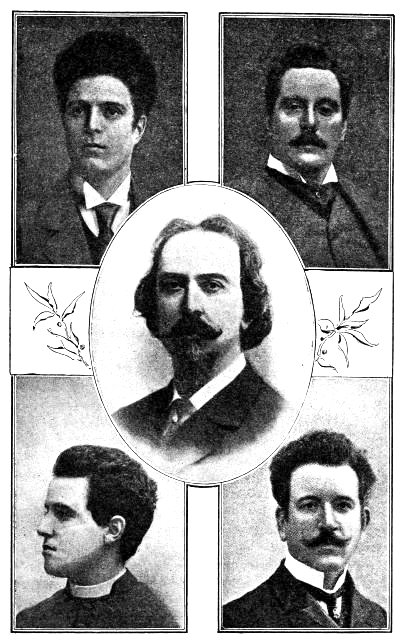
Pietro Mascagni. Giacomo Puccini. G. Sgambati. Abbé Perosi. Enrico Bossi.