TO THE RIGHT HONORABLE, HENRIE, Earle of Holland, &c. Captaine of the Guard; Lord-chiefe-Iustice in Eyre of all his Majesties Forrests, Parkes and Chases on this side Trent; Knight of the most noble Order of the Garter, and one of his Majesties most Honourable Privie Counsell.
Reading edition
Right Noble SIR,
HAving, of late, some Cause, to overlooke That thankfull Register, wherein I booke My noblest Friends; I found so many Names Possessing nothing, but their honour'd Fames, (Whose living Persons, wee injoyed, here, A while agoe;) that, I began to feare, I might grow Friendlesse; (having now so few) Vnlesse I sought, their Number to renew. By some Disasters, also, gaining proofe, How much this Course would make for my behoofe; I call'd my Wits to Counsell, Where, and How I might, with hopefulnesse, begin to sow The seeds of such a Blessing: And, me thought Within mee, something said: Where should be sought What thou so gladly wouldst renewed finde, But, from some Branches of the selfe-same kinde; Whose faire Aspects may seeme to promise fruit, According to the Virtues of the Roote? Assoone as Fancie had inform'd me so, Your Lordship, came to my remembrance, too, With what our Soveraigne's Favour, Vulgar Fame, Or, your owne Merits, addeth to your Name. Which, having weigh'd, no doubts at all I had Of Worth in Yov; But, rather, doubtings made That, all my Wits would insufficient be, To make that Worth, become a Friend to mee. For, I have oft observ'd, that, Favour shunnes The best Desert, if after her, it runnes. Yet, who can tell what may befall? thought I: It is no great Adventure, if I try Without successe: And, if, I gaine my End, I am assured of a Noble-Friend. His honourable Father, deem'd mee worth So much respecting as to seeke me forth, When, I was more obscure: And, Mee, for nought But, onely to Befriend mee, forth Hee sought. Then, wherefore, of his Sonne, should I suspect That (feeling Him) hee can my love reject? Since, Courtesie doth alwaies, there, abound, Where such a lovely Personage is found? My LORD, these were my Fancies: But I take them To be of no more worth, than, you shall make them By your Acceptance: Nor, is't my intent To Court you, with fruitlesse Complement: But, to attempt your Favour with a mind, As readily, and really, inclinde To serve you, when my services may steed; As to expect your Favours, in my need. For, had my Fates enabled me so much, I should more willingly have sought out such On whom I Courtesies might have bestowne, Than, seeke to cure Misfortunes of mine owne. No doubt, but, every day, your Lordship heares Inventions, which may better please your eares Than these I now present; And, yet you might (For ought I knew) finde profit, or delight, By our plaine EMBLEMS, or, some uses in them, Which from your Honour, some respects may win them; Ev'n for that good Moralitie, which they To Vulgar Vnderstandings will convay. But, Truth to speake, the chiefest cause which drew My minde, to make them PRESENTS, for your view, Was, but to take Occasion to professe, That, I am Servant, to your WORTHINESSE. In which, if YOV are pleased; All is got, At which I aym'd: And, though you like it not, It shall but teach Mee (for the time to come) To take more heed, where I am troublesome.
And, I shall be, neverthelesse,
your Honours to be commanded,
as becommeth your Servant,
Geo: Wither.
Whil'st I, the Sunne's bright Face may view, I will no meaner Light pursue.
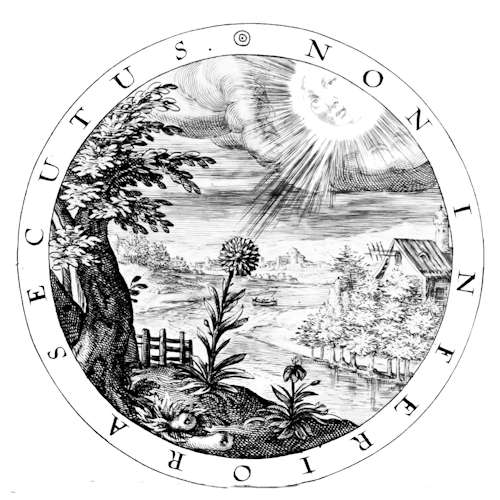
Illvstr. I. Book. 4
WHen, with a serious musing, I behold The gratefull, and obsequious Marigold, How duely, ev'ry morning, she displayes Her open brest, when Titan spreads his Rayes; How she observes him in his daily walke, Still bending towards him, her tender stalke; How, when he downe declines, she droopes and mournes, Bedew'd (as 'twere) with teares, till he returnes; And, how she vailes her Flow'rs, when he is gone, As if she scorned to be looked on By an inferiour Eye; or, did contemne To wayt upon a meaner Light, then Him. When this I meditate, me-thinkes, the Flowers Have spirits, farre more generous, then ours; And, give us faire Examples, to despise The servile Fawnings, and Idolatries, Wherewith, we court these earthly things below, Which merit not the service we bestow. But, oh my God! though groveling I appeare Vpon the Ground, (and have a rooting here, Which hales me downward) yet in my desire, To that, which is above mee, I aspire: And, all my best Affections I professe To Him, that is the Sunne of Righteousnesse. Oh! keepe the Morning of his Incarnation, The burning Noone-tide of his bitter Passion, The Night of his Descending, and the Height Of his Ascension, ever in my sight: That imitating him, in what I may, I never follow an inferiour Way.

The Earth is God's, and in his Hands Are all the Corners of the Lands.
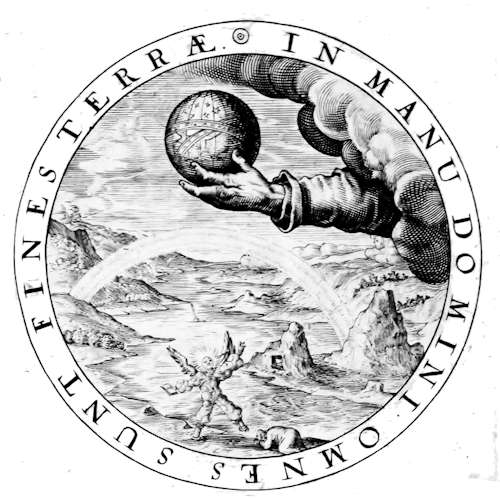
Illvstr. II. Book. 4
LOng since, the sacred Hebrew Lyrick sayd, (A Truth, which never justly was denayd) That, All the world is God's; and that his hands Enclose the limits of the farthest Lands. The selfe same Truth affirmes, that likewise, there, By him, their clodds, and furrowes warred are, And, that with dewes and showres, he doth so blesse The dwellings of the barren Wildernesse, That, those Inhabitants (whom some conceiv'd, Of usefull, and all pleasant things bereav'd) Their labors, with advantage, doe employ, And, fetch their yearely Harvests home, with joy. Why then should wee, that in God's Vineyard live, Distrust that all things needfull hee will give? Why should his Garden doubt of what it needs, Since hee oft waters barren Rocks and Weeds? Why should his Children, live in slavish feare, Since hee is kind to those that strangers are? Or, whither from his presence, can we flie, To whom the furthest hiding-place is nigh. And, if I may, from lower objects clime, (To questioning, in matters more sublime) Why should I thinke, the Soule shall not bee fed, Where God affoords, to Flesh, her daily Bread? Or, dreame, that hee, for some, provided none, Because, on us, much Mercie is bestowne? 'Tis true enough, that Hell devoureth all, Who shall be found without the Churches pale; But, how farre that extends, no Eye can see, Since, in Gods hands, Earth's farthest Corners bee.

By seeming other than thou art, Thou dost performe a foolish part.
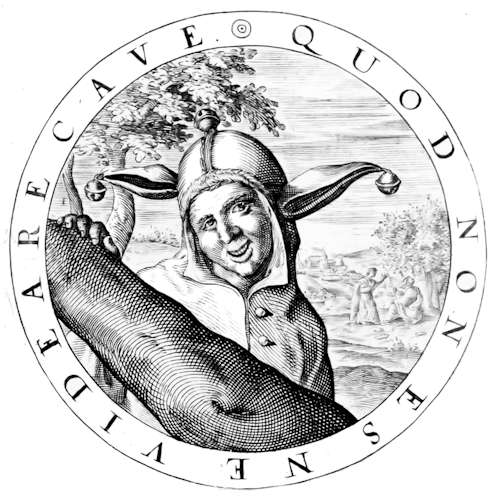
Illvstr. III. Book. 4
THe World is much for Shewes, and few there are So diligent to bee, as to appeare; Although a little travaile more, would make them Those men, for which, the lookers-on mistake them. Some, have so toyled, and consum'd so much, To get a false repute of being Rich, That, they have spent farre more, than would have bought, The substance of the shadow, they have sought; And, caused those, who deem'd them rich before, To know them, to bee miserably poore. Some others, would so faine be counted Wise, That, they consume in Curiosities, In Sophistries, and superficiall showes, More pretious Time, than would have made them those, They long to seeme, (had halfe that meanes been spent, In seeking Wisdome, with a pure intent) Whereas, the glorioust purchases of such, (Though by their Peeres they seeme applauded much) Are still so vaine, that little they possesse, But fruitlesse leaves, of learned foolishnesse: Yea, by affecting more than is their due, They lose ev'n both the substance, and the shew; And, so, instead of honours Crowne, have worne The Coxcombes, of a well-deserved scorne. But, of all Fooleries, the grossest Folly Is theirs, who weare those garbes of seeming-holy, Which paine them sore, yet make them still appeare, To God and Men, as wicked as they are. Be, therefore, what, to be thou hast profest; But, bee not of this last, of all the rest.

Pursue thy Workes, without delay, For, thy short houres runne fast away.
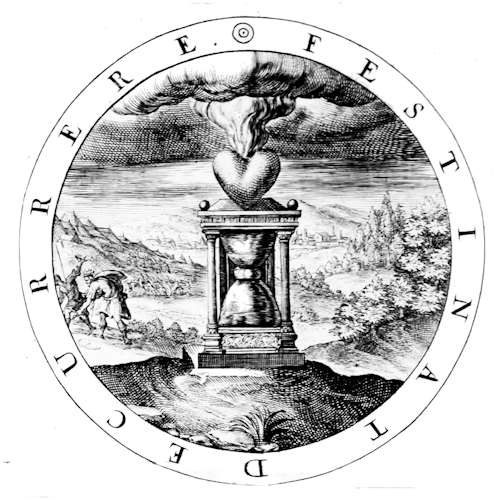
Illvstr. IIII. Book. 4
THough this bee but the picture of that Glasse, By which thou measur'st how thine houres doe passe, Yet, sleight it not; for, much 'twill profit thee, To ponder what the Morals of it bee. And, 'tis an Emblem, whence the Wise may learne, That, which their persons, neerely doth concerne. The brittle Glasse, serves fitly to expresse The Bodie's frailtie, and much crasinesse. Foure Pillars, which the glassie worke empale, Instruct thee, that the Vertues Cardinall, To guard the Manhood, should bee still employ'd, Lest else the feeble fabrick bee destroy'd. The Sand, still running forth, without delay, Doth shew, that Life-time, passeth fast away, And, makes no stop: yea, and the Motto too, (Lest thou forgetfull prove) informes thee so. By viewing this, Occasion, therefore, take, Of thy fast-flying Houres, more use to make; And, heedfull bee, to shunne their common crime, Who take much care to trifle out the time; As if it merited their utmost paine, To lose the gemme, which most they seeke to gaine. Time-past is lost already: Time-to-come, Belongs, as yet, thou knowst not unto whom. The present-houres are thine, and, onely those, Of which thou hast Commission to dispose; And, they from thee, doe flye away so fast, That, they are scarcely knowne, till they are past. Lord, give mee grace, to minde, and use Time so, That, I may doe thy worke, before I goe.

Repent, or God will breake the thread, By which, thy doome hangs o're thy head.
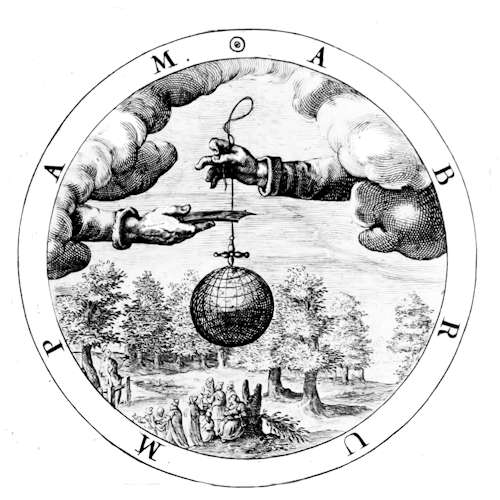
Illvstr. V. Book. 4
MArke well this Emblem; and, (when in a thread, You see the Globe, there, hang above their head, Who in securitie, beneath it sit) Observe likewise, the Knife, that threatens it; The smallnesse of the Twine; and, what a death Would follow, should it fall on those beneath: And (having well observ'd it) mind, I pray, That, which the word about it, there, doth say: For, it includes a Caveat, which wee need To entertaine, with a continuall heed. Though few consider it, wee finde it thus (Throughout our lives) with ev'ry one of us. Destruction hangeth in a single thread, Directly over every Sinner's head. That Sentence is gone forth, by which wee stand Condemn'd to suffer death. The dreadfull hand, Of God's impartiall Iustice, holds a Knife, Still ready, to cut off our thread of life; And, 'tis his mercie, that keepes up the Ball From falling, to the ruine of us all. Oh! let us minde, how often wee have bin, Ev'n in the very act of Deadly-sinne, Whilst this hung over us; and, let us praise, And love him, who hath yet prolong'd our dayes: Yea, let our thankfulnesse, bring forth such fruit, As, to the benefit may somewhat suit: For, though a sudden-Death may not ensue, Yet, (since Times Axe, doth every minute hew The Root of Life) the Tree, e're long, must fall; And, then perhaps, too late, repent wee shall.

When woe is in our selves begun, Then, whither from it, can wee run?
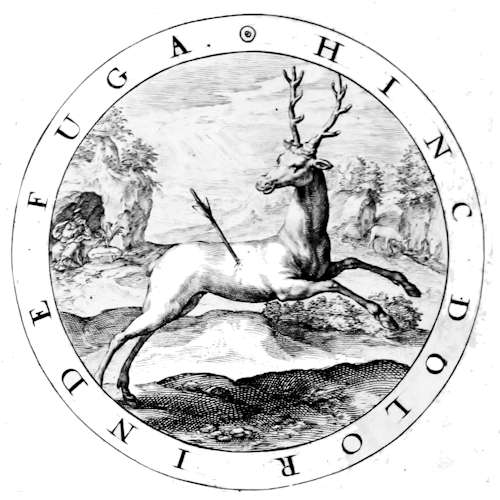
Illvstr. VI. Book. 4
POore Hart, why dost thou run so fast? and why, Behind thee dost thou looke, when thou dost fly? As if thou seem'dst in thy swift flight, to heare Those dangers following thee, wch thou dost feare? Alas! thou labour'st, and thou runn'st in vaine, To shunne, by flight, thy terrors, or thy paine; For, loe, thy Death, which thou hast dreaded so, Clings fast unto thee, wheresoere thou goe: And while thou toyl'st, an outward-ease to win, Thou draw'st thine owne destruction further in; Making that Arrow, which but prickes thy hide, To pierce thy tender entrailes, through thy side. And, well I may this wounded Hart bemoane; For, here, me thinkes, I'm taught to looke upon Mine owne condition; and, in him, to see Those deadly wounds, my Sinnes have made in mee. I greatly feare the World, may unawares Intangle mee, by her alluring snares: I am afraid, the Devill may inject Some poys'nous fume, my Spirit to infect, With ghostly Pestilence; and, I assay, To flie from these, with all the pow'rs I may. But, oh my Flesh! this very Flesh I weare, Is worse to mee, than Worlds, and Devils are: For, without this, no pow'r on mee, they had. This is that Shirt, which made Alcides mad. It is a griefe, which I shall never cure, Nor flie from, whilst my life-time doth endure: From thence, oh Lord, my greatest sorrowes bee; And, therefore, from my Selfe, I flie to Thee.

When Magistrates confined are, They revell, who were kept in feare.
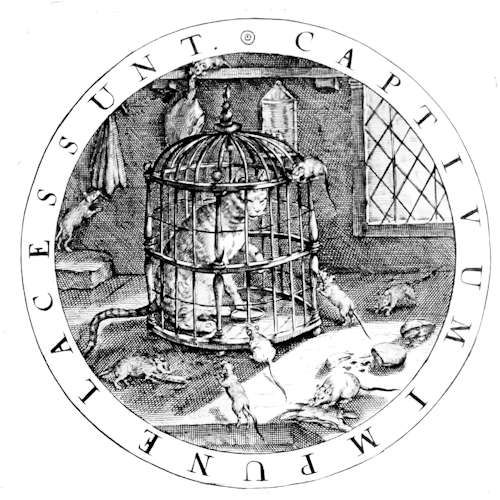
Illvstr. VII. Book. 4
A Tyrannous, or wicked Magistrat, Is fitly represented by a Catt: For, though the Mice a harmfull vermine bee, And, Cats the remedie; yet, oft wee see, That, by the Mice, far lesse, some house-wives leese, Then when they set the Catt to keepe the Cheese. A ravenous Cat, will punish in the Mouse, The very same Offences, in the house, Which hee himselfe commits; yea, for that Vice, Which was his owne (with praise) he kills the Mice; And, spoyleth not anothers life alone, Ev'n for that very fault which was his owne, But feeds, and fattens, in the spoyle of them, Whom hee, without compassion did condemne. Nay, worse than so; hee cannot bee content, To slaughter them, who are as innocent, As hee himselfe; but, hee must also play, And sport his wofull Pris'ners lives away; More torturing them, 'twixt fruitlesse hopes and feares, Than when their bowels, with his teeth he teares: For, by much terrour, and much crueltie, Hee kills them, ten times over, e're they die. When, such like Magistrates have rule obtain'd, The best men wish their powre might be restrain'd: But, they who shun enormities, through Feare, Are glad when good-men out of Office are. Yea, whether Governours bee good or bad, Of their displacings wicked-men are glad; And, when they see them brought into disgraces, They boldly play the Knaves before their faces.

Loe, heere is all, that bee possest, Which once was Victor of the East.

Illvstr. VIII. Book. 4
WHen hee, who by his conquering Arme, possest The rich, and spacious Empires of the East, Felt his approaching end; he bade them beare A Shirt throughout his Armie, on a Speare, Proclaiming, that of all his large estate, No more was left him, then, but only that: Perhaps intending, thereby, to expresse, A sorrow for his wilde Ambitiousnesse; Or, hoping, by that Spectacle, to give Some good Instructions unto those that live. However, let it serve us, to declare, How vaine their toylings, and ambitions are, Who rob themselves, and other men of rest, For things that are so little while possest. And, if that powerfull King, could nothing have, That was of use, to carry to his Grave, (Of all his conquered Kingdomes) but, one Shirt, Or, Winding sheet, to hide his Royall durt; Why should we pinch, and scrape, and vext become, To heap up Riches, for we know not whom? Or, macerate the Flesh, by raising strife, For more, than will bee usefull during life? Nay, ev'n for that, which sometimes shortens breath, And makes us, also, wretched after Death. Let mee, oh God! my labour so employ, That, I, a competencie may enjoy. I aske no more, than may Lifes want supply, And, leave their due to others, when I die. If this thou grant, (which nothing doubt I can) None ever liv'd, or dy'd a richer man.

When Hopes, quite frustrate were become, The Wither'd-branch did freshly bloome.
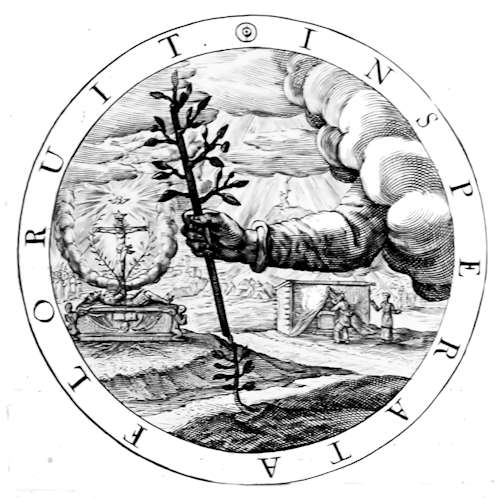
Illvstr. IX. Book. 4
T'is true, a wither'd-branch I am, and seeme To some, as voyd of Hopes, as of esteeme; For, in their judgements, I appeare to be A saplesse Bough, quite broken from the Tree, (Ev'n such as that, in this our Emblem, here) And, yet, I neither feele Despaire, nor Feare; For, I have seene (e're now) a little Spray, (Rent from her Stemme) lye trodden by the way, Three moneths together; which, when Spring drew on, To take an unexpected Root begun; (Yea, grew to bee a Tree) and, growing, stood, When those great Groves, were fell'd for firing-wood, Which once had high esteeme; and sprung unhurt, While that poore Branch, lay sleighted in the durt. Nay, I have seene such twiggs, afford them shade, By whom they were the meanest shrippings made, Of all the Wood; And, you may live to see, (For ought yet knowne) some such event in mee. And, what if all who know mee, see me dead, Before those hopes begin to spring and spread? Have therefore they that hate me, cause to boast, As if mine expectations I had lost? No sure: For, I, who by Faith's eyes have seene, Old Aarons wither'd Rod grow fresh and greene; And also viewed (by the selfe-same Eyes) Him, whom that Rod, most rightly typifies, Fall by a shamefull Death, and rise, in spight Of Death, and Shame, unto the glorioust height. Ev'n I, beleeve my Hope shall bee possest, And, therefore, (ev'n in Death) in Hope I'le rest.

True Vertue, whatsoere betides, In all extreames, unmoov'd abides.
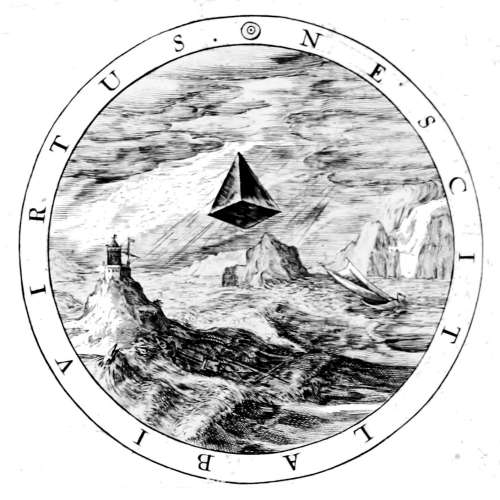
Illvstr. X. Book. 4
WHen, in this Emblem, here, you have espide, The shape of a triangled Pyramide, And, have observed well, those mightie Rockes, Whose firme foundation bides the dreadfull shockes Of angry Neptune; you may thereby see, How firmly setled, Vertues reall bee. For, as the raging Seas, although they roare, Can make no breach upon the Rockie shore; And, as a true triangled Pyramide, Stands fast, and shewes alike, on ev'ry side: So, howsoever Fortune, turnes or winds, Those men, which are indow'd with vertuous minds, It is impossible, to drive them from Those Formes, or Stations, which those minds become. And, as the raging Sea, with foming threats, Against the Rockie-shore, but vainely beats; So, Envie shall in vaine, loud blustrings make, When vertuous resolutions they would shake. For, Vertue, which receives an overthrow, Was Vertue, not indeed, but in the show. So farre am I, oh Lord! from laying claime To have this Vertue, that, I doe but ayme At such perfection; and, can come no nigher As yet, than to obtaine it in desire. But, fixe thou so, this weake desire of mine, Vpon the Vertues of thy Rocke divine, That I, and that invaluable Stone, May bee incorporated into One: And, then, it will bee neither shame, nor pride, To say, my Vertues, will unmov'd abide.

The motion of the World, this day, Is mov'd the quite contrarie way.

Illvstr. XI. Book. 4
WHat was this Figures meaning, but to show, That, as these kinde of Shell-fish backward goe, So now the World, (which here doth seeme to take An arseward Iourney on the Cancer's backe) Moves counterwise; as if delight it had, To runne a race, in Courses retrograde: And, that, is very likely to be true, Which, this our Emblem, purposeth to shew. For, I have now, of late, not onely seene, What backward motions, in my Friends have beene; And, that my outward Fortunes and Affaires, Doe of themselves, come tumbling downe the staires: But, I have also found, that other things, Have got a wheeling in contrary Rings; Which Regresse, holding on, 'tis like that wee, To Iewes, or Ethnicks, backe shall turned bee. Some punie Clerkes, presume that they can teach The ancient holy Doctors, how to preach. Some Laicks, learne their Pastors how to pray. Some Parents, are compelled to obay Their Sonnes; and, so their Dignitie to lose, As to be fed and cloth'd, at their dispose. Nay, wee have some, who have assay'd to draw, All backward, to the Bondage of the Law; Ev'n to those abrogated Rites and Dayes, By which, the wandring Iew markes out his wayes. And, to pursue this Round, they are so heady, That, they have made themselves, and others giddy. Doe then, these froward Motions, Lord, restraine, And, set the World in her due course againe.

Invincibilitie is there, Where Order, Strength, and Vnion are.
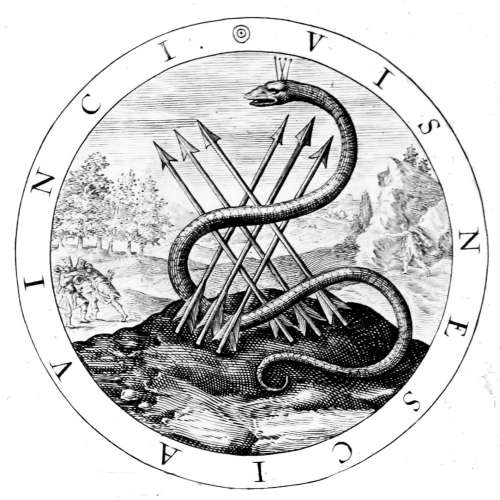
Illvstr. XII. Book. 4
FRom these well-order'd Arrowes, and the Snake, This usefull Observation you may make; That, where an able Prudence, doth combine Vnited-forces, by good Discipline, It maketh up a pow'r, exempted from The feare, or perill, to be overcome: And, if you covet safetie, you will seeke To know this Ward, and to acquire the like. For, doubtlesse, neither is it in the force, Of iron Charets, or of armed Horse, In which, the King, securitie may finde, Unlesse the Riders bee well Disciplinde. Nor, lyes it in the Souldiers common Skill In warlike Postures; nor in theirs, who drill The Rankes and Fyles, to order them aright, According as Occasion makes the Fight. But, men must use a further Prudence too, Or else, those vulgar-Arts will all undoe. For, these, are onely Sciences injoynd, To order well the Body, not the Mind: And, men best train'd in these (oft times) we see, The Hare-brain'dst-fooles, in all our Armies bee. To strength, and skill, unite we must, therefore, A manly Prudence, comprehending more, Than all these Powr's: ev'n such, as when shee please, To all her ends, can use and mannage these; And, shew us how to cure, or to prevent All HaZards; or, withall to bee content. Hee that's thus arm'd, and trusts in God alone, May bee oppos'd, but, conquered of none.

When thou art shipwrackt in Estate, Submit with patience, unto Fate.
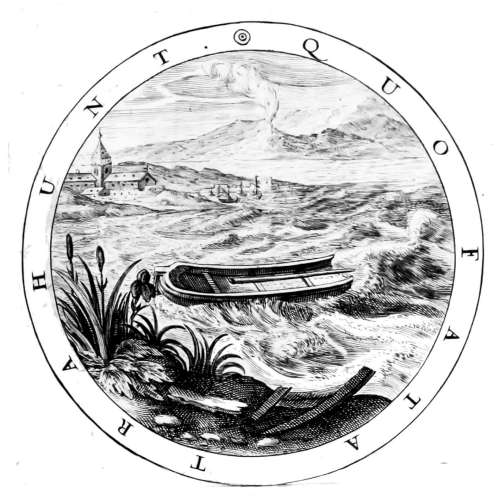
Illvstr. XIII. Book. 4
WHen I beheld this Picture of a Boat, (Which on the raging Waves doth seeme to float) Forc'd onward, by the current of the Tide, Without the helpe of Anchor, Oare or Guide, And, saw the Motto there, which doth imply, That shee commits her selfe to Destinie; Me thinkes, this Emblem sets out their estate, Who have ascribed ev'ry thing to Fate; And dreame, that howsoe're the businesse goe, Their Worke, nor hinders, neither helpes thereto. The leaking Ship, they value as the sound: Hee that's to hanging borne, shall ne're bee drown'd; And, men to happinesse ordain'd (say these) May set their Ship to float, as Fate shall please. This Fancie, springing from a mis-beleeving Of God's Decrees; and, many men deceiving, With shewes of Truth, both causeth much offence Against God's Mercies, and his Providence; And brings to passe, that some to ruine runne, By their neglect of what they might have done. For, Meanes is to bee us'd, (if wee desire, The blessing of our safetie to acquire) Whose naturall effects, if God deny, Vpon his Providence wee must relye, Still practising what naturall aydes may bee, Vntill no likely ayd untride wee see. And, when this Non plus wee are forc'd unto, Stand still, wee may, and wayt what God will do. Hee that shall thus to Fate, his fortunes leave, Let mee bee ruin'd, if Shee him deceive.

The best, and fairest House, to mee, Is that, where best I love to bee.
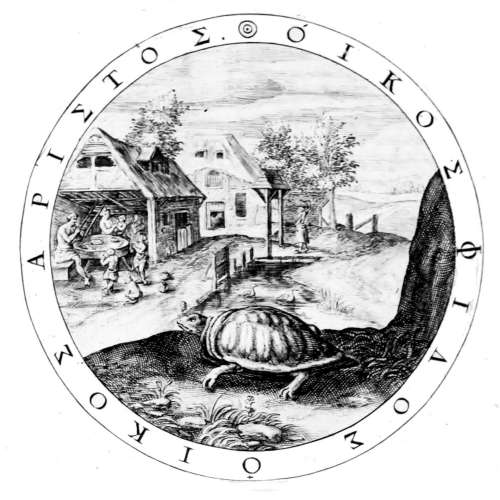
Illvstr. XIV. Book. 4
THey are not Houses builded large and high, Seel'd all with Gold, and pav'd with Porphyrie, Hung round with Arras, glaz'd with Christall-glasse, And cover'd o're with plates of shining Brasse, Which are the best; but, rather, those where wee In safetie, health, and best content, may bee; And, where wee finde, though in a meane Estate, That portion, which maintaines a quiet Fate. Here, in a homely Cottage, thatcht with reed, The Peasant seemes as pleasedly to feed, As hee, that in his Hall or Parlour dines, Which Fret-worke Roofes, or costly Cedar Lines: And, with the very same affections too, Both to, and from it, hee doth come and goe. The Tortois, doubtlesse, doth no house-roome lack, Although his House will cover but his back; And, of his Tub, the Cynicke seem'd as glad, As Alexander was of all hee had. When I am setled in a place I love, A shrubby hedge-row, seemes a goodly Grove. My liking maketh Palaces of Sheds, And, of plaine Couches, carved Ivory Beds: Yea, ev'ry path, and pathlesse walke, which lies Contemn'd, as rude, or wilde, in others eyes, To mee is pleasant; not alone in show, But, truly such: For, liking makes them so. As pleas'd in theirs, the Snailes, and Cocles dwell, As doth a Scallop in his pearly shell: For, that commends the House, which makes it fit, To serve their turnes, who should have use of it.

The King, his pow'r from God receives: For, hee alone the Scepter gives.
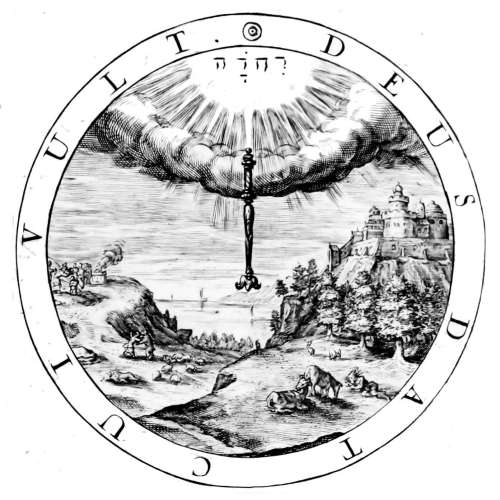
Illvstr. XV. Book. 4
THe Gift of Kingdomes, Children, and good-Wives, Are three of God's most choice Prerogatives, In temp'rall Blessings; and, of all these three, The gifts of Kingdomes, his rar'st Favours bee: For, in five hundred Millions, there's not one, Whom this high Honour is conferr'd upon; Nor is there any knowne Estate on earth, (Whereto wee come, by Merit, or by Birth) Which can, to any man assurance bring, That, hee shall either live, or die a King. The Morning-Starre, that's Heire unto a Crowne, Oft sets, before the shining-Sunne is downe; And, some, that once a glorious Empire swayd, Did lose their Kingdomes, e're their heads were layd. The greatest earthly Monarch hath no powre, To keepe his Throne one minute of an houre, (Vse all the meanes, and policies hee can) If God will give it to another man. Hee, when Belshazzar was in high'st estate, His Kingdome to the Persians did translate. King Saul, and Rehoboam, could not stay The Royalties, which God would give away; And, Hee that was the proudest of the rest, God, changed from a King, into a Beast. Nor is there any man so meane, but hee, When God shall please, an Emperour may bee. Some, from the Pot-kilne, from the Sheep-cote, some, Hee raised hath, great Princes to become: Yea, hee o're heav'n and earth, hath rear'd his Throne, That was on earth, the most despised-one.

Her favours, Fortune, oft imparts, To those that are of no deserts.

Illvstr. XVI. Book. 4
WOuld you not laugh, and thinke it beastly fine, To see a durtie, and ill-favour'd Swine, Weare on her snout, a Diamond, or a Pearle, That might become the Ladie of an Earle? And hold it head, as if it meant to show It were the Pigg of some well-nurtur'd Sow? Perhaps, you thinke there be not any where Such Antickes, but in this our Emblem here. But, if you take these Charmes, and then goe forth Among some troupes, which passe for folkes of worth, You shall discover, quickly, if you please, A thousand sights, as mimicall as these. Here, you shall see a noble Title worne, (That had not mis-beseem'd one better borne) By him, whose vertues are of little price, And, whose estate, was gotten by his Vice. You shall behold another Mushrome, there, Walke with our Lords, as if hee were their Peere, That was well knowne, to be but tother day, No fit companion for such men as they; And, had no other meanes to climbe this height, But Gaming, or to play the Parasite. Yet (though he neither hath his Trade, nor Lands, Nor any honest In-come, by his hands) Hee, oft consumes at once, in Games or Cheare, More than would keepe his Better all the yeare. Yea, many such as these, thou shouldst behold, Which would bee vext, if I describe them should: For, thus, unworthily, blind Fortune flings, To Crowes, and Geese, and Swine, her precious things.

The best good-turnes that Fooles can doe us, Proove disadvantages unto us.

Illvstr. XVII. Book. 4
A Foole, sent forth to fetch the Goslings home, When they unto a Rivers brinck were come, (Through which their passage lay) conceiv'd a feare His Dames best Brood, might have been drowned there; Which, to avoyd, hee thus did shew his wit, And his good nature, in preventing it. Hee, underneath his girdle, thrusts their heads, And, then the Coxcombe through the water wades. Here learne, that when a Foole his helpe intends, It rather doth a mischiefe, then befriends; And, thinke, if there be danger in his love, How harmefull his Maliciousnesse may prove: For, from his kindenesse, though no profit rise To doe thee spight, his Malice may suffise. I could not from a Prince beseech a boone By suing to his Iester or Buffoone: Nor, any Fooles vaine humor, sooth or serve, To get my bread, though I were like to starve. For, to be poore, I should not blush so much, As if a Foole should raise me to be rich. Lord, though of such a kinde my faults may be, That sharpe Affliction still must tutor mee, (And give me due Correction in her Schooles) Yet, oh preserve me from the scorne of Fooles. Those wicked Fooles, that in their hearts have sed There is no God; and, rather give me Bread By Ravens, Lord, or in a Lions Den, Then by the Favours of such foolish men: Lest, if their dainties I should swallow downe, Their smile might more undoe, me, than their frowne.

Though weaknesse unto me belong, In my Supporter, I am strong.
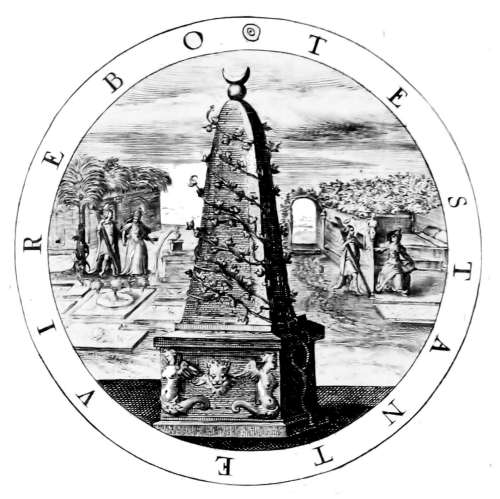
Illvstr. XVIII. Book. 4
ALthough there bee no Timber in the Vine, Nor strength to raise the climbing Ivie-twine, Yet, when they have a helper by their side, Or, prop to stay them, like this Pyramide, One roote sometime, so many Sprayes will beare, That, you might thinke, some goodly Grove it were: Their tender stalkes, to climbe aloft, are seene; Their boughs are cover'd with a pleasant greene; And, that, which else, had crept upon the ground, Hath tops of loftie trees, and turrets crown'd. This Emblem, fitly shadowes out the Natures Of us, that are the Reasonable-creatures: For, wee are truely by our nat'rall-birth, Like Vines undrest, and creeping on the earth; Nor free from spoyling, nor in case to beare Good fruits, or leaves, while we are groveling there. But, if new-borne by Grace, streight borne are wee, From earthly creepings, by that Living-tree, Which, here, was planted, meerely to this end, That, by his pow'r, our weaknesse might ascend. And, hee our frailtie to himselfe so takes, So, of his might, the partners us hee makes; That, hee, in us, doth seeme to hide his pow'rs, And, make the strength hee gives, appeare as ours. Continue, Lord, this Grace, and grant wee may, Firme hold, on our Supporter, alwayes lay: So climbing, that wee nor neglect, nor hide His Love; nor over-climbe it, by our Pride. Thus, our yet staggering weaknesse, shall at length, Bee fully changed into perfect Strength.

Be wary, whosoe're thou be, For, from Loves arrowes, none are free.
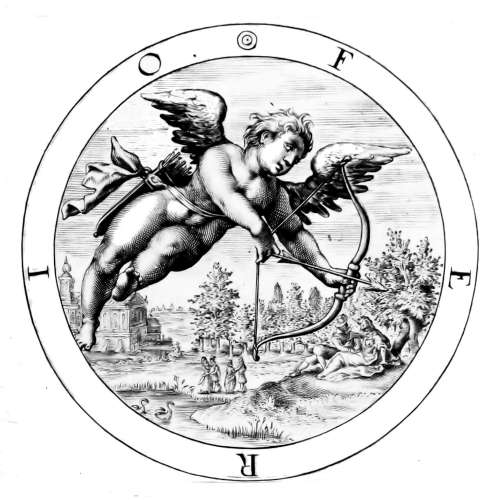
Illvstr. XIX. Book. 4
GOod Folkes, take heede; for, here's a wanton Wagge, Who, having Bowes and Arrowes, makes his bragg That, he hath some unhappy trick to play; And, vowes to shoot at all he meets to day. Pray be not carelesse; for, the Boy is blinde, And, sometimes strikes, where most he seemeth kinde. This rambling Archer spares nor one, nor other: Yea, otherwhile, the Monkey shoots his Mother. Though you be little Children, come not neere; For, I remember (though't be many a yeare Now gone and past,) that, when I was a Lad, My Heart, a pricke, by this young Wanton had, That, pain'd me seven yeares after: nor had I The grace (thus warn'd) to scape his waggery; But many times, ev'n since I was a man, He shot me, oftner then I tell you can: And, if I had not bene the stronger-hearted, I, for my over-daring, might have smarted. You laugh now, as if this were nothing so; But, if you meet this Blinkard with his Bow, You may, unlesse you take the better care, Receive a wound, before you be aware. I feare him not; for, I have learned how To keepe my heart-strings from his Arrowes now: And, so might you, and so might ev'ry one That vaine Occasions, truely seekes to shunn. But, if you sleight my Counsells, you may chance To blame at last, your willfull ignorance: For, some, who thought, at first, his wounds but small Have dyed by them, in an Hospitall.

On whether side soe're I am, I, still, appeare to bee the same.
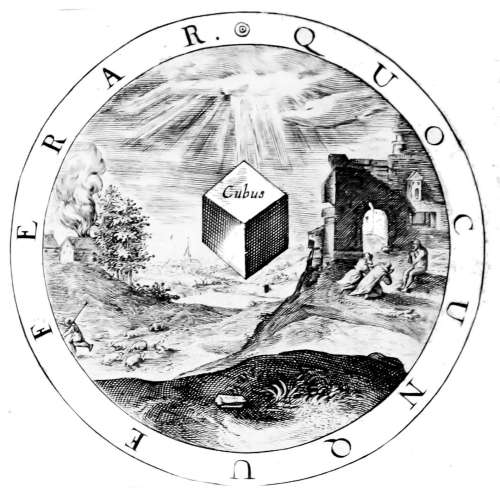
Illvstr. XX. Book. 4
THis Cube, which is an equall-sided-square, Doth very well, in Emblem-wise, declare The temper of that vertuous minded man, Whose resolutions nothing alter can. For, as the Cube, which way soever plac't, Stands ever in one posture, firmely fast, And, still, appeares the same in forme and size, Vpon what side or part soe're it lyes: So, men well formed by the Word divine, And, truly squar'd by vertuous Discipline, Will keepe (though changes them shall turne & wind) The forme and firmnesse of an honest-minde. If, digging deepe, his Fortunes lay him, there, Where he his owne, and others weights must beare, (There, many yeares compelling him to lie, Opprest with dis-respect or povertie) Hee keepes the place to which hee stands enjoyn'd, And brooks his chances with a constant mind. If shee remoove him thence, and set him up On temporall Prosperities high top, The Squarenesse of Plaine dealing hee retaines, And, in the same integritie remaines: Nor coveting vaine Wealth, or false esteemes; Nor, being any other than he seemes. Although by Nature, wee are wondrous hard, Lord, let us into such like Stones be squar'd: Then, place us in thy spirituall Temple, so, That, into one firme Structure, we may grow; And, when we, by thy Grace, are fitted thus, Dwell Thou thy selfe, for evermore, in us.

Deformitie, within may bee, Where outward Beauties we doe see.

Illvstr. XXI. Book. 4
LOoke well, I pray, upon this Beldame, here, For, in her habit, though shee gay appeare, You, through her youthfull vizard, may espy Shee's of an old Edition, by her Eye: And, by her wainscot face, it may bee seene, Shee might your Grandams first dry nurse have been. This is an Emblem, fitly shaddowing those, Who making faire, and honest outward showes, Are inwardly deform'd; and, nothing such, As they to bee suppos'd, have strived much. They chuse their words, and play well-acted parts, But, hide most loathsome projects in their hearts; And, when you think sweet Friendship to embrace, Some ugly Treason, meets you in the face. I hate a painted Brow; I much dislike A Mayden-blush, dawb'd on a furrowed Cheeke: And, I abhorre to see old Wantons play, And, suite themselves, like Ladies of the May. But, more (yea, most of all) my soule despiseth A Heart, that in Religious formes, disguiseth Prophane intentions; and arrayes in white, The coale-blacke conscience of an Hypocrite. Take heed of such as these; and, (if you may) Before you trust them, tract them in their way. Observe their footsteps, in their private path: For, these (as 'tis beleev'd, the Devill hath) Have cloven feet; that is, two wayes they goe; One for their ends, and tother for a show. Now, you thus warned are, advise embrace; And, trust nor gawdy Clothes, nor painted Face.

My Hand and Heart, in one agree, What can you more desire of mee?
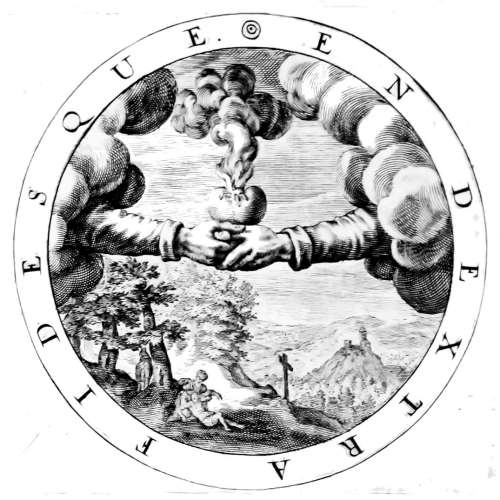
Illvstr. XXII. Book. 4
A Heart with Hand-in-hand, united thus, Makes here an Emblem not unknowne to us; And, 'tis not hard for any Vulgar wit, Without a Comment, to interpret it. But, though of ev'ry man confest it be, That Hand and Heart together should agree; And, that, what we in outward-shew expresse, Perform'd should be, with inward-heartinesse. (Since, now the World, to such a passe is growne, That, all is not consider'd, which is knowne) I cannot thinke it altogether vaine, To speake of that, which may appeare so plaine. When thou dost reach thy hand unto thy friend, Take order, that thy heart the same intend: For, otherwise in Hand, or Heart, thou lyest, And, cuttest off a Member, e're thou dyest. Some, give their Hearts (as many Lovers do) Yet, are afraid, to set their hands thereto. Some give their Hands; and, then by many a deed, To ratifie the gift, they dare proceede; Yet, keep their tongues from saying what they meant, To helpe excuse their hearts, when they repent. Yea, some can very cunningly expresse, In outward shew, a winning heartinesse, And, steale the deare affections they have sought, From those, to whom they meant, nor promis'd ought. Then, will they, if advantage come thereby, Make all their Deeds, for want of Words, a ly. Among Dissemblers, in things temporall, These Raskalls are the ver'est Knaves of all.

No Emblem, can at full declare, How fickle, Minds-unconstant are.
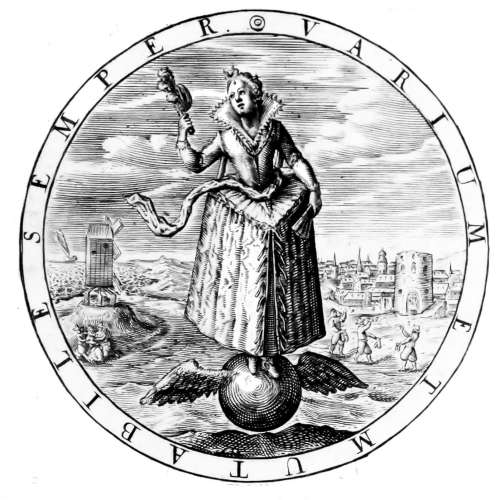
Illvstr. XXIII. Book. 4
SOme, thinke this Emblem serveth to expresse No more, but onely Womens ficklenesse; And, they will most desire to have it so, Who, like those best, that most inconstant grow. Although my Fortunes were, in some things, bad, I never in my life, experience had Of an inconstant woman: Wherefore, then, Should I condemne the Females, more than men? I heare some talke, that Women fickle be: And so I thinke; and so I know are wee. And (being put together) say I dare, That, they and wee, in equall manner, share A giddinesse, and ficklenesse of minde, More wavering, than a Feather, or the Winde. The Woman, heere, is plac'd, to typifie A minde distracted with much levitie: Not, that the womans Wav'rings are the more; But, for this cause: Most Vices, heretofore, And Vertues too, our Ancestors did render, By words declined in the female-gender. The winged Ball, (whose tottering Foundation, Augments the causes of our variation) Meanes, here, those uselesse, and vaine temp'rall things, That come and goe, with never-staying wings; And, which (if thereupon our hearts we set) Make Men and Women, the Vertigo get. Hereafter, then, let neither Sexe accuse Each other; but, their best endeavours use, To cure this Maladie in one another, By living well, and lovingly together.

Hee that enjoyes a patient Minde, Can Pleasures in Afflictions finde.
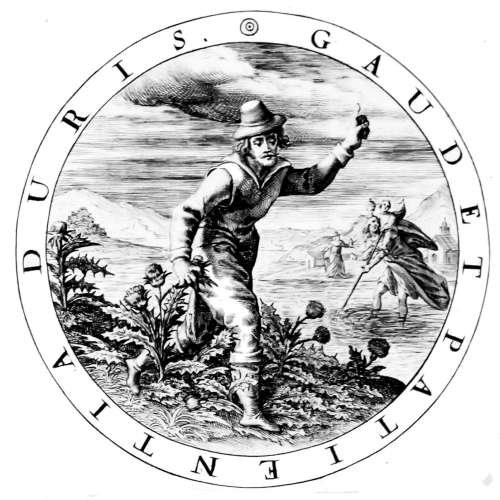
Illvstr. XXIV. Book. 4
WHat meanes this Countrey-peasant, skipping here Through prickling Thistles wth such gamesom cheere? And, plucking off their tops, as though for Posies, He gather'd Violets, or toothlesse Roses? What meaneth it, but onely to expresse How great a joy, well-grounded Patientnesse Retaines in Suff'rings? and, what sport she makes, When she her Iourney through Affliction takes? I, oft have sayd (and, have as oft, beene thought To speake a Paradox, that favours nought Of likely truth) that, some Afflictions bring A Honey bag, which cureth ev'ry Sting (That wounds the Flesh) by giving to the Mind, A pleasing taste of Sweetnesses refin'd. Nor can it other be, except in those, Whose Better part, quite stupifyed growes, By being Cauterized in the Fires Of childish Feares, or temporall Desires. For, as the Valiant (when the Coward swounds) With gladnesse lets the Surgion search his Wounds; And, though they smart, yet cheerefully indures The Plaisters, and, the Probe, in hope of Cures: So, Men, assured that Afflictions paine Comes not for vengeance to them, nor in vaine; But, to prepare, and fit them for the place, To which, they willingly direct their pace; In Troubles, are so farre from being sad, That, of their Suffring, they are truely glad. What ever others thinke, I thus beleeve; And, therefore, joy, when they suppose I grieve.

All is not Gold, which makes a show; But, what the Touchstone findeth so.
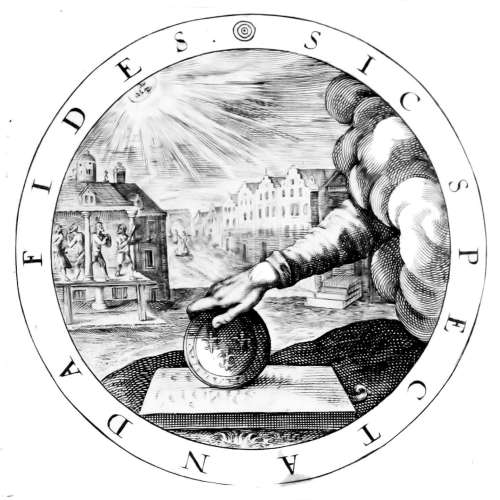
Illvstr. XXV. Book. 4
WHen Silver Medalls, or some coynes of Gold, Are by the Gold-smith either bought or sold, Hee doth not only search them with his Eye, But, by the Scale, their weight will also trie; Or, by the Touchstone, or the Test, assay The truenesse of them, and their just Alay. Now, by their warinesse, who thus proceed, Wee fairely are admonished, to heed The faithfulnesse of him wee make our Friend; And, on whose love wee purpose to depend: Or else, when wee a Iewell thinke to get, Wee may bee cheated by a Counterfet. All is not Gold that glisters: Otherwhile, The Tincture is so good, it may beguile The cunningst eye: But, bring it to the Touch, And, then, you find the value not so much. Some, keepe the Tincture, brooking, likewise, well An ordinarie Touch; but, yeeld a Smell, Which will discover it, if you apply Vnto your Nose, that piece of Chymistrie. Sometime, when there's enough to give content, In Colour, in the Touch, and in the Scent; The Bulke, is more than answers Gold in weight, And, proves it a sophisticall deceit. Nay, some, is fully that which you desire, In all these Properties; and, till the fire Hath made assayes, you'l thinke you might be bold To pawne your life, it had been Ophir-gold: But, to bee false, the Metall's then descride; And, such are many Friends, when they are tride.

Apollo shoots not ev'ry day, But, sometime on his Harpe doth play.
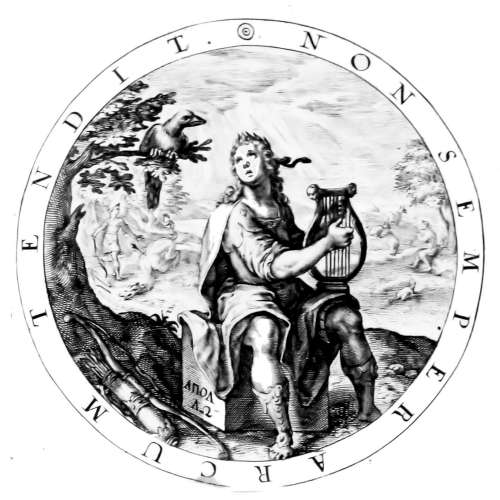
Illvstr. XXVI. Book. 4
THere are a sort of people so severe, That, foolish, and injurious too, they are; And, if the world were to bee rul'd by these, Nor Soule, nor Bodie, ever should have ease. The Sixe dayes, (as their wisdomes understand) Are to bee spent in Labour, by command, With such a strictnesse, that they quite condemne All Recreations which are us'd in them. That, which is call'd the Sabbath, they confine To Prayers, and all Offices-divine, So wholly, that a little Recreation, That Day, is made a marke of Reprobation: And, (by this meanes) the reason is to seeke, When their poore Servants labour all the weeke, (Of which, they'l bate them nothing) how it tyes Them, to observe the sixe-fold Sacrifice By some injoyn'd; and gives them such due Rest, As God allowed, both to Man and Beast. Hee, gave the Woods, the Fields, and Meddowes, here, A time to rest, as well as times to beare. The Forrest Beasts, and Heards, have howres for play, As well as time to graze, and hunt their prey: And, ev'ry Bird some leasure hath to sing, Or, in the Aire, to sport it on her wing. And, sure, to him, for whom all these were made, Lesse kindnesse was not meant, then these have had. The Flesh will faint, if pleasure none it knowes; The Man growes madd, that alway muzing goes. The Wisest men, will sometimes merry bee: And, this is that, this Emblem teacheth me.

Live, ever mindfull of thy dying; For, Time is alwayes from thee flying.
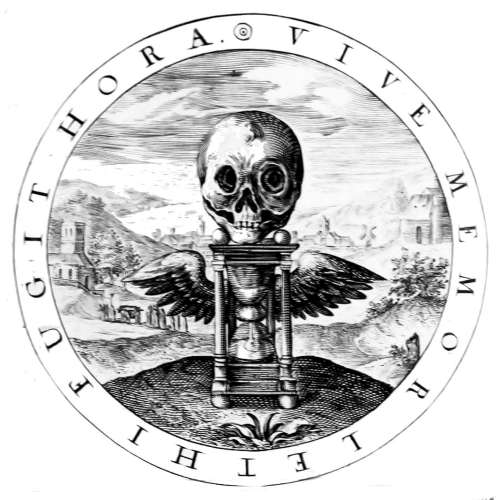
Illvstr. XXVII. Book. 4
THis vulgar Figure of a winged glasse, Doth signifie, how swiftly Time doth passe. By that leane Scull, which to this houre-glasse clings, We are informed what effect it brings; And, by the Words about it, wee are taught To keepe our latter ending still in thought. The common houre-glasse, of the Life of Man, Exceedeth not the largenesse of a span. The Sand-like Minutes, flye away so fast, That, yeares are out, e're wee thinke months are past: Yea, many times, our nat'rall-day is gone, Before wee look'd for twelve a clocke at Noone; And, where wee sought for Beautie, at the Full, Wee finde the Flesh quite rotted from the Skull. Let these Expressions of Times passage, bee Remembrancers for ever, Lord, to mee; That, I may still bee guiltlesse of their crime, Who fruitlesly consume their precious Time: And, minde my Death; not with a slavish feare, But, with a thankfull use, of life-time, here: Not grieving, that my dayes away doe post; But, caring rather, that they bee not lost, And, lab'ring with Discretion, how I may Redeeme the Time, that's vainely slipt away. So, when that moment comes, which others dread, I, undismay'd, shall climbe my dying bed; With joyfull Hopes, my Flesh to dust commend; In Spirit, with a stedfast Faith ascend; And, whilst I living am, to sinne so dye, That dying, I may live eternally.

In ev'ry Storme, hee standeth fast, Whose dwelling, on the Rocke is plac'd.
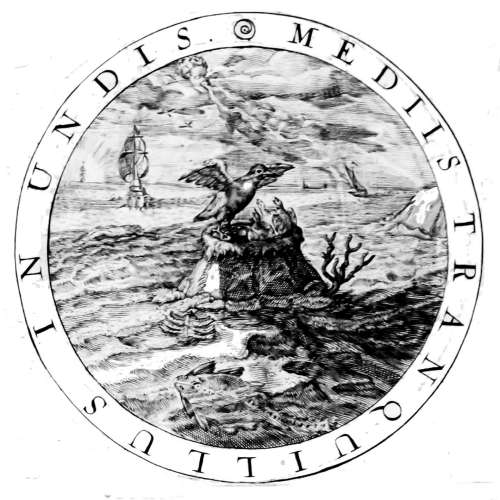
Illvstr. XXVIII. Book. 4
WHat thing soever some will have exprest, As typified by this Halcyons-nest, I shall not thinke this Emblem ill-appli'd, If, by the same, the Church bee signifi'd. For, as it is (by some) affirm'd of these, That, whilst they breed, the fury of the seas Is through the world alayd; and, that their Brood Remaines in safetie, then, amidst the flood: So, when the Christian Church was in her birth, There was a generall Peace throughout the earth; And, those tumultuous Waves, which after that Began to rise, and bee enrag'd thereat, Were calmed so, that Hee was borne in peace, From whom, the faithfull Off-spring did encrease. They, likewise, on a Rocke, their dwellings have, As here you see; and, though the raging Wave, Of dreadfull Seas, hath beaten, ever since, Against the Fortresse of their strong defence, Yet, still it stands; and, safe, it shall abide, Ev'n in the midst of all their foming pride. Vpon this Rocke so place me, oh my God! That, whatsoever Tempests bee abroad, I may not feare the fury of my Foe; Nor bee in danger of an overthrow. My life is full of Stormes; the Waters roule, As if they meant to swallow up my soule. The Tides oppose; the furious winds doe roare; My Cable's weake, my tacklings, Lord, are poore, And, my fraile vessell cannot long endure; Yet, reach to mee thy hand, and I'm secure.

That's Friendship, and true-love, indeed, Which firme abides, in time of need.
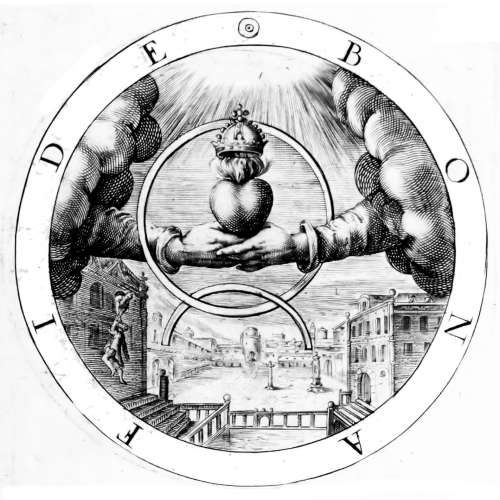
Illvstr. XXIX. Book. 4
THat's Love in earnest, which is constant found, When Friends are in Affliction, or in Bands; And, their Affection merits to be crown'd, Whose hearts are fastned where they joyne their hands. Tis easie to be friendly, where wee see A Complement or two will serve the turne; Or, where the kindnesse may required bee; Or, when the charge is with a trifle borne. It is as easie too, for him to spend At once, the full Revenues of a yeare, In Cates, for entertainment of his Friend, Who thinkes his glorie, is expensive-cheere: For, 'tis his pleasure; and, if none should come Like fashionable-Friends, for him to court, Hee would with Rogues, and Canters, fill the Roome, Or, such as should abuse, and flout him for't. But, hard it is, to suffer, or to spend For him (though worthy) that's of meane estate, Unlikely our occasions to befriend, Or, one unable to remunerate. Few men are liberall, whom neither Lust, Vaine glorie, Prodigalitie, nor Pride, Doth forward into foolish Bountie thrust; As may, by Observation bee espide. For, when a slender Bountie would relieve Their vertuous Friend, whose wants to them are knowne, To their Buffoone, a Knights estate they'l give, And, thinke on t'other trifles ill-bestowne. Yet, this Ile say; and, give the Devill his due; These Friends, are to their lusts, and humours, true.

The Sword hath place, till War doth cease; And, usefull is, in time of Peace.

Illvstr. XXX. Book. 4
THe Sword, to bee an Emblem, here, we draw, Of that Authoritie, which keeps in awe Our Countries Enemies; and, those that are The Foes of Peace, as well as those of Warre; That, Peace may give the Law of Armes her due, And, Warre, to Civill-pow'rs, respect may shew. For, Kingdomes, nor in Warre nor Peace, can stand, Except the Sword have alway some command: Yea, that, for which our forraine Spoylers come, Domesticke Foes, will else devoure at home; And, stranger-drones the peacefull Bees will harme, Vnlesse with warlike stings, themselves they arme. Considering this, let none bee so unwise, The Swords well-us'd protection to despise: Or, thinke the practice of this double-guard, In any place, or age, may well bee spar'd. Let not the Sword-man sleight the pow'rfull Gowne; Nor Gowne-men cast the Sword out of their Towne, Because it terrifies, or draweth Blood; For, otherwhile Phlebotomy is good: And, though to kill a Lowse, the Banians feare; (Though Anabaptists love no Sword to weare) Yet, being drawne, to fright, or cut off Sinne, It may bee brandish'd by a Cherubin. However, from the Sword divide not you (In any case) the peacefull Olive-bough: That is, let Peace, at all times, be that End, For which, to draw the Sword you doe intend; And, for well-doing, bee as ready, still, To give rewards, as blowes, for doing-ill.

A Fortune is ordain'd for thee, According as thy Labours bee.
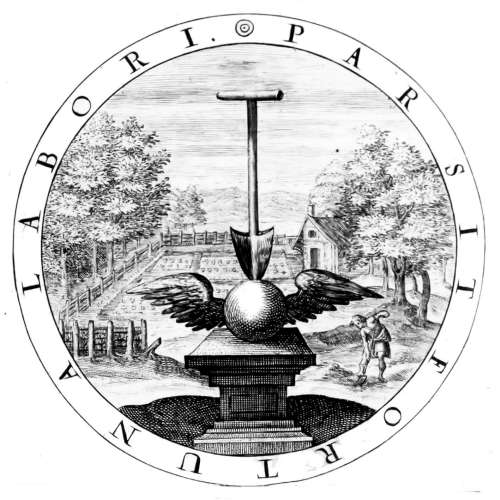
Illvstr. XXXI. Book. 4
THe Spade, for Labour stands. The Ball with wings, Intendeth flitting-rowling-wordly-things. This Altar-stone, may serve in setting foorth, Things firmer, sollid, and of greater worth: In which, and by the words inclosing these, You, there may read, your Fortune, if you please. If you, your labour, on those things bestow, Which rowle, and flutter, alwaies, to and fro; It cannot be, but, that which you obtaine, Must prove a wavering, and unconstant gaine: For, he that soweth Vanitie, shall finde, At reaping-time, no better fruit then Winde. Your houres, in serions matters, if you spend, Or, such, as to a lasting purpose tend, The purchase of your paines will ever last; And, bring you Pleasure, when the Labour's past. Yea, though in teares, your Seed-time, you imploy, Your Harvest shall be fetched home, with ioy. If much be wrought, much profit will ensue; If little, but a little meede is due. Of nothing, nothing comes: On evill deedes An evill conscience, and, ill fame succeedes: An honest-life, still findes prepared for't, Sweet Hopes in Death; and, after, good-report. Of Sexe, or of Degree, there's no regard: But, as the Labour, such is the reward. To worke-aright, oh Lord, instruct thou mee; And, ground my Workes, and buildings all on thee: That, by the fiery Test, when they are tride, My Worke may stand, and I may safe abide.

Let none in troublous times repine; For, after Stormes, the Sun will shine.
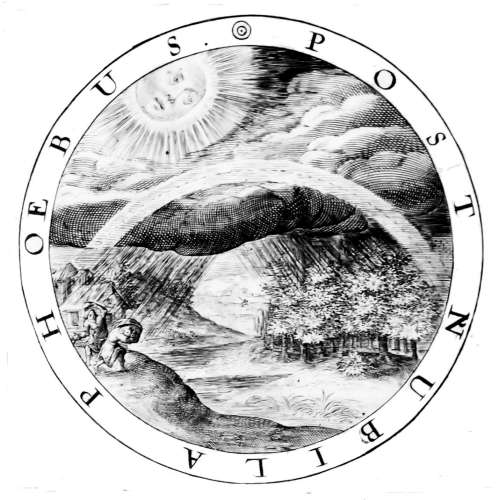
Illvstr. XXXII. Book. 4
DIscourage not your selves, although you see The weather blacke, and stormes prolonged be. What though it fiercely raines, and thunders loud? Behold, there is a Raine-bow in the Cloud, Wherein, a trustfull promise may be found, That, quite, your little-worlds, shall not be drown'd. The Sun-shine, through the foggy mists appeare, The lowring Skie, begins againe to cleare; And, though the Tempest, yet, your eyes affright, Faire weather may befall you, long ere night. Such comfort speakes our Emblem, unto those, Whom stormie Persecution doth enclose; And, comforts him, that's for the present sad, With hopes, that better seasons may bee had. There is nor trouble, sorrow, nor distresse, But mitigation hath, or some release. Long use, or time, the storme away will turne, Else, Patience makes it better to be borne. Yea, sorrowes lowring dayes, will come and goe, As well as prosp'rous houres of Sunshine doe; And, when 'tis past, the paine that went before, Will make the following pleasure seeme the more. For, hee, hath promis'd, whom we may beleeve, His blessing, unto those that mourne and grieve; And, that, though sorrow much dejects their head, In ev'ry need, wee shall be comforted. This promise I beleeve; in ev'ry griefe, Performe it, Lord, and helpe my unbeliefe: So, others viewing how thou cheerest mee, Shall, in all sorrows, put their trust in thee.

For whatsoever, Man doth strive, The Conquest, God alone, doth give.
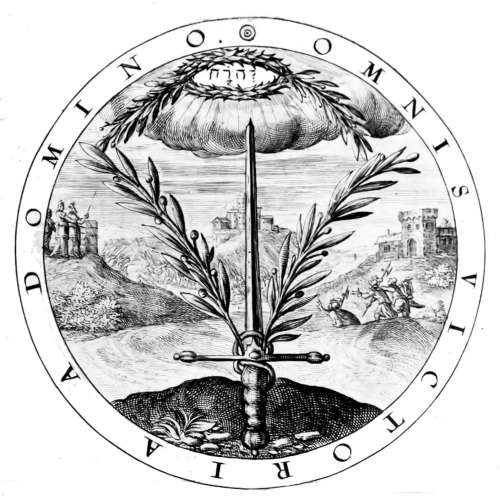
Illvstr. XXXIII. Book. 4
WHen on the Sword, the Olive-branch attends, (That is, when bloody Warres, have peacefull Ends) And, whensoever Victories are gained; This Emblem shewes, by whom they are obtained: For, that all Victorie, doth onely from The pow'rfull hand of God-Almightie, come, The Boughes of Bayes and Olives, doe declare, Which round the Tetragrammaton appeare. Nor must we thinke, that God bestowes, alone, The Victories of Warre, on any one; But, that, when we contend in other things, From him, th'event that's wisht for, also springs. This being so, how dare wee, by the Lawes, Or, by the Sword, pursue a wicked Cause? How dare wee bring a matter that's unjust, Where hee (though few perceive him) judge it must? Or, prosecute with fury, or despite, Against the person of his Favourite? What Fooles are they, who seeke the Conquest, by Oppression, Fraud, or hellish Perjurie? How mad are those, who to the Warres prepare, For nothing, but to spoyle and murther there? Who, nor ingag'd by Faith to their Alies, Nor urg'd by any private injuries, (Nor sent, nor tolerated, by their Prince, Nor caring whether side hath giv'n offence) Run rambling through the World, to kill and slay, Like needie Butchers, for two groats a day? These men may side, where Conquests, God bestowes; Yet, when the Field is wonne, these men doe lose.

Since overmuch, will over-fill, Powre am enough; but doe not spill.
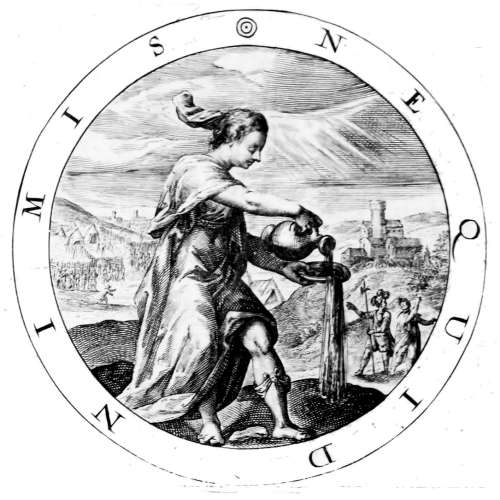
Illvstr. XXXIV. Book. 4
IT is this Emblems meaning, to advance The love and practise, of true Temperance. For, by this Figure (which doth seeme to fill, Vntill the liquor overflow, and spill) Wee are, as by example, taught to see How fruitlesse our Intemperancies bee: Thus by the Rule of Contrarieties, Some Vertues, best are showne to vulgar eyes. To see a nastie Drunkard, reele and spew, More moves to Sobernesse, than can the view Of twentie civill men; and, to behold One Prodigall, (that goodly lands hath sold) Stand torne and louzie, begging at the dore, Would make Intemperance abhorred more, (And, manly Sobernesse, much better, teach) Than all that sixe Philosophers can preach: So, by the Vessels overflowing, here, True Moderation doth more prais'd appeare, Than by the meane it selfe: And, without sinne, That's pictur'd, which to doe, had wicked bin, For, though to vertuous ends; wee doe deny The Doing-ill, that Good may come thereby. From hence, let us be taught, that carefull heed, Whereby wee should both Minde and Bodie, feed. Let us, of our owne selves, observe the size; How much wee want, how little will suffize; And, our owne longings, rather leave unfill'd, Than suffer any portion to bee spill'd: For, what we marre, shall to account be layd, And, what wee wisely spend, shall be repayd.

They passe through many stormes, and streights, Who rise to any glorious heights.
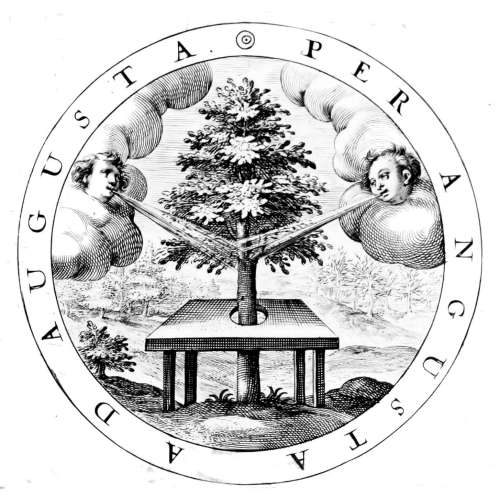
Illvstr. XXXV. Book. 4
THis Tree, which here doth largely seeme to grow, (And spreads above, though streightned in below) Through adverse Winds, and many a Winters blast, Hath gain'd a faire proportion at the last; And, from a lowly shrub, is growne to bee A well-esteemed, and a goodly Tree. Thus, hath it chanced unto many a man: And, he that first in misery began, (So poore and meane, that very few or none Have judg'd him to be worth the looking on) Ev'n he, through scornes, through wrongs, and povertie, Hath crept, and screw'd, and rais'd himselfe so high, That, he hath placed been among the prime, Of those, who seem'd the Worthies of the time; Yea, overtopt and aw'd, the best of those, Who sought to curbe him, when he first arose. This, I have seene; And, as wee seldome find A Tree grow faire, that cannot brooke the Wind, Or, must be hous'd at Winter; or, on whom The Gardners pruning-knife, did never come: So, I have rarely knowne those men to rise To any good, or noble qualities, Who feele not, first some hardship, or some storme, To prune, to discipline, and to reforme Their wits and manners. For, prosperitie, Ease, plentie, and too large a libertie, Doth often blast them; and, somtime bereave them, Of what their Predecessors worth's, did leave them. Let, therefore, no man, feare when this he knowes, Although in tempests, and through streights he goes.

God, ever will bee present, there, Where, of one Faith, and Mind they are.
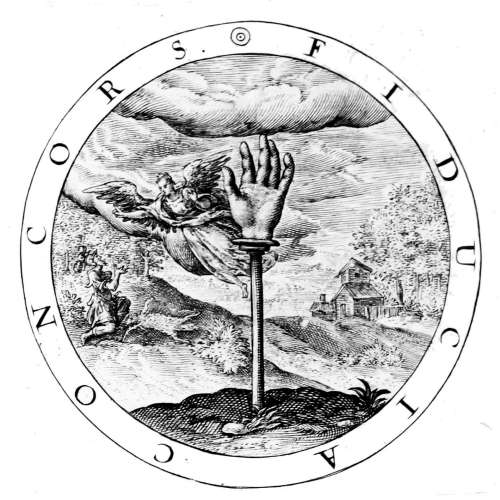
Illvstr. XXXVI. Book. 4
A Fixed Palme, (whose Fingers doe appeare, As if displayed, and advanc'd they were) Intended by our Author, here, wee see, To shaddow out agreeing-Minds, that bee Establish'd in one Trust. And, well it may, That Vertue, of the holy Church display. For, as our hands, the better meanes can make, To gaine, as well as to retaine, or take, The benefits we seeke; when wee intend, Our differing Fingers, all, to worke one end: So, when the Church of Christ (wherein wee finde A diff'rence of Degrees) shall with one minde, Pursue a faithfull hope; they'l soone obtaine, That wished benefit, they seeke to gaine: For, when but two or three shall in Gods name, Request a blessing, he will grant the same. Let all thy sev'rall Churches, Lord (that stand Like many Fingers, members of one Hand) Thy Will-Essentiall with joynt love obay, Though circumstantially, they differ may. Some have the larger Circuit, some are stronger, Some are of short continuance, some of longer; But, though their Guifts may differ, yet provide, That, still, on one Foundation, they may bide; And, that, all those, who in one Faith agree, May, in one Band of Love, united bee: Till our confined Wisdome comes to know, That, many things, for which wee wrangle so, Would further that, whose hindrance wee doe feare, If more our Faith, and lesse our Discord were.

Protect mee, if I worthy bee; If I demerit, punish mee.
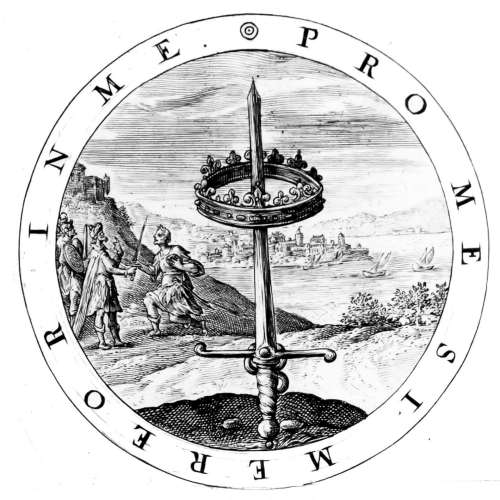
Illvstr. XXXVII. Book. 4
THis Emblem, forth unto your view hath set, A Sword, together with a Coronet; To shew the prudent Reader, what Reward For ill, and for well doing, is prepar'd; That they, who heretofore, amisse have done, May learne, their threatned punishments to shun: That they, whose Actions warrantable were, May, in their honest Courses, persevere: And, that those men, who great and pow'rfull bee, Should punish and reward, as cause they see. Men are of diff'ring tempers: Some, are wonne By promises, and gentle meanes alone: Some, moved are by shame; and, some through dread, To bee in purse, or bodie punished. And, some, their duties are allur'd to doe, No way, but by a mixture of these two. They, therefore, neither Wise, nor Honest bee, Who dandle all Offenders on their knee; Or, punish onely with a God-forbid; Or, Doe not so, my sonnes, as Ely did. Nor wiser ought, are they, nor honester, Who alwayes fright, and threaten those that erre; No mercie joyning, to the chastisement Of them, whose faults are worthy to bee shent. Nor are they lesse to blame, who carry Swords, To punish errors; but, nor lookes, nor words, To cherish well deservings: And, in this, Most men, that punish others, doe amisse. Sure, if the Sword misdoing, may pursue, For doing-well, the Coronet is due.

The Tongue, which every secret speakes, Is like a Barrell full of leakes.
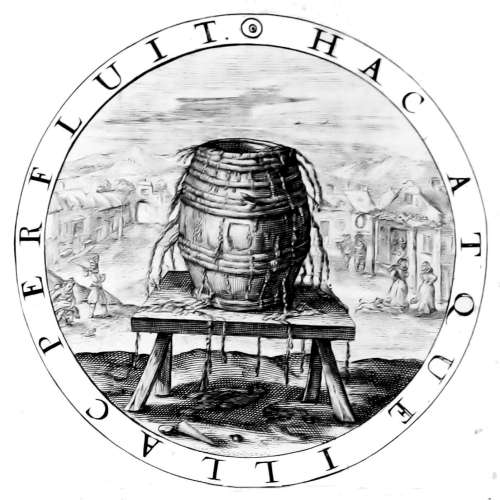
Illvstr. XXXVIII. Book. 4
THe Barrell, from whose bottome, sides, and bung, The liquor (as in this our Emblem) flowes, May fitly typifie the babling Tongue, Of him that utters ev'ry thing hee knowes. For, such as are their taskes, who strive to fill An ever-leaking Vessell, to the brim; Ev'n such are his, who laboureth to still A tatlers tougue; for, paines are lost on him. This Figure, also, serveth to expresse, The trustlesse nature of a whorish woman; For, shee to all displayes her wantonnesse, And, cares to keepe her secresies, from no man. Within her bosome, nothing long shee keeps, But, whatsoever shee conceives or knowes, Streight, from the heart, up to her tongue, it creeps; And, round about the Citie, then, it goes. Bee warned therefore, and commit thou not Thy person, state, or fame, to such as these; Lest, they thy Reputation doe bespot, Consume thy Substance, or thy Minde disease. But, most of all, bee wary, lest the crime, Which here wee doe reproove, thy mind infect: For, Vice, like weeds, will grow in little time, And, out-grow Vertues, if Wee them neglect. The surest way to keepe such errors out, And, in our selves true Vertnes to maintaine; Is, to bee hoopt with Temp'rance, round about, And, our out-flowing humors to restraine. If thus we practise, 'twill prevent the wrongs Of our owne errors, and of others tongues.

How ever thou the Viper take, A dang'rous hazzard thou dost make.
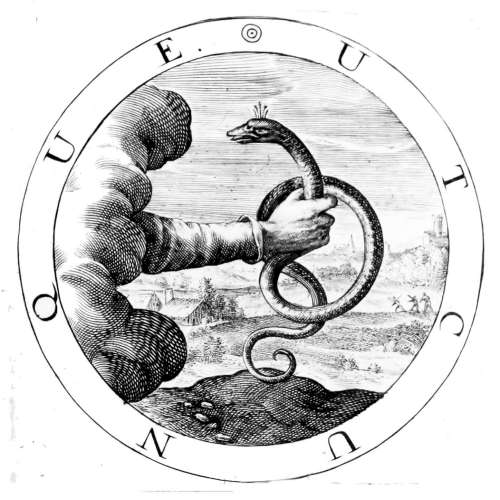
Illvstr. XXXIX. Book. 4
THis Figure warnes us, that wee meddle not With matters, whereby nothing may bee got, Save harme or losse; and, such as once begun, Wee may, nor safely doe, nor leave undone. I should bee loath to meddle in the strife Arising 'twixt a Husband, and his Wife; For, Truth conceal'd, or spoke, on either side, May one or th'other grieve, or both divide. I would not with my most familiar Mate, Be Partner in the whole of my estate; Lest I, by others errors, might offend, Or, wrong my Family, or, lose my Friend. I would not, willingly, in my distresse, From an unworthy hand, receive redresse; Nor, when I need a Suretie, would I call An Vnthrift, or a roaring Prodigall: For, either these I thanklesly must shun, Or, humour them, and be perhaps undone. I would not heare my Friend unwisely prate Those things, of which I must informe the State: And, seeme unfriendly; or, else leave to doe, That, which a stronger Band obligeth to. Nor would I, for the world, my heart should bee Enthrald by one, that might not marry mee; Or, such like passions, bee perplexed in, As hang betwixt a Vertue, and a Sinne; Or, such, as whether way soe're I went, Occasion'd guilt, or shame, or discontent: For, howsoe're wee mannage such like things, Wee handle winding Vipers, that have stings.

The gaining of a rich Estate, Seemes, many times, restrain'd by Fate.
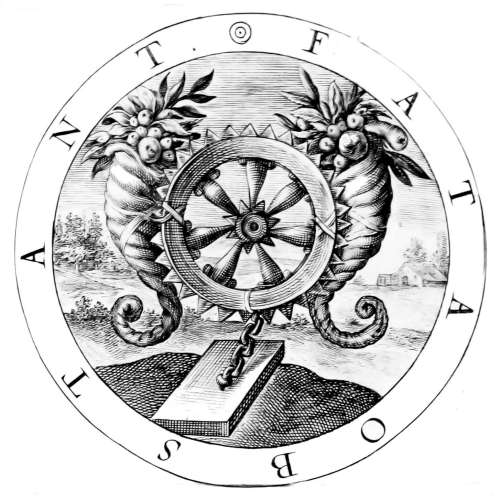
Illvstr. XL. Book. 4
OBserve this Wheele, and you shall see how Fate Doth limit out to each man, that Estate Which hee obtaines; Then, how hee doth aspire To such a height; and, why hee mounts no higher: For, whatsoere their Authors understood, These Emblems, now, shall speake as I thinke good. The Cornucopias fastned to a Round, Thus fixt, may shew, that Riches have their bound; And, can be raised, by mans pow'r or wits, No higher than Gods Providence permits. The placing of them on that Wheele, doth show, That, some waxe Poore, as others Wealthy grow: For, looke how much the higher, one doth rise, So much the lower, still, the other lies; And, when the height of one is at an end, Hee sinkes againe, that others may ascend. The many stops, which on this Wheele you spie, Those many obstacles may typifie, Which barre all those that unto Wealth aspire, From compassing the Round of their desire. The want of Wit, from Riches, barreth some; Some, cannot rich, because of Sloth, become. Some, that are wise, and painefull, are deny'd Encrease of wealth, through Pleasure, or through Pride. Some, lose much profit, which they else might make, Because of Conscience, or for Credit sake. If none of these did hinder, wee have store, That might bee Rich, who, yet, are very Poore. And, these, indeed, doe come to be those Fates, Which keepe most men, from getting large Estates.

In all thine Actions, have a care, That no unseemlinesse appeare.
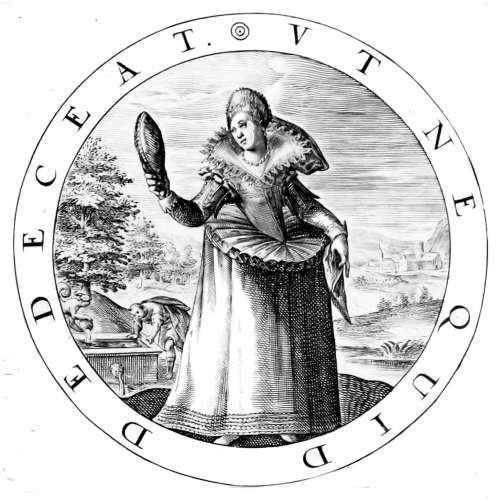
Illvstr. XLI. Book. 4
THe Virgine, or the Wife, that much desires, To please her Lovers, or her Husband's Eyes, In all her costl'est Robes, her selfe attires; And, seekes the coml'est Dresse, shee can devise. Then, to her trustie Looking-glasse, shee goes, (Where, often, shee her person turnes and winds) To view, how seemely her attiring showes; Or, whether ought amisse therein she finds. Which praisefull Diligence, is figur'd thus In this our Emblem; that, it may be made A documentall signe, remembring us, What care of all our Actions, must bee had. For, hee that in God's presence would appeare An acceptable Soule; or, gracious grow With men, that of approv'd conditions are, Must by some faithfull Glasse, be trimmed so. The good Examples of those pious men, Who liv'd in elder times, may much availe: Yea, and by others evills, now and then, Men see how grossely, they themselves, doe faile. A wise Companion, and, a loving Friend, Stands nearer, than those ancient glasses doe; And, serveth well to such an usefull end: For, hee may bee thy Glasse, and Fountaine too. His good Example, shewes thee what is fit; His Admonition, checks what is awry; Hee, by his Good-advise, reformeth it; And, by his Love, thou mend'st it pleasedly. But, if thou doe desire the perfect'st Glasse, Ioyne to the Morall-Law, the Law of Grace.

Wee, bring the Hony to the Hive; But, others, by our labours thrive.
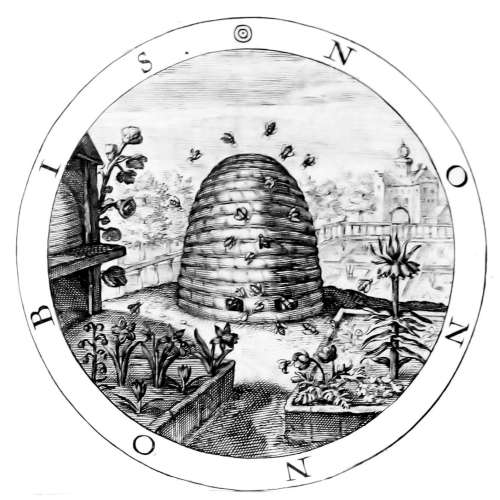
Illvstr. XLII. Book. 4
THe prettie Bees, with daily paines contrive Their curious Combes, and from the flowry Fields, Doe bring that pleasant sweetnesse to their Hive, Which Nectar, and Ambrosiack dainties, yeelds, Yet, when themselves with labours they have tir'd, The following Winters famine to prevent, For their good service, either they are fir'd, Or, forth into an emptie Hive are sent: And, there, with slender diet they are served, To leave another Summers worke, to those Who take no care, though all the swarme be starved, If weake, and quite past labour once it growes. As with such Bees, it fares with many a one, That, spends his youthfull time in honest thrift; And, by the Waspe, the Hornet, or the Drone, Of all their labours, they are soone bereft. Sometime, the bordring Flies, much wrong this brood, Through idle visitings; or, them despoyle, By making friendly shewes of neighbourhood; When, all their Complements, are nought but guile. Sometime, their powerfull Foes do rob them quite; Sometime, their Lords, or Landlords, with pretence, Of claiming only what is just and right, Oppresse them without mercie, or defence. Thus, by one course or other, daily, some (That are laborious in an honest way) The prey of Pride, or Idlenesse become: And, such as these, may therefore truely say, That, whatsoever they to passe have brought, Not for themselves, but others, they have wrought.

God, by their Names, the Stars doth cal; And, hee is Ruler of them all.
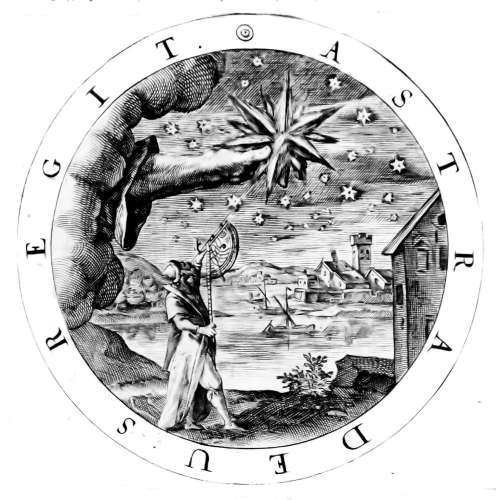
Illvstr. XLIII. Book. 4
SOme say, (and many men doe these commend) That, all our deeds, and Fortunes doe depend Vpon the motions of celestiall Spheres; And, on the constellations of the Starres. If this were true, the Starres, alone, have bin Prime cause of all that's good, and of all sinne. And, 'twere (me thinkes) injustice to condemne, Or, give rewards to any, but to them. For, if they made mee sinne, why for that ill, Should I be damn'd, and they shine brightly, still? If they inforc'd my goodnesse, why should I Bee glorified for their Pietie? And, If they neither good nor ill constraine, Why then, should wee of Destinie complaine? For, if it bee (as tis) absurd to say, The starres enforce us (since they still obay Their just Commander) 'twere absurder, farre, To say, or thinke, that God's Decree it were, Which did necessitate the very same, For which, we thinke the starres might merit blame. Hee made the starres to bee an ayd unto us, Not (as is fondly dream'd) to helpe undoe us: (Much lesse, without our fault, to ruinate, By doome of irrecoverable Fate) And, if our good Endeavors, use wee will, Those glorious creatures will be helpfull still In all our honest wayes: For, they doe stand To helpe, not hinder us, in God's command; And, hee not onely rules them by his pow'rs, But, makes their Glory, servant unto ours.

Who, Patience tempts, beyond her strength, Will make it Fury, at the length.
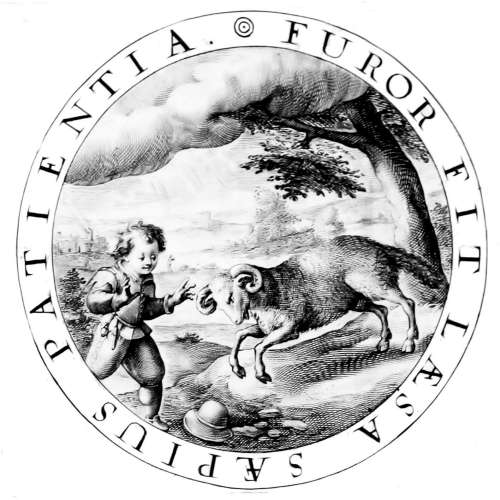
Illvstr. XLIIII. Book. 4
ALthough wee know not a more patient creature, Than is the Lambe, (or, of lesse harmfull nature) Yet, as this Emblem shewes, when childish wrong, Hath troubled, and provok'd him overlong, Hee growes enrag'd; and makes the wanton Boyes, Bee glad to leave their sports, and run their wayes. Thus have I seene it with some Children fare, Who, when their Parents too indulgent were, Have urg'd them, till their Doting grew to Rage, And, shut them wholly from their Heritage. Thus, many times, a foolish man doth lose His faithfull Friends, and justly makes them foes. Thus, froward Husbands; and, thus, peevish Wives, Doe foole away the comfort of their lives; And, by abusing of a patient-Mate, Turne dearest Love, into the deadliest Hate: For, any wrong may better bee excused, Than, Kindnesse, long and wilfully abused. But, as an injur'd Lambe, provoked, thus, Well typifies how much it moveth us, To finde our Patience wrong'd: So, let us make An Emblem of our selves, thereby to take More heed, how God is moved towards them, That, his long suffring, and his Love contemne. For, as wee somewhat have of every Creature, So, wee in us, have somewhat of his Nature: Or, if it bee not sayd the same to bee, His Pictures, and his Images are wee. Let, therefore, his long-suffring, well be weigh'd, And, keepe us, to provoke him, still afraid.

Hee that is blind, will nothing see, What light soe're about him bee.
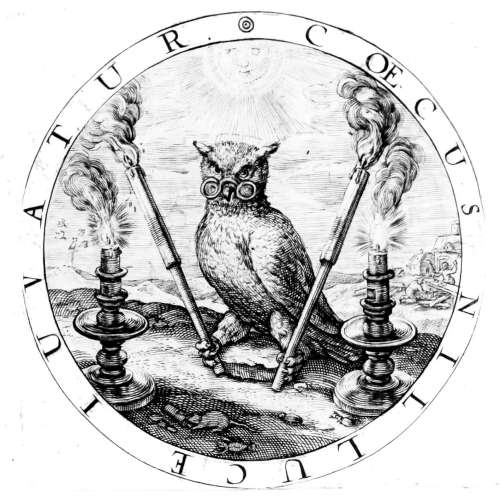
Illvstr. XLV. Book. 4
IT is by some supposed, that our Owles, By Day-time, are no perfect-sighted Fowles; And, that, the more you doe augment the light, The more you shall deprive them of their sight. Nor Candles, Torches, nor the Sunne at noone, Nor Spectacles, nor all of these in one Can make an Owlet in the day-time see, Though none, by night, hath better eyes than shee. This Emblem, therefore, sets their blindnesse forth, Who cannot see, when an apparant worth Illustrates vertuous Men; yet, seeme to spie Those faults, wherewith ill-willers them belie. The blindnesse, also, well it may declare, Of Heretikes, who Eagle-sighted are, In Sophistries, and in the cloudie-night, Of those darke Errors, which delude the sight; Yet, cannot see the Rayes of Truth divine, Though, brighter than the Day-light, shee doth shine. It, likewise, very fitly typifies, Those, in our dayes, who spie out mysteries, Beyond the Moone; yet, cannot gain the view Of that, which common Reason proveth true: And, therefore, onely, crie it (madly) downe, Because, by Reasons light, it may be knowne. These, when 'twas offred, first, the light refused; And, they have now the darknesse which they chused. Till, therefore, God shall offer Grace againe, Man strives to set up Lights, to these, in vaine: For, what are Lights to those who blinded bee? Or, who so blinde, as they that will not see?

None knowes, untill the Fight be past, Who shall bee Victor, at the last.
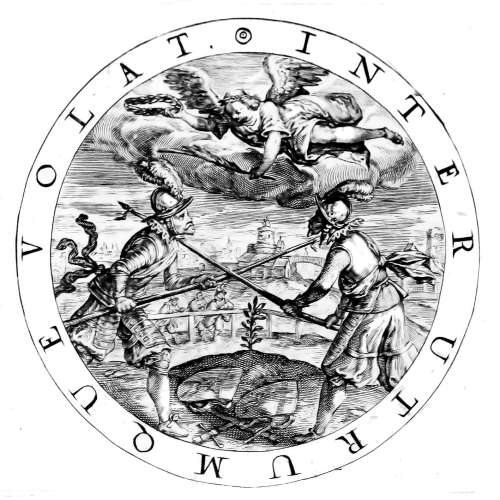
Illvstr. XLVI. Book. 4
WHile, these two Champions for the Conquest fight, Betwixt them both Victoria takes her flight, On doubtfull wings; and, till the fray bee past, None knowe, to whether, shee the Wreath will cast. Which Emblem serves, not onely, to expresse The danger, and the issues doubtfulnesse, In all Contentions; but, may warne us too, That, wee no strivings rashly undergoe; Since they, who long with painfull skill have striv'd, Of likely Conquests, are at length depriv'd. Force, much prevailes; but Sleight and Wit hath pow'r, Sometime, to hurle downe Strength upon the floore. Sometimes againe, our Ingineeres doe faile; And, Blowes, doe more than Stratagems, prevaile. Though, I, upon mine honest-Cause depend, Another may o'rethrow it, by his Friend: And, hee that boasteth of his Patrons grace, May lose his hopes, if Bribing come in place. To say the Truth, in whatsoever Cause, Wee by the Sword contend, or by the Lawes, There's no event or issue more assured, Than this, that, losse to both shall bee procured: And, that, sometime, as well an innocent, As guilty-cause, may finde an ill event. Let, therefore, our endeavours be, to strive, Who, shall hereafter, least occasion give Of those contentions, and of those debates, Which hurt our honor, safetie, or estates: That, we, a Conquest, may be sure to gaine, And, none repine, at that which we obtaine.

Why should I feare the want of Bread? If God so please, I shall bee fed.
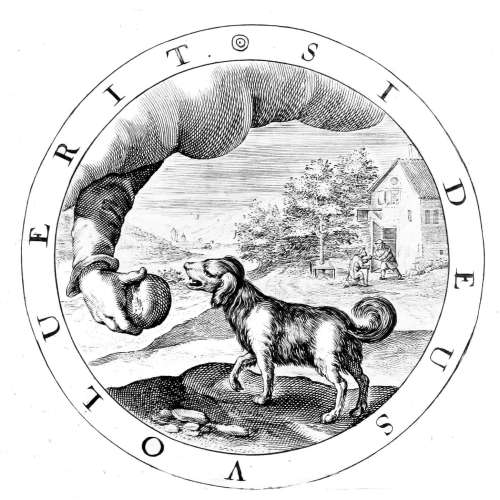
Illvstr. XLVII. Book. 4
THe faithlesse Iewe's repining currishnesse, The blessed Psalmist, fitly did expresse, By grinning-dogs, which howling roame by night, To satisfie their grudging appetite. Here, therefore, by an Emblem, wee are showne, That, God, (who as hee lists, bestowes his owne) Providing so, that none may bee unfed, Doth offer to the Dogges, the Childrens bread. And, by this Emblem, wee advised are, Of their presumptuous boldnesse to beware, Who bound God's Mercie; and, have shut out some From hope of Grace, before the Night is come: Since, to the Dogs, his meat is not denide, If they returne, (though not till Evening-tide.) Moreover, wee, some notice hence may take, That, if provision, God, vouchsafes to make, For Lyons, Dogs, and Ravens, in their need, Hee will his Lambes, and harmlesse Turtles feed: And, so provide, that they shall alwayes have Sufficient, to maintaine the Life hee gave. I must confesse, I never merit shall, The Crummes, which from thy Childrens table fall: Yet, thou hast oft, and freely fed mee, Lord, Among thy Children, at thy Holy-board: Nor have I, there, been fill'd with Bread alone; But, on the blessed Bodie of thy Sonne, My Soule hath feasted. And, if thou dost grant Such favours, Lord! what can I feare to want? For, doubtlesse, if thy Sonne thou please to give, All other things, with him, I shall receive.

All Flesh, is like the wither'd Hay, And, so it springs, and fades away.
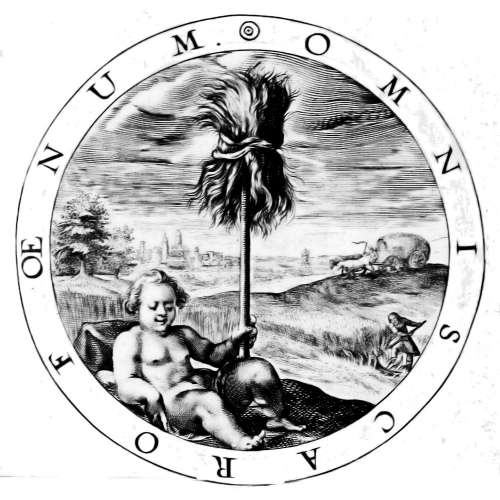
Illvstr. XLVIII. Book. 4
THis Infant, and this little Trusse of Hay, When they are moralized, seeme to say, That, Flesh is but a tuft of Morning-Grasse, Both greene, and wither'd, ere the day-light passe. And, such we truly finde it; for, behold, Assoone as Man is borne, hee waxeth old, In Griefes, in Sorrowes, or Necessities; And, withers ev'ry houre, untill hee dyes: Now, flourishing, as Grasse, when it is growne, Straight perishing, as Grasse, when it is mowne. If, wee with other things, mans Age compare, His Life is but a Day (For, equall'd are His Yeares with Houres: His Months, with Minutes bee Fit parallels; and, ev'ry breathing, wee May tearme a Day) yet, some, ev'n at the Night Of that short Day, are dead, and witherd quite. Before the Morning of our lives bee done, The Flesh oft fades: Sometime, it growes till Noone: But, there's no mortall Flesh, that will abide Vnparched longer, than till Evening-tide. For, in it selfe, it alwayes carries that, Which helpeth so, it selfe to ruinate; That, though it feele, nor storme, nor scorching flame, An inbred Canker, will consume the same. Considering well, and well remembring this, Account the Flesh no better than it is: Wrong not thine everlasting Soule, to cherish A Gourd, which in a moments time will perish. Give it the tendance, fit for fading Crops; But, for Hay-harvest, lose not better hopes.

Make use of Time, that's comming on; For, that is perish'd, which is gone.
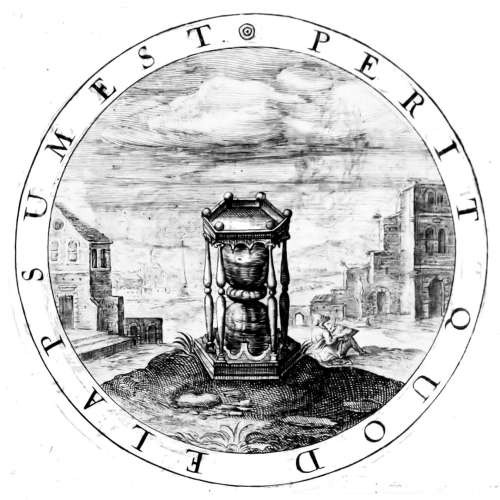
Illvstr. XLIX. Book. 4
THis Glasse declares, how Time doth passe away; And, if the Words, about it, rightly say, Thy Time that's gone, is lost: and, proofe will shew, That, many find both Words, and Emblem, true. How fast their Time departs, they best perceive, From whom it steales, before they take their leave, Of what they love; and, whose last houre is gone, Before their chiefest businesses are done. How fast it slides, ev'n they are also taught, (Too late, perhaps) who never kept in thought Their ending-day; but, alwayes did presume, Or, largely hope upon the Time to come; The present-howres, nor thankfully enjoying, Nor, honestly, nor usefully employing. That, yeares expir'd, are lost, they likewise find: For, when their understanding brings to mind, How fondly (or, how ill perchance) they spent Their passed age; they see, with discontent, The Time, not onely lost, but, worse than so; Lost, with a thousand other Losses moe: And, that, when they shall need it, wealth nor pow'r, Can purchase them, one minute of an howre. Consider this, all ye that spend the prime, The noone tide, and the twilight of your Time, In childish play-games, or meere worldly things; As if you could, at pleasure, clip Times wings, Or turne his Glasse, or, had a Life, or twaine To live, when you had fool'd out this in vaine. Short is the present; lost Times-passed bee; And, Time to come, wee may not live to see.

The Garland, He alone shall weare, Who, to the Goale, doth persevere.
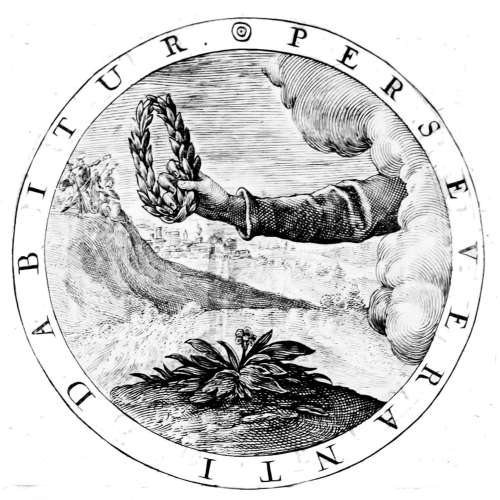
Illvstr. L. Book. 4
AN Arme is with a Garland here extended; And, as the Motto saith, it is intended, To all that persevere. This being so; Let none be faint in heart, though they be slow: For, he that creepes, untill his Race be done, Shall gaine a Wreath, aswell as they that runne. This being so; let no man walke in doubt, As if Gods Arme of Grace were stretched out To some small number: For, whoe're begins And perseueres, the profer'd Garland winns: And, God respects no persons; neither layes A stumbling blocke in any of our Waies. This being so, let no man think't enough To set his hand, a little, to the Plough, And, then desist; but, let him still pursue, To doe that Worke, to which that Wreath is due: For, nor on Good-beginners, nor on those That, walke halfe-way, (much lesse on him, that goes No stepp at all) will God this gift conferre; But, onely, unto those that persevere. Lord, by thy Grace, an entrance I have made In honest Pathes; and, thy assistance had, To make in them, some slow proceedings too. Oh grant me, full abilitie, to doe Thy sacred Will; and, to beginn, and end Such Workes, as to thy glory, still, may tend. That (Walking, and continuing in the Path, Which evermore, thine approbation hath) I may that Garland, by thy grace, obtaine, Which, by mine owne desert, I cannot gaine.

Glory be to God.
