TO THE HIGH AND MIGHTY Prince, JAMES, Duke of Lennox, &c.
Reading edition
WHen Richmond, your beloved Vnkle, liv'd, (For whose departure, all this Empire griev'd, And, yet laments) his GRACE did not refuse To deigne respects, to my obscured MVSE; Nor scorne, from Highest-worth, to stoope so low, As, mee, in my despisednesse, to know: And, had not Bashfulnesse restrain'd my Wit, From pressing-on, (when he incourag'd it,) My Pegasvs, had learn'd, e're now, to rise, Which, yet, with lame, and sickly Feathers flies. But, HEE hath left us; and, I thought not on The losse I had of HIM, till he was gone; Nor could I dreame, till he did hence ascend, What t'was to want an Honourable-friend: Nor, what they feele, whom Fate constraines, to tarry On stormy Plaines, without a SANCTVARIE. Assoone, as from among us, he made wing, My Hopes did waine, and, I began to sing A Mournfull-song, not easie to forget; Because, I beare the burthen of it, yet. Nor was I silent (though my Epicede Appear'd not, for the publike eye to reade) But, griev'd in private, as one wanting Art, To give, the Life of praise, to his desart: Which, if I could have equall'd with his Name, His Death had gain'd my Verse, a living-Fame. And, why expresse I this? except it give Your GRACE, a fit occasion to perceive, That, my decayed Hopes I would renew, And, faine derive them downe, from HIM to YOV? That, as you branched from his Princely Stemme; (Are, honour'd with his Ducall-Diadem) And, imitate his Vertue; So, you might Be Lord, in mee, of that, which was his right: And, for his Noble sake, vouchsafe to own A Servant, which, to you, is yet unknowne. As Prologue, to the service I intend, This PRESENT comes; and, without Hope, or End, Of gaining further Grace, or more Esteeme, Than may, with humblest modestie, beseeme His Love, and Honest-meaning, to expect, Whose Merits have, no visible effect, Conducing to your profit; and, from whom The best of his intents, are yet to come. I cannot thinke, these Lots, or Emblems, are So worthy in themselves, as they'l appeare In your acceptance; Or, that they can give, Such Grace to YOV, as they'l from you receive. Yet, if YOV please, they may be, otherwhile, A profitable Meanes, to help beguile A Melancholy thought; And, have the pow'r To shorten (without losse) a tedious howre. Sometime (no doubt) content you are to walke In Artlesse Groves; Or, to admit the talke of Rustick Swaines (though ev'ry day you might Your self in well-trim'd garden-bowr's, delight, Or, heare the learnedst Muses, when you please;) Ev'n so, for change, you may, perhaps, in these A Recreation finde; and, in some measure, A Profit, intermixed with your Pleasure. I will not make my Promises too large, Lest, my Performances, they overcharge With Expectation: but, I leave them, SIR, To Bee, and to be thought, the same they are. And, if your EXCELLENCE, (when you behold The Ground whereon I first became so bold, To make this Entrance) shall vouchsafe to daigne Those Favours, which, I dare not thinke to gaine By Meer-deserving; you may then, perchance, My Willingnesse, to Ablenesse advance: And, reap in Mee (when ripened they are grown) Some timely fruits, of that, which you have sown. Till then, let it suffice, that I professe A cheerefull, and a thankfull Readinesse To honour Yov; and, openly to show The Dutie, which, it may appeare, I owe To HIM that's gone. And, let your GRACE descend To take this Pledge, of what I more intend.
Who am in all humilitie
Your Graces to be
commanded,
Geo: Wither.
If well thou dost, and well intend, Thou shalt be crowned, in the end.
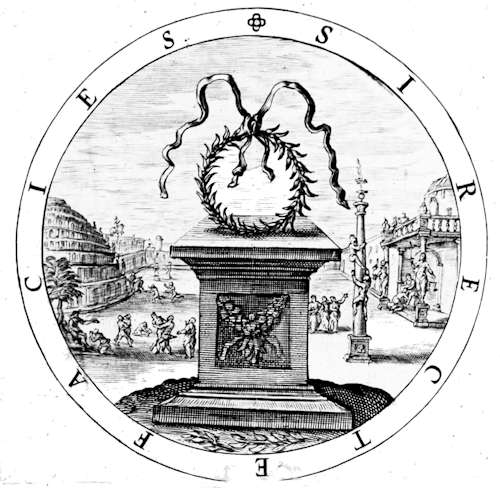
Illvstr. I. Book. 3
WHen, many, for the chiefest Garland runne, That height of Glory, can befall but one; Yet, Wreaths there are, for ev'ry man prepar'd, According as he meriteth reward: And, though the Worke deserveth little meed, Grace, prints a worth, on ev'ry willing-deed, Which formes it currant; and, doth gratious make Man's weake endeavors, for God's promise sake. All seeke the selfe-same prize; but, doe not seeke, With mindes, and, with endeavors, all alike. Most, wish the Wreath; but, few those things will doe, That may be helpfull to attaine thereto: And, some (that will be doing) more delight In doing their owne will, then doing right. One, thinkes by airie titles, to atchieve The Palme he seekes; Another, doth believe Tis gain'd, by giving to his Appetite, The fulnesse of his Bodies vaine delight: To reach their aime, some others nourish hopes, By scrambling up unto the dunghill-tops Of temp'rall Riches: and, of all the wayes, Most thinke this course deserves the greatest praise. But, this our Emblem's Motto, doth implie, That, nothing Man possesseth outwardly Can purchase him the Crowne, that should be sought, Like rightly-doing, what is rightly-taught. And, that God never passed any doome, To barre their blisse, who righteous would become: For, ev'n to Cain he said (of sinne detected) If well thou dost, thou shalt be well respected.

A little Wit, may stand in stead, When Strength doth faile, in time of need.
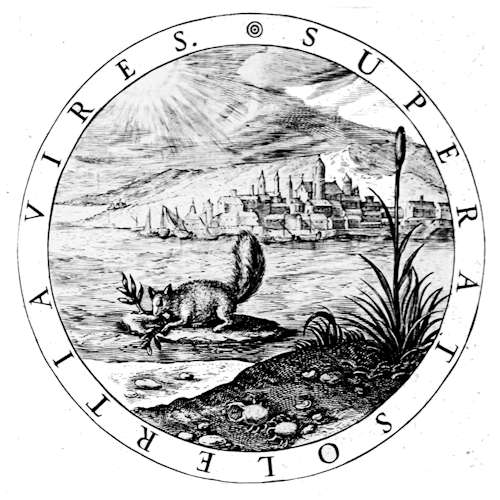
Illvstr. II. Book. 3
THe Squirrell, when shee must goe seeke her food, By making passage through some neighb'ring flood, (And feares to be devoured by the Streame) Thus, helpes her weaknesse, by a Stratagem. On blocks, or chips, which on the waves doe flote, She nimbly leaps; and, making them her boate (By helpe of Windes, of Current, and of Tide) Is wafted over to the further side. Thus, that, which for the Body proves unfit, Must often be acquired by the Wit. And, what our outward Fortunes shall denye, Our providence must labour to supply. Those Casualties, which may our need befriend, We should with heedfull diligence attend; And, watch to seize those opportunities, Which, men of abler fortunes may despise. Some Birds, when they an Oyster would unlock, Mount up, and let it fall upon a Rock; And, when the Cockles on the Shores lye gasping, (At ev'ry Tides approach their Shells unclasping) Crowes cast in Pebles, and so take that meat By craft, which by their force they could not get. Wee, by indeav'ring thus, may gaine, at length, That, which at first appeares above our strength. By little Screwes an entrance we may make, Where Barres of Iron cannot passage breake. Small Engines, lift huge weights; and, we have heard, That one Wise-man (though poore without regard) May save a City, when the Men of Warre, And, all their Captaines, at a non plus are.

To Kings, both Sword and Mace pertaine; And, these they doe not beare in vaine.
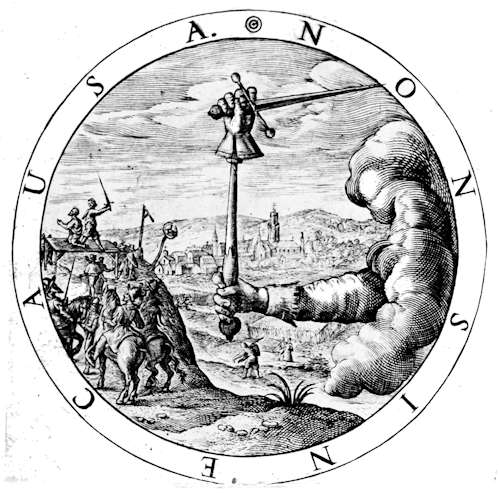
Illvstr. III. Book. 3
WHen thou behold'st, upon a Day of State, The King (or, some inferiour Magistrate) Walke forth in publicke, and the royall Mace, The Sword, or Scepter borne before his face: Suppose thou not, that those are carried, so, In ostentation, or for idle show. These vulgar Emblems, are significant; And, that authority, which Princes grant To Bodies-politicke, was, heretofore Declared, by those Ensignes, which they bore. The bruzing Mace (although, perhaps, with us, It be not in these times, restrained thus) That branch of Royall-power did signifie, Which doth by Fines, or losse of liberty, Correct Offenders. By the Sword, they meant, That larger branch of pow'r, to represent, Which takes the Malefactors life away; And, armes it selfe, when Rebells disobay. As often, therefore, as thou shalt espie Such Hieroglyphickes of Authority; Be mindefull, and advis'd (how meane soere The Persons, or the Places may appeare, Who get this pow'r) that still thou honour them: Lest, thou in those, the pow'r of God contemne. If not for theirs, yet for thy Sov'raignes cause, Whom these doe personate; Or, for the Lawes, (Which threaten punishment) thy selfe submit; And, suffer what Authority thinkes fit: For, whatsoere they be that guide the Reyne, He, gave the pow'r, who gave it, not, in vaine.

He, that concealed things will finde, Must looke before him, and behinde.
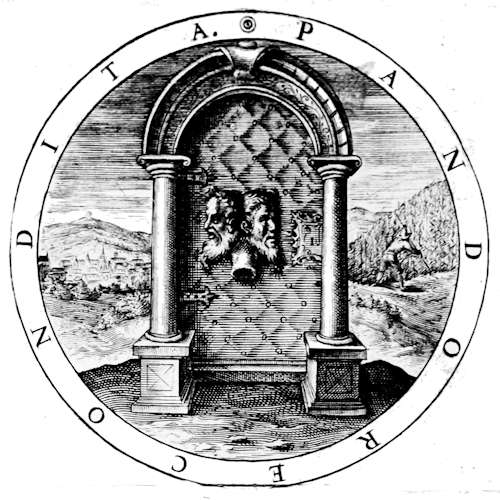
Illvstr. IV. Book. 3
THat Head, which in his Temple, heretofore, The well-knowne figure of old Ianus bore, Retain'd the forme, which pictur'd here you finde; A Face before him, and a Face behinde. And this old Hieroglyphicke doth comprize A multitude of Heathenish Mysteries; Which, wee omitting, will insist on what This Emblem's Motto, chiefely poynteth at. In true Divinity, 'tis God alone, To whom, all hidden things are truely knowne. Hee, onely, is that ever-present-being, Who, by the vertue of his pow'r all-seeing, Beholds, at one aspect, all things that are, That ever shall be, and that ever were. But, in a Morall-sense, we may apply This double-face, that man to signifie, Who (whatsoere he undertakes to doe) Lookes, both before him, and behinde him, too. For, he shall never fruitfully forecast Affaires to come, who mindes not what is past: And, such as doe not, oft, before them looke, May lose the labour, that's already tooke. By, sometimes, looking backward, we behold Those things, which have been done in times of old; By looking wisely forward, we foresee Such matters, as in future-times will bee: And, thus, we doe not onely fruits receive, From that short space of time, in which we live; But, by this meanes, we likewise have a share, In times to come, and, times that passed are.

Good Fortune will with him abide, That hath true Vertue, for his guide.
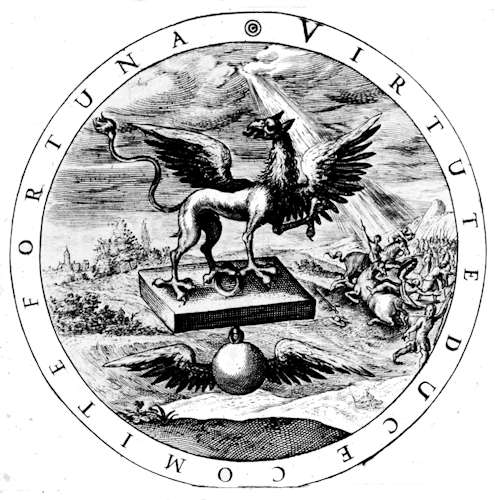
Illvstr. V. Book. 3
THe Gryphon, is the figure of a creature, Not found within the Catalogues of Nature: But, by those Wits created, who, to shew Internall things, externall Figures drew: The Shape, in which this Fiction they exprest, Was borrow'd from a Fowle, and, from a Beast; Importing (when their parts were thus combin'd) The Vertues, both of Body, and of minde: And, Men are sayd on Gryphons backes to ride, When those mixt Vertues, them have dignify'd. The Stone (this Brute supporting) may expresse The firme abiding, and the solidnesse Of all true Vertues. That, long-winged Ball, Which doth appeare fast-linked therewithall, The gifts of changing Fortune doth implye: And, all those things together, signifie, That, when by such like Vertues Men are guided, Good Fortune cannot be from them divided. If this be true (as true I this believe) Why should wee murmure, why repine, or grieve, As if our Studies, or our honest paines, Deprived were of some deserved gaines? Why should we thinke the world hath done us wrong, Because wee are not register'd among Those thriving men, who purse up evr'y day, For twelve hours labour more then twelve months pay? If wee our paines rewarded cannot see, Wee count our Merits greater then they be. But if we bide content, our worth is more; And rich we are, though others think us poore.

When prosperous our Affaires doe growe; God's Grace it is, that makes them so.
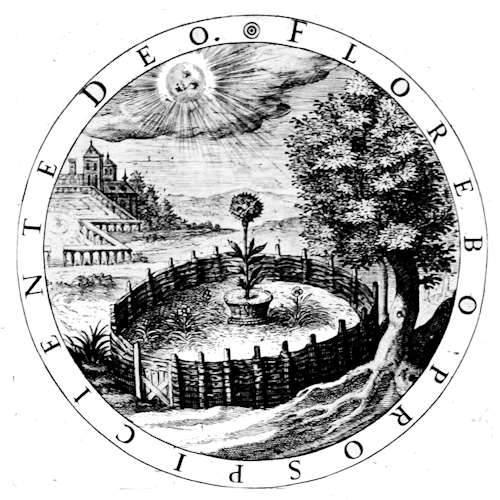
Illvstr. VI. Book. 3
SVch pleasant Flowres, as here are shadow'd out (Full-grown, well-trim'd, and strongly fenc'd about) At first, perchance, had planting (where they stand) And, husbanding, by some good Gard'ners hand: But, when to perfect ripenesse, they are grown, (And, spread forth leaves, and blossomes, fully blowne) They draw it from the Vertue of the Sunne, Which worketh, when the Gard'ners worke is done: For, lost were all his Travaile, and his praise, Vnlesse that Planet cheare them with his rayes. In this our Pilgrimage, it fares with us (In all our hopes, and all our labours) thus. For, whatsoever bus'nesse wee intend, On God, our good successes doe depend. Our Hands may build; but, structures vaine we make, Till God, to be Chiefe-builder, undertake. To wall a City, wee may beare the cost; But, he must guard it, or, the Towne is lost: The Plow-man useth diligence to sowe; But, God must blesse it, or, no Corne will grow: Yea, though Paul plant, and, though Apollo water, They spend their sweat, upon a fruitlesse matter, Till God, from heaven, their labours please to blesse, And crowne their travailes, with a good increase. Let, therefore, those that flourish, like this Flowre, (And, may be wither'd, e're another houre) Give God the praise, for making of their Seeds Bring forth sweet Flowres, that, else, had proved Weeds: And, me despise not, though I thrive not so; For, when, God pleaseth, I shall flourish too.

If thou thy Duties truely doe, Of thy Reward, be hopefull too.
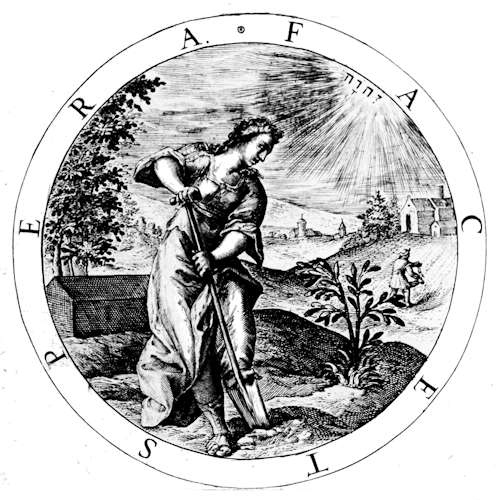
Illvstr. VII. Book. 3
SOme Sects are found, who so believing be, They thinke themselves from legall-workings free; And, so they live, as if they stood in feare That, with Good-works, their God offended were. Another sort we know, who credit not, That any hope of Mercie can be got, Till they themselves, by their externall-deed, Have merited the favours they shall need: And, so they prize their workings; that, for Grace, They seeme to disallow all usefull place. Both sorts, their errours may be purged from, When to the Fiery-tryall they shall come. So, likewise, may another Faction too, That erre more deadly then these former doe. These doe (forsooth) affirme, that God's decree Before all Worlds (what Words can fouler be?) Debarr'd the greatest part of humane-race, Without respecting sinne, from hope of Grace; And, that, howere this number shall indeaver, They must continue Reprobates, for ever. The first, are errours of Impiety; But, this, ascends the top of blasphemy; Dispoyles Religion wholly of her fruits; And, wrongeth God in all his Attributes. These Errours, therefore shunne; and, so believe, That wee thy Faith, may by thy Workes perceive. So worke, that thy believing may approve Thou wrought'st not for thy Wages; but, for love. For (whatsoe're thou be) if thus thou doe, Thou mayst have hopes, and, God will grant them too.

By Wisedome, things which passe away, Are best preserved from decay.
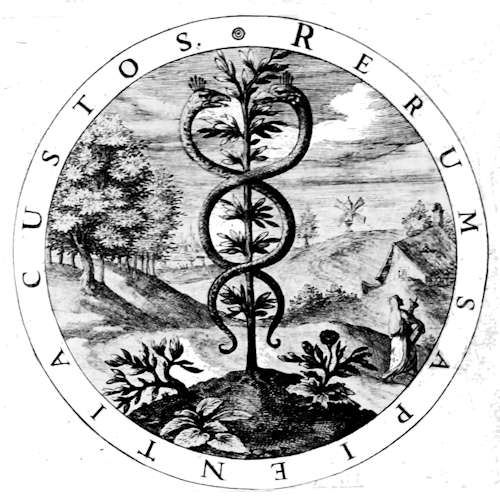
Illvstr. VIII. Book. 3
THe Laurell, which is given for a Crowne (To men deserving Glory, and renowne) Is figur'd here, those noble deeds to show, For which, the Wreaths of Honour, we bestow. Two Serpents (Wisdome's Emblems) twisted are About this branch of Lawrell, to declare, That, Wisdome is the surest meanes to save Our Names and Actions, from Oblivion's Grave. The Snakes are two, perhaps, to signifie That Morall-wit, and Christian-policie (Vnited both together) doe contrive The safest guard, and best preservative. Consider this, all yee, that trust your Names To Marble Monuments; or, mount your Fames By those poore meanes, which Fooles and Knaves pursue; And, may effect as easily as you: Nay, with more ease; and, overtop you too, When you have done the best, your wits can doe. I say, consider this; and, let the Pen Of learned, wise, and understanding men, Renowne your worths, and register the story Of your deserved, and, well-gotten glory; Lest, else, it suffer close-imprisonments, Within the walls of such poore Monuments, As oft are built, to leave it quite forgotten, Whose bones they cover'd, e're those bones be rotten. But, you shall best preserve your Honest-fame, Your Workes, your Hopes, and Honours of your Name, If you your selves be wise; and, so provide That Prudence, all your Workes, and Speeches guide.

Good Hopes, we best accomplish may, By lab'ring in a constant-Way.
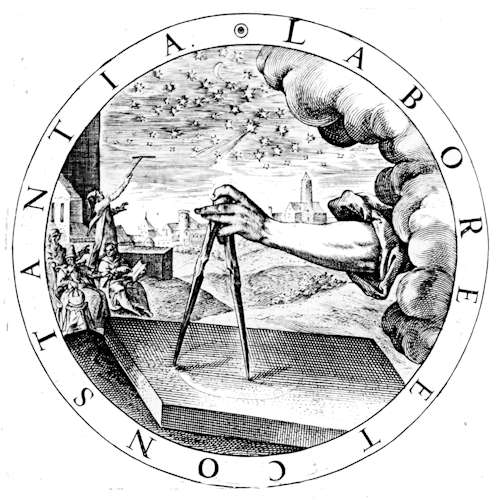
Illvstr. IX. Book. 3
SOme Folkes there are, (and many men suppose, That I my selfe, may passe for one of those) Who many likely Businesses intend, Yet, bring but very few, unto an end. Which folly to prevent, this Emblem, here, Did in a luckie houre, perhaps, appeare. For, as to draw a Circle, with our hand, We cause the brazen Compasses to stand With one foot firmely fixed one the ground; And move the other in a Constant-round: Right so, when we shall purpose to proceed In any just, and profitable deed, We first, should by a constant-resolution, Stand firme, to what we put in execution: And, then, with perseverance, labour out Those workings, which we are employ'd about. For, we with constant-liking, must elect Those Businesses, we purpose to effect: Or els, our time, our labour, and our cost, Will, oft, be much in vaine, or wholly lost. With constant-labour, we must follow, too, Those things, which we resolved are to do; Or, els, our hopes will never be effected, How warily soe're we have projected. Long Iourneys I abhorre; yet, otherwhile I meane a Furlong, and performe a Mile. I greatly feare Long-labours to begin; Yet some I finish, when I'me entred in: And, if in Labour, I more constant grow, How I improve, hereafter, you shall know.

Ere thou a fruitfull-Cropp shalt see, Thy ground must plough'd and harro'wd be.
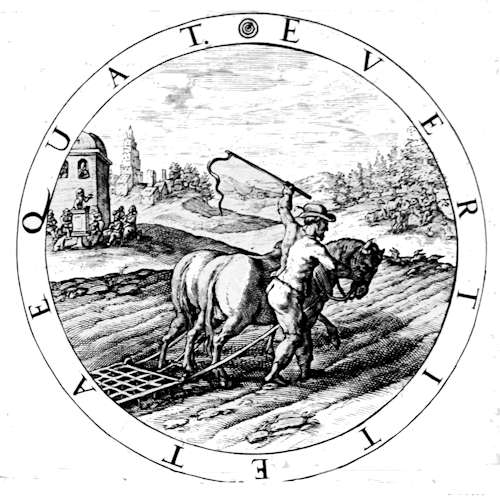
Illvstr. X. Book. 3
BEfore the Plowman hopefull can be made, His untill'd earth good Hay or Corne will yeeld, He breakes the hillocks downe, with Plough or Spade; And, harrowes over, all the cloddie Field. Then, from the leaveld-ground, at last, he mowes That Cropp of grasse, which he had hope to gaine; Or, there, doth reape the fruit of what he sowes, With profit, which contents him for his paine. Our craggie-Nature must be tilled, thus, Before it will, for Herbes of Grace, be fit. Our high conceit, must downe be broke in us; Our heart is proud, and God must humble it. Before good Seed, in us will rooting take, Afflictions ploughes and harrowes, must prepare us: And, that the truer levell, he may make, When we are sunck too low, Gods hand must reare us. Then, neither stormings of Adversitie, Shall drowne the Seedes of Hope, which we have sowne; Nor shall the Sunne-beames of Prosperitie, Drie up their moisture, ere they ripe are growne. Oh Lord, thou know'st the nature of my minde; Thou know'st my bodyes tempers what they are; And, by what meanes, they shall be best inclin'de Such Fruits to yeeld, as they were made to beare. My barren Soule, therefore, manure thou so; So, harrow it; so emptie, and so fill; So raise it up, and bring it downe, so low As best may lay it levell to thy Will. In this Desire, the worke is well begunne; Say thou the Word, and all is fully done.

True Knowledge is a constant Friend, Whose Friendship, never shall have end.
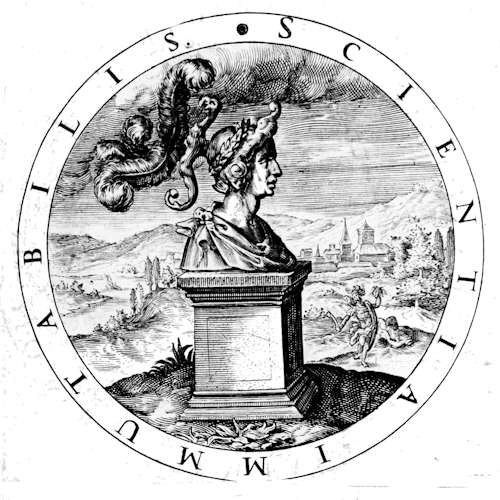
Illvstr. XI. Book. 3
BY viewing this fixt-Head, enwreath'd with Bayes, (And, what the Motto round about it sayes) Your Apprehension's eye, may partly see What constant Vertues, in true Knowledge be. For, if right plac'd it be, it ever will Continue in the same condition, still: And, though it make mens manners to be chang'd; Yet, never is it, from it selfe, estrang'd: Nor doth, nor can it, cease to be a Friend, What Fate soever, shall on us attend. When Wealth is lost, or faileth to besteed us; Shee findes out honest meanes to cloath and feede us. In farre, and forraigne Lands, shee will become, As kinde, and as familiar, as at home; And, travelleth, without the costly cumber, Of Carriages, or Clokebagges full of Lumber. No Place can from our presence, her enclose; Nor is she frighted from us by our Foes. No Pickthankes, of her Favours, can bereave us; No Promises, can woo her to deceive us. In Youth, in Age, in Sickenesse, and in Griefe, Shee bringeth Consolation and reliefe: And, is in all estates, a blessing to us, So constant (and so apt, all helpes to doe us) That, he for whom, such Knowledge, God provideth, Enjoyes a Friend, that alwaies firme abideth. Lord, I am friendlesse left; therefore, to me, This Knowledge, and this Friend, vouchsafe to bee: For, thou that Wisdome art, (from heav'n descending) Which, neither hath beginning, change, nor ending.

By Studiousnesse, in Vertue's waies Men gaine an universall-praise.
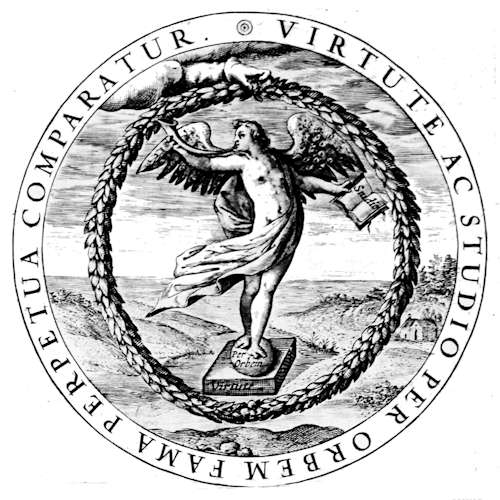
Illvstr. XII. Book. 3
WHen Emblems, of too many parts consist, Their Author was no choice Emblematist: But, is like those, that wast whole howres, to tell What, in three minutes, might be said as well. Yet, when each member is interpreted, Out of these vulgar Figures, you may read A Morall, (altogether) not unfit To be remembred, ev'n, by men of wit. And, if the Kernell proove to be of worth, No matter from what shell we drew it forth. The Square whereon the Globe is placed, here, Must Vertue be; That Globe upon the Square, Must meane the World; The Figure, in the Round, (Which in appearance doth her Trumpet sound) Was made for Fame; The Booke she beares, may show, What Breath it is, which makes her Trumpet blow: The Wreath, inclosing all, was to intend A glorious Praise, that never shall have end: And, these, in one summ'd up, doe seeme to say; That, (if men study in a vertuous-way) The Trumpet of a never-ceasing Fame, Shall through the world proclaime their praisefull Name. Now Reader, if large Fame, be thy ambition, This Emblem doth informe, on what condition She may be gain'd. But, (herein, me beleeve) Thy studie for meere-praise, will thee deceive: And, if thy Vertues, be, but onely, those For which the vulgar Fame, her Trumpet blowes, Thy Fame's a blast; Thy Vertues, Vices be; Thy Studie's vaine; and, shame will follow thee.

Above thy Knowledge, doe not rise, But, with Sobrietie, be wise,
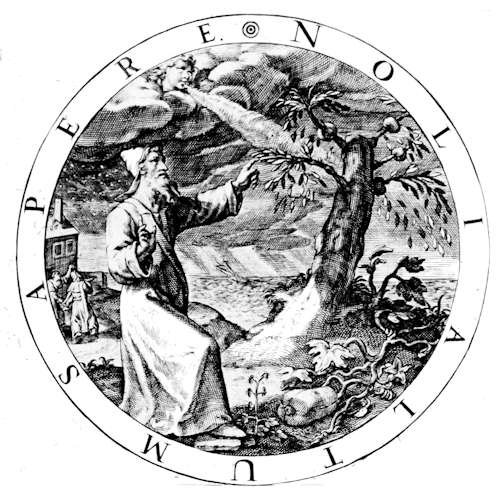
Illvstr. XIII. Book. 3
EXalt thou not thy selfe, though, plac'd thou be, Vpon the topp of that old Olive-tree, From whence the nat'rall branches prun'd have bin, That, thou, the better, mightst be grafted in. Be not so over-wise, as to presume The Gard'ner, for thy goodnesse, did assume Thy small Crab-Olive, to insert it, there, Where, once, the sweetest-berries, growing were: Nor let thy Pride those few old-boughes contemne, Which, yet, remaine upon their ancient Stemme; Because, thy new-incorporated Sprayes, Doe more enjoy the Sunnes refreshing raies: But, humbled rather, and, more awfull bee; Lest, hee that cut off them, doe breake downe thee. Be wise, in what may to thy good, belong; But, seeke not Knowledge, to thy neighbours wrong: Be thankefull for the Grace thou hast receiv'd, But, judge not those, who seeme thereof bereav'd; Nor into those forbidden secrets peepe, Which God-Almighty, to himselfe doth keepe. Remember what our Father Adam found, When he for Knowledge, sought beyond his bound. For, doubtlesse, ever since, both good and ill Are left with Knowledge, intermingled still; And, (if we be not humble, meeke, and warie) We are in daily danger, to miscary. Large, proves the fruit which on the Earth doth lie; Windes, breake the twigge, that's grafted over-high; And, he that will, beyond his bounds, be wise, Becomes a very Foole, before he dies.

When each man keepes unto his Trade, Then, all things better will be made.
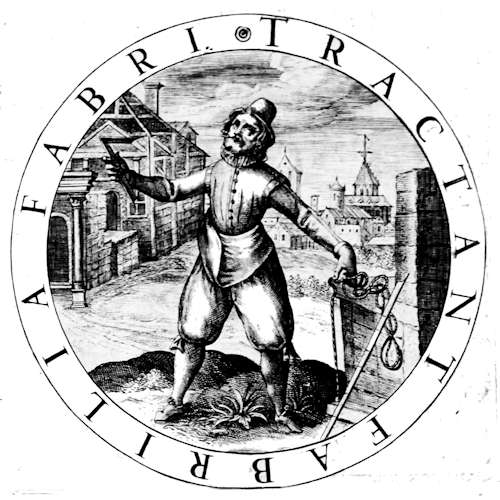
Illvstr. XIV. Book. 3
WE more should thrive, and erre the seldomer, If we were like this honest Carpenter, Whose Emblem, in reproofe of those, is made, That love to meddle, farther then their Trade. But, most are now exceeding cunning growne In ev'ry mans affaires, except their owne: Yea, Coblers thinke themselves not onely able, To censure; but, to mend Apelles Table. Great-Men, sometime, will gravely undertake To teach, how Broomes and Morter, we should make. Their Indiscretions, Peaants imitate, And boldly meddle with affaires of State. Some Houswives teach their Teachers how to pray, Some Clarks, have shew'd themselves, as wise as they; And in their Callings, as discreet have bin, As if they taught their Grandames how to spinne: And, if these Customes, last a few more Ages, All Countries will be nothing els, but Stages Of evill-acted, and mistaken parts; Or, Gallemaufries, of imperfect Arts. But, I my selfe (you'l say) have medlings made, In things, that are improper to my Trade. No; for, the MVSES are in all things free; Fit subject of their Verse, all Creatures be; And, there is nothing nam'd so meane, or great, Whereof they have not Liberty to treat. Both Earth and Heav'n, are open unto these; And (when to take more libertie they please) They Worlds, and things, create, which never were; And, when they list, they play, and meddle, there.

A Shepherd carefull of the Sheepe, At all times, faithfull Watch doth keepe.
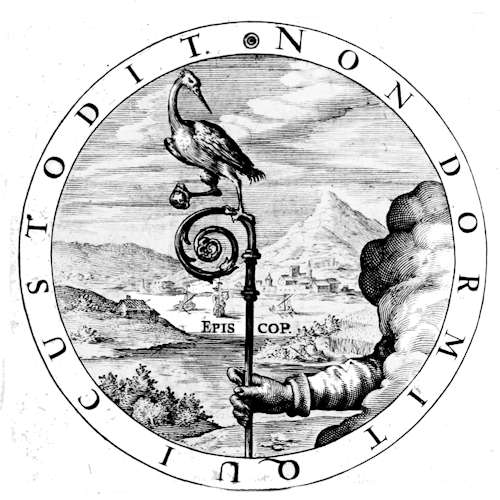
Illvstr. XV. Book. 3
THe Figure of a Storke in elder dayes, Was us'd in Hieroglyphick, many wayes: But, when one Foote, thus grasp'd a Peple-stone, The other being firmely fixed on The Staffe Episcopall; in that position, It makes an Emblem, of a late edition: By some, thought not improper, to expresse Their painefull, and their serious, watchfulnesse, Who take upon themselves, the Pastorall care; And, in that Function, truely watchfull are. The Shepherds-Crooke, doth some expression make Of that regard, which, of their Flocks, they take. The Peble in the Foote, doth seeme to showe, That, these must farther diligence bestowe, (And, use their utmost pow'r) themselves to keepe From slothfull Ease; and from intemp'rate sleepe: For, he that hath such Duties undertooke, (And, must the lives of others overlooke) Shall finde himselfe, unto himselfe become A burthen, and a Charge more troublesome Then all his Flocke, unles, he still provide His owne, aswell as others waies, to guide. Now, though this Emblems Morall doth concerne The Clergie most; yet, hence we all may learne Strict watch to keepe; since, unto all that bee, A Watchmans place belongs, in some degree. Which, to discharge, if wee endeavour, still, Our universall Shepherd aide us will, And us from harmes, and error he will keepe, For, Hee that guardeth Isr'ell doth not sleepe.

Our Dayes, untill our Life hath end, In Labours, and in Hopes, wee spend.
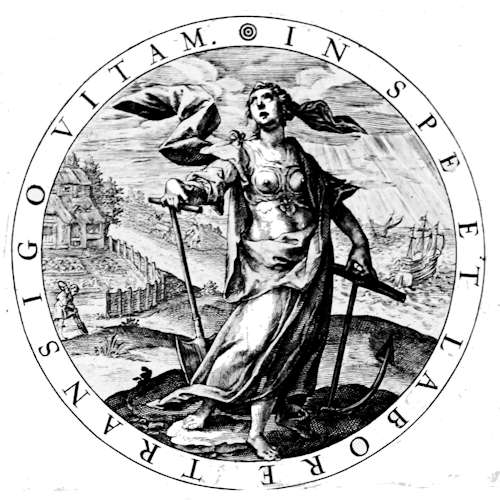
Illvstr. XVI. Book. 3
AS soone as our first Parents disobey'd, Forthwith a Curse, for their offence, was layd, Inforcing them, and their succeeding race, To get their Food, with sweatings of the Face. But, afterward, this Doome to mitigate, (And ease the miseries of their estate) God gave them Hope, that she might helpe them beare The burthens of their Travaile, and their care. A Woman with an Anchor, and a Spade, An Emblem of that Mystery is made: And, this Estate, wee all continue in, By God's free Mercie, and our proper Sinne. By Sinne, the Labour is on us intail'd; By Grace, it is, that Hoping hath not fail'd; And, if in Hope, our Labours wee attend, That Curse will prove a Blessing, in the end. My Lot is Hope, and Labour; and, betweene These Two, my Life-time hath prolonged beene: Yet, hitherto, the best of all my Paine, With most of all my Hopes have beene in vaine; And to the World-ward, I am like to wast My time in fruitlesse labours, till the last. However, I have still my Hopes as faire As hee, that hath no temptings to Despaire; And, change I will not, my last howres for theirs, Whose Fortune, more desirable appeares; Nor cease to Hope and Labour, though, of most, My Hope and Labour be adjudged lost: For, though I lose the shaddow of my Paines, The stubstance of it, still, in God, remaines.

Man's life, no Temper, more doth blesse, Then Simple-prudent-harmelessenesse.
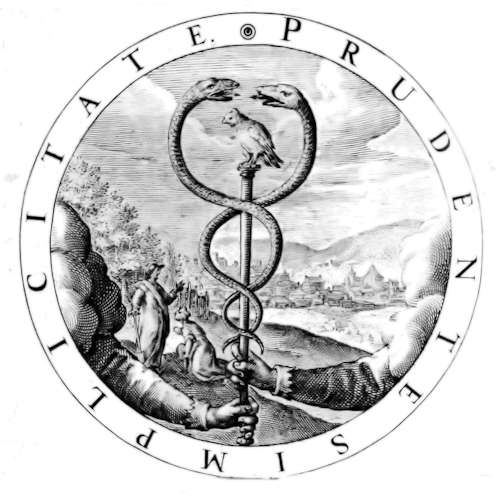
Illvstr. XVII. Book. 3
WHen from the harmelesse Turtle, and the Snake, Their most commended properties wee take, (And, mixe them well) they make a composition, Which yeelds a temper of the best condition. Yet, wickednesse, or sorrow, doth abound, Where, any one of these, alone, is found: For, whensoe're the Serpents-braine we find, With which, there is no Dove-like-meekenesse joyn'd, (Without all peradventure) thence proceedes, All harmefull fraud, and all injurious deedes. And, where such meekenesse as doth seeme to be In harmelesse Doves, divided you shall see From that discretion, and that policie, Which in the Serpents head, is thought to lie; They liable to ev'ry wrong become; And, to it selfe, make Vertue burthensome. But, where these two are ioyned, they procure A life so sweet, so rich, and so secure, That, all the pow'rs of Malice cannot shake Their out-workes, nor within them, terrors make. Vouchsafe thou oh my God! vouchsafe, in me, That these two Vertues may vnited be. Such Prudence give, as never will disdaine The Dove-like Innocencie, to retaine. That meekenesse, grant me, which delighteth not, It selfe, with indiscretion, to besot: But, let these two, each other so defend, And, so, in me continue, till my end, That, simple-prudence, I may still possesse, Although the World shall count it foolishnesse.

Where er'e we dwell, the Heav'ns are neere; Let us but fly, and wee are there.
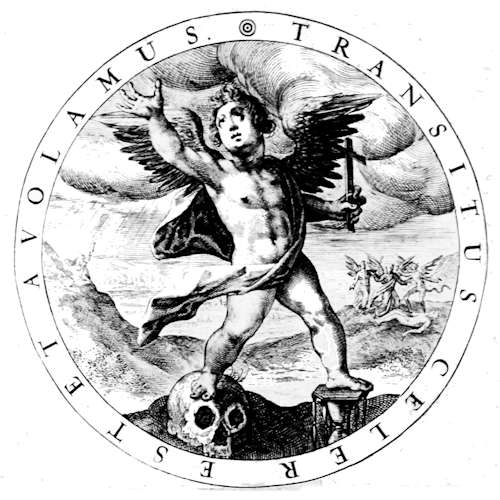
Illvstr. XVIII. Book. 3
WHy, with a trembling faintnesse, should we feare The face of Death? and, fondly linger here, As if we thought the Voyage to be gone Lay through the shades of Styx or Acheron? Or, that we either were to travell downe To uncouth Deapthes, or up some heights unknowne? Or, to some place remote, whose nearest end Is farther then Earths limits doe extend? It is not by one halfe that distance, thither Where Death lets in, as it is any whither: No not by halfe so farre, as to your bed; Or, to that place, where you should rest your head, If on the ground you layd your selfe (ev'n there) Where at this moment you abiding are. This Emblem shewes (if well you looke thereon) That, from your Glasse of life, which is to run, There's but one step to Death; and, that you tread At once, among the Living, and, the Dead. In whatsoever Land, we live or die, God is the same; And, Heav'n is, there, as nigh As in that place, wherein, we most desire Our Soules, with our last breathing, to expire. Which things, well heeding; let us not delay Our Iourney, when we summon'd are away, (As those inforced Pilgrims use to doe, That know not whither, nor, how farre they goe) Nor let us dreame that we in Time, or Place, Are farre from ending our uncertaine Race. But, let us fix on Heav'n, a faithfull eye, And, still, be flying thither, till wee die.

His Pace, must wary be, and slow, That hath a Slippery-way to goe.
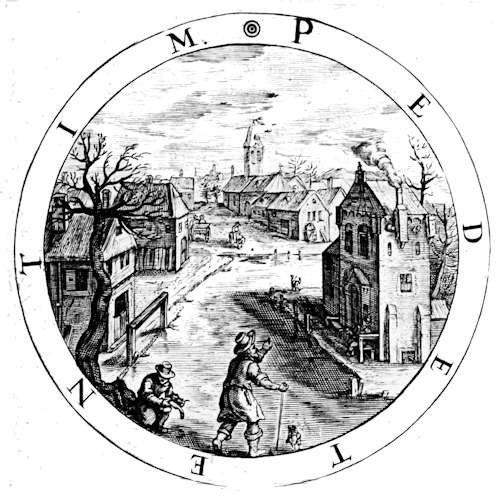
Illvstr. XIX. Book. 3
A Travailer, when he must undertake To seek his passage, o're some Frozen Lake, With leisure, and with care, he will assay The glassy smoothnesse of that Icie-way, Lest he may slip, by walking over-fast; Or, breake the crackling Pavement, by his hast: And, so (for want of better taking heed) Incurre the mischiefes of Vnwary-speed. We are all Travellers; and, all of us Have many passages, as dangerous, As Frozen-lakes; and, Slippery-wayes, we tread, In which our Lives may soone be forfeited, (With all our hopes of Life-eternall, too) Unlesse, we well consider what we doe. There is no private Way, or publicke Path, But rubs, or holes, or slipp'rinesse it hath, Whereby, wee shall with Mischiefes meet; unlesse, Wee walke it, with a stedfast-warinesse. The steps to Honour, are on Pinacles Compos'd of melting Snow, and Isicles; And, they who tread not nicely on their tops, Shall on a suddaine slip from all their hopes. Yea, ev'n that way, which is both sure and holy, And, leades the Minde from Vanities and Folly, Is with so many other Path-wayes crost, As, that, by Rashnesse, it may soone be lost; Vnlesse, we well deliberate, upon Those Tracts, in which our Ancestours have gone: And, they who with more haste, then heed, will runne, May lose the way, in which they well begunne.

Our Pelican, by bleeding, thus, Fulfill'd the Law, and cured Vs.
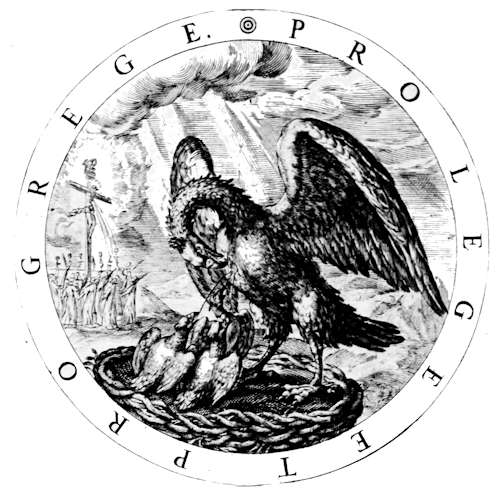
Illvstr. XX. Book. 3
LOoke here, and marke (her sickly birds to feed) How freely this kinde Pelican doth bleed. See, how (when other Salves could not be found) To cure their sorrowes, she, her selfe doth wound; And, when this holy Emblem, thou shalt see, Lift up thy soule to him, who dy'd for thee. For, this our Hieroglyphick would expresse That Pelican, which in the Wildernesse Of this vast World, was left (as all alone) Our miserable Nature to bemone; And, in whose eyes, the teares of pitty stood, When he beheld his owne unthankfull Brood His Favours, and his Mercies, then, contemne, When with his wings he would have brooded them: And, sought their endlesse peace to have confirm'd, Though, to procure his ruine, they were arm'd. To be their Food, himselfe he freely gave; His Heart was pierc'd, that he their Soules might save. Because, they disobey'd the Sacred-will, He, did the Law of Righteousnesse fulfill; And, to that end (though guiltlesse he had bin) Was offred, for our Vniversall-sinne. Let mee Oh God! for ever, fixe mine eyes Vpon the Merit of that Sacrifize: Let me retaine a due commemoration Of those deare Mercies, and that bloudy Passion, Which here is meant; and, by true Faith, still, feed Vpon the drops, this Pelican did bleed; Yea, let me firme unto thy Law abide, And, ever love that Flocke, for which he dy'd.

Bee Iust; for, neither Sea nor Land, Shall hide thee from the Royall-hand.
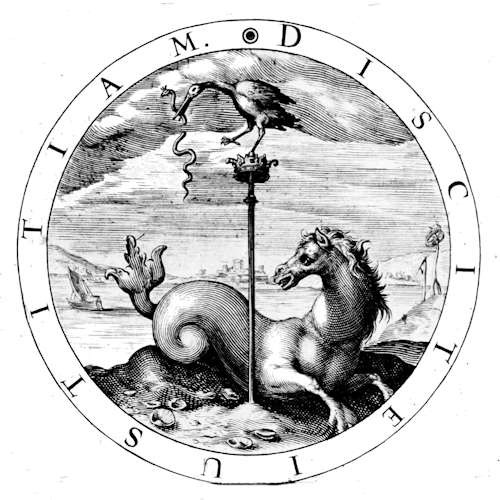
Illvstr. XXI. Book. 3
THat, which wee call the Sea-horse, is a Creature, Whereby the Priests of Ægypt, wonted were, To typify an Ill-disposed nature; And, such, as to their Parents, cruell are: Because, this Monster (as their Authors write) When strong he growes, becommeth so ingrate, That he pursues, with violent despight, His old and weakly Sire, which him begate. Contrariwise, the Storke, they figur'd, then, When they occasion had, to signifie The good condition, of those honest men, Who pleasure take, in workes of Piety: Because, the Storkes, not onely harmed none, But, holpe their aged Parents in their need; And, those offensive Serpents, prey'd upon, Which, in the Fennes of Ægypt, yearely, breed. The Royall-Crowne, therefore, supporting thus That pious Fowle, and overtopping, here, The wicked, and the fierce Hyppotamus, May serve to comfort, and to keep in feare. For, it informes, that, if we pious grow, And love our Princes (who those Parents bee, To whom all Subjects, filiall duties owe) The blessings of their Favours, we shall see. It shewes us, also, that, if we affect Vnrighteous-wayes, no Wit, or Strength of our, Nor any Vncouth-place, shall us protect From being reached, by the Sov'raigne-power. The way of Iustice, therefore, learne thou still, For love of Goodnesse, or for feare of Ill.

Take wing, my Soule, and mount up higher; For, Earth, fulfills not my Desire.
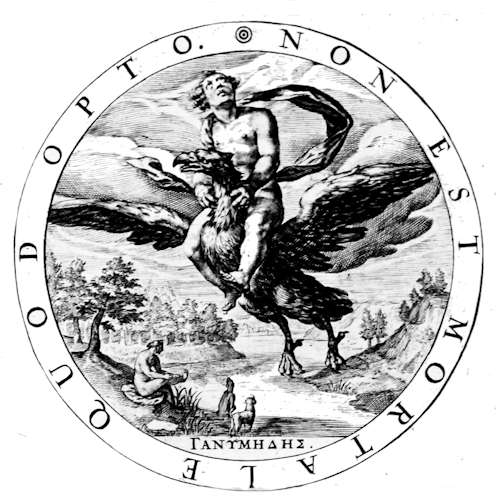
Illvstr. XXII. Book. 3
WHen Ganymed, himselfe was purifying, Great Iupiter, his naked beauty spying, Sent forth his Ægle (from below to take him) A blest Inhabitant, in Heav'n to make him: And, there (as Poets feigned) he doth still, To Iove, and other God-heads, Nectar fill. Though this be but a Fable, of their feigning, The Morall is a Reall truth, pertayning To ev'ry one (which harbours a desire Above the Starry Circles, to aspire.) By Ganymed, the Soule is understood, That's washed in the Purifying flood Of sacred Baptisme (which doth make her seeme Both pure and beautifull, in God's esteeme.) The Ægle, meanes that Heav'nly Contemplation, Which, after Washings of Regeneration, Lifts up the Minde, from things that earthly bee, To view those Objects, which Faith's Eyes doe see. The Nectar, which is filled out, and given To all the blest Inhabitants of Heaven, Are those Delights, which (Christ hath sayd) they have, When some Repentant-soule beginnes to leave Her foulnesse; by renewing of her birth, And, slighting all the Pleasures of the Earth. I aske not, Lord, those Blessings to receive, Which any Man hath pow'r to take, or give; Nor, what this World affords; for, I contemne Her Favours; and have seene the best of them: Nay, Heav'n it selfe, will unsufficient bee, Vnlesse, Thou, also, give Thy selfe, to mee.

Through many spaces, Time doth run, And, endeth, where it first begun.
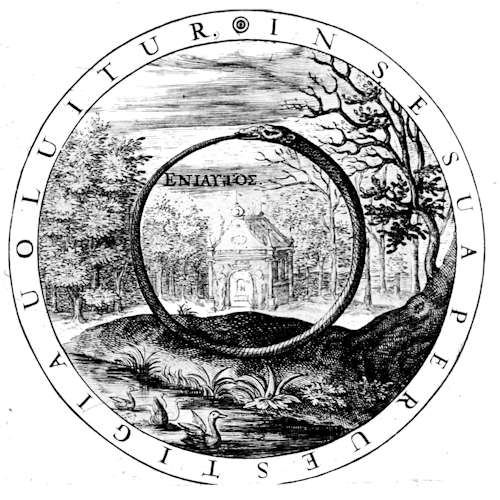
Illvstr. XXIII. Book. 3
OLd Sages by the Figure of the Snake (Encircled thus) did oft expression make Of Annuall-Revolutions; and of things, Which wheele about in everlasting-rings; There ending, where they first of all begun, And, there beginning, where the Round was done. Thus, doe the Planets; Thus, the Seasons doe; And, thus, doe many other Creatures, too. By minutes, and by houres, the Spring steales in, And, rolleth on, till Summer doth begin: The Summer brings on Autumne, by degrees; So ripening, that the eye of no man sees Her Entrances. That Season, likewise, hath To Winter-ward, as leasurely a path: And, then, cold Winter wheeleth on amaine, Vntill it brings the Spring about againe, With all those Resurrections, which appeare, To wait upon her comming, every yeare. These Roundells, helpe to shew the Mystery Of that immense and blest Eternitie, From whence the Creature sprung, and, into whom It shall, againe, with full perfection come, When those Additions, it hath fully had, Which all the sev'rall Orbes of Time can add. It is a full, and fairely written Scrowle, Which up into it selfe, it selfe doth rowle; And, by Vnfolding, and, Infolding, showes A Round, which neither End, nor entrance knowes. And (by this Emblem) you may partly see, Tis that which IS, but, cannot uttred be.

Each Day a Line, small tasks appeares: Yet, much it makes in threescore Yeares.
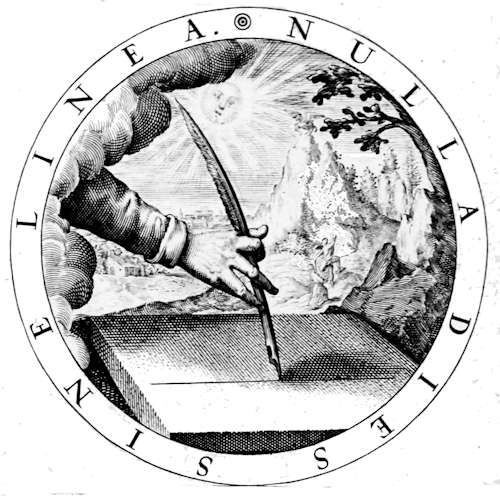
Illvstr. XXIV. Book. 3
HEre's but one Line; and, but one Line a Day, Is all the taske our Motto, seemes to lay: And, that is thought, perhaps, a thing so small, As if it were as good bee nought at all. But, be not so deceiv'd; For, oft you see Small things (in time) great matters, rise to be: Yea, that, which when the same was first begun, A Trifle seem'd, (and easie to be done) By long nelect of time, will burthensome, And, at the last, impossible, become. Great Clarkes, there are, who shall not leave behinde them, One good Weekes worke, for Future-Times to minde them, (In Callings, either Humane, or Divine) Who, by composing but each Day a Line, Might Authors, of some famous Workes appeare, In sixtie, seventie, or in eightie yeare; To which, ten hundred thousands have arrived Of whom, we see no signe that ev'r they lived. And, with much pleasure, wee might all effect, Those needfull Works, which often we neglect, (Vntill too late). If we but, now and then Did spare one houre to exercise the penn. For, still, one-Line, another draweth on, And, Line by Line, great Workes at last are done. Whereas, dis-use, and many dayes mispent, Without their Lines, let in discouragement, Or, bring Despaire; which doth so sottish make us, That we, to no endeavour can betake us. Marke this, and, labour in some honest Way, As much as makes, at least, One Line a Day,

Our outward Hopes will take effect, According to the King's aspect.
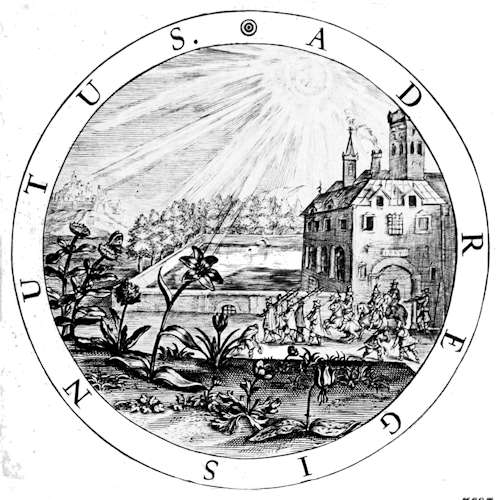
Illvstr. XXV. Book. 3
WHen Phœbus with a cheerefull eye, beholds The Flow'r-embroydred earth, and freely spreads His beames abroad; behold, the Marigolds Beginne to reare their low-dejected heads: The Tulips, Daysies, and the Heliotropes Of ev'ry kinde, their closed Leaves display; And (as it were) with new-recover'd hopes, Attend upon the Ruler of the Day. Againe, when either in the West he shrowds His Rayes below this Horizon, or hides His Face behinde the Curtaines of the Cloudes; They lose their beauties, and abate their prides. Thus fares it with a Nation, and their King, 'Twixt whom there is a native Sympathy. His Presence, and his Favours, like the Spring, Doe make them sweetly thrive, and fructify: Yea (like fresh Groves, or Flow'rs of pleasing hew) Themselves in all their jollity they showe; But, they, if with displeasure, them he view, Soone lose their Glory, and contemned growe. All, are not Heliotropes that favour'd growe, In Princes Courts; nor Marigolds, that beare The golden blossomes; but some spring below, Like Daysie flow'rs, that in the Pathwayes are: Yet all shall feele it, when their Sov'raignes eye Doth frowne, or smile, regard, or else neglect: Yea, it will finde them in Obscurity, By some Disheartning, or some sweet Effect, Vouchsafe to shine on Mee, my Gracious King, And then my Wither'd Leaves, will freshly spring.

The Right-hand way, is Vertues Path, Though rugged Passages it hath.
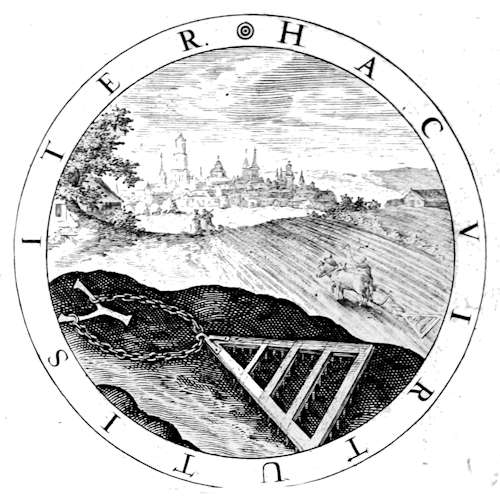
Illvstr. XXVI. Book. 3
IF any covet knowledge of that Path, Which thither tends, where Peace her dwelling hath, This Emblem (being well observ'd) will show On whether side, it will be best to goe. The Left-hand-way, seemes to be walk'd, at ease, Through Lawnes, and Downes, and green-swath'd Passages; And, much allures the Traveller, to trie The many Pleasures, which doe that Way lye. The Right-hand-course, is through a Pathlesse-mound Of newly ploughed, and deep-furrow'd Ground; Which, as uneasie seemeth, to be gone, As, in appearance, rough to looke upon. Yet, this is Vertue's Path: This Way uneven, Is that, which unto ev'ry man is given, To travaile in; and, hath a safer ending, Then those, whereon more Pleasures are attending: And (though it leades us thither, where we see Few promises of outward Glories bee) It brings (us when we passe the common sight) Through easy Tracts, to gaine our Hearts delight. The other Way (though seeming streight, it lyes, To Pleasure's Pallaces, before our eyes) Hath many rubs, and perills, which betweene Our Hopes, and Vs, will alwayes lurke unseene; Till we are drawne so farre, that 'twill be vaine, To seeke, with safety, to returne againe. This, let us heed; and, still be carefull, too, Which Course it most concerneth us to goe. And, though the Left-hand-way, more smoothnesse hath, Let us goe forward, in the Right-hand-path.

I was erected for a Bound, And I resolve to stand my ground.
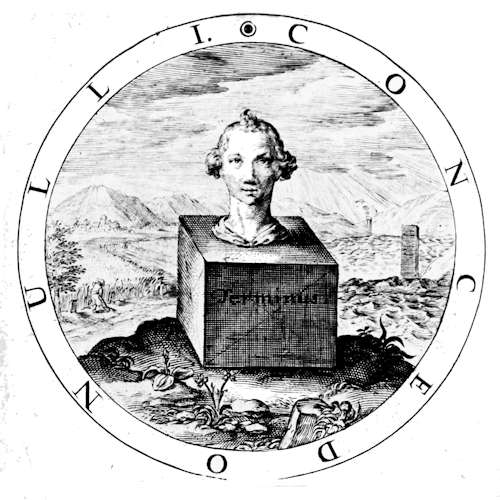
Illvstr. XXVII. Book. 3
THe Bounder-Stones, held sacred, heretofore, Some did so superstitiously adore, As, that they did not onely rev'rence doe them, But, have ascrib'd a kinde of God-head, to them: For, Terminus had many a Sacrifize, As well as other senslesse Deities. I am not so prophane, as to desire Such Ethnick zeale should set our hearts on fire: But, wish I could, Men better did regard Those Bounders, which Antiquity hath rear'd; And, that, they would not, with so much delight, There, make incroachments, where they have no right. That, ev'ry man might keep his owne Possessions, Our Fathers, us'd in reverent Processions (With zealous prayers, and with praisefull cheere) To walke their Parish-limits, once a yeare: And, well knowne Markes (which sacrilegious Hands Now cut or breake) so bord'red out their Lands, That, ev'ry one distinctly knew his owne; And, many brawles, now rife, were then unknowne. But, since neglected, sacred Bounders were, Most men Incroachers, and Intruders are: They grieve each other, and their Dues they steale, From Prince, from Parent, and from Common-weale. Nay, more; these bold Vsurpers are so rude, That, they, on Christ's Inheritance intrude. But, that will be aveng'd; and (on his right) Though such incroach, he will not lose it quite: For, hee's that Bounder, and that Corner-stone, Who all confines, and is confin'd, of none.

Where Lovers fitly matched be, In mutuall-duties, they agree.
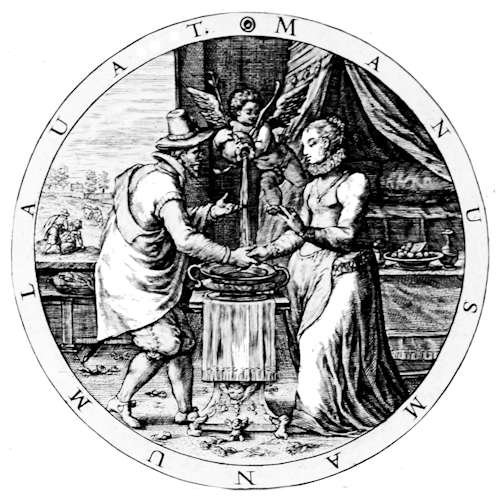
Illvstr. XXVIII. Book. 3
WOuld God, I could as feelingly infuse A good effect of what this Emblem shewes, As I can tell in words, what Moralls bee, The life of that, which here you pictur'd see. Most Lovers, minde their Penny, or their Pleasure; Or, painted Honors; and, they all things measure, Not as they are, but as they helpfull seeme, In compassing those toyes, they most esteeme. Though many wish to gaine a faithfull Friend, They seldome seeke one, for the noblest end: Nor know they (should they finde what they had sought) How Friendship should be manag'd, as it ought. Such, as good Husbands covet, or good Wives (The deare companions of most happy lives) Wrong Courses take to gaine them; yet, contemne Their honest love, who rightly counsell them: And, lest, they unawares the Marke may hit, They blinde their judgements, and befoole their wit. He, that will finde a Friend, must seeke out one To exercise unfeigned love upon; And, mutuall-duties, must both yield, and take, Not for himselfe; but, for his Friendship sake. Such, as doe rightly marry, neither be With Dowries caught, nor wooe a Pedigree; Nor, meerely come together, when they wed, To reape the youthfull pleasures of the Bed: But, seeke that fitnesse, and, that Sympathy, Which maketh up the perfect'st Amity. A paire, so match'd; like Hands that wash each other, As mutuall-helpes, will sweetly live together.

When Law, and Armes, together meet, The World descends, to kisse their feet.
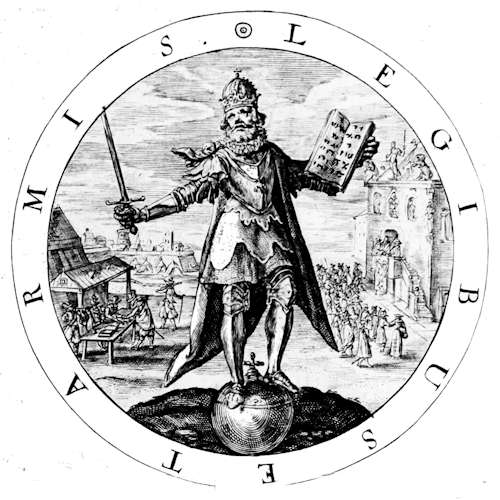
Illvstr. XXIX. Book. 3
THe Picture of a Crowned-king, here, stands Upon a Globe; and, with outstretched hands, Holds forth, in view, a Law-booke, and a Sword: Which plaine and moderne Figures, may afford This meaning; that, a King, who hath regard To Courts for pleading, and a Court of Guard, And, at all times, a due respect will carry, To pious Lawes, and Actions military; Shall not be Monarch, onely in those Lands, That are, by Birth right, under his commands: But, also, might (if just occasion were) Make this whole Globe of Earth, his power to feare; Advance his Favorites; and, bring downe all His Opposites, below his pedestall. His conquering Sword, in forraigne Realmes, he drawes, As oft, as there is just, or needfull cause: At home, in ev'ry Province of his Lands, At all times, armed are his Trayned bands. His Royall fleets, are terrours to the Seas; At all houres, rigg'd, for usefull Voyages: And, often, he his Navy doth increase, That Warres Provisions, may prolong his Peace. Nor, by the tenure of the Sword, alone, Delighteth he to hold his awfull Throne, But, likewise, labours, Mischiefes to prevent, By wholsome Lawes, and rightfull Goverment. For, where the Sword commands, without the Law, A Tyrant keepes the Land in slavish awe: And, where good Lawes doe want an Armed pow'r, Rebellious Knaves, their Princes, will devoure.

Faire-shewes, we should not so much heed, As the Vprightnesse of the Deed.
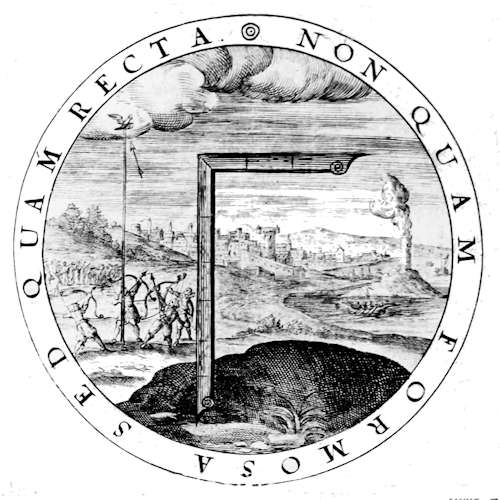
Illvstr. XXX. Book. 3
WHen wee should use a Ruler, or a Square, Or such like Instruments, as usefull are, In forming other things; we prize not so The carving, or the colourable show (Which makes them beautifull in outward sight) As when, for Vsefulnesse, we finde them right. A warped Bowe, though strung with silken threads, And, crooked Arrowes, tipt with Golden heads, Delight not Archers; tyet, such uselesse Toyes Be fit enough for Bunglers, and for Boyes. A skilfull Artist (in what Art soe're, He seekes, to make his ablenesse appeare) Will give large Prices, with much more content, To buy a plaine (if perfect) Instrument; Then, take for nothing (or, for thankes alone) An uselesse Toole, though, gay to looke upon. From whence, observe; that, if there must be sought, When meere Mechanick-workes are to be wrought, Such Instruments, as rather have esteeme For their true-being, then for what they seeme. Much more, should all those Rules be such, whereby Wee goe about, our selves to rectify; And, build up, what in Body, or in minde, We may defective, or impaired finde. Else, peradventure, that we thinke to mend, More faulty may become, at later end. But, hence, I chiefly learne, to take a care, My Life, and Actions, rather be sincere, Then seeming such: And, yet, Ile thinke no shame, To seeme, to be as honest, as I am.

My Substance, and my Light, are spent, In seeking other mens content.
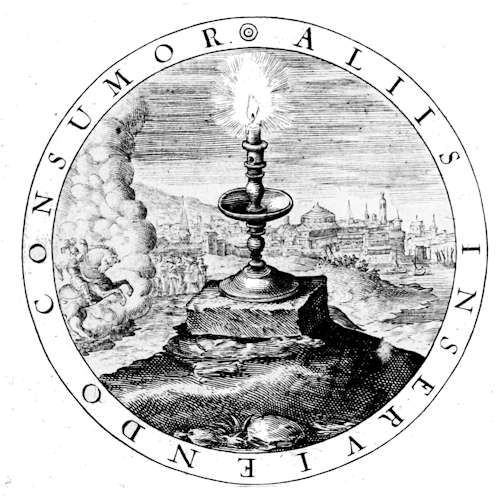
Illvstr. XXXI. Book. 3
IF this nigh-wasted Candle, you shall view, And, heed it well, it may enlighten you To looke with more compassion, on their paines, Who rob themselves, to multiply your gaines. The Taper burnes, to give another light, Ev'n till it selfe, it hath consumed quite; And, all the profit, which it thence doth winne, Is to be snufft, by ev'ry Commer-in. This is the Lot of some, whom I have knowne, Who, freely, all their life-time, have bestowne In such industrious labour, as appeares, To further others profits, more then theirs; And, all their Patrimonies, well nigh spent, The ruining of others, to prevent. The wit, the strength, and all the pow'r they had, (Which might, by probability, have made Good meanes to raise them, in this world, as high, As most, who climbe to wealthy dignity) Ev'n these, they have bestow'd, to better them, Who their indeavours, for their paines, contemne. These are those Lamps, whose flames, from time to time, Have through each Age, and through-out ev'ry Clime, To one another, that true Light convey'd, Which Ignorance, had, els, long since betray'd To utter darknesse. These, despightfull Pride Oft snuffs; and, oft, to put them out, hath try'd. But, from the brightnesse of such Lights, as they, We got our Light of knowledge, at this day. To them, God make us kinder; and to Him, More thankfull, that we gain'd such light by them.

The safest Riches, hee shall gaine, Who alwayes Faithfull doth remaine.
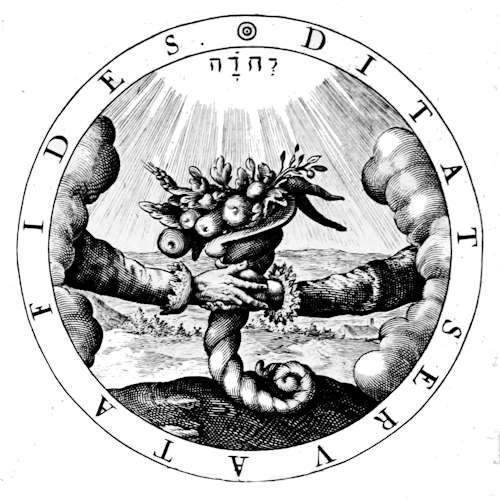
Illvstr. XXXII. Book. 3
THe Horne-of-plenty, which Wealth signifies, The Hand-in-hand, which Plighted-faith implies, (Together being painted) seeme to teach, That, such as will be honest, shall be rich. If this be so, why then for Lucre-sake, Doe many breake the Promises they make? Why doe they cheat and couzen, lye, and sweare? Why practise they all Villanies that are? To compasse Wealth? And, how doe such as they Inlarge their ill-got Portions, ev'ry day? Or, whence proceedes it, that sometimes we see Those men grow poore, who faithfull seeme to bee? Thus, oft it proves; and, therefore, Falshood can, In likelihood, much more inrich a man, Then blamelesse Faith; and, then, the Motto here Improper to this Emblem, doth appeare. But, well enough they sute; and, all is true, Which these things (being thus united) shew. Should it be then concluded, that all those, Who poore and honest seeme, have made but showes Of reall Faith? And, therfore, plagu'd have bin With publicke lashes, for their private sin? Indeed, sometime it hath succeeded so: But, know you should, that, most who richest grow, In Outward-wealth, are very poore in that, Which brings true Plentie, and a blest Estate: And, that, Good men, though poore they seeme to bee, Have Riches, which the Worldling cannot see. Now He, who findes himselfe endow'd with such, (Whate're wee thinke him) is exceeding rich.

Poore-Theeves, in Halters we behold, And, great-Theeves, in their Chaines of gold.
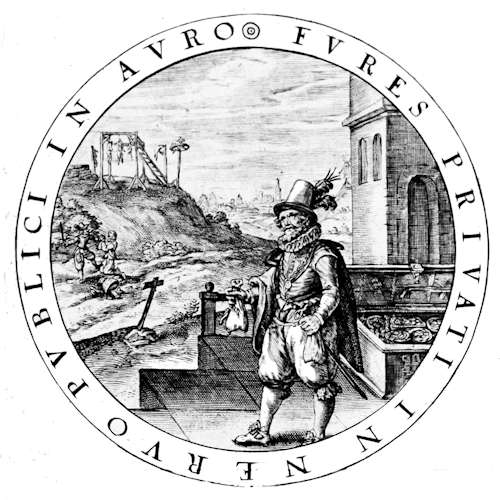
Illvstr. XXXIII. Book. 3
IF you, this Emblem, well have look'd upon, Although you cannot helpe it, yet, bemone The Worlds blacke Impudence; and, if you can, Continue (or become) an honest man. The poore, and petty Pilferers, you see On Wheeles, on Gibbets, and the Gallow-tree Trust up; when they, that farre more guilty are, Pearle, Silke, and costly Cloth of Tissue, weare. Good God! how many hath each Land of those, Who, neither limbe, nor life, nor credit lose (But, rather live befriended, and applauded) Yet, have of all their livelihoods defrauded The helplesse Widowes, in their great distresse? And, of their Portions, robd the Fatherlesse? Yet, censur'd others Errours, as if none Had cause to say, that they amisse have done? How many, have assisted to condemne Poore soules, for what was never stolne by them? And, persecuted others, for that Sin, Which they themselves, had more transgressed in? How many worthlesse men, are great become, By that, which they have stolne, or cheated from Their Lords? or (by some practices unjust) From those, by whom they had beene put in trust? How many Lawyers, wealthy men are growne, By taking Fees, for Causes overthrowne By their defaults? How many, without feare, Doe rob the King, and God, yet blamelesse are? God knowes how many! would I did so, too, So I had pow'r to make them better doe.

Whil'st thou dost, here, injoy thy breath, Continue mindfull of thy Death.
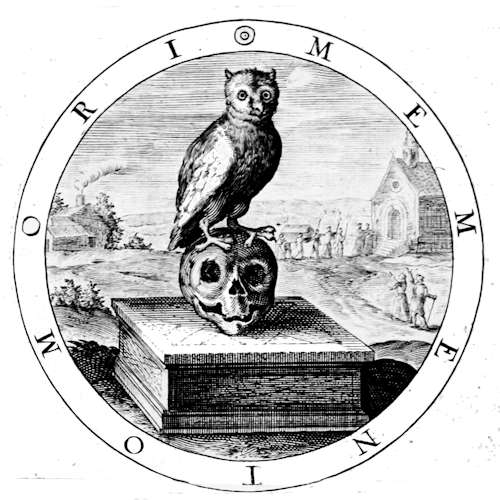
Illvstr. XXXIV. Book. 3
WHen thou beholdest on this Burying-stone, The melancholly Night-bird, sitting on The fleshlesse ruines of a rotten-Skull, (Whose Face, perhaps, hath been more beautifull, Then thine is now) take up a serious thought; And, doe as thou art by the Motto taught. Remember Death: and, minde, I thee beseech, How soone, these Fowles may at thy window screech; Or, call thee (as the common people deeme) To dwell in Graves, and Sepulchers, by them, Where nothing else, but Bats, and Owles, appeare; Or, Goblins, form'd by Fancies, and, by Feare. If thou shalt be advis'd, to meditate Thy latter end, before it be too late, (And, whil'st thy friends, thy strength, and wits may bee In likely case, to help and comfort thee) There may be courses taken, to divert Those Frights, which, else, would terrifie thy heart, When Death drawes neare; and helpe thee plucke away That Sting, of his, which would thy Soule dismay. But, if thou madly ramble onward, still, Till thou art sinking downe that darkesome-hill, Which borders on the Grave (and dost beginne To see the Shades of Terrour, and of Sinne To fly acrosse thy Conscience) 'twill be hard To learne this Lesson; or, to be prepar'd For that sad parting; which, will forced bee, Betweene this much beloved World, and thee. Consider this, therefore, while Time thou hast, And, put not off this Bus'nesse, till the last.

Doe not the golden Meane, exceed, In Word, in Passion, nor in Deed.
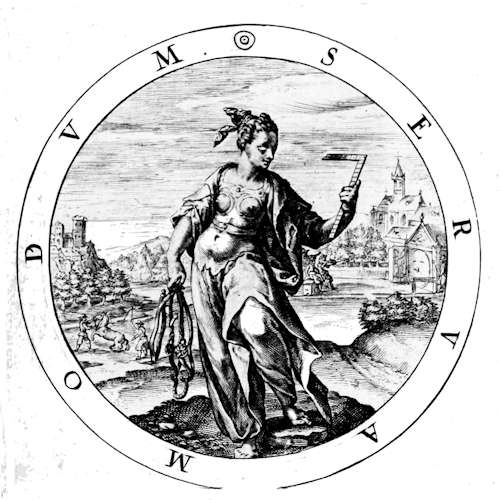
Illvstr. XXXV. Book. 3
AS is the head-strong Horse, and blockish Mule, Ev'n such, without the Bridle, and the Rule, Our Nature growes; and, is as mischievous, Till Grace, and Reason, come to governe us. The Square, and Bridle, therefore let us heed, And, thereby learne to know, what helpes wee need; Lest, else, (they fayling, timely, to bee had) Quite out of Order, wee, at length, bee made. The Square, (which is an usefull Instrument, To shape foorth senselesse Formes) may represent The Law: Because, Mankind, (which is by Nature, Almost as dull, as is the senselesse-creature,) Is thereby, from the native-rudenesse, wrought; And, in the Way of honest-living taught. The Bridle, (which Invention did contrive, To rule, and guide the Creature-sensitive) May type forth Discipline; which, when the Law Hath school'd the Wit, must keepe the Will in awe. And, hee that can by these, his Passions bound, This Emblems meaning, usefully, hath found. Lord, let thy sacred Law, at all times, bee A Rule, a Master, and a Glasse to mee; (A Bridle, and a Light) that I may, still, Both know my Dutie, and obey thy Will. Direct my Feet; my Hands, instruct thou so, That I may neither wander, nor mis-doe. My Lookes, my Hearing, and my Wordes confine, To keepe still firme, to ev'ry Word of thine. On thee, let also my Desires attend: And, let me hold this temper, till mine end.

Wee then have got the surest prop, When God, alone, becomes our Hope.
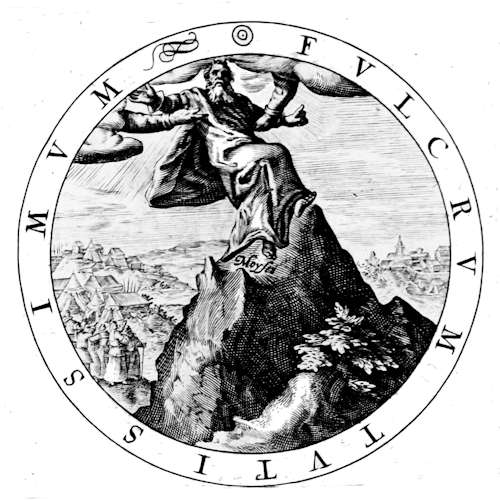
Illvstr. XXXVI. Book. 3
I Should not care how hard my Fortunes were, Might still my Hopes be such, as now they are, Of helpes divine; nor feare, how poore I bee, If thoughts, yet, present, still may bide in mee. For, they have left assurance of such ayd, That, I am of no dangers, now afraid. Yea, now I see, mee thinkes, what weake and vaine Supporters I have sought, to helpe sustaine My fainting heart; when some injurious hand, Would undermine the Station where I stand. Me thinks, I see how scurvie, and how base, It is to scrape for favours, and for grace, To men of earthly minds; and unto those, Who may, perhaps, before to morrow lose Their Wealth, (or their abus'd Authoritie) And, stand as much in want of helpe as I. Me thinks, in this new-rapture, I doe see The hand of God from heaven supporting me, Without those rotten-Ayds, for which I whinde, When I was of my tother vulgar-minde: And, if in some one part of me it lay, I, now, could cut that Limbe of mine away. Still, might I keepe this mind, there were enough Within my selfe, (beside that cumbring stuffe Wee seeke without) which, husbanded aright, Would make mee Rich, in all the Worlds despight. And, I have hopes, that, had shee quite bereft mee, Of those few ragges and toyes, which, yet, are left me; I should on God, alone, so much depend, That, I should need, nor Wealth, nor other Friend.

True Vertue, firme, will alwayes bide, By whatsoever suffrings tride.
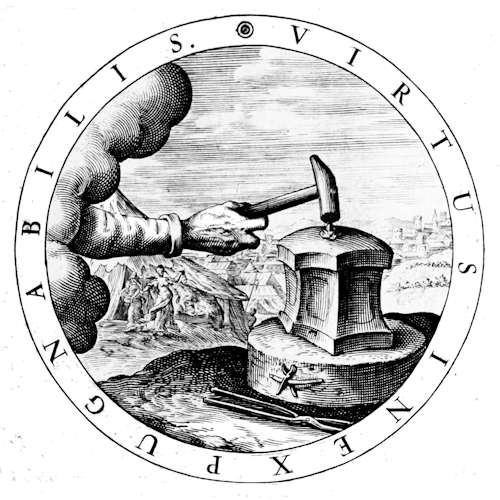
Illvstr. XXXVII. Book. 3
THis is a well-knowne Figure, signifying, A man, whose Vertues will abide the trying: For, by the nature of the Diamond stone, (Which Violence, can no way worke upon) That Patience, and long-suffering is intended, Which will not bee with Injuries offended; Nor yeeld to any base dejectednesse, Although some bruising Pow'r, the same oppresse; Or, such hard streights, as theirs, that hamm'rings feele, Betwixt an Anvile, and a Sledge of Steele. None ever had a perfect Vertue, yet, But, that most Pretious-stone, which God hath set On his right hand, in beaming-Majestie, Vpon the Ring of blest ETERNITIE. And, this, is that impenitrable Stone, The Serpent could not leave impression on, (Nor signe of any Path-way) by temptations, Or, by the pow'r of sly insinuations: Which wondrous Mysterie was of those five, Whose depth King Solomon could never dive. Good God! vouchsafe, ev'n for that Diamond-sake, That, I may of his pretiousnesse, partake, In all my Trialls; make mee alwayes able To bide them, with a minde impenitrable, How hard, or oft so'ere, those hamm'rings bee, Wherewith, Afflictions must new fashion mee. And, as the common Diamonds polish'd are, By their owne dust; so, let my errours weare Each other out; And, when that I am pure, Give mee the Lustre, Lord, that will endure.

Truth, oft oppressed, wee may see, But, quite supprest it cannot bee.
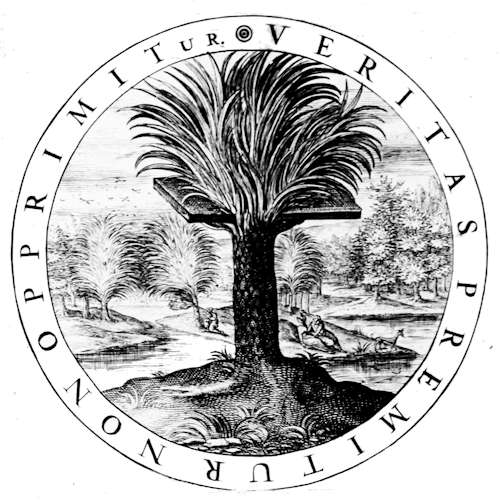
Illvstr. XXXVIII. Book. 3
THis is that fruitfull Plant, which when it growes, Where wholesome Water in abundance flowes, Was, by the Psalmist, thought a likely Tree, The Emblem, of a blessed-man, to bee: For, many wayes, it fitly typifies, The Righteous-man, with his proprieties; And, those true Vertues, which doe helpe increase His growing, in the state of Blessednesse. The Palme, (in this our Emblem, figur'd, thus) Depressed with a Stone, doth shew to us The pow'r of Truth: For, as this Tree doth spread, And thrive the more, when weights presse downe the head; So, Gods eternall Truth (which all the pow'r And spight of Hell, did labour to devoure) Sprung high, and flourished the more, thereby, When Tyrants crush'd it, with their crueltie. And, all inferiour Truths, the same will doe, According as they make approaches to The best Perfection; or, as they conduce To God's due praise, or some such pious use. Lord, still, preserve this Truth's integritie, Although on ev'ry side, the wicked prie, To spie how they may disadvantage it. Yea, Lord, though Sinners in high place doe sit, (As David saith) yet, let them not oppresse Thy Veritie, by their imperiousnesse. But, make both Her, and her Professors, bide The Test, like Silver seven times purifide. That, all Truths lovers, may with comfort see, Shee may deprest, but, not, oppressed bee.

They, who but slowly-paced are, By plodding on, may travaile farre.
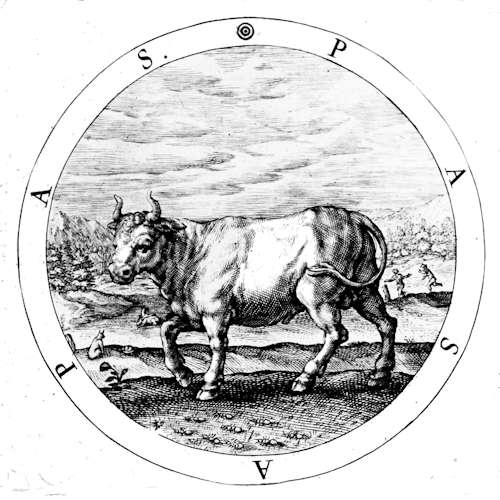
Illvstr. XXXIX. Book. 3
THe big-bon'd Oxe, in pace is very slow, And, in his travaile, step by step, doth goe, So leisurely, as if he tir'd had bin, Before his painfull Iourney did beginne; Yet, all the day, he stifly ploddeth on, Vntill the labour of the day be done: And, seemes as fresh (though he his taske hath wrought) As when to worke he first of all was brought. Meane-while, the Palfray, which more swiftnesse had, Hath lost his breath, or proves a Resty-jade. This Emblem, therefore, maketh it appeare, How much it profiteth, to persevere; And, what a little Industry will doe, If wee continue constant thereunto. For, meanest Faculties, discreetly us'd, May get the start, of nobler Gifts, abus'd. This, may obserued be in many a one: For (when their course of life was first begunne) Some, whose refined wits, aspi'rd as high, As if above the Sphæres, they were to flie: By Sloth, or Pride, or over-trusting to Their owne Sufficiencies, themselves undoe. Yea and those forward-wits, have liv'd to see Themselves inferiours, unto those, to be, Whom, they did in their jollity, contemne, As blocks, or dunces, in respect of them. Then, learne, Great-wits, this folly to prevent: Let Meane-wits, take from hence, incouragement: And, let us all, in our Affaires proceed, With timely leisure, and with comely speed.

Vncertaine, Fortunes Favours, bee, And, as the Moone, so changeth Shee.
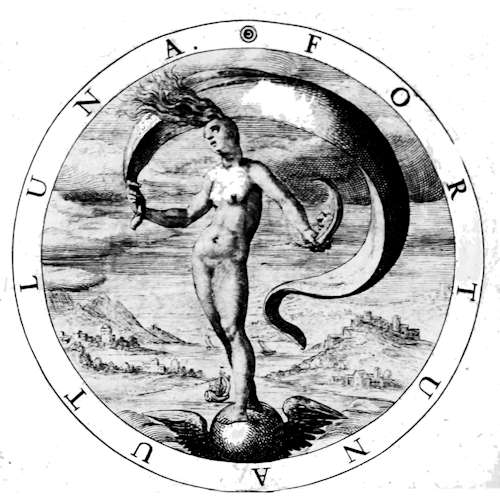
Illvstr. XL. Book. 3
OVr Author, peradventure, giveth us Dame Fortune (for these Reasons) pictur'd, thus: She hath a Comely-body, to declare, How pleasing shee doth usually appeare To them, that love her Favours. She is blinde, (Or, hath still closed eyes) to put in minde, How blindly, and how heedlesly, she throwes Her Largesse, where her Bounty, she bestowes. She stands upon a Ball; that, wee may learne, Of outward things, the tottering, to discerne: Her Ball hath wings; that it may signifie How apt her Favours are, away to flie. A Skarfe displayed by the wind, she beares, (And, on her naked-Body, nothing weares) To shew, that what her Favorite injoyes, Is not so much for Vsefulnesse, as toyes. Her Head is hairelesse, all, except before; To teach thee, that thy care should be the more To hold her formost kindnesse, alwayes fast; Lest, she doe show thee slipp'ry tricks, at last. And, lastly, that her changing may be showne; She beareth in her Hand a Wayned-moone. By this Description, you may now descry Her true conditions, full as well as I: And, if you, still, suppose her, worth such honour, You have my leave to wooe, and wayt upon her. Moreover (to her credit) I confesse, This Motto falsly saith, her Ficklenesse Is like the Moones: For, she hath frown'd on mee Twelve Moones, at least; and, yet, no Change I see.

Vntill the Steele, the Flint shall smite, It will afford nor Heat, nor Light.
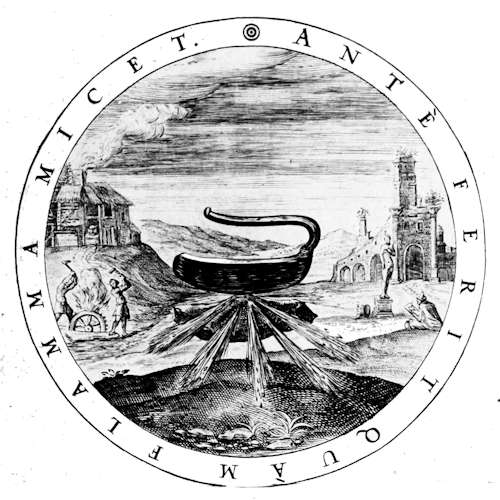
Illvstr. XLI. Book. 3
WHilst by the High-way-side, the Flint-stone lies, Drie, cold, and hardnesse, are the properties We then perceive: But, when we prove it nigher, We finde, that, Coldnesse doth inclose a Fire; And, that, though Raine, nor cloudie-skie appeares, It will be (many times) bedew'd with teares. From hence, I mind, that many wronged are, By being judg'd, as they, at first, appeare; And, that, some should bee prais'd, whom wee despise, If inward-Grace, were seene with outward-Eyes. But, this is not that Morall (wee confesse) Which this our Emblem, seemeth to expresse: For (if the Motto speake the meaning right) It shewes, that, hard-afflictions first must smite Our hardned hearts, before it will bee seene, That any light of Grace, in them, hath beene. Before the Flint will send forth shining Rayes, It must bee strucken, by the Steele, (it sayes.) Another Morall, adde we may to this, (Which, to the Figure, sutes not much amisse.) The Steele, and Flint, may fitly represent Hard-hearted men, whose mindes will not relent: For, when in opposition, such become, The fire of Malice, flames and sparkles from Their threatning Eyes; which else, close hidden rests, Within the closets of their flintie brests: And, flame out-right it will not, (though it smokes) Till Strife breake passage, for it, by her strokes. If any of these Moralls may doe good, The purpose of my paines is understood.

My Wit got Wings, and, high had flowne; But, Povertie did keepe mee downe.
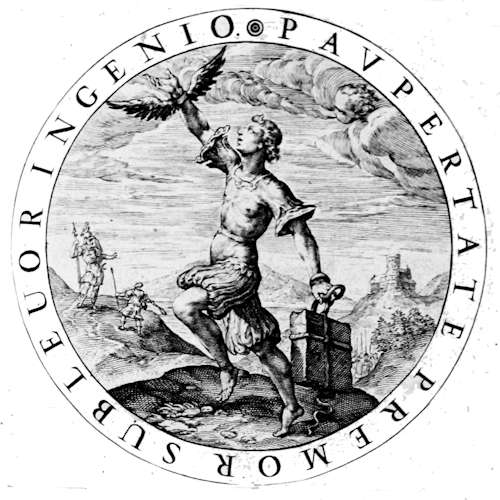
Illvstr. XLII. Book. 3
YOu little thinke, what plague it is to bee, In plight like him, whom pictur'd here you see. His winged-Arme, and his up-lifted-eyes, Declare, that hee hath Wit, and Will, to rise: The Stone, which clogs his other hand, may show That, Povertie and Fortune, keepe him low: And, twixt these two, the Bodie and the Mind, Such labours, and such great vexations finde, That, if you did not such mens wants contemne, You could not chuse but helpe, or pitie them. All Ages had (and, this I know hath some), Such men, as to this misery, doe come: And, many of them, at their Lot, so grieve, As if they knew, (or did at least beleeve) That, had their Wealth suffiz'd them to aspire (To what their Witts deserve, and they desire). The present Age, and future Ages too, Might gaine have had, from what they thought to doe. Perhaps I dream'd so once: But, God be prais'd, The Clog which kept me downe, from being rais'd, Was chain'd so fast, that (if such Dreames I had) My thoughts, and longings, are not now so mad. For, plaine I see, that, had my Fortunes brought Such Wealth, at first, as my small Wit hath sought; I might my selfe, and others, have undone, Instead of Courses, which I thought to runne. I finde my Povertie, for mee was fit; Yea, and a Blessing, greater than my Wit: And, whether, now, I rich or poore become, Tis nor much pleasing, nor much troublesome.

A Mischiefe, hardly can be done, Where many-pow'rs are knit in one.
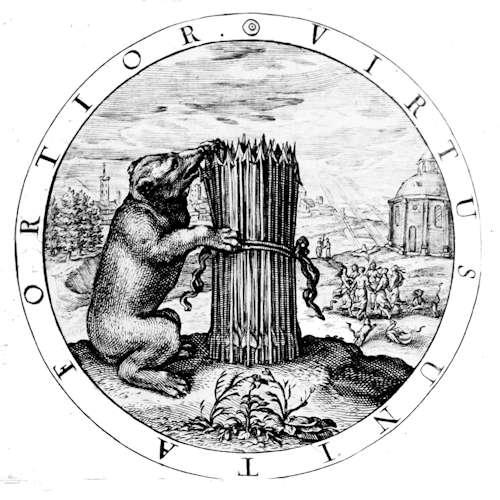
Illvstr. XLIII. Book. 3
OBserve the Sheafe of Arrowes, figur'd here; And, how the pow'r, and fury, of the Beare (Though hee attempt it) no device can finde To breake one slender-shaft, while they are joyn'd: Whereas, were they divided, strength but small, Like rotten Kexes, would soone breake them all. This Emblem, therefore, fitly doth imply That Safeguard, which is found in Vnity; And, shewes, that, when Dis-union is begunne, It breedeth dangers, where before were none. The Psalmist, numerous Off-springs, doth compare To Quivers, that with Shafts replenish'd are. When Vnity hath knit them in her bands, They prove like Arrowes in a Gyants hands. And, though, for these, their Foes in wayt have layd, They shall not be supriz'd, nor made afrayd. Consider this, yee Children of one Sire, 'Twixt whom, is kindled some contentious fire, And, reconciled be, lest you, at length, Consume away the marrow of your strength; Or, by dividing, of your joyned-pow'r, Make way for those, who studie to devoure. Yea, let us all consider, as we ought, What Lesson, by this Emblem, we are taught. For, wee are Brethren all; and (by a Bloud More precious, then our nat'rall Brother-hood) Nor knit, alone, but, mingled, as it were, Into a League; which is, by much, more deare, And, much more dangerous, to be undone, Then all the Bands, that can be thought upon.

They, best injoy their Hearts desires, In whom, Love, kindles mutuall-fires.
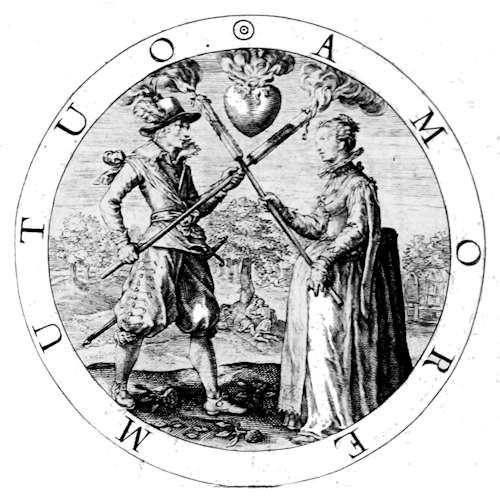
Illvstr. XLIV. Book. 3
WHat may the reason be, that, when Desire Hath kindled in the brest, a Loving-fire, The Flame, which burn'd awhile, both cleere & strong, Becomes to be extinguished, ere long? This Emblem gives the reason; for, it showes, That, when Affection, to perfection growes, The Fire, which doth inlighten, first, the same, Is made an equall, and a mutuall-flame. These burning Torches, are alike in length; To shew, Love equall, both in time, and strength. They, to each otherward, their Flames extend, To teach us, that, True-lovers have no end Pertayning to Selfe-love; and, lo, betweene These Two, one Flaming-heart, is to be seene; To signifie, that, they, but one, remaine In Minde; though, in their Persons, they are twaine. He, doubtlesse, then, who Lov'd, and, giveth over, Deserveth not the Title of a Lover; Or, else, was unrequited in Affection, And, was a Lover, with some imperfection. For, Love, that loves, and is not lov'd as much, May perfect grow; but, yet, it is not such, Nor can be, till it may that object have, Which gives a Heart, for what it would receive: And, lookes not so much outward, as to heed What seemes within, to want, or to exceed. Whether our Emblem's Author, thought of this, You need not care; nor, will it be amisse, If they who perfect Lovers, would be thought, Doe mind, what by this Morall, they are taught.

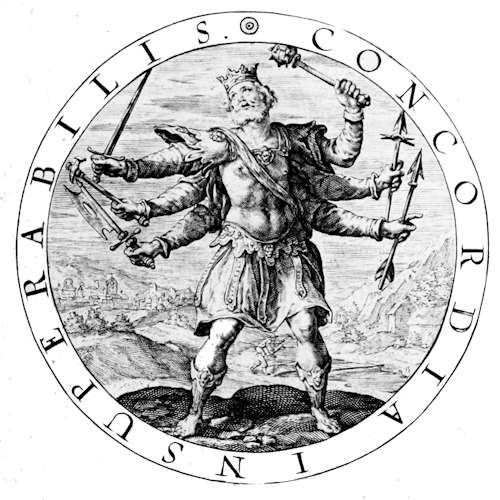
Where many-Forces joyned are, Vnconquerable-pow'r, is there
Illvstr. XLV. Book. 3
AN Emblem's meaning, here, I thought to conster; And, this doth rather fashion out a Monster, Then forme an Hieroglyphicke: but, I had These Figures (as you see them) ready made By others; and, I meane to morallize Their Fancies; not to mend what they devise. Yet, peradventure, with some vulgar praise, This Picture (though I like it not) displayes The Morall, which the Motto doth imply; And, thus, it may be sayd to signifie. He, that hath many Faculties, or Friends, To keepe him safe (or to acquire his ends) And, fits them so; and, keepes them so together, That, still, as readily, they ayd each other, As if so many Hands, they had been made; And, in One-body, usefull being had: That man, by their Assistance, may, at length, Attaine to an unconquerable-strength; And, crowne his honest Hopes, with whatsoever He seekes for, by a warranted Endeavour. Or, else, it might be sayd; that, when we may Make our Affections, and, our Sense, obay The will of Reason, (and, so well agree, That, we may finde them, still, at peace to be) They'l guard us, like so many Armed-hands; And, safely keepe us, whatsoere withstands. If others thinke this Figure, here, inferres A better sense; let those Interpreters Vnriddle it; and, preach it where they please: Their Meanings may be good, and so are these.

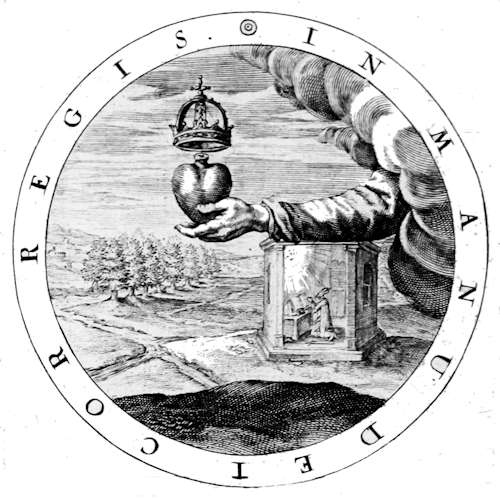
The Hearts of Kings are in God's Hands; And, as He lists, He Them commands.
Illvstr. XLVI. Book. 3
WHy doe men grudge at those, who raysed be, By royall Favour, from a low degree? Know this; Hee should be honour'd, whom the King, To place of Dignity, shall please to bring. Why should they blame their Kings, for fav'ring such, Whom, they have thought, scarce meriting so much? God rules their Hearts; and, they, themselves deceive, Who dreame, that Kings exalt, without Gods leave. Why murmure they at God, for guiding so The Hearts of Kings, as oft they see him doe? Or, at his Workes, why should they take offence, As if their Wit, could teach his Providence? His just, and his all-seeing Wisedome knowes, Both whom, and why he crownes, or overthrowes; And, for what cause, the Hearts of Princes, bee Inlarg'd, or shut; when we no cause can see; We sometime know, what's well, and what's amisse; But, of those Truths, the root concealed is; And, False-hoods, and Uncertainties, there are, In most of those things, which we speake, or heare. Then, were not Kings directed by God's hand, They, who are best, and wisest in the Land, Might oft misguide them, either by receiving A False report, or, by some wrong-believing. God's Grace it is, that Good-men rays'd have bin: If Sinners flourish, we may thanke our Sin. Both Good and Bad, so like in out-sides be, That, Kings may be deceiv'd, in what they see; And, if God had not rul'd their Hearts aright, The World, by this time, had been ruin'd quite.

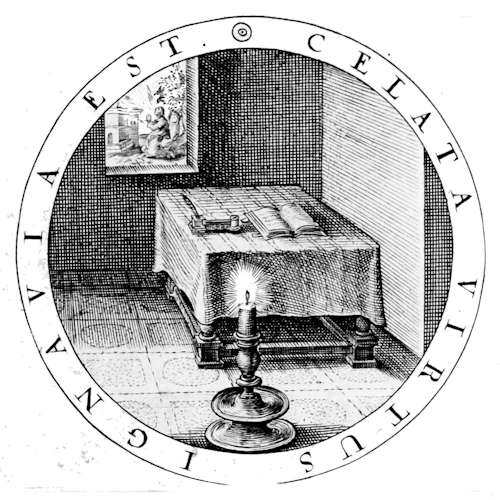
A Vertue hidden, or not us'd, Is either Sloth, or Grace abus'd.
Illvstr. XLVII. Book. 3
The World hath shamelesse Boasters, who pretend, In sundry matters, to be skill'd so well, That, were they pleased, so their houres to spend, They say, they could in many things excell. But, though they make their hearers to beleeve, That, out of Modestie their Gifts they hide, In them wee very plainely may perceive, Or Sloth, or Envy, Ignorance, or Pride. When other mens endeavours they peruse, They either carpe at what they cannot mend; Or else of Arrogance doe those accuse, Who, to the publike view, their Workes commend. If these men say, that they can Poetize, But, will not; they are false in saying so: For, he, whose Wit a little that way lies, Will doing bee, though hee himselfe undoe. If they, in other Faculties are learned, And, still, forbeare their Talents to imploy; The truest Knowledge, yet, is undiscerned, And, that, they merit not, which they injoy. Yea, such as hide the Gifts they have received, (Or use them not, as well as they are able) Are like fayre Eyes, of usefull sight bereaved; Or, lighted-Candles, underneath a Table. Their glorioust part, is but a Painted-cloath, Whose Figures, to the wall-ward, still are hung. Their hidden Vertues, are apparant Sloth; And, all their life, is to the publike wrong: For, they doe reape the Fruits, by many sowne, And, leave to others, nothing of their owne.

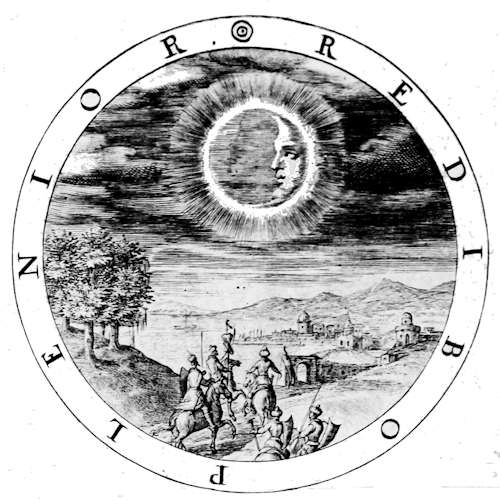
The Moone, which is decreasing now, When shee returnes, will fuller, grow.
Illvstr. XLVIII. Book. 3
I Never, yet, did murmuringly complaine, Although those Moones have long been in the Waine, Which on their Silver Shields, my Elders wore, In Battels, and in Triumphs, heretofore. Nor any mention have I ever made, Of such Eclipses, as those Crescents had; Thereby, to move some Comet, to reflect His fading-light, or daigne his good-aspect. For, when I tell the World, how ill I fare, I tell her too, how little I doe care, For her despights: yea, and I tell it not, That, helpe, or pitie, might from her be got; But, rather, that her Favourites may see, I know my Waynings, yet, can pleased bee. My Light, is from the Planet of the Sunne; And, though the Course, which I obliquely runne, Oft brings my outward Fortunes to the Waine, My Light shall, one day, bee renew'd againe. Yea, though to some, I quite may seeme to lose My Light; because, my follies interpose Their shadowes to eclipse it: yet, I know, My Crescents, will increase, and fuller, grow. Assoone as in the Flesh, I beeing had, I mooved on in Courses retrograde, And, thereby lost my Splendor: but, I feele Soft motions, from that great Eternall-Wheele, Which mooveth all things, sweetly mooving mee, To gaine the Place, in which I ought to bee: And, when to Him, I backe returne, from whom At first I came, I shall at Full become.

Bee warie, wheresoe're, thou bee: For, from deceit, no place is free.
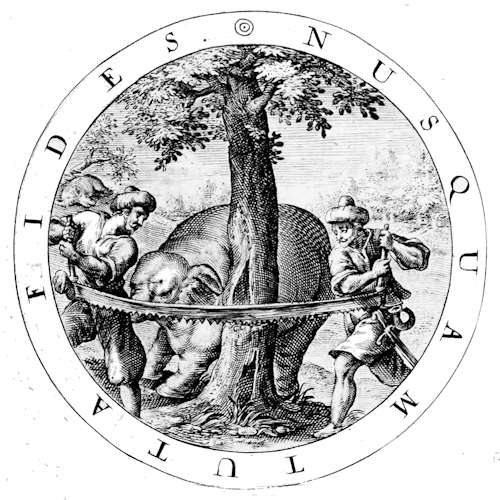
Illvstr. XLIX. Book. 3
SOme write (but, on what grounds, I cannot tell) That they, who neere unto the Deserts dwell, Where Elephants are found, doe notice take, What trees they haunt, their sleeping-stocks to make; That, when they rest against an halfe-sawne stemme, It (falling) may betray those Beasts to them. Now, though the part Historicall, may erre, The Morall, which this Emblem doth inferre, Is overtrue; and, seemeth to imply, The World to bee so full of Treacherie, As, that, no corner of it, found can be, In which, from Falshoods Engines, wee are free. I have observ'd the Citie; and, I finde The Citizens, are civill, grave and kinde; Yet, many are deluded by their showes, And, cheated, when they trust in them repose. I have been oft at Court; where I have spent, Some idle time, to heare them Complement: But, I have seene in Courtiers, such deceit, That, for their Favours, I could never wait. I doe frequent the Church; and, I have heard Gods judgements, by the Preachers, there, declar'd, Against mens falshoods; and, I gladly heare Their zealous Prayers, and good Counsells there; But, as I live, I finde some such as they, Will watch to doe a mischiefe, if they may. Nay, those poore sneaking Clownes, who seeke their living, As if they knew no manner of deceiving; Ev'n those, their witts, can (this way) so apply, That, they'l soone cousen, wiser men, than I.

This Day, my Houre-glasse, forth is runne; Thy Torch, to Morrow, may bee done.
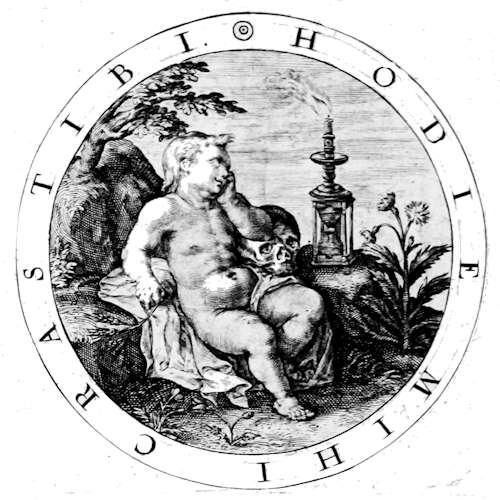
Illvstr. L. Book. 3
THere is no Day, nor minute of the Day, In which, there are not many sent away From Life to Death; or, many drawing-on, Which, must within a little while, bee gone. You, often, view the Grave; you, often, meet The Buriers, and the Mourners, in the street, Conveying of some Neighbour, to that home, Which must, e're long, your dwelling-place become. You see the Race, of many a youthfull Sonne Is finish'd, e're his Father's Course is done; And, that, the hand of Death, regardeth neither Sexe, Youth, nor Age; but, mingleth all together. You, many times, in your owne houses, heare The groanes of Death, and, view your Children, there, Your loving Parents, or, beloved Wives, To gaspe for breath, and, labour for their lives. Nay, you your selves, do sometime find the paines Of Sicknesse, in your Bowels, and your Vaines. The Harbingers of Death, sometime, begin To take up your whole Bodie, for their Inne. You beare their heavie Aches, on your back; You feele their twinges, make your heartstrings crack; And, sometime, lye imprison'd, and halfe dead, With Age, or with Diseases, on your bed: Yet you deferre your ends; and, still contrive, For temp'rall things; as if you thought to live Sixe Ages longer: or, had quite forgot, That, you, and others, draw one common-Lot. But, that, you might not, still, the same forget, This Emblem, and this Motto, here were set.

Finis Libri tertij.
