Part 3 — CHAPTER III. MIRACLES AT NAZARETH AND CAPERNAUM. A.D. 29.
Reading edition
AMONGST the places He now visited, the Redeemer repaired to Nazareth, where He had been brought up (Lk. iv. 16), and where many, if not all His kindred were residing. The Sabbath came round, and, as was His wont, He entered the Synagogue, and for the first time stood up to read in His native village. The worship, which began with prayer, was followed by the reading of the Law and the Prophets, and the portion of the latter either appointed for the day, or selected by His own Divine wisdom and foreknowledge, was taken from the 61st chapter of the prophet Isaiah. This portion was by universal consent applied to the Messiah, and spoke of Him as anointed to preach the Gospel to the poor, as sent to heal the broken-hearted, to preach deliverance to the captives and recovery of sight to the blind, to set at liberty them that were bound (Lk. iv. 18, 19). Accordingly the Saviour read the words in the ears of those assembled, and then folding up the scroll, returned it to the chazzan or minister, and sat down280.
This last act was a sign that He intended to take upon Himself the office of interpreter, and the eyes of all were fastened upon Him (Lk. iv. 20). This day, He began to say, is this Scripture fulfilled in your ears, and proceeded to pour forth the long-hidden treasures of wisdom and grace. The first effect upon His audience was one of signal approval. They all marvelled at the gracious words which proceeded out of His lips (Lk. iv. 22). But other and very different feelings soon arose in their minds. They began to recall the fact of His lowly origin (Lk. iv. 22), and when the Holy One went on to intimate that no prophet was accepted in his own country, that, as was illustrated, even in Old Testament times, by the cases of the widow of Zarephath and Naaman the Syrian, the mercies of God were not restricted to the Jews only (Lk. iv. 24–28), they were wrought up to such a pitch of fury, that they not only arose and thrust the Speaker out of their synagogue, but leading Him to the brow of the hill on which their city was built281, would have cast Him down headlong, had He not, probably by an exercise of Divine power, escaped from their hands, and disappeared (Lk. iv. 30).
Thus rejected at Nazareth as He had been at Jerusalem, the Saviour turned His steps towards the busy neighbourhood of the lake of Gennesaret, and took up His abode at Capernaum282 (Mtt. iv. 13; Lk. iv. 31), whence He could easily communicate, as well by land as by lake, with many important towns, and in the event of any threatened persecution retire into a more secure region283.
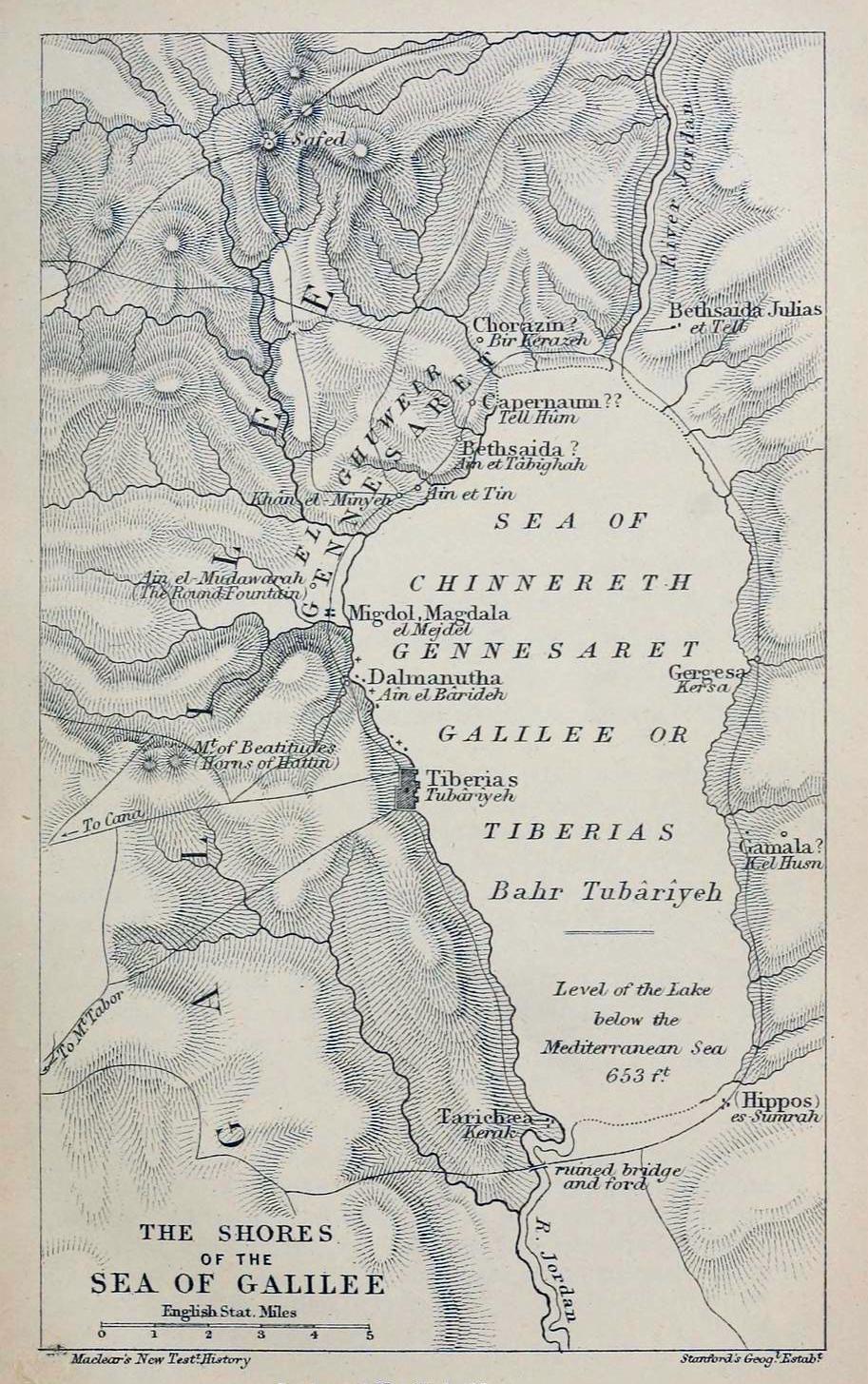
THE SHORES OF THE SEA OF GALILEE
London and New York: Macmillan & Co. Maclear’s New Test.t History Stanford’s Geog.l Estab.t
The recent cure of the son of the officer in Herod’s court was not forgotten at Capernaum, and many pressing upon the Saviour to hear the word of God (Lk. v. 1), it became clear that an opportunity was now afforded for an active and systematic ministry among a people sitting in darkness and in the shadow of death (Mtt. iv. 16). The first act, therefore, of the Redeemer was permanently to attach to His Person, and invest with the authority of teachers, four of the number afterwards known as the “twelve Apostles.” As He walked by the lake, He saw Simon and Andrew employed in fishing, and the sons of Zebedee284, James and John, in a vessel mending their nets (Mk. i. 16, 19; Mtt. iv. 18, 21; Lk. v. 2–6). They had already known Him for above a year, and now He would formally call them to leave their earthly occupations, and become fishers of men285.
As the people, therefore, pressed upon Him, He requested Simon to push off his boat a little way from the shore, that He might teach the multitude, and at the close of His discourse, bade him thrust out into the deeper waters, and let down his net for a draught. The ill success that had attended his efforts the previous night, made Simon at first hesitate, but he had no sooner made the trial, than the net enclosed such a multitude of fishes, that it began to break (Lk. v. 6). On this he and Andrew beckoned to James and John, and their companions in the other boat, who had doubtless watched all that had occurred, and they immediately came to their help, and filled both the boats so that they began to sink (Lk. v. 7). So deep was the impression made by this unlooked-for success upon the mind of Peter, that yielding as always to the impulse of the moment, he cried, Depart from me, for I am a sinful man, O Lord286. But the emblem of their future destinies, and the pledge of future success, having thus been given them, the Saviour bade him and the others leave their ships and become fishers of men. And thus Peter and Andrew, James and John, quitting their earthly occupations, henceforth became His regular attendants and disciples.
The report of this miracle, and of the determination of the four to follow the Prophet of Nazareth, would soon be noised abroad among the populous villages along the lake. It is no wonder, then, that on the following Sabbath the words of the Saviour were eagerly listened to in the synagogue of Capernaum (Mk. i. 22; Lk. iv. 32), confirmed as they also were by a remarkable occurrence that now took place. A man was present in the synagogue possessed with an evil spirit, which, in the hearing of all, cried out, What have I to do with Thee, Jesus of Nazareth? art Thou come to destroy us? I know Thee who Thou art, the Holy One of God. Thereupon the Redeemer rebuking him, and bidding him hold his peace, commanded the Evil Spirit to leave the sufferer he was tormenting, and the demon having thrown the man into strong convulsions (Mk. i. 26), and “uttering an inarticulate cry of rage and pain287” left him, amidst the awe and wonder of those assembled.
This miracle—the first of the kind—over unclean spirits was speedily noised abroad throughout the whole region of Galilee, and excited a strong enthusiasm in favour of the Prophet of Nazareth. Leaving the synagogue, the Saviour repaired to the abode of Peter, whose wife’s mother lay struck with a violent fever288, and taking her by the hand lifted her up. Immediately the malady yielding before that Divine rebuke (Lk. iv. 39), left her, and in place of the exhausted energy and prostration usually following it, she found herself able not only to rise, but even to minister to the Healer and His disciples (Mk. i. 31).
When, however, the sun began to set, the effect of the miracle in the synagogue became still more apparent. The whole city seemed to have collected about the abode of the humble fisherman, bringing with them all who were sick, or afflicted with demons, and placed them before his Master. Nor did they come in vain, for laying His hands upon each of them, He, who Himself took our infirmities and bare our sicknesses (Is. liii. 4; Mtt. viii. 17), restored to them the blessing of health.