PART II.
Reading edition
BEAVER ISLAND.
Beaver Island was once the home of the Mormons. This island is the largest in the group of islands in lake Michigan, containing about fifteen thousand acres of land.
To many who may read these pages it may seem like a fairy tale to know that a kingdom ever existed within the borders of the United States. A kingdom has existed, and that little kingdom was on Beaver Island, now commonly known as St. James, being named in honor of him who made himself a king. James Jesse Strang was born and educated in New York State, graduated from the Fredonia Academy of the same state. He studied law and was classed among the brilliant lawyers of his day. In his eight years rule on Beaver Island he was twice elected to the State Legislature of Michigan. His speeches were considered among the most brilliant delivered in the halls of Lansing, the State Capitol. He spoke with ease, his manner was winning, he aimed to be a leader. Strang was living at Voree, Wis., at the time of Joseph Smith's death at Nauvoo, Ill. Having joined the Mormon Church he now claimed to have "Divine Revelations" from God that he was chosen to fill Joseph Smith's place to lead the people left without a leader. After a hard struggle which he made for the leadership, Brigham Young was chosen as Smith's successor.
BEAVER ISLAND CHOSEN AS A KINGDOM.
Strang felt his defeat very keenly and withdrew with a few of his followers who had entire belief in his revelations. He now went to Kirtland, Ohio, where a Mormon temple had been built as a place of worship for the Latter Day Saints, as they are now commonly known. Strang soon became restless. Brigham Young had already gone with a large number of Smith's followers to Salt Lake City, Utah. Strang wanted more territory, more privileges, which he knew he could not have in Kirtland, so he began to look about for a place where he could establish a kingdom over which he could rule with undisputed sway. Being a lawyer and understanding the law so perfectly he knew he could not carry out his plans unless he found some secluded place where the law of the land could not easily reach him, and where could he find a place better suited to carry out his plans than Beaver Island? In 1846, two years prior to Strang's coming to Beaver Island to establish his kingdom he was on his way west to Wisconsin. The steamer he took passage on was driven into Beaver Harbor to seek shelter from a storm. When Strang was telling all this to my father he said, "When my eyes first rested on Beaver Island I thought it the most beautiful place on earth."
At the time Strang was there, a Mr. Alva Cable from Fairport, Ohio, had located at the Point and was establishing a business. He had built a dock, a store and a fine large dwelling and was already buying fish from the fishermen and shipping them to outside markets.
STRANG'S FIRST COMING TO THE ISLAND WITH HIS PEOPLE.
Strang had already settled in his mind to locate at Cheboygan, Mich., having looked over the location. Mackinac Island being just near enough for him to get their supplies. At that time Mackinac Island was the largest fish market in northern Michigan, furnishing supplies to the whole north shore and fishermen among the great number of islands, its several stores furnishing everything necessary to the people around and being in close touch with the outside world, having a postoffice and mails coming there from Detroit.
But when Strang saw Beaver Island, its beautiful harbor, fine timber and natural beauty of scenery, the thought came to him like an inspiration, and he said, "This is where I will come to build up my kingdom." And when he saw all the improvements being done he had no doubt but he could soon have all the people about the shore as his followers. But there was much to hinder before he could persuade many of his followers to come and locate on a lonely island, as it seemed to them, in the middle of Lake Michigan. Also Strang's wife was not a believer in the Mormon doctrine, having no faith in the revelations he claimed to have: but Strang had a great command of language and possessed a strong will power. He at last persuaded a few of his followers to come with him to Beaver Island, where they landed from a steamer in the early part of June, 1848, two years after he had first seen the island. About twenty-five people came with him, and before navigation closed over a hundred more had landed, most of them being all unprepared for a long, cold winter on an island where the snows were extremely deep in winter.
PAYMENT TIME FOR THE INDIANS.
The whole surrounding country at that time was a wilderness. White settlers were few in number. There were many different tribes of Indians wandering about from place to place on their hunting and fishing tours. They were all peaceably inclined, many remained long enough to plant small gardens near the shores, but never clearing the land at any distance back from the shore. The woods were filled with abundance of game to satisfy all their wants and needs. The red men of the forest were best satisfied in their own native wilds. They were nature's children. The trees, flowers, buds, leaves and waves on the shore all whispered their mystery of the great and good Spirit that ruled all things. In those days the Indians were receiving payments from the government. An agent was employed with a clerk to make these annual payments. Sometimes the money would be paid out at Sault Ste. Marie, sometimes Green Bay was the place of gathering, other times Mackinac Island. Then the tribes would gather from far and near, bringing their whole families to receive their money. That was a happy time for the red man and his family to know the "Great Father" at Washington was such a friend. Payment time, as it was called, also made trade for the white man.
THE INDIANS AND THEIR ISLANDS.
There was a large band of Indians living on Garden Island, three miles distant north from Beaver Island. This island had been deeded to them by the government as their own. Also another island about six miles west of Beaver Island, called High Island. Both these Islands were fertile, covered with heavy timber, and both afforded good fishing opportunities with good harbors at each island. Strang's people never having seen Indians before were naturally very timid, especially when the Indians gathered at Beaver Harbor to sell their fish and being friendly often called at the Chemokamon's house. The Indian being of an inquisitive nature, wanted to see how the white brothers lived in their homes. Strang himself said he felt none too sure of his own life when he saw so many coming to his home, but the Indians and their squaws with their papooses on their backs, that being the fashion of carrying their young children, were always smiling and good natured, which very soon reassured Strang and his people that they were friendly and meant them no harm. At first the Mormons always kept their doors locked and barred. Strang soon preached to them to leave their doors open to their Indian friends, which they did with the faith that their King knew best.
JAMES JESSE STRANG, THE MORMON KING.
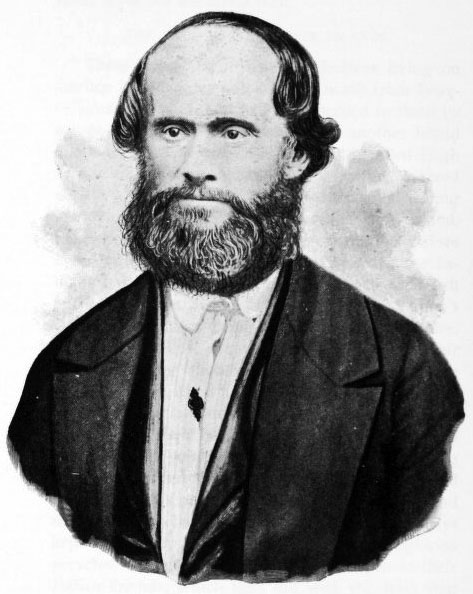
STRANG CALLING ON US.
About the time my people came to Beaver Island the property at the Point in Beaver Harbor was just changing hands, Mr. Alva Cable having sold his dock and buildings to a Mr. Peter McKinley from Painesville, Ohio, who came with his family and took possession at once, putting in a supply of provisions for the fall trade with the fishermen.
Strang soon called on our people, and was anxious to have my father build our home near the Mormon settlement at the harbor, promising there would be plenty of work, as more of his people were constantly coming. Strang was so friendly and sent many of his people to call on us. His wife also called on us. She was a bright, sensible, noble woman, and we found her friendship was true. My mother being a nurse, Strang told her he would always be glad of her assistance when any of his people were sick. Our people had never heard about Mormons before and knew nothing about their belief or doctrine. Mother told me many times afterward it seemed very strange to her seeing the Mormon women dressed in short dresses with hair cut short and keeping Saturday for their Sunday. When mother spoke to them about it they told her that King Strang had all these revelations from God and that, he being their leader, they must obey what he said.
FIRST SETTLERS.
Our house was soon finished. Father had built it near to a Gentile family, an elderly couple from Toronto, Canada. They had bought a small piece of land from the government, making themselves a home the year previous to the coming of the Mormons. They were an Irish family with considerable means. They first came to Mackinac Island to visit a nephew, Mr. P. Kilty. They took a little trip to Beaver Island with others, and were so pleased with it, thinking it would soon be settled and make a desirable place to live. Their name was Loaney, and the place where they located has always borne the name of Loaney's Point. It was on the south side of Beaver Harbor, distant about two miles from the village. On the end of Loaney's Point rests a large boulder which has always been a land mark, sometimes looming up looking like a great black steamer near the shore. Mr. Loaney's nephew, P. Kilty, also located at the Island and was driven away with the rest of the Gentiles, returning again after the Mormons were sent away from the Island, residing many years there and being a successful fisherman and farmer. His son, Mr. Peter Kilty, is now, and has been for several years, a captain on one of the large steamboats on lake Michigan. The old couple, Mr. and Mrs. Loaney, had some sad experience with their Mormon neighbors, losing their home and all they had by their persecutions. After the Mormons were driven off the Island Mr. Loaney returned and was appointed keeper of the Beaver Island lighthouse at the head of the Island, holding the position several years, he being the second keeper having charge of that station, a Mr. Van Allen being the first keeper when the light was first erected.
PREPARING FOR WINTER.
The winter of 1849 was an extremely cold winter, with heavy ice and deep snows. Our summer boarders had all packed and gone to their homes. Father had brought our provisions home and packed it away for winter use. Many of our Mormon neighbors with their children came often to see us, and we children played with them. Mr. Loaney had some cows and Auntie Loaney was always bringing us milk as well as to her Mormon neighbors. Our boys and father and mother were very busy making a large fishing seine for a man in Ohio who was coming the next spring.
GOING OVER TO THE POINT TO DINNER WITH THE MCKINLEYS.
Before the ice came in the fall father took us all in our boat across to the Point so mother could do some shopping. Mr. McKinley was a very kind and pleasant man and would have us go to his house for dinner. He wanted us to get acquainted with his family. Father took us over to their nice, large and comfortable home. Mrs. McKinley was very kind and seemed pleased to see us. She was a pretty, bright-faced woman, slender, with dark hair and eyes. She had three little girls, Sarah the eldest, Effie and Mary. We children were soon acquainted, playing with the dolls and having tea with the children's little dishes. Mr. McKinley had a sister living with him whom the children called "Aunt Ann." She was very kind to us, giving us many slices of bread and butter with cups of milk.
I remember the children had such beautiful hair, which I admired so much. Mother helped to set the table and get the dinner on the table, as they boarded several of their help. Our boys were out exploring the Point with some Mormon boys. When we were ready to go home Mrs. McKinley filled a great basket with large red apples for us to take home. Father thanked her, saying he ought not to take them, as he had two barrels at the store for winter use. She said, "Do take these apples, they came from home in Ohio and are better than the apples at the store. Now I want you to have them." We children played together until the last moment. The little girls gave me large packages of candy. Kissing them I promised to come again sometime. Mrs. McKinley was very kind, wanting us all to come again. Father told me afterward when I was older how lonely she was, missing her Ohio home so much. She asked father what he thought about our Mormon neighbors. He said he knew very little about them, so far they had been very kind and pleasant. She told him her fears, saying. "I have no faith in Strang at all. I fear he is misleading those people and I am afraid they will cause us all lots of trouble before long, but my husband thinks they are a well-meaning people. We have invested considerable money, which I feel quite sure we shall regret." Father tried to encourage her to feel more hopeful, but she said she could not feel they were true. She liked Mrs. Strang, as everybody did who knew her.
Soon after this the cold snows of winter were upon us, ice made very fast. We heard no more the whistle of the boats, and saw no more the white sails of the vessels and fish boats that sailed in and out of the pretty harbor. I was young, yet I remembered and missed all these things.
KIND NEIGHBORS.
I was never tired going over to see Uncle and Auntie Loaney, as they taught us children to call them. They were a dear old couple and loved us the same as if we were their own. I remember the pretty large cat with the little white kittens. When she gave me bread and milk I would sit on her clean white floor, and it was hard to know which ate most of that bread and milk, myself or the cats. I used to take my dolls over and stay days at a time with Auntie, and when mother came after me she would say, "Oh don't take her away home. Sure you have four and I have none at all, at all. Now you must leave me one." Then little brother Charley would go and stay a while with them until he got lonely for the rest of us. In that way we took turns being with our kind, good neighbors all the time we lived near them. Some of us were always with them. They had a son married and doing business in Toronto. The next year he came to visit them for a month. Then how pleased she was to tell Michael how good we little children were to her. We children all loved them dearly.
Winter was advancing. There was much sickness among the Mormon people. Food was scarce with no means to buy, and clothing thin for a northern winter. Mother was called away from home to care for them, and we children were often left at home with grandpa and father. Auntie and Uncle Loaney were always coming to see how we were. I staid with them most of the time, getting lonesome often for Charley and Bob. Poor old Bob was more feeble than ever now, the cold winter bringing on rheumatism.
BOB'S NEW FRIEND.
I remember one day Uncle Loaney coming in and saying to father, "Sure Mr. Whitney, why don't you kill that old dog? He is good for nothing and can't stand up any more." That was enough, little brother and I began to cry and then poor old grandpa, the tears rolled down his cheeks, and when he could speak he said in his broken English, "Oh don't keel Bob, you keel Bob me die too. Me and Bob good friends good many year. Oh no keel Bob." Then father explained what a long time Bob had lived and been with grandpa and how he had saved brother Toney's life the winter before. Then how sorry Uncle Loaney was, saying. "Yes let poor Bob live as long as he can." After that many were the little pails of milk sent to Bob.
SUFFERING OF THE PEOPLE.
I remember a man came to our house one morning and two little boys were with him. Father had gone with Toney and Lewis out to chop wood a short distance from the house. The man came in with the children and asked to see father. Grandpa was so afraid to be alone with the Mormon he said, "Me no want you keel me. Me give you everything in the house you no keel me." The man said, "No, I don't want to hurt you. My children are hungry." Charley ran out to tell father to come, then the man explained how hungry his family were, having no bread and no money to buy. Father gave them something to eat, and soon the children were sitting with Charley and me eating bread and butter. Father gave flour and other things for the man to carry home.
CARING FOR THE SICK AND DYING.
Mother soon came home, telling of the want and suffering among the people. The King had gone from the Island on the last boat, leaving them to fare as best they could. They had come to the Island too late to plant anything that season and none of them knew how to fish or help themselves. They suffered cold, hunger and death that winter without complaint of their King. Their whole cry was "Oh, if our King were only here." There was some one every day to our house and Aunt Loaney's. The Mormons were in a starving condition. Father gave to them until he feared we should be left with nothing. Grandpa was afraid we children would be left hungry, so he buried many things for us. Mother and Auntie were always busy cooking and carrying food to the sick and dying. Mrs. McKinley was just as busy at the Point helping the suffering people all she could. There were several deaths in the winter and spring. After awhile father, grandpa and the boys put some nets through the ice, catching many fish for the hungry people. Our boys set hooks, showing the Mormon boys how to catch the fish to keep themselves from starving. Father and mother were so much among them they began to learn something about their strange belief, which was peculiar, their faith being all placed on their leader, "King James," as they often called Strang, always calling upon him to help them in their trouble. Mother said to them, "Why do you call upon man to help you? Why don't you call upon God and pray to him for help?" They would not listen, saying, "Has not our King the revelations revealed to him?"
RETURN OF SPRING AND COMING OF STRANG.
Spring had come. Our good old steamboat "Michigan" had come to our harbor once more. Strang also came. He was just as calm and serene as usual, nothing seemed to disturb him. His wife did not return until later in the season. He soon came to our house and seemed very grateful to our people for their kindness to his suffering people during his absence. When mother told him how much they had suffered he laughed, saying, "Oh, they must get used to Island life and expect to have some hardships." Soon the boats came and brought more Mormons. Those that came now were more comfortable and seemed to have more means to help themselves with. Very soon they were at work clearing the land and making ready to put in crops of potatoes, corn and other vegetables. There were several families who came from Texas, bringing their horses with them, with wagons and a few cows. Of course those who had plenty had to share with those who had little and give their every tenth part to the King's treasury, and very often giving more to help out extra expenses. Strang seemed in excellent spirits and went about from house to house, talking and encouraging his people, and father said no one would think they had passed through such trouble so recently. Soon it was planned to give a feast in honor of the King's return, and great were the preparations going on among the Mormons.
JAMES CABLE SETTLING AT THE HEAD OF BEAVER ISLAND.
With the springtime also came many fishermen to all of the islands, and many settled along the east shore of Beaver Island as far up as the light house at the head of the Island. A Mr. James Cable, nephew of Mr. Alva Cable, had now come to locate at the head of Beaver Island, three miles north of the light-house point. James Cable came from York State. He was a bright, smart, enterprising young man, recently married to a most estimable young lady of the same city where he lived. They came with their little son Claude, a child of about two years old. Here Mr. Cable invested considerable money; put out a good dock, built a large dwelling and store, carrying on the wood business for many years, as well as having a fish market, employing several men getting out cord wood to supply the steamboats, as well as buying fish and furnishing provisions and all fishing supplies to fishermen. Mr. C. R. Wright, also another man from New York State, settled at Cable's dock and carried on a large cooper shop to supply the barrels for the fishermen, which became a great industry. Mr. Cable, with all the rest of the Gentiles, was compelled to leave Beaver Island in 1852, not feeling safe to remain longer. After the death of King Strang he returned, taking possession again of his property, carrying on the business with success for several years. Feeling his need of rest he closed out his business and bought the property at Mackinac Island known as the "Astor House."
Several of the men who had been with us the year before now returned again and were boarding with us. There were two brothers that came. Their names were Thomas and Samuel Bennett. Thomas was married when he came and they soon took some land, built a house and put in some crops. They also were in the fishing business. They never were very friendly with the Mormons.
STRANG'S REVELATIONS.
Soon after Strang's coming after that terrible winter of cold and suffering among his people, he claimed to have had several new revelations which must be told to his people. They all prepared for a great feast showing their joy at their King's safe return among them again. It would seem in his talk to them about his new revelations that he told them God was sending many Gentiles to be a help and a support to God's people, meaning themselves, the Latter Day Saints, and that it was right for his people to take whatever was necessary for them to have. That it was their privilege to take from the Gentiles. This was the first time that the King had openly given any orders of that nature to his people. Whether any Gentile had ever been admitted within the council room was never known, or whether some of his own people told what had been said, which many of us thought might be the case, but the news soon spread, and from that time no Gentile felt secure about his property. My father once asked Strang if he had ever preached to his people and given such orders. He answered he had not, but their actions soon told what their instructions had been.
ROBBING THE GENTILES.
His people soon began to take from the Gentiles whatever they could get. Up to this time the feeling between the Mormons and Gentiles had been very friendly, the fishermen being glad to have the Island settled with a good peaceful people as they had until now seemed to be. Mr. Peter McKinley at the Point was now suffering considerable losses by the Mormons taking his cattle and butchering them, also other goods which they were taking. A young man, or boy, Wheelock by name, told or gave information about the butchering of the cattle. He being a Mormon boy employed by Mr. McKinley, had to suffer the penalty by receiving fifty stripes with the "blue beaches," that being one kind of their punishments. We had never heard before of the Mormons doing anything of this kind to their people. The boy had told the truth and had to suffer the cruel whipping.
WHIPPING OF THOMAS BEDFORD.
A man by the name of Thomas Bedford was employed by Mr. Peter McKinley. He also gave some information about the stealing of property by the Mormons, and he also received seventy-five of the cruel stripes with the "blue beaches." For this awful treatment Mr. Bedford swore revenge. The Mormons never proved that Mr. Bedford had given any information about their stealing goods from Mr. McKinley, but just concluded he had and gave him the awful punishment. So Bedford bided his time for revenge.
Strang had now a great number around him who sought his favor and were ever ready to do his bidding and many times did things he did not sanction. There were some good, kind, peaceable people that knew nothing about the working of the inner circle that surrounded the king. There was one apostle that aimed to take the King's place and be ruler himself. He was a cruel and crafty man. He took charge of all things among the people in Strang's absence.
BUILDING TEMPLE AND PRINTING OFFICE.
The Mormons were now building a temple after the pattern of the one at Kirtland, Ohio, and I believe of the same size. They had already built a saw mill so they could manufacture their own lumber. They had built a large building made of logs hewn on both sides. This was fitted up as a printing office and Strang edited a paper called the "Northern Islander." The printing office still remains and was turned into a hotel and is known as the Gibson House of St. James. The Mormons were a very busy people. Those that were improving their farms and building their homes had nothing to do, as a rule, with the making of Strang's laws. He had his council men, his twelve apostles, besides elders under the apostles, members of the households of twelve. They did the voting and had all to do with making the laws, that is the laws that governed the conduct of their people. Strang had the revelations and the council of twelve voted it a law. And they had the power to enforce the law and punish any who disobeyed. So far the King had preached against polygamy and said that it should not be allowed, although there were a number of Mormons that had a number of wives apiece. Strang allowed it to be so, as he said they had practiced the law according to Joseph Smith's doctrine, and having several wives apiece he told them they might keep them, but that no more should be taken. So the men who had more than one wife kept them. Strang had many people now to control, every boat during the summer season brought more converts, as he had several apostles traveling constantly about the country making new converts to their faith. Strang instructed them to make all things to appear at its best, so the people were made to believe the Island was truly the "promised land."
STRANG'S REVELATION OF POLYGAMY.
Now the King had a new revelation that polygamy must be practiced. When he made it known to his people it gave them a great shock, as their minds had been made up that this was not to be. Strang very soon obeyed the "Divine Command" by taking a spiritual wife, or as the Mormons called it, "being sealed." Mrs. Strang, his wife, packed her clothing and taking her three children with her, left the Island, never coming back to live with him again. Strang was absent when she left, so she met with no opposition. She came back to the Island twice during his absence, gathering the people together in the temple, talking and pointing out to them the error of practicing such a doctrine, and both times she came she burned the robes which the King wore when preaching in the temple. Mrs. Mary Strang was greatly loved by all his people that knew her. Of course the King was not pleased with the interference of Mrs. Strang.
"CHARLES DOUGLAS."
The King now took one of his young wives, had her dressed in man's apparel and travel about with him seeking after more converts. The name he gave her was "Charles Douglas." He made a great joke of this, and boasted "Charles" was the best worker he ever had. If Strang was magnetic "Charles Douglas" was irresistible. She was a beautiful woman and extremely fine looking when dressed as "Charles Douglas." I saw Strang and "Douglas" once together. One of the Mormon apostles was living neighbor to us. Mother had sent me on an errand to their house. Strang and his companion came there to dinner. Both were dressed in plain black suits, wearing high silk hats, which was the fashion. Both were smiling and talking very pleasantly together. Of course I supposed it was a young man with Strang, but the apostle's wife told mother about it later.
A MAN WITH SEVERAL WIVES.
There was one family living at the harbor settlement who kept a boarding house. This man had four wives. Gentiles as well as Mormons boarded with him, and many were the jokes the man had about his wives, saying he had no need of hired girls, as he had wives enough to do his work. My father was often there to take his meals, and once I remember mother was with him and took me. One of the wives was a French woman. Mother talked with her in her own language and she said she was tired of that life. She not being a favorite wife had too much work to do. She had four small children. When the other women saw her talking to mother in French they seemed not to like it, thinking perhaps she was talking about them. As soon as they came into the room the French woman began to sing as though she was very happy. At another time, when she was sick and my mother was taking care of her, she said, "Only for the love I have for my children I would take poison." Many women that we met were very cheerful and pleasant, while there were many more with very sad faces and manner. When our people first lived neighbors to the Mormons they were very friendly and talked about their work. As soon as they began to take things from us they became silent and did not appear to care to meet us any more. There were a few who never changed toward us and proved friends to the last, although they had to appear sometimes to be our enemies.
BOB'S DEATH.
One morning I missed Bob. I always ran to see him when I first got up. Sometimes it was very hard for Bob to walk, and when the warm spring sunshine came our boys and grandpa would put Bob in a nice place to lay. Now I could not find him, and when I saw mother I saw that she had been weeping and was now silent when I asked her about Bob. I ran over to Auntie Loaney's. There was grandpa. He was sobbing as if his heart would break and our boys were trying to comfort him by telling him Bob had not suffered a moment. Then I realized. Bob, my old friend, was dead, and I sobbed, "Oh, boys, what made you kill Bob?" Then they tried to explain. I could not listen, I could not understand why it should be done. Then Auntie and Uncle Loaney said, "Now dear children do not grieve, poor old Bob was too old to live any longer. It is best his sufferings are over." We were all sad over the faithful dog's death. It was several weeks before grandpa and I could feel it was for the best. We buried him where the birds sang first in the spring.
KING STRANG'S RESIDENCE, BUILT IN 1850.
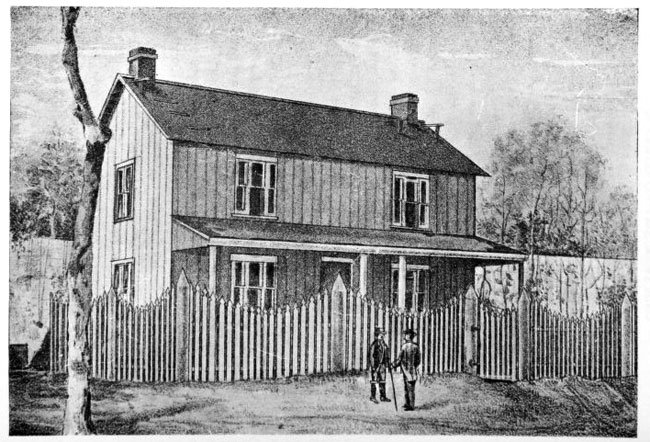
Father now thought it best to move to the head of the island, his work being there with Mr. Cable. We were beginning to fear the Mormons, as they had greatly changed toward us. In their travels up and down the island they most always stopped at our house. And sometimes there would be five or six, and very often they would ask for a meal, which we never refused to give them. Very often they remained all night, and then they were always sure to let us see the big knives they carried hanging to the belt they wore. Towards the last of our stay they carried a gun with them as well. When they came to our doors they never rapped, but simply walked in and helped themselves to a chair. We were told by some of their own people who were disgusted with Strang's doctrine that these men were just obeying the King's commands. He was trying to make all the Gentile people know the Mormons were to have their own way on the island. Just as fast as the Gentiles moved away from the Mormon settlement the Mormons followed and built their homes near to them. The Bennett brothers had already left their home at the harbor and gone to the Gentile settlement.
THE COUNTY SEAT OF SAINT JAMES.
Strang had now got the county organized, being attached to Mackinac county; later it was changed to Manitou county. The county seat and post office was at the harbor, named in honor of the King "Saint James." The island was divided into three districts and townships. The town at the harbor was named in honor of the Indian Chief at Garden Island, town of "Peain." The district at the head of the Island was called Gallilee, the center, Troy, the lower, Enoch. Strang was always very kind to the Indians, trying hard to have the Chief "Peain" give him one of his handsome daughters for a wife, which the Chief refused to do. Strang now established a school for the Indians at his own expense, sent a young Mormon over to Garden Island, where he taught school for three years. At a later date the government appointed teachers and gave many years of schools to the Indians, my husband being one of the teachers appointed. Chief "Peain" ruled his tribe with great kindness and firmness. He was a man of noble appearance. Their tribe was the Ottawas. Myself and husband remained on their island as teachers two years, from '62 to '64. Chief "Peain" was always the friend of the Chemokamon (white man.)
MOUNT PISGAH AND INLAND LAKES.
On Beaver Island there are six beautiful little lakes. Lakes Genessarett, Fox Lake, Green Lake. These lakes are near the head of the Island, while the other three, Font, Long and Round Lakes, are near the harbor. Font Lake is where the Mormons baptized their people, and also held their yearly feasts. It is a pretty spot with a long narrow point reaching out into the Lake. This lovely lake is about half a mile distant from the harbor. Long Lake is just a short distance beyond. That, too, is a beautiful spot. Its high land on one side is covered with heavy hardwood timber and great quantities of fish are in Long Lake. Just a short distance from Long Lake is "Mount Pisgah," a high sand mountain. One can look down into the harbor from its top. That, too, has beautiful scenery all about it.
The group of islands near Beaver Island can be seen from "Mount Pisgah." High Island, Trout Island, Squaw Island, which now has a fine lighthouse erected upon it. Rabbit Island and Garden Island, with Hog Island off nine miles to the east. All these Islands show from this mountain, and on a clear day it is a beautiful sight to look upon. Lake Michigan, with its dark blue waters, with so many pretty islands covered with green trees, and the white pebbly and sandy beaches, where the white sea gulls are constantly soaring about or resting upon the water. The island was very beautiful when the Mormons first went there. At that time no timber had been cut off. One can appreciate its beauty only by going out into its center and among its pretty lakes. When my people first came there to live there were still traces left of the "Beaver dams" where the busy beavers had made their homes about the little lakes. This is why the island was named "Beaver Island," and sometimes the whole group comes under the one name of the "Beaver Islands."
WILD ANIMALS AND BIRDS.
At one time while I lived on the island there were several deer supposed to have come across the ice from the north shore. There was an abundance of wild duck, pigeons, partridges and wild birds of many different kinds. Foxes were plentiful, both grey and red, and once and a while a black fox. Lynx and wild cats were seen, and one old hunter declared he heard a "panther." These wild animals traveled many times across the ice in winter time from the north shore, and very often the foxes crossed from one island to another in the winter. At this date there are no wild animals, unless there might be some wild cats. I saw a wild cat that was shot there in 1882. One great reason that made the island so desirable a place to live at that time was its splendid fishing grounds. No one need to be without money in those days. Fish always brought a good price, and at the time of our Civil war brought a very high price. There were many large cooper shops run. These furnished barrels to the fishermen to pack and salt their fish in. The cooper trade was followed by a great many men. They came to the island from the cities to work through the summer season, then going home again for the winter. The climate being so pure many recovered their health that had lost it. At the present time the barrel trade is a thing of the past. Fish are packed in ice and shipped to the market fresh. Changes have come to Beaver Island as well as everywhere else. Still it will always be "Beaver Island."
MRS. BENNETT STARTING TO CROSS THE LAKE.
Thomas Bennett was living near to Cable's dock. There were several families at the little settlement. Some came from Canada, others were summer people going home in the fall. Mrs. Bennett and her three children were going on a visit across the lake. Her people lived at Cross Village. Her father and mother came with their own boat to take her with them. I remember so well the morning she left us. We all felt sorry to see her go. Mr. Bennett was a fond father and kind husband. His wife and children were everything to him. There were three little girls, the eldest five, the next three years, and the baby six months. Preparations were made the evening before for an early start. Father, mother and I went to the beach to see them off. It was hard for Mr. Bennett to let them go. He kissed his children many times, then his wife, and he said, "Isabel, how can I let you go. Come back to the house, you must not go." She felt very sad, saying, "Yes, Thomas, I know you will miss us, and I will not stay so long as I was going to. I will come back in a week." Good-bys were said, little hands waved and the boat went sailing out over the rippling waves. Mrs. Bennett held the baby high in her arms for her papa to see, little white handkerchiefs were fluttered as far as we could see them. Somehow we all felt sad. Mr. Bennett walked on the shore saying, "Oh, my wife, my children. Why did I let them go? I shall never see them more." We tried to comfort him, but we could not. As the darkness came on and the wind blew fiercer our hearts grew heavy. Mr. Bennett walked all night on the shore and my father with him. I lay in my bed listening to the sound of the sullen roar of the sea as the breakers dashed high on the beach. At times it seemed the waves would never stop their rolling until they swept us away. They came so near our door once or twice I went to the window to look out, and nothing but a sheet of white foam could be seen. At times it was like the sound of distant thunder as the waves broke and washed about us. All the next day the sky was dark, the waves had a moaning, sobbing sound that was very sad to hear. We waited two days, then the messengers came over from Cross Village. Two Indians were sent with a letter from the Catholic priest telling all he could of the sad accident.
Early the next morning after the storm some Indians at Cross Village went to the beach to see if their canoes were all secure. The first object they saw was the boat of their neighbor drifting along the shore. No one was to be seen in the boat. They waited until the boat came in reach so they could pull it out from the breakers that still ran high. The boat was almost full of water. They took the water out as soon as possible, and in among the quilts lay little three-year-old Rebecca. She still breathed, her body was warm. The Indians in their excitement delayed taking the child to the house, thinking there might be more bodies washed upon the shore. They carried the child to the good priest's house and everything that human power could do was done to save the child, but it was too late, "Baby Rebecca had gone to join the angels."
Oh the sadness, it was hard. It seemed sometimes Mr. Bennett could not survive the shock. None of the other bodies were ever recovered. Mrs. Bennett was a very beautiful woman with a sweet, loving disposition.
THE KING'S RESIDENCE.
About this time King Strang decided to build a residence for himself. He made the plans and called it the "King's Cottage." The King came to our house asking my father to go to the harbor and help build his house. He wanted him to do the framing, and father, not being very busy, and not liking to refuse the King, went. Father was gone about six weeks, coming home often to see how we were at home. He boarded at the house where there were four wives. The King's Cottage was built very strong. A story and a half high with a porch across the front. The wide hall went right through the center, with massive strong doors at front and back, and with an open stairway. On each side of the hall was a large room, two bedrooms, hall and closets upstairs. A white picket fence about the yard with a nice garden spot on the hillside. It was a pleasant, cosey home, and the location was most beautiful, looking out on the harbor and Lake Michigan. The house was in the midst of a lovely grove of forest trees, maple, beach, oak and scattering evergreens. The cottage was built under the small hill or terrace on a level flat and just a short distance from the docks and stores. When we arrived after the Mormons had left the island the house was in good repair. My father and mother occupied it two years, being the first ones to live in it after Strang's death. Strang had started a large addition to the cottage before he died, which was much larger than the cottage itself. The addition was put at the back of the main building, made of logs hewed on both sides, containing eight rooms. But like the cottage itself, it has gone to decay. Strang remarked, "I am getting so many wives I have to enlarge my house."
While father was there Strang invited him to dinner one day in his own home, as he said he wanted him to see how a man could get along with several wives. My father went and had a fine dinner, and Strang was very gay, entertained with many jokes and stories. The four wives had very little to say, but were smiling and pleasant and seemed very anxious to please the King.
THE KING'S JOKES.
Strang joked about soon adding some more wives and soon starting a school for his own children, at which they all laughed. He talked continually, trying to have them all know that he was the king and having authority to rule his subjects as he pleased. When dinner was ended they went to the new cottage, Strang and the favorite wife, the other three women remained at home. Father said none of the other women ever came with Strang to see how the work progressed, only this one that he most always called "Charles." Father said this young woman was very pleasant and greatly pleased with the house. Strang seemed very affectionate to this wife. Every pleasant day they were walking about together. When father came home he said he was glad to be home again. They were all very kind to him, but it seemed terrible to see people live in that way. He told mother the women had sad faces when people saw them at their work. When Strang came again he said to mother, "I am going to make a Mormon of your husband and what will you do when he brings home more wives?" Mother said "I hope that will never happen, and if it should the women that come into my home will not have a happy time." Strang looked at her saying, "We could find a way to make everything agreeable in a very short time." Then he laughed, saying, "If you were a Mormon, Mrs. Whitney, you would think differently about these things. We believe in this doctrine and that is why we are happy." Mother said to him, "Now you can't make me believe you are as happy as you want us to think you are." He said no more and appeared thoughtful. After he was gone mother said to father. "Do take us away from this island. I am afraid of that man. No one knows what he may do yet."
THE KING'S LAWS.
The King was very particular about the appearance of his peoples' homes. The houses were built of logs hewed on both sides and all were whitewashed outside as well as in. Their yards were all laid out with care and taste, with flowers and shrubs, and nice vegetable gardens at the back, which gave all a homelike appearance. No liquor, tea, coffee or tobacco were to be used. There were men sent out every day to see that all refuse of fish was buried deep in the ground. He exacted a tax from the fishermen all along the shore of ten dollars for each boat, and as there were always a large number of boats, this added quite a little income to the King's treasury. All paid without hard feelings, as money was plenty and no one cared to have trouble with the King. The Bennetts would not pay the tax. Thomas Bennett felt he had been greatly wronged about his home, having to leave his land as his Mormon neighbors had made it so unpleasant for them, besides he felt Strang had no right to collect the tax from the fishermen. At any rate he refused to pay when Strang sent his men to collect it and the feelings between them were not very friendly.
OUR MORMON NEIGHBORS.
The winter of 1851 my brother Lewis went to Ohio to school; my father was very sick that winter. We had two Mormon neighbors that were very kind to us. One was a good doctor, and he took care of father almost constantly with help from others. The other Mormon friend was an apostle in the church. He and his wife lived near us. He had charge of the people that lived near the Gentile settlement. They were very nice people. Both these neighbors were very much worried about the things Strang was preaching. The people were getting restless and divided. Many wanted to leave the island but had no means to go with, and feared to be punished if found trying to get away. A great many were opposed to polygamy. Strang tried to keep his people in harmony together, but the strife was growing every day. In the early spring Strang came to see my father. He was very sympathetic about his being so sick. Mother told him how kind Mr. Bower and Mr. Sinclair had been to us. He seemed greatly pleased and asked to know if he could do anything to help.
STRANG AND HIS FAVORITE WIFE.
When he was leaving he said to mother, "Come over to Sinclair's. My wife is there. We have a nice baby. Come and see our baby boy." Mother took me with her to the apostle's home. There we saw the King and his favorite wife, Charles Douglas, and their baby. I, being fond of babies, wanted to hold him. I sat in a little chair and the mother put the child in my arms. The King was afraid I would let the baby fall. He never let go the child's dress. He seemed very fond of the child, and it was plain to be seen that this was his favorite wife. Most of the time he called her "Charles" and sometimes Elvira. She was very sweet and seemed very fond of her baby, yet her face seemed sad when not smiling. Her manner was quiet and her voice low. Before we left Strang took me on his lap, asking if I did not want to go to school. I stammered "Yes," but mother said she is too young yet to go to school. When we came home mother said to father, "Don't you ever consent to send Elizabeth to the Mormon school." Strang had remained on the island that winter.
Very soon after our visit to the apostle, we were startled one morning to hear several boats and nets had been taken by the Mormons, with many barrels of fish from the store houses near the light-house point at the head of the island. Some Ohio fishermen had stored their fish and other property expecting to come back in the spring, leaving a man to look after the property. The ice was just breaking up in the lake. The Mormons took everything to the harbor. Our people saw them passing very early in the morning. All were well armed and ready to resist any interference from the Gentiles. We Gentiles were very frightened, fearing they would take our provisions from us, as there were all sorts of rumors. Mr. Cable had a store with a stock of all kinds of merchandise for their spring trade. He feared they would demand the keys and take possession of his goods. There was very little sleep for several nights among us. Our Mormon friends who were true to us advised us all to keep very quiet and not be seen talking with them. They kept us posted as much as possible. The Gentiles made preparations to defend themselves. The Mormons took the boats and nets to the north shore, concealing them in the woods, making it appear the north shore fishermen did the plundering. The owners of the property recovered the boats and part of the nets, but never recovered any of the fish. They were sold by the Mormons.
At the harbor all was gaiety. Their theater was kept going to amuse the people with dancing parties every week. The King made it a point to entertain the sailors when vessels were detained by rough weather, and they began to think Beaver Harbor was not a bad place to be weather-bound. They found King Strang a charming entertainer. With opening of navigation the summer people came, and our house was again full of boarders. We had built a comfortable house, which was almost complete. Our regular boats were calling, business had started up and we all felt more secure from the Mormons as so many people were coming. Fishing was good, money plenty and everybody was busy. Strang had gone with his wife and child to attend outside affairs. The head apostle was in charge of everything and there was much dissatisfaction among many of his people. Several felt fear for their life, if they disobeyed the King's command. Among these was the Apostle Sinclair.
THE KILLING OF BENNETT.
The Bennetts were living not a great distance from us. Sam, as the younger brother was called, had married a young lady from Detroit, a Miss Sullivan. Thomas now boarded at his brother's home, and was still very sad over the loss of his wife and children. I had been visiting a week with Mrs. Bennett and returned home in the morning. In the afternoon a message came to our house saying that Thomas Bennett was dead. The Mormons had shot him. It was hard to believe, yet it was true. The Gentiles were very much excited and sorrowful, too, as Bennett had been a favorite with us all. Could it be possible they had killed our friend and neighbor?
My three brothers were dressed in their Sunday suits and walked to the harbor, grandpa going with them, fearing something might happen to the boys. Bennett had always been very fond of my brothers and they loved him. Now, they must see him buried. It was long after dark before they reached the harbor. A Mormon family, who had some boys about their age, kept them all night. The next morning they went to where the body was. It had been put in a blacksmith's shop. Dr. McCulloch opened the body to see which of the seven bullets had proved fatal. One had pierced the heart. The body was put in a plain pine coffin and buried without prayer or ceremony of any kind. The grave was near the water in a little grove of cedar trees where the sound of the waves never ceased their solemn murmurings. When my brothers visited the grave soon after it was piled high with great rocks, meaning that every Gentile would be served the same unless they obeyed the king's commands.
TO BE BROUGHT DEAD OR ALIVE.
The killing of Bennett was a threat shock to all our people, as no one believed the Mormons would carry things so far. The Bennetts had gone early on the lake, returning before noon. While attending to their work in their workhouse two Mormon men stepped in, demanding the tax money. Bennett answered, "I want to see the king before I pay it." The men went away. The Bennetts stepped out to go to their dwelling, when seven bullets were fired at once into the body of Thomas Bennett. He dropped dead instantly. The brother ran toward his house with his hand up to his head. Bullets came thick and fast around him. He was shot through the hand, shattering all his fingers on one hand. There were many shots entered the windows. Mrs. Bennett to save her life had to go into the cellar.
The body of Bennett was put into his own boat with all the fish there was in the fish house, which amounted to considerable money, and taking the wounded brother with them to the harbor. There the doctor dressed his wound. Strang always declared he never gave orders to have Bennett killed or to be brought "dead or alive." Until the killing of Bennett we could not believe the Mormons meant to do us bodily harm. Now all was changed. There was no more open friendship between Mormons and Gentiles as before. They avoided us, passing us without speaking with their heads bent and eyes looking to the ground. They seemed a sad and silent people.
Not long after Bennett's death I saw the king coming to our house. The very name of Strang struck a terror to my heart. I felt so afraid of them all now. He was almost to the door, dressed in his black suit and high hat, I always recognized him from the rest. I said to mother, "Oh, where shall I go, I am so afraid of Strang?" Mother's bedstead was a high, old-fashioned one with white curtains about it. I ran and had just time to seat myself under it, and tried hard to pull the curtains around me, but my feet were left sticking out from under the curtain.
STRANG HAVING DINNER WITH US.
Strang walked in, seating himself in a chair, saying: "Good morning, Mrs. Whitney." Mother greeted him very coolly, as she had not seen him since Bennett's death. How my heart did beat when he asked where my father was. Then I was sure he wanted to take me away to the harbor to school. Mother told him father would soon be in to dinner, which she was then preparing. Strang said: "I guess I will stay to dinner, Mrs. Whitney, and have some of your nice baked whitefish, which I see you have." He saw her putting it into the oven. He talked about many things and after a little while he said, "Where is your little girl?" Then I was sure he would take me away. I wanted to scream, but kept quiet. Mother told him, "The child is afraid of you since you had Bennett killed." He came over to the bed, getting down on his knees, saying, "Come out, child; I will not hurt you. Come and sit on my lap." I drew back. He pulled me out by the hand, taking me in his arms and sitting in the chair he stroked my hair, saying: "I will not hurt you, child. Do not be afraid of me." His voice was low and his face looked sad. I looked at him a long time, then said: "I see blood on your head. I am afraid of you." He put his hand to his head, passing it over his forehead, and looking at his hand, he said: "I see no blood." He was very pale and his face was serious. Mother explained to him that I had heard the people say that the blood of Bennett was resting on Strang's head. I got down from his lap and took my little chair as far as I could from him, and holding my doll. I watched the king, fearing him so much. He told mother he was absent when Bennett was killed. She asked him why he was always absent when his people did the most disagreeable things. He said: "Do not judge me too harshly. I am not responsible for the killing of Bennett." Father and our boys soon came in with our friend, John Goeing. Strang staid to dinner and praised our boys for being so brave in going on the lake. He said: "My people will never learn to be good sailors; they are too timid." Then he asked about the schooling. Father told him John Goeing, our boarder, was teaching us.
THE MORMON FEAST GROUND AT FONT LAKE, BEAVER ISLAND.
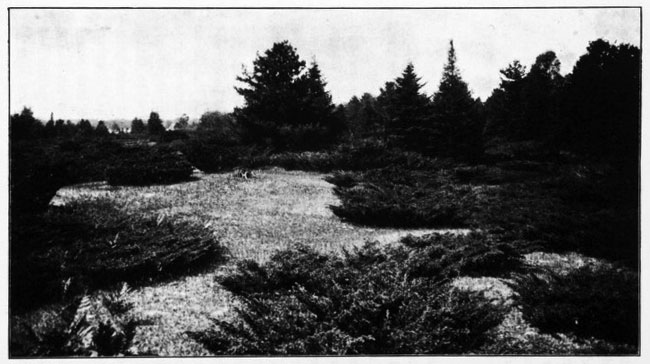
Father told me in after years he had a very serious talk with Strang that day, and the king admitted it was not right that Bennett was killed, but said where there were people that were opposite in their beliefs there was always trouble. Mother told him some sorrows would come to him if he persisted to live as he was living. He smiled, saying: "Oh, we aren't such a bad people, after all, Mrs. Whitney, and when you become one of us you will think just as we do." He shook hands and was gone. Mother said to father: "I do believe we shall have to leave here soon or we shall be forced to become Mormons." Father assured her that would never be.
JOHN GOEING AND HIS DEAR OLD IRISH HOME.
John Goeing came to the island and had been with us two years. He was an educated and refined gentleman from Ireland. His father was a rich Irish lord. John had been disappointed in love and left his "dear old Irish home" to come to America. From a visit to friends in Canada he had wandered to Beaver Island, and had been with us ever since. He was a great reader, having a box full of books. He did not work, and being very fond of us children he took it upon himself to teach us. He received money from home often, with the finest of broadcloth suits of clothes with silk underwear. Every evening after the lessons were heard John would read to us or tell us about his "old home in Erin." What brother Charley and I loved most was to have John tell about the chase with hounds. I liked it all except where the fox was killed by the dogs, then I would say, "John, can't you tell some stories where the fox gets away from the hounds?" Then he smiled, saying, "I won't have the foxes killed any more. It makes Elizabeth feel too sorry." Then he would get his books, saying, "Now, children, where shall we go tonight? England, Ireland or Scotland?" Sometimes we all wanted different stories. Then he would say, "I will take you to Ireland, my own native home." To me it was fairyland to listen to John telling of the home he had left, with its lovely green parks, graveled walks, shady bowers where his father and mother often strolled about with their children. We could almost see it all as he told it to us, and so often when he finished the tears would be falling through his fingers as his head rested on his hands. And the books, how wonderful were the places he took us to in them! He had traveled almost everywhere and we loved best to hear about his travels. We could understand it all better. John was like a brother to us younger ones, and like a kind son to father and mother.
MY BROTHER CHARLEY GOING TO OHIO.
Summer was fast slipping away. Our summer boarders were talking of home. One of our boarders, Mr. William Hill, was anxious to take my brother Charley home with him, put him to school and teach him the engineer's trade. It was all talked over and settled that Charley was to go. We children could not realize much about what it meant. My eldest brother had been one winter with the same man. Charley was to remain with Mr. Hill until he was twenty-one, he being past ten now. Papers were made out and signed. Mother prepared all the clothes for her boy that was going away to another home. I remember so well seeing the tears rolling down her cheeks as she sewed and stitched far into the night, making the little jackets that Charley was to wear in his far away new home. She sacrificed her own feeling that her boy might have an education, and a good trade when he became a man. The time had now come for Charley to go. Father and mother had grown thin and pale. The packing began. Mother could not finish and neighbors had to come in and finish it for her.
BROTHER LEWIS AND I WERE GOING TO OHIO WITH MR. CRANE.
Mr. Hill told her Charley could come back to see us every summer. But somehow it seemed it never would be the same. Charley would never be ours again. It was terrible to think about when the time came for them to go. A letter came to Mr. Hill from his sister in Painesville, Ohio, asking if he could not bring the little sister, meaning me, that she would like to have a little girl to be with her two small children. She would send me to school and I would be near my brother. Then I could come home in the spring and go back another winter if all was agreeable. It was at last decided that I, too, should go the last trip of the steamer Michigan, in December.
BROTHER CHARLEY GONE.
The steamer was at the dock. Good-byes were said. Charley was gone. The boat steamed away, taking the first one from the home nest. It was hard for mother to give up her boy, but she felt it was best for him. Oh, how long the time seemed to me! No more could we wander about together. Our little canoe lay idle upon the beach. There was no little brother to help row the boat, or swing in the old swing from the big maple tree, or chase the plovers along the shore. Our little pet dog was always searching about for Charley. His bows and arrows were put away out of sight. The house seemed still; it was as if some one lay dead. John felt just as sad as any of us. Our neighbors came to cheer us, telling us we should meet again when the spring time came.
Mother still was busy getting the rest of us ready to go. Mr. Crane was our neighbor. He came from the headlands near Fairport, Ohio. His daughter Elizabeth came with him and her brother to be their housekeeper. They owned a farm in Ohio. They were a large family and money could be earned easily at the island as the fish were so plenty. They came with several other Ohio families. Mr. Crane was coming back next season and I could return with them. Nearly all our summer people were gone. We had just two left and they were going on the last boat.
The Mormons were now taking boats and nets every chance they got and the Gentiles felt very unsafe. Our two Mormon friends told our people there was great trouble among them in the Church, as Strang's laws were becoming unbearable.
The weather had changed and snow and ice were now with us, and brother Anthony had gone to Green Bay to his uncle John Gebeau. In another week brother Lewis and I would be gone. How often I said to John, "Now you will be good to father and mother, won't you? for they will have no one but you, and you will read to them and tell them about Ireland and your old home."
John promised all and mother told me afterward she never could have lived through the winter only that John was so kind. He read them stories, and being a good singer, he sang his old native songs of Ireland. All was ready. Our trunks were packed. Mr. Crane's goods were on the dock. Fishing had been good and those who had not had their nets stolen were going home with money. There were about twenty families of the Gentiles to remain all winter at the settlement at Cable's dock. The rest went to their winter homes.
I was busy bidding my little playmates farewell, as the boat was expected every hour. At last the steamer was beside the dock. Elizabeth Crane had packed my trunk, as mother could not do it. I had my dolls packed and then took them out, saying to mother, "I will leave my dolls so you can see them and you won't be so lonesome." When she could speak she said, "Yes, leave the dolls. When I look at them I shall think you are near." So the dolls were left in their little beds covered up with their sheets and quilts just as I always put them to sleep. We all ate our dinner together. It was a sad, silent meal. Mr. Crane and Elizabeth were charged over and over again to take good care of me if I should be sick. They promised to do all they could for me. Mr. Crane said. "I shall take care of your child as if she were my own." I said to John. "Now who will go to England, Ireland and Scotland with you these long winter evenings?" He said, "I guess I will have to take your father and mother with me as you children will all be gone." "Well John, be sure you take little dog Prince and all the dolls. Don't leave them here alone." The whistle blew, good-byes were said, mother caught me in her arms with one last long kiss and "God bless you, my child." Mr. Crane and Elizabeth with brother hurried to the boat, John and father coming as the captain shouted "all aboard." Father kissed me, saying, "Be a good girl, come home in the spring and God bless you."
ON BOARD STEAMER MICHIGAN.
My hand slipped from his into Elizabeth's. She led me over the gang-plank. My little dog had followed me. He put his paws upon my shoulder and was licking the tears off my face. Father called to him, but he would not leave me. The men carried him to father, the plank was pulled in, the paddles turned and we steamed away with those on the dock waving us good-by. Elizabeth took me up on deck where brother and I stood waving as long as we could see the old home where we had all been so happy together. We soon reached the harbor, we landed at the Point dock to take freight. Mr. McKinley had taken his family the trip before and gone to Ohio for the winter, his clerk taking charge of the business in his absence. His father, grandpa McKinley as we called him, came on board to go away for the winter. He was always so kind to us children and we all loved him. It was Sunday, but I noticed the Mormon women had their washing on the line, Saturday being their Sunday.
We steamed away and soon could see nothing about us, as it was snowing and the sea was heavy. Our boat rolled and pitched about so no one could stand upon their feet. Jane, the cabin maid, took me to her private cabin and let me lie on her couch. As I lay there I began to realize I was leaving my home. It was dark, the lamps were lighted and I said, "Oh I must go home. I can't leave father and mother." Elizabeth took me to her room, putting me in her berth. There I sobbed myself to sleep.
AT MACKINAC ISLAND.
When I awakened we were at the dock at Mackinac Island. Everything was white with snow. The whole island looked like white marble. The damp snow had covered the trees. The fort on the hill looked so pretty where the snow was on the tops of the houses and chimneys. A flag waved over the fort. There were soldiers in their blue clothes walking up and down the fort hill. Dogs and ponies hitched to sleds with people dressed in fur coats, caps and mittens riding along the front street that reached round the pretty bay. The dock was full of people. Men, women and children nearly all speaking in French. There were a number of families going away on the last boat to their winter homes. Elizabeth took me ashore. We went into several stores and there I met old grandpa. I told him I was going to see Charley. He was so pleased to see me and cautioned me to be careful not to fall overboard and to be sure and tell Charley grandpa had not forgotten him. Then he gave me packages of candy, apples and raisins. I met several that knew me, as they were so often with us at home. We walked down to the Mission House, as mother had told me so much about the Mission. When Mr. Ferry was there mother had attended the Mission school for a time. We saw Robinson's Folly with the white snow covering the rocks and trees. We then came back to the old Mission Church, and going inside I told Elizabeth my mother had often taken me there when I was a baby. I showed her the Dousman pew in front where the family used to sit, my mother being adopted by Mr. and Mrs. Dousman. We then came to the "Old Agency House" with its quaint old chimney outside at the end, its little dormer windows in the roof. It was now all covered with the pure white snow and every shrub around its doors was draped in white. We passed on, going toward the Grand, many little houses covered with cedar bark and some had cedar bark put all around the outside, with narrow strips of wood tacked on to hold it. Some had little square windows with four and six panes of glass with white muslin curtains. They looked like little toy houses, but were warm and comfortable. It was a quaint little village full of jolly, kind hearted people whose hearts were tender and true to their neighbors.
It being cold we soon went back to the boat. Our boat looked like a huge snow bank beside the dock. The freight was being rolled over the plank and all was confusion. There were handshakes and good-byes as the people hurried over the plank. The "all aboard" was shouted, the plank was pulled in, the paddles turned and we were moving away amid the waving of caps and fluttering of handkerchiefs. Our whistle was saluting, and many of the people on the dock joined in one of the old French-Canadian glee or boat songs, their voices sounding far out over the waters as we passed Round Island.
ON LAKE HURON.
For a short time we watched the white island covered with snow. It soon set in thick again and the snow came down in blinding sheets with a cold wind. Our boat rocked and tumbled about. We were now out on Lake Huron in a heavy snow storm. Our captain and sailors were dressed in their warm fur coats. Every turn of the paddies was taking me farther from home, and soon such a longing came over me which I could not shake off. I wanted to go home. Elizabeth and my brother tried their best to comfort me, telling me I was going to see brother Charley; but nothing could make me feel better. Brother tried to have me eat something, but I could not. My chin quivered, I tried so hard not to cry, I ran to my room, throwing myself on my bed, trying hard to keep the tears back. Soon Mr. Crane came with a big doll he bought for me at Mackinac Island and grandpa McKinley came to see me, taking me in his arms and rocking me in one of Jane's chairs. I was very glad to see him. He was a dear white haired old man. He told me some droll stories that made me laugh. Then I told him I was going to see my brother Charley and that I was homesick, and if I didn't get better soon I was going to ask the captain to turn the boat and take me back to Beaver Island.
The storm grew worse, the seas ran higher, the snow was blinding and all things had to be made secure on the boat. No one but the sailors could walk about. Any that tried would be thrown down. The only way they could move about was to creep on their hands and knees. Sometimes our boat was high on the waves, when it seemed every timber in her would be broken. She trembled and then sank way down, where it seemed we would be buried in the foaming waters.
CROSSING SAGINAW BAY.
We were now crossing Saginaw Bay in a blinding snow storm. The whistle was blowing almost constantly, and once we heard another quite close to us. Women and children were crying in their state-rooms, others were groaning in fear and sickness. Our boat was creaking and tossing, sometimes on her side, when it seemed she would never rise again. Sailors were running on the deck and orders were shouted by the captain. Water was splashing into the cabins, glass was broken from the windows, and cabin boys were hurrying about nailing up blankets. Dishes were smashing as they fell from the lockers. Cabin doors could not be shut, our boat was twisted, and it seemed she could not last much longer she settled and trembled so at times, and then the great waves dashed all over her.
PRAYING FOR THE STORM TO CEASE.
Our blankets were wet by water coming in upon us as Elizabeth and I lay in our berth with our hands tightly clasped in each others. She had been telling me about her home, mother, sisters and brothers. How they were waiting and watching for them to come home, saying, "I know my mother is praying for us." Then I said, "And we must pray, pray awful hard, because my father, mother and John said if I was in trouble God would hear me and help me, and I guess I will pray for our boat to be saved." Elizabeth said, "Yes child, pray for us all." And I am sure God heard the feeble prayer I made as I told him how sorry everybody would be if our dear old Michigan steamboat went down. I felt no fear through all the storm. I said to Elizabeth, "Now we must go to sleep." She kissed me, saying, "Dear child, what a comfort you are to me." We were cold and wet in our berths and now the boat seemed pitching and tossing another way. Her head would go down so far it seemed she would pitch over head first. Many were screaming in the cabins. Mr. Crane with my brother and William were on the cabin floor near our door. Our door had to be tied back to keep from slamming. My brother had the life preservers ready and some had already put them on. Oh the praying and the screaming was terrible; but in the midst of all I went sound to sleep. When I awoke our boat was still. We had weathered the gale.
AT PRESQUE ISLE DOCK.
There was tramping of feet and scraping of shovels. I was sure we had run aground. Brother soon told us we were safe at Presque Isle dock. Oh how glad we felt! Brother said hurry and dress so you can get out on deck and look at our boat. She is a sight to look at. We were soon on the dock looking at our boat covered with snow and ice. One could never have imagined it was a boat that lay there. It was like a big ice berg. Her spar was so covered with ice it looked like a great tree. Our boat was a side wheel steamer with a walking beam. Capt. Newberry was owner and master. He said to his mates, "Boys, when this old steamer of ours can weather such a gale she can go through anything." People came running down to the dock to see the steamer as the news spread. We laid there two days and nights to clear the snow and ice off and make some repairs so she could go to Buffalo to lay up for the winter. Brother Lewis said he could not tell how many barrels of salt were used on that trip to keep the boat from sinking with ice. Our ears were tired hearing the shovels scraping the snow and ice for the rest of the trip.
AT DETROIT AND CLEVELAND.
Our passengers began to feel better that the great storm was over and again we were moving. Many were to leave the boat at Detroit, as some were to cross over to the Canada side. At Detroit we remained for some time, our Captain's home being there. Mr. Crane, Elizabeth, William, Lewis and I went ashore. Mr. Crane bought me some red morocco shoes and a pretty red silk hood to match my red cloak. We had not many passengers after we left Detroit, and again the sea was rough with a heavy rain storm. When we reached Cleveland we again went ashore, walking about the city all morning, and in the afternoon Mr. Crane took a carriage and we drove about the city, seeing many handsome residences, but they could not get me to say anything I saw was nicer to me than my island home. That night there was a gale on Lake Erie so our boat laid in port. I was still homesick and the tears would come often, though I tried to keep them back. My brother Lewis was to leave us here at Cleveland, as this was where he was going to school. After he left us I was very lonely.
TRYING TO BE HAPPY.
Elizabeth said. "Now my dear child you must have patience. Spring will soon be here and we will take you home again. So now, have patience." All day long after she talked to me I kept repeating every little while. "Patience, patience; have patience." I did not know its meaning. At last I asked her what it meant. She tried to explain to me it meant not to worry, not to fret, to be quiet and wait, try to be happy, sing when I wanted to cry, and be cheerful and not give up to sadness. I repeated many times what she said to me and promised to do the best I could. How much I needed that lesson before my face was again turned homeward! I did not cry any more. I told Elizabeth my heart was getting too big and I was sure it would burst. When I felt so bad and it was hard to keep the tears back I took my doll Jane (I had named her after the dear, kind cabin maid) in my arms, rocking and singing some of my old French songs my mother had taught me. When Elizabeth looked at me I said, "Now I am getting patience." Soon the captain came in, saying, "Is this the little girl that is homesick?" I said, "Oh no, I'm not homesick any more. I have got patience." He laughed heartily. Elizabeth explained to him what I meant. He said, "No don't you get homesick any more. I will take you home next April on this old steamboat of mine. So get all the patience you can."
ON THE HEADLANDS.
At nine o'clock that evening we reached Fairport. It had been raining hard and the night was dark. We were ready to leave the boat. Jane, the cabin maid kissed me many times, saying, "Now my dear child try not to be homesick and we hope to meet you in the spring and take you home with us." We stepped ashore, it seemed to me the dock was moving from under us, we had been over a week on the boat. Elizabeth was soon with her brothers and sisters who had come to meet her. She took my hand saying, "This is my little friend, Elizabeth Whitney." They gave me a hearty welcome and I knew I was among friends. We hurried to the hotel kept by Mrs. Root in Fairport, where we remained all night. Next morning after breakfast we crossed over the river on the scow ferry, where we were met by Mr. Crane's carriage and we drove to their home on the Headlands. There Mrs. Crane was standing in her door to meet her husband and children. After all had greeted their father and mother, Mrs. Crane with the rest of the family gave me a kind welcome and I felt quite happy with them. Their nearest neighbor was Mr. Alexander Snell. He had been to Beaver Island and knew my parents. Mrs. Snell and everybody was very kind to the little "Island Girl," as I was called. Her sister, Mrs. Wright, was our neighbor at home. Mr. Crane's youngest child was a girl of five years, and a boy named Charley eight, so we children had great fun hunting hen's eggs in the big barn.
After one week one bright morning Mr. Crane took me in the carriage to Painesville to my new home. We crossed the Grand river at Fairport, then took the old plank road to Painesville. How the horses' hoofs did clatter as we drove on a fast trot! We stopped at the turn of the road, where Mr. Crane had two sisters living. Their house was on a pretty knoll on the right as we drove into Painesville. We had dinner with Mrs. Matthews. The other sister was a maiden lady called by the children "Aunt Margaret." They were all very kind to me.
IN MY NEW HOME.
After dinner we drove into Painesville up to the cottage door to my new home. The lady came to the door and knew at once I was the little girl she expected and said, "Come in." We stepped inside, Mr. Crane saying, "I have brought you this child as you directed me in your letter. Her father has put her in my care and I am responsible for her. If you do not like to keep her this winter I shall take her home with me. If you do take her and at any time don't want her, let me know. I shall come once every week to see her until I go back to the island, and of course you know she is to go back to her home with me unless she wants to stay and you want to keep her." The lady said, "Yes you have said just as my letter to her father reads." She looked at me, then turning to Mr. Crane she said, "She is so small she won't be able to help me much." Mr. Crane said, "Why you said in your letter you wanted her for company and to do little errands and chores for you and be with your children." "Yes," the lady said, "But I shall expect her to help me some." Mr. Crane told her, "You promised to send the child to school and I have money from her father to buy her books." The lady said, "Oh I know we shall like her." Then Mr. Crane handed her the money for my books, saying, "She has clothes enough. If there is anything more needed let me know." He gave her his address and went out to bring my trunk. He said, "Now my dear child, I hope you will be happy in your new home. I will come every week to see you." Turning to Mrs. Shepard, he said, "If this child gets sick let me know." He bent down and kissed me, the tears falling fast from his eyes, he bowed to Mrs. Shepard and hurried away.
The last link that reminded me of my island home was gone. Oh it was terrible! I tried to run after him to call him back. I wanted to say come back, come back and take me to your home. I could not speak, I could not move, never while life lasts can I forget how I felt when I saw Mr. Crane driving away in the carriage. I was among entire strangers in a strange land. A child of seven and a half years of age. The lady said, "Come to the fire you must be cold." She then took my cloak and hood. I sat down in a little chair. She went about the house at her work, never speaking to me. All was silent and quiet. In a little while the two little children, one a boy of three, the other a year old, just walking, came to me. The oldest brought me some toys and put in my hands, never speaking. Then the youngest came and put his little face up to mine. I kissed him, which seemed to please him, and soon I took him on my lap, where he soon fell asleep, while the other child was sitting quietly beside me on the floor playing with his toys. The lady took the child and laid him on the bed saying. "Do you like children?" I answered. "Yes Ma'm." It was the first word I had spoken since I entered the house. She took her sewing and never spoke. Oh how long the time seemed! I cannot tell how I felt. No tears would come to give me relief. At last she put her sewing away and began the supper. Then the lights were lit; the baby had wakened and I again took him in my arms. The other child stood close beside me.
MR. MILTON A. SHEPARD.
Soon the door opened and a man came in. The children cried, "Papa." He kissed the children saying, "Who is this little girl?" His wife told him, "This is the little island girl we expected." He took my hand, saying. "I am glad to see you. But wife what a little midget she is." He was a kind looking man with black hair and eyes. Supper was on the table. I was placed near the children. I tried to eat, but I could not swallow. The food stuck in my throat. Mr. Shepard noticed I did not eat, so he asked me if I would like some milk. I answered, "Yes, sir." Mrs. Shepard told him there was none only what the children had. I said, "Never mind," but little Henry gave me his cup full. I managed to drink it. When the meal was over I asked if I should do the dishes. "Not tonight, but tomorrow," she said. Mr. Shepard asked me a few questions about my island home, which was the only time in all my stay that my home or my parents were ever mentioned to me.
HOMESICK.
I was put to bed upstairs alone in a room. The first time in my life I was ever alone at night, but I was not afraid, only homesick. I took my doll Jane in my arms, saying my prayers I went to bed, but not to sleep. My thoughts went back to my home on the island. I could see my pets, father, mother and John sitting around the table, mother sewing, John reading, and the tears would come in spite of all my efforts to keep them back. Then I thought about what Elizabeth said to me that I must have patience, yes I must not cry and I would soon see brother Charley. I would ask Mr. Shepard in the morning about my brother. Then I whispered so low to Jane, telling her it was naughty to cry and complain, and that we must pray God to help us, asking her if she had forgotten the big storm when we were on the lake. In talking to my doll I fell asleep and only awoke when Mr. Shepard was building the fire in the morning. I was soon dressed and was down stairs, where I began dressing the children, and always after that I took care of them. The dear children, how they loved me and I loved them! Never once were they cross to me, and I hope I never was to them. Of course I could not comb my hair. It was long and heavy. Mrs. Shepard did it for me. I helped her with the dishes and soon learned how she did her work. She was very neat and her home was always in order. By standing on a little stool I could reach the dishes on the pantry shelves and soon could do the dishes alone and help about the other work.
GOING TO SCHOOL IN THE LITTLE RED SCHOOL HOUSE.
The next week I was sent to school in the little red school house. Miss Elizabeth Crawford was my teacher. She and her mother lived near the school house in a little vine covered cottage. I was very happy in school. Mr. Shepard heard my lessons in the evenings so he could see what progress I made. Mr. and Mrs. Shepard had both been teachers. The Christmas time was saddest for me, for then I missed my home the most.
MEETING BROTHER CHARLEY.
I was in Painesville over a month before I saw my brother Charley. He came one day and staid to dinner. I could scarcely believe it was he, he had grown so tall and seemed such a little man. After dinner we took the children on the sled and went to Mr. Shepard's shop where he made the wagons. Then we went down the bank to the river. At four o'clock he must start for home. I wanted him to stay all night, but he said he could not. The time came all too soon for him to go and with many promises to come again we bade good-by and he was gone. For days afterward I wondered "had I dreamed he was there or was it a reality." I never saw him again while I remained.
One morning soon after when Mrs. Shepard was combing my hair she took the shears and cut it off short. My heart was broken. She said, "I can't be troubled with your long hair every morning." Mr. Shepard was sorry, but said, "Never mind, it will grow again," which comforted me because I feared it would always be short like the Mormon women's hair. Mrs. Shepard had a niece boarding with her. She liked to tease me, telling me it would never grow again.