PART II. (continued 2)
Reading edition
Every Sabbath I went to church and always had my verse learned for my Sabbath school teacher. One morning on my way to school I met Mr. Peter McKinley. He lived in a large house near our school. He was very glad to see me. To me it seemed like seeing some one from home. Mr. Crane came every week to see me, but I never saw him. Sometimes I was at school, twice I was in the house upstairs with the children but never knew he was there until he was gone. Spring was drawing near and I wondered if I ever would see Mr. Crane and go home.
One day Mr. and Mrs. Shepard left home and went to Willoughby. Her niece kept house and I helped her take care of the children. They were gone two days. The front door was always locked and I was told not to go to the door if anyone came. Once when I was on the street I saw Elizabeth Crane and her sister driving. They knew me and I knew them, but they were out of sight so quick I had not time to speak to them. Mr. and Mrs. Shepard came home. They began to pack their goods. Once I said, "Are you going away?" She said, "Yes, we are going to move to Willoughby."
A CHILD'S PRAYER.
All that night I lay awake. I knew then they intended to move and take me with them, and then I would never see my father and mother again. My heart was heavy, and all night I kept praying that God would help me to go to my own home. Mrs. Shepard had a sister living near, and next day I went to her, telling her I had not seen Mr. Crane and I feared I was to be taken away to another place and would never see my people again. She was a dear, kind lady, and she said, "I will see my sister about this," and she came right home with me. She talked with her sister for a long time. I did not hear their conversation, only I saw Mrs. Shepard was displeased. When Mrs. Robinson left she kissed me. I saw tears in her eyes. She had been so kind to me all winter. It was the one bright spot in that winter's life for me. The next morning we were to start for Willoughby. As I went to my room my heart was heavy with trouble. I took my doll Jane, telling her my sorrows and fears, but somehow Jane could not comfort me. I said to her, "It is because you don't know anything about my people. You have never been to Beaver Island." The moon was shining bright into my room. I lay a long time thinking and saying, "Oh, what shall I do!" I got out of bed and knelt beside it praying as I had never prayed before. I told God all about my sorrows, saying, "Oh won't you help me and take me home to my father?" My heart felt lighter. With Jane in my arms I lay me down to sleep and never wakened until Mr. Shepard called. We hurried our breakfast. Mrs. Shepard appeared nervous. My heart felt lighter than it had for many a day and I kept listening for carriage wheels which I felt sure would come. One load of goods had gone to the depot, the dray had just left the door with another and there were just a few things left for the last load. Our wraps lay on a chair.
A CHILD'S PRAYER ANSWERED.
Mr. Shepard had gone to the postoffice. A carriage drove up and stopped before our door. A lady came quickly in. I looked and saw it was Aunt Margaret, Mr. Crane's sister. I threw my arms about her, saying, "I am so glad to see you. Will you take me home?" She said, "Do you want to go?" "Yes, I want to go." She turned to Mrs. Shepard saying, "I see you are moving. I am Mr. Crane's sister. He was not able to see this child this winter. He sent me as the time is drawing near when my brother returns to the Island. He promised this child's father to bring her back if she wants to go." Mrs. Shepard told her she would have no interference and would keep me. "No," said Aunt Margaret, "Your letter reads the child could go home and come again if all was agreeable. And she says she wants to go and I shall take her. Elizabeth get your things on." I just flew I got my trunk, the lady putting it into the carriage. I was following her when Mrs. Shepard said, "Child aren't you going to kiss me and the children?" I put my arms about her neck, kissing her and caught the children in my arms with a hug and a kiss, then ran to the carriage.
Aunt Margaret lifted me to the seat, took the lines, and our horse just flew down the plank road till we arrived at Mrs. Matthews, where Mr. Crane was waiting for us. He came, saying, "Dear child how I have worried about you. When I saw I could never get to see you I sent sister Margaret and now you can go home on the steamboat Michigan." Oh what a happy child I was! All the sad, gloomy, lonesome days were forgotten. I was going home. Home to my father and mother. Going to my island home.
We soon started for the Headlands once again. The horses' hoofs clattered over the road to Fairport. We crossed the river, and in a short time were at Mr. Crane's house, where all the family met me with greetings of love. I entered school; Miss Marion Brooks was my teacher. I was at the Headlands three weeks when a letter came from the Captain of the steamboat Michigan to be ready at a certain date to meet the boat at Fairport. Mr. Crane made preparations, and on the date mentioned in the letter we were all in Fairport to take the steamboat. My brother had come from Cleveland.
HOMEWARD BOUND ON STEAMBOAT MICHIGAN.
How my heart swelled with joy when I heard the Michigan's whistle and saw the steamer nearing the dock. Mr. Crane's people were sad to have them go, but all was ready, good-byes were said and again the old familiar sound of "all aboard" was heard. We stepped upon the gang-plank. Jane met us with her pleasant greetings, lines were cast off, our boat was moving, we steamed out upon the waters of Lake Erie with many blocks of floating ice about us, and the sea gulls were again soaring high above us, uttering their shrill cries, as if they, too, were glad to have the spring time come. We reached Cleveland, where several families took passage for the island, some of whom were our boarders of the year before. At Detroit more came on board. Among the rest Mr. and Mrs. Loaney. They had been to Toronto, Canada, for the winter. There were many fishermen returning to the island on this first trip. More would follow later. The weather was fair. Our steamer had been repaired since that terrible trip in December.
The Captain said to me, "Little girl did you get lots of patience this winter?" At first I could not remember what he meant. Then it flashed through my mind and I answered, "Yes sir." He said, "Well child, I told you this old steamboat would carry you home and now you will soon be there." Jane was glad to see us all again, the tears ran down her face when I told her how homesick I was and what a comfort my Jane had been to me. It was pleasant enough for us to be on deck after we left Detroit. We stopped at almost every port. Lake Huron was calm and quiet this time with just a ripple on Saginaw Bay, but we could feel the motion of big swells, which sent many to their state rooms.
AT MACKINAC ISLAND.
We passed Bois Blanc, and were soon at the dock at Mackinac Island. This time green trees greeted our view, but the white fort on the hill with the flag waving over it looked just the same. The people were all out to greet the first steamboat of the season, it being sometime about the middle of April, 1852, old grandpa being among the rest. He was glad to see us, but sorry Charley was not among us. Again we walked the streets and climbed to the fort. The grass was springing up in the yards, and all nature told us spring had come. There were happy, cheerful smiles on people's faces, children were playing in the sunshine.
We had now left the dock and again there was waving and singing on the dock to cheer us on our way. Our boat moved out past Round Island. There were great blocks of drifting ice on every side. Near the little island of St. Helena we almost stopped to keep clear of the ice. We steamed past Hog Island, with little Hat Island looking white with ice packed about it. Over to the northward was all ice, which had not yet broken to drift. We soon were at the McKinley dock at the harbor; freight was taken on for Green Bay, again the "all aboard" was called and we steamed along past Big Sand Bay. We could see all the little homes that would soon be occupied by summer people.
HOME AGAIN.
Brother and I saw our home, with father, mother and John standing in the door. We waved to them; they saw and answered. Our boat was landed; father and John were there to meet us with other friends. I could scarcely wait for the gang plank to be put out. Ah well, the home coming was almost worth the waiting for. As soon as I had greeted father and John I ran up the dock for home, my little dog chasing after me. I met Mr. Cable hurrying down. As I ran past without stopping, he said, "Aren't you going to shake hands?" "Oh yes, but I am in such a hurry to get home," I answered. Oh the joy to be once more at home! I took both hands and dashed the water up into my face as I ran along the shore to our house. The sound of the waves seemed welcoming me home. I looked back once toward the boat and saw father with Elizabeth and the rest coming. I ran almost breathless into the house saying, "Mother I have come home." She hurried toward me saying. "Charley." Then she caught at the back of a chair. Her face was so pale I thought she would fall, and I gave her water to drink. She kissed me with her eyes full of tears. I whispered, "No, Charley has not come."
The rest came in. Mr. Crane's people were to stay with us until their house was ready. We were a happy family around our table at supper time.
I was now home and yet there was a sadness about it. We were not all together as we once had been. Father and mother had grown thin and pale. John said he could never tell how much we children had been missed. He had read his books, sung his songs and told his stories to pass away the winter evenings, and they had all worried much about the Michigan, knowing that we were out in that terrible storm when we left in the fall. I was busy for a few days visiting our neighbors and telling them about my trip and where I had been. My little friend Rose and her mother were glad to see me, as I could tell them about their people on the Headlands. Their Aunt Mary Snell and Cousins Andrus, Alva and the rest. There was a sweet little babe at Cable's. They called her Cora, and I was so glad, because now I could help take care of her. Somehow life had changed. Before going away the world did not seem to reach out very far beyond our island home, now it began to seem like a great big world to me, and many were the questions I asked John, which he was always glad to answer. Once I said, "John were you ever homesick?" After a minute he answered, "Yes, sometimes." I said, "I know what homesick means now."
A MOTHER'S LONGING TO SEE HER BOY.
Though life was busy with us, we missed Charley. Brother Anthony had returned from Green Bay, being delighted with his school, his uncle and aunt were so kind to him. One evening I went to the beach to sit beside the water. I wanted to hear its soft low whisperings again. I was not there long before I heard some one sobbing. I turned and mother was beside me. She said, "I came to look for you and I was thinking that perhaps Charley may never come home." She sat beside me silent for a time and then said, "Now we must not spend our time in sorrow. Sometime Charley may come." And she told me how anxious she was about a sick neighbor she was caring for, saying, "I shall depend on you, Elizabeth, to help me, and I want you to be careful never to repeat anything we talk about. There is much trouble among the Mormons themselves. Strang has been gone all winter, and some of the apostles refuse to obey the laws of polygamy. There are spies all about us and the Mormons are not our friends any more." I promised her I would be careful. She said, "Mr. Sinclair is afraid of his life, as he knows he may be made an example of for refusing to obey Strang's laws. I have many things to think about and do for this sick woman. And I want to tell you something else. Elizabeth Crane is going to be married in June. Charles Angel will come after her. Then her home will be in Saginaw and her sister Jennie will come in her place to keep house for her father. So now do not worry Elizabeth about anything, for she has lots of sewing and we must help her all we can."
Life was busy; our summer people were with us. Elizabeth Crane had left us never to return. Mr. Angel and she were married at Mackinac Island. When the boat came back her sister Jennie, a beautiful girl of nineteen, came to remain until fall, when she, too, married Mr. James Corlette of the Headlands. Mr. Crane, with others, left the island early in September, as the Mormons had taken every boat along the shore below Cable's dock, with the nets from the lake and fish from their fish houses. They left the island, never coming back again, just a few months before we, too, were obliged to leave or become Mormons.
MENOMINEE INDIAN FAMILY.
Sometime in June there came a canoe of Indians to our shore. They made their camp near us. Mother went to see them. When she came home she told us they were Menominee Indians come to fish for a time. They had been over to Cross Village visiting some friends. Their home was in Green Bay county. There were two small children, the Indian and his wife. The Indian woman was a pretty woman with jet black hair cut straight across the forehead, this being the fashion with Menominee squaws. Their wigwam was always nice and clean. She was a nice sewer, piecing pretty bed quilts, which always looked clean. Often when mother got in a hurry with her work she hired the Indian woman to scrub and wash, and other times to do some sewing. She was always smiling, showing her pretty white teeth.
One morning when I awoke I found father and Mr. Dora, a neighbor, had gone to Mackinac Island. They were gone about three days. When they came home father had clothing for mother which Mr. Cable did not keep in his store. Among the rest was a great quantity of bright colored glass beads and many yards of colored ribbon, which she put away in her trunk, saying to me, "Do not speak about what I have put away." Mother and the Indian woman were often together speaking softly, so I never knew what they said. Mother seemed anxious, and the Indian woman also seemed quiet and thoughtful.
Soon after father's return mother said to me, "Elizabeth I want you to let all your other work alone and string beads for me." I was delighted, for if there was anything I loved to do it was to string the pretty colored beads. So I began at once, each color on a strong thread. After stringing a great quantity in this way, then I made many strings in different colors, mixing the beads. As much as I enjoyed it I got very tired, and whenever I went to the camp the little Indian children were stringing beads and their mother was sewing, making deerskin moccasins, on which she sewed the beads, which were so pretty when finished. She made many pairs of them. Sometimes the Indian woman came to our house, helping mother and me to string the beads, which she did so fast, and talked so pleasantly in her own language, mother speaking her language as well as the other tribes' that lived around us. There were several camps of Chippewa Indians that lived along the shore that helped the fishermen clean their fish, and the women made oil from the fish refuse which sold for one dollar a gallon or more, according to quality. Most of these Indians came from Garden Island.
THE ROBBERS' DEN.
Our Mormon friends who used to come to our house did not come any more. There were two who sometimes came in a few minutes, but never remained long. Everybody was anxious to know what the king would do about his people when he came back. Many of the Mormons believed Strang would take no notice of the refusal of some of his elders to practice polygamy, while others thought that the man who hoped to have Strang's place would influence him to make them suffer the penalty, which the Mormons themselves told us was death, this elder contending severe measures was the only way to enforce obedience to the law.
THE KING'S HIGHWAY. BEAVER ISLAND.
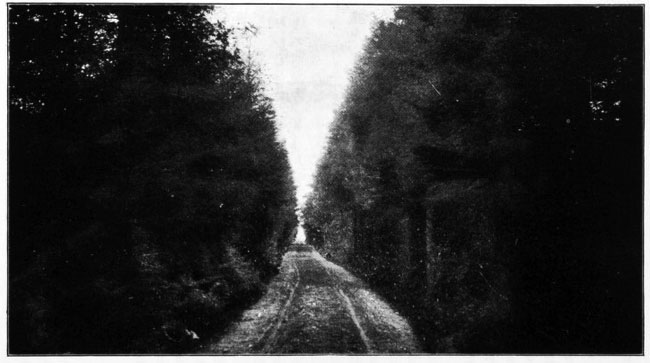
Having already organized a band of forty thieves, these men were being trained to go out and do all the robbing from the Gentiles they saw fit to do. The two men who headed the band were brothers and were large and powerful men, Isaac and John Pierce. They were well suited to do such work. The place they chose to secrete their stolen goods was a long point at the lower end of Beaver Island, distant about three miles from the harbor. This place was called by them "Rocky Mountain Point." Being an out-of-the-way place they would not be seen secreting much of their plunder.
WAKING AND SEEING INDIANS IN MY ROOM.
One night I was awakened out of a sound sleep by hearing footsteps in the room. I opened my eyes and saw mother with the Indian woman and another woman going up stairs. I waited sometime for them to come down, but fell asleep before they came. I was awakened again. There was a very dim light in the room. I saw a tall Indian who seemed to walk about very feeble as if sick. His black hair was pulled over his eyes and he held his hand up as if to shade his eyes from any light. There were two Indian women in the room, one the Menominee woman, the other was a stranger but she wore her hair cut across the forehead. She seemed young and was dressed very beautifully. Her moccasins were trimmed with pretty beads, and many strings of bright colored beads were about her neck, and I thought she must be a princess, the daughter of a chief. She and the Indian walked about the room several times, while mother and the Menominee woman spoke to them in their language, they answering in the same. I saw father nod and smile, at which they all took up parcels and small bundles from the table and walked out in single file.
DEPARTURE OF THE INDIANS.
I waited some little time, and hearing nothing I got frightened, thinking father and mother had gone away and left me, I got up, ran out of doors and met mother. She took a blanket from my bed, saying, "Come Elizabeth and see the Menominee Indians, they are going away. They must go home and see to their crops and cannot stay here any longer." I said, "Where did the other two come from?" She made a quick motion, putting her hand over her mouth, which I understood was to be silent and ask no questions. We were both speaking in French. I followed her to the beach, where a large birch bark canoe was packed. I saw four little children packed away Indian fashion, each had a little black puppy dog in his arms. The tall sick Indian got in first, seating himself and smoking his pipe, then the young Indian woman followed, then the Indian and his wife. There were many "bou shou's" (good-byes) spoken in subdued tones. The Indian and his wife took the paddles, father gave one hard push and away sped the bark canoe over the blue water. The sky was just getting red in the east, little birds were twittering in the branches of the trees, we all stood watching the fast receding canoe, which soon looked a speck upon the water. I ran to the house and crept into bed, and when I awakened the sun was high. I asked mother where the Indians were now; she answered. "They are far away." All day she seemed cheerful, and I heard her sing for the first time since I came home from Ohio. I wandered down to the Indian camp and all I saw was just a few marks where the wigwams had stood. No rubbish was lying about. They had vanished as if they had never been. Surely "They had folded their tents like the Arabs and as silently stole away."
THE APOSTLE AND HIS FAMILY AMONG THE INDIANS.
It was eight years afterward when I learned just who it was that stole away on that quiet morning in the bark canoe. I was living for a short time in the Green Bay country. I was invited out one afternoon to a quilting party. The men were to come for supper and a lady was to play for us on the violin, she being an accomplished musician. She had come there from Baltimore for her health. As we sat at our quilting in the afternoon, one of the women asked the lady of the house why it was they had settled there near the Menominee Indian reservation, and if they were not afraid to be killed sometime by the Indians. Then the lady of the house explained and told her story of how her husband, herself and children had been saved by one family of these Indians with the help of a white family, and this was why her husband was devoting his time to preaching among the Indians. I, being a stranger in the place, had not met this family before, but had been invited to their home with others. Before she had finished I seemed to understand it all. I knew now what all the beads and bright colored ribbons were used for and I knew who the tall sick Indian was with the pretty young Indian woman and the two little children with the others in the canoe. When I made myself known to the lady and her family they were overjoyed to see me. I met them several times afterward, and she told me how they crossed over to the north shore and kept along close to the shore, camping many times where the Indian and his wife set their net and caught all the fish they needed to eat, all the time teaching them to speak their language. They did not go direct to the Indian settlement until fall, then her husband concluded to settle among them and act as a missionary to them. Never very strong in health he had grown stronger in the open air life. Their children were educated at Green Bay.
I will try to tell just a little of this woman's story. Of how they came to Beaver Island with many others, and how they got away from the Island after much sorrow.
THE APOSTLE'S WIFE'S STORY.
Our home was in a small town in New Jersey. We had a little farm and were very comfortable. It was spring time, our crops were planted and growing. It was told us one day two men had asked for our little church to hold a meeting in for a couple of evenings and the whole neighborhood was invited to attend. My husband being an elder in our little church we, with many other neighbors went to hear the men speak. They were both good talkers and we were all greatly interested. They continued the meetings a week and we all became so interested they were invited to remain longer. One claimed to be a minister, the other an elder. They told a great deal about the Land of Promise they had found. My husband's two brothers were ready to join and prevailed upon my husband to come with them. About thirty were ready to follow the new preaching. They left us to go to other parts and told us to be ready at a certain time, when they would come back and take us with them. We sold our little farm and stock at a great sacrifice, keeping only our bedding and clothing, as they told us it was a long journey. We waited for them to come until November and had almost given up in despair, when one day they came. When we started there were twenty-five grown people with their children. We had two small children, twins, a boy and a girl. Our hopes were high, we were going westward they told us. We took a steamboat at Buffalo, as they told us no railroad had yet been built to reach there. The trip was hard, cold and tedious. Not one of us had ever been on the water before. We were afraid and we were all sick, but we stood it as bravely as possible and hoped for better times.
It was a dark, stormy night when we landed. Snow was falling. We were a cold, shivering company as we stumbled along up the dock. We were taken into a house, where we soon had a warm supper and were told we could sleep on the floor if we had bedding of our own, as their beds were all full. We made our beds and found it very cold, as doors were opening and shutting until almost morning. We were all put into one large room which was very bare of furniture. Children cried and there was not very much sleep. At the first peep of day most of us were up to take our first look at the Promised Land. At first we tried to look out of the windows, but they were steamed and frosty and we could not see. We then went out of doors. Our first glance was out on the cold, rough water of a little harbor, as they called it, and never shall I forget the lonely feeling that came over me. All was silent but the sound of the waves that washed upon the shore. What little ground was visible where the snow had drifted was all bare white sand. There were many pretty evergreen trees back a short distance from the water. There being few houses visible we were told the houses and farms were farther back in the country. We were called to breakfast, and when it was finished we were told we could go to the King's house, which was pointed out to us, and he would direct us what to do next. "The King's House." What did they mean? We had never heard of any king. They said, "You will soon know. We are ruled by a king who has revelations direct from God. There are twelve apostles to rule with him, and out of this company of people he will choose four more which are needed." Our surprise was great. We were anxious to know all, so were taken to the King's house. He met us very kindly and explained many things to us. He talked considerable about his revelations and what he hoped to do for his people. His manner was very captivating, and we all felt much encouraged after he had talked with us. We were all divided up among the other families on the island until we could build our homes. We were there over a week before we knew for certain we were on an island. To me it was a terrible shock but we had no time to think much about it only what we should do to provide shelter for the long winter. The King soon left to go travelling for the winter to bring more converts in the spring.
It so happened the home we went to live in the people kept a boarding house and I soon found to my horror the man had four wives, had had six but two were dead. We soon found them a peculiar people with great faith in Strang and of his building up of Zion calling themselves Latter Day Saints, or Mormons. We had not known or heard of this but had been led to think we could worship as we liked. We soon found it was best not to exchange much thought with our neighbors on the subject and we were so scattered about we seldom met only at meetings. There was being a temple built to worship in and my husband being a carpenter he was most of his time working on it. We soon learned every tenth of our income belonged to the King and many extras to help the expenses. It took quite a large sum to build this temple. They had a small saw mill and there the lumber was cut. Everybody was busy. We were ruled by a man who had no pity for any one. That winter was too terrible to remember. We were all glad to have the King come back in the springtime. He brought more people who seemed to have more means, for those who had, had to share with those who had little. My husband and his two brothers were made apostles soon after Strang came. I saw very little of my husband after he was made an apostle. There was always something to be talked over and explained, so the King had to have most of their time.
Our funds were getting low and I felt very low spirited, but my husband told me he thought that everything would be satisfactory in time. I longed to be free. I wanted to feel I could talk to my husband for it soon dawned upon me we must not discuss the subject of the doctrine only with a true belief in all of Strang's revelations. The most of the people were gay. The winter time was their time for gaiety. The following spring after we came, when my husband was made an apostle, there was a great feast and we were all baptized in the waters of Little Font Lake. The King was dressed in a robe of white and purple. He gave a short brilliant discourse. To most of them the ceremony was impressive. His wife, Mrs Strang, did not attend as she was not a believer in the doctrine. To me it all seemed a sham. Just before my husband was made an apostle I asked Strang about polygamy and why some had more than one wife. He answered that they had practiced it to some extent in Joseph Smith's time but he would have no such practice but had allowed those who had several to keep them. On the next Sabbath he preached a powerful sermon against polygamy. I felt more secure because I hoped he would keep his word. Very soon after this it came like a thunderbolt to us. The king had a revelation. He must take more wives, and very soon took some more.
In his absence his wife took her three children and left. Before going we managed to meet, as we were fast friends from the first. She advised me to persuade my husband to get away as soon as possible, as she was sure there was great sorrow in store for me. She then told me any disobedience to the oath of allegiance of the apostles, to the king, would be punished with death, saying she knew this to be true, having overheard the apostle that ruled in her husband's absence, talking about it. But they never knew she heard, and now I must be watchful. It was terrible to know all this, yet I knew she told me the truth. She said, "Make a confidant of no one." We had talked many times before this, but now she told me more, saying, "I would stay here and fight it to the bitter end but I know it would do no good. My life would soon be ended. They have already said, 'Dead people tell no tales.'" "I feel sure Strang's own life is in danger by the plotting of his head apostle." She ended by saying, "I never expect to come back unless I can help some poor soul to be happier. If you ever need a friend's help send a letter to me. You can always trust the Indians." She said, "I have warned Strang of his danger and begged him to put away that bad man, but he will not heed me." She left. I was very sad, but not yet realizing how soon I would need her help.
After awhile a law was made by the King that all officers of the church must have a plurality of wives. Then we women banded ourselves together, I being at the head, we met the king in the temple and took votes, coming out victorious each time. The whole island was in a state of agitation. Every woman interested took her Bible and talked and read God's laws faster than the king could tell us about his revelations. One little woman spoke, saying, "Take all our earnings, but leave us our husbands. We want to live an honest life." He said he did not propose to be ruled by a lot of weak, whining women. This roused me. I jumped to my feet and I talked two hours. He answered sarcastically and I answered him in the same way. I recounted everything to him. How we had been deceived. He ordered me from the room, and when his guards attempted to obey his orders the other women interfered and Strang was obliged to let me have my say. Often the women applauded me. At last I could speak no more. I was exhausted, but I managed to tell him I hoped he would consider all we had asked of him and grant our request. After a few moments of silence he looked me in the face, saying, "Madam, you have shown such great ability in discussing this matter I think I had better put my temple robe upon you." I answered in the same sarcastic tone, "Yes, and I think your robe would be far more becoming to me than it is to you and I could rule the people and make them happier than you have so far." Never can I forget the look of hatred he gave me. The men hurried me from the room and appeared very much excited. After I left other women made an appeal to him, but left without gaining any promise from him, saying he would give them an answer the next morning. I heard nothing more. Next morning I was sent home in a lumber wagon. My two children and husband were not allowed to come with me. My home was very near to the Gentile settlement. My heart was heavy. I went to some of my Mormon neighbors. Their doors were shut in my face and none spoke to me when I met them. After a week I was very sick in bed. I became unconscious. When I realized anything I recognized a Gentile neighbor. She was preparing some food for me to eat. I asked her many questions about my children and husband, but she could give me no information. She told me I had many friends among the Mormons, as it was a Mormon woman who had directed her to come to me. She told me to be quiet and have courage and all would be well and that I must get well as fast as possible.
Strang had gone for the winter and she feared there might be trouble between the Gentiles and Mormons, as the fishermen felt they could not endure much more robbery. I felt more courage because I knew this woman had an influence with the Indians, as she could speak their language and was always the Indian's friend. This woman's children were away for the winter and her heart was sad. We could sympathize with each other. One dark night in March I heard a gentle tap at my window. I opened the door. It was my husband. He had been handed a note that morning saying, "Go home. You are safe for awhile." He had walked all the distance after dark. Next day the neighbor woman came and told me my children were both well and cared for. Oh joy! I could get well now, and gained my strength fast.
Navigation opened; Strang came home, remaining only a few days. He was becoming greatly troubled over the discontent of his people and thought best to be away for a time. The fishermen began to come, and several Indian families came also to fish and make oil. Myself and husband were left to ourselves. One night a letter came to my husband saying, "When the king comes home Mr. Sinclair must be prepared to obey the law or suffer the consequences." It was signed by the head apostle. My husband was greatly worried, knowing the laws so well. In my heart I asked God to help me in my sore distress. I recalled the words of Mrs. Strang that if ever I needed a friend to call on her and she would come if possible. I wrote her to come. I gave the letter to my faithful friend.
The letter was taken to Mackinac Island and from there it was taken to Mrs. Strang. She came, she got my children and brought them to the Indian camp. Myself and husband were disguised as Indians, our children the same, and all were taken away from the island in a birch bark canoe.
CHOLERA AT THE ISLAND.
The summer was passing, it was late in August. Cholera was raging at Mackinac Island. Fifty-two deaths had occurred there and three deaths occurred at Beaver Island. A lady was boarding with us from Mount Clemens. Her two youngest children died from cholera in our house. My father and I both had it but recovered. Also a captain of a small vessel died. After the deaths our clothing was all washed and the Mormons came, taking everything they could find. They took several boats and all the fish from the fish houses between Cable's dock and the harbor. It was now becoming serious between the Gentiles and the Mormons. Peter McKinley had moved his family to Mackinac Island, not considering it safe to carry on business any longer. Mr. Cable had also left and gone to Indiana. His uncle, Mr. Alva Cable, came with his vessel, taking C. R. Wright and family, with several others, to Charlevoix, then called "Pine River." All the Ohio, Canada and Detroit fishermen had gone home. My two brothers had gone to Detroit to school for the winter. Our family, and seven others, were the only Gentiles left on the island, and we were preparing to leave as soon as possible. One morning about the first of November a messenger came to every Gentile family with a letter from the king, saying every Gentile family must come to the harbor and be baptized into the Church of Zion or leave the island within ten days after receiving the notice signed by the King, James J. Strang. Within twenty-four hours after receiving the notice every Gentile family had gone but ours. They had taken what they could in their fish boats. Our boat being small, father thought best to wait for a vessel to come and take us away. The fourth day no vessel had come. Father feared the message to the captain of the vessel had not been delivered, which had been sent by an Indian family going home to the Old Mission. Winds were ahead, the weather rough. Our goods were packed, and every day some Mormon men could be seen walking along the beach, each carrying a gun, but none ever spoke to us. These were anxious days to us, watching and waiting for a sail. Father had made up his mind if the vessel did not come we would take what we could in our small boat and go to the Indians for protection until we could get to the main land. The evening of the ninth day had come and no welcome sail in sight. John Goeing, our faithful friend, was with us and cheered us with his strong faith that the vessel would come in time.
I had laid down and fallen asleep. I was wakened by hearing low voices talking. I listened a few moments and knew it was Mr. Bower. He was the man who had doctored father when he was sick. He had stolen away from his home in the darkness and came to sympathize with us. He then told us he was going to leave the island the next spring if possible, as he was tired of the life he had to live among the Mormons, saying. "There are many excellent people here that would be glad to go, but they have no means to go with and fear to try to go." With a warm clasp of the hand and a good-by to all, he was gone.
LEAVING THE ISLAND.
I was called from a sound sleep by my mother saying, "Get up quick Elizabeth, here is the vessel at anchor just in front of our house." I was up in a minute and ran out to see. Yes, there was the little vessel resting so quietly on the water. Father and John were carrying goods to the shore, the captain and another man were loading the yawl, mother and I carried what we could. Our pets had all been put on board, our clothing and most of our bedding was loaded. Mother and I had gone to the vessel. All was loaded except a few boxes and two large trunks. When father and John started to go back to the shore after them several men were standing beside the goods and each had a gun in his hands. This was enough. Father knew the rest of our goods must be left. Our sails were quickly hoisted, the anchor pulled up and soon we were sailing toward Charlevoix, where we knew our friends were waiting for us. The sun was just coming up in the east, and as we looked back we could see the door of our house stood open as our doors had always been to strangers or any who needed help. None had ever gone away cold or hungry. And some of the people who now stood on the shore with guns pointed toward us had been fed and cared for by my people.
With a fresh breeze and a fair wind our little vessel was nearing Charlevoix, the land that seemed to promise us safety. Surely there we could live in peace. As we neared the river we could see our friends waiting for us on the shore. We came to anchor on the north side of the river, the wind making a big sea at the river's mouth. I remember how happy we all felt that night to be with friends and no Mormons to be afraid of. Mr. Alva Cable had built a large house and shop on the south side of the river on the bank, very close to the water. The lumber he had bought at Traverse City. Captain Morrison had built his house also on the south side just close to the river bank. Several houses were made on the north side of the river. There were twenty-five families of Gentiles, and two Mormon families had stolen away with the fishermen, claiming their protection, which was freely promised them. One was a Mormon elder and his family, the other a young man living with his widowed mother.
THE LITTLE VILLAGE OF CHARLEVOIX.
The little village of Charlevoix was just about complete. Our house was built just beside the river, not far from the shore, with just room for a foot path between the house and the river bank. A high hill was on the other side of us. One night a storm came up with a great tidal wave and Mr. Cable's house was almost washed away. The whole village turned out and helped to save the goods. Many of the neighbors had advised him not to put his house so near the water, but he said he always liked to "experiment." Next time he built his house farther up the river, several rods below where now stands the Lewis Opera House. Fishing being good, those that had not had their nets stolen put them out, catching all the fish they could take care of. Mr. Cable had a cooper shop which employed several men. He kept a store, supplying groceries and provisions to the little village, and having a few dry goods to supply their needs. When Christmas and New Years came the people had many little parties and took their dinner together. Many of them employed their time by preparing their nets and knitting new ones for the next season's fishing. There was no sickness and all felt very happy and secure from the Mormons, at least while the winter lasted.
WILLIAM DAVENPORT OUR MAIL CARRIER.
Our mails came every two weeks. Our mail carrier was William Davenport of Mackinac Island, his route being from the Island to Traverse City, calling at Old Mission and Elk Rapids. Davenport had four large hound dogs. His sled was made of thin boards steamed and bent at one end, with many little ribs or cleats across to give it strength. It glided along on top of the snow and would hold heavy loads. It was called a train. The winter was extremely cold, with deep snow and heavy ice. The mail carrier always stopped with us over night each way, going south and coming north, our people knowing his parents so well he always felt at home with us. It was always a pleasure seeing the mail carrier coming with his dogs and great pouches full of mail. The tinkling of the bells around the dogs' necks always made us drop our work to see them coming on a fast trot, for the dogs enjoyed being noticed and petted. Always a crowd gathered around William to hear the news from the outside. He always trimmed the harness up with gay colored ribbons before coming to the village. How we children loved to watch those great dogs run and play when taken out of the harness, rolling over each other in the deep snow. Father made them a warm place to sleep in the woodshed. Davenport always had various little packages for the whole village. He was obliging and good natured. All of northern Michigan in those days had very few white settlers. Only just now and then a white family. Indians were everywhere. In the summer season their bark canoes could be seen coming and going in all directions. The smoke from their wigwams was seen rising along the lake shore where they fished and made gardens. In winter they usually went further inland to hunt.
OPENING OF NAVIGATION.
Navigation was now open. Boats and vessels could be seen passing. Fishermen had come from Detroit, Cleveland, Lake Huron and Canada. Several had brought their families to spend the summer beside the sea. My brothers came with the rest. Mr. Cable, or Uncle Alva as he was called by every one, was very happy. He felt sure the little village would grow fast, as he intended making many improvements as soon as possible. Word soon came from Beaver Island for those two Mormon families to come back to the island. In some way the Mormons had found out the men were with the Gentiles. The men sent back word that they would never go back. Soon another message came saying a boat with force enough would be sent to bring them to the island.
As soon as navigation opened Strang extended his territory by sending several families to South Fox Island and several more to Grand Traverse, where they settled near the pretty little harbor, which they named "Bower's Harbor" in honor of the man who had charge of the little settlement, where a beautiful resort is now situated at the harbor, which is called "Neahtawanta" (peaceful waters.) Those who settled there were Mormons only in name, as they were only too glad to get away from the island. About this time it was becoming quite difficult for Strang to manage all his people. The new people coming to the island had very little faith in his "Divine Revelations." They enjoyed the island life for its healthful climate. Strang was losing hold upon many of his people. The newcomers had means of their own and felt free to come and go when they pleased. Many of the women were refusing to wear the bloomer dress and their hair cut short. This greatly annoyed Strang, for he could see he was fast losing control of the people. There had been many improvements, farms were well cultivated, a new dock and store at the harbor village, roads made through the island, good warm houses with gardens attached, and the most of them were very comfortable.
COMING OF THE MORMONS.
One bright, clear day, the 14th of July, 1853, our men were nearly all on the lake at their work. A watch was kept every day by our people from the high hill near us, where the lake could be seen for many miles. Father and Captain Morrison were on duty this day, taking turns in watching. The men on the lake also keeping a close watch toward the island. Sometime in the forenoon of that day two small dark objects could be seen upon the calm water in the direction of Beaver Island. Captain Morrison took a powerful field glass and soon made out the objects were fish boats coming from the island. The boats were being rowed and seemed to come slow, keeping very close together. We watched their approach with anxious hearts, fearing our men would not see them in time to reach shore as soon as the boats came. It so happened on that day nearly all the women were together at a quilting party given by Mrs. Morrison. When they learned the Mormons were coming they became greatly excited at first, knowing their husbands had made up their minds to fight if necessary. Father and the captain began to prepare everything for battle. Thinking there might not be bullets enough the lead was melted and father said to me, "Here Elizabeth, take these moulds and run the bullets," which I did. We had notified Uncle Alva Cable and he, too, was preparing. The boats came along, steadily nearing the shore. At one time all took them to be Indians, but as they came nearer it was plain they were white people. A short time before they landed we saw the white sails of our fishing fleet hoisted nearly all at one time. Then we were sure they had seen the strange boats coming. A light breeze sprang up fair for our boats and they came sailing in to land. The fishermen's boats would land over by the south point from the river, as that made the best landing. This was some little distance, a mile or more by land. Captain Morrison went round by the path back from the beach so that he would not be seen by the Mormons. He was to notify the men to come as soon as possible.
TO BRING THEM DEAD OR ALIVE.
My father went down the shore to meet the Mormons. They landed on the south side of the river, and the boats were landed side by side. The head man of the boats was one of the Pierce brothers. Father asked him his business. He said, "We have come to take the two men that are here with you. Our orders are to bring them dead or alive." Father said. "Why do you want these men? They have left you and will do you no harm. Why not let them go when they do not want to stay with you? And I warn you now, Mr. Pierce, our people have made up their minds to give these men their protection and it will not be best to try to force them to give them up. If you do try to take them there will be trouble, so you had better go." He answered, "I will never leave this shore until we have these men, and we will make you all as humble as mice, and your blood shall mingle with these waters if you attempt to resist us," and many more boastful threats, which he made while he kept walking about swinging his arms. Father talked to him quietly, but he would not be quieted. He grew more fierce every moment. After a time the youngest of the men they came after walked down to the boat, telling Pierce himself he would not be taken back by them. He and the leader had many hot words together pertaining to their own troubles which they had had together before he left them. He had been a member of Pierce's crew and becoming tired of the life had quit them. This they did not like, as they knew he knew too many of their secrets. Soon Captain Morrison came back and walked down to the boats, telling them not to persist in taking the men. Pierce was more furious than ever. Father and the two others walked away from them towards the house. The Mormons talked a few minutes together. One boat captain seemed to want to push off his boat and go. But Pierce would not let him. I stood looking out of a small window from Captain Morrison's house. I could see directly on to both boats and was but a short distance from them. I could hear almost every word spoken by the leader, as he spoke in a loud, deep voice.
THE BATTLE AT CHARLEVOIX.
Soon shots were fired, I cannot say how many. All was confusion, women were screaming, some were praying. Men were talking, trying to quiet them. I never took my eyes from the Mormon boats, and when the smoke cleared away I saw the men hurriedly push their boats off and jump into them, taking their oars and pulling with all their might. Then I saw our men coming towards the house carrying a man who seemed to be dead, as blood was streaming down. The form looked familiar to me. I ran to the door and saw it was my brother Lewis. They carried him home, laying him down and examined his wound. He was shot in the calf of the leg. It was a flesh wound. The place was small where the bullet went in, but the flesh was badly torn where the bullet came out. Excitement was great; the men wanted to follow the Mormon boats. At the river there were but two boats at the time, our own, which was too small, and Captain Morrison's, which was a large, heavy boat.
GIVING CHASE TO THE MORMONS.
The men concluded at last to take that boat and give chase to the Mormons, as the delay would be too great in getting a boat from the fishermen's landing. So the boat was manned by a double crew to row. One man was placed in the bow with his rifle to shoot into the Mormon's boats and sink them if possible. Every bullet he shot seemed to take effect. Our men were powerful oarsmen, and in spite of the distance the two boats had made before our men had got started, our boat was gaining on them fast. Soon one of the Mormon boats was sinking, and they made some delay by getting out of the sinking boat into the other. Our men were straining every nerve to overtake them, which they soon would have done had not the Mormons hurried toward a large vessel which lay becalmed just ahead of them. It was getting dusk, but everything could be plainly seen.
MORMONS SAVED BY "BARK MORGAN."
The Mormons rowed with all their might to the vessel, telling the captain that they were fishermen and that the Mormons were chasing them and begged to be saved from their enemies. Of course the captain could do no less than let them get aboard his vessel, which they soon did. Our men came as near to the vessel as they could and told the captain how it was. He told them he could not do anything, and it was best for them to go quietly home, which they did. The vessel was the "Bark Morgan." It was stated in "The Northern Islander," a paper edited and printed at the island, that seven were killed and five wounded of the Mormons at the battle of Charlevoix. A man who boarded with me several years after this happened told me that this was the correct number. As he was in the boat and one of the wounded, he being shot in the shoulder. He was very young when he was in training with these bad men. He also told us that Pierce, the leader, was very angry and had planned to come back and drive us away or murder us all. They wanted to settle there themselves, which they did as soon as we left.
LEAVING CHARLEVOIX.
Mr. Alva Cable called the people together and consulted about what was best to be done. Some wanted to remain and fight the Mormons if they came again, but the women all wanted to go. About that time a Mormon that had left the island and never intended to go back, advised us all to go. So it was decided we should get away as soon as possible, as news kept coming that it was not safe for us to remain longer. Mr. Alva Cable, Wrights and many other families went to Little Traverse, now Harbor Springs, my two brothers going with them. My father decided we should go to Traverse City. Our friend, John Goeing, had left us the week before the Mormons came. He received a letter from home. His mother was very sick and wanted to see her son before she died. He went to Mackinac Island, and from there took a steamer to Buffalo. He wrote us just before he took the steamer from New York City, promising to write us as soon as he reached home. We never heard from him again. We felt sorry to have him go. He had been with us four years and seemed like one of our own family.
Our friends and neighbors were all gone. We were left alone at Charlevoix. Waiting patiently for the little vessel to come from Northport which was to take us to Traverse City. At last we saw the white sails which proved to be our vessel. It was dark before the vessel anchored outside the river. The night was warm, our goods were on board, all was silent, only the splash of the waves as they washed along the shore. The little village was in darkness when we closed the latch to our door and walked down to the little yawl waiting for us to be taken on board. We were soon on the deck of the little vessel, the moon was rising, and by the time our sails were up and we were ready to start the water was sparkling like diamonds as the soft light shone upon it. Never had we appreciated its beauty before as now in this beautiful moonlight. Tears were in our eyes, for we had been very happy there with our neighbors. Now we were leaving all and going to a strange place, but we hoped to find a place of safety. Long we watched the beautiful shore as we sailed along in the light breeze. Again we were driven from home. Father helped the captain sail the vessel. Mother and I lay down for a while in the little cabin. I was wakened by hearing the anchor chain when the captain said, "Here we are at Northport." We visited there several days. The captain's home was there. We met many kind people, who invited us to make our home with them for the time of our stay. We accepted the invitation of the Rev. George Smith and were nicely entertained by himself and his family. Their beautiful vine covered home was a perfect bower of roses. The most beautiful flowers grew everywhere about their grounds. Mr. Smith was a Congregational minister. His family were very musical, and our stay of nearly a week is a bright spot in my memory.
Our little vessel had to have some repairs before we could proceed on our journey. We then sailed direct to Bower's harbor, remaining two days with our old friend, Mr. Bower. Himself and wife were glad to see us and to know we had escaped safely from Mormon persecutions. They were very happily situated in their new home and their new surroundings of scenery were very beautiful. Oh, how glad Mrs. Bower was to be released from Mormon rule.
TRAVERSE CITY.
The day was fair, the sun shone bright when our sails were filled with the breeze that carried us along over the blue waters to Traverse City. Arriving at Traverse City, we found several people whom we knew, so we felt that we were not entirely among strangers. We were soon comfortably settled among very kind neighbors. Traverse City at that time was very new. The Boardman Company had settled there to lumber. The firm of Hannah, Lay & Co. bought the Boardman Company out. A steam saw mill, also a water mill run by water power. This small mill was in the west part of town beside the big mill pond. The company's big boarding house was where the company's men boarded. This was in charge of Dr. D. C. Goodale. Then the company's store, with a large stock of general merchandise, presided over by the genial clerk, H. D. Campbell, or "Little Henry," as we children always called him. He was the children's friend. No matter how busy he might be he always had a kind word and a pleasant smile for us children. Then there was the large steam mill and blacksmith shop just beyond the store. There was no bridge there then to cross the river on. We children most always crossed over on the boom which held the logs in the river. The only bridge on the river was up near the Boardman Lake.
HAPPY SCHOOL DAYS IN TRAVERSE CITY.
The school house was near the river bank, just about opposite to the river's mouth. It stood back far enough for a good wide street. It was in the midst of a pretty grove of small oak trees that reached their branches far out, giving cool shade where we could sit and eat our lunch. The evergreens and maple trees were mixed about, giving it a variety of change. Wild roses grew everywhere. It was truly an ideal spot that we never tired of.
Our teacher was Miss Helen Goodale. I will just mention a few names of the scholars I first met on the morning of my first school day in Traverse City. Alexander, James and Jane Carmicheal, George, John and Tom Cuttler, James, William and Richard Garland, Augusta and Lucius Smith, Helen Rutherford and brother, Albert Norris and Agnes Goodale, sister of the teacher.
The next year more people came and more scholars. Our little school house was filled. We were a happy lot, seeming almost like one family. We drank from the same cup, swung in the same swing, sharing our lunches together, and no matter where we have roamed through the wide world can we forget that little old log school house. I have seen it many times in my dreams, and the happy faces of each as we tried to excel to please the teacher. We all loved her, though trying her patience often. Yet we knew and felt she loved us. Oh, happy school days and pleasant school companions! Only a few of us are left at this writing, many have crossed over on the other side, yet I believe it will be a happy re-union if sometime we may meet where no good-byes are said.
EARLY DAYS OF TRAVERSE CITY.
Very near to our school house east Mr. J. K. Gunton built the house which bore the name of "The Gunton House," and was run with success by himself and wife for a number of years. There was no steamboats coming to Traverse City in those days. The lumber was shipped by vessel to Chicago. The schooner "Telegraph" made regular trips every two weeks. The "Telegraph" brought all the supplies for the Company. At the opening of navigation it was a pleasant sound to hear someone say for the first time, "Here comes The Telegraph." Our mails were brought by a mail carrier from Grand Rapids. An Indian and sometimes a white man carried the mail. It was brought down along the shore, it being considered the safest way to travel alone. Sometimes the rivers had no bridges and the mail carrier had to swim across. Mr. Hugh McGinnis carried the mail on that long lonely route for a long time while we lived there.
No farms were yet cleared about Traverse City at that time. Mr. Lyman Smith being the only family living out at Silver Lake, seven miles south of this city. Soon Mr. Alvin Smith took some land on the west side of Silver Lake with Mr. West. More people moved in, and soon the Bohemians came in, settling on the east side of Silver Lake and made nice homes for themselves. Mr. Rice's family came the next year after we came. There were five girls in their family. The two eldest soon married, the other three entered school. Mellisa, Emma and Annie. They lived very near to us and we girls were always fast friends. We walked to school, picked berries in summer time, played, sang and worked together. And of all the places we liked best to go was out to the "Company's Garden." There we waded the brook, picked the flowers and wild strawberries, and sometimes we caught the horses that belonged to the Company, and climbing on their backs we rode around the field, for it was only a garden in name. It was used for a pasture field for the Company's cattle and horses. Those were days to be remembered. The little water mill, as it was called, had a horse car track laid from it down to the west dock where the lumber was put on the car and the horse drew it to the dock for shipment. Then what fun we all had to run down the track and get the ride back on the car.
The huckleberry plains, as they were called, were between east and west Bay. There on Saturdays, when there was no school, almost everybody went picking and took their lunches with them. Mrs. and Mr. Garland, one of our neighbors, moved to Old Mission on a farm and new people took their house.
MY FATHER ADOPTING A LITTLE BOY.
The same year we went to Traverse City a family came from Chicago. The next week the man's wife died, being very sick when she came. In six weeks after the little baby died, leaving three more children. Mr. Churchill was sick himself. Mother brought them all home. A neighbor, Mrs. Hillery, took the oldest girl of nine and kept her all winter. There were two little boys left, Frank aged seven, and George aged five. Father and mother adopted little Frank, so I now had a little brother for company. Mr. Churchill left the next June for Chicago, taking Amelia and George with him, promising to write us often. We never heard from him again, and always felt anxious to know what became of the two children. Little Frank was very happy with us.
Mr. Greilick and family now came. They built a steam mill near Mr. Norris, about two miles west of Traverse City, on the shore. After we were in Traverse City three years we moved to Greilick's mill. Frank and I used to walk around to the city to school on the shore road. The road was pleasant and very close to the water most of the way. There were no churches in Traverse City then, but Sunday was kept just as sacred as though the people had churches to go to. Sometimes religious services were held by a minister that came from Chicago, going around among the settlers. There were also no saloons in Traverse City. Mr. Hannah kept a large number of men to do his logging in the camps in winter. No liquor was sold nearer than Old Mission and very little being sold there. A drunken man was seldom ever seen in Traverse City in those days. In the camps there was always many accidents and deaths from falling trees and accidents in the mills. Dr. Goodale being the only doctor was kept very busy at times, my mother helping him often. The life at Traverse City was a busy one for us all. We were very happy with our neighbors, often going to Bower's harbor in summer time in our own boat to visit friends.
Rumors many times reached us about the Mormons and their doings on Beaver Island, and at one time everybody feared they were coming to Traverse City to drive the Gentiles away. Mr. Hannah set watchmen to guard the place by night for a long time, and the fishermen were more unsafe than ever, and were making an appeal to the Government for protection.
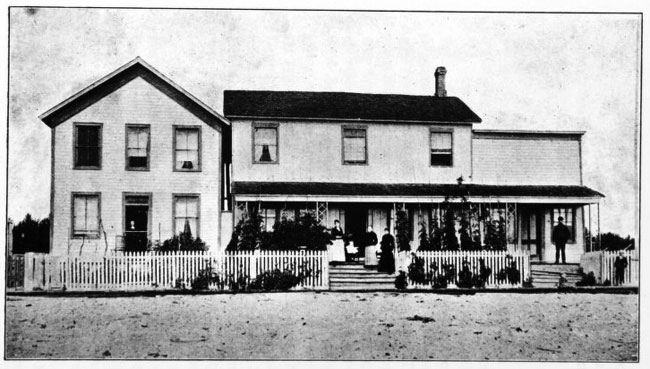
THE OLD MORMON PRINTING OFFICE. NOW THE GIBSON HOUSE. AT SAINT JAMES, BEAVER ISLAND, MICHIGAN.
THE KILLING OF "KING STRANG."
I must now hurry over many things that happened while at Traverse City. In June of 1856 news came that "King Strang" had been shot by his own people. It was a long time before we could get the particulars.
The fishermen and merchants had now made a strong appeal to the government asking for protection, and this time Strang could not make his plea strong enough to prevent the coming of the U. S. steamer Michigan with officers to make an investigation of the matter. The king met the steamer at Mackinac Island, hoping to gain a little more time to prevent any arrests of his people. The U. S. steamer proceeded to Beaver Island, landing at the village dock in the harbor. King Strang took passage on her back to the island, and as soon as landing he immediately went to his home not far distant from the dock. He was soon sent for by the officers, as they wished to consult with him about the affair. He started for the steamer, and when about half way on the dock two men stepped from behind a pile of cordwood and both fired their revolvers at once, both bullets taking effect. He was shot through the back twice, but did not die until eleven days after. He knew his last hours had come, and he begged to be taken to his wife Mary, his true wife. The women he had with him now were no comfort to him. Dr. McCulloch dressed the wounds and told him he feared the trip would be too much for him, that he might die on the way. He said, "No, no, take me home to Mary, my true wife. I cannot die here, doctor. I want to die with my wife and children. Take me to Mary, I know she will forgive me." Dr. McCulloch had him put on a mattress, carried on board a steamboat and taken to his wife's home in Wisconsin. The death of Strang was a terrible blow to most of his people, but a relief to those that were suffering such persecutions from him. One woman at Bower's Harbor expressed great joy when she heard it, but I could not understand why she should be glad of any one's death. She said. "I will tell you just a little of what the king made me suffer."
THE STORY MRS. H—— TOLD ME.
I was born and raised in a dear little nook in York state. There were four girls in our family, my oldest sister being deaf and dumb. After a time she and sister next to her married, then myself and youngest sister were left with father and mother. A young man came to our village to teach the village school. We became acquainted and in time were married. Mr. H—— built us a nice little home and we settled down to a very happy life. Our home was just a short distance from my parents. My deaf sister was married to a deaf and dumb man. He had a high temper and did not treat sister Nellie very kindly. After awhile Nellie came home to live with our parents, bringing her little twin babies with her. We all helped to care for them and then John, her husband, seemed more kind. Five years rolled around, when one day three Mormon elders came to our village, going around from house to house talking their doctrine, calling themselves Latter Day Saints. They visited us. My mother being in, she seemed greatly taken with their talk. They came again in a few days. Mr. H—— was out in the fields, and when I told them they said they would go out and find him. They did so and remained with us for supper, staying the evening; then father came over to hear them talk. One of the men was a fluent talker. He kept the attention of all when speaking. I felt a great dread; I knew not why. Then they held services in our little church in the evenings, which continued a week. Many were greatly excited. My parents and younger sister, Sarah, my husband and a number of our neighbors. The men left us promising to come again soon, when they hoped many would join their religion. I could see as the days went by Mr. H—— and my people, with others, were ready to follow these men.
I said all I could to discourage them, but it was of no use, I could do nothing. Preparations were made to leave. Our home was sold at a sacrifice and father's the same. At the time set the three elders came again, holding more meetings. Our goods were packed; also father's and mother's, and as Nellie and the babies could not be left, we took them with us. One pleasant day in August we bade farewell to our dear old home and kind good neighbors I had known my lifetime. And with many tears of sorrow and regret on my part we started for the Promised Land.
After a tedious trip we reached "Beaver Island." I need not try to tell how disappointed many of us were, as everything was so different from what it had been represented to us. The island itself was very beautiful, just as nature had made it. But to us that had come from a settled country with farms all cultivated, it was a great change. I saw Mr. H—— was very low-spirited, and knowing we must make the best of it, I tried to cheer him, saying, "Now we will soon make us another home, and if all is well we shall soon be as happy as we were before. But you know I can never enjoy this new doctrine." We also found when reaching the island that the bright talking elder was "King Strange" himself, and he well knew I had no sympathy or belief in his teachings. However, Strang gave us our choice of a building spot and we chose as pleasant a place as possible, with father and mother near us, just a short distance from the pretty little Font Lake. We tried to make our home like the one we had left behind. I went to work with a will helping Mr. H—— to build the new home. That first winter I never like to think about, the people suffered so much, but were always patient, never complaining. The next spring I helped to make our garden, also our flower garden, putting in the seeds I had brought from the old home. That first winter we endured hunger and cold, but I tried to bear it without complaint. I kept the best for my husband to eat and many times went supperless to bed, fearing there would not be enough for his breakfast, as he had to be out chopping wood during the day. A tenth part of our income must be given to the King, and sometimes there was little left, as there was always extras to help other expenses. We had plenty of clothing when we came, but in a few months we had divided most of it with our suffering neighbors. With hard work and scanty food, and great anxiety about Nellie's sick babies, it began to tell on my health. I scarcely knew a care in the old home, now it all seemed to fall on me. When spring came I was much run down in health. When Mr. H—— would sometimes blame himself I would cheer him up by telling him, "Never mind, we have each other, and together we can endure almost anything." We dared not talk much to others that we felt any disappointment. We soon found the King exacted perfect obedience from his people. I knew in my heart he did not like me because he could not win me over to his belief.
The third year we began to be a little more comfortable, and I found a little more time to rest. I had been so busy with hard work trying to make our home bright and cheerful I had not noticed what was going on at the Tabernacle meetings. I soon began to hear rumors how the king was preaching polygamy. I felt worried and I could see that other women were the same, though we dared not talk much together about the King's affairs. I spoke with my husband about it and he said, "Have no fears. Strang can never make me bring another wife into our home." Soon a friend told me she feared our husbands might be forced to obey the law that the King had made. She was an elder's wife. She then told me my husband was soon to be ordained as an elder. Again I spoke to my husband about my fears. He took me in his arms, saying, "Have no fears Mary. We have worked and suffered together and do I not know how you have endured hunger and cold and gave up our pleasant home to come here with me? I will never desert you or treat you so mean as to bring another into our home. The King has urged me to do so, but I told him I could not obey that command." In a few days several women came asking me to join them in voting down Strang's new law. I said to them. "No, I dare not oppose that man. I feel such a dreadful fear of him." In a day or two they came again, saying, "Mrs. H—— you will be sorry if you do not help us try to vote against this law. We believe if we women band ourselves together, and now that we have the right to vote on this subject the king may think better of it when he sees how we feel about it, and don't you feel afraid your husband may bring home another wife?" I said, "Oh, no, I am sure this cannot be." Then they left me. I felt like one in a dream. This seemed such a strange life to live. I did so long to once more feel free like I used to in the other days. I tried hard at times to understand about this religion, but could not. I went very seldom to the Tabernacle to hear the preaching so I knew very little about what was said. Father and mother never talked about the old home any more. To them it was as if it never had been. Mr. H——, too, never talked about it, and sometimes I wondered had I dreamed that we ever lived in our eastern home. It was very seldom I ever went to the harbor, as my husband always brought me anything I wanted. I often heard about the parties given there, but never attended any.
One pleasant day in August, the eighth anniversary of our wedding, my husband said to me, "I shall not be home to dinner as there is some very important business to be done at the temple among the elders. Have tea at five o'clock and I shall surely be home at that hour." I followed him to the door saying, "Now remember, Mr. H——, this is our anniversary." He kissed me saying, "I will remember it Mary and be home at five." I sang at my work as I had not done before for months. I felt so happy. I looked about the home and it seemed more like the old home in York State: my flowers on each side the walk to the gate, in front the mountain ash was lovely, and my climbing rose bushes all about, which gave it all such a home-like look. I soon started for the woods to gather wild flowers, mosses and trailing vines to trim the room with so it would look nice when Mr. H—— came home. I met a neighbor and asked her to go with me. She said. "No, my heart is too sad. I fear my husband will soon bring home another wife. Are you not afraid Mrs. H——?" I answered, "No I am not afraid, for Mr H—— would tell me so if anything like that was to happen." She gave me such a sad look with her eyes full of tears. Pulling her sunbonnet over her face she passed on. I gathered my flowers and vines, returned home and trimmed my rooms. I put the vines around my white muslin window curtains with the pretty lace I had knit around the edge and the white bed curtains to match. I set my table the prettiest I knew how, with the lovely wild flowers in the center; I then ran over to mother, telling her all I had done. I saw her and sister Sarah exchange looks, both saying they were glad I had done so. I played with the children a few minutes, then ran home to prepare the tea. I wore a pink muslin dress, the only one I had left from the old home, and a pretty white apron, the last I had of the kind. Somehow the day had been long, but I felt no fear, only a sadness for the neighbor I had met. Her sorrowful face seemed always before me. Remembering my husband was fond of warm biscuit, I made some, and just as the clock struck five I heard the gate click and our faithful dog Tiger give a low growl. I thought strangers must be coming, as he always barked with delight to see his master. I hurried to the door. Mr H—— was coming up the path with a woman holding to his arm. Before I had time to move or speak they stepped past me into the house. Mr. H—— said to me, "Mary let me introduce you to my wife to whom I have just been sealed in spirit this day, and I hope you will welcome her and show her the respect which is her due from you." I stood still; I could not move; I could not speak; my tongue would not move in my mouth. I tried to say "husband, husband," but no sound came. Oh the agony I suffered! I could only follow them with my eyes. I could not speak; I was dumb. The woman gave me an insolent look, saying, "I guess I must have been expected. The house seems to be pretty well fixed up, but she doesn't seem to be very glad. She'll get used to it soon. We'll make her know that I am the mistress here now. Won't we Mr. H——?" He smiled and nodded, saying, "Come let's have some supper. Come Mary, pour the tea." I rushed from the house, running to my mother's house. She met me calmly at the door. "Oh mother, did you know of this?" She answered, "Yes Mary, we all knew it all along and what is the use of making any fuss. It's God's commands." I ran to my sister. She laughed, saying to me, "Well, you must be a fool. You ought to be proud to know your husband is made an apostle of the Church of Zion and already blessed with a spiritual wife. Now do have some sense and don't disgrace us all." It just began to dawn upon me my sister was just the rankest little Mormon alive. I then went to my father, thinking I would receive sympathy from him. He said, "Now Mary do be quiet. Your husband has talked this over with us. We all thought best to say nothing to you about it and when you saw it could not be helped you would just settle down. Your mother and I believe in this doctrine, and we think it is right." I stayed to hear no more. Wild with grief I ran back home. Oh, my home no longer, to make a last appeal to my husband, to be sure it was not a horrible joke just to try me. I rushed in, throwing myself down at his feet, crying. "Tell me, tell me this is not true! Tell me it is only a joke to try me." I very soon learned it was only too true. They both threatened me with a straight jacket, with bread and water diet until I would quietly submit. I got upon my feet and staggered from the door down the walk to the road. I was blind, my limbs refused to carry me, and just as I was sinking down my dumb sister caught me in her arms. She had seen by my face I was in great trouble, and she saw my mother did not sympathize with me. She followed me, then looking toward the house saw the two standing together. She seemed to understand what it meant, and the first sound I ever heard her make aloud, she gave a hoarse cry and partly dragged me away to a large log beside the road a short distance from the house. It was a large tree that was upturned from the roots and sheltered us from the passers-by. She rubbed my hands, smoothed my hair, pressing kisses upon my face, and showing me she sympathized with me in my trouble. Many times she showed anger, stamping on the ground and shaking her fist toward the house. The moon had risen, and every time I opened my eyes I could not bear to look at it. I wanted it all dark. Dark as midnight. Dark as the world now seemed to me. After awhile the neighbor woman I had met in the morning came to me. She took my hands saying, "Mrs. H—— I am truly sorry for you. I wanted to tell you this morning, but you seemed so happy I could not do it. I saw you had entire belief in your husband's word. I blame him very much for not telling you his intentions. You might have felt different about it. I, too, have just one week of freedom, then my husband brings in another wife, as he, too, was made an apostle today. But in my case I have been told of it and have the privilege of choosing among the young women the one I think I can best endure. I have chosen a friend of mine. We have agreed to live as sisterly as possible. For my four children's sake I can endure much and I don't see how I can help myself; but I must not be found talking with you, as such things are forbidden." In a still lower tone she said, "I will help you all I can in your sorrow." She pressed a kiss on my face and was gone. I sat beside my dumb sister thinking. "Was it for this I had suffered cold and hunger, leaving our comfortable home in New York State? And of all the days in the year, the anniversary of our wedding day he had brought home the most homely old grass widow to be found on the island, that everybody detested." The king said afterwards he did this to humble my pride. After the woman left us Nellie made me understand she would go to mother's and get me a shawl. The dew was falling, I had no wrap, my dress was muslin. She made me understand I was to wait here until she came back. As soon as she left me I partly crawled and dragged myself to little Font Lake, which was about a quarter of a mile distant. I laid myself down on the moss covered bank, the darkness of despair rolled over me. My husband did not seem the same to me now. He seemed only a great monster beast that I wanted to get away from. I thought how happy our home had been before we knew anything about these strange people, and the dear friends I had left to come to this island. Then I thought of baby's grave far away in the old home. I could endure it no longer. I would end it all by plunging into the little lake where my husband and I had strolled so many times along its green shores. I gave the leap that would end my earthly suffering. I was held back by the dress and dear old Tiger whined, jumping up, licking my face and hands and pulling me back from the water. This is the last I remember until I felt the warm sunshine upon my face and old dog Tiger was lying beside me. When he felt me move he began to whine and lick my hands. I had no recollection of time any more as Tiger and I wandered about through the woods. I ate berries and drank from the lake. All the food I had was what my dog brought me. Bread crusts and meat bones. At last my dumb sister found me by watching Tiger and following him. I knew Nellie, although I was in a very weak condition. She tried her best to get me home with her, but I would not go.
Just about the time all this happened to me Nellie's deaf and dumb husband had come to the island on a steamboat. He had not come with the rest of us, and since we came he had fallen heir to considerable money and had come to claim Nellie and the children. They had gone to housekeeping in a little log cabin built in a secluded spot on the edge of the heavy woods. The little home was not yet finished. Nellie by her dumb language made me understand John had come and brought letters from the old home. She made me promise I would wait until she came back with John and the letters. In a short time they came. When he saw me it was terrible to look upon his silent rage. He foamed at the mouth and stuck his knife into the earth, but he could make no sound. He passed his hand over my hair. It was white as snow. It was auburn in color when I left my home. I did rouse up a little when I watched the tears roll down his cheeks. Nellie put a dress on me and a shawl. My bare feet were cut and swollen. They both helped me to walk; I was too weak to walk alone. At the last John carried me in his arms to his home. Nellie made me understand that I had been over three weeks in the woods and by the king's orders no one had dared openly to hunt for me or give me aid in any way, claiming that was the way to subdue an unruly spirit. It was told me that he who once had been my loved husband never made an effort to find me, not even my own father and mother. Strang called all this "Divine Revelation." Oh he was more cruel than the grave to me.
From the time I entered John's home my three dumb friends never left me. It was a hard struggle for life with me. I saw no one and none ever came to see us. The dear children kept me alive with their sweet, childish prattle. At that time Strang's rule was absolute. None would have dared to give me aid. Many were living a double life, seemingly good Mormons, but only waiting for an opportunity to get away. Strang had enemies that would strike hard when the time came. Not long after I went to Nellie's he that I once called husband, watched and shot my faithful dog Tiger. Then I was roused. All the demons in me came to the surface. I could not keep quiet any longer. I got well as fast as possible and caused the King and Mr. H—— all the trouble I could.