PART II. (continued 3)
Reading edition
The people were divided, not all were pleased with the king and his rule. The Gentiles were leaving as fast as they could, as there was no safety for them or their property. Strang was losing much control of his people. Then he concluded to extend his territory to the mainland, Charlevoix and Bower's Harbor in Grand Traverse. Some had gone to Fox Island. About this time Nellie's husband died very sudden. We never knew the cause of his death. Nellie with her children went with me to Charlevoix, staying there all winter, then went to Bower's Harbor. That winter in Charlevoix we almost starved before spring came. The snow was very deep and ice heavy in the lake. The latter part of March teams came over from Beaver Island on the ice, bringing us provisions. They also went to Fox Island, as the people there were in a starving condition. This was not done by any of Strang's orders. There were some good people who knew our provisions could not last us till the opening of navigation and they came without orders and saved our lives from starvation. "Now do you wonder I am glad of Strang's death?"
The story was a sad one, but true. It had not been all pleasure in Strang's kingdom. The doctrine they believed in and practiced beyond limit stifled all the good there was in their hearts. There was no pity felt or shown to those who went contrary to the "Divine Revelations" which their king was supposed to have. Poor, deluded people, how different would all have been for them had their leader used his splendid talent for good and taught his people the way of life and truth.
MY BROTHER LEWIS VISITING US AND HIS STORY.
Another year had rolled round. The June days lingered with us still when my brother Lewis came from Beaver Island to visit us. We had not seen him since he left us at Charlevoix after he was wounded. The four years had changed him from a boy to a man. He was now twenty-three years of age. He had many things to tell us, he being one of the men chosen the year before to help preserve law and order in the sending away of the Mormons after the king was shot. He went to the island to help get the people away on the steamboats that were sent to carry them from the island.
As soon as Strang was shot a great number of the people left at once, having means of their own to help themselves with. There were others who had small means. Their homes were all they had. Strang had preached and taught in the temple that no bullet could pierce his body, and strange as it may seem, there were a large part of his people who believed it. And now when they knew their king was killed, and killed by the bullet, they were prostrate with sorrow; many of them completely incapable of thinking or doing for themselves. My brother said it was a sad sight to look upon when they came to the harbor to go on board the boats. Their sorrow was great. They seemed like a people without a hope in the world. Many wrung their hands and wept with sad moanings, saying, "Our king, our king is dead." Women fainted and were carried on board; children were crying. Even men were sobbing, and two or three attempted to throw themselves from the dock into the water to end their misery. All were allowed to take their household goods, yet many did not do so. Some only took their clothing and bedding. Poor suffering people! No doubt they were afraid of the Gentiles, thinking great harm would be done to them. The feeling had become so bitter between them that in a great many cases justice was not done where it should have been. These people now had no desire to remain on the island now that their king was dead, even when going meant leaving their comfortable homes and all they had in the wide world. Those that worked the hardest suffered most. The building and making of their homes and improving their farms had occupied all their time and attention. They loved their king and their hearts were loyal to him, seeing him only in his best moods, as he was always kind and pleasant to them in his visits about the island. They knew nothing about the workings of the inner circle or private temple teachings.
TEACHINGS OF MORMONISM.
Strang knew just how to manage these hardworking, faithful people, and the reason so many were beginning to think favorably of polygamy was because they were taught that only those who were faithful could be sealed, and in this way were counted God's elect. But there were a large number of women who came to the island that had been better taught than to believe in such a doctrine, which was the reason of Strang's failure to enforce the law.
The two men who shot Strang had their own wrongs to avenge. Bedford had been whipped, he claimed unjustly. The other man, Wentworth, also had much bitterness in his heart of treatment he had suffered from Strang. So the two had planned to shoot him at their first opportunity. Immediately after they shot him they ran to the U. S. steamer Michigan and gave themselves up to the officers saying, "We have shot Strang and are willing to suffer the consequences." They were taken to Mackinac Island and put in jail, where they remained about one week. One dark night the door was unlocked and a man said to them. "Ask no questions, but hurry to the dock and go on board the steamboat that is there." They did so. Nothing was ever done in the way of giving these men a trial. Public sentiment was so great at the time against the Mormons it would have been impossible to find a jury to convict them.
FATHER AND MOTHER'S VISIT TO BEAVER ISLAND.
My brother remained with us three weeks. Father and mother thought they would like to go back to the island with him to visit many of their old-time friends, who had gone back to the island after the Mormons left. Mr. Bower, at Bower's Harbor, owned a small vessel and was anxious, as he said, "To go and see how the island looked with the Mormons gone." So, with several more friends from Traverse City and Old Mission, father, mother and Frank went to Beaver Island. They were gone two weeks. I remained with Mrs. Hitchcock, my former teacher, Miss Helen Goodale. She had gone to housekeeping in their cozy new home just built on First street. I was very contented while they were gone never thinking of such a thing that father would move away from Traverse City. When they came back I could see mother was greatly pleased with the island. There she had met so many of her old friends, and there she could talk her own language again.
A MOTHER LONGING TO SEE HER CHILDREN.
I could see when mother spoke of the island her heart was drawn to it. I said to her, "Would you leave Traverse City and go to Beaver Island?" It was dark and I could not see her face, but I knew by her voice there were tears in her eyes as she said, "Well, I don't know Elizabeth, but it seemed to me while I was there I was nearer to my boys, Charley and Anthony, and now as both are sailing they might sometime come into the harbor in a storm." I spoke with father about it. He said he knew mother wanted to go back, but he did not want to take me from school. Frank, too, said mother was anxious to go to the island, telling him there she might see her two boys who were sailing and have her oldest son with her all the time. There was nothing said to me again about it. I had forgotten all about my talk with my mother.
One morning the latter part of August Frank came and said to me, "Elizabeth you must come home. We are going to move to Beaver Island." At first I said. "No, this can't be so. I can't leave my school which will soon now begin." But I hurried home to find it was true. Packing was going on and all preparations were made to move. Mother was happy. She was going to be near her boys as she so many times said when her neighbors urged her not to go. My heart was heavy. How could I go and leave all my dear companions and my dear school, which was my greatest sorrow. Mr. Therian Bostwick had been our teacher the winter before and would be again the coming winter. He was a highly educated man and he and his wife wanted me to remain with them all winter and go to school. Father said I might if I wanted to and then I could go to the island the next spring, but I felt I could not do it. My winter in Ohio, where I had been homesick, made me timid about being separated from my parents. Dearly as I loved my young companions and Traverse City, I felt I was needed by my parents. Father's health was failing, that I could plainly see, and Frank not old enough to be much help.
LEAVING TRAVERSE CITY.
With many tears of sorrow to think of leaving companions, friends and Traverse City, the place where we had been so happy in the four years of our stay, we bade adieu to our kind friends and neighbors and once more were sailing away over the waters to Beaver Island. As we sailed toward Northport it was not long before all traces of the little city had passed from our view, and though I could not see it with my eyes, I could see it with my heart, as I said to one of the gentlemen on board our vessel. There were three summer people that had been at the island since early June. They came over to Traverse City to see what the country looked like and voted their preference for the island as a summer home.
We called at Northport, stopping to see several friends and wait for a fresher breeze. There we met Mr. Dame, his wife and daughter, Mrs. Page, and son Sebe, as we always called him. Mr. and Mrs. Smith and many more wished us "God speed" on the way across the water to our "Island home." We left Northport just as the sun was rising over the treetops. The little town looked bright and pleasant in the morning sunlight. The wind was fair and sea smooth. We soon were past the point, where we could look upon Lake Michigan. North and South Fox Islands at our left, Charlevoix shore on our right, and soon Cat Head was left far behind, with the "Beavers" growing larger every minute.
LANDING AT THE ISLAND.
The day was fair; the sky was blue; the sea gulls soared about our little ship, uttering their shrill cries in search of food. Soon the land could be plainly seen along the island, and as we neared its shores my thoughts went back to a few years ago, when I stood on the deck of the steamboat Michigan watching so eagerly to catch the first glimpse of the dear old island that was my home. And now as we passed Cable's dock and saw the houses, and people walking about, how familiar everything looked to me. I watched to see our old home, but father said to me, "It is burned down." I looked at the place where it had stood and through my tears it seemed I could almost see my little brother Charley and myself strolling along the beach as we so often did in the old days, chasing the plovers along the shore. Then again I could see ourselves hurrying to get on board the little vessel with our goods left upon the beach and the Mormon men pointing the guns at us. Father seemed to know what was passing in my mind as he said. "There are only friends here now."
We sailed along Big Sand Bay, and there were many little buildings left where the fishermen lived. The Martin's and Sullivans place, with Kilty's and others, all looked so familiar, then past Loaney's Point with the big rock, and the homes looked just the same. In a short time our little ship was sailing into the harbor, where something new greeted my eyes, and that was the light house on the point, which was not there when I was there last. Everything was so beautiful and fair to look upon I could not help enjoying the lovely trip across the lake.
HOTELS AT THE HARBOR.
My brother and other friends met us and took us to the Mormon printing office, which had been turned into a hotel. When reaching there we were met by ever so many old friends, nearly all speaking in French, and their manner so hearty we could not help but feel their welcome. At supper time the dining room was filled with a jolly crowd of fishermen with a number of city people that were staying for rest and recreation in the summer months. Several of them had been with the fishermen on the lake that day watching the process of setting and lifting the nets, and many were the jokes that were made at their expense. Next door was another larger hotel, kept by Mr. David Lobdell and his wife. Mrs. Lobdell came from Fremont, Ohio. This hotel had been full of summer boarders, but many had gone to their city homes. This house had been used by the Mormons as a dance hall and theater.
The summer at the island had been a very gay one. About twenty families had summered there, living in the deserted homes of the Mormons. There were also two or three smaller boarding houses that were all filled and doing a good business. Fish were plenty, bringing a good price. Everybody had money and used it freely. The fishermen were a good, kind, jolly people as a class, borrowing no troubles for the morrow. In those days there were no tugs used in the fishing business, neither were there pound-nets used. There were many seines used. The fish caught were usually very large in size, both whitefish and trout. The merchants did a prosperous business. In winter the cord wood was chopped and brought to the docks for the steamers' fuel during the summer season.
THE FAREWELL RECEPTION TO FRIENDS.
The evening before we reached there a large party had been given as a farewell to the many summer friends that were going to their city homes. The two young Mormon sisters that Strang had chosen as Spiritual wives were also going away. They were to have a great festival, or feast, in July to celebrate the sealing ceremony of the King's marriage with the two young sisters, but death had come and taken the King before the time of the ceremony. These two sisters were very beautiful girls who were orphans and had a home with their uncle, he being a staunch Mormon, but a very good man. The summer people had been very interested in these two young sisters. Their parents had both died while they were very young. Being raised in the Mormon faith they thought it was right and considered it a great honor to have been chosen by the prophet and King. I was told by one who knew them intimately that they expressed great joy that they had escaped such a fate. Since the shooting of Strang they, as well as many others, had lost their faith in his religion.
RETURN OF THE MERCHANTS.
We were soon settled in a comfortable house left by the Mormons. The houses as a rule were placed close together in groups of three. Their yards were nicely laid out and filled with handsome flowers, which were now in bloom. When we reached there houses were plenty and we could take our choice. Mr. C. R. Wright and family had returned to the island, starting a large cooper shop and employing a number of workmen. Mr. James Moore and family, T. D. Smith and family, and many others who had left in 1852 had now returned. Mr. James Cable had taken possession of his property at the head of the island and was again in business. Mr. Peter McKinley had returned and was in business across the harbor on the opposite side from the point at what was called the "Gregg property." Mr. McKinley had been elected to the State Legislature at Lansing, so did not return to the island until late in the fall. His brother Morrison taking charge of the business. Peter McKinley was first cousin to William McKinley, our late President of the United States.
There was a very comfortable school house, built by the Mormons. It was a frame building containing a large library of fine books which belonged to the King. There were books of Greek and Latin, with histories and law books. Our school was taught that winter by Mr. Isaac Wright from Illinois. The Mormons had always had good schools, as the king wanted to have his subjects educated, but would not allow them to go outside to be educated. The teachers being their own people.
About a mile back from the shore on high, level land was Mr. Campbell's farm. This was a beautiful location on the south side of the harbor. This family had remained when the Mormons had left. They were glad to be left in peace and had become tired of Strang's rule. They were my neighbors for many years and proved themselves kind and true friends.
Mrs. Campbell had been one of Strang's greatest enemies in preventing his enforcing the laws of polygamy. She carried her family Bible to the temple, and there with many other women read God's laws from its pages faster than the king could explain it in his way. She told me all this herself, and said many times when she started for the temple it was with fear and trembling, not knowing sometimes whether she would ever return to her home.
She knew she was defying the King, and no one at the time could tell what the outcome might be, adding, "But we knew we were right and were fighting for our homes. We kept agitating and gained time. Strang began to find his power was not absolute. We women banded ourselves together and fought him with words so strong he had to stop to consider where he stood. Before it was settled the king was shot."
DR. McCULLOCH'S RESIDENCE.
At the harbor side, or St. James, was quite a village. Two docks, two stores, with the two hotels and two or three boarding houses; further around the bay was the old Mormon boarding house building that had been run by the Mormon with four wives. It was built of logs smooth on both sides. Mr. C. R. Wright converted that building into a large cooper shop. There were about twenty houses back along the hill, reaching along past the temple and Strang's cottage, with several more in the other direction around the bay toward the point. Just back a short distance from the street just opposite the dock stood what was called "Dr. McCulloch's residence." A very pretty gothic story and a half cottage. It was painted white with a white picket fence around it. Dr. McCulloch was the Mormon doctor from Baltimore. A fine physician. Coming to the island just to rest, he gained his health and liked the climate so well he settled there. His wife was a highly cultured lady. While not wholly Mormons, they were just enough so as to live peaceably with the King. Mrs. McCulloch was the leader in much of their amusements, and she often ridiculed Strang about his way of living and insisting upon the women wearing short hair and bloomer costumes. She always wore her dresses long when going on her annual trips home to Baltimore. But when on the island she wore the regulation short dress, as she said, "Just for fun."
The year we returned, in 1857, a Mr. Burke, a merchant from Buffalo. N. Y., had been that summer at the island with a stock of goods, leaving in the fall, selling his goods to Mr. George R. Peckham, of Toledo, Ohio, who carried on the business a few years alone, after which C. R. Wright went partner with him; then for a number of years the firm of Peckham & Wright was known. Later George Peckham sold his interest to Mr. Wright, and then the firm was known as C. R. Wright & Son. The business grew, as thousands of barrels of fish were caught and shipped every season. It soon became equal to the fish market at Mackinac Island, it being nearer to most of the fishing grounds. In a few years the property at the point was bought by the firm of Dormer & Allen, of Buffalo, N. Y. A large store and warehouse was built, with the dock improved, and the business was carried on at the point with success by that firm for a number of years.
THE KING'S HIGHWAY.
At Cable's dock Mr. John Corlette, of Ohio, had settled, and after a fair success in business of several years he moved to Cheboygan, Mich., with his son-in-law, Mr. Andrew Trombley. Captain Appleby, of Buffalo, N. Y., took Mr. Loaney's place as keeper of the light-house at the head of the island, where his nephew, Frank Blakeslee, assisted. After a few years Mr. Harrison Miller took Capt. Appleby's place, remaining eleven years or more, assisted by his nephew, Edwin Bedford. Mr. William Duclon succeeded Miller, and after about eight years was transferred to Eagle Bluff light-house, where he still continues at this writing. Mr. Harrison Miller, after leaving the light-house, was appointed keeper of the life saving station at Beaver Harbor, and was transferred to Point Betsey life-saving station. Mr. Owen Gallagher succeeded him at the Beaver Island station.
The Mormons laid the roads out very convenient for the settlers that were in the interior of the island. One road went direct from the harbor across to Bonnar's landing, a distance of five miles. This road passed through many fine farms, and there were roads branching from this one leading to all parts of the island, with the king's highway leading direct through from the harbor to the head of the island. The king's highway was very beautiful with its wild scenery. Many of the roads were built with small logs cut the width of the road and laid down firmly close together. These were called cause-ways or corduroy. This kind was built where it was swampy and low land to go through. These cause-ways were very beautiful in summer time with their branches arching overhead in many places, with beautiful evergreens mixed in with willows, green mosses and flowers.
HORSEBACK RIDING ABOUT THE ISLAND.
I soon became acquainted with Mr. Campbell's daughter. She was a bright, jolly girl just two years older than I. They had horses, so Mary and I used to ride horseback almost every day until she had taken me almost all over the island. Oh, those delightful rides! There were roads and bridle paths going in every direction. I would soon have been lost, but Mary knew them all, and when she had any doubts about the way out from the deep woods those two horses never failed to take us right. Mary was a pleasant companion. She knew the names of all the people who had lived on those now deserted farms. Every house we came to was vacant. The little gates were broken off their hinges in several places, and in some of the houses the curtains were still at the windows. Weeds were growing all about the doors, flowers were still in bloom, with weeds mixed in among them, barns were empty with some of their doors open. There were broods of chickens around many of the barns, and one yard we rode into some pretty little kittens ran scampering under the barn. Mary was talking all the time, saying, "Such a man lived here; they were very good people. Just see how pretty the flowers grow and the lovely currant bushes. Ma and I came and picked the most of them this season, as Mrs. M—— told us to. Oh we did feel so sorry for her to have to leave her home. Now these people were awfully queer. They never talked to anybody; and just see the lovely hay in this field all going to waste." We rode along where there were several houses built close together with a large barn, and the flowers were beautiful. Roses climbing about the windows. "Yes, this is where one of the apostles lived. We didn't like him a bit. Ma says he made Strang do lots of things he didn't want to and wanted to put father high in office and have him sealed to some more wives, but Ma would not allow it. She went to the temple and did all she could do to stop it, and I believe Strang was afraid the women would mob him. At any rate he let us alone. We liked that apostle's wife. She was a kind little woman." I enjoyed the riding, but it made me sad to see all those deserted homes. I could see how much hard work had been done to make everything so comfortable.
THE HOME WHERE THE WIFE HAD BEEN DRIVEN OUT.
One day, on our last ride, we rode directly across to Bonnar's landing. Mr. and Mrs. John Bonnar had bought and settled on a very fertile piece of land. At that time there was not much cleared; later they had a beautiful home. Mr. Ray Peckham and wife also had bought a good farm near Mr. Bonnar's. This day Mary and I rode around all the homes out on that road, then came down and took the road leading out to Long Lake, near Font Lake. Our horses were walking, Mary was pointing out and telling me about the people that lived on this road. We soon came to a home that it seemed to me I had seen before. I said, "Mary, who lived here?" "Oh, this is where Mr. H—— lived; the man who treated his wife so badly because she did not like it when he brought home another wife." We tied our horses and walked about the yard. Yes, here was the home. There were the rose bushes about the windows, the flowers down the walk, a mountain ash with its red berries, the vegetable garden at the back of the house with the currant and gooseberry bushes. I looked a long time, seeing it all in my mind as the woman had told me her story. I could see the man and woman standing together in the door while the wife was hurrying away to her mother for sympathy. I could not keep the tears back. Mary saw I felt sad and said, "Why do you cry? Are you lonesome for the friends you have left in your old home?" I said, "No, I am crying because I have heard the story about the woman. She told it to me herself." "Oh yes, I remember hearing ma tell me about this woman. She says she thinks it was the most cruel joke Strang ever planned." (Strang always called such things jokes.) Over there is where her father and mother lived and way over there (pointing to the woods) is where that deaf and dumb sister of her's lived. We walked over to the woods. The little log cabin stood almost hid by the trees and bushes. It had a more deserted look than the rest of the houses. Bushes and weeds were right up to the door. Mary said no one had ever lived in it since the deaf and dumb man had died and his wife and children had gone away. We hurried away. It gave us such a gloomy feeling. We were glad to come back where the sun was shining.
TIGER'S GRAVE.
Mary said, "Come, I will show you old Tiger's grave, where the woman and her deaf and dumb sister buried him after Mr. H—— shot him for his faithfulness to his mistress." We stood beside the spot where the wronged wife had buried her faithful dog. She had planted a rose bush beside it. There were many beautiful roses on the bush that season. Tiger's grave was near the shore of little Font Lake at the place where he pulled his mistress from a watery grave. We then rode down through Enoch, and there Mary pointed to a grave with a beautiful lilac bush at its head with a white picket fence about it. That is where the mother of four young girls is buried. It almost broke their hearts to go away and leave their mother's grave. They had asked Mary to see to it sometimes, which she had promised to do.
THE JOHNSON HOUSE.
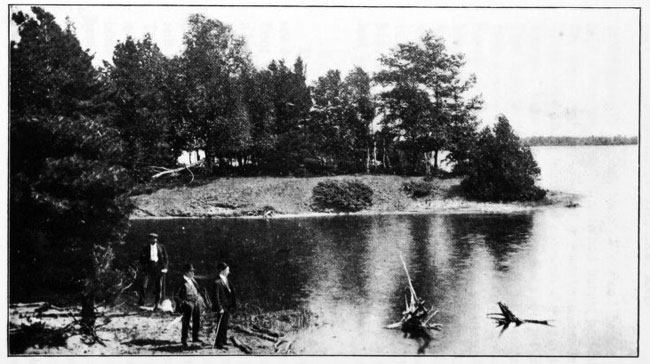
Mary said, "Now just one more place to go and see before we go home." We rode around pretty Font Lake, soon coming to a large two story and a half house, built very near the sloping shore of the lake. We tied our horses, walking down the path to the water. There were seats in among the small cedars, which grew thickly about. The house was still in good repair. "This is the Johnson House. The people were rich. He was a merchant living in Buffalo. The King and 'Douglas' went to their home and soon persuaded them to sell and come here. They built this house, and out there you can see the large barn. They brought their horses and carriages. They brought their dead daughter's body and buried it out there on that little knoll." I looked and saw the white railing about the lonely grave with rose bushes at the head. We went up stairs and saw the large dancing hall with its waxed floors which were still glossy. She told me how beautifully it had been furnished. The parlors and all the rooms were large. Rose bushes grew near the windows, flower gardens with blooming flowers. The setting sun was shining through the windows; the house was clean and it seemed the occupants had just cleaned house and not yet arranged the furniture. It had such a bright, cheerful look. Some city visitors had lived there all summer. Yes, these people were another disappointed family. They had a very handsome daughter highly educated and a fine musician. Strang and "Douglass" used to go there to the parties given, the family not knowing at first that "Charles Douglas" was a woman, that being another one of the king's jokes. Mr. Wentworth married this daughter and the king's visits became disagreeable to the young wife. This caused hard feelings and may have been one of the reasons for Wentworth's shooting the king. We hurried home as the sun was sinking in the west, and I wanted to get away from all these empty houses, for every one seemed like an open grave. I staid with Mary all night and her mother told me many things about their life on the island.
FONT LAKE, BEAVER ISLAND, WHERE KING STRANG BAPTIZED HIS PEOPLE.
MRS. CAMPBELL'S STORY.
"We had a comfortable home in New York State near to where many more of our neighbors who came with us lived. Strang himself, with two more apostles, were traveling through the country preaching and telling about the rich beautiful country they had found. We went to hear them, and, like many others, were greatly pleased. Strang did most of the talking himself. He was a brilliant talker. He had such a bright, cheerful manner we were won from the first. We sold our home, the other neighbors doing the same, and in a short time started for the 'Promised Land.' When we reached here we found nothing as it had been represented to us. The island was in its wild natural state. A few had cleared some land and were struggling along the best they could. Our first winter was a hard one, and I cannot bear to think how sadly we were disappointed. When I asked Strang why we had not been told the truth he always turned it off in some way, talking so encouragingly and always making us see the brightest side. Life became busy, as we had a large family dependent upon us. We had some money saved and bought this land and built this house, which you see is large and comfortable. Our children were sent to school and we were beginning to feel quite contented. I often went to hear Strang preach, but I did not feel satisfied, his doctrine did not sound the same as he told it to us before we left our old home, and he was having so many 'New Revelations' that I soon lost what little belief I had ever had in the doctrine. Somehow it was different from what my old family Bible taught me, but I said very little about it at first, although a few of us women used to say Strang had too many revelations to be true. He never spoke anything to me about them, but often spoke to other women he called upon. Very soon he preached in the temple that he had a new revelation that all the apostles and officers in the Church of Zion must take more wives, and had already taken more himself. This preaching stirred us women up, as he had preached before against polygamy, and about this time I found the king was urging my husband to accept a high office in the church. I called upon the king, asking if this was all true that we heard. He answered in a very decided tone, 'Yes, it is true, and the law will be enforced if you do not quietly submit.' I told him I would never submit or consent to another woman coming into my house while I lived. He said, 'You are not yet high enough in the faith to understand the true meaning of being sealed to spiritual wives.' Well, I tell you I was mad. I went home, and in a few days I joined with several other women. We went to the temple, I carrying my family Bible, and there we faced the King. We women talked faster than he could. He tried to have us stopped but could not. You know how it all ended; I was sorry to see him killed, yet I knew something terrible would happen to him and I told him so when I talked that day. I said such things cannot go on any longer. All these homes would not be empty had Strang lived according to the doctrine he preached to us before we sold our old homes and came here; we would have been a happy, contented people, but his teachings were all false from beginning to end, and he has suffered the same fate of Joseph Smith, whose example he followed. I know there were bad men influencing him to do all this. It might have been for the purpose of getting rid of him so they themselves could take his place. It is all ended and I am glad I never knew anything more about Mormonism than I have since I came here."
BURNING OF THE MORMON TEMPLE.
At the time the Mormons left the island the temple was left standing. The excitement was so great and the Gentiles feared the Mormons might return with another leader in Strang's place, so they thought best to burn the temple. It was of the exact pattern as the one at Kirtland, Ohio, as Strang had built it after the same plans. The building was all up and inclosed, but not yet finished. The large room used for preaching was also used for the council room.
ROCKY MOUNTAIN OR INDIAN POINT.
In my rides about the island there were many narrow paths in every direction and the young growth of trees made it almost impossible to pass through. We would come upon many little log cabins in the dense woods with no clearing except a small yard and I wondered why this was so. I was told these were some of the places where they used to secrete stolen goods, it being such an out-of-the-way place and in the dense woods no one would expect to find a house. One of the band of "Forty Thieves" who lived with us a few months after I was married and keeping house, told us there were many such places about that locality of Rocky Mountain, or Indian Point as it has always been called late years, where goods could be hid and they could hide themselves so as not to be found by any stranger. The very mention of the band of "Forty Thieves" struck terror to people's hearts in the days of Mormon rule. There were rumors of many dark deeds done by that band of highwaymen, or pirates as they were sometimes called. It was common talk among Gentiles, and told us by some of their own people who were not very loyal to the king, that vessels were plundered and the crews never heard from. Of course this none of us knew to be true, yet a great many things happened to lead us to think that it might be a possibility. When my people came back to the island there was still a great quantity of goods left stored away in some houses up in that part called "Enoch," about one mile distant from the harbor. There were several boxes of shoes, some crates of dishes partly full, screen cupboards, furniture, chairs and tables. One small house was almost full of stoves. All these goods were new and did not seem to have been damaged. The people who came had helped themselves to all they wanted and wondered where all the goods came from. This helped to make the rumors prove more true that vessels had been plundered and the crews killed. One of our lake captains told me he had a brother who was last seen at Beaver harbor. The vessel and crew were never heard from and no one knew their fate. Of course when Strang's people were getting so bold, doing what they did, taking everything from the fishermen, it could easily be believed they would plunder vessels if a good opportunity came.
THE SECRET SOCIETY.
Many have been the hours spent, and days even, by people hunting to find the hull of a schooner which was said to have been sunk off Little Sand Bay, myself among the rest, and several times we were sure we could see the hull of the vessel lying at the bottom of the lake several rods from shore. We often went rowing and sailing in that direction and we were sure to say, "Let's look for the wreck." I asked the young man that boarded with us about it, as he had once been a member of the "Secret Society." I said, "Is it true? Has there been such things done?" He said, "If only these stones could talk they would tell you of some things that would horrify you, and though I am free from Mormon rule, I would not dare to tell you some things which our band was sworn to do. We were trained for our work and were known among ourselves as the 'Secret Society.' It meant sure death to any of us to betray anything pertaining to our business." He was only eighteen at the time he joined the "Secret Society." He often had spells of great sadness and many nights walked the floor because he could not sleep. Once I said to him. "Did the King ever give you orders what to do?" He said. "At first the orders were given our captains by the King, but it was not long before we never waited for orders from headquarters. We did what we found to do. It was the intention that Strang should own and rule the whole territory about these islands and mainland as fast as he could get his people scattered about to possess the whole. Strang got too busy making laws that did not suit many of the women, which was one cause of the ill-feeling among his people."
PAGE TOWN.
In one of my rides with Mary we went to the place called "Rocky Mountain Point," where the forty thieves had their rendezvous. It was a lonely place, with the waves rolling in over the rocky shore where we went to the beach and the woods were dense. I had heard so many stories of the Mormons' doings there I felt afraid and told Mary I wanted to hurry away, which we did as fast as our horses could travel through the path. When we came to "Page Town" then the spell was broken. No one could look upon this beautiful place and feel fear. The view is grand out over the water to the neighboring islands and the evergreens are most beautiful. "Page Town" is just on the Lake Michigan side of Font Lake. We could see the Johnson House as we rested on the bank of the lake. There were about a dozen houses scattered about, some right near the bank and others back in among the evergreens. It was named in honor of Mr. Page, who first built his house there with several of his relatives. The location is most beautiful. At this spot Lake Michigan is not quite a half mile from Font Lake.
The land is a little rolling going out to Font Lake, which gives it a most beautiful view all about. The road was good to the portage. We rode around by the Station Hill, a station put there for government survey, and is a most beautiful place for a look-out, with its white sandy beach and clear water sparkling in the sunlight. During my stay on the island that was always a favorite place to go for a quiet, restful stroll, and our summer visitors never failed to visit Station Hill. There Garden Island, with its lovely green trees, was a pleasant view.
VISITING THE LIGHT KEEPER AND HIS WIFE.
From there Mary and I turned our horses' heads toward the point to visit the light keeper and his wife. They were a dear old couple. They would not let us go before we had tea with them. Their children were all married but one daughter. She was visiting with her sister, Mrs. E. Kanter, in Detroit, and expected to remain there for the winter. The old couple had a young boy named Anthony Frazier living with them. Their home was a marvel of neatness. Their name was Granger. He had been light-keeper at Bois Blanc, near Mackinac Island. His son had taken his place and Mr. Lyman Granger had come to take charge of Beaver Island harbor light, just erected the year before. They took us in the tower to see the lamp It was in beautiful order. Mrs. Granger seeing to the polishing of the lamp and fixtures herself. A few years later I was married and lived neighbor to them until they left the light-house. Then Mr. Peter McKinley was appointed keeper, where he remained nine years with his two young daughters, Effie and Mary. He lost his health soon after his appointment, but the girls took charge of the light house and were faithful to their charge during the whole time of their stay, finally resigning to go away.
OUR SCHOOL TEACHERS.
There were always good schools at the island, having several teachers from the city at different times. I will mention a few of our city and island teachers. The city teachers were Miss Ann E. Granger, Detroit; Clara Holcomb, Fremont, Ohio; Miss Belle and Hattie Buckland, Buffalo, N. Y.; Miss J. Voas and Miss J. V. Wilkes, both of Buffalo, N. Y. Our island teachers were C. R. Wright, Michael F. O'Donnell, Miss Effie McKinley, Miss Sarah O'Malley, Miss Sarah J. Gibson, Miss Annie Gibson, and many others. There were two brothers. Charles and George Gillett, of Detroit, Mich. They came several summers. Both were fine musicians. They were sure to be on our first boat in the spring, remaining until fall. One spring Charles came alone. The younger brother had died during the winter. We missed his pleasant face and sweet music. When the other brother returned home that fall he took a bride with him, marrying Miss Clara Holcomb, of Fremont, Ohio. Life on the island was never dull. Our summer friends were pleasant, friendly people, making the life happier by their coming. Good books were sent us for winter reading, and many little tokens of remembrance were often sent us. We gladly hailed the first boat in the spring because it always brought some friends from the outside world.
GOING TO MACKINAC ISLAND.
I was again on board the steamer Michigan. The same captain, the same crew; Jane, the cabin maid was there with her pleasant smile. There were several passengers from Green Bay going to Mackinac Island, for it was payment time. Among the passengers was Mr. Scott, of Green Bay, who once lived at Mackinac Island. Another was Mr. Michael Dousman, he being another that had lived many years on Mackinac Island. His home then being in Milwaukee. When we landed at Mackinac Island the entire beach from Mission House Point to the place where the "Grand" now stands was filled with a row of Indian wigwams.
There were Indians wearing their blankets and the women dressed in bright gay colors with their papooses strapped on their backs in their Indian cradles. The cradles were trimmed with gay colored ribbons. Dogs and children were all mixed up together. Many squaws were pounding Indian corn to make soup for their supper. The streets near the water at Mackinac looked very bright in their gay colors. Indian women and their children were strolling and chatting together looking at the bright colored goods, while the men were most of the time walking about the streets wrapped in their white blankets, they talking together in low tones. Perhaps telling about how their grandfathers had met for councils of war at this same place so many years before.
The island was just as beautiful as ever. It was early spring time when I saw it last with the straits full of floating ice. Now the grass was green and the trees were in autumn dress with the beautiful evergreens mixed in among the pretty colored leaves of maple and birch. The crisp autumn air gave new life after a hot summer. It had been a busy season with summer visitors and a few had lingered for payment time.
MY RETURN TO BEAVER ISLAND.
My visit of a month was greatly enjoyed and I returned to Beaver Island, entering school at once. Our winter was a cold one, with heavy ice in the lake, but the next spring we had the steamer Michigan in our harbor on April first. There was still drifting ice, fishing soon began and the summer was a busy one, with many summer visitors. Our island people were very happy not to be disturbed any more by the Mormons or have their property stolen.
There were several Irish families that came as soon as the Mormons left, and more soon followed. They bought the land and made themselves homes. Among those that came was our genial friend Capt. Roddy, so well known all over Northern Michigan. He was a true sailor, owning several sailing crafts at different times, also owning a very fine farm on the island. He lived there a number of years. He died leaving his family very comfortable. Many of the people who came to the island bought land and took some of the houses the Mormons had left that were around the harbor and moved them to other locations, so that in a few years the island was changed in its appearance by the buildings being taken away from where they had been. Soon there were enough people to support a church, then a Catholic Priest came, and by subscription a church was built, the Protestants helping. Rev. Father Murray was the first priest stationed there. He was a very social and kind hearted man. After him came Rev. Father Gallagher, a young student just from college. His former home was Philadelphia. He made many improvements to the church building, devoting his whole time to his people. He was a jolly social man and a great entertainer. He passed away after a useful life of thirty-two years service. His remains were taken to his native city, Philadelphia, for interment.
THE GIBSON HOUSE.
Mr. Robert Gibson and wife came to the island the spring of 1858, buying the property of the old Mormon printing office, converting it into a hotel known ever since as "The Gibson House." Its doors have been open to guests up to the present. Mr. Gibson died some years ago, since which time his widow, Mrs. Julia Gibson, with her family, have continued the business with success.
The "King Strang Cottage" has gone to ruin. What little there was left of it after summer visitors had carried away pieces as relics took fire and burned.
Capt. Bundy with his gospel ship "Glad Tidings" often came to our harbor and sailing around other parts of the shores and islands in later years holding religious services among the people.
THE NURSE'S STORY.
Soon after our return to the island after the going away of the Mormons I became acquainted with a lady that had come to the island just a few weeks before Strang was shot. She came to visit her brother. She was a nurse. She told me what a sad time it was to those people when their king was shot. Some would not believe until they saw him. Soon after Strang was carried home the doctor sent a messenger to this lady to come and take charge of the sick room, as no one else could be found capable, all being in such an excited state of mind. She said, "When I reached Strang's home I found him resting under an opiate. His wounds had been dressed. The doctor was sitting beside the bed. I knew him well and he motioned me to a seat. I went across the hall into another room, hearing the sounds of crying and sobbing. There I saw the four wives with several neighbor women all in a sorrowful state of mind. There was one that sat by herself by an open window looking out over the water. She was silent and quiet with a far away look in her eyes. I motioned to the rest to be quiet, as I feared it would disturb the sick man. I went close and spoke to the quiet woman. She was the one called 'Douglas,' the favorite wife. Strang often called her Charley. I told her why I had come, that I had been sent for. She roused herself up, saying, 'Oh yes, now I remember some one is needed in the sick room.' She seemed to be almost in a dream. I said to her, 'This may not be so bad. He may get well.' She shook her head, her lips quivered, then she spoke in low tones to me, saying, 'No, he says himself he can't get well and he wants the doctor to take him away from the island.' She stopped a moment and then went on, 'He wants to go to his wife in Wisconsin. He says he must go. The doctor told him he had better not go, but his mind is made up to go. And I think it is best, but the rest don't think so,' meaning the other three women. She told me where I could find everything I needed. There were soon large crowds gathering about the house, women were wringing their hands and sobbing aloud. The quiet woman went out among them, telling them they must be quiet and not disturb the sick man, but they did not seem to know what she said. They acted as if they were dazed. The doctor went out and explained to them that they must be quiet. Some of them went away, others sat down on the grass, sobbing quietly, seeming almost heartbroken. I was in the room when Strang awoke. The doctor was near him. The first words he spoke were, 'Doctor can I go? Will a boat soon come to take me home to my wife?' His voice was strong. The doctor answered, 'We will think about this later.' 'No doctor I must go, I cannot die here on the island. I must go to my wife and children. I must see her before I die. I can't get well, I know it, and I know she will forgive me.' His voice was pleading. It was hard for the doctor to know just what to do or say to him. I soon went to him with some drink. He looked straight in my face saying, 'Tell the doctor I must go home to my wife and children. I am going to die.' Then after a few moments of quietness he exclaimed, 'If I had only heeded her counsel this would not have happened.' His pleadings never ceased until the doctor said. 'Yes. I will take you.' Such a look of joy came over his face and the great tears started from his eyes. The quiet woman came and took his hand and wiped away the tears, but he seemed not to see her. He repeated several times, 'I am going home to Mary.' His eyes had a far away look and his mind was not dwelling on the daily cares, and he took no interest in anything about the house. He never mentioned anything about the business of the temple, as his only desire was to live until he reached his wife. This quiet woman that seemed so much to him before was nothing to him now. Her sorrow was great but she bore it quietly and helped in the preparations to make him comfortable on his journey, knowing she would never see him again in this life. Four days after he was wounded he was carried on board the steamer. The scene was a sorrowful one; everybody came to see their King who had taught them no harm could come to him. Strang was calm and quiet through it all, for to him they only seemed as passing friends. His thoughts were not of earth and his lips moved often as if in prayer. He stood the journey well, and the kind and loving wife freely forgave him as he died in her arms. He suffered much, but bore it bravely, seeming perfectly satisfied to be at home with his true wife."
MARRIED AND KEEPING HOUSE.
The light-keeper Mr. Granger, had given up his position as a keeper, Mr. Peter McKinley succeeding him. I was now married to Mr. Van Riper and living very near the light-house. My husband had come from Detroit for his health. After we were married he started a large cooper shop at the Point, employing several men in the summer season. My father had now moved into the "Strang House," as the King's house was always called by the islanders. Up to this time no one had ever lived in it since the King's death. Somehow no one cared to live in it, but father and mother found it very comfortable and pleasant. There were more people coming to the island all the time to settle, buying farms. The "Johnson House" was now taken down and moved on some farm. All the houses between Strang's house and Enoch had been taken down. We found the light-keeper and his daughters very kind neighbors. The two girls and myself were like sisters as time went on.
There was no doctor at that time on the island. When anything serious happened the people had a doctor come from Mackinac Island and later from Charlevoix.
Our mails came by ice in winter from Mackinac Island, a distance of fifty miles. When our mail carrier came with the pouches full we were like a hungry lot of people, as often we were without mail for a month or six weeks. Work was laid aside until the letters and papers were read, then for several days news was discussed among us. Good news was enjoyed by everybody and sad news was sadness for all. In later years our mail route was changed in winter to Cross Village, distant about twenty-five miles. Both Indians and white men were engaged in carrying it, using dogs with sleds as the mail grew heavier, with more inhabitants coming. Winter was the time for social amusements. We usually had fine ice for skating, which was enjoyed by both old and young, women, as well as men.
The merchants laid in a good stock of everything necessary in the fall, but many times people ran short of provisions, then other neighbors divided with them.
TRAVELLING BY WATER.
In the sixties Charlevoix people came to Beaver Island to do much of their trading, going back and forth in small boats. All travelling had to be done by water. People felt no fear. We were going from island to island in summer time. In those days at Little Traverse, now Harbor Springs, there were just a few white settlers, with one or two stores. In the early fifties Mr. Richard Cooper started a store and another was kept by the "Wendells" of Mackinac Island. Many Mackinac Island people took their families every summer for several years to the Gull islands, that being a fine fishing ground. Thousands of dollars worth of fish were caught there. Beaver Harbor was then the center for trade. Near to reach. "The boats were our carriages, the wind our steeds." Sometimes there were accidents and many were drowned, still people had to live, and their work was on the water most of the time.
The winter of 1861 my husband and I went to Milwaukee to spend the winter. Mr. C. R. Wright was elected to the State Legislature at Lansing that winter, his family spending the winter in Fairport, Ohio. We all returned to the island in springtime. My parents had now gone back to Traverse City to live. Frank, my adopted brother, had enlisted as a drummer boy at the beginning of the Civil War.
OUR INDIAN SCHOOL AT GARDEN ISLAND.
In July of 1862 my husband was appointed as a Government school teacher to the Indians at Garden Island. The school was a large one as there was a large band of Indians. Our school continued for two years, then was discontinued for several years before another teacher was sent among them. That two years was a busy life for us both. The Government furnished seeds of all kinds for their gardens, flower seeds as well to beautify their homes. We were expected to teach them how to plant and cultivate their gardens and farms. They learned rapidly to make their gardens, to plant corn and vegetables, but these little flower seeds, they could not manage them. Chief Peain was a very social, intelligent man. He watched the process of making the flower beds and the putting in of the small seeds. Then he said, "Too much work for Indian." He then took many of the boys and girls with some of the older ones to help clearing off three or four acres of land, put a brush fence around it, they then took the flower seeds of the different kinds, sowing them like grain and raked them in. Well, such a flower garden was never seen! There was every flower in the catalogue growing up together, and never were flowers enjoyed as those Indians enjoyed that flower garden. Every day at all hours could be seen both old and young going out to look at the bright flowers. Old grandmothers with the little grand children would sit in the shade near the flowers and work the pretty beads on the deerskin moccasins while the children played and amused themselves. As soon as school was over then the race began for the flower garden. And it was a pleasure to us to see them so happy. It was called "The Chief's Garden." He was greatly pleased with the bright flowers, and had us write a letter of thanks to the Indian agent for him.
We always had several friends visiting us from Milwaukee and other cities, which made the time seem all too short. I often look back to that two years of my life and feel that my time was not wasted.
WENTWORTH'S VISIT TO HIS ISLAND HOME.
Soon after I was married Alexander Wentworth, one of the men that shot Strang, boarded with us for several weeks. He came back to the island to visit and see how things were prospering. He was a fine looking and intelligent man, very quiet in his manner. We had several other boarders at the same time, people who came to see King Strang's Island. Alec, as they always called him, was their guide to show them the best fishing streams and take them to hunt ducks and wild pigeons. I often talked with Wentworth about the shooting of Strang, asking him if he had any regrets about what he had done. He said, "I have never yet regretted what I did. The Mormon life was bad, and there was no good in it as I can see and I would not live it over again for anything." The place he liked to go best was to little Font Lake to the "Johnson House," his wife's old "Island Home." This had been the second season he came. After that he never came again and we never heard from him any more.
MY HUSBAND APPOINTED LIGHT-KEEPER.
The winter of 1865 we spent a very pleasant winter in Northport, the next winter in Charlevoix, where we had built us a new home on Bridge street. We sold and returned again to the island, engaging in the fishing business quite extensively for a few years.
In August of 1869 Mr. Peter McKinley resigned his position as light-keeper, my husband being appointed in his place. Then began a new life, other business was discontinued and all our time was devoted to the care of the light. In the spring of 1870 a large force of men came with material to build a new tower and repair the dwelling, adding a new brick kitchen. Mr. Newton with his two sons had charge of the work. A new fourth order lens was placed in the new tower and the color of the light changed from white to red. These improvements were a great addition to the station from what it had been. Our tower was built round with a winding stairs of iron steps. My husband having now very poor health I took charge of the care of the lamps; and the beautiful lens in the tower was my especial care. On stormy nights I watched the light that no accident might happen. We burned the lard oil, which needed great care, especially in cold weather, when the oil would congeal and fail to flow fast enough to the wicks. In long nights the lamps had to be trimmed twice each night, and sometimes oftener. At such times the light needed careful watching. From the first the work had a fascination for me. I loved the water, having always been near it, and I loved to stand in the tower and watch the great rolling waves chasing and tumbling in upon the shore. It was hard to tell when it was loveliest. Whether in its quiet moods or in a raging foam.
VESSELS SEEKING SHELTER FROM THE STORMS.
My three brothers were then sailing, and how glad I felt that their eyes might catch the bright rays of our light shining out over the waste of waters on a dark stormy night. Many nights when a gale came on we could hear the flapping of sails and the captain shouting orders as the vessels passed our point into the harbor, seeking shelter from the storm. Sometimes we could count fifty and sixty vessels anchored in our harbor, reaching quite a distance outside the point, as there was not room for so many inside. They lay so close they almost touched at times. At night our harbor looked like a little city with its many lights. It was a pleasant sound to hear all those sailors' voices singing as they raised the anchors in the early morning. With weather fair and white sails set the ships went gliding out so gracefully to their far away ports. My brothers were sometimes on those ships. Many captains carried their families on board with them during the warm weather. Then what a pleasure to see the children and hear their sweet voices in song in the twilight hours. Then again when they came on shore for a race on land, or taking their little baskets went out to pick the wild strawberries. All these things made life the more pleasant and cheerful.
DEATH OF MY HUSBAND, THE LIGHT-KEEPER.
Life seemed very bright in our light house beside the sea. One dark and stormy night we heard the flapping of sails and saw the lights flashing in the darkness. The ship was in distress. After a hard struggle she reached the harbor and was leaking so badly she sank. My husband in his efforts to assist them lost his life. He was drowned with a companion, the first mate of the schooner "Thomas Howland." The bodies were never recovered, and only those who have passed through the same know what a sorrow it is to lose your loved one by drowning and not be able to recover the remains. It is a sorrow that never ends through life.
MY APPOINTMENT AS LIGHT-KEEPER.
Life to me then seemed darker than the midnight storm that raged for three days upon the deep, dark waters. I was weak from sorrow, but realized that though the life that was dearest to me had gone, yet there were others out on the dark and treacherous waters who needed to catch the rays of the shining light from my light-house tower. Nothing could rouse me but that thought, then all my life and energy was given to the work which now seemed was given me to do. The light-house was the only home I had and I was glad and willing to do my best in the service. My appointment came in a few weeks after, and since that time I have tried faithfully to perform my duty as a light keeper. At first I felt almost afraid to assume so great a responsibility, knowing it all required watchful care and strength, with many sleepless nights. I now felt a deeper interest in our sailors' lives than ever before, and I longed to do something for humanity's sake, as well as earn my own living, having an aged mother dependent upon me for a home. My father had passed beyond. Sorrows came thick and fast upon me. Two brothers and three nephews had found graves beneath the deep waters, but mine was not the only sorrow. Others around me were losing their loved ones on the stormy deep and it seemed to me there was all the more need that the lamps in our light-house towers should be kept brightly burning.
Let our lamps be brightly burning For our brothers out at sea— Then their ships are soon returning, Oh! how glad our hearts will be. There are many that have left us, Never more will they return; Left our hearts with sorrows aching, Still our lamps must brightly burn.
TRIBUTE TO THE SAILORS.
Oh sailor boy, sailor boy, sailor boy true! The lamps in our towers are lighted for you. Though the sea may be raging your hearts will not fail; You'll ride through the rolling foam not fearing the gale. And God in his mercy will lead you aright. As you watch the light-house with lamps burning bright. The wind your lullaby, as the raging seas foam; Oh sailor boy, sailor boy, we welcome you home. Oh sailor boy, sailor boy, sailor boy true! Your dear darling mother is praying for you; Your sweet bride is weeping as her vigil she keeps, Not knowing your ship has gone down into the deep. As she walks on the shore, her eyes out to sea, "Oh husband, my sailor boy, come back to me!" The wild waves dash up at her feet in a foam, They answer, "Your sailor boy no more can come home." In sorrow she kneels on that wave-beaten shore, "Shall I never, see my dear sailor boy more?" The waves whisper softly, their low moaning sound, "You'll meet your dear sailor boy, in Heaven he's crowned."
LIGHT-KEEPERS AND THEIR WORK.
Our light keepers many times live in isolated places, out on rocks and shoals far away from land and neighbors, shut off from social pleasures. In many places there can be no women and children about to cheer and gladden their lonely lives. There is no sound but the cry of the sea gulls soaring about or the beating of the restless waters, yet their lives are given to their work. As the sailor loves his ship so the light-keeper loves his light-house. Where there are three or four keepers at one station they manage to make the time pass more pleasantly. They must in many cases be sailors as well as light-keepers, as it requires both skill and courage to manage their boats in sailing back and forth between their lights and the mainland, where mail, provisions and other necessaries are procured for their comforts. Often they are drowned in making these trips. The passing of the ships near their stations are like so many old friends to them. They learn to love the passing boats and vessels, and it is a pleasure to know our lights cheer and gladden the hearts of the sailors as the waves run high and the wild winds blow on dark, stormy nights. May the hearts of the light-keepers, as well as the life savers in the life saving service along the great lakes and coasts, be strengthened and cheered in the grand and noble work.
As we lie in our beds so snugly and warm. The sailors are on the sea battling the storm. As the sailors are tramping their decks in the midnight hours, We are trimming our lamps in our light-house towers.
GALES ON OUR LAKES.
There were many wrecks towed into our harbor, where they were left until repaired enough to be taken to dry docks in cities. Sometimes in spring and fall the canvas would be nearly all torn off a schooner in the terrible gales which swept the lakes, many of which I have been out in, in my trips on the lakes and among the islands.
One of our pioneers, Capt. Robert Roe, of Buffalo, N. Y., had settled on South Fox Island in 1859. He put out a dock, built a comfortable house, and bought the land the Mormons had occupied. He farmed, and furnished cord wood to lake steamers for many years. Many were the gales he sailed through in his trips passing from the island to main land. His brother was keeper of the light-house several years at South Fox Island.
STEAMER "BADGER STATE."
Of all the many steamers that came to our harbor as the years passed on, and there were many, the "Badger State" of the Union Line of Buffalo, N. Y., gave us the longest service, running for ten years into Beaver Harbor, never once missing a trip and most always on time. Capt. Alexander Clark was master. No matter what the weather might be, how heavy the gale, the good ship "Badger State" never failed us. Thousands of barrels of fish were shipped on her to city markets, bringing the merchants' goods and merchandise. She also carried our summer mails and being a popular boat was always filled with passengers. From the spring of 1873 to the summer of 1883 the "Badger State" was a faithful friend. No one but those who reside on an island can appreciate the steamboat service or what it means to the people. We learn to love the boats, the sound of the whistle even in the midnight hours was music in our ears and brought cheer and comfort to our hearts.
CAPT. E. A. BOUCHARD.
Capt. E. A. Bouchard, of Mackinac Island, commanded several steamers around the lakes and islands of Northern Michigan and Green Bay. Steamers Passaic and Canisteo of the Green Bay line and the Grace Dormer, which burned in our harbor, where one man was burned and the captain and his wife had a narrow escape with their lives.
In the early days Capt. E. A. Bouchard sailed a small steamboat called the "Islander," and oftentimes when we saw the craft coming it looked as though it might be one of the small islands broke loose from its moorings floating along the water. And it really seemed the captain loved his little craft, for his face always wore a pleasant smile when he greeted us. It mattered not for the "Islander's" beauty, she brought our mail and many friends, who came to enjoy a summer vacation on our beautiful island.
In the sixties we had the steamers Galena, Capt. Stelle, master; Queen of the Lakes, Capt. Lewis Crarey, master; Mayflower, Capt. Woodruff, master; S. D. Caldwell, Capt. Hunt, master; Fountain City, Capt. Penney, master; Dean Richmond, Cuyahoga, Norton, and many others. In the year 1883 steamers Lawrence and Champlain made regular trips until replaced by the newer and larger boats of the Northern Michigan Line.
OLD NEIGHBORS LEAVING THE ISLAND.
About the year 1876 Mr. James Dormer, who had done an extensive business at the Point, retired and went to his home in Buffalo, N. Y., renting his property to Mr. John Day of Green Bay, Wis. Later Mr. C. R. Wright and son, also one of the old pioneers of the island who had carried on the fish business so many years, sold his dock property and store building, moving to Harbor Springs, still continuing in the dry goods business. About that time others of our island people moved to the main land, settling in different parts, making new homes. Several of the young men filling responsible positions as captains, mates and clerks on the lake steamers, and several of the young women being trained nurses in city hospitals.
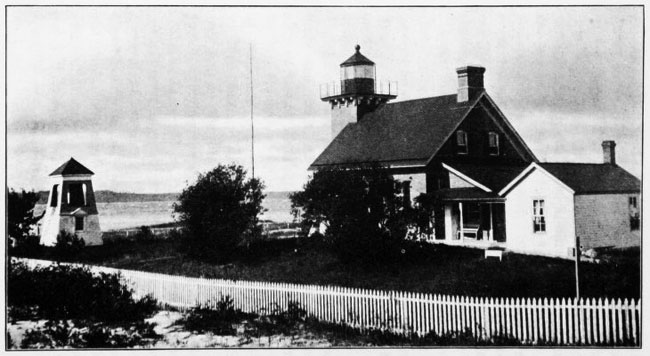
I now married again, still holding my position as light-keeper. Since my marriage my official title has been Mrs. Daniel Williams. Having a desire to change my residence from the island to the mainland I made the request to be changed to a mainland light station. I was soon transferred to the Little Traverse light-station at Harbor Springs, Mich. The light-house just finished, the lamp being lighted the first time September 25th, 1884. The light-station is situated on the extreme end of Harbor Point, at the entrance of Little Traverse harbor.
SAD THOUGHTS ON LEAVING MY ISLAND HOME.
Preparations were made, goods were packed, the steamer "Grace Barker" with Capt. Walter Chrysler as master, had come to take us to our new home. So often before had I left the island, passing several winters in other parts, but always returning again, and happy to get back to my neighbors and pleasant island home, with its fresh, pure air. But now I knew this was different. There would be no more coming back to live, this time was to be the last. The dear old island and I must part. I had always thought it beautiful in the many years I had called it my home; but never before had I realized what it had been to me until now. I was leaving, perhaps never more to return.
Recollections came of my childhood days when free from care and knowing no sorrow, I had wandered through the pleasant paths strewn with flowers, sending their sweet perfume upon the air, as my brothers had so often taken me with them on their hunts; and the beautiful white beach where the blue waters came rolling in where so often we had wandered together, chasing the waves as they came tumbling in upon us, or as we paddled about the shores in our canoes, and where I so often had watched to see their white sails returning to land when I had not gone with them upon the water. As all these thoughts came passing through my mind I wondered if I could leave all these memories behind, or could I carry them away to the new home, the new land as it almost seemed. Though our family was broken and no more could we gather around the hearth at evening time, some had passed over into the beyond, yet there was no place on earth where we all seemed so close together as on the island shores. We had passed through many storms, both mental and physical, but had felt the mighty power of him who rules all things to give us peace and strength. And the "light-house!" That had been my home so many years, I loved the very bricks within its walls. Under its roof I had passed many happy years as well as some sorrowful ones. It was filled with hallowed memories. Then came the separation from the friends and neighbors. Could their places ever be filled?
The sun shone bright, the day was fair as we stepped upon our steamer that was to bear us away from our island home. As we steamed so fast away, we looked back to watch its white shores with beautiful green trees in the background and the pretty white tower and dwelling of our light-house, which soon could be seen no more only in sad, sweet memories.
Just a few hours passed when we steamed into Little Traverse Harbor, and the "red light," just like the one we had left, was flashing its rays over the waters of Little Traverse Bay for the first time. The water was calm and still. The "red light" shone deep into the quiet waters, and many eyes were watching the bright rays from the light-house tower, and the wish of their hearts had been gratified in having a light house on Harbor Point to guide steamers and vessels into the harbor. The evening was clear and the picture was a lovely one as we rounded the point so near the light. Some passengers said to me. "Here is your home. Don't you know the red light is giving you a welcome?" Yes, it was all one's heart could wish, yet I felt there was another I had left in the old home that was now just a little more dear to my heart.
IN THE NEW HOME.
We were met by friends and taken to their home for the night. Next morning we drove through the resort grounds to "Harbor Point Light House," as it is known by the land people, but to the mariner it is "Little Traverse Light House." We were soon at work putting our house in order, and the beautiful lens in the tower seemed to be appealing to me for care and polishing, which I could not resist, and since that time I have given my best efforts to keep my light shining from the light-house tower. Many old-time friends came to see us in our new home on Harbor Point, and though we greatly missed our island home and island neighbors, we soon felt an interest in our new surroundings. What I missed here most was not to see the passing ships and steamers, as they were constantly passing where we could see them from the island.
There were a number of steamers, both large and small, running on our bay. Steamers City of Grand Rapids, T. S. Faxton, both owned by Mr. Hannah at Traverse City, that ran as far as Mackinac Island, steamer Van Raalte, owned by Mr. Charles Caskey of Harbor Springs. She was put on the Manistique route, calling at St. James, carrying the mail, with Capt. E. A. Bouchard as master; Clara Belle, another small steamer, with several tugs. Northern Michigan line was Lawrence, Champlain, City of Petoskey, and City of Charlevoix. At this writing the same company have the Kansas, and the two staunch new steamers, Illinois and Missouri. We also have the large passenger S. S. Manitou with Steamer Northland, and the Hart line boats of Green Bay.
LITTLE TRAVERSE LIGHT HOUSE, AT HARBOR POINT MICHIGAN
VISITING AT TRAVERSE CITY.
Since coming to mainland I have visited my old Traverse City home. There I met many friends of my childhood days, my teacher among the rest, with her sister Agnes. For a couple of weeks I was entertained by my old friends, Mr. and Mrs. H. D. Campbell and family. While there I visited all the old haunts and located the spot where the little log school house had stood, and the crooked tree which we school children loved so much to climb into and sit while our companions played about among the green pines and oaks. I strolled around to Bryant's where the road turns off to Old Mission. The old Bryant home looked just the same, nestling among the green trees, as in the years of long ago. Close beside it was the beautiful home of my school days' friend, Mrs. Frank Brush, where I was very cordially entertained by herself and family. I visited with my old friends in their handsome country home, Mr. and Mrs. J. K. Gunton, then around the bay to Greilick's. It seemed but yesterday since I had left it, and yet I missed so many of the old familiar faces. There was much sadness mixed in with the pleasure of meeting with old friends.
The city had changed, no traces were left of my old home. The mill pond was filled in and streets and buildings were in its place. Strangers were in the places where once we children had run our races down the car track to the dock. The house where I had last visited my father, had been removed and another built in its place, but the little gurgling brook was still singing its cheerful songs and the flowers were blooming on its mossy banks. The beautiful forest trees had been cut down and a city was made where once the wild strawberries and June roses grew, even the Company's garden where we school children used to go and ride the horses around the field, was all changed into a city. While there I found where my three school friends were, the Rice girls. I had thought them dead, but happy was the meeting after thirty-six years of separation, and every summer since they never fail to make a little visit to the light-house, where we again live over the old days. Although there are silvery threads among the gold of our hair, we feel our hearts are young when speaking of the old school days.
Since I left my island home I have never returned but once. The short time I was there were precious hours to me, and though I cannot go I so often see it in memory as it was when nature had put on her most lovely garments of green; when June roses were in bloom filling the air with fragrance with the friends of my younger days. Such pictures can never fade from memory.
I always feel a deep interest in the prosperity and welfare of the island people. My present surroundings are all that could be wished for, and the light-house on Harbor Point is the place that is dearest to me.
A few of the old pioneers of the island are Capt. Manus Bonnar, who owns and runs the Hotel Beaver; Mr. and Mrs. James Dunlevey have a fine, large dry goods store; Mr. James McCann has another with general merchandise; Mr. William Gallagher is the pioneer pound-net fisherman of the island; Mr. William Boyle and several others are in business. Several outside people have invested in land and in the near future expect to have a resort with daily boats running to main land in the summer months. No more healthful place can be found for rest and recreation than the fair and beautiful Beaver Island.
RESORTS AROUND LITTLE TRAVERSE BAY
The growth of many resorts around little Traverse Bay have been wonderful since my coming to Harbor Point light-house. Bay View with its summer schools of music, paintings and works of art, with its splendid gospel teachings and quiet restful places where people come to rest the tired brain from a busy city life. It is an ideal place for summer rest.
Petoskey is a beautiful little city built upon a hillside. It has many advantages of pure air, beautiful views of the water on the bay and Lake Michigan. With its boats and railroads nothing more is needed for comfort.
Roaring Brook, a picturesque spot of nature which must be seen to be appreciated. One must listen to the roaring of the brook to understand the meaning of the gurgling sound. One never tires in rambling about through the quiet, shady, green mossy nooks where the birds sing sweetly among the cedar trees.
Wequetonsing, how fair to look upon. With its handsome cottages, green lawns, flowing water clear as crystal. Surely no drink can be sweeter than this pure water! It has a beautiful view of the bay, with Petoskey showing so prettily across the waters, and the light-house point with its green trees making delightful scenery for the eyes to rest upon.
Then the pretty town of Harbor Springs nestling so near the high bluff with its many pretty buildings on the heights from which the view is perfect. On clear days Fox Islands and Beaver Island can be plainly seen.
And beautiful Charlevoix. Her natural beauties with works of man have made her fair to look upon. I love to remember the beautiful scenery as I saw it when a child, with its lovely forest trees growing down to the water's edge, wild birds warbling in the branches, wild ducks swimming upon the quiet, calm waters of little Round Lake. There are many other resorts scattered all about the bays and shores where people find rest and strength.
Last, but not least, is beautiful Harbor Point. A narrow point of land which helps to form the harbor with water on both sides and a heavy growth of trees of many different kinds making lovely, natural, shady parks, with many fine summer homes and beautiful drives. On the end of the Point stands the lighthouse with its red light flashing out at night over the waters, looking like a great red ruby set with diamonds as the electric lights are shining around the bay and harbor. What more is needed of nature's beauty to make the picture complete?
The sun has sunk in the west, leaving the sky all purple and pink. The moon, just risen, sheds her soft, mellow light over the earth; all nature is resting. The birds are in their nests, the whip-poor-will has ceased her plaintive notes, the sea gulls are soaring away to their nightly rest. No sound is heard save the soft, low murmurings of the waves upon the shore.

Transcriber's Corrections
Following is a list of significant typographical errors that have been corrected.
Page 14, "morroco" changed to "morocco" (little red morocco shoes).
Page 19, "is" changed to "its" (from its tower).
Page 27, "cant'" changed to "can't" (Me can't stay).
Page 29, "swoolen" changed to "swollen" (still badly swollen).
Page 31, "you" changed to "your" (your mother on my back).
Page 34, "to" added (happened to grandpa).
Page 83, "and" added (and also held their yearly feasts).
Page 88, "it" added (it has gone to decay).
Page 136, "somthing" changed to "something" (There was always something).
Page 178, "langauge" changed to "language" (her own language again).
Page 194, "disapointed" changed to "disapointed" (we were disappointed).