A BLIGHTED LIFE.
Reading edition
The following is a true Woman’s Record of sad suffering. Her wrongs have driven her half mad, and we do not wonder that it should be so, for she has sought redress in vain from almost every source. Her trampler and her tyrant was always victorious in every conflict. The Queen, as she most usually does with all criminals, took him by the hand; petted, favoured and promoted him; while his Victim was driven from Society into poverty and exile, and was for years the unceasing object of abuse, slander and libel. God pity her! May God protect and avenge her! Excuse her language, O Reader, whenever it seems “strong,” for it is the cry of an indignant and broken heart—it is the wild shriek of Right, crushed under the heel of insolent and guilty Might.
Sir,—Time was, ere I grew too sick of fiction, or rather of the hollow unprincipled vaux rien, who for the most part trade upon it, that your and Thackeray’s works were the only novels that I read; because they were the only ones independent of their indisputable talent[1] that bore the Hall mark of sincerity, and of conveying the real feelings and opinions of the writers; and not written up to the market standard, whether the twaddle was to be about very little children, which costs nothing—on paper—or underfed and overbirched boys; to say nothing of that great charm, that intellectual aroma of their being written by educated gentlemen. But your Novel I have not read, having a horror of all things that emanate from or appear under the auspices of that patent Humbug, Mr. Charles Dickens, or any of his clique, and it is only the having seen in the “Englishwoman’s Domestic Magazine” for this month, a review of your Novel, and an extract of your Notice, and requesting all persons in various ranks of life, who by letter or viva voce, during the last five years have told you of some persons incarcerated in asylums, &c., &c., &c., and inviting fresh communications, &c., &c., &c., which induces me to furnish you with a few additional facts as to the incarceration—villainy—so much in vogue. But don’t mistake my motive in so doing. I want you to do nothing for me; for nothing can now be done, and if it could, je connais mon Angleterre trop bien not to know that the English to a man are the most sordid, selfish, time-serving tuft-hunters in the whole world; Mammon being their only god, and Self high priest: and moreover I am also too fully aware, after 25 years’ bitter experience, that wherever the literary element enters, there cameraderie, expediency, clap-trap, treachery, moral cowardice and concrete meanness are sure to follow. There is such a thing as cheap chivalry, as well as cheap philanthropy, which are the only sorts à la porte de Messieurs les litterateurs Anglais. And it makes all the difference in the world to make a cheval de bataille (and become a hero upon it) of a poor man’s wrongs, who has no powerful foes to bring their masked batteries to bear upon his champion—aye, or in the event of the victim’s being a chimney sweep’s wife—for the same reason there is nothing easier than for chivalry to make a desperate and victorious onslaught upon Soot, as psychologically as well as horticulturally that pulverised darkness would only make the laurels flourish the more luxuriantly. But change the venue and let the victim only be in the upper sphere of life, without father, mother, or money, while her infamous husband not only having with his brother done dirty work for every government for the last 30 years, and being moreover a litterateur whose grossly immoral plagiaries had been be-puffed by a venal press as immortal works, for value received in government interest, and invitations to their vulgar wives—shew me the man in England who would move a finger that might make this Infernal Machine of occult power explode against himself to save any woman from being incarcerated in fifty mad-houses and bechameled afterwards in minced meat, as small as that into which Puss in Boots threatened to cut the reapers, and to save the lurch of your true motto.
Dict sans faict, A Dieu deplait.
The Chivalric Philanthropist in question would immediately and most conveniently feel that “no man had a right to interfere between another man and his wife, as this, of course, came under the category of strictly private and family affairs.” To say nothing of the real gist of the matter, to wit the Freemasonry which exists among “gentlemen,” (?) that each gentleman’s vices should be held sacred by any other gentleman, as there is no knowing when their own turn may come. So the non-intervention plan is by far the best, alias the safest, both for Parliamentary and Philanthropic humbug. How well my meanest of all villains, and most unlimited of all blackguards knew this, when years ago, after one of his brutal outbursts of personal violence, the cowardly reptile said to me: “Remember, Madame, you have neither father nor brother, and therefore you are completely in my power.” When, 23 years ago, I and my then infant children were turned out of our home, to make room for one of this loathsome brute’s then strumpets, Miss Laura Deacon, Serjeant Talfourd had just cooked up his sham popularity-catching Custody of Infants’ Bill. A silly friend of mine persuaded me to send my case to him, as one of the strongest and most flagrant that could possibly be. I pointed out to her that he also wrote Plays and Poems; and knowing what utter blackguards you “literary men” are in this country—for as old Landor says, “there is a spice of the scoundrel in them all”—and therefore he was not likely to risk either the puffery or the persecution of that literary political ruffian. And I was the Cassandra as I always am, for the “learned Serjeant” kept my papers a few days and then returned them to me, saying, “he was very sorry he had not time to look at them.” A pretty person to bring a Bill into Parliament, who had not time to look into the most flagrant abuses that necessitated the change in the law. True, God’s judgment overtook this hypocrite at last; for he who never went to bed sober, after a most eloquent diatribe against drunkenness the Bacchanalian Judge fell back stone dead, instead of a son ordinaire dead drunk. But how could this country be anything but the Land of Cant and Crime it is, when we see the irredeemably infamous men who occupy the highest places in literature and politics in England at the present day? Men whose triumphant vices and poisonous example are enough to breed rottenness in the very marrow of the nation. And they have done so; more especially their impious hypocrisy. When God was on earth the only sin he had no mercy on was hypocrisy. And why? Because it is a rank and blasphemous forgery on Heaven. When the late Sir Robert Peel wanted to make Lord Lyndhurst Lord Chancellor, he could not do so because of the £15,000 unpaid damages hanging on him about his crim.-con. with Lady Sykes, whereupon Mr. Baring, the present Lord Ashburton said, “I’ll pay the damages for Copley if you’ll give me a peerage,” and this creditable guardian of the public morals (which, of course are only preserved by private debauchery) had not been six months Lord Chancellor before he had another crim.-con. with Lady G., during the trial for which, poor Lord G. cut his throat. But he, the moral cause of the tragedy, lived to concoct at the instigation of one of the most infamous of our extensive aristocratic Traviataocracy, Messalina Norton, our present job Divorce Court, and to die, puffed by a venal press as if he had been a saint or a demi-god. Faugh! how sick it all makes one. Then see we not still living, to false-weight the scales of justice, that other precious legal Don Juan and doer of dirty work dessous les cartes, for his old college chum, the Chief Justice Sir Alexander Cockburn, who, as Denison, the law reporter of the Times, said the other day, was “about the most unprincipled scoundrel in England,” passing his whole time in debauching the wife or daughter of every man who came in his way. So with all this Diabolus ex machina up the backstairs, like the onions in Sydney Smith’s salad, “unsuspected, animating the whole,” you may imagine the fearful odds a poor legal Victim with “neither Father, Brother, nor Money” has against her! But never mind, “wait for the end.” Dieu et mon droit, and the indomitable hatred and colossal contempt of them all with which I am nerved makes me feel that, single-handed and alone as I have before partially been, I shall yet effectually be more than a match for these immund reptiles. This is a long Proem, but it was almost necessary to make you comprehend this of necessity condensed and therefore not over-clear because not categorical résumé of such a tissue of complex and chronic iniquity before coming to the culminating atrocity of Sir ——’s mad-house conspiracy; which, beyond the details you have asked to be supplied with from all quarters, of course can have no earthly interest for you, who once truly remarked in a note I received from you, that “for the most part the fine feelings or rather fine sentiments of Authors were all fused in their inkstands for general circulation, which left them none for their own personal use.” And yet verily, I think Lamartine is right, when he says, “Si l’on savait tout on ne serait indifferent a rien.”
To begin at the beginning of the Mad-house Conspiracy episode, for the Ruffian long ago began his lies in Paris, having put an infamous libel in his lick-dust ame damnée, the Court Journal, about my having insulted his brother at a ball at Lady Aylmer’s, to which Lord Aylmer had forbidden the brother to be asked, and to which, therefore, he was not asked. For this gross lie and libel, my solicitor, a Mr. —— ——, then and ever a red-hot Tory, instantly brought an action against Sir ——’s tools, as Sir L. then called himself a Whig, and got me for my counsel Sir F. Pollock, the present Chief Baron. The defence the dastardly wretches set up in court was that I had fabricated this gross libel against myself, to bring myself before the public!!! Whereupon my counsel remarked that even in a Court of Justice I was not free from the base calumnies of my unscrupulous enemies. Bref, I gained this action, costs and damages against them, but pray bear in mind the name of my (as I thought) devoted attorney, Mr. —— ——, who, as the sequel will show, was only a devoted and unscrupulous jobber to the Tory faction. Well, as I said before, to begin at the beginning of the Mad-house Conspiracy episode, I had taken a cottage in the Fulham-road in 1852, but being very poor I was obliged to furnish it by degrees, and after the drawing-rooms and library, had only furnished my own bed-room and dressing-room, when, with my usual good luck, a most—to me—loathsomely disgusting person, from her extreme personal dirt, hideousness, and inanity, came down to me crying one cold wet November day, saying her relation, Mrs. Loudon (Mrs. Corn-law Loudon, who says Cobden stole all her fame from her), had literally turned her into the streets, that she had not a sou, knew no one in London but me, who she thought would have compassion on her, and both her brothers were away. What could I do? Had I had ready money to pay for a lodging I would have done so; but I had not a farthing till a publisher’s (of the name of Shoberl) bills for between £400 and £500 became due. Then my poor pretty furniture, among which I would rather have let loose a whole litter of pigs! Oh! it was a horrible dilemma; but not being made of stone cemented with mud, as I ought to be, with the infamous name I had the irreparable misfortune to be branded with at the matrimonial galleys, I gulped all my difficulties and disgusts, and sent for an upholsterer in hot haste to furnish at a year’s credit a bedroom (which should have been a sty for this biped swine), and as my intention was to let my cottage whenever I left town, there was no use in furnishing it less well than the rest of my little gem of a house, which I had done cheaply enough, picking up the things by degrees for ready money. Alas, in one week the housemaid came to me with tears in her eyes to come and see the wreck; and truly the Augean stable must have been the beau ideal of neatness and cleanliness to it. The honest creature stayed with me a year in my poor cottage, I finding her not only in evening dresses, but in clothes from head to foot, as I did for three years after in other places, being, of course, therefrom obliged to do without essentials for myself. At the end of that year, my swindling publisher, Shoberl, went smash, and I did not get a penny; but the obliging upholsterer came down upon me with an exorbitant fancy bill for the furnishing Miss R——’s room, more in amount than any three other rooms in the house. I really felt stunned, or rather crushed, as if an elephant had trodden down my heart. I was for four months ineffectually trying to let my cottage, and as ineffectually (tied up as I was on a beggarly pittance of £400 a year for that monster’s life, irregularly paid) trying to borrow money. At length a good Samaritan at the Stock Exchange, a stranger of course, and his good, excellent unattorney-like lawyer, poor Mr. Hodgson, now also dead, said he had heard such a good character of my honesty from the best judges, or at least the most impartial ones, the creditors, that he most humanely and generously lent me £1000 at £5 per cent. for 10 years, and paying £100 a year off the principal, and insuring both Sir ——’s and my own life. With this fearful drain upon my already disgraceful pittance, as you may suppose, I could not stay in London. My friends, by way of economising, asked me to go on visits to them; so I went first to Lady Hotham at Brighton, and then to other friends there, but soon found out that there is nothing so expensive as visiting in great houses, and dressing and going out, &c., &c., &c. So after a short trip to Paris with Lady Hotham, I went to bury myself in a little village in Wales (Llangollen), where the people about the country were good enough to come and see me, but I honestly told them I could not afford to go and see them, as I was even obliged to give up my maid, which to me was indeed a bitter, bitter privation. Then it was, being at a village inn alone, that that cowardly brute Sir —— thought he had beau jeu; and sent down first a vulgar old woman calling herself Mrs. P—— with her “darter” and one of Sir ——’s bastards (of whom I could give you an incident quite fit for a novel, but too long to insert here), the said P—— scraping an acquaintance with me upon the plea of her being an American, which she acted to the life by obtruding herself upon me at all hours, breakfast and dinner, and in my bedroom before I was up of a morning, and of course she had as good a right to be in the hotel as I had. One day, before I came into the dining-room, she had helped me to soup. I found her with her bonnet on, and before I had time to eat the soup, she pretended she had had a sudden summons to London and was off. I had no sooner eaten the soup than before dinner was over I was seized with the most agonizing pains and violent retchings. My Doctor gave me antidotes; and said some attempt had been made to poison me, but the dose had not been sufficient. This seemed to be confirmed by my (in about three weeks) getting a letter from old P—— (which letter I have got), with another from another old adventuress, calling herself Mme. S——, who, being at K—— with some more of Sir ——’s elegant acquaintances, says she overheard the whole plot to incarcerate me in a Mad-house, and so have me gradually made away with. She also sent me a copy of a letter, which she says(?) she sent to Sir ——, after I was incarcerated, saying if a hair of mine was injured she would denounce him publicly as the black villain he was. Well, to return to old P——’s letter. In it she seemed seized with a remorse of conscience—her grandchild having died suddenly, and that she was off to Paris, but could not go without warning me “for God’s sake to be upon my guard, as a person would be sent down whose name would begin with G, and to attract my attention, in order to scrape acquaintance with me, she would have a little black King Charles dog,” as old P—— herself had had.
Before I come to the spy No. 2, Miss G——’s arrival, I must tell you of three other personages in this infamous dramatis personæ. Soon after my arrival at Llangollen, a man calling himself “Mr. Leighton,” and purporting to be a theatrical manager, wrote to me for permission to dramatise my novel of ——, which I gave him; but this correspondence extended over so many months without anything being done, his letters being dated Theatres Royal, Southampton, Birmingham, Liverpool, Manchester, in short, every provincial theatre in the kingdom, that I, of course, began to see this was some fresh villainy of Sir ——, who, after cutting the ground from under me in every unimaginably mean way, by preventing my earning the bread he will not give me, no doubt thought it a rare jest to fool me into the supposition that one of my books, which is a ready made drama, was going to be dramatised. But one has only to look at his hideous face, and that of that other brute, Dickens, to see that every bad passion has left the impress of its cloven hoof upon their fiendish lineaments. However, as Haydon the painter told old Melbourne years ago, “Any scamp who trades in politics is considered a fit companion for Lords,” and my Lord Derby seems to have a foible for most unprincipled and disreputable scamps, and such adventurers as D—— and Sir —— are admirably calculated for ‘Nyanziang’ at our exceptionally stupid and inane Court, before our Royal Betty Foy, “the idiot mother of an idiot boy.”
But to return to Llangollen. I luckily kept all the soi-disant Mr. Leighton’s letters, and the Llangollen post office was kept by a druggist of the name of G—— D——, while next to his shop was a gin shop kept by a very low person of the name of J——, who had formerly had something to do with minor theatres and had narrowly escaped transportation for some of his malpractices. He and this D—— were great cronies, and a private door in a passage of J——’s gin-shop opened into the post office department of D——’s shop. Bear all this in mind. This J—— was then living with the maid of a woman with whom he had formerly intrigued, and whose whole family he had ruined. Well, as soon as I got old P——’s letter of warning, I put all the people of the ‘Hand Hotel’ on their guard, and as it was then the depth of winter, no tourists came to Llangollen, and I told them to be sure and let me know if anyone whose name began with a G came to stay there. About ten days after this, Brellisford, the waitress, came to me, and said an old woman looking like a housekeeper had just arrived from the station to take apartments for “her young lady,” a Miss G——, who had just lost her mother, and who intended to spend some time at Llangollen. Brellisford, who had been by me put in possession of old P——’s letter, answered her sharply that it was very strange that a young lady who had lost her mother had no friends to go to, but should come to such a desolate out-of-the-way place, to which the old woman made no reply. I then told Brellisford to let me see (unseen) this old woman, and to be sure and let me know when the young lady arrived. Soon after B—— came up in haste to say the old woman was going to the Post, and that I could see her from the window. I ran to it, and who should I see but old Tate, Sir L——’s housekeeper!!! The young lady did not arrive till two nights after; a most hideous vulgar-looking creature, past 40, with a fiery red face. The morning after her arrival, old Tate left in haste for London, telling Mrs. P——, the woman of the Inn, that she had a large dinner to attend to. For six mortal days Miss G—— was unable to fire her first shot, for even old P——’s old King Charles “Tiney,” who had been re-christened “Prince” for the new campaign, had only succeeded in getting a snap from my Blenheim Tiger on the stairs, unaccompanied by his mistress. For I was waiting for the enemy’s first move before I opened my batteries. It appears that the very first day at dinner, so well acquainted was she with the carte du pays from her predecessors, that she accosted the waitress by her somewhat uncommon name of “Brellisford,” asking her to carve a chicken. “Pray,” said the latter, “how did you know my name?” Miss G—— coloured and stammered and said she’d heard her called so. “That you havn’t since you’ve been in this house, for all the servants call me Sarah.” On the seventh day, instead of resting from her labours, the amiable G—— could hold out no longer, and apropos de bottes asked Brellisford at dinner “If I never went out?” “Seldom in the winter,” was the reply. “Dear me,” said Grogblossom, returning to the charge, “I wish Lady —— would take a drive with me.” Though of course the vulgar wretch, a la Dickens, said “ride.”—“Not very likely,” said B., “after that other (emphasising the word) vulgar old Spy of that bad man, Sir —— ——, Mrs. P——, playing up the games she did here, Lady —— is not likely to let any more, no one knows who, force themselves upon her.” “Spies,” re-echoed Grogblossom, “dear me, what can he have to spy her about. Every one knows what a profligate bad man he is; but at all events, I am not in a sphere of life to know Sir —— —— as an acquaintance, and I’m far too respectable to do his dirty work.” “Then,” said Brellisford, firing up as she snatched the last dish off the table, “if you are not in a spear of life to know Sir ——, who is just fit for the likes of you, how dare you presume to ask, or to think, that her ladyship would go out with you?” and slamming to the door, with an excellent imitation of thunder, she hurried down the passage, and came to my room to report “that Miss Get-nothing’s,” as she always called her, impudence, and tell me the whole conversation. Whereupon, I instantly wrote a short note saying that if Miss G—— did not take herself off instantly to her infamous employer, I would have her forcibly ejected. This note I took myself, and, opening the door, flung it without going in, on the round table, in the middle of the room. A full quarter-of-an-hour after she got up a series of screams, doing duty for hysterics, and rang the bell violently for Mrs. P——, telling her that I had insulted her (G——) in the most violent and unprovoked manner, and that I must be mad (c’etait la sa consigne). Old P—— came to me in great consternation, saying, “I should not have taken the law into my own hands.” “You never mind that,” said I, “but go back and tell her that if she does not leave this to-morrow morning, I’ll find a way of making her; and if she feels herself aggrieved, and don’t know what to do, I’ll tell her—namely, if she is not a Spy of that Cowardly Ruffian, Sir —— ——’s, sent to finish the job old P—— begun, let her instantly go to her lawyer, and instruct him to bring an action against me for defamation.” Mrs. P—— returned in a very short time to say that Miss G—— had said very humbly she would go as soon as she possibly could; but she had come in such a hurry she had had to buy a flannel petticoat!!! on her arrival (idem old P——’s darter, to whom the same romantic incident of travel had happened), and that she must write for money (ditto old P——’s “darter” again), having none, and she could not possibly get an answer before the day after to-morrow.
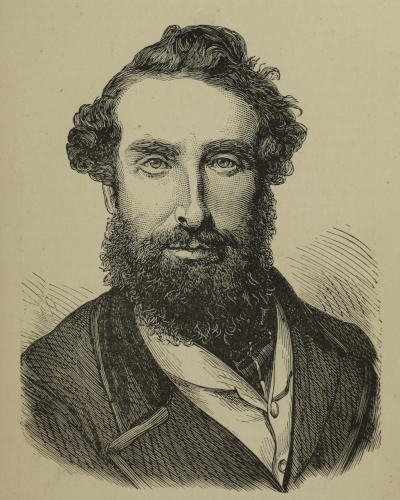
EDWARD, LORD LYTTON.
Now Sir —— was at that time flaring up at Leeds, lecturing at Mechanics’ Institutes upon “The Holiness of Truth” to the “snobs,” and the Sacredness of Probity!! till, as a lady who wrote me word of it said, she wondered the earth did not open and swallow the blasphemous monster. I told Sarah Brellisford to be sure and bring me any letter or letters that came to Miss G—— on the morning she expected the indispensable remittance, not to open or destroy them, or intercept them, as her friend Sir —— would have done; but merely to see the superscription, that is, the handwriting of the remittance letter. Well, it came, with Sir ——’s unmistakable mean scrawl, and crest on the seal, and the Leeds postmark, and no mistake, and two hours after Miss G—— was bundled off. She was scarcely gone when I got letters from London imploring me to be on my guard, as these G——’s lived at Brighton, and the one sent to Llangollen had a carriage always ready on the road, in order, if I could be found out walking, to kidnap me, and carry me off to a Madhouse, as Sir —— was giving out all over London, via a Mr. Robert Bell, one of the Dickens’s literary clique, that I was quite mad, and also by his infamous ame damnée, the infamous attorney, L——. Now this L——, you must know, Sir —— himself told me years ago, “intrigued with his own sister, to save the expense of a mistress!” A fitting tool, truly, for so loathsome a ruffian as the bran new baronet! And the attorney boasts with his sardonic grin, “Oh! Sir —— ——, he must do whatever I please.” After I had put Miss G—— to flight, I wrote to Lady Hotham and several others at Brighton, to find out who and what those G——’s were, and telling them of the Madhouse Conspiracy en train. To which I got back an ocean of English twaddle and conventional cant, telling me not to talk of spies and madhouse conspiracies in the 19th century, but to remember that I lived in a free country (very free, for any villainy to be practised with impunity, where there is money to pay for it, a position to cover it, or Lords Palmerstons, Derbys, Lyndhursts, or Chief Justice Cockburns, who so long as they do the public humbug well in verbal sounding brass, can and do employ the most infamous tools to do their private dirty work, and of course are in duty bound to screen and protect the said tools in all their own little personal crimes and enormities) and above all, I was told to remember that however bad Sir —— might be, he knew the laws of his country, and couldn’t (couldn’t he, when it is done every day!) incarcerate me without a public (oh, dear) and full enquiry about all my sayings, and doings, and habits, which would be the very best thing that could happen to me, as he had so many years ground me down to poverty, as to effectually make me a dead letter; so that all the lies he so indefatigably disseminated about me went by default. However, as one evening Lady Hotham was repeating at dinner the sapient advice that she had written to me to her Brighton Doctor, a Dr. T——, who lives in Regency-square there, and another gentleman, an acquaintance of mine, Dr. T—— said, “G——, G——! Stop; I do know some people who know two Miss G——s. My wife and I are going to a party there to-morrow night, and I’ll try and find out what I can about those Miss G——s.” “Do,” said the other gentleman, “and as I must return to town to-morrow, be so good as to write and let me know what you do find out, that I may tell Lady ——, as I don’t at all agree with Lady Hotham about the madhouse conspiracy being a chimera of hers.” Accordingly, the day after the party, this gentleman received the following letter from Dr. T——, which he sent me, and which I have got. It began: “Dear Sir,—I went to the party I told you of last night, and sure enough who should be there but a Miss G——, who was boasting that Sir E—— L—— was a great friend of theirs, and that her sister had just returned from Llangollen, where she had seen that horrid wife of his (a lie, for she had not seen me), who was quite mad, but she was happy to say also, so ill, that she could not live a week. Poor Lady L——, it is really too hard,” Dr. T—— goes on to say—but I need not trouble you with the rest of the letter.
The summer after this I got out of the hotel into a lodging, small, but very nicely furnished, of which I took the whole except the parlours, which, as the woman only asked 25 shillings a week for them, I told her on no account to let them to any one, but if she had an offer to do so I would pay her for them rather than have any other lodger in the house, after all I had suffered. Nothing could exceed the attention and prevoyante civility of these people. But when I had been there about three weeks, to my great horror and indignation, in the teeth of her promise, she informed me that she had let the parlour to a lady and gentleman, as they had given her two guineas a week for them; this alarmed me more, whereupon this silly woman, to reassure me, told me she was a lady of the highest connections, a Mrs. B——, as she herself had told her she was related to Lord This and the Marquis of That. I said, my good Mrs. P——, depend upon it by her giving you more than you asked for your rooms, and bragging about her great relations, she is not a gentlewoman, but some improper person or other. The next morning the plot began to thicken, and up came a great disgusting dish of raw trout with Mr. B——’s compliments, as he had been out fishing, though Mrs. P—— let out that he had bought them of Mrs. J—— at the gin-shop. I returned them saying I was much obliged, but I never ate river fish. Through the windows I had the felicity of seeing Mr. and Mrs. B——. He looked a something between a retired undertaker and a methodist parson in a rusty black coat and a dirty white cravat and shoes and stockings of a morning; and she was a perfect hybrid (with long black ringlets, a staring silk Stuart plaid dress, and very short petticoats) between a ballet girl at a fifth-rate theatre and a Regent’s-street social evil, who did not attend the midnight meetings. I have since heard from indisputable authority that these vulgar wretches are always with Sir —— at K—— and Ventnor, and elsewhere, that he took to intriguing with that raw-boned frau, Madame Ernst, and dedicating his Balderdashiana in ‘Blackwood’ to her paralysed gorilla of a husband, Ernst the fiddler, whose society must be delightful to a man who is as deaf as a post, and who, before he was so, in point of music did not know “Bob and Joan” from “God save the Queen,” and who does not know one word of German. For of all his literary charlataneries, his pretended translation of —— —— was the most iniquitous, as at them it was he slaved his poor young daughter to death. His French is execrable and ridiculous enough; still he can read and understand it, though he does call naïveté navetty!! which is almost as marvellous a travesty as that other woful attempt at an admirable Crichton and an omniscient genius(?), Mr. W—— R——, who calls Voltaire—Voll-taire, so as to rhyme with Noll; and who seems strongly to confound notoriety with fame, and therefore went to the trouble and expense of going to Africa to so usefully enlighten the world by informing it that when he attempted to kiss the African young ladies, they ran away! Why—he need not have gone so far to make that discovery, as “my dear husband to a toad-stool” (which is a fair bet, the venemous reptile against the poisonous fungus), had he made the experiment in England every young lady, to a crinoline, would have done the same. This singularly antipathique young gentleman who, after favouring me with a brisk correspondence which I knew must have some covert meaning, as an Englishman never does anything without a sordid or selfish motive, last June did me the honour of inflicting upon me a three days’ visit, ostensibly en route to Tenby to see his parents, of whom he spoke in a depreciating contemptuous manner that quite disgusted me, as if, poor silly people, they were quite below par, and unworthy of having such a son—I beg pardon, such a genius(?) of a son. With true English good breeding he hunted me up the day before I could possibly receive him, but however stupid he might have been to me, I daresay it was agreeable enough to him; as I understand he spent his nights down in the bar, which I should think was a much more congenial place to him than a drawing-room. When he went, as I thought, to Tenby, he wrote me word he had gone back to Oxfordshire, “and his parents would keep,” as upon getting to Reading he found he had no money! This was so very like all the Sir ——’s innumerable myrmidons, that it gave me as I wrote a cold shudder; as I could not but solve the mystery of his correspondence and invasion by setting him down as one of Sir ——’s spies, in which idea I am confirmed by his after getting or not getting what he wanted, just like a true English boor, and with his insane literary mania and evident absence of principle, I have no doubt he would be glad to ingratiate himself with that infamous man on any terms. A friend of mine suggested to me as a solution of his visit, that perhaps he had heard that I was such a fool, as the dear, selfish English say, in helping others, when I so sorely needed help myself, that he might have wanted to borrow money; but though I may be able to skin myself in £20 or £30, he surely could not suppose that any one condemned to the miserable and disinherited life I lead could have any hundreds to lend him towards ministering to his overweening and senseless vanity? I have not seen his book, feeling no interest in it after seeing him; but I was silly enough two or three years ago to give him a volume of Essays that I had written in great haste, thinking he might sell them for a few pounds; and I should not be the least surprised if every thought in them (originality certainly not being his forte) were, a la Sir L——, made to do duty as his reflections in “Savage Africa.” The kissing episode I have quoted was sent me by a lady in a newspaper extract to make me laugh, which it did most heartily. Now to return to the dear B——, whom I understand with the Swiss drab of a governess whom Sir —— seduced long ago at Malvern, and whom recently in that pretty —— trial about the crystal ball he improvised as his cook! thinking, no doubt, that as the devil sends cooks and also concubines, it was all the same thing, and cook sounded better in a Court of Justice. So these B——s and the Swiss Traviata form the corps d’armee of his spirit-rapping establishment, which is this great man’s mode of combining spirit and matter: the vice being the real, and his genius the ideal, or non est.
Well, Mr. B——, I suppose by way of doing his spiriting gently, that is, not disturbing the spirits (except those in the brandy bottle, to which he gave no quarter, but always full measure), used always to take off those pretty dust undertaker’s shoes of his to steal up and down stairs, which I suppose meant that if I was going out of the drawing-room I might not be deterred from doing so by hearing a step upon the stairs.
A few evenings after I had returned the trout caught in the lake of Gin-eva down at J——’s, the evening being very sultry, I was obliged to leave my drawing-room door slightly ajar, when, to my horror, who should come tripping in with a basket of strawberries but the social amateur evil, dressed, or rather undressed, to a pitch that would have alarmed even an art student. She made me a sort of theatrical speech in which she introduced herself and her strawberries. I never eat strawberries any more than trout; and in the absence of Wenham-lake ice, my reception of her must have been most refreshing, or rather refrigerating. Nothing daunted, this intensely vulgar piece of effrontery (who, I understand, is a natural daughter of that horrid old scamp, Lord Lowther: hence her high connexions) spread her furbelows, and, uninvited, seated herself; and seeing the shoeless undertaker creeping upstairs, she had the crowning impertinence to call him in, and introduce him to me, I visibly petrifying the while, and not replying to a single thing he said; till the he B——, by way of saying something pleasant, remarked that Dickens was a wonderful man. “A wonderful brute and humbug he certainly is,” said I. The she B—— then began, with a volubility that reminded one of one of Charles Matthews’s patter songs, to recount to me a spirit-rapping story of an umbrella that had been left in a corner, and suddenly took it in its head—its ivory dog’s head at the end of the handle—to turn round, walk across the room, and walk downstairs; whereupon I said in an insinuating voice: “Will you both have the goodness to show me how it went downstairs?” At which Mr. B—— indulged in a loud guffaw, and gently and elegantly knocking his two thumbnails together, as if he had been trying vivisection on a flea, said, “Not bad; not bad.” I then rose, and very stiffly announced that I had drank tea, was going to bed, and could not offer them any wine and water, as I never drank wine; whereupon this “charming woman,” turning briskly to the undertaker, said, “B——, run down, and bring up the wine and spirits.” I said, “Not here, pray,” and darting into my bedroom, locked the door.
The next day came a note from Mrs. B——, expressing her great sympathy with all I had suffered; and as the cuisine was not particularly good at those lodgings, would I do them the favour of dining with them at the hotel? I sent down a verbal message to say that I never dined out. The next day the pair took their departure for London; but the people of the house became suddenly and unbearably insolent; and although I had taken the rooms for six months certain, said I must leave them immediately, as they had let them. This was pleasant, for lodgings are difficult to get at Llangollen, and worse than that, it wanting six weeks to the time I should receive my parish allowance, and also to the time when the two months’ rent would become due, I had not a sou wherewith to meet this sudden and unfair demand in the teeth of a written agreement. But my kind old Dr. Price not only came to the rescue, rating these vile people soundly, and telling them they would repent their shameful conduct before they were much older (which they did), but he kindly got me another lodging higher up in the same road, in which I had not been installed a week when Dr. Price wrote to me, saying that horrid woman Mrs. B——, and a woman she called her maid, were installed in my old lodgings. I put on my bonnet and went out to pass the house, and what should I see but Mrs. B—— and her soi-disant maid sitting on the sill of the open drawing-room window, with a salver between them with two decanters of wine on it, and glasses in their hands, over which they were laughing and singing; and as soon as they saw me they set up a perfect shout.
Two nights after this, the lady and her maid were literally drummed out of the place for roaring and screaming about the streets with men, at between one and two in the morning, and disturbing the quiet village. So Mrs. P—— and her brother did not get much by their infamy to me, and to their highly connected Patroness Mrs. B——, more especially as I lodged a complaint of their conduct with the Baptist minister, who lectured them publicly in chapel for it. A fortnight after Mrs. B——’s expulsion, Mr. B—— came down solo, and went to the Chester races, in an open carriage and four, with those two blackguards, J—— of the Gin Shop, and D—— of the Post-office, driving past my windows, shouting and roaring and waving their hats; and previous to his departure, B—— wrote me a most infamous anonymous letter, beginning that “he had the Queen’s and ——’s permission to sleep with me”—which letter was precisely in the same hand-writing as all those purporting to be from Mr. L——, the soi-disant Theatrical Manager, which infamous letter, and all the rest, I have got. Upon this crowning outrage inflicted by that far more ruffianly B——’s myrmidons, I sent for Mr. Whalley, the Magistrate, the present member for Peterborough—(Maynooth Whalley), and he told J—— he would take away his licence. I, of course, could not stay in a place where I had been so outraged and persecuted; and then it was I wrote to a friend of mine to engage me rooms in some Hotel in this dead-letter town; and sending all my luggage on to London, directed to a Mrs. Wilson, for her to forward them here; I took a young person who used to make my dresses at Llangollen as my maid, coming on here without any luggage but a carpet bag with “passenger” on it, so that none of the Llangollen people knew where I was going, by which means Sir —— completely lost the track of his victim, which made him so furious that when good Mr. Hodgson went to receive my pittance, as he always did, Sir —— and the ruffian L—— vowed they would not pay it till they had a clergyman’s certificate! to say I was alive! which was, of course, as they thought, a clever plan to find out where I was; but Mr. Hyde, my solicitor, whose country place was at Sangport, 16 miles from this, and who was then alive, and had not yet found his account in selling me “to screen the party,” wrote to say, that if my beggarly pittance was not instantly paid, Sir —— should have the best of all assurances that I was alive, as he, Mr. Hyde, would drive down to K—— with me to take possession, and remain there with me to protect me. So the dastardly brute was foiled for the nonce. Soon after I came here Miss R—— again was homeless, and gave me the benefit—no, the discipline—of her company, and worried me into sending a statement of my case to Lord Lyndhurst, who was then, with Messalina Norton, concocting the job of the Divorce Court. Apropos of the latter, she is such an awful hypocrite, quite of Sir ——’s calibre, that they would have made a matchless pair, because she is actually a proverb for brutalising servants and governesses. I see in to-day’s Times she has a long and charmingly benevolent letter advocating the cause of Poor Servants against their not sufficiently considerate masters and mistresses! Oh! why does not the Devil foreclose his mortgage upon those three such hypocrites, Mother Norton, Sir ——, and Dickens, and drive them and their fine sentiments round his dominions. Sir —— at least would not be quite new to the lash, as years ago, when that infamous Mrs. Norton kept her amateur house of ill-fame in Bolton-row, and Sir —— was intriguing with a cousin of hers, a Mrs. Barton, the wife of a clergyman—some “good-natured friend” wrote to Mr. Barton and told him if he would go at such an hour to Mrs. Norton’s, and walk up into the back bedroom, he would find Sir —— with his wife. He did so, and horsewhipped Sir ——. Whereupon Messalina, putting her arms akimbo, said, “If you are such a d——d fool that you cannot manage a little affair of this sort without being found out, you must go elsewhere.” The uninitiated keep wondering how the Examiner could puff that intensely trashy and immensely infamous last book of Mrs. Norton’s. But those who know that she used to intrigue with that hideous old Albany Fonblanque, and any other dirty editor that came in her way, for a puff, don’t wonder at all. If any of Mrs. Norton’s ill-used servants were to write to the Times, illustrating by a few facts her practical benevolence and consideration towards them, I should just like to see the Times printing them, though thanks to our wheel within wheel of Humbug within Humbug, and Sham upon Sham, the Times can do its cheap brummagem philanthropy and championship of the oppressed as well as any other “Tartuffe” in the kingdom. And yet this most vile woman (with plenty of others of the same sort) is received at “our Virtuous Court,” and quite worthy of being so, by the little selfish sensuous Inanity who rules over it, the Murderess of poor Lady Flora Hastings, and the amiable daughter who did all she could to hold up her own mother with Sir John Conroy. Poor excellent Prince Albert, a rara avis—a man who had principle and acted up to it, from the smallest to the greatest things,—knowing neither truckling nor expediency, had a life of it! happy he to have so soon escaped, and gone home to a more congenial sphere, where he invested the great treasure of good deeds, while still a labourer here.—But to return to the Lyndhurst affair: I told Miss R—— that my sending my case to Lord L—— was like writing in water; nothing would come of it. Still, I drew it up as briefly as I could, with a full statement of the last Llangollen infamy; but fortunately I was obstinate in my own common sense and would not yield to the sapient Miss R——’s advice to send him some infamous letters of Sir R——’s, which he, the ruffian, has denied on oath! For what are perjuries to one who has lived upon them as Mithridates did on poisons, till they have become his daily food? Neither did I send him any original documents, beyond my own written statement of facts. So well am I aware, with regard to the thimble-rig of Politics, of what my fate would be, no matter who were the ins or the outs. I told Lord Lyndhurst not to take the trouble of writing, but merely make his secretary acknowledge the receipt of my papers till he returned them with his opinion. But two months passed and I had no acknowledgment of even the receipt of the packet. I then wrote again, expressing my surprise at this, when I received a note from Lord Lyndhurst, beginning, “My dear lady L——.” Cool, from a man I did not know personally. This is the note—
“My dear Lady L——, In the hurry of business I mislaid your present address, and therefore wrote to you at Llangollen, telling you that I had read your papers, and written my opinion on them, and that they were left with my porter ready for you whenever you sent for them. Ten days after I had despatched my letter to you, a young woman called at my house, saying she had been sent by Lady L—— for her papers, and my porter gave her the packet addressed to you. Therefore I was much surprised on the receipt of your letter this morning, saying you had not received the papers.—Believe me, yours faithfully, Lyndhurst.”
In reply to this “Strange Story,” before Sir L——’s other blasphemous “Strange Story,” that that brute Dickens just published, I wrote to Lord Lyndhurst to say that in the first place I never should have sent in that vulgar, cavalier way, without writing a note to him for my papers; in the next, it was strange he should have forgotten my present address! and only remember my former one at Llangollen, since both addresses were equally mentioned in the papers he said he had left with his porter for me. But that such being the case, it behoved him for his own honour (?!) to stir in the matter, and find out who had got the letter he wrote to me at Llangollen, out of the Llangollen post-office, and who the woman was who had called for the papers, with the infamous lie that I had sent her. And the first step towards this was to tell the date of the letter he had written to me, and the day, and then the office in London at which the letter had been posted; and next, to employ Mr. Peacock, the Solicitor of the post-office, to sift out the affair, as, like a true-born Briton, he of course would be likely to put more zeal into his measures if employed by Lord Lyndhurst to detect an affront and fraud practised upon him, than merely an outrage and an injustice practised upon me, or every other defenceless woman in England. To this I received a palpably shuffling and wide of the mark note from Lord Lyndhurst, and the farce was gone through of writing to that vile fellow D——, at Llangollen, who actually had the effrontery to pretend that no such letter had ever arrived at Llangollen post-office for me. Then how—as I told my Lord Lyndhurst, could the swindlers who called for my papers have known where to do so, but for the information contained in that letter? unless, indeed, the letter was a myth, and his lordship, to make things pleasant to the party, had kindly made over my papers to my Lord Derby’s creditable Colonial Secretary? which was the only other possible solution of the affair. D—— then wrote to me, “did I suppose that after my great kindness to his poor wife, in her last illness, which he should never forget, that he could do anything to injure me?” To which I replied yes, that was the very reason why he would; as I had never yet served anyone, in much, or in little, that they had not repaid me by the basest ingratitude, treachery, and injury—of some kind. My Lord Lyndhurst, finding I would not be quiet, though the old Tory jobbing attorney Mr. C—— H——, under the pretence of setting Mr. Peacock to work, but in reality to seize the golden opportunity of scraping personal acquaintance with an old Tory law lord, and by joining issue with him, to make things pleasant to the party, and crush and gag their victim a little more. So, finding that I was not the plastic, swallow-anything Fool that men think women ought to be, and which for the propagation and comfortable impunity of their vice, too many women are, my Lord Lyndhurst sent down his nephew and private secretary, Mr. Richard Clarke, to see what he could do in the much-ado-about-nothing-humbug line. I boldly taxed him with this Divorce Bill being a job concocted between Lord Lyndhurst and Mother Norton. “Well,” said he, “you put it in such a point blank way, that I cannot deny it.” You can, if you like, said I, or anything else, but I’m not bound to believe you. I then taxed D—— with having a finger in the pie with regard to the swindle of my papers; knowing the creditable way in which, years ago, his acquaintance with Lord Lyndhurst (which was his first political stepping stone, after poor fool of a Wyndham Lewis had paid his election expenses at Maidstone) had begun, namely, by their joint property with three more in Lady Sykes. “Oh,” said Mr. Clarke, “D—— and Lord Lyndhurst are two. D—— has not crossed our threshold for ages; and we all nearly fell off of our chairs laughing at breakfast, the other morning, at the capital, and to the life facsimile you gave in that imaginary conversation you put into his mouth, in your last letter to Lord Lyndhurst.” But Mr. Richard Clarke could do nothing with me, for I assured him this disgraceful affair should not rest between Lord Lyndhurst, me, and the post. I then, as a pis aller, got General Thompson to present a petition in the House of Commons demanding an inquiry into the fate of the papers sent to Lord Lyndhurst, of which I could obtain no clear or satisfactory account. The poor superannuated Conservative peer, from his place in the House of Lords, mumbled some circumlocution rubbish about his being the last man to be guilty of want of courtesy to a lady.—Hang his courtesy!! his justice and common honesty were what I wanted, and not his courtesy; but it is precisely those two exotics which are not to be had in this accursed land of crime and cant, and so this infamy ended in smoke, as most things do in the two Houses of Humbug down at Westminster. I need not tell you, from the day I ordered her out of Llangollen to this, dear Miss G—— never brought any action against me. No doubt your Orthodox English Conventionality is greatly shocked at my “coarse,” “violent,” “unladylike language”! But you must make some allowance (though English people never do, being wisely and justly only shocked and scandalized at terrible results, while they remain perfectly placid and piano upon terrible causes); but I was going to say you must make some allowance for a person writhing under nearly life-long, unparalleled, ever-recurring, and never-redressed outrages,—and suffering from a chronic indigestion of falsehood, hypocrisy, and unscrupulous villainy. No wonder, then, that the other day I cordially sympathised with a man who said, that though no more fires blazed, or faggots crackled in Smithfield—for which thank God—he should like to make a bonfire of all the fine benevolent sentiments Dickens, Sir Edward Lytton, and Mrs. Norton ever wrote, with those of that other scoundrel Lawrence Sterne, and placing the three former within smelting heat of the flames, collect an equivalent quantity of ink to all they had ever used in gulling the public, and force the black-lie-vehicle down their throats! It was this same man who wittily said, constituting himself Advocatus Diaboli, when a whole room full of people were crying out against the utter trash and horrible immorality of Mrs. Norton’s last book—“Well, now, I like the book, for it may be considered as Mrs. Norton’s oral confession, her peccavi, in fact, as it so clearly and abundantly proves that there is not a single Traviata ‘dodge’ in all Babylon that she is not practically up to.” Which sally was received with peals of laughter, and “Hear, Hear’s.”—Talking of the humbug and omnipresence of Self in Authors, how thoroughly characteristic was that vainglorious “In Memoriam” of poor Thackeray by Mr. Dickens in this month’s Cornhill; it being a mere stalking-horse to parade his own importance and repeat the compliments poor Thackeray had paid him, though there were so many other and better things the public would all have rather heard of good Thackeray. It was also a way of letting the groundlings know that his son, Master Dickens had been at Eton, though he took good care not to tell them that Miss Burdett Coutts had paid for him there. For she can do these supererogatory display things, and build churches, though she cannot give a private unknown guinea to her own starving relations, of which, like everyone else, she has some. I liked Mr. Trollope’s “In Memoriam” much better, and from the extracts I have read from his wishy-washy vulgar Novels, I did not think he could have written so well. Only I wish he had not opened with that tag Latin quotation; for though Latin is all very well, and indeed at times necessary for terseness’ sake to add force to sense or satire, real feeling generally finds expression in our mother tongue.
After this Lyndhurst swindle of my papers, Miss R—— went to her brother, who was then in London: this was in the autumn of 1857. The part Mr. H—— had acted on that occasion first raised my suspicions against him: but alas, what is the use of a prophetic spirit, when one has nobody to help one? That is no visible earthly help; and no wonder if long before this time I had reversed the injunction to fear God and love my neighbour, for I love God more and more however much bitter wrong He may for some inscrutably wise purpose allow, but I fear my neighbour most “consumedly.” Sir Liar had of course found out my new abode by the Lyndhurst conspiracy, so the creature lost no time in being at his dirty work again. Accordingly, towards the end of October I was brought up a card with “Mrs. S—ll—” upon it, accompanied by a message that the lady (!) wanted particularly to see me. I enquired where this lady came from, and was told she had just arrived from London by the train; had engaged a bed here, but had not a vestige of luggage, or any servant with her. I told them to say I was not well enough to see any one; and to repeat that answer while she remained; and that whatever business she wanted to see me upon she could state in writing. I then told them to send Mrs. C—— to me; and when she came I begged of her to watch this woman narrowly, as I strongly suspected she was some fresh Spy of that infamous wretch Sir L. The next morning Mrs. C—— came to report herself, and said she was sure she was some “infamous baggage,” by her theatrical manner; and saying that she would get a divorce from her husband, if she knew where he was; but she did not know whether he was dead or alive, or anything about him (that there could be no doubt of), that she had come here to teach music and give theatrical readings, for which she wanted to hire Mrs. C——’s ball-room, which Mrs. C—— refused to let to her; she then asked all sorts of questions about me, and said, she must see me. Mrs. C—— coolly told her that the word was rather inappropriate. She then, it appears first by bribery, and then by bullying, sought to make the chamber-maid tell her the number of my bed-room, and to give her a room next to it; upon which the chamber-maid very nearly insulted her, but thought it better to trick her instead, so took her to a room on the second floor, and quite in another wing of the house. The next morning she returned to the charge of trying to see me, and gave her a written prospectus of all the great masters who had taught her singing and the harp, and all the great people whom she had taught; but in this list I did not fail to remark that both the teachers and the taught were all conveniently dead; this and the mention of the harp brought a sudden conviction into my mind who the soi-disant Mrs. S—ll— really was, especially when Mrs. C—— talked of her exceeding vanity about her personal appearance (though now an old woman), and above all about her hand, and when I asked for a personal description of her, and the inventory given was the pale hay-coloured hair, faded blue eyes, and aquiline nose, I felt sure that she was no other than the soi-disant Mrs. Beaumont, alias Miss Laura Deacon, for whom I and my children had been turned out of a home: who had with some half-dozen predecessors been the mistress of Colonel King when he lived at Craven Cottage, Fulham, and who, when he discovered the game she was carrying on with Sir Liar, turned her off; however settling £200 a year upon his poor deformed eldest child by her, Georgiana—which £200 a year I was told was all she had to live upon; as Sir Liar with his usual generosity (!) now gave her nothing; though when he kept her in his fine Pompeian house in Hill-street, and the wretch dared to take my name (as she did after at petty German courts, which was done by her monster Keeper, of course, not only to insult but to defame me), a bill of £300 for a grand piano came in to me from D’Almaine, that this wretch had had; for which blunder poor D’Almaine made me every possible apology. You will see precisely why I bore you with all these details. When I told Mrs. C—— my suspicions, she said she would get her out of the town as soon as possible, but first warn the tradespeople about her, or she might run up bills in my name as part of her instructions. “Do,” said I, “for I understand she never pays any one.” Mrs. C—— did so—therefore she did not succeed in hiring the assembly or any other rooms for her readings, or getting any pupils. And Mrs. C—— insisted upon her leaving this hotel, which she did; going to Weston-super-Mare, but forgetting to pay her hotel bill here, which she has never done to this day. About three weeks after Mrs. C—— brought me word that she was still at Weston, teaching singing in the boarding school of a Miss R——, but that Miss R—— had said she knew this Mrs. S—ll— to be a woman of such character that she would not be seen in the street with her. No wonder English misses are what they are, when this is a specimen of English schoolmistresses. Upon hearing this I set off to Weston to call upon this Miss R——, and asked her if it was true that she had said so? She replied, “Yes—I certainly did say so.” “What,” cried I, starting up with indignation, “you dare place a woman about the young girls confided to your care whom you know to be so infamous that you would not be seen in the street with her? Shame, shame upon you.” “Oh,” said the “genteel” Miss R——: “I only do it for their singing, she teaches in such a very superior manner to the provincial teachers, and can teach them so much more.” “Of that I have no doubt,” I said, leaving Miss R——’s room, and house. I then went to Rogers’s hotel to see if they knew anything about her, and Mrs. Rogers said she had slept there one night, but that Mr. Rogers had turned her out the next morning: and that there was a Mr. and Mrs. S—— staying in the hotel, Mr. S—— being a solicitor and a most dissipated man; and that one day he met the waiter on the stairs carrying up Mrs. S—ll—’s card to Mrs. S——, and that he (Mr. S——) took the card off the salver, and looking at it said, “Pooh! pooh! Mrs. S—ll— indeed, come, tell her that I know who she is, and not to presume to try it on by attempting to scrape acquaintance with my wife.” Having gained this additional information, I went to Whereat’s library, where seeing her programmes for a reading from the ‘Lady of Lyons,’ I wrote under her name, “alias Mrs. Beaumont, alias Miss Laura Deacon, maitresse en titre to Sir E—— B—— L—— and half a score more,” and I told Arthur Kinglake, the Weston magistrate, he had better warn the tradespeople about her, as she paid no one. He said she was already in debt all over the place. About a week after this I was favoured with a letter from a pettifogging solicitor in Bath, a Mr. P——, upon the part of Mrs. S—ll—, to say that if I did not instantly send her £50, she would bring an action against me for defamation. To which I replied she must be aware that no one having the misfortune to be dependant upon Sir E—— B—— L—— ever had £5, let alone £50, at their disposal; but as for the action, the sooner he brought it the better: only according to my knowledge of English law, the little contretemps of Mr. S—ll— being lost or mislaid, might render it a difficult process. However, after several more applications for the £50, I was duly served with a summons to appear in the Queen’s Bench at the suit of Mrs. Maria S—ll— “she having obtained the permission of Sir E—— B—— L—— and Mr. L—— to bring the said action.” But not a word about Mr. S—ll—. I wrote to Mr. Henry H—— in London, Mr. C—— H——’s brother and partner, to put in an appearance for me; Mr. C—— H—— being conveniently ill at Longport. I was obliged to employ a little reptile of an attorney of this town of the name of T—— (by the bye he has a niece, a young lady of 18, qui chasse bien de race, for she has just been distinguishing herself in divers cases of shoplifting, and stole a valuable casolette of Lady Taunton’s at the recent ball given to Captain Speke). I now saw that my best card would be to send him to London to that profligate attorney Mr. S——, who said he knew all about her, and ascertain beyond a doubt her real name. But Mr. H——, ever alive to the interests of the Conservative party, telegraphed in hot haste for this Mr. T—— to go to him; and no doubt to give him his lesson in the particular trickery and chicanery required to foil me and protect the party. I can only hope that where he is now gone, his fidelity may be rewarded by meeting many distinguished members of “the party” who will there be able to thank him warmly! Well, the reptile T—— went to town, and his report was that Mr. S—— had said, “Well, I first knew her years ago, when I was articled to old Bicket. She used to come to our office about a deed of annuity for £200, that a Colonel somebody was settling upon her, and was a lovely young creature then.” “But her name, her name, Mr. T——,” I broke in. “Oh, her name,” said the wretch, biting his lips and his ears burning scarlet, “why I—a—that is—I ascertained positively that she is a married woman, but I quite failed in finding out her name”!!!!!
“Do you take me for an idiot,” said I, “that you dare trump up such a clumsy, bare-faced lie? Your instructions have been to sell me, in order to screen that unprincipled blackguard Sir E—— L—— and the ‘party,’ and therefore not to divulge his infamous mistress’s name to me, forgetting in your shallow craft, that of all things marriage requires identity, and that you could not have positively ascertained that this creature was a married woman, which you know she is not, and yet have failed to find out in what name she was married”!! After muttering something about my being so sharp upon him, the wretch pretended to be highly offended, and rushed out of the room. For truly says Alfonso Karr, On ne peut avoir de plus grand tort, que d’avoir raison contre tout le monde. Et moi, j’ai ce grand tort là, et on ne me le pardonne pas.
This contemptible fellow did not again make his appearance till three days before the sham action was to come on. “Let me advise you, Lady L——,” said the wretch, “to try to stop it by buying off Mrs. S—ll—’s solicitor. I’ll manage it for you for a £5 note.” “In the first place,” said I, gulping down my rage, and trying to be calm, “I think £5 more than all the attorneys in England body and soul are worth. In the next place you and Mr. H—— must really think my folly quite commensurate to your and his knavery and to Sir E—— L——’s infamy. But tell him, or tell both of them for me, that were this room piled with gold up to the ceiling, and I was suffocating under it, I would not give a single coin of it to play that ruffian’s game, and write myself an ass, to have it said I had bribed them to stop a sham action that they can never bring.”
“Oh well, if you won’t be advised by your solicitor”——“I never asked your advice, I employed you to do my work, and like most of your tribe, you have done the Devil’s instead, and sold me—but I won’t sell myself to please you.” No sooner did the special pleader in London see the citation to the Queen’s Bench, when I sent it up, than he said, “Lady L—— is quite right; this bears farce and fraud upon the face of it”; and accordingly the day before S—ll— v. L—— was to come on, the suit was withdrawn. What a pity I did not oblige them by buying it off; and what could that charming injured man Sir E—— L—— do, but incarcerate such a wretch in a madhouse, which is the only safe place for wives not wanted, and who won’t and can’t be fooled?
Remarkably true as far as that loathsome brute Sir E—— is concerned, is Jean Paul’s assertion, that the past and the future are written in every face, for what a fiendish past and what a hellish future are written in that worst bad man’s face. Hotten wrote to me the other day saying that in the memoir of Thackeray he is bringing out, Thackeray’s feud with Sir L—— is alluded to, but it is stated it was subsequently arranged; but it is not all clearly told how, and could I give him any particulars on the subject? I said I could not, and that I had always respected Thackeray’s loathing of and utter contempt for the charlatan and arch hypocrite, as he had never personally injured or offended Thackeray, who only honestly detested him for his unredeemedly infamous life, and the intense meanness of his nature. I had never heard of any intercourse being effected between them, but if there had been any such jobbed up, no doubt the vaurien venal literary clique to which he belonged had concocted it (most likely that blackguard Dickens). Well, after the S—ll— affair, the ruffian tried his old plan of starving me out by not paying the beggarly pittance he professed to give me, though he had been warned by friends (if he has any, for though plenty of cameraderie, there is and can be no friendship among the wicked) and foes, not to drive me to extremities. “Truly,” says Richter, “the devil invented seeking and his grandmother waiting,” and I was nearly worn out with both. The month of June, 1858, had arrived, and the Hertford election was to take place on the 8th, a Wednesday, I think. The Sunday before I was in bed with one of my splitting headaches, from ceaseless worry of mind and want of rest. I got up, and in a perfect agony prayed to God to direct me, to send me some help in my cruel, cruel position. I went back to bed exhausted, and the sudden thought struck me, I would go to the Hertford election, and publicly expose the ruffian. Aye; but how? I was penniless, and three quarters in Mrs. C——’s debt. Never mind; she was a good woman, and I did put her goodness to the test. I rang for her and said, “Mrs. C——, I am deeply in your debt; but I want to get more into it. I want to go to Hertford, and publicly expose that monster; you must lend me the money to do so, and come with me, for I cannot go alone; it is your only chance of being paid. I know the dastardly, cowardly villain well; public exposure is the only thing his rottenness fears. For as long as I can beggar myself in rascally lawyers, whom he can always ‘manage,’ or trust to the timid, and imbecile milk and waterings of soi-disant friends, who are in reality my worst enemies, and rivet the wrong their pusillanimity succumbs to, the Fiend only laughs at me and them.” “Very well,” said she, “I’ll do it.” “Then, like a good soul, you must do more. I want some giant posters printed, to placard all over the town of Hertford, with simply these words:
“‘Lady B—— L—— requests the Electors of Herts to meet her at the Corn Exchange this day, Wednesday, June 8, 1858, before going to the Hustings.’”
But I told her not to get them done at a common printing office, so as to have it talked of all over this town. She said she’d have them done at the private printing-office of my chemist, whom she could trust. On the Tuesday, by the 3.20 p.m. train, we started, but instead of going the direct way by London—for fear of meeting Sir Liar or any of his gang—we went a round which, with the usual delays of the trains, made it 11 at night before we got to Bedford; so that the last train for Hertford had started half-an-hour before, and it was three mortal hours before post horses could be got for love or money; which threw us out dreadfully, and oh those mortal hours of slow crawling with jaded horses, the remaining miles; and when at last we arrived my head was burning and I had cold shivers in every limb; while there was the pale summer moon setting on the one side, and the red summer sun rising on the other; so that as usual I was between two fires, as I entered the little dirty mean town of Hertford and drove up to the ‘Dimsdale Arms.’ Mrs. C—— I told to give the boots of the inn a sovereign, to instantly (it was then 5 o’clock a.m.), paste up my posters all over the town; and he worked so zealously that before seven they were all over the town.
Mrs. C—— persuaded me to go to bed for a few hours, I was so ill; the doing so, and my bath, together, brought it to half-past eleven, too late to go to the Mayor to ask for the use of the Corn Exchange or Town Hall, or do anything but order a brougham to drive to the hustings, where the speechifying and public virtue had already begun. And another provoking delay was Mrs. C—— making the discovery that she had blue ribbons in her bonnet, and stopping at a milliner’s to change them for white, saying: “Blue is that infamous man’s colour, and I won’t wear it.” As we drove into the field where the humbug was going on, the postillions of Sir Liar’s carriage, whom I did not know (as of course they were long since my time) stood up in their stirrups and took off their hats as I drove past. Around in front of the semi-circle of carriages before the hustings, I pulled the check and got out. For a moment I was in a perfect fever, for though I hope I shall never become that sponge of all iniquity, a human being without moral courage, I am fearfully afraid physically of a mob. But seeing their cowardly brute of a county member on the hustings before me, with that intensely, vulgar-looking personage, Lord and Lady Palmerston’s bastard, the soi-disant Mr. W—— C—— for his bottle holder—so much for the political thimble-rig of the present day—I made one great effort over myself to do properly what I had come to do, and from a high fever that I was in the minute before, I became deadly cold and pale, and with it superhumanly calm and collected. So touching with my large green fan the arm of the first man near me, while Mrs. C—— followed closely holding my dress, I said in a loud clear voice, “My good people, make way for your member’s wife, and let me pass, for I have something to say to him,” whereupon the mob began to cheer and cry, “Make way for Lady L——; that we will, God bless her, poor lady.” And instantly a clear passage was made for me up to the very scaffolding of the hustings. “Thank you, friends,” said I. And then steadily fixing my eyes upon the cold, pale, fiendish, lack-lustre eyes of the electioneering baronet, I said, “Sir Edward Earle Bulwer L——, after turning me and my children out of our house to run an unexampled career of vice, you have spent years in promulgating every lie of me, and hunting me through the world with every species of persecution and outrage, your last gentlemanlike and manly attempt having been to try and starve me out: therefore, in return for your lies, I have come here to-day to say the truths I have to say of you, to you, openly and publicly. If you can deny one of the charges I shall bring against you, do so, but to disprove them I defy you.”
Here, as the papers said, his jaw fell like that of a man suddenly struck with paralysis, and he made a rush from the hustings, valiantly trampling down the flower-beds of the house of Mr. Stephen Austin, the editor of The Hertford Mercury, which was close at hand, by jumping over the pailings, and heroically locking himself into the dining-room. The moment the cowardly brute took to flight, the mob began to hiss and yell and vociferate, “Ah! he’s guilty, he’s guilty; he dare not face her. Three cheers for her ladyship.” As soon as silence was restored, I turned to the crowd, who roared, “Silence, listen to what Lady L—— has to say.” Whereupon I said, “Men of Herts, if you have the hearts of men, hear me.” “We will, we will—speak up.” Here a voice cried, “Stop, where is the Times’ reporter?” to which several voices from the hustings cried out, “Oh, oh, he’s been bundled off fast enough.” Cries of “Shame.” I then went on to tell them that their member’s last conspiracy was to make out—because I dared to resent, having no brother to horsewhip him for his dastardly persecutions, and sending his infamous street-walkers to insult me—that I was quite mad, in order to incarcerate me in a Madhouse. Cries of “Cowardly villain, but that won’t do, after to-day, now that we have seen and heard you.” I spoke for more than an hour. But I need not bore you with my speech, nor their plaudits, or the way in which they cheered and wanted to draw me back to the Hotel, which, thanking them cordially—I implored them not to do; as I had to go by the 3 o’clock train. Nor need I tell you how the roofs of the houses were covered with people, as well as the windows, waving handkerchiefs, and crying, “God bless you,” when I went.
But this I will tell you, that, calling at the Mayor’s before I went (for the people had asked me to address them in the Town Hall in the evening), as I wanted him to explain to them that I was tied to time and could not go; his wife told me that as I drove past to go to the hustings an old woman of 85, who lived in the village of Knebworth, and was a tenant of Sir Liar’s, and had been one of his grandfather’s, and who came into Hertford occasionally to sell poultry, and who happened to be in the hall at the Mayor’s house when I drove by, upon hearing it was I, and that I was going to the hustings, fell upon her knees and said, “Thank God! thank God! that I have lived to see this day, and that villain will be exposed at last, and poor dear Miss L——’s death avenged.” I can only say that if the horrible opinion that all classes in the town of Hertford have of him be any criterion of that of those in the country (except that they, to be sure, belong to our putrescently rotten and profligate Aristocracy), it is a miracle how any amount of political jobbery or party bribery can get him returned.
Well, the journey back from Hertford being as hurried as the journey there, and I having been so ill when I set out, I was on my return, with all the painful excitement in addition, quite knocked up. And on the second day after my return, being in bed about 11 o’clock a.m., a card was brought to me with Mr. F—— H—— T——, 4, C—— Street, Piccadilly, on it, accompanied by a message that that gentleman wanted to see me particularly. “Why did you not say I was ill in bed, and could not see any one?” “Henry told him so, my lady.” “Then go and tell him so again.” “The gentleman says he must see your ladyship, as it is for your advantage,” was the answer to my message. “If he has any business, he can write,” said I. “He can be no gentleman to persist in attempting to see a lady who is ill in bed, and a total stranger to him.” Shortly after this I heard several voices loud in altercation outside my bedroom door, and Mrs. C——’s above them all, saying, “You shall not force your way in, unless you cut me down first.” Whereupon I rang my bell, and Mrs. C—— came round the other way, through the drawing room, in a very excited state, and I said, “What on earth is the matter?” “A pack of wretches,” said she, “evidently some of that villain Sir Edward’s emissaries.” “Let them in,” said I, “and if they should attempt to carry me off bodily, send for the police. Now,” added I, sitting up in bed, arranging the frills of my night things, and settling myself down to freezing point on the score of calmness and impassibility, as is my wont in every crisis that must be met, “unbolt the door, or rather unlock it” (for she had carried off the key that they should not force their way in during her absence), “and let them in.” She did so; and in walked a little very dark man, with very black hair and eyes, of about 60, followed by a Patagonian woman of six feet high, who was a keeper from the Madhouse at Fairwater, near this, conducted by a Dr. W——. The giantess he told to sit down at one side of my bed, while he came round to the other, but followed by Mrs. C——. “Pray, Lady L——,” said he, pulling out an election skit on blue paper, purporting to be Sir Liar’s address to his constituents, saying that one of the first measures he should propose in Parliament would be about “the social evil,” to which he had always so largely contributed, and that as family ties and domestic duties had always been held so sacred by him, he regretted that his loved and honoured wife was not there to share his triumphs upon that occasion, as, although it might be considered a weakness in him, ambition had no charms for him but as it contributed to the happiness of his alter ego and those who blest his own fireside!!! and a great deal of similar persiflage and more pungent satire. Before I could reply, Mrs. C—— cried out, “No, I can answer for that, for I it was who, in great haste, got Lady L——’s placards printed—those on white paper pasted on the walls.”
“No,” said I, very quietly, “upon my honour I never saw that effusion before; but God bless the honest man who wrote it, whoever he be.” “Your word is quite sufficient” said T——, who then, feeling my pulse the whole time—which he remarked was one of the most quiet and even he had ever felt—began divers florid panegyrics upon Sir Liar’s brilliant talents, success in life, and everything else that was exasperating, with the evident intention of exasperating me, in which he did not succeed. After an hour spent in this work, he went out of the room to consult with some one in another room, leaving the gaunt keeper in possession, and this round of going backwards and forwards he repeated till nine at night; for, of course, he had to earn the £100, which was his fee, for coming down here. Had I then known what Mrs. C—— told me after, i.e., that the wretch L—— was the person in the other room, with whom he went to consult, and that there was a carriage with the horses to waiting all day at the other (Castle) Hotel, ready to carry me off to W——’s Madhouse, at Fairwater, I don’t think I could have had sufficient control over myself to have retained my imperturbable calmness as I did.
When this T—— returned from a two hours’ conference with the vile Unknown in the other room (during which time I had been very civil to the giantess, offering her luncheon), he again began feeling my pulse, and touching upon every irritating topic he could devise, and then upon European politics and other topics of the day; and then as a charming little variation he made me put out my tongue, looked at my teeth, and raised up my eyelids, in short, investigated me as minutely as if I had been a 500 guinea horse he was going to buy; after which, turning himself to the gaunt keeper, he said, “Well, I don’t know. I think I never saw any one in sounder mind or body. What do you think?” “Why, really, sir,” said the giantess, wiping her eyes, for which touch of human feeling I felt very grateful to her, “I do think this is one of the cruellest outrages I ever witnessed or heard of.” “Humph,” said T——, going out for another season of two hours’ duration, which brought it to 5 o’clock before he returned, and when he did so, he was accompanied by Dr. W—— who pursued his plan of irritating topics, but with more provincial coarseness and vulgarity, culminating it all by saying in a sort of jibing way, “I must really say, Lady L——, that I think you are unreasonable to Sir Edward, for £400 a year is a very good allowance.” “It might be for a mad Doctor or attorney’s wife,” I replied. “Ah! true—yes—a—certainly, that makes a difference.” “And even then,” added I, “they might be so very unreasonable as to want it paid in coin instead of promissory notes.” Here ensued a series of telegrams of nods and winks between the two M.D.’s. So he again left the room, and I heard T—— mutter, “It won’t do.” When he returned again (without W——), it was 8 at night, so you may suppose what a day of rest I had after that horrid journey.
“Now, Lady L——,” said T——, “I want you to oblige me by writing me a note, stating what terms you will accept from Sir Edward, to never again expose him as you did at Hertford on Wednesday.” “It’s no use,” said I, “it has been urged upon him for years to give me a decent and punctual allowance; he would rather part with his life than his money, and, moreover, neither honour, nor oaths can bind him.” “Well, but what would you accept?” “Why, as one might as well expect to get blood out of a stone as money out of him, if I asked for an adequate income, I know he would never even promise it; so if he will really give, that is, pay me £500 a-year for my life; instead of a mythological £400 for his;—I’ll not again publicly expose him”—(were you here, I would tell you how I came to be put off upon the original swindle of this disgraceful £400 a-year; but it is too long to write). “Well, do write me a note to that effect, and I’ll go into your drawing-room while you’re writing it.” “And what guarantee have I, pray Mr. T——, that the gross outrage of to-day, so long hatching, shall not be repeated?” “My word of honour as a gentleman (??) Lady L——,” said he, laying his hand upon his left side as he walked into the drawing-room. “Do write the note,” whispered Mrs. C—— hurriedly,—“that man’s your friend;—I’ll tell you all by-and-by.” I shook my head and said, “I don’t believe in any man’s friendship; more especially in a mad Doctor’s, employed by Sir Edward.” When the note was finished, it was 9 o’clock! I asked him when I should hear from him in reply to that note? “In four days, at furthest,” said he, as at length he rid me of his presence. When he was gone, poor Mrs. C—— sank down exhausted (as well she might be) into a chair. She then told me the reason she had said he was my friend was, that L—— had stormed, foamed, and stamped to make him and W—— sign a certificate of my insanity. T—— said he could not; and W—— he dare not. The latter moreover said, down in the Bar—as he went away, “Mad! Lady L—— is no more mad than I am; I’m afraid Sir Edward will find her only too sane.”
I may as well tell you here before you have the pleasure of meeting him again at his own house in Clarges-street, this H—— T——’s antecedents, which of course I did not learn until long after. To begin with, he was a friend of L——’s, which comprises every other infamy,—and to show himself worthy of so being, he had been dismissed from some Hospital, to which he was surgeon. Not only the stipulated four days, but nine, had elapsed, without my hearing from Mr. T—— the result of the note he had made me write. I then wrote to him to enquire the reason of this? His reply did not even allude to the subject, but was a rigmarole about the weather; as if he had been writing to an idiot, who did not require a rational answer to any question they had asked. So I again wrote to say—that having been so grossly outraged I was not going to be insulted and fooled by him, and that if he did not send me a definite and explicit reply to the note I had written at his urgent request before the following Tuesday, or the following Wednesday, I should call at his house, and according to the answer I then received, should know how to act. Now my plan was, that in case of again being fooled by these wretches, to take two of Sir Liar’s infamous letters with me, which he has denied upon oath; the one, a threat before the publication of my first book, saying, “he would ruin me if I published that, or any other book”—the other a letter he had written me after one of his tigerish onslaughts, in which he had frightfully bitten my cheek, in which he says, “You have been to me perfection as a wife, I have eternally disgraced myself, I shall go abroad, change a name which is odious to me,—take £200 a year, and leave you all the rest.” Fancy that selfish, pompous Sybarite, profligate brute, on £200 a year! But saying is one thing and doing another, as his friend Dizzy and my Lord Derby know. By these letters I was determined to seek the only redress left to me that could not in the onset be tampered with, that of a common woman; by going to a London Police office, letting the Magistrate read them, and stating my Lord Derby’s creditable Colonial Secretary’s recent persecutions, which statement he could not prevent being taken down by the reporters, and appearing in all the next day’s papers. This was my plan, in case that loathsome ruffian, Sir L——, was insane enough not to accede to the ridiculously moderate and lenient terms I had offered him, after his life-long, dastardly, and fiendish rascality. Well, on the Tuesday evening, having heard nothing further from T——, Mrs. Clark and I set off for London. With my usual good fortune, the Great Western, and all the neighbouring Hotels, were full, and we could only get rooms at a horrid dirty hole, opposite the Marble-arch, where we arrived at 8 in the morning. After washing, dressing, and breakfasting, we set off for C—— street, getting out at the corner of Piccadilly, and telling the brougham to wait there; and as St. James’s clock was striking 12 on Wednesday, 22nd of June, 1858—for God knows I never can forget the day!—I knocked at Mr. H—— T——’s door. We were shown up into the drawing-room. Presently the fellow came to us—holding out both his hands (which, of course, I did not see, but retained mine to hold my parasol;) saying he was delighted to see me (no doubt), and hoped I was come to dine with him!!! “Mr. T——,” said I, “I have neither come to dine with you nor to be fooled by you. I come to know what you have done with that note, which you so entreated me to write, proposing terms to Sir Edward L——.” “That note! that note!—let me see,” said he, tapping his forehead, as if he had to go back into the night of ages to find out what note I alluded to. And after this piece of by-play—he said, suddenly, “Oh! oh! that note you wrote at Taunton. I gave it to L——.” I now knew what to expect. “But you had better, in his interest, communicate with Sir Edward L——, and tell him I must have a definite answer one way or the other, for which I shall call at six o’clock this evening. Good morning.” I then went to call upon Miss R——, and she asked to come with me, to be present when I returned to T——’s; and fortunately I gave her Sir Liar’s two infamous letters to take care of, lest I, in my agitation, should drop or mislay them. At six, she, Mrs. Clarke, and I, again drove to the corner of C—— street, and there got out. As we did so, I observed an impudent-looking, snub-nosed man, who was walking up and down, and stared at me in the most impudent and determined manner, as if he had been watching for us, as afterwards turned out to be the case. We were again shown up into the drawing-room at T——’s, but this time the folding-doors were closed between the two rooms, and we heard the murmuring of low voices in the back room. After being kept waiting more than half an hour, I rang the bell and told the servant to say, “That if I could not see Mr. T——, I must go.” The wretch then soon after made his appearance, saying he had been detained by patients; and soon after him stalked into the room a tall, raw-boned, hay-coloured-hair Scotchman, who I subsequently learned was an apothecary of the name of R——, keeping a druggist’s shop in Fenchurch-street (another friend of L——’s, of course, and the second with T——, who signed the certificate of my insanity!—he never having seen me, or I him before, and I never having once spoken to him!). This fellow, like all the other employees, began talking of—quite a propos de bottes—Sir Liar’s extraordinary cleverness! Whereupon, Miss R——, in a passion, took his cheek-biting letter out of her pocket, and read it to him, adding, “Perhaps you” think this brutality another proof of his cleverness?” “Evidently a man of great sensibility!!” said the lean apothecary when she had finished. I could not stand this, and finding I was to get no answer about the letter from T——, I said to Miss R—— and Mrs. Clarke, “Come, don’t let us waste any more time in being fooled and insulted here, we’ll go.” Easier said than done, for upon reaching the hall we found it literally filled with two mad Doctors, that fellow, his assistant, the impudent snub-nosed man who had stared so when I got out of the brougham—two women keepers, one a great Flanders mare of six feet high, the other a moderate-sized, and nice-looking woman, and a very idiotic-looking footman of T——’s, with his head against the hall door, to bar egress, and who seemed to have acquired as an amateur that horrible Mad Doctor’s trick of rolling his head and never looking at any one, but over their heads, as if he saw some strange phantasmagoria in the air above them; and which that fellow had to such a degree, that I am certain any nervous or weak-minded person would, from sheer physical irritation, have been driven mad really in a very short time; and no doubt that is what it is done for. Seeing this blockade, I exclaimed, “What a set of blackguards;” to which Mr. H——, wagging his head, and phantom-hunting over mine, with his pale, poached egg-unspeculative eyes—said, “I beg you’ll speak like a lady—Lady L——.” “I am treated so like one, that I certainly ought,” I replied. Hearing a loud talking in the dining-room, into which Mrs. C—— had been summoned by T——, I walked into it, in time to hear her very energetically saying, “I wont,” to some proposition they were making to her, and seeing a side door that led into a back room again, I looked in, and there saw that precious brace of scoundrels, Sir Liar, Coward, Swindler himself, and “that sublime of rascals, his Attorney—listening! for the dastardly brute always fights shy,” with his vizor down, from behind an ambush; but from the stabs in the back, and the force of the blows, there is no mistaking one’s antagonists. So, boldly advancing towards him, “You cowardly villain,” said I, “this is the second time I have confronted you this month; why do you always do your dirty work by deputy, except when you used to leave the marks of your horse teeth in my flesh; and boldly strike a defenceless woman.” At this, the reptile rushed, as he had done at the Hertford hustings, but this time not into Mr. Austin’s flower garden, but down Mr. H—— T——’s kitchen stairs! and up his area steps! into the open street. I turned to Miss R——, who had followed me, and said, “See, the contemptible wretch has taken to his heels.” Whereupon, going into the hall, she pushed the idiotic footman aside and said, “Whatever villainy you are paid to practise towards Lady L——, you have no right to detain me.” T—— ordered the hall door to be unchained and unlocked, and she rushed out into the street. Talk of novels! She told me after, that at the corner of Piccadilly, she stumbled up against a young man, and said—“Oh sir, for God’s sake, get me a cab, they are taking in the most iniquitous manner a friend of mine to an asylum, the best friend I ever had, to whom I owe everything, Lady L——, and she is no more mad than you are.” The young man turned deadly pale, staggered against the wall, and said in a voice scarcely audible, “I am very sorry I can’t interfere.”—The young man was my own wretched son!