A BLIGHTED LIFE. (continued 2)
Reading edition
Meanwhile I, who was again sitting in T——’s hall—said, “Nothing shall get me out of this.” Whereupon the hall door was opened, and two policemen were brought in, at which I started to my feet, and said, “Don’t presume to touch me, I’ll go with these vile men, but the very stones of London shall rise up against them, and their infamous employers.” “That shall they,” said Mrs. Clarke, “they’ll get the worst of it.” She told me after, that when she had told T—— and L——, in the dining-room, that a stirring investigation would be made which would be their ruin, instructed by their infamous employer, they had quite laughed in her face, and said, “Pooh! nonsense, Lady L—— has lived out of the world so long, she has no friends, and there can be no investigation made, and Sir Edward is at the top of the tree.” “Well, before you are much older, you will see whether she has friends or not, and whether this villainy will pass off with impunity,” she replied. At the advent of the policemen, I got into H——’s carriage, which was in waiting. He, the two keepers, Mrs. Clarke, and myself inside, and the impudent-looking, snub-nosed assistant on the box. The wretches took me all through the Park, and as there had been a breakfast at Chiswick that day, it was crowded; many whom I knew kissed their hands in great surprise to see me. Ah! thought I, you little know where they are dragging me to! Arrived at Mr. H——’s stronghold, a very fine house in fine grounds, which had formerly belonged to the Duke of Cumberland (and which since my incarceration H—— has been obliged to leave, and transfer himself to London, public indignation having made it too hot for him), as Mrs. Clarke knew nothing of London, fortunately I had the presence of mind to ask the name and locale of my prison, and write it down upon one of my cards for her, that she might bring me my things from the hotel. I was then shown upstairs, after she left me, into a large bedroom, with the two keepers, and the windows duly nailed down, and only opening about three inches from the top. After kneeling down and praying to God in a perfect agony, I bathed my face in cold water, and the little keeper was very kind and feeling, and said to me, “Oh pray, my lady, try and keep calm under this severe trial; it does seem to me to be something very monstrous, and depend upon it, God will never let it go on.” “I know He will not,” said I, and then looking out at the window, or rather through it, I saw between 30 and 40 women walking in the grounds. “Are all these unfortunates incarcerated here?” I asked of the little keeper. “Those,” said she, rather evasively, “are our ladies; they are out gathering strawberries.” I then rang the bell, and when it was answered, I said, “I want to see Mr. H——.” He came, and before I could speak, said, “It’s a lovely evening. You had better come out and take a walk, Lady L——.” “Mr. H——,” said I, “I sent for you to order you to remove those two keepers from my room, for I am not mad as you very well know, and I won’t be driven mad by being treated as a maniac, and as for walking out, or associating with those poor creatures out there, if they really are insane, I’ll not do it, if I am kept in your Mad-house for 10 years.” “Mad-house, mad-house, nonsense! Lady L——, this is no mad-house, and those are my children.” “Then you must be a perfect Danaus,” said I, “for there are about 50 of them. But if you had a hundred, I again order you to remove these women from my room, and at your peril disobey me.” He then told them to leave the room, and went himself soon after. In about half-an-hour I heard my door unlocked on the outside, and a gentle knock at the door; I said, “Come in,” and a charming little girl of about 14, with a pretty gentle expression of face, soft chestnut hair, and the prettiest and almost dove-like dark hazel eyes I ever saw, came in with some tea and some strawberries. This was H——’s eldest daughter, and how he and his odious vulgar wife came by such a child, I can’t imagine, unless the fairies stole theirs, and left this one in exchange. This dear little girl, my only consolation while there, conceived a most violent affection for me, which I heartily returned, for she was a perfect star in the desert, and with a big fat magnificent tortoiseshell cat, with the most fascinating manners, a perfect feline Chesterfield! and the poor cow, which that brute H—— used to leave in an arid field, under a vertical sun, without water (the pump being deranged, like his patients), were my only comforts; and as I and poor little Mary H—— used to pump for hours at this crazy pump, till we filled the stone trough for the poor cow, which used to bound and caper like a dog, when it saw us coming to the rescue; this was no doubt considered as a strong proof of my insanity; or at least of my having water on my brain! I never would go into the grounds with my keepers, only with my dear, gentle, affectionate little Mary. And moreover Mr. H—— sent all his “children” to his other Madhouse farther on the road, so that I had the Palladian Villa all to myself, without even the three kings. The first evening poor Mrs. Clarke returned about 10 o’clock with my scanty wardrobe. I implored her not, by way of consulting a lawyer, to go to Mr. H——, who after the Lyndhurst papers and Seller’s affair, I believed to be the thorough rascal he eventually proved himself to be. But unfortunately, at Miss R——’s instigation, she did; for your friends (?) always know your affairs better than you do yourself. It appeared that two days after I was incarcerated in Mr. H——’s stronghold, and Mrs. Clarke had returned to Taunton to rouse up the people, which she did to good purpose! that ruffian L—— came down here, and brought with him a solicitor, a Mr. E—— B——, saying he had come for my tin boxes and all my papers! “Then,” said Mrs. Clarke, “you won’t have one of them.” Of course, the provincial attorney thought the great man, and that sacred Mumbo Jumbo of a husband! (no matter how infamous) ought to be omnipotent, and that she should give them up. But she would not; and some commercial traveller in the hotel, hearing the altercation between them, very kindly called her out of the room, and said, “Ask him to show you his warrant, or authority for making such a demand. And if the fellow won’t or can’t, then I’ll know how to deal with him.” She did so, and the wretch said he had his order in his pocket. “Well then, produce it,” said the traveller, coming in, “and if you won’t I’ll send for a constable to turn you out of this.” At which the attorney said, in all humble sycophancy, to L——, “My dear sir, you had better produce your authority.” But as the wretch, of course, could not produce what he had not got, he was bundled out neck and crop by the commercial traveller. But as he went, he turned to Mrs. Clarke, clenching his fist, and said, “Take my word for it, you will never see Lady L—— again, nor will anyone else.” “And take my word for it, Mr. L——, that this threat of yours will turn out as great a falsehood as everything else you have ever said,” was her answer. This it was, I suppose, made my friend feel I should be made away with in the Madhouse; in which, though no doubt Sir Liar’s intention, like most utterly unscrupulous villains, he had overreached himself, for as Mr. H—— was to get £1,000 a year for keeping me there, it is not likely to oblige his patron he’d have jeopardized his neck by poisoning me. L—— when going, as a pis aller, turned round and said, “Ah! by-the-by, Mrs. Clarke, Sir Edward wants to see you, to pay you your bill.” She said, “I’d rather forfeit every shilling of my bill, than stay one instant in the room with such a villain. He need not fear, I’ll take care to have my bill paid, and no thanks to him.”
At H——’s the rule of the house was about two inches of candle to go to bed with, for fear of some mad incendiary, and then the door double locked upon you outside, but as I was not either mad or an incendiary, and am in the habit of making my ablutions, and reading, and saying my prayers before I go to bed, I could not do with the two inches, and so effectually resisted the candle rule, but could do nothing against the locked door, and therefore was greatly frightened the next morning, for the first time one awakens in a strange place one cannot for a few seconds remember where one is; so I was frightened at seeing the great Flanders mare keeper standing over me, who said, “I came to call you, but your ladyship seemed in such a happy sleep, I did not like to wake you.” I told H—— that this must not happen again, but she must wait till I rang. He then said he meant to get me a maid the next day, which was a delicate way of putting it, considering that the Flanders mare’s successor was even more strapping, only dark, and the image, or rather the facsimile, of “The Fair Sophia” in Cruikshank’s Ballad of “Lord Bateman,” if she had only worn a turban instead of a cap, and had had a gold warming-pan of a watch at her side. Her name was Sparrow, but she never was in the way when I wanted her, her excuse being, the house had a flat Italian roof, and she used to sit out there to work, the “prospec” was so rural! “But Sparrow,” said I, “you were got to attend upon me, and so should not, like the rest of your species, sit alone upon the house-top.” Everything was so atrociously bad in this fine house that I really could not eat, and I believe H—— began to fear that I should die upon his hands, so at the end of four or five days he said to me, “What can I get you? What do you have for breakfast at Taunton?” “What I am not likely to get here, Mr. H——, an appetite.” But what I really suffered most from in that intensely hot summer, being a water-drinker, and the water here being the finest I ever tasted in any part of the world, was the horrible tepid ditchwater at H——’s; and when I tried the soda water, that was equally bad. I was also thoroughly wretched without my clothes and books or a single thing I was accustomed to. H——, it is true, was very anxious to send for all my goods and chattels to Taunton, which you may be quite sure I would not let him do; as I told him it was not worth while for the very short time I was sure public indignation would allow me to remain incarcerated in his stronghold. One day Mrs. H——, a thoroughly vulgar, selfish, inane “British female,” as they very properly and zoologicaly call themselves, and who moulted her h’s in reckless profusion, came and informed me that Mr. H—— was gone to Hascot, and would I like to take a drive with her? I said, “Yes, I should be very glad indeed to breathe a little fresh air,” for, like herself, Mr. H—— had made me Ill, too, by that eternal phantasmagoria wagging of his head, and rolling of his eyes. After having faits mes premières amies with madame, oh! joy, little Mary and I were sent out to drive alone, so that I really might have made my escape with ease, only I had given my word I would not. When I had been there about ten days, those patent humbugs the Commissioners made their visit. They were Dr. H—— and that vile old Dr. C——, who as Dr. Oily Gammon Roberts said, would sell his own mother, or do anything else for money; but there to be sure comes in the literary elements again, for has he not published some rubbish about ‘Hamlet’? and so it is throughout, even the cheap and nasty Daily Telegraph, or Court plaister, as it is now called, which began not only by lapidating and crucifying Sir Liar, but also by spatchcocking him, on the top of a column, like saint somebody, one of the early martyrs before martyrdom became a civilized institution. The moment Mr. Dickens’s chum, the literary scamp and debauchee, Mr. S——, is enrolled on its staff—il fait volte face, and began puffing him in the most barefaced and outrageous manner. The other Commissioner was Mr. Proctor—Barry Cornwall, by far the best, and most gentlemanlike of them—and who listened to my statement with marked attention, saying with a shrug of the shoulders, “Those letters I confess startled me.” The letters he alluded to were two I had written to Sir Liar touching some of his infamies, for there is no vice that he has left unexhausted, and no virtue unassumed. But as I told Mr. Proctor, the charges in those letters were no inventions of mine, and I gave him my authority, which was that when I was at Geneva, my old friend, the Comtesse Marie de Warenzon, came to me one morning and said she had got a letter from her niece, Lady Pembroke, and she must read me one paragraph—“That disgusting wretch Sir E—— B—— L—— has just been drummed out of Nice—not Vice—for his infamy with women.” Before these Commissioners I turned to that great walrus H——, who stood like a footman at a respectful distance in their presence, and I said, “Now Mr. H——, I have been nearly a fortnight in your house, can you say from your conscience—if you have one?—that I have said, done, or looked any one thing that could in any way make you think I was not in the full and clear, and very analytic possession of my intellect?” H—— wagged his head, twirled his thumbs, and rolled his poached egg orbs fearfully, phantom-hunting, as he mumbled in a low voice “I’d rather not give an opinion.” “Of course not,” said I, “having taken the ghost’s word for a thousand pounds yearly! But pray, if you believe me in any even the slightest degree insane, how can you reconcile it to your conventionality towards these gentlemen the Commissioners, to leave your very charming little daughter unguarded with me all day long, and worse still, allow her to drive with me alone! when from one minute to another, I might do her some grievous bodily harm, or make my escape with ease.” At this, without wasting a reply on me, Mr. H——, began sonorously clearing some imaginary obstruction in his throat, and reminded the Commissioners that they would be late for the train. I may as well tell you here, what of course I only heard from her and others after, i.e., that Miss Ryves it was, after rushing out of T——’s house, and nearly stumbling over Mr. L——, who drew up, and sent to the papers a true and circumstantial account of my most iniquitous kidnapping and incarcerations, which the infamous time-serving Times, of course, did not insert; she also wrote to the Hertford papers, to say she had been for years witness to, and cognisant of Sir Edward’s persecutions of me, and my maid was (and thank God is) still living, who had been witness to his personal brutalities in former times, and in short, that out of Hell there was not such an iniquitous pair as my Lord Derby’s Colonial Secretary, and his Attorney L——. Now pray bear these facts well in mind. I may also as well here mention a circumstance touching Miss Ryves, which from its absurd triviality I should have indubitably have forgotten, but for the infamous lie that unscrupulous ruffian, Sir Edward, founded upon it, in converting this parasite into a relation!!!! of mine with whom I had gone abroad by my own choice!!—The circumstance to which I allude, is this. My father’s maternal grandfather, Lord Massey, was godfather to Miss Ryves’s father! whereupon she and her brothers (now, poor young men, both dead) called themselves Massey Ryves; but I really don’t think that even in Ireland, that land of cousins, the most distant relationship could be fabricated out of that! otherwise, I am related to the Grattans, as the great Grattan was my mother’s godfather, and very fond of her. But England being the land of cozening, that King of Cozeners and Swindlers, Sir Edward ——, actually had the effrontery to forge a relationship between me and his tool, to suit his own ever nefarious purposes. What matter who detected and laughed at the cheat? Lord Melbourne used to say that “if a lie lived only half an hour, it would do its work,” and upon this plan has Sir Liar acted all his life, which, I suppose, is what he would call “Half hours with the best Authors,” to wit, the Devil and himself. The Sunday after the humbug visit of the Commissioners, an oppressively hot day, the door was unlocked, and Mr. Hyde tottered into my room, for he was then suffering from softening of the brain (but certainly not of the heart), the complaint of which he afterwards died. His hands were full of papers, and he said, in his bluff, bull-dog way, “Well! I’ve seen Sir Edward in Downing-street.” “Dear me,” said I, “you seem quite overpowered with the honour!” “I saw him yesterday,” said he, “and though it’s almost too bad to show you, yet you must see it; I mean the statement he and L—— drew up for the Commissioners respecting your insanity.”
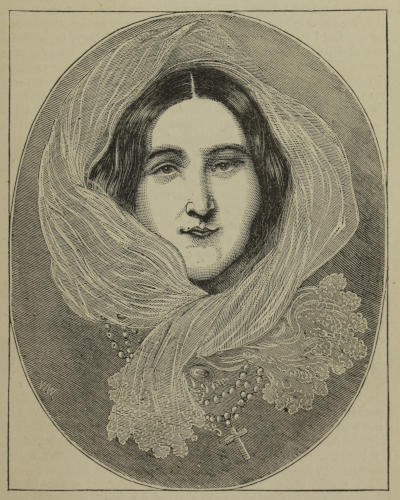
ROSINA, LADY LYTTON.
This precious piece of documentary rascality set forth that both my father and mother died mad—— Now my father had had one of the most absurdly splendid public funerals for a Commoner that ever was seen, being Grand Master of some Masonic Lodge—and ostentatious burials are not generally bestowed on lunatics; and my poor mother having been only ten years dead, anyone could have refuted that lie. But like all the villainous lies, they were only fabricated for the few, and for the dark, and never allowed to appear in the honest searching light of publicity. This tissue of lies went on to say that I had attempted to commit suicide!! and that the family insanity in me had developed itself in delirium tremens!!!! from my intemperate habits!!!!!! “The dastardly fiend!” I exclaimed, “so the sacrilegious monster would even desecrate my poor mother’s and father’s graves! for what? to bury his life-long victim alive in a Madhouse. It is true, but worse, far worse than that, this unscrupulous demon would, without one touch of remorse, brand with a triple hereditary taint of insanity his only son! at least his only legitimate son, who will have the quite sufficient misfortune of inheriting the name of so infamous a father.” “Yes—’pon my soul it’s too bad,” said the Attorney, “but I’m happy to tell you that I have now got you the £500 a-year for your life.” I knew by this, though all papers but the conveniently reticent Times had been kept from me, that the public indignation must be astir, and making things rather unpleasant for my Lord Derby’s creditable Colonial Secretary, in which I was right, for I afterwards heard that not only the people here were holding committees and meetings every day on the outrage of which I had been the victim; and the Somersetshire Yeomanry were determined upon going mounted to London, and pulling his house about his ears if I were not released; but that his Butler could literally scarcely stand under the loads of letters he had to bring in every morning of imprecations and threats, by no means anonymous, and as poor Prince Albert was then living (for our little selfish, sensuous, inane and carnal Queen would not care if all her subjects were equally distributed in Madhouses, or pounded in mortars), my Lord Derby was sent for in hot haste by her Majesty, and told, either I must be instantly set at liberty or his Colonial Secretary must resign; for the outrage, or rather the scandal, was too great; for that’s the only thing they dread, being quite of Tartuffe’s opinion que pecher en secret n’est pas pecher, ce ne que l’eclat qui fait le crime. Now, my woman’s intuition and common sense told me that something of this sort must be going on, or I should never have heard a syllable of the £500 for my life. So in reply to Mr. Hyde’s obliging communication, I said; “What! are they trying to make me out an idiot as well as a maniac, that they, or you, should suppose after such an irreparable culminating outrage as he has inflicted upon me by this incarceration, I will let that scoundrel Sir Edward off on the beggarly pittance I would have accepted before it? and oblige him by vegetating upon it in the exile of some living tomb, for the rest of the life he has so poisoned at every source. No thank you.” “Well,” said the Attorney, who had at that time received his bribe, to say nothing of breathing the air of Downing-street, and being brought into personal contact with the Magnates of the party, which would do to brag among the snobocracy of Ely-place, Highgate, and Langport for the rest of his life. “Well,” said he, “Sir Edward has shown me his rental, and how he is tied up, and he really cannot”—“Pray Mr. Hyde,” said I, interrupting him; “are you Sir Edward’s solicitor or mine?” Whereupon, not finding it convenient or agreeable to endure any probing, he scrambled up all his papers, and said, taking out his watch—“Bless me, I shall lose the train,” and darted off out of the room.
The next day, Dr. Oily Gammon Roberts, whom I had known a long time, called upon me. He had just had the supreme felicity of becoming Lord Palmerston’s medical attendant, and is just the smooth, mellifluous, double-dealing, Jesuitical personage, who would be happy to accept a reversionary emetic from any of the peers or peeresses whom he attends, (or) though an infidel, to do any amount of canting with Lord Shaftesbury in Exeter Hall in the morning, or any amount of pimping for Lady Shaftesbury all the evening. The dear Conservatives having fallen upon evil days, via their Colonial Secretary, was of course nuts to the dear Whigs, though as far as any amount of dirty work, back-stair climbing, and athletic, indefatigable, political, and every other sort of jobbery, the two parties are in reality “one concern;” and having the same “bonnets,” during their alternate ins and outs, always know the exact thimble the pea lurks under. Well, Dr. Oily Gammon came, and his manner was a perfect emulsion of almonds when I told him of Mr. Hyde’s audacious proposition about the £500 a year. He urged me to be firm and not take a doit less than a thousand a year; which, as he truly said, was little enough after such an outrage. “For which,” said I, “no money could compensate.” “Very true,” said he, and after assuring me of the universal indignation and sympathy my case had excited, he took his departure, promising soon to call again. The plot was now evidently thickening, for the next morning the fair Sophia, alias Sparrow, came twittering into my room, and said a groom had ridden out in such haste that the horse was covered with foam to tell Mr. H. he must go to London without a moment’s delay; and “I cannot but think and hope,” said she, “that it means some good to your ladyship.” About five o’clock H. returned from town, more fat, frowsy, head-wagging, and eye-rolling, than ever; but desperately civil! and aux petits soins, and asked me if I would like a drive as far as Richmond? I said, “Yes, amazingly, provided Miss H. went with us.” “Oh yes, certainly,” said he, with a smile, or rather a dyspeptic leer, which he meant to be half prevenant, half paternal, but which only made him look as
“Hyenas in love are supposed for to look, or A something between Abelard and old Blucher.”
“Oh, certainly, for your ladyship has quite bewitched my little Mary, and she cries every time a servant is sent up to you with anything instead of her.” Never was anything so beautiful! as that always lovely view from Richmond Hill upon that glorious July evening, with the golden sun steeping it in light and turning the “Silver Thames” into a perfect Pactolus, while the fresh breeze from the river was a real luxury after my nearly three weeks’ incarceration in that large, but low-ceilinged stuffy room, with its nailed down windows. And as caged birds are always wild when they do get out, Mary Hill and I took to running races, and not the least part of the pleasure of which to me was seeing old fat H—— “Like panting Time, toiling after us in vain,” and puffing and blowing like a steam engine; till he made almost as much noise as all his ten children with their hoops and skipping ropes under my windows of a morning, when, groaning in my cage, I used to say, “Why skip ye so ye little Hills?”
By the time we got back to T—— L—— the evening was fast closing in, and though as always I had an invitation to sit below in a really magnificent groined lofty roofed banquetting room, some 50 feet long, that they had there, I always preferred my own society, even with my own ills, to Mrs. H—— and all her Ills,—which with the greatest Ill of all—her husband—made a party of thirteen of them, which yet did not comprise all the ills that flesh is heir to.
And now comes the most horrible and cruel part of this history, and which is so painful to me to write, or rather to excavate out of the desolate grave of all my hopes, where it has lain buried for the last five years and a half, and where I thought it would remain till God had mercy on me and I was buried with it. But it would have been impossible to tell you all the rest without telling this too; or you would really think me not only mad, but a liar, that I had not in our Courts of Justice, or more frequently of Injustice, fully exposed, and got at least as much redress as public indignation and condemnation can afford to the Victim, when bestowed upon the perpetrators of such dastardly and chronic and complex infamy. But Sir Edward does not do his fiendish work by halves. He knew that from me he could neither expect mercy nor longer forbearance. So he, with demoniacal and unscrupulous astuteness baited the trap with the two lacerated hearts of both Mother and Child; for he knew that even to expose him I would not, and could not, expose my own son—whom God forgive—though I firmly believe that he, at first, was as much duped as I was. For though under ordinary circumstances—he was well aware, from bitter experience, that he could not believe in any promise his father ever made—still he naturally thought that after standing upon the brink of such a ruinous Abyss, and having been only saved by nature’s great miracle, a Mother’s Love—he would for once in fear and trembling have kept faith with his victims wholly and solely in his own sordid and selfish interest. And so this truly unhappy young martyr did evil that good might come of it; and that, as he at the time told me, he might buy his Mother back at any price. It is Walter Scott, I think, who says—“There can be no Virtue without Truth, and there can be no Truth without Moral Courage.” But where was this poor predestined young victim to acquire that? when the whole course of his accursed literary training was to develope his intellect, and stultify his moral qualities, by, from his youth denying to his naturally gentle and affectionate nature the holy vigils of a Mother’s care, and the humanizing and heart-expanding influences of home. While the diplomatic obligations of his detestable profession could not fail to weaken to annihilation that plebeian appendage called conscience; so surely does custom blunt and familiarize either the worst or most frightful things. No wonder then that I should have no admiration for, but a positive contempt for, mere intellect; as intellect without a moral fulcrum is, of all the Devil’s levers, the one that raises the most fearful preponderances of evil, and causes them to float buoyantly and triumphantly over the world. But I must get on, and get over this last heartquake of mine as rapidly as I can. God knows I would not injure him in the world’s estimation (little as it is worth) more than he has already injured himself; and God, I am convinced, has punished him far more than He has thought fit to afflict me. Five years and a half since this crowning iniquity have I waited, hoping against hope that now, that he was no longer a Boy, he would shake off the glamour of his father’s terrorism, and show some spark of manliness and human feeling, if only as a sort of expiatory conscience tax to God. But when was conscience, courage, or feeling, ever evinced by either a B—— or a L——? For the rest of this disgraceful history, I should be only too glad if you proclaimed it at the market cross. But that I am very sure you will not do; as I am fully aware of the requirements of literary amenities and social conventionalities; and therefore it is that I have lived too long alone with God, and the bitter sorrows He has sent me, not to gauge everything by simple Truth, unalloyed by expediency; and, perhaps too, as Esmond says, “I have seen too much of success in life to take off my hat and huzza to it, in its gilt coach, as it passes.” I am also fully aware of literary posthumous chivalry, and its Bayard courage! upon the safe vantage ground of posterity! therefore, when I have been dead some hundred years,—how pens will start from their inkstands, like swords from their scabbards, to avenge me! while Electric Caligraphy will not have left sufficient ink in Christendom to blacken Sir Edward, the Cæsar Borgia of the nineteenth century (with the beauty and the courage left out) up to his natural hue. Gentlemen of 1964, I cannot find words to thank you—for all I shall have to say then, is what I pray now—Implora Pace!
Well, on the evening after my return from Richmond, while I was at tea, the door was thrown open and Miss R—— was announced. I reproached myself with ingratitude at the time, but she was more antipathetic to me than ever; her manner was so brusque, coarse, and unfeeling—meeting me for the first time in such a place. And she did look so dreadfully ugly, and so additionally dirty! a great tour de force! that I recoiled from her touch, and when she said, without any preparation in that sharp, shrill, cracked bell of a voice of hers, “Shure I’ve brought your son to see you,” I felt almost as though she had knocked me down, and burst out crying—“Then,” said I, “I won’t see him; he has never acted like a son to me; and I suppose his infamous father is springed in his own trap, and he has sent his son to get him out of it.” For two hours ineffectually, for I would not yield to this evident bullying, did Miss R——, with her usual want of tact, want of feeling, and coarse uncouthness, irritate every nerve in my body. I may as well here give you the keynote of her character. It is an inane and egregious vanity—and a mania pour se faire personnage; one of that dangerous class of meddling fools, who are for ever rushing in “where angels fear to tread.” She was indeed “a thing of shreds and patches,” made up of the fragments of other person’s thoughts and opinions—which she invariably retailed as her own. In all things a mere ape and echo. During the Crimean War, she read up the leaders in the Times, and Mr. Russell’s letters, and then thought herself quite competent to argue with, or rather to dictate to the first military authorities, past, or present. Vilely ill-educated, or rather not educated at all, she could not open her mouth without mutilating the Queen’s English, and, like “The Wife of Bath,” her “French was French of Bow,” or, rather, of Boœtia—“for French of Paris knew she none,” and her grotesque and barbaric pronunciation of what she called such, was worthy of Sir Edward himself! or of that other universal genius (in his own opinion) Mr. W—— R——. She also had, like most vain fools, a literary mania, and a great ambition to appear very blue. I am confident, from her subsequent ingratitude towards me, who, as she acknowledged to my son, was the only benefactress she had ever had, that next to her fear, by my incarceration for life, of losing an excellent milch cow, which she had no chance of replacing, her motive in writing to the papers, and making my iniquitous abduction public, was that she thought by so doing she should put herself forward, and become quite a heroine. I am also certain that when Sir Liar got hold of her, and that other patent scoundrel E—— J—— (who had been plied for him by that little Red Rat, Cockburn—as of course it does not do for a Chief Justice to appear in dirty work, all English virtue, being strictly PUBLIC!), seeing the empty, heartless, vain, unprincipled ass they had to deal with, they fooled her to the very top of her bent; the rascally Q.C. telling her, that he, Sir Liar’s ame damnée, had only undertaken the business in my and my son’s interest; and what a thing it would be for her to heal family differences! and what a proud position for her, a young girl (39), to be the sole pivot that could keep the Derby Ministry in! and E—— J——, knowing that there was no friend like a woman, and no head like a woman’s, when dictated to by her heart. All this I learned from herself after; but where it struck me, like an electric flash, how they had fooled, and sold—or rather bought—her, for I was the sold! was her saying, the day I left H——’s stronghold, and we were driving to town, as she pointed out of the window to the Asylum for Idiots, on the left-hand side of the road, and said, with one of her vain-glorious chuckles, “As E—— J—— said, ‘we won’t put you there, Miss R——!’” “Then,” said I, “I am certain that he, and his infamous client, must have fooled you to their heart’s content.” I have no doubt, too, that when she heard the jingle of the thimbles, about keeping the Derby Ministry in! and she being the sole pivot! that could secure the Cabinet!! a vista opened to her of all the salons in London; ibid, the becoming an honorary member of all the literary cliques; and ditto, of her being made free of the sesame of all the backstairs in Downing-street! To say nothing of her having fallen desperately in love with Mr. L——! (poor fellow, how soon his punishment overtook him), whom she used to rave about as the bo-eye-dale (alias beau ideal) of what a young poet ought to be; so handsome, so elegant, so charming! and I have no doubt in the plenitude of her imbecile conceit, she thought she would fasten herself on me, as a daughter-in-law, for the rest of my life. What a pity she could not hear the loathing disgust that her bo-eye-dale used to speak of her with. At all events, it is some comfort to know how those he-villains—the brand new Baronet, and the outlawed, swindling Q.C.—squeezed the orange and then threw away the rind, and when they had got all they wanted of her, kicked her off in a way quite worthy of them. And it is also a consolation, that, as a Frenchman said to me, when she used to be talking about her cost hume de cheval (Amazone), as she called her habit, “Ah! madame, quel bonheur puisque que cette drolesse la c’en est amourachée de monsieur votre fils qu’elle ne peut jamais devenir votre belle-fille!”
And now, before telling you what remains of this terrible history I must exonerate my unhappy Son from ever having gone such lengths in impious falsehood and hypocrisy, as to have written that disgusting “Dedication of Lucile” to his infamous father’s “loved” and honoured name. He never did write it; but how could a son publicly disclaim it, and say my father is a Liar and a Forger? Of course he could not. But where he is eternally to be blamed is for ever having let weakness and subserviency come to that; when, instead of thanks for having thrown himself into the breach to save his fiend father from the crushing disgrace of a full exposé of the Mad House Conspiracy, he found that unscrupulous monster only wanted him to tell more lies, and forge new springes for his Victim Mother, he should have unhesitatingly and firmly refused, and said—No, sir, I have done everything I could, and more than I ought, to screen you; setting facts, and truth, and my own feelings, and all justice, at defiance to do so; but if you now intend to break faith, and go back from all you promised in a moment of imminent peril, you cannot expect me to write myself down a Coward or a Villain by deserting and betraying the Mother, through whose unexampled forbearance and noble self-abnegation I was alone able to serve you. For had not my poor, generous Mother accepted me as a hostage, you know the Queen’s dominions would not have bribed her to forego the public redress she was so more than entitled to. But this would have been honest and true; and how could Sir E——’s son, pupil, and tool, be either? And, alas! the Bible is right—as the twig is bent, so will it grow. Poor, poor, unfortunate young martyr! as his Fiend Father has crushed my life from out its setting, so has he crushed that young and once bright soul from out its orbit, and sent it erring through the tenebrous nebula of his own Avernus. Poor young victim! truly
“His honour, rooted in dishonour stood, And faith, unfaithful! made him falsely true.”
For if you only knew his opinion of and feeling towards that vile Father, you would not wonder that after, through sheer moral cowardice, having been made to run counter to all his feelings and his whole nature, and play the part of a sort of Judas tranie Tartufe! he should have written in that heart-cry of his, called “Last Words,” that appeared three years ago in the Cornhill Magazine.
“But what will the angels say, when they are looking at me?”
They will tell him perhaps that his Mother pitied even while she despised him. There are some persons who can manage to love, and yet despise; I cannot, as I told him; for with me contempt is a moral bourne from which no affection ever returns. But I am not angry with him. Oh no, I wish I was; for that would pass. No, I am not angry with him; I have left him all I have in the world—not money, for I have none; but all my pictures, books, bronzes, rare carvings, and rarer historical enamel portraits, and miniatures, including a most exquisite one of la belle Ferronière, that belonged to Francois Premier, and a fine miniature of Madame de Montespan, set in a diamond bracelet, which had belonged to her son, the Duc de Maine! also a fine miniature of the great Lord Strafford, and that most beautiful miniature of Lord Byron that Lady Caroline Lamb left me; my large Sèvres jewelled Ecrelles, with a portrait of Louis Quinze on it, which he gave to poor Marie Antoinette when she was Dauphine; and which she gave to the Comte D’Artois (Charles Dix), who gave it to his cousin, the Duc de Boillon, and he it was left it to my mother. All my bijouterie I have also left him, but with a solemn injunction in my will, on pain of God’s judgment! that he should never desecrate the grave of the Mother he had so cruelly betrayed, and inhumanly neglected, by any tombstone, verbiage, or any impious posthumous sentimentalities! in Poems or Magazines.—Amen.
And yet with all my knowledge of and unlimited faith in the diabolical villainy of Sir Edward, there is still a mystery of iniquity about his unhallowed power (divorced as it is from all affection and respect) over his truly unfortunate Son, that even I cannot fathom, nor even guess at. But I must get to the end as quickly as possible; for much as I have tried to condense this complex tissue of iniquity, which after all is but a drop in the great ocean of it, in which I have been plunged; it would have been quite unintelligible to you, as a stranger to both the actors, and their actions, had I not, in narrating the latter, put you in some degree au fait to the former.
Well, the next day, after Miss R——’s semi-nocturnal visit, when without giving me any particulars, she informed me I was to be set at liberty almost immediately, H—— came up, and was more explicit, for he was in a towering passion, fanning himself with a newspaper that he clutched vindictively. “’Pon my word,” said he, “those abominable papers are too bad! More especially the Somersetshire ones; to read their abusive tirades, one would really suppose, Lady L——, that instead of being surrounded with every comfort, you had been thrown into a dungeon.” “You forget, Mr. H——,” said I, “to the impartial public, who are not paid, and have no interest in thinking otherwise, the infringement upon the liberty of the subject in any way, much less in the brutal one of so unwarrantably kidnapping and seizing without judge or jury an inoffensive and defenceless woman, and incarcerating her in a lunatic asylum, is in itself a quite sufficient deed of iniquity—whatever the Sybarite surroundings of the locale may be—to raise a storm of public indignation far more easily evoked than quelled. And you also forget that, take a person nolens volens, and by force, to Buckingham Palace, or to the Tuileries, which is rather more like a palace—and nail down the windows, lock the doors, and put keepers to attend to them, and presto! you convert the palace into a prison, and the most terrible of all prisons, a Madhouse.” Finding he could get no sympathy from me, as he might have supposed! he began tapping that bay window of a paunch of his, and said he was so ill with all the uproar that was going on, that he was obliged to take “shugger” (sugar) in his tea!!!! which he never did but when he was ill! Having stated this highly interesting and physiological fact, he left the room as abruptly as he had entered it. Now really his coming to me for sympathy and consolation, on the vituperations of the public against him, was almost as fine a piece of logical and inverse justice as Lord Dundreary, in Punch, saying in a fury to his wife upon getting his brother’s letter, “I tell you what, Georgina, if I had known you would have had such a beastht of a brother-in-law as Thom, I would not have married you.” Feeling very sure that Mr. L—— would return to the charge, I sat down and wrote him a letter, ready to be given to him when he came. Oh! if we have a Guardian Angel, why did mine desert his post on that day! of all days? I had nearly finished my letter, when that too odious Miss R—— marched in again informing me she had brought my Son down with her again; then, said I, “you may take him back with you again; but just wait two minutes and my letter will be finished, which I am writing to him, and you can give it to him.” Whereupon this always vulgar, ill-bred, and unwarrantable person, pounces down her skinny, talon-like hand, seizes my letter, and tears it to pieces. I was indignant at such an impertinent outrage, and ordered her to leave the room. She had scarcely done so, before the door again opened, and in walked Mr. L——, while the door was locked on the outside! The next moment he was kneeling and kissing my feet in a paroxysm of tears—I cannot describe the scene that followed, and I would not, if I could. Enough, that at the end of three hours, he still found me determined to seek legal redress, both in the Divorce Court and elsewhere, for the culminating outrage his Father had inflicted upon me. He said he thought his Father would destroy himself, rather than stand the disgrace. I laughed at that, and told him not to alarm himself, for that his Father was far too great a coward to die voluntarily, even a coward’s death; he might, indeed, said I, murder either you or me, if he thought he could lay the crime on anyone else, or make it appear that we had committed suicide. And to tell you the truth, I have no compassion for that nice sense of honour which only shrinks from the public odium of exposure, but defies God, by never recoiling before the commission of any amount of evil doing that money can conceal, or hypocrisy varnish. “Then, mother,” said he solemnly and sadly,—“every prospect I have in life is ruined, I never can stand the fearful, the horrible exposure of my Father that is inevitable.” Here, he had hit the mark; I leaned back in my chair, irresolute, and he saw it, while he continued kneeling with both my bands in his, and his pale tearful, agonized face, looking up to mine. “But don’t you know, don’t you see, Robert, that the moment your Father has cleared this precipice with impunity; then shall I be debarred by ‘condonation’ from my redress, and left more at his mercy (who has none!) than ever.”
“No, no, my own angel darling Mother, then you will bind me to you for ever; he cannot, he dare not, after owing his salvation to your generosity—prevent your having me to protect, and be devoted to you all my life, and if anything goes wrong in future, you will always have me to appeal to, and protect you. Oh, Mother! if you could but see into my heart, you would see that I would, that I have given up everything to get to you and to be with you. I know I am not worth it, that is, that I have been far from worth it, but if you could, darling, make this great, great, noble sacrifice for me—your child—never, never, shall you repent it.” After a great deal in the same strain, striking the one chord in my heart that he knew he was sure of, till he had brought it into perfect unison with his own wishes, he had conquered. I threw my arms about his neck and said, “Oh, Robert, had you asked me to tear my heart out bodily, and give it naked and unguarded into your keeping, it would not be half such a sacrifice as you require of me.” “I know it, mother darling, I know it;” and then, after a couple of the happiest and perhaps the most foolish hours I ever passed in my life, believing—as I firmly did—that out of such a Slough of Despond I had walked into the warm sheltering Paradise of my child’s heart, who at least externally and in manner was all I could wish, which was in itself a great boon after the coarse, common clay I had so long been used to be knocked and bruised against. When he urged me to go abroad with him, to pass what he called our honeymoon, and to take Miss R——, as he might not be able to get sufficient leave of absence to return with me at the end of three or four months, “Oh! no, not Miss R——,” said I, “she is so very antipathic to me. I’ll give her any sum of money for any exertions she may have made in getting my incarceration made public, but we shall be so happy without her, and she is such a wet blanket, and a dirty wet blanket too.” “Well, that she certainly is, and when I first saw her I said to myself, ‘Heavens! can this be a friend of my mother’s?’ But when she told me all you had done for her, I then knew how it was. She seems to have set her heart upon going abroad with us, and after all she’s done, I don’t think we could well refuse her.” “Well, dear,” said I, very much annoyed at this, “you might have let me choose my own evils and not have extended your hospitality to my bete noire. But suppose I do yield every point to you, in this way; you know I cannot possibly go abroad, whatever arrangements are made, without appointing one Trustee, and that is more easily said than done, as I know of old the great dislike people have to being brought into contact with your Father; knowing that they have either to abandon my rights, or quarrel with him, which before was what drove me to the pis aller of appointing the do-nothing-goose, Sir Thomas Cullum.” After considering a little while, I said: “I have no great faith in public philanthropists, more especially of the Exeter Hall breed; but as he is one of the Commissioners in Lunacy, and knows the whole affair, I wonder if, under the circumstances, as a piece of good Samaritanship, Lord Shaftesbury would consent to be my Trustee? for he might be a check upon your Father.” “A very good person,” said he, “I’ll ask him, and let you know to-morrow, darling.” So, it being then seven o’clock, and he having to get back for his Father’s dinner, left me after this most harrowing day; though I then little dreamed of the red-hot ploughshares there were to come, after being kept full three months in a Fool’s Paradise about my son’s love and devotion to me; and when I used to chide him for being so demonstrative, even in public places, and say people would think I was some old woman whom he had married for money, he would say, “Oh, but Mother darling, we are not like ordinary Mother and Son; I love you in every possible way, and then I love you back all the love I’ve not been let to pay you for years; and then you have suffered so much, and borne it so nobly, that you are to me something holy.” At other times he would cry out after hugging me, “Mamma,” as he always called me, “what I worship in you, is, that with a lion’s heart, you are so tender a woman!” All these demonstrations were, of course, music to my ears, and what tended materially to keep me in this Fool’s Paradise, was that there was a girl whom he was much attached to (not an English miss, thank God), and whom his vile Father was luring him on to suppose he would give him sufficient money to marry, and when I used to see him looking wretched, and thinking it was about her, he’d burst into tears, and throw himself into my arms, saying, “Oh, no! it’s not that, Mother, for I declare before God, if it were to be made a matter of alternative, which I would give up, her or you, I’d give her up to-morrow, if I might always have you with me.” Then, too, a very old and kind benefactor of his, an elderly gentleman, who had shown him much kindness, and whose large means, when Robert was a boy, had often atoned for his father’s sordid parsimony, wrote to me, saying, “I can answer for the deep love and yearning, dear, dear Robert has always had for his Mother; and oh! how sincerely do I rejoice in his happiness now.” Add to which my maid was always telling me that Fletcher, Robert’s valet, used to say to her, “Oh! how Mr. L—— does adore his Mother. I often surprise him kissing her gloves, and slippers. Poor young gentleman! I never saw a happy face on him till now; he seems like a natural person now, which he never did with his Father, of whom he is mortally afraid.” So you will own that if this was fooling, I was well fooled. But I must return to the horrors. The next day, after the first on which I had seen him, Mr. L—— returned to the lodge, and on coming into the room, said, “Well darling, you owe me a million of kisses, for I have good news for you; Shaftesbury consents to being your trustee, so that’s settled.” I thought this exceedingly kind of Lord Shaftesbury, as I did not know him personally, and of course wrote to thank him, which note I gave to Mr. L—— to take to town; and, despite the almost universality of English bearishness and ill-breeding, still as anything in the shape of a gentleman or gentlewoman always answers a letter, more especially such a one as I had written, I was surprised at that evening, and the whole of the next day passing without my receiving any reply; and I said to Mr. L——, late on the following day, “Are you sure, Robert, that my note went to Lord Shaftesbury?” “I would not trust it to a servant, so I took it myself.” At this I felt quite satisfied and did not think any more of the matter. The next day the invasion increased; I was quite knocked up, and in bed. That vile fellow, H——, came down to see me. I told Miss R—— to say I could not see him, as I was in bed, and I added to her—though he was acting in my interest, I would not see him if I were not. Indeed, a friend of mine, Mrs. T——, told me, after my return from my trapped going abroad, that hearing —— was engaged, she had driven down to Miss R—— at 12 at night, to tell her, for Heaven’s sake to be on her guard, that that man, of such notoriously infamous character, retained by Sir E——, did not wreck me. But she having so completely done so, in order, as she thought, to play her own game, replied, like the double distilled ass she is, “Oh, —— is all on Lady L——’s side!” “Oh, Miss R——,” said Miss T——, “how can you believe such nonsense as that?”
Well, it appears that with E—— J—— had come down Mr. L——, and Dr. F—— W——, who, I was told, was come on my behalf to counteract—that is, contradict—the statements made by that precious pair of rascals, R—— and H—— T——. “But how,” said I, “can he possibly do that when he knows nothing about me—has never seen me, and will only do so for a few minutes?” Verily they are a nice set, one and all of them, ready to swear a poor victim mad or sane, at a moment’s notice, for value received! Shame! shame! That disgusting Miss R—— then began screaming out in her peacock voice, “Now your son wants you to go abroad with him to-morrow.” “But I won’t and can’t,” said I; “I must at least have a week to get some clothes and things.” And then this horrid creature made me quite ill with her vulgar bullying manner, and I begged she would leave the room. The dulcifluous Dr. F—— W—— was then sent up to me, as he with more tact than truth expressed it, to know my wishes. I told him that I thought I had done quite enough in yielding to my son’s wishes in going abroad at all; and that I did not see why I was to be hurried off in this life and death way, as if I had committed a crime, and was to be smuggled out of the country. “Very true,” said the amiable Doctor, “and I am sure nothing can be more reasonable than your wish to have a few days to prepare for the journey.” He then added, “You are to have, or they are getting you (I don’t remember the exact words) a thousand a year, and a house to be furnished for you in town;” which flourishing promise ended in £500, but the solemn assurance from Sir Liar, E—— J——, and Hyde, that all my debts should be immediately paid, and my debts of honour, before I could get across the Channel was never kept. The dulciferous Dr. W——, after so perfectly agreeing in all I said, then went down, to as perfectly agree with all the opposition said; and was again sent back to urge their suit; telling me confidentially that the fact was, that the place was in such an uproar that Sir E—— was terrified; and there would be no peace till the public was assured I was at liberty, and really gone abroad with my son. I may as well here tell you, that such was the honourable estimation Sir L—— was held in by the said public, that people fully believed I was sent abroad to be made away with; and hence, among many others, the atrocious lie, that I was accompanied by a relation of my own! M—— R——, by my own special request! Whereas, as I discovered, like all the rest, too late, this wretch was only sent as a Spy on me and my Son—upon the Jesuitical plan of triplets, and as “own correspondent” to Sir Liar, to whom she used to write every day from the programme he had given her, the blackest lies, for him to read to people:—such for instance, as that I had been very violent and unmanageable till I had arrived in Paris, when I became calmer! the real truth being, that I was so exhausted, in body and mind from all I had gone through, that I could scarcely move or speak, but used to say, lying down, while my son sat beside me, my hand clasped in his, that I felt so grateful to God for his being restored to me that I could almost forgive the relentless author of my life-long misery, and cruelly exceptional persecutions; but that at all events now I’d try and forget him and them, and think of nothing but the present and the future. Well, Dr. F—— W——, finding he could not move me from my resolve of not being smuggled out of the country like a felon, sent up the only person who could fool me, my son. And when he told me what it would entail upon him, if he could not succeed in doing his father’s bidding, why then I yielded; and having been brought to Mr. H——’s stronghold on Wednesday the 22nd of June, 1858, at 7 p.m., I left it on Saturday, July the 17th, 1858, at 3 p.m., by almost an equal degree of treachery, falsehood, and springeing. Poor little Mary H—— cried so violently, that I was really grieved to leave her, and felt quite selfish in going (as I then thought) to be happy, when she who had been for three weeks my one sole Star in the Desert was left so unhappy. Mrs. H—— said the whole affair had made her usband hill; I said I thought he had been always Hill; while he said he had never suffered so much in his life; the uproar that had been made had played the deuce with him. “I told you it would, Mr. H——, the day you forced me to come here; why did you not listen to me?” “And then,” said he, “my daughter Mary is breaking her heart, and I have got, I’m sure, a confirmed liver complaint from it.” “Then,” said I, “you must leave off ‘shugger,’ it is the worst thing in the world for the liver.” Dr. Oily Gammon R—— told me, after my return, that H—— had been on his knees, imploring him to have pity on his ten children, and not ruin him. The valiant Doctor, who literally could not, or would not say Boo! to a goose, or he might have had beau jeu with H——, pretends he said to him, “You should have thought of these before. You had no mercy upon Lady L—— when you dragged her to your asylum in that iniquitous manner.” However, after my departure Brentford became too hot for him, and he removed to London, where, between him and the rest in whose power he, of course, was completely, I understand Sir Liar was completely beggared with hush-money; not with my tremendous debts, which, at the end of 20 years’ ceaseless persecutions, and consequent onerous law expenses, amounted to the mighty sum of £4,500, which, when at last at the point of the sword, alias the writ, that generous and honourable man was compelled to pay; he did so by disgorging some of my own money. Upon this memorable and broiling 17th of July, 1858, from 3 to 7 p.m., I had to drive all over London in quest of ready-made things, and then go to ‘Farrance’s Hotel’ to eat a hurried dinner, and after from Belgrave-square to the London Bridge Station, so that I was really quite worn out when at 11 o’clock at night I found myself in bed at the ‘Lord Warden Hotel,’ Dover, from whence we did not cross to Calais till Monday, the 19th, all newspapers being carefully kept out of my way; and, indeed, I was both too happy and too tired to ask for any, which, of course, was precisely what was calculated upon. Abroad, I can only suppose that all my letters were intercepted by that vile Miss R—— in her capacity of own correspondent to Sir Liar, as Mrs. Clarke told me she had forwarded innumerable ones; and, on my return, I found duplicates, recapitulating their painful contents, and alas! too late warnings, as warnings generally are. “For I told thee so” the Fiend ever whispers, when the deed is done! At Bordeaux I got a letter from Judas H——, in which the following audacious and asinine passage occurred, “Sir Edward is quite changed, his only wish is to render your life in future as happy as possible.” To which I replied, “Yes, no doubt, for it is a patent fact in natural history that the leopard is in the habit of changing its spots at a moment’s notice.” A few nights after this H—— humbug, Robert was brought some letters from England at the Opera, one of which he no sooner read than bursting into a perfect agony of tears, he rushed out of the box. I, of course, went after him, when that beast, Miss R——, caught hold of my dress to prevent my following him, saying, “Augh, shure, he’s often in dat way,” as if she had known him all her life, and had been his bonne d’enfant. I could not find him; and when that night I went to kiss him, and wish him good-night, I found him pacing his room in a state of distraction, with his hands to his head, exclaiming, “What does my father think I’m made of! what can he suppose I am?” And upon another occasion, though not so fearfully shaken, he appeared in a greater rage; his vile father had written him a furious letter about the scandalous expenses of our journey! “As if,” said Robert, “I was a dishonest courier; and talks of withdrawing his patronage! from me, as if I was some beggar he had picked up in the street!” “Well dear,” said I, “you should keep a strict account of the expenditure; enclose your father all the bills, and ask him if he knows of any way in which five persons can travel for nothing in a country where everything now is fabulously dear?” For even at Luchon at the end of the season, after leaving the Hotel de Bonne Maison as being too expensive, they made us pay 500 francs a week for the Châlet we had, for which in the season Mme. de Rothschild had paid 1000. Often and often, when I saw the poor boy in these dreadful paroxysms of mingled rage and despair, I implored him on my knees to confide in me, and I would help him, if it were even against myself, for I could bear anything and everything, but to feel and find out that my own child, for whom I had sacrificed everything, and in whom I had garnered up all my hopes, was deceiving me! And who can you trust if not your own mother? But no, the chronic habits of terror and subterfuge were too strong! even when stung or goaded into making me little half-confidences, from which no one, as I told him, could give sound advice, as the very point that is kept from them is in all probability the turning one, which would alter their whole opinion and counsel. But his terror of his vile father was so great, and now added to it, that of that “beastly disgusting old Spy,” as he called her, that even in the heart of the Pyrenees, if he did unburden himself in the least to me, it was in a whisper; and he would turn pale, and look furtively around, as if the very birds of the air would carry his words back to Park-lane, or Downing-street. Poor young martyr! poor young martyr! But all the tortures he was then enduring were worthy of the Fiend-Father, who when the poor boy had had a fearful, and nearly fatal, fever at Lucca—took no note of whether he lived or died, only to storm about the expense of the Doctors!!! Yet this is the loathsome wretch! to whom he allowed the impious dedication to “Lucile” to appear, and blaspheme about his “loved! and honoured name!! and his gentle kindness to him as a child!!” And this is the Father for whom he could so cruelly and treacherously sacrifice the Mother who had sacrificed everything, and every chance of redress for him, and whom he professed to adore, in a way that might have deceived the Recording Angel himself. And worse still! Miss R——, whom he so loathed and detested, that old Spy, as he called her—was the parasite he could afterwards cabal with against his Mother, to steal those letters of his infamous Father’s, which I had entrusted to that creature the day I was kidnapped at H—— T——’s; but in that they did not succeed, as you shall hear presently. So much for that paralysis of the conscience, moral cowardice, which is at once the germ and hotbed of every vice. It was not until I had been thus far springed upon, and thus far on the journey, that after writing to know if all my debts of honour had been paid, as so solemnly promised before I could get across the channel, and the deed drawn up, settling that beggarly £500 a year on me for my life, that I got a letter from that precious rascal, Mr. —— ——, coolly telling me that everything was at a standstill, till I had appointed a trustee!!! I sent for Mr. L——, and pointing to the paragraph, said “What does this fresh shuffle mean? did you not explicitly tell me at Inverness Lodge that Lord Shaftesbury had consented to be my trustee? and that you yourself took my note of thanks to him? to which I have never from that day to this received any answer?” He turned red and pale alternately, stuttered, stammered, and said, “Did not H—— tell you?” “Tell me what?” said I; “when and where could I have seen him, to tell me anything?—when I was hurried out of the country like a condemned felon. Of course, that your father, and Mr. —— ——, might have the whole arena to themselves, to concoct their unscrupulous lies and plots.” This was the first terrible wrench my affection, that is my esteem for, and confidence in, my son got. A few days after, I saw an advertisement in the Times, from that low swindling publisher ——, of Paternoster-row, of a cheap railway edition of a book of mine called ‘—— ——,’ which at the time it came out, two years before, Sir Liar had left no stone unturned to get crushed and abused. Now a Mr. Ironside had undertaken to sell one of my books to —— for a re-issue, and knowing the apathetic hand-over-head way English people do other people’s business, I gave Mr. Ironside a list of the books he was not to allow to go into a railway edition, and another list of books of which I had not the copyrights, and ‘—— ——,’ was first upon the interdicted list. Seeing this barefaced swindle, I sent for Mr. L——, knowing how potential a man’s name always is with English blackguards, and I said, “Will you just write two lines to that fellow ——, saying, ‘Sir,—My mother having seen in the Times of the 26th of September (1858), an advertisement of yours re-issuing a novel of hers, entitled “—— ——,” which Mr. Ironside had so expressly forbidden you to do, she wishes to know by whose, and what authority you have now done so?—I am, sir, your obedient servant,
“‘R—— B—— L——.’”
“Ah!” said the young gentleman, “my father has written to me about this re-issue, and says you have broken faith with him about that book in re-issuing it.” “How broken faith with him?” said I. “How could that be when I have never had any communication with him upon that or any other subject? I merely interdicted ——’s re-issuing that book, because I could get better terms for it elsewhere. So pray ask your father how I could have broken faith with him about it; and how angry I am at ——’s barefaced swindle! and pray go and write that letter to —— directly.” I may as well here tell you while I think of it, that part of their plan was to get me to go back and live with Sir Liar for a short time to patch up his character, and throw dust in the eyes of the public, which is all that is ever required on the score of English morality. Had I been such a glorious fool as to do this, of course he could have poisoned me off comfortably out of hand, and then written a touching In Memoriam on me in Mr. Humbug Dickens’s “All the Year Round.” For that vile Miss R——, one day at Luchon, had the imbecility and the effrontery to bring me a letter from her employer, from which that meanest of all villains had ordered her to read out the following unique in the annals of humbug paragraph: “Try and soften Lady L——’s heart, by reminding her of the time when I was so devoted to her”!!!
“Dear, now, do tink of your own interest, and tell me what I shall write back to Sir Edward.” “One word will do,” said I, “the word ‘When?’”
In my dreadful dilemma of being without a trustee—not to leave them any pretext for keeping the poor people out of their money, I had written to Dr. Oily Gammon R—— to know if he would be my trustee? Not certainly from choice, as I never have any but Hobson’s choice; but because he was already au fait to the last Madhouse Conspiracy, and knew all the dramatis personæ. He wrote me back a most oleaginous letter, accepting the office, and praising Mr. L—— up to the skies, with one of those double barrelled compliments which professionally he was in the habit of bestowing upon my lord and my lady—i.e., saying “He is a noble fellow, worthy of the mother who bore him.” No, verily; she is not a coward; and for all the kingdoms of the earth could neither lie away a person’s life, repay good with evil, or cringe to infamy in high places; nor pander to treachery and injustice. Though as Falstaff was not only witty himself, but the cause of wit in others; so Sir Edward is not only false, treacherous, and infamous, but is the cause of falsehood, treachery, and infamy in others. Yet, thank God, neither by bribery nor intimidation, has he ever, or will he ever, be able to mould me to his purposes; and hence his implacable persecution, and his poisoned treacherous arrows that always fly in darkness, and from an ambush. When Mr. L—— returned with his dispatch to C——, he put it into my hand, saying “Will that do?” It began: “Sir,—Lady B—— L—— having seen in The Times,” &c., &c. “No,” I said, “it will not do; I told you to say my mother having seen, &c., &c., that he fully might know that I had a son, and therefore conclude, however erroneously, that he would protect me.” At this he left the room, and I felt so angry and heart-stricken, that I wrote him an indignant note, reproaching him with having lured and springed me abroad, merely to patch up his father’s character, which, sooth to say, was rather past mending. Upon the receipt of this, for truth to evil-doers is the most unpardonable of all crimes, car ce n’est que la verité qui blesse, the young gentleman having of course had his orders (and when did this pious Æneas ever dare to disobey any order of his loved!!! and honoured!!! father, “from pitch-and-toss up to manslaughter?”) sent for post horses and set off to Toulouse, on his return to Paris, leaving his Mother, now nothing more could be done with her, and the bubble was beginning to burst, to find her way home as she could. Certainly he did leave his man Fletcher to attend upon me, who kept saying to Williams (my maid) the whole journey, “’Pon my soul, it’s too, too bad; I did not think Mr. L—— could have acted so by his Mother—whom I know he loves—merely from fear of that old villain Sir Edward.” When I found Mr. L—— gone, without a word, without a line, my short dream all shattered and shimmering about me! and a cold, black, unfathomable abyss before me,—never shall I forget the first petrifying yet bewildering agony—the severing, as it were, of body and soul—that I felt, and which I am certain must be what one feels when the real severing of them by death comes. For hours I seemed turned to stone, and could not shed a tear, till I saw, sitting under the trees opposite our windows, in her little carriage, a poor little lame girl about thirteen, who used to sit there begging. She had a little, pale, melancholy face, with imploring eyes, that seemed to say, “Pour l’amour de Dieu!” for she never asked in words. Robert had given her a five-franc piece one day, and came into me with the tears streaming down his cheeks, and said, “Oh, Mother, can you give me any warm wraps for her? she is so cold and so thinly clad.” How I loved the poor fellow at that moment—so much good feeling was so un-Bulwerish, and so un-Lyttonian. I gave him all he wanted, and he then flung his arms round my neck, and said, “How good you are to me, darling; anyone else would have laughed at me.” “Then they must be thorough wretches if they did,” said I. Upon seeing his poor little protegée looking up wistfully, that cold, gloomy November day, after he was gone, I put on my bonnet, and went down to her. Her first question was for “Monsieur”—for he was her idol; no one, she said, had ever been so kind, or so gentle to her. When I told her he was gone, and would not return, she cried bitterly. Her name was Jeanne Hestier. I said, “Jeanne, would you like to be taken out of the cold and clothed, and taught, and live entirely avec les bonnes sœurs a l’Hospice?” She clasped her hands and said, “Oh, that would be too good—but what would my mother say?” who took all the money people gave her at the baths (and indeed I had trouble enough with the worthless, grasping mother after). “Oh, never mind, I’ll settle that,” said I, and I took the pole of her little carriage and drew her to the convent, where I consigned her to the Mère Superieure, paying the first year in advance, and sufficient besides for her “necessaire”—have done so ever since, and shall do so as long as I live; and as it is only £20 a year, I hope and trust Mr. —— won’t leave poor Jeanne to starve when I am dead, as I send the money every six months, through his old Luchon Doctor, Dr. Pejot. It is so pleasant to have his inquiries about “le jeune homme charmant Monsieur votre fils.” Oh, what a bitter! bitter! sting, life is to some of us. Well, when I arrived in Paris, I still made a last effort to save this wretched young victim from himself. I sent a note to the hotel, where he always put up, to tell him not, after what he and he alone (for no one else could have done it) had trapped me into, to let us part in such a manner; for if he did, nothing should induce me ever to see him again. He came, but the hideous Kate R—— was in the room, and his manner was cold and constrained. To get rid of her (for she always stuck to us like a leech), I sent her off on a wild goose chase to Galignani’s. I then implored him only to be candid with me, and tell me all, no matter how bad it was, or what his orders were to do against me; I would not only freely forgive him, but help him, for, as I said before, I could bear all things; but to feel he was deceiving me, and I should not at all mind what I suffered, or even try to get redress for any outrages or insults from his father, and his father’s tools; if I could be only certain that my own child was merely playing a part against me, and not doing so in his own heart; much as I deprecated such expedient duplicity, and which, to save my life, I could not resort to myself. He flung himself at my feet, hiding his face in my lap, and in such an agony of hysterical sobs, that I really was quite frightened. But not one word could I get out of him. As there is no courage like a coward’s for rashness, when pushed to desperation, so I suppose there is no obstinacy like a weak vacillator’s, when they have been pushed to take the Curtius’ leap into the gulf of determination. At dinner, the Spy being there, he again congealed into a proper B—— L——ish degree of frigidity, and talked of this, that and the other, sachant sans doute, que la bete noire R——, etait la faisant son courier, et dressant son procès verbal—pour son barbe bleu de pere. Then he said how sorry he was to leave beautiful Luchon, which was the most lovely place he had ever seen. And that poor little lame girl—her face haunted him—he must send her something, “You need not, at least just now,” said I, “for I thought you would be glad of it, so I’ve provided for your child.” “Provided for her! how?” I then told him I had deposited her with my friends, the Sisters of Charity, at the Hospice, where both she and her health would be taken care of. At this he drew up, with an air of pomposity that was almost worthy of “my father,” and said—while Miss R——’s hideous, toad-like eyes were fixed upon him, “Those sort of things are all very well, if people have large fortunes.” “Well,” I broke in, “it will neither come out of your father’s private fortune (whatever that may really be, it is so magnified to the public, and so contradicted to his family), nor out of his £5,000 a year as Colonial Secretary; and, by doing without something else, I have no doubt I shall be able to manage £20 a year, even out of my splendid income.”
But all my pleasures were still to come! The good people of Taunton, when they heard I was to return safe and sound, wanted to give me a triumphal entry from the station. But upon my unhappy son’s account, I wrote to Mrs. Clarke to say how grateful I felt, and always should feel, to them for their great kindness and zeal on my behalf; but that they would greatly add to their kindness, if they would allow me to return to them as quietly as possible, as I was far from well. On my return, I found duplicates of the intercepted letters, which had not reached me abroad; they were all to the same purport, and in the same strain, viz., that it was natural for me to believe in my son, but imploring me not to trust him; as “the world paints him in the same colours as his father—black, and very black.” And in confirmation of this, they enclosed me two infamous letters, tissues of the grossest falsehoods, which had appeared in The Times on Saturday, July the 17th, 1858, the very day I was taken from H——’s stronghold, and hurried off without breathing time to Dover, which letters bore my son’s signature! But knowing the unscrupulous use his Ruffian of a Father made of his name, I tried to hope that they were a concoction of his and L——’s, and wrote of course to Judas H——, and my Oily Gammon of a trustee, Dr. R——, about them. Mr. H—— of course “very much disapproved” of these letters! but thought it better—no doubt he was paid for so doing—to let them die away, by not taking any notice of them! a nice way of defending a client truly! While Dr. Oily Gammon “was quite shocked and startled at them, and would certainly have contradicted every false statement contained in them, had he been my trustee at the time(!!!) and he had quite dreaded the effect they would have on me when they came to my knowledge!” Yet the sneaking toady and loathsome double-dealer, being perfectly cognisant of them at the time, could, with all his pretended friendship and sympathy! let me leave England with this mine of cowardly lies exploding after me, and continue his horrible hypocrisy by writing to me that my son “was a noble fellow”! Il parint en ce cas la que, noblesse! n’obligéant pas! I was also sent some Hertford Papers with a letter from that vile wretch, Miss R——, saying that “she was bound to say (no doubt of it) that Sir Edward —— had never been unkind to me! and that from the representations made to him (!!!!!!) he could not have done otherwise than send me to Mr. H——’s establishment! which had been done solely for the benefit of my health.” The attorney H——, signing himself “Lady Bulwer Lytton’s Solicitor,” was, of course, bound to tell the same lies. But the Hertford Papers opened a perfect battery of indignation upon that vile Miss R——, saying—who could have but the worst opinion of a person who, for ten days had printed statements in not only the Hertford but London papers, that nothing could exceed Sir Edward ——’s cruelty to, and persecution of me for years, which she could vouch for before his culminating Conspiracy of the Madhouse, and that out of Hell there were not two other such demons as he and L——. And then! in the short space of half an hour after her first interview with these men, she writes to say he had never been unkind to me! Why, they could only say that she was a bribed perjurer, and that if anything could damage Sir Edward more in public opinion, it would be her present sudden and contradictory statements respecting him. As for Mr. H——! solicitors are a proverb for their elastic consciences. But it is the old story in all cases of the wicked strong against the innocent weak. Sir Walter Raleigh, it was arranged beforehand, was to be condemned; therefore, vain were his cloud of witnesses, his legions of facts, and his eloquence of truth. Just as, of course, Prime Ministers never are, under the most glaring and palpable of facts, to be found guilty in cases of crim. con. Why should they, with secret service money and unlimited patronage at their command? I remember that very clever, but intensely unprincipled literary man, Dr. Maginn, as most literary men that I have had the misfortune to know are, telling me the clever dirty work he did in Lord Melbourne’s and that vile Mrs. Norton’s Trial; how he packed the Jury, and how he invalidated the testimony of the only witness they were afraid of—a footman, by worming out all his evidence, and sending it to her Counsel, and making the man so beastly drunk at the eleventh hour at a public house, “The Chequer’s” at Westminster, that when he was called into Court it completely invalidated his evidence! And he also gave me chapters and verses of the exact sums of money—Baronetcies and civil service appointments—he had had to distribute in the higher quarters; old Melbourne sticking out more about the money than anything, but sending Sir Joseph Yorke to close with his demands at 7 o’clock on the morning of the Trial. But because Maginn was a high Tory, the sapient public of course would never suspect him of doing dirty work for a Whig Premier. Yet this unscrupulous fellow, dining at my house at Bath at the time, showed me two articles he had written upon this Trial simultaneously, one, for the Tory John Bull and Standard, making Mrs. Norton out ten times more scarlet than the Lady of Babylon; the other for a Whig organ proving her to be purer than unturned snow! which is the way Literature and Politics are conducted in this country. And my miserable lot in life having thrown me chiefly among Political and Literary Magnates, I have no hesitation in saying that all the misery and crime in this country (where—despite sermons—schools—refuges and reformatories they are ever frightfully on the increase), originate in the Stygian vices and blasphemous hypocrisy! of these two great motive powers. And have we not just been edified with another signal example of English virtue! and above all, English justice! in high places, in the Trial of “O’Kane versus O’Kane and Palmerston,” where you perceive it was Mr. O’Kane’s friends!! that negotiated the compromise! as poor dear Lord Palmerston could have no possible interest in the matter!—Oh dear no! so it was solely for Mr. O’Kane’s interest that he should accept Lord Palmerston’s money, offered by his O’Kane’s friends! and as Mrs. O’Kane had been a maid of Lady Jocelyn’s, and therefore had the run of Cambridge House, it’s not likely that a man of Lord Palmerston’s Cato-like virtue ever even looked at her. So the superannuated Joseph came out pure and spotless! (as most men are) amid the plaudits of a properly crammed court, dear Cockburn having no doubt, sub rosa, played the manager, and “animated the whole,” even to inspiring Mr. O’Kane’s friends with the ways and means to inspire O’Kane with a suitable idea of his own interests! Verily the force of humbug can no farther go! On my return to all these agreeable, perhaps not exactly, surprises, I had also the pleasure of finding that none of my debts of honour were paid, despite the solemn promises of all concerned that they were to be, before I crossed the Channel. Only Judas H—— had been sent down in hot haste to Taunton to throw dust in the people’s eyes by paying the tradespeople here, who were in no hurry to be paid, and whom I would much rather have paid myself on my return, when cordially thanking them all for their unanimous and active zeal, for they had even felt in their pockets for me, and told Mrs. Clarke that two or three thousand pounds, or more, should be instantly raised if wanted for law expenses. The only person who had not sent in his bill was a Quaker upholsterer, who was owed £5. This turned out a very fortunate circumstance for me, as you will hear presently. After this homœopathic gold-dust throwing at Taunton, Sir Liar began a son ordinaire, going back from every promise, when he thought the storm had a little blown over, and what he more particularly stood out about most resolutely, was insisting that that beggarly £500 a year should not be settled upon me for my life, but only for his. Whereupon the admirable Mr. E—— J—— told him that if that at least was not done, I should of course proclaim the whole affair, and bring an action for false imprisonment, &c., &c. So that it was at the eleventh hour, four days after my return, that it was at length done; upon which Dr. Oily Gammon R——, my valiant trustee, wrote me a most heroic piece of braggadocia, that he would not leave the room till the deed was executed, signed, and duly attested. But by this time, not believing one word any of them said, I sent my copy of this deed to a barrister of my acquaintance, Mr. Henry Cole, to know if it were a quibble or a fresh swindle. He said no, it was stringent and en regle, and about a month after its execution Judas H—— wrote to me saying Miss R—— and E—— J—— had written, and called innumerable times on him at his office in Ely-place, to try and make him give up the original of that document to them; no doubt E—— J—— having promised his friend Sir Liar that if he’d only sign that deed, to humbug me and the public a little more, he (E—— J——) would swindle H—— out of it in some way or other, under pretence of looking at it, and then destroy it. And Judas H—— made a tremendous merit to me of his fidelity in not giving it up; to which I wrote him back word: “Clearly not, Mr. H——; you have got all you were to get for selling me, and for your lies to the Hertford and other papers about being bound to say that infamous man, Sir Edward H——, had never been unkind to me. And of course you were not such a fool as to risk being struck off the Rolls for such an overt breach of trust as the giving up the original of that deed would have been.” This reminded me to tell Dr. R—— to get my two letters (those two letters of Sir Liar’s) from that vile Miss R——. When I told him about my going abroad in the full belief that Lord Shaftesbury was my trustee, he, who is Lord Shaftesbury’s Physician, said that in the first place he had never been asked, and never got my note, and in the next, if he had, he would have declined, his horror of Sir Edward —— was so great. So much for his philanthropy. Mr. L—— having returned to England about his own business with his father, and finding that after solemnly promising poor Lady Blackburne the interest of the £400 she had generously lent me when I was starved out at the Revolution of Geneva in 1846, which interest she never would accept from me, I wrote to Mr. L—— to know if it were possible that in the teeth of all truth he had written those two letters, with his signature to them, which had appeared in the Times the day I left England, and which such care was taken I should not see. And also as he had so solemnly promised that I should appeal to him if anything went wrong in future; and I found Dr. R—— (as was his bounden duty), though always more than agreeing with me in everything, never saw, or insisted upon any compact being fulfilled, and was worse than none as a trustee. I must depend upon him in common honour and common decency to see that Lady Blackburne, who had acted so kindly and generously by me, should be paid the interest of her money, and all my other debts of honour also immediately paid. To this, the young gentleman, who now had his papa, and his papa’s cane! to lean over him, and see that he did his lessons properly (what in mathematics is called a Crocodile, I suppose), boldly replied, that “he had written those letters,—and that as for Lady Blackburne, she must recollect that in law! she could claim nothing, and must therefore be contented with the principal without the interest! (though bear in mind the interest had been solemnly promised to her by the whole gang)—and as to taking any proceeding against his father, if I had no respect for family ties (this from him to me), that at all events he hoped that I would at least have some respect for the name he (Mr. L——) inherited”! To which I wrote back—“God forgive you—you poor unfortunate young man, but as you have every reason to be heartily ashamed of ‘the name you inherit’! take my advice, and say as little about it as possible, and try before it is too late to act so that your children may not have equal cause to be ashamed of the name they inherit.” You may suppose that by this time I had my quietus! and could not be more wounded and disgusted. After that contemptible sneak and double-dealer Dr. R—— had been for weeks writing me lying excuses about Miss R—— not returning me that cheek-biting and other letter, which he knew to be lies; I received the following charming effusion from Mr. L——, and to rejoice my mother’s heart the more it came on New Year’s Day! and showed me he was still doing his father’s dirty work in concert with that vile wretch Miss R——, whom I had forbidden to ever again darken my doors, if she was fifty times turned penniless into the streets of London, or any other place.