A BLIGHTED LIFE. (continued 3)
Reading edition
“Dear mother, what is this Miss R—— tells me about some letters of my father to you? Surely there was a broad understanding that all your papers(!!) were to be given up to him.” My reply to this disgusting and too brutal piece of audacity, bearing the stamp of Sir Liar’s cloven foot upon every word, was to send a gentleman to town to go to Sir Richard Mayne, who gave him a police force, with which he went to that vile wretch, Miss R——, and got the letters at last! while to Mr. L—— I wrote—“As it is not in my nature to love what I could not esteem, all intercourse must cease between us.”—To get that £1,000, that the gentleman on the Stock Exchange so kindly lent me, when I had been turned out of my cottage, he had to send a man with a writ to dear E—— J——, who had the nominal paying of those debts; because, you see, it would not do on my account to have lying, swindling, or any other villainy brought directly home to that great man, Sir Liar! like the villainous and atrocious lie worthy of him, or of any of his literary gang—that from the representations made to him, he could not have done otherwise than incarcerate me at H——’s. Well, this man, E—— J——, tried to bully, saying, “No, my good fellow, what can you do? Surely you’d never think of arresting me, or Sir Edward, for a debt, which in law we might dispute.” “Shouldn’t I, Mr. J——,” said he, pulling the writ out of his pocket, “you either instantly give me a cheque for £1,000, which I don’t leave your house without, or I instantly serve this writ upon you.” So the honourable Q.C. preferred giving the cheque to having the writ served on him! and the gentleman who had lent me the money, kindly returned me from the Insurance Office some £50 odd, on the policies I had been paying for seven years,—they being for life although I had only borrowed the money for ten years. About this time, Dr Oily Gammon R—— began being tremendously civil and prevenant to me; he and his wife sending me Dresden china, and engravings, for which I had no room, my walls being covered with good pictures. I did not dream at that time that this smooth-tongued sneaking J——, was actively enlisted to cheat me out of the copy-right of that book (Sir Liar’s little bit of entr’acte dirty work, while I was safely out of the country), for which I have never received sixpence, or got the slightest redress;—but more injustice, as you shall hear. But although I did not know this then, yet I am so fully aware that English people are never commonly civil; and much less never give even a used postage stamp without some sordid or selfish motive; that I began to puzzle my brains as to what this sudden civility could mean? I must say, all the good that is to be found in the English character, is among the middle class, and this arises more from their strong commercial instinct, than anything else; they will give an apple, where they are perfectly sure of getting an orchard, or perhaps two; but the upper and lower classes, invariably swindle—or at least try to swindle—you out of the orchard, without even giving you an apple-pip for it. Like a poor fool, I went to town, and made an appointment with Dr. Oily Gammon to go to Mr. C——’s in Paternoster-row, at nine in the morning; despite this matutinal hour, Mr. C—— had had his telegram to keep out of the way, and he was out. Oily Gammon then went through the farce of writing some bosh to C——, telling his substitute in the shop that he particularly required an answer by the four o’clock post at latest. At four p.m. Oily Gammon brought me C——’s reply in triumph! which was, that he had my authority in my own handwriting, in a note written to Mr. Ironside two years before, to re-issue my novel of “Cheveley!” “Cheveley!” who on earth is talking of “Cheveley”? surely Dr. R——, you would not have made such a ridiculous mistake; when even this morning in C——’s shop, I was reiterating it to you that it was “Very Successful.” To say nothing of my having written to you, so much on the subject. Then much against his will, I made Dr. Oily Gammon write to C—— to say this; to which that fellow gave the barefaced lie, that he had Mr. Ironside’s authority to publish “Very Successful.” This I know to be a black lie! for when I was abroad, Mr. Ironside was so astonished at seeing the book advertised in the teeth of his, and my, prohibition, that he wrote to Mr. H—— to inquire about it, as he was sure I would be very angry when I heard it. That double distilled rascal, liar, and perjurer, wrote back word that it was all right, as I myself had given C—— permission to re-issue it!!!! Indignant at this, I made Mr. Oily Gammon write to Mr. Ironside, that he might state to him again in writing, what I have just told you, and which he had written a short time before to another gentleman! which letter I have. As my grinding poverty is always putting spokes in my wheel (and that is why I have been always kept poor), I could not afford to remain in London, either at the houses of fine friends, or at an hotel, so that I returned here, begging Oily Gammon to let me know Mr. Ironside’s answer, which finding he did not do, in the course of five weeks, I wrote to him to know what reply he had received, and to beg he would send me Mr. Ironside’s letter. To this the contemptible wretch wrote back word that he had lost Mr. Ironside’s letter, but that all he (Ironside) had said was, that “really, it was so long ago (two years), that he could not remember anything about it”!!! Upon this I made a solicitor of this town write to Dr. R——, saying that after all the contradictory and palpably false statements that had been made to me about that book, it was a great pity that instead of sending me Mr. Ironside’s letter at once, as he was in duty bound, he should have lost it, and sent me no reply at all, till I had written to him on the subject at the end of five weeks, as both circumstances had a very awkward appearance for him (Mr. R——). Whereupon Mr. Oily Gammon (for weak cowards are invariably false to all parties, themselves included) suddenly and miraculously found Mr. Ironside’s letter, and instead of its being (as stated by Dr. R——) only two lines, to say it was so long ago he could not remember, it was a long letter (which I have) of four sides, crossed, on large old-fashioned Bath post paper, such as was used in the days of franking. In this letter he recapitulated all he had previously stated in his former letter, of his surprise at the re-issue of the book, and his writing to Mr. H——, to inquire about it, and that lying rascal’s answer, stating that it was “all right,” I myself having given C—— permission to re-issue it; and Mr. Ironside concluded by saying that my statement was correct to the letter, and that C—— was such....
Armed with this fresh proof of the fraud that had been practised upon me, I again went to London, and went to Mr. H—— C——, at his chambers in Brick-court, showed him all the documents I had on the subject, and asked him if he could recommend a good sharp solicitor (honest, I feared, there was none), who would immediately bring an action against C——? That I was quite aware that, as a married slave, I could not bring one, or get any redress against my lord and master’s infamy: but that by making the book over to what one of the law’s charming fictions call “a next friend,” I could do so. Mr. C—— said it was a most scandalous shame, and he would recommend me to a clever solicitor, who he thought would settle it (he did, indeed), a Mr. H—— (which may be considered as the generic name of the whole tribe), of Regent-street. This fellow was the image of Napoleon the First, so I did not doubt his capacity—nor, perhaps, his unscrupulousness. As all London knew of the Madhouse Conspiracy then, Mr. John H—— (as I told him I wished his name had been Tom, as a Tomahawk was what I wanted for my enemies) found out many truths about Sir Liar and E—— J—— deserving hanging, and was urgent, nay importunate, with me, to bring an action against H—— and the rest of them (of course, for that would have been a feather in the H——’s cap, or tail, and gold in his crop), but I told him for my truly unfortunate son’s sake, I could not, or rather would not; but that he must go to work forthwith about C——.
He then asked me what Judge I would like it tried before? adding, “I would recommend the Chief Justice, Sir Alexander Cockburn, for he is a friend of mine.” Good heavens! said I, if you want to ruin me outright, you will not mix him up in the affair, or let him know anything about it. Now, you must know that although Cockburn always says I am the worst-used woman in England, so have all my husband’s doers of dirty work for that matter; he and Sir L. were at Cambridge together, and in their green and salad days—when the little carrotty, briefless barrister, who had nothing to eat but his terms, except when he dined with us—Sir L. used to lend him money when he was intriguing with some tradesman’s wife, whom he called “Clara,” and by whom he had his bastard son and daughter, whom he has at least the redeeming points of acknowledging and well-providing for—and I respect him for it. But you comprehend, this having been the state of affairs between him and Sir L., they, like literary vice and politics, have their laws and amenities, which require that dirty work and backstair services should always be paid in kind, and however dislike and contempt may be and are in the ascendant in private, homage, deference and friendship (?) is de riguéur in public. And as astronomers say that it takes two-and-twenty years for a ray of light to reach the earth from Sirius, the Dog Star; so I suppose it takes two-and-twenty centuries for a ray of conscience to penetrate such a lawyer as Cockburn, or, indeed, most men’s brains. “Humph!” said H——. “Well, I’d rather have a case tried by Cockburn than any Judge on the bench.” “You might,” said I, “but mine is such a hard case that I don’t want it made harder.” Well, not to bore you longer than need be, Mr. H—— having started with the greatest energy in the C—— affair, suddenly came to a dead lock. I could not even get a letter from him, though I had never had but four, and after pretending to be ill, though I ascertained he came to his business every day, and, sending Mr. Cole to hunt him up, who never could find him either in his office or at his own house, and after fooling me in this manner for thirteen months! this new addition to the scoundrelocracy flatly refused to give me up my documents about this iniquitous swindle until I had paid him £60 for torturing my life out, and doing worse than nothing, as usual selling me to my ruffianly and dastardly husband. Mr. Cole said his demands were simply preposterous and absurd. How differently would a French juris consulte have acted had the commonest woman in the place been so used by an Avoué, to whom he had recommended her; he would very soon have brought him to book, or have held him up to public scorn. But trust an English barrister risking a single brief by embroiling himself with any attorney if all the women in England had been skinned by them to save parchment. Mr. Cole no doubt thought he was doing great things in getting me Mr. Comyn of Lincoln’s Inn, his own solicitor (whose bill I had of course to pay), to cut down that other bird of prey’s extortion to £35, and at length got me back my papers, when time, and Cockburn, had given security and consolidation to that meanest of all ruffians, Sir Edward Bulwer Lytton, and as Mr. Cole refused a fee (as well he might), I gave him a piece of plate that cost me £20, for the Englishman is not yet born whom I like sufficiently, or think sufficiently well of, to rest under the cold shadow of an obligation to.
And here, as I am on Cockburn, let me mention a curious fact, which proves the sincerity of that intimacy and friendship which existed between himself and Sir Liar. I was one day sitting in the breakfast-room, when Alexander the Little was suddenly shown in. Poor small man, how shabby, and how frightened he looked! With tears in his eyes, he said that he had been hunted about by bailiffs (or duns, I forget which) all the morning; and had taken refuge here. He said he had not been to chambers for several days, as he knew he should be arrested; and having not a sou in his pockets, even to buy him a dinner, he had called on my husband, as an old Cambridge friend, to ask him for the loan of only five pounds. And the poor dwarf looked haggard and hungry; and the tears were in my eyes as I saw his woe-begone and famished face. I told him my husband was in the next room, and that I had no doubt when he heard the facts he would be happy to oblige him; and I left C. in the breakfast-room, having ordered some coffee and rolls for him, for I really thought he was starving. I then made my way to Sir Liar, and asked him for the cash. Oh! what a scene! Sir Liar swore like a trooper. He cursed, he raved, he foamed at the mouth; for it seems he had been previously “not at home” to his small friend, who had then, in despair, enquired for me, and been shown in. His oaths, his fury were fearful. He stamped about, raved like a madman, calling Cockburn every name of cheat, card-sharper, swindler, scoundrel, adulterer, &c., &c. He poured forth all the choicest phrases of the Dictionary of the Vulgar Tongue, which—I forget the fool’s name—one somebody has published. At length I was pushed violently out of the room, and I came back to Cockburn, who by this time had devoured the rolls and swallowed the coffee. I told him how sorry I was, that I could do nothing with Sir E., and, as I had no money of my own, I actually gave him a ring off my finger for his necessities; and he went down on his knees and thanked me in the most abject manner that ever I saw in my life.
But to come back to “Very Successful.” Were you here I could soon explain to you, viva voce, Sir Liar’s double motive in his conspiracy about this copyright, which does not in any way appear on the surface, since in addition to his usual efforts to crush all my books by the venal and unscrupulous abuse of his literary gang, and so starve me out that way, he took especial means to crush and defame that particular book on its first appearance. But exclusive of the tax upon your time and patience—having already written so much, and having still so much to write, I can neither afford the time nor the space to do so. And now for the Quaker Upholsterer and his £5! He wrote letters innumerable to Dr. R—— about it (for after the mean and barefaced lies of the latter in the plot, and about Mr. Ironside’s letters, I of course returned him his Normandy presents, and renounced all further intercourse with him). Oily Gammon began by assuring Foden Lawrence, the Quaker, that of course he ought to be paid, and he should be paid. But, as usual, the vane did not long remain towards one point. So at last he wrote to say, he could not possibly recover the debt, not having it included in the schedule of the other Taunton tradespeople’s claims. I then of course offered to pay it to the poor man. “No,” said he, “not if thee were made of gold and swimming in diamonds; I’ll make them pay me and they shall.” He then wrote to Sir Liar, who sent him back a demented looking scrawl, which looked as if an insane spider had tumbled into the ink, and then the webs of Sir L’s. lies, being too flimsy to make it a straight waistcoat, it had with my complaint! delirium tremens!—from the ink it had imbibed—frantically dashed itself against the paper; the purport of its plungings being to inform the Quaker “that I had a most liberal (very!!) allowance to pay my own debts, and that Sir Liar was neither morally nor legally obliged to do so.” The Quaker then wrote to E—— J—— a few highly spiced truths about the infamy of the Madhouse Conspiracy (for you must know that friend Lawrence, albeit a man of peace, was one of the most bellicose and irate of my many indignant champions here) and more particularly of himself and his client! Whereupon Edwin the Unfair wrote back that neither he, nor Sir Edward Bulwer Lytton, were persons to be bullied into anything.—“Well then,” said the Quaker, making his debut as a wit, on reading this letter to me, with an expression of face (as he held the letter at arm’s length in one hand, and shook the fingers of his other at it), the inimitable comicality of which would have made the fortune of Webster or Savasseur, “If bullying won’t do, I’ll try courting you—you precious pair!”—and he accordingly forthwith cited Sir Liar to appear before the County Court, at which, by return of post, on the Sunday, so that Lawrence got it on the Monday, a cheque for the £5 was enclosed! but J——s dying hard—as he had lived—saying with a flourish on the last trumpet “That although neither he nor Sir Edward Lytton were either legally or morally bound to pay that £5, Sir Edward with his usual (ahem) generosity (!!!!), rather than Mr. Lawrence should be a loser, sent it!” The Quaker threw up his eyes piously, and said he hoped he should never want food or raiment till Sir Edward Bulwer Lytton was generous! or E—— J——s!!! and then sat down and wrote the Q.C. the following letter, of which I took a copy:—“I have to acknowledge the receipt of the £5 due to me by Sir Edward Bulwer Lytton, which he and thee should have sent long ago, without putting me to the trouble of County Courting him. If, as he says, he is neither legally nor morally obliged to pay it; I am very sure it was both legally and morally due to me; or I neither should have demanded it, nor compelled thee and thy client to pay it.—Foden Lawrence.”
What I would give to have seen Sir Liar’s face when he read what the spirit, and a very proper spirit too, had moved the Quaker to write to him! No wonder that God’s judgment overtook him, and that soon after, being more mad and outrageous than usual, the great man (very) was packed off to Algiers with two keepers. “Vengeance is Mine, saith the Lord, I will repay.”
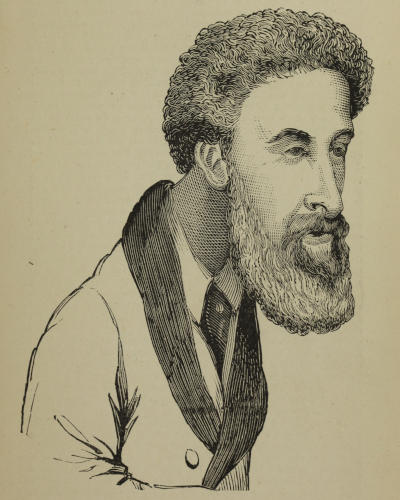
ROBERT, LORD LYTTON.
It would appear that E—— J——, not having told lies enough, and done dirty work enough in the country, must needs re-commence after his outlawry; for it is only last year, in America, that upon a woman being tried for the murder of her husband, and the defence set up being his barbarous usage of her, that the Judge said, “If brutal usage and persecution was an excuse for committing murder, I ought to have murdered Sir Edward Bulwer Lytton long ago, if only half the papers had stated about his brutal treatment and persecutions of me was true.” Whereupon, that model of all honour and truth! Mr. E—— J——, rose up in Court and said, “He must beg to set the Judge right on that point, for that Lady Lytton had never complained (!!) of unkindness from Sir Edward, and could not!!! and that it was only last year, just before he (E—— J——) quitted England, that Sir Edward, having been left a large fortune by a relation” (Oh!! Mr. J——! what next? and next?) “he had generously doubled his wife’s income”!!!!! There! let his Satanic Majesty beat that if he can! I of course instantly wrote to the New York Times (as these most infamous and barefaced lies had appeared in that beastly Daily Telegraph), refuting them, and saying, “that for the many colossal falsehoods, for which Mr. E—— J—— was proverbial, never had he dared to utter any equal in magnitude to these!” But as my doing so had of course been anticipated, and the Press of all countries is equally corrupt and venal, “The Editor of the New York Times could not publish my letter, as its contents referred to strictly private and family matters!!” This is quite England over again, where the most horrible lies and calumnies by a husband (in power) are to be given full and world-wide publicity! but if the victim wife dares to refute them, ah! then they become strictly private, and personal affairs, and no newspaper, for fear of the Law of Libel, will give any refutations admission into their columns! And so this meanest and cruellest of all Villains and Cowards! Sir Edward Bulwer Lytton, who has not even the courage of his loathsome vices, goes on for ever, strutting over the ruins of the moral Carthage he has razed, and heralding forth to posterity, through the brazen trumpet of mendacity, all the inverse virtues of his hideous and manifold vices. But let the wretch beware! The last time, a wave of my fan drove the cowardly reptile from the Hertford hustings, but only let him dare ever again to parade his physical and moral leprosy upon any hustings; and he shall find his escape shall not be so easy. After I had declined any further intercourse with my useful, and honourable, and veracious trustee, Dr. R——, his petty spite was to keep me each quarter two or three weeks out of my beggarly pittance, a most serious inconvenience to me; but their calculation was, no doubt, that I should, as of old, eat it all up in paying lawyers to obtain it, Pas si bete. So, pondering the matter a little while, a bright thought struck me. I went down to Foden Lawrence the Quaker, and asked him “if he would each quarter, on the day it was due, pay me this beggarly £125, and send Dr. R—— my receipt for it, making him repay him. He said “with pleasure,” and wrote to Dr. R——: “As I think it a most scandalous shame that, used as she has already been, Lady Lytton should be kept one hour out of so scandalously inadequate a pittance, I have this day paid her the £125 due to her; and shall continue to do so punctually, every quarter when it becomes due, and I enclose thee her receipt for the £125 paid this day, and will thank thee to send me a cheque by return of post for the amount.—Foden Lawrence.”
And as, like all knaves, these cowardly wretches are mortally afraid of an honest, straightforward, and resolute man, and of my fighting Quaker in particular, he has ever since, now four years, paid me to the day, and got the money from them by return of post. Meanwhile that dastardly villain, Sir Edward Bulwer Lytton, is comfortably playing out his game of lies; his victim buried alive, too poor to mix in the society to which she belongs, and too proud to go upon sponging visits she cannot repay by invitations in return, to say nothing of this being the only place I could ever feel safe in while that monster lives, as here, after the uproar there was, he never dare attempt any fresh villainy. I am doubly crippled by that trapped journey abroad, having done much, which having known all I now know, I should not have done. I don’t mean about poor little Jeanne Hestier, for that is a drop in the sea, and, moreover, having told good Mrs. Clarke that as long as I live, whether here or not, I shall always pay her the same, which I thought was the least I could do after her kindness and fidelity to me, you may suppose I have no money to go about with; so being all the same as if I were buried dead, instead of only being buried alive, of course the outer public believe (as Sir Liar has worked so hard for them to do) that I really am mad, or imbecile, or something, or else I of course should have brought an action for false imprisonment and conspiracy against those villainous mad doctors long ago, or got a divorce from that monster, or been seen or heard of somewhere. It is little matter what they think—God and my own conscience know the truth. But it is hard, bitterly cruelly hard! Still I would not change with one of the wretches, more especially H—— H——, and H——, who have now gone to their fearful account! A lady was here the other day, furious! at that vile wretch, Sir L., having dared to come so near me as Bath. “Pooh! never mind,” said I, “He can’t be more near than he has always been.” About six months after my return from that trapped journey, I heard that Mr. Robert Lytton’s marriage was broken off, his father having broken faith with him (as I told him he would), and given him nothing to marry on; and that he had quarrelled with his father. He was then first paid attaché at Vienna; despite my having written to him to say all intercourse must cease between us, when he was trying with that vile Miss R—— to purloin those letters; now that he was in such deep misery, and I know in such deep humiliation, at the unworthy part he had acted when so noble a one was before him, I felt I was still his mother; and wrote to him a letter, which, if he had had a heart of stone, provided it were only in the shape of a heart! and a conscience, even if no bigger than a midje’s egg, he would have answered! but he never has. I then thought that if he could not trust the Embassy bag, and was equally afraid of the post with such a father, whose Jesuitical influence he believes to be ubiquitous—that as he was at Copenhagen when his great friend Sir Augustus Paget came over here for the Prince of Wales’s marriage, that surely he might have trusted him;—but no—nothing. Never mind, he’ll want me, before I want.
And now, sir, I ought to, and would make you many apologies for inflicting upon you such a long, and to you—necessarily uninteresting history—but that I read and believed the “Notice” appended to your last (every one says) “masterly work,” and have done you the honour of taking you for an honest man. And hence this otherwise unwarrantable infliction. As I told you at the commencement of this letter, I want you to do nothing for me; for nothing can now be done; and yet for three things in your power to do, without in any way compromising yourself, I should be very grateful to you:—
Firstly. To tell the facts herein contained as far, and as wide as you can.
Secondly. In telling them, to say nothing of, or nothing against my truly unfortunate son, who, God knows, is well punished! for the fearful weakness in which he has been purposely trained, by his relentless and unscrupulous father, that he might effectually crush by moulding him resistlessly to his will.
Thirdly. As a man of real genius, as you are, you must be in the habit of analysing human nature, by a sort of psychological vivisection, or you never could produce the photographs of characters you do. Can you then conjecture, or suggest any clue, to my unhappy son’s contradictory conduct? Emanating as it were from two distinctly opposite natures; the one almost angelic, the other almost the reverse. But putting his weakness, and more than Hamletish dreamy irresolution out of the analysis; you must not seek a solution of his unworthy conduct in the equally unworthy and mundane fear of being disinherited. No doubt his vile father! would leave him a beggar, if he could, but that he might not immolate all to his own Juggernaut selfishness, Knebworth is not only strictly entailed upon his son, but luckily, stringently 12 deep after him, or Sir L. might have got his poor weak victim to cut off the entail. If you can solve this enigma, I should be so grateful.
I have the honour to be, sir,
Your obedient servant,
ROSINA BULWER LYTTON.
Wednesday, February 10th, 1864.
P.S.—One thing I forgot to mention to you, which was, that the last time I saw that double-dealing sneak, Dr. R——, which was the day that upon leaving town I asked him to write to Mr. Ironside about the swindle of my book; he said suddenly, apropos de bottes, “the fact is we have been completely sold!” which solitary truth from him was, as you may suppose, a great consolation to me, seeing how indefatigably he had assisted in selling me. He then added, clenching his hand, and muttering to himself, “Well, I think I’d have begged my bread before I could have used my mother so!” It is he that would! But it is so easy always to say the right and do the wrong thing, which is the compromise most men make with the Devil.—R.B.L.