Volume 2 — VOLUME II. (continued 6)
Reading edition
This western front, or facade, is divided into three stages or compartments. The bottom or lower one is occupied by three magnificent porches; of which the central is by far the loftiest and most ornamental. The period of their execution is from the year 1270 to 1320: a period, when gothic architecture was probably at its highest pitch of perfection. The central porch is divided into five compartments on each side--forming an angle of about forty-five degrees with the door-way. The lower parts of these divisions contain each a statue, of the size of life, upon its respective pediment. The upper parts, which blend with the arch-like construction, are filled with small statues, upon pediments, having a sort of brilliant, fretted appearance. All these figures are representations of characters in Scripture. Again, above this archway, forming the central ornaments of the sharper angles, are the figures of the Almighty, the Virgin and Child, and Solomon. In front, above the door way, upon a flat surface, are four sculptured compartments; devoted to scriptural subjects. The same may be said of the right and left porch. They are equally elaborate, and equally devoted to representations of scriptural subjects. They will have it, that, according to tradition, the daughter of Ervin de Steinbach, the chief architect of the western front, worked a great deal at this central porch, and even sculptured several of the figures. However this may be, the tout ensemble is really beyond any thing which could be satisfactorily conveyed by a written description.
We now cast our eye upon the second division of this stupendous facade; and here our attention is almost exclusively devoted to the enormous circular or marygold window, in the central compartment. It is filled with stained glass--and you are to know that the circumference of the outer circle is one hundred and sixty-English feet: or about fifty-three feet in diameter; and I challenge you to shew me the like--in any building of which you have any knowledge!
Perhaps the most wonderful part of this structure is the open filigree work of the tower, immediately above the platform: though I admit that the spiral part is exceedingly curious and elaborate. Of course there was no examining such a wonder without mounting to the platform, and ascending the tower itself. The platform is about three hundred feet from the pavement. We quitted this tenement, and walked straight forward upon the platform. What a prospect was before us. There flowed the RHINE! I felt an indescribable joy on my first view of that majestic river. There it flowed ... broad and rapid ... and apparently peaceful, within its low banks. On the other, or eastern side of it, was a range of lofty hills, of a mountainous character. On the opposite side of the town ran the great chain of hills--called the VOSGES--which we had crossed in our route hither; and of which we had now a most extensive and unobstructed view. These hills were once the abode of adventurous chieftains and powerful nobles; and there was scarcely an eminence but what had been formerly crowned by a baronial castle.208 Below, appeared the houses of Strasbourg ... shrunk to rabbit-hutches--and the people ... to emmets!
It remained to ascend the opposite tower. At each of the four corners there is a spiral stair-case, of which the exterior is open work, consisting of slender but lofty pillars; so that the ascending figure is seen at every convolution. It has a fearful appearance to the adventurer: but there is scarcely the possibility of danger. You go round and round, and observe three distinct terminations of the central work within--forming three roofs--of which, the third is eminently beautiful. I could not help expressing my astonishment at some of the exterior columns, which could not be much less than threescore feet in height, and scarcely twelve inches in diameter! Having gained the top of one of these corner spiral stair-cases, I breathed and looked around me. A new feature presented itself to my view. About one hundred feet beneath, was the body of this huge cathedral. Immediately above, rose the beautifully-tapering and curiously ornamented SPIRE--to the height of probably, one hundred and twenty-five feet! It seemed indeed as if both tower and spire were direct ladders to the sky. The immortal artist who constructed them, and who lived to witness the completion of his structure, was JOAN HÜLTZ, a native of Cologne. The date of their completion is 1449. Thus, on the continent as well as in England, the period of the most florid style of gothic architecture was during the first half of the fifteenth century.
I essayed to mount to the very pinnacle; or bouton of the spire; but the ascent was impracticable--owing to the stair-case being under repair. On the summit of this spire, there once stood a statue of the Virgin, above a cross. That statue was taken down at the end of the fifteenth century, and is now placed over the south porch. But, what do you think supplied its place during the late Revolution, or in the year of our Lord 1794, on the 4th day of May? Truly, nothing less than a large cap, made of tin, and painted red--called the Cap of Liberty! Thank heaven, this latter was pulled down in due time--and an oblong diamond-shaped stone is now the finishing piece of masonry of this wonderful building. In descending, I stopped again at the platform, and was requested to see the GREAT BELL; of which I had heard the deep-mouthed roar half a dozen times a day, since my arrival. It is perhaps the finest toned bell in Europe, and appeared to me terrifically large--being nearer eight than seven feet high.209 They begin to toll it at four or five o'clock in the summer-mornings, to announce that the gates of the town are opened. In case of fire at night, it is very loudly tolled; and during a similar accident in the day time, they suspend a pole, with a red flag at the end of it, over that part of the platform which is in a line with the direction of the fire.
A grand defect in the structure of this Cathedral, as it strikes me, is, that the nave and transepts do not seem to belong to such a western front. They sink into perfect insignificance. Nor is the style of their exterior particularly deserving of description. Yet there is one feature in the external architecture of this Cathedral--namely, a series or suite of DROLLERIES ... of about four or five feet high ... which cannot fail to attract the antiquary's especial notice. These figures are coarsely but spiritedly cut in stone. They are placed upon the bracket which supports the galleries, or balcony, of the eastern side of the facade of the tower, and are about sixty-five English feet from the ground. They extend to thirty-two feet in length. Through the kind offices of my friend Mr. Schweighæuser, junior, (of whom by and by) I have obtained drawings of these droll subjects,210 and I am sure that, in common with many of our friends, you will be amused with the sight of a few of them. They are probably of the date of 1370;
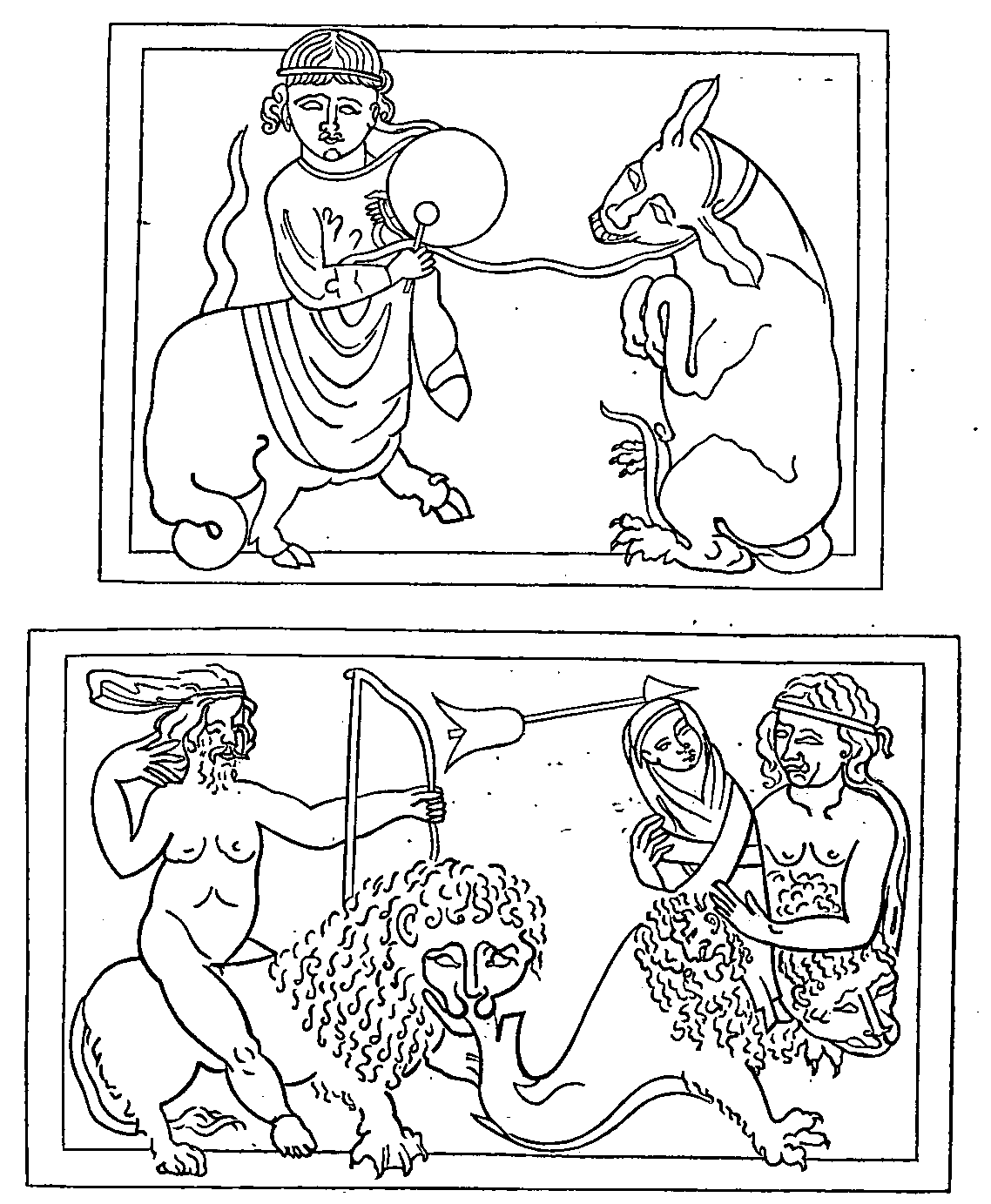
The common people call this series the Sabbath of Demons, or the Dance of the Witches. You are to know, however, that on the opposite side of the cathedral there is a series of figures, of the same size, and executed nearly in the same style of art, descriptive of scriptural events, mixed with allegorical subjects. Having now pointed out what appears to me to be chiefly interesting in the exterior of this marvellous building, it is right that I give you some notion of its interior: which will however occupy but a short portion of your attention. Indeed--I grieve to speak it--both the exterior and interior of the nave are wholly unworthy of such a magnificent west-front.
The nave and choir together are about three hundred and fifty-five English feet in length; of which the nave is two hundred and forty-four--evidently of too scanty dimensions. The width of the nave and side aisles is one hundred and thirty-two feet: the height of the nave is only seventy-two feet. The larger of the nine clustered columns is full seventy-two feet in circumference; the more delicate, thirty feet. There is really nothing striking in this nave; except that, on turning round, and looking up to the painted glass of the circular or marygold window, you observe the colours of it, which are very rich, and absolutely gay, compared with those of the other windows. There is a profusion of painted glass in almost all the windows; but generally of a sombre tint, and of a correspondent gloomy effect. Indeed, in consequence of this profusion, the cathedral absolutely wants light.
The choir is sixty-seven feet wide, without side aisles, and is much lower than the nave. It is impossible to speak of this choir without indignation. My good friend--the whole of this interior has recently undergone rather a martyrdom than a metamorphosis. The sides are almost entirely covered with Grecian pilasters and pillars; and so are the ornaments about the altar. What adds to the wretched effect of the whole, is, a coat of white-wash, which was liberally bestowed upon it some forty years ago; and which will require at least the lapse of another century to subdue its staring effect. There are only three chapels in this cathedral. Of altars there are not fewer than twelve: the principal being in the chapels of St. Lawrence and St. Catharine.
It was near the chapel of St. Catharine, that, on the morning of our first visit, we witnessed a group of country people, apparently from the neighbourhood of Saverne--from their huge, broad, flat hats--engaged in devotion before the image of some favourite saint. The rays of a bright sun darted through the windows, softened by the varied tints of the stained glass, upon their singular countenances and costumes; and the effect was irresistibly striking and interesting.
In the centre of the south transept, there rises a fine, slender, clustered column, reaching to its very summit. On the exterior of this column--placed one above another, but retreating or advancing, or in full view, according to the position of the spectator--are several figures, chiefly females; probably five feet high, with labels or scrolls, upon each of which is an inscription. I never saw any thing more elegant and more striking of its kind. These figures reach a great way up the pillar--probably to the top--but at this moment I cannot say decidedly. It is here, too, that the famous Strasbourg Clock, (about which one Dasypodius hath published a Latin treatise in a slim quarto volume211 is placed. This, and the tower, were called the two great wonders of Germany. This clock may be described in few words: premising, that it was preceded by a clock of very extraordinary workmanship, fabricated in the middle of the fourteenth century--of which, the only existing portion is, a cock, upon the top of the left perpendicular ornament, which, upon the hourly chiming of the bells, used to flap his wings, stretch out his neck, and crow twice; but being struck by lightning in the year 1640, it lost its power of action and of sending forth sound. No modern skill has been able to make this cock crow, or to shake his wings again. The clock however is now wholly out of order, and should be placed elsewhere. It is very lofty; perhaps twenty feet high: is divided into three parts, of which the central part represents Our Saviour and Death, in the middle, each in the act as if to strike a bell. When, in complete order, Death used to come forward to strike the quarters; and, having struck them, was instantly repelled by our Saviour. When he came forward to strike the hour, our Saviour in turn retreated:--a whimsical and not very comprehensible arrangement. But old clocks used to be full of these conceits.
Upon throwing an eye over what I have just written, I find that I have omitted to notice the celebrated STONE PULPIT, in the nave, enriched with small figures--of the latter end of the fifteenth century. In fact, the date of 1485, in arabic numerals, (if I remember rightly) is at the bottom of it, to the right of the steps. This pulpit, my good friend, is nothing less than the very ecclesiastical rostrum from which the famous John Geyler thundered his anathemas against the monkish clergy. You may remember that some slight notice was taken of it at the beginning of this letter, in which the progress of Protestantism at Strasbourg was attempted to be traced. I will frankly own to you, that, of all pulpits, throughout Normandy, or in Paris--as yet examined by me--I have seen none which approaches to THIS; so rich, varied, and elaborate are its sculptured ornaments.212 The Revolutionists could only contrive to knock off the figure which was upon the top of the canopy, with other contiguous ornaments; all of which might be easily restored.
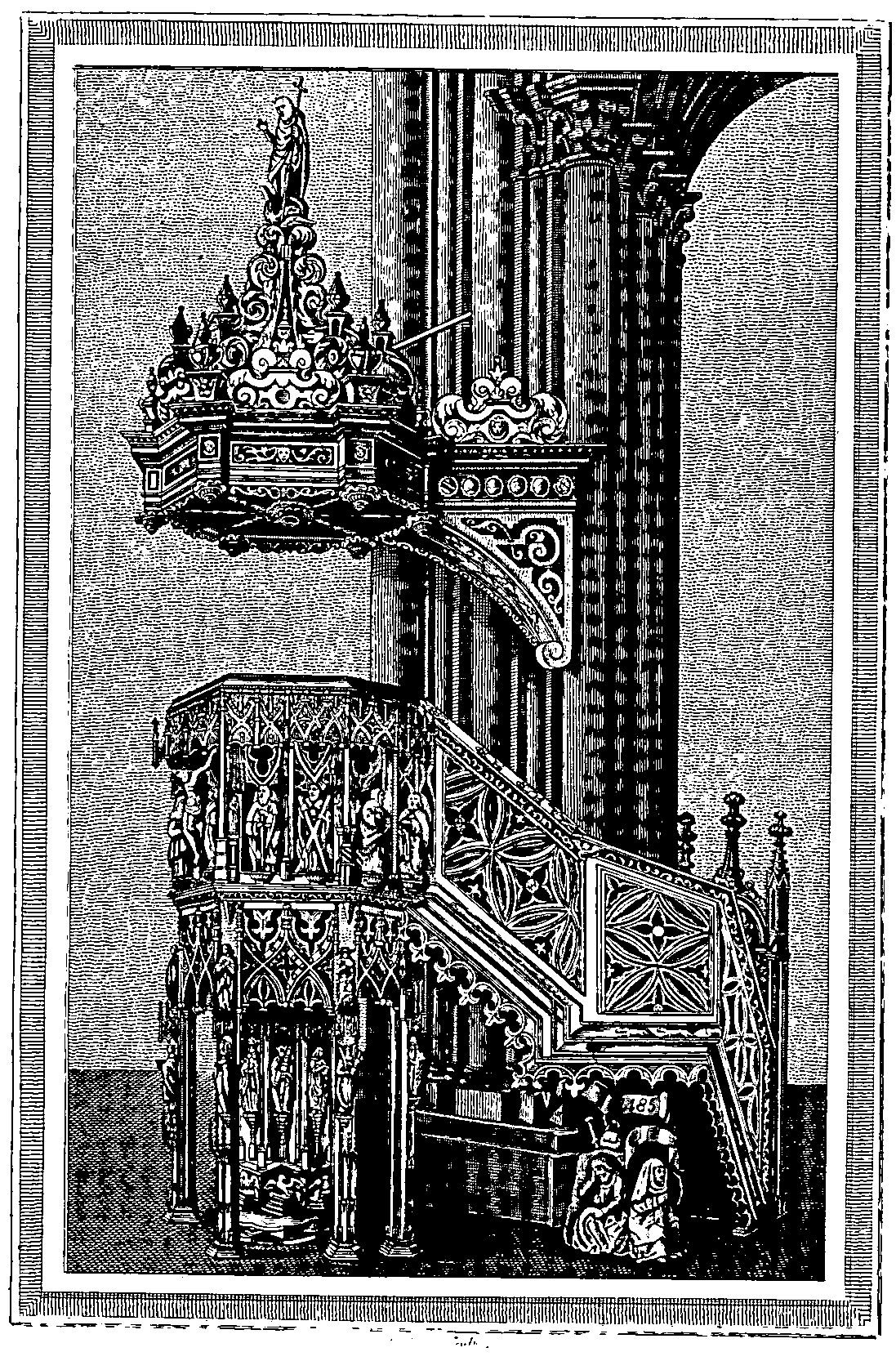
STONE PULPIT, STRASBOURG CATHEDRAL.
A word now about the great Organ. If Strasbourg have been famous for architects, masons, bell-founders, and clock-makers, it has been not less so for organ builders. As early as the end of the thirteenth century, there were several organs in this cathedral: very curious in their structure, and very sonorous in their notes. The present great organ, on the left side of the nave, on entering at the western door, was built by Silbermann about a century-ago: and is placed about fifty feet above the pavement. It has six bellowses, each bellows being twelve feet long and six wide: but they are made to act by a very simple and sure process. The tone is tremendous--when all the stops are pulled out--as I once heard it, during the performance of a particularly grand chorus! Yet is this tone mellow and pleasing at the same time. Notwithstanding the organ could be hardly less than three hundred feet distant from the musicians in the choir, it sent forth sounds so powerful and grand--as almost to overwhelm the human voice, with the accompaniments of trombones and serpents. Perhaps you will not be astonished at this, when I inform you that it contains not fewer than two thousand two hundred and forty-two pipes. This is not the first time you have heard me commend the organs upon the Continent.
One of the most remarkable features belonging to the history of Strasbourg cathedral, is, the number of shocks of earthquakes which have affected the building. It is barely possible to enumerate all these frightful accidents; and still more difficult to give credence to one third of them. They seem to have happened two or three times every century; and, latterly, yet more frequently. Take one recital as a specimen: and believe it--if you can. In the year 1728, so great was the agitation of the earth, that the tower was moved one foot out of its perpendicular direction--but recovered its former position presently. "What however is quite certain--(says Grandidier)--the holy water, contained in a stone reservoir or basin, at the bottom of a column, near the pavement, was thrown by this same agitation, to upwards of half the height of a man--and to the distance of eighteen feet! The record of this marvellous transaction is preserved in a Latin inscription, on a slab of black marble, fastened to the lower part of the tower, near the platform."213 In 1744 a severe tempest of thunder and lightning occasioned some serious injuries to portions of the cathedral; but in 1759 it suffered still more from a similar cause. Indeed the havoc among the slighter ornamental parts, including several delicately carved figures, is recorded to have been dreadful.
Of the subordinate churches of Strasbourg, the principal, both for size and antiquity, is that of St. Thomas. I visited it several times. The exterior is one of the most tasteless jumbles of all styles and ages of art that can be imagined; and a portion of it is covered with brick. But I question if there be not parts much older than the cathedral. The interior compensates somewhat for the barbarism of the outside. It is large and commodious, but sadly altered from its original construction; and has recently been trimmed up and smartened in the true church-warden style. The great boast of this church is its MONUMENTS; which, it must be confessed, are upon the whole exceedingly interesting. As to their antiquity, I noticed two or three of the thirteenth century; but they pretend to run up as high as the tenth. Indeed I saw one inscription of the eleventh century--executed in gothic letters, such as we observe of the latter end of the sixteenth. This could not be a coeval inscription; for I doubt whether there exist, any where, a monumental tablet of the eleventh century executed in coeval gothic letters. The service performed here is after the confession of Augsbourg; in other words, according to the reformed Lutheran church. A small crucifix, placed upon an altar between the nave and the choir, delicately marks this distinction; for Luther, you know, did not wage an interminable war against crucifixes.
Of modern monuments, the boast and glory of this church is that of the famous MARSHAL SAXE; who died at the age of 55, in the year 1755. While I was looking very intently at it, the good verger gently put a printed description of it into my hands, on a loose quarto sheet. I trust to be forgiven if I read only its first sentence:--Cette grande composition réunit aux richesse de l'art des Phidias et des Bouchardon, les traits de la grande poésie." "Take any shape but this"--thought I to myself--and, folding it up as gently as it had been delivered to me, I put it into my pocket. My good friend, I do beseech you to hear me out--when I preface my remarks by saying, that, of all monuments, this is one of the most tasteless and uninteresting. Listen to a brief but faithful description of it.
An immense pyramidal-shaped gray marble forms the background. Upon such a back-ground there might have been a group of a dozen figures at least. However, there happen to be only four of the human species, and three of animals. These human figures are, the Marshal; a woman weeping lustily--I had almost said blubbering; (intended to represent France) Hercules; and a little child--of some order or degree, not less affected than the female. The animals are, a lion, a leopard, (which latter has a bear-like form) and an eagle. I will now tell you what they are all doing. Before the Marshal, is an opened grave; into which this illustrious hero, clad in complete armour, is about to march with a quiet, measured step--as unconcernedly, as if he were descending a flight of steps which led to a conservatory. The woman--that is France--is, in the meantime, weeping aloud; pointing to the grave, and very persuasively intreating the Marshal to enter--as his mortal moments have expired. I should add that death--a large formidable-looking figure, veiled by a piece of drapery, is also at hand: seeming to imply that hesitation and reluctance, on the part of the hero, are equally unavailing. Next comes Hercules; who is represented as stationary, thoughtful, and sorrow-stricken, as France is agitated and in motion. The lion and leopard (one representing Holland, and the other England--intending to convey the idea that the hero had beaten the armies of both countries) are between the Marshal and Hercules: the leopard is lying upon his back--in a very frolicksome attitude. The lion is also not less abstracted from the general grief of the figures. And this large, ugly, unmeaning composition--they have the temerity to call the union of art by Phidias and Bouchardon--with the inspiration of sublime poetry! I will make no comments.214 It is one of those felicitous efforts which have the enviable distinction of carrying its own text and commentary. Below this vast mural monument, is a vault, containing the body of the Marshal. I descended into it, and found it well ventilated and dry. The coffin is immediately obvious: it contains the body of the chieftain enclosed in two cases--of which the first is silver, and the second copper. The heart is, I believe, elsewhere.
Forming a strikingly happy contrast to this huge, unmeaning production- -are the modest and unassuming monuments of Schoepflin, Oberlin, and Koch: men, of whom Strasbourg has good reason to be proud. Nor let the monument of old Sebastian Schmidt escape the notice and commendation of the pensive observer. These were all "fine fellows in their day:" and died, including the illustrious Marshal, steady in the faith they had espoused--that is, in the belief and practice of the tenets of the reformed church. I have no time for a particular description of these monuments. Schoepflin's consists of a bronze bust of himself placed in the front of a white marble urn, between two cinnamon-colour columns, of the Corinthian order--of free stone. The head is thought to be very like. Oberlin's is in better taste. You see only his profile, by Ohmacht, in white marble--very striking. The accompaniments are figures in white marble, of which a muse, in rilievo, is larger than life. The inscriptions, both for Schoepflin and Oberlin, are short and simple, and therefore appropriate. The monument of Koch is not less simple. It consists of his bust--about to be crowned with a fillet of oaken leaves--by a figure representing the city of Strasbourg. Below the bust is another figure weeping--and holding beneath its arms, a scroll, upon which the works of the deceased are enumerated. Koch died in his seventy-sixth year, in the year 1813. Ohmacht is also the sculptor of Koch's monument. Upon the whole, I am not sure that I have visited any church, since the cathedral of Rouen, of which the interior is more interesting, on the score of monuments, than that of St. Thomas at Strasbourg.
I do not know that it is necessary to say any thing about the old churches of St. Stephen and St. Martin: except that the former is supposed to be the most ancient. It was built of stone, and said to be placed upon a spot in which was a Roman fort--the materials of which served for a portion of the present building. St. Martin's was erected in 1381 upon a much finer plan than that of St. Arbogaste--which is said to have been built in the middle of the twelfth century. Among the churches, now no longer wholly appropriated to sacred uses, is that called the New Temple--attached to which is the Public Library. The service in this church is according to the Protestant persuasion. I say this Church is not wholly devoted to religious rites: for what was once the choir, contains, at bottom, the BOOKS belonging to the public University; and, at top, those which were bequeathed to the same establishment by Schoepflin. The general effect--both from the pavement below, and the gallery above--is absolutely transporting. Shall I tell you wherefore? This same ancient choir--now devoted to printed tomes--contains some lancet-shaped windows of stained glass of the most beautiful and exquisite pattern and colours!... such as made me wholly forget those at Toul, and almost those at St. Owen. Even the stained glass of the cathedral, here, was recollected ... only to suffer by the comparison! It should seem that the artist had worked with alternate dissolutions of amethyst, topaz, ruby, garnet, and emerald. Look at the first three windows, to the left on entering, about an hour before sun-set:--they seem to fill the whole place with a preternatural splendor! The pattern is somewhat of a Persian description, and I should apprehend the antiquity of the workmanship to be scarcely exceeding three hundred years. Yet I must be allowed to say, that these exquisitely sparkling, if not unrivalled, specimens of stained glass, do not belong to a place now wholly occupied by books. Could they not be placed in the chapel of St. Lawrence, or of St. Catharine, in the cathedral?
As I am now at the close of my account of ecclesiastical edifices--and as this last church happens to be closely connected with a building of a different description--namely, The PUBLIC LIBRARY--you will allow me to colophonise my first Strasbourg epistle with some account of the contents of this library.
The amiable and excellent younger Schweighæuser, who is head librarian, and one of the Professors in this Gymnase, was so obliging as to lend me the key of the library, to which I had access at all hours of the day. The public hours are from two till four, Sundays excepted. I own that this accommodation was extremely agreeable and convenient to me. I was under no restraint, and thus left to my own conscience alone not to abuse the privilege conceded. That conscience has never given me one "prick" since the conclusion of my researches.215
My researches were usually carried on above stairs, at the table where the visitors sat. Of the MSS. I did not deem it worth while to take any particular account; but there was one, so choice, so splendid, so curious, so interesting, and in such an extraordinary state of preservation, that you may as well know it is called the famous Hortus Deliciarum of Herarde, Abbess of Landsberg. The subjects are miscellaneous; and most elaborately represented by illuminations. Battles, sieges, men tumbling from ladders which reach to the sky--conflagrations, agriculture--devotion, penitence--revenge, murder,--in short, there is hardly a passion, animating the human breast, but what is represented here. The figures in armour have nasals, and are in quilted mail: and I think there can be little doubt but that both the text and the decorations are of the latter end of the twelfth century. It is so perfect in all its parts, and so rich of its particular description, that it not only well merits the labour which has been bestowed upon it by its recent editor Mr. Engleheardt, but it may probably vie with any similar production in Europe.216
However, of other MSS. you will I am sure give me credit for having examined the celebrated Depositions in the law-suit between Fust and Gutemberg--so intimately connected with the history of early printing, and so copiously treated upon by recent bibliographers.217 I own that I inspected these depositions (in the German language) with no ordinary curiosity. They are doubtless most precious; yet I cannot help suspecting that the character or letter is not of the time; namely of 1440. It should rather seem to be of the sixteenth century. Perhaps at the commencement of it. These documents are written in a small folio volume, in one uniform hand--a kind of law-gothic--from beginning to end. The volume has the following title on the exterior; "Dicta Testium magni consilij Anno dni mo. cccco. Tricesimo nono. The paper is strong and thick, and has a pair of scales for the water-mark. The younger Schweighæuser thinks my doubts about its age not well founded; conceiving it to be a coeval document. But this does not affect its authenticity, as it may have been an accurate and attested copy--of an original which has now perished. Certainly the whole book has very much the air of a Copy: and besides, would not the originals have been upon separate rolls of parchment?218
I now come to the PRINTED BOOKS: of which, according to the MS. catalogue by Oberlin, (who was head librarian here) there are not fewer than four thousand three hundred, printed before the year 1520:--and of these, again, upwards of eleven hundred without dates. This, at first hearing, sounds, what the curious would call, promising; but I must say, that of the dated and dateless books, printed before the year 1500, which I took down, and carefully opened--and this number could not be less than four or five hundred--there was scarcely one in five which repaid the toil of examination: and this too, with a thermometer frequently standing at eighty-nine and ninety, in the shade in the open air! Fortunately for my health, and for the exertion of physical strength, the public library happened to be very cool--while all the windows were opened, and through the openings was frequently heard the sound of young voices, practising the famous Martin Luther's Hymn--as it is called. This latter was particularly grateful to me. I heard the master first sing a stave, and he was in general accurately followed by his pupils--who displayed the well-known early tact of Germans in the science of music. But to revert to the early printed books.
FIRST GERMAN BIBLE; supposed to have been printed by Mentelin; without date: Folio. Towards the latter half of this copy, there are some interesting embellishments, in outline, in a bistre tint. The invention and execution of many of them are admirable. Where they are coloured, they lose their proper effect. An illumination, at the beginning of the book of Esther, bears the unequivocal date of 1470: but the edition was certainly four or five years earlier. This Bible is considered to be the earliest German version: but it is not so.
LATIN BIBLE, BY MENTELIN: in his second character. This Bible I saw for the first time; but Panzer is decidedly wrong in saying that the types resemble the larger ones in Mentelin's Valerius Maximus, Virgil and Terence: they may be nearly as tall, but are not so broad and large. From a ms. note, the 402d leaf appears to be wanting. This copy is a singularly fine one. It is white, and large, and with rough edges throughout. It is also in its first binding, of wood.
LATIN BIBLE; printed by Eggesteyn. Here are several editions, and a duplicate of the first--which is printed in the second smallest character of Eggesteyn.219 The two copies of this first edition are pretty much alike for size and condition: but one of them, with handsome illuminations at the beginning of each volume, has the precious coeval ms. date of 1468--as represented by the fac-simile of it in Schoepflin's Vind. Typog. Tab. V. Probably the date of the printing might have been at least a year earlier.
LATIN BIBLE: printed by Jenson, 1479. Folio. A fine copy, upon paper. The first page is illuminated.
To this list of impressions of the SACRED TEXT, may be added a fine copy of the SCLAVONIAN BIBLE of 1584, folio, with wood cuts, and another of the HUNGARIAN Bible of 1626, folio: the latter in double columns, with a crowdedly-printed margin, and an engraved frontispiece.
As to books upon miscellaneous subjects, I shall lay before you, without any particular order, my notes of the following: Of the Speculum Morale of P. Bellovacensis, here said to be printed by Mentelin in 1476, in double columns, roman type, folio--there is a copy, in one volume, of tremendously large dimensions; as fine, clean, and crackling as possible. Also a copy of the Speculum Judiciale of Durandus, printed at Strasbourg by Hussner and Rekenhub, in 1473, folio. Hussner was a citizen of Strasbourg, and his associate a priest at Mentz. Here is also a perfect copy of the Latin PTOLEMY, of the supposed date of 1462, with a fine set of the copper-plates.
But I must make distinct mention of a Latin Chronicle, printed by Gotz de Sletztat in 1474, in folio. It is executed in a coarse, large gothic type, with many capital roman letters. At the end of the alphabetical index of 35 leaves, we read as follows:
DEO GRATIAS. A tpe ade vsqz ad annos cristi 1474 Acta et gesta hic suffitienter nuclient Sola spes mea. In virginis gracia Nicholaus Gotz. De Sletzstat.
The preceding is on the recto; on the reverse of the same leaf is an account of Inventors of arts: no mention is made of that of printing. Then the prologue to the Chronicle, below which is the device of Gotz;220 having his name subjoined. The text of the Chronicle concludes at page CCLXXX--printed numerals--with an account of an event which took place in the year 1470. But the present copy contains another, and the concluding leaf--which may be missing in some copies--wherein there is a particular notice of a splendid event which took place in 1473, between Charles Duke of Burgundy, and Frederick the Roman Emperor, with Maximilian his Son; together with divers dukes, earls, and counts attending. The text of this leaf ends thus;
SAVE GAIRT VIVE BVRGVND.
Below, within a circle, "Sixtus quartus." This work is called, in a ms. prefix, the Chronicle of Foresius. I never saw, or heard of, another copy. The present is fine and sound; and bound in wood, covered with leather.
Here are two copies of St. Jerom's Epistles, printed by Schoeffher in 1470; of which that below stairs is one of the most magnificent imaginable; in two folio volumes. Hardly any book can exceed, and few equal it, in size and condition--unless it be the theological works of ARCHBISHOP ANTONIUS, printed by Koeberger, in 1477, in one enormous folio volume. As a specimen of Koeberger's press, I am unable at the present moment to mention any thing which approaches it. I must also notice a copy of the Speculum Humanæ Salvationis, printed at Basle, by Richel, in 1476, folio. It is a prodigious volume, full of wood cuts, and printed in double columns in a handsome gothic type. This work seems to be rather a History of the Bible; having ten times the matter of that which belongs to the work with this title usually prefixed. The copy is in its original wooden binding.
JUNIANUS MAIUS. De Propriet. Priscor. Verborum, printed at Treviso by Bernard de Colonia, 1477, folio. I do not remember to have before seen any specimen of this printer's type: but what he has done here, is sufficient to secure for him typographical immortality. This is indeed a glorious copy--perfectly large paper--of an elegantly printed book, in a neat gothic type, in double columns. The first letter of the text is charmingly illuminated. I shall conclude these miscellaneous articles by the notice of two volumes, in the list of ROMANCES, of exceedingly rare occurrence. These romances are called Tyturell and Partzifal. The author of them was Wolfram von Escenbach. They are each of the date of 1477, in folio. The Tyturell is printed prose-wise, and the Partzifal in a metrical form.
We now come to the Roman CLASSICS, (for of the Greek there are few or none)--before the year 1500. Let me begin with Virgil. Here is Mentelin's very rare edition; but cropt, scribbled upon, and wanting several leaves. However, there is a most noble and perfect copy of Servius's Commentary upon the same poet, printed by Valdarfer in 1471, folio, and bound in primitive boards. There are two perfect copies of Mentelin's edition (which is the first) of VALERIUS MAXIMUS, of which one is wormed and cropt. The other Mentelin copy of the Valerius Maximus, without the Commentary, is perhaps the largest I ever saw--with the ancient ms. signatures at the bottom-corners of the leaves. Unluckily, the margins are rather plentifully charged with ms. memoranda.
Of CICERO, there are of course numerous early editions. I did not see the De Officiis of 1465, or of 1466, of which Hermann speaks, and to which he affixes the novel date of 1462:--but I did see the De Oratore, printed by Vindelin de Spira without date; and such a copy I shall probably never see again! The colour and substance of the paper are yet more surprising than the size.
It is hardly possible to see a finer copy of the Scriptores Hist. Augustæ, printed by P. de Lavagna in 1475, folio. It possesses all the legitimate evidences of pristine condition, and is bound in its first coat of oak. Here is a very fine copy of the Plutarchi Vitæ Paralellæ, printed in the letter R, in two large folio volumes, bound in wood, covered by vellum of the sixteenth century. But, if of any book, it is of the first edition of Catullus Tibullus et Propertius, of 1472, folio--that this Library has just reason to be proud. Here are in fact two copies, equally sound, pure and large: but in one the Propertius is wanting;221 in lieu of which, however, there is the first edition of JUVENAL and PERSIUS by V. de Spira--in equal purity of condition. The perfect copy has the SYLVÆ of STATIUS subjoined. It should seem, therefore, that the Juvenal and Persius had supplied the place of the Propertius and Statius, in one copy. You are well aware of the extreme rarity of this first edition of Catullus Tibullus et Propertius.
I now take leave of the Public Library of Strasbourg; not however without mentioning rather an amusing anecdote connected with some of the books just described; nor without an observation or two upon the present state of the library. The anecdote is thoroughly bibliographical. After having examined some of the finer books before mentioned, and especially having dwelt upon the Latin Bible of Mentelin, and a few copies of the rarer Classics, I ventured to descant upon the propriety of parting with those for which there was no use, and which, without materially strengthening their own collection, might, by an advantageous sale, enable them to enrich their collection by valuable modern books: of which they obviously stood in need. I then proposed so many hundred francs, for such and such volumes. Messrs. Schweighæuser, jun. Dahler, and several other professors were standing round me--when I made this proposition. On the conclusion of it, professor Dahler put his hand upon my shoulder--stooped down--(for I was sitting the whole time)--and looking half archly, replied thus: "Monsieur le Bibliographe, vous raisonnez bien: mais--nous conserverons nos anciens livres." These sturdy conservators were not to be shaken; and none but duplicates were to be parted with.222
The next observation relates to the collection. Never did a collection stand in greater need of being weeded. There are medical books sufficient to supply six copies for the library of every castellated mansion along the Vosges223-- should any of them ever be repaired and put in order. Schoepflin's library furnishes many duplicates both in history and theology; and in Classics they should at least make good their series of the more important first Editions. The want of a perfect Virgil by Mentelin, and the want of a first Terence, by the same printer--their boasted townsman--are reproachful wants. At any rate, they should not let slip any opportunity of purchasing the first Ovid, Horace, Ausonius, and Lucretius. No man is more deeply impressed with a conviction of these wants, than the present chief librarian, the younger Schweighæuser; but, unfortunately, the pecuniary means of supplying them are slender indeed. I find this to be the case wherever I go. The deficiency of funds, for the completion of libraries, may however be the cry of other countries besides France.
As to booksellers, for the sale of modern works, and for doing, what is called "a great stroke of business," there is no one to compare with the house of TREUTTEL and WÜRTZ--of which firm, as you may remember, very honourable mention was made in one of my latter letters from Paris. Their friendly attention and hospitable kindness are equal to their high character as men of business. It was frequently in their shop that I met with some of the savants of Strasbourg; and among them, the venerable and amiable LICHTENBERGER, author of that very judicious and pains taking compilation entitled Initia Typographica. I was also introduced to divers of the learned, whose names I may be pardoned for having forgotten. The simplicity of character, which here marks almost every man of education, is not less pleasing than profitable to a traveller who wishes to make himself acquainted with the literature of the country through which he passes.
LETTER XIV.
SOCIETY. ENVIRONS OF STRASBOURG. DOMESTIC ARCHITECTURE, MANNERS AND CUSTOMS. LITERATURE. LANGUAGE.
My last letter, however copious, was almost wholly confined to views of interiors; that is to say, to an account of the Cathedral and of the Public Library. I shall now continue the narrative with views of interiors of a different description; with some slight notices of the society and of the city of Strasbourg; concluding the whole, as well as closing my Strasbourg despatches, with a summary account of manners, customs, and literature.
The great Greek luminary, not only of this place, but perhaps of Germany--the ELDER SCHWEIGHÆUSER--happens to be absent. His son tells me that he is at Baden for the benefit of the waters, and advises me to take that "enchanting spot" (as he calls it) in my way to Stuttgart. "'Twill be only a trifling détour." What however will be the chief temptation--as I frankly told the younger Schweighæuser--would be the society of his Father; to whom the son has promised a strong letter of introduction. I told you in my last that I had seen LICHTENBERGER at Treuttel and Würtz's. I have since called upon the old gentleman; and we immediately commenced a bibliographical parley. But it was chiefly respecting Lord Spencer's copies of the Letters of Indulgence of Pope Nicolas V. of the date of 1455, that he made the keenest enquiries. "Was the date legitimate?" I assured him there could be no doubt of it; and that what Hæberlin had said, followed by Lambinet, had no reference whatever to his Lordship's copies--for that, in them, the final units were compressed into a V and not extended by five strokes, thus--iiiij. As he was unacquainted with my account of these copies in the Bibliotheca Spenceriana, I was necessarily minute in the foregoing statement. The worthy old bibliographer was so pleased with this account, that he lifted up his eyes and hands, and exclaimed, "one grows old always to learn something."
M. Haffner, who was one of the guests at a splendid, but extremely sociable dinner party at Madame Franc's224 the principal banker here--is a pleasing, communicative, open-countenanced, and open-hearted gentleman. He may be about sixty years of age. I viewed his library with admiration. The order was excellent; and considering what were his means, I could not but highly compliment him upon his prudence and enthusiasm. This was among the happiest illustrations of the Bibliomania which I had ever witnessed. The owner of this well chosen collection shewed me with triumph his copy of the first Greek Testament by Erasmus, and his copies of the same sacred book by R. Stephen and Wetstein, in folio. Here too I saw a body of philological theology (if I may use this term) headed by Walchius and Wolff, upon the possession of a similar collection of which, my late neighbour and friend, Dr. Gosset, used to expatiate with delight.
Let me now take you with me out of doors. You love architecture of all descriptions: but "the olden" is always your "dear delight." In the construction of the streets of Strasbourg, they generally contrive that the corner house should not terminate with a right angle. Such a termination is pretty general throughout Strasbourg. Of the differently, and sometimes curiously, constructed iron bars in front of the windows, I have also before made mention. The houses are generally lofty; and the roofs contain two or three tiers of open windows, garret-fashioned; which gives them a picturesque appearance; but which, I learn, were constructed as granaries to hold flour--for the support of the inhabitants, when the city should sustain a long and rigorous siege. As to very ancient houses, I cannot charge my memory with having seen any; and the most ancient are those on the other side of the Ill; of which several are near the convent before mentioned.
The immediate environs of Strasbourg (as I have before remarked) are very flat and poor, in a picturesque point of view. They consist chiefly of fields covered with the tobacco plant, which resembles that of our horse-radish; and the trade of tobacco may be considered the staple, as well as the indigenous, commodity of the place. This trade is at once extensive and lucrative; and regulated by very wholesome laws. The outskirts of the town, considered in an architectural point of view, are also very indifferent.
As to the general character, or rather appearance, of the Strasbourgeois, it is such as to afford very considerable satisfaction. The manners and customs of the people are simple and sober. The women, even to the class of menial servants, go abroad with their hair brushed and platted in rather a tasteful manner, as we even sometimes observe in the best circles of our own country. The hair is dressed à la grecque, and the head is usually uncovered: contrary to the broad round hats, and depending queues, of the women inhabiting the neighbourhood of Saverne. But you should know that the farmers about Strasbourg are generally rich in pocket, and choice and dainty in the disposition of their daughters--with respect to wedlock. They will not deign to marry them to bourgeois of the ordinary class. They consider the blood running in their families' veins to be polluted by such an intermixture; and accordingly they are oftentimes saucy, and hold their heads high. Even some of the fair dames coming from the high "countre," whom we saw kneeling the other day, in the cathedral, with their rural attire, would not commute their circular head pieces for the most curiously braided head of hair in the city of Strasbourg.
The utmost order and decency, both in dress and conduct, prevail in the streets and at spectacles. There seems to be that sober good sense among the Strasbourgeois--which forms a happy medium between the gaiety of their western, and the phlegm of their eastern, neighbours; and while this general good order obtains, we may forgive "officers for mounting guard in white silk stockings, or for dancing in boots at an assembly--and young gentlemen for wearing such scanty skirts to their coats:"--subjects, which appear to have ruffled the good temper of the recent historian of Strasbourg.225 It seems clear that the morals of the community, and especially of the female part, were greatly benefited by the Reformation,226 or establishment of the protestant religion.
In alluding to manners and customs, or social establishments of this place, you ought to know that some have imagined the origin of Free-masonry may be traced to Strasbourg; and that the first lodges of that description were held in this city. The story is this. The cathedral, considered at the time of its erection as a second Solomon's temple, was viewed as the wonder of the modern world. Its masons, or architects, were the theme of universal praise. Up rose, in consequence, the cathedrals of Vienna, Cologne, Landshut and others: and it was resolved that, on the completion of such stately structures, those, whose mechanical skill had been instrumental to their erection, should meet in one common bond, and chant together, periodically, at least their own praises. Their object was to be considered very much above the common labourer, who wore his apron in front, and carried his trowel in his hand: on the contrary, they adopted, as the only emblems worthy of their profession, the level, the square, and the compass. All the lodges, wherever established, considered that of Strasbourg as the common parent; and at a meeting held at Ratisbon in 1459, it was agreed that the ARCHITECT OF STRASBOURG CATHEDRAL should be the Grand Master of Free-masons; and one DOTZINGER of Worms, who had succeeded Hulz in 1449, (just after the latter, had finished the spire) was acknowledged to be the FIRST GRAND MASTER. I own my utter ignorance in the lore of free-masonry; but have thought it worth while to send you these particulars: as I know you to be very "curious and prying" in antiquarian researches connected with this subject.
Strasbourg has been always eminent for its literary reputation, from the time of the two STURMII, or rather from that of GEYLER, downwards. It boasts of historians, chroniclers, poets, critics, and philologists. At this present moment the public school, or university, is allowed to be in a most flourishing condition; and the name of SCHWEIGHÆUSER alone is sufficient to rest its pretensions to celebrity on the score of classical acumen and learning. While, within these last hundred years, the names of SCHOEPFLIN, OBERLIN, and KOCH, form a host in the department of topography and political economy.
In Annals and Chronicles, perhaps no provincial city in Europe is richer; while in old Alsatian poetry there is an almost inexhaustible banquet to feast upon. M. Engelhardt, the brother in law of M. Schweighæuser junr. is just now busily engaged in giving an account of some of the ancient love poets, or Minne-Singers; and he shewed me the other day some curious drawings relating to the same, taken from a MS. of the XIIIth century, in the public library. But Oberlin, in 1786, published an interesting work "De Poetis Alsatiæ eroticis medii ævi"--and more lately in 1806; M. Arnold in his "Notice littéraire et historique sur les poëtes alsaciens," 1806, 8vo.--enriched by the previous remarks of Schoepflin, Oberlin, and Frantz--has given a very satisfactory account of the achievements of the Muses who seem to have inhabited the mountain-tops of Alsatia--from the ninth to the sixteenth century inclusively. It is a fertile and an interesting subject. Feign would I, if space and time allowed, give you an outline of the same; from the religious metres of Ottfried in the ninth--to the charming and tender touches which are to be found in the Hortus deliciarum227 of Herade Abbess of Landsberg, in the twelfth-century: not meaning to pass over, in my progress, the effusions of philology and poetry which distinguished the rival abbey of Hohenbourg in the same century. Indeed; not fewer than three Abbesses--Rélinde, Herade, and Edelinde--cultivated literature at one and the same time: when, in Arnold's opinion, almost the whole of Europe was plunged in barbarism and ignorance. Then comes Günther, in the fifteenth century; with several brave geniuses in the intervening period: and, latterly, the collection of the Old Troubadour Poetry of Alsace, by Roger Maness--of which there is a MS. in the Royal Library at Paris; and another (containing matter of a somewhat later period) in the Public library here; of which latter not a specimen, as I understand, has seen the light in the form of a printed text.
In later times, Brandt, Wimphelin, Locher, Baldus, Pfeffel, and Nicolay, are enough to establish the cause of good poetry, and the celebrity of this city in the production of such poets. As to the Meister-Sængers (or Master-Singers) who composed the strains which they sang, perhaps the cities of Mentz and Nuremberg may vie with that of Strasbourg, in the production of this particular class. Hans Sachs of Nuremberg, formerly a cobler, was considered to be the very Coryphoeus of these Master-Singers. At the age of fourscore he is said to have composed four thousand three hundred and seventy verses.
A word or two only respecting the language spoken at Strasbourg. From the relative situation of the town, this language would necessarily be of a mixed character: that is to say, there would be intermarriages between the Germans and French--and the offspring of such marriages would necessarily speak a patois. This seems to be generally admitted. The ancient language of Strasbourg is said to have been the pure dialect of Suabia; but, at present, the dialect of Saxony, which is thought to be purer as well as more fashionable, is carefully taught in the schools of both sexes, and spoken by all the ministers in the pulpit. Luther wrote in this dialect, and all protestant preachers make use of it as a matter of course. Yet Hermann labours to prove how much softer the dialect of High Germany is than that of High Saxony. There have lately appeared several small brochures in the common language of the town--such, of course, as is ordinarily spoken in the shops and streets: and among others, a comedy called; Der Pfingst-Montag, written (says Hermann) with much spirit; but the author of this latter work has been obliged to mark the pronunciation, which renders the perusal of it somewhat puzzling. It is also accompanied with a glossary. But that you, or your friends, may judge for yourselves, I send you a specimen of the patois, or common language spoken in the street--in the enclosed ballad: which I purchased the other day, for about a penny of our money, from an old goody, who was standing upon a stool, and chanting it aloud to an admiring audience. I send you the first four stanzas.228
Im Namen der allerheiligsten Dreifaltigkeit
das goldene ABC,
Neu verfasst für Jedermann, dass er mit Ehr' bestehen kann.
Alles ist an Gottes Segen, Was wir immer thun, gelegen, Arbeit aber bleibt doch unsre Pflicht: Der Träge hat den segen Gottes nicht.
Behalt' ein weises Maass in allen Stücken; Das Uebertriebne kann dich nicht beglücken. Dies Sprichwort trifft in allen Dingen ein: Das Gute selbst muss eingeschränket seyn.
Christ! sey der Rache nicht ergeben, Der Zorn verbittert nur das Leben; Und wer dem Feinde gern verzeiht, Geniesst schon hier der Seligkeit.
Der wird verachtet von der Welt, Der das gegebne Wort nicht hält: Drum gieb dein Wort nich leicht von dir; Hast du's gethan, so steh' dafür.
In the name of the most Holy Trinity.
THE GOLDEN A B C.
Newly set forth to enable every man to stand fast in honour.
Howe'er employed, we ev'ry nerve should strain On all our works God's blessings to obtain. Whilst here on earth to labour we're ordain'd; The lazy never yet God's blessing gain'd.
In all things strive a medium to procure; Redundance never can success insure: This proverb will in all things be found true, That good itself, should have its limits due. Christian! avoid revenge and strife, For anger tends to embitter life: And he who readily forgives his foe, Ev'n here on earth true happiness shall know.
He who the promise he hath given denies, Will find the world most justly him despise; Be cautious then how thou a promise make, But, having made it, ne'er that promise break.
DANNBACH is the principal Greek printer of this place; his Greek type (which I cannot too much commend) is precisely that used in the Bipont Thucydydes and Plato. The principal printers, for works in which the Greek type is not introduced, is LEVRAULT Pere et Fils: and I must say that, if even a fastidious author, a resident Strasbourgeois,--whose typographical taste had been formed upon the beautifully executed volumes of Bodoni, Didot, or Bulmer--chose to publish a fine book, he need not send it to Paris to be printed; for M. Levrault is both a skilful, intelligent, and very able printer and publisher. I visited him more than once. He has a considerable commercial establishment. His shop and warehouses are large and commodious; and Madame Levrault is both active and knowing in aiding and abetting the concerns of her husband. I should consider their house to be a rich one. M. Levrault is also a very fair typographical antiquary. He talked of Fust and Jenson with earnestness, and with a knowledge of their productions; and told me that he had, up stairs, a room full of old books, especially of those printed by Aldus--and begged I would walk up and inspect them. You will give me credit for having done so readily. But it was a "poor affair,"--for the fastidious taste of an Englishman. There was literally nothing in the way of temptation; and so I abstained from tempting the possessor by the offer of napoleons or golden ducats. We had a long and a very gratifying interview; and I think he shewed me (not for the purpose of sale) a copy of the famous tract of St. Austin, called De Arte prædicandi, printed by Fust or by Mentelin; in which however, as the copy was imperfect, he was not thoroughly conversant. They are all proud at Strasbourg of their countryman Mentelin, and of course yet more so of Gutenberg; although this latter was a native of Mentz. Mr. Levrault concluded his conversation by urging me, in strong terms, to visit Colmar ere I crossed the Rhine; as that place abounded with "DES INCUNABLES TYPOGRAPHIQUES." I told him that it was impossible; that I had a great deal on my hands to accomplish on the other side of the Rhine; and that my first great stroke, in the way of BOOK-ACQUISITIONS, must be struck at Stuttgart. M. Levrault seemed surprised--"for truly," (added he) "there are no old books there, save in the Public Library." I smiled, and wished him a good day.
Upon the whole, my dear friend, I have taken rather an affection for this place. All classes of people are civil, kind, and communicative: but my obligations are due, in a more especial manner, to the younger Mr. Schweighæuser and to Madame Francs. I have passed several pleasant evenings with the former, and talked much of the literature of our country with him and his newly married spouse: a lively, lady-like, and intelligent woman. She is warm in commendation of the Mary Stuart of Schiller; which, in reply to a question on my part, she considers to be the most impassioned of that Dramatist's performances. Of English she knows nothing; but her husband is well read in Thomson, Akenside, and Pope; and of course is sufficiently well acquainted with our language. A more amiable and zealous man, in the discharge of his duties as a teacher of youth, the town of Strasbourg does not possess. His little memoir of Koch has quite won my heart.229
You have heard me mention the name of OHMACHT, a sculptor. He is much caressed by the gentry of this place. Madame Francs shewed me what I consider to be his best performance; a profile, in white marble, of her late daughter, who died in childbed, in her twenty-first year. It is a sweet and tender production: executed upon the Greek model--and said to be a strong resemblance of the deceased. Madame Francs shewed it to me, and expatiated upon it with tears in her eyes: as she well might--for the character of the deceased was allowed to have been as attractive as her countenance.230 I will candidly confess that, in other respects, I am a very qualified admirer of the talents of Ohmacht. His head of Oberlin is good; but it is only a profile. I visited his Studio, and saw him busy upon a colossal head of Luther--in a close-grained, but coarse-tinted, stone. I liked it as little as I have always liked heads of that celebrated man. I want to see a resemblance of him in which vulgarity shall be lost in energy of expression. Never was there a countenance which bespoke greater intrepidity of heart.
I am hastening to the close of this despatch, and to take leave of this place. Through the interposition of Messrs. Treuttel and Würtz, I have hired a respectable servant, or laquais, to accompany me to Vienna, and back again to Manheim. His name is Rohfritsch; and he has twice visited the Austrian capital in the rear of Napoleon's army,--when he was only in his sixteenth or seventeenth year--as a page or attendant upon one of the Generals. He talks the French and German languages with equal fluency. I asked him if we needed fire arms; at which he smiled--as if wondering at my simplicity or ignorance. In truth, the question was a little precipitate; for, the other evening, I saw two or three whiskered Bavarian travellers, starting hence for Munich, in an open, fourgon-shaped travelling carriage, with two benches across it: on the front bench sat the two gentlemen, wrapped round with clokes: on the hinder bench, the servant took his station--not before he had thrown into the carriage two huge bags of florins, as unconcernedly as if they had been bags of pebbles. They were to travel all night--without sabre, pistol, or carbine, for protection.
I own this gave me a very favourable opinion of the country I was about to visit; and on recollecting it, had good reason to acquiesce in the propriety of the smiles of Rohfritsch. Every thing, therefore, is now settled: gold ducats and silver florins have been obtained from Madame Francs; and to morrow we start. My next will be from Stuttgart-- where a "deed of note" will, I trust, be accomplished. Fare you well.
END OF VOL. II.
London: Printed by W. Nicol, Cleveland-row, St. James's.