Note 1 — VOLUME II.
Reading edition
[Several Notes in this volume having reference to MONS. CRAPELET, a Printer of very considerable eminence at Paris, it may be proper to inform the Reader that that portion of this Tour, which may be said to have a more exclusive reference to France, usually speaking--including the notice of Strasbourg--was almost entirely translated by Mons. Crapelet himself. An exception however must be made to those parts which relate to the King's Private Library at Paris, and to Strasbourg: these having been executed by different pens, evidently in the hands of individuals of less wrongheadedness and acrimony of feeling than the Parisian Printer. Mons. Crapelet has prefixed a Preface to his labours, in which he tells the world, that, using my more favourite metaphorical style of expression, "a CRUSADE has risen up against the INFIDEL DIBDIN."
Metaphorical as may be this style, it is yet somewhat alarming: for, most assuredly, when I entered and quitted the "beau pays" of France, I had imagined myself to have been a courteous, a grateful, and, under all points of view, an ORTHODOX Visitor. It seems however, from the language of the French Typographer, that I acted under a gross delusion; and that it was necessary to have recourse to his sharp-set sickle to cut away all the tares which I had sown in the soil of his country. Upon the motive and the merit of his labours, I have already given my unbiassed opinion. A Here, it is only necessary to observe, that I have not, consciously, falsified his opinions, or undervalued his worth. Let the Reader judge between us.
A Vide Preface.
2 [They have now entirely lost the recollection, as well as the sight, of them.]
3 ["The Parisians would doubtless very willingly get rid of such a horrid spectacle in the streets and places of the Metropolis: besides, it is not unattended with danger to the Actors themselves."--CRAPELET.]
4 ["And will continue to be so, it is feared--to the regret of all Frenchmen--for a long time. It is however the beginning of a new reign. The building of some new Edifices will doubtless be undertaken. But if the King were to order the finishing of all the public Buildings of Paris, the epoch of the reign of Charles X. would assuredly be the most memorable for Arts, and the embellishment of the Capital." CRAPELET. 1825.]
5 [It is now completed: but seven years elapsed, after the above description, before the building was in all respects considered to be finished.]
6 [A most admirable view of this Market Place, with its picturesque fountain in the centre, was painted by the younger Mr. Chalon, and exhibited at Somerset House. A well executed print of such a thoroughly characteristic performance might, one would imagine, sell prosperously on either side of the channel.]
7 [This building, which may perhaps be better known as that of the Opera, is now rased to the ground--in consequence of the assassination of the Duke de Berri there, in February, 1820, on his stepping into his carriage on quitting the Opera. But five years were suffered to elapse before the work of demolition was quite completed. And when will the monument to the Duke's memory be raised?--CRAPELET.]
8 [It is now entirely demolished, to make way for a large and commodious Street which gives a complete view of the church of St. Stephen. CRAPELET.]
9 The views of it, as it appeared in the XVIth century, represent it nearly surrounded by a wall and a moat. It takes its name as having been originally situated in the fields.
10 [Two years ago was placed, upon the top of this small lantern, a gilt cross, thirty-eight feet high: 41 of English measurement: and the church has been consecrated to the Catholic service. CRAPELET. Thus, the criticism of an English traveller, in 1818, was not entirely void of foundation.]
11 [Our public buildings, which have continued long in an unfinished state, strike the eyes of foreigners more vividly than they do our own: but it is impossible to face the front of St. Sulpice without partaking of the sentiment of the author. CRAPELET.]
12 [Louis XVIII.]
13 [read and understand GRAHAME.]--Mr. Grahame is both a very readable and understandable author. He has reason to be proud of his poem called the SABBATH: for it is one of the sweetest and one of the purest of modern times. His scene however is laid in the country, and not in the metropolis. The very opening of this poem refreshes the heart--and prepares us for the more edifying portions of it, connected with the performance of the religious offices of our country. This beautiful work will LIVE as long as sensibility, and taste, and a virtuous feeling, shall possess the bosoms of a British Public.
14 See the note p. 20, ante.
15 It is now completed.
16 [Mons. Crapelet takes fire at the above passage: simply because he misunderstands it. In not one- word, or expression of it, is there any thing which implies, directly or indirectly, that "it would be difficult to find another public establishment where the officers are more active, more obliging, more anxious to satisfy the Public than in the above." I am talking only of dress--and commending the silk stockings of Mons. Van Praet at the expense of those by whom he is occasionally surrounded.]
17 So, even NOW: 1829.
18 In the year 1814, the late M. Millin published a dissertation upon this medal, to which he prefixed an engraving of the figure of Louis. There can indeed be but one opinion that the Engraving is unworthy of the Original.
[For an illustration of the Medallic History of France, I scarcely recollect any one object of Art which would be more gratifying, as well as apposite, than a faithful Engraving of such a Medal: and I call upon my good friend M. DU CHESNE to set such a History on foot. There is however another medal, of the same Monarch, of a smaller size, but of equal merit of execution, which has been selected to grace the pages of this second edition--in the OPPOSITE PLATE. The inscription is as follows: LUDOVICO XII. REGNANTE CÆSARE ALTERO. GAUDET OMNIS NATIO: from which it is inferred that the Medal was struck in consequence of the victory of Ravenna, or of Louis's triumphant campaigns in Italy. A short but spirited account is given of these campaigns in Le Noir's Musée des Monumens Français, tome ii. p. 145-7.]
19 ["And it is Mr. DIBDIN who makes this confession! Let us render justice to his impartiality on this occasion. Such a confession ought to cause some regret to those who go to seek engravings in London." CRAPELET, vol. ii. p. 89. The reader shall make his own remark on the force, if there be any, of this gratuitous piece of criticism of the French Translator.]
20 [And, till within these few months, those of the REV. DR. NICOLL, Regius Professor of the Hebrew Language! That amiable and modest and surprisingly learned Oriental Scholar died in the flower of his age (in his 36th year) to the deep regret of all his friends and acquaintances, and, I had well nigh said, to the irreparable loss of the University.]
21 ["This observation is just; and it is to be hoped that they will soon carry into execution the Royal ordonance of October, 1816, which appropriates the apartments of the Treasury, contiguous, to be united to the establishment, as they become void. However, what took place in 1825, respecting some buildings in the Rue Neuve des Petits Champs, forbids us to suppose that this wished for addition will take place." CRAPELET, p. 93.]
22 [M. Crapelet admits the propriety of such a suggested improvement; and hopes that government will soon take it up for the accommodation of the Visitors--who sometimes are obliged to wait for a vacancy, before they can commence these researches.]
23 [Mons. Crapelet estimates the number of these splendid volumes (in 1825,) at "more than six thousand!"]
24 [M. Crapelet might have considered this confession as a reason, or apology, sufficient for not entering into all those details or descriptions, which he seems surprised and vexed that I omitted to travel into.]
25 An enquiry into the History of Engraving upon Copper and in Wood, 1816, 4to. 2 vol. by W.Y. Ottley. Mr. Ottley, in vol. i. p. 90, has given the whole of the original cut: while in the first volume p. iii. of the Bibliotheca Spenceriana , only the figure and date are given.
26 Idée générale d'une Collection complette des Estampes. Leips. 1771. 8vo.
27 Since the above was written, the RIVAL ST. CRISTOPHER have been placed side by side. When Lord Spencer was at Paris, last year, (1819,) on his return from Italy--he wrote to me, requesting I would visit him there, and bring St. Christopher with me. That Saint was therefore, in turn, carried across the water--and on being confronted with his name-sake, at the Royal Library ... it was quite evident, at the first glance, as M. Du Chesne admitted--that they were impressions taken from different blocks. The question therefore, was, after a good deal of pertinacious argument on both sides-- which of the two impressions was the MORE ANCIENT? Undoubtedly it was that of LordB Spencer's.
B [The reasons, upon which this conclusion was founded, are stated at length in the preceding edition of this work: since which, I very strongly incline to the supposition that the Paris impression is a proof--of one of the cheats of DE MURR.]
28 He died in 1824 and a notice of his Life and Labours appeared in the Annales Encyclopèdiques.
29 "M. Dibdin may well make the fourth copy--as to size." CRAPELET, p. 115.
30 Bibliographical Decameron, vol. i. p. xxxi.
31 Earl Vivian, and eleven monks, in the act of presenting the volume to Charles.
32 Vol. i. p. lvi.-vii.
33 The present Emperor of Russia.
34 A very minute and particular description of this Missal, together with a fac-simile of the DUKE OF BEDFORD kneeling before his tutelary SAINT GEORGE, will be found in the Bibliographical Decameron, vol. i. p. cxxxvi-cxxxix.
35 For an account of these ancient worthies in the art of illumination, consult the Bibliographical Decameron, vol. i. p. cxlii.-clxiv.
36 See the OPPOSITE PLATE. [The beautiful copy of the Original, by Mr. G. Lewis, from which the Plates in this work were taken, is now in the possession of Thomas Ponton, Esq.]
37 [It was bought at Sir Mark's sale, by Messrs. Rivington and Cochrane. See a fac-simile of one of the illuminations in the Bibliographical Decameron, vol. i. p. clxxix.]
38 Vol. i. p. ccxx-i.
39 See Bibl. Spenceriana, vol. iv p. 421.
40 The fac-simile drawing of this portrait, by M. Coeuré--from which the print was taken, in the previous edition of this work--is also in the possession of my friend Mr. Ponton. See note, page 79 ante.
41 The words "del lac" are in a later hand.
42 What is rather singular, there is a duplicate of this book: a copy of every illumination, done towards the beginning of the sixteenth century; but the text is copied in a smaller hand, so as to compress the volume into lxviij. leaves. Unluckily, the copies of the illuminations are not only comparatively coarse, but are absolutely faithless as to resemblances. There is a letter prefixed, from a person named Le Hay, of the date of 1707, in which the author tells some gentleman that he was in hopes to procure the volume for 100 crowns; but afterwards, the owner obstinately asking 200, Le Hay tells his friend to split the difference, and offer 150. This book once belonged to one "Hector Le Breton Sievr de la Doynetrie
43 In his meditated Catalogue raisonné of the books PRINTED UPON VELLUM in the Royal Library. [This Catalogue is now printed, in 8vo. 5 vols. 1822. There are copies on LARGE PAPER. It is a work in all respects worthy of the high reputation of its author. A Supplement to it--of books printed UPON VELLUM in other public, and many distinguished private libraries, appeared in 1824, 8vo. 3 vols.--with two additional volumes in 1828. These volumes are the joy of the heart of a thorough bred Bibliographer.]
44 The measurement is necessarily confined to the leaves--exclusively of the binding.
45 See the Art. "Roman de Jason"
46 [There are, now, ten known perfect copies of this book, of which six are in England. M. Renouard, in his recent edition of the Annals of the Aldine Press, vol. i. p. 36, has been copious and exact.]
47 [Since bound in blue morocco by Thouvenin.]
48 [This anecdote, in the preceding Edition of the Tour, was told, inaccurately, as belonging to the Caxton's edition of the Recueil des Hist. de Troye: see p. 102 ante. I thank M. Crapelet for the correction.]
49 Bibl. Spenceriana, vol. i. p. 107, &c.
50 [The finest copy in the world of the second edition, as to amplitude, is, I believe, that in the Bodleian library at Oxford. A very singular piece of good fortune has now made it PERFECT. It was procured by Messrs. Payne and Foss of M. Artaria at Manheim.]
51 Nine years ago I obtained a fac-simile of this memorandum; and published an Essay upon the antiquity of the date of the above Bible, in the Classical Journal, vol. iv. p. 471-484. of Mr. J.A. Valpy. But latterly a more complete fac-simile of it appeared in the Catalogue of Count M'Carthy's books.
52 "Iste liber illuminatus, ligatus & completus est per Henricum Cremer vicariu ecclesie sancti Stephani Maguntini sub anno dñi Millesimo quatringentesimo quinquagesimo sexto, festo Assumptionis gloriose virginis Marie. Deo gracias. Alleluja."
53 [This copy having one leaf of MS.--but executed with such extraordinary accuracy as almost to deceive the most experienced eye--was sold in 1827, by public auction, for 504l. and is now in the collection of Henry Perkins, Esq.]
54 Bibl. Spenceriana; vol. i. p. 85-89.
55 Bibl. Spenceriana; vol. i. p. 103-4; where there is also an account of the book itself--from the description of Camus. The work is entitled by Camus, The ALLEGORY OF DEATH.
56 This subject is briefly noticed in the Bibliographical Decameron, vol. i. 371; and the book itself is somewhat particularly described there. I think I remember Lord Spencer to have once observed, that more than a slight hope was held out to him, by the late Duke of Brunswick, of obtaining this typographical treasure. This was before the French over-ran Prussia.
57 See Bibl. Spenceriana; vol. iii. p. 129, vol. iv. p. 500.
58 Vol. iii. p. 484.
59 [I had said "De Rome"-- incorrectly--in the previous edition. "M. Dibdin poursuit partout d'un trait vengeur le coupable Derome: mais ici c'est au relieur CHAMOT qu'il doit l'addresser." CRAPELET; vol. iii. p. 268.]
60 [The very sound copy of it, upon paper, belonging to the late Sir M.M. Sykes, Bart. was sold at the sale of his library for 100 guineas.]
61 That sigh has at length ceased to rend my breast. It will be seen, from the sequel of this Tour, that a good, sound, perfect copy of it, now adorns the shelves of the Spencerion Library. The VIRGILS indeed, in that library, are perfectly unequalled throughout Europe.
62 [There is a fine copy of this very rare edition in the Public Library at Cambridge.]
63 [Fine as is this book, it is yet inferior in altitude to the copy in the Public Library at Cambridge.]
64 [There was another copy of this edition, free from the foregoing objections, which had escaped me. This omission frets M. Crapelet exceedingly; but I can assure him that it was unintentional; and that I have a far greater pleasure in describing fine, than ordinary, copies--be they WHOSE they may.]
65 [Not so. There was another copy upon vellum, in the library of Count Melzi, which is now in that of G.H. Standish, Esq. I know that 500 guineas were once offered for this most extraordinary copy, bound in 3 volumes in foreign coarse vellum.]
66 Vol. ii. p. 11: or to the Bibliotheca Spenceriana; vol. iv. p. 385.
67 Now in Lord Spencer's Collection.
68 Vol. i. p. 281-2.
69 [To the best of my recollection and belief, the finest copy of this most estimable book, is that in the Library of the Rt. Hon. Thomas Grenville.]
70 [The finest copy of this valuable edition, which I ever saw, is that in the Public Library at Cambridge.]
71 See Bibl. Spenceriana; vol. i. page 272.
72 [I had called it a UNIQUE copy; but M. Crapelet says, that there was a second similar copy, offered to the late Eugene Beauharnais.]
73 [It is the Edition of Verard, of the date of 1504. The copy looks as if it had neither Printer's name or date, because the last lines of the colophon have been defaced. See Cat. des Livr. Iniprim. sur Vèlin de la Bibl. du Roi. vol. iii. p. 35. CRAPELET.]
74 At page 599, &c.
75 [See Cat. des Livr. sur Vélin, vol. iv. No. 236.]
76 Vol. iii. p. 176.
77 [Mr. Hibbert's beautiful copy, above referred to, is about to be sold at the sale of his library, in the ensuing Spring; and is fully described in the Catalogue of that Library, at p. 414: But the fac-simile portrait of Francis Sforza, prefixed to the Catalogue, wants, I suspect, the high finished brilliancy, or force, of the original.]
78 [Not so: see the Introduction to the Classics , vol. 1. p. 313. edit. 1827 The only known copy of the first volume, UPON VELLUM, is that in the Library of New College, Oxford.]
79 See the Bibliographical Decameron; vol. iii. p. 165.
80 [The only ENTIRELY PERFECT copy in Europe, to my knowledge, is that in the library of the Right Hon. Thomas Grenville.]
81 [The only copy of it in England, UPON VELLUM, is that in the Royal Library in the British Museum.]
82 [It seems that it is a production of the GIUNTI Press. Cat. des Livr. &c. sur Vélin, vol. ii. p. 59.]
83 [I learn from M. Crapelet that this book is a Lyons Counterfeit of the Aldine Press; and that the genuine Aldine volume, upon vellum, was obtained, after my visit to Paris, from the Macarthy Collection.]
84 [I had blundered sadly, it seems, in the description of this book in the previous edition of this work: calling it a Theocritus, and saying there was a second copy on large paper. M. Crapelet is copious and emphatic in his detection of this error.]
85 [I thank M. Crapelet for the following piece of information--from whatever source he may have obtained it: "The library of Henri II. and Diane de Poictiers was sold by public auction in 1724, after the death of Madame La Princesse Marie de Bourbon, wife of Louis-Joseph, Duc de Vendome, who became Proprietor of the Chateau d'Anet. The Library, was composed of a great number of MSS. and Printed Books, exceedingly precious. The sale catalogue of the Library, which is a small duodecimo of 50 pages, including the addenda, is become very scarce." CRAPELET; vol. iii. 347.
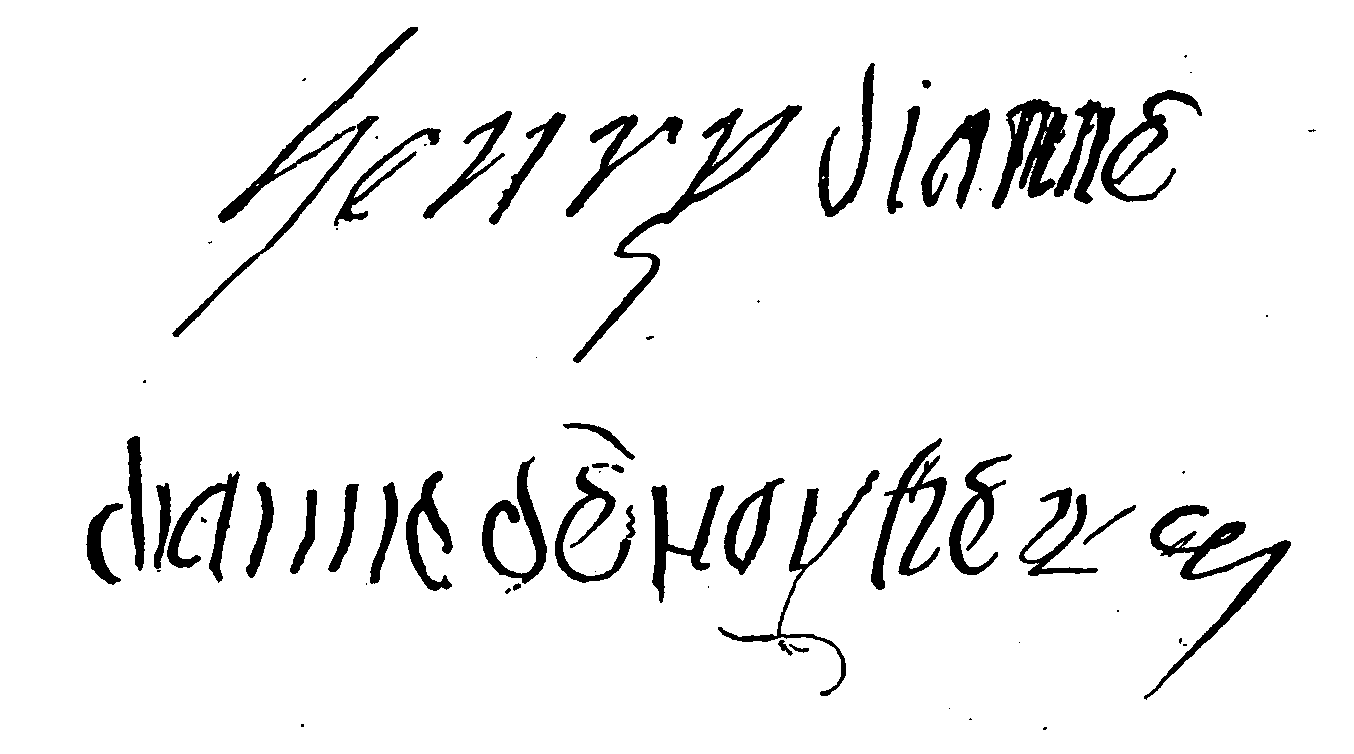
My friend M. GAIL published a very interesting brochure, about ten years ago, entitled Lettres Inedites de Henri II. Diane de Poitiers, Marie Stuart, François, Roi Dauphin &c. Amongst these letters, there was only ONE specimen which the author could obtain of the united scription, or rather signatures, of Henry and Diana. Of these signatures he has given a fac-simile; for which the Reader, in common with myself, is here indebted to him. Below this united signature, is one of Diana HERSELF--from a letter entirely written in her own hand. It must be confessed that she was no Calligraphist.
86 [My friend Mr. Drury possessed a similar copy.]
87 It may not be generally known that one of the most minute and interesting accounts of this assassination is given in Howell's Familiar Letters. The author had it from a friend who was an eye-witness of the transaction.
88 As for the "singeing."--or the reputed story of the greater part of them having been burnt--my opinion still continues to be as implied above: I will only now say that FORTUNATE is that Vendor who can obtain 25l. for a copy--be that copy brown or fair.
89 [My friend, the late Robert Lang, Esq. whose extraordinary Collection of Romances was sold at the close of the preceding year, often told me, that THE ABOVE was the only Romance which he wanted to complete his Collection.]
90 Page 164, ante.
91 [Because I have said that M. FLOCON was "from home" at the time I visited the library, and that M. Le CHEVALIER was rarely to be found abroad, M. Crapelet lets loose such a tirade of vituperation as is downright marvellous and amusing to peruse. Most assuredly I was not to know M. Flocon's bibliographical achievements and distinction by inspiration; and therefore I hasten to make known both the one and the other--in a version of a portion of the note of my sensitive translator: "M. Flocon is always at work; and one of the most zealous Librarians in Paris: he has worked twenty years at a Catalogue of the immense Library of Ste. Geneviève, of which the fruits are, twenty-four volumes--ready for press. Assuredly such a man cannot be said to pass his life away from his post." CRAPELET, vol iv. p. 3, 4. Most true--and who has said that HE DOES? Certainly not the Author of this Work. My translator must have here read without his spectacles.]
92 Editiones Italicæ; 1793. Præf.
93 Vol. i. p. 63-7. It is there observed that "there does not seem to be any reason for assigning this edition, to a Roman press."
94 See page 116 ante
95 See page 139 ante.
96 See page 145 ante.
97 [Now the property of the Right Hon. T. Grenville; having been purchased at the sale of Mr. Dent's Library for 107l.]
98 M. Crapelet doubts the truth of this story. He need not.
99 [See the account of M. Barbier, post.]
100 It is on a small piece of paper, addressed to M. Barbier: "Cherchez dans les depôts bien soigneusement, tous les ouvrages d'ANDRE CIRINE: entr'autres ses De Venatione libri ii: Messanæ 1650. 8vo. De natura et solertia Canum; Panormi, 1653. 4to. De Venatione et Natura Animalium Libri V. ibid, 1653. 3 vol. in 4to.--tous avec figures gravées en bois. Peut être dans la Bibl. des Théatres y étoient-ils. Je me recommande toujours à M, Barbier pour la Scala Coeli, in folio, pour les Lettres de Rangouge, et pour les autres livres qu'il a bien voulu se charger de rechercher pour moy." ST. LEGER.
101 The Abbé Hooke preceded the abbé Le Blond; the late head librarian. The present head librarian M. PETIT RADEL, has given a good account of the Mazarine Library in his Recherches sur les Bibliotheques, &c. 1819, 8vo.; but he has been reproached with a sort of studied omission of the name of Liblond-- who, according to a safe and skilful writer, may be well considered the SECOND FOUNDER of the Mazarine Library. The Abbé Liblond died at St. Cloud in 1796. In M. Renouard's Catalogue of his own books, vol. ii. p. 253, an amusing story is told about Hooke's successor, the Abbé Le Blond, and Renouard himself.
102 Bibl. Spenceriana, vol. i. p. 3, &c. and page 154 ante.
103 When Lord Spencer was at Paris in 1819, he told MM. Petit Radel and Thiebaut, who attended him, that it was "the finest copy he had ever seen." Whereupon, one of these gentlemen wrote with a pencil, in the fly-leaf, "Lord Spencer dit que c'est le plus bel exemplaire qu'il ait vu." And well might his Lordship say so.
104 Bibliomania, p. 50. Bibliographical Decameron, vol. ii. p. 493.
105 Mons. Petit-Radel has lately (1819) published an interesting octavo volume, entitled "Recherches sur les Bibliothéques anciennes et modernes, &c. with a "Notice Historique sur la Bibliothéque Mazarine: to which latter is prefixed a plate, containing portraits in outline, of Mazarin, Colbert, Naudé and Le Blond." At the end, is a list of the number of volumes in the several public libraries at Paris: from which the following is selected.
ROYAL LIBRARY Printed Volumes about 350,000
Ditto, as brochures, &c. 350,000
Manuscripts 50,000
LIBRARY OF THE ARSENAL Printed Volumes 150,000
Manuscripts 5,000
LIBRARY OF ST. GENEVIEVE Printed Volumes 110,000
Manuscripts 2,000
MAZARINE LIBRARY Printed Volumes 90,000
Manuscripts 3,500
LIBRARY OF THE PREFECTURE (Hotel de la Ville) Printed Volumes 15,000
---- ---- ---- INSTITUTE Printed Volumes 50,000
This last calculation I should think very incorrect. M. Petit Radel concludes his statement by making the WHOLE NUMBER OF ACCESSIBLE VOLUMES IN Paris amount to One Million, one hundred and twenty-five thousand, four hundred and thirty-seven. In the several DEPARTMENTS OF FRANCE, collectively, there is more than that number. But see the note ensuing.
106 [Mons. Crapelet says, 60,000 volumes: but I have more faith in the first, than in the second, computation: not because it comes from myself, but because a pretty long experience, in the numbering of books, has taught me to be very moderate in my numerical estimates. I am about to tell the reader rather a curious anecdote connected with this subject. He may, or he may not, be acquainted with the Public Library at Cambridge; where, twenty-five years ago, they boasted of having 90,000 volumes; and now, 120,000 volumes. In the year 1823, I ventured to make, what I considered to be, rather a minute and carefull calculation of the whole number: and in a sub note in the Library Companion, p. 657, edit. 1824, stated my conviction of that number's not exceeding 65,000 volumes, including MSS. In the following year, a very careful estimate was made, by the Librarians, of the whole number:--and the result was, that there were only.... 64,800 volumes!]
107 Now, numbered with THE DEAD. Vide post.
108 [The translation of the whole of the concluding part of this letter, beginning from above, together with the few notes supplied, as seen in M. Crapelet's publication, is the work of M. Barbier's nephew.]
109 [For M. Barbier Junior's note, which, in M. Crapelet's publication, is here subjoined, consult the end of the Letter.]
110 See pages 65-7 ante.
111 [This conclusion is questioned with acuteness and success by M. Barbier's nephew. It seems rather that the MS. was finished in 781, to commemorate the victories of Charlemagne over his Lombardic enemies in 774.]
112 [This restoration, in the name of the City of Toulouse, was made in the above year--on the occasion of the baptism of Bonaparte's son. But it was not placed in the King's private library till 1814. BARBIER Jun.]
113 [Now complete in 8 volumes--at the cost of 80,000 francs!]
114 [The latter was the true guess: for M. Barbier died in 1825, in his 60th year.]
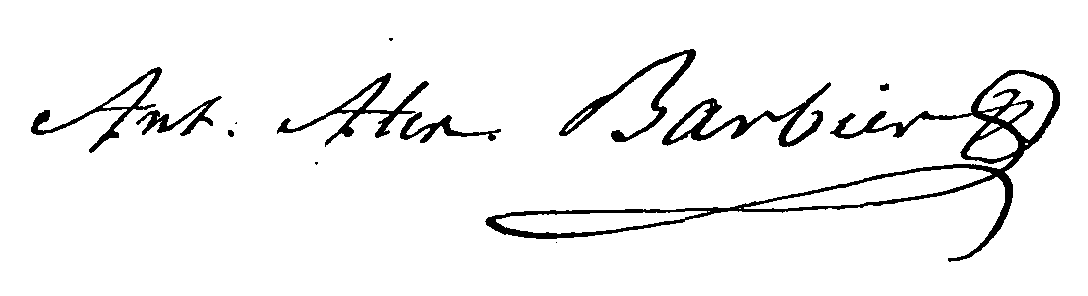
115 It was published in 1821. In one of his recent letters to me, the author thus observes--thereby giving a true portraiture of himself--"Je sais, Monsieur, quelle est votre ardeur pour le travail: je sais aussi que c'est le moyen d'être heureux: ainsi je vous félicite d'être constamment occupé." M. Barbier is also one of the contributors to the Biographie Universelle,116 and has written largely in the Annales Encyclopédiques. Among his contributions to the latter, is a very interesting "Notice des principaux écrits relatifs à la personne et aux ouvrages de J.J. Rousseau." His "Catalogue des livres dans la Bibliothéque du Conseil d'Etat, transported to Fontainbleau in 1807, and which was executed in a handsome folio volume, in 1802, is a correct and useful publication. I boast with justice of a copy of it, on fine paper, of which the author several years ago was so obliging as to beg my acceptance. [From an inscription in the fly-leaf of this Catalogue, I present the reader with a fac-simile of the hand-writing of its distinguished author.]
116 [I "ALONE am responsible for this Sin. Suum Cuique." BARBIER, Jun.]
117 [These volumes form the numbers 1316 and 1317 of the Catalogue of M. Barbier's library, sold by auction in 1828.]
118 [Consult Bibl. Barbier: Nos. 1490, 1491, 1861.]
119 [The agreeable and well instructed Bibliographer, to the praises of whom, in the preceding edition of this work, I was too happy to devote the above few pages, is now NO MORE. Mons. Barbier died in 1825, and his library--the richest in literary bibliography in Paris,--was sold in 1828. On referring to page 197 ante, it will be seen that I have alluded to a note of M. Barbier's nephew, of which some mention was to be made in this place. I will give that note in its original language, because the most felicitous version of it would only impair its force. It is subjoined to these words of my text: "Be pleased to go strait forward as far as you can see." "L'homme de service lui-même ne ferait plus cette rêponse aujourd'hui. Peu de temps après l'impression du Voyage de M. Dibdin, ce qu'on appelle une organisation eut lieu. Après vingt-sept ans de travaux consacrés à la bibliographique et aux devoirs de sa place, M. Barbier, que ses fonctions paisibles avoient protégés contre les terribles dénonciations de 1815, n'a pu régister, en 1822, aux délations mensongères de quelque commis sous M. Lauriston.
Insere nunc, Meliboee, pyros; pone ordine vites!
J'ai partagé pendant vingt ans les travaux de mon oncle pour former la bibliothéque de la couronne, et j'ai du, ainsi que lui, être mis a la retraite au moment de la promotion du nouveau Conservateur." CRAPELET, vol. iv. p. 45.
I will not pretend to say what were the causes which led to such a disgraceful, because wholly unmerited, result. But I have reason to BELIEVE that a dirty faction was at work, to defame the character of the Librarian, and in consequence, to warp the judgment of the Monarch. Nothing short of infidelity to his trust should have moved SUCH a Man from the Chair which he had so honourably filled in the private Library of Louis XVIII. But M. Barbier was beyond suspicion on this head; and in ability he had perhaps, scarcely an equal--in the particular range of his pursuits. His retreating PENSION was a very insufficient balm to heal the wounds which had been inflicted upon him; and it was evident to those, who had known him long and well, that he was secretly pining at heart, and that his days of happiness were gone. He survived the dismissal from his beloved Library only five years: dying in the plenitude of mental vigour. I shall always think of him with no common feelings of regret: for never did a kinder heart animate a well-stored head. I had hoped, if ever good fortune should carry me again to Paris, to have renewed, in person, an acquaintance, than which none had been more agreeable to me, since my first visit there in 1818: But ... "Diis aliter visum est." There is however a mournful pleasure in making public these attestations to the honour of his memory; and, in turn, I must be permitted to quote from the same author as the nephew of M. Barbier has done....
His saltem accumulem donis, et fungar inani Munere....
Perhaps the following anecdote relating to the deceased, may be as acceptable as it is curious. Those of my readers who have visited Paris, will have constantly observed, on the outsides of houses, the following letters, painted in large capitals:
MACL:
implying--as the different emblems of our Fire Offices imply--
"M[aison] A[ssurée] C[ontre] L'[incendie]:"
in plain English, that such houses are insured against fire. Walking one afternoon with M. Barbier, I pointed to these letters, and said, "You, who have written upon Anonymes and Pseudonymes, do you know what those letters signify?" He replied, "Assuredly--and they can have but one meaning." "What is that?" He then explained them as I have just explained them. "But (rejoined I) since I have been at Paris, I have learnt that they also imply another meaning." "What might that be?" Stopping him, and gently touching his arm, and looking round to see that we were not overheard, I answered in a suppressed tone:--
"M[es] A[mis] C[hassez] L[ouis]."
He was thunderstruck. He had never heard it before: and to be told it by a stranger! "Mais (says he, smiling, and resuming his steps) "voila une chose infiniment drole!"
Let it be remembered, that this HERETICAL construction upon these Initial Capitals was put at a time when the Bonaparte Fever was yet making some of the pulses of the Parisians beat 85 strokes to the minute. Now, his Majesty Charles X. will smile as readily at this anecdote as did the incomparable Librarian of his Regal Predecessor.
120 [A young stranger, a Frenchman--living near the mountainous solitudes between Lyons and the entrance into Italy--and ardently attached to the study of bibliography-- applied himself, under the guidance of a common friend--dear to us both from the excellence of his head and heart--to a steady perusal of the Bibliographical Decameron , and the Tour. He mastered both works within a comparatively short time. He then read A Roland for an Oliver--and voluntarily tendered to me his French translation of it. How successfully the whole has been accomplished, may be judged from the following part--being the version of my preface only.
OBSERVATION PRELIMINAIRE.
"La production de M. Crapelet rappelée, dans le titre précédent, sera considérée comme un phénomène dans son genre. Elle est, certes, sans antécédent et, pour l'honneur de la France, je desire qu'elle n'ait pas d'imitateurs. Quiconque prendra la peine de lire la trentième lettre de mon voyage, soit dans l'original, soit dans la version de M. Crapelet, en laissant de coté les notes qui appartiennent an traducteur, conviendra facilement que cette lettre manifeste les sentimens les plus impartiaux et les plus honorables à l'état actuel de la librairie et de l'imprimerie à Paris. Dans plusieurs passages, où l'on compare l'éxécution typographique, dans les deux pays, la supériorité est décidée en faveur de la France. Quant a l'esprit qui a dicté cette lettre, je déclare, comme homme d'honneur, ne l'avoir pas composée, dans un systême d'opposition, envers ceux qu'elle concerne plus particulièrement.
"Cependant, il n'en a pas moins plu à M. Crapelet, imprimeur de Paris, l'un de ceux dont il y est fait plus spécialement l'éloge, d'accompagner sa traduction de cette lettre, de notes déplacées et injurieuses pour le caractère de l'auteur et de son ouvrage. Par suite probablement du peu d'étendue de ses idées et de l'organisation vicieuse de ses autres sens, ce typographe s'est livré a une séries d'observations qui outragent autant la raison que la politesse, et qui décèlent hautement sa malignité et sa noirceur. Les formes de son procédé ne sont pas moins méprisables que le fond. Avec la prétention avouée de ne répandre que partiellement sa version,
(Voulant blesser et cependant timide pour frapper)
il s'est servi de ses propres presses et il a imprimé le texte et les notes avec des caractères et sur un papier aussi semblables que possible à ceux de l'ouvrage qu'il venait de traduire. Il en a surveillé, a ce qu'on assure, l'impression, avec l'attention personelle la plus scrupuleuse, en sorte qu'il n'est aucune epreuvé égarée, qui ait été soumise à d'autres yeux que les siens. Il a prit soin, en outre, d'en faire tirer, au moins, cent exemplaires, et de les répandre. C Comme ces cent exemplaires seront probablement lus par dix fois le même nombre de personnes, il y aurait eu plus de franchisé et peut-être plus de bon sens de la part de M. Crapelet à diriger publiquement ses coups contre moi que de le faire sous la couverture d'un pamphlet privé. Il a fait choix de ce genre d'attaque; il ne me reste plus qu'à adopter une semblable méthode de défense: si ce n'est, qu'au lieu de cent exemplaires, ces remarques ne seront véritablement imprimée qu'a trente six. Ce procédé est certes plus délicat que celui de mon adversaire; mais soit que M. Crapelet ait préféré l'obscurité à la lumière, il n'en est pas moins évident que son intention a été d'employer tous ses petits moyens, a renverser la réputation d'un ouvrage, dont il avoue lui-même avoir à peine lu la cinquantième partie!
"Par le contenu de ses notes, on voit qu'il a cherché, avec une assiduité condamnable, a recueillir le mal qu'il me suppose avoir eu l'intention de dire des personnes que j'ai citées, et cependant, après tout ce travail, a peine a-t-il pû découvrir l'ombre d'une seule allusion maligne. Jamais on ne fit un usage plus déplorable de son tems et de ses peines, car toutes les phrases de cette production sont aussi obscures que tirées de loin.
"Il est difficile, ainsi que je l'ai déjà observé, de se rendre compte des motifs d'une telle conduite. Mais M. Crapelet n'a fait part de son secret à personne, et d'après l'échantillon dont il s'agit ici, je n'ai nulle envie de le lui demander.
T.F.D.
"J'avais eu d'abord l'intention de relever chacunes des notes de M. Crapelet, mais de plus mûres réfléxions m'ont fait connaitre l'absurdité d'une telle enterprise. Je m'en suis donc tenu à la préface, sans toutefois, ainsi que le lecteur pourra s'en appercevoir, laisser tomber dans l'oubli le mérite des notes. Encore un mot; M. Crapelet m'a attaqué et je me suis défendu. Il peut récommencer, si cela lui fait plaisir; mais désormais je ne lui répondrai que par le silence et le mépris."
C "M. Crapelet, en sa qualité de critique, a mis ici du raffinement; car je soupçonne qu'il y a eu au moins vingt cinq exemplaires tirés sur papier vélin. C'est ainsi qu'il sait dorer sa pillule, pour la rendre plus présentable aux dignes amis de l'auteur, les bibliophiles de Paris. Mais ces Messieurs ont trop bon gout pour l'accepter.
121 Bibliomania; p. 79. Bibliographical Decameron; vol. i. p. xxii.
122 See the Bibliographical Decameron; vol. ii. p. 20.
123 [Consistently with the plan intended to be pursued in this edition, I annex a fac-simile of their autograph.]
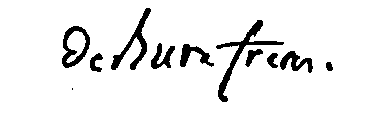
124 [Madame Debure died a few years ago at an advanced age.]
125 [Mr. Hibbert obtained this volume from me, which will be sold at the sale of his Library in the course of this season.]
126 [Nothing can be more perfectly ridiculous and absurd than the manner in which M. Crapelet flies out at the above expression! He taunts us, poor English, with always drawing comparisons against other nations, in favour of the splendour and opulence of our own Hospitals and Charitable Foundations--a thought, that never possessed me while writing the above, and which would require the peculiar obliquity, or perversity of talents, of my translator to detect. I once thought of dissecting his petulant and unprovoked note--but it is not worth blunting the edge of one's pen in the attempt.]
127 [In a few years afterwards, the body of the husband of Madame Treuttel was consigned to this, its last earthly resting-place. M. JEAN-GEORGE TREUTTEL, died on the 14th Dec. 1825, not long after the completion of his 82d year: full of years, full of reputation, and credit, and of every sublunary comfort, to soothe those who survived him. I have before me a printed Memoir of his Obsequies--graced by the presence and by the orations of several excellent Ministers of the Lutheran persuasion: by all the branches of his numerous family; and by a great concourse of sympathising neighbours. Few citizens of the world, in the largest sense of this expression, have so adorned the particular line of life in which they have walked; and M. Treuttel was equally, to his country and to his family, an ornament of a high cast of character. "O bon et vertueux ami, que ne peut tu voir les regrets de tous ceux qui t' accompagnent à ta derniere demeure, pour te dire encore une fois à REVOIR!" Discours de M. COMARTIN Maire de Groslai: Dec. 17.]
128 ["Delightful" as was this Library, the thought of the money for which it might sell, seems to have been more delightful. The sale of it--consisting of 1028 articles-- took place in the spring of last year, under the hammer of Mr. Evans; and a surprisingly prosperous sale it was. I would venture to stake a good round sum, that no one individual was more surprized at this prosperous result than the OWNER of the Library himself. The gross produce was £2704. 1s. The net produce was such... as ought to make that said owner grateful for the spirit of competition and high liberality which marked the biddings of the purchasers. In what country but OLD ENGLAND could such a spirit have been manifested! Will Mons. Renouard, in consequence, venture upon the transportation of the remaining portion of his Library hither? There is a strong feeling that he will. With all my heart--but let him beware of his MODERN VELLUMS!!]
129 [I shall now presume to say, that M. Renouard is a "VERY rich man;" and has by this time added another 500 bottles of high-flavoured Burgundy to his previous stock. The mention of M. Renouard's Burgundy has again chafed M. Crapelet: who remarks, that "it is useless to observe how ridiculous such an observation is." Then why dwell upon it--and why quote three verses of Boileau to bolster up your vapid prose, Mons. G.A. Crapelet.?]
130 [The second edition of this work, greatly enlarged and corrected, appeared in 1825, in 3 volumes: printed very elegantly at the son's (Paul Renouard's) office. Of this improved edition, the father was so obliging as to present me with a copy, accompanied by a letter, of which I am sure that its author will forgive the quotation of its conclusion--to which is affixed his autograph. "Quoiqu'il en soit, je vous prie de vouloir bien l'agréer comme un témoignage de nos anciennes liaisons, et d'être bien persuadé du dévouement sincere et amical avec lequel je n'ai jamais cessé d'être.
Votre très humble Serviteur,

131 [Now completed in 60 volumes 8vo.: and the most copious and correct of ALL the editions of the author. It is a monument, as splendid as honourable, of the Publisher's spirit of enterprise. For particulars, consult the Library Companion, p. 771, edit. 1824.]
132 The year following the above description, the Catalogue, alluded to, made its appearance under the title of "Catalogue de la Bibliothèque d'un Amateur," in four not very capacious octavo volumes: printed by CRAPELET, who finds it impossible to print--ill. I am very glad such a catalogue has been published; and I hope it will be at once a stimulus and a model for other booksellers, with large and curious stocks in hand, to do the same thing. But I think M. Renouard might have conveniently got the essentials of his bibliographical gossipping into two volumes; particularly as, in reading such a work, one must necessarily turn rapidly over many leaves which contain articles of comparatively common occurrence, and of scarcely common interest. It is more especially in regard to modern French books, of which he seems to rejoice and revel in the description--(see, among other references, vol. iii. p. 286-310) that we may be allowed to regret such dilated statements; the more so, as, to the fastidious taste of the English, the engravings, in the different articles described, have not the beauty and merit which are attached to them by the French. Yet does M. Renouard narrate pleasantly, and write elegantly.
In regard to the "brush at the Decameron," above alluded to, I read it with surprise and pleasure--on the score of the moderate tone of criticism which it displayed--and shall wear it in my hat with as much triumph as a sportsman does a "brush" of a different description! Was it originally more piquan? I have reason not only to suspect, but to know, that it WAS. Be this as it may, I should never, in the first place, have been backward in returning all home thrusts upon the aggressor- -and, in the second place, I am perfectly disposed that my work may stand by the test of such criticism. It is, upon the whole, fair and just; and justice always implies the mention of defects as well as of excellencies. It may, however, be material to remark, that the third volume of the Decameron is hardly amenable to the tribunal of French criticism; inasmuch as the information which it contains is almost entirely national--and therefore partial in its application.
133 [Not so. Messrs. Payne and Foss once shewed me a yet larger copy of it upon vellum, than even M. Renouard's: but so many of the leaves had imbibed an indelible stain, which no skill could eradicate, that it was scarcely a saleable article. It was afterwards bought by Mr. Bohn at a public auction.]
134 [It was sold at the Sale of his Aldine Library for £68. 15s. 8d. and is now, I believe, in the fine Collection of Sir John Thorold, Bart, at Syston Park. The Cicero did not come over for sale.]
135 [In the previous edition I had supposed, erroneously, that it was the Father, M. Renouard himself, who had invoked his name on the occasion. The verses are pretty enough, and may as well find a place here as in M. Crapelet's performance.
Je l'ai vu ce fameux bouquin Qui te fait un titre de gloire: Tout Francois qui passe le Rhin Doit remporter une Victoire.]
136 [M. Renouard obtained it at a public sale in Paris, against a very stiff commission left for it by myself. A copy of equal beauty is in the Library of the Right Hon. T. Grenville.]
137 [The Theophrastus was sold for £12 1s. 6d. and the Aristotle for £40. The latter is in the Library of the Rt. Hon. T. Grenville, having been subsequently coated in red morocco by C. Lewis.]
138 [It seems that I have committed a very grave error, in the preceding edition, by making Mons. Renouard "superintend the gathering in of his VINTAGE," at his country- house (St. Valerie) whereas there are no Vineyards in Picardy. France and Wine seemed such synonymes, that I almost naturally attached a vineyard to every country villa.]
139 [It was published in 1820.]
140 "The luxurious English Bibliographer is astonished at the publication of the "Manuel" without the accompaniment of Plates, Fac-similes, Vignettes, and other graphic attractions. It is because intrinsic merit is preferable to form and ornament: that at once establishes its worth and its success." CRAPELET, vol. iv. p. 88. This amiable Translator and sharp-sighted Critic never loses an opportunity of a fling at the "luxurious English Bibliographer!"
141 [My translator again brandishes his pen in order to draw good-natured comparisons. "It would be lucky for him, if, to the qualities he possesses, M. Dibdin would unite those which he praises in M. Brunet: his work and the public would be considerable gainers by it: his books would not be so costly, and would be more profitable. The English Author describes nothing in a sang- froid manner: he is for ever charging: and, as he does not want originality in his vivacity, he should seem to wish to be the CALLOT of Bibliography." CRAPELET. Ibid. I accept the title with all my heart.]
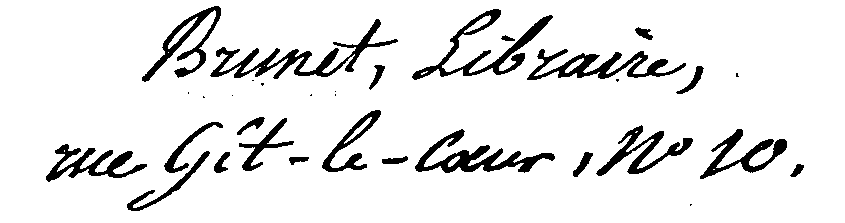
142 When he waited upon Lord Spencer at Paris, in 1819, and was shewn by his Lordship the Ulric Han Juvenal (in the smallest character of the printer) and the Horace of 1474, by Arnoldus de Bruxella, his voice, eyes, arms, and entire action ... gave manifest proofs how he FELT upon the occasion! [It only remains to dismiss this slight and inadequate account of so amiable and well-versed a bibliographer, with the ensuing-fac-simile of his autograph.]
143
Chardin passe surtout parmi les amateurs Pour le plus vétilleux de tous les connaisseurs; Il fait naître, encourage, anime l'industrie; LES BEAUX LIVRES font seul le CHARME DE SA VIE.
LA RELIURE, poëme didactique. Par LESNÉ'. 1820, 8vo. p. 31.
144 [This curiosity is now in the limited, but choice and curious, collection of my old and very worthy friend Mr. Joseph Haslewood. The handle of the stick is decorated by a bird's head, in ivory, which I conjectured to be that of an Eagle; but my friend insisted upon it that it was the head of an Hawk. I knew what this meant--and what it would end in: especially when he grasped and brandished the Cane, as if he were convinced that the sculptor had anticipated the possession of it by the Editor of Juliana Barnes. It is whispered that my friend intends to surprise the ROXBURGHE CLUB (of which he is, in all respects a most efficient member) with proofs of an Engraving of this charming little piece of old French carving.]
145 Mons. Chardin is since dead at a very advanced age. His mental faculties had deserted him a good while before his decease: and his decease was gentle and scarcely perceptible. The portrait of him, in the preceding edition of this work, is literally the MAN HIMSELF. M. Crapelet has appended one very silly, and one very rude, if not insulting, note, to my account of the deceased, which I will not gratify him by translating, or by quoting in its original words.
146 [A copy of the Horace UPON VELLUM (and I believe, the only one) with the original drawings of Percier, will be sold in the library of Mr. Hibbert, during the present season.]
147 ["And unquestionably the best Letter Founder. His son, M. Amb. Firmin Didot; who has for a long time past cut the punches for his father, exhibits proof of a talent worthy, of his instructor." CRAPELET.]
148 [The translation of the above passage runs so smoothly and so evenly upon "all fours," that the curious reader may be gratified by its transcription: "On ne doit pas être surpris que le meilleur vin de Champagne et de Chambertin ait été servi sur la tablé de celui qui, au milieu des toasts de ses convives, avait pour accompagnement le bruit agréable. des frisquettes et des tympans de vingt- deux presses.".Vol. ii. 102.]
149 ["Would one not suppose that I had told M. Dibdin that it was impossible for the French to execute as fine plates as the English? If so, I should stand alone in that opinion. I only expatiated on the beauty of the wood-cut vignettes which adorn many volumes of the 4to. Shakspeare by Bulmer. (N.B. Mr. Bulmer never printed a Shakspeare in 4to. or with wood cuts; but Mr. Bensley did- -in an 8vo. form.) Their execution is astonishing. Wood engraving, carried to such a pitch of excellence in England, is, in fact, very little advanced in France: and on this head I agree with M. Dibdin." CRAPELET, iv. 104.]
150 ["How can M. Dibdin forget the respect due to his readers, to give them a recital of dinners, partaken of at the houses of private persons, as if he were describing those of a tavern? How comes it that he was never conscious of the want of good taste and propriety of conduct, to put the individuals, of whom he was speaking, into a sort of dramatic form, and even the MISTTRESSES OF THE HOUSE! CRAPELET: Vol. iv. 106. I have given as unsparing a version as I could (against myself) in the preceding extract; but the sting of the whole matter, as affecting M. Crapelet, may be drawn from the concluding words. And yet, where have I spoken ungraciously and uncourteously of Madame?]
151 [Bozérian undoubtedly had his merits .]--Lesné has been singularly lively in describing the character of Bozérian's binding. In the verse ...
Il dit, et secouant le joug de la manie....
he appears to have been emulous of rivalling the strains, of the Epic Muse; recalling, as it were, a sort of Homeric scene to our recollection: as thus--of Achilles rushing to fight, after having addressed his horses:
152 Some account of French bookbinders may be also found in the Bibliographical Decameron, vol. ii. p. 496-8.
153 Cependant Thouvenin est un de ces hommes extraordinaires qui, semblables à ces corps lumineux que l'on est convenu d'appeler cometes, paraissent une fois en un siècle. Si, plus ambitieux de gloire que de fortune, il continue à, se surveiller; si, moins ouvrier qu'artiste, il s'occupe sans relache du perfectionnement de la reliure, il fera époque dans son art comme ces grands hommes que nous admirons font époque dans la littérature. p. 117.
154 [In the year 1819, Lord Spencer sent over to the Marquis de Chateaugiron, a copy of the Ovid De Tristilus, translated by Churchyard, 1578, 4to. (his contribution to the Roxburghe Club) as a present from ONE President of Bibliophiles to ANOTHER. It was bound by Lewis, in his very best style, in morocco, with vellum linings, within a broad border of gold, and all other similar seductive adjuncts. Lewis considered it as a CHALLENGE to the whole bibliopegistic fraternity at Paris:--a sort of book-gauntlet;--thrown down for the most resolute champion to pick up--if he dare! Thouvenin, Simier, Bozérian (as has been intimated to me) were convened on the occasion:--they looked at the gauntlet: admired and feared it: but no man durst pick it up!
Obstupuere animi:----
Ante omnes stupet ipse Dares D....
In other words, the Marquis de Chateaugiron avowed to me that it was considered to be the ne plus ultra of the art. What say you to this, Messrs. Lesné and Crapelet?
D Thouvenin.
155 This poem appeared early in the year 1820, under the following title. "La Reliure, poème didactique en six chants; précédé d'une idée analytique de cet art, suivi de notes historiques et critiques, et d'un Mémoire soumis à la Société d'Encouragement, ainsi qu'au Jury d'exposition de 1819, relatif à des moyens de perfectionnement, propres à retarder le renouvellement des reliures. PAR LESNÉ. Paris, 1820. 8vo. pp. 246. The motto is thus:
Hâtez-vous lentement, et sans perdre courage, Vingt fois sur le métier remettez votre ouvrage; Polissez-le sans cesse et le repolissez.
Boileau Art. Poét. ch. 1.
This curious production is dedicated to the Author's Son: his first workman; seventeen years of age; and "as knowing, in his business at that early period of life as his father was at the age of twenty-seven." The dedication is followed by a preface, and an advertisement, or "Idée analytique de la Reliure." In the preface, the author deprecates both precipitate and severe criticism; "He is himself but a book-binder--and what can be expected from a muse so cultivated?" He doubts whether it will be read all through; but his aim and object have been to fix, upon a solid basis, the fundamental principles of his art. The subject, as treated in the Dictionary of Arts and Trades by the French Academy, is equally scanty and inaccurate. The author wishes that all arts were described by artists, as the reader would gain in information what he would lose in style. "I here repeat (says he) what I have elsewhere said in bad verse. There are amateur-collectors who know more about book-binding, than even certain good workmen; but there are also others, of a capricious taste, who are rather likely to lead half-instructed workmen astray, than to put them in the proper road." In the poetical epistle which concludes the preface, he tells us that he had almost observed the Horatian precept: his poem having cost eight years labour. The opening of it may probably be quite sufficient to give the reader a proper notion of its character and merits.
Je célèbre mon art; je dirai dans mes vers, Combien il éprouva de changemens divers; Je dirai ce que fut cet art en sa naissance; Je dirai ses progrès, et, de sa décadence. Je nommerai sans fard les ineptes auteurs: Oui, je vais dérouler aux yeux des amateurs: Des mauvais procédés la déplorable liste. Je nommerai le bon et le mauvais artiste;
156 He died on the 24th of May, 1828; on the completion of his 85th year. See the next note but one.
157 The reader may be amused with the following testy note of my vigilant translator, M. Crapelet: the very Sir Fretful Plagiary of the minor tribe of French critics! "Cette phrase, qui n'est pas Française, est ainsi rapportée par l'auteur. M. l'Abbé Bétencourt, aura dit a peu près: "Il mourra sans laisser d'élève." M. Dibdin qui parle et entend fort bien le Français, EST IL EXCUSABLE DE FAIRE MAL PARLER UN ACADEMICIEN FRANÇAIS, et surtout de rendre vicieuses presque toutes les phrases qu'il veut citer textuellement? L'exactitude! l'exactitude! C'est la première vertu du bibliographe; on ne saurait trop le répéter a M. Dibdin." CRAPELET. vol. iv. 124. Quære tamen? Ought not M. Crapelet to have said "il mourrira?" The sense implies the future tense: But ... how inexpiable the offence of making a French Academician speak bad French!!--as if every reader of common sense would not have given me, rather than the Abbé Bétencourt, credit for this bad speaking?
158 [In a short, and pleasing, memoir of him, in the Révue Encyclopédique, 115th livraison, p. 277, &c. it is well and pleasantly observed, that, "such was his abstraction from all surrounding objects and passing events, he could tell you who was Bishop of such a diocese, and who was Lord of such a fief, in the XIIth century, much more readily, and with greater chance of being correct, than he would, who was the living Minister of the Interior, or who was the then Prefect of the department of the Seine?" By the kindness of a common friend, I have it in my power to subjoin a fac-simile of the autograph of this venerable Departed:]
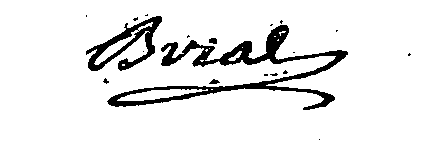
159 The Thucydides was published first; in twelve volumes 8vo. VOL. II. 1807; with various readings, for the first time, from thirteen MSS. not before submitted to the public eye. The French version, in four volumes, with the critical notes of the Editor, may be had separately. The VELLUM 4to. copy of the Thucydides consists of fourteen volumes; but as the volumes are less bulky than those of the Xenophon, they may be reduced to seven. The Xenophon was published in 1809, in seven volumes, 4to. The Latin version is that of Leunclavius; the French version and critical notes are those of M. Gail. The vellum copy, above alluded to, is divided into ten volumes; the tenth being an Atlas of fifty-four maps. Some of these volumes are very bulky from the thickness of the vellum.
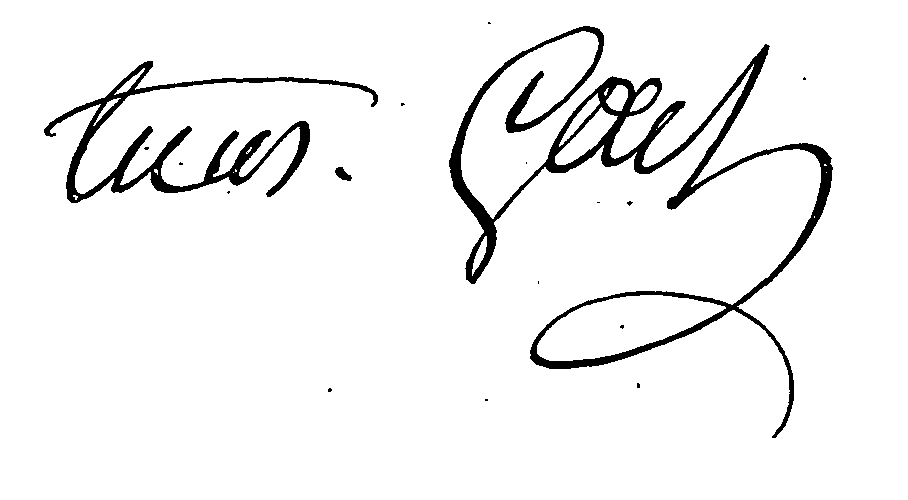
Upon this unique copy, M. Gail submitted to me, in writing, the following remarks. "Of the Xenophon, two vellum copies were printed; but of these, one was sent to the father of the present King of Spain, and received by him in an incomplete state--as the Spanish Ambassador told M. Gail: only six volumes having reached the place of their destination. The Editor undertakes to give authenticated attestations of this fact." "If," say M. Gail's written observations, "one considers that each sheet of vellum, consisting of eight pages, cost five francs ten sous, and three more francs in working off--and that skins of vellum were frequently obliged to be had from foreign countries, owing to the dearth of them at Paris--whereby the most extravagant demands were sometimes obliged to be complied with--add to which, that fifteen years have passed away since these sums were paid down in hard cash,--the amount of the original expenses is doubled." The volumes are in stout boards, and preserved in cases. In one of his letters to me, respecting the sale of his vellum copy- -the worthy Professor thus pleasantly remarks: "Je ne veux pas m'enricher avec ce livre qui, lorsque je serai cendres, aura un bien grand prix. Je n'ai que le desir de me débarrasser d'une richesse qui m'est à charge, et ne convient nullement à un modeste et obscur particulier, comme moi." I subjoin the autograph of this worthy and learned Professor: hoping yet to shake the hand heartily which guided the pen.
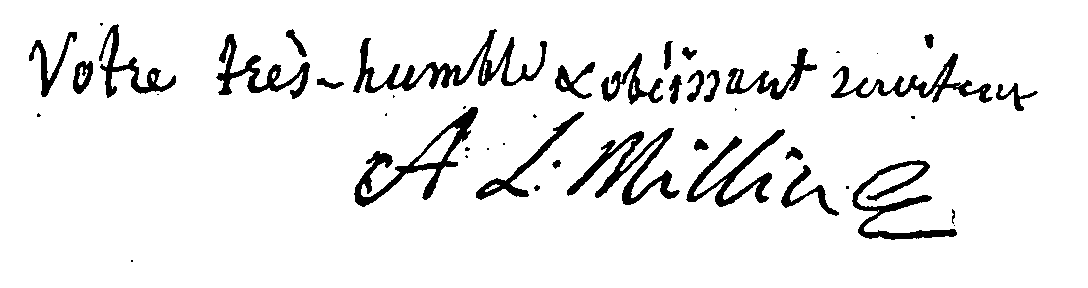
160 M. Millin DIED about the middle of the following month, ere I had reached Vienna. His library was sold by auction in May 1819, under the superintendence of Messrs. Debure, who compiled the sale catalogue. It produced 53,626 francs. The catalogue contained 2556 articles or numbers; of which several were very long sets. One article alone, no. 866., consisted of 326 volumes in folio, quarto, and octavo. It is thus designated, "RECUEIL DE PIECES SUR LES ARTS, LA LITTE'RATURE, LES ANTIQUITE'S, en Latin, en Italien, et en François. This article produced 4501 francs, and was purchased by the Grand Duke of Tuscany. Millin had brought up from boyhood, and rescued from poverty and obscurity, a lad of the name of Mention. This lad lived with him many years, in the capacity of a valet and private secretary. In his second and last voyage to Italy, Millin declined taking him with him, but left him at home, in his house, with a salary of fifty francs per month. Five months after his departure, in February, 1812, a great quantity of smoke was seen issuing from the windows of Millin's apartments. Several people rushed into the room. They found the drawings and loose papers taken from the portfolios, rolled up lightly, and the room on fire at the four corners! A lighted candle was placed in the middle of the room. Suspicion immediately fell upon Mention. They ran to his bed chamber: found the door fastened: burst it open--and saw the wretched valet weltering in his blood ... yet holding, in his-right hand, the razor with which he had cut his throat! He was entirely dead. Millin's collection of Letters from his numerous Correspondents perished in the flames.
This accident, which also deprived Millin of a fund of valuable materials that he was preparing for a Dictionary of the Fine Arts, and for a Recueil de Pièces gravées Inédites--might have also had an infinitely more fatal tendency: as it occurred within the walls which contain the ROYAL LIBRARY! Millin received the news of this misfortune, in Italy, with uncommon fortitude and resignation. But this second voyage, as has been already intimated, (see p. 260) hastened his dissolution. He planned and executed infinitely too much; and never thoroughly recovered the consequent state of exhaustion of body and mind. As he found his end approaching, he is reported to have said--"I should like to have lived longer, in order to have done more good--but God's will be done! I have lived fifty-nine years, the happiest of men--and should I not be ungrateful towards Providence, if I complained of its decrees?!" And when still nearer his latter moments--he exclaimed: "I have always lived, and I die, a Frenchman: hating no one: complaining only of those who retard the cause of reason and truth. I have never, intentionally, hurt a single creature. If I have injured any one, I ask pardon of him for the error of my understanding." He died on the 18th of August, and his body was interred in the churchyard of Père la Chaise. His old friend and colleague, M. GAIL, pronounced a funeral discourse over his grave--in which, as may be well supposed, his feelings were most acutely excited. I subjoin a facsimile of Millin's autograph: from the richly furnished collection of Mr. Upcott, of the London Institution.
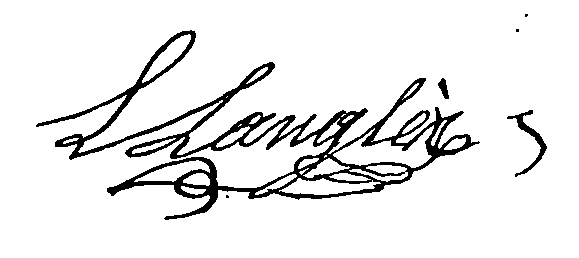
161 [Mons. Langlès survived the above account between five and six years; dying January 28, 1824. His Library was sold by auction in March, 1825. It was copious and highly creditable to his memory. From the source whence the preceding autograph was derived, I subjoin the following autograph.
162 Monsieur Millin had been before hand in his description of this day's festival, but his description was in prose. It appeared in the Annales Encyclopédiques, for the ensuing month, July, 1818, and was preceded by a slight historical sketch of the Club, taken chiefly from the Bibliographical Decameron. His account of the festival may amuse some of my readers, who have not been accustomed to peruse English toasts cloathed in French language. It is briefly thus:
"Pendant que les membres du Roxburghe Club célébroient le 17 juin 1818 la mémoire des premiers imprimeurs de Boccace, à Venise et en Angleterre, sous la présidence de sa grâce lord Spencer; M. Dibdin, vice- président, s'unissoit à ce banquet bibliographique par une répétition qu'il en faisoit à Paris. Il avoit appelé à ce banquet M. DENON, à qui la France doit encore une grande partie des manuscrits et des éditions rares dont elle s'est enrichie, et plusieurs conservateurs de la bibliothèque royale, MM. VANPRAET, LANGLE'S, GAIL, et MILLIN. On pense bien que l'histoire littéraire, la bibliographie, devinrent un inépuisable sujet pour la conversation. L'entretien offrit un mélange de gaïté et de gravité qui convient aux banquets des muses; et selon l'adage antique, les convives étoient plus que trois et moins que neuf. M. Gail lut sur cette réunion des vers latins, dont les toasts bruyans ne permirent pas de savourer d'abord tout le sel et l'esprit. Ils doivent être imprimés dans l'Hermes Romanus.
"M.D., amphitryon et président du festin, porta, comme il convenoit, les premiers toasts:
1°. A la santé de milord Spencer et des honorables membres du Roxburghe Club. 2°. A la mémoire de Christophe Valdarfer, inprimeur du Boccace de 1471; livre dont l'acquisition fait par le duc de Marlborough, fut l'occasion de la fondation du Roxburghe Club. 3°. A la mémoire immortelle de Guillaume Caxton, premier imprimeur anglois. 4°. A la gloire de la France. 5°. A l'union perpétuelle de la France et de l'Angleterre. 6°. A la prospérité de la bibliothèque royale de France. 7°. A la santé de ses dignes conservateurs, dont le savoir est inépuisable, et dont l'obligeance ne se lasse jamais. 8°. A la propagation des sciences, des arts, des lettres, et de la bibliomanie. 9°. Au désir de se revoir le même jour chaque année.
"Les convives ont rendu ces toasts par un autre qu'ils ont porté, avec les hurras et les trois fois d'usage en Angleterre, au vice-président du Roxburghe-Club, qui leur avoit fait l'honneur de les rassembler.
"La Séance a fini à l'heure où le président du Roxburghe-Club lève celle de Londres; et le vice-président, M. Dibdin, a soigneusement réuni les bouchons, pour les porter en Angleterre comme un signe commémoratif de cet agréable banquet."E
The verses of Monsieur Gail were as follow:--but I should premise that he recited them with zest and animation.
Auspice jam Phæbo, SPENCEROQUE AUSPICE, vestrum Illa renascentis celebravit gaudia lucis Concilium, stupuit quondam quâ talibus emptus Boccacius cunctorum animis, miratus honores Ipse suos, atque ipsa superbiit umbra triumpho. Magna quidem lux illa, omni lux tempore digna. Cui redivivus honos et gloria longa supersit Atque utinam ex vobis unus, vestræque fuissem Lætitiæ comes, et doctæ conviva trapezæ. Sed nune invitorque epulis, interque volentes Gallus Apollineâ sedeo quasi lege Britannos.
Arridet D***: habet nos una voluptas. Me quoque librorum meministis amore teneri, Atque virûm studiis, quos Gallia jactat alumnos: Nam si Caxtonio felix nunc Anglia gaudet, Non minus ipsa etiam Stephanorum nomina laudat. Hic nonnulla manent priscæ vestigia famæ. Nobis Thucydides, Xenophon quoque pumice et auro, Quem poliit non parca manus; felicior ille Si possit .....F melius conjungere Musas! Quidquid doctorum est: tantis ego lætor amicis. Æternum hæc vigeat concordia pocula firment Artesque et libri, quæ nectant foedera reges, Utramque et socient simul omnia vincula gentem.
CECINIT JOAN. B. GAIL,
Lector regius in biblioth. regiâ codd. gr. et lat. præfectus.
While one of the London morning newspapers (which shall be here nameless) chose to convert this harmless scene of festive mirth into a coarse and contemptible attack upon its author, the well-bred Bibliomanes of Paris viewed it with a different feeling, and drew from it a more rational inference. It was supposed, by several gentlemen of education and fortune, that a RIVAL SOCIETY might be established among themselves-- partaking in some degree of the nature of that of the ROXBURGHE, although necessarily regulated by a few different laws.
Taking the regulations of the ROXBURGHE CLUB (as laid down in the Ninth Day of the Decameron) as the basis, they put together a code of laws for the regulation of a similar Society which they chose, very aptly, to call LES BIBLIOPHILES. Behold then, under a new name, a Parisian Roxburghe Society. When I visited Paris, in the summer, of 1819, I got speedily introduced to the leading Members of the club, and obtained, from M. DURAND DE LANÇON, (one of the most devoted and most efficient of the members) that information--which is here submitted to the public: from a persuasion that it cannot be deemed wholly uninteresting, or out of order, even by the most violent enemies of the cause." The object of this Society of the BIBLIOPHILES must be expressed in the proper language of the country. It is "pour nourrir, reléver, et faire naître méme la passion de la Bibliomanie." I put it to the conscience of the most sober-minded observer of men and things--if any earthly object can be more orthodox and legitimate? The Society meet, as a corporate body, twice in the year: once in April, the second time in December; and date the foundation of their Club from the 1st of January 1820. Whatever they print, bears the general title of "Mélanges;" G but whether this word will be executed in the black-letter, lower-case, or in roman capitals, is not yet determined upon. One or two things, however, at starting, cannot fail to be premised; and indeed has been already observed upon--as a species of heresy. The Society assemble to a "déjeuné à la fourchette," about twelve o'clock: instead of to a "seven o'clock dinner," as do the London Roxburghers: whereby their constitutions and pockets are less affected. The other thing, to observe upon, is, that they do not print (and publish among themselves) such very strange, and out-of-the way productions, as do the London Roxburghers. For truly, of some of the latter, it may be said with the anonymous poet in the Adversaria of Barthius,
Verum hæc nee puer edidici, nee tradita patre Accepi, nee Aristotelis de moribus umquam Librum, aut divini Platonis dogmata legi.
Edit. Fabri. 1624, col. 345, vol. i.
And why is it thus? Because these reprints are occasionally taken (quoting Caspar Barthius himself, in the xxth chapter of his iid book of Adversaria, Edit. Ead.) "ex libro egregiè obscuro et a blattis tineisque fere confecto." But, on the other hand, they are perfectly harmless:
Sweet without soure, and honny without gall:
as Spenser observes in his Colin Clout's come home again: edit. 1595: sign. E.F. Or, as is observed in Les Illustrations de France, edit. 1513, 4to. litt. goth.:
Le dedens nest, ne trop cler, ne trop brun, Mais delectable a veoir...comme il me semble.
Sign. Cii. rev.
A genuine disciple of the Roxburghe Club will always exclaim "delectable a veoir" let the contents of the book be "cler," or "brun." Nor will such enthusiastic Member allow of the epithets of "hodg-podge, gallimaufry, rhapsody," &c. which are to be found in the "Transdentals General," of Bishop Wilkins's famous "Essay towards a real character and a philosophical language:" edit. 1668, fol. p. 28--as applicable to his beloved reprints! I annex the names of the Members of the Societé des Bibliophiles, as that club was first established.
1. Le Marquis de Chateaugiron, Président. 2. Guilbert de Pixérécours, Secrétaire. 3. Le Chevalier Walckenaer, Membre de l'Institut, Trésorier. 4. Alph. de Malartic, Maître des Requêtes. 5. Durand de Lançon. 6. Edouard de Chabrol. 7. Berard, Maître des Requêtes. 8. Le Vcte. de Morel-Vindé, Pair de France. 9. Madame la Duchesse de Raguse, (par courtoisie.) 10. Pensier. 11. Comte Juste de Noailles. 12. Le Baron Hely d'Oisel, Conseiller d'etat. 13. Le Marquis Scipion du Nocere, Officier Superieur du Garde du Corps. 14. Hippolyte de la Porte. 15. De Monmerqué, Conseiller à la Cour Royale. 16. Coulon, à Lyon. 17. Le Duc de Crussol. 18. Le Comte d'Ourches, à Nancy. 19. Le Chevalier Langlès, Membre de l'Institut. 20. Duriez, à Lille. 21. Le Marquis Germain Garnier, Pair de France. 22. Monsieur le Chevalier Artaud, Secrétaire d' Ambass. à Rome.
It remains to conclude this, I fear unconscionably long, note, as the above letter is concluded, with the mention of ANOTHER BANQUET. This banquet was given by the Bibliophiles to the NOBLE PRESIDENT of the Roxburghe Club, when the latter was at Paris in the Spring of the year 1820. The Vice-President of the Roxburghe Club, who happened at the same time to be at Paris, also received the honour of an invitation. The festival took place at Beauvilliers', the modern Apicius of Parisian restorateurs. About twelve guests sat down to table. The Marquis de Chateaugiron was in the chair. They assembled at six, and separated at half-past nine. All that refinement and luxury could produce, was produced on the occasion. Champagnes of different tints, and of different qualities- -lively like M. Langlès, or still like Monsieur ****; fish, dressed as they dress it à la Rocher de Cancale--poultry, and pastry-- varied in form, and piquant in taste--but better, and more palatable than either, conversation--well regulated and instructive--mingled with the most respectful attention to the ILLUSTRIOUS GUEST for whom the banquet had been prepared--gave a charm and a "joyaunce" to the character of that festival-- which will not be easily effaced from the tablets of the narrator's memory. Where all shine pretty equally, it seems invidious to particularise. Yet I may be allowed to notice the hearty urbanity of the Marquis, the thorough good humour and bibliomaniacal experience of the Comte d'Ourches, (who, ever and anon, would talk about an edition of Virgil's Pastorals printed by Eggesteyn) the vivacious sallies of the Chevalier Langlès, the keen yet circumspect remarks of the Comte Noailles, the vigilant attention and toast-stirring propensities of M.D. de Lançon, the Elzevirian enthusiasm of M. Berard, the ... But enough ... "Claudite jam rivos pueri-- sat prata biberunt."
E These Corks are yet (1829) in my possession: preserved in an old wooden box, with ribs of iron, of the time of Louis XI.
F The word here in the original is not clear.
G [They have now published FOUR VOLUMES, in royal 8vo. of singular beauty and splendour: but the fourth vol. falls far short of its precursors in the intrinsic value of its contents. The first volume is so scarce, as to have brought £20. at a sale in Paris. I possess the three latter vols. only, by the kindness of the Society, in making me, with Earl Spencer, an Honorary Associate.]
163 [The Reader must not break up with the party, until he has cast his eye upon the autograph of an Individual, of as high merit and distinction in the department which he occupies, as any to which he has yet been introduced. It only remains to say--it is the autograph of Mons.
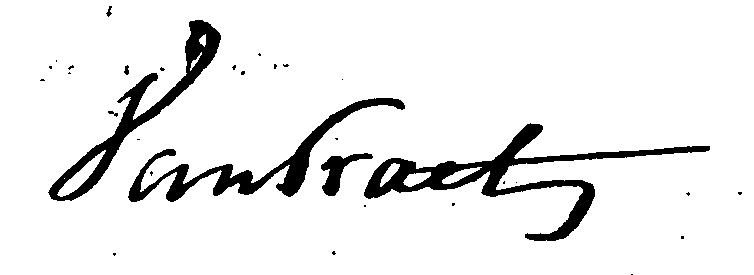
164 It was translated into English, and published in this country on a reduced scale, both as to text and engravings--but a reprint of it, with a folio volume of plates, &c. had appeared also in 1802. At the time, few publications had such a run; or received a commendation, not more unqualified than it was just. See an account of this work in the Library Companion, p. 442. edit. 1824.
165 [M. Denon DIED in 1825, aged 78. The sale of his Marbles, Bronzes, Pictures, Engravings, &c. took place in 1826.]
166 [It was sold at the sale of M. Denon's pictures for 650 francs, and is numbered 187 in the Catalogue.]
167 [One of these pictures brought 1,400, and the other 220 francs: prices, infinitely below their real worth. They should have been sold HERE!]
168 [M. Crapelet says-- this bust was modelled after the life by PIGALLE: and was, in turn, the model of that belonging to the figure of Voltaire in the library of the Institute: see p. 195 ante.]
169 [The result--judging from the comparative prices obtained at the sale--has confirmed the propriety of my predilection. It brought 5000 francs. In the sale catalogue, is the following observation attached: "On admire dans ce précieux tableau de chevalet la facilité surprenante de pinceau et cette harmonic parfaite de couleur qui faisaient dire au Tiarini, peintre contemporain, "Seigneur Guerchin, vous faites ce que vous voulez, et nous autres ce que nous pouvons." No. 14.]
170 ["This figure was cast from a model made by Montoni in 1809. There were ONLY six copies of it, of which four were in bronze and two in silver." Cat. No. 717. I have not been able to learn the price for which it was sold.]
171 The OPPOSITE PLATE will best attest the truth of the above remark. It exhibits a specimen of that precise period of art, when a taste for the gothic was beginning somewhat to subside. The countenance is yet hard and severely marked; but the expression is easy and natural, and the likeness I should conceive to be perfect. As such, the picture is invaluable. [So far in the preceding edition. The sequel is a little mortifying. The above picture, an undoubted original--and by a master (the supposed pupil of John Van Eyk) who introduced the art of oil-painting into Italy--was sold for only 162 francs: whereas the copy of it, in oil, by Laurent, executed expressly for the accompanying plate (and executed with great skill and fidelity) cost 400 francs!]
172 [What a taste have the Virtuosi at Paris! This interesting picture was allowed to be sold for 162 francs only. Who is its fortunate Possessor?]
173 [The OPPOSITE PLATE, which exhibits the head in question, is a sufficient confirmation of the above remark.]
174 [First, of the MARC ANTONIOS. Since the sale of the Silvestre Collection, in 1810, nothing had been seen at Paris like that of M. Denon. It was begun to be formed in the eighteenth century: from which it is clear, that, not only was every proof at least an hundred years old, but, at that period, ZANETTI, the previous possessor of this Collection, sought far and wide, and with unremitting diligence, for the acquisition of the choicest impressions of the engraver. In fact, this Collection, (contained in an imperial folio volume, bound in morocco--and of which I necessarily took but a hasty glance) consisted of 117 original impressions, and of 26 of such as were executed in the school of M. Antonio. Of the original impressions, the whole, with the exception of four only, belonged to Zanetti. "If, says the compiler of the Catalogue, (1826, 8vo. p. ij.) some of the impressions have a dingy tint, from the casualties of time, none have been washed, cleaned, or passed through chemical experiments to give them a treacherous look of cleanliness." This is sound orthodoxy. The whole was put up in one lot, and ... BOUGHT IN.
Secondly, for the REMBRANDTS. The like had never been before submitted to public auction. The Collections of Silvestre and Morel de Vindé out and out eclipsed! Zanetti again--the incomparable--the felicitous--the unrivalled Zanetti had been the possessor of THIS Collection also. But yet more ... John Peter Zoomer, a contemporary (and peradventure a boon companion) of Rembrandt, was the original former of the Collection. It is therefore announced as being COMPLETE in all respects--"exhibiting all the changes, retouches, beautiful proofs, on India and other paper: ample margins, unstained, uninjured; and the impressions themselves, in every stage, bright, rich, and perfect. The result of all the trouble and expence of 50 years toil of collection is concentrated in this Collection." So says John Peter Zoomer, the original collector and contemporary of Rembrandt. It consisted of 394 original pieces: 3, attributed to Rembrandt, without his name: 11, of John Lievens, Ferdinand Bol, and J.G. Villet: 11 copies: and 9 engraved in the manner of Rembrandt. The whole contained in 3 large folio volumes, bound in red morocco.
No reasonable man will expect even a précis of the treasures of this marvellous Collection: A glance of the text will justify every thing to follow: but the "Advertisement" to the Catalogue prepares the purchaser for the portrait of Rembrandt with the bordered cloak--Ditto, with the Sabre--Ephraim Bonus with the black ring--the Coppinol, as above described--the Advocate Tolling--the Annunciation of Christ's Nativity to the Shepherds--the Resurrection of Lazarus--Christ healing the Sick; called the Hundred GuildersH --the Astrologer asleep--and several Landscapes not elsewhere to be found--of which one, called the Fishermen (No. 456) had escaped Bartsch, &c. &c. The descriptions of the several articles of which this Collection was composed, occupy 47 pages of the Catalogue. The three volumes were put up to sale--as a SINGLE LOT-- at the price of 50,000 francs:--and there was no purchaser. Of its present destiny, I am ignorant: but there are those in this country, who, to my knowledge, would have given 35,000 francs.
I ought to add, that M. Denon's collection of CALLOT'S WORKS, in three large folio volumes,--bound in calf--also once the property of Zanetti--and than which a finer set is supposed never to have been exhibited for sale--produced 1000 francs: certainly a moderate sum, if what Zanetti here says of it (in a letter to his friend Gaburri, of the date of 1726) be true. "If ever you do this country (Venice) the honour of a visit, you will see in my little cabinet a collection of CALLOTS, such as you will not see elsewhere--not in the royal collection at Paris, nor in the Prince Eugene's, at Vienna--where the finest and rarest impressions are supposed to be collected. I possess every impression of the plates which Callot executed; many of them containing first proofs, retouched and corrected by the engraver himself in red chalk. I bought this Collection at Paris, and it cost me 1950 francs. They say it was formed by the engraver himself for his friend M. Gérard an Amateur of Prints." "It should seem that Zanetti's description was a little overcharged; but in his time there was no complete catalogue of the artists." Cat. p. 153.
H It formed No. 345 of the Catalogue; where it is described as being "a magnificent proof upon India paper, with a margin of 15 lines all round it. It was with the bur, and before the cross-hatchings upon the mane of the Ass." The finest copy of this subject, sold in this country, was that formerly in the collection of M. Bernard; and recently purchased by T. Wilson, Esq. Will the reader object to disporting himself with some REMBRANDTIANA, in the Bibliomania p. 680-2.?
175 One of those pictures (No. 188 in the Catalogue) produced 3015 francs: the other, only 180 francs. The Sebastian Bourdon (No. 139,) was sold for 67 francs, and the Parmegiano, (No. 34) for 288 francs.
176 See the Bibliographical Decameron; vol. i. p. clvii. &c. [M. Denon's Missal was purchased by an English amateur, and sold at the sale of the Rev. Theodore Williams's Library for £143. 17s.]
177 [Ere we take leave of this distinguished Frenchman, let us dwell for two seconds on his autograph.
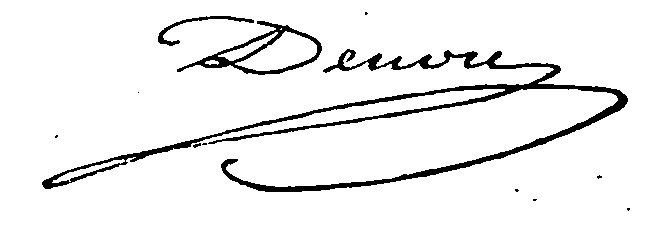
178 There has been recently struck (I think, in 1819) a medal with the same obverse and reverse, of about the size between an English farthing and halfpenny. The statue of Henry is perhaps the MIRACLE OF ART: but it requires a microscopic glass to appreciate its wonders. Correctly speaking, probably, such efforts are not in the purest good taste. Simplicity is the soul of numismatic beauty.
179 The Artist who struck the series of medals to commemorate the campaigns of the Duke of Wellington, from his landing in Portugal to the battle of Waterloo.
180 [See the OPPOSITE PLATE, which represents the upper part of the Picture.]
181 [I sent a commission for it, for a friend, at the sale of Mr. Craufurd's effects, but lost it.]
182 [Purchased by myself: and now at Hodnet.]
183 [This picture was purchased for the gallery at ALTHORP. There is an exquisite drawing of it by Wright, for the purpose of a stipling engraving.]
184 It was purchased by the late King of France for 10,000 francs.
185 [Purchased for the gallery at ALTHORP.]
186 The above quotation is incomplete; for the passage alluded to runs thus.--"Where is the painter so well sorting his colours, that could paint these faire eyes that are the windows of the body, and glasses of the soul." The continuation is in a very picturesque style. See the Theatre or Rule of the World, p. 236-7, quoted in a recent (1808) edition of More's Utopia, vol. ii. p. 143. But Primaudaye's French Academy, Lond. 1605, 4to. runs very much in the same strain.
187 A little graphic history belongs to this picture. I obtained a most beautiful and accurate copy of it by M. Le Coeuré, on a reduced scale: from which Mr. J. Thomson made an Engraving, as a PRIVATE PLATE, and only 75 copies were struck off. The plate was then destroyed; the impressions selling for a guinea. They are now so rare as to be worth treble that sum: and proofs upon India paper, before the letter, may be worth £5. 5s. Three proofs only were struck off of the plate in its mutilated state; of which my friends Mr. Haslewood and Mr. G. H. Freeling rejoice in their possession of a copy. The drawing, by Coeuré, was sold for 20 guineas at the sale of my drawings, by Mr. Evans, in 1822, but it has been subsequently sold for only nine guineas; and of which my worthy friend A. Nicholson, Esq.--"a good man, and a true"--is in the possession.
Subsequently, the ABOVE ORIGINAL picture was sold; and I was too happy to procure it for the gallery at Althorp for twelve guineas only!
188 [A magnificent whole length portrait of this first DUKE DE GUISE, painted by PORBUS--with a warmth and vigour of touch, throughout, which are not unworthy of Titian-- now adorns the very fine gallery at Althorp: where is also a whole length portrait of ANNE OF AUSTRIA, by Mignard. Both pictures are from the same Collection; and are each probably the masterpiece of the artist. They are of the size of life.]
189 [Mr. Craufurd died at Paris in 1821.]
190 ["Amateurs, connaisseurs, examinateurs, auteurs de revues du Salon, parodistes même, vous n'entendez rien à ce genre de critique; prenez M. Dibdin pour modèle: voila' la bonne école!" CHAPELET, vol. iv. p. 200. My translator shall here have the full benefit of his own bombastical nonsense.]
191 [The work is now perfect in 3 volumes.]
192 [I here annex a fac- simile of his autograph from the foot of the account for these drawings.]
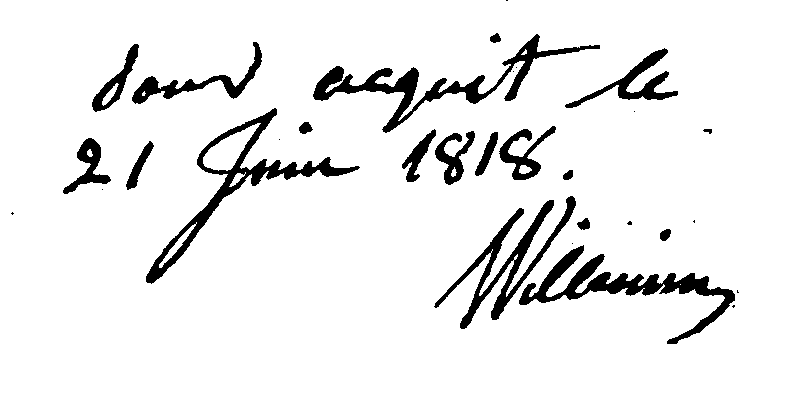
193 Then, Louis XVIII.
194 ["Sir T. Lawrence, who painted the portrait of the late Duke de Richlieu, which was seen at the last exhibition, is undoubtedly of the first class of British Portrait painters; but, according to Mr. Dibdin's judgment, many artists would have preferred to have sided with our Gérard." CRAPELET. vol. iv. 220. I confess I do not understand this reasoning: nor perhaps will my readers.]
195 [Here, Mons. Crapelet drily and pithily says, "Translated from the English." What then? Can there be the smallest shadow of doubt about the truth of the above assertion? None--with Posterity.]
196 At Domremi, in Lorraine.
197 When Desnoyers was over here, in 1819, he unequivocally expressed his rapture about our antiquarian engravings--especially of Gothic churches. Mr. Wild's Lincoln Cathedral produced a succession of ecstatic remarks. "When your fine engravings of this kind come over to Paris we get little committees to sit upon them"--observed Desnoyers to an engraver--who communicated the fact to the author.
198 [The experience of ten years has confirmed THE TRUTH of the above remark.]
199 [Not so now! Mahogany, according to M. Crapelet, is every where at Paris, and at the lowest prices.]
200 A folio volume, printed at St. Nicolas, a neighbouring village, in 1518. It is a poem, written in Latin hexameter verse by P. Blaru [P. de Blarrovivo]-- descriptive of the memorable siege of Nancy in 1476, by CHARLES THE RASH, Duke of Burgundy: who perished before the walls. His death is described in the sixth book, sign. t. iiij: the passage relating to it, beginning
"Est in Nanceijs aratro locus utilis aruis:"
A wood cut portrait of the commanding French general, Renet, is in the frontispiece. A good copy of this interesting work should always grace the shelves of an historical collector. Brunet notices a copy of it UPON VELLUM, in some monastic library in Lorraine. [Three days have not elapsed, since I saw a similar copy in the possession of Messrs. Payne and Foss, destined for the Royal Library at Paris. A pretty, rather than a magnificent, book.]
201 See page 362.
202 When this 'chaussée,' or route royale, was completed, it was so admired, that the ladies imitated its cork-screw shape, by pearls arranged spirally in their hair; and this head dress was called Coiffure à la Saverne.
203 Alsatia Illustrata, 1751-61, folio, two volumes.
204 In the middle of the fifteenth century there were not fewer than nine principal gates of entrance: and above the walls were built, at equal distances, fifty-five towers--surmounted, in turn, by nearly thirty towers of observation on the exterior of the walls. But in the beginning of the sixteenth century, from the general adoption of gunpowder in the art of war, a different system of defence was necessarily adopted; and the number of these towers was in consequence diminished. At present there are none. They are supplied by bastions and redoubts, which answer yet better the purposes of warfare.
205 This work is entitled "Notices Historiques, Statistiques et Littéraires, sur la Ville de Strasbourg." 1817, 8vo. A second volume, published in 1819, completes it. A more judicious, and, as I learn, faithful compilation, respecting the very interesting city of which it treats, has not yet been published.
206 I had before said 530 English feet; but a note in M. Crapelet's version (supplied, as I suspect, by my friend M. Schweighæuser,) says, that from recent strict trigonometrical measurement, it is 437 French feet in height.
207 The Robertsau, about three quarters of a mile from Strasbourg, is considered to be the best place for a view of the cathedral. The Robertsau is a well peopled and well built suburb. It consists of three nearly parallel streets, composed chiefly of houses separated by gardens--the whole very much after the English fashion. In short, these are the country houses of the wealthier inhabitants of Strasbourg; and there are upwards of seventy of them, flanked by meadows, orchards, or a fruit or kitchen garden. It derives the name of Robertsau from a gentleman of the name of Robert, of the ancient family of Bock. He first took up his residence there about the year 1200, and was father of twenty children. Consult Hermann; vol. i. p. 209.
208 "The engineer Specklin, who, in order to complete his MAP of ALSACE, traversed the whole chain of the VOSGES, estimates the number of these castles at little short of two hundred: and pushes the antiquity of some of them as far back as the time of the Romans." See Hermann; vol. i. p. 128, note 20: whose compressed account of a few of these castellated mansions is well worth perusal, I add this note, from something like a strong persuasion, that, should it meet the eye of some enterprising and intelligent English antiquary, it may stimulate him--within the waning of two moons from reading it, provided those moons be in the months of Spring--to put his equipage in order for a leisurely journey along the VOSGES!
209 This was formerly called the bell of the HOLY GHOST. It was cast in 1427, by John Gremp of Strasbourg. It cost 1300 florins; and weighs eighty quintals;, or 8320 lb.: nearly four tons. It is twenty-two French feet in circumference, and requires six men to toll it. In regard to the height, I must not be supposed to speak from absolute data. Yet I apprehend that its altitude is not much over-rated. Grandidier has quite an amusing chapter (p. 241, &c.) upon the thirteen bells which are contained in the tower of this cathedral.
210 It was necessary, on the part of my friend, to obtain the consent of the Prefect to make these drawings. A moveable scaffold was constructed, which was suspended from the upper parts--and in this nervous situation the artist made his copies--of the size of the foregoing cuts. The expense of the scaffold, and of making the designs, was very inconsiderable indeed. The worthy Prefect, or Mayor, was so obliging as to make the scaffold a mere gratuitous affair; six francs only being required for the men to drink! [Can I ever forget, or think slightly of, such kindness? Never.]
Cicognara, in his Storia della Scultura, 1813, folio, has given but a very small portion of the above dance; which was taken from the upper part of a neighbouring house. It is consequently less faithful and less complete. [In the preceding edition of this work, there are not fewer than eleven representations of these Drolleries.]
211 I think this volume is of the date of 1580. CONRAD DASYPODIUS was both the author of the work, and the chief mechanic or artisan employed in making the clock--about which he appears to have taken several journeys to employ, and to consult with, the most clever workmen in Germany. The wheels and movements were made by the two HABRECHTS, natives of Schaffhausen.
212 [The Reader may form some notion of its beauty and elaboration of ornament, from the OPPOSITE PLATE: taken from a print published about a century and a half ago.]
213 See Grandidier, p. 177: where the Latin inscription is given. The Ephémérides de l'Académie des Curieux de la Nature, vol. ii. p. 400, &c. are quoted by this author--as a contemporaneous authority in support of the event above mentioned.
214 My French translator will have it, that, "this composition, though not without its faults, is considered, in the estimation of all connoisseurs, as one of the finest funereal monuments which the modern chisel has produced." It may be, in the estimation of some--but certainly of a very small portion of- -Connoisseurs of first rate merit. Our Chantry would sicken or faint at the sight of such allegorical absurdity.
215 [This avowal has subjected me to the gentle remonstrance of the Librarian in question, and to the tart censure of M. Crapelet in particular. "Voilà le Reverend M. Dibdin (exclaims the latter) qui se croit obligé de déclarer qu'il n'a rien derobé!" And he then quotes, apparently with infinite delight, a passage from the Quarterly Review, (No. LXIII. June 1825) in which I am designated as having "extraordinary talents for ridicule!" But how my talents "for ridicule" (of which I very honestly declare my unconsciousness) can be supposed to bear upon the above "prick of conscience," is a matter which I have yet to learn. My amiable friend might have perhaps somewhat exceeded the prescribed line of his duty in letting me have the key of the Library in question--but, can a declaration of such confidence not having been MISPLACED, justify the flippant remarks of my Annotator?]
216 [It is now published in an entire state by the above competent Editor.]
217 See the authorities quoted, and the subject itself handled, in the Bibliographical Decameron, vol. i. p. 316, &c.
218 [Here again my sensitive Annotator breaks out into something little short of personal abuse, for my DARING to doubt what all the world before had held in solemn belief! Still, I will continue to doubt; without wishing this doubt to be considered as "paroles d'Evangile"--as M. Crapelet expresses it.]
219 Fully described in the Bibl. Spenceriana, vol. i. p. 39, with a fac-simile of the type.
220 A fac-simile of this device appears in a Latin Bible, without name of printer, particularly described in the Ædes Althorpianæ; vol. ii. p. 41. Hence we learn that the Bible in question, about the printer of which there appears to be some uncertainty among bibliographers, was absolutely printed by Gotz.
221 The imperfect copy, being a duplicate, was disposed of for a copy of the Bibl. Spenceriana; and it is now in the fine library of the Rt. Hon. T. Grenville. The very first glance at this copy will shew that the above description is not overcharged.
222 "These Duplicates related to some few articles of minor importance belonging to the library of the Public School, and which had escaped a former revision. The cession was made with due attention to forms, and with every facility." Such (as I have reason to believe) is the remark of M. Schweighæuser himself. What follows--evidently by the hand of M. Crapelet--is perfectly delicious ... of its kind. "That M. Dibdin should have preferred such an indiscreet request to the Librarians in question--impelled by his habitual vivacity and love of possessing books--is conceivable enough: but, that he should publish such an anecdote--that he should delight in telling us of the rudeness which he committed in SITTING while the gentlemen about him were STANDING, is to affect a very uncommon singularity"!!!
223 There are yet libraries, and rare books, in the district. I obtained for my friend the Rev. H. Drury, one of the finest copies in England of the first edition of Cicero's Offices, of 1465, 4to. UPON VELLUM--from the collection of a physician living in one of the smaller towns near the Vosges. This copy was in its ancient oaken attire, and had been formerly in a monastic library. For this acquisition my friend was indebted to the kind offices of the younger M. Schweighæuser.
224 [This dinner party is somewhat largely detailed in the preceding edition of this work; but it scarcely merits repetition here; the more so, since the presiding Hostess is NO MORE!]
225 Hermann; vol. i. p. 154.
226 greatly benefited by the Reformation.]--Among the benefactors to the cause of public morality, was the late lamented and ever memorable KOCH. Before the year 1536, it should seem, from Koch's statement, that even whole streets as well as houses were occupied by women of a certain description. After this year, there were only two houses of ill fame left. The women, of the description before alluded to, used to wear black and white hats, of a sugar-loaf form, over the veil which covered their faces; and they were confined strictly to this dress by the magistrates. These women were sometimes represented in the sculptured figures about the cathedral. Hermann says that there may yet be seen, over the door of a house in the Bickergase (one of the streets now called Rue de la fontaine, which was formerly devoted to the residence of women of ill fame) a bas- relief, representing two figures, with the following German inscription beneath:
Diss haus steht in Gottes Hand Wird zu deu freud'gen kindern gennant.
which he translates thus:
Cette maison; dans la main de Dieu, S'appelle aux enfans bien joyeux.
It should seem, therefore, (continues Hermann) that this was one of the houses in which a public officer attended, to keep order, prevent quarrels, and exact municipal rights. The book, in which the receipt of this tax was entered, existed during the time of the Revolution, and is thought to be yet in existence. Hermann, vol. i. p. 156.
227 See p. 401 ante.
228 For the English metrical version I am indebted to "an old hand at these matters."
229 Since the publication of this Tour, I have received several pleasant and thoroughly friendly letters from the above excellent Individual: and I could scarcely forgive myself if I omitted this opportunity of annexing his autograph:--as a worthy companion to those which have preceded it.
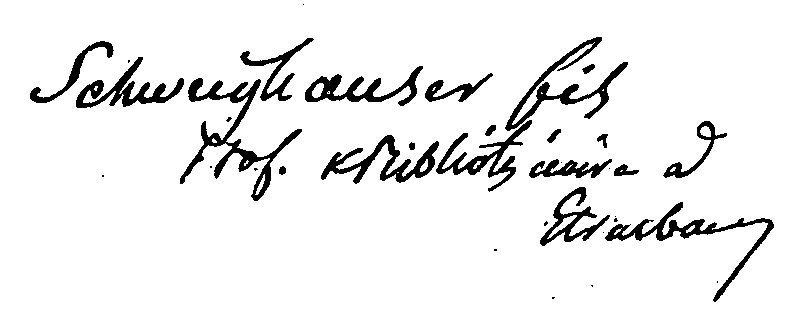
230 [Madame Francs, whose kind and liberal conduct towards me can never be forgotten, has now herself become the subject of a monumental effigy. She DIED (as I learn) in the year 1826.]