Volume 2 — VOLUME II. (continued 4)
Reading edition
The house of TREUTTEL and WURTZ is one of the richest and one of the most respectable in Europe. The commerce of that House is chiefly in the wholesale way; and they are, in particular, the publishers and proprietors of all the great classical works put forth at Strasbourg. Indeed, it was at this latter place where the family first took root: but the branches of their prosperity have spread to Paris and to London with nearly equal luxuriance. They have a noble house in the Rue de Bourbon, no. 17: like unto an hotel; where each day's post brings them despatches from the chief towns in Europe. Their business is regulated with care, civility, and dispatch; and their manners are at once courteous and frank. Nothing would satisfy them but I must spend a Sabbath with them, at their country house at Groslai; hard by the village and vale of Montmorenci. I assented willingly. On the following Sunday, their capacious family coach, and pair of sleek, round, fat black horses, arrived at my lodgings by ten o'clock; and an hour and three quarters brought me to Groslai. The cherries were ripe, and the trees were well laden with fruit: for Montmorenci cherries, as you may have heard, are proverbial for their excellence. I spent a very agreeable day with mine hosts. Their house is large and pleasantly situated, and the view of Paris from thence is rather picturesque. But I was most struck with the conversation and conduct of Madame Treuttel. She is a thoroughly good woman. She has raised, at her own expense, an alms-house in the village for twelve poor men; and built a national school for the instruction of the poor and ignorant of both sexes. She is herself a Lutheran Protestant; as are her husband and her son-in-law M. Würtz. At first, she had some difficulties to encounter respecting the school; and sundry conferences with the village Curé, and some of the head clergy of Paris, were in consequence held. At length all difficulties were surmounted by the promise given, on the part of Madame Treuttel, to introduce only the French version of the Bible by De Sacy. Hence the school was built, and the children of the village flocked in numbers to it for instruction. I visited both the alms-house and the school, and could not withhold my tribute of hearty commendation at the generosity, and thoroughly Christian spirit, of the foundress of such establishments. There is more good sense and more private and public virtue, in the application of superfluous wealth in this manner, than in the erection of a hundred palaces like that at Versailles!126
A different, and a more touching object presented itself to my view in the garden. Walking with Madame, we came, through various détours, into a retired and wooded part: where, on opening a sort of wicket gate, I found myself in a small square space, with hillocks in the shape of tumuli before me. A bench was at the extremity. It was a resting place for the living, and a depository of the dead. Flowers, now a good deal faded, were growing upon these little mounds--beneath which the dead seemed to sleep in peace. "What might this mean?" "Sir," replied Madame Treuttel, "this is consecrated ground. My son-in-law sleeps here--and his only and beloved child lies by the side of him. You will meet my daughter, his wife, at dinner. She, with myself, visit this spot at stated seasons--when we renew and indulge our sorrows on the recollection of those who sleep beneath. These are losses which the world can never repair. We all mean to be interred within the same little fenced space.127 I have obtained a long lease of it--for some fifty years: at the expiration of which time, the work of dissolution will be sufficiently complete with us all." So spake my amiable and enlightened guide. The remainder of the day--during which we took a stroll to Montmorenci, and saw the house and gardens where Rousseau wrote his Emile--was spent in a mixed but not irrational manner: much accordant with my own feelings, and most congenial with a languid state of body which had endured the heats of Paris for a month, without feeling scarcely a breath of air the whole time.
ANTOINE-AUGUSTIN RENOUARD, living in the Rue St. André des Arts, is the next bibliopolist whom I shall introduce to your attention. He is among the most lynx-eyed of his fraternity: has a great knowledge of books; a delightful ALDINE LIBRARY;128--from which his Annals of the Aldine Press were chiefly composed--and is withal a man in a great and successful line of business. I should say he is a rich man; not because he has five hundred bottles of Burgundy in his cellar, which some may think to be of a more piquant quality than the like number of his Alduses--but because he has published some very beautiful and expensive editions of the Latin and French Classics, with equal credit to himself and advantage to his finances.129 He debuted with a fine edition of Lucan in 1795, folio; and the first catalogue of his books was put forth the following year. From that moment to the present, he has never slackened head, hand, or foot, in the prosecution of his business; while the publication of his Annals of the Aldine Press places him among the most skilful and most instructive booksellers in Europe. It is indeed a masterly performance: and as useful as it is elegantly printed.130 M. Renouard is now occupied in an improved edition of Voltaire, which he means to adorn with engravings; and of which he shewed me the original drawings by Moreau, with many of the plates.131 He seems in high spirits about the success of it, and leans with confidence upon the strength of a host of subscribers. Nor does a rival edition, just struggling into day, cause him to entertain less sanguine expectations of final success. This enterprising bookseller is now also busily occupied about a Descriptive Catalogue of his own library, in which he means to indulge himself in sundry gossipping notes, critical disquisitions, and piquant anecdotes. I look forward with pleasure to its appearance; and turn a deaf ear to the whispers which have reached me of an intended brush at the Decameron.132
M. Renouard has allowed me free access to his library; which also contains some very beautiful copies of books printed in the fifteenth century. Among these latter, his VELLUM VALDARFER is of course considered, by himself and his friends, as the keimelion of the collection. It is the edition of the Orations of Cicero, printed by Valdarfer, at Venice, in 1471, folio: a most exquisite book--which may be fairly considered as perfect throughout. It is in its second binding, but that may be as old as the time of Francis I.: perhaps about the middle of the sixteenth century. This copy measures thirteen inches in height, by eight inches and seven-eighths in width:--almost, I conceive, in its original state of amplitude. I will frankly own that I turned over the leaves of this precious book, again and again--"sighed and looked, &c." "But would no price tempt the owner to part with it?" "None. It is reserved as the bijou of my catalogue, and departs not from hence." Severe, but just decree! There is only one other known copy of it upon vellum, which is in the Royal Library133-- but which wants a leaf of the table; an imperfection, not belonging to the present copy.
The other "great guns," as VELLUM BOOKS, in the collection of M. Renouard, are what is called the Familiar Epistles of Cicero printed by Aldus in 1502, 12mo: and the Petrarch of 1514, 8vo. also printed by Aldus. Of these, the latter is by much the preferable volume. It is almost as large as it can well be: but badly bound in red morocco.134 The Cicero is short and sallow-looking. It was on the occasion of his son starting for the first time on a bibliographical tour, and, on crossing the Rhine, and finding this Cicero and the almost equally rare Aldine Virgil of 1505, that a relation of this "fortunate youth" invoked his muse in some few verses, which he printed and gave to me.135 These are little "plaisanteries" which give a relish to our favourite pursuits; and which may at some future day make the son transcend the father in bibliographical renown. Perhaps the father has already preferred a prayer upon the subject, as thus:
Ζευ, αλλοι τε Θεοι, δοτε δη και τονδε γενεσθαι Παιδ εμον ως και εγω περ,....
There are some few noble volumes, from the press of Sweynheym and Pannartz, in this collection; and the finest copy of the FIRST LUCIAN in Greek, which perhaps any where exists.136 It was obtained at a recent sale, (where it was coated in a lapping-over vellum surtout) at a pretty smart price; and has been recently clothed in blue morocco. M. Renouard has also some beautiful copies from the library of De Thou, and a partly uncut Aldine Theophrastus of 1497, which belonged to Henry the Second and Diane de Poictiers; as well as a completely uncut copy of the first Aldine Aristotle.137 Few men probably have been luckier in obtaining several of their choice articles; and the little anecdotes which he related to me, are such as I make no doubt will appear in the projected catalogue raisonné of his library. He is just now briskly engaged in the pursuit of uncut Elzevirs ... and coming to breakfast with me, the other morning, he must needs pick up a beautiful copy of this kind, in two small volumes, neatly half bound, (of which I have forgotten the title,) and of which he had been for some time in the pursuit. M. Renouard also took occasion to tell me that, in his way to my chambers, he had sold, or subscribed, of a forthcoming work to be published by him--just nine hundred and ninety-nine copies! Of course, after such a trouvaille and such a subscription, he relished his breakfast exceedingly. He is a man of quick movements, of acute perceptions, of unremitting ardour and activity of mind and body--constantly engaged in his business, managing a very extensive correspondence, and personally known to the most distinguished Collectors of Italy. Like his neighbours, he has his country-house, or rather farm, in Picardy138 whither he retires, occasionally to view the condition and growing strength of that species of animal, from the backs of which his beloved Aldus of old, obtained the matériel for his vellum copies. But it is time to wish M. Renouard a good morning, and to take you with me to his neighbour--
MONS. BRUNET, THE YOUNGER. This distinguished bibliographer, rather than bookseller, lives hard by--in the Rue Gît-Le-Coeur. He lives with his father, who superintends the business of the shop. The Rue Gît-Le-Coeur is a sorry street--very diminutive, and a sort of cropt copy--to what it should have been, or what it might have been. However, there lives JACQ. CH. BRUNET, FILS: a writer, who will be known to the latest times in the bibliographical world. He will be also thanked as well as known; for his Manuel du Libraire is a performance of incomparable utility to all classes of readers and collectors. You mount up one pair of stairs:--the way is gloomy, and might well lead to a chamber in the monastery of La Trappe. You then read an incription, which tells you that "in turning the button you pull the bell." The bell sounds, and Mons. Brunet, Pere, receives you--with, or without, a silken cap upon his head. He sits in a small room, sufficiently well filled with books. "Is the Son at home?" "Open that door, Sir, you will find him in the next room." The door is immediately opened--and there sits the son, surrounded by, and almost imprisoned in, papers and books. His pen is in his hand: his spectacles are upon his nose: and he is transcribing or re-casting some precious little bit of bibliographical intelligence; while, on looking up and receiving you, he seems to be "full of the labouring God!" In short, he is just now deeply and unintermittingly engaged in a new and third edition of his Manuel.139 The shelves of his room almost groan beneath the weight of those writers from whom he gathers his principal materials. "Vous voilà, Mons. Brunet, bien occupé!;" "Oui, Monsieur, cela me fait autant de plaisir que de peine."
This is a very picture of the man.... "The labour we delight in physics pain,"--said Lady Macbeth of old; and of a most extraordinary kind must the labour of Mons. Brunet be considered, when the pleasure in the prosecution of it balances the pain. We talked much and variously at our first interview: having previously interchanged many civilities by letter, and myself having been benefitted by such correspondence, in the possession of a large paper copy of his first edition--of which he was pleased to make me a present, and of which only twenty copies were struck off. I told him that I had given Charles Lewis a carte blanche for its binding, and that I would back his skill--the result of such an order--against any binding at that time visible in any quarter of Paris! Mons. B. could not, in his heart, have considered any other binding superior.
He told me, somewhat to my astonishment, and much to my gratification, that, of the first edition of his Manuel, he had printed and sold two thousand copies. This could never have been done in our country: because, doubting whether it would have been so accurately printed, it could never have been published, in the same elegant manner, for the same price. The charges of our printers would have been at least double. In the typographical execution of it, M. Crapelet has almost outdone himself. Reverting to the author, I must honestly declare that he has well merited all he has gained, and will well merit all the gains which are in store for him. His application is severe, constant, and of long continuance. He discards all ornament,140 whether graphic or literary. He is never therefore digressive; having only a simple tale to tell, and that tale being almost always well and truly told.141 In his opinions, he is firm and rational, and sometimes a little pugnacious in the upholding of them. But he loves only to breathe in a bibliographical element, and is never happier than when he has detected some error, or acquired some new information; especially if it relate to an Editio Princeps.142 There is also something very naïf and characteristic in his manner and conversation. He copies no one; and may be said to be a citizen of the world. In short, he has as little nationality in his opinions and conversation, as any Frenchman with whom I have yet conversed.
Thus much for the leading booksellers of Paris on the south side of the Seine: or, indeed, I may say in the whole city. But, because the south is a warm and genial aspect in the bringing forth of all species of productions, it does not necessarily follow that ... there should be no bibliopolistic vegetation on the north side of the Seine. Prepare therefore to be introduced to MONS. CHARDIN, in the Rue St. Anne, no. 19; running nearly at right angles with the Rue St. Honoré, not far from the Eglise St. Roq. M. Chardin is the last surviving remains of the OLD SCHOOL of booksellers in Paris; and as I love antiquities of almost all kinds, I love to have a little occasional gossip with M. Chardin. A finer old man, with a more characteristic physiognomy, hath not appeared in France from the time of Gering downwards. M. Chardin is above the mean height; is usually attired in a rocquelaure; and his fine flowing grey locks are usually surmounted by a small black silk cap. His countenance is penetrating, but mild: and he has a certain air of the "Old School" about him, which is always, to my old-fashioned taste, interesting and pleasing.
In his youth he must have been handsome, and his complexion is yet delicate. But good old M. Chardin is an oddity in his way. He physics "according to the book"--that is, according to the Almanack; although I should think he had scarcely one spare ounce of blood in his veins. Phlebotomy is his "dear delight." He is always complaining, and yet expects to be always free from complaint. But Madame will have it so, and Monsieur is consenting. He lives on the floor just above the entresol, and his two or three small apartments are gaily furnished with books. The interior is very interesting; for his chief treasures are locked up within glazed cabinets, which display many a rich and rare article. These cabinets are beautifully ornamented: and I do assure you that it is but justice to their owner to say, that they contain many an article which does credit to his taste.
This taste consists principally in a love of ornamented MSS. and printed books UPON VELLUM, in general very richly bound.143 It is scarcely seven years ago since M. Chardin published an octavo catalogue, of nearly two hundred pages, of MSS. and printed books ... all upon vellum. He has been long noted for rarities of this kind. "Il n'y a que des livres rares" is his constant exclamation--as you open his glazed doors, and stretch forth your hand to take down his treasures. He is the EDWARDS of France, but upon a smaller scale of action. Nor does he push his wares, although he does his prices. You may buy or not, but you must pay for what you do buy. There is another oddity about this courteous and venerable bibliopolist. He has a great passion for making his Alduses perfect by means of manuscript; and I must say, that, supposing this plan to be a good one, he has carried it into execution in a surprisingly perfect manner: for you can scarcely, by candle-light, detect the difference between what is printed and what is executed with a pen. I think it was the whole of the Scholia attached to the Aldine Discorides, in folio, and a great number of leaves in the Grammatical Institutes of Urbanus, of 1497, 4to. with several other smaller volumes, which I saw thus rendered perfect: How any scribe can be sufficiently paid for such toil, is to me inconceivable: and how it can answer the purpose of any bookseller so to complete his copies, is also equally unaccountable: for be it known, that good M. Chardin leaves you to make the discovery of the MS. portion; and when you have made it,--he innocently subjoins--"Oui, Monsieur, n'est il pas beau?" In a sort of passage, between his principal shew-room and his bed room, is contained a very large collection of tracts and printed volumes relating to the FAIR SEX: being, in fact, nothing less than a prodigious heap of publications "FOR and AGAINST" the ladies. M. Chardin will not separate them--adding that the "bane and antidote must always go together."
This singular character is also vehemently attached to antiquarian nick-knackery. Old china, old drawings, old paintings, old carvings, and old relics--of whatever kind--are surveyed by him with a curious eye, and purchased with a well-laden purse. He never speaks of GOUJIN but in raptures. We made an exchange the other day. M. Chardin hath no small variety of walking canes. He visited me at the Hôtel one morning, leaning upon a fine dark bamboo-stick, which was headed by an elaborately carved piece of ivory--the performance of the said Goujon. It consisted of a recumbent female, (with a large flapped hat on) of which the head was supported by a shield of coat armour.144 We struck a bargain in five minutes. He presented me the stick, on condition of my presenting him with a choice copy of the Ædes Althorpianæ. We parted well satisfied with each other; but I suspect that the purchase of about four-score pounds worth of books, added much to the satisfaction on his part. Like all his brethren of the same craft, M. Chardin disports himself on Saturdays and Sundays at his little "ferme ornée," within some four miles of Paris--having, as he gaily told me "nothing now to do but to make poesies for the fair sex."145
With Chardin I close my bibliopolistic narrative; not meaning thereby to throw other booksellers into the least degree of shade, but simply to transmit to you an account of such as I have seen and have transacted business with. And now, prepare for some account of PRINTERS ... or rather of three presses only,--certainly the most distinguished in Paris. I mean those of the DIDOT and that of M. CRAPELET. The name of Didot will last as long as learning and taste shall last in any quarter of the globe: nor am I sure, after all, that what Bodoni, Bensley, and Bulmer have done, collectively, has redounded more to the credit of their countries than what Didot has achieved for France. In ancient classical literature, however, Bodoni has a right to claim an exception and a superiority. The elder, Pierre Didot, is Printer to his Majesty. But when Pierre Didot l'ainé chose to adopt his own fount of letter--how exquisitely does his skill appear in the folio Virgil of 1798, and yet more, perhaps, in the folio Horace of 1799!? These are books which never have been, and never can be, eclipsed. Yet I own that the Horace, from the enchanting vignettes of Percier, engraved by Girardais, is to my taste the preferable volume.146
FIRMIN DIDOT now manages the press in the Rué Jacob; and if he had never executed any thing but the Lusiad of Camoens, his name would be worthy to go down to posterity by the side of that of his uncle. The number of books printed and published by the Didots is almost incredible; especially of publications in the Latin and French languages. Of course I include the Stereotype productions: which are very neat and very commodious--but perhaps the page has rather too dazzling an effect. I paid a visit the other day to the office of Firmin Didot; who is a letter founder "as well as a printer.147 To a question which I asked the nephew, (I think) respecting the number of copies and sizes, of the famous Lusiad just mentioned, he answered, that there were only two hundred copies, and those only of one size. Let that suffice to comfort those who are in terror of having the small paper, and to silence such as try to depreciate the value of the book, from the supposed additional number of copies struck off.
I wished to know the costs and charges of printing, &c.--from which the comparative price of labour in the two countries might be estimated. M. Didot told me that the entire charges for printing, and pulling, one thousand copies of a full octavo size volume--containing thirty lines in a page, in a middle-size-letter--including every thing but paper--was thirty-five francs per sheet. I am persuaded that such a thing could not be done at home under very little short of double the price:--whether it be that our printers, including the most respectable, are absolutely more extravagant in their charges, or that the wages of the compositors are double those which are given in France.
After Didot, comes CRAPELET--in business, skill, and celebrity. He is himself a very pleasant, unaffected man; scarcely thirty-six; and likely, in consequence, to become the richest printer in Paris. I have visited him frequently, and dined with him once--when he was pleased to invite some agreeable, well-informed, and gentlemanly guests to meet me. Among them was a M. REY, who has written "Essais Historiques et Critiques sur Richard III. Roi d'Angleterre," just printed in a handsome octavo volume by our Host. Our conversation, upon the whole; was mixed; agreeable, and instructive. Madame Crapelet, who is at this moment (as I should conjecture) perhaps pretty equally divided between her twenty-fifth and twenty-sixth year, and who may be classed among the prettier ladies of Paris, did the honours of the fête in a very agreeable manner: nor can it be a matter of surprise that the choicest Chambertin and Champagne sparkled upon the table of one--who, during the libations of his guests; had the tympans and friskets of twenty-two Presses in full play!148 We retired, after dinner, into a spacious drawing room to coffee and liqueurs: and anon, to a further room, wherein was a BOOK-CASE filled by some of the choicest specimens of the press of its owner, as well as of other celebrated printers. I have forgotten what we took down or what we especially admired: but, to a question respecting the present state of business, as connected with literature and printing, at Paris, M. Crapelet replied (as indeed, if I remember rightly, M. Didot did also) that "matters never went on better." Reprints even of old authors were in agitation: and two editions of Montaigne were at that moment going on in his own house. I complimented M. Crapelet--and with equal sincerity and justice--upon the typographical execution of M. Brunet's Manuel du Libraire. No printer in our own country, could have executed it more perfectly. "What might have been the charge per sheet?" My host received the compliment very soberly and properly; and gave me a general item about the expense of printing and paper, &c., which really surprised me; and returned it with a warm eulogy upon the paper and press-work of a recent publication from the Shakspeare press--which, said he, "I despair of excelling." "And then (added he), your prettily executed vignettes, and larger prints! In France this branch of the art is absolutely not understood149--and besides, we cannot publish books at your prices!"
We must now bid adieu to the types of M. Crapelet below stairs, and to his "good cheer" above; and with him take our leave of Parisian booksellers and printers.150 What then remains, in the book way, worthy of especial notice? Do you ask this question? I will answer it in a trice--BOOK-BINDING. Yes ... some few hours of my residence in this metropolis have been devoted to an examination of this seductive branch of book commerce. And yet I have not seen--nor am I likely to see--one single binder: either Thouvenin, or Simier, or Braidel, or Lesné. I am not sure whether Courteval, or either of the Bozérians, be living: but their handy works live and are lauded in every quarter of Paris.
The restorer, or the Father, (if you prefer this latter appellative) of modern Book-binding in France, was the Elder Bozérian: of whose productions the book-amateurs of Paris are enthusiastically fond. Bozérian undoubtedly had his merits;151 but he was fond of gilt tooling to excess. His ornaments are too minute and too profuse; and moreover, occasionally, very unskilfully worked. His choice of morocco is not always to my taste; while his joints are neither carefully measured, nor do they play easily; and his linings are often gaudy to excess. He is however hailed as the legitimate restorer of that taste in binding, which delighted the purchasers in the Augustan age of book-collecting. One merit must not be denied him: his boards are usually square, and well measured. His volumes open well, and are beaten ... too unmercifully. It is the reigning error of French binders. They think they can never beat a book sufficiently. They exercise a tyranny over the leaves, as bad as that of eastern despots over their prostrate slaves. Let them look a little into the bindings of those volumes before described by me, in the lower regions of the Royal Library152--and hence learn, that, to hear the leases crackle as they are turned over, produces nearly as much comfort to the thorough-bred collector, as does the prattling of the first infant to the doating parent.
THOUVENIN153 and SIMIER are now the morning and evening stars in the bibliopegistic hemisphere. Of these, Thouvenin makes a higher circle in the heavens; but Simier shines with no very despicable lustre. Their work is good, substantial, and pretty nearly in the same taste. The folio Psalter of 1502, (I think) in the Royal Library, is considered to be the ne plus ultra of modern book-binding at Paris; and, if I mistake not, Thouvenin is the artist in whose charcoal furnace, the tools, which produced this êchantillon, were heated. I have no hesitation in saying, that, considered as an extraordinary specimen of art, it is a failure. The ornaments are common place; the lining is decidedly bad; and there is a clumsiness of finish throughout the whole. The head-bands--as indeed are those of Bozérian--are clumsily managed: and I may say that it exhibits a manifest inferiority even to the productions of Mackinlay, Hering, Clarke, and Fairbairn. Indeed either of these artists would greatly eclipse it. I learn that Thouvenin keeps books in his possession as long as does a certain binder with us--- who just now shall be nameless. Of course Charles Lewis would smile complacently if you talked to him about rivalling such a performance!154
There is a book-binder of the name of LESNÉ--just now occupied, as I learn, in writing a poem upon his Art155--who is also talked of as an artist of respectable skill. They say, however, that he writes better than he binds. So much the worse for his little ones, if he be married. Indeed several very sensible and impartial collectors, with whom I have discoursed, also seem to think that the art of book-binding in France is just now, if not retrograding, at least stationary--and apparently incapable of being carried to a higher pitch of excellence. I doubt this very much. They can do what they have done before. And no such great conjuration is required in going even far beyond it. Let Thouvenin and Simier, and even the Poet himself, examine carefully the choice of tools, and manner of gilding, used by our more celebrated binders, and they need not despair of rivalling them. Above all, let them look well to the management of the backs of their books, and especially to the headbands. The latter are in general heavy and inelegant. Let them also avoid too much choking and beating, (I use technical words--- which you understand as well as any French or English bookbinder) and especially to be square, even, and delicate in the bands; and the "Saturnia regna" of book-binding in France may speedily return.
LETTER IX.
MEN OF LETTERS. DOM BRIAL. THE ABBÉ BÉTENCOURT. MESSRS. GAIL, MILLIN, AND LANGÈS. A ROXBURGHE BANQUET.
Paris, June 20, 1818.
MY DEAR FRIEND,
We have had of late the hottest weather in the memory of the oldest Parisian: but we have also had a few flying thunder showers, which have helped to cool the air, and to refresh both the earth and its inhabitants. In consequence, I have made more frequent visits; and have followed up my morning occupations among BOOKS, by the evening society of those who are so capable, from their talents, of adding successfully to their number. Among the most eminent, as well as most venerable of historical antiquaries, is the celebrated Dom BRIAL, an ex-Benedictin. He lives in the Rue Servandoni, on the second-floor, in the very bosom, as it were, of his library, and of city solitude. My first visit to him, about three weeks ago, was fortified by an introductory letter from our friend * * *. The old gentleman (for he is about seventy four) was busily occupied at his dinner--about one o'clock; and wearing a silk night cap, and habited en rocquelaure, had his back turned as his servant announced me. He is very deaf; but on receiving the letter, and recognising the hand-writing of our friend, he made me heartily welcome, and begged that I would partake of his humble fare. This I declined; begging, on the other hand that he would pursue his present occupation, and allow me to examine his library. "With the greatest pleasure (replied he); but you will find it a very common-place one."
His books occupy each of the four rooms which form the suite of his dwelling. Of course I include the bed room. They are admirably selected: chiefly historical, and including a very considerable number in the ecclesiastical department. He has all the historians relating to our own country. In short, it is with tools like these, and from original MSS. lent him from the Royal Library--which his official situation authorizes--- that he carries on the herculean labour of the Recueil des Historiens des Gaules, &c. commenced by BOUQUET and other editors, and of which he shewed me a great portion of the XVIIth volume--as well as the commencement of the XVIIIth--already printed. Providence may be graciously pleased to prolong the life of this learned and excellent old man till the latter volume be completed; but beyond that period, it is hardly reasonable or desirable to wish it; for if he die, he will then have been gathered to his fathers in a good old age.156 But the labours of Dom Brial are not confined to the "Recueil," just mentioned. They shine conspicuous in the "Histoire Littéraire de la France," of which fifteen goodly quarto volumes are already printed; and they may be also traced in the famous work entitled L'Art de, Verifier les Dates, in three large folio volumes, published in 1783, &c. "Quand il est mort, il n'a point son élevè"157--says his old and intimate friend the ABBÉ BÉTENCOURT; an observation, which, when I heard it, filled me with mingled regret and surprise--for why is this valuable, and most patriotic of all departments of literature, neglected abroad as well as at home? It is worth all the digamma disquisitions in the world; and France, as well as Italy, was once rich in historical Literati.
Dom Brial is very little above the mean height. He stoops somewhat from age; but, considering his years, and incessantly sedentary labours, it is rather marvellous that he does not exhibit more striking proofs of infirmity. His voice is full and strong; his memory is yet retentive, and his judgment sound. His hand-writing is extremely firm and legible. No man ever lived, or ever will, or can live, more completely devoted to his labours. They are his meat and drink--as much as his "bouilli et petites poies:"--of which I saw him partaking on repeated visits. Occupied from morning till night in the prosecution of his studies--in a quarter of Paris extremely secluded--he appears to be almost unconscious of passing occurrences without;158 except it be of the sittings of the Institute, which he constantly attends, on Fridays, as one of the Secretaries. I have twice dined with him; and, each time, in company with the Abbé Bétencourt, his brother Secretary at the Institute; and his old, long-tried, and most intimate friend.
The Abbé BÉTENCOURT was not unknown to me during his late residence in England, as an Emigré: but he is still-better known to our common friend * * *, who gave me the letter of introduction to Dom Brial. That mutual knowledge brought us quickly together, and made us as quickly intimate. The Abbé is above the middle height; wears his own grey hair; has an expressive countenance, talks much; and well, and at times drolly. Yet his wit or mirth is well attempered to his years. His manner of rallying his venerable friend is very amusing; for Dom Brial, from his deafness, (like most deaf men) drops at times into silence and abstraction. On each of my dinner-visits, it was difficult to say which was the hotter day. But Dom Brial's residence, at the hour of dinner, (which was four--for my own accommodation) happened luckily to be in the shade. We sat down, three, to a small circular table, (in the further or fourth room) on the tiled floor of which was some very ancient wine, within the immediate grasp of the right hand of the host. An elderly female servant attended in the neighbouring room. The dinner was equally simple, relishing, and abundant; and the virtues of the "old wine" were quickly put into circulation by the Benedictin founder of the feast.
At six we rose from table, and walked in the Luxembourg gardens, hard by. The air had become somewhat cooler. The sun was partially concealed by thin, speckled clouds: a gentle wind was rising; and the fragrance of innumerable flowers, from terraces crowded with rose-trees, was altogether so genial and refreshing, that my venerable companions--between whom I walked arm in arm--declared that "they hardly knew when the gardens had smelt so sweetly." We went straight onward--towards the Observatoire, the residence of the Astronomer Royal. In our way thither we could not avoid crossing the Rue d' Enfer, where Marshal Ney was shot. The spot, which had been stained with his blood, was at this moment covered by skittles, and groups of stout lads were enjoying themselves in all directions. It should seem that nothing but youthful sports and pastimes had ever prevailed there: so insensibly do succeeding occupations wear away all traces of the past. I paused for half a minute, casting a thoughtful eye towards the spot. The Abbé Bétencourt moralised aloud, and Dom Brial seemed inwardly to meditate. We now reached the Observatory. The Sub-Principal was at home, and was overjoyed to receive his venerable visitors. He was a fellow-townsman of Dom Brial, and we were shewn every thing deserving of notice. It was nearly night-fall, when, on reaching the Rue Servandoni, I wished my amiable companions adieu, till we met again.
I have before mentioned the name of M. GAIL. Let me devote a little more time and attention to him. He is, as you have been also previously told, the curator of the Greek and Latin MSS. in the Royal Library, and a Greek Professor in the Collège Royale. There is no man, at all alive to a generous and kind feeling, who can deny M. Gail the merit of a frank, benevolent, and hearty disposition. His Greek and Latin studies, for the last thirty-five years, have neither given a severe bias to his judgment, nor repressed the ebullitions of an ardent and active imagination. His heart is yet all warmth and kindness. His fulfilment of the duties of his chair has been exemplary and beneficial; and it is impossible for the most zealous and grateful of her sons, to have the prosperity of the Collège Royale more constantly in view, than my friend I.B. Gail has that of the University of Paris. His labours, as a scholar, have been rather useful than critical. He has edited Anacreon more than once: and to the duodecimo edition of 1794, is prefixed a small portrait--medallion-wise--of the editor; which, from the costume of dress and juvenility of expression, does not much remind me of the Editor as he now is. M. Gail's great scholastic work is his Greek, Latin, and French, editions of Xenophon and Thucydides, in twenty-four quarto volumes; but in the execution of this performance he suffered himself to be rather led astray by the attractions of the Bibliomania. In other words, he chose to indulge in membranaceous propensities; and nothing would serve M. Gail's turn but he must have a unique COPY UPON VELLUM! in a quarto form.159 Twenty four quarto volumes upon vellum!.. enough to chill the ardour and drain the purse of the most resolute and opulent publisher.
When I dined with the Editor, the other day, I was shewn these superb volumes with all due form and solemnity: and I must say that they do very great credit to the press of the Elder Didot. Yet I fear that it will be a long time before the worthy M. Gail is remunerated for his enterprising and speculative spirit. In all the duties attached to his situation in the Royal Library, this worthy character is equally correct and commendable. He is never so fully occupied with old Greek and Latin MSS., but that he will immediately attend to your wants; and, as much as depends upon himself, will satisfy them most completely. Anacreon has left behind some little deposit of good humour and urbanity, which has continued to nourish the heart of his Translator; for M. Gail is yet jocose, and mirth-loving; fond of a lively repartee, whether in conversation or in writing. He may count some sixty-two years.
But it is high time to introduce you to another of these "Confrères" at the Bibliothèque du Roi; of whom indeed, hitherto, I have made but a slight mention. You will readily guess that this must be the well-known AUBIN LOUIS MILLIN--the Head of the department of Antiquities; or the principal Archaeologist of the establishment. My friend Mr. Dawson Turner having furnished me with introductory credentials, I called upon M. Millin within twenty-four hours of my arrival at Paris. In consequence, from that time to this, I have had frequent intercourse with him. Indeed I am willing to hope that our acquaintance has well nigh mellowed into friendship. He is a short, spare, man; with a countenance lighted up by intelligence rather than moulded by beauty. But he is evidently just now (and indeed, as I learn, has been for some time past) labouring under severe indisposition. He is the thorough Frenchman both in figure and manners: light, cheerful, active, diligent, and exceedingly good natured and communicative. His apartments are admirably furnished: and his LIBRARY does him infinite honour--considering the limited means by which it has been got together. His abode is the constant resort of foreigners, from all countries, and of all denominations; and the library is the common property of his friends, and even of strangers--when they are well recommended to him.
Millin has been a great traveller; but, if the reports which have reached me prove true, his second voyage to Italy, recently accomplished, have sown the seeds of incurable disease in his constitution. Indeed: when I look at him, at times, I fancy that I discover that in his countenance ... which I wish were not so palpable ... to my observation. His collection of drawings, of fac-similes of all descriptions--of prints and of atlasses--is immense. They are freely laid open to the inspection of any curious observer: and I have already told you how heartily M. Millin begged that Mr. Lewis would consider his house as his home--for the prosecution of his drawings from the illuminated MSS. in the Royal Library, when the regular time of attendance in that place was closed. The other day, we had a superb déjeuné à la fourchette at M. Millin's--about three o'clock. It was attended by two Marchionesses, of the bas bleu order; and by the whole corps of the confrères bibliographiques of the Royal Library. Several other literary distingués were of the party: and we sat down, a very agreeable mélange, both to gossip and to eat and drink. M. Langlès was all animation and all intelligence; and M. Van Praet seemed for a time to have forgotten VELLUM ARISTOTLES and VIRGILS in alternate libations of champagne and noyeau. Meanwhile, the worthy Gail, by his playful sallies and repartees, afforded a striking contrast to the balanced attitude and grave remarks of the respectable Caperonnier, the senior Librarian. Poor Millin himself had no appetite, but picked a little here and there. We sat down about fourteen; rose at six--to coffee and conversazione; and retired shortly after: some to the theatre, and others to their country houses. This is pretty nearly a correct picture of the bettermost society of Paris at this time of the year.
In regard to the literary reputation of MILLIN, I well know that, in England, it is rather the fashion to sneer at him; but this sneer may proceed as often from ignorance, as from superiority of information. The truth is, M. Millin does too much to do every thing well. At one moment, he is busied with a dyptych: at another, he is examining a coin or a medal: during the third, he is lost in admiration over a drawing of a tomb or statue:--his attendant enters with a proof-sheet to engage his fourth moment--and so it goes on--from sunrise to sunset; with pen in hand, or blank or printed paper before him, he is constantly occupied in the pursuit of some archaeological enquiry or other. THIS praise, however--and no mean or unperishable praise it is--most indisputably belongs to him. He was almost the ONLY ONE in France; who, during the reign of terror, bloodshed, and despotism--cherished and kept alive a taste for NATIONAL ANTIQUITIES. But for his perseverance, and the artists employed by him, we should not now have had those graphic representations of many buildings, and relics of art, which have since perished irretrievably. Another praise also belongs to him; of no very insignificant description. He is among the most obliging and communicative of literary Parisians; and does not suffer his good nature to be soured, or his activity to abate, from the influence of national prejudice. He has a large acquaintance among foreigners; and I really think that he loves the English next best to his own countrymen. But whoever applies to him with civility, is sure to be as civilly received. So much for MILLIN.160
This group of literary whole lengths would however be imperfect without the introduction of Monsieur LANGLÈS. The forte of M. Langlès consists in his cultivation of, and enthusiastic ardor for, oriental literature. He presides, in fact, over the Persian, Arabic, and other Oriental MSS. and he performs the duties of his office, as a public librarian, with equal punctuality and credit. He has also published much upon the languages of the East, but is considered less profound than DE SACY: although both his conversation and his library attest his predilection for his particular studies. M. Langlès is eclipsed by no one for that "gaieté de coeur" which, when joined with good manners and honourable principles, renders a well-bred Frenchman an exceedingly desirable companion. He loves also the arts; as well of sculpture as of painting and of engraving. His further room affords unquestionable evidence of his attachment to English Prints. Wilson, West, and Wilkie--from the burins of Woollett, Raimbach, and Burnet--struck my eye very forcibly and pleasingly. M. Langlès admires and speaks our language. "Your charming Wilkie (says he) pleases me more and more. Why does he not visit us? He will at least find here some good proofs of my respect for his talents." Of course he could not mean to pun. I was then told to admire his impression of Woollett's Battle of La Hogue; and indeed I must allow that it is one of the very best which I have seen. He who possesses that, need not distress himself about any of the impressions of the Death of Wolfe; which is also in the collection of Langlès.
His library is probably less extensive than Millin's; but it is not less choice and valuable. His collection of books (in which are a great number of our best Voyages and Travels) relating to Asia--and particularly his philological volumes, as connected with the different languages of that country, cannot be too much commended. I saw Sir John Malcolm's History of Persia lying upon his table. "How do you like that work, M. Langlès?" "Sir (replied he) I more than like it--I love it: because I love the author." In fact, I knew that Sir John and he were well acquainted with each other, and I believe that the copy in question bore the distinctive mark of being "ex dono auctoris." I have had a good deal of interesting conversation with M. Langlès about the history of books during the Revolution; or rather about that of the ROYAL LIBRARY. He told me he was appointed one of the commissioners to attend to the distribution of those countless volumes which were piled up in different warehouses, as the produce of the ransacked monasteries. I am not sure, whether, within the immediate neighbourhood of the Royal Library, he did not say that there were at least half a million of books. At that time, every public meeting of Parisians--whatever might be the professed object--was agitated, and often furious. One of the red-hot demagogues got up in the assembly, and advised "mangling, maiming, or burning the books: they were only fit for cartridges, wadding, or fuel: they were replete with marks of feudalism and royalty--for they had arms or embellishments on them, which denoted them to belong to Aristocrats." This speech made some impression: his comrades were for carrying the motion immediately into execution, by sword and faggot.... But M. Langlès rose ... calm, collected, and actuated by feelings a little more accordant with the true spirit of patrotism. "Citizens," said the Orientalist, "we must not do mischief, in the desire of doing good. Let the books remain where they are. If you set fire to them, can you say how far the flames shall extend? Our own great national library, so renowned and celebrated throughout Europe! may become the prey of the devouring element, and then how will you be reproached by posterity! Again--if you convert them to other purposes of destruction, how can you hope to prevent the same example from being followed in other places? The madness of the multitude will make no distinction; and as many pikes and swords may be carried within the great library, as within the various depositories of the monastic books. Pause awhile. Respect those collections of books, and you will both respect yourselves and preserve the great national library. In due time, we shall make a proper selection from them, and enrich the book stores of the capital!" So spake M. Langlès; and the Assembly assented to his contre-projet--luckily for Paris and themselves.161
But nearly all these worthy characters, of whom I have just made mention, had an opportunity of exhibiting their social qualities, of whatever description, at a sort of FESTIVAL which I gave the other day (last Wednesday) in honour of the Roxburghe Club--which met on that same day, I presume, at the Clarendon Hotel. This Parisian Roxburghe Banquet went off upon the whole with flying colours. You shall know as much about it as is likely to interest you. Having secured my guests, (Messrs. DENON, GAIL, LANGLÈS, VAN PRAET and MILLIN) and fixed both the place and hour of repast, I endeavoured to dress out a little bill of fare of a bibliomaniacal description--to rival, in its way, that of Mons. Grignon, in the Rue Neuve des Petits Champs, (within two minutes walk of the Royal Library,) where we were to assemble, at five o'clock. I knew that Millin would put my toasts or sentiments into good French, and so I took courage against the hour of meeting. I had secured a ground-floor apartment, looking upon a lawn, with which it communicated by open doors. The day was unusually hot and oppressive. After finishing my labours at the Royal Library, I returned to my hotel, arranged my little matters connected with the by-play of the festival--dressed--and resorted to Grignon's. Every thing looked well and auspiciously. Our room was in the shade; and a few lingering breezes seemed to play beneath the branches of an acacia. The dark green bottles, of various tapering shapes, were embedded in pails of ice, upon the table: and napkins and other goodly garniture graced the curiously woven cloth. I hung up, in the simplicity of my heart--over the seat which I was to occupy,--the portrait of John King of France, which M. Coeuré had just finished;--not considering that this said John had been beaten and taken prisoner, at the battle of Poictiers by our Black Prince! Never was a step more injudicious, or an ornament more unappropriate. However, there it hung throughout the day. A dinner of the very best description, exclusively of the wine, was to be served up for twelve francs a head. I make no doubt but the Club paid a little more where they assembled in London!
At length came the hour of dinner, and with the hour the guests. I requested Brother Van Praet to be deputy chairman; and taking my seat beneath the unfortunate John King of France, gave the signal for a general attack--upon whatever was placed before the guests. Monsieur Denon, however, did not arrive till after the first course. He had been detained by a visit from the Duke of Bedford. M. Millin sat at my right hand, and M. Gail at my left. The first course consisted chiefly of fruit, and slices of anchovy, crossed. A large paper copy of a melon cut a magnificent appearance in the centre; but all this quickly gave way to fish, flesh, and fowl of a various but substantial description. Poor Millin had no appetite, and would only carve. He looked particularly ill. The rest ate, drank, and were merry. The desert was of the very best quality: and this was succeeded by the introduction of a little of English fashion and manners. We drank toasts, connected with the object of the day's festival; and never were a set of guests more disposed to relish both the wine and the sentiment which accompanied each glass. They even insisted upon a "three times three" for "Lord Spencer and the Club!" But if we were merry, we were wise. Shortly after dinner, M. Gail rose, as if in a moment of inspiration, from his seat--and recited the Latin verses which are here enclosed.162 They will at least make you admire the good humour of thé poet. He afterwards chanted a song: his own literal version of thé XIXth ode of Anacreon, beginning the Fables of Pfister, printed at Bamberg in 1461:--which they had recently RESTORED to the Wolfenbuttel Library! It was "more than enough" for the acute feelings of the devoted head-librarian. M. Van Praet talked with legs and arms, as well as with tongue, in reply to my observations upon the extraordinary worth and singular rarity of that singular volume. "Alas, Sir, nothing pained me more. Truly--"Here a smart flash of lightning came across us--which illumined our countenances with due effect: for it had been sometime past almost wholly dark, and we had been talking to each other without perceiving a feature in our respective faces. M. Langlès joined in M. Van Praet's lamentation; and the Baron Denon, who (as I learnt) had been the means of obtaining that identical precious volume, united his tones of commiseration with those of his brethren.
The lightning now became more frequent, and in larger flashes--but neither sharp nor very dazzling. Meanwhile the notes of a skilfully touched harp were heard from one of the windows of a neighbouring house, with a mingled effect which it was difficult to describe. Pfister, books, busts, and music, now wholly engrossed our attention--and we were absolutely enveloped in blue lightning. We had continued our discourse till towards midnight, had not the rain come down in a manner equally sudden and severe. It was one of the heaviest showers which I remember to have witnessed. The storm was directly in the centre of Paris, and over our heads. We retreated precipitately to the deserted banqueting room; and had a reinforcement of coffee. After such a series of melting hot weather, I shall not easily forget the refreshing sweetness emitted from every shrub upon the lawn. About ten o'clock, we thought of our respective homes.163 I went into another room to pay the reckoning; liberated King John from his second confinement; shook hands very heartily with my guests--and returned to my lodgings by no means out of humour or out of heart with the day's entertainment. Whether they have been more rational, or more economical, in the celebration of the same festival, AT HOME, is a point, which I have some curiosity, but no right, to discuss. Certainly they could not have been happier.
Having come to the conclusion of my account of the ROXBURGHE BANQUET, and it being just now hard upon the hour of midnight, I must relinquish my correspondent for my pillow. A good night.
LETTER X.
THE COLLECTIONS OF DENON, QUINTIN CRAUFURD, AND THE MARQUIS DE SOMMARIVA.
All the world has heard of the famous DENON, the Egyptian traveller; and editor of the great work of the Antiquities of Egypt, published in 1802, in two sumptuous folio volumes. As you possess a copy of the French work,164 with choice impressions of the plates, I need say nothing further upon the subject--except that I believe it to be one of the very finest works of the kind, which has ever appeared ... on the score of art. But the author has other claims to attention and popularity. He was an intimate friend--and certainly the confidential adviser--of Buonaparte, in all public schemes connected with the acquisition of pictures and statues: and undoubtedly he executed the task confided to him with ability. He was verging oh his sixtieth year, when he started with his master upon the Egyptian expedition--a proof at least of energy, as well as of good disposition, in the cause. But Denon has been a great European traveller: he has had access to private, as well as to public, cabinets; and has brought home some rich fruits of his enterprise and taste.
His house, on the Quai Malaquais, is the rendezvous of all the English of any taste--who have respectable letters of introduction; and I must do him the justice to say, that, never did a man endure the inconveniences which must frequently result from keeping such open house, with greater adroitness and good humour than does the Baron Denon. I have sometimes found his principal rooms entirely filled by my countrymen and countrywomen; and I once, from the purest accident, headed a party of twenty-two ... in which were three British officers, and more than that number of members of either University. I will fairly own that, on receiving us, he drew me quietly aside, and observed:--"Mon ami, quand vous viendrez une autre fois, ne commandez pas, je vous prie, une armée si nombreuse. Je m'imaginois encore en Egypte." What was still more perplexing, we found there a party of English as numerous as ourselves. It was thus, however, that he rebuked my indiscretion.
We had twice exchanged visits and cards before we met. The card of Denon was worth possessing, from the simple, unaffected modesty which it evinced. You merely read the word DENON upon it!... The owner of the collection which I am about to describe, is certainly "un peu passé" as to years; but he has a cheerful countenance, with the tint of health upon it; small, gray, sparkling eyes, and teeth both regular and white.165 He is generally dressed in black, and always as a gentleman. His figure, not above the middle height, is well formed; and his step is at once light and firm. There is doubtless a good deal which is very prepossessing in his manners. As he understands nothing of the English language, he can of course neither read nor speak it.
It is now time to give you some idea of this curious collection. You ascend a lofty and commodious stone staircase (not very common in Paris) and stop at the first floor:--another comfort, also very rare in Paris. This collection is contained in about half a dozen rooms: lofty, airy, and well furnished. The greater number of these rooms faces the Seine. The first contains a miscellaneous assemblage of bronze busts, and pictures of Teniers, Watteau, and of the more modern School of Paris. Of these, the Watteau is singular, rather than happy, from its size.166 The two Teniers are light, thin, pictures; sketches of pigs and asses; but they are very covetable morsels of the artist.167 In a corner, stands the skeleton of a female mummy in a glass case, of which the integuments are preserved in a basket. This is thought to be equally precious and uncommon. M. Denon shews the foot of the figure (which is mere bone and muscle) with amazing triumph and satisfaction. He thinks it is as fine as that of the Venus de Medicis, but there is no accounting for tastes. Among the busts is one of West, of Neckar, and of Denon himself: which latter I choose here to call "Denon the First." The second room contains a very surprising, collection of Phoenician, Egyptian, and other oriental curiosities: and in a corner, to the left, is a set of small drawers, filled with very interesting medals of eminent characters, of all descriptions, chiefly of the sixteenth century. Above them is a portrait of the owner of the collection--which I choose to call "Denon the Second." This room exhibits a very interesting mélange. Over the fire place are some busts; of which the most remarkable are those of Petrarch and Voltaire; the former in bronze, the latter in terra-cotta; each of the size of life. Voltaire's bust strikes me as being the best representation of the original extant. It is full of character; a wonderful mixture of malignity, wit, and genius.168
The third room is the largest, and the most splendidly hung with pictures. Of these, the circular little Guercino--a holy family--is, to my poor judgment, worth the whole.169 The Rysdael and Both are very second rate. As you approach the fire-place, your attention is somewhat powerfully directed to a small bronze whole length figure of Buonaparte--leaning upon a table, with his right hand holding a compass, and his left resting upon his left thigh.170 Some charts, with a pair of compasses, are upon the table; and I believe this represents him in his cabin, on his voyage to Egypt. Is there any representation of him, in the same situation, upon his return? However, it is an admirable piece of workmanship. In this room is also (if I remember rightly) the original colossal head of the ex-emperor, when a young man, in white marble, by CANOVA. But I must not omit informing you that here is also another portrait, in oil, of the owner of the collection--which, if you please, we will call "Denon the Third." You next enter a narrow, boudoir-shaped apartment, which contains, to my taste, the most curious and precious morsels of art which the Baron Denon possesses. They are specimens of the earlier schools of painting, commencing with what are called Giottos and Cimabues--down to a very striking modern picture of a group of children, by a late French artist, just before the time of our Reynolds. This latter you would really conceive to have been the production of Sir Joshua himself. Of the specimens of the earlier schools, I was most struck with the head of PISANI, the inventor of medals--of the fifteenth century--painted by Antonello da Messina, a pupil of John Van Eyk. It is full of nature and of character. I could not get away from it. "Is it possible to obtain a copy of this picture?"--said I to its owner. "I understand you, (replied Denon) you wish to carry that copy to your own country. And to have it engraved there?" ... "Most unquestionably"--resumed I. "It is at your service (he rejoined); Laurent will copy it admirably." I hardly knew how to thank Mons. Denon sufficiently.171
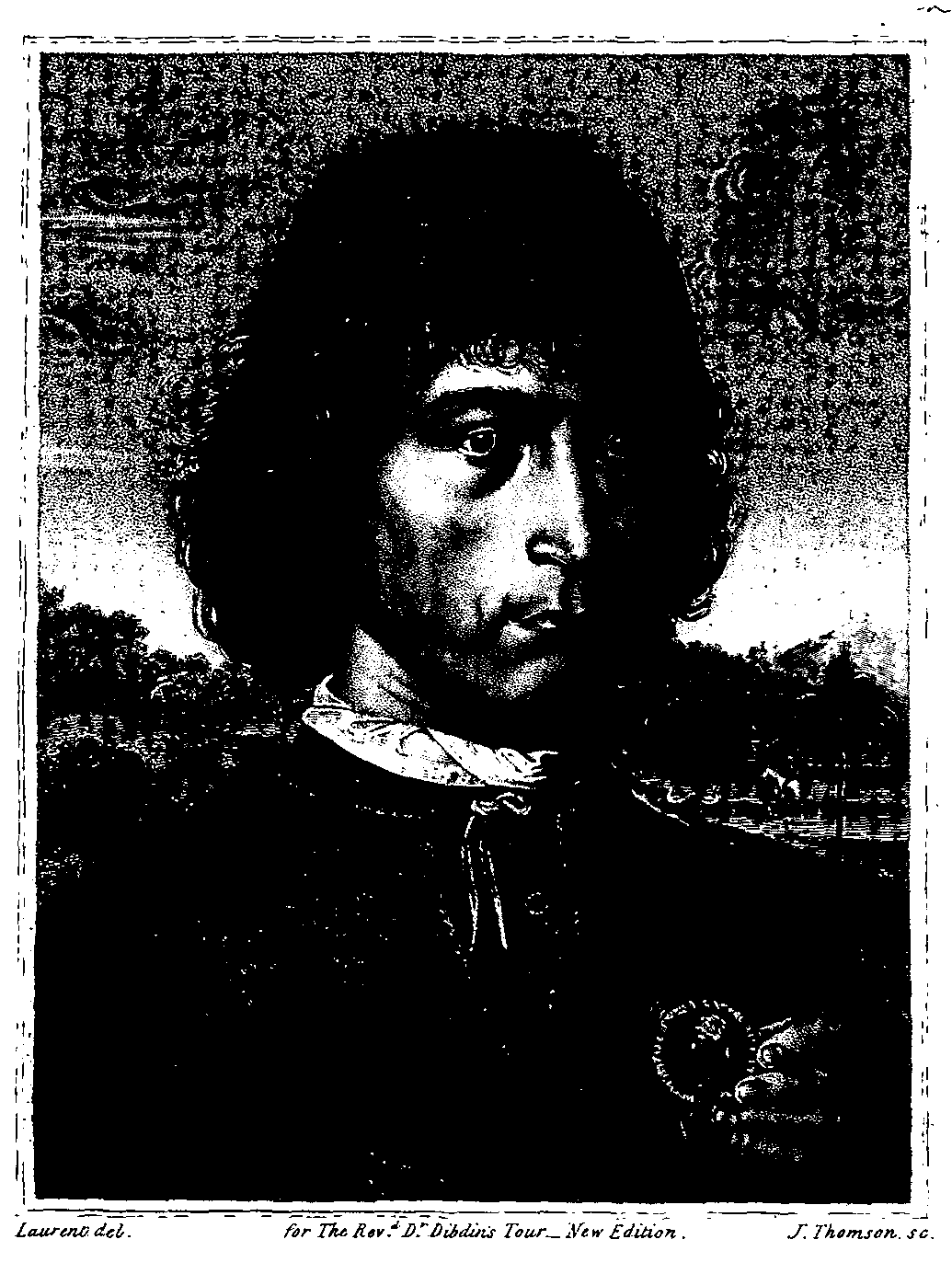
PISANI. From the Original Portrait by Antonella da Messina In the Collection of Baron Denon.
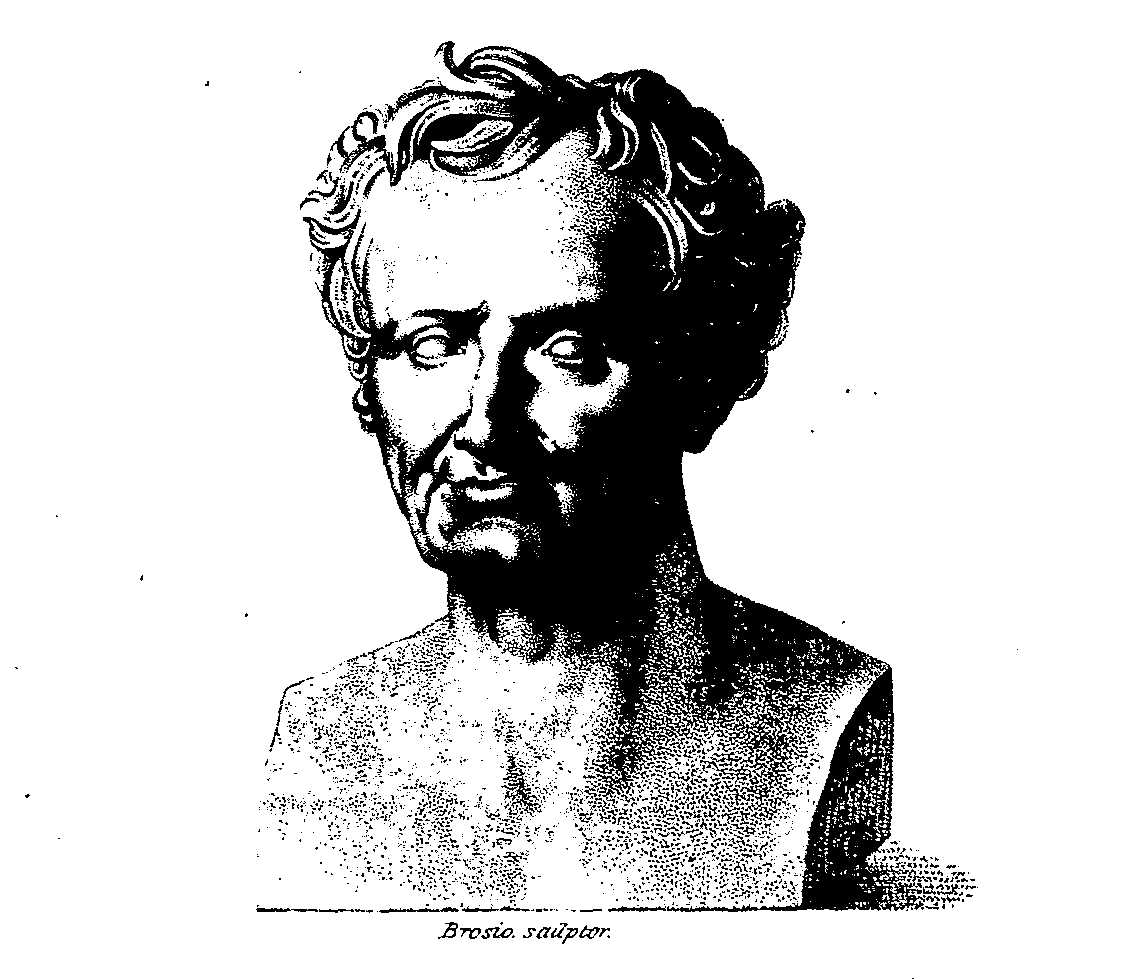
DENON. Engraved by J. Thomson from a Drawing by Laguiche.
There was another head ...but "non omnia possumus omnes." I mean, one of a female in profile, by MASACCIO. It was full of expression.172 "What, (said its owner,) must you have an engraving of that head also? It is bespoke; by myself. In short, every thing which you behold in these rooms (including even your favourite Pisani) will be lithographised for the publication of my own collection." Of course, after this declaration, I was careful of what I did or said. "But there was yet one thing in this collection--of which, as I saw such a variety, he could not refuse me a copy." "What might that be?" "A portrait of HIMSELF: from marble, from oil, or from enamel." "Take your choice: he replied: "faites ce que vous voulez,"--and it was agreed that M. Laguiche should make a drawing of the bust, in white marble, (I think the sculptor's name is Bosio) which is indeed very like him.173 There is also a large and beautiful enamel of Denon, full dressed with all his orders, by Augustin; perhaps the most perfect specimen of that artist which France possesses. It is the work of several years past, when Denon had more flesh upon his cheek, and more fire in his eye. We may therefore say that this room contains "Denon the Fourth, and Denon the Fifth!"
In the same room you observe a very complete specimen of a papyrus inscription; brought from Egypt. Indeed the curiosities brought from that country (as might naturally be supposed) are numerous and valuable. But my attention was directed to more understandable objects of art. Opposite to the bust of Denon, is one of his late master, the ex-Emperor, in bronze: and above this latter, is a small picture, by Lucas Cranach, of a man with a bag of money tempting a young woman: full of character, and singularly striking. This room--or the one adjoining, I have forgotten which--contains M. Denon's collection of the prints of MARC ANTONIO or of REMBRANDT--or of both; a collection, which is said to be unequalled.174 Whether the former be more precious than the latter, or whether both be superior to what our British Museum contains of the same masters, is a point which has not yet been fairly determined. But I asked, one morning, for a glimpse of the Rembrandts. We were alone; just after we had breakfasted together. M. Denon commenced by shewing me two different states of the Coach Landscape, and the two great Coppinols with white grounds--each varying somewhat!!! "Enough," cried I--holding up both hands,--"you beat all in England and all in France!"
From hence you pass into a fourth room, which is M. Denon's bed-chamber. About the fire-place are numerous little choice bits of the graphic art. Two small Watteaus, in particular, are perfectly delicious;175 as well as a very small Sebastian Bourdon; of a holy family. In a corner, too much darkened, is a fine small portrait of Parmegiano in profile: full of expression--and, to the best of my recollection, never engraved. These are, I think, the chief bijoux in the bed-room; except that I might notice some ancient little bronzes, and an enamel or two by Petitot. You now retrace your steps, and go into a fifth room, which has many fair good pictures, of a comparatively modern date; and where, if I mistake not, you observe at least one portrait in oil of the master of the premises. This therefore gives us "Denon the Seventh!" It is here that the master chiefly sits: and he calls it his workshop. His drawers and port-folios are, I think, filled with prints and old-drawings: innumerable, and in the estimation of the owner, invaluable. You yet continue your route into a further room,--somewhat bereft of furniture, or en dishabille. Here, among other prints, I was struck with seeing that of the late Mr. Pitt; from Edridge's small whole length. The story attached to it is rather singular. It was found on board the first naval prize (a frigate) which the French made during the late war; and the Captain begged Monsieur Denon's acceptance of it. Here were also, if I remember rightly, prints of Mr. Fox and Lord Nelson; but, as objects of art, I could not help looking with admiration--approaching to incredulity--upon three or four large prints, after Rembrandt and Paul Potter, which M. Denon assured me were the production of his burin! I could scarcely believe it. Whatever be the merits of Denon, as a critical judge of art, ancient or modern, there is no person, not wholly blinded by prejudice, or soured by national antipathies, that can deny him great zeal, great talent, and great feeling ... in the several pursuits of art, of which his apartments furnish such splendid evidence.
But, you may be disposed to add, "has this celebrated man no collection of Books?--no LIBRARY? At least he must have a missal or two?" 'Tis even so, my friend. Library, he has none: for as "one swallow does not make a summer," so three or four pretty little illuminated volumes do not constitute a library. However, what he has of this kind, has been freely exhibited to me; and I here send you a transscript of some notes taken upon the spot.
I was first shewn a small missal, prettily executed in a gothic type, of the Italian form, after the models of those of Jenson and Hailbrun. The calendar has the paintings injured. On the reverse of the last leaf of the Calendar, we read, in roman capitals, the following impressive annotation: DEUM TIME, PAUPERES SUSTINE, MEMENTO FINIS. On the reverse of the ensuing leaf, is a large head of Christ, highly coloured: but with the lower part of the face disproportionately short: not unlike a figure of a similar kind, in the Duke of Devonshire's Missal, described on a former occasion.176 The crucifixon, on the next leaf but one, is full of spirit and effect. Then commence the Drolleries: or a series of subjects most whimsically conceived, but most sweetly touched and finished. You cannot imagine any thing more perfect of their kind and for their size, than are the beasts, birds, insects, fruits, and flowers. The vellum harmonises admirably, from its colour and quality. There are several comparatively large illuminations: some with very small figures; and two (one of St. John the Baptist, and the other of Christ mocked) are of great beauty in respect to force of colour. The initial capitals are executed with equal attention to taste in composition, and delicacy in colouring. This diminutive volume is only four inches high, by about two inches and three quarters wide. It is bound in red velvet, and mounted with silver knobs, with heads of cherubim upon them. It is fastened by a silver clasp; upon which is painted, and glazed, a head of Christ--of the time, as I conceive. M. Denon told me he bought this little gem of a bookseller in Italy, for 400 francs.
He has another Missal, about half an inch wider and taller, in the binding of the time, with stamped ornaments. This exhibits flowers, fruits, and birds, in the margins; touched with great delicacy and truth. Some of the borders have a gold ground, shaded with brown, upon which the fruit is richly brought out in relief: others have human figures; and the border, encircling the temptation of our first Parents, has nothing superior to it--and is really worth an engraved fac-simile: but not in lithography! It is on the forty-fifth leaf. One of the heads, in the border, is like that of our Edward VI. The third illuminated ms. volume, in M. Denon's possession, is probably the most valuable. It is a quarto, written in the Spanish language, and bearing the date of 1553. The scription is in red and black letters, alternately. This book contains several large illuminations, and coloured borders; and I was told, by its owner, that it was the very book upon which the OATHS OF INITIATION INTO THE SPANISH INQUISITION were administered. Its condition is most perfect. The first large illumination represents a Saint, with his scull divided by a sword, and blood streaming copiously from him: a palm, with three crowns, is in his right hand; a book is in his left: at top we read "Exsurge Domine, et judica Causam tuam." The Saint is surrounded by a border of fruits and flowers. It is the principal embellishment in the volume. This book is in its original, black leather, stamped binding, with knobs and clasps. A marginal note thus remarks: "ynoscan obligados asseruier cargome offo. de ella salbo si de su voluntad loquisier en servi."
In my last visit to Denon,177 I met with ANDRIEU; a name which reflects lustre upon the Fine Arts. As a medallist, he has no equal, nor perhaps ever had any, among the French. Our own SIMON enables us to oppose to him a rival of great and unquestionable talents; but we have slept soundly, both in the medallic and numismatic art, since the time of Cromwell: except that we were shook a little out of our slumbers during the reigns of Anne and George I. Andrieu has more of the pure Greek feeling about him, than Simon ever evinced: and prefers executing his hair more in masses than in detail. He is therefore on this head, a copyist; but he transfuses into the countenance that soul and intelligence which we delight to contemplate, and which we are prompt to own, in the countenances upon Greek coins. The series of Bonaparte-Medals are, almost entirely, I believe, the work of his hand. But every head is safe with Andrieu. He had just brought a medal of the present King (Louis XVIII.) to shew Denon. It was about the size of our half crown, in bronze. The countenance was in profile:--an admirable, and a very strong resemblance. The reverse was the equestrian statue of Henri IV., upon the Pont-Neuf.178 Upon the whole, quite as good, as an effort of art, as what has been done for Bonaparte. The artist had well nigh succeeded in drawing me into a sort of half temptation to bespeak an impression of the medal in gold. "It was but a trifling sum--some twenty louis, or thereabouts. It would look so sharp and splendid in gold! and...." "I thank you much Sir, (replied I) but twenty louis will carry me almost to Strasbourg, whither I am to proceed in about a week or ten days." One thing I must add, much to his good sense and pure patriotic feeling:--he had been indirectly solicited to strike some medals, commemorative of the illustrious achievements of our WELLINGTON: but this he pointedly declined. "It was not, Sir, for me to perpetuate the name of a man who had humbled the power, and the military glory, of my own country." Such was his remark to me. What is commendable in MUDIE,179 would have been ill-timed, if not disgraceful, in Andrieu.
Come with me, now, to a very different exhibition: to a unique collection, of its kind: to a collection, not frequently visited: as little known; but undoubtedly well deserving both of being often visited and described. It is of the Collection of Paintings belonging to MR. QUINTIN CRAUFURD, living in the Rue d'Anjou, no. 21, that I am about to speak:--the fruits of a long residence (upwards of thirty years) in France; during the alternate commotions of republicanism and despotism. A letter of introduction procured me every facility of access to make repeated examinations of these treasures; and during my sojournings I fancied myself holding converse alternately with some of the grandees of the time of Francis I. and Louis XIV.
Such a collection of French portraits--almost entirely of characters who have cut a figure in history--is no where else to be seen in Paris. In my estimation, it is beyond all price.
Facing you, as you enter, stands--firmly upon his legs, and looking you manfully in the face--- the gallant and faithful Comte De Brienne, Grand Master of the Ceremonies to Francis I. and Henry II. A fine picture; and quite perfect.180 To the left, is a charming whole length portrait, by Velasquez: a tender and exquisitely careful specimen of art. Of other whole lengths, but subordinately executed, you should notice one of Christine, Duchesse de Savoie, daughter of Henry II. and Catherine de Medicis; very curious, and in perfect preservation. There is a duplicate of this picture in the Louvre. A much more curious picture is a whole length, supposed to be of Agnes Sorel, mistress of Charles VII. One minute's reflection will correct this designation of the portrait. In the time of Agnes Sorel, portrait painting, in oil, was unknown--at least in France. The costume betrays the misnomer: for it is palpably not of the time of Agnes Sorel. Here is also a whole length of Isabella, daughter of Philip II. and Governess of the Low Countries. There are several small fancy pictures; among which I was chiefly, and indeed greatly struck, with a woman and two children by Stella. 'Tis a gem of its kind.
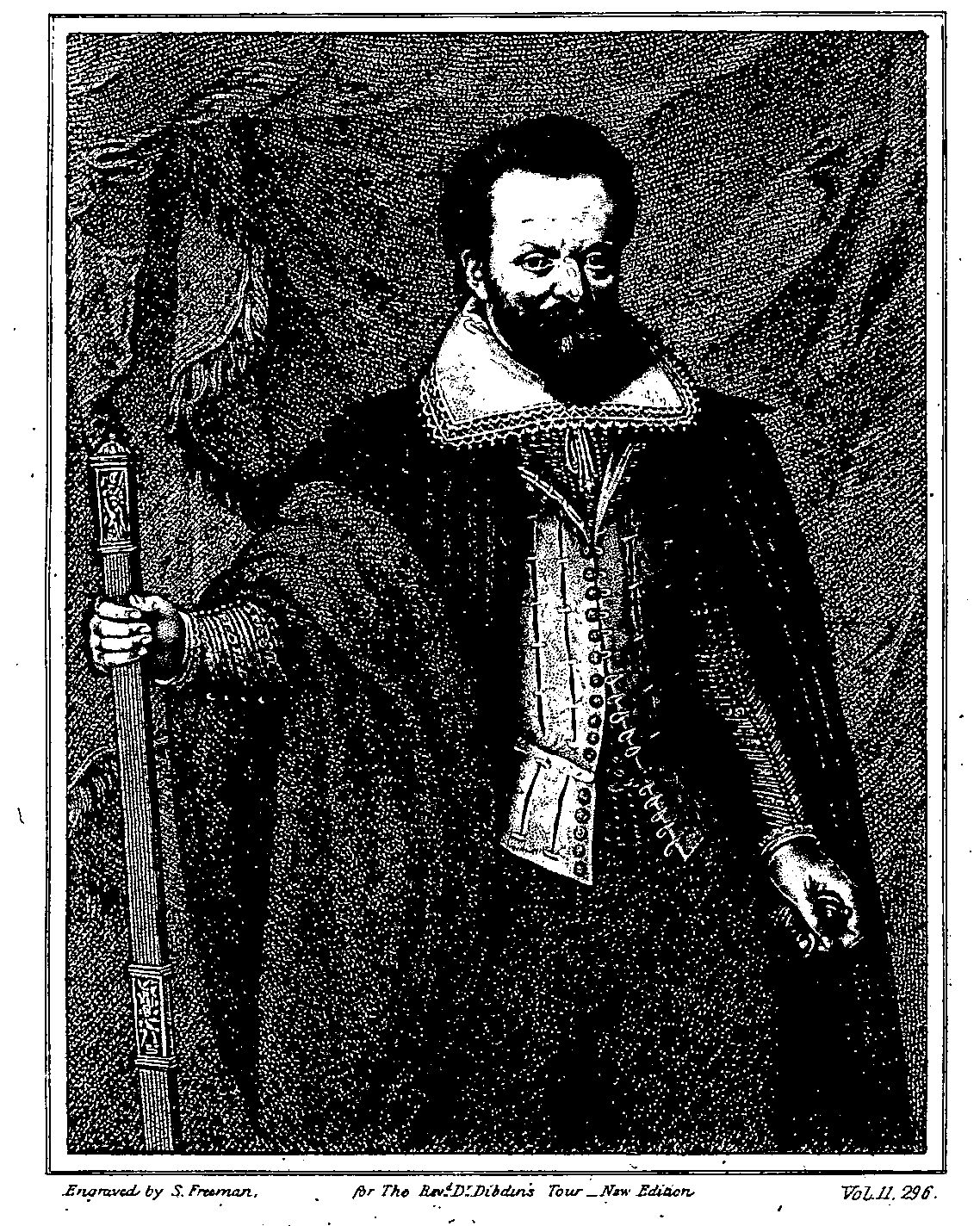
COMTE DE BRIENNE From an original Painting in the Collection of the late Quintin Crauford Esq.
Leaving this room, you turn, to the left--into a small room, but obscurely lighted. Here is a Virgin and Child, by Sasso Ferrato, that cannot be surpassed. There is a freedom of design, a crispness of touch, and a mellowness of colouring, in this picture, that render it a performance very much above the usual representations of this subject. In the same room is a spirited, but somewhat singular, picture of the birth of Venus. It exhibits the conception and touch of a master. The colouring is very sober. The name of the artist is not upon the frame, and as I was generally alone when I made my memoranda, I had no one to instruct me. You leave this room, and pass on--catching a glimpse of a lawn richly bedecked with flowers and shrubs--into a long and lofty room, which unites the two enviable distinctions of LIBRARY and GALLERY. Here you are bewildered for an instant: that is to say, you are divided in your attention between the admiration of the proportion and structure of the room, and the alternate captivation of books, busts, and pictures. But as you have had enough of paper and print in former despatches, I shall confine myself here exclusively to the pencil and the chisel.
Let us first walk leisurely about the ground floor, ere we mount the gallery. To begin with the busts. That of the late Abbé Barthelemi, in white marble, immediately strikes you.181 It is full of nature and of character; and the hair has just enough of the antique gusto about it to render the toute ensemble equally classical and individualised--if you will allow this latter expression. Here is a terra-cotta head of Corneille, of very indifferent workmanship; and much inferior to a similar representation of him at Rouen. The terra-cotta head of Rousseau is considerably better. But the marble bust of Voltaire, by Houdon, throws every thing about it into tameness. It is as fine as is the terra-cotta bust of the same person which Denon possesses. Here, however, the poet is in a peruque, or dress-wig. His eyes sparkle with animation. Every feature and every muscle seems to be in action: and yet it is perfectly free from caricature or affectation. A surprising performance. This head and that of Barthelemi are quite perfect of their kind. And yet I am not sure whether I should not have preferred the fine bronze bust of Henri II., somewhat larger than life, to either of the preceding. But I must not forget the colossal head of Bonaparte, when a young man, by Canova. It is of white marble: considered to be the original. Denon has a similar head, by the same artist. I am not sure if I do not prefer Mr. Craufurd's. Of paintings, on this floor, the head of Francis I. by Titian--(which may be called rather a finished sketch, and which is retouched in parts) is a very desirable performance; but it is inferior to the same head, by the same artist, in the Louvre. Here is a charming portrait of a Lady in the time of Louis XV., who chose to lead the life of a Réligieuse: sweetly and naturally touched. A fine portrait of Grotius is also here; well deserving a conspicuous place in any cabinet of learning.182
We will now walk up stairs to the gallery. Of course, in the confined space between the balustrade and the wainscot (not much more than three feet), it is barely possible to appreciate the full effect of the paintings; but I here send you a list of the greater part of them, with brief remarks, upon the general accuracy of which you may rely.
Madame Scarron, with the Duc du Maine; apparently by Mignard: in a very fresh and perfect state.
A fine head of Racine, and similar one of De La Motte.
Mademoiselle de Guiche, Princesse de Monaco; in all probability by Mignard. Good.
Mademoiselle Hamilton, Comtesse de Grammont; by Mignard. If the Comte de Grammont chose to fall in love only with beautiful women, he could scarcely, upon his own principles, (which indeed were any thing but moral) have found any one so lovely as was his WIFE. Yet I have seen handsomer portraits of her than this.
Anne de Gonzague. She was Princess Palatine, and daughter of Charles Duke of Nevers. This is a half length portrait. A garland is in her right hand. A gay and pleasing picture.
Le Chancelier d'Aguesseau. By Rigaud. A fine mellow portrait.
Louis XI. A whole length; supposed to be by Leonardo da Vinci. Not very credible. It is a fine, bold, horribly-looking portrait: not in the very best state of preservation.
Blaise Pascal. Very fine. The artist's name is not inscribed; but there is a Murillo-like effect about this portrait, which is very striking. Pascal holds a letter in his hand.
Next to Pascal is a prodigiously fine oval portrait (is it of Fontaine?) by Rigaud. No name is subjoined.
Comtesse de la Fayette. A fine countenance: hands apparently recoloured. In yellow drapery.
Julie-Lucie d'Augennes, Duchesse de Montausier. She died in 1671. The portrait is by Mignard. It represents this celebrated female, when young, encadred by flowers. The carnation tints of the flesh, and the blue lustre of the eye, have nothing finer in the whole circle of Mignard's performances. This is a picture from which the eye is withdrawn with no common reluctance. It is clear, bright, fresh, and speaking.183
The Wife of P. de Champagne. She holds a small oval portrait of the mother of her husband, the famous painter, in her lap. The picture is by P. de Champagne himself. The head of the mother is very clever: but the flesh has perhaps too predominant a tint of pinkish-purple throughout.
Madame de la Sabliere. Oval: very clever.
Madame Deshoulieres. Similar, in both repects.
Madame Cornuel. Oval: a stiff performance.
Madame la Duchesse d'Orleans. She is represented as Hebe. A pretty picture; but a little too much "frenchified."
Madame de Staal. Oval. Beautiful and perfect.
Madame la Marquise de Rambouillet. A° 1646. A most beautiful picture. The head and shoulders are worthy of Vandyke. The curtain, in the background, is flowered; and perhaps too hard.
Madame la Duchesse de la Valliere, mère du dernier duc de ce nom. She was the mother of the Duke de la Valliere who had the celebrated library; and died in 1782, within three months of reaching her hundredth year! She was an old woman, but yet very handsome, when this portrait was painted. Her colour is yet tender, and her features are small and regular. The eyes have unusual intelligence, for so protracted a period of life. It is a half length, and I should think by Rigaud. She is sitting in a chair, holding a tea spoon in her right hand, and a tea cup in her left. This may have some allusion, of which I am ignorant. The whole picture is full of nature, and in a fine tone of colour.
The Duke of Monmouth. He is sitting: holding a truncheon in his right hand. A helmet and plume are before him. He wears a white sash. This is a dark, but may be called a finely painted, picture. Yet the Duke is not represented as a handsome man.
Turenne. By P. de Champagne. Fine.
Bossuet. By Rigaud. This is not only considered as the chef- d'oeuvre of Rigaud, but it has been pronounced to be the finest portrait ever executed within the last century of the French School.184 It is a whole length; and is well known to you from the wonderful print of it by Drevet. The representation is worthy of the original; for Bossuet was one of the last of the really great men of France. He had a fine capacity and fine scholarship: and was as adroit in polemics as Richelieu was in politics. He resembled somewhat our Horsley in his pulpit eloquence,--and was almost as pugnacious and overbearing in controversy. He excelled in quickness of perception, strength of argument, and vehemence of invective; yet his sermons are gradually becoming neglected--while those of Fenelon, Massillon, and Saurin are constantly resorted to ... for the fine taste, pure feeling, and Christianlike consolation which breathe throughout them. One thing, in this fine whole length portrait of Bossuet, cannot fail to be noticed by the curious. The head seems to have been separately painted, on a small square piece of canvass, and let into the picture.
There is certainly a rifacimento of some kind or other; which should denote the head to have been twice painted.
C. Paulin. By Champagne. Paulin was first confessor to Louis XIV.; and had therefore, I should apprehend, enough upon his hands. This is a fine portrait.
William III. Harsh and stiff. It is a performance (as most of those of William seem to be) for the model of a head of a ship.
Colbert, Evéque de Montpellier. A fine head.
Fléchier, Evéque de Nismes. A very fine portrait. The name of the painter does not appear.
A fine half length portrait of a Marshal of France, with a truncheon in his hand. Both the hands are beautifully drawn and coloured.
Maréchal duc d'Harcourt. By Rigaud.
Eliz. Angelique de Montmorenci, Duchesse de Chatillon. She died in 1695 in her 69th year. This is a fine picture, but injured and retouched. The left hand rests upon a lion's head.
F. Marie de Bourbon, fille de Madame de Montespan, et femme du Régent. A stiffish picture; but the countenance is pleasing.
Madame la Duchesse de Névers, fille de Madame de Thianges, et nièce de Madame de Montespan. A bow is in her right hand, and a dog in her left. The countenance is beautiful and well painted. The eyes and mouth in particular have great sweetness of expression.
Duc de Montausier; in a hat and red feather. By Rigaud.
Madame la Duchesse de Sforce: fille cadette de Madame de Thianges. A small whole length, sitting: with two greyhounds in her lap, and a third at her side.
Le Ministre Colbert. By Mignard. A fine picture.185
Marie Leezinska, femme de Louis XV. A cleverly painted head.
Le Cardinal Mazarin. By P. de Champagne. Whole length. A fine portrait--which I never contemplate without thinking of the poor unfortunate "man in an iron mask!"
Madame de Motteville. She died in her 74th year, in 1689. This is merely the head and shoulders; but in the Vandyke style of execution.
Charles Paris d'Orleans, dernier Duc de Longueville. He was killed in the famous passage of the Rhine, at Tolhuys, in 1672.
Charles I. By Vandyke. A beautiful half length portrait. Perhaps too highly varnished.
Le Marquis de Cinq-Mars. He was beheaded at the age of twenty- two, in September 1642. There is also a whole length of him, in a rich, white, flowered dress. A genuine and interesting picture.
Mary Queen of Scots. Whole length: in a white dress. A copy; or, if an old picture, repainted all over.
Don Carlos, the unfortunate son of Philip II. of Spain. A beautiful youth; but this picture, alleged to have been painted by Alfonso Sanchez Coello, must be a copy.
The foregoing are the principal decorations along the gallery of this handsome and interesting room. In an adjoining closet, where were once two or three portraits of Bonaparte, is a beautiful and highly finished small whole length of Philip Duke of Orleans, Regent of France. Also a whole length of Marmontel, sitting; executed in crayon. The curiously carved frame, in a brown-coloured wood, in which this latter drawing is contained, is justly an object of admiration with visitors. I have scarcely seen a more appropriate ornament, for a choice cabinet, than this estimable portrait of Marmontel. Here are portraits of Neckar, and Clement Marot, in crayons: the latter a copy. Here is, too, a cleverly painted portrait of L. de Boulogne.
We descend--to a fourth room, or rather to a richly furnished cabinet--below stairs. Every thing here is "en petit." Whether whole lengths, or half lengths, they are representations in miniature. What is this singular portrait, which strikes one to the left, on entering? Can it be so? Yes ... DIANE DE POICTIERS again! She yet lives every where in France. 'Tis a strange performance; but I have no hesitation in calling it AN ORIGINAL ... although in parts it has been palpably retouched. But the features--and especially the eyes--(those "glasses of the soul," as old Boiastuau calls them186) seem to retain their former lustre and expression. This highly curious portrait is a half length, measuring only ten inches by about eight. It represents the original without any drapery, except a crimson mantle thrown over her back. She is leaning upon her left arm, which is supported by a bank. A sort of tiara is upon her head. Her hair is braided. Above her, within a frame, is the following inscription, in capital roman letters: "Comme le Cerf brait après le décours des Eaues; ainsi brait mon Ame, après Toy, ô Dieu." Ps. XLII. Upon the whole, this is perhaps the most legitimate representation of the original which France possesses.187
In the same boudoir is a small and beautifully coloured head of Francis I. Here is a portrait of the famous Duchess of Portsmouth, on horseback, in red; and another of the Duchess of Nevers, in a blue riding jacket. But much more estimable, and highly to be prized--as works of art--- are the TWO MURILLOS: one, apparently of St. Francis, which was always religiously preserved in the bed-chamber of Madame de Maintenon, having been given to her by Louis XIV. The other, although fine, has less general interest. I could hardly sufficiently admire the whole length of Jacques Callot, painted by himself. It is delicious, of its kind. There is a very curious and probably coeval picture representing whole length portraits of the Cardinals of Guise and Lorraine, and the Dukes of Guise and Mayenne,188 The figures are very small, but appear to be faithful representations. An old portrait of Louis Roi de Sicile, Père de Réné,--a small head, supposed to be of the fifteenth century--is sufficiently singular, but I take this to be a copy. Yet the likeness may be correct. A whole length of Washington, with a black servant holding his horse, did not escape my attention. Nor, as an antiquary, could I refuse bestowing several minutes attention upon the curious old portrait (supposed to be by Jean de Bruges) of Charlotte, Wife of Louis XI. It is much in the style of the old illuminations. In one of the lower rooms, I forget which, is a portrait of Bonaparte; the upper part of the same representation of him which appeared in London from the pencil of David. He is placed by the side of a portrait (of the same dimensions) of his conqueror, Wellington: but I am not much disposed to admire the style of execution of our hero. It is a stiff, formal, and severely executed picture. Assuredly the present school of French portrait painters is most egregiously defective in expression; while ours, since the days of Reynolds, has maintained a most decided superiority. I believe I have now noticed every thing that is more particularly deserving of attention in the Collection of Mr. Quintin Craufurd ... But I cannot retrace my steps without again expressing my admiration of the local of this little domain. The garden, offices, and neighbourhood render it one of the most desirable residences in Paris.189
As I happen to be just now in the humour for gossiping about the fine arts, suppose I take you with me to the collection of paintings of the MARQUIS DE SOMMARIVA, in the Rue du Bas Rempart? It is among the most distinguished, and the most celebrated, in Paris; but I should say it is rather eminent for sculpture than for painting. It is here that Canova reigns without a rival. The early acquaintance and long tried friend of the Marquis, that unrivalled sculptor has deposited here what he considers to be the chef-d'oeuvre of his art, as a single figure. Of course, I speak of his Magdalen. But let me be methodical. The open day for the inspection of his treasures is Friday.
When I entered, not a creature was in the rooms. The general effect was splendid and imposing. I took out my memorandum-book, and went directly to work; noticing only those subjects which appeared, on one account or other, to be more particularly deserving of attention. There is a pretty picture of CUPID AND PSYCHE, by Carlo Cignani; the simple and quiet effect of which is much heightened by being contrasted with the very worst representation of the same subject, which I ever saw, by David: painted last year at Brussels. How the Marquis can afford so many square yards of his walls for the reception of such a performance, is almost marvellous. It is, throughout, in the worst possible taste. The countenance of Cupid, who is sitting on the bed or couch with the vacant grin of an ideot, is that of a negro. It is dark, and of an utterly inane expression. The colouring is also too ruddy throughout. Near to this really heartless picture, is one of a woman flying; well drawn, and rather tenderly coloured. Opposite, is a picture of Venus supported in the air by a group of Cupids. The artist is Prudhon. In the general glare of colour, which distinguishes the French school, it is absolutely refreshing to have the eye soothed by something like an attempt, as in this picture, at a mellow chiaro-oscuro. It has undoubted merit. It is, upon the whole, finely coloured; but the countenance of Venus is so pale as to have an almost deathly effect. It is intended to represent her as snatched away from the sight of her dead Adonis.
In common courtesy I must make but brief mention of a very clumsy, and ill-drawn child, by De Broisefremont: and hasten, in the next room, to the magnificent picture of Diana and Endymion, painted by Guerin in 1810, and lately engraved. This picture is a very fair illustration of the merits and demerits of the FRENCH SCHOOL OF PAINTING. The drawing of Endymion is, upon the whole, good; but a palpable copy of the antique. This necessarily gives it somewhat an air of affectation. The shepherd lies upon a bed of clouds, (terminated by an horizon which is warmed by the rays of a setting sun) very gracefully and perhaps naturally. He seems to sleep soundly. His whole figure and countenance glow with the warmth of beauty and youth. I will not disturb his slumbers by finding the least fault--even with the disposition of the extremities. But his nightly visitor--the enamoured goddess--is, of all female figures which I have ever seen upon canvass, one of the most affected, meagre, and uninteresting. Diana has been exchanged for an opera dancer. The waist is pinched in, the attitude is full of conceit, and there is a dark shadow about the neck, as if she had been trying some previous experiment with a rope! Endymion could never open his eyes to gaze upon a figure so utterly unworthy of the representation of an enamoured deity.190 The Cupids must also be condemned; for they are poor in form, and indifferent in execution. The back ground has considerable merit: but I fear the picture is too highly glazed. In this room also is the famous picture of Belisarius, engraved with so much éclat by Desnoyers. I own that I like the engraving better than the painting; for I see no occasion for such a disproportionate quantity of warm colouring as this picture exhibits.