DESCRIPTIONS OF NANTUCKET
Reading edition
The people for whom the old dwellings were built and the conditions under which they lived were responsible for the architecture.
Here are extracts from most of the older writings, and some later ones, which writings should be read in full by those interested.
1772—This is the date the author (Crevecoeur) of Letters From An American Farmer, by J. Hector St. John, visited this island. The “Letters” were written in English and first published in London in 1782. There was a French edition of 1784 and one of 1787. This is the earliest descriptive writing of Nantucket with which we are familiar. It consists of nearly one hundred pages, with a map, and should be read entire by all who love their old Nantucket. Subsequent articles and histories of the Island have not failed to make use of what St. John wrote.
It is best to state that M. St. Jean de Crevecoeur may not have been accurate in some details, as for instance the extent to which building frames and foundations were brought from the mainland. The writer of 1807 quoted hereinafter says of St. John’s Letters.
… “his pictures, though striking likenesses, are always flattering. Another objection is that he is frequently erroneous in minute and unimportant circumstances. He gives the contour and character of the face exactly though, as said before, in too favorable a light, but he makes strange mistakes in the sleeve of a coat or the strap of a shoe. If the reader has good nature enough to pardon these two faults, he will peruse the Letters with perpetual delight.”
The following quotations are assembled from the “Letters:”
“The Island has nothing deserving of notice but its inhabitants; here you meet with neither ancient monuments, spacious halls, solemn temples nor elegant dwellings; not a citadel nor any kind of fortification, not even a battery to rend the air. Their rural improvements are all of the most simple and useful kind. Sherburn is the only town on the Island, which consists of about 530 houses that have been framed on the main. They are lathed and plastered within, handsomely painted and boarded without. Each has a cellar underneath, built with stones also fetched from the main. They are all of a similar construction in appearance, plain and entirely devoid of exterior or interior ornament. I observed but one which was built of bricks, belonging to Mr. ——, but like the rest it is unadorned. Quayes is a small but valuable tract long since purchased by Mr. Coffin where he has erected the best house on the Island. The differences which I observed in the people are founded on nothing more than the good or ill success of their maritime enterprises and do not proceed from education. That is the same through every class: simple, useful and unadorned, like their dress and their houses. They are well acquainted with the cheapest method of procuring lumber from the Kennebeck and Penobscot Rivers. All their houses are neat, convenient and comfortable. Some of them are filled with two families, for when the husbands are at sea the wives require less house room. Those who possess the greatest fortunes at present belong to the Society of Friends. They yearly go to different parts of this continent, constantly engaged in sea affairs. Sometimes they have emigrated like bees. Some have settled on the famous river Kennebeck, clearing the heaviest timbered land in America, and instead of entirely consuming their timber as we are obliged to do, some parts of it are converted into useful articles for exportation, such as staves, boards, hoops, barrels, etc. For that purpose they keep a correspondence with their native island, and I know many of the principal inhabitants of Sherburn, who though merchants and living at Nantucket, yet possess valuable farms, on that river, from whence they draw a great part of their substance, meat, grain, firewood, etc. Yet there are not at Nantucket so many wealthy people, after having considered their great successes. The reason of this, I believe, is that their island supplies the town with little or nothing (with few families excepted). Everyone must procure what they want from the main. Here are neither Scotch, Irish nor French, as in the case in most other settlements. They are an unmixed English breed.”
1791—By Walter Folger, jun., dated Nantucket, May 21, (Mass. Hist. Soc. Coll.)
“In 1790 the whole number of inhabitants was 4619. They for the most part are a robust and enterprising people, mostly seamen and mechanics. It is no strange thing to see the same man occupy the station of a merchant, at other times that of a husbandman or of a blacksmith or of a cooper or of a number of other occupations.”
1792—By Zaccheus Macy, dated Nantucket, 15th of 5th mo. 1792 (Mass. Hist. Soc. Coll.)
“In the year 1659 Thomas Macy removed with his family from Salisbury to the west end of the island to a place called Madakit harbour. Thither came four from Martha’s Vineyard for the sake of gunning and lived with them as boarders. At that time there were near 3000 Indians on Nantucket. They were willing to sell their land and the English went on purchasing, beginning at the west end of the island.”
Further on, Mr. Macy, alluding to the then (1792) status of affairs on the island, states:
“A great many of our most substantial men, lured by the hope of large bounties, have moved from the island, some to England, some to France and others to Halifax, where they carry on the whale fishery. This is a great damage to us. If these persons had carried away with them their part of the poor it would have lightened our burden, for we now have 215 widows, of whom not thirty are able to support themselves without the assistance of friends and neighbors and some are maintained by the town. We have besides a great number of poor, but we have a considerable number of able and industrious men who carry on the whale fishery.”
1801—Josiah Quincy made a journey through the southeast parts of New England in 1801. He kept a diary which is most interesting reading. (Mass. Hist. Soc. Proc.) The following are brief quotations from it:
“The town of Nantucket appears from the harbor as large as Salem but exhibits no marks of elegance or splendour. With one or two exceptions they (the houses) are built wholly of wood and have but two stories. By far the greater number are without paint and with those which have it, red is the predominant color. They are built generally upon the street. The almost total want of trees, houses and fences in the interior part of the island makes the road very uninteresting. Once in every two or three miles a single farmhouse appears, surrounded by half a dozen dwarf cherry trees. Such an assemblage is a wood on Nantucket, where there is not a tree of native growth. We dined with Dr. and Mrs. Easton.”
1807—A writer, under date of Aug. 1, 1807, (Mass. Hist. Soc. Coll.) states:
“The town stands on the west side of the harbour and is a mile and a half in length and a third of a mile in breadth. It contains 850 dwelling houses (including 15 at Podpis, Quayz, Squam, etc.) 63 stores, a great number of shops, besides candle works, rope walks, etc., five wharves and five windmills. The town, with exception of one or two houses, is built of wood. The houses are generally two stories in height; some of them have clapboards in front; but the greatest part of them are covered with shingles. Several of them are painted green. They are convenient buildings, but there is not much elegance in their appearance.”
Later on in his notes, he states:
“House lots in the town sell for from $100 to $200 a square rod; rents are low, few exceeding $100 a year. The greatest part of the houses are owned by those who live in them. The present number of inhabitants is estimated at 6730.”
1811—Joseph Sansom, in The Port Folio, Jan. 1811:
“The Nantucket stores and houses are built of timber, are mostly painted red or white and are crowned by the steeples, or rather towers, of two Presbyterian meeting houses. Several new streets have been laid out in straight lines and a number of houses have been built within a year or two with ceilings of 10 feet high. This, however, is considered a piece of useless extravagance, the old-fashioned stories of eight or nine feet being generally reckoned high enough, and to spare. Every other house in this seafaring place has a lookout upon the roof or a vane at the gable end; to see what ships have arrived from sea or whether the wind is fair for the packets.”
1850 (before and after)—
Joseph E. C. Farnham was born in Nantucket in 1849. He was a keen observer of the people of the Island and their customs and wrote at considerable length “Brief Historical Data and Memories of My Boyhood Days at Nantucket.” It delightfully describes the town at the close of the whaling era.
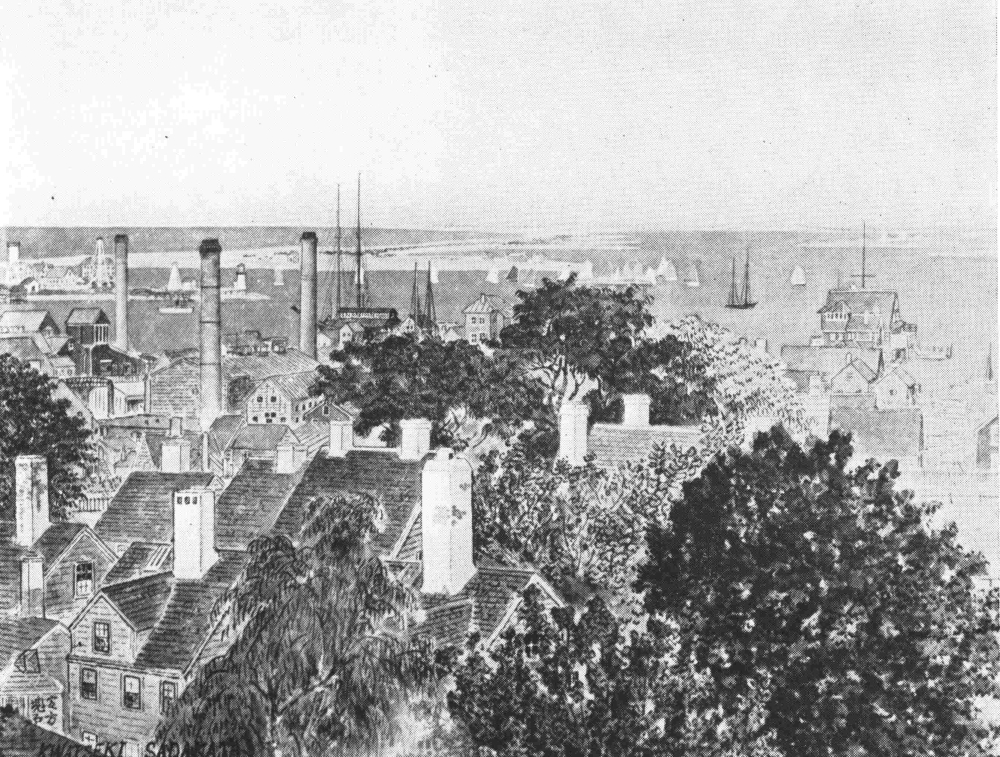
Worth observes that “the gambrel-roofed house never attracted the attention of the Nantucket people. The few that are still standing were erected after 1750. After the Revolution, when prosperity dawned on the Island, the common type of house was the square two-story structure, with large center chimney, numerous examples of which are to be seen. The same regard for ancient houses has also led people to retain the large center chimney. While in many towns desire for increased room or for the appearance of a small chimney has led house owners to replace the old structure with one greatly inferior in size, at Nantucket the disposition has prevailed to keep without change this distinguishing mark of the 18th century construction.”
1876—Nantucket after the end of the whaling, at its lowest ebb. Read “Nooks and Corners of the New England Coast” by S. A. Drake.
1882—This date is early in a new period of prosperity due to the summer visitors. The back log and fore log of this growing and practically only sizeable remaining “industry” are now the owners and renters of houses. Visitors used to come for a “vacation” of a few days or weeks, but now they stay the season or longer. Read “Island of Nantucket, What It Was and What It Is” by E. K. Godfrey.
1924—From an article by Walter Prichard Eaton:
Individually, and in the mass, the architecture of old Nantucket was and is extraordinarily dignified in its quiet simplicity and nice proportions, and often really exquisite in its use of ornamental detail.
Nearly every other American town, once rich in Eighteenth or early Nineteenth Century architecture, has been injured by the intermingling of later buildings, but by a curious set of economic chances, old Nantucket has almost entirely escaped, and remains today architecturally much as it was when the crest of the whaling prosperity enabled the islanders to build it more than a century ago.
Then came sophisticated moderns, and the best these moderns could do were hideous casinos, sprawling cottages with verandas stuck all over them helter-skelter, houses with broken and meaningless roof lines, windows badly spaced and without style, ornamentation without dignity, gingerbread trimmings and nothing, anywhere, that had repose, unity, beauty of outline, or even adaptability to its site.
The Puritans of Nantucket left behind no poems or plays, but to say they left behind no art is ridiculous. They left behind an entire town which is a work of art, in its way as charming and as nearly perfect as anything in the Old World, and utterly different from anything in the Old World—a unique expression. They were able to do this because, to them, art was expressed through the crafts, and every man who used a tool (which meant almost every man) was an artist.
Chimneys, Old and New