2. LULL
Reading edition
Rate of Exchange—on Berlin
With four Cockney comrades of the Rifle Brigade, during 1915 at Fleurbaix, I was indulging in a quiet game of nap in the front line.
One man dropped out, "broke to the wide." Being an enthusiastic card player, he offered various articles for sale, but could find no buyers. At last he offered to find a Jerry prisoner and sell him for a franc.
He was absent for some time, but eventually turned up with his hostage, and, the agreement being duly honoured, he recommenced his game with his fresh capital.
All the players came through alive, their names being J. Cullison, F. Bones, A. White, W. Deer (the first-named playing leading part), and myself.—F. J. Chapman (late 11th Batt. Rifle Brigade), 110 Beckton Road, Victoria Docks, E.16.
A Hen Coup
During the retreat from Mons strict orders were issued against looting. One day an officer, coming round a corner, discovered a stalwart Cockney Tommy in the act of wringing the neck of an inoffensive-looking chicken. The moment the Tommy caught sight of his officer he was heard to murmur to the chicken, "Would yer, yer brute!" Quite obviously, therefore, the deed had been done in self-defence.—The Rev. T. K. Lowdell, Church of St. Augustine, Lillie Road, Fulham, S.W.6.
A "Baa-Lamb" in the Trenches
The "dug-out" was really a hole scraped in the side of a trench leading up to the front line and some 50 yards from it. It was October '16 on the Somme, after the weather had broken. The trench was about two feet deep in liquid mud—a delightful thoroughfare for runners and other unfortunate ones who had to use it.
The officer in the dug-out heard the splosh—splosh—splosh ... of a single passenger coming up the trench. As the splosher drew abreast the dug-out the officer heard him declaiming to himself: "Baa! baa! I'm a blinkin' lamb lorst in the ruddy wilderness. Baa! baa!..."
And when the bleating died away the splosh—splosh—splosh ... grew fainter too, as the "lamb" was lost in the night.—L. W. Martinnant, 64 Thornsbeach Road, Catford, S.E.6.
He Coloured
When serving with the Artists' Rifles in France we went into the line to relieve the "Nelsons" of the 63rd (Royal Naval) Division.
As I was passing one of their men, a regular "Ole Bill," who was seated on the fire-step, I heard him say, "Artists' Rifles, eh; I wonder if any of you chaps would paint me a plate of 'am and eggs!"—R. C. Toogood, 43 Richmond Park Avenue, Bournemouth.
Why the Fat Man Laughed
During the winter of 1914-15 the trenches were just like canals of sloppy mud, and dug-outs were always falling in. To repair the dug-outs pit-props were used, but they often had to be carried great distances up communication trenches, and were very difficult to handle. The most popular way to carry a prop was to rest one end on the left shoulder of one man and the other end on the right shoulder of the man behind.
On one occasion the leading man was short and fat, and the rear man was tall and thin. Suddenly the front man slipped and the prop fell down in the mud and splashed the thin man from head to foot. To add to his discomfort the little fat man gave a hearty laugh.
"Can't see anything to larf at, mate," said the mud-splashed hero, looking down at himself.
"I'm larfing," said the little fat Cockney, "'cos I've just remembered that I tipped the recruiting sergeant a bloomin' tanner to put me name down fust on his list so as I'd get out here quick."—A. L. Churchill (late Sergt., Worcs. Regt.), 6 Long Lane, Blackheath, Staffs.
He Met Shackleton!
The troops in North Russia, in the winter of 1918-19, were equipped with certain additional articles of clothing designed on the same principles as those used on Antarctic expeditions. Among these were what were known as "Shackleton boots," large canvas boots with thick leather soles. These boots were not at all suitable for walking on hard snow, being very clumsy, and they were very unpopular with everyone.
The late Sir Ernest Shackleton was sent out by the War Office to give advice on matters of clothing, equipment, and so on. When he arrived at Archangel he went up to a sentry whose beat was in front of a warehouse about three steps up from the road, and said to him, "Well, my man, what do you think of the Shackleton boot?"
To this the sentry replied: "If I could only meet the perishing blighter wot invented them I'd very soon show——"
Before he could complete the sentence his feet, clad in the ungainly boots, slipped on the frozen snow, and slithering down the steps on his back, he shot into Sir Ernest and the two of them completed the discussion on Shackleton boots rolling over in the snow!—K. D., Elham, near Canterbury.
Domestic Scene: Scene, Béthune
Near the front line at Béthune in I917 was a farm which had been evacuated by the tenants, but there were still some cattle and other things on it. We were, of course, forbidden to touch them.
One day we missed one of our fellows, a Cockney, for about two hours, and guessed he was on the "scrounge" somewhere or other.
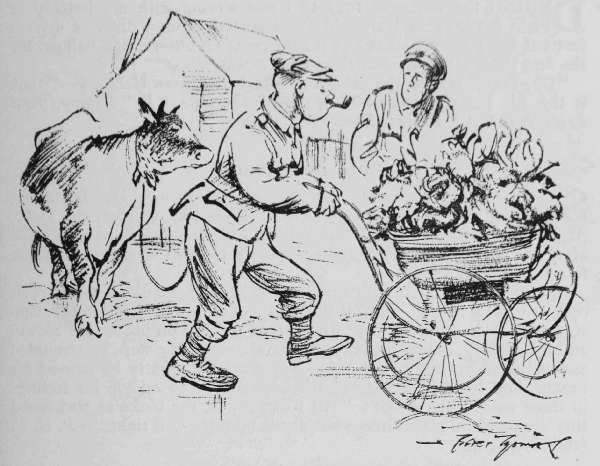
"... only taking the kid and the dawg for a bit of a blow."
Eventually he was seen coming down the road pushing an old-fashioned pram loaded with cabbages, and round his waist there was a length of rope, to the other end of which was tied an old cow.
You can imagine what a comical sight it was, but the climax came when he was challenged by the corporal, "Where the devil have you been?" "Me?" he replied innocently. "I only bin takin' the kid and the dawg for a bit of a blow."—A. Rush (late 4th Batt. R. Fus.), 27 Milton Road, Wimbledon.
Getting Their Bearings
It was on the Loos front. One night a party of us were told off for reconnoitring. On turning back about six of us, with our young officer, missed our way and, after creeping about for some 15 minutes, a message came down, "Keep very quiet, we are nearly in the German lines."
I passed on the message to the chap behind me, who answered in anything but a whisper, "Thank 'eaven we know where we are at last."—H. Hutton (late 16th Lancers, attached Engineers), Marlborough Road, Upper Holloway.
High Tea
During the winter of 1917-18 I was serving with my battery of Field Artillery in Italy. We had posted to us a draft of drivers just out from home, and one of them, seeing an observation balloon for the first time, asked an old driver what it was.
"Oh, that," replied the old hand, who hailed from Hackney—"that is the Air Force canteen!"—M. H. Cooke (late "B" Battery, 72nd Brigade, R.F.A.), Regency Street, Westminster.
Lots in a Name
Salonika, mid-autumn, and torrents of rain. The battalion, changing over to another front, had trekked all through the night. An hour before dawn a halt was called to bivouac on the reverse slope of a hill until the journey could be completed in the darkness of the following night.
Orderlies from each platoon were collecting blankets from their company pack mules. Last of them all was a diminutive Cockney, who staggered off in the darkness with his load perched on his head. Slowly and laboriously, slipping backwards at almost every step, he stumbled and slithered up hill in the ankle-deep mud. Presently he paused for breath, and took advantage of the opportunity to relieve his feelings in these well-chosen words: "All I can say is, the bloke as christened this 'ere perishin' place Greece was about blinking well right."—P. H. T. (26th Division).
Gunga Din the Second
After the battle of Shaikh Sa'Ad in Mesopotamia in January 1916 more than 300 wounded were being transported down the Tigris to Basra in a steamer and on open barges lashed on either side of it. Many suffered from dysentery as well as wounds—and it was raining.
There appeared to be only one Indian bhisti (water-carrier), an old man over 60 years of age, to attend to all. He was nearly demented in trying to serve everyone at once. When my severely wounded neighbour—from Camberwell, he said—saw the bhisti, his welcome made us smile through our miseries.
"Coo! If it ain't old Gunga Din! Wherever 'ave yer bin, me old brown son? Does yer muvver know yer aht?"—A. S. Edwardes (late C.S.M., 1st Seaforth Highlanders), West Gate, Royal Hospital, Chelsea, S.W.3.
A Fag fer an 'Orse
Late one afternoon towards the end of 1917, on the Cambrai sector, enemy counter-attacks had caused confusion behind our lines, and as I was walking along a road I met a disconsolate-looking little Cockney infantryman leading a large-size horse. He stopped me and said, "Give us a fag, mate, and I'll give yer an 'orse."
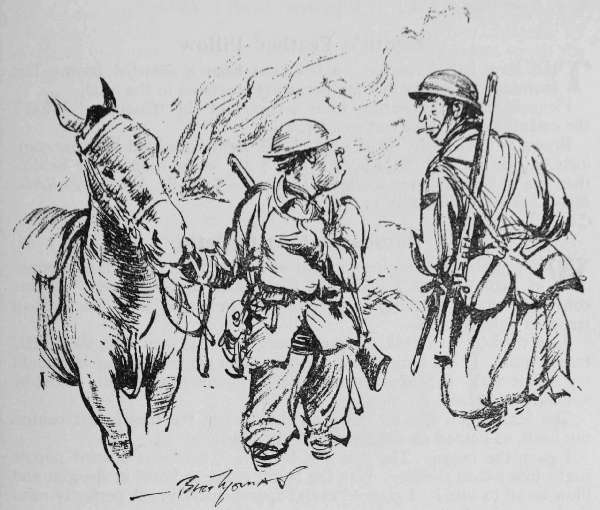
"Give us a fag and I'll give yer an 'orse."
I gathered that he had found the horse going spare and was taking it along with him for company's sake.—H. J. Batt (late Royal Fusiliers), 21 Whitehall Park Road, W.4.
Put to Graze
It was at the siege of Kut, when the 13th ("Iron") Division was trying to relieve that gallant but hard-pressed body of men under General Townshend. Rations had been very low for days, and the battery had been digging gun-pits in several positions, till at last we had a change of position and "dug in" to stay a bit. What with bad water, digging in, and hardly any food, the men were getting fed up generally. An order came out to the effect that "A certain bunchy grass (detailed explanation) if picked and boiled would make a very nourishing meal." One hefty Cockney, "Dusty" Miller, caused a laugh when he vented his feelings with "'Struth, and nah we got ter be blinking sheep. Baa-Baa!"—E. J. Bates (late R.F.A.), 37 Ulverscroft Road, E. Dulwich.
Smith's Feather Pillow
The boys had "rescued" a few hens from a deserted farm. The morning was windy and feathers were scattered in the mud.
Picquet officer (appearing from a corner of the trench): "What's the meaning of all these feathers, Brown?"
Brown: "Why, sir, Smiff wrote 'ome sayin' 'e missed 'is 'ome comforts, an' 'is ma sent 'im a fevver piller; an' 'e's so mad at our kiddin' that 'e's in that dug-out tearin' it to bits."—John W. Martin, 16 Eccles Road, Lavender Hill, S.W.11.
Bombs and Arithmetic
We were in the trenches in front of Armentières in the late summer of 1916. It was a fine, quiet day, with "nothing doing." I was convinced that a working party was busy in a section of the German trenches right opposite.
Just then "O. C. Stokes" came along with his crew and their little trench gun. I told him of my "target," and suggested that he should try a shot with his Stokes mortar. Glad of something definite to do, he willingly complied.
The Stokes gun was set down on the floor of the trench just behind my back, as I stood on the fire-step to observe the shoot.
I gave the range. The gun was loaded. There was a faint pop, a slight hiss—then silence. Was the bomb going to burst in the gun and blow us all to bits? I glanced round apprehensively. A perfectly calm Cockney voice from one of the crew reassured me:
"It's orl right, sir! If it don't go off while yer counts five—you'll know it's a dud!"—Capt. T. W. C. Curd (late 20th Northumberland Fusiliers), 72 Victoria Street, S.W.1.
Help from Hindenburg
I was serving with the M.G.C. at Ecoust. Two men of the Middlesex Regiment had been busy for a week digging a sump hole in the exposed hollow in front of the village and had excavated to a depth of about eight feet. A bombardment which had continued all night became so severe about noon of the next day that orders were given for all to take what cover was available. It was noticed that the two men were still calmly at work in the hole, and I was sent to warn them to take shelter. They climbed out, and as we ran over the hundred yards which separated us from the trench a high explosive shell landed right in the hole we had just left, converting it into a huge crater. One of the men turned to me and said, "Lumme, mate, if old Hindenburg ain't been and gone and finished the blooming job for us!"—J. S. F., Barnet, Herts.
Raised his Voice—And the Dust
In the early part of 1917, while the Germans were falling back to the Hindenburg line on the Somme, trench warfare was replaced by advanced outposts for the time being. Rations were taken up to the company headquarters on mules.
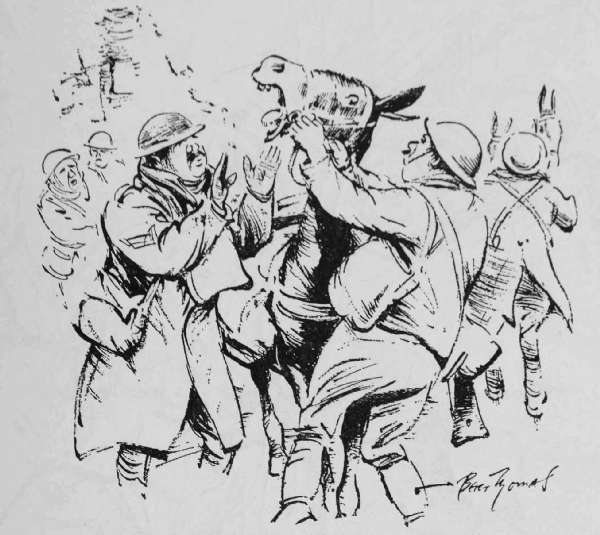
"S'sh. For 'eaven's sake be quiet."
Another C.Q.M.S. and I were going up with mules one night and lost our way. We wandered on until a voice from a shell-hole challenged us. We had passed the company headquarters and landed among the advanced outposts.
The chap implored us to be quiet, and just as we turned back one of the mules chose to give the Germans a sample of his vocal abilities.
The outpost fellow told us what he thought of us. The transport chap leading the mule pulled and tugged, using kind, gentle words as drivers do.
And in the midst of it all my C.Q.M.S. friend walked up to the mule, holding his hands up, and whispered: "S-sh! For 'eaven's sake be quiet."—F. W. Piper (ex-Sherwood Foresters), 30 The Crescent, Watford, Herts.
Mademoiselle from—Palestine
After the fall of Gaza our battalion, on occupying a Jewish colony in the coastal sector which had just been evacuated by the Turks, received a great ovation from the overjoyed inhabitants.
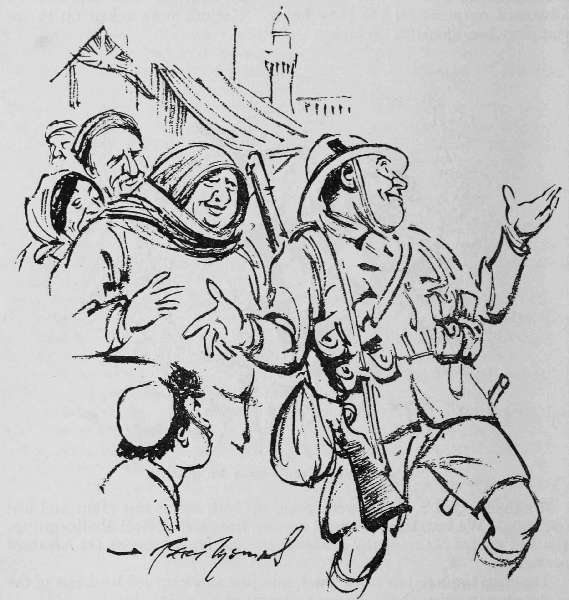
"Mademoiselle from Ah-my-Tears."
One of our lads, born well within hearing of Bow Bells, was effusively greeted by a Hebrew lady of uncertain age, who warmly embraced him and kissed him on each cheek.
Freeing himself, and gesticulating in the approved manner, he turned to us and said: "Strike me pink! Mademoiselle from Ah-my-tears."—Edward Powell, 80 Cavendish Road, Kentish Town, N.W.
"Ally Toot Sweet"
At the latter end of September 1914 the 5th Division was moving from the Aisne to La Bassée and a halt was made in the region of Crépy-en-Valois, where a large enemy shell was found (dud).
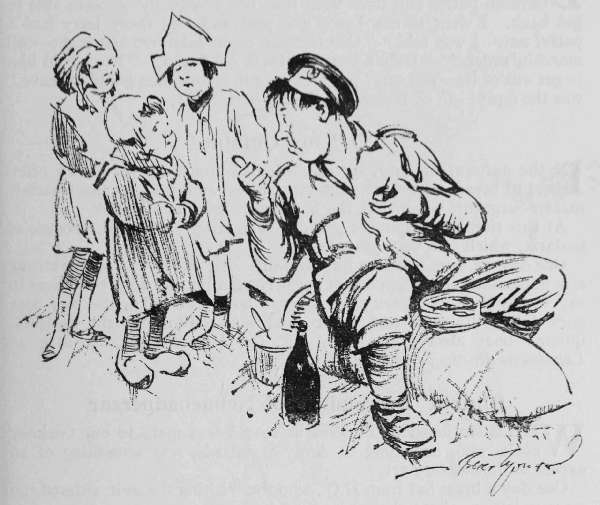
"Ally toot sweet. If this shell goes orf...."
A Cockney private was posted to keep souvenir hunters from tampering with it. When he received his dinner he sat straddle-legged on the shell, admired by a few French children, whom he proceeded to address as follows: "Ally! Toot sweet, or you'll get blown to 'ell if this blinkin' shell goes orf."—E. P. Ferguson, "Brecon," Fellows Road, S. Farnborough, Hants.
Luckier than the Prince
In the autumn of 1916, while attending to the loading of ammunition at Minden Post, a driver suddenly exclaimed, "'Struth, Quarter; who's the boy officer with all the ribbons up?"
Glancing up, I recognised the Prince of Wales, quite unattended, pushing a bicycle through the mud.
When I told the driver who the officer really was, the reply came quickly: "Blimey, I'm better off than he is; they have given me a horse to ride."—H. J. Adams (ex.—B.Q.M.S., R.F.A.), Highclare, Station Road, Hayes, Middlesex.
A Jerry he Couldn't Kill
During a patrol in No Man's Land at Flesquières we were between a German patrol and their front line, but eventually we were able to get back. I went to our Lewis gun post and told them Jerry had a patrol out. I was told: "One German came dahn 'ere last night—full marchin' order." "Didn't you ask him in?" I said. "No. Told him to get out of it. You can't put a Lewis gun on one man going on leave," was the reply.—C. G. Welch, 109 Sayer Street, S.E.17.
"Q" for Quinine
In the autumn of 1917, on the Salonika front, we were very often short of bread, sugar, etc., the reason, we were told by the Quartermaster-Sergeant, being that the boats were continually sunk.
At this time the "quinine parade" was strictly enforced, because of malaria, which was very prevalent.
One day we were lined up for our daily dose, which was a very strong and unpleasant one, when one of our drivers, a bit of a wag, was heard to say to the M.O.: "Blimey! the bread boat goes dahn, the beef boat goes dahn, the rum and sugar boat goes dahn, but the perishin' quinine boat always gets 'ere."—R. Ore (100 Brigade, R.F.A.), 40 Lansdowne Road, Tottenham, N.17.
Blinkin' Descendant of Nebuchadnezzar
While stationed at Pozières in 1917 I was mate to our Cockney cook, who, according to Army standards, was something of an expert in the culinary art.
One day a brass hat from H.Q., who was visiting the unit, entered the mess to inquire about the food served to the troops.
"They 'as stew, roast, or boiled, wiv spuds and pudden to follow," said cook, bursting with pride.
"Do you give them any vegetables?" asked the officer.
"No, sir, there ain't none issued in the rations."
"No vegetables! What do you mean?—there are tons growing about here waiting to be picked. Look at all those dandelions—they make splendid greens. See that some are put in the stew to-morrow." With which illuminating information he retired.
Followed a few moments' dead silence. Then the Cockney recovered from the shock.
"Lumme, mate, what did 'e say? Dandelions? 'E must be a blinkin' descendant of Nebuchadnezzar!"—R. J. Tiney (late Sapper, R.E. Signals, 10th Corps), 327 Green Lanes, Finsbury Park, N.
Well-Cut Tailoring
Back from a spell behind Ypres in 1915, a few of us decided to scrounge round for a hair-cut. We found a shop which we thought was a barber's, but it turned out to be a tailor's. We found out afterwards!
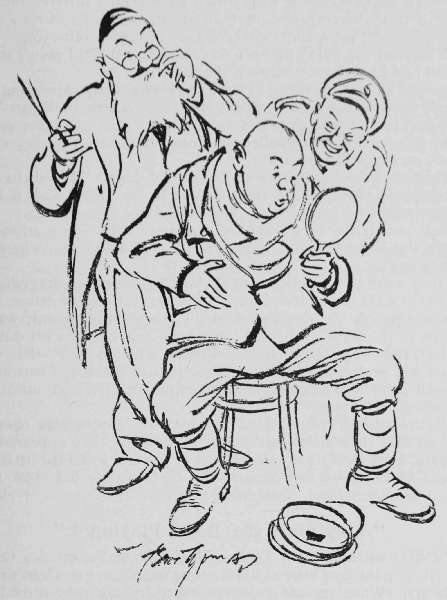
"My old girl will swear I bin in fer a stretch...."
Still, the old Frenchman made a good job of it—just as though someone had shaved our heads. My Cockney pal, when he discovered the truth, exclaimed: "Strike, if I go 'ome like this my old girl will swear I bin in fer a stretch."—F. G. Webb (late Corpl., Middlesex Regiment), 38 Andover Road, Twickenham.
Evacuating "Darby and Joan"
Things were going badly with the town of Albert, and all day the inhabitants had been streaming from the town. On horse, on foot, and in all manner of conveyances they hastened onwards....
Towards evening, when the bombardment was at its height and the roads were being plastered with shells, an old man tottered into sight pulling a crazy four-wheeled cart in which, perched amidst a pile of household goods, sat a tiny, withered lady of considerable age. As the couple reached the point where I was standing, the old man's strength gave out and he collapsed between the shafts.
It seemed all up with them, as the guns were already registering on the only exit from the town when, thundering round a bend in the road, came a transport limber with driver and spare man. On seeing the plight of the old people, the driver pulled up, dismounted and, together with his partner, surveyed the situation.
"What are we going to do with Darby and Joan?" asked the driver. "We can't get them and all their clobber in the limber and, if I know 'em, they won't be parted from their belongings."
"'Ook 'em on the back," replied the spare man. Sure enough, the old man was lifted into the limber and the old lady's four-wheeler tied on the back.
Off they went at the gallop, the old lady's conveyance dragging like a canoe in the wake of the Mauretania. The heroic Cockney driver, forcing his team through the din and debris of the bombardment, was now oblivious to the wails of distress; his mind was back on his duty; he had given the old people a chance of living a little longer—that was all he could do: and so he turned a deaf ear to the squeals and lamentations that each fresh jolt and swerve wrung from the terrified antiquity he was towing.
Shells dropped all around them on their career through the town until it seemed that they must "go under." However, they appeared again and again, after each cloud cleared, and in the end I saw the little cavalcade out of the town and danger.—N. E. Crawshaw (late 15th London Regt.), 4 Mapleton Road, Southfields, S.W.18.
"Why ain't the Band Playing?"
I served with the 11th London Regiment in Palestine. One day our officer paid us a visit at dinner-time to find out if there were any complaints. While we were endeavouring to find the meat at the bottom of the spoilt water we heard a voice say: "Any complaints?" One of the platoon, not seeing the officer, thought the remark was a joke, so he replied, "Yes, why ain't the band playing?" On realising it was an official request he immediately corrected himself and said: "Sorry, sir, no complaints."
I rather think the officer enjoyed the remark.—F. G. Palmer, 29 Dumbarton Road, Brixton, S.W.2.
His Deduction
Our battalion, fresh from home, all nicely groomed and with new kit, stepped out whistling "Tipperary." We were on the road to Loos. Presently towards us came a pathetic procession of wounded men struggling back, some using their rifles as crutches.
Our whistling had ceased; some faces had paled. Not a word was spoken for quite a while, until my Cockney pal broke the silence, remarking, "Lumme, I reckon there's been a bit of a row somewhere."—Charles Phillips (late Middlesex Regt.), 108 Grosvenor Road, Ilford.
Peter in the Pool
We had advanced beyond the German first line in the big push of '18. The rain was heavy, the mud was deep; we had not quite dug in beyond "shallow," and rations had not come up—altogether a most dismal prospect.
Quite near to us was a small pool of water which we all attempted to avoid when passing to and fro. Suddenly there was a yell and much cursing—the Cockney of the company, complete with his equipment, had fallen into the pool.
After recovering dry ground he gazed at the pool in disgust and said, "Fancy a fing like that trying to drahn a bloke wiv a name like Peter."—J. Carlton, Bayswater Court, St. Stephen's Court, W.2.
Where "Movie" Shows Cost Soap
We landed in North Russia in June 1918. We were piloted in on the City of Marseilles to a jetty. We did not know the name of the place. On the jetty we saw from the boat a British marine on sentry duty. We shouted down to him, "Where are we, mate?" He answered "Murmansk."
We asked, "What sort of place," and he shouted, "Lumme, you've come to a blighted 'ole 'ere. They 'ave one picture palace and the price of admission is a bar of soap."—M. C. Oliver (late Corporal R.A.F.), 99, Lealand Road, Stamford Hill, N.16.
Sherlock Holmes in the Desert
In the autumn of 1917, when training for the attack on Beersheba, in Palestine, we were encamped in bivouacs in the desert.
The chief meal of the day was served in the cool of the evening and more often than not consisted of bully beef stew.
One evening the Orderly Officer approached the dixie, looked into it, and seeing it half full of the usual concoction, remarked, "H'm, stew this evening."
At once there came a voice, that of a Cockney tailor, from the nearest bivouac—"My dear Watson!"—R. S. H. (late 16th County of London Q.W.R.), Purley, Surrey.
The Army "Loops the Loop"
The road from Jerusalem to Jericho was very bad, and if you went too close to the edge you were likely to go over the precipice; indeed, many lives were lost in this way.
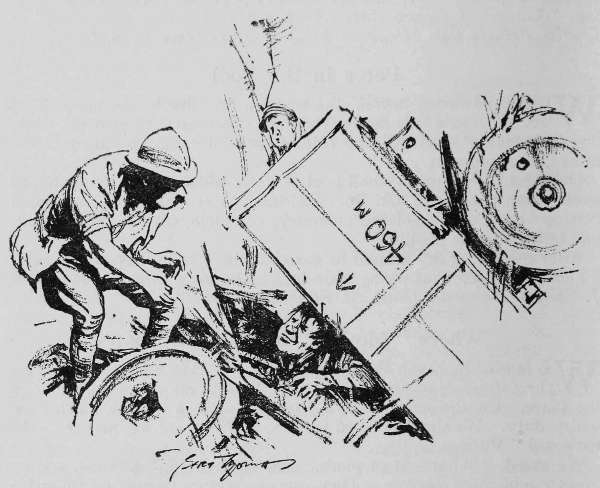
"I'll bet I'm the first bloke to loop the loop in a lorry."
One day a lorry toppled over and fell at least a hundred feet. When the rescuers got down to it, expecting to find a mangled corpse, they were surprised to hear a well-known Cockney voice from under the debris, exclaiming: "Blimey, I'll bet I'm the first bloke in the whole Army wot's looped the loop in a motor-lorry."—Sidney H. Rothschild, York Buildings, Adelphi, W.C.2.
Repartee on the Ridge
While on the Vimy Ridge sector I was going one dark night across the valley towards the front line when I lost my way among the mud and shell-holes. Hearing voices, I shouted an inquiry as to the whereabouts of Gabriel Trench. Back came the reply: "Lummie, mate, I ain't the blinkin' harbourmaster!"—T. Gillespie (late Mining Company, R.E.), London.
A New Kind of "Missing"
A battalion of the 47th London Division was making its first journey to the front line at Givenchy.
As we were proceeding from Béthune by the La Bassée Canal we passed another crowd of the same Division who had just been relieved. We were naturally anxious to know what it was like "up there," and the following conversation took place in passing:
"What's it like, mate?"
"All right."
"Had any casualties?"
"Yes, mate, two wounded, and a bloke lost 'is 'at."—F. G. Nawton, (ex-Major 15th Batt. M.G.C., 2 Kenton Park Road, Kenton, Middlesex).
And it Started with a Hen Raid!
While we were behind the line in March 1918 some chickens were stolen from the next village and traced to our billet by the feathers.
As the culprits could not be found our O.C. punished the whole company by stopping our leave for six months.
A few days later we "moved up" just as Jerry broke through further south. The orderly sergeant one night read out orders, which finished up with Sir Douglas Haig's famous dispatch ending with the words: "All leave is now stopped throughout the Army till further orders." Thereupon a tousled head emerged from a blanket on the floor with this remark: "Blimey, they mean to find out who pinched those blinking chickens."—J. Slack, 157 Engadine Street, Southfields, S.W.18.
"I'm a Water-Lily"
This incident took place on the Neuve Chapelle front early in 1916.
Our platoon was known as the "Divisional Drainers," for it was our job to keep the trenches as free from water as possible.
One day, while we were working in a very exposed drain about three feet deep, Jerry was unusually active with his whizz-bangs, and we were repeatedly shelled off the job. During one of our periodical "dives" for cover, one of the boys (a native of Canning Town) happened to be "left at the post," and instead of gaining a dry shelter was forced to fling himself in the bottom of the drain, which had over two feet of weedy water in it.
Just as he reappeared, with weeds and things clinging to his head and shoulders, an officer came to see if we were all safe.
On seeing our weed-covered chum he stopped and said, "What's the matter, Johnson? Got the wind up?"
Johnson, quick as lightning, replied, "No, sir; camouflage. I'm a water-lily."—F. Falcuss (late 19th Batt. N.F.), 51, Croydon Grove, West Croydon.
Not Knowin' the Language
A team of mules in November 1916 was taking a double limber up to the line in pitch darkness on the Béthune-La Bassée road. A heavy strafe was on, and the road was heavily shelled at intervals from Beavry onwards.
On the limber was a newly-joined padre huddled up, on his way to join advanced battalion headquarters. A shell burst 60 yards ahead, and the mules reared; some lay down, kicked over the traces, and the wheel pair managed to get their legs over the centre pole of the limber.
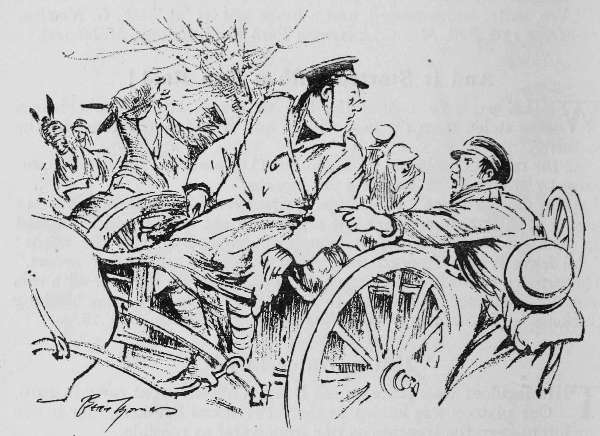
"Would you mind trekkin' off up the road?"
There was chaos for a few minutes. Then the padre asked the wheel driver in a very small voice, "My man, can I do anything to assist you?"
"Assist us," was the reply. "Yes, you can. Would you mind, sir, trekkin' off up the road, so as we can use language these blighters understand?"—L. C. Hoffenden (late 483rd Field Co. R.E.), "Waltonhurst," 16 Elmgate Gardens, Edgware.
Churning in the Skies
After returning from a night's "egg-laying" on Jerry's transport lines and dumps, my brother "intrepid airman" and I decided on tea and toast. To melt a tin of ration butter which was of the consistency of glue we placed it close to the still hot engine of the plane. Unknown to us, owing to the slant of the machine, the tin slipped backwards and spilled a goodly proportion of its melted contents over the propeller at the back. (Our planes were of the "pusher" type.)
Next day as we strolled into the hangar to look the bus over we found our Cockney mechanic, hands on hips, staring at the butter-splattered propeller.
"Sufferin' smoke, sir," he said to me, with a twinkle, "wherever was you flyin' lars' night—through the milky way?"—Ralph Plummer (late 102 Squadron R.A.F. Night-Bombers), Granville House, Arundel Street, Strand.
Larnin' the Mule
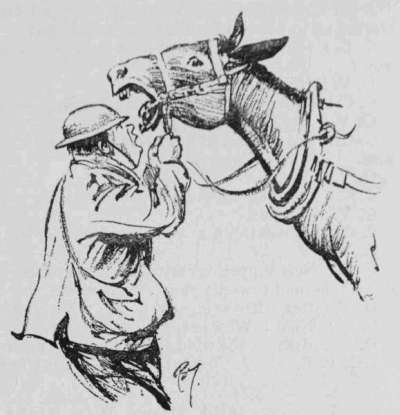
"Now p'raps you'll know!"
On the Somme I saw a Cockney driver having trouble with an obstinate mule. At last he got down from his limber and, with a rather vicious tug at the near-side rein said, "That's your left," and, tugging the off rein, "that's your right—now p'raps you'll know!"—E. B. (late Gunner, R.G.A.), Holloway Road, N.7.
"Dr. Livingstone, I Presoom"
Early in 1915 one of our Q.M. Sergeants was sent to Cairo to collect a gang of native labourers for work in the brigade lines. Whilst at breakfast one morning we saw him return from the train at Ismailia, leading a long column of fellaheen (with their wives and children) all loaded with huge bundles, boxes, cooking pots, etc., on their heads.
The Q.M.S., who was wearing a big white "solar topi" of the mushroom type instead of his regulation military helmet, was greeted outside our hut by the R.S.M., and as they solemnly shook hands a Cockney voice behind me murmured: "Doctor Livingstone, I presoom?" The picture was complete!—Yeo Blake (1st County of London Yeomanry), Brighton.
The Veteran Scored
One morning, while a famous general was travelling around the Divisional Headquarters, his eagle eye spotted an old war hero, a Londoner, whose fighting days were over, and who now belonged to the Labour Corps, busy on road repairs. The fact was also noticed that although within the gas danger-zone the old veteran had broken standing orders by not working with his gas mask in position.
Accordingly the Corps Commander stopped his car and, getting out, started off in his own familiar way as follows:
C. C.: Good morning, my man; do you know who is speaking to you?
O. V.: No, sir!
C. C.: I am your Corps Commander, Sir ——, etc.
O. V.: Yes, sir.
C. C.: I'm pleased to have this opportunity of talking to one of my men.
O. V.: Yes, sir.
C. C.: I see you are putting your back into your work.
O. V.: Yes, sir.
C. C.: I also notice that you have evidently left your gas mask behind.
O. V.: Yes, sir.
C. C.: Now supposing, my man, a heavy gas cloud was now coming down this road towards you. What would you do?
O. V. (after a few moments' pause): Nothing, sir.
C. C.: What! Why not, my good man?
O. V.: Because the wind is the wrong way, sir.
Exit C. C.—T. J. Gough, Oxford House, 13 Dorset Square, N.W.1.
Old Moore Was Right
One of my drivers, a Cockney, called one of his horses Old Moore—"'cos 'e knows every blinkin' fing like Old Moore's Almanac."
One evening, as we were going into the line, we were halted by a staff officer and warned of gas. Orders were given at once to wear gas helmets. (A nose-bag gas-mask had just been issued for horses.)
After a while I made my way to the rear of the column to see how things were. I was puffing and gasping for breath, when a cheery voice called out, "Stick it, sargint."
Wondering how any man could be so cheery in such circumstances, I lifted my gas helmet, and lo! there sat my Cockney driver, with his horses' masks slung over his arm and his own on top of his head like a cap-comforter.
"Why aren't you wearing your gas helmet?" I asked.
He leaned over the saddle and replied, in a confidential whisper, "Old Moore chucked his orf, so there ain't no blinkin' gas abaht—'e knows."
We finished the rest of that journey in comfort. Old Moore had prophesied correctly.—S. Harvey (late R.F.A.), 28 Belmont Park Road, Leyton, E.10.
He Wouldn't Insult the Mule
One day, while our Field Ambulance was on the Dorian front, Salonika, our new colonel and the regimental sergeant-major were visiting the transport lines. They came across a Cockney assiduously grooming a pair of mules—rogues, both of them.
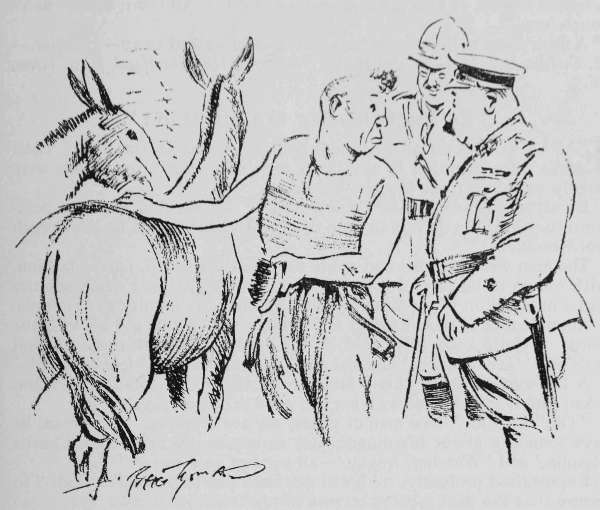
"... because I didn't want to hurt his feelings."
Said the R.S.M.: "Well, Brown, what are the names of your mules?"
Brown: "Well, that one is Ananias, because his looks are all lies. This one is Satan, but I nearly called him something else. It was a toss-up."
With a smile at the C.O., the sergeant-major remarked: "I would like to know what the other name was. Tell the colonel, what was it?"
Brown: "Well, I was going to call him 'Sergeant-Major,' but I didn't want to hurt his feelings."—"Commo" (ex-Sergeant, R.A.M.C.), London, N.1.
"Don't Touch 'em, Sonny!"
We had just come back from Passchendaele, that land of two options—you could walk on the duck boards and get blown off or you could step off them yourself and get drowned in the shell-holes.
A draft from home had made us up to strength, and when Fritz treated us to an air raid about eight miles behind the line I am afraid he was almost ignored. Anyway, our Cockney sergeant was voicing the opinion that it wasn't a bad war when up rushed one recruit holding the chin strap of his tin hat and panting, "Aero—aero—aeroplanes." The sergeant looked at him for a second and said, "All right, sonny, don't touch 'em."
A flush came to the youngster's face, and he walked away—a soldier.—R. C. Ida, D.C.M. (late 2nd Royal Berks), 39 Hoylake Road, East Acton, W.3.
"Ze English—Zey are all Mad!"
Early in 1915 an Anti-Aircraft Brigade landed at Dunkirk. Their guns were mounted in armoured cars, the drivers for which were largely recruited from London busmen.
By arrangement with the French staff it was decided that the password to enable the drivers to pass the French lines should be the French word aviation.
The men were paraded and made to repeat this word, parrot fashion, with orders to be careful to use it, as it was said that French sentries had a nasty habit of shooting first and making any inquiries afterwards.
About a month later I asked my lorry driver how he got on with the word. "Quite easy, sir," said he. "I leans aht over the dash and yells aht 'ave a ration,' and the Frenchies all larfs and lets me by."
A bit worried about this I interviewed the French Staff Officer and asked him if the men were giving the word satisfactorily.
"Oh," he said, "zose men of yours, zey are comique. Your man, he says somezing about his dinner, and ze ozzers zey say 'Ullo, Charlie Chaplin,' and 'Wotcher, froggy'—all sorts of pass-words."
I apologised profusely. "I will get fresh orders issued," I said, "to ensure that the men say the correct word."
"No," replied the French officer, "it ees no use. We know your men now. Ze English will never alter—zey are all mad."—G. H. Littleton (Lieut.-Col.), 10 Russell Square Mansions, Southampton Row, W.C.1.
Mixed History
The Scene: Qurnah, Mesopotamia.
Cockney Tommy—obviously an old Sunday school boy—fed up with Arabs, Turks, boils, scorpions, flies, thirst, and dust: "Well, if this is the Garden of Eden, no wonder the Twelve Apostles 'opped it!"—G. T. C., Hendon, N.W.4.
Got His Goat!
We, a Field Company of the R.E.'s in France, were on the move to a new sector, and amongst our "properties" was a mobile "dairy"—a goat.
"Nanny" travelled on top of a trestle-wagon containing bridging gear, with a short rope attached to her collar to confine her activities. But a "pot-hole" in the narrow road supplied a lurch that dislodged her, with the result that she slid overboard, and the shortness of the rope prevented her from reaching the ground.
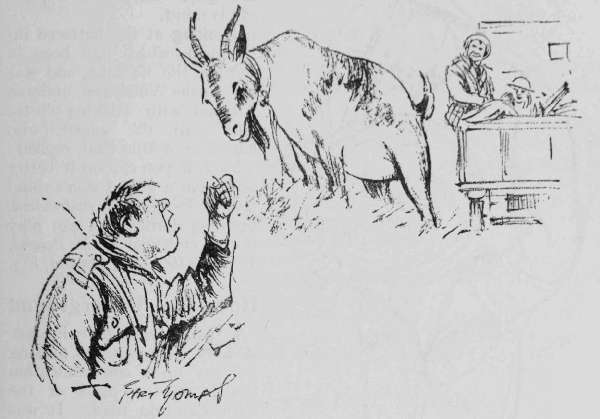
"Nanny, you'll hang next time!"
The driver of the wagon behind saw her predicament, and, dismounting, ran to her assistance, shouting for the column to halt. Then he took Nanny in his arms to relieve the weight on her neck, whilst others clambered aboard and released the rope.
Nanny was then put on her legs while her rescuer stood immediately in front, watching her recover.
This she speedily did, and, raising her head for a moment, apparently discerned the cause of her discomfiture peering at her. At any rate, lowering her head, she sprang and caught Bermondsey Bill amidships, sending him backwards into a slimy ditch at the side of the road.
As he lay there amidst the undergrowth he yelled, "Strike me pink, Nanny! You'll hang next time."—E. Martin, 78 Chelverton Road, Putney, S.W.15.
A Difficult Top Note
Somewhere in Palestine the band of a famous London division had been called together for very much overdue practice. The overture "Poet and Peasant" called for a French horn solo ending on a difficult top note.
After the soloist had made many attempts to get this note the bandmaster lost his temper and gave the player a piece of his mind.
Looking at the battered instrument, which had been in France, the Balkans, and was now in the Wilderness, and was patched with sticking-plaster and soap, the soloist, who hailed from Mile End, replied: "Here, if you can do it better you have a go. I don't mind trying it on an instrument, but I'm darned if I can play it on a cullender."—D. Beland, 17 Ridgdale Street, London, E.3.
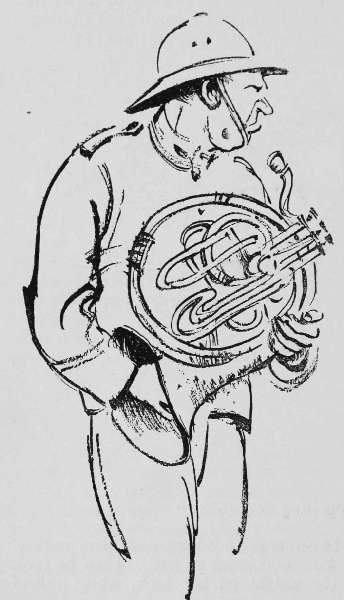
"... but I'm darned if I can play it on a cullender."
Home by Underground
A cold, wet night in France. My company was making its way up a communication trench on the right of the Arras-Cambrin road. It was in some places waist deep in mud. I was in front next to my officer when the word was passed down that one of the men had fallen into the mud and could not be found. The officer sent me back to find out what had happened.
On reaching the spot I found that the man had fallen into the mouth of a very deep dug-out which had not been used for some time.
Peering into the blackness, I called out, "Where are you?"
Back came the reply: "You get on wiv the blinkin' war. I've fahnd the Channel Tunnel and am going 'ome."
I may say it took us six hours to get him out.—H. F. B. (late 7th Batt. Middlesex Regt.), London, N.W.2.
A Job for Samson
During Allenby's big push in Palestine the men were on a forced night march, and were tired out and fed up. An officer was trying to buck some of them up by talking of the British successes in France and also of the places of interest they would see farther up in Palestine.
He was telling them that they were now crossing the Plains of Hebron where Samson carried the gates of Gaza, when a deep Cockney voice rang out from the ranks, "What a pity that bloke ain't 'ere to carry this pack of mine!"—C. W. Blowers, 25 Little Roke Avenue, Kenley, Surrey.
Jerry Wins a Bet
In the Salient, 1916: Alf, who owned a Crown and Anchor board of great antiquity, had it spread out on two petrol cans at the bottom of a shell-hole.
Around it four of us squatted and began to deposit thereon our dirty half and one franc notes, with occasional coins of lesser value. The constant whistle of passing fragments was punctuated by the voice of Alf calling upon the company to "'ave a bit on the 'eart" or alternately "to 'ave a dig in the grave" when a spent bullet crashed on his tin hat and fell with a thud into the crown square. "'Struth," gasped Alf, "old squarehead wants to back the sergeant-major." He gave a final shake to the cup and exposed the dice—one heart and two crowns. "Blimey," exclaimed Alf, "would yer blinkin' well believe it? Jerry's backed a winner. 'Arf a mo," and picking up the spent bullet he threw it with all his might towards the German lines, exclaiming, "'Ere's yer blinking bet back, Jerry, and 'ere's yer winnings." He cautiously fired two rounds.—G. S. Raby (ex-2nd K.R.R.C.), Shoeburyness, Essex.
Lucky he was Born British
Many ex-soldiers must remember the famous Major Campbell, who (supported by the late Jimmy Driscoll), toured behind the lines in France giving realistic demonstrations of bayonet fighting.
I was a spectator on one occasion when the Major was demonstrating "defence with the naked hands." "Now," he shouted as Jimmy Driscoll (who acted the German) rushed upon him with rifle and bayonet pointed for a thrust, "I side-step" (grasping his rifle at butt and upper band simultaneously); "I twist it to the horizontal and fetch my knee up into the pit of his stomach, so! And then, as his head comes down, I release my right hand, point my fore and third fingers, so! and stab at his eyes."
"Lor'!" gasped a little Cockney platoon chum squatting beside me, "did yer see that lot? Wot a nice kind of bloke he is! Wot a blinkin' stroke of luck he was born on our side!"—S. J. Wilson (late 1/20th County London Regt.), 27 Cressingham Road, Lewisham.
You Never Can Tell
Scene: Turk trench, Somme, on a cold, soaking night in November, 1916. A working party, complete with rifles, picks, and spades, which continually became entangled in the cats' cradle of miscellaneous R.E. wire, is making terribly slow progress over irregular trench-boards hidden under mud and water. Brisk strafing ahead promising trouble.
Impatient officer (up on the parapet): "For heaven's sake, you lads, get a move on! You're not going to a funeral!"
Cockney voice (from bottom of trench): "'Ow the dooce does 'e know!"—W. Ridsdale, 41 Manor Road, Beckenham, Kent.
The Window Gazer
In the early part of 1915, when the box periscope was in great use in the trenches, we received a draft of young recruits. One lad, of a rather inquisitive nature, was always looking in the glass trying to find Jerry's whereabouts.
An old Cockney, passing up and down, had seen this lad peeping in the glass. At last he stopped and addressed the lad as follows:
"You've been a-looking in that bloomin' winder all the die, an' nah yer ain't bought nuffink."—E. R. Gibson (late Middlesex Regt.), 42 Maldon Road, Edmonton, N.9.
"I Don't Fink"
After we landed in France our officer gave us a lecture and told us that our best pal in this world was our rifle. He warned us that on no account must we part with it. A couple of nights later Gunner Brown, a Cockney, was on guard. When the visiting officer approached him and said, "Your rifle is dirty, gunner," he replied, "I don't fink so sir, 'cos I cleaned it." "Give it to me," said the officer sternly, which Brown did. Then the officer said, "You fool, if I were an enemy in English uniform I could shoot you." To which Brown replied, "I don't fink you could, sir, 'cos I've got the blinkin' bolt in my pocket."—E. W. Houser (late 41st Division, R.F.A.) 22 Hamlet Road, Southend.
Why the Attack Must Fail
November 1918. The next day we were to move up in readiness for the great advance of the 3rd Army.
Some of us were trying to sleep in a cellar when the silence was broken by a small voice: "I'm sure this attack will go wrong, you chaps! I feel it in my bones!"
It can be imagined how this cheerful remark was received, but when the abuse had died down, the same voice was heard again: "Yes, I knows it. Some blighter will step orf wi' the wrong foot and we'll all 'ave to come back and start again!"—"D" Coy., M.G.C. (24th Batt.), Westcliff.
The "Shovers"
During the retreat of 1918 I was standing with my company on the side of the road by Outersteene Farm, outside Bailleul, when three very small and youthful German Tommies with helmets four sizes too large passed on their way down the line as prisoners for interrogation. As they reached us I heard one of my men say to another: "Luv us, 'Arry, look what's shovin' our Army abaht!"—L. H. B., Beckenham.
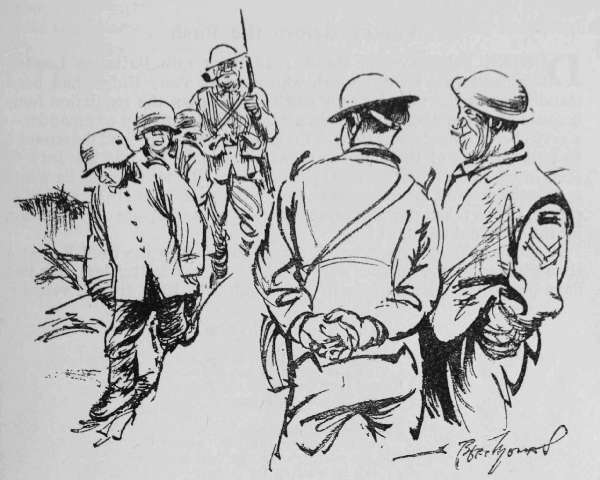
"Luv us, 'Arry; look what's shovin' our Army abaht!"
Rehearsal—Without the Villain
A small party with a subaltern were withdrawn from the line to rehearse a raid on the German line. A replica of the German trenches had been made from aircraft photographs, and these, with our own trench and intervening wire, were faithfully reproduced, even to shell-holes.
The rehearsal went off wonderfully. The wire was cut, the German trenches were entered, and dummy bombs thrown down the dug-outs.
Back we came to our own trenches. "Everything was done excellently, men," said the subaltern, "but I should like to be sure that every difficulty has been allowed for. Can any man think of any point which we have overlooked?"
"Yus," came the terse reply—"Jerry."—Edward Nolan (15th London Regt.), 41 Dalmeny Avenue, S.W.16.
Poetry Before the Push
During February and March 1918 the 1/13th Battalion London Regiment (the Kensingtons), who were at Vimy Ridge, had been standing-to in the mornings for much longer than the regulation hour because of the coming big German attack. One company commander—a very cheery officer—was tired of the general "wind up" and determined to pull the legs of the officers at Battalion H.Q. It was his duty to send in situation reports several times a day. To vary things he wrote a situation report in verse, sent it over the wire to B.H.Q., where, of course, it was taken down in prose and read with complete consternation by the C.O. and adjutant!
It showed the gay spirit which meant so much in the front line at a time when everyone's nerves were on edge. It was written less than two days before the German offensive of March 21. Here are the verses:
(C Company Situation Report 19/3/18) There is nothing I can tell you That you really do not know— Except that we are on the Ridge And Fritz is down below. I'm tired of "situations" And of "wind" entirely "vane." The gas-guard yawns and tells me "It's blowing up for rain." He's a human little fellow. With a thoughtful point of view, And his report (uncensored) I pass, please, on to you. "When's old Fritzie coming over? Does the General really know? The Colonel seems to think so, The Captain tells us 'No.' "When's someone going to tell us We can 'Stand-to' as before? An hour at dawn and one at dusk, Lor' blimey, who wants more?"
The word "vane" in the second verse refers, of course, to the weather-vane used in the trenches to indicate whether the wind was favourable or not for a gas attack.—Frederick Heath (Major), 1/13th Batt. London Regt. (Kensingtons).
'Erb's Consolation Prize
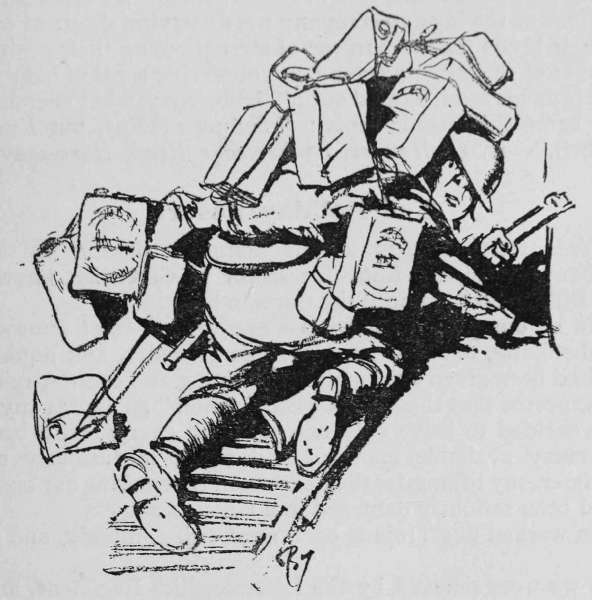
A narrow communication trench leading up to the front line; rain, mud, shells, and everything else to make life hideous.
Enter the ration party, each man carrying something bulky besides his rifle and kit.
One of the party, a Londoner known as 'Erb, is struggling with a huge mail-bag, bumping and slipping and sliding, moaning and swearing, when a voice from under a sack of bread pipes: "Never mind, 'Erb; perhaps there's a postcard in it for you!"—L. G. Austin (24th London Regiment), 8 Almeida Street, Upper Street, Islington, N.1.
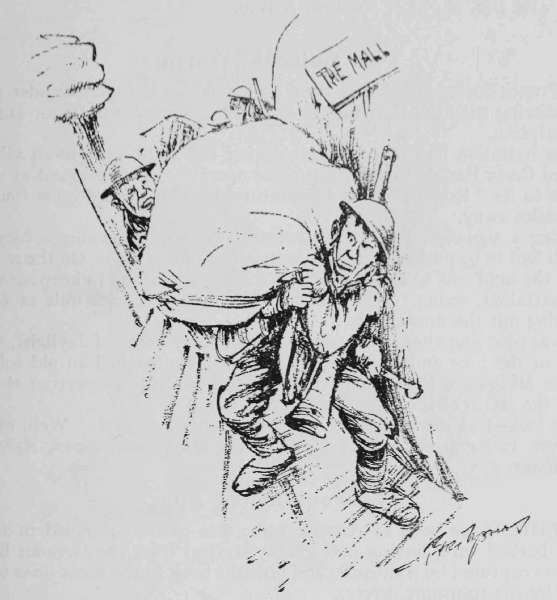
"Never mind, 'Erb, perhaps there's a postcard in it for you!"
Rum for Sore Feet
Whilst doing duty as acting Q.M.S. I was awakened one night by a loud banging on the door of the shack which was used as the stores. Without getting up I asked the reason for the noise, and was told that a pair of boots I had issued that day were odd—one was smaller than the other. The wearer was on stable piquet, and could hardly walk.
I told him he would have to put up with it till the morning—I wasn't up all night changing boots, and no doubt I should have a few words to say when I did see him!
"Orl right, Quarter," came the reply, "I'm sorry I woke yer—but could yer give us a tot of rum to stop the pain?"—P. K. (late 183rd Batt. 41st Div. R.F.A.), Kilburn, N.W.6.
Two Guineas' Worth
In France during November 1914 I received an abrupt reminder that soldiering with the Honourable Artillery Company entails an annual subscription.
The battalion had marched out during the night to a small village named Croix Barbée to carry out some operation, and returned at daybreak to its "lodging" near La Couture, another village some four or five miles away.
Being a signaller, I had the doubtful privilege of owning a bicycle, which had to be pushed or carried every inch of the way. On the march back the mud was so bad that it was impossible for me to keep up with the battalion, owing to the necessity every quarter of a mile or so of cleaning out the mudguards.
I was plodding along all by myself in the early hours of daylight, very tired of the bike and everything else, and I approached an old soldier of the Middlesex Regiment sitting by the roadside recovering slowly from the strain of the fatiguing night march.
He looked at me and, with a twinkle in his eye, said, "Well, mate, 'ad yer two guineas wurf yet?"—J. H. May, Ravenswood, Ashford, Middlesex.
The Four-footed Spy
Whilst we were at Arras a horse was found entangled in some barbed wire, having presumably strayed from the German lines. He was captured by a rifleman and brought back to the horse lines to be used by the transport driver.
A Cockney groom was detailed to look after him. The two never seemed to agree, for the groom was always being bitten or kicked by "Jerry."
One morning the picket discovered that "Jerry" was missing, and concluded that he must have broken away during the night. The matter was reported to the sergeant, who went and routed out the groom. "What about it? Ain't you goin' to look for 'im?" said the sergeant.
"Not me, sarge! I always said the blighter was a blinkin' spy!" replied the groom.—J. Musgrave (late 175th Infantry Brigade), 52 Cedar Grove, South Ealing, W.5.
Not Every Dog has his Night
Our battalion arrived in a French village late on the night of September 25, 1915, after marching all day in pouring rain. To add to our troubles no billets were available (the place was teeming with reserve troops for the attack at Loos).
We were told to find some sort of shelter from the rain and get a good night's rest, as we were to move up to the attack on the morrow.
My chum, a Londoner, and I scouted round. I found room for one in an already overcrowded stable; my chum continued the search. He returned in a few minutes to tell me he had found a spot. I wished him good night and went to sleep.
In the morning, when I came out of the stable, I saw the long legs of a Guardsman (who proved to be my chum) protruding from a dog kennel. Beside them sat a very fed-up dog!—F. Martin (late 1st Batt. Scots Guards), 91 Mostyn Road, Brixton, S.W.
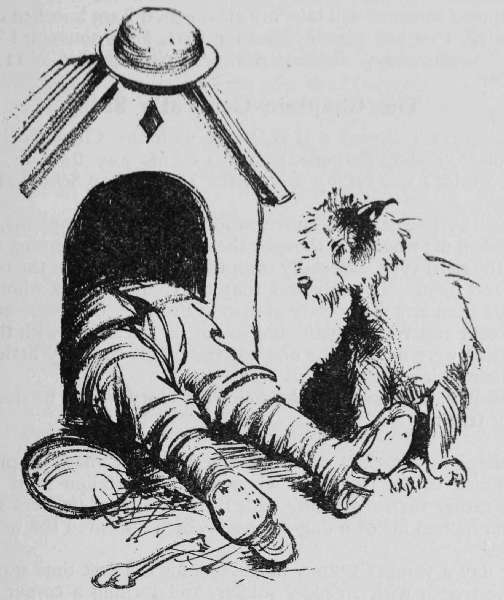
"...A very fed-up dog."
The Brigadier's Glass Eye
A brigadier of the 54th Infantry Brigade (18th Division), who had a glass-eye, and his Cockney runner, were on their way up the line when they observed a dead German officer who had a very prominent gold tooth.
The next day, passing by the same spot, the Brigadier noticed that the gold tooth was missing.
"I see that his gold tooth has gone, Johnson," he said.
"Yessir."
"I suppose someone will take my glass eye, if I am knocked out."
"Yessir. I've put meself dahn fer that, fer a souvenir!"—W. T. Pearce, "Southernhay," Bethune Avenue, Friern Barnet, N.11.
The Chaplain-General's Story
In June 1917 I shared a G.H.Q. car with the Chaplain-General to the Forces, Bishop Gwynne, who was on his way from St. Omer to Amiens, whilst I was on my way to the Third Army School at Auxi-le-Château.
During the journey our conversation turned to chaplains, and the bishop asked me whether I thought the chaplains then coming to France were of the right type, especially from the point of view of the regimental officers and men. My reply was that the chaplains as a whole differed very little from any other body of men in France: they were either men of the world and very human, and so got on splendidly with the troops, or else they were neither the one nor the other, cut very little ice, and found their task a very difficult one.
The Bishop then told me the following story, which he described as perfectly true:
"A chaplain attached to a London regiment made a practice of always living in the front line whenever the battalion went in to the trenches rather than remaining with Battalion Headquarters some way back, and he had his own dug-out over which appeared the words 'The Vicarage.'
"One day a young Cockney in the line for the first time was walking along the trench with an older soldier, and turning a corner suddenly came on 'The Vicarage.'
"'Gorblimey, Bill!' he said, 'who'd 'ave fought of seein' the b—— vicarage in the front line?'"
"Immediately the cheery face of the padre popped out from behind the blanket covering the entrance and a voice in reply said: 'Yes! And who'd have thought of seeing the b—— vicar too?'"
"That's the kind of chaplain," said the Bishop, "I'm trying to get them to send out to France."—(Brig.-Gen.) R. J. Kentish, C.M.G., D.S.O., Shalford Park, Guildford.
A Thirst Worth Saving
During the summer of 1917 our battalion—the 1/5th Buffs—formed part of General Thompson's flying column operating between the Tigris and the Shatt Al-'Adhaim.
One morning we discovered that the native camel drivers had deserted to the enemy's lines, taking with them the camels that were carrying our water.
No man had more than a small cup of water in his bottle yet we waited orders until dawn the next day, when a 'plane dropped a message for us to return to the Tigris.
I shall not dwell on that 20-mile march back to the river over the burning sand—I cannot remember the last few miles of it myself. None of us could speak. Our lips and tongues were bursting.
When we reached the Tigris we drank and drank again—then lay exhausted.
The first man I heard speak was "Busty" Johnson, who, with great effort hoarsely muttered: "Lumme, if I can only keep this blinkin' first till I goes on furlough!"—J. W. Harvey (late 1/5th Buffs, M.E.F.), 25 Queen's Avenue, Greenford Park, Middlesex.
Points of View
On a wet and cold winter's night in the hills south of Nablus (Palestine) a sentry heard sounds as of slipping feet and strange guttural noises from the direction of the front line. He waited with his rifle at the port and then challenged: "Halt! who goes there?"
A thin, dismal voice came from the darkness. "A pore miserable blighter with five ruddy camels."
"Pass, miserable blighter, all's well," replied the sentry.
Into the sentry's view came a rain-soaked disconsolate-looking Tommy "towing" five huge ration camels.
"All's well, is it? Coo! Not 'arf!" said he.—W. E. Bickmore (late "C" 303 Brigade, R.F.A., 60th Div.), 121 Gouville Road, Thornton Heath, Surrey.
Not the British Museum
The Labyrinth Sector.
Three of us—signallers—having just come off duty in the front line, were preparing to put in a few hours' sleep, when a voice came floating down the dug-out steps: "Is Corporal Stone down there?"
Chorus: "No!"
Ten minutes later came the same voice: "Is Sergeant Fossell down there?"
"Go away," replied our Cockney; "this ain't the blinkin' British Museum!"—G. J. Morrison (late 14th London Regt.), "Alness," Colborne Way, Worcester Park, Surrey.
Jerry Would Not Smile
I met him coming from the front line, one of "London's Own." He was taking back the most miserable and sullen-looking prisoner I have ever seen.
"Got a light, Jock?" he asked me. I obliged. "'Ave a Ruby Queen, matey?" I accepted.
"Cheerful-looking customer you've got there, Fusie," I ventured, pointing to his prisoner.
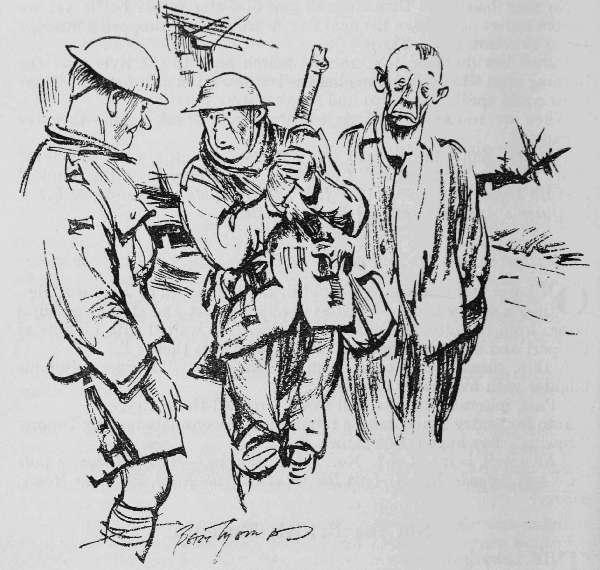
"... and if that don't make a bloke laugh, well, it's 'opeless."
He looked up in disgust. "Cheerful? Lummie, he gives me the creeps. I've orfered 'im a fag, and played 'Katie' and 'When this luvly war is over' on me old mouf orgin for him, but not a bloomin' smile. An' I've shown him me souvenirs and a photograph of me old woman, and, blimey, if that don't make a bloke laugh, well, it's 'opeless!"
And then, with a cheery "Mercy bokoo, matey," and a "Come on, 'Appy," to his charge, he pushed on.—Charles Sumner (late London Scottish), Butler's Cottage, Sutton Lane, Heston, Middlesex.
"Birdie" Had to Smile
While I was serving with the Australians at Gallipoli in 1915 I was detailed to take charge of a fatigue party to carry water from the beach to the front line, a distance of about a mile.
Our way lay over rather dangerous and extremely hilly country. The weather was very hot. Each man in the party had to carry four petrol tins of water.
While trudging along a narrow communication trench we were confronted by General Birdwood and his A.D.C. As was the general's cheery way, he stopped, and to the man in front (one "Stumpy" Stewart, a Cockney who had been in Australia for some time) he remarked, "Well, my man, how do you like this place?"
"Stumpy" shot a quick glance at the general and then blurted out, "Well, sir, 't'aint the sort of plice you'd bring your Jane to, is it?"
I can see "Birdie's" smile now.—C. Barrett (Lieut., Aust. Flying Corps, then 6th Aust. Light Horse), Charing Cross, W.C.
Their Very Own Secret
We were on a forced march to a sector on Vimy Ridge. It was a wicked night—rain and thick fog—and during a halt several of our men got lost. I was ordered to round them up, but I also got hopelessly lost.
I had been wandering about for some time when I came across one of our men—a young fellow from the Borough. We had both lost direction and could do nothing but wait.
At last dawn broke and the fog lifted. We had not the slightest idea where we were, so I told my friend to reconnoitre a hill on the right and report to me if he saw anyone moving, while I did the same on the left.
After a while I heard a cautious shout, and my companion came running towards me, breathless with excitement, and in great delight gasped, "Sergeant, sergeant! Germans! Germans! Fousands of 'em—and there's nobody but you and me knows anyfing abaht it!"—G. Lidsell (late Devon Regt.), Brixton, S.W.9.
Window Cleaners Coming!
We were passing through Ypres, in 1915, in a Wolseley Signals tender when we came upon a battalion of the Middlesex on their way out to rest, very tired and very dirty.
Our cable cart ladders, strapped to the sides of the lorry, caught the eyes of one wag. "Blimey, boys," he cried, "we're orl right nah; 'ere comes the blinkin' winder-cleaners."—"Sigs.," Haslemere, Surrey.
First Blow
It was outside Albert, during the Somme attack, that I met a lone Army Service Corps wagon, laden with supplies. One of the horses was jibbing, and the driver, a diminutive Cockney, was at its head, urging it forward. As I approached I saw him deliberately kick the horse in the flank.
I went up to the man and, taking out notebook and pencil, asked him for his name, number, and unit, at the same time remonstrating with him severely.
"I wasn't doin' 'im no 'arm," pleaded the man; "I've only got my gum-boots on, and, besides, 'e kicked me first."
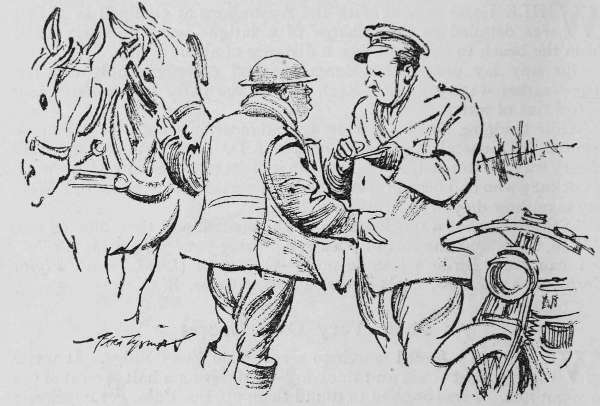
"An' besides, he kicked me first."
I tore up my entry, mounted my motor-cycle, and left an injured-looking driver rubbing a sore shin.—R. D. Blackman (Capt., R.A.F.), 118 Abbey Road, St. John's Wood, N.W.6.
M.M. (Mounted Marine)
After riding for several hours one wet, windy, and miserable night, with everyone soaked to the skin and fed up generally, we were halted in a field which, owing to the heavy rain, was more like a lake.
On receiving the order to dismount and loosen girths, one of our number remained mounted and was busy flashing a small torch on the water when the sergeant, not too gently, inquired, "Why the dickens are you still mounted, and what the deuce are you looking for anyway?" To which a Cockney voice replied, "Blimey, sergeant, where's the landing stage?"—"Jimmy" (late Essex Yeomanry).
His German 'Arp
Having been relieved, after our advance at Loos in 1915, we were making our way back at night.
We had to pass through the German barbed wire, which had tins tied to it so that it rattled if anyone tried to pass it.
Our sergeant got entangled in it and caused a lot of noise, whereupon a Cockney said: "You're orl right on the old banjo, sergeant, but when it comes to the German 'arp you're a blinkin' washaht."—W. Barnes, M.M. (late 1st Bn. K.R.R.C.), 63 Streatfeild Avenue, East Ham.
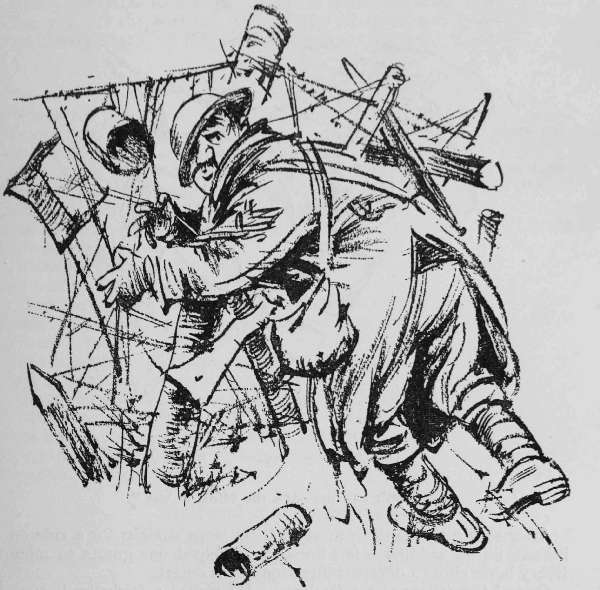
"When it comes to the German 'arp you're a washaht."
Jack went a-Riding
Early in 1916 we were on outpost duty at a place called Ayun Musa, about four miles east of Suez.
One day a British monitor arrived in the Gulf of Suez, and we were invited to spend an hour on board as the sailors' guests. The next day the sailors came ashore and were our guests.
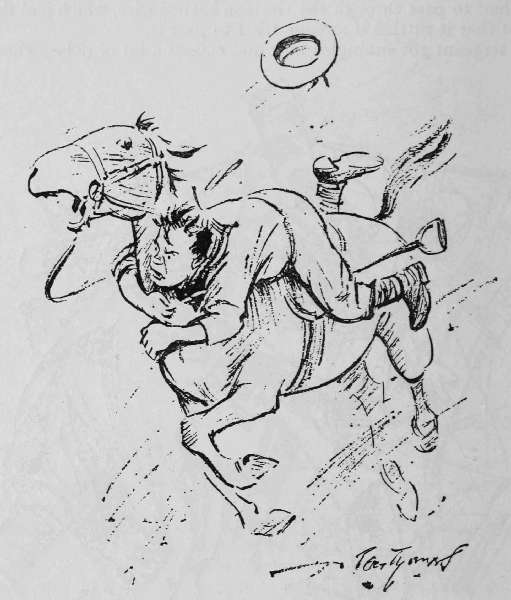
"Don't ask me—ask the blinkin' 'oss."
After seeing the canteen most of them were anxious for a ride on a horse. So we saddled a few horses and helped our guests to mount. Every horse chose a different direction in the desert.
One of the sailors was a Cockney. He picked a fairly fresh mount, which soon "got away" with him. He lost his reins and hung round the animal's neck for dear life as it went at full gallop right through the Camp Commandant's quarters.
Hearing the commotion, the Commandant put his head out of his bivouac and shouted, "What the dickens do you mean galloping through here?"
Back came the retort, "Don't ask me—ask the blinkin' 'oss."—H. F. Montgomery (late H.A.C.), 33 Cavenham Gardens, Ilford.
Bitter Memories
During an attack near Beer-Sheba, Palestine, our regiment had been without water for over twenty-four hours. We were suffering very badly, as the heat was intense. Most of us had swollen tongues and lips and were hardly able to speak, but the company humorist, a Cockney, was able to mutter, "Don't it make you mad to fink of the times you left the barf tap running?"—H. Owen (late Queen's Royal West Surrey Regt.), 18 Edgwarebury Gardens, Edgware, Middlesex.
Tommy "Surrounded" Them
It was in July 1916. The Somme Battle had just begun. The troops in front of us had gone over the top and were pushing forward. We were in support and had just taken over the old front line.
Just on our right was a road leading up and through the German lines. Looking up this road we saw a small squad strolling towards us. It was composed of four Germans under the care of a London Tommy who was strolling along, with his rifle under his arm, like a gamekeeper. It made quite a nice picture.
When they reached us one of our young officers shouted out: "Are you looking for the hounds?"
Then the Cockney started: "Blimey, I don't know abaht looking for 'ounds. I got four of 'em 'ere—and now I got 'em I don't know where to dump 'em."
The officer said: "Where did you find them?"
"I surrounded 'em, sir," was the reply.
Our officer said: "You had better leave them here for the time being."
"Right-o, sir," replied the Cockney. "You hang on to 'em until I come back. I'm going up the road to get some more. There's fahsends of 'em up there."—R. G. Williams, 30 Dean Cottages, Hanworth Road, Hampton, Middlesex.
Shell-holes and Southend
My pal (a Battersea boy) and I were two of a draft in 1916 transferred from the K.R.R.s to the R.I.R.s. On the first night in the trenches we were detailed for listening post. My pal said: "That's good. I'll be able to tell father what No Man's Land is like, as he asked me."
After we had spent what was to me a nerve-wracking experience in the mud of a shell-hole, I asked him what he was going to tell his father. He said: "It's like Southend at low tide on the fifth of November."—F. Tuohey (late 14th Batt. R.I.R.), 31 Winchester Road, Edmonton.
"Make Me a Good 'Orse"
Having come out of action, we lay behind the line waiting for reinforcements of men and horses. The horses arrived, and I went out to see what they were like.
I was surprised to see a Cockney, who was a good groom, having trouble in grooming one of the new horses. Every time he put the brush between its forelegs the animal went down on its knees.
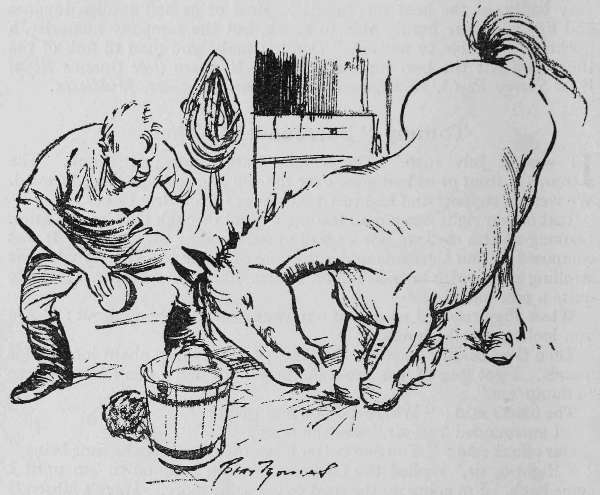
"Gawd bless farver an' make me a good 'orse."
At last in desperation the Cockney stepped back, and gazing at the horse still on its knees, said: "Go on, yer long-faced blighter. 'Gawd bless muvver. Gawd bless farver, an' make me a good 'orse.'"—Charles Gibbons (late 3rd Cavalry Brigade), 131 Grove Street, Deptford, S.E.8.
The Lost Gumboot
An N.C.O. in the Engineers, I was guiding a party of about seventy Royal Fusiliers (City of London Regt.) through a trench system between Cambrin, near Loos, and the front line. About half-way the trenches were in many places knee-deep in mud. It was about 2 a.m. and shelling made things far from pleasant. Then word came up that we had lost touch with the tail-end of the party, and a halt was called, most of us standing in mud two feet deep.
The officer in charge sent a message back asking why the tail-end had failed to keep up. The reply came back in due course: "Man lost his gumboot in the mud." The officer, becoming annoyed at the delay, sent back the message: "Who's the fool who lost his gumboot?"
I heard the message receding into the distance with the words "fool" "gumboot" preceded by increasingly lurid adjectives. In about three or four minutes I heard the answer being passed up, getting louder and louder: "Charlie Chaplin," "Charlie Chaplin," "CHARLIE CHAPLIN." Even our sorely-tried officer had to laugh.—P. Higson, Lancashire.
"Compree 'Sloshy'?"
During one of the Passchendaele advances in 1917 my battery was situated astride a board roadway leading over the ridge. After this particular show was over I happened to be in the telephone dug-out when prisoners started coming back.
One weary little lance-jack in a London regiment arrived in charge of an enormous, spectacled, solemn-looking Fritz. As he reached the battery position he paused to rest and look at the guns.
Leaning against the side of the dug-out he produced a cigarette end and, lighting it, proceeded to make conversation with his charge which, being out of sight, I was privileged to overhear.
"Ain't 'arf blinkin' sloshy 'ere, ain't it, Fritz? Compree sloshy?" No reply.
He tried again. "Got a cushy job these 'ere artillery blokes, ain't they? Compree cushy?" Still no answer.
He made a third attempt. "S'pose you're abart fed up with this blinkin' guerre. Compree guerre?" Again the stony, uncomprehending silence; and then:
"Garn, yer don't know nuffink, yer don't, yer ignorant blighter. Say another blinkin' word and I'll knock yer blinkin' block orf."—A. E. Joyce (late R.F.A.), Swallowcroft, Broxbourne Road, Orpington, Kent.
Looking-Glass Luck
During the second battle of Ypres, in May 1915, I was attached to the 1st Cavalry Brigade, and after a terrific strafing from Fritz there was a brief lull, which gave us a chance for a "wash and brush up."
While we were indulging in the luxury of a shave, a Cockney trooper dropped his bit of looking-glass.
Seeing that it was broken I casually remarked, "Bad luck for seven years." And the reply I got was, "If I live seven years to 'ave bad luck it'll be blinking good luck."—J. Tucker, 46 Langton Road, Brixton, S.W.
Mine that was His
Just before our big push in August 1918 we were resting in "Tank Wood." The place was dotted with shell holes, one of which was filled with rather clean water, evidently from a nearby spring. A board at the edge of this hole bore the word "Mine," so we gave it a wide berth.
Imagine our surprise when later we saw "Tich," a lad from the Old Kent Road, bathing in the water. One of our men yelled, "Hi, Tich, carn't yer read?"
"Yus," replied "Tich," "don't yer fink a bloke can read 'is own writing?"—Walter F. Brooks (late R.W. Kent Regt.), 141 Cavendish Road, Highams Park, E.4.
"Geography" Hour
Just before going over the top a private, wishing to appear as cheerful as possible, turned to his platoon sergeant and said: "I suppose we will be making history in a few minutes, sergeant?"
"No," replied the sergeant: "our first objective is about 250 yards straight to the front. What you have to do is to get from here to there as quickly as your legs will carry you. We are making geography this morning, my lad!"—"Arras," London, S.W.1.
To the General, About the Colonel
The colonel of the regiment, gifted with the resonant voice of a dare-devil leader, was highly esteemed for his rigid sense of duty, especially in the presence of the enemy.
The Germans had been troubling us a lot with gas, and this kept everyone on the qui vive.
Accompanied by the colonel, the divisional commander was making his usual inspection of the front line intent on the alertness of sentries.
In one fire-bay the colonel stopped to give instructions regarding a ventilating machine which had been used to keep the trench clear of gas after each attack.
Meanwhile the general moved on towards the other end of the fire-bay, where the sentry, fresh out from the reserve battalion recruited in Bermondsey, stood with his eyes glued to the periscope.
A natural impulse of the general as he noticed the weather-vane on the parapet was to test the sentry's intelligence on "gas attack by the enemy," so as he approached the soldier he addressed him in a genial and confiding manner: "Well, my lad, and how's the wind blowing this morning?"
Welcoming a little respite, as he thought, from periscope strain, by way of a short "chin-wag" with one or other of his pals, the unsuspecting sentry rubbed his hands gleefully together as he turned round with the reply: "'Taint 'arf so dusty arter all." Then, suddenly through the corner of his eye he caught sight of his colonel at the other end of the fire-bay. His face instantly changed its cheerful aspect as he breathlessly whispered to his inquirer, "Lumme, the ole man! 'Ere, mate, buzz orf quick—a-a-an' don't let 'im cop yer a-talkin' to the sentry on dooty, or Jerry's barrage will be a washaht when the Big Noise starts 'is fireworks!"—William St. John Spencer (late East Surrey Regiment), "Roydsmoor," Arneson Road, East Molesey, Surrey.
Bow Bells—1917 Style
We were going up the line at Bullecourt in April 1917. I have rather bad eyesight and my glasses had been smashed. Being the last of the file I lost touch with the others and had no idea where I was. However, I stumbled on, and eventually reached the front line.
"Take those bells orf."
Upon the ground were some empty petrol cans tied up ready to be taken down to be filled with water. I tripped up amongst these and created an awful din, whereupon an angry voice came from out the gloom.—"I don't know 'oo or wot the dickens you are, but for 'eaven's sake take those bells orf!"—W. G. Root (late 12th London Regt.), 24 Harrington Square, N.W.1.
"The Awfentic Gramerphone!"
This happened on that wicked March 21, 1918.
During a lull in the scrapping, a lone German wandered too near, and we collared him. He was handed over to Alf, our Cockney cookie.
Things got blacker for us. We could see Germans strung out in front of us and on both flanks—Germans and machine guns everywhere.
"Well, boys," said our major, "looks as if it's all up with us, doesn't it?"
"There's this abaht it, sir," said Alf, pointing to his prisoner; "when it comes to chuckin' our 'ands in, we've got the awfentic gramerphone to yell 'Kamerad!'—ain't we?"—C. Vanon, 33 Frederick Street, W.C.1.
The Muffin Man
Two companies of a London regiment were relieving each other on a quiet part of the line, late in the evening of a dismal sort of day. The members of the ingoing company were carrying sheets of corrugated iron on their heads for the purpose of strengthening their position.
A member of the outgoing company, observing a pal of his with one of these sheets on his head, bawled out: "'Ullo, 'Arry, what'cher doing of?" to which came the laconic reply: "Selling muffins, but I've lost me blinkin' bell."—H. O. Harries, 85 Seymour Road, Harringay, N.8.
The Holiday Resort
Early in October 1915 a half company of the 3rd Middlesex Regiment occupied a front-line sector at Givenchy, known as the "Duck's Bill," which ran into the German line.
In spite of our proximity to the enemy our chief annoyance was occasional sniping, machine gunning, rifle grenades, and liquid fire, for the area had been given over mainly to mining and counter-mining.
It was expected that the "Duck's Bill" would "go up" at any moment, so it was decided to leave only one officer in charge, with instructions to keep every available man engaged either in furiously tunnelling towards the enemy to counter their efforts, or in repairing our breast-works, which had been seriously damaged in a German attack.
My men worked like Trojans on a most tiring, muddy, and gruesome task.
At last we were relieved by the Leicestershire Regiment, and one of my men, on being asked by his Leicester relief what the place was like, replied: "Well, 'ow d'yer spend yer 'olidies, in the country or at the seaside? 'Cos yer gits both 'ere as yer pleases: rabbit 'unting (pointing to the tunnelling process) and sand castle building (indicating the breastwork repairs), wiv fireworks in the evening."
The Leicesters, alas! "went up" that evening.—S. H. Flood (late Middlesex Regiment and M.G.C.), "Prestonville," Maidstone Road, Chatham, Kent.
The "Tich" Touch
We had survived the landing operations at Murmansk, in North Russia, and each company had received a number of sets of skis, which are very awkward things to manage until you get used to them.
On one occasion when we were practising, a "son of London," after repeated tumbles, remarked to his pals, who were also getting some "ups and downs": "Fancy seein' me dahn Poplar way wiv these fings on; my little old bunch of trouble would say, 'What's 'e trying ter do nah? Cut aht Little Tich in the long-boot dance?'"—C. H. Mitchell (late Staff-Sergt. A.S.C.), 7 Kingsholm Gardens, Eltham, S.E.9.
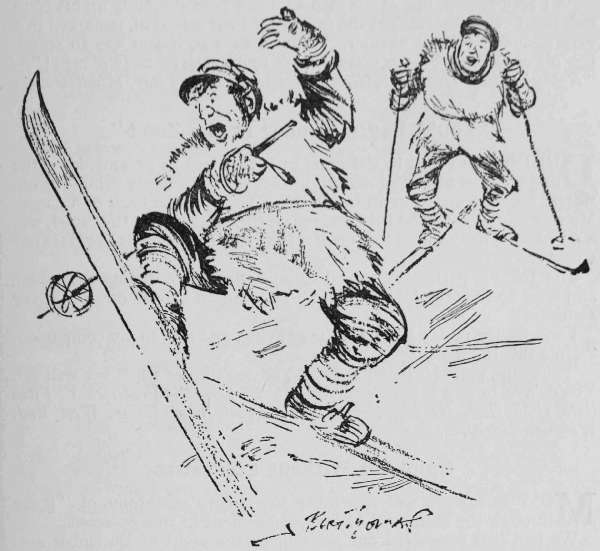
"Trying to cut aht Little Tich in the long-boot dance."
Smart Men All
One of the usual orders had come through to my battalion of the Middlesex Regiment for a number of men to be detailed for extra regimental duties which would be likely to take them away from the battalion for a considerable time. The company I commanded had to provide twenty men.
It was a golden opportunity to make a selection of those men whose physical infirmities were more evident than the stoutness of their hearts. Together with my company sergeant-major I compiled a list of those who could best be spared from the trenches, and the following day they were paraded for inspection before moving off.
As I approached, one of the men who had been summing up his comrades and evidently realised the reason for their selection, remarked in a very audible Cockney whisper, "What I says is, if you was to search the 'ole of Norvern France you wouldn't find a smarter body o' men!"—"Nobby" (late Captain, Middlesex Regiment), Potters Bar, Middlesex.
"You'd Pay a Tanner at the Zoo!"
During the floods in Palestine in 1917 I had to be sent down the line with an attack of malaria. Owing to the roads being deep in water, I was strapped in an iron chair pannier on the back of a camel. My sick companion, who balanced me on the other side of the camel, was a member of the London Regiment affectionately known as the Hackney Gurkhas.
The Johnnie patiently trudged through the water leading the camel, and kept up the cry of "Ish! Ish!" as it almost slipped down at every step.
I was feeling pretty bad with the swaying, and said to my companion, "Isn't this the limit?"
"Shurrup, mate!" he replied. "Yer don't know when yer well orf. You'd 'ave to pay a tanner for this at the Zoo!"—Frederick T. Fitch (late 1/5th Batt. Norfolk Regt.), The Gordon Boys' Home, West End, Woking, Surrey.
Smoking Without Cigarettes
Most ex-soldiers will remember the dreary monotony of "going through the motions" of every movement in rifle exercises.
We had just evacuated our position on the night of December 4-5, 1917, at Cambrai, after the German counter-attack, and, after withstanding several days' severe battering both by the enemy and the elements, were staggering along, tired and frozen and hungry, and generally fed up.
When we were deemed to be sufficiently far from the danger zone the order was given to allow the men to smoke. As practically everyone in the battalion had been without cigarettes or tobacco for some days the permission seemed to be wasted. But I passed the word down, "'C' Company, the men may smoke," to be immediately taken up by a North Londoner: "Yus, and if you ain't got no fags you can go through the motions."—H. H. Morris, M.C. (late Lieut., 16th Middlesex Regt.), 10 Herbert Street, Malden Road, N.W.5.
An Expensive Light
Winter 1915, at Wieltje, on the St. Jean Road. We were on listening post in a shell-hole in No Man's Land, and the night was black.
Without any warning, my Cockney pal Nobby threw a bomb towards the German trench, and immediately Fritz sent up dozens of Verey lights. I turned anxiously to Nobby and asked, "What is it? Did you spot anything?" and was astonished when he replied, "I wanted ter know the time, and I couldn't see me blinkin' watch in the dark."—E. W. Fellows, M.M. (late 6th Battn. D.C.L.I.), 33 Dunlace Road, Clapton, E.5.
Modern Conveniences
A Tommy plugging it along the Arras-Doullens road in the pouring rain. "Ole Bill," the omnibus, laden with Cockneys going towards the line, overtakes him.
Tommy: "Sitting room inside, mate?"
Cockney on Bus: "No, but there's a barf-room upstairs!"—George T. Coles (ex-Lieut., R.A.F.), 17 Glebe Crescent, Hendon, N.W.4.
"There's a barf-room upstairs!"
The Trench Fleet
A certain section of the line, just in front of Levantie, being a comparatively peaceful and quiet spot, was held by a series of posts at intervals of anything up to three hundred yards, which made the task of bringing up rations an unhappy one, especially as the trenches in this sector always contained about four feet of water.
One November night a miserable ration party was wading through the thin slimy mud. The sentry at the top of the communication trench, hearing the grousing, splashing, and clanking of tins, and knowing full well who was approaching, issued the usual challenge, as per Army Orders: "'Alt! 'Oo goes there?"
Out of the darkness came the reply, in a weary voice: "Admiral Jellicoe an' 'is blinkin' fleet."—W. L. de Groot (late Lieut., 5th West Yorks Regt.), 17 Wentworth Road, Golders Green, N.W.11.
The Necessary Stimulant
On the St. Quentin front in 1917 we were relieved by the French Artillery. We watched with rather critical eyes their guns going in, and, best of all, their observation balloon going up.
The ascent of this balloon was, to say the least, spasmodic. First it went up about a hundred feet, then came down, then a little higher and down again.
This was repeated several times, until at last the car was brought to the ground and the observer got out. He was handed a packet, then hastily returned, and up the balloon went for good. Then I heard a Cockney voice beside me in explanatory tones: "There! I noo wot it was all the time. 'E'd forgotten his vin blong!"—Ernest E. Homewood (late 1st London Heavy Battery), 13 Park Avenue, Willesden Green, N.W.2.
A Traffic Problem
A dark cloudy night in front of Lens, two patrols of the 19th London Regt., one led by Lieut. R——, the other by Corporal B——, were crawling along the barbed wire entanglements in No Man's Land, towards each other.
Two tin hats met with a clang, which at once drew the attention of Fritz.
Lieut. R—— sat back in the mud, while snipers' and machine-gun bullets whistled past, and in a cool voice said, "Why don't you ring your perishing bell?"—L. C. Pryke (late 19th London Regt.), "Broughdale," Rochford Avenue, Rochford, Essex.
Scots, Read This!
On the afternoon of Christmas Day, 1915, three pipers, of whom I was one, went into the trenches at Loos, and after playing at our Battalion H.Q., proceeded to the front line, where we played some selections for the benefit of the Germans, whose trenches were very close at this point. Probably thinking that an attack was imminent, they sent up innumerable Verey lights, but, deciding later that we had no such intention, they responded by singing and playing on mouth-organs.
Having finished our performance, my friends and I proceeded on our way back, and presently, passing some men of another regiment, were asked by one of them: "Was that you playin' them bloomin' toobs?" We admitted it.
"'Ear that, Joe?" he remarked to his pal. "These blokes 'ave bin givin' the 'Uns a toon."
"Serve 'em right," said Joe, "they started the blinkin' war."—Robert Donald Marshall (late Piper, 1st Bn. London Scottish), 83 Cranley Drive, Ilford.
Met His Match
A London Tommy was standing near the leave boat at Calais, which had just brought him back to France on his way to the firing line. It was raining, and he was trying to get a damp cigarette to draw.
Just then a French soldier approached him with an unlighted cigarette in his hand, and, pointing to Tommy's cigarette, held out his hand and exclaimed "Allumette?"
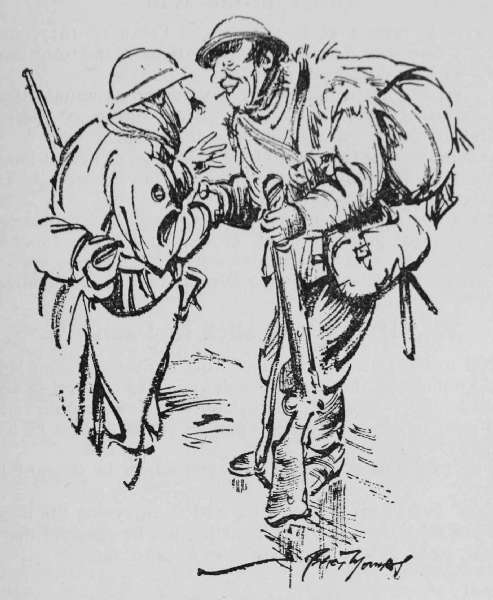
Poilu: "Allumette?" Tommy: "'Allo, mate." (Shakes.)
The Tommy sadly shook hands and replied "Allo, Mate."—A. J. Fairer, Mirigama, Red Down Road, Coulsdon, Surrey.
Why Jerry was "Clinked"
On August 8, 1918, as our battery began the long trail which landed us in Cologne before Christmas we met a military policeman who had in his charge three very dejected-looking German prisoners. "Brummy," our battery humorist, shouted to the red-cap: "'Ullo, Bobby, what are yer clinkin' those poor old blokes for?"
"Creatin' a disturbance on the Western Front," replied the red-cap.—Wm. G. Sheppard (late Sergeant, 24th Siege Bty., R.A.), 50 Benares Road, Plumstead, S.E.18.
Stick-in-the-Mud
We were in reserve at Roclincourt in February 1917, and about twenty men were detailed to carry rations to the front line. The trenches were knee-deep in mud.
After traversing about two hundred yards of communication trench we struck a particularly thick, clayey patch, and every few yards the order "Halt in front!" was passed from the rear.
The corporal leading the men got very annoyed at the all-too-frequent halts. He passed the word back, "What's the matter?" The reply was, "Shorty's in the mud, and we can't get 'im out."
Waiting a few minutes, the corporal again passed a message back: "Haven't you got him out yet? How long are you going to be?" Reply came from the rear in a Cockney voice: "'Eaven knows! There's only 'is ears showin'."—G. Kay, 162 Devonshire Avenue, Southsea, Hants.
"If That can stick it, I can!"
Owing to the forced marching during the retreat from Mons, men would fall out by the roadside and, after a rest, carry on again.
One old soldier, "Buster" Smith, was lying down puffing and gasping when up rode an officer mounted upon an old horse that he had found straying.
Going up to "Buster" the officer asked him if he thought he could "stick it."
"Buster" looked up at the officer and then, eyeing the horse, said: "If that can stick it, I can," and, getting up, he resumed marching.—E. Barwick, 19 St. Peter's Street, Hackney Road, E.2.
Wheeling a Mule
In November '15 we were relieved in the early hours of the morning.
It had been raining, raining most of the time we were in the trenches, and so we were more or less wet through and covered in mud when we came out for a few days' rest.
About two or three kilometres from Béthune we were all weary and fed-up with marching. Scarcely a word was spoken until we came across an Engineer leading a mule with a roll of telephone wire coiled round a wheel on its back. The mule looked as fed-up as we were, and a Cockney in our platoon shouted out, "Blimey, mate, if you're goin' much furver wiv the old 'oss yer'll 'ave to turn it on its back and wheel it."—W. S. (late Coldstream Guards), Chelsea, S.W.3.
Three Brace of Braces
While I was serving with the 58th Siege Battery at Carnoy, on the Somme, in 1916, a young Cockney of the 29th Division was discovered walking in front of three German prisoners. Over his shoulders he had three pairs of braces.
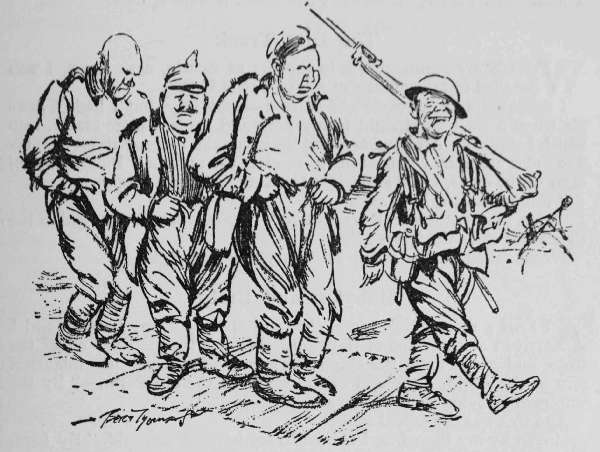
"... while I got their 'harness' they can't get up to any mischief."
A wag asked him if he wanted to sell them, and his reply was: "No, these Fritzies gets 'em back when they gets to the cage. But while I got their 'harness' they can't get up to any mischief."—E. Brinkman, 16 Hornsey Street, Holloway Road, N.7.
"Bow Bells" Warning
At the beginning of March 1918, near Flesquières, we captured a number of prisoners, some of whom were put in the charge of "Nipper," a native of Limehouse.
I heard him address them as follows: "Nah, then, if yer wants a fag yer can have one, but, blimey, if yer starts any capers, I'll knock 'Bow Bells' aht of yer Stepney Church."—J. Barlow (20th London Regt.), 18 Roding Lane, Buckhurst Hill, Essex.
"'Ave a Sniff"
My father tells of a raw individual from London Town who had aroused great wrath by having within a space of an hour given two false alarms for gas. After the second error everyone was just drowsing off again when a figure cautiously put his head inside the dug-out, and hoarsely said: "'Ere, sergeant, yer might come and 'ave a sniff."—R. Purser, St. Oama, Vista Road, Wickford, Essex.
The Dirt Track
While my regiment was in support at Ecurie, near Arras, I was detailed to take an urgent message to B.H.Q.
I mounted a motor-cycle and started on my way, but I hadn't gone far when a shell burst right in my path and made a huge crater, into which I slipped. After going round the inside rim twice at about twenty-five miles an hour, I landed in the mud at the bottom. Pulling myself clear of the cycle, I saw two fellows looking down and laughing at me.
"Funny, isn't it?" I said.
"Yus, matey, thought it was Sanger's Circus. Where's the girl in the tights wot rides the 'orses?"
Words failed me.—London Yeomanry, Brixton, S.W.
Babylon and Bully
After a dismal trek across the mud of Mespot, my batman and I arrived at the ruins of Babylon. As I sat by the river under the trees, and gazed upon the stupendous ruins of the one-time mightiest city in the world, I thought of the words of the old Psalm—"By the waters of Babylon we sat down and wept——"
And this was the actual spot!
Moved by my thoughts, I turned to my batman and said, "By Jove, just think. This is really Babylon!"
"Yes, sir," he replied, "but I'm a-wonderin' 'ow I'm goin' to do your bully beef up to-night to make a change like."—W. L. Lamb (late R.E., M.E.F.), "Sunnings," Sidley, Bexhill-on-Sea.
Twice Nightly
An attack was expected, and some men were kept in reserve in an underground excavation more closely resembling a tunnel than a trench.
After about twenty hours' waiting in knee-deep mud and freezing cold, they were relieved by another group.
As they were filing out one of the relief party said to one of those coming out, "Who are you?"
"'Oo are we?" came the reply. "Cahn't yer see we're the fust 'ouse comin' aht o' the pit?"—K. Haddon, 379 Rotherhithe New Road, North Camberwell, S.E.16.
In Shining Armour
A horrible wet night on the Locre-Dranoutre Road in 1914. A narrow strip of pavé road and, on either side, mud of a real Flanders consistency.
I was on my lawful occasions in a car, which was following a long supply column of five-ton lorries.
"'Ere, ally off the perishin' pavé, you knight in shinin' armour."
I need scarcely say that the car did not try to forsake the comparative security of the pavé, but when a check of about a quarter of an hour occurred, I got down from the car and stumbled through the pouring rain, well above the boot-tops in mud, to the head of the column.
Impasse barely describes the condition of things, for immediately facing the leading lorry was a squadron of French Cuirassiers, complete with "tin bellies" and helmets with horse-hair trimmings.
This squadron was in command of a very haughty French captain, who seemed, in the light of the lorry's head-lamps, to have a bigger cuirass and helmet than his men.
He was faced by a diminutive sergeant of the A.S.C., wet through, fed up, but complete with cigarette.
Neither understood the other's language, but it was quite obvious that neither would leave the pavé for the mud. Did the sergeant wring his hands or say to the officer, "Mon Capitaine, je vous en prie, etc."? He did not. He merely stood there, and, removing his cigarette from his mouth, uttered these immortal words:
"'Ere, ally off the perishing pavé, you son of a knight in shinin' armour!"
And, believe me or believe me not, that is what the haughty one and his men did.—"The Ancient Mariner," Sutton, Surrey.
"A Blinkin' Paper-Chase?"
One pitch black rainy night I was bringing up the rear of a party engaged in carrying up the line a number of trench mortar bombs known as "toffee-apples."
We had become badly tailed-off during our progress through a maze of communication trenches knee-deep in mud, and as I staggered at last into the support trench with my load I spied a solitary individual standing on the fire-step gazing over the parapet.
"Seen any Queen's pass this way?" I inquired.
"Blimey," he replied, apparently fed-up with the constant repetition of the same question, "wot 'ave you blokes got on to-night—-a blinkin' piper-chise?"—W. H. Blakeman (late Sergt., Queen's R.W.S. Regt.), 22 Shorts Road, Carshalton.
Biscuits—Another Point of View
In April 1915 my battalion was on the way up to take over a line of "grouse-butts"—there were no continuous trenches—in front of a pleasure resort by the name of Festubert.
Arrived at Gore, a couple of miles or so from the line, we ran into some transport that had got thoroughly tied up, and had a wait of about half-an-hour while the joy-riders sorted themselves out. It was pitch dark and raining hard, and the occasional spot of confetti that came over added very little to the general enjoyment.
As I moved up and down my platoon, the usual profane but humorous grousing was in full spate. At that time the ration arrangements were not so well organised as they afterwards became, and for some weeks the bulk of our banquets had consisted of bully and remarkably hard and unpalatable biscuits. The latter were a particularly sore point with the troops.
As I listened, one rifleman held forth on the subject. "No blinkin' bread for five blinkin' weeks," he wound up—"nothin' but blinkin' biscuits that taste like sawdust an' break every tooth in yer perishin' 'ed. 'Ow the 'ell do they expect yer to fight on stuff like that?" "Whatcher grousin' about?" drawled another weary voice. "Dawgs lives on biscuits, and they can fight like 'ell!"—S. B. Skevington (late Major, 1st London Irish Rifles), 10 Berkeley Street, W.1.
His Bird Bath
A battalion of the Royal Fusiliers (City of London Regiment) was in support, and a private was endeavouring to wash himself as thoroughly as possible with about a pint of water in a mess-tin.
A kindly disposed staff officer happened to come along, and seeing the man thus engaged, said, "Having a wash, my man?"
"Wish I was a blinkin' canary: I could have a bath then."
Back came the reply, "Yus, and I wish I was a blinkin' canary. Could have a bath then."—R. G. Scarborough, 89 Tennyson Avenue, New Maiden, Surrey.
Ducking 'em—-then Nursing 'em
After the Cambrai affair of November 1917 our company came out of the line, but we had to salvage some very large and heavy shells.
We had been carrying the shells in our arms for about an hour when I heard a fed-up Cockney turn to the sergeant and say: "'Ere 'ave I been duckin' me nut for years from these blinkin' fings—-blimey, and nah I'm nursin' 'em!"—-Rfn. Elliott (late 17th K.R.R.C.), 9 Leghorn Road, Harlesden, N.W.
Salonika Rhapsody
Three of us were sitting by the support line on the Salonika front, conditions were fairly bad, rations were short and a mail was long overdue. We were fed-up. But the view across the Vardar Valley was some compensation.
The wadis and plains, studded with bright flowers, the glistening river and the sun just setting behind the distant ridges and tinting the low clouds, combined to make a perfect picture. One of my pals, with a poetic temperament, rhapsodised on the scene for several minutes, and then asked our other mate what he thought. "Sooner see the blinkin' Old Kent Road!" was the answer of the peace-time costermonger.—W. W. Wright, 24 Borthwick Road, E.15.