2. LULL (continued 2)
Reading edition
A Ticklin' Tiddler
In January 1915, near Richebourg, I was one of a ration-party being led back to the front line by a lance-corporal. The front line was a system of breast-works surrounded by old disused trenches filled with seven feet or so of icy-cold water.
It was a very dark moonless night, and near the line our leader called out to those in the breast-works to ask them where the bridge was. He was told to step off by the broken tree. He did so and slid into the murky depths—the wrong tree!
We got him out and he stood on dry (?) land, shining with moisture, full of strange oaths and vowing vengeance on the lad who had misdirected him.
At stand-down in the dawn (hours afterwards) he was sipping his tot of rum. He had had no chance of drying his clothes. I asked how he felt.
"Fresh as a pansy, mate," was his reply. "Won'erful 'ow a cold plunge bucks yer up! Blimey, I feel as if I could push a leave train from 'ere to the base. 'Ere, put yer 'and dahn my tunic and see if that's a tiddler ticklin' me back."—F. J. Reidy (late 1st K.R.R.s), 119 Mayfair Avenue, Ilford.
Biscuits and Geometry
During a spell near St. Quentin our company existed chiefly on biscuits—much to the annoyance of one of our officers, who said he detested dogs' food.
One evening he met the Cockney corporal who had just come up in charge of the ration party.
Officer: "Any change to-night, corporal?"
Corporal: "Yessir!"
Officer: "Good! What have we got?"
Corporal: "Rahnd 'uns instead of square 'uns, sir."—R. Pitt (late M.G.C.), 54 Holland Park Avenue, W.11.
All that was Wrong with the War
Taking up ammunition to the guns at Passchendaele Ridge, I met a few infantrymen carrying duckboards.
My mule was rather in the way and so one of the infantrymen, who belonged to a London regiment, gave him a push with his duckboard.
Naturally, the mule simply let out and kicked him into a shell-hole full of water.
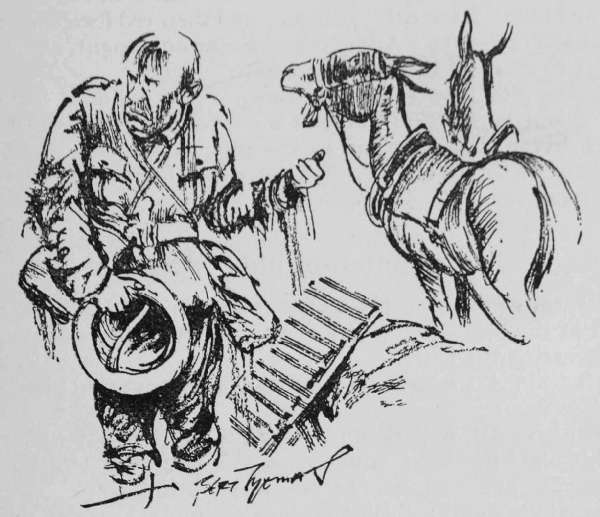
"... and that's mules."
We got the unlucky fellow out, and his first action was to shake his fist at the mule and say: "There's only one thing I don't like in this blinking war and that's those perishin' mules!"—H. E. Richards (R.F.A.), 67 Topsham Road, Upper Tooting, S.W.17.
Not a Single Cockney
In 1917, when we were acting as mobile artillery, we had halted by the roadside to water and feed our horses, and were just ready to move off when we were passed by a column of the Chinese Labour Corps, about 2,000 of them.
After they had all passed, a gunner from Clerkenwell said: "Would yer believe it? All that lot gorn by and I never reckernised a Townie!"—C. Davis (late Sergeant, R.A., 3rd Cavalry Division), 7 Yew Tree Villas, Welling, Kent.
Sanger's Circus on the Marne!
On the way from the Marne to the Aisne in September 1914 the 5th Cavalry Brigade passed a column of Algerian native troops, who had been drawn up in a field to allow us to continue along the nearby road.
The column had all the gaudy appearance of shop windows at Christmas. There were hooded vehicles with stars and crescents blazoned on them, drawn by bullocks, mules, and donkeys. The natives themselves were dressed, some in white robes and turbans, others in red "plus four" trousers and blue "Eton cut" jackets; and their red fezzes were adorned with stars and crescents. Altogether a picturesque sight, and one we did not expect to meet on the Western Front.
On coming into view of this column, one of our lead drivers (from Bow) of a four-horse team drawing a pontoon wagon turned round to his wheel driver, and, pointing to the column with his whip, shouted, "Alf! Sanger's Circus!"—H. W. Taylor (late R.E.), The Lodge, Radnor Works, Strawberry Vale, Twickenham.
"Contemptible" Stuff
When the rumour reached us about a medal for the troops who went out at the beginning, a few of us were sitting in a dug-out outside Ypres discussing the news.
"Mac" said: "I wonder if they'll give us anything else beside the medal?"
Our Cockney, Alf, remarked: "You got a lot to say about this 'ere bloomin' 'gong' (medal); anybody 'd fink you was goin' ter git one."
"I came out in September '14, any way," said Mac.
Alf (very indignant): "Blimey, 'ark at 'im! You don't 'arf expect somefink, you don't. Why, the blinkin' war was 'arf over by then."—J. F. Grey (late D.L.I, and R.A.O.C.), 247 Ducane Road, Shepherd's Bush, W.12.
A Cockney on Horseback—-Just
We were going out to rest after about four months behind the guns at Ypres, and the drivers brought up spare horses for us to ride. One Cockney gunner was heard to say, "I can't ride; I've never rode an 'orse in me life." We helped him to get mounted, but we had not gone far when Jerry started sending 'em over. So we started trotting. To see our Cockney friend hanging on with his arms round the horse's neck was quite a treat!
However, we eventually got back to the horse lines where our hero, having fallen off, remarked: "Well, after that, I fink if ever I do get back to Blighty I'll always raise me 'at to an 'orse."—A. Lepley (late R.F.A.), 133 Blackwell Buildings, Whitechapel, E.1.
A Too Sociable Horse
We were asleep in our dug-out at Bray, on the Somme, in November 1915. The dug-out was cut in the bank of a field where our horse lines were.
One of the horses broke loose and, taking a fancy to our roof, which was made of brushwood and rushes, started eating it.
Suddenly the roof gave way and the horse fell through, narrowly missing myself and my pal, who was also a Cockney.
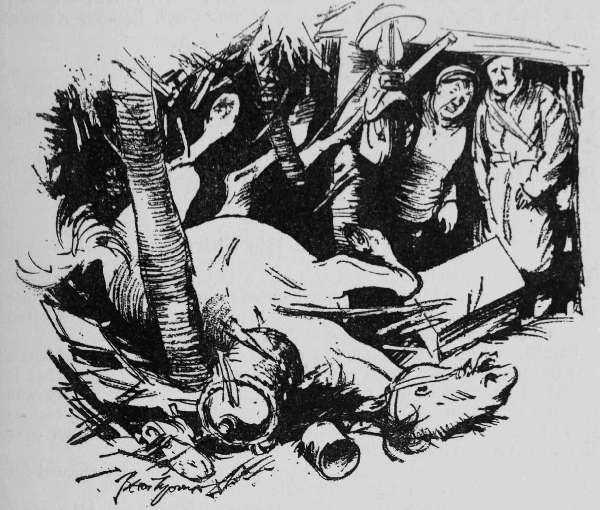
"They want to come to bed wiv us."
After we had got over the shock my pal said, "Well, if that ain't the blinkin' latest. These long-eared blighters ain't satisfied with us looking after them—they want to come to bed with us."—F. E. Snell (late 27th Brigade, R.F.A.), 22 Woodchester Street, Harrow Road, W.2.
General Salute!
While "resting" at Bully-Grenay in the winter of 1916 I witnessed the following incident:
Major-General —— and his A.D.C. were walking through the village when an elderly Cockney member of a Labour battalion (a typical London navvy) stumbled out of an estaminet. He almost collided with the general.
Quickly pulling himself together and exclaiming "Blimey, the boss!" he gave a very non-military salute; but the general, tactfully ignoring his merry condition, had passed on.
In spite of his pal's attempts to restrain him, he overtook the general, shouting "I did serlute yer, didn't I, guv'nor?"
To which the general hastily replied: "Yes, yes, my man!"
"Well," said the Cockney, "here's anuvver!"—A. J. K. Davis (late 20th London Regt., att. 73rd M.G.C.), Minnis Croft, Reculver Avenue, Birchington.
Wipers-on-Sea
Scene, "Wipers"; Time, winter of 1917.
A very miserable-looking R.F.A. driver, wet to the skin, is riding a very weary mule through the rain.
Voice from passing infantryman, in the unmistakable accent of Bow Bells: "Where y' goin', mate? Pier an' back?"—A. Gelli (late H.A.C.), 27 Langdon Park Road, Highgate, N.6.
He Rescued His Shirt
During the latter stages of the war, with the enemy in full retreat, supply columns and stores were in most cases left far behind. Those in the advance columns, when marching through occupied villages, often "won" articles of underclothing to make up for deficiencies.
Camberwell Alf had a couple of striped "civvy" shirts, and had lent a less fortunate battery chum one of these on the understanding that it would be returned in due course. The same evening the battery was crossing a pontoon bridge when a mule became frightened at the oscillation of the wooden structure, reared wildly, and pitched its rider over the canvas screen into the river.
Camberwell Alf immediately plunged into the water and rescued his unfortunate chum after a great struggle.
Later the rescued one addressed his rescuer: "Thank yer, Alf, mate."
"Don't yer 'mate' me, yer blinkin' perisher!" Alf replied. "Wot the 'ell d'yer mean by muckin' abaht in the pahny (water) wiv my shirt on?"—J. H. Hartnoll (late 30th Div. Artillery), 1 Durning Road, Upper Norwood, S.E.19.
A Smile from the Prince
One morning towards the end of May 1915, just before the battle of Festubert, my pal Bill and I were returning from the village bakery on the Festubert road to our billets at Gorre with a loaf each, which we had just bought.
Turning the corner into the village we saw approaching us a company of the Grenadier Guards in battle order, with a slim young officer at the head carrying a stick almost as tall as himself. Directly behind the officer was a hefty Guardsman playing "Tipperary" on a concertina.
We saluted the officer, who, after spotting the loaves of bread under our arms, looked straight at us, gave us a knowing smile and acknowledged our salute. It was not till then that we recognised who the officer was. It was the Prince of Wales.
"Lumme!" said Bill. "There goes the Prince o' Wales hisself a-taking the guard to the Bank o' England!"—J. F. Davis, 29 Faunce Street, S.E.17.
"Just to Make Us Laugh"
We were one of those unlucky fatigue parties detailed to carry ammunition to the forward machine gun positions in the Ypres sector. We started off in the dusk and trudged up to the line. The transport dumped the "ammo" at a convenient spot and left us to it. Then it started raining.
The communication trenches were up to our boot tops in mud, so we left them and walked across the top. The ground was all chalky slime and we slipped and slid all over the place. Within a very short time we were wet through and, to make matters worse, we occasionally slipped into shell-holes half full of water (just to relieve the monotony!).
We kept this up all night until the "ammo" had all been delivered; then the order came to march back to billets at Dranoutre. It was still pouring with rain, and when we came to Shrapnel Corner we saw the famous notice board: "Avoid raising Dust Clouds as it draws Enemy's Shell Fire."
We were new to this part of the line and, just then, the idea of raising dust clouds was extremely ludicrous.
I asked my pal Jarvis, who came from Greenwich, what he thought they put boards like that up for. His reply was typically Cockney: "I 'spect they did that just to make us laugh, as we cawnt go to the picshures."—Mack (late M.G.C.), Cathcart, The Heath, Dartford.
No Use Arguing with a Mule
Whilst "resting" after the Jerusalem battle, my battalion was detailed for road-making. Large stones were used for the foundation of the road and small and broken stones for the surface. Our job was to find the stones, assisted by mules.
A mule was new to Joe Smith—a great-hearted boy from Limehouse way—but he must have heard about them for he gingerly approached the one allotted to him, and as gingerly led him away into the hills.
Presently Joe was seen returning, but, to our amazement, he was struggling along with the loaded baskets slung across his own shoulders, and the mule was trailing behind. When I asked why he was carrying the load, he replied: "Well, I was loading 'im up wiv the stones, but he cut up rusty, so to save a lot of argument, I reckoned as 'ow I'd better carry the darned stones meself."—-A. C. Wood, 56 Glasslyn Road, N.8.
Kissing Time
It was towards the end of '18, and we had got old Jerry well on the run. We had reached a village near Lille, which had been in German occupation, and the inhabitants were surging round us.
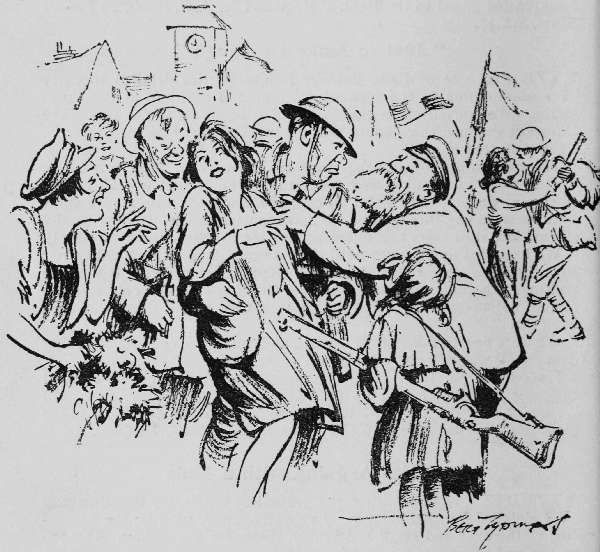
"Take the rough with the smooth."
A corporal was having the time of his life, being kissed on both cheeks by the girls, but when it came to a bewhiskered French papa's turn the corporal hesitated. "Nah, then, corporal," shouted one of our boys, "be sporty! Take the rough with the smooth!"—-G. H. Harris (late C.S.M., 8th London Regt.), 65 Nelson Road, South Chingford, E.4.
"Playin' Soldiers"
We were in the Cambrai Salient, in support in the old Hindenburg Line. Close to us was a road where there were a ration dump and every other sort of dump. Everybody in the sector went through us to get rations, ammunition, stores, etc.
There was just room in the trench for two men to pass. Snow had been on the ground for weeks, and the bottom of the trench was like glass. One night at stand-to the Drake Battalion crowded past us to get rations. On their return journey the leading man, with two sandbags of rations round his neck and a petrol can of water in each hand, fell over at every other step. Things were further complicated by a party of R.E.'s coming down the line with much barbed wire, in which this unfortunate "Drake" entangled himself.
As he picked himself up for the umpteenth time, and without the least intention of being funny, I heard him say: "Well, if I ever catch that nipper of mine playin' soldiers, I won't 'arf knock 'is blinkin' block orf."—A. M. B. (late Artists Rifles), Savage Club, W.C.2.
Per Carrier
During the occupation of the "foreshores of Gallipoli" in 1915 the troops were suffering from shortage of water.
I and six more, including Tich, were detailed to carry petrol cans full of water up to the front line. We had rather a rough passage over very hilly ground, and more than one of us tripped over stones that were strewn across the path, causing us to say a few strong words.
By the time we reached our destination we were just about all in, and on being challenged "Halt; who goes there?" Tich answered: "Carter Paterson and Co. with 'Adam's ale,' all nice and frothy!"—D. W. Jordan (late 1/5th Essex, 54th Division), 109a Gilmore Road, Lewisham, S.E.13.
"Enemy" in the Wire
I was in charge of an advanced post on the Dorian front, Salonica, 1917, which had been often raided by the Bulgars, and we were advised to be extra wary. In the event of an attack we were to fire a red flare, which was a signal for the artillery to put over a barrage.
About 2 a.m. we heard a commotion in our wire, but, receiving no answer to our challenge, I decided to await further developments. The noise was soon repeated in a way that left no doubt in my mind that we were being attacked, so I ordered the section to open fire and sent up the signal for the guns.
Imagine our surprise when, after all was quiet again, we heard the same noise in the wire. One of the sentries was a Cockney, and without a word he crawled over the parapet and disappeared in the direction of the noise.
A few minutes later came the sound of smothered laughter, and the sentry returned with a hedgehog firmly fixed in an empty bully tin. It was the cause of our alarm!
After releasing the animal from its predicament, the sentry said: "We'd better send the blighter to the Zoo, Corp, wiv a card to say 'this little pig put the wind up the troops, caused a fousand men to open fire, was bombed, machine-gunned, and shelled.' Blimey! I'd like to see the Gunner officer's face if he knew this."—D. R. Payne, M.M. (ex-Worcester Regt.), 40 High Street, Overton, Hants.
Straight from the Heart
Under canvas at Rousseauville with 27th Squadron, R.F.C., early 1918—wet season—raining hard—everything wet through and muddy—a "fed-up" gloomy feeling everywhere.
We were trying to start a 3-ton lorry that was stuck in the mud on the aerodrome. After we had all had a shot at swinging the starting handle, the very Cockney driver of the lorry completely exhausted himself in yet another unsuccessful attempt to start up. Then, leaning against the radiator and pushing his cap back, he puffed out:
"I dunno! These perishin' lorries are enough to take all the flamin' romance out of any blinkin' camp!"—R. S. W. (Flying-Officer, R.A.F. Reserve), 52 Cavendish Road, N.W.6.
Smile! Smile! SMILE!!
Conversation between two Cockney members of a North Country regiment whilst proceeding along the Menin road in March 1918 as members of a wiring party:
1st: I'm fed up with this stunt.
2nd: Same 'ere. 'Tain't 'arf a life, ain't it? No rest, no beer, blinkin' leave stopped—er, got any fags?
1st: No, mate.
2nd: No fags, no nuffink. It's only us keepin' so ruddy cheerful as pulls us through.—V. Marston, 232 Worple Road, Wimbledon, S.W.20.
War's Lost Charm
Time, winter of 1917: scene, a track towards Langemarck from Pilkem. Weather and general conditions—Flanders at its worst. My companion that night was an N.C.O. "out since 'fourteen," and we had plodded on in silence for some time. Suddenly behind me there was a slither, a splash, and a smothered remark as the sergeant skidded from the duckboard into an especially dirty shell hole.
I helped him out and asked if he was all right. The reply came, "I'm all right, sir; but this blinkin' war seems to have lost its charm!"—J. E. A. Whitman (Captain, late R.F.A.), The Hampden Club, N.W.1.
Taking It Lying Down
The 1st Battalion of the 25th Londons was preparing to march into Waziristan.
Old Bert, the cook, diligently loading up a kneeling camel with dixies, pots and pans, and general cooking utensils, paused for a bit, wiped the sweat from his brow, and stood back with arms akimbo gazing with satisfaction upon his work.
Then he went up to the camel, gave him a gentle prod, and grunted "Ooush, yer blighter, ooush" (i.e. rise). The camel turned gently over on his back, unshipping the whole cargo that Bert had worked so hard upon, and kicked his legs in the air.
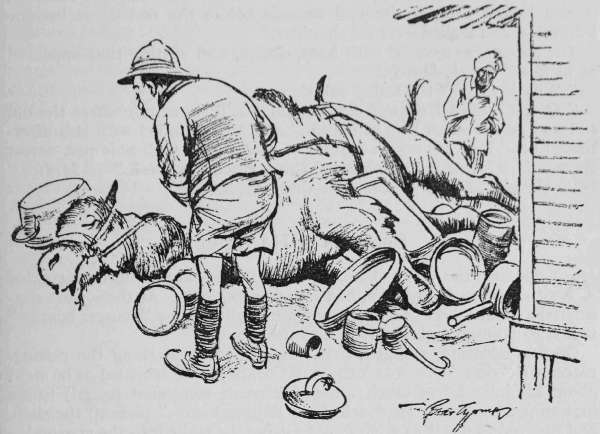
"Don't yer understand yer own langwidge, yer kitten?"
Poor old Bert looked at the wreckage and exclaimed, more in sorrow than in anger: "Blimey, don't yer understand yer own langwidge, yer kitten?"—T. F. Chanter, 16 Atalanta Street, Fulham.
The First Twenty Years
It was round about Christmas 1917, and we were resting (?) at "Dirty Bucket Corner." The Christmas present we all had in view was a return to the line in front of Ypres.
On the day before we were due to return the Christmas post arrived, and after the excitement had abated the usual "blueness" settled in—the craving for home comforts and "Blighty."
My partners in the stretcher-bearing squad included a meek and mild man (I believe he was a schoolmaster before the war) and a Cockney from Seven Dials. We used to call him "Townie."
Although the ex-schoolmaster would have had cause in more normal times to rejoice—for the post contained a letter telling him that he had become the father of a bonny boy—the news made him morbid.
Of course, we all congratulated him. Meanwhile "Townie" was busy with a pencil and writing pad, and after a few minutes handed to the new parent a sheet of paper folded in half. The recipient unfolded it and looked at it for several seconds before the rest of us became interested and looked over his shoulder.
The paper was covered with lines, circles, and writing that appeared to us like "double-Dutch."
"What's this?" the father asked.
"That's a map I drawed fer yer kid. It'll show him where the old pot and pan is when he's called up," and he concluded with this afterthought: "Tell 'im ter be careful of that ruddy shell-hole just acrost there. I've fallen in the perishin' thing twice this week."—"Medico" (58th (London) Division), Clapham Common, S.W.11.
Shell as a Hammer
At one time the area just behind Vimy Ridge was plentifully sprinkled with enemy shells which had failed to explode. As these were considered a great source of danger they were indicated by "danger boards" nailed to pointed stakes driven into the ground.
On one occasion, seeing a man engaged in so marking the resting-place of a "dud"—he was a cheerful Cockney, who whistled as he went about his job—I was much amused (though somewhat scared) to see him stop at a nearby shell, select a "danger board," pick up the shell, and proceed to use it as a hammer to drive the stake into the ground!—H. S. A. (late Lieut., Suffolk Regt.), Glebe Road, Cheam.
Sore Feet
After the first battle of Ypres an old driver, whom we called "Krongie," had very bad feet, and one day reported sick at the estaminet where the M.O. held office.
After the examination he ambled up the road, and when he was about 50 yards away the M.O.'s orderly ran out and called: "Krongie, when you get to the column tell the farrier the M.O.'s horse has cast a shoe."
"Krongie": "Ho, yus. You tell 'im ter give the blinkin' cheval a couple of number nines like he gave me for my feet."—P. Jones (R.H.A.), 6 Ennis Road, N.4.
My Sword Dance—by the C.O.
A bitterly cold morning in winter, 1916, in the Ypres Salient. I was on duty at a gas alarm post in the front line when along came the colonel.
He was the finest soldier and gentleman I ever had the pleasure to serve under (being an old soldier in two regiments before, I had experienced a few C.O.s). It was said he knew every man's name in the regiment. No officer dare start his own meal until every man of his company had been served. No fatigue or working party ever went up the line, no matter at what hour, without the colonel first inspected it.
He had a mania for collecting spare ammunition, and more than once was seen taking up to the front line a roll of barbed wire over his shoulder hooked through his stick. To him every man was a son, and to the men's regret and officers' delight he soon became a general.
This particular morning he approached me with "Good morning, Walker. You look cold. Had your rum?" To which I replied that I had, but it was a cold job remaining stationary for hours watching the wind.
"Well," said the C.O., "do this with me." With that he started marking time at a quick pace on the duckboards and I did likewise. We kept it up for about two minutes, while others near had a good laugh.
"Now you feel better, I know. Do this every ten minutes or so," he said, and away he went to continue his tour of inspection.
My Cockney pal in the next bay, who, I noticed, had enjoyed the scene immensely, said, "Blimey, Jock, was he giving you a few lessons in the sword dance or the Highland Fling?"—"Jock" Walker (late Royal Fusiliers), 29 Brockbank Road, Lewisham, S.E.13.
A Big Bone in the Soup
In Baghdad, 1917, "Buzzer" Lee and I were told off to do "flying sentry" round the officers' lines from 3 to 5 a.m. Well, we commenced our duty, and Buzzer suggested we visit the mess kitchen to see all was well, and in case there was anything worth "knocking off" (as he called it) in the way of char or scran (tea or bread and butter).
The mess kitchen was in darkness, and Buzzer began scrounging around. After a while he said: "I've clicked, mate! Soup in a dixie!" By the light of a match he found a cup, removed the dixie lid, and took a cup of the "soup."
"We're in the market this time, mate," said Buzzer, and took out a cupful for me.
"It don't taste like Wood's down the New Cut," I said, doubtfully.
He dipped the cup again and exclaimed: "'Ere, I've fahnd a big bone!"
It was a new broom-head, however; it had been left in the dixie to soak for the night!—G. H. Griggs (late Somerset L.I.), 3 Ribstone Street, Hackney, E.9.
"I Shall have to Change Yer!"
In the Ypres Salient in July 1915 Headquarters were anxious to know which German regiment was facing us. An immense Cockney corporal, who was particularly good on patrol, was instructed to secure a prisoner.
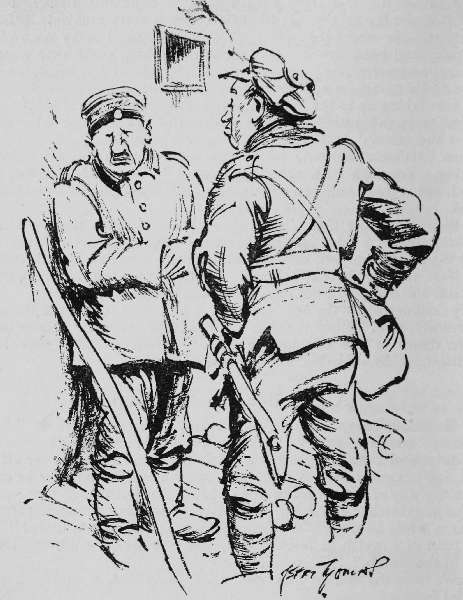
"I shall have to take yer aht to-night and change yer."
After a night spent in No Man's Land he returned at dawn with a capture, an insignificant little German, trembling with fear, who stood about five foot nothing.
Lifting him on to the fire-step and eyeing him critically, the corporal thus addressed him: "You won't do for our ole man; I shall have to take yer aht to-night and change yer!"—S. Back, Merriams Farm, Leeds, near Maidstone.
Scots Reveille
Ours was the only kilted battalion in the division, and our bagpipes were often the subject of many humorous remarks from the other regiments.
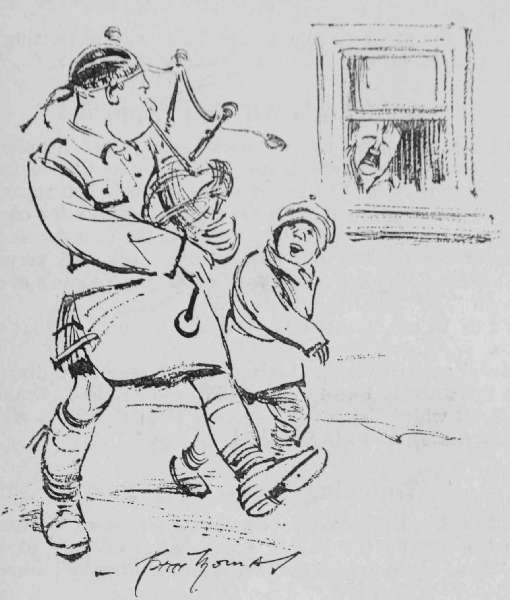
"There goes them perishin' 'toobs' agin."
On one occasion, while we were out resting just behind the line at Château de la Haye, we were billeted opposite a London regiment. Very early in the morning the bagpipes would sound the Scottish reveille—a rather long affair compared with the usual bugle call—and it did not please our London friends to be awakened in this manner.
One morning while I was on early duty, and just as the pipers were passing, a very dismal face looked out of a billet and announced to his pals inside, "There goes them perishin' 'toobs' again."—Arthur R. Blampied, D.C.M. (late London Scottish), 47 Lyndhurst Avenue, Streatham Hill, S.W.2.
In the Negative
A battalion of the London Regiment had been having a particularly gruelling time in the trenches, but some of the men were cheered with thoughts of impending leave. In fact, permission for them to proceed home was expected at any moment.
At this time the Germans started a "big push" in another sector, and all leave was suddenly cancelled.
An N.C.O. broke the news to the poor unfortunates in the following manner: "All you blokes wot's going on leaf, ain't going on leaf, 'cause you're unlucky."
In spite of the great disappointment, this way of putting it amused even the men concerned. The real Cockney spirit!—S. C., Brighton.
"An' That's All that 'Appened"
Before going up the line we were stationed at Etaples, and were rather proud of our cook-house, but one day the colonel told the sergeant-major that he had heard some of the most unparliamentary language he had ever heard in his life emanating from the cook-house.
The sergeant-major immediately called at the cook-house to find out the cause of the trouble, but our Cockney cook was very indignant. "What, me Lord Mayor? [slang for 'swear']. No one's ever 'eard me Lord Mayor."
"Don't lie to me," roared the sergeant-major. "What's happened here?"
"Nuffin'," said the cook, "except that I slopped a dixie full of 'ot tea dahn Bill's neck. I said 'Sorry, Bill,' and Bill said 'Granted, 'Arry,' an' that's all what's 'appened."—Ryder Davies (late 1st Kent Cyclists, Royal West Kents), 20 Villa Road, S.W.9.
Watching them "Fly Past"
Our first big engagement was a counter-attack to recapture the trenches lost by the K.R.R.'s and R.B.'s on July 30, 1915, when "Jerry" used liquid fire for the first time and literally burned our chaps out.
To get into action we had to go across open country in full view of the enemy. We began to get it "in the neck" as soon as we got to "Hell Fire Corner," on our way to Zillebeke Lake. Our casualties were heavy, caused by shell fire, also by a German aeroplane which was flying very low overhead and using its machine gun on us.
My pal, Wally Robins (later awarded M.M., promoted corporal, and killed at Lens), our company humorist, was looking up at the 'plane when a shell landed, killing several men in front of him.
As he fell I thought he too had caught it. I rushed to him anxiously and said, "Are you hurt?"
This was his reply: "I should think I am. I wish they would keep their bloomin' aeroplanes out of the way. If I hadn't been looking up at that I shouldn't have fallen over that blinkin' barbed wire stake."—E. W. Fellows, M.M. (late Corporal, 6th Battn., D.C.L.I.), 33 Dunlace Road, Clapton, E.5.
High Necks and Low
After the first Battle of Ypres in 1914 the Scots Guards were being relieved by a well-known London regiment.
A diminutive Cockney looked up at a six-foot Guardsman and asked him what it was like in the front line.
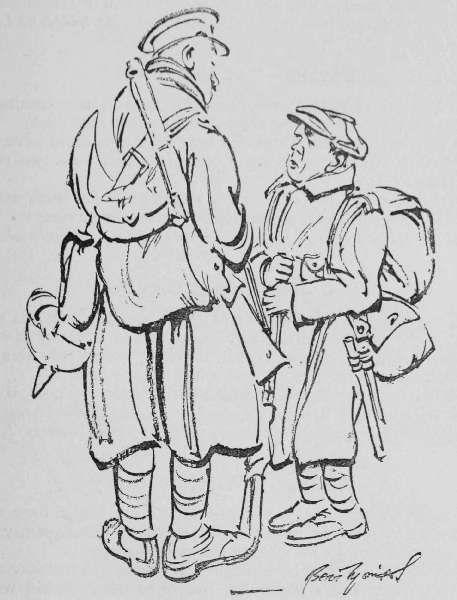
"'Oo's neck?"
"Up to your neck in mud," said the Guardsman.
"Blimey, oo's neck?" asked the little chap.—H. Rogers (late 116th Battery, 1st Div. R.F.A.), 10 Ashley Road, Richmond, Surrey.
Too Light—by One Rissole
During the night before my Division (21st) attacked, on October 4, 1917, my unit was in the tunnel under the road at "Clapham Junction," near Hooge.
Rations having failed to arrive, each man was given a rissole and a packet of chewing-gum. We went over about 6 a.m., and, despite rather severe losses, managed to push our line forward about 1,300 yards.
When we were back in "rest" dug-outs at Zillebeke, our officer happening to comment on our "feed" prior to the attack, my mate said: "Yus. Blinkin' good job for old Jerry we never had two rissoles a man—we might have shoved him back to Berlin!"—C. Hartridge, 92 Lancaster Street, S.E.1.
Psyche—"at the Barf!"
I was billeting at Witternesse, near Aire, for a battery coming out of the line for rest and training prior to the August 1918 push.
I was very anxious to find a place where the troops could have a much-needed bath. The only spot was a barn, in which were two rusty old iron baths.
Further inspection showed that one was in use. On being asked who he was, the occupant stood up and replied in a Cockney voice: "Sikey at the Barf!"—H. Thomas, "Ivydene," Herne Grove, East Dulwich, S.E.22.
A Juggler's Struggles
We were disembarking at Ostend in 1914. Each man was expected to carry as much stores as he could. Our Cockney Marine was struggling down the gangway—full marching order, rifle slung round his neck, kitbag under his arm, and a box in each hand.
As he balanced the boxes we heard him mutter, "S'pose, if I juggle this lot orlright they'll poke annuver in my mouf."—Thomas Bilson (late Colour-Sergeant, Royal Marines), 56 The Strand, Walmer, Kent.
Almost a Wireless Story
Sir Sidney Lawford was to inspect our wagon lines in Italy, and we had received notice of his coming. Consequently we had been up since about 5 a.m. making things ship-shape.
One of the fatigues had been picking up all the spare wire lying about—wire from hay and straw bales, telephone wire, barbed wire, wire from broken hop poles, miscellaneous wire of all sorts.
Sir Sidney Lawford arrived about 11 a.m. with a number of his staff, dismounted ... and promptly tripped over a piece of wire. Imagine our chagrin. However, the feeling passed away when a Cockney driver (evidently one of the wire-collecting fatigue) said in a voice audible to everyone as he peeped from under the horse he was supposed to be grooming: "Blimey, if he ain't fallen over the only piece of blinking wire in Italy!"—F. Praid (late Lieut., R.F.A., 41st Div.), 88a High Street, Staines.
When the S.M. Got Loose
We were behind the lines at Merville in 1914. It was raining hard and it was night. "Smudger" Smith, from Lambeth, was on night guard. The horses were pulling their pegs out of the mud and getting loose, and "Smudger" was having a busy time running around and catching them and knocking the pegs in again with a mallet.
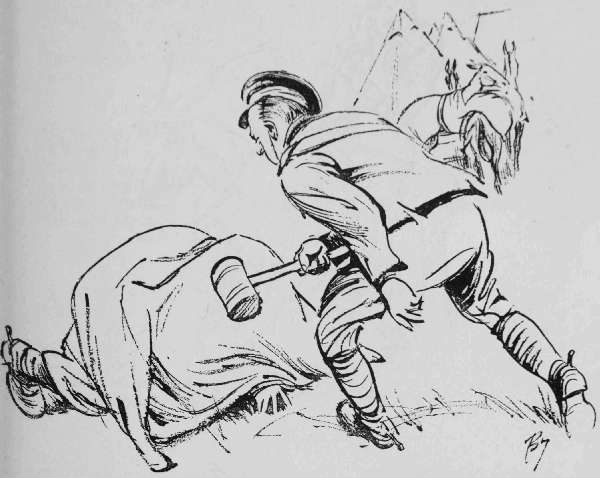
"Wot, yer loose again, yer blighter?"
The sergeant-major, with a waterproof sheet over his head, visited the lines. "Smudger," seeing something moving about in the dark, crept up, and muttered, "Wot, yer loose again, yer blighter?"—and down went the sergeant-major.—W.S. (late Queen's Bays), 2 Winsover Road, Spalding.
Mons, 1914—Not Moscow, 1812!
In 1914 we of the 2nd Cavalry Brigade were going up to support the infantry somewhere near Mons, and when nearing our destination we saw several wounded being carried from the line.
Following them, seemingly quite unconcerned, was an infantry transport driver, who cut a queer figure. He was wearing a stocking hat, and was mounted on an old mule. Thrown over the mule, with the tail-end round the mule's neck, was a German's blood-bespattered overcoat.
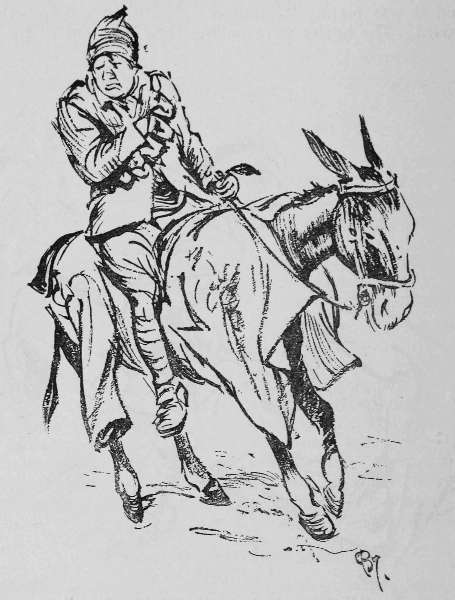
"Napoleon's retreat from Moscow ain't in it wiv this!"
One of our troop addressed the rider thus: "Many up there, mate?"
He answered: "Millions! You 'ave a go. We can't shift 'em. They've took root, I fink."
He then dug both heels into the mule and, looking round with a bored expression, exclaimed: "Talk about Napoleon's blinkin' retreat from Moscow, it ain't ruddy well in it wiv this!"
And he rode on.—W. Baker (late 3rd Hussars), 35 Tunstall Road, Brixton, S.W.9.
The S.M. knew "Mulese"
During the Somme offensive in 1916 I was one of a party carrying rations up to the front line. We came upon a mule which was having a few pranks and pulling the chap who was leading it all over the road.
This man turned out to be an old Cockney pal of mine in the East Surreys. I said, "Hello, Jim, what's the matter?"
"Blimey," he replied, "'e won't do nuffink for me, so I'm taking 'im back to our sergeant-major, as 'e talks the mule langwidge."—C. A. Fairhead (late R.W. Kent Regt.), 16 Council Cottages, Ford Corner, Yapton, Sussex.
Lost: One Star
We were on our way to the front line trenches one wet and dreary night when our subaltern realised that we were lost. He asked our sergeant if he could see the North Star. My Cockney pal, fed up, as we all were, turned to me and said: "Pass the word back and ask if anyone 'as got a Nawth Star in his pocket."—H. J. Perry, 42 Wells House Road, Willesden Junction, N.W.10.
Simpler than Sounding It
After leaving Gallipoli in December 1915 our battalion (4th Essex) were in camp near the pyramids in Egypt.
"Pro Tem." we reverted to peace-time routine, and brought the buglers into commission again. One bugler was making a rather rotten show at sounding the "fall-in"—his "lip" being out of practice, I suppose—when a bored Cockney roared out, "Go rahnd and tell 'em."—H. Barlow, 5 Brooklands, Abbs Cross Lane, Hornchurch.
Under the Cart
The place was a rest billet, which we had just reached after a gruelling on the Somme. Time, 12.30 a.m., dark as pitch and pouring with rain.
A despatch-rider arrived with an "urgent" message from H.Q., "Must have the number of your water-cart."
Out of bed, or its substitute, were brought the regimental sergeant-major, the orderly-room clerk, and the quartermaster-sergeant (a director of a London shipping firm bearing his name). All the light we had was the end of a candle, and as the Q.M.S. was crawling in the mud under the water-cart trying to find the number the candle flickered, whereupon the Cockney sergeant-major exclaimed: "For Heaven's sake, stop that candle from flickerin', or our blinkin' staff will think we're signalling to Jerry!"
The look on the Q.M.S.'s face as he sat in the mud made even the soaked despatch-rider laugh.
"What's the number of your water-cart?" became a byword with the boys.—W. J. Smallbone (late R.M.S., 56th Field Ambulance, 18th Division), 22 Stoneycroft Road, Woodford Bridge, Woodford Green, Essex.
The Lion Laughed up his Sleeve
I had been driving a lorry all day in the East African bush with a Cockney escort. When we "parked" for the night I invited the escort to sleep under cover in the lorry, as I was going to do. But he refused, saying proudly that he had slept in the open since he had landed in Africa. So, undressing, he proceeded to make the rim of the rear wheel his pillow, covering himself with a blanket and greatcoat.
About 1 a.m. I was awakened by hearing someone climbing over the tail-board. Responding to my challenge the Cockney said: "It's all right. The blighter's been and pinched my blanket and greatcoat. It's a good job I had my shirt on." We found next morning that a lion had run off with them: about 100 yards away they lay, and one sleeve was torn out of the coat.—H. J. Lake, 40a Chagford Street, N.W.1.
The Carman's Sarcasm
While our allies, the Portuguese, were holding part of the line to the left of Festubert, a Portuguese officer rode up on the most emaciated and broken-down old "crock" I had set eyes on.
He dismounted and was looking round for somewhere to tether the horse, when one of our drivers, a Cockney carman in "civvy" life, cast a critical eye over the mount and bawled out, "Don't worry abaht tying it up, mate. Lean it up agin this 'ere fence."—A. G. Lodge (Sergeant, 25th Division Artillery), 12 Derinton Road, S.W.17.
Burying a Lorry
During the Battle of the Somme, near Ginchy, a R.A.S.C. motor-lorry ran off the main track in the darkness and got stuck in the mud. The driver came to our battery near by and asked for help, so six gunners and I volunteered and set out with shovels.
On arriving at the scene, there was the motor-lorry almost buried to the top of the wheels. We all stood around surveying the scene in silence, wondering how best to make a start, when the Cockney member of the volunteer party burst out with: "Lummy, the quickest way out of this is to shovel some more blinkin' dirt on top, an' bury it."—H. Wright (ex-Sig./Bdr., C/74 Bde., R.F.A.), 45 Colehill Lane, Fulham, S.W.6.
Striking a Bargain
During the battle of the Narrows at the Dardanelles (March 18, 1915) I was in charge of No. 3 stokehold in H.M.S. Vengeance. The front line of ships engaged consisted of Irresistible, Ocean, Vengeance, and an old French battleship, the Bouvet. The stokers off watch were the ambulance party and fire brigade.
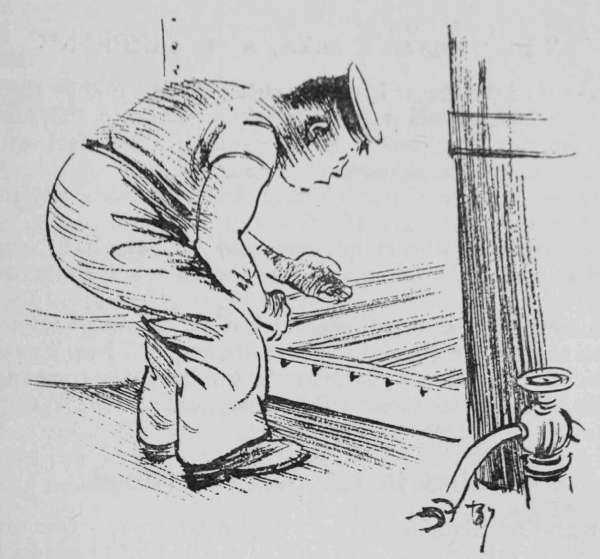
"Give us yer week's 'navy' and I'll let yer aht."
When the battle was at its height one of the fire brigade, a Cockney, kept us informed of what was going on, and this is the news we received down the ash hoist:
"Ocean and Irresistible 'as gorn darn, the Froggy's gone up in smoke: our blinkin' turn next.
"Pat, give us yer week's 'navy' (rum ration) and I'll lift this bloomin' 'atch (armoured grating) and let yer aht!"—"Ajax," 23 King's Drive, Gravesend, Kent.
Bugling in 'Indoostanee
After the evacuation of Gallipoli a transport was conveying British troops to Egypt.
The O.C. wanted a trumpeter or bugler to follow him around during the daily lifeboat parade and to sound the "Dismiss" at the end. The only one available was an Indian trumpeter, who had not blown a trumpet or bugle since 1914. He was ordered for the duty.
On the first day, immediately after the inspection was over, the O.C. gave orders for the trumpeter to sound the "Dismiss." After the trumpeter had finished, the O.C., with a look of astonishment on his face, gasped, "What's that? I never heard it sounded like that before."
Came a Cockney voice from the rear rank, "'E sounded it in 'Indoostanee, sir."—M. C., Surrey.
"For 'eaven's sake, stop sniffin'!"
Our sector of the line at Loos was anticipating a raid by the Germans and the whole battalion was ordered to "stand to" all night.
Double sentries were posted at intervals of a few feet with orders to report any suspicious shadows in No Man's Land.
All eyes and ears were strained in an effort to locate any movement in the darkness beyond the parapet.
Strict silence was to be maintained, and the guns had been ordered to hang fire so that we might give the Germans a surprise welcome if they came over.
The ominous stillness was broken at last by a young Cockney saying to his pal standing with him on the fire-step: "For 'Eaven's sake, stop sniffin', Porky. How d'yer fink we'll 'ear Jerry if he comes acrorst?"—C. J. Blake, 29a Collingbourne Road, Shepherd's Bush, W.12.
Babes in the Salonika Wood
I was with the Salonika Force on the Dorian front. One night while an important raid was on my platoon was told off to seize a big wood between the lines and make sure it was clear of Bulgars, who could otherwise have enfiladed the main raiding party.
The orders were "absolute silence, and no firing unless the other side fires first." I halted my men behind a fold in the ground near the wood and called up two men and told them to creep forward and see if the wood was occupied.
It was nasty work as the first news of any Bulgars would almost certainly have been a bayonet in the back from somebody perfectly concealed behind a tree.
I asked them if the instructions were quite clear and one of them, Charlie, from Limehouse, whispered back:
"Yessir! We're going to be the Babes in the Wood, and if the Wicked Uncles is out to-night we don't fire unless they fires first. Come on, George (to his companion), there's going to be some dirty work for the Little Robin Redbreasts to-morrer!"—A. Forsyth (late Army Cyclist Corps), 65 St. Martin's Lane, W.C.2.
Bringing it Home to Him
For several months in 1917 matches were rationed in a Y.M.C.A. rest-camp canteen, somewhere in France. There entered during this time a war-worn Cockney, a drawn, tired look still in his eyes, and the mud of the trenches on his uniform and boots. He asked for cigarettes and matches, and was told there were no matches.
"Wot, no matches? 'Ow am I goin' ter light me fags, miss?"
"You see matches are rationed now," I said, "and the few we are allowed run out at once."
With a weary sigh, as if a great truth had dawned upon him, he said pathetically:
"Lumme, that do bring the war 'ome to a bloke, don't it, miss?"—Miss H. Campbell, Pennerly Lodge, Beaulieu, Hants.
After the Feast
The company dinner on Christmas Day 1917 was eaten in a large barn at Ribemont, on the Somme, and before this extra special feast began an affable "old sweat," one Billy Williams, of London Town, volunteered for the clearing-up party.
It was a long sitting and some considerable time before the men began to wander back to their billets, and it fell to the most capable of the orderlies to clear up the debris.
This had just been accomplished to the satisfaction of the orderly officer when out of the barn strode old Billy carrying a dixie full of beer. "Where are you going with that, Williams?" asked the officer.
Springing smartly to attention, and with a pained look upon his face, old Billy replied: "This 'ere, sir? Sick man in the 'ut, sir!"—R. E. Shirley (late The London Regiment), 5 Staunton Road, Kingston, Surrey.
Wait for the "Two Pennies, Please"
Near the River Struma, on the Salonika front, in March 1917 our brigade H.Q. was on the extreme right of the divisional artillery and near a French artillery brigade.
For the purpose of maintaining communication a French telephonist was quartered in our dug-out. Whenever he wished to get into communication with his headquarters he unmercifully thumped the field telephone and in an excitable voice called out: "'Ullo, mon capitaine," five or six times in half as many seconds.
Greatly impressed by one of these sudden outbursts, the adjutant's batman—a typical Cockney—exclaimed in a hurt voice: "Nah then, matey, jest cool yerself a bit till the young lidy tells yer to put in yer two coppers!"—F. G. Pickwick (301 Brigade R.F.A.), 100 Hubert Grove, Stockwell, S.W.9.
The General Goes Skating
One horribly wet day during the winter of 1915 I met the Brigadier paying his morning visit to the front line and accompanied him along my section of the trench. Entering one fire-bay, the gallant General slipped and sat down uncommonly hard in the mud.
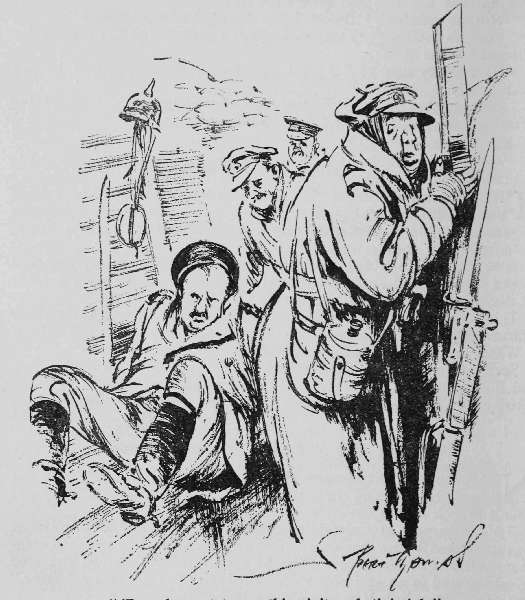
"'Ere, chum, get up; this ain't a skatin' rink."
Discipline stifled any desire on my part for mirth, but to my horror, the sentry in that bay, without turning away from his periscope, called over his shoulder in unmistakable Cockney accents: "'Ere, chum, get up; this ain't a blinkin' skatin' rink!"
Fortunately the General's sense of humour was equal to the occasion, and he replied to the now horror-stricken sentry with an affable "Quite."—"Company Commander," Orpington, Kent.
"To Top Things Up"
During the early part of 1916 a few picked men from the North Sea Fleet were sent on a short tour of the Western Front to get an accurate idea of the work of the sister Service. One or two of these men were attached to my company for a few days in January when we were at Givenchy—a fairly lively spot at that time. The morning after their arrival there was some pretty heavy firing and bombing, which soon died down to normal.
Later in the day, as I was passing down the line, I asked one of our guests (an out-and-out Londoner) what he thought of things. He shook his head mournfully. "I thought the blighters was coming over after all that gun-fire this morning, sir," he said. "I been in a naval action; I been submarined; I been bombed by aeroplanes; and, blimey, I did 'ope I'd be in a bay'nit charge, just to top things up."—L. V. Upward (late Capt. R.N.), 14 Lyndhurst Road, Hampstead, N.W.3.
Luck in the Family
A cockney R.A.S.C. driver had been knocked down and badly injured by a staff-officer's car.
On recovering consciousness in hospital, he highly amused the doctor by exclaiming, "Well, me gran'farver was kicked by a Derby winner, me farver knew Dr. Crippen, an' 'ere's me gets a blighty orf a brass-'at's Rolls-bloomin'-Royce. It's funny 'ow luck runs in famblys!"—J. F. C., Langdon Park Road, N. 6.
"I'm Drownded"
We were going into the line in front of Cambrai, in November 1917, and were walking in single file. The night was pitch black. Word came down at intervals from the leading file, "'Ware wire," "'Ware shell-hole."
My pal, a Cockney, was in front of me. Suddenly I heard a muffled curse—he had deviated and paid the penalty by falling into a particularly deep shell-hole filled with mud and water.
I stumbled to the edge of the hole and peered down and saw his face. I asked him if he was all right, and back came the reply, "Blimey, I'm drownded, so let the missus know I died like a sailor."
Three days later he did die ... like a soldier.—Ex-Rfn. John S. Brown, 94 Masterman Road, East Ham, E.6.
Not a New World's Wonder
The regiment had reached Hebuterne after marching from St. Amand, and a party of us was detailed to carry stuff up to the front line.
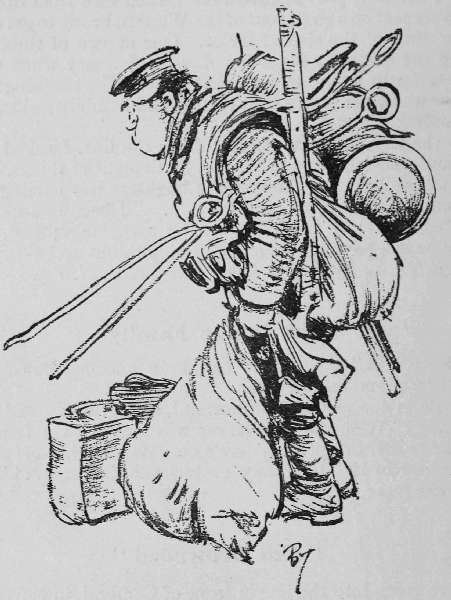
"There's only seven wonders."
One of our number, a hefty Cockney, besides being in full marching order, had a bag of bombs and a couple of screw pickets. A sergeant then handed him some petrol tins. With a look of profound disgust, the Cockney dropped the tins and remarked, "Chuck it, mate; there's only seven wonders in this blinkin' world."—W. G. H. Cox (late 16th London Regt.), 9 Longstaff Crescent, Southfields, S.W.18.
Lads of the Village
While en route from the Western to the Italian front we were held up at an Italian wayside station and, hearing that we had some time to wait, our cook says, "Nah's our chance to make some tea."
So we dragged our boiler on to the end of the platform, scrounged some wood, and soon had the fire going and the water on the boil. "Nah we will get the tea and sugar," says the cook. When we returned we found that the chimney of the boiler had disappeared, smoke and flames were roaring up, and the water was ruined by soot.
An Italian soldier was standing by, looking on. "Somebody's pinched our chimbley," gasped the cook, "and I've got an idea that this Italian fellow knows somefing abaht it."
Back came the reply from the Italian, in pure Cockney: "I ain't pinched yer chimbley, mate!"
"What! yer speak our lingo?" says the cook. "What part of the Village do yer come from?"
"Clerkenwell," was the reply.
"Give us yer mitt," says the cook. "I'm from the same parish. And nah I knows that yer couldn't 'ave pinched our chimbley. It must have been one of them scrounging Cockneys."—H. Howard, 26 Hanover Street, Islington, N.1.
Before 1914, When Men Worked
Night after night, for three weeks, with never a night off, we took ammunition up for the guns at Ypres in 1917. Sometimes we couldn't get back until 5 a.m. or 6 a.m.—and the day was spent feeding and grooming the horses, cleaning harness, and a hundred odd jobs besides.
We had built a bit of a shack, and in this I was writing a letter home, and one of my drivers noticed my handwriting on the envelope.
"Coo, Corp! You can't 'arf write! 'Ow did yer learn it?" he said.
I told him I had been in an insurance office before I joined up.
"Lumme!" he exclaimed, "did yer work once, Corp?"—David Phillips (late R.F.A.), The Ship Inn, Soham, near Ely, Cambridgeshire.
Their Fatigue
In August 1915, our Division was moved to the Loos area in preparation for the battle which began on September 25, and I well remember the long march which brought us to our destination—the mining village of Nœux-les-Mines, about a mile from Mazingarbe.
We ended the hard and tiring journey at a spot where a huge slag-heap towered above our heads to a height of seventy or eighty feet. On our arrival here there were the usual fatigue parties to parade, and with everyone tired and weary this was an unthankful duty.
The youngest Cockney in my section, who was always cheerful, hearing me detailing men for fatigue, shouted out, "Come on, mites; paride with spoons and mess-tins. The blinking fattygue party will shift this perishin' slag-heap from 'ere to Mazingarbe."—Herbert W. Bassett (Cpl. attached 47th London Division), 41 Argyle Road, Sevenoaks, Kent.
Teaching Bulgars the Three-card Trick
At Butkova, on the right of Lake Doiran, in 1917, we had surprised the Bulgar and had pushed forward as far as the foot of the Belashitsa Mountains, the reserve position of the enemy.
After a sharp encounter we retired, according to plan, and on the return to our lines we heard murmurings in a nullah to our right.
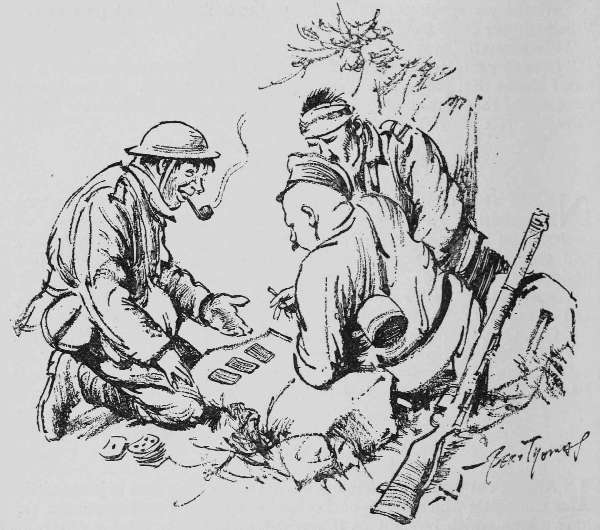
"Find der lidy—dere you are—over yer go—under yer go—nah find 'er!"
Motioning to me and the section corporal, our platoon commander advanced cautiously towards the nullah and you can imagine our surprise when we discovered "Dido" Plumpton calmly showing the "three-card trick" to the two Bulgar prisoners he had been detailed to escort. He was telling his mystified audience: "Find der lidy—dere you are—over yer go—under yer go—nah find 'er!"—Alfred Tall (late 2nd East Kents), 204 Hoxton Street, N.1.