1. ACTION (continued 3)
Reading edition
The cool way in which he gave orders, as he told his men to make their way back—lying down for a bit, then making a run for another shelter—would have been humorous if conditions had not been so terrifying.
He himself kept his gun working to protect their retreat, and when he saw they had reached a place of safety he picked up his gun and rejoined them unhurt.
One of his men, describing the action afterwards, said, "Carried his gun three miles—wouldn't part with it—and the first thing he did when he was able to settle down quietly was to start cleaning the blessed thing!"—H. R. Tanner, "Romsdal," Newton Ferrers, S. Devon.
Top-hatted Piper of Mons
During the retreat from Mons it was a case of "going while the going was good" until called upon to make a stand to harass the enemy's advance.
After the stand at Le Cateau, bad and blistered feet caused many to stop by the wayside. Among these, in passing with my little squad, I noticed a piper belonging to a Scottish regiment sitting with his blistered feet exposed and his pipes lying beside him. Staff officers were continually riding back and urging the parties of stragglers to make an effort to push on before they were overtaken.
In the late afternoon of this same day, having myself come up with my unit, I was resting on the roadside when I heard the skirl of bagpipes. Before long there came into sight, marching with a fair swing, too, as motley a throng as one ever saw in the King's uniform. Headed by a staff officer were about 150 men of all regiments with that same piper, hatless and with one stocking, in front.
Beside him was a Cockney of the Middlesex Regiment, with a silk hat on his head, whose cheeks threatened to burst as he churned out the strains of "Alexander's Rag-time Band" on the bagpipes. Being a bit of a piper himself, he was giving "Jock" a lift and was incidentally the means of fetching this little band away from the clutches of the enemy.—"Buster" Brown (late Bedfordshire Regt.), Hertford.
Two Heads and a Bullet
Early in 1916 ten of us were going up with rations—chiefly bread and water. In one part of the trench there were no duckboards and the vile mud was thigh-deep.
Here we abandoned the trench and stumbled along, tripping over barbed wire and falling headlong into shell-holes half-full of icy water.
A German sniper was at work. Suddenly a bullet pinged midway between the last two of the party.
"Hear that?" said No. 9. "Right behind my neck!"
"Yes," replied No. 10, "right in front of my bloomin' nose!"—C. A. Davies (late 23rd R. Fusiliers), 85 Saxton Street, Gillingham, Kent.
Spoiling the Story
We were billeted in the upper room of a corner house north of Albert, and were listening to "Spoofer's" memories of days "dahn Walworf way."
"Yus," he said, "I ses to the gal, 'Two doorsteps an' a bloater.'"
At that moment a "coal-box" caught the corner of the house, bringing down the angle of the wall and three-parts of the floor on which we had squatted.
Except for bruises, none of us was injured, and when the dust subsided we saw "Spoofer" looking down at us from a bit of the flooring that remained intact.
"Yus," he continued, as though nothing had happened, "as I was saying, I'd just called fer the bloater...."
Came another "coal-box," which shook down the remainder of the floor and with it "Spoofer."
Struggling to his hands and knees, he said, "Blimey, the blinkin' bloater's cold nah."—F. Lates, 62 St. Ervan's Road, North Kensington.
Afraid of Dogs
Towards the end of October 1918 I was out on patrol in front of Tournai on a dark, windy night. I had a Cockney private with me, and we were some distance from our lines when we heard a dog barking. All at once, before I could stop him, the Cockney whistled it.
I threw the Cockney down and dropped myself. A German Verey light went up—followed by a hail of machine-gun bullets in our direction. As the light spread out, we saw the dog fastened to a German machine-gun! We lay very still, and presently, when things had quietened down, we slid cautiously backwards until it was safe to get up.
All the Cockney said was, "Crikey, corp, I had the wind up. A blinkin' good job that there dawg was chained up. Why? 'Cause 'e might 'ave bitten us. I allus was afeard o' dawgs."—J. Milsun (late 1/5th Battn., The King's Own 55th Div.), 31 Collingwood Road, Lexden, Colchester.
The Song of Battle
At the first Gaza battle we had to advance 1,700 yards across a plain in full view of the Turks, who hurled a terrific barrage at us. We were in artillery formation, and we marched up until within rifle range. With machine guns and artillery the Turks were depleting our ranks, so that less than half of us were still marching on at 500 yards range.
In my section was the Cockney "funny man" of the company. When things were bad, and we were all wondering how long we would survive, he began singing lustily a song which someone had sung at our last concert party behind the lines, the refrain of which was "I've never heard of anybody dying from kissing, have you?"
Before he had started on the second line nearly everyone was singing with him, and men were killed singing that song. To the remainder of us it acted like a tonic.
Good old Jack, when he was wounded later he must have been in terrible pain, yet he joked so that at first we would not believe he was seriously hit. He shouted, "Where is 'e?—let me get at 'im."—J. T. Jones (late 54th Division), 37 Whittaker Road, East Ham, E.6.
Stalls at "Richthofen's Circus"
A New Zealander was piloting an old F.E. 2B (pusher) 'plane up and down over the lines, observing for the artillery, when he got caught by "Richthofen's Circus."
The petrol tank behind the pilot's seat was set on fire and burning oil poured past him into the observer's cockpit ahead and the clothes of both men started to sizzle.
They were indeed in a warm situation, their one hope being to dive into Zillebeke Lake, which the New Zealander noticed below. By the time they splashed into the water machine and men were in flames; and, moreover, when they came up the surface surrounding them was aflame with the burning oil.
Treading water desperately and ridding themselves of their heavy sodden flying coats, they made a last bid for life by swimming under water, that flaming water, and at last, half-dead, reached the bank.
There a strong arm gripped the New Zealander by the scruff of the neck and he was hauled to safety, dimly aware of a hoarse voice complaining bitterly, "Ours is the best hid battery in this sector, the only unspotted battery. You would choose just 'ere to land, wouldn't yer, and give the bloomin' show away?"
Our Cockney battery sergeant-major had, no doubt, never heard of Hobson or his choice.—E. H. Orton, 9 High Grove, Welwyn Garden City, Herts.
"Butter-Fingers!"
A Cockney infantryman of the 47th Division was on the fire-step on the night preceding the attack at Loos. He was huddled up in a ground-sheet trying to keep cheerful in the drizzle.
Suddenly a British 12-in. shell passed over him, and as he heard its slow rumble he muttered, "Catch that one, you blighters."
Just then it burst, and with a chuckle he added, "Oh, butter-fingers, yer dropped it!"—Henry J. Tuck (late Lt., R.G.A.).
Getting into Hot Water
We were in the front line, and one evening a Battersea lad and myself were ordered to go and fetch tea for the company from the cook-house, which was in Bluff Trench. It was about a mile from the line down a "beautiful" duckboard track.
With the boiling tea strapped to our backs in big containers, both of which leaked at the nozzles, we started for the line. Then Jerry started sniping at us. There came from the line a sergeant, who shouted, "Why don't you lads duck?" "That's right," replied my chum. "D'yer fink we wants ter be scalded to death?"—H. G. Harrap (23rd London Regiment), 25 Renfrew Road, S.E.
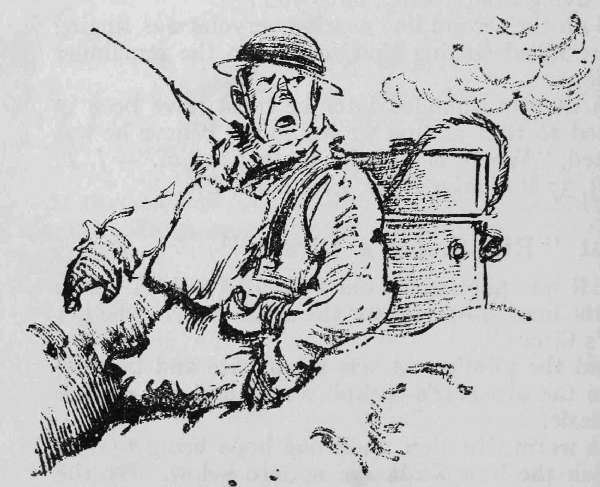
"D'yer fink we wants ter be scalded ter death?"