LETTER II. (continued 4)
Reading edition
The Surgeon.
The Surgeon, who was the chief Embalmer, generally 284directed and took care to see the several Operations perform’d in due order, and sometimes did them himself; for tho’ the Curatores Corporis, that were his Assistants and Servants, commonly Dissected, Embowell’d, Wash’d, Anointed and Embalm’d the Bodies of the meaner sort of People, yet when any Prince or Nobleman was to be Embalm’d, after the richest and most curious manner, he perform’d the chief part of the Work himself, and this he was the more capable of as being both an exquisite Anatomist, and well vers’d in the Nature of all Balsamic Medicines, whether Galenical or Chymical, and tho’ he might be something inferior to the Physician, yet in conjunction with him, was he both the better able to consider the Nature of the deceas’d Person’s Distemper, or Cause of his Death, and accordingly to proceed in his Embalming; and lastly, he was very dextrous and knowing in the Art of Bandage, whereby it appears his chief Business was to Embalm and Roul up the Body, which, in respect to its being thus preserv’d by Balsamic and Medicinal Ingredients, artificially and topically apply’d, was said to be Corpus Medicatum, |Corpus Medicatum.| a Body preserv’d from Putrifaction by Embalming. Now I cannot imagine, as some Authors affirm, they did this always in one road or manner, but that the Physician vary’d his Prescriptions, by adding one thing and subtracting another, increasing the quantity of one Ingredient or diminishing that of another, according to the Constitution of the Person, and Nature of his Disease, agreeable to which was the Embalming perform’d; for ’tis certain some Medicines are more prevalent against Putrifactions than others, and that there ought to be a difference, as well, in the Composition of the Medicine, as in the 285Embalming one that dy’d only thro’ a natural Decay, one that dy’d of some malignant Distemper, or one that dy’d of a Hectic Feaver, which consumes and dries up the radical Moisture of the Body, and one that dy’d of a Dropsie, which colliquates the Body and makes it fluid with its Waters. In a word, there ought to be a difference even in an old Body and a Young; therefore, as the Doctor’s Prescriptions were vary’d, according to these Considerations, so was there a greater occasion for a skilful Apothecary, to take care of and see to the compounding the Aromatic Powders, Oils, Balsams, Ointments, Cerecloths, Tinctures, Spirits, and the like analogous Things, and their Application, according to the Directions of the Doctor; and as the Surgeon had under him a Dissector, &c. |Dissector.| who embowell’d and wash’d the Body, and did the like inferior Businesses, so had the Apothecary Servants under him to make up the Medicines, administer Clysters and Injections, and to Anoint the Body, thence call’d Pollinctors. |Pollinctor.| Thus was the chief Concern of the Embalming a Body manag’d by the Advice and Assistance of the Physician, Surgeon and Apothecary, as indeed it ought also to be perform’d at this Day, and not to have ignorant Undertakers direct and act all things at their pleasure. But when Bodies were to be Embalm’d without Gums, Spices, Cedria, Asphalt, Pissasphalt or the like, such as the poorest People, who could not be at the expence of them, they were chiefly committed to the Care of the Taricheutæ or Salitores, |Taricheutæ Salitores.| who only prepar’d and dry’d them with Salt, and then such Bodies were call’d Corpora Condita, pickl’d or salted Bodies. |Corpora Condita.| Thus having shown the principal Persons of this Office, and who directed and perform’d the Embalming, we will next 286give an account of those that provided all things necessary for the Funeral. These were such as the Greeks call’d Ἐνταφιαστής, |Ἐνταφιαστής,| he that got the Body ready and prepar’d all Necessaries for the Interment; |Ἐνταφιοπώλις.| Ἐνταφιοπώλις, he that sold all Matters appertaining to Funerals, and Νεκροκόσμος the Dresser, |Νεκροκόσμος,| or one that put on the Ornaments of the Dead: But all these were term’d by the Romans in general Libitinarii, |Libitinarii.| the Undertakers and Furnishers of Funerals, who had the Care of preparing, letting out or selling the Ornaments and Dresses for the Dead, and of providing Mourners, mourning Habits, and whatever else was necessary for the Funeral Pomp; nay who eas’d the afflicted Friends of their Trouble. They were thus nam’d from Libitina, a Goddess whom the Ancients believ’d to preside over Funerals, and some took to be Proserpina, but others Venus, thereby to show, that as she was at the beginning of Life by Generation, so was she likewise at the end or conclusion thereof, inasmuch as in her Temple were kept and sold all things necessary for Funeral-Solemnities. Other Officers were the Herald, Painter, Carver, &c.
The Herald.
The Herald’s Business was to proclaim and give notice of the approaching Funeral, to summon and invite the Company, and lastly to marshall them in the Funeral-Procession, according to their respective Dignities and Quality. |Painter.| The Painter was to gild or paint the Body and Coffin, with Hieroglyphic Characters, &c. |Carver.| And the Carver to make the Models of Wood that were to be shown to the deceas’d Person’s Friends, to denote that they Embalm’d Bodies three several Ways, and at as many different Rates; they likewise wrought the Coffins into the shape and form of the Deceas’d. But we shall speak more of these in their order, after having 287first given some Particulars relating to the several Methods of the Egyptian Embalming, not hitherto so fully describ’d. |Embalming with Cedar.| First then, we believe the manner of Embalming with Cedar might probably be invented to satisfie such whose Consciences would admit of no Dissection at all, and the most likely Method of performing it was by injecting into the Brain, thro’ the Nostrils, into the Thorax, thro’ the Aspera Arteria, and into the Stomach and Intestines, thro’ the Oesophagus and Anus, Oil of Cedar, by the help of a Siringe and Dilator. This being a subtil, hot, and rectify’d Oil of a Caustic Nature, wasted and consum’d the Bowels like to quick Lime, and then the Body being hung up or plac’d in a declining posture, they press’d and squeez’d out the said Oil, which brought away with it the Bowels wasted. Then the Corps being wash’d and cleans’d, they again injected into all the Cavities and Venters, as much as they could of a Balsam distill’d from the Pitch of young Cedars, which being depriv’d of its corrosive and subtil Oil, had nothing of a Caustic Quality remaining in it, but consisted only of drying, exsiccating and Balsamic Parts. Then they laid the Body in Pickle for 70 Days; after which, having wip’d it, they anointed it with a sweet and drying Ointment, which perhaps from the Basis of its Composition might be term’d Unguentum Cedrinum, |Unguentum Cedrinum.| and then dry’d it in the Sun or otherwise, by which means all remaining Moisture, and the thinner and more subtil parts of the Balsam being evaporated, the Body became hard, firm and solid, like to a Colophony of Turpentine or Pitch.
Embalming with Pissasphalt.
The second Way of Embalming among the Egyptians was perform’d with natural or factitious Pissasphalt, 288just in the same manner as I shall show with Asphalt, but only the natural Pissasphalt was us’d for the midling sort of People, and the factitious for the poorer and common People and Slaves; nor was there any Curiosity in these more than the usual Exenteration, Salination and Coction in the Bitumens, for they neither us’d Roulers nor bestow’d Coffins on them.
The third sort, which was for the more substantial People, |Embalming with Asphalt.| was more costly and exact, and perform’d with Asphalt after this manner: The Corps being open’d, embowell’d, wash’d, cleans’d and salted after the usual Method, was put into a large Cauldron fill’d with Asphalt, or Bitumen Judaicum, made fluid with Naptha, and then boil’d ’till it had melted the Fat, and consum’d all the Humors and Juices which are the Principals of Corruption, by which means the soft parts of the Flesh were made firm, and the whole Body penetrated, and as it were pitch’d to the Marrow of the Bones, with this Bituminous Liquor. Then being taken out of the Cauldron, and swath’d up whilst it was yet hot, it at length became petrify’d and hard like to Marble.
Embalming with Aromatics and Balsams.
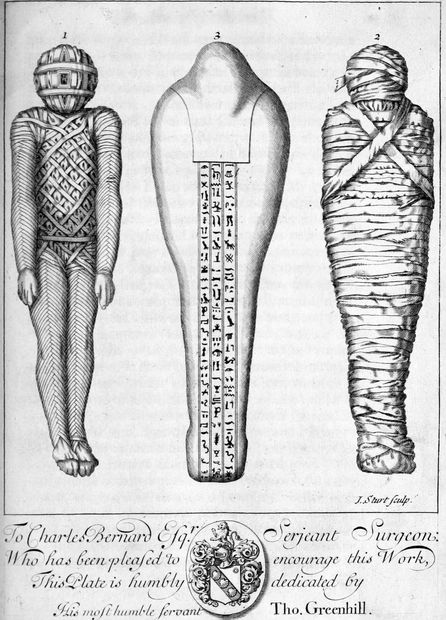
The fourth and last way is both Noble and Expensive, and was perform’d to the utmost Perfection, Art and Skill. The Brain being extracted, and the Thorax and Abdomen releas’d of their Viscera, all the Cavities were thoroughly cleans’d with aromatiz’d Wine, and then repleted with a Composition of Myrrh, Aloes, Cinamon, Opobalsamum, Saffron, and the like; after which, they sew’d up the Incisions, and salted the Body with Nitre for 70 Days, and then wiping and drying it from the Pickle or Salt, they anointed it with an Ointment made of aromatic, balsamic and odoriferous Ingredients, 289whence some Authors have call’d a Body so prepar’d, Funus odoratum. |Funus odoratum.| This done, they swath’d it up with Roulers made of fine Linnen, and dipp’d in some Balsam, Ointment or Cerecloth, which being dry, serv’d like Glue to stop the Pores, and hinder the Dissipation of the volatil parts of the Aromatics, as well as the Penetration of the Air. Guichard, cap. 10. p. 479. des Funerailles des Ægyptiens, thinks this Gum to have been Acacia, of which see Dioscorides, Lib. 1. cap. 134. & apud Mathiol. p. 115. But Bellonius and other Authors think the Gum which Herodotus says the Egyptians us’d instead of Glue was Cedria, besmear’d on the Roulers in manner of a Cerecloth: |Roulers how prepar’d, &c.| Others say the Body was first anointed with a Gum, and then wrapped up in fine Linnen, and Casalius de veter. Ægyptior. Ritibus, p. 30. says, Gummi Oleo inungebant, which is more agreeable to the Observations I have made, That the Roulers seem’d either dipp’d in Oleo seu Unguento Cedrino, or after the Body was anointed with it, roul’d up and finish’d, then that the Bandages were prepar’d after the manner of a Cerecloth, with Gum or Rosin of Cedar, because this would have made them hard and brittle, whereas those which I have seen, were pliable and free from any Gum or Embalming Matter adhering to them, and no ways different from other Linnen, but only of a Cinnamon or Snuff-Colour; so that probably they might dip or anoint them with the Oil or Ointment of Cedar, rather to make them lasting and durable than to stick to the Body; for Greaves tells us in his Pyramidographia, p. 50. that he had seen some of these Roulers so strong and perfect, as if they had been made but Yesterday. With these they bound and swath’d the dead Body, beginning at 290the Head and ending with the Feet. Over these again they wound others, so often one upon another, that there could not be less than a 1000 ells upon one Body. They interwove these Roulers so artificially and in such manner, says Kircher, as would puzzle the Ingenuity and tire the Industry of our Modern Surgeons to find out, yet, with submission to him, it may not be so difficult to perform by any one tollerably skill’d in the Art of Bandage as he imagines, for, as I take it, they began with the Feet and Hands, and ended with the Head, contrary to what Greaves asserts, tho’ I cannot say this of my own Knowledge, having never had any opportunity of unrouling such Bodies, but only offer the Consideration thereof, according to the appearance of the following Figures, of which the first shows the interior artificial Circumvolutions of the Roulers, the Body being first wrapp’d in fine Linnen, wherein Egypt excell’d, as the Holy Scriptures testifie, Prov. 7. 16. &c. The second Figure represents the manner of the next Rouling, and the fourth shews the external Ornaments, painted with Hierogliphics, &c. |Designer or Painter.| For when the Body was thus roul’d, the Designer or Painter cover’d the superficies of the Roulers with a kind of Paste or Gum, on which he gilded and painted Cyphers, Figures, Letters, Characters and other Hieroglyphics. The third Figure shows a Case to keep the Body in, made of Linnen, and painted in like manner with Hieroglyphics in distinct Colours, having been found in the Musæum of Johannes Nardius. Now concerning the nature and signification of these Hieroglyphics, |Hieroglyphic Characters.| Authors variously write; but none have taken so much Pains, or div’d so far into the meaning of them, as the Learned Kircher, who pretends to explain 291all the Hieroglyphic Characters painted on the Roulers and Coffins of the Mummies, in his Oedipi Ægyptiaci Theatrum Hieroglyphicum, where also, p. 412 and 414. you may find the particular Explanations of the third and fourth Figures. But since there remains no Alphabet or Dictionary of these Characters (for the entire Knowledge of Hieroglyphics perish’d at the Time the Egyptian Ceremonies ceas’d, and were abolish’d by the Irruption Cambyses made into Egypt) we believe all those assiduous Penetrations into these Mysteries by Kircher and R. P. Menestrier, are but imperfect Conjectures and meer Imaginations. However, having spoken of the Egyptian Language in no part of this Book before, it may not be amiss to insert here some few Particulars concerning it. |Two sorts of Languages and Characters.| First then, there were two sorts of Languages and Characters among the Egyptians; one common and us’d by all, constituted for their Trade and Commerce with Mankind, and which was that Tongue or Idiom call’d the Coptic or Pharonic, and the other us’d only by Priests, Prophets, Hierogrammatists or Holy Writers, and the like Persons in Sacerdotal Orders. The first was written from the Right Hand to the Left in Characters not unlike the old Greek; but the latter consisted not of Letters, Syllables or Words, but thro’ the Image and Pictures of Things, they endeavour’d to deliver their hidden Conceits in the Letters and Language of Nature. Thus by a representation of the several Parts and Actions of Man, the shape of Artificers Tools and Instruments, the form of all sorts of Animals, Beasts, Birds and Fish, the resemblance of the Sun, Moon, Planets and the like, they exactly read and understood every thing couch’d within those Hieroglyphics. For Example, the 292Crocodile was the Emblem of Malice; the Eye the Preserver of Justice and the Guard of the Body; the Right Hand, with its Fingers open, signify’d Plenty, and the Left, with its Fingers clos’d, Preservation and Custody of Mens Goods and Estates. To express their Eneph or Creator of the World, the Egyptians describ’d an old Man in a blew Mantle, with an Egg in his Mouth, which was the Emblem of the World, and express’d their Notion of Divinity by an Eye on a Scepter, by an Eagle’s Head, &c. Of which see more in Sir Thomas Brown’s Vulgar Errors, cap. 20. where he rightly observes, that of all Nations that suffer’d by the Confusion of Babel, the Egyptians found the best Evasion; for tho’ Words were confounded, they invented a Language of Things, and spake to each other by common Notions in Nature, whereby they discours’d in silence, and were intuitively understood from the Theory of their Impressions; for they assum’d the shapes of Animals common to all Eyes, and by their Conjunctions and Compositions were able to communicate their Conception to any that co-apprehended the Syntaxis of their Natures. This many conceive to have been the Primitive way of Writing, and of greater Antiquity than Letters; and this Language indeed might Adam well have spoken, who understanding the Nature of Things, had the advantage of Natural Expressions, &c. But to add two or three Examples more out of Orus: For Eternity the Egyptians painted the Sun and Moon, as Things which they believ’d to have had no beginning, nor were likely to have any ending; for a Year they painted a Snake with his Tail in his Mouth, to show how, one Year succeeding another, the World was still kept in an endless 293Circle; for a Month they painted a Palm-Tree, by reason at every new Moon that Tree sends forth a new Branch; for GOD they painted a Falcon, as well in that he soars so exceeding high, as that he governs the lesser Birds, for Integrity of Life they painted Fire and Water, both because these Elements are in themselves most pure, and by reason all other Things are purify’d by them; for any thing that was abominable to the Gods they painted a Fish, because in their Sacrifices the Priests never us’d them, and the like of which you will find innumerable Instances in Pierius’s Book of the Egyptian Hieroglyphics. Now what so great a number of these Sacred Characters inscrib’d on their Obelisks and Mummies signify’d, Authors seem to differ about, some looking on them as Charms and Necromancy, |Hieroglyphics, their Signification.| and others thinking they did thereby endeavour not so much to express as hide their Meanings, to amuse and awe the Vulgar; but I am more inclinable to think they always contain’d some History of the Life and Death, Virtues and Actions of the Deceas’d, or else some Religious Ceremonies, and the like; for Diodorus Siculus, Lib. 1. cap. 4. writes of Sesoosis, that he erected two Obelisks of polish’d Marble 120 Cubits high, on which were inscrib’d a Description of the large extent of his Empire, the great Value of his Revenue, and the number of the Nations by him conquer’d; and what sort of Writing this was, is explain’d a little before, where, speaking of the like Works, he says, he erected Pillars whereon were inscrib’d in Egyptian Letters call’d Hieroglyphics these Words: Sesoosis King of Kings and Lord of Lords subdu’d this Country by his Arms. Also Lib. 5. cap. 3. he writes of a Golden Pillar whereon were Letters inscrib’d, 294call’d by the Egyptians Sacred Writing, expressing the famous Actions of Uranus, Jupiter, Diana and Apollo, written, as they say, by Mercury himself, whom most Authors agree with him to have been the first Inventor of these Hieroglyphic Characters.
Dresses and Ornaments of the Mummies.
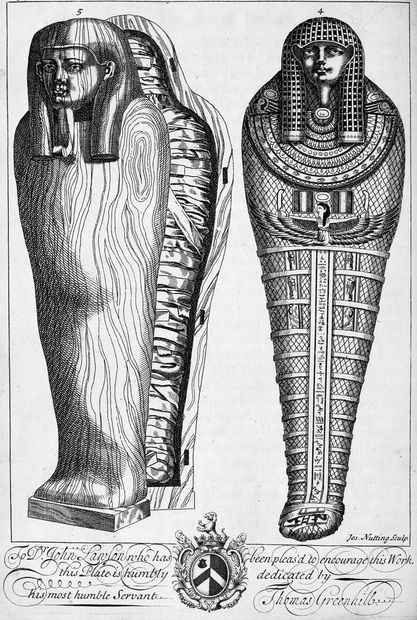
But to return to the manner of dressing and adorning the Embalm’d Bodies, such as is represented in Figure the 4th, where you may see the Image and Form of a Woman set off with various Ornaments, the signification of whose Hieroglyphic Characters you have explain’d by Kircher, in the Book and Page before-mention’d; we shall next proceed to give an account of an extraordinary fine Mummy which Pietro della Valle saw and describes in this manner, viz. That upon it was the Figure of a young Man, dress’d in a long Gown, gilded and sprinkl’d over with Hieroglyphic Emblems from Head to Foot, set off with precious Stones, with the Hair of his Head black and curl’d, and his Beard of the same colour, but short; a Chain of Gold hung about his Neck, having a Medal with the Image of the Bird Ibis on it, with many other Marks and Characters, which give us to understand this young Man was possess’d of great Dignities. In his Right Hand he held a Golden Bason full of red Liquor, and in his Left a Fruit somewhat resembling an Apple: He had a Gold-Ring on his Thumb, and another on his little Finger, likewise Sandals which cover’d the Soles of his Feet only, and were ty’d above the Instep with Straps or Latchets. On a Fillet or Rouler hanging at his Girdle, one might plainly read the word Eutichi, which signifies Good Time. By his side was a Woman yet more richly and mysteriously adorn’d, with an Ox, the Image of Apis or Isis, at her Feet. In a word, both these Figures were painted like to the Saints of the Ancients. When the dead Bodies of the Egyptians were Embalm’d, roul’d, painted and adorn’d after the manner we have describ’d, as you may partly see at Figures the first, second and fourth, they put them into Cases or Coffins made of Linnen pasted to a great thickness, or else of Wood carv’d in the similitude and likeness of the Person deceas’d, as you may see at Figures the third and fifth; the first of which shows the back part of a Linnen-Case for a Mummy, painted with several Colours, as is to be seen in the Collection of Johannes Nardius; and the other how a roul’d Body lies plac’d in a wooden Coffin, as may be seen in the Musæum of the Great Duke of Tuscany.
Coffins of Sycamore.
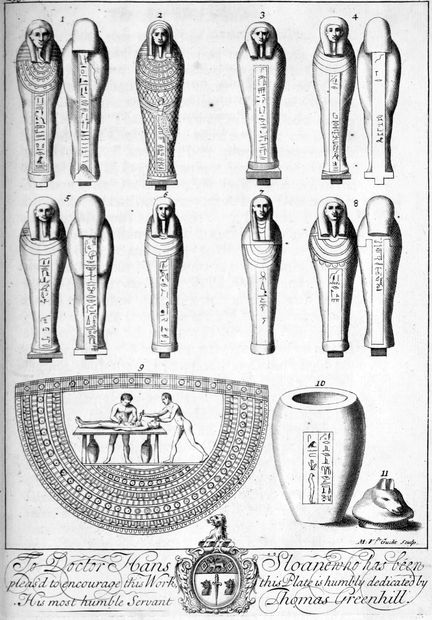
295These Coffins were sometimes made of Cedar, but most commonly of Sycamore, a large Tree, very plentifully growing in Egypt and Judæa, which bears Leaves like to the Mulberry-Tree, but larger, and Fruit like to a Fig, not sprouting from the Branches, but from the Stock or Body of the Tree. ’Tis call’d by us the Egyptian Fig, by them Giumez. Its Leaves afford a pleasant shade, its Fruit refreshment to such as Travel in the Plains of those hot Countries, and its Wood serves not only for Coffins but Buildings. ’Tis also a Tree so lasting and well rooted, that the Sycamore which Zacheus ascended, is still shown in Judæa to Travellers, as is also the hollow Sycamore at Matarea in Egypt, where the Blessed Virgin is said to have remain’d for some Time, which tho’ it savour of the Legend, says Sir Thomas Brown in his Observations on Scripture-Plants, p. 12. yet it plainly shows what Opinion the Egyptians had of the lasting Condition of this Tree to countenance their Tradition, of which likewise they might 296not be without some Experience, since the Learned Greaves observes, p. 57. that the old Egyptians made Coffins of this Wood, of which there are many frequently found among the Mummies, very fair, entire and free from Corruption even at this Day, nay after the Revolution perhaps of 3000 Years. Of these Coffins Greaves tells us, p. 50. he had seen many fashion’d after the likeness of a Man, or rather resembling one of those Embalm’d Bodies, which, as we have describ’d before, are bound about with Fillets or Roulers, and wrapp’d in a Shroud of Linnen; for as in those there is the shape of a Head, with a kind of painted Vizard or Mask fastned to them, but without any appearance of their Arms or Legs, in like manner is it with these Coffins, the Lids of which have the shape of the Head of a Man, with a Face painted on it resembling a Woman, the residue being one continued Trunk. At the end of this Trunk is a Pedestal somewhat broad, on which it stood upright in the Reconditory, as Herodotus relates. Some of these Coffins are handsomly painted without with several Hieroglyphics; opening two of them he found within, over the Body, |Scroles painted with Characters, &c.| divers Scroles fastned to the Linnen-Shroud: These were painted with Sacred Characters, in Colours very lively and fresh, among which were, in a larger size, the Pictures both of Men and Women, some headed like Hawks, others like Dogs, &c. These Scroles ran either down the Belly and Sides, or else were plac’d on the Knees and Legs. On the Feet was a Linnen-Cover (and so were all the Scroles before-mention’d of Linnen, it being not lawful for them to use Woollen) painted with Hieroglyphics, and fashion’d like a high Slipper. On the Breast was a kind of Breast-Plate, made with folds 297of Linnen cut Scallop-wise, richly painted and gilt. In the midst of the bend at the top, was the Face of a Woman with her Arms extended, on each side, at the two outmost ends, was the Head of a Hawk fairly gilt, by which they represented the Divine Nature. Thus far Greaves. Moreover Thevenot, Bellonius, Nardius and others observe, |Several things found included in the Mummies,| that the Egyptians were wont to put within the Cavities of the Breasts and Bellies of their Embalm’d Bodies, such Things as they generally lov’d most in their Life-Time, viz. Books, Writings, Arms, Medals, Money and pieces of Antiquity, little Vessels, or any sort of antient Houshold-Goods; also little Idols and Images of the Gods which they Worshipp’d whilst alive, &c. Kircher tells us in his Oedipus Ægyptiacus Theatr. Hierogl. p. 420. that Nardius sent him two Roulers mark’d with Hieroglyphics, and roul’d up in the manner of a Scrole, taken out of the Breast or Belly of a Mummy; adding also that the Egyptians did not only look on such Hieroglyphics as Symbols of the greatest Secrecy, but also that they had a power to obtain Protection of those Gods to whom they were fastned, and that these Roulers signify’d nothing else but the Funeral Pomp, which was perform’d as magnificently as possible, especially if it were of a King, Priest or the like, the Explanation whereof see in the Page above-mention’d. Gulielmus Rondeletus, a Physician of Montpelier, kept as a great Rarity 20 Leaves of antient Paper, |as Papers,| taken out of the Breast of a Mummy, which was fill’d with old Arabic Letters, yet none could read it, tho’ the Jews of Avignon conjectur’d it contain’d the Life of the Deceas’d; but nothing is so commonly found in these Mummies, as Idols of various sizes, tho’ generally about half a Foot or a Span long, 298form’d either of Potters Earth, glaz’d or varnish’d and bak’d, or else of Stone, Metal, Wood or the like. Some of all these kinds Mr. Greaves brought over, and particularly mentions one cut out of a Magnes or Loadstone, in the form and bigness of a Scarabæus: See p. 48. of his Pyramidographia. Camerarius, Horar. subcisivar. Cent. 1. cap. 14. speaks more remarkably of those made of Brass, |Brass-Images,| affirming they were chiefly us’d in that manner, by reason they had great Virtue to preserve dead Bodies from Putrifaction, especially, since Pierius in his Book of Hieroglyphics witnesses, that Brass-Nails were stuck into the Body for the same purpose; but this is not to be credited by any one physically skill’d in the Virtues of Minerals, &c. We have more reason to believe these Idols were so plac’d out of Superstition, especially seeing many are the Figures of Isis, Osiris, and other Gods; nor did they only place them in the inside of dead Bodies, but also hung them there on the out-side, sewing them to the Roulers and Ornaments, and likewise plac’d them in their Sepulchres: These from their Office or Use were distinguish’d by several Names, |Averruncal and| such as Averruncal or Apotropæan Gods, so call’d because they were thought to avert Evil; |Prophylactic Statues.| others were term’d Prophylactic Statues or Portable Amulets, which they carry’d as Charms about their Necks, Arms and Girdles; and a third sort, in general Esteem among them, |Serapes.| were the Serapes, the same with what the Hebrews call’d Teraphim, the Latins, Penates and Lares, being Tutelar Gods, appointed to defend and keep certain Places, and some of these they carry’d along with them where-ever they went. Of this number were Osiris, Isis, Nepthe, Horus, Harpocrates, Arveris, Apopis and innumerable others of the like kind, 299which altho’ they were all in the Nature of Genii, and the same in Substance, differing only in their Effects, yet, says Kircher, as they were deputed to the Custody of private Things, so they obtain’d the Name of Tutelar Gods, and were accordingly Worshipp’d for private Deities. Thus some were Country-Gods, others Defenders of Cities, and a third sort Keepers of private Houses. There have been great numbers of these brought out of Egypt, of various sizes and compos’d of different Matter, such as Earth, Stone, Wood, Metal or the like, |Their Forms and Actions.| differing both in Form and Actions, some appearing like Mummies and roul’d up in the same manner, others with deform’d and threatning Countenances thereby to strike an awe and terrifie, to which purpose they held various Instruments in their Hands, such as Hooks and Harping-Irons, Sheilds, Whips, and the like; but all these kinds of Statues were adorn’d with Hieroglyphic Characters both before and behind, nay, some all over, whence they came to be call’d Polycharacteristic Statues, of which you may see above 50 several Figures, with their Descriptions, in Kircher’s Book before-mention’d, Syntagma 16, 17, 18 and 19. I shall here therefore only insert two Plates out of Johannes Nardius’s Annotations on Lucretius, whereof all the Statues and Figures were in his own Custody and Musæum, and of which the first Plate represents the foreside and backside of eight Wooden Images, without either Arms or Legs, adorn’d in a manner with the same Dresses, Ornaments and Characters as the Mummies, about a Cubit and half long, which the Egyptians were wont to place on their Tombs and Coffins, as may be seen at p. 203. The 9th Figure shews a Linnen Ornament for the Breast, distinctly painted 300with divers Colours, wherein was express’d the true way of opening Bodies in order to their Embalming; from which also appears, that they open’d the Thorax, tho’ neither Herodotus nor Diodorus Siculus make any mention thereof. The 10th Figure shews an Alabaster-Urn or Pot mark’d with Hieroglyphics, and fill’d with Asphalt, with which they us’d to Embalm their Bodies, and the 11th is the Cover of the Pot with a Dog’s Head on it.
The second Plate represents such Figures as the Egyptians hung on their Embalm’d Bodies, which were made of glaz’d and colour’d Earth, or else of Brass: The first nine are deform’d, with horrid Countenances, either of Men or Animals, some joyning their Hands, others bearing on their Knees, or else hanging them down. The 1st and 9th, which look most terrible with a Lion’s Countenance, represent the Mophtæi Genii; the 2d has the Face of the Dog Anubis; the 3d and 7th have the monstrous Beards of the Priests of Isis; the 4th and 6th are the Nepthæi; the 5th represents Horus, a Boy with a monstrous Head; the 8th has the Face of a Boy likewise, with a loop-hole on the Back, to sew it to the Mummies, as have also the 1st, 2d, 4th, 6th, 20th, 21st and 25th Figures, tho’ not altogether so conspicuous. The 12th and 14th, as also the 19th and 25th are the same, with the 1st and 9th, signifying the Genii Mophtæi; the 11th and 15th are the same with the 4th and 6th; the 16th, 21st and 23d carry great Stones on their Heads and Shoulders, as it were threatning to fling them at such as offer’d to disturb them, or else to bury them under them; the 10th is a Scarabæus; the 13th a Phallus occulatus, which they carry’d about with them as one of the greatest Amulets they could use against Sterility; the 17th and 18th are two Crocodiles, likewise carry’d along with them to appease Typhon; the 20th and 24th with Hawks Heads represent Osiris; the 22d is most monstrous of all, carrying a Bushel on its Head, all the Figure being compos’d of Head and Belly. It denotes Serapis, of whom they say there was a Statue in Alexandria of that Magnitude, that it touch’d both sides of the Serapian Temple; the 26th is Harpocrates holding his Finger on his Mouth, to shew the Silence religiously observ’d by the Egyptians in their Mysteries; the 27th is the Ox Apis, before describ’d p. 200, and the 28th the Statue of Isis, giving Suck to her Son Horus.
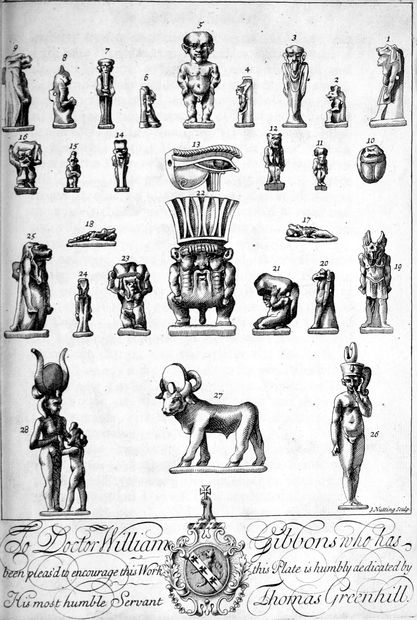
301These were the true Phylacteric and Averruncal Statues of the Egyptians, some made portable with Handles, and others with a square piece of Wood proceeding from their Pedestal, whereby they were the better fix’d on Tombs. Some again were put within the Bellies of the Mummies, and others hung about the outsides of them, and that as well to preserve the Bodies from Putrifaction as the Sepulchres from Rapine, |Their Use and Virtues.| which they were suppos’d to effect by their Divine Power, or Magical Virtue, or else by their terrible and deform’d Countenances were thought to strike a Dread into every approaching Adversary.
Thus the Body being Embalm’d and adorn’d with Hieroglyphic Characters, magical Amulets, Statues and the like, and every thing else got ready for the Funeral, it was on the last Day or Time appointed for the Burial, put on board a Ship call’d Barris, and by the Ferry-Man, Charon, |Charon.| wafted o’er the Lake Acherusia; which lies on the South side of Memphis, where being 302landed on a Plain, the chief Burial-Place of the Egyptians, and which is fabl’d by the Greeks to be the Elysian Fields, they plac’d the Corps on a Bier, before the Mouth of the Sepulchre, when the Judges, Priests and common People surrounding it, |Manner of Judging the Dead.| one who was purposely appointed to rehearse impartially the Funeral-Oration, openly declar’d the Virtues, Vices and Actions, nay whole Life and Conversation of the Deceas’d, and after all the Evidences were examin’d (every one having a free power to accuse the dead Person) according to the majority of Votes and judgment of the Judges, the Corps was dispos’d of. If he had liv’d Virtuously he was honour’d with the greatest Praises and Commendations, and consequently magnificently Interr’d; but if Viciously, he was mightily exclaim’d against and depriv’d of Sepulture. This made even the Kings themselves to live uprightly, fearing so much as to anger the common People whilst alive, lest they should thereby incur their eternal Hatred after their Death. This Custom of the Egyptians examining and trying their Dead, Bossuet in his History of the World, p. 457, takes notice of as a very extraordinary kind of Judgment which none escap’d, affirming, ‘It was a Consolation at the Time of Death to leave their Names in esteem among Men, and of all Human Blessings, this was the only one which Death cannot ravish from us; but it was not suffer’d in Egypt to commend all the Dead indifferently, that was an Honour to be had only from a public Judgment. The public Accuser was heard, if he prov’d the Conduct of the Deceas’d bad, then was his Memory condemn’d and he depriv’d of Sepulture. The People admir’d the power of their Laws, which reach’d them even after Death, 303and every one being touch’d by the Example, was afraid to dishonour his Memory and Family: But if the Defunct was not convicted of any Crime, then had he an honourable Interment. They made his Panegyric, but medled not in the least with his Birth: All Egypt was Noble, and besides, they receiv’d no farther Commendations than what they had got by their Merits. Moreover, the Egyptians were very curious in Preserving dead Bodies: Thus their Gratitude to their Kindred became Immortal. Children, by seeing the Bodies of their Ancestors, call’d to mind their Virtues, which the Public had made such Acknowledgements to, and they were incited to love those Laws which had so recommended them to them. This Custom of Judging Kings after their Deaths, says he p. 457. seem’d so holy to the People of GOD, that they have always practis’d it. We read in the Scriptures wicked Kings have been depriv’d of the Burial of their Ancestors; and we learn from Josephus, that that Custom lasted even to the Time of the Asmoneans: This gave Kings to understand, that tho’ their Majesty put them above Human Judgments whilst alive, yet were they not above them when Death had equall’d them with other Men. Likewise our Author further adds, p. 454. That to prevent borrowing, which was the Parent of Idleness, Frauds and Branglings, the Decree of King Asychis did not suffer any to borrow, |Pawning the Dead.| but on condition he pawn’d the Body of his Ancestor to him of whom he borrow’d; and it was reputed both an Impiety and Infamy together not to redeem it so soon as ever he could, so precious a Pledge 304was it reckon’d, and he that dy’d before he had acquitted himself of that Duty, was deny’d Burial.’
Now how the Bodies, which are said to have been bury’d, were laid up, is somewhat difficult to determine, since Authors speak so variously of their Burial; for some say they were bury’d either in their private or proper Sepulchres, or else in a public Reconditory, and others say they kept the Dead in their Dwelling-Houses. Now which of these was most us’d by such as could indifferently afford the Expence of either, I will not pretend to determine, however, the great variety of Sepulchres, found even at this Day, plainly proves they bury’d in the Fields and Plains, whereas the other is but traditionally asserted, yet not altogether improbable to be done by so Superstitious a People, of whom it is reported that some, especially the richer Sort, put their Embalm’d Bodies in Cases carv’d after their own likeness, |The Dead kept in Houses,| and these they set up in their Halls or Parlours in great Order (perhaps in Niches) being very richly adorn’d, where they took great delight to see a long Race of their Ancestors, in a manner, with as great satisfaction as if they were alive, and they were Conversing with them. Nay, Herodotus, Pomponius Mela and Lucian assert, |and plac’d at Table.| they plac’d them at Table like Guests, and made merry with them by Eating and Drinking; yet, when they were necessitous, they scrupl’d not to give them as a Pledge for Money they borrow’d, yet then took particular Care, both punctually to pay the one and redeem the other: But as for such as bury’d their Dead out of their Houses and Villages, in the Fields and Plains, they built Sepulchres for them as noble 305as possible, some after one Fashion, and some after another, every one according to their own Fancy, or the Charges they could best spare; for they chose rather to have their Monuments magnificently built than their Dwelling-Houses, laughing at the Greeks and other Nations, who caus’d theirs to be rais’d with great expence like to Palaces, notwithstanding they were to live but a very little while in them, and at the same time neglected their Tombs, where they were to lye for a much longer Time. But the Egyptians acted just contrary; they despis’d the present Life, and took little care in building their Habitations, looking upon them only as so many Inns or Baiting-Places, where they were to Inhabit but for a Season, whereas the Glory of a future Life, that was to be procur’d by Virtue, they greatly esteem’d, and consequently spent their whole Care, Study and Riches about the magnificence of their Sepulchres, |Sepulchres call’d Eternal Houses.| which they call’d Sempiternal or Eternal Houses, looking upon the Time they were to dwell here on Earth as nothing, in respect of the stay they were to make in the Grave. And hence it is no Nation in the World has been so curious as the Egyptians in their Funeral Ceremonies, Preserving the Dead, and magnificence of Sepulchres, which, besides abundance of private Structures, those Obelisks at Rome and the Pyramids of Egypt, do not only testifie, but will for ever be numbred among the Wonders of the World.
These, Sir, are my humble Thoughts and Opinion concerning the Funerals of the Egyptians, which 306I entirely submit to your better Judgment, hoping you will pardon this Interruption of your precious Time from more weighty Concerns, and candidly accept the mean, but grateful Performance of,
SIR,
Your most Obliged and
Devoted Humble Servant,
Thomas Greenhill.
307
THE
Art of Embalming.