LETTER II. (continued 2)
Reading edition
That this was the antient state of Medicine in Egypt, and all over the World, is farther apparent from the Hebrews, being peremptorily requir’d to expel from among them, all such as practis’d the same, Deut. 18. 10, 11. Those who Sacrifice their Children, as the Phænicians did for a Remedy against the Plague, as also Diviners, Observers of Times, Enchanters, Witches, Charmers, Consulters of Familiar Spirits, Wizards and Necromancers; so many kinds of Magicians, who among other Things, undertook the Cure and Prognostics of Diseases, so many several ways, particularly the Charmer, v. 11. term’d by the Septuagint, φαρμακὸς ἐπαείδων ἐπαοιδήν one that us’d Medicines and Charms together: |Magic us’d in Embalming.| Thus was Magic so generally mix’d by the Egyptians with their Physic, that the very Dead that were Embalm’d were not free from it. This appears from the various Ornaments of their Mummies, being adorn’d with painted Characters and Hieroglyphics, and defended by several little Idols or Averruncal Gods. Some of these were plac’d within the Bodies, as suppos’d, perhaps to preserve them from Corruption; and others were sow’d to their out-sides, plac’d upon their Tombs, or in their Burial-Vaults, there to guard them from external Injuries, and by the various Shapes they represented, to deter Men from violating them; but of these we shall speak more particularly in another place.
177Yet however Superstitious and Idolatrous the antient Egyptians were in Magical Physic, they were soon convinc’d of the inefficacy of such Practices, therefore study’d other Methods and Physical Remedies, which might prove more prevalent; and altho’ they did not immediately leave off the former, yet was it to the latter only their admirable success in Physic was owing. In like manner are we to believe the preservation of dead Bodies was not effected by those Charms or Idols, found about them, but purely perform’d by an extraordinary Skill in Medicine and Anatomy, and particularly in that exquisite Art of Embalming. In this, that they might be the better instructed, and more thoroughly knowing, they took such infallible Methods, as none could hardly be ignorant of that part they were to perform; for they had these several Persons belonging to and employ’d in Embalming, |Persons how qualify’d for Embalming.| each performing a distinct and separate Office, viz. a Designer or Painter, a Dissector or Anatomist, a Pollinctor or Apothecary, an Embalmer or Surgeon, and a Physician or Priest, which last was a great Philosopher, and taught and instructed the others in these Ceremonies, as we shall shew in its proper Place.
By this means, not only the Art of Embalming, but likewise every branch of Physic, flourish’d and came to the greatest perfection, whereas, in our Age, every Art grows the more imperfect as it incroaches on another, and the civil Wars now a Days between Physicians, Surgeons and Apothecaries have been the chief occasions of reducing Physic to so low an ebb; for whilst these have been fighting for each others Countries, the Monarchy was usurp’d by Quacks and Undertakers, who are the only Vultures that attend such Battles, in 178order to prey immediately on the vanquish’d Enemy. Now did every one keep to his own Province, as they did formerly in Egypt, there would be none of these Divisions among us, but every Art would flourish and stand upon its own Basis, and yet, I assure you, it would be found more difficult to understand, and perform one Art rightly, than to acquire a superficial Knowledge of many Things, in other Businesses, which relate little to the Purpose. |No Quacks or Undertakers in Egypt.| To prevent these, there were in Egypt no Pretenders to Physic in general, nor any Artists who medl’d with anothers Province, each keeping strictly to his own, as Herodotus assures us in his Euterpe, where he tells us, some only profess’d curing Diseases of the Head, others of the Ears; some were Oculists, others Tooth-Drawers; some for particular Diseases in Men, and others for those in Women. In a word, there were Physicians for every Disease, but none pretended to more than one. The same thing was observ’d in other Arts, for better maintaining of which, a Law was enacted, that if any Person exercis’d more than one Profession or Trade, he should incur the most grievous of Punishments; and King Amasis also made a Law, That such as had no Profession or Trade at all, or did not yearly make appear, to the Governors of the Provinces how they lawfully got their Livelihoods, should be punish’d with Death. This Law Solon borrow’d of the Egyptians, and carry’d to Athens, where he had it put in practice: Is it not therefore a shame for us, who, no doubt, esteem our selves a much more polite People than those Heathens were, to suffer a sort of Men call’d Undertakers, to monopolize the several Trades of Glovers, Milliners, Drapers, Wax-Chandlers, Coffin-Makers, 179Herald-Painters, Surgeons, Apothecaries, and the like.
Art can never Flourish where they are.
Art can never flourish where ’tis assum’d by every ignorant Pretender, nor be brought to any perfection, while practis’d by illiterate Persons. We may as well expect one, that has never seen a Campaign, should understand Military Discipline; or one that has never been at Sea, Command and Steer a Ship rightly, as that an Upholsterer, a Taylor, Joyner, or the like Undertaker, should be well skill’d in the misterious Art of Embalming. These are the present Grievances, as well in Sciences as Trade, and ’till such Time as Quacks and Undertakers, Hawkers, Pedlers and Interlopers, and all such Persons, as were not brought up in the Emploiment they profess, be remov’d; we can think no otherwise but that Art must sink, Trade be ruin’d, and every public Office, as well at Court as in the Country, be ill serv’d: For whence came every Art and Science, nay all kinds of Learning, to flourish so mightily in Egypt? And how came it to pass the Egyptians so much excell’d, and perform’d more wonderful Works, than all the World beside, but only by strictly confining every Artist to his particular Emploiment, and punishing all that any ways interfer’d with another? But lest we may seem to dwell too long on this Subject, which we think also more convenient to be discours’d of in another part of this Book, we will next proceed to consider, besides their Pharmacy, the extraordinary Skill of the Egyptians in other Branches of Physic, such as Anatomy, Chymistry, Surgery, &c.
Egyptians well skill’d in Anatomy.
That the Egyptians must needs understand the natural Oeconomy of the Body, appears in that they were 180the first that employ’d their Industry in searching out the inward Nature of Animals by Anatomy, and first open’d Human Bodies to discover their respective Diseases. Olaus Borrichius, Lib. de Ægypt. Sap. p. 141. brings many Arguments to prove their Knowledge in Anatomy; and among them, this out of Aulus Gellius, Lib. 10. c. 10. Veteres Græcos, annulum habuisse in Digito sinistræ Manus, qui minimo est proximus: Romanos quoque Homines aiunt sic plerumq; Annulis usitatos; Causam esse hujus rei Appion in Libris Ægyptiacis hanc dicit; Quod insectis apertisq; Humanis Corporibus, ut mos in Ægypto fuit, quas Græci Ἀνατομὰς apellant repertum est Nervum quendam tenuissimum, ab eo uno Digito, de quo diximus, ad Cor Hominis pergere ac pervenire: Propterea non inscitum visum esse, eum potissimum Digitum tali Honore decorandum, qui continens & quasi connexus esse in principatu Cordis videretur. That the antient Greeks wore a Ring on that Finger of the left Hand, which is next to the little one: And it is likewise said of the Romans, that they for the most part wore their Rings in the same manner; of which Appion, in his Egyptian Treatises, gives this Reason; That the Egyptians in Dissecting, and opening Human Bodies, which was a Custom among them, call’d by the Greeks Anatomy, found a certain slender Nerve, deriv’d from their Finger above-mention’d, which crept along ’till it inserted it self into the Heart; wherefore they thought convenient that Finger should chiefly be adorn’d with such Honour. Macrobius, as quoted by Polydor Virgil, de Rerum Inventione, p. 140. affirms likewise, Quod ille Digitus annulo ornatur, quia ab eo Nervus quidam ad Cor pertinet. Also in Saturnius, Lib. 7. c. 13. Disarius, in consulting the Egyptian Books of Anatomy, says, he found the same. Orus 181adds, that for this Reason the Egyptian Priests anointed that Finger with sweet Odours; which Doctrine however, Conringius says, deserves rather to be laugh’d at than confuted; nevertheless, Borrichius thinks there may perhaps be a more secret consent between that Finger and the Heart, than young Anatomists are aware of, therefore endeavours to prove the same, p. 143. However, says he, we need not wonder if the Egyptians were sometimes in the dark, when at this Day the Anatomy of the Greeks is so empty; and surely ’twas as easie a matter for the Greeks to have added something more solid, to the Egyptian Anatomy, as for us Moderns to have so much improv’d it after them. But nothing was invented and perfected at the same Time, therefore we must not imagine the Anatomy of the Egyptians to have been so compleat as ours is now. Yet he that shall think the wise Egyptians could be so absurd as to believe the Heart Annually increas’d the weight of two Drams, for the space of Fifty Years, and afterwards gradually decreas’d for Fifty more, must needs be guilty of too great credulity, since none can doubt but that Persons of all Ages were open’d by them, in order to Embalming, and therefore such like Follies must of necessity have been refuted by ocular Inspection and Demonstration. That which Conringius chiefly builds upon, is, that all the Anatomy of the Egyptians was only instituted for the use of Embalming; yet, which is likewise confuted by Pliny, Lib. 19. c. 5. where speaking of the Phthiriasis, he says, The Cure thereof was found out in Egypt, Kings being accustom’d to Dissect dead Bodies, for that purpose: The words are plain, In Ægypto Regibus Corpora mortuorum ad scrutandos Morbos insectantibus. This I look upon 182to be the chief intent of their Anatomy, and not the use of Embalming, since, if we may believe Diodorus Siculus, those who were the Dissectors very probably understood no more than what they were directed to perform by the Priest and Scribe. The same Author assures us it was even a very unthankful Office to perform that; for no sooner had they finish’d their Incision, but they were forc’d to run away, the By-standers most commonly flinging Stones at them, as abhorring to see them exercise such seeming Cruelty on their Friend or Relation. Yet this does not disprove their Skill or Practice of Anatomy for other Purposes, since, besides the foregoing Arguments, we are assur’d they were well acquainted with Ostiology; |And Ostiology.| for Galen, Lib. 1. De admin. Anatom. advising as well ocular Inspection as reading good Authors, says, It is best to be done at Alexandria, where Physicians, expose to the sight of their Auditors, the Discipline of the Bones. On the contrary, tho’ the Egyptian Embalmers did not rightly understand Anatomy, yet is that Art nevertheless very requisite to be known, by those who would be thoroughly acquainted with the more exquisite Methods of the Moderns; for hereby they may be instructed how to keep the Muscles, make Skeletons, and prepare Schemes of the Nerves, Arteries and Veins, as likewise to preserve the Brain, Lungs, Stomach, Bowels, Uterus, and other curious Preparations, which serve instead of Books or Pictures for the Instruction of young Pupils, and refreshing the Memories of more experienc’d Practicers. In a word, I may justly say, to Anatomy are owing those rare Inventions of Steno, Swammerdam, Ruysh, Blanchard, Bilsius and others, for their new Methods of Embalming.
Chymistry Invented by Hermes.
183As Chymistry is said to have had its Rise in Egypt, so is it also generally suppos’d to have been invented by Hermes. But that this Art was somewhat different from what we at this Day understand by that Denomination, appears from the Etymology of the Word, which the Greeks call, χημεία, ἡ τοῦ ἀργύρου καὶ χρυσοῦ κατασκευή, al. χυμία, i. e. Fusio Metallorum; præfixo artic. |The Art of making Gold and Silver.| Arab, Al, Alchimy, Chymistry; or, The Art of melting and counterfeiting Metals. Suidas likewise calls Chymistry, The preparation or making of Gold and Silver. This was the true Philosophers Stone which so enrich’d that Kingdom, and brought all their Arts to a mighty Perfection; and in quest of which, so many Persons of all Nations have since fruitlesly consum’d both their Lives and Fortunes. Whereas, on the contrary, by this Art the Wealth of the Egyptians was increas’d to that immense degree, that they study’d means how to expend what they had heap’d up. On this occasion Pliny, Lib. 36. c. 12. thus writes: Dicuntur, says he, obiter & Pyramides in eadem Ægypto, Regum Pecuniæ otiosa & stulta Ostentatio. But besides their Pyramids, their Obelisques, Colossus’s, Monuments, Pensile Gardens and Cities, their Labyrinth, Lake Mœris, and the like stupendious Works, which cost so many Millions of Talents, are sufficient Arguments of their Skill in Alchymy, whence they receiv’d so vast a supply of Riches. ’Tis recorded of Ptolomy Philadelphus, he spent at one pompous Show at Alexandria, and that even when Egypt was declining, 2239 Talents, as Athenæus reckons up, Deipn. Lib. 5. c. 8. Not to mention their Statues and Temples of entire Gold, or the Cedar Ship, built by Sesostris, which was 280 Cubits in length, the outside cover’d with Gold, and the inside with Silver, 184as Diodorus asserts. We have a sufficient remarkable instance of their great Riches in the Tomb of Osymanduas, describ’d by the same Author, about which there was a Circle of Gold 365 Cubits in compass, and one Cubit thick, which Circle was afterwards carry’d away by Cambyses, the Persian Monarch, when he conquer’d Egypt; besides which, as Marcellinus, Lib. 6. reports, he took out of Thebes 300 Talens of Gold, and at least 2300 of Silver. Now, since no Authors mention any Gold Mines in the Time of Osiris or Hermes, whence can we imagine they should acquire such exceeding great Wealth, but from the Chymic Art of transmuting Metals? Besides the Egyptian Mines, which perhaps were afterwards discover’d, could yeild but little Profit, because of the vast Expence and Labour they must be at in Digging them. What farther seems to confirm their Knowledge in this misterious Art, is that, as Suidas reports, the Emperor Dioclesian upon his taking Alexandria, search’d with the utmost diligence for all these Chymical Books, written by the Ancients, and burn’d what he found, both to prevent the Egyptians growing thereby Rich and Rebelling against him. It was nevertheless thought, the Art of making Gold remain’d for some Time, among the Egyptians of the first Rank, at Colchis, and that by Jason’s Golden Fleece, was meant a Book of Chymistry written on Sheep-skin or Vellum, which he fetch’d from thence. However, at last this Art was lost, and perhaps for these following Reasons: |How the Egyptians Arts came to be lost.| First, Because the Egyptian Priests, who were Masters of all Sciences, conceal’d their Chymistry as much as might be, lest others, excited by their Happiness, might envy their Treasure, and consequently hasten their Ruin. Secondly, 185Because these Priests were so obstinate and resolute, they would rather chuse to suffer the greatest Tortures than discover their Art. Thirdly, In that their Chymical Books, &c. being written in secret Characters, and consequently understood by few, were laid up in Subterranean Vaults, or private Recesses of their Temples, for fear of the Incursions of their Enemies, thro’ which means some never came to light. And, Lastly, by reason of the hostile Invasions of the Persians, Ethiopians, Romans and others, who ransack’d the Temples of Memphis, Thebes and Alexandria, where these secret Arts were kept, burnt that famous Library of Ptolemy Philadelphus, which contain’d about 700000 Volumes, and destroy’d in like manner the Serapion. All this consider’d, we need not wonder if this, as well as their Art of Embalming, be lost. But ’tis farther to be noted, as their Chymistry was very profitable to them in making Gold and Silver, |The Art of tinging Glass and making Artificial Stones.| so in teaching them how to give beautiful Tinctures to Stones and Glass, as also Enamel, make Pastes, and the like, was equally curious and delightful. They were wont to make Drinking-Glasses, call’d [3]Allassontes, which would change colour like a Pidgeons Neck; one of which, as Vopiscus relates, being presented by an Alexandrian Priest to the Emperor Adrian, was esteem’d by him as a great Gift and rare Invention. They could likewise tinge the Lapis Obsidianus and Cyanos, with various beautiful Colours, as Pliny, Lib. 36. c. 26. and Lib. 37. c. 9. relates. Also Seneca Epist. XC. tells us Democritus, by being well acquainted with the Egyptians, discover’d how to soften Ivory, and by boiling a Stone, learn’d how to convert it into an Emerald; for 186those People are said to have made Gems so artificially, they imitated the natural both in lustre and hardness. Moreover, Appion Plistonices writes, there was to be seen in the Labyrinth of Egypt a Colossus of Serapis 9 Cubits high of an entire Emerald, which surely must have proceeded from a Chymical Operation, since neither of the Indies have hitherto been able to produce the like Rarity. By all this ’tis plain the antient Egyptians knew the more secret and profitable part of Chymistry, but whether that relating to Physic was practis’d by them, in the same manner as with us, is a Matter of some concern in Embalming, but, by reason of the scarcity of their Monuments or Books, not so easie to determine. Yet that they were not wholly ignorant thereof, appears by their Æs ustum, Ærugo, Alumen ustum, Diphryges, Misy, Sory, Nitre, Sal Armoniac, Salts latent in Ashes, Calcinations, and the like Operations which require the help of Fire; |The Art of Distilling, Calcining, &c.| as also in that they were acquainted with the Art of Distilling, whereby Bodies were made Incorporeal, rarify’d into Fumes, and afterwards kept from evaporating by help of Alembics, Matrasses and Retorts well luted to their Heads and Receivers. These Vessels were made of Glass, and some of them with their Figures have been describ’d by Zosimus, an antient Chymist of Panopolis, in his Book περὶ ὀργάνων καὶ καμίνων, from whence Olaus Borrichius had his Plate in his Book De Hermetis Ægyptiorum sapientia, p. 156. Now certainly, after all has been said, no Body will pretend to dispute the use of Chymical Preparations in Embalming, |Chymical Medicines useful in Embalming.| who has heard of the wonderful Effects of the Spiritus Solomonis, the Spiritus universalis Clauderi, the Spiritus Matricalis Blancardi, the Sal enixum Paracelsi, Sal mirabile Glauberi, 187Succinum liquidum Kerkringij, the Arcanum Bilsij, and other Chymical Spirits, Tinctures and Balsams, too many to be enumerated here, therefore I intend to describe them at large in my Pharmacopœia.
Surgery Invented and Improv’d in Egypt.
Surgery, which was another branch of their Physic, was, as Sanchuniathon asserts, invented by Æsculapius the Egyptian, first of that Name, Son of Jupiter, and Brother of Mercury, who reign’d at Memphis according to the report of Clemens Alexandrinus. After his Name several others were so call’d, who, in succeeding Ages, contriv’d any new Methods of dressing or binding up Wounds, or added any thing else which was curious to Surgery. This Art increas’d much in Egypt, as Celsus Lib. 7. Præf. witnesses; and Philoxenus, a very good Author, compos’d many Books thereof. Egypt also was the chief place famous for Surgery, insomuch that Cyrus King of the Persians, when he found no Remedy for a Disease in his Eyes, among his own Physicians and Surgeons, friendly besought Amasis King of Egypt, that he would send him an Oculist, whom he accordingly receiv’d with desir’d Success, as Herodotus in his Thalia acquaints us. Likewise both the Greeks and Romans, in case of necessity, requir’d and receiv’d the like Benefit from the Egyptians; but that their Surgery was so complete as ours is now, none will allow, nevertheless, this must be granted, that they had some Medicaments which we stand in need of; for Dioscorides, Lib. 5. c. 158. and Pliny, Lib. 36. c. 7. make mention of the Lapis Memphitis, which being powder’d and mix’d with Vinegar, they us’d to anoint any part with which they intended to Burn or Cut, and it so stupify’d it without any danger, that the Patient underwent the Operation almost without any Pain.
How useful in Embalming.
188Surgery therefore being of that antiquity, and so well known by the Egyptians, ’twill be expected I should apply it to our Subject of Embalming: Wherefore, as was before mention’d, p. 177. there being several Persons employ’d to Embalm a Corps, as they were directed by the Physician, so one of those, to wit the Embalmer, we take to be properly a Surgeon, inasmuch as by understanding the nature of Fermentation and Putrifaction, both of the Juices and Blood, as also how to cure Mortifications in the Living, he might thereby be better enabl’d to prevent the like Qualities in the Dead. This he is likewise more capable of, by being well acquainted with Galenical and Chymical Medicines, and Anatomical Preparations and Experiments; in which Matters, seeing Physicians are generally most knowing, Santorellus thought it their Property, and consequently wrote a Book on this Subject, entitl’d, Post Praxis Medica, which shews what a Physician has to do after his Patient is dead, viz. To prescribe proper Remedies for Embalming him, as the Egyptian Priests or Physicians were wont to direct their Operators to do. So that ’tis plain, the true Office of the Physician was to prescribe, the Apothecaries to compound Medicines, anoint the Body, &c. and the Surgeons to Embalm and roul it up; |It teaches the Art of Bandage.| an Art which scarce any of our Moderns can equal, and perhaps I may have been the first that has imitated it, as Mr. Talman, one of our Masters of Anatomy, can witness I perform’d on the Body of Sir Robert Jeffrys, whom we Embalm’d.
A Surgeon the proper Embalmer.
He therefore whom the Egyptians call’d the Embalmer, was strictly speaking the Surgeon, for as much as the curing the Corps was to be perform’d by a manual 189Operation, and local application of Medicines, a Thing which requir’d much care, skill and dexterity, and which, a Person that is not as well acquainted with this, as Balsamic Medicines, can never perform as he ought, or be able to invent any new Method; whereas Frederic Ruysch, a good Physician, a great Anatomist and Reader of Surgery at Amsterdam, was well skill’d in this Art of Embalming, as his several Preparations of the Veins, Arteries, Uterus, &c. testifie, all which, Doctor Brown, President of the College of Physicians London, affirms he saw most accurately done at Ruysch’s House at Amsterdam, and which he particularly mentions in his Book of Travels, viz. The Lymphatic Vessels so preserv’d, that their Valves were very perspicuous, and the very minute Vessels of an excarn’d Liver clear and shining. He likewise says, he saw the Muscles of Children dissected and kept free from Corruption; as also an entire Body preserv’d, and the Face of one without the least spot, change of colour, or alteration of the Lineaments, from what might be expected after Death, and yet Ruysch had kept them Two Years, and hop’d so to continue them.
We have insisted the longer on Physic and its particular Branches, such as Anatomy, Chymistry, Surgery, &c. in as much as they not only teach how to prevent and cure Diseases, but likewise to Embalm dead Bodies. Yet seeing the Egyptians were famous in other Arts and Sciences, such as Painting, Carving, Architecture, Astronomy, Geometry and the Mathematics, some of which conduc’d very much to their Embalmings, and others to the erecting and compleating their Pyramids and Monuments; it may not be impertinent to enquire into those Arts, by which Egypt grew into such repute, 190that it was generally esteem’d, in respect to its Magnificence, |Egypt Mistress of the World, and Mother of all Arts and Sciences.| The Mistress of the World; to its Fertility, The Magazine or Store-House of the World; and to its Antiquity, The Origin, or Mother of all Arts and Sciences. This Digression I hope will be the more pardonable, in that it will be somewhat diverting to the Lovers of Art, and also help to give a true Notion of the several Ceremonies and great Expences us’d about their Embalm’d Bodies. |Egyptians their Antiquity.| We will first therefore begin with their Antiquity, for from thence we may expect the first Progress or Invention, tho’ perhaps not the Perfection of Arts; in which point the Egyptians would make us believe, the first Men were form’d in their Country, and give so great a number of their Kings, and so long a duration of their Reigns, as to deduce their Origin some Thousands of Years before the Creation of the World; asserting also that they were govern’d by the Gods about 25000 Years, before their Kingdom fell into the Hands of Men: But however questionable this Tradition may be, yet is it not to be doubted but the Egyptians were of very great Antiquity, and perhaps the antientest People of the World, from whom Laws, Arts, Sciences and Ceremonies were first deriv’d to other Countries. |Their Inventions.| Now the Inventions commonly attributed to them are, Geometry, Arithmetic, Music, Astrology, Physic, Necromancy or Sorcery, Carving, Painting, Enameling, Fluxing of Metals and Stones, curious Works in Glass, and making of fine Linnen, Mathematical Machines and Automata, Pneumatic and Hydraulic Engines, and various other Mechanical Curiosities; in a word, all kinds of Learning and Ingenuity, but more particularly they were the first Inventors of the Art of Embalming. Some of these we have already 191mention’d, therefore shall only speak of those not hitherto treated of. First then, The Thebans boast they were the most antient Philosophers and Astrologers, |Astrology.| as having found out the first Rules for the Improvement of those Sciences, since they most accurately observ’d the Courses of the Sun, Moon and Stars, their Eclipses, Constellations, Risings, Aspects and Influences, dividing thereby their Years into Months, and grounding their Divinations on their hidden Properties; yet did they so manage their Prognostications, that they could certainly foretel every particular Event.
Mathematics.
In the Mathematics and Mechanical Powers the Egyptians were particularly famous, for they had Engines whereby they could raise their Obelisques, and hoist up vast Stones to so incredible and prodigious a height as their Pyramids are. They also devis’d other wonderful Machines for divers purposes, as some for dreining Marshes, others for watering Gardens, of which Diodorus Siculus says, In the pensile Garden of Semiramis there was an Engine, that, thro’ certain Conduits or Conveyances from the Platform of the Garden, drew a great quantity of Water out of the River, yet no Body was the wiser or knew how it was done. A third sort of Machines they had for destroying and confounding their Enemy, with which last they had once almost reduc’d Julius Cæsar to extream despair, when he invested Alexandria with his whole Army; for as Aulus Hirtius, Writer of that War, relates, Ganymedes with Wheels and other Machines of great force, pump’d the Water out of the Sea, and threw it from high Places, with that great force and violence on Cæsar’s Men, that they thought of raising the Seige. He farther adds, 192That by those means he also made all their Water so salt they could not drink it. But besides these they had a sort of Water-Works for pleasure, as their Organa Hydraulica or Water-Organs, and others for measuring Time, as the Clepsydra or Water-Hour-Glass. They had likewise other Machines which mov’d with the Air or Wind, and some Automata that went by invisible Springs; for, as Cælius Rhodiginus relates, the Egyptians made some Statues of their Gods both to walk of themselves, and also to utter certain Words articulately. As to their Motion, that may be ascrib’d to some Wheels and Springs within, and their Voice or Speech, to some Air forc’d up thro’ Pipes plac’d in their Heads and Mouths. Kircher in Tom. 2. Oed. Ægyptiac. gives many Examples of Pneumatical Engines, among the Egyptians, in their Temples. Yet is there none so remarkable as the Statue of Memnon, which was made by the Theban Priests with that Art and Contrivance, that in the Morning, on the rising of the Sun, and the striking of its Beams upon it, it utter’d a kind of Music. This was so famous a piece of Work, that Men travell’d from far to see it. Lucian the Sophister went to view that Miracle, as he terms it, and as he tells us in his Philopseudes. The same did the Emperor Severus, as Spartianus informs us, and Germanicus, as Tacitus, and Strabo, that judicious Geographer, went to see it; the like did Apollonius Tyanæus, as Philostratus writes, which Matter need not seem fabulous, says Natalis Comes, to any that shall understand the Power of Art and Human Wit, nor how expert the Theban Priests were in all Mathematical Sciences. But I need say no more in particular of their Art of Building, Carving or Painting, |Their wonderful Works in Architecture.| since 193those will appear much more conspicuous by a Relation of such stupendious and beautiful Works as were the City of Thebes, together with its stately Sepulchres, Obelisks and Temples, all built by them. The Sepulchre of King Osymandua, the Cities of Memphis, Cairo, Babylon and Alexandria, the Tower of Pharos, the long Wall built by Sesostris, the Labyrinth, their Pyramids, Obelisks, Columns, Colossus’s, Statues, Sphinx’s, Monuments, Subterranean Vaults and Lamps, and other like admirable Works, testifie their extraordinary Skill and Ingenuity in all kinds of Arts to be such, as neither the Greeks, Romans, nor any other Nation were afterwards capable of. But that you may not, Sir, be put off with a bare enumeration of them, I will give such a particular account of them, as will, I dare say, not only surprise and divert the Reader, but also lead him into every minute Circumstance of their Embalming.
Thebes.
First then of Thebes, a very rich and glorious City, once the Regal Metropolis of all Egypt, and built by Busyris, who resided in it. It was call’d by the Egyptians Heliopolis, or the City of the Sun, and by Strabo, Diospolis, or Jupiter’s City, by reason he was there worshipp’d. It was in circuit about 140 Furlongs, or 17 Miles and an half, and was adorn’d with so many stately Monuments both of Gold, Silver and Ivory, such multitudes of Colossus’s and Obelisks, cut out of entire Stone, such exceeding splendid Temples, Palaces and Tombs of the old Egyptian Pharaohs, and other such like Ornaments and stupendious Rarities, that it was not only look’d upon to be the most beautiful and stately City of Egypt, but of all others in the World; for it is recorded, that not only King Busyris, 194but all his Successors also from Time to Time beautify’d and adorn’d it, and ’tis certain it had in it 20000 Chariots of War, and that there were 100 Stables all along the River, from Memphis to Thebes, towards Libya, each of which was capable of containing 200 Horses. Pomponius Mela says, Thebes was so exceeding Populous, it could draw out of every Gate 10000 armed Men, and that the Greek Word Hecatompolis, which as some think signifies an hundred Gates, according to which, Thebes was so call’d by Homer, is not to be understood literally, but rather to be explain’d to relate to an hundred Palaces, in which so many Princes had their Residence. Pliny, Lib. 36. c 14. will have the whole City to have stood upon Arches, so made on purpose, that the Egyptian Kings might march their Armies this way and that way under the Houses, without being discover’d. In this City were also four Temples, very wonderful for their beauty and largeness, of which, the most antient was 13 Furlongs, or above a Mile and half in circuit, and 45 Cubits high, and had a Wall 24 Foot thick. The Ornaments of this Temple were suitably magnificent both for Cost and Workmanship, and the Fabric continu’d ’till Diodorus Siculus’s Time, but the Silver, Gold, and other Ornaments of Ivory and precious Stones, were carry’d away by the Persians at such Time as Cambyses burn’d the Temples of Egypt. ‘Here, says Diodorus Siculus, Lib. 1. cap. 4. were the wonderful Sepulchres of the antient Kings of Egypt, which for State and Grandeur far exceeded all that Posterity could attain to even to this Day. The Egyptian Priests say, That in their Sacred Records there were register’d 47 of these Sepulchres, yet which is not only reported by the 195Egyptians, but by many of the Grecians likewise, who travel’d to Thebes in the Time of Ptolemeus Lagus, and wrote Histories of Egypt. Among these, one was Hecatæus, who agrees with what Diodorus relates, viz. That when he was there, which was in the 180th Olympiad, there remain’d only 17 of these Sepulchres. |Osymandua’s Tomb.| Of the first of these, that of King Osymandua was 10 Furlongs in compass, and at the entrance, they say, there was a Portico of vari-colour’d Marble, 45 Cubits in height and 200 Feet long. Thence going forward, you came into a four square Stone-Gallery, every Square being 400 Feet, supported by Beasts instead of Pillars, each of which was of an entire Stone, 16 Cubits high, and Carv’d after the antique manner. The Roof was also entirely of Stone, each Stone being 8 Cubits broad, with an azure Sky all bespangl’d with Stars. Passing out of this, you enter’d another Portico like the former, but more curiously carv’d, and adorn’d with greater variety. At the entrance stood 3 Statues, each of one entire Stone, being the Workmanship of Memnon of Scienitas. One of these was sitting, whose Foot measur’d 7 Cubits, and in the whole magnitude, exceeded all other Statues in Egypt. The other two were much less, reaching but to the Knee, the one standing on the right Hand, and the other on the left, being the Mother and Daughter. This Piece is not only commendable for its greatness, but likewise admirable for its Workmanship, and the excellency of the Stone, that in so great a Work there was not to be discern’d the least flaw or blemish. Upon the Tomb there was this Inscription:
196‘I am Osymandua, King of Kings; if any would know how Great I am, and where I lye, let him excel me in any of my Works.
‘There was likewise at the second Gate another Statue, of the Mother by her self, of one Stone, 20 Cubits high; upon her Head were plac’d Three Crowns, to denote she was both Daughter, Wife and Mother of a King. Near this Portico, they say, there was another Gallery, more remarkable than the former, in which were various Sculptures representing his Wars with the Bactrians, who had revolted from him, against whom, ’tis said, he march’d with 400000 Foot and 20000 Horse, which Army he divided into four Bodies, and appointed his Sons Generals of the whole.
‘In the first Wall might be seen the King assaulting a Bulwark environ’d with the River, and fighting at the head of his Men, against some that made up against him, assisted by a Lion in a terrible posture; which some affirm must be understood to be a real Lion that the King bred up tame, went along with him in all his Wars, and by his great strength ever put the Enemy to flight. Others make this Construction, that the King being a Prince of extraordinary Courage and Strength, he was willing to set forth his own Praises and bravery of Spirit, by the representation of a Lion. In the second Wall were carv’d the Captives dragg’d after the King, represented without Hands and Privy Members, to signifie that they were effeminate Spirits, and had no Hands when they came to fight. The third Wall 197represented all sorts of Sculptures and curious Images, in which were set forth the King’s Sacrificing of Oxen, and his Triumphs in that War. In the middle of the Perystilion or Portico, open to the Air at top, was rear’d an Altar of polish’d Marble, being of excellent Workmanship, and equally to be admir’d for its Magnitude. In the last Wall were two Statues, each of entire Stone, 27 Cubits high, near which three Passages open’d out of the Portico into a stately Room, supported by Pillars, like a Theatre for Music. Every side of the Theatre was 200 Feet square. Here were many Statues of Wood, representing Pleaders and Spectators looking upon the Judges. Those which were carv’d on one of the Walls were 30 in number, and in the middle sat the Chief Justice, with the Image of Truth hanging about his Neck, his Eyes clos’d, and many Books lying before him. This signify’d that a Judge ought not to take any Bribes, but only to regard the Truth and Merits of the Cause. Next adjoyning was a Gallery full of diverse Apartments, in which were all sorts of delicate Meats ready serv’d up. Near this was represented the King himself, curiously carv’d and painted in glorious Colours, offering as much Gold and Silver to the Gods as he yearly receiv’d out of his Mines. The Sum was there inscrib’d (according to the rate of Silver) to amount unto 32 Millions of [4]Mina’s, which is about 100 Millions of Pounds Sterling. Next was the Sacred Library, on which were inscrib’d these words, The Cure of the Mind. Adjoyning to this were the Images of all the Gods in Egypt, to every one of which 198the King was making Offerings, peculiarly belonging to each of them, that Osiris and all his Associates, who were plac’d at his Feet, might understand his Piety towards the Gods, and his Righteousness towards Men. Next to the Library was a stately Room, wherein were 20 Beds to set upon, richly adorn’d, in which were the Images of Jupiter and Juno together with the Kings, and here it’s suppos’d the King’s Body lay interr’d. Round the Room are many Apartments, wherein are to be seen all the Beasts that are accounted Sacred in Egypt, very curiously painted. Thence you ascend to the top of the Monument or Sepulchre, which having mounted, there appears a Border of Gold round the Tomb of 365 Cubits in compass, and one in thickness; within the division of every Cubit were the several Days of the Year ingraven, with the natural Risings and Settings of the Stars, and their Significations, according to the Observations of the Egyptian Astrologers. In this manner they describe the Sepulchre of King Osymandua, which seems far to exceed all others both for Magnificence and curiosity of Workmanship.’ Now he who shall seriously consider this, as also several other Passages in Herodotus and Diodorus Siculus of the stupendious Works of the Egyptians, says Greaves in his Pyramidographia, p. 9. must needs acknowledge, that for Magnificence, if not for Art, they far exceeded the Grecians and Romans, even when their Empires were at the highest pitch and most flourishing: Wherefore those Admiranda Romæ, collected by Justus Lipsius, are hardly admirable, if compar’d with some of these. At this Day there is scarce any great Column or Obelisk remaining in Rome worthy of Note, which 199has not antiently been brought hither out of Egypt.
Thebes sunk and fell to decay, upon removing the Court to Memphis, |Memphis.| a great and eminent City, built by Uchoreus, as Diodorus Siculus, Lib. 1. relates, but Sandys says ’twas built by Ogdoo, and call’d Memphis after the Name of his Daughter, compress’d, as they feign, by Nilus in the likeness of a Bull. Hereupon this became the Regal City, and Strength and Glory of all Egypt, being exceeding Populous, and adorn’d with a world of Antiquities. It was particularly famous for the Temple of Apis, the Subterranean Vaults or Burying-Places, and the Pyramids or stately Sepulchres of the Kings, erected within a few Miles of it.
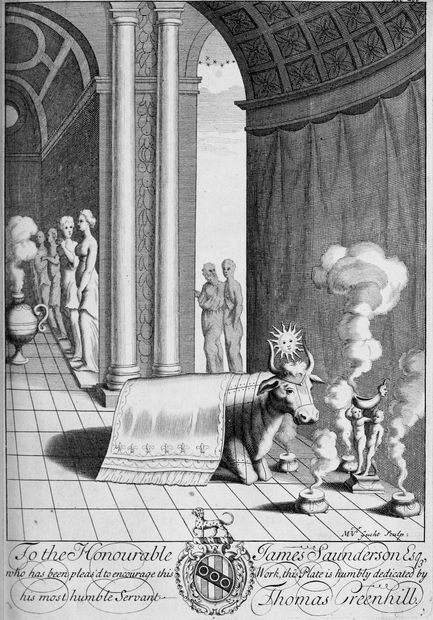
The God most esteem’d by the Egyptians, and ador’d at Memphis, |The God Apis.| was Apis, a coal-black Ox, with a white Mark on his Forehead, the figure of an Eagle on his Back, and having Hair on his Tail of two kinds. When this God happen’d to die, none valu’d their Hair, tho’, as Lucian says, they had as good as Nisus, but shav’d it all off in token of their Grief. Also Diodorus Siculus, Lib. 1. cap. 6. says, They were then as much concern’d, as at the Death of their own Children, and laid out in the Burial of this God, as much, if not more than all their Goods were worth; for when Apis thro’ old Age dy’d at Memphis, in the Reign of Ptolomeus Lagus, his Keeper not only spent all the Provision he had heap’d up, in burying him, but also borrow’d of Ptolomy 50 Talents of Silver for the same purpose. Nay even in our Time, says the same Author, some of the Keepers of these Sacred Creatures, have lavish’d away no less than 100 Talents, in maintaining them whilst alive. After the pompous Funeral of Apis was over, those Priests that had the charge 200of the Matter, sought out another Calf, which they substituted in its stead, with the same Marks as the former; and this pass’d for a great Miracle among them, but certainly it was not difficult for evil Spirits, who might take pleasure in deceiving these People, to represent to a Cow, when she went to Bull, an Ox with those Marks, as Jacob made the Goats and Sheep of the same colours, by placing speckl’d Rods before the Eyes of the Dams at the Time of their Coition. Thus, having found an Ox to their Mind, an end was immediately put to all further Mourning and Lamentation, and the young God was led by the Priests thro’ the City of Nilopolis, fed 40 Days, and afterwards put into a Barge, in a golden Cabbin, transported to Memphis, and plac’d in Vulcan’s Grove. For the Adoration of this Ox, they give this Reason, viz. That the Soul of Osiris pass’d into the Ox Apis, and consequently into all the rest that were successively substituted in his stead: |Sepulchre of Osiris.| But some say, the Members of Osiris, kill’d by Typhon, were thrown by Isis into an Ox made of Wood, and cover’d with Ox-Hides (from whence the City of Busiris took its Name;) and this, as it is reported, she did, because, as she was in search of her Husband, a very handsome Bull appear’d to her, which she believ’d to be him, and whom she afterwards caus’d to be Honour’d in Egypt, under the Figure of that Animal. Many other Things are fabulously reported of Apis, which would be too tedious to relate in particular; therefore I need only consider whether the Adoration and Worship of that Creature, came first in use from being the Sepulchre of Osiris, |Of Mycerinus’s Daughter.| or from the Account Herodotus in his Euterpe gives of the Daughter of Mycerinus, bury’d in like manner, which we shall here relate, 201viz. That one of the Egyptian Kings, Mycerinus by Name, seeing himself depriv’d of Heirs by the Death of his Daughter and only Child, spar’d nothing whereby he might express how sensibly he was touch’d with this Loss, and consequently indeavour’d to immortalize her Memory, by the most superb and sumptuous Structure he could possibly devise. Instead therefore of a Monument he order’d a Palace to be erected for her, with a great Hall in the midst of it, adorn’d with abundance of Figures and Statues, all glittering with precious Stones. After this, he caus’d her Corps to be deposited in a Coffin of incorruptible Wood, fashion’d after the likeness of an Ox, which was cover’d all over with Plates of Gold, and had a purple Mantle cast over it. The Figure of this Ox was kneeling, having a Sun of Massy Gold between his Horns, and being enlightn’d by a Lamp hanging before him, whose Flames were fed with a most odoriferous Oil. Round about the Hall stood Perfuming-Pans and Censers, which continually threw up clouds of sweet Scents and Perfumes. In another Parlour adjoyning to this, stood about 20 great Images, partly naked and carv’d in Wood, which as the Priests report were the Concubines of Mycerinus. But some there are who speak otherwise of this Ox and those Figures, viz. That Mycerinus falling in Love with his Daughter ravish’d her, who thereupon hanging herself for Grief, her Father bury’d her in this Ox, and the Servants who betray’d the Daughter, and slew the Mother, were represented by these Images, as having been accessary to such Wickedness. This Sepulchral Story, Porus has very well delineated in Porcachius, after the manner you’ll find represented in this first Plate. But 202to return to the City Memphis, said to have been in circuit about 20 Miles; Greaves tells us, there is not now so much as the Ruines of any such Place to be seen, altho’ Monsieur Thevenot affirms, those pretty near the Mummies, enclining towards the Nile, are doubtless the Ruines of that City, whose Inhabitants, even at this Day, in imitation of their Ancestors, bury their Dead without the Gates, and consequently make use of the Plain for a Burying-Place. Yet Sandys avers, ’tis not likely they should carry their Dead so far, when they have as convenient a place belonging to their City, and this is also agreeable to what some of the Ancients write, viz. |Subterranean Caves.| That on these Subterranean Caves the City Memphis, and several other Places thereabouts were built, as on so many Vaults or Arches. Without doubt they bury’d in both places, tho’ cheifly in the Plains of Egypt and Libya, where, in Caves and Grots under Ground, are said to be about 40 Sepulchres of their Kings. In these they were very curious, sparing no cost, but roofing them over like so many great Halls, and dividing them into several Apartments, with Passages out of one into the other, alotting also to each Family or Person, one suitable to his Quality and Expense he had been at in making them. These were like those Hypogea of the Greeks, or Cryptæ of the Romans, p. 95, 96. and are thus describ’d by Sandys, p. 103. Not far above Memphis, near the brow of the Libyan Desarts, and straitning of the Mountains, are the Sepulchres or Graves of the antient Egyptians, who have been there from the first inhabiting that Country, and who coveted that place of Burial, as suppos’d to contain the Body of Osiris. When discover’d, they are to be seen after this manner: 203By the removal of a certain square Stone (which is very close fitted, and cover’d over with Sand for privacy sake) a descent appears like the narrow mouth of a Well, with holes on each side of the Wall to descend by, yet which are so troublesome, that many, says Sandys, who go thither on purpose to see them, refuse to go down into them. Some of these are near 10 Fathom deep, leading into long Vaults, hewn out of Rocks, with Pillars of the same, and which seem to have belong’d to particular Families: Under every Arch lye the Bodies that have been Embalm’d, &c. Here also are several Pyramids and Obelisks to be seen, adorn’d with Hieroglyphical Inscriptions, which set forth the Riches and Power of those Kings; but these we shall more particularly treat of in another place, and therefore here only represent to you the Ichnography and Schenography of the antient Burial-Places of the Egyptians, near the Pyramids, out of which the Mummies are brought, with a Prospect of Memphis, Babylon, Cairo, &c. The Scituation and Disposition of these, I presume, will appear very plainly describ’d in this second Plate, taken out of Johannes Nardius, at the end of his Lucretius, with the Mistakes amended.
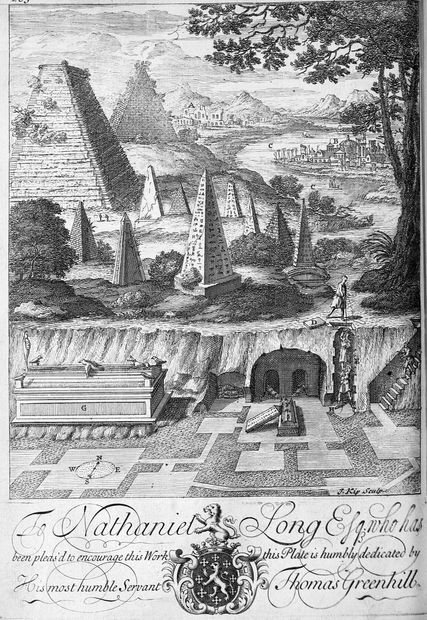
A. The Ruines of the antient City of Memphis.
B. The City of Babylon, now Grand Cairo.
C. The River Nile flowing from South to North.
D. A carv’d Stone the Cover of the Well.
E. The Well or Passage thro’ which they descended into the arch’d Chamber.
F. A Stone-Coffin carv’d with Hieroglyphicks, containing another of Wood mark’d G. which that it may be the better seen, is shown in another place, having 204an Image standing thereon, and some Tutelar Gods. At the Well or Passage E. a Servant holding by a Rope, descends with his Master upon his Shoulders, whom having set down at the bottom of the Well, he creeps upon his Belly through a Foramen at H. and then enters into a magnificent arch’d Chamber, in the middle of which is plac’d a Marble-Tomb, F. having a Mummy in it. Out of this, many Passages lead into other Chambers, which are so numerous and intricate, the way out is almost as difficult to find, as that of a Labyrinth.
From Memphis, the Court of the Egyptian Kings is said to have remov’d to Alexandria, and afterwards to Cairo; |Babylon.| but in respect that Babylon, now Cairo, lies opposite to Memphis, as is seen at Letter B, and this second Plate thereby better describ’d, I will begin with that first. This, in opposition to the great City of Babylon in Chaldæa, built by Semiramis, was also for distinction sake call’d the Egyptian Babylon: It is said to have been founded by Cambyses the Persian Monarch, the first that made this Kingdom stoop to the Yoke of a Foreign Power, and was by him peopled with some Babylonians or Chaldæans transplanted thither. It stood at some distance towards the South of Cairo, where now appear nothing hardly but great Mountains of Ruines, among which many of the Christian Temples and Monasteries lye in rubbish. The Castle hereof serv’d long after for a Garrison of three Legions, appointed to defend this Country in the Time of the Romans. Adjoyning to this Castle are Store-Houses, |Granaries of Joseph.| suppos’d to be of the Granaries of Joseph, which, as they say, he built, and therein laid up Corn against the ensuing Famine. 205In all they were seven, but now three only are standing, which are also employ’d to the same use: From hence, for the space of 20 Miles up the River, there are nothing but Ruines.
Old Cairo.
From the Ruines of this City, Babylon, Old Cairo was rais’d, being heretofore a most stately City, but now in a manner desolate, having been alter’d several Times, as the Conquerors or Lords of the Country thought fit. At length a more convenient and pleasant place of Abode was pitch’d upon, when about half a League off the Old, |New Cairo.| they built New Cairo, which for a long Time has been, and at present is, the chief City or Metropolis of all Egypt. The Italians call it Alcairo, and others, by way of Excellency, Grand Cairo. It is scituate on the East side of Nile, in a very pleasant Plain, at the foot of the rocky Mountain Muccat, winding therewith, and representing the form of a Crescent. It stretches, says Sandys, p. 92. South and North, with the adjoyning Suburbs, five Italian Miles, and is in breadth scarce one and a half where it is broadest; but as to the bigness or circumference of this City, Authors differ very much, because some will have it consist of four Parts, viz. Old Cairo, New Cairo, Boulac and Charafat, which, if we compare with London, the City of Westminster and Borough of Southwark, we shall find it at least three times bigger. For it is said, the parts of Cairo, together with its Suburbs, are 10 or 12 Leagues in length, 7 or 8 in breadth, and 25 or 30 in circuit, and yet is this City so exceeding Populous, that the People pass to and fro in throngs, altho’ the Women, according to the Custom of that Country, seldom or never appear abroad. Once in seven Years ’tis visited with a terrible Pestilence, 206insomuch that 1000 or 1500 have dy’d in a Day, nevertheless, if not above 300000 die within the Year, the City is reckon’d to be in good Health, and there is hardly any miss of the Deceas’d. There are said to be in it 18000 Streets, 23000 Mosques, and 200000 Houses, besides several Markets, Exchanges, Hospitals, and other magnificent Structures. Every Street is known by its Name, and fortify’d with a great Gate at each end, which at Night, to prevent Tumults and Uproars, are lock’d up with wooden Locks, and open’d with a Key of the same; for here all the Locks and Keys, even of the City Gates themselves, which are plated with Iron, are made only of Wood. The number of Men, which every Night guard this City, is 28000. There is a Canal or Khalis, as they call it, which runs the whole length of the City, and conveys thro’ it Water from the Nile. At the South end it is fortify’d with a stately Castle (the Palace of the Mamaluke Sultans) scituate on the top of a Mountain, overlooking the City and a great part of the Country. It is so large it seems a City of it self, environ’d with high Walls, divided into Partitions, and enter’d by Doors of Iron, and has within it spacious Courts, which in Time past were the places of Exercise. Now the Ruines of those antient Buildings only show how sumptuous they have formerly been, for there are Pillars of solid Marble yet standing, of so immense a Magnitude, that how they came thither is not the least to be wonder’d at. ’Tis not therefore without reason that this City was nam’d Grand Cairo, which is reported in great measure to be encompass’d with a Wall, and in which, says Thevenot, there are so many curious Things to be seen, that a very large Book might 207be fill’d with the relation of them. Among some of the extraordinary Things to be seen at Cairo, |The Hatching of Chickens.| is the artificial way of Hatching Chickens, upon which the aforesaid Author well observes, it might be thought a Fable to relate that Chickens are to be hatch’d without Hens sitting upon the Eggs, and yet a greater to say, that Chickens are sold by the Bushel, nevertheless they are both true. To effect this, they put their Eggs into Ovens, and heat them with a temperate warmth, which imitates so well the natural heat, that Chickens are form’d and hatch’d in them; but for the particular manner of this, I must refer you to Thevenot in his Travels, p. 144. where it is to be found more plainly describ’d. To Cairo are brought, over Land by the Caravan from Mecca, all sorts of Perfumes, Aromatics, precious Stones and Gums, |Drugs brought by the Caravan.| such as Olibanum, Frankinsence, Mastic, Myrrh, Amber and Opobalsamum, also Indian Stuffs, Indico, and other rich and valuable Commodities. The Caravan consists of many Thousands of Pilgrims, that Travel yearly to Mecca, out of Devotion and for Traffic. That City is distant from Cairo 40 easie Days Journey, separated by a Wilderness of Sand, that lies in drifts, and is often dangerous to the Traveller, when mov’d by the Wind, thro’ which he is guided in many places by the Stars only, as Ships are in the Ocean. The whole Caravan has above 1000 Horses, Mules and Asses, and 500 Camels. These are the Ships of Arabia, and their Seas are the Desarts. The City of Mecca, Capital of Arabia Fælix, lying near the Red Sea, is a Place of great Traffic, not only by reason of the Indian Caravans, that repair thither yearly with their Commodities, but also of the Country adjoyning, whose precious 208Productions have procur’d it the Name of Happy. From hence they go to Medina Talnabi, or the City of the Prophet, where in a little Chappel, lighted by 3000 Lamps that burn there perpetually, lye Mahomet, Omer and Haly, in plain Tombs of the antique Fashion, cut out like Lozenges. That of Mahomet (not hanging in the Air as is reported) is cover’d with green, having on the side a Carbuncle as big as an Egg, which yields a marvellous Lustre. These meet again the rest of the Caravan at the place appointed, as Sandys, p. 97. tells us, who gives the foregoing Account.
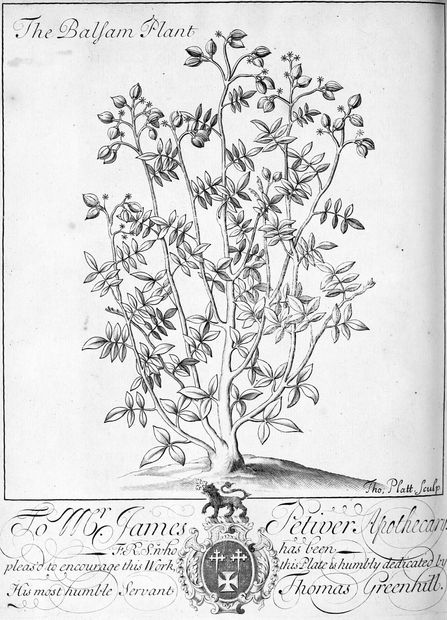
Five Miles North-East of the City Cairo, lyes a Village call’d El Matharia, |Matarea.| where, in a Garden, is preserv’d the Balsam Plant as a great Rarity: |The Balsam Plant.| Some falsly attribute the natural Production of it to this Country, and some to other Places, tho’, truly speaking, ’tis brought from Mecca in Arabia Fælix, beyond the Red Sea, by the Turkish Pilgrims when they go to visit Mahomet’s Tomb, and so has been cultivated in several Places, and renew’d by the same means whenever it dy’d. Thus the Balsam Plant grew and prosper’d in Judæa, as is attested by Theophrastus, Pliny, Justin, and many more; nay by Galen also, who purposely travel’d into Palæstin to see and learn the Virtues of this Balsam of Syria; likewise from the Story of Cleopatra, who obtain’d some Plants of Balsam from Herod the Great, to transplant in Egypt. Yet that this Plant was not in Judæa before the Time of Solomon, that great Collector of Vegetable Rarities, appears from the Account of Josephus, who relates how the Queen of Sheba, a part of Arabia, brought, among other Presents to that King, some Plants of the Balsam-Tree, as one of 209the most valuable Things in her Country; whereby it appears it was not an original Native Plant of Judæa, and others affirm also that it had not its natural Growth there, utterly denying it was peculiar to that Country, or only to be seen in two Gardens about Jericho. We are to rely chiefly on the Credit and Authority of Joannes Veslingius and Prosper Alpinus, who rightly conclude the natural and original Place of this Plant to be in Arabia, about Mecca and Medina, where it still plentifully grows, and Mountains abound therewith. From hence it has been carefully transported, by the Basha’s of Grand Cairo, to the Garden of Matarea, where, when ever it dies, it is renew’d from those parts of Arabia where it grew, from whence the Grand Signior yearly receives a Present of Balsam from the Xeriff of Mecca, still call’d by the Arabians Balessan, and whence ’tis suppos’d the Greek Apellative Balsam arose. The Shrub, which produces this Liquor, is about two Cubits high, with few Leaves, like to those of Rue, always green, and somewhat inclining to white, yet which fall not off in Winter. The Wood is gummy, cleaving to the Fingers, and outwardly of a reddish colour, with Branches of the same that are long, streight, slender and odoriferous, with a few Leaves disorderly plac’d, sometimes three, five or seven together, after the manner of the Mastic-Tree: It bears a few small white Flowers, like Acatia or the Egyptian Thorn, which are of a pleasant scent, but fade in a little Time. After the Blossoms follow yellow fine scented Seeds, inclos’d in a reddish black Bladder, very sweet, and containing a yellowish Liquor like Honey: They are bitterish and a little tart on the Tongue, and of the same shape and bigness with the Fruit of the Turpentine-Tree, 210in the middle thick, and at the ends pointed. The Juice call’d Opobalsamum, drops in the Summer-Time from the slit of the insected Bark, which no sooner comes into the Air but it turns whitish, afterwards green, then of a gold colour, and lastly becomes paler. When ’tis first dropp’d ’tis clear, but instantly turns thick and cloudy, and when old grows like Turpentine. ’Tis at first of so strong a Smell, that in many it causes the Head-Ach, and in some a sudden bleeding at the Nose; but this strong and sharp Savour at length changes into a pleasant Scent, which in old Balsam is so weak that you can hardly discover any Smell at all.
There is another sort of Balsam brought from Cairo, in Flasks and Leather-Bottles, which is very odoriferous, yet not the pure Liquor or Gum issuing from the Bark of the aforesaid Tree, but drawn out of the Wood and green Branches by boyling. Another sort is press’d out of the Seeds, and many times sold for the right, tho’ not so strong scented nor so bitter in Taste. There is no Medicine more generally us’d by the Egyptians than the True Balsam, which they esteem a kind of Panacea for all Diseases, both external and internal, curing therewith divers sorts of Wounds, as also the bitings of venomous Creatures. They use it moreover as a Preservative against the Plague, and to drive away Agues or Fevers that proceed from Putrifaction. The Seeds and green Branches, are likewise us’d against all Distempers that the Balsam it self is: The same Virtue is ascrib’d to the Wood; but the Balsam, term’d by the Greeks, Opobalsamum, is the strongest, the Seed or Carpobalsamum more gentle, and the Wood or Xylobalsamum the weakest of all. But 211the chief Use of the Balsam for our Purpose, is preserving the dead Bodies of Kings and Princes; from which Quality, and on account of its Analogy with Embalming, the Art it self deriv’d its Name from it, as we shall show hereafter, when we come to speak of its Etymology: Its other Virtues, which are very many, together with a more general Description of it, the manner of extracting the Liquor, and the true signs of its Goodness when unsophisticated, I intend to treat of more fully in my Pharmacopœia, in the Chapter of Balsams, &c. therefore shall here only insert the Draft of this Plant, which is very scarce, taken out of Prosper Alpinus de Plantis Ægyptiacis, and represented in our third Plate.
We come next, according to the Method propos’d, to speak of Alexandria, |Alexandria.| so call’d from Alexander the Great, who built this City upon a Promontory, thrusting it self into the Sea, by which on the one side, and the Lake Mareotis on the other, it is exceeding well defended. Here Alexander built himself a large and stately Palace of admirable Workmanship, and all the succeeding Kings of Egypt so enlarg’d and beautify’d this City, some with Ports and Arsenals, and others with magnificent Temples, and such like rich Donations, that it was then judg’d by many to be second, if not the first City of the World; being exceeding Populous, and plentifully provided with all sorts of Provisions and other Necessaries. Diodorus Siculus tells us, when he was there, he was inform’d by those that kept the Rolls of the Inhabitants Names, that there were above 300000 Freemen, and the King receiv’d above 6000 Talents yearly Revenue. This City Alexander peopl’d with Greeks, immediately upon his Conquest 212of Egypt, and some of his Successors had their Residence here for 900 Years. This was the Metropolis of Egypt before Grand Cairo was built; but Alexandria is now so ruinous, says Thevenot, that many Strangers ask where it is even when they are in the middle of it, yet are there such fair remains among the Ruines, as shew it to have been a wonderful Place. One of the finest Things, now to be seen there, are the Walls, which, tho’ ruin’d, are so Magnificent, one must needs confess they have been matchless. These Walls are strengthn’d with stately ranks of Pillars, and have 118 great square Towers, with a little one betwixt every two, nay, they are so neatly contriv’d, that there are stately Casemates underneath, which may serve for Galleries and Walks: In each Tower there is a large square Hall, the Vault whereof is supported by great Pillars of Thebaic Stone; there are a great many Chambers above, and over all a large Platform, above 20 Paces square. In short, all these Towers are so many Palaces, able to contain 200 Men each. The Walls are several Foot thick, and have every-where Port-holes in them, and formerly encompass’d the antient Town, fortify’d by such Towers. Next to the Walls, the finest piece of Antiquity that has withstood the rage of Time, is the Pillar of Pompey, |Pompey’s Pillar.| scituate about 200 Paces from the City, upon an Eminence or little Hill, whereby it is seen at a great distance: This Pillar stands on a square Pedestal seven or eight Foot high, and each Face about 14 Foot over; the Pedestal is fix’d on a square Base about half a Foot high and 20 broad, made of several Stones cemented together. The Body of the Pillar consists only of one Stone, which some believe to be 213of Granit; but Thevenot and others affirm, ’tis a sort of Cement, which, in process of Time, grew into Stone, or else was cast on the spot, for ’tis aver’d for truth, the Ancients had the Secret of casting Stones. But others absolutely deny this Stone was so made, affirming the antient Egyptians got these Pillars and Obelisks, that are to be seen at so many places in Italy, at Saide, where they pretend many have been cut out and brought by Water down the Nile: If this be true, what extraordinary Barks or Water Carriages must they have had, to bring so great a weight, and in so large a bulk, as was that of this Pillar, nay, what Engins to raise it on its Pedestal? Thevenot says, No Artificer could be found that would undertake to remove it to another place, and that it is 120 Foot high, but Le Bruyn, who measur’d it, found it to be but 90, yet as much as six Men could grasp round, which, according to his Calculation is 38 Feet. On the top is a fine Chapiter, proportionable to the bigness of the Pillar, but made of a distinct piece of Stone. ’Tis said Julius Cæsar erected this Pillar in memory of the Victory he obtain’d over Pompey.
Cæsar’s Palace.
At some Paces distant is Cæsar’s Palace, but all ruin’d, says Thevenot, except some Pillars of Porphiry that are now entire and standing, yet the Frontispiece is still pretty sound, being a very lovely piece of Architecture. About 80 Paces wide of Pompey’s Pillar is a Khalis or Canal of the Nile, dug by the antient Egyptians to bring Water to Alexandria, which has no other to drink. This, when the Nile swells and breaks down a Bank, fills the Cisterns that are purposely made under the City, and which are very magnificent and spacious; for Alexandria is all hollow underneath, being 214an entire Cistern, whose Vaults are supported by several fair Marble-Pillars, and upon these Arches the Houses are built. Now this Water of the Nile, so convey’d by the Khalis under the Town, is by Wheels, with Earthen Pitchers or Buckets, drawn up into the private Cisterns of each House. There are likewise to be seen at Alexandria two very stately Obelisks of Theban Marble, intermix’d or speckl’d with Veins of various colours: One of these remains entire, but so sunk into the Earth, that it appears without a Pedestal. The other is quite bury’d in the Ground, except the Pedestal only, which is about 10 Foot high; each of these are of one entire Stone, 100 Foot in height and eight in breadth, suppos’d to be larger than those at Rome, and mark’d with such like Hieroglyphical Figures.
Palace of Cleopatra.
Near these Pillars or Obelisks are the Ruins of Cleopatra’s Palace, by whose stately Chambers or Apartments, in some part remaining entire, it may reasonably be conjectur’d, it was a very superb and magnificent Building, as likewise by some remains, still to be seen on the Sea-side, of a Gallery supported by many fair Pillars, and running outwards to the Mouth of the Harbour, so that any one might embark there from the Palace. Thevenot tells us, in his Travels to the Levant, p. 125. that this City abounds with Marble, Porphiry and Thebaic Stone or Granit, as also that among the Ruins, there are several very curious Stones to be found, such as Agats, Garnets, Emeralds, &c. like to Medals, some engrav’d with Heads, others with Idols, and some with Beasts, all being different from each other, and serving heretofore for Talismen or Charms. These are so excellently well wrought, 215that certainly nothing now-a-days can come up to them, whereby it appears either their Engravers were wonderful Artists, or else they had the Art of casting, or at least of softning Stones; for tho’ some of these are so small one can hardly finger them, yet are they nevertheless all engrav’d or otherwise wrought to perfection.
This City of Alexandria was likewise very famous for its Academies or Colleges, endow’d with large Revenues, and planted with such Persons as were eminent in Liberal Sciences, who were drawn thither by Rewards, and cherish’d by Favours, thro’ which means Alexandria became the Parnassus of the Muses, and the School of all good Literature. The chiefest and most memorable Place of all these was the Serapion, |The Serapion.| or Temple of the God Serapis, for sumptuous Workmanship and magnificent Building inferior to none but the Roman Capitol. It had a curious Portico of a Mile in length, whereto adjoyn’d a Court of Justice and a Grove: In this last, the Followers of Aristotle’s Doctrine had a peculiar School, whereof the Alexandrians, as Eusebius and Nicephorus write, would needs impose the Charge on Bishop Anatolius, for his extraordinary Knowledge in all Arts. St. Mark the Evangelist was here first Divinity-Professor, whose Successor erected a School for Theology, wherein, for the advancement of the Christian Religion, several of the most learn’d Men were appointed Readers, who scholastically handled the main and fundamental Points only: Among these was Pantænus, who read both Divinity and Philosophy to all such as came to hear him, which, as it is conceiv’d, gave the first hint to the instituting of Universities throughout the rest of 216Christendom, insomuch that, from so small a beginning, the Schools of Alexandria became so great and eminent, that Nazianzen gave them the Title of Παντοίας παιδεύσεως ἐργαστήριον, The Shops or Workhouses of all Learning. Here also St Jerom, St. Basil, St. Gregory and others were educated, and Philo-Judæus likewise became eminent, for in this Academy the Jews had a flourishing and populous Synagogue; but what greatly encreas’d the glory of this Assembly, was that most wonderful Library of Ptolemy Philadelphus, |Library of Ptolemy.| Son of Ptolemeus Lagus, the second of that Name of the Line of the Egyptian Kings, first establish’d by him, and afterwards augmented and enrich’d by his Successors; for this King being an exceeding Lover of all Arts and Sciences, he, with great Labour and much Expence, made a Collection of all manner of Books, as well in Divinity as in all Arts, Sciences, History, and the like, some of which he obtain’d from Greece and other places, but the Pentateuch, and the rest of the Old Testament, he procur’d from Judæa. Then wrote this King to Eleazer the High Priest, to send him six out of every Tribe to Translate this Book for the common Use. These Ptolemy receiv’d at Alexandria with exceeding great civility, and erected several convenient Mansions for them, wherein every one was by himself to Translate the Holy Law, which they so perform’d, according to the Testimonies of Josephus, Clemens Alexandrinus, Eusebius Nicephorus, St. Austin, and other learned Writers, that they not only us’d the same Sense, but the very same Words also, yet that certainly not without the special Grace and Assistance of the Holy Spirit. Now this is the Translation which bears the Name of Septuagint to this very Day. |The Septuagint.| Moreover, 217this King sent to the Chaldeans, Romans and other Nations for Books, all which he likewise commanded to be Translated into the Greek Tongue. One Phalerius Demetrius, a Learned Athenian Exile, was Keeper of this Library, which amounted, as Agellius, Ammianus Marcellinus and Diodorus Siculus alledge, to 700000 Volumes, and was afterwards from Time to Time very much augmented by the succeeding Kings, ’till at length this invaluable Treasure of Manuscripts (for then the Art of Printing was not so much as thought of) was burn’d in the Civil Wars between Pompey and Cæsar, in the 183 Olympiad, after it had continu’d about 124 Years. This Cæsar ever after accounted the greatest of his Misfortunes, that he, who was so great a Lover of Arts and Sciences, should be Cause of the destruction of so incomparable and unparalel’d a Library.
The Serapion Library.
Another Library was afterwards erected by Cleopatra in the Serapion, a Building of great Excellency and wonderful Art: This was greatly adorn’d and enrich’d by the assistance of Marc Anthony, who acquir’d the Attalian and Pergamæan Libraries, and which continu’d during the Time of the Primitive Christianity; when, in the Days of Theodosius the Great, it was demolish’d, as a harbour of Infidelity. Among other remarkable Places in this City of Alexandria, was the Seraglio call’d Somia, belonging to the Palace, famous for its being the Burial-Place of the Ptolemys, and of Alexander the Great, |Alexander’s Sepulchre.| whose Body lay here inclos’d in a Sepulchre of Gold; but Cybiosactes despoil’d it of that precious Cover, after which, it was cover’d with Glass, and so remain’d to the Time of the Saracens, as Sandys, p. 87. informs us. Now since the Burial of Alexander 218the Great was manag’d, in all respects, suitably to his Grandeur, whereby it not only exceeded all others in regard of Expence, State and Pomp, but also in point of curiosity of Workmanship, Diodorus Siculus, Lib. 18. cap. 3. thought fit to recommend to Posterity these remarkable and entertaining Matters concerning it, viz. That to Aridæus, Bastard Son of Philip, and Brother of Alexander, whom he succeeded, the care of his Funeral, and preparing a Chariot to convey his Body to the Temple of Jupiter Ammon, was commited. First therefore he provided a Coffin of beaten Gold, wrought in form and proportion to his Body: This he fill’d with Aromatic Spices, as well to delight the Senses, as to preserve the Corps from Putrifaction, and then fitted it exactly with a Cover of Gold, which again was over-spread with a purple Pall, embroider’d with Gold, and near it were plac’d the Arms of the Deceas’d, thereby to represent the Acts of his Life. Then were these plac’d in a Chariot under a Triumphal-Arch of Gold, beset with precious Stones, and supported by Pillars and Chapiters of Gold also, made after the Ionic Order. On each side the Arch stood a Golden Image of Victory bearing a Trophy, and on the top was a Gold-Fringe of Net-Work, from which hung Bells so large, that they might be heard at a great distance. Under this Portico or Arch was plac’d a four square Throne of Gold, adorn’d with little Coronets of various beautiful Colours. On every side of this Arch, from a Net-Work of Gold, a Finger thick, hung four Tables or Pannels, whereupon were pourtray’d all sorts of Creatures. In the first Table was represented Alexander sitting in a Chariot, with a Royal Scepter in his Hand, his Armour-Bearer before 219him, and his Life-Guards, compleatly arm’d, round about him. In the second follow’d Elephants, adorn’d in their proper Habiliments, on which sat Indians before, and Macedonians behind, arm’d according to the Customs of their respective Countries. In the third might be seen Squadrons of Horse drawn up in Battalia; and in the fourth appear’d a Fleet order’d in a Line of Battel. At the entrance into this Arch were plac’d Golden Lions, looking sternly towards those that should offer to enter. On the out-side of the Arch, and middle of the Roof, was plac’d on a purple Carpet, a Crown of Gold, so large, that by the reflection of the Sun-Beams, it darted such an amazing splendor and brightness, that at a distance it appear’d like a flash of Lightning. The whole Work was set upon two Axel-Trees, the ends of which were likewise of Gold, representing Lions Heads with Darts in their Mouths. The whole Machine was mov’d by four Wheels, whose Spokes and Naves were also over-laid with Gold, and there were four Poles to draw it by, to each of which were yok’d 16 of the largest and finest Mules that could be got, in all 64. Every Mule was adorn’d with a Crown of Gold, Bells of Gold on either side their Heads, and rich Collars about their Necks, set off and beautify’d with precious Stones. After this manner did the Chariot set forth, the sight of which was more stately and pompous than can be imagin’d, so that its Fame brought together Multitudes of Spectators; for the People out of every City, whither it was coming, met it, and then ran back again before it, never satisfy’d with the delight they took in gazing on it; and, suitable to so stately a Show, attended a vast company of Workmen and Pioneers to clear the way for its Passage. 220Thus Aridæus (who spent two Years in Preparations for it) brought the King’s Body from Babylon to Egypt. Ptolemy, in Honour to this great King, met the Corps with his Army as far as Syria, where he receiv’d and accompany’d it with great Respect and Observance; for he had resolv’d not to conduct it to the Temple of Jupiter Ammon, but to keep it in this City which Alexander had built, being the most famous almost of any in the World. For this end he built a Temple in Honour of Alexander, in greatness and stateliness of Structure, becoming the Glory and Majesty of so great a King; and in this Repository laid the Body, and honour’d his Exequies with Sacrifices and magnificent Shows, agreeable to the State of a Demi-God: Thus much for the glorious Sepulchre and Burial of the greatest Monarch perhaps that ever liv’d. Next we shall take notice of two Physiological Observations on the Earth and Water of Egypt, made by Father Vansleb in his Voyage thither, p. 109. 111. where, speaking of Alexandria, he tells us the Earth thereabouts is full of Nitre, which is easily prov’d by the following Experiment, viz. That if you take a piece of Earth and set it in the hot Sun, it will become white as Snow on that side that is towards the Sun. Also in the Grand Signior’s Salt-Pits, that are out of this City, near the Khalis or Chanel of Cleopatra, he took notice of two things very remarkable: First, That the Water of Nile, the sweetest and freshest in the World, makes a Salt, not only whiter than ordinary, but likewise very excellent. Secondly, That this Salt has the taste of Violets. The last thing, but not the least, that I have to say of Alexandria, |Isle of Pharos.| is concerning the famous Isle of Pharos, which stands over-against the City, and was formerly 221a Mile distant from the Land, but joyn’d to the Continent by Cleopatra, on the following occasion, says Heylin, p. 849. The Rhodians, then Lords of the Sea, us’d to exact some Tribute or Acknowledgement from every Island within those Seas, and consequently from this: Their Embassadors, upon this Occasion, sending to Cleopatra to demand this Tribute, she deferr’d it for seven Days, under pretence of celebrating a Solemn Festival, but in the mean Time, by raising huge Dams and Banks in the Sea, both with incredible charge and speed, she united the Island to the Shoar, which finish’d, she sent away the Rhodians empty-handed, with this witty Jeer, That they were to take Toll of the Islands, and not of the Continent. A Work of great rarity and magnificence this, both for its extent, taking up the space of seven Furlongs, and thence call’d Heptastadium, and the incredible speed wherewith it was finish’d. Upon a Promontory hereof, on a Rock, environ’d by the Sea, Ptolemy Philadelphus caus’d a Watch-Tower to be built for the benefit of Sailors, (the Seas upon that Coast being very unsafe and full of Flats) to guide them over the Bar of Alexandria. This Pharos or Watch-Tower was of wonderful height, ascended by Steps, and having many Lanthorns at the top, wherein Lights burn’d nightly, as a Direction to such as sail’d by Sea; yet oftentimes the multitude of Lights appearing a far off as one, and being mistaken for a Star, procur’d contrary effects to the promis’d Safety. This had the repute of the Worlds seventh Wonder, call’d after the Name of the Island, and is at this Day a general Name for such Towers as serve to that purpose. The Materials of it were white Marble, and the chief Architect Sostratus of Gnidos, 222who grav’d upon it this Inscription: Sostratus of Gnidos, Son of Dixiphanes, to the Gods Protectors for the safeguard of Sailors. This Inscription he cover’d over with Plaister, and inscrib’d thereon the Name and Title of the King, Founder of this Tower, to the end that when the King’s Name should be wasted and wash’d away, his own, which was cut on Marble, might be celebrated to Eternity.
To the South side of the City of Alexandria, near the Lake Mareotis, wherein the Sepulchres of King Mœris and his Wife were Pyramidically built, adjoins the Labyrinth, |The Labyrinth.| not much inferior to that Structure, as will appear from that Description given by Sandys, p. 88. where he tells us, ‘That in the midst of this Labyrinth were 37 Palaces, belonging to the 37 Jurisdictions of Egypt; to which resorted the several Presidents to celebrate the Festivals of their Gods (who had herein their particular Temples, moreover 15 Chapels, containing each a Nemesis) and also to advise of Matters of Importance relating to the Public Good. The Passages thereunto were thro’ Caves of a miraculous length, full of dark and winding Paths, and Rooms within one another, having many Doors to confound the Memory and distract the Intention, and leading into inextricable Error: Now mounting aloft, and then again re-descending, not seldom turning about Walls infolded within each other, in the form of intricate Mazes, not possible to thred or get out of without a Conductor. The Building was more under Ground than above, being all of massy Stone, and laid with that Art, that neither Cement nor Wood was us’d in any part of the Fabric. The end at length being attain’d, a 223pair of Stairs of 90 Steps, conducted into a stately Portico, supported by Pillars of Theban Marble, and this again gave entrance into a spacious Hall, the place of general Conventions. All this Hall was of polish’d Marble, and adorn’d with Statues both of Gods and Men. The Chambers were so dispos’d, that upon their opening, the Doors gave Reports no less terrible than Thunder. The first Entrance was of white Marble within, adorn’d throughout with Marble Columns, and divers Figures.’ Dedalus is said to have imitated this, in that Labyrinth he built in Crete, yet expressing hereof scarce the Hundredth part; for, as Heylin observes, it fell as short of the Glories of this, as Minos was inferior to Psammiticus (the Founder) in Power and Riches. ‘Whoso mounted the top, should see as it were a large Plan of Stone, and withal, those 37 Palaces environ’d with solid Pillars, and Walls consisting of Stone of a mighty size. At the end of this Labyrinth stood a square Pyramid of a marvelous breadth and answerable height, being the Sepulchre of King Ismandes that built it.’ |By whom, and to what end built.| But who built this Labyrinth, and to what end, Authors differ very much, and Pliny, who writes a great deal of it, gives no certain Reason why it was made. ’Tis said it was first built by King Petesucus or Tithoes, altho’ Herodotus affirms ’twas the Work of all the Kings, and lastly of Psammiticus. The cause of building it is as variously reported: Demoteles thinks it to have been the Palace of Motherudis; Lycias, that it was the Sepulchre of Mœris (of which Opinion is also Diodorus) but most believe ’twas built as sacred to the Sun. Bellonius thinks it to have been a Sepulchre rather than any thing else, for such like magnificent 224Works, as was also the Mausoleum, were commonly rais’d for that end, and Herodotus clearly describes this wonderful Labyrinth to have been built for a Sepulchre, telling us, ‘The Kings of Egypt, where they perform’d their Sacred Rites, resolv’d to leave a common Monument of themselves, therefore in that Place, which is a little above the Lake of Mœris, and near the City of Crocodiles, they built a Labyrinth, which Herodotus himself saw, and which he says was much bigger than Fame had represented it; for if any one should reason with himself about the Walls and nature of this Work, according to the Narration of the Greeks, he would never conceive the Labour and Charge of this Labyrinth. The Temple of Diana at Ephesus is very well worth mentioning, yet are the Pyramids far greater, the least of which equals the largest Labour of the Grecians; and tho’ this Labyrinth likewise excels them, yet does the Lake Mœris, near which it is built, and the Description of which you have at p. 141. afford much greater admiration.’ The former of these, viz. the Labyrinth, is said to have been for the Sepulchre of those Kings that built it, and for the Sacred Crocodiles; and the latter to contain the Sepulchres of King Mœris and his Wife.
The Wall built by Sesostris.
Not to describe particularly that prodigious Wall built by Sesostris, which defended the East side of Egypt, against the Irruptions of the Syrians and Arabians, being 1500 Furlongs in length, and extending from Pelusium by the Desart as far as Heliopolis; we come next to speak of those famous Walls belonging to the City of Babylon in Chaldea, built by Semiramis the Wife of Ninus, a Princess, who being naturally of an 225high aspiring Spirit, was ambitious of excelling all others in glorious Actions. So soon therefore as she had bury’d her Husband Ninus, |Ninus his Sepulchre.| King of Assyria, in the Royal Palace, and rais’d over him a Mound of Earth of wonderful bigness, which as Ctesias reports, standing at some distance from the City that lay in the Plain, appear’d like a stately Cittadel, being 9 Furlongs high and 10 broad: She provided her self of 2000000 Artists and Workmen to build this City of Babylon in one Year, |Babylon in Chaldea.| so ordering it that the River Euphrates should flow thro’ the midst of it, as Diod. Siculus, Lib. 2. cap. 1. informs us. She next encompass’d it with a Wall as many Furlongs in circuit as there are Days in the Year, viz. 365: This Wall was 300 Foot high and 75 broad, insomuch that Coaches might meet and turn upon it; She adorn’d it with 250 Turrets of suitable proportion: Then she made a Bridge 5 Furlongs in length, over the narrowest part of the River, and Floor’d it with great Joists and Planks of Cedar, Cypress and Palm-Tree, 30 Foot long: At each end of this Bridge, just on the Brink of the River, she built a Palace, whence she might have a Prospect of the whole City: Then in a low Ground she sunk a four square Pond, every Square being 300 Furlongs and the depth of the whole 35 Foot, lining it with Bricks, cemented together with a sort of Bitumen of a very glutinous Nature like Asphalt, which work’d out of the Earth so plentifully thereabouts, that it not only supply’d the People with Fuel, but serv’d them also instead of Mortar for their Buildings, and with which both the Palaces and Walls of this City were cemented. Afterwards, by turning the River aside, she made a Passage in the nature of a Vault from one Palace to 226another, and then let the Water again into its former Channel, which immediately overflow’d the whole Work, by which means she could go under the River when she had not a mind to pass over it. She likewise made two brazen Gates, one at each end of this Vault, as also Banqueting-Houses of Brass, into which passages were open’d by certain Engins. Here might be seen brazen Statues of Ninus, Semiramis and all the great Officers, as likewise Armies drawn up in Battalia. These Palaces were moreover surrounded with Walls, 30 Furlongs in circuit, with Turrets on them 140 Yards high, on whose Bricks were pourtray’d, before they were burn’d, all kinds of living Creatures, with great Art and curious Painting, particularly a general Hunting of all sorts of wild Beasts, each Beast being four Cubits high: Among these was Semiramis on Horseback, striking a Leopard thro’ with a Dart, and near her Ninus her Husband peircing a Lion with his Lance.
In the middle of the City she built a Temple to Jupiter Belus of exceeding great height, |Temple of Belus.| by the advantage of which, the Chaldean Astrologers observ’d the setting and rising of the Stars. Upon the top of it she plac’d three Statues of Jupiter, Juno and Rhea, all of beaten Gold. That of Jupiter was about 40 Foot high, and Juno held in her hand a Scepter adorn’d with precious Stones. These three Statues weigh’d 2830 Babylonish Talents, and for these Deities, there were plac’d on an Altar of beaten Gold, 40 Cubits long and 15 broad, Censors, Cups and Drinking-Bowls of Gold likewise, weighing at least 3230 Talents. Besides the richness of this City, it was so vast and great that Aristotle said, it ought rather to have been 227call’d a Country, adding withal, that when the Town was taken, it was three Days before the farthest part had notice of it.
The Pensil Garden.
Here likewise was the Pensil Garden so much fam’d, being 400 Foot square, with an ascent to it like to the top of a Mountain, and having Buildings and Apartments out of one into another, like a Theatre. Under the Steps of the Ascent were Arches, gradually rising one above another, and supporting the whole Building, the highest Arch upon which the Platform of the Garden was laid being 50 Cubits high, and the Garden it self surrounded with Battlements and Walls 22 Foot in thickness. The whole Fabric was floor’d over with massy Stones, 16 Foot long and 4 broad, and these again cover’d with Reeds run over with Bitumen, upon which were laid double Tiles, set together with hard Plaster, and those cover’d with Sheet-Lead, that the wet which should drain thro’ the Earth might not rot the Foundation. Upon all these was laid Earth of a convenient depth, which was planted with all sorts of Trees, that for largeness and beauty might delight the Spectators. The Arches had in them many stately Rooms of all kinds, and for all purposes; one of these had a certain Engin, that drew plenty of Water out of the River for watering the Garden, after such manner as none above knew how it was done. This Garden was built in latter Ages by Cyrus, at the request of a Persian Courtesan, who, coveting Meadows on the tops of Mountains, desir’d the King, by an artificial Plantation, to imitate the Land in Persia.
Semiramis built other Cities on the Banks of Euphrates and Tigris, and likewise caus’d a great Stone 228to be cut out of the Mountains of Armenia, 125 Foot in length and 5 in breadth and thickness, which she convey’d to the River by the help of many yokes of Oxen and Asses, and there putting it on board a Ship, brought it to Babylon, where she set it up in the most remarkable Place, as a wonderful Spectacle to all Beholders. |Obelisk of Semiramis.| This from its shape was term’d an Obelisk, signifying in Greek, a Spit, and accounted, says Diodorus, one of the seven Wonders of the World; from whence we have a very good Argument, that the Egyptian Obelisks were cut out of Rocks or Quarries, and not cast as some have suppos’d. Semiramis having finish’d these Works, went to the Mountain Bagistan in Media, which is 17 Furlongs from top to bottom, and there caus’d her own Image to be carv’d on the side of the Rock, and 100 of her Guards with Lances round about her. She also made a Garden on the middle of an exceeding high Rock, and built therein stately Houses of Pleasure, from whence she might have both a delightful Prospect into her Garden, and view her Army encamp’d below on the Plain: Likewise that she might leave behind her a lasting Monument of her Name, she in a short Time, yet at vast expence, made a shorter Passage towards Ecbatana, for by hewing down the Rocks, and filling up the Valleys, she laid that Way open and plain, which to this Day is call’d Semiramis’s Way. She plentifully supply’d Ecbatana with wholsome Waters, by means of a Canal she dug, 15 Foot over and 40 Foot deep, beginning from the foot of the Mountain Orontes, and as she went thro’ Persia and Asia, she plain’d all along the way before her, levelling both Rocks and Mountains. On the other hand, in Champagne Countries, 229she rais’d Eminences, whereon she either built Towns and Cities, or else Sepulchres for her Officers and great Commanders. Many other wonderful Things were done by this Queen, which seem to exceed common Belief; but as for those more admirable Works of the Egyptians, Herodotus, Diodorus Siculus, Strabo, Pliny and others are full of Relations of what they have been, and the present Remains of some of them at Rome are sufficient Arguments to evince there were such, so that we should but loose Time in endeavouring to prove that which we now hope every one is satisfied of. Our next business therefore, must be to enquire how these Arts came first to be found out, and by what means they were accomplish’d and brought to so great Perfection: What these Arts and Sciences were, suppos’d by Authors to have been found out by the Egyptians, I have already shown else-where, so shall here only add, that Hermes or Mercury is reported by Diodorus Siculus and other Writers, to have been the chief Inventor of them; but as no Art was ever invented and compleated at one Time, so neither was it ever invented and perfected by one Person so far, but another could add somewhat more commodious or advantagious to it.