Zoological Illustrations,
Reading edition
OR
ORIGINAL FIGURES AND DESCRIPTIONS
OF
NEW, RARE, OR INTERESTING
ANIMALS,
SELECTED CHIEFLY FROM THE CLASSES OF
Ornithology, Entomology, and Conchology,
AND ARRANGED ON THE PRINCIPLES OF
CUVIER AND OTHER MODERN ZOOLOGISTS.
BY
WILLIAM SWAINSON, F.R.S., F.L.S.,
MEMBER OF THE WERNERIAN SOCIETY OF EDINBURGH, ETC.
VOL. I.

London:
PRINTED BY R. AND A. TAYLOR, SHOE-LANE:
FOR BALDWIN, CRADOCK, AND JOY, PATERNOSTER-ROW; AND W. WOOD, STRAND.
1820-1.
PREFACE.
The termination of the first volume of the Zoological Illustrations is accomplished, and its contents will not only enable our readers to discern the nature of the work, but likewise to form a judgement, on that degree of improvement which we have introduced since its first publication, and they may safely rely on the continuation being in no respect inferior.
In commencing a work of this nature, we have had two principal objects in view: the diffusion of original observations, which, while they might further the ends of science, would also be interesting to the general reader; and that of discouraging the publication of distorted figures copied from old authors, by accustoming the public eye to original designs and correct representations of natural objects. How far we may have succeeded in this latter object, remains to be judged by others; we are however satisfied with having made the attempt, and we hope that abler pencils than our own, may engage in the prosecution of this most desirable object; for it is only by the publication of original matter, that a check can be given to the increasing number of compilations and multiplied copies of "ill-shaped" figures, by which error is perpetuated, and science retarded.
The only original work that has appeared in this country similar to our own, is the Zoological Miscellany by Dr. Leach, which, as it was discontinued after the third volume, it may be presumed was unsuccessful: although little can be said of many of the figures in the early volumes, those in the latter are much to be praised, and the whole are original; the descriptions also abound with details highly interesting to the scientific world, for which indeed the learned author principally intended it; nevertheless it is a question, whether science in the end would not have been equally, and perhaps more advanced, had this work been more adapted to general readers. Instruction in these days of refinement must be made easy, palatable, and enticing; the eye must be pleased, while the understanding is improved, and Wisdom in her simple dignified garb will often be deserted for Ignorance, decked out in the glittering trappings of Folly.
The Naturalist's Miscellany conducted by Dr. Shaw, in its miscellaneous nature also resembled the present work, and reached to the extent of twenty-four volumes. What an invaluable fund of information these might have contained had their contents been original! Unfortunately, however, the exceptions are so few, that the whole may be termed a loose compilation, the descriptions being mostly given in as few words as possible, and the figures not only copied from wretched representations found in old authors, but often coloured from their descriptions only! It is indeed lamentable that the Author, whose talents and abilities were unquestionable, should have exerted them so little, and thus have descended to the rank of a voluminous compiler, for little better can be said of the General Zoology, begun and continued under his name: little original matter can there be found, excepting in the latter volumes, yet even in these no notice whatever is taken of the immense number of new species discovered in Africa by Le Vaillant, and long ago published in the Oiseaux d'Afrique: the engravings also are in like manner copied from old prints, enlarged or diminished as occasion offers, without even a regard to the selection of the best. It may be as well to observe in this place, that a great number of generic distinctions have been made in the two last volumes; which, as they have not been followed by any of the great and acknowledged Zoologists on the Continent, and appear to us in many instances trivial and unnecessary, will not be adopted in this work.
It will be unnecessary to point out with regard to the scientific arrangement, that we have avowedly adopted the principles of the modern classification; which the strict followers of Linnæus (in this country alone) have so long, but so ineffectually opposed. The first has been designated as the natural, and the other the artificial system; and, without entering into a critical disquisition on these definitions, it will be sufficient to observe, that by the Artificial System we bend nature to conform to certain arbitrary principles, which we lay down and to which we insist all her productions known and unknown will conform; while in the Natural method, we endeavour by tracing her modifications, to adapt our system to that which appears to regulate her operations. In the one we give laws, in the other receive them; by the first we are taught to believe that the highest attainment of the science, is that of ascertaining the name of an object in our Museum, or of giving a new one; we record it in our favourite system as a grammarian enters a new word in his dictionary, and there the matter terminates. Where the artificial system ends, the natural begins; for we then proceed to the investigation of affinities founded on anatomical construction, economy, and geographic distribution; our attention ceases to be confined to individuals, and extends to large groups; general facts enable us to draw general conclusions, till the mind begins faintly to discern a vast and mighty plan, by which the zones of the earth are peopled by their own respective races of animate beings; blending their confines unto each other with divine harmony, beauty, and usefulness.
That these inquiries and results have had a most wonderful effect on the natural sciences of late years, is abundantly evident. Geology, a subject hardly thought of in this country a few years ago, is now found to be a science of the first importance; with this, however, Conchology is so intimately connected, that without a certain knowledge of it, the geologist is frequently unable to prosecute inquiries of the most interesting nature; and there is little doubt but that Botany has been raised to the rank it now so justly holds, solely because its natural system has been more generally studied and advocated in this country, than that of any other branch of Natural History. In this science at least, we possess a superiority which our continental neighbours cannot dispute; and the name of Brown will be enrolled in the brightest page of our philosophic inquirers.
That the prejudiced adherence to the strict Linnæan system, has been the primary cause why Zoology has been more neglected with us than on the Continent, will admit of little doubt; for by shutting the door to all further improvement, it has impressed the generality of our countrymen with an idea, that the highest object of the Naturalist was to label the contents of a museum, and to arrange stuffed animals, like quaint patterns of old china, in glass cases: to thinking minds no less than to the vulgar, this idea has produced a feeling of contempt and ridicule, and very few of those qualified by nature for accurate investigation and philosophic reasoning, have been induced to make the science a study; and thus from such an unfortunate prejudice, to use the words of a powerful writer of the present day, "some future historian of the progress of human knowledge, will have to state that England, till within the few last years, stood still at the bottom of the steps where Linnæus had left her; while her neighbours were advancing rapidly towards the entrance of the temple[1]."
Finally—Linnæus to a comprehensive genius united indefatigable industry; yet he could not see and study those innumerable productions that have been discovered since his death: in proportion as our knowledge of objects increases, so must our systems change, until the natural one is fully developed; and the question simply comes to this, Whether the Linnæan method should be upheld as a solitary exception to the mutability of human wisdom.
The sun of truth must however finally prevail, and there is every reason to think it has already broke, and will gradually disperse these mists of prejudice. It is however much to be regretted, that our public institutions are wholly inadequate to facilitate not only the advancement of students, but the researches of those who are already engaged in prosecuting their inquiries: in Scotland alone are founded any Professorships of Natural History, and the establishment of our National Museum (in this branch only) is confessedly difficult: materials for study are more necessary in this science than any other; yet the public Institutions and libraries of the metropolis, "rich and rare" in every other department of knowledge, in most instances are deficient in this of the most elementary books; setting aside those of illustration, which, from being unavoidably expensive and within the reach of few purchasers, are more particularly adapted for such general repositories of learning. The protracted ill-health of its noble possessor, was the cause no doubt of the Banksian magnificent library being left deficient in several of the latest continental works; and that of the British Museum I have reason to think is still more defective. To the honour however of the keepers of the Bodleian and Radcliffe Libraries, it should be mentioned, that no pains or expense have been spared to render them as perfect in this branch as possible; and we have been told that the latter particularly is the most magnificent in the kingdom.
We shall now as briefly as possible advert to the contents of this volume.
In the Ornithological department the systems of Cuvier and Temminck have mostly superseded all others: as a whole, we give a decided preference to the latter, as being more natural, though it may be doubted if the generic distinctions are not too few, while those of Cuvier are too many: both however can be considered only as sketches, subject to improvement—as natural affinities are more studied.
Regarding that part of our work which relates to Entomology, we have given a decided preference to the Lepidoptera, for the simple reason that this order has received less attention from all writers, concerning their real characters and affinities, than any other; indeed they have been most unaccountably neglected even by Latreille, the great founder of the modern school: we have therefore thought it necessary to propose in this department many new genera, and only have to regret that their definitions could not be made more perfect without the destruction of the specimens, frequently not our own, and which therefore was unattainable: a more extended knowledge of the natural affinities existing in this tribe, will alone confirm or annul the propriety of these distinctions.
In Conchology many of the genera long established on the Continent, but new to our own collectors, have been characterized and illustrated, as well as specific distinctions defined between shells hitherto considered as varieties; and here it must be observed that so much latitude has been given to the meaning of the term variety, that in its general acceptation its definition becomes impossible: our own idea of its true meaning is, a shell possessing one or more characters which are changeable and uncertain, and which consequently will not serve as indications by which it may infallibly be distinguished from all others; variety depends on local circumstances, and affects the size, colour, and greater or less development of the same modification of structure; a species is permanent, its structure always the same though more or less developed, producing and perpetuating its kind, and depending on formation, discernible in youth, and matured in age: we cannot therefore comprehend the contradictory term of permanent varieties in a state of nature (though such occur in domesticated animals), which some authors have used, and which has led to, in many instances, the most erroneous conclusions.
It is lamentable to see the opposition which is still made by our own writers against all the modern improvements; yet although Linnæan Introductions to Conchology are constantly issuing from the press, the desire of being acquainted with a more natural and intelligible classification has already appeared; and as we are frequently questioned on the subject, we cannot in this place do better than refer the young student to the valuable article on Conchology contained in the late supplement to the Encyclopedia Britannica, the perusal of which will convey more solid information, and less perplexity, than all the Introductions our booksellers can boast of.
With respect to the quotations or synonyms, it should be observed that we have in most instances limited them only to original works, all doubtful ones have been rejected, and such only given as have been actually consulted; indeed to this latter cause must be attributed the occasional omission of some, existing in books we had not the immediate power of consulting; our own library is not small; but the difficulty and expense of procuring all the new continental publications, and the impossibility of meeting with them at our public libraries[2], may have sometimes led us into error, and unintentionally to have passed over the discoveries of others.
With the few additions contained in the Appendix we shall now conclude; trusting that in the remarks drawn from us by the present state of the science in this country, our zeal for truth will not give us an appearance of want of candour or of vanity. The truth of our remarks on the labours of others, every one at all acquainted with the subject can inquire into, and either acknowledge or disprove: we neither deprecate nor despise criticism: an author who presumes to instruct others, should have his pretensions publicly canvassed, his merits admitted, or his deficiency exposed; no one is more sensible than we are that our own pretensions chiefly consist in having set an example for others more able to follow: and if we have in any way advocated the cause of truth and science, our object will be attained, and we shall then gladly retire in the shade.
London, Sept. 15, 1821.
LIST OF BOOKS REFERRED TO.
Bruguire, Encycl. Meth. Histoire Naturelle des Vers, par M. Bruguire, 1 vol. 4to. and 4 vols. of Plates, forming part 10, 19, 21, 23, of the "Encyclopedie Méthodique." Paris, 1789-1792.
Bloch. Histoire Naturelle des Poissons, en 6 parties, 8vo. Berlin, 1796.
Cramer. Papillons Exotiques, 4 vols. 4to. Amsterdam, 1779-1782.
Cuvier. Le Règne Animal, 4 vols. 8vo. Paris, 1817.
Chemnitz, Martini. Neus Systematisches Conchylein Cabinet, 11 vols. Nurnburg, 1781-1795.
Dill. A Descriptive Catalogue of Recent Shells. By F. W. Dillwyn, 2 vols. 8vo. London, 1817.
Edwards. A Natural History of uncommon Birds, &c.; and Gleanings of Natural History. By G. Edwards, 7 vols. 4to. 1763, &c.
Fab. Ent. Syst. Entomologia Systematica, emendata et aucta. J. C. Fabricius, 4 vols. 4to. Hafnia, 1792-1794.
Gen. Zool. General Zoology, commenced by Dr. Shaw, and continued by Mr. Stevens, 11 vols. 8vo. to 1819.
Gmelin Linn. Syst. Nat. C. Linné Systema Naturæ. Cura J. F. Gmelin. Lipsiæ, 1788-1793.
Godart in Encycl. Method. Encyclopedie Méthodique, t. 9. p. 1. 1819.
Gualtieri. Index Testarum Conchyliorum quæ adservantur in Musæo N. Gualtieri. Florentiæ, 1742.
Illiger. Prod. Systematis Mammalium et Avium, 8vo. Berolini, 1811.
Knorr. Les Delices des Yeux et de l'Esprit, 6 P., 4to. Nuremb. 1760, &c.
Klein Hist. Pisc. Historiæ Nat. Piscium promovendæ Missus, 6, 4to. Dantzic, 1740-49.
Linn. Syst. Nat. See Gmelin.
Linn. Trans. Transactions of the Linnean Society of London, 13 vols. 4to. 1791-1821.
Lister. M. Lister Historia Conchyliorum, folio. Oxonii, 1770.
Lamarck Syst. Hist. Nat. des Animaux sans Vertèbres. Par le Chevalier de Lamarck, 6 vols. 8vo. Paris, 1815-1819.
—— Anal. Mus. Annales du Museum d'Histoire Naturelle de Paris, 4to. 1802-1821.
Lath. Synop. Suppl. A General Synopsis of Birds. By Dr. J. Latham, 3 vols, and 2 Supplements, 4to. London, 1782, &c.
—— Index Ornith. Index Ornithologicus, 2 vols. 4to. London, 1790.
Martyn Univ. Conch. The Universal Conchologist. By T. Martyn, 4 vols. 4to. London, 1784, &c.
Martini. See Chemnitz.
Pennant. British Zoology. By T. Pennant, 4 vols. 8vo. London, 1812.
Risso Icth. Ichtyologie de Nice, 1 vol. 8vo. Paris, 1810.
Rumph. Thesâurium Imaginum Piscium, &c., folio. Hagæ, 1739.
Seba. Albertus Seba Rerum Naturalium Thesauri, 4 vols. folio. Amsterdam, 1734-1765.
Say. Description of the Land and Fresh-water Shells of the United States. By Thomas Say. Philadelphia, 1819.
Shaw in Gen. Zool. See General Zoology.
Temminck Pig. et Gall. Histoire Naturelle Générale des Pigeons et des Gallinaces. Par C. J. Temminck, 2 vols. 8vo. Amst. 1813.
—— Manuel. Manuel d'Ornithologie, 2d edit., 2 vols. 8vo. 1820.
Le Vaill. Hist. Nat. des Toucans et des Barbus, folio. Paris, 1806.
—— Hist. Nat. des Perroquets, 2 vols. folio. Paris, 1801.
White's Voyage. Journal of a Voyage to N. S. Wales, 4to. Lond. 1790.
Pl. 1
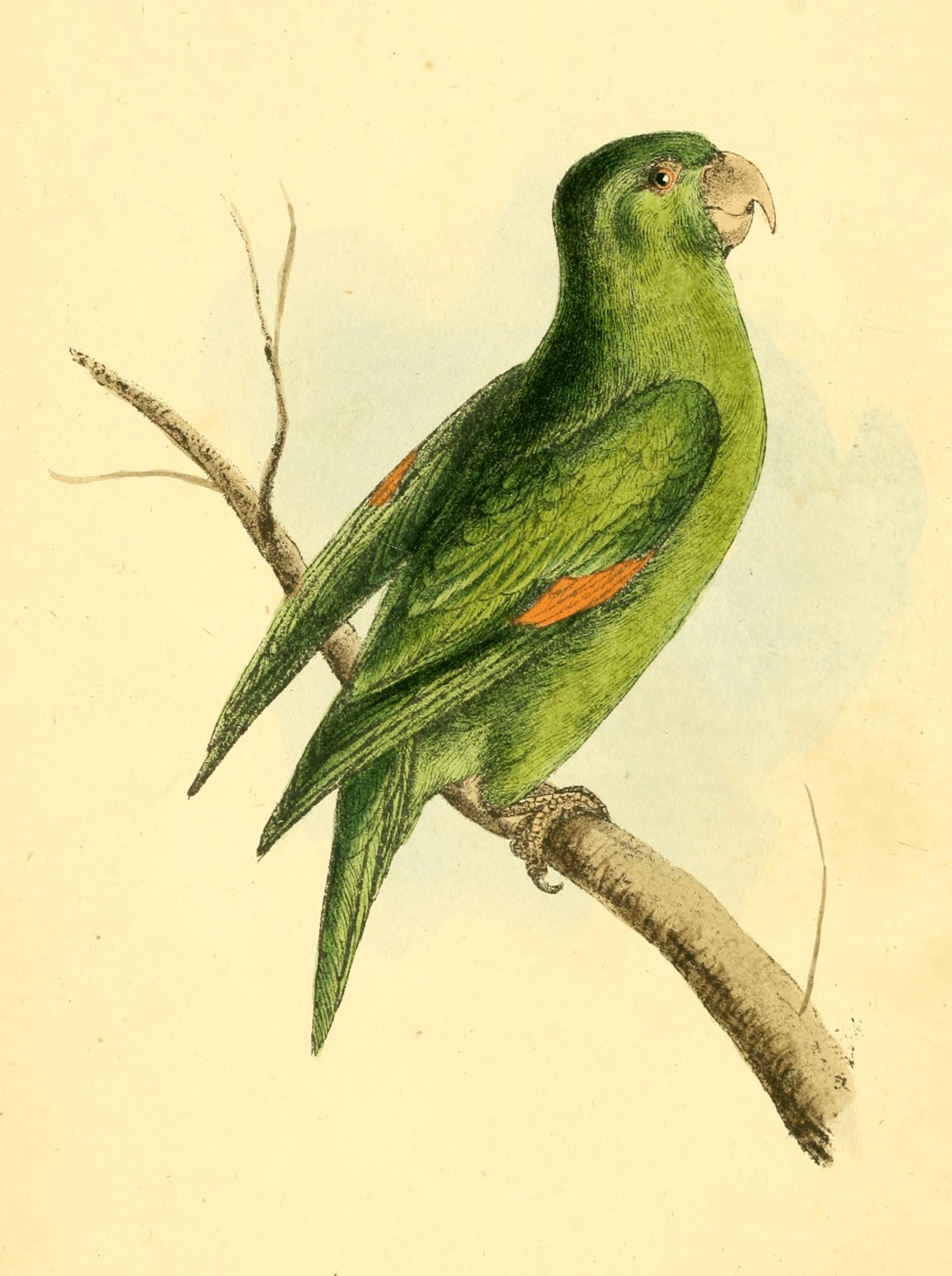
PSITTACUS Cayennensis.
Cayenne gold-winged Parakeet.
Generic Character.
Rostrum breve, crassum, validissimum, ad basin cute tectum; mandibulâ superiore aduncâ; inferiore sub-recurvatâ, breviore. Nares rotundæ, nudæ, fermè verticales. Pedes scansorii.
Bill short, thick, very strong, covered at the base by a cere; upper mandible sharply hooked; under mandible obtuse, curving upwards, and much shorter. Nostrils round, naked, nearly vertical. Feet scansorial.
Specific Character.
P. viridis, alis spuriis aurantiis, remigibus exterioribus basi cæruleis, caudâ brevi cuneatâ.
Green Parakeet, with the spurious wings golden-orange: outer quills blue at their base. Tail short, wedged.
Le Perruche à tache souci. Le Vaill. pl. 58, 59. p. 169.
We only thoroughly identified this beautiful little bird, by an inspection of the costly work of Le Vaillant on this family, in the Banksian Library: for the description of the orange-winged Parakeet of Dr. Latham is not applicable; and Dr. Shaw has persisted in the old error of considering this species a variety of the Toui Parakeet, although the question had been put at rest by the original description and sound reasons of Le Vaillant. There is a wide difference between naturalists who compile, and form their theories from books, and those who study nature, and think for themselves; and nothing will result from the first but mischief to the science, and perplexity to the student.
Our figure is from a specimen brought from Demerara by C. Edmonston, Esq.; another is in the possession of A. MacLeay, Esq. Though rare in our cabinets, M. Le Vaillant says it is common in Cayenne. He has given a beautiful figure of the female, which is entirely green.
Total length six inches. Plumage above entirely green, beneath paler and inclining to yellow; just under the lower mandible is a small snuff-coloured spot, and a very narrow line of the same in front just above the nostrils; the quills dark-green, the greater ones on their outside base are blue, with which the head is also tinged. The spurious wings are entirely of a rich and clear orange. Inner wing-covers green. Quills inside greenish-blue, except on each side the shafts, where there is a line of black. Tail short, cuneated, hardly projecting an inch beyond the wings, both above and below green: the interior margin dirty-yellow, the feathers pointed. Bill and legs flesh-colour.
Pl. 2
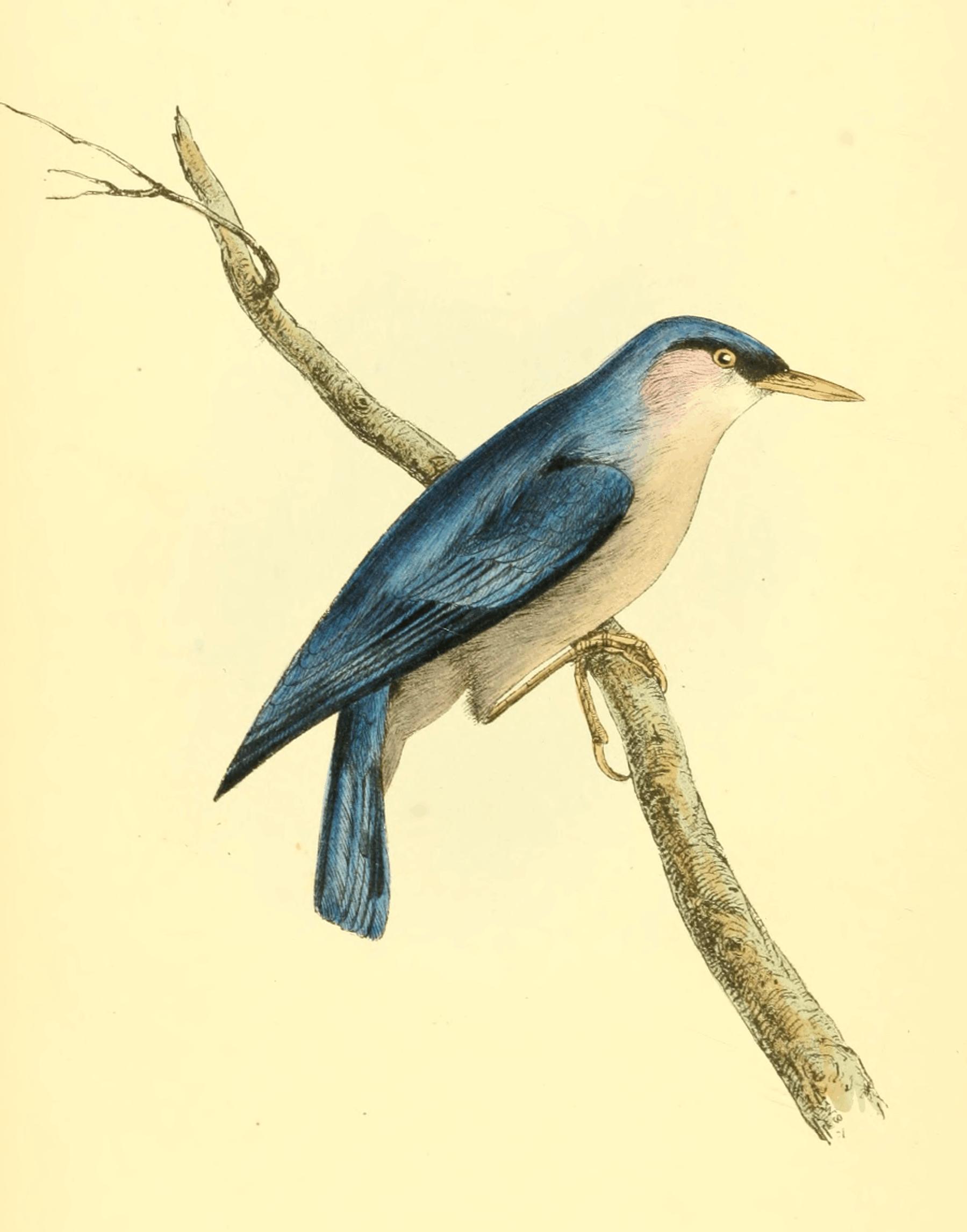
SITTA frontalis.
Blue Nuthatch.
Generic Character.
Rostrum rectissimum, acutum, compressum; utroque mandibulo ad apicem æque inclinato; apice integro cuneo compresso simili. Nares basales, ovales, apertæ, plumis setaceis incumbentibus extrinsecus tectæ. Pedes tribus digitis anticis; uno postico; digitus interior minimus; exterior ad basin medio connexus; hallux productus validus. Ungues compressissimi; antici subæquales; posticus maximus. Cauda brevis, rectricibus duodecim subæqualibus.
Typus Genericus S. Europæa.
Bill very straight, sharp-pointed, compressed; both mandibles equally inclining to the tip, which is entire, and resembles a compressed wedge. Nostrils basal, oval, open, covered externally with incumbent setaceous feathers. Feet with three toes forward and one backward; inner toe very small; outer toe connected to the middle at its base; hind toe lengthened, strong. Claws much compressed; anterior nearly equal, posterior largest. Tail short, of twelve nearly equal feathers.
Generic Type Sitta Europæa.
Specific Character.
S. supra cærulea; supercilio, fronte, et remigibus lateralibus in medio nigris; subtus cinereo-fusca, auribus lilacinis, mento albo.
Nuthatch, above blue: line above the eye, front, and middle of the lateral tail-feathers black; beneath cinereous brown, ears lilac, chin white.
...
The present species is one of the many interesting birds collected in Java by my friend Dr. Horsfield: it was not, however, until I had described and engraved another specimen, sent to Sir J. Banks from Ceylon, that I discovered the species had already been included in the Doctor's account of the birds of Java, presented to the Linnæan Society, where he has described it under the name of Orthorynchus frontalis.
The specific name of its first describer is of course retained: with respect, however, to its generic situation, I must be allowed to dissent from considering it as a distinct genus, merely from the prolongation of the hinder toe being somewhat more developed than in Sitta Europæa and Carolinensis, both which birds are now before me, and which in themselves differ in the relative proportion of this part: thus in S. Carolinensis the hind toe and claw is two-tenths of an inch shorter than the leg; in S. Europæa it is one-tenth shorter; and in the present species it just exceeds that of the leg: in every other respect not the slightest difference I apprehend will be observed ....
Total length five inches. Size of the European Nuthatch. Bill, from the angle of the mouth to the tip, eight lines; front of the head velvet-black, continued in a stripe of the same colour over the eye, and terminating above the ear feathers: the upper plumage is of a rich blue, more brilliant on the head, and paler on the front, and external margins of the quills. Spurious wings and lesser quills black margined with blue. Inner wing-covers deep black; the under plumage is a light-brown, changing to lilac on the ears and sides of the neck, and tinged with cinereous on the flanks and vent: the chin is white; tail even, the two middle feathers blue, the rest more or less black, having the external margins and tips blue. The outer quill of the wings is short, the second and third longest and equal, the fourth rather less; the hind toe with the claw, measures one inch in a straight line.
Pl. 3
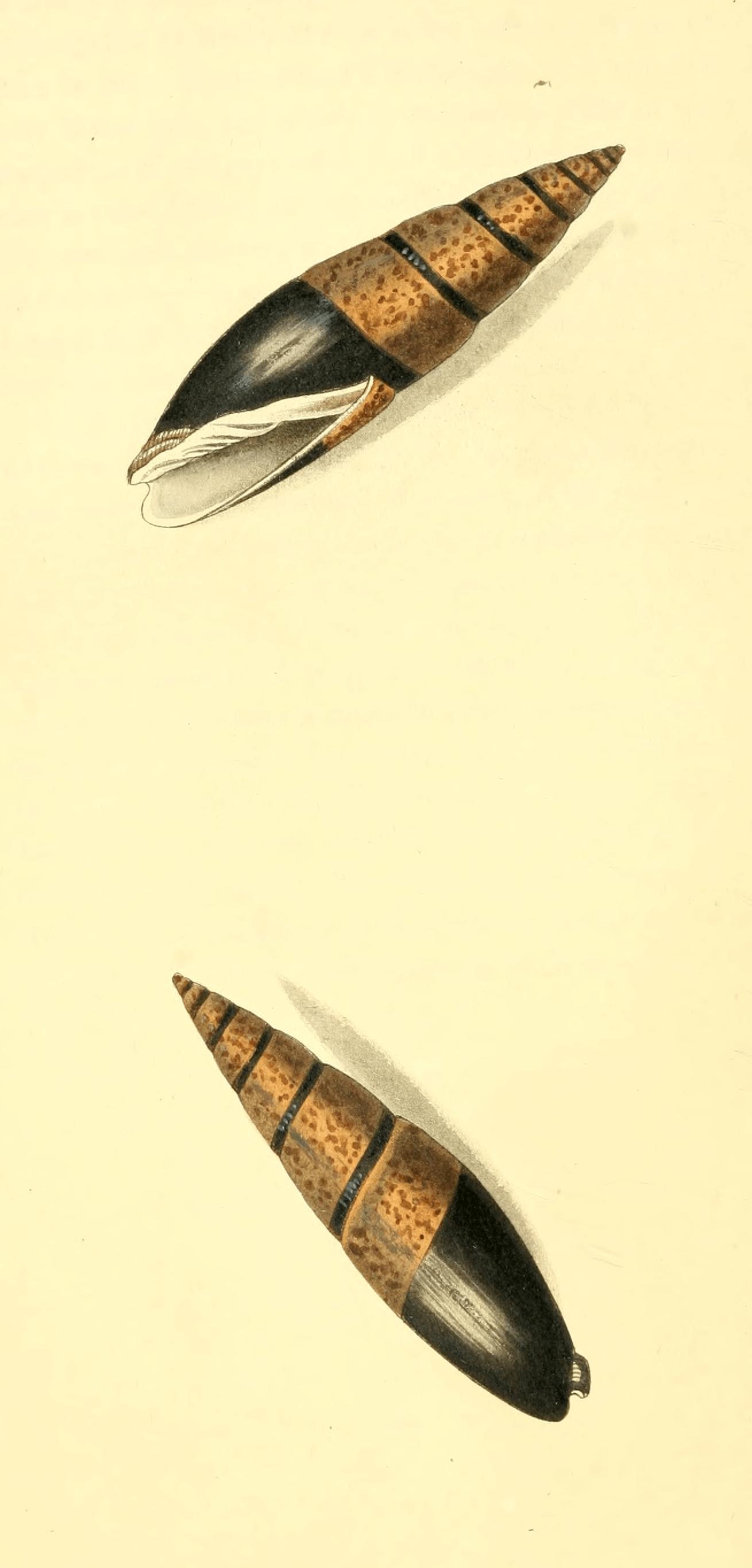
MITRA zonata.
Zoned Mitre.
Generic Character.
Testa inæqualiter fusiformis, spirâ productâ attenuatâ, labio exteriore intus edentulo. Columella plicata.
Shell unequally fusiform. Spire lengthened, attenuated. Outer lip simple, not toothed within. Columella plaited.
Specific Character.
M. epidermide luteâ, fulvo-marmoratâ, anfractibus infernè basi nigris, columellâ quinque-plicatâ. Linn. Trans. xii. p. 338.
Mitre, with the epidermis marbled with brownish-yellow; volutions at their base black; columella five-plaited.
Mitra zonata. Marryat in Linn. Trans. vol. xii. pl. 10. fig. 1. 2.
This unique and beautiful Mitre has been already described by Captain Marryat in the Linnæan Transactions: the figures, however, are uncoloured, and give a very indifferent idea of the graceful symmetry of its form. My friend Dr. Leach, with his usual liberality, permitted me to draw the accompanying figure of it at the British Museum, where it is now deposited.
It appears to have been taken near Nice in the Mediterranean, adhering to a sounding-line, in very deep water; a very singular locality, since nearly all the Mitres have generally been supposed to inhabit the tropical seas, or at least far from the coasts of Europe. It should, however, be remarked, that Cypræa lurida, an Asiatic shell, I have found on the shores of Greece: and C. Ulysses, in his travels in the kingdom of Naples, enumerates several shells as inhabiting the warm shores of the Tarentine Bay, which are generally known only as natives of the Red Sea and Indian Ocean. These facts, with many others, prove the physical distribution of Molluscæ to be less decidedly marked than almost any other class of animals.
This genus is included with that of Voluta by Linnæus and our own writers, although long ago justly separated by the continental zoologists.
Pl. 4
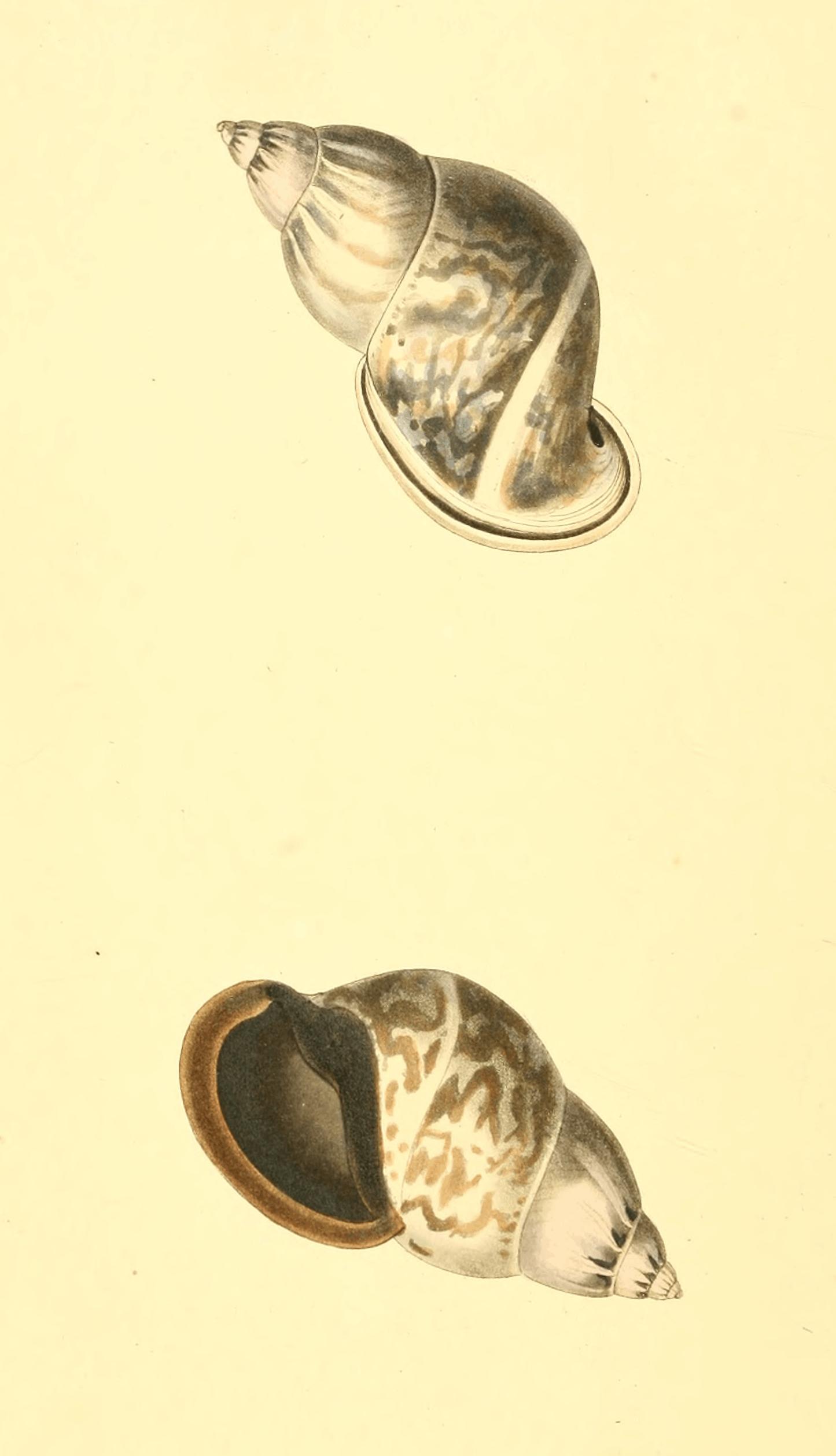
BULIMUS melastomus.
Blackmouthed Bulimus.
Generic Character.
Testa ovalis, vel oblongo-ovalis. Spira elevata. Os integrum, sub-ovale. Columella lævis, simplex. Labium externum crassum, reflexum. Internum ultra medium cavo-inflexum. Operculum nullum.
Shell oval or oblong-oval. Spire elevated. Mouth entire, sub-oval. Column smooth, simple. Exterior lip thick, reflected. Interior lip beyond the middle inflected, and hollowed beneath. Operculum none.
Specific Character.
B. testâ oblongo-ovatâ, albâ, cinereo marmoratâ, spiræ anfractibus longitudinaliter plicatis, labio exteriore complanato; aperturâ nigrâ.
Shell oblong-ovate, white, marbled with cinereous. Spiral whorls longitudinally plaited. Outer lip flattened; aperture black.
The genus Bulimus was long ago formed by Scopoli out of the heterogeneous mixture of shells thrown together in the Linnæan genus Helix[3], &c.: it comprehends some of the larger and most beautiful of the exotic land shells, among which the present species will stand conspicuous both in beauty of colouring and excessive rarity. While travelling among the forests of Brazil, in the province of Bahia, I found the shell here figured one morning on the leaves of a Solanum. I not only searched myself, but promised as a reward to any of my Indians who would bring me another, a two-bladed Birmingham knife!—the greatest temptation they could have!—but in vain; for I never saw another before or since.
There are many peculiar characters presented in this species independent of its colour: the spiral whorls are strongly plaited longitudinally about half their length, and marked very slightly (but sufficiently distinct) with several oblique indented striæ; the principal whorl has a row of indented and unequal sulcations near the suture, and a slight appearance of elevation along the white transverse band; the outer lip is thick, broad, and flattened beneath; but the margin is reflected back, and forms a prominent rim on the upper surface. The shell, when viewed closely, appears rough with minute scale-like elevations, very much resembling shagreen.
Pl. 5
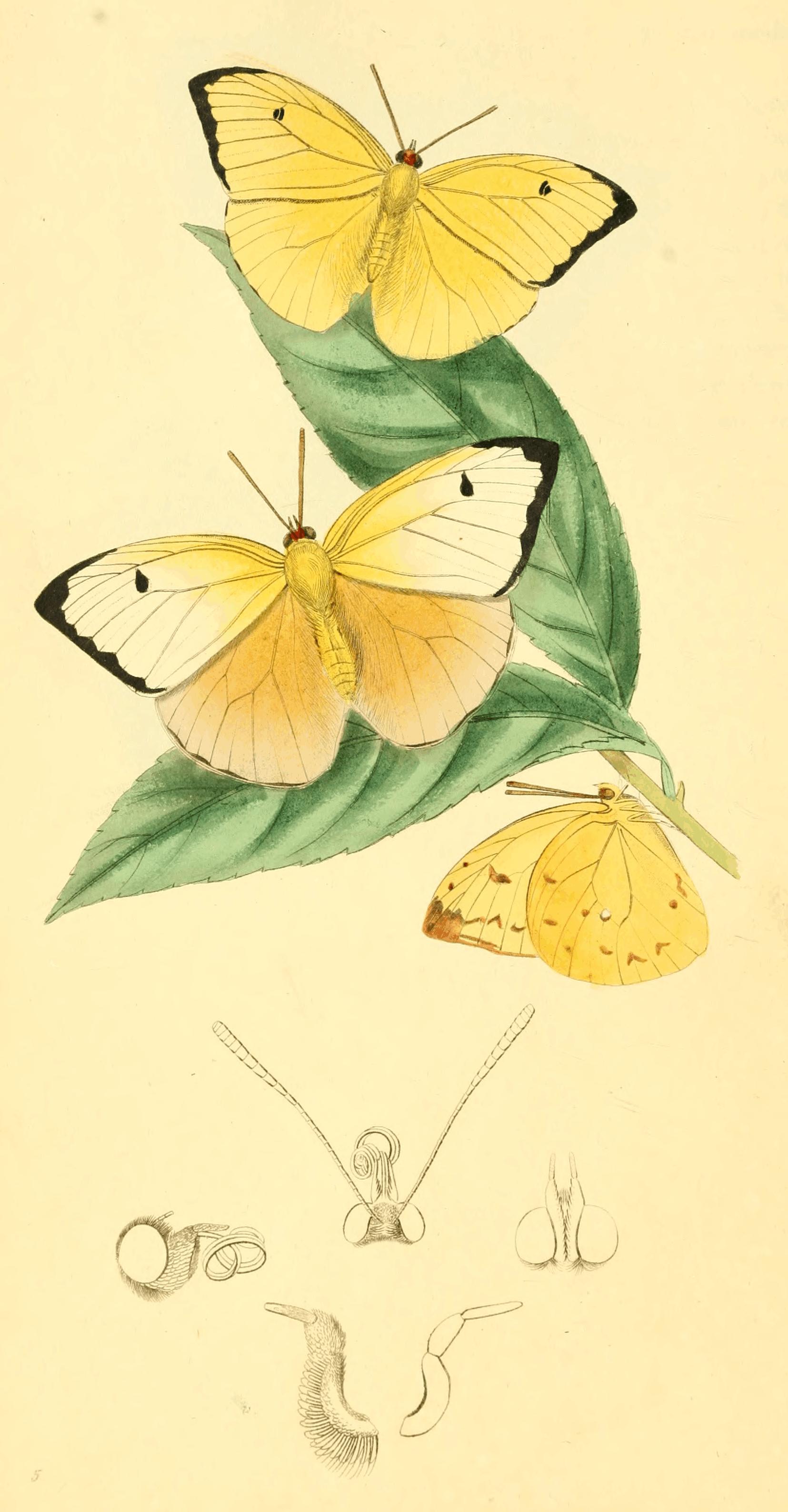
COLIAS Statira.
Generic Character.
Palpi breves, curvati, compressi ad linguam, squamis dense tecti. Articulis tribus; primo longissimo, ad basin curvato, ultrà erecto; secundo erecto, brevi; tertio minimo, proclivi; apice nudo, obtuso. Antennæ breves, cylindraceæ, ad apicem nudum et abruptè truncatum sensim incrassatæ. Alæ anteriores trigonæ. Abdomen maris, ultimo articulo acuto, et subtùs tenui unco incurvato; valvis magnis, attenuatis, aduncis.
Typus Genericus Colias Ebule.
Palpi short, curved, compressed on the tongue, thickly covered with scales. Articulations three; the first very long, curved at the base, erect beyond; the second erect, short; the third minute, inclining forward; the tip naked, obtuse. Antennæ short, cylindric, gradually thickening to their tip, which is naked and abruptly truncate. Anterior wings trigonal. Abdomen of the male with the last joint pointed, and a slender incurved hook beneath; the valves large, attenuated and hooked.
Generic Type Colias Ebule.
Specific Character.
C. alis dilutè flavis, vel fulvis; anticis suprà, puncto medio margineque extimo, nigris; subtùs ferrugineis; posticis subtùs, singulis duobus niveis punctis inæqualibus; palpis productis.
Wings diluted yellow or fulvous; anterior with a black border and central dot, which beneath is ferrugineous; posterior beneath, each with two unequal snowy spots; palpi lengthened.—Female.
Papilio Statira. Cramer, pl. cxx. fig. C. D.
The present insect is selected to illustrate a very elegant family of Butterflies, whose predominant tints are composed of orange, yellow, and white, variously blended and disposed in a greater or less degree throughout all the species. The generic characters above given will distinguish them as peculiar to the tropics, and principally those of South America; one or two species only being found in Africa, and five or six inhabiting India.
I have no doubt this is the Pap. Statira of Cramer; it is found only in Brazil, and has been erroneously considered by Godart and Latreille as a variety of C. Jugurthina, an Indian insect, and which in fact is not in itself a species, being no other than the female of C. Alcmeone, as an attentive examination of a vast number of both, collected in Java by Dr. Horsfield, enabled me to ascertain.
The extraordinary prolongation of the last joint of the palpi, and the white borderless spots beneath, which are never silvered, will distinguish this species through all the variations; in the ground colour of its wings, which in no two specimens are exactly alike, and one before me is nearly white; the lesser snowy dot is sometimes very obscure, and often wanting; but the prolongation of the palpi is even expressed in Cramer's figure above quoted.
I have examined about a dozen specimens, mostly captured by myself, and all have been females; and I strongly suspect future and more decided observations will prove C. Evadne to be the other sex: it has the palpi lengthened, though in a less degree; and the articulations of the antennæ in both insects will be found somewhat thickened at their termination when viewed under a magnifier, a peculiarity I have seen in no other species; and although I have examined near thirty specimens of C. Evadne, they have invariably proved to be males.
The palpi in this insect will be found at variance with the generic character now given; a striking proof that in a natural system no single part can be taken as an unerring criterion for generic distinction, without making it eventually an artificial one. The Colias Drya of Fabricius has the same formation of palpi, but is a totally different insect.
Pl. 6
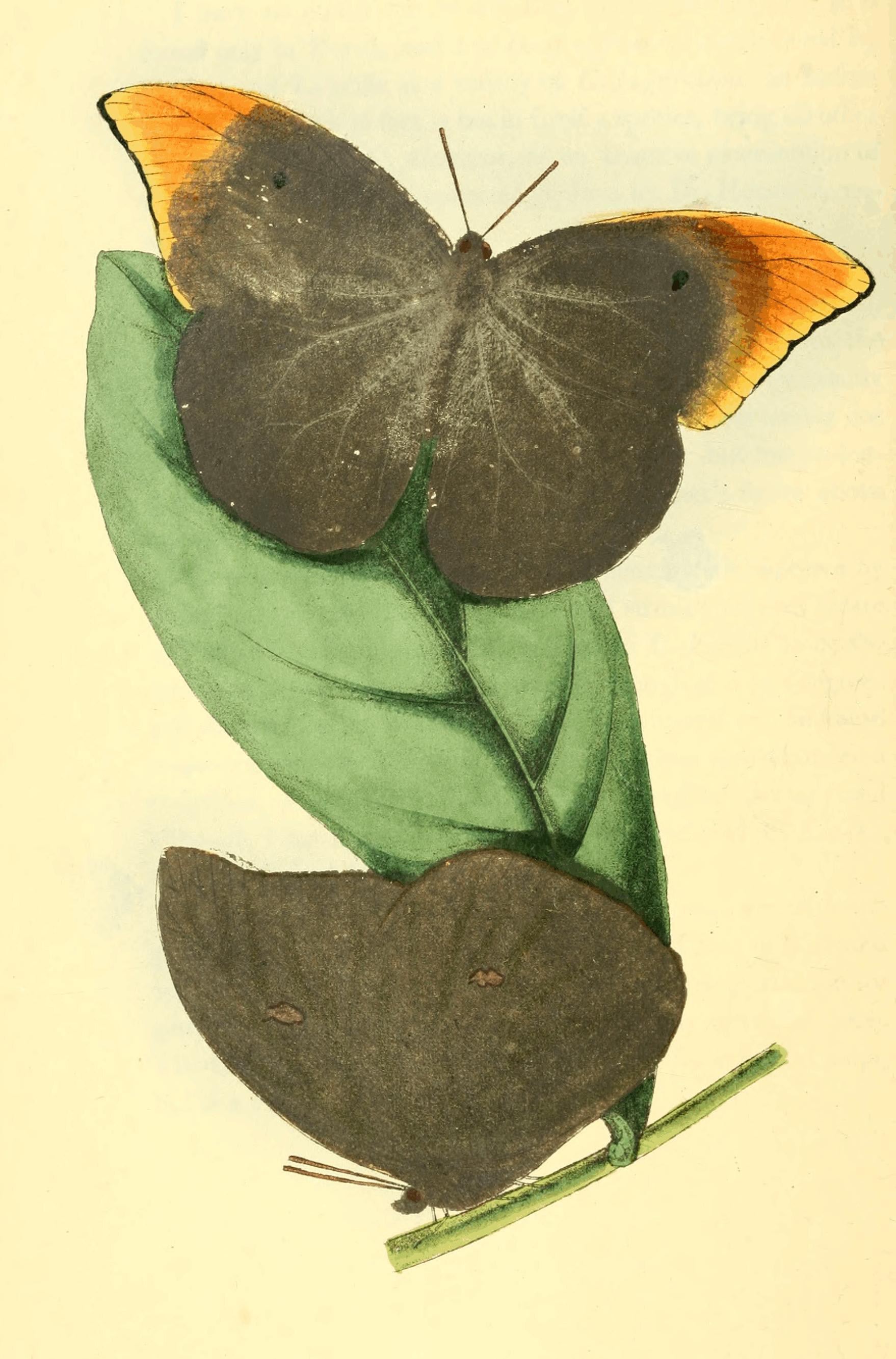
COLIAS Leachiana.
Leachian Colias.
Generic Character.—See Pl. 5.
Specific Character.
C. alis subrotundatis, integris, virescenti-albidis, anticis supra fulvis, margine punctoque medio nigris, singulis subtus maculâ centrali ferrugineâ. Encycl. Method.
(Male) wings slightly rounded, entire, greenish white; anterior pair above orange, at their tips, margin, and central dot black: each pair beneath with a central ferrugineous spot. Female ——?
C. Leachiana. Godart in Encycl. Method. vol. ix. p. 91.
In size this insect is the largest of the genus yet discovered; it was first noticed by Godart, who has given it the name of my learned and valued friend, Dr. W. E. Leach, of the British Museum, whose talents are too well known to need any eulogium in this place.
It appears to inhabit both the northern and southern extremities of Brazil; for I have seen it in a box sent from Parà, and my specimens were captured in Minas Geraes by my friend Dr. Langsdorff. It is, however, a rare species; for I have only seen seven or eight specimens, and they were all males: the female, when found, will probably differ as remarkably as in most of this genus.
The opaque spot on the inferior wings above is very large; but the tuft of hair corresponding beneath the superior wings, is entirely wanting. It should be likewise observed, that although this insect in every outward respect resembles a genuine Colias (the type of which may be C. Ebule), it differs very materially in the terminal appendages of the abdomen; the last joint being the shortest, and scarcely pointed; and the hook, instead of being concealed beneath this segment, is exserted beyond it, and met by two others, one at the base of each lateral valve: these valves are also much shorter, ovate, and not attenuated, although ending in an incurved hook. In the present ignorance in which a true knowledge of the Lepidoptera is involved, it is impossible to say how far these dissimilarities may point out natural groups; it is therefore of the highest importance to the science such facts should be noticed.
Pl. 7
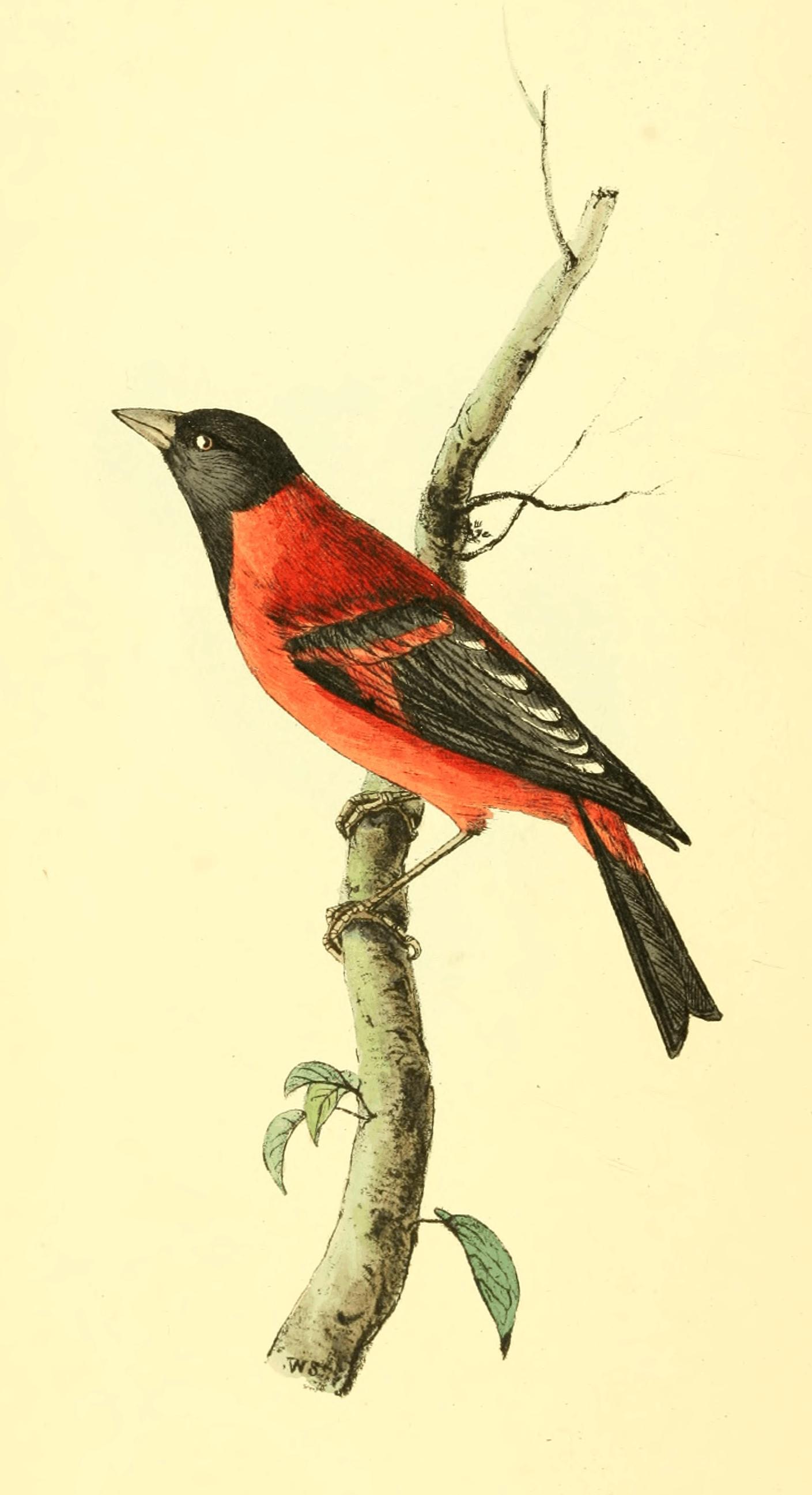
CARDUELIS cucullata.
Hooded Seed-eater.
Generic Character.
Rostrum breve, validum, conicum, rectissimum; mandibulis subæqualibus; apice immarginato, recto, acuto; mandibulâ superiore culmine convexâ; inferiore basi marginis angulatâ, utrinque subtusque convexâ.
Typus Genericus Fringilla Canaria. Lath., &c.
Bill short, stout, very conic, without any curvature above; both mandibles nearly equal, the tip entire, straight and sharp; upper mandible convex above: lower one at the base of the margin with an obtuse angle, the sides and under part convex.
Generic Type Fringilla Canaria. Latham, &c.
Specific Character.
C. aurantia: capite, gutture, fasciâ trans tectrices, remigibus caudâque nigris; remigibus primoribus basi obliquè aurantio fasciatis.
Orange: head, front of the neck, bar across the wing-covers, quills and tail black; greater quills at their base obliquely barred with orange.
A richly coloured little bird, much smaller than our Goldfinch, and approaching very near to the Bouvreuil de Bourbon of Buffon, from which, however, I think it quite distinct. The only one I have yet seen is in the possession of E. Falkner, Esq. of Fairfield near Liverpool, who received it with a few other rare birds from the Spanish Main.
Total length four inches. Bill blackish and very sharp. The whole head and forepart of the neck is black. The plumage of the body is a fine reddish-orange, duller on the back and brightest beneath: wing-covers the same; the greater ones at their base black, which forms a bar: the quills are also black, the greater ones having at their base an oblique bar of orange, and some of the lesser ones slightly margined externally with white. Tail divaricated and black; some of the lateral feathers faintly margined with orange. Spurious wings black. Legs and claws brown.
The Bouvreuil de Bourbon, and the B. du Cap de Bonne Esperance of Buffon (Pl. Enl. pl. 204. fig. 1, 2.) appear to have been described as the different sexes of one bird (the Orange Grossbeak of Latham) on mere conjecture. I think them quite distinct, inhabiting different countries, and having all the appearance (in the figures) of being two male birds; for the females in this family seldom possess the rich colours of the male; and the figure of the last of these birds, has not the slightest habit of a female.
The present genus was formed by Cuvier, (though but very slightly defined,) and includes the common Goldfinch and Canary-bird.
Pl. 8
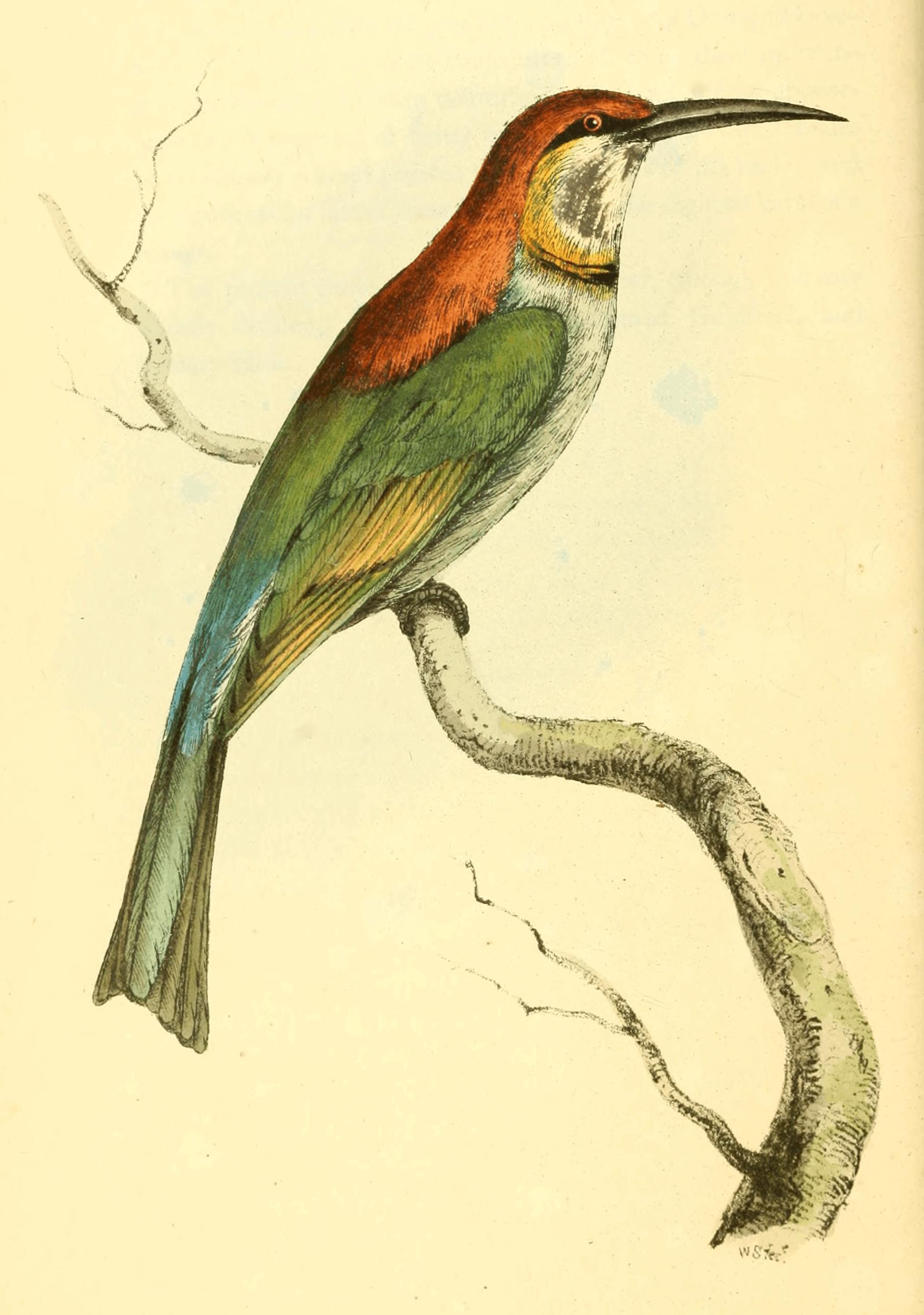
MEROPS urica.
Javanese Bee-eater.
Generic Character.
Rostrum productum, læve, subcurvatum, compressum; apice acuto, basi trigono; culmine carinato. Pedes brevissimi, gressorii. Alæ attenuatæ.
Typus Genericus M. apiaster. Linn., &c.
Bill lengthened, smooth, slightly curved, terminating in a sharp point; the base triangular, the sides much compressed, the back carinated. Feet very short, gressorial. Wings pointed.
Generic Type Merops apiaster. Linn., &c.
Specific Character.
M. viridis, infra pallidior; capite, collo suprà rufo; mento, jugulo, sulphureis; lineâ temporali et torque colli nigris; tegminibus uropygioque cæruleis; caudâ subfurcatâ.
Green, beneath paler. Head and neck above rufous; chin and throat sulphur; line under the eyes, and collar round the neck, black. Tail-covers and rump pale blue. Tail slightly forked.
Merops urica. Horsfield in Linn. Trans.
The true Bee-eaters are confined to the old world, principally inhabiting Africa and Asia; one species only, the European Bee-eater, being known with any degree of certainty to be found in Europe; and this is occasionally seen in England. They are all gregarious, feeding on the wing, and in general migratory.
Most unwillingly I have again in this instance anticipated my friend Dr. Horsfield in describing this bird, which he found in Java, and which I engraved after one sent from Ceylon, without knowing it had also fallen under his observation.
The figure is less than the natural size, which is nearly that of our European species. Bill an inch and a half long from the gape, and black. Nostrils small, basal, round, not sulcated, partially defended by incumbent hairs; at the angle of the mouth is a row of short, stiff bristles; a black line commences from the nostrils, passes under the eye, and terminates with the ears. The upper part of the head, neck, and between the wings, rufous. The rump and upper tail-covers pale blue: the chin and throat sulphur tinged with rufous, where an irregular and narrow collar of black crosses the neck. The remaining under parts yellowish-green. Wings and quills fulvous green, the latter tipt with black, and all the inner shafts more or less rufous: the second quill longest, and the lesser quills and tail-feathers notched at their tips. Tail green, slightly forked; the tips and under side dusky-black, and three inches and a half long. Wings, when closed, four inches one line in length. Vent blueish-white.
The females in this genus may generally be distinguished by the two middle tail-feathers being but slightly or not at all elongated.
Pl. 9
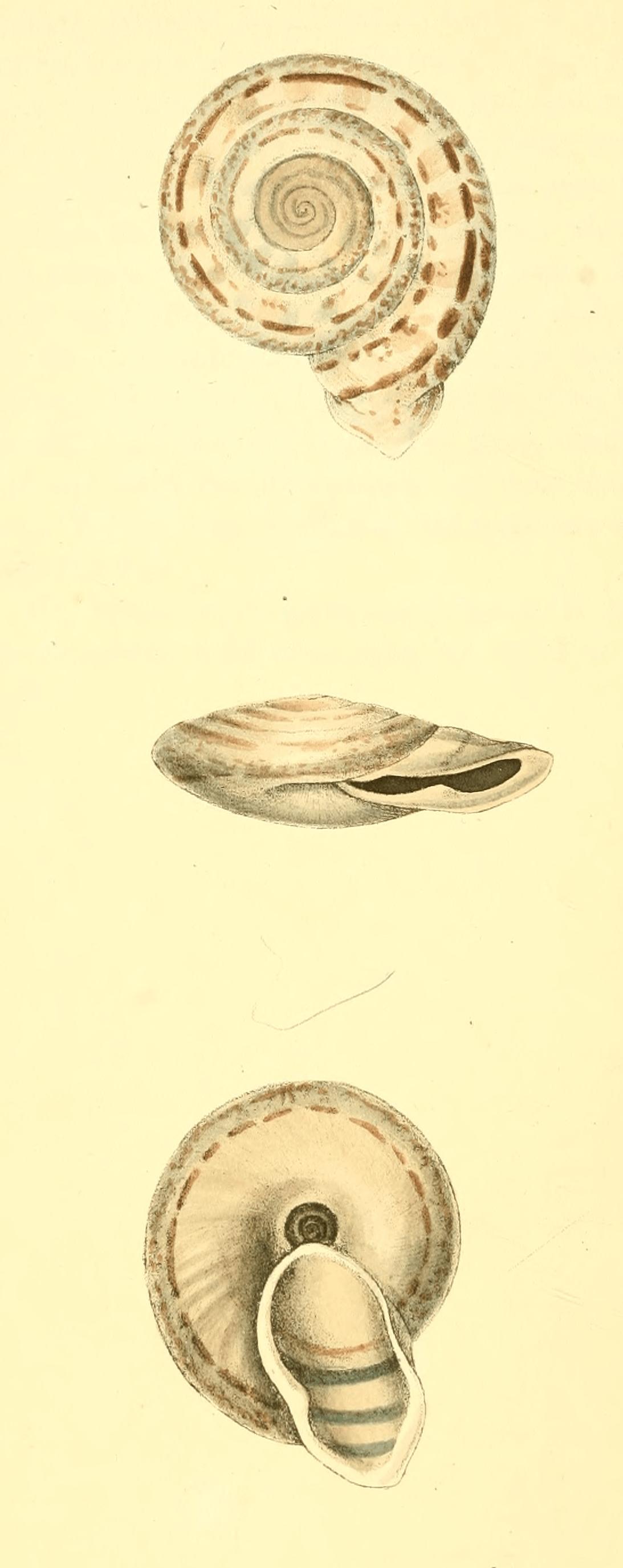
HELIX auriculata.
Eared Helix.
Generic Character.
Testa orbicularis vel globosa. Spira depressa vel paululum elevata. Apertura integra. Labium exterius marginatum. Operculum nullum.
Shell orbicular or globose. Spire depressed, or but slightly elevated. Aperture entire. Outer lip margined. Operculum, none.
Specific Character.
H. testâ depressissimâ, ferrugineo-marmoratâ et bifasciatâ, umbilico magno, profundo, aperturâ auriformi; labio exteriore incrassato, margine interiore dente obsoleto.
Shell much depressed, marbled and doubly-banded with ferrugineous. Umbilicus large, deep. Aperture ear-shaped. Outer lip thickened, reflected, with a gibbous obsolete tooth within.
A shell no less remarkable for its form than its extreme rarity. The mouth bears a most striking resemblance to the human ear; and the only specimen known in this country is the one here figured, from the cabinet of Ch. Dubois, Esq., who obligingly favoured me with it for examination; neither does the exquisite work on the Land Shells, by M. de Ferrusac, now publishing at Paris, contain this species among the numerous matchless figures already given of this family.
In the present uncertainty respecting the natural groups of the genus Helix, as left by Lamarck, I have preferred for the present following the example of Cuvier and de Ferrusac, in placing it with that family, in preference to adopting the ill-defined and palpably artificial distribution of them by D. de Montfort, or of forming a new genus for its reception.
The variegations in its colouring are better seen in the figures than described. The whole shell is slightly marked with obsolete longitudinal striæ; the umbilicus is very deep, and the tooth does not extend externally beyond the margin of the lip.
Pl. 10
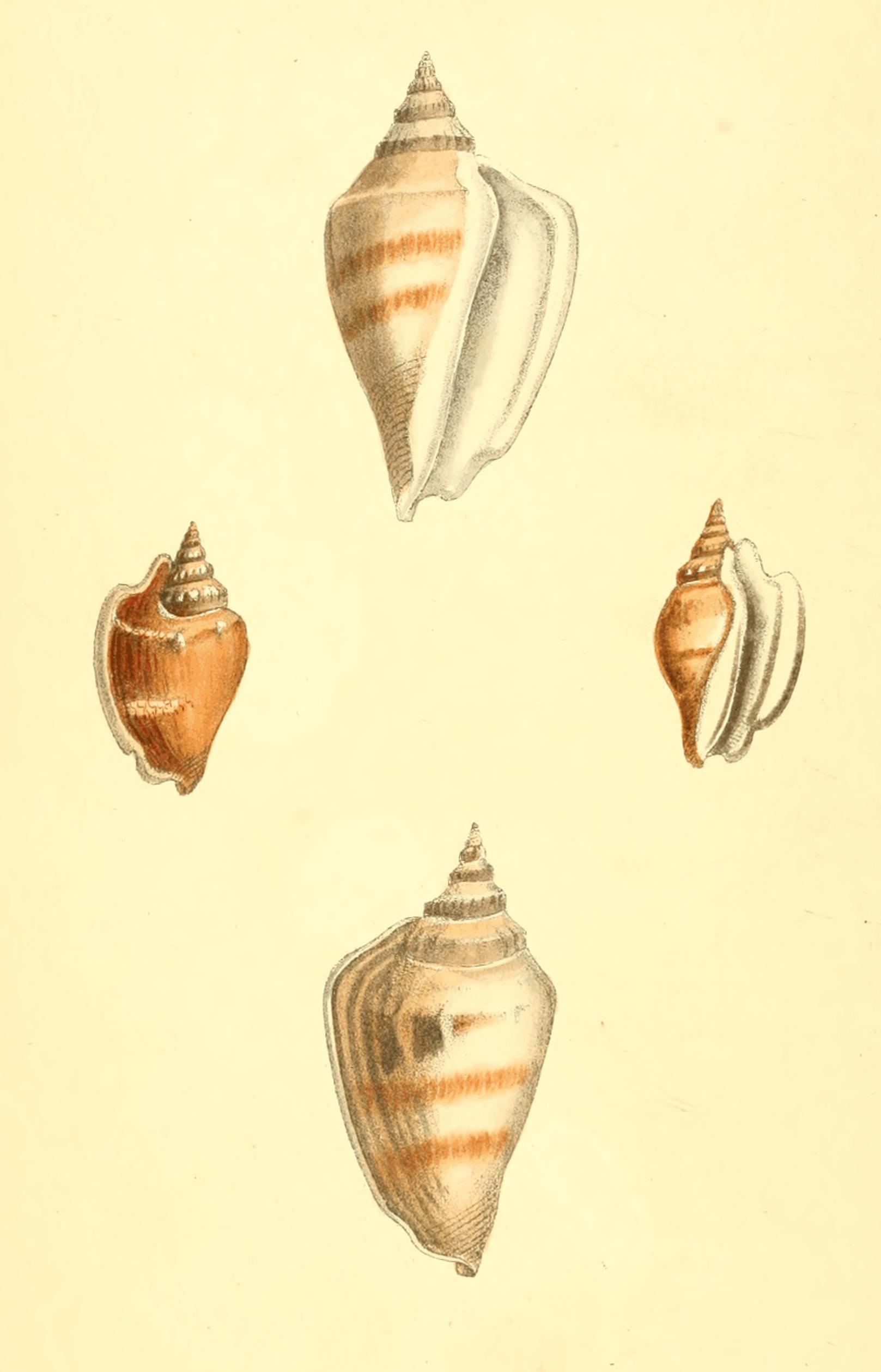
STROMBUS.
Generic Character.
Testa ventricosa; basis canali brevi, truncato vel emarginato; labium exterius simpliciter alatum, ala ad basin inferne emarginata; suprà dilatata.
Animal marinum, carnivorum, trachelipodum; corpore spirali; pede compresso ad cervicis basin inferiorem. Leach in Zool. Misc. vol. i. p. 51.
Typus Genericus S. pugilis. Linn.
Shell ventricose; base with a short canal, which is either emarginate or truncate; external lip dilated into a simple wing, notched at the base, and prominent above.
Animal marine, carnivorous; body spiral, with a compressed foot at the inferior base of the neck.
Generic Type S. pugilis. Linn.
STROMBUS minimus.
Little Strombus—central figures.
S. testâ nodosè plicatâ; spirâ subtilissimè striatâ; labio interiore reflecto, incrassato, suprà obtusè-acuminato; exteriore intrà lævi, suprà altè-lobato, anfractui secundo spirali adjuncto.
Shell with nodulous plaits; the spire finely striated; inner lip thickened and reflected, and obtusely pointed above. Outer lip smooth within, deeply lobed above, attached to the second spiral volution.
Lister 859. 15. Chemnitz. tab. 156. fig. 1491, 1492. Rumph. tab. 36, P. Gualtieri, tab. 32, G.
Strombus marginatus. Dillwyn's Cat. p. 665. no. 18.
A pretty and diminutive species, scarcely ever more than one inch three lines long. The spire long in proportion, and occupying half an inch: when in perfection the colour is a deep chesnut, minutely broken into finely serrated darker lines, with one, two, or three interrupted bands of white on the body whorl, the spire, and margin of the outer lip paler; there are two or three nodules above; and the spiral volutions have the carinated row of tubercles usual in the Strombi, and are besides finely striated transversely. The base of the shell is more deeply and distinctly striated; both the lips are much thickened, tumid, white, and highly polished; terminating above in obtuse points on the second spiral whorl, leaving a narrow ascending channel between; the inside of the aperture is a fine yellow.
Inhabits the Indian seas, but is not common.
By some unaccountable oversight, Mr. Dillwyn has very well described this shell, but under the name and supposition of its being the S. marginatus of Linnæus; though a few pages after he brings all the true synonyms referring to his shell, under a description purporting to be that of S. minimus, but which in reality is more applicable to our next species. Why this writer should doubt the correctness of Gmelin, Chemnitz, &c. respecting the true S. marginatus of Linnæus, does not appear, particularly as he has substituted for it a well known species. I have little doubt myself they all mean one and the same shell, which is nothing more than a scarce variety of S. accinctus, now before me, with which Linnæus's original description pretty well agrees.
STROMBUS variabilis.
Variable Strombus—upper figure.
S. testâ nodosè plicatâ, spirâ striis nullis; labio interiore simplice, exteriore reflecto, intrà lævi, suprà leviter lobato.
Shell with nodulous plaits, the spire not striated. Inner lip simple. Outer lip reflected, smooth within, and slightly lobed above.
Shell two inches and a quarter long, the spire occupying little more than half an inch. The ground colour generally is white with numerous undulated short lines of a darker colour, sometimes crossed by four or five obsolete whitish bands: it approaches very near S. minimus, but is easily distinguished by being in general much larger, by having the inner lip not at all thickened above, the outer lip very slightly lobed, and only advancing on the first volution of the spire: it varies, however, amazingly in colour. There is a small variety, having a brown spot beneath, from India; and others (labelled from the So. Seas) in the Banksian collection, also small, are purplish-brown, with three or four well-defined bands of white: the aperture is always pure white.
Pl. 11
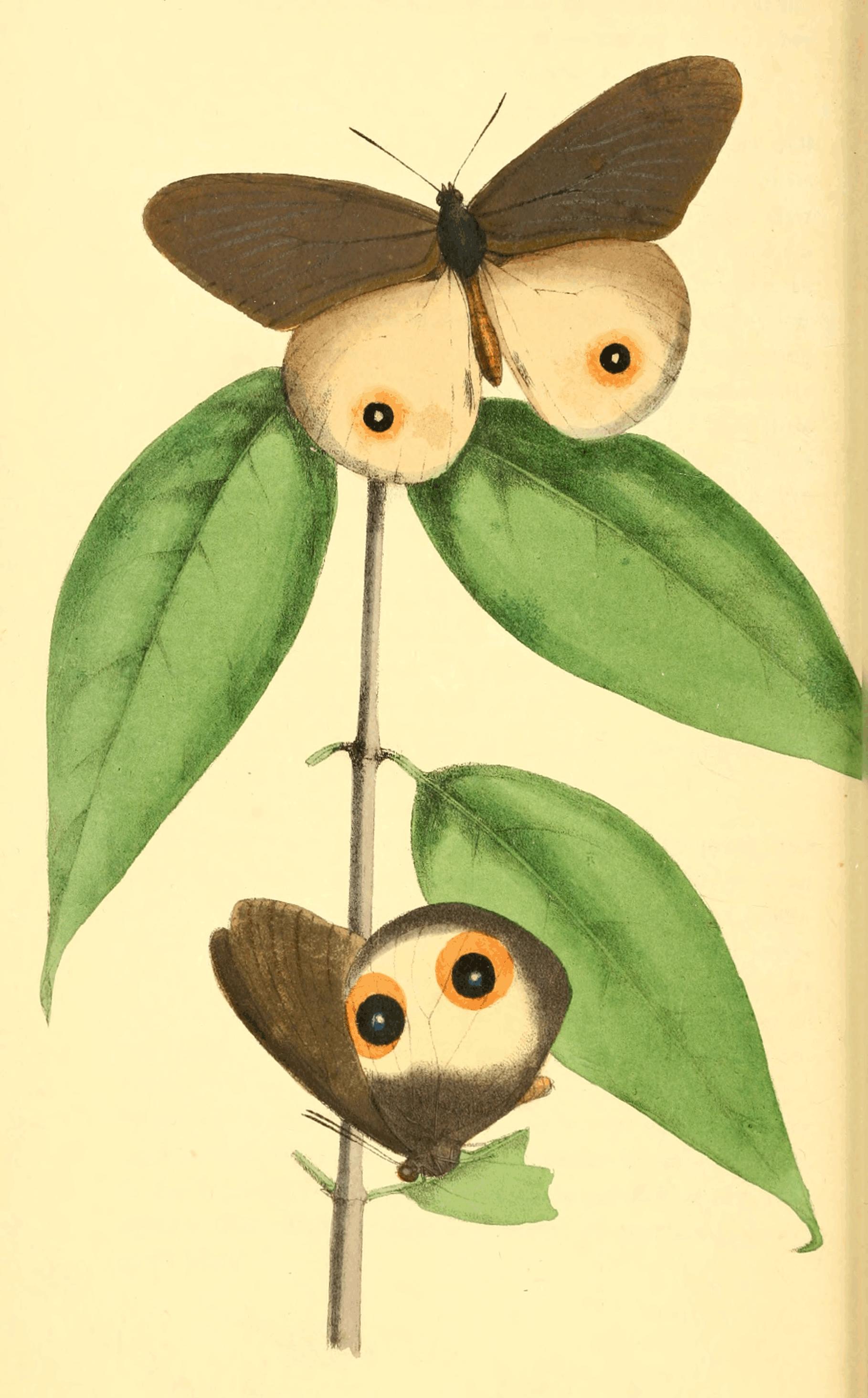
DRUSILLA Horsfieldii.
Generic Character.
Antennæ mediocres, clavâ productâ, gracili, cylindraceâ. Palpi breves, compressissimi, obtusi, remoti, linguam non attingentes; lateribus utrisque hirsutissimis, articulos obtegentibus. Abdomen (in maribus) 7-articulatum: 1mo longissimo, ultimo simplici, truncato, suprà integro, subtus unco incurvato, valvis nullis. Alæ anticæ (in maribus) basi posticâ dilatatæ, fasciculum in alas posticas obtegentes.
(Obs. Alæ integerrimæ, subdiaphanæ, posticæ magnæ, orbiculares. Pedes antici spurii; antennarum articuli basales ad apicem incrassati.)
Typus Genericus Papilio Jairus. Fabr.
Antennæ moderate, the club lengthened, slender, cylindric. Palpi short, much compressed, obtuse, remote, not touching the tongue, covered equally on both sides with thickset hairs concealing the joints. Abdomen (in the male) 7-jointed, the first very long, the last simple, truncate, and entire above, without valves, and with an incurved hook beneath. Anterior wings (in the male) dilated at the posterior base, concealing a tuft of hair on the inferior wings.
Generic Type Papilio Jairus. Fabr.
(Obs. Wings very entire, sub-diaphanous. Hinder wings large, orbicular. Fore-legs spurious. Basal articulations of the antennæ thickened at the end.)
Specific Character.
D. alis anticis angustatis, fuscis, concoloribus; margine posteriore et exteriore æqualibus: posticis albidis; margine exteriore fusco, suprà uni-ocellato, subtus bi-ocellato.
Wings, anterior, narrowed, the posterior and exterior margins equal, uniform brown; posterior cream-coloured, with a brown margin, one ocellate spot above, and two beneath.
This new and elegant insect was discovered by my worthy friend Dr. Horsfield (after whom I have named it) in the interior of Java: it forms a part of the extensive collections made there by this zealous naturalist for the East India Company, and which will make a most important addition to our present confined knowledge of the productions of that interesting island: indeed these collections exceed in extent, preservation, and value, any which have been brought to this country.
The general resemblance of this species with Papilio Jairus of Fabricius is so great, that it might pass on a cursory view as a mere variety, did not the form of the anterior wings at once point out the difference. In the present insect the posterior and exterior margins are of equal length, giving a narrow appearance to the wings, much resembling some of the true Papilionidæ; but in P. Jairus, these wings are much broader, more obtuse, and the length of the posterior margin much greater; other minor differences exist in the colouring and markings. My valued friend A. H. Haworth, Esq., F.L.S., &c. possesses a fine pair of the true P. Jairus in his rich and extensive collection; and the liberality with which it is constantly and freely opened to me, deserves my warmest thanks.
From these two species I have formed the present genus, the characters of which will distinguish it from that of Hætera (Fabr.), a scanty genus confined to South America; and this seems to occupy its place in India: both will come in the natural family of Hipparchidæ. Only one specimen (a male) exists in Dr. Horsfield's collections; I could not therefore dissect the mouth, &c. On the inner borders of the inferior wings is a lengthened tuft of fine hairs: the anus beneath has on each side an obtuse lengthened process, partially attached, and which appears to supply the place of the lateral valves. It is represented on a sprig of
Gærtnera racemosa,
which, although differing slightly from the figure of Dr. Roxburgh's Coromandel Plants, p. 19. t. 18, Dr. Horsfield considers as the same plant. The Javanese name is Kakas.
Pl. 12
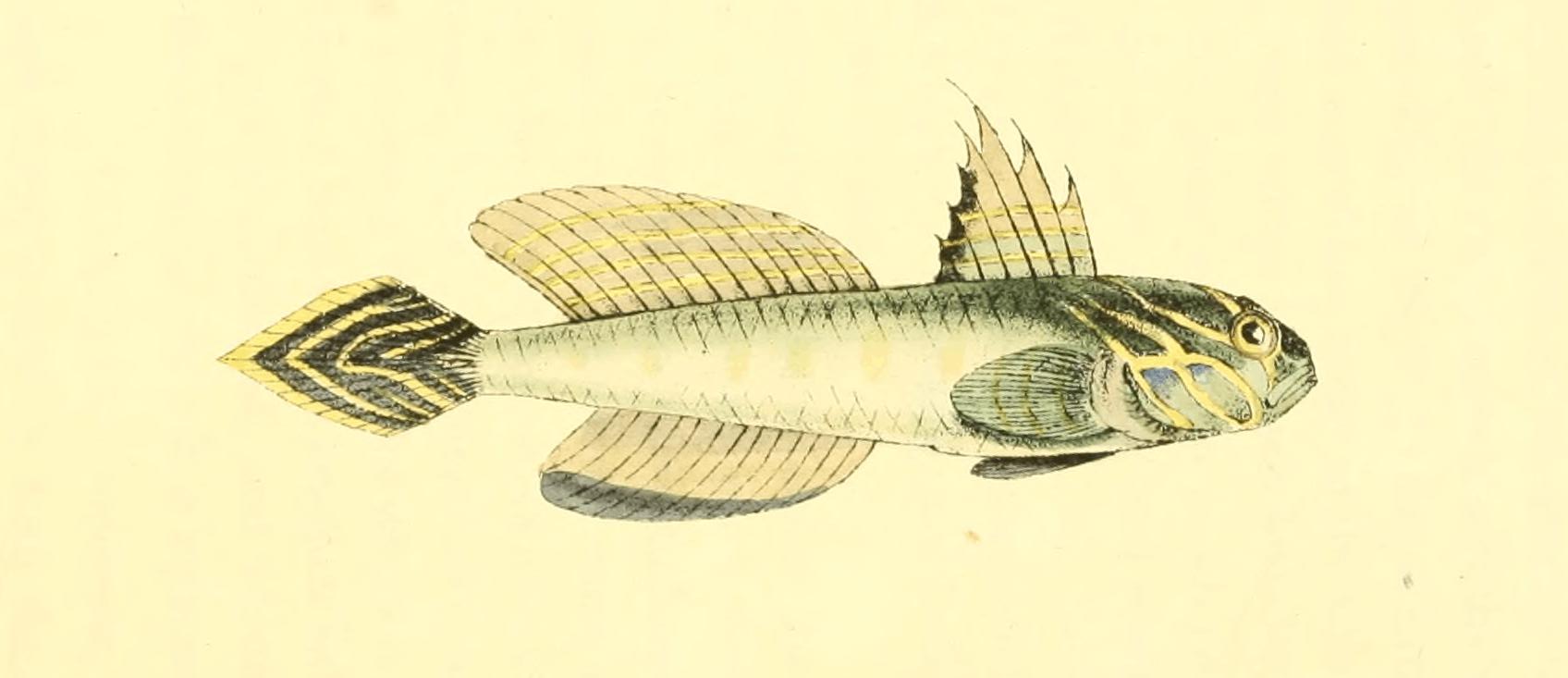
GOBIUS Suerii.
Suerian Goby.
Generic Character.
Caput parvum. Oculi approximati. Pinnæ dorsales duæ, radiis flexilibus: ventrales conjunctæ, infundibuliformes. Branchiarum apertura contracta, membranâ 4-radiatâ.
Typus Genericus Gobius niger. Pennant.
Head small. Eyes approximating. Dorsal fins two, the rays flexible. Ventral fins united into the form of a funnel. Gill aperture contracted, the membrane four-rayed.
Generic Type Gobius niger. Pennant.
Specific Character.
G. olivaceus, caudâ atro-purpureâ. Capite, operculis, pinnâ dorsali et caudali longitudinaliter flavo-lineatis.
Olivaceous Goby. Tail obscure purple. Head, gills, dorsal and caudal fins with yellow longitudinal lines.
Gobius Suerii. Risso Icth. p. 387. pl. 11. fig. 43.
This beautiful little fish never exceeds the size here represented. It is not uncommon on the coast of Sicily in the spring months: it has likewise been discovered on the shores of Nice by Risso, who is its first describer: his figure, however, is so remarkably bad, that it would be impossible to recognise it but for his description: in fact, the fish is so delicate, that unless the fins are very carefully expanded in water their form and colouring will never be seen correctly. It has been named after M. C. A. Le Sueur (who accompanied Peron in the French circumnavigation), an able zoologist and most inimitable draftsman and engraver.
General colour pale olivaceous yellow, with a few obscure large spots along the body somewhat brighter. The head has four yellow oblique bands, between which, and behind the eye, is a bright blue spot. Ventral fins blackish. The first dorsal fin is trigonal, and has the third ray lengthened and longest; the three last rays tipt with deep-black; the second fin is lengthened, broadest at the end, the membrane greyish-white with narrow longitudinal lines of yellow. Caudal fin lanceolate, pointed, blackish-purple, margined and marked with yellow lines parallel with the borders. Pectoral fin ovately rounded, with faint yellow transverse bands. Anal fin resembling the second dorsal, greyish, with the margin dull-purple. Scales large, very deciduous; lateral line invisible; lower jaw longest; teeth minute. Body and fins semi-transparent. The first dorsal fin has seven rays; the second fifteen; anal fifteen; pectoral twelve; caudal seventeen; ventral fourteen.
Pl. 13
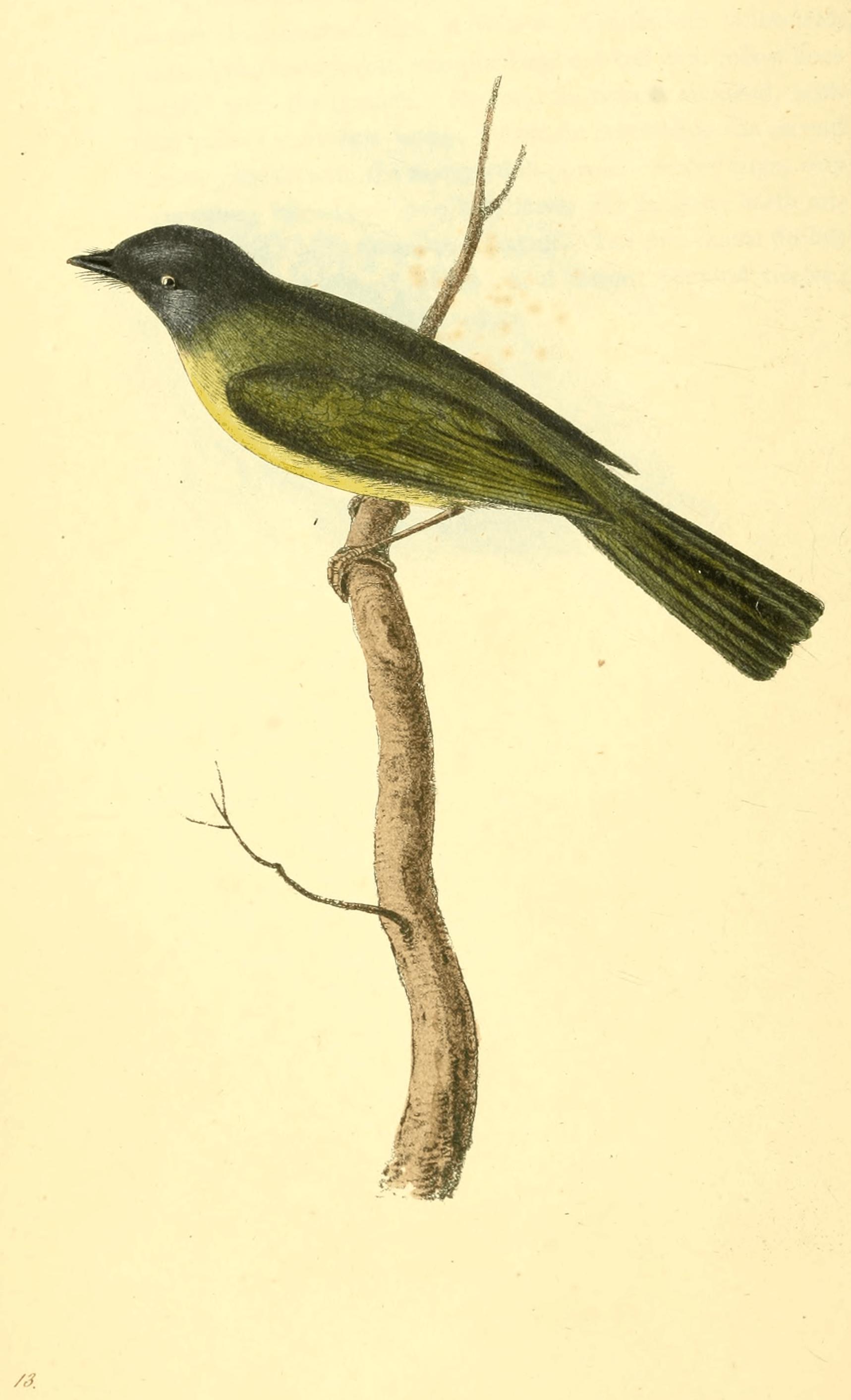
PLATYRHYNCHUS Ceylonensis.
Ceylonese Flat-bill.
Generic Character.
Rostrum breve, rectum, depressissimum, fermè trigonum; mandibulâ superiore ad apicem abruptè aduncâ, emarginatâ; inferiore rectâ, breviore; marginibus superioris inferiorem superplicantibus. Os et Nares longis rigidis vibrissis obtectæ. Nares, mediæ inter apicem et hiatum rostri. Cauda plerumque æqualis, rectricibus duodecim. Pedes et Tarsi breves, graciles.
Typi Generici. Div. I. Todus Platyrhynchos. Gm. Div. II. Muscicapa barbata. Lath.
Bill short, straight, thin, very depressed, and nearly triangular; the upper mandible abruptly hooked at the tip, and notched; the margins folding over those of the under mandible, which is straight and shorter. Mouth and nostrils defended by long stiff bristles. Nostrils medial between the tip and gape of the bill. Tail mostly even, of twelve feathers. Legs and toes short, slender.
Generic Types. Div. I. Todus Platyrhynchos. Gm. Div. II. Muscicapa barbata. Lath.
Specific Character.
P. olivaceus, subtùs flavus; capite mentoque cinereis.
Olivaceous Flat-bill, beneath yellow. Head and chin cinereous.
The sober tints of this little bird accord more with those of Europe than of India, of which country however it is a native, having been sent from Ceylon to the British Museum: it is the only one I have yet seen, and appears hitherto undescribed.
The stiff bristles at the corner of the mouth are nearly the length of the bill, which is quite flattened: the tail is even, and the whole bird in every respect but colour closely resembles the bearded Flycatcher (Musc. barbata Lath.).
Cuvier and other modern zoologists have done much in distributing the Linnæan Muscicapæ into their natural families; but as we are acquainted with a great number from descriptions only, the arrangement is by no means perfect.
The generic characters now given of the genus Platyrhynchos (very slightly noticed by Vieillot) will be found perfectly applicable to the separate divisions here formed; the first comprising the Todus Platyrhynchos of Gmelin, and a few others having the bill larger and more dilated than the second division, which includes the present species, together with M. barbata, cærulea, cuneata, and no doubt many others. The construction of the bill in all these birds will be found precisely the same, though more or less developed in each division, and even in the species; it thus becomes impossible to draw the line of demarcation without refining too much on generic distinctions. Their bills, although so broad, are by no means stout; thus enabling them to prey with greater readiness on the Lepidoptera and other large winged insects with soft bodies; while the long stiff bristles at the base of the bill seem intended to confine the resistance their prey would otherwise make by their wings. The illustrious Cuvier has well observed, that the true Flycatchers have the bill longer, narrowed, less compressed, and the tip but slightly bent.
Pl. 14
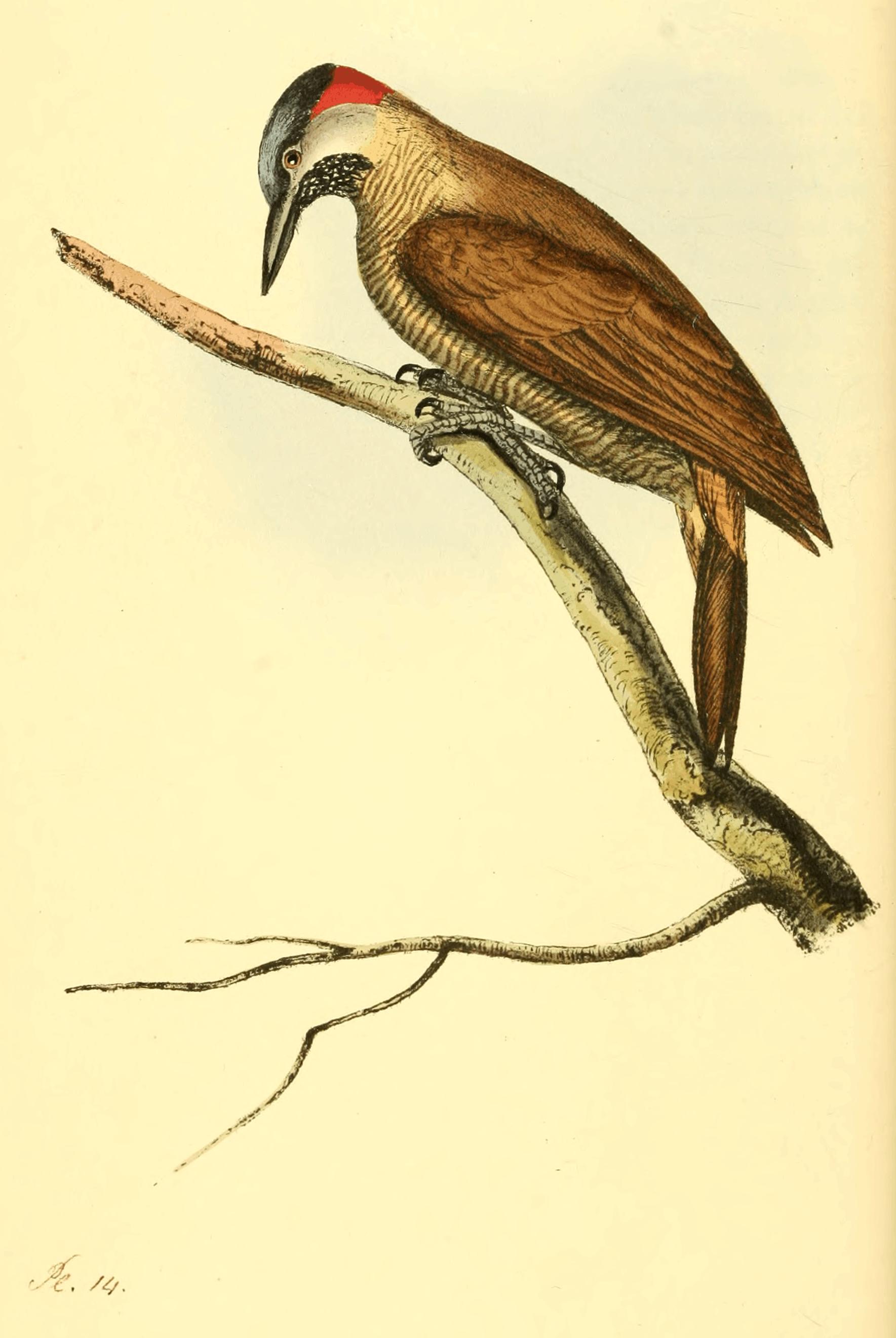
PICUS rubiginosus.
Brown Woodpecker.
Generic Character.
Rostrum polyedrum, rectum, in apicem compressum, cuneatum, attenuatum. Nares basales, ovales, patulæ, plumis angustis recumbentibus tectæ. Lingua longissima, jaculatoria, apice sagittato. Cauda rectricibus validis, rigidis, acuminatis, 10, intermediis duabus longioribus. Pedes scansorii.
Typus Genericus Picus viridis.
Bill many-sided, straight, the tip resembling a compressed pointed wedge. Nostrils basal, oval, open, covered externally with narrow recumbent feathers. Tongue very long, retractile, the tip barbed. Tail-feathers ten, strong, rigid, acuminated; the two middle ones longest. Feet climbing.
Generic Type Picus viridis.
Specific Character.
P. suprà rubiginosus: vertice nigrescente; occipite rubro, subtùs fulvo, fusco-fasciato.
Above tawny rufous. Crown blackish; hind head crimson, beneath fulvous, with brown transverse bands.
The Woodpeckers form a most natural family of birds, and are dispersed in every part of the known world, excepting the Polar regions. Eight species inhabit Europe, five of which are found in our own country. The largest however of these, the Great Black Woodpecker, is very rare; and even the others are less frequently seen than formerly, from the gradual diminution of our few remaining forests.
The present appears an undescribed species, and was sent from the Spanish Main to E. Falkner, Esq. of Fairfield. I have since seen the male, which, like many others of this genus, is distinguished by a patch of red below the eye.
Total length, eight inches and a half; bill one inch long, blackish; front and crown cinereous black; the hind head and nape crimson; a dusky whitish line (beginning at the nostrils) includes the eye and ear-feathers; below this on each side blackish, with longitudinal whitish dots, which in the male is mixed near the bill with crimson; chin blackish, speckled with white. The general plumage above is uniform tawny rufous brown, becoming more olive on the rump. Under parts olivaceous yellow, crossed with numerous close bands of blackish brown. Quills with the inner web black, the margin pale yellow; shafts and outer web tawny; tail the same, the shafts and outer half black, excepting the last pair, which have yellowish shafts and dusky tips. Wings inside, pale orange. Legs and claws dusky green.
Two or three other individuals have since fallen under my observation: the male I saw at Mr. Leadbeater's, Animal Preserver, in Brewer-street, of whose liberality and integrity in every way, I can bear the most unqualified and cheerful testimony.
Pl. 15
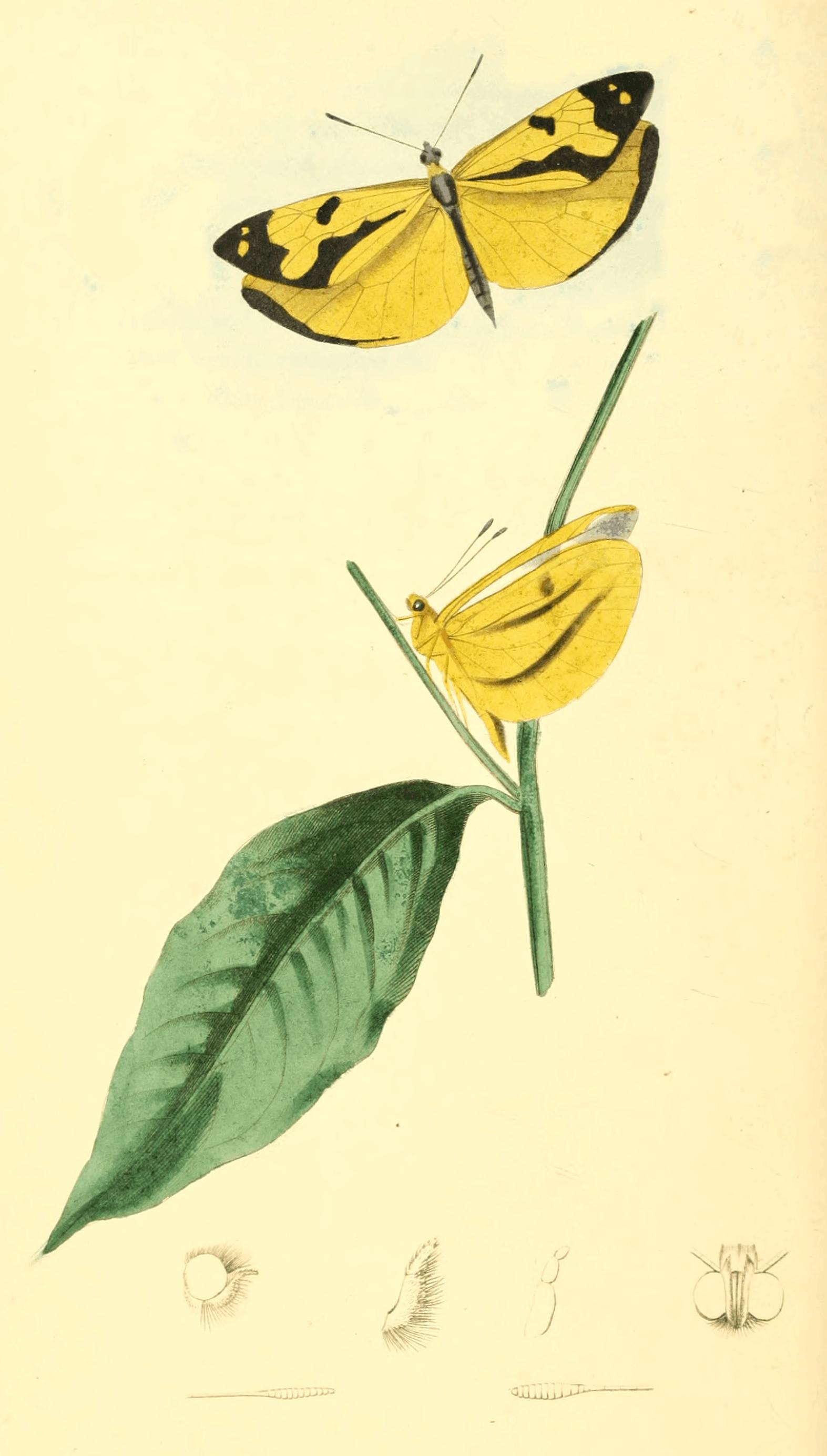
LICINIA Melite.
Generic Character.
Antennæ graciles; clavâ elongatâ, fusiformi, compressâ. Palpi brevissimi, vix ultra caput producti, ad linguam compressi, squamis linearibus tecti, margine ciliati, articulo ultimo sub-nudo, secundo subæquali. Abdomen elongatum, gracile, in maribus 6-articulatum, articulo ultimo integro; valvis plerumque elongatis, attenuatis, apice acutis. Alæ anticæ (in maribus) angustæ, obtusè-attenuatæ, (in fœminis) latiores, obliquè rotundatæ. Alæ posticæ (in maribus) dilatatæ, longitudine anticis penè æquales; margine antico opaco, in fœminis breviores, suborbiculares.
Typus Genericus L. Melite. Nobis.
Antennæ slender, the club elongated, fusiform, and compressed. Palpi very short, hardly projecting beyond the head, compressed on the tongue, covered with scales and margined externally with long hairs, the last joint nearly naked and almost as long as the second joint. Body elongated, slender, in the male with 6 joints, the last entire. Valves generally elongated, attenuated, their tips acutely pointed. Anterior wings (in the male) narrow, obtusely attenuated; in the female broader, and obliquely rounded. Posterior (in the male) dilated, nearly as long as the anterior wings, the fore margin opaque; in the female shorter, and nearly orbicular.
Generic Type L. Melite.
Specific Character.
L. (Mas.) alis flavis; anteriore suprà nigrâ, fasciâ obliquâ flavâ, et lineâ, basali transversâ, margine posteriore flavo. (Fœm.) Alis suprà albis; anteriore apice stigmateque marginali obliquo nigris; posteriore suprà nigro marginatâ, subtùs (in utroque sexu) flavescente, lineis duabus transversis fuscis.
Male. Wings yellow, anterior above black, with an oblique yellow band and transverse basal line; posterior margin yellow. Fem. Wings above white; anterior, with the tips and marginal oblique stigma black. Posterior, above margined with black; beneath (in both sexes) yellow, with two transverse brown lines.
Papilio Melite. Fab. Ent. Syst. 160, 494. Cramer, tab. 153. C. D.
The remarkable size of the under wings in the male insects of this genus will distinguish them even to a casual observer as forming a natural group. They are all natives of South America, where I discovered nine species. The females differ most strikingly, and have hitherto been mistaken by authors not only for distinct species, but as belonging to different genera.
Their natural situation will be among the Pieridæ, with whose general habit they accord.
The female of this species resembles Pap. Licinia of Cramer, except in having a short black stigma in the middle of the anterior border of the fore wings, pointing obliquely to the exterior margin. Cramer's insect, however, is the female of another undescribed species in my cabinet.
The under side of the posterior wings in both sexes is the same.
Pl. 16
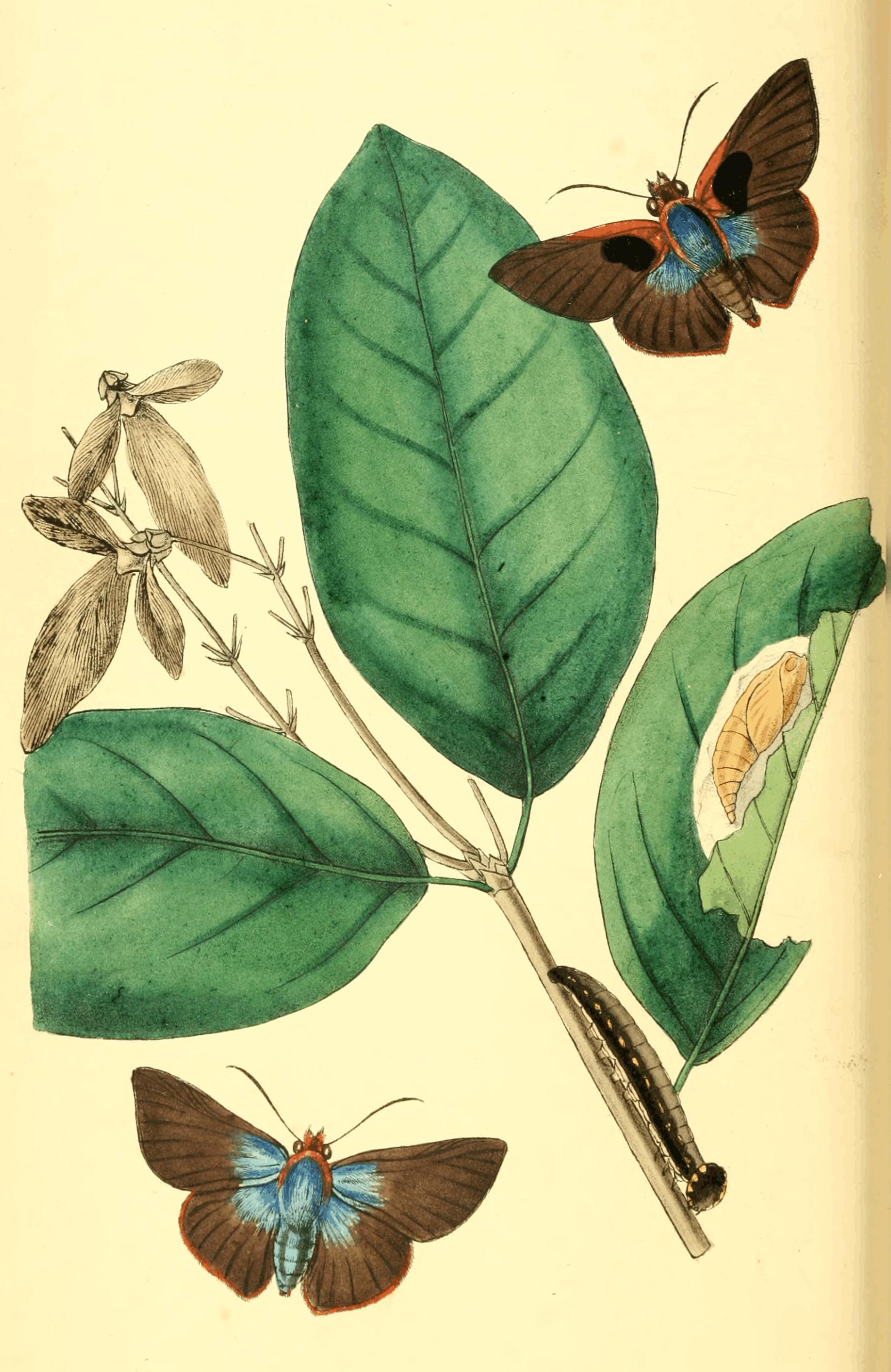
ISMENE Œdipodea.
Generic Character.
Antennæ cylindraceæ, juxta medium crassissimæ, versus apicem subulatæ, articulis numerosis brevissimis pene detectis. Palpi crassi squamosi, fronte obtusâ, lateribus compressis, marginibus exterioribus ciliatis, articulo ultimo nudo, producto, subhorizontali, lineari, compresso. Oculi (in maribus) magni. Corpus (in maribus) 7-articulatum, articulo ultimo suprà appendice transverso truncato subemarginato terminante, subtùs duobus uncis recurvis obtusis, fasciculo tectis; articulo 1mo et ultimo brevissimis: (in fœminis) articulo ultimo producto, subacuminato.
Antennæ cylindrical, thickest near the middle, the terminal half subulate; articulations numerous, very short, hardly perceptible. Palpi thick, scaly; frontal side obtuse; lateral sides compressed; the margins externally fringed with hair; the last joint naked, lengthened, nearly horizontal, linear, compressed. Eyes (in the male) very large. Body (in the male) of seven joints, the last with a transverse, slightly emarginate, truncate appendage above; and two obtuse recurved hooks below, concealed by a tuft of hair; the first and last segment shortest. Body in the female with the last joint lengthened and pointed.
Specific Character.
I. alis suprà fuscis, basi nitidè-cæruleâ, posticis aurantio marginatis, subtùs rufo-fusco nebulosis, basi puncto nigro: anticis (in maribus) basi aurantiis, maculâ nigrâ tomentosâ.
Wings above fuscous, shining blue at their base; posterior margined with orange; beneath clouded with rufous and brown, and a black dot at the base of the posterior wings. Anterior wings (in the male) orange at the base, and a large velvet-like spot of black.
The resplendent and changeable azure blue which ornaments the body and part of the wings in this very singular insect, can be but ill expressed in the figure. It is one of the many new and interesting subjects in entomology discovered in Java by Dr. Horsfield; and by his kindness and liberality I am enabled to add the figures of the caterpillar and chrysalis, which were copied out of a fine series of drawings made in Java under his own eye: they do not appear to differ in their formation from others of this family, although the perfect insect possesses such striking and peculiar generic characters; one of the many facts which prove the impossibility of making the Larvæ a primary consideration in forming the genera of Lepidoptera.
This is a rare insect, I have therefore been obliged to leave the generic character imperfect, as the dissection of the mouth, &c. would destroy the specimen. The posterior margin in the wings of the male is sinuated; in the female it is nearly straight; the underside of the wings in both sexes is the same; the anterior pair reddish-brown, paler in the middle; the tip and posterior margin whitish: inferior wings reddish-orange towards the inner margin, with an obsolete central curved band of the same, and a black dot at the base of the inferior wings. The head, palpi, and thorax are margined with orange, less conspicuous in the female.
Our knowledge of the genus Hesperia of Latreille (under which the present insect would come) is little more than what was known of Scarabæus twenty years ago; nor has Fabricius even noticed one half of the species figured by Cramer. The larva feeds on
Gærtnera Javensis
Foliis ovatis, obtusè-acuminatis, caule volubili ramosissimo, ramulis diffusis, deflexis,
a new species, discovered in Java by Dr. Horsfield, who has distinguished it by the above specific character. He informs me the natives give it the name of Kakas-rambat, which last word signifies twining or trailing. In the inflorescence and fruit it differs not from G. racemosa.
Pl. 17
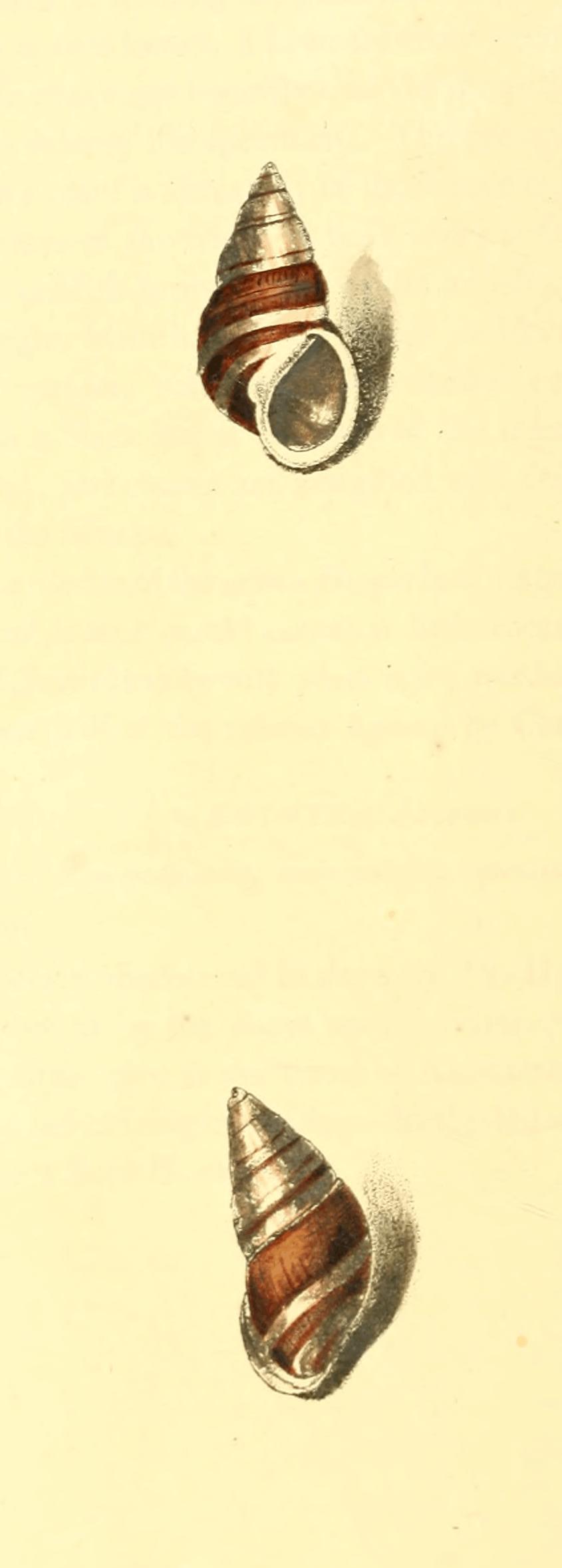
BULIMUS zonatus.
Zoned Bulimus.
Generic Character.—See Pl. 4.
Specific Character.
B. testâ lævi conicâ; spiræ anfractibus quinque; ultimo aliquantulum distorto; albis duabus fasciis ferrugineis inæqualibus; anfractu basali rufo duabus albis fasciis; aperturâ albâ.
Shell smooth, conic, of five volutions, the last somewhat distorted; white, with two unequal ferrugineous bands; body whirl rufous, with two white bands. Aperture white.
A small though very elegant shell, seldom seen in Collections; nor do I find such a description of it as will identify the species. One figured by Martini, at tab. 134, fig. 1215, comes near it, but differs sufficiently for a specific distinction.
Its precise locality is unknown: a fine specimen exists in my father's collection, who thinks it came from the East Indies; and this is the only one I have yet seen.
The aperture is more round than ovate, and is less than one half the total length of the shell; the outer lip much reflected, and the transverse bands on the spiral whirls nearly obsolete.
Pl. 18
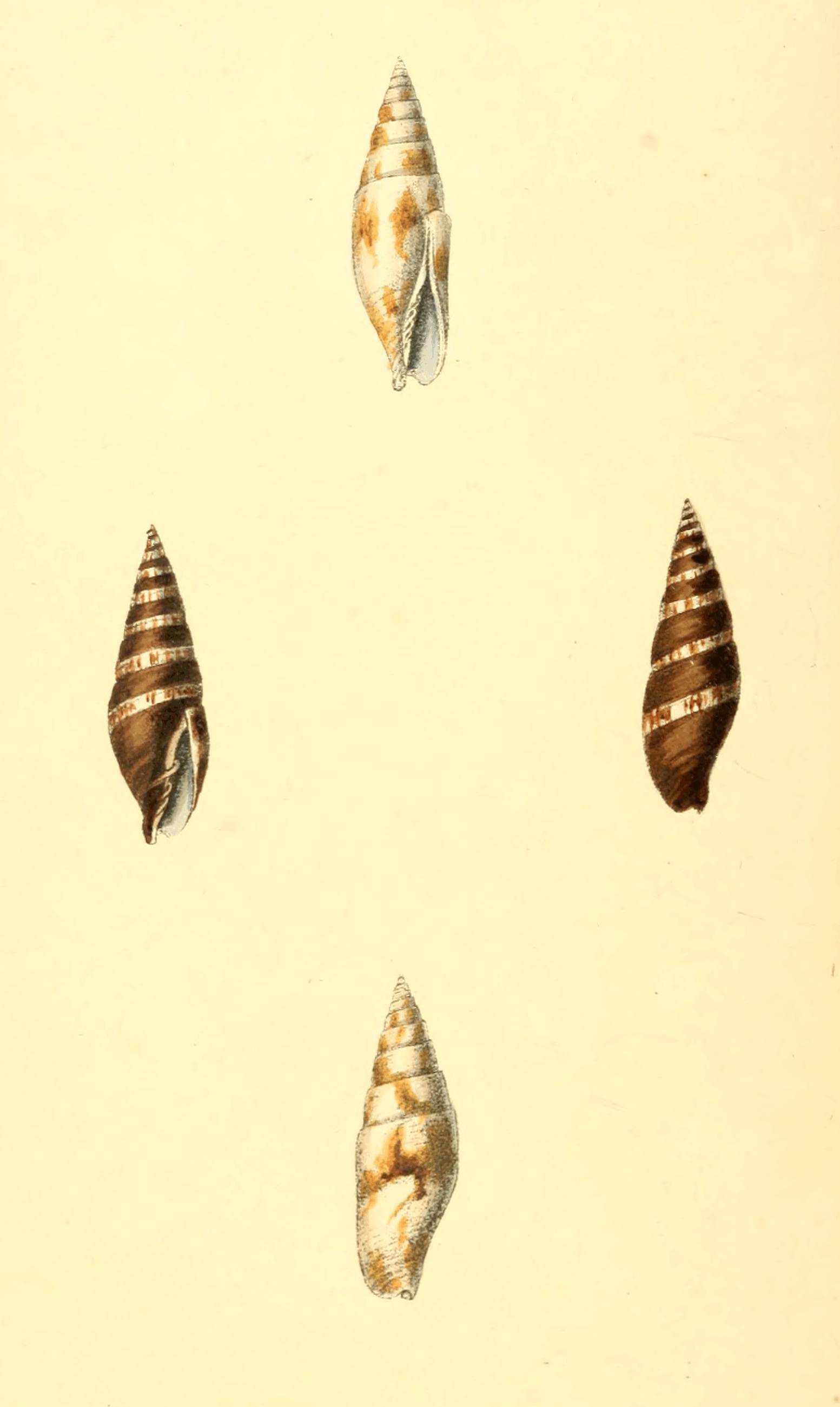
MITRA contracta.
Contracted Mitre—upper figure.
Generic Character.—Pl. 23.
Specific Character.
M. (Div. 3.) testâ sublævi; margine superiore anfractuum prominente, anfractu basali in medio contracto
Shell nearly smooth; upper margin of the volutions prominent; basal whorl contracted in the middle.
An undescribed species, for the loan of which I am indebted to Mr. G. Humphrey, of Leicester-street, whose knowledge as a collector, and integrity as a dealer, have gained him respect and confidence through a long life: and it is no less singular than true, that many genera of modern authors, now universally adopted, were formed by him near twenty-five years ago (under different names) in the Museum Calonianum, printed in 1797.
Shell one inch and a half long, and smooth; the base and spire with faint remote grooves; the spiral whorls are scarcely convex, and their upper margins prominent. Outer lip thick, effuse, slightly reflected below, and contracted above. Pillar five-plaited; colour yellowish white, with two or three waved longitudinal bands of orange, and a few others broad and remote on the spire. A finer specimen I have since seen with Mr. Humphrey's was one inch three quarters long, the ground-colour pure white, the aperture orange, and the bands rich orange-chesnut.
MITRA australis.
New Holland Mitre.
M. (Div. 2) testâ lævissimâ; spirâ elongatâ; anfractibus basi castaneo-fuscis; fasciâ albâ in basali anfractu, centrali. Columellâ 4-plicatâ.
Shell very smooth. Spire elongated, chesnut-brown; base of the spiral volutions with a whitish band, which is central on the basal whorl. Pillar four-plaited.
Dead shells of this new Mitre were received from Van Dieman's Land by Mr. Humphrey: it is perfectly destitute of striæ, excepting a few faint ones at the base: the mouth, which is smooth inside, appeared in the few specimens he had, to be unformed; it is, however, sufficiently distinct from any other.
Pl. 19
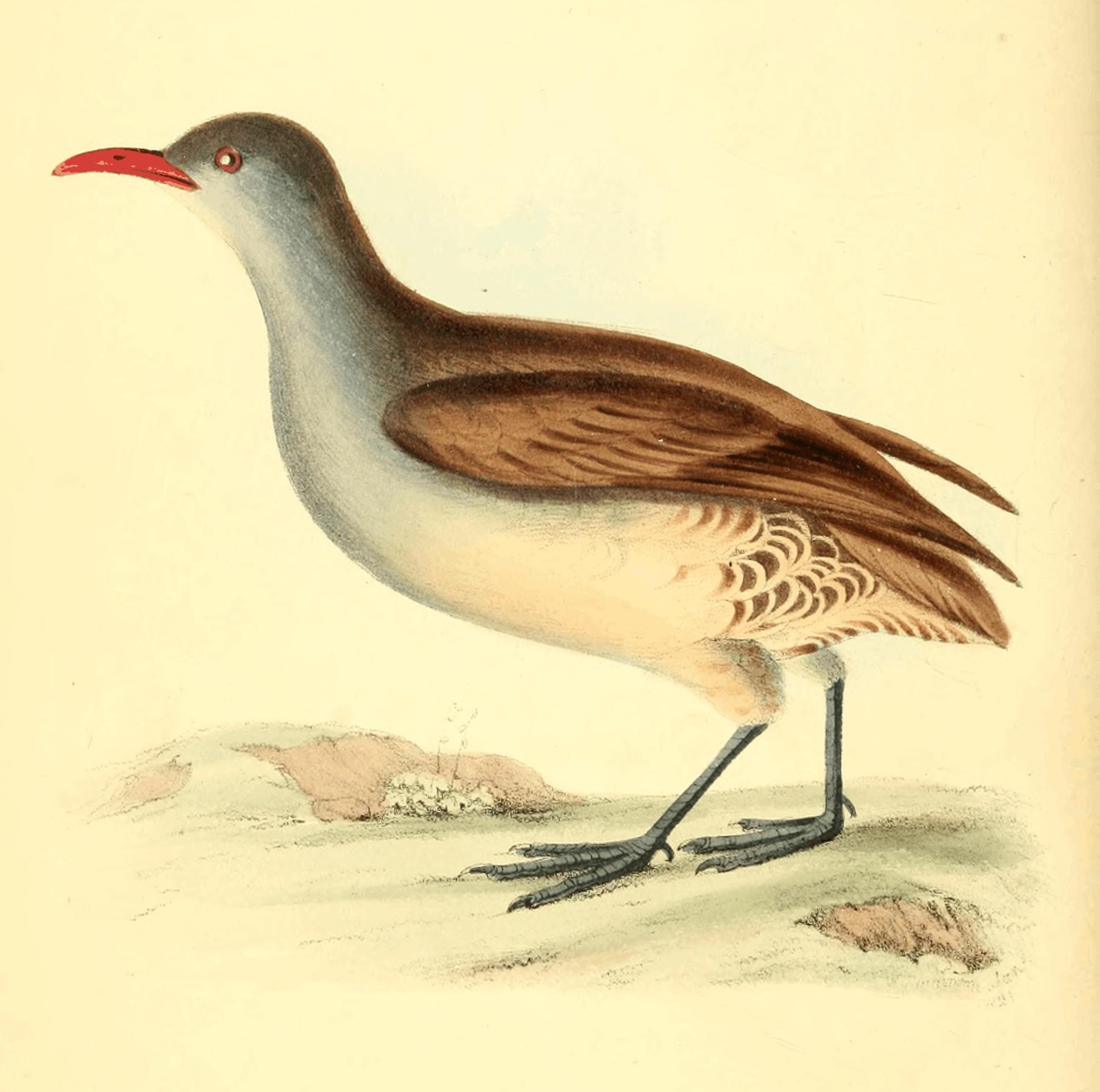
TINAMUS Tataupa, var.
Tataupa Tinamou.
Generic Character.
Rostrum mediocre, depressum, latius quam altum, apice rotundato obtuso; culmine lato, excelso. Nares laterales, mediæ, ovatæ, patulæ, apertæ. Pedes tetradactyli, fissi; halluce brevissimo, insistente. Cauda nulla, aut brevissima, plumis uropygii obtecta. Alæ breves. Temminck, vol. iii. p. 747.
Typus Genericus T. rufescens. Latham.
Bill moderate, depressed, broader than high, tip obtuse, back broad. Nostrils lateral, medial, ovate, expanded and open. Feet four-toed, cleft; hind toe very short. Tail none or very short, concealed by the rump-feathers. Wings short.
Generic Type T. rufescens. Latham.
Specific Character.
T. corpore suprà fusco-rufo, immaculato; capite et collo fusco-nigro; mento albo; gulâ, collo, pectoreque cinereis; corpore infrà albescente; uropygio lateribusque posticis rufis aut nigris, pennis albo-marginatis.
Tinamou with the body above dusky-rufous, immaculate. Head and neck dusky-black; chin white; throat, neck and breast, cinereous; body beneath whitish; vent and flanks rufous or black, the feathers margined with white.
Tinamus Tataupa. Temminck Pig. et Gall. iii. p. 590 et 752. Gen. Zool. vol. xi. part 2. p. 416.
The Tinamous are entirely confined to the new world, where they seem to hold the same scale in creation which the Partridges do in the old continent. Our knowledge of these singular birds has been much increased by the writings of Professor Temminck, who has described twelve species. The present bird is nearly the smallest of its family: I found it only once in the interior of Bahia in Brazil, where it must be very rare, or frequent to particular districts only. Though differing in some respects from the description of Temminck, I am inclined to consider it merely as a variety.
Total length (excepting the legs) eight inches and a quarter. The bill is one inch one line long from the gape, and, with the irides, is red. The head and neck above blackish cinereous; the crown much darker and tinged with brown, the rest of the upper plumage uniform reddish-brown; the edges of the wing-covers tinged with pale cinereous; the spurious wings and quills greyish-brown; the chin is white, changing on the throat, neck, breast and their sides to a pale lead-colour, which, on the body, again becomes white; the feathers on the flanks are blackish or rufous, beautifully margined all round by white, with another internal mark of the same kind; those on the vent are similarly marked, but on a pale rufous ground; the thighs are rufous-white; the under tail-covers rufous, marked by narrow undulated concentric lines of black, the ends whitish. The length of the legs (from the knee to the base of the middle toe) one inch two lines, and from that to the tip of the claw one inch. Legs blueish-purple. Hind toe very short, and elevated above the ground.
Pl. 20
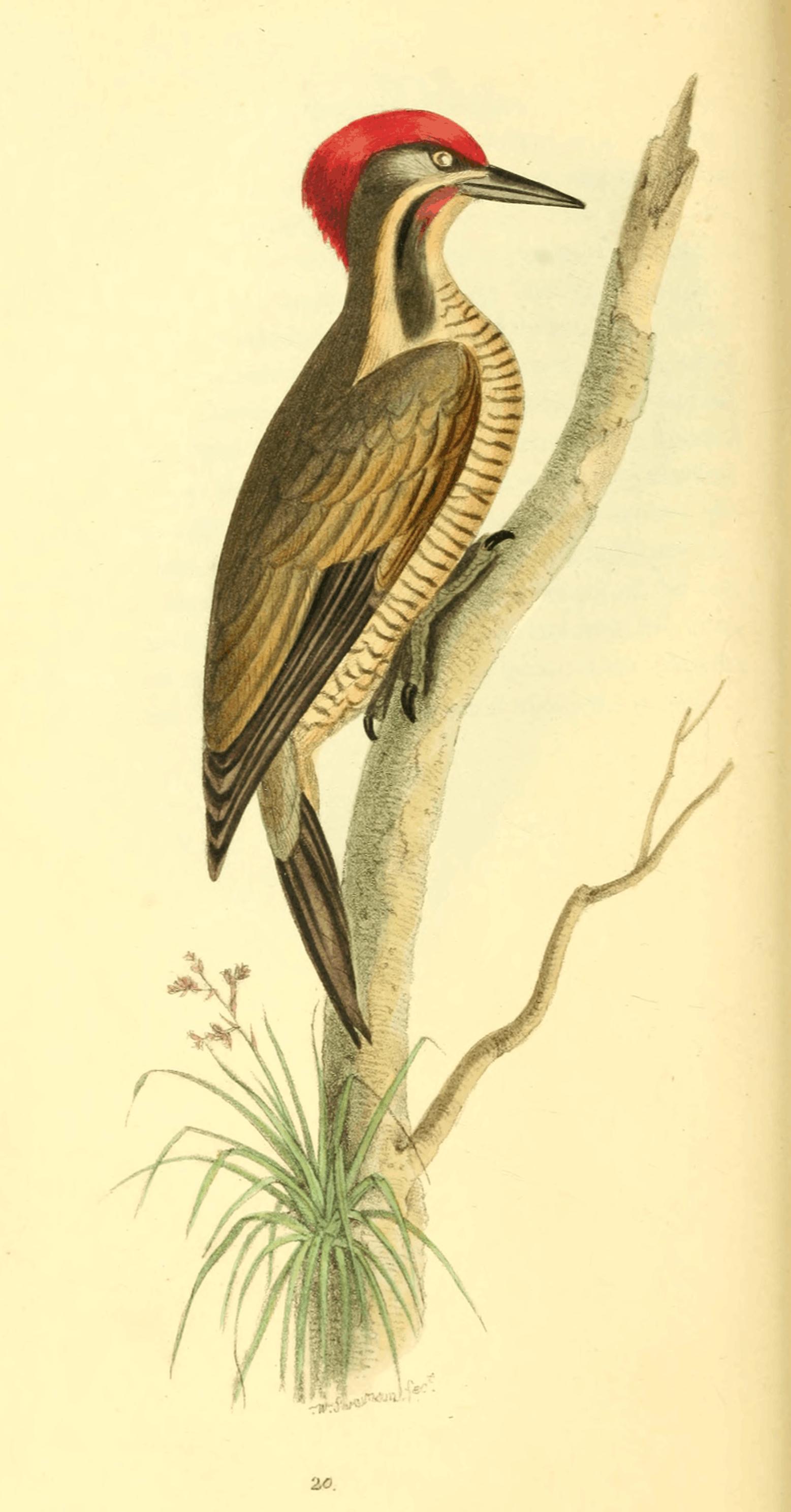
PICUS Braziliensis.
Brazilian Woodpecker.
Generic Character.—See Pl. 14.
Specific Character.
P. olivaceus, subtùs fulvus, nigrescente-fasciatus; capite subcristato, suprà rubro, utrinque lineis olivaceis, fulvis, et rubris.
Olive Woodpecker: beneath fulvous, with transverse blackish bands. Head sub-crested, above red, the sides with olive, yellow, and red streaks.
P. Braziliensis, Swains. in Wern. Trans. 3. p. 291.
A new species of this already extensive family, inhabiting the interior of Brazil in the province of Bahia, where I met with it but once. It was, I believe, first described in a paper I sent to the Wernerian Society some time ago: the figure is less than the natural size.
Total length nine inches. Bill not quite an inch, and blackish. Irides yellow. Head slightly crested; the whole upper part crimson. Orbits and cheeks olive-brown; beneath this a narrow line of tawny-yellow begins at the nostrils and passes down the sides of the neck; next this is a similar stripe crimson on the jaws and olive beyond, leaving the chin and throat in front yellowish; the plumage above is tawny-olive. Quills black, within edged with rufous: all the under parts tawny-yellow, transversely banded with blackish lines; inner wing-covers yellowish. Tail three inches and a half long, the feathers black, unspotted, and tinged at their base with olive. Feet and claws lead-colour. The neck is very slender. The only one I have yet seen was a male.
Pl. 21
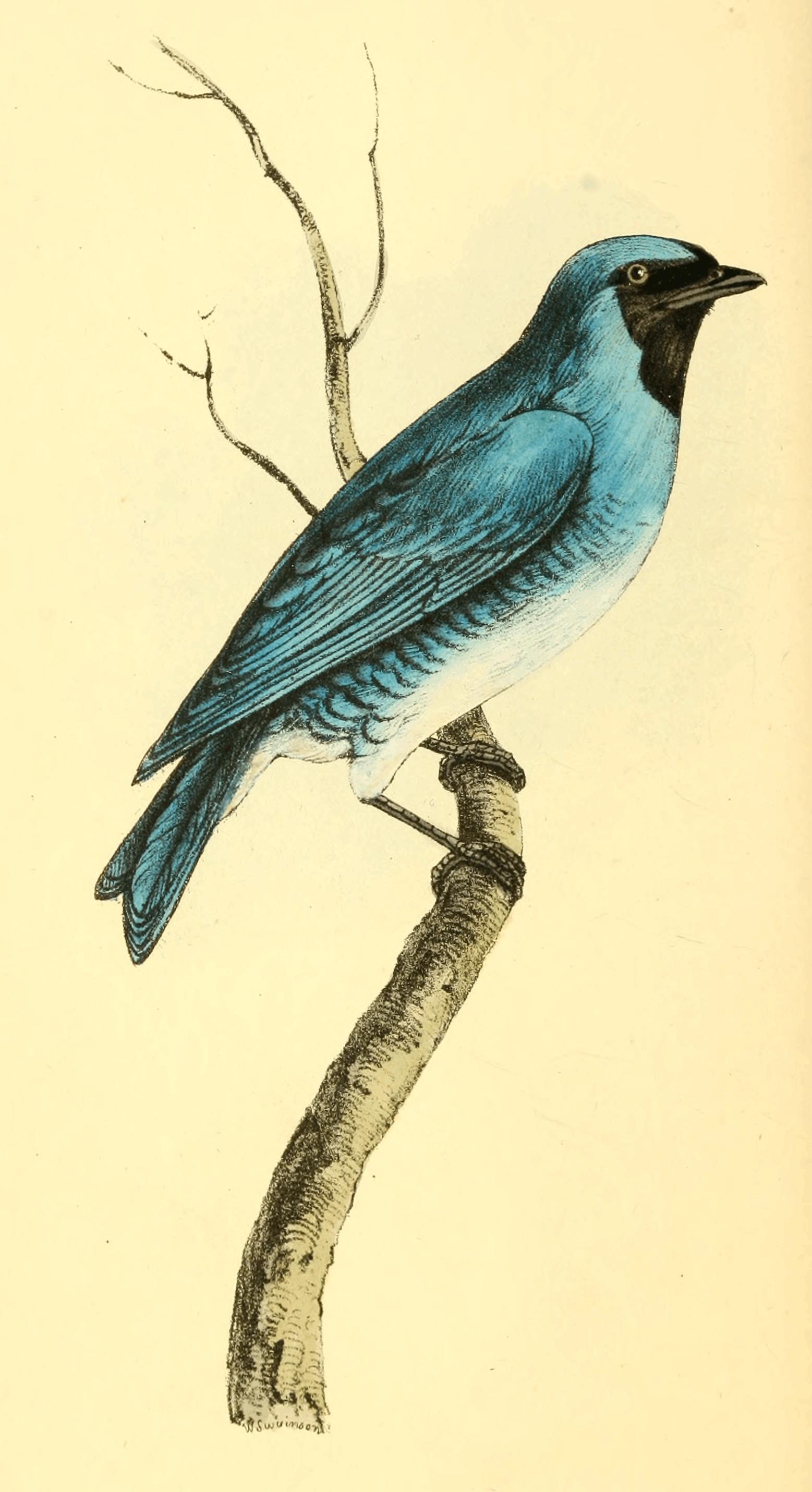
PROCNIAS hirundacea.
Swallow Fruit-eater.
Generic Character.
Rostrum breve, trigonum, basi latissimum, dilatatum, versus apicem contractum: mandibulis emarginatis; marginibus intraflexis; mandibulâ superiore, tomiis curvatis, carinatis; inferiore rectâ, breviore. Nares latæ, basales, subnudæ; aperturis orbiculatis, approximantibus, apicem quam malam magis appropinquantibus. Lingua brevissima, angusta. Rictus amplissimi infra oculos aperientes. Pedes insidentes. Alæ mediocres.
Typus Genericus Ampelis carunculata. Latham.
Bill short, triangular, base very broad, dilated, towards the end contracted; both mandibles notched, the margins bent inward; upper mandible slightly curved and carinated above; lower mandible straight and shortest. Nostrils broad, basal, nearly naked, the aperture much nearer the tip than the gape of the bill. Tongue very short, narrow. Mouth very large, opening beneath the eye. Feet formed for perching. Wings moderate.
Generic Type Carunculated Chatterer. Latham.
Obs. MM. Temminck and Lagier had just before us, and without our knowledge, published this bird under the name of Procnias Ventralis, (Pl. 5.) by which name in right of priority it should stand in the system.
Specific Character.
P. (in maribus) cærulea; fronte, jugulo, temporibusque nigris; corpore subtùs in medio albo, lateribus striis transversis nigrescentibus.
(Fœm.) viridis; mento temporibusque griseis; corpore infrà flavescente, striis obscurè-viridibus transversis.
(Male) blue; front, throat, and temples black; middle of the body beneath white, the sides with blackish transverse striæ.
(Female) green; chin and temples grey; body beneath yellowish, transversely striated with dusky-green.
The birds of this genus are remarkable for the enormous width of their mouths, which in some species exceeds that of the Swallow family, thus enabling them with ease to swallow the large berries of the Melastomæ and other tropical shrubs, on which they alone subsist; not on insects, as Cuvier asserts. Although in the construction of their bills they perfectly resemble the Swallows, their wings are not formed for long or rapid flight; and their feet are much stronger, and calculated for searching among branches for their food, in which situations I have frequently seen them. The term "pedes ambulatorii," or walking-feet, is applied too generally, and should be confined to the gallinaceous and Pigeon tribes.
This genus was formed by Count Hoffmansegg, and the present is the smallest species known: our figure is of the male bird. Total length about five inches and a half. The bill from the angle to the tip measures seven lines; but from the nostrils only three lines and a half. The middle of the body, vent, and under tail-covers in the male are pure white; in the female yellowish, with a line of olive-green down the middle of each shaft; the quills, wing-covers, and tail-feathers are black, margined in the male with blue, and in the female with green: the tail is slightly forked. The nostrils round and bare; the base of the bill has a few weak setaceous hairs. The legs resemble the true Chatterers, having the outer toe rather longer than the inner, and attached to the base of the middle.
This is a scarce bird, apparently not hitherto described; I met with it only three times in Bahia; but it appears more frequent in the southern provinces of Brazil, specimens having been sent me from Minas Geralis and Rio de Janeiro.
Pl. 22
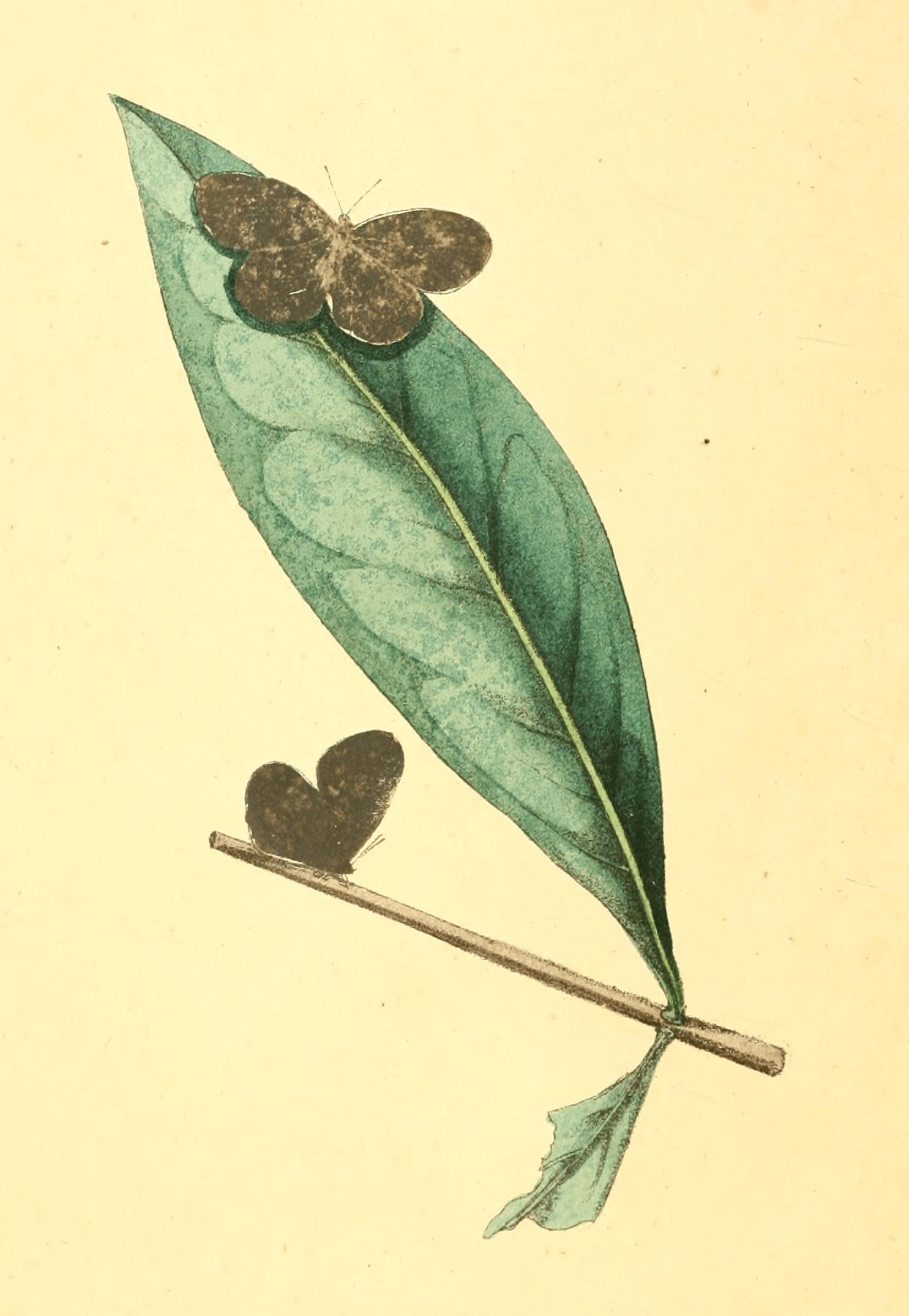
TERIAS Elvina.
Generic Character.
Antennæ breves, clavâ subtruncatâ, compressâ. Palpi brevissimi curvati, vix ultra caput producti, ad linguam compressi, densis squamis imbricatis in totum tecti apice nudo. Abdomen elongatum, gracile, in maribus 6-articulatum, articulo ultimo duobus uncis incurvatis approximantibus; valvis latis, incrassatis, truncatis, aduncis. Alæ utroque sexu similes; latæ, obtusæ, rotundatæ, integerrimæ.
Typus Genericus Papilio Hecabe. Linnæus.
Antennæ short, the club somewhat truncate and compressed. Palpi very short, curved, hardly projecting beyond the head, closely compressed on the tongue, entirely covered with close imbricate scales, the tip naked. Body elongated, slender, in the male six-jointed, the last with two approximating incurved hooks; valves broad, thickened, truncate, and hooked. Wings in both sexes alike, broad, obtuse, rounded, very entire.
Generic Type Papilio Hecabe. Linnæus.
Specific Character.
T. alis subdiaphanis, sulphureis, subtùs immaculatis. Anticis suprà apice nigris, posticis (in maribus) margine antico basi gibbosis. Fœm. ——?
Wings sub-diaphanous, pale sulphur; beneath immaculate. Anterior, above with a black marginal tip; posterior (in the male) with the fore-margin gibbous at the base. Female ——?
Pieris Elvina. Godart in Encycl. Method, p. 158. no. 67.
This is one of the smallest of Butterflies, and from the extreme delicacy of its form seems to sanction with truth the poetic idea of living "but for a day." It is found in Brazil, inhabiting only the deepest forests, as if fearful its little life would be endangered by the scorching rays of a tropical sun: in these sombre shades it is seen to fly slowly and feebly near those spots where a ray of the sun has partially entered the thick canopy of foliage above, which is frequently fifty or sixty feet from the ground.
The genus I have now placed it in belongs to the Coliadæ, and appears to connect that family with the Pieridæ: their distinctions are obviously marked and very constant in all the species I have yet seen, and which are tropical: of these, seven I discovered in Brazil; three or four more are natives of the southern extremity of North America; and Dr. Horsfield has four or five from Java. I know of none from Africa. Their size in general is very small.
I think this species is the Pieris Elvina of Godart; although the insect he mentions as the female is in reality that of his Pieris Neda. The true female I have never seen; I suspect it will want the gibbous curve on the hinder wings of the male, which sex is, indeed, not common, and is generally much smaller, and sometimes half the size only, of the figure.
Papilio Nicippe of Cramer (tab. 210. fig. C. D.) strictly belongs to this genus, though placed in that of Colias by Godart, as well as his Pieris Agave, Hecabe, and doubtless many others not now before me.
Pl. 23
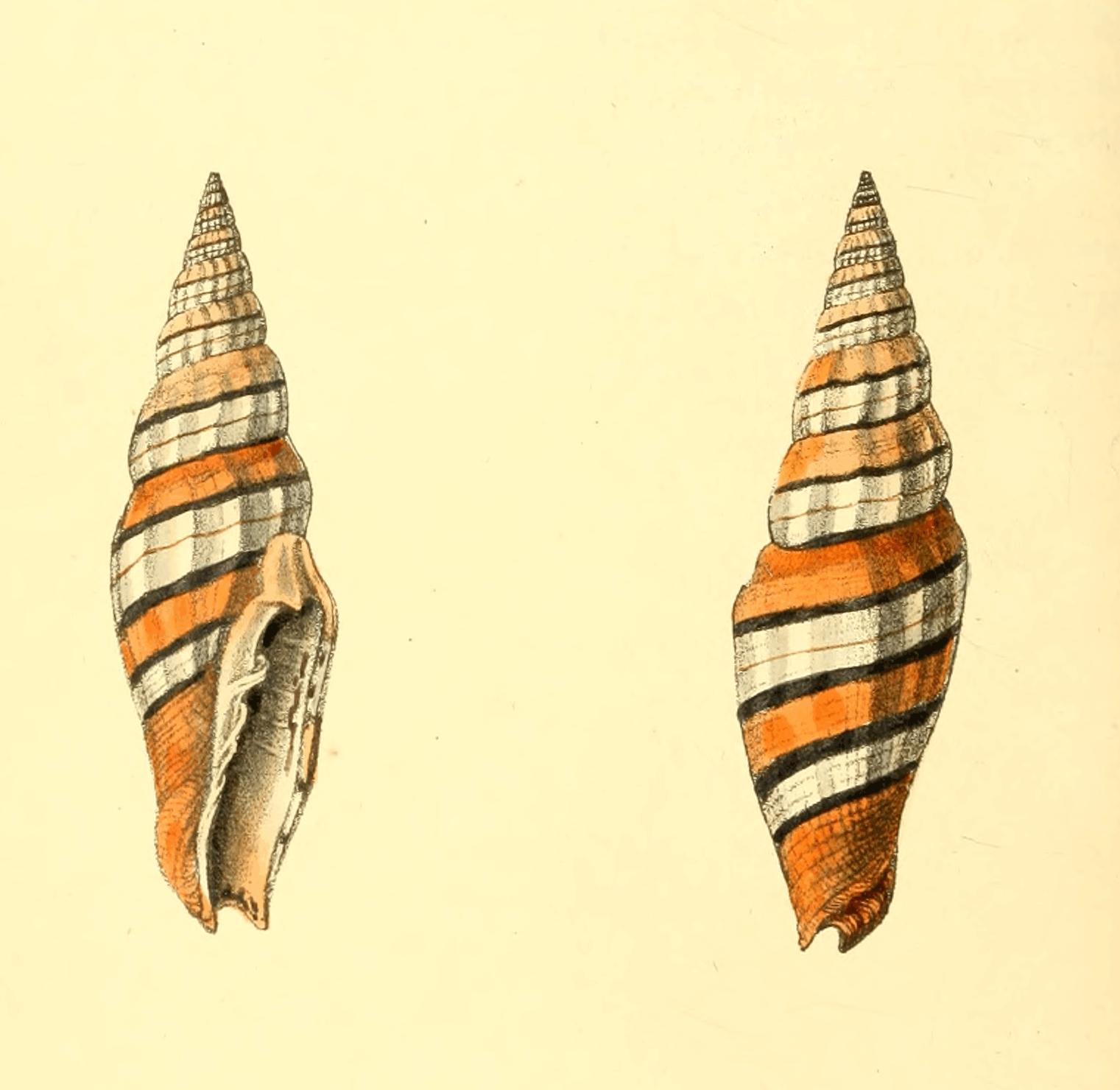
MITRA vittata.
Ribbon Mitre.
Character Genericus.
Testa inæqualiter fusiformis, spirâ productâ attenuatâ; labio exteriore intùs edentato. Columella plicata.
Divisiones.
III. Apertura angusta, linearis, suprà angulata, infrà subcontracta.
Mitræ vulpecula, plicata, &c.
Obs. Testa plerumque longitudinaliter plicata, æqualiter fusiformis, labio exteriore lævi leviter undulato, interiore ad apicem intrà crassato; gulâ striatâ.
III. Apertura suprà acuminata, infrà angusta, extrinsecus curvata.
Voluta mitra-abbatis. Chemnitz, &c.
Obs. Testa plerumque spirâ elongatâ, aperturâ ad basin angustatâ, siphone superiore parvo aut nullo.
III. Apertura suprà acuminata, extrinsecus recta, infrà rotundata, dilatata, vel effusa.
Mitræ papalis, episcopalis, &c.
Obs. Testâ plerumque lævi ad basin obtusâ, truncatâ, labio exteriore margine crenato, gulâ lævi.
Generic Character.
Shell unequally fusiform; spire lengthened, attenuated; outer lip simple not toothed within. Columella plaited.
Divisions.
III. Aperture narrow, linear, above angulated, below a little contracted.
Mitræ vulpecula, plicata, &c.
Obs. Shell generally longitudinally plaited, equally fusiform; outer lip smooth, slightly waved; top of the inner lip much thickened within; throat striated.
III. Aperture above pointed, below narrowed, externally curved.
Voluta mitra-abbatis. Chemnitz, &c.
Obs. Shell generally with an elongated spire, the aperture below narrowed; upper syphon or channel small or wanting.
III. Aperture above pointed, externally straight, below rounded, widened or effuse.
Mitræ papalis, episcopalis, &c.
Obs. Shell generally smooth, the base thick and truncated; margin of the outer lip crenated; throat smooth. The smaller shells of this division connect the genera Mitra and Colombella (Lamarck).
Specific Character.
M. testâ angustâ, basi cancellatâ; spirâ plicis carinatis; interstitiis sulcis transversis confertis; columellâ 4-plicatâ; gulâ 4 aut 5 striis remotis.
Shell narrow, base cancellated. Spire with carinated plaits, the interstices with slender, crowded, transverse grooves. Pillar of four plaits; throat with four to five remote striæ.
This superb shell is figured from a matchless specimen brought home by that illustrious and lamented patron of science, the late Sir J. Banks, from the Pacific Ocean: it is now, together with his entire collection of shells and insects, in the Museum of the Linnæan Society.
It is of great rarity, and the present specimen far exceeds in size any I have yet seen. A very perfect one exists in my father's collection which measures only two inches one line long: it differs slightly in wanting the lower white band and its inferior border: there is also an additional small plait between the second and third, a variation not uncommon in the Linnæan Volutes, and which lessens the importance of this character as a specific distinction.
It is unfigured, and I believe undescribed, unless perhaps in Solander's MSS. In its small state it may have been overlooked as one of the numerous varieties of M. vulpecula; but the sharp angulated plaitings, the cancellated base, and the numerous faintly-grooved lines on the spire, as well as the more slender and lengthened form, will at once distinguish it: its colours also are very striking and dissimilar.
Pl. 24
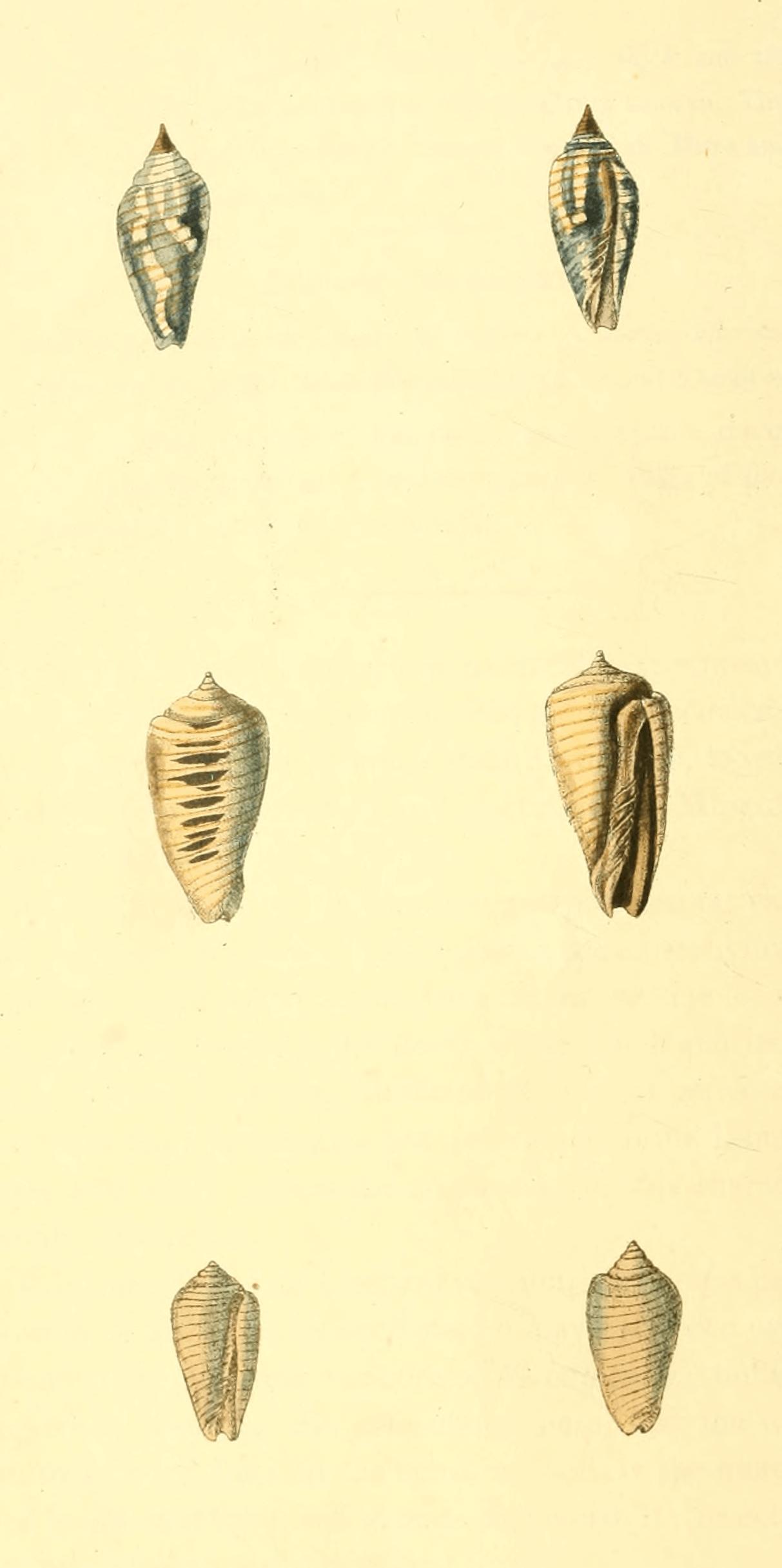
CONŒLIX.
Generic Character.
Testa coniformis; spira brevissima; labium exterius simplex; columella plicata; apertura linearis, angusta, spirâ longior.
Typus Genericus Conœlix lineatus. Nobis.
Shell coniform. Spire very short. Outer lip simple. Columella or pillar plaited. Aperture linear, narrow, longer than the spire.
Generic Type Conœlix lineatus.
CONŒLIX marmoratus.
Marbled Conœlix—upper figures.
Specific Character.
C. testâ striis transversis, remotis, capillaribus; spirâ subproductâ, acuminatâ; anfractibus in medio lineâ sulcatâ; labio exteriore crenato.
Shell with remote capillary transverse striæ. Spire slightly produced, acuminated; the whorls with a central indented line. Outer lip crenated.
The rare little shells composing the group I have now formed into the genus Conœlix, seem to have escaped the observation of modern systematic writers. They form a beautifully defined link connecting the Cones with the Volutes, strictly so termed, and their generic characters seem to be very constant and clear. The present species varies more or less in the regularity of its tessellated markings. The inside of the mouth is brown, and the pillar has five plaits. Several specimens are in the Banksian Cabinet, from the Pelew Islands. The figures are enlarged to one half more than the natural size.
CONŒLIX lineatus.
Lineated Conœlix—middle figures.
C. testâ lævi, albescente, lineis transversis, fulvis, capillaribus; spirâ depressâ, apice prominulo; columellâ 6-plicatâ.
Shell smooth, whitish, with transverse capillary fulvous lines. Spire depressed, the apex prominent. Pillar six-plaited.
Figured of the natural size. The volutions of the spire are somewhat convex; the coloured lines are not indented. Inhabits the South Seas?
CONŒLIX punctatus.
Punctured Conœlix—lower figures.
C. testâ fulvo-albescente, striis transversis capillaribus, intrà minutè punctatis; spirâ brevi; columellâ 5-plicatâ.
Shell cream-colour, with capillary transverse striæ, which are minutely punctured. Spire short. Pillar five-plaited.
Inhabits Otaheite: from the Banksian Collection. The figures are on the same scale as C. marmoratus.
These are the only three species which I have myself seen. Another is figured in Chemnitz x. tab..150. fig. 1415 and 6. Mr. Humfreys informs me he has seen at different times five or six others, all of a small size.
Pl. 25
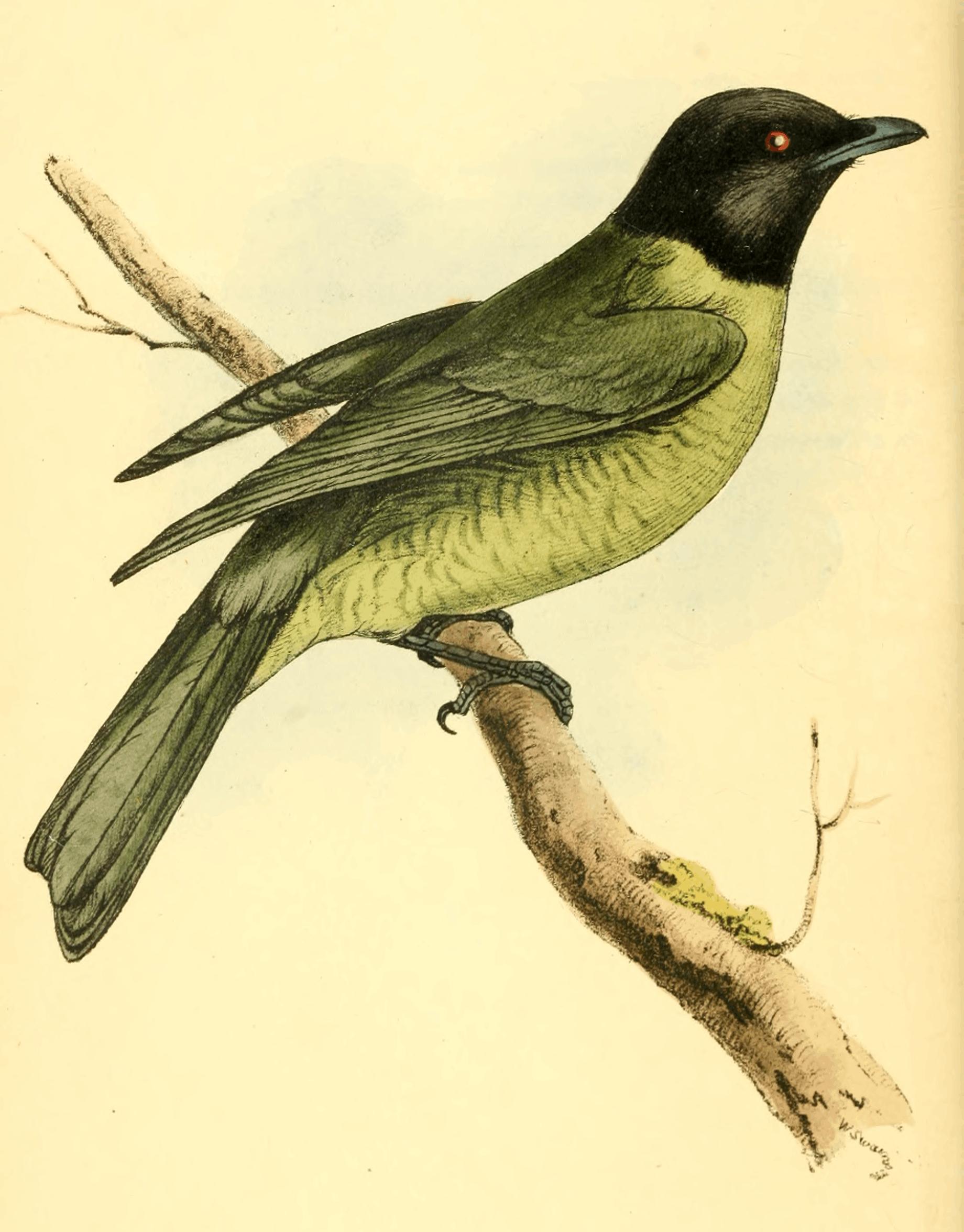
PROCNIAS melanocephalus.
Black-headed Berry-eater.
Generic Character.—See Pl. 21.
Specific Character.
P. oliva-viridis, subtus flavescens, striis fuscis transversis, capite omnino nigro.
Olive-green, beneath yellowish, with dusky transverse striæ. Head entirely black.
Another new and very rare bird of this singular genus, inhabiting, like all the other species, the tropical regions of America. I met with it in Brazil but twice in the forests of Pitanga, not far distant from Bahia; and my hunters were at a loss for its name, never having seen it before: the eyes in the fresh bird are of a beautiful crimson.
Its total length is nine inches and a quarter; the bill is nine lines from the gape to the tip, and four from the base of the nostrils, at which part the bill is not so proportionably broad as in the Swallow Berryeater (pl. 21.): the colour blueish-black, paler at the base: the whole head, sides, chin, and part of the throat are black, the feathers of the crown a little lengthened and pointed, giving a slight appearance of a crest: the wings and tail are dusky-black on the inner shafts and green on the outer; the whole of the upper plumage olive-green, and of the under pale greenish-yellow crossed with short dusky transverse lines from the breast downwards; under wing and tail-covers the same. Tail four inches from the base, slightly divaricated, and of twelve feathers. Wings four inches and a half, the first quill very short, the third, fourth and fifth of equal length. Legs black.
This was a male bird: the female I have not seen.
Pl. 26
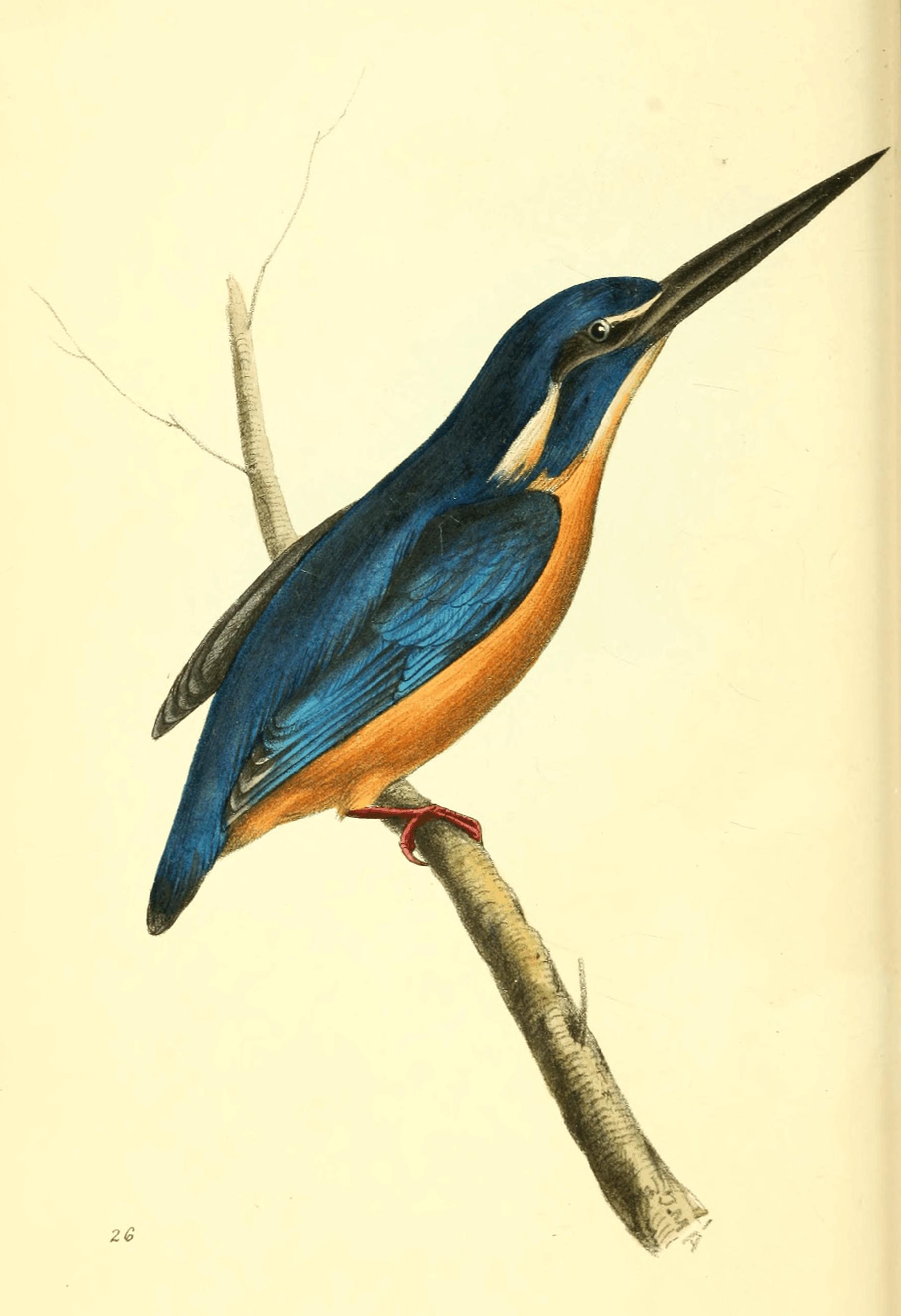
ALCEDO azurea.
Azure Kingsfisher.
Generic Character.
Rostrum longissimum, rectum, attenuatum, altius quam latius, in totum compressum, mandibulis carinatis; marginibus lateralibus leviter inflexis. Nares basales, membrana tectæ, apertura nuda, lineari, obliqua; cauda plerumque brevissima. Pedes gressorii, digito antico interiore minimo aut nullo.
Typus Genericus Alcedo ispida. Linn.
Bill very long, straight and attenuated, higher than broad, compressed the whole length, both mandibles carinated, the margins slightly bent inwards. Nostrils basal, covered by a membrane; the aperture linear, oblique, and naked. Tail mostly very short. Feet gressorial, inner fore-toe small or wanting.
Generic Type Common Kingsfisher. Lath. Bewick, &c.
Specific Character.
A. Corpore suprà, capitis lateribus colloque nitido cyaneis; subtus rufis; mento gulaque albescentibus, alis nigricantibus; digito antico interiore nullo.
Body above, sides of the head and neck shining mazarine blue; beneath rufous; chin and throat whitish; wings blackish; inner fore-toe wanting.
Alcedo azurea. Azure Kingsfisher. Lath. Synop. Suppl. ii. p. 372. Lewin's Birds of New Holland, fasc. i. pl. 1.
Alcedo Tribrachys. Tridigitated Kingsfisher. Shaw in Gen. Zool. viii. 1. 105.
The Kingsfishers have such a general similarity of form, that the most casual observer is able to distinguish them: a very long straight bill, short wings, and (in general) a shorter tail with very small legs, are the prominent distinctions of such as are usually seen; and the richness of plumage that generally pervades them cannot be better exemplified than in our own beautiful species, the common Kingsfisher, not unfrequent in many parts of England.
These birds, hitherto placed in systems under one genus, nevertheless contain two distinct groups differing materially in the construction of that primary organ of supporting life, the bill; and in their physical distribution, or the countries they respectively inhabit, two most important considerations in the natural arrangement of animals under the present elevated views of the philosophic zoologist, with whom the study of Nature consists no longer in the study of words, the retention of names, or even the accurate description of species.
These considerations have induced me to form these birds into two genera, the definitions of which are now given: those retained under the old genus of Alcedo appear to be scattered (though sparingly) in every part of the old and the new world. Their bills seem formed for swallowing their food more in an entire state, similar to the Herons. In each of these genera one species exists with only three toes, a remarkable circumstance, which in an artificial system would endanger their being united in a separate genus; but which, from the remarkable smallness of the inner toe in all the other species, cannot I apprehend point out any peculiarity either in their habit or economy: and this opinion I find is likewise entertained by Professor Temminck.
Total length seven inches and a quarter. Bill from the gape two inches one line, the upper mandible rather longest, and both with a slight appearance of a notch; the colour black. All the upper plumage, as well as the sides of the head, ears, and stripe beyond, fine ultramarine blue, more vivid on the rump and tail-covers, and duller on the tail, wing-covers, and lesser quill-margins; front blackish; from the nostrils to the eye a whitish line, and from the ears on each side the neck a whitish stripe, which almost forms a collar round the nape. Quill-feathers sooty black. All the under parts orange ferrugineous; throat and belly nearly white. Tail very short, nearly hid by the upper covers. Feet red, claws black. The inner fore-toe wanting, but a slight rudiment of it exists in my specimen.
Since writing the above, I find this bird is figured and described in a beautiful work commenced by Lewin on the birds of New Holland, which Mr. Brown, the learned possessor of the Banksian library, pointed out to me. I believe but a few copies are known. Lewin observes, "it inhabits heads of rivers, visiting dead trees, from the branches of which it darts on its prey in the water beneath, and is sometimes completely immersed by the velocity of its descent."
Dr. Latham has very well described it, but quite overlooked the construction of the feet.
Pl. 27
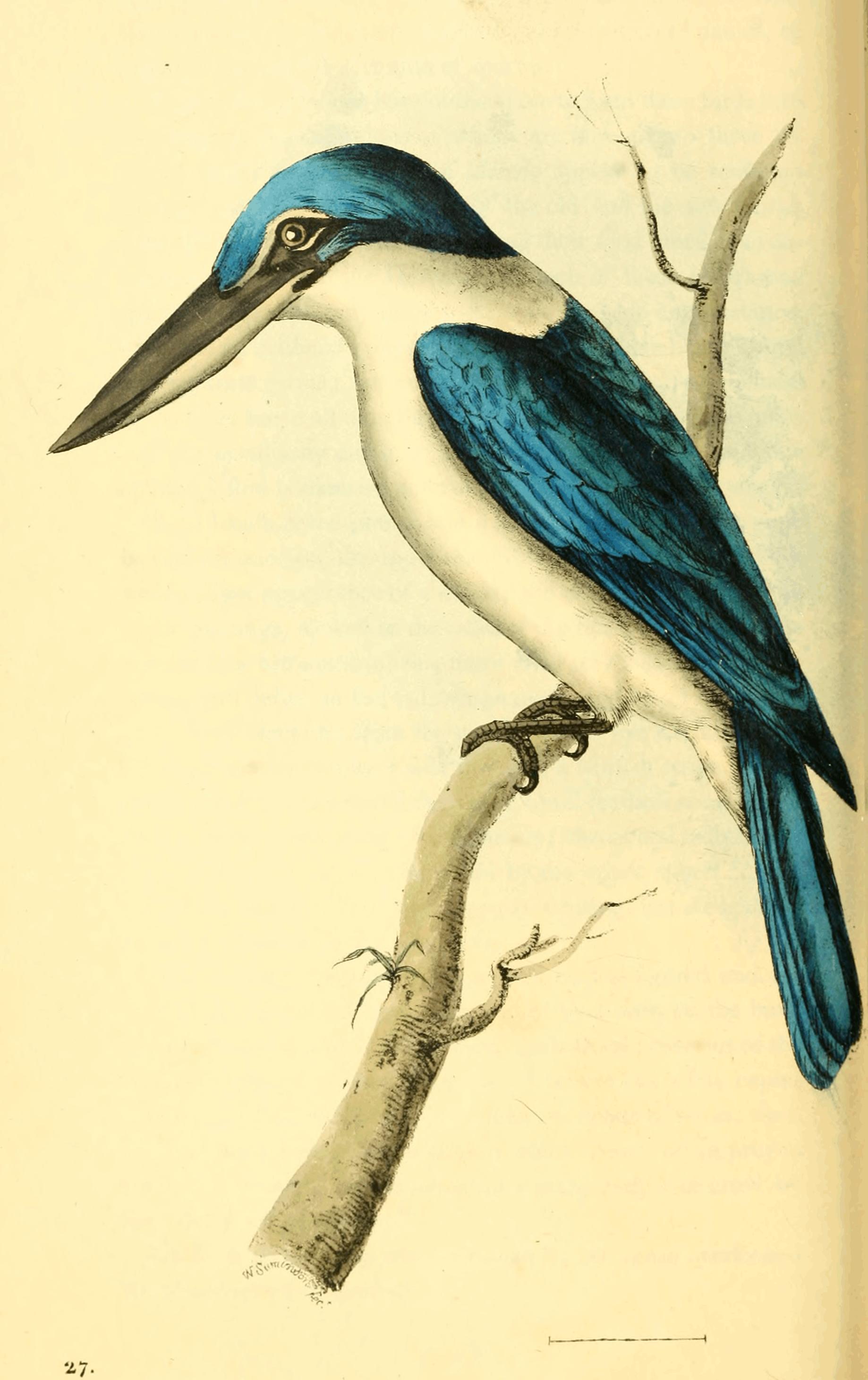
HALCYON collaris.
Collared Crabeater.
Generic Character.
Rostrum longissimum, rectum, validum, ad basin latius quam altius, lateribus tetragonis; mandibula superiore rectissima, ad basin rotundata; inferiore carinata, recurvata, margine superioris inferiorem obtegente. Nares basales, membrana tectæ, apertura nuda, lineari obliqua. Cauda plerumque mediocris. Pedes gressorii, digito antico interiore minimo aut nullo.
Typus Genericus Alcedo Senegalensis. Linn.
Bill very long, straight, thick, the base broader than high; the sides tetragonal; upper mandible very straight, the base rounded; under mandible beneath carinated and recurved, the margins covered by those of the upper. Nostrils basal, covered by a membrane, the aperture naked, linear and oblique. Tail mostly moderate. Feet gressorial: interior fore-toe small or wanting.
Generic Type Crabeating Kingsfisher. Latham.
Specific Character.
H. viridi-cærulea; corpore subtus, lunulaque cerviculi albis.
Greenish-blue. Body beneath and nuchal collar white.
Alcedo collaris. Latham Index Ornith. i. 250.
Sacred Kingsfisher, Var. D. Latham Syn. ii. p. 623.
Collared Kingsfisher. Gen. Zool. viii. i. p. 80.
Referring to the observations we have already made on Kingsfishers generally, it will be only necessary to observe, that the species now formed into the genus Halcyon appear entirely excluded from the American continent: their bills are much stronger, thicker, and more rounded than the genuine Kingsfishers, and the under mandible beneath invariably carinated and curving upwards. One of them (the Alcedo Senegalensis of Latham) is known to feed on crabs, the breaking and disjointing of which this structure seems admirably calculated to accomplish; and although some authors mention insects also as their food, I apprehend it is only in the absence of other larger prey more suited to the construction of their bills.
Total length eight inches and a half. Bill two inches three lines from the gape, and one inch three quarters from the nostrils; upper mandible and margin and lip of the lower, black, the rest yellowish-white. The general plumage above is pale and changeable greenish-blue, the green predominating on the scapulars, head and tail; the upper part of the neck is crossed by a white collar, separated from the green of the head by a narrow margin of black, which passes on the ear-feathers round the nape; a narrow whitish line runs from the nostrils to the eyebrows, and another very short one is beneath the eye; the whole of the under plumage white. Quills black edged with blue, the second, third and fourth equal and longest. Wings four inches and a quarter. Tail even, near three inches long, above blue-green, beneath black. Feet dusky; middle and outer claws much longer than the leg.
Inhabits Java and other parts of India, and is I believe unfigured. The line at the bottom of the plate is on the scale of an inch.
Since writing the above, Temminck's new edition of the Manuel d'Ornithologie has just reached me, in which I perceive he has continued the birds of this genus under that of Alcedo, observing that their plumage is always shining, and that he can find no characters for their geographic distribution: yet, notwithstanding the opinion of this eminent ornithologist, a close attention will I believe prove, first, that no species of Linnæan Alcedo bearing the characters of Halcyon have yet been discovered as natives of America; and secondly, that species of genuine Alcedo will be found with plumage quite devoid of any bright or shining colours. One or two exist in my own cabinet, but to which I cannot now refer.
The situation of Halcyon will be between Alcedo and Dacelo; from the last of which it is distinguished by its perfectly straight, acute, and entire upper mandible, which, on the contrary, in Dacelo is notched, the tip bent and obtuse.
Pl. 28
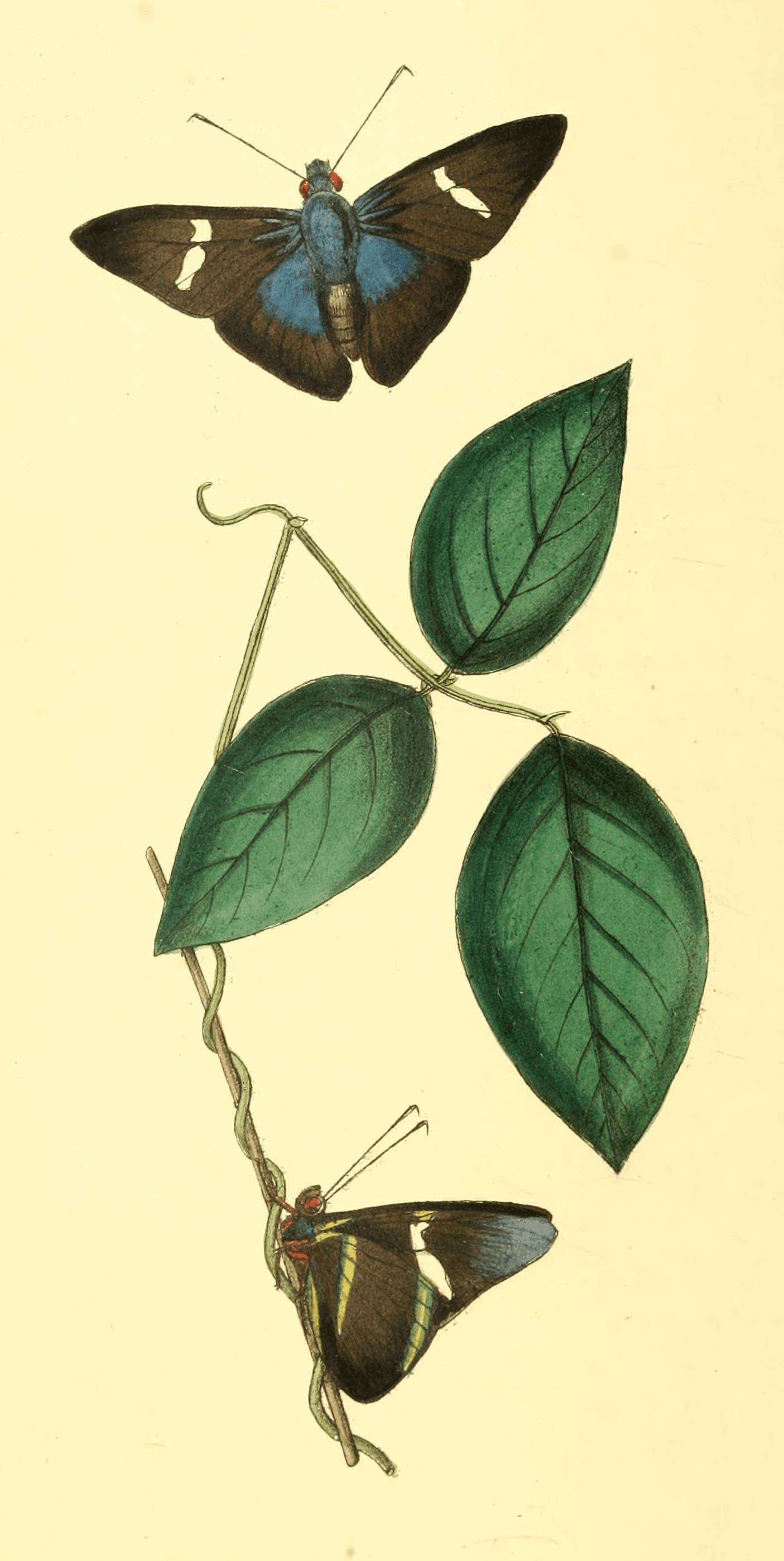
HESPERIA Haworthiana.
Haworth's Hesperia.
Generic Character.
Antennæ mediocres vel elongatæ, rectæ, graciles; clava subterminali, brevi, crassata, cylindracea; unco abrupto, brevi, acuminato. Palpi in fronte compressi, incurvati, lateribus convexis vel angulatis, articulo ultimo erecto, verticali. Alæ (sedentes) erectæ.
Divisiones.
III. Palpi lati, in fronte compressissimi. Antennæ breves, clava crassissima.
III. Palpi pene quadrati, crassissimi. Antennæ elongatæ.
III. Palpi articulo ultimo longiore, gracile. Antennæ mediocres.
Typus Genericus Hesperia Comma Auctorum.
Antennæ moderate or elongated, straight, slender, the club nearly terminal, short, thick, cylindric, ending in an abrupt, short and pointed hook. Palpi compressed, incurved in front of the head, the sides convex or angular; the last joint erect, pointing vertically. Wings when at rest erect.
Divisions.
III. Palpi broad, very compressed in front. Antennæ short, the club very thick.
III. Palpi nearly square, very thick. Antennæ elongated.
III. Palpi with the last joint lengthened, slender. Antennæ moderate.
Generic Type Hesperia Comma of Authors.
Specific Character.
Hesp. (Div. 2.) alis suprà nigrescente-fuscis, basi nitido-cæruleis, anticis fascia mediali hyalina, posticis subtus fuscis, lineis duabus longitudinalibus viridi-flavis; pedibus fusco-aurantiis.
Hesperia (Div. 2.). Wings above blackish-brown, the base shining blue; anterior with a medial hyaline band; posterior beneath brown, with two longitudinal yellow-green lines. Legs brownish-orange.
The celebrated Latreille, the father of modern Entomology, has well observed, that the immense number of insects crowded together in the genus Hesperia contain many natural genera, but which the paucity of species generally found in cabinets prevents us from discriminating. Having for a long time paid attention to this family, and possessing near 300 species in my own cabinet, I have had the opportunity of attempting their elucidation; and the above generic character is applied to those insects only which I propose considering genuine species of the genus Hesperia, and which will comprise near 170 species.
I have named this new, undescribed and very rare insect, in honour of my esteemed friend A. H. Haworth, Esq. F.L.S., &c., well known by the benefits his writings have conferred on the sister sciences of entomology and botany. The only two insects I ever saw of this species I captured in the southern part of Brazil.
Pl. 29
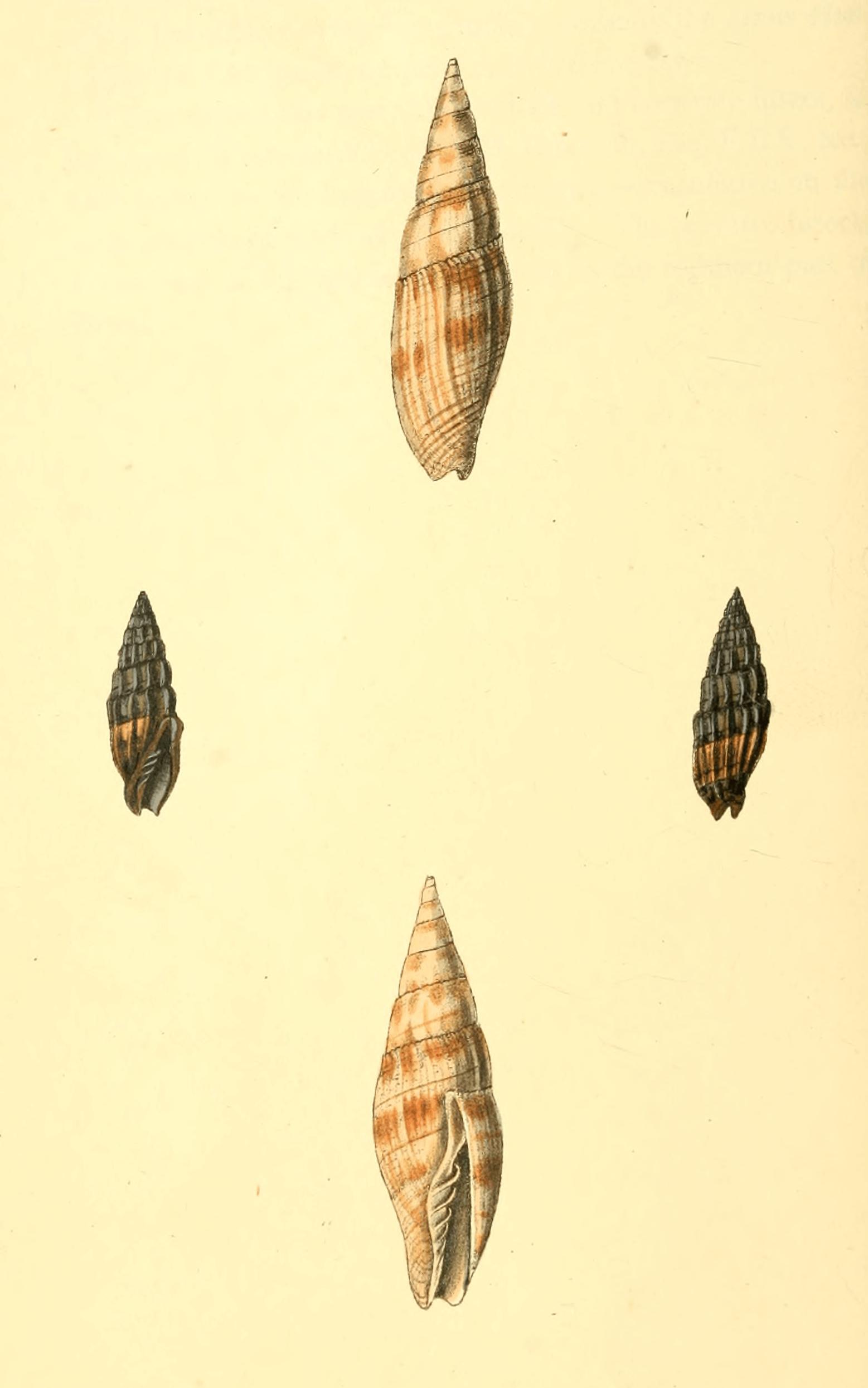
MITRA cancellata.
Basket Mitre—upper figure.
Generic Character.—See Pl. 23.
Specific Character.
M. (Div. 2.) testa fusiformi, cancellata; striis longitudinalibus incrassatis, spira aperturaque æqualibus; columella 5-plicata; spira sublævi.
Shell fusiform, cancellated, the longitudinal striæ thickened; spire and aperture of equal length; pillar five-plaited; spire nearly smooth.
Another undescribed species of this elegant family, and of great rarity, in the private collection of Mr. G. Humfreys. The whole of the body whorl and commencement of the spire is cancellated. The longitudinal striæ are crowded, thickened, and slightly elevated, giving a crenated appearance to the suture: the transverse striæ slender, and filling up the interstices. The spire is nearly smooth and a little bent: the ground colour very light orange, with three darker interrupted bands on the body: whorl separated by two slender lines of the same colour; the spiral whorls have only two bands and a line between; the upper margins slightly compressed on the suture; the outer lip within smooth.
MITRA rigida.
Ribbed Mitre—middle figures.
Specific Character.
M. testa costis longitudinalibus, elevatis, linearibus, integris, interstitiis lævibus ad basin granulatis; spira producta; columella 4-plicata; apertura brevi.
Shell with elevated, longitudinal, obtuse, entire ribs, the interstices smooth, the base granulated; spire lengthened; pillar four-plaited; aperture short.
Equally rare, and from the same collection as the preceding. In habit it approaches nearest to M. exasperata of Chemnitz, but has not the ribs angulated or their interstices striated, and is much more narrowed at the base than in that shell, which I have seen: the outer lip is also smooth; the inside strongly striated. This shell was formerly in the collection of Mr. Keate, the elegant author of the "Sketches from Nature."
Pl. 30
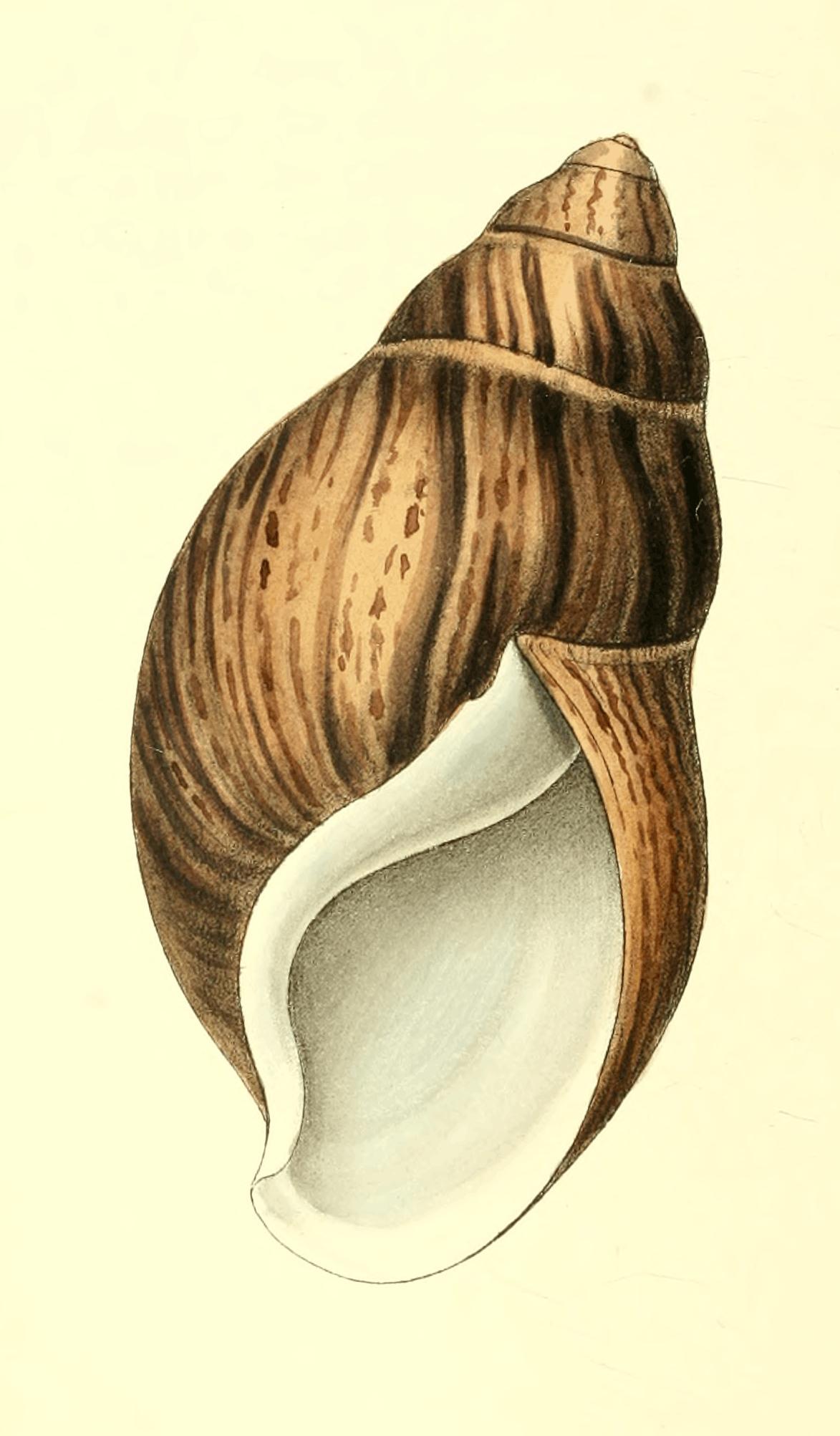
ACHATINA marginata.
Marginated Achatina.
Generic Character.
Testa ovata, vel oblongo-ovata, spira elevata, apertura subovale. Columella lævis, simplex, ad apicem truncata; labium externum tenue, internum inflexum integrum; umbilicus nullus.
Typus Genericus Bulla Achatina. Linn.
Shell ovate, or oblong-ovate; spire elevated; mouth nearly oval. Columella smooth, simple, truncated. Outer lip thin; inner lip entirely inflexed. Umbilicus none.
Generic Type Bulla Achatina. Linn.
Specific Character.
A. testa ovato-oblonga, strigis inæqualibus ferrugineis; spira ad apicem obtusa, 5-voluta; sutura depressa linea sulcata marginali.
Shell ovate-oblong, with irregular ferrugineous stripes; spire obtuse at the top, of five volutions; the suture depressed, with a marginal indented line.
Lister 579. fig. 34. Gualt. pl. 45. B. Knorr, vol. iv. tab. 24. 1. (badly coloured.)
The largest shells hitherto discovered as inhabiting the dry land belong to this genus, instituted by the celebrated Lamarck, but still divided by the strict followers of Linnæus between the Bullæ and Helices, with a singular infelicity of even artificial arrangement. The simple characters peculiar in a greater or less degree to all, will readily distinguish them; and I apprehend most of the species of the first division (which includes the present) will be found to inhabit only the African continent, while Bulla virginea and the smaller shells placed in the second division are found principally in the new world; where also two or three gigantic species of Bulimus occupy the place of the larger African Achatinæ.
Of these, the shell now figured is one of the rarest, and has hitherto been overlooked as a variety of the Linnæan Bulla Achatina; the colour of both is subject to much variation; but this will be found at best a most indecisive and vague character for specific distinction when unaccompanied by others more important and connected with the formation of shells. I have therefore not hesitated in making this a distinct species, from having had the means of examining at different times near twenty specimens, all of which presented the following characters. Spire of five whorls, the last or terminal one very small and flattened; the apex obtuse; the suture depressed, as if flattened on the shell, and margined by one or sometimes two indented lines, parallel, and at the top of each whorl. In the colour of its mouth it varies in sometimes having a tinge of rose-colour at the base and top of the spire, but the mouth is more generally white. The body whorl is more or less ventricose; the outer lip is a little reflected, and the whole shell, when full grown, much thicker and heavier than any of the other species. The epidermis is yellowish-brown, beneath which the shell is nearly white, beautifully marked with broad remote stripes of chesnut, with others more slender (and sometimes broken into spots) between. I have another specimen which agrees tolerably with Lister's figure in being more than usually ventricose, and which I think is accidental. The only constant variety appears to be that figured by Knorr, ii. tab. 3. fig. 1. having the spire entirely rose-colour.
The marginal line and the correct number of whorls in the spire are well expressed in the figures of Lister, Gualtieri and Knorr. The first of these figures is accidentally more ventricose; the second, like all the other figures of Gualtieri, is defective at the apex; and Knorr's I suspect has been outrageously coloured from the real pink-mouthed Achatina.
It inhabits the coast of Guinea; and I am informed the animal is eaten by the natives.
Pl. 31
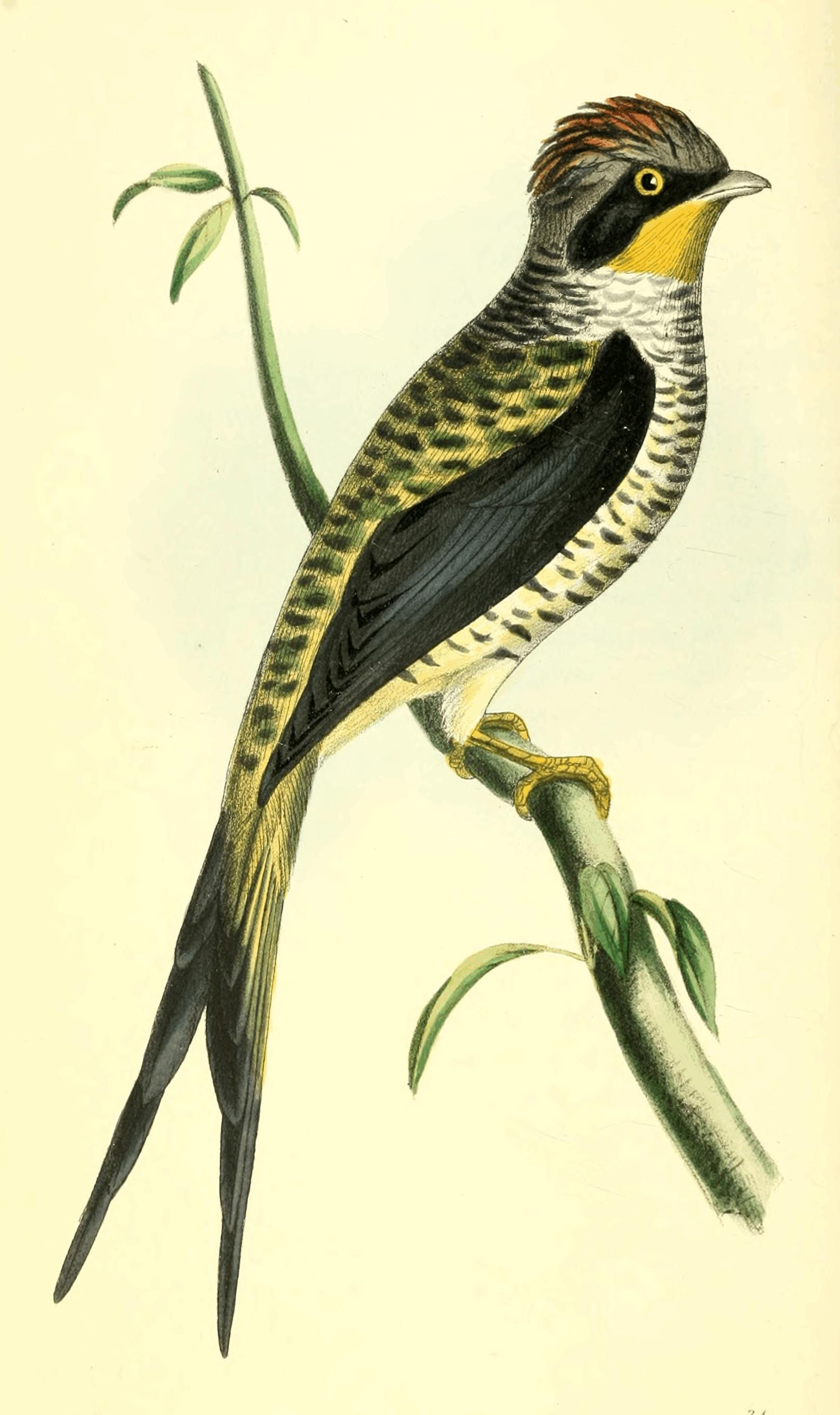
PHIBALURA cristata.
Crested Shortbill.
Generic Character.
(Phibalura Vieillot.)
Rostrum brevissimum, trigonum, latius quam altum; mandibula superiore culmine subcurvata carinata; inferiore recta; utrisque marginatis. Nares basales, simplices, subrotundæ, plumulis densis incumbentibus in totum obtectæ. Rictus ampli, infra oculos aperientes. Alæ attenuatæ, remigibus spuriis nullis. Cauda elongata, furcata, rectricibus duodecim. Pedes insidentes, digitis anticis æqualiter fissis, ad basin subconnexis.
Bill very short, triangular, broader than high; upper mandible above slightly curved and carinated; lower mandible straight, both notched. Nostrils simple, basal, roundish, entirely concealed by thick-set incumbent feathers. Mouth large, opening beneath the eye. Wings pointed; spurious quills none. Tail elongated, forked, of twelve feathers. Feet formed for sitting; the fore-toes equally cleft and slightly connected at their base.
Specific Character.
P. corpore supra nigro flavo variegato; subtus albo, fasciis nigris transversis; mento flavo, capitis crista rufa nigro variegatâ, alis caudaque elongata furcata chalybeis, immaculatis.
Above black varied with yellow; beneath white, with transverse black bands; chin yellow. Head crested, the feathers rufous, varied with black. Wings, and elongated forked tail raven-black, immaculate.
For this beautiful and extraordinary bird I am indebted to Miss E. Yeates, of the Dingle near Liverpool, who received it from South America. Its general habit clearly points it out as belonging to the Baccavoræ or Berryeaters, apparently connecting the genera Procnias and Pipra, where Temminck with much judgement has also placed it, in the new edition of his Manuel d'Ornithologie just received, and before reading which I had considered the genus as unpublished.
The total length is nine inches, of which the tail occupies four and a half. The bill is whitish, and is remarkably short, measuring only three lines from the nostrils to the tip, but three quarters of an inch from the angle of the mouth, which opens just under the eye: the plumage is singularly variegated: the crown of the head is furnished with a crest, which, when not elevated, is scarcely seen, and appears a deep glossy black mixed with grey and rufous; but when erected it is very conspicuous, and all the feathers are bright rufous tipt more or less with black; the upper sides of the head grey, the lower part and ears deep-black; the neck above is greyish-white, with blackish transverse lines: the back, scapulars, rump and tail-covers are varied transversely with olive, shining black, and bright yellow, each feather being olive at the base, black in the middle, and yellow at the tip. Beneath the feathers of the chin and part of the throat are somewhat lengthened, semi-setaceous, and of a bright yellow; the neck and breast are white, with two transverse lines of deep black on each feather; these lines diminish, and are broken into spots on the body, and nearly disappear on the vent: the edges of the breast-feathers are tipt with yellow, which colour increases downwards on the vent and tail-covers, which latter are entirely yellow. The wings are four inches long, uniform deep black with a blue gloss, much pointed, and calculated for rapid flight. Tail the same colour, the exterior basal margins olive: all the feathers are narrow, pointed, and gradually lengthening, the middle pair being two inches three quarters longer than the outer pair, which exceed those next them by an inch. The feet are very pale yellow, and three-quarters of an inch from the knee to the claws, the three foremost of which are equally connected together (though slightly) nearly as far as the first joint; the outer and inner toes equal, and rather shorter than the hind-toe: claws slender and much compressed.