Zoological Illustrations, (continued 2)
Reading edition
Whether this species is the same as the one mentioned by Temminck as existing in the French Museum under the name of P. flavirostris, it is quite impossible to say, as the description of that bird has never been published. This leads me to notice a custom several naturalists of the present day have lately adopted, of publishing names, and names only, of new or undescribed animals, which they then wish to be considered as permanently fixed, and as having thus secured to themselves all the merit of first describing. Now this at best is but a surreptitious path to fame, and in many instances bears the appearance of originating in a petty vanity, quite beneath the dignity of true science: it is easily fixing a name to an object which we have not before seen, or suspect may be new, without the trouble of investigating authors and comparing synonyms: the name may remain, but if it should afterwards be discovered as hasty and erroneous, its author is in no way amenable to the opinions and criticisms of others, for they cannot discover such mistakes when no clue is given them beyond a name, which may frequently be applicable to half a dozen species. If, on the other hand, the object is really new, the scientific world is still in the dark, for without a description the name conveys nothing. Besides this, it has a tendency to deprive those writers of their well-earned merit, who undergo the laborious but necessary investigation of books, the examining and comparing of specimens, and the construction of sound characters previous to their publishing a new addition to the great volume of Nature. Against this scientific monopoly a stand should be made, and all names either of families, genera, or species should be totally rejected, unless their meaning is clearly defined. Let those who run the race, receive the wreath; and not let it be snatched from the winning-post by another, who jumps from behind and claims it as his own.
On a careful examination of my specimen, I find the nostrils are not covered by a membrane, as observed by Temminck, but are open, obliquely and ovately round, and a narrow rim round the margin. That excellent ornithologist likewise remarks that the first and second quill-feathers are the longest; but my bird (which, however, is in full plumage) has the first and third of equal length and shorter than the second, which is longest. These nice distinctions lead me to suppose the species from which his generic character was taken, is distinct from this.
Pl. 32
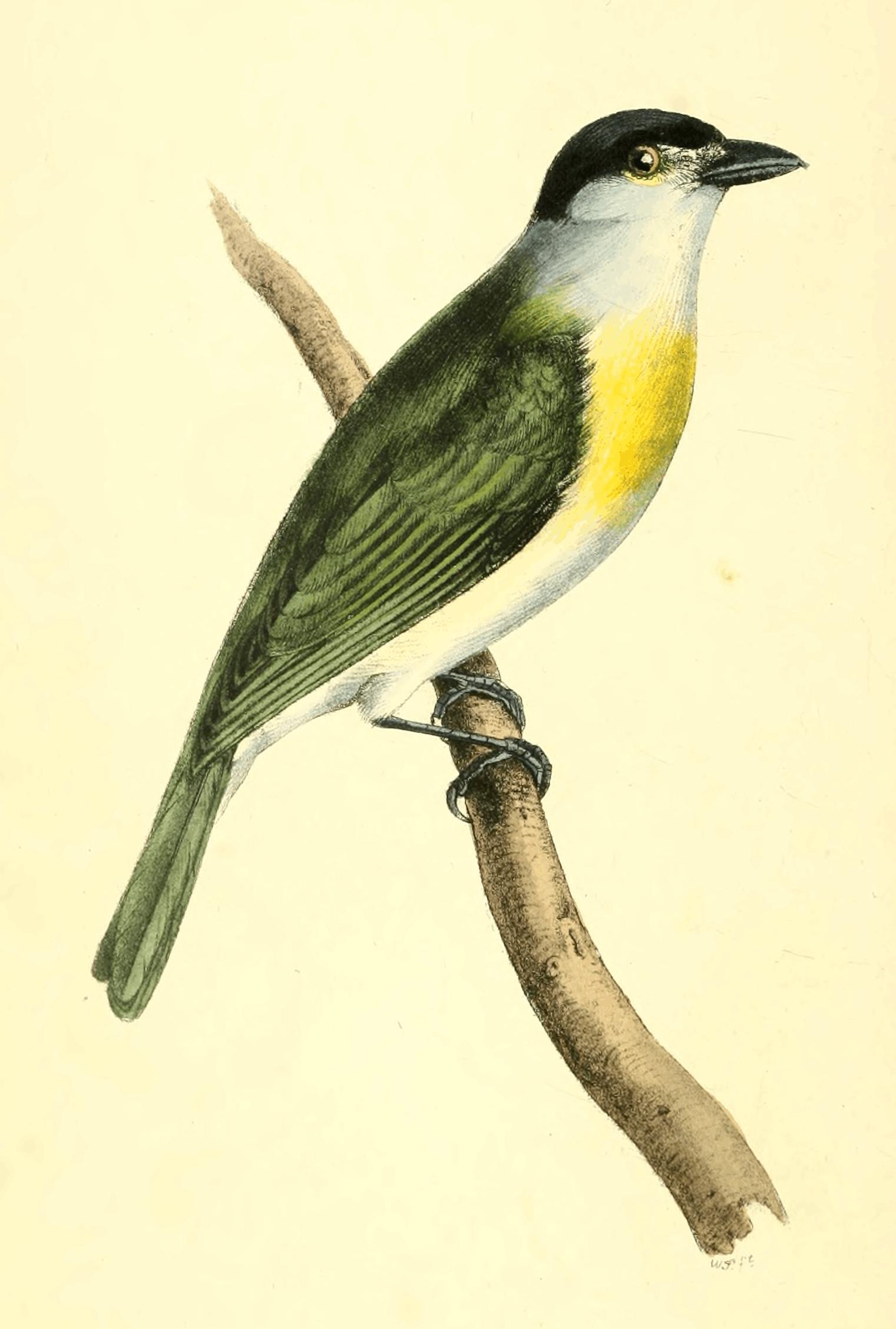
PSARIS Cuvierii.
Cuvier's Psaris.

Generic Character.
Rostrum validum, crassum, conicum, basi rotundatum, versus apicem leviter compressum, culmine convexo non carinato; mandibulis emarginatis, superiore apice adunco. Nares basales, simplices, rotundæ, juxta marginem sitæ, basi paucis plumulis setaceis incumbentibus. Pedes simplices, tribus digitis anticis æqualiter fissis. Remiges spuriæ nullæ. Cauda brevis: rectricibus duodecim æqualibus.
Typus Genericus Lanius cayanus. Linn., Lath., &c.
Bill strong, thick, conic, the base rounded, towards the top slightly compressed, the top convex, not carinated; both mandibles notched, the tip of the upper hooked. Nostrils basal, simple, round, situated near the margin, the base with a few short incumbent setaceous feathers. Feet simple, the three fore-toes equally cleft. Spurious quills none. Tail short, of twelve equal feathers.
Generic Type Lanius cayanus. Linn., Lath., &c.
Specific Character.
P. olivaceus, subtus albidus; capite suprà nigro; occipite temporibus et colli lateribus cinereis; pectore lateribus tegminibusque infernis flavis.
Olive, beneath whitish; crown black; nape, sides of the head and neck pale cinereous; breast, sides, and under wing-covers yellow.
The genus Psaris was first instituted with great propriety by Cuvier; and before the discovery of the species now made known, was supposed to consist of only one, the Cayenne Shrike of Latham, which with the present bird (named in honour of the first zoologist of the age) is found in Brazil. The figure is nearly of the natural size.
Total length five inches and a half. Bill blueish, three quarters of an inch from the angle of the mouth, and four-tenths from the nostrils, which are ovately round, rather large, and simple, being entirely devoid of an external membrane, but the base is partially covered with small thick-set, short, setaceous feathers; between the eye and base of the bill are a few weak and short hairs; the upper part of the head, as far as the nape, is capped by deep-black, having a blueish gloss: between the nostrils and the eye, as well as on the chin and throat, the colour is white, which changes to a pale cinereous grey on the sides of the head and round the neck; the ears at their base and margin of the eye tinged with yellow; the rest of the upper plumage yellowish-olive. The under plumage on the lower part of the neck and breast, the sides, and the inner wing-covers are clear yellow, and from that to the vent white. Wings two inches long, the quills brown, margined externally with olive and internally with yellow; the first and second quill progressively shorter than the third and fourth, which are of equal length. Tail short, slightly divaricated; olive, with whitish marginal tips. Legs blueish-black; the three fore-toes are equally cleft, but a membrane will be found connecting them equally at the base nearly as far as the first joint.
Temminck must be mistaken in giving as a generic character to this genus, that the external toe is connected to the middle one as far as the first joint, and the inner toe cleft to the base; at least such is not the case either in my specimens of this bird or in those of the Cayenne Shrike: and they have been carefully relaxed in warm water, the best method of ascertaining such peculiarities.
Pl. 33
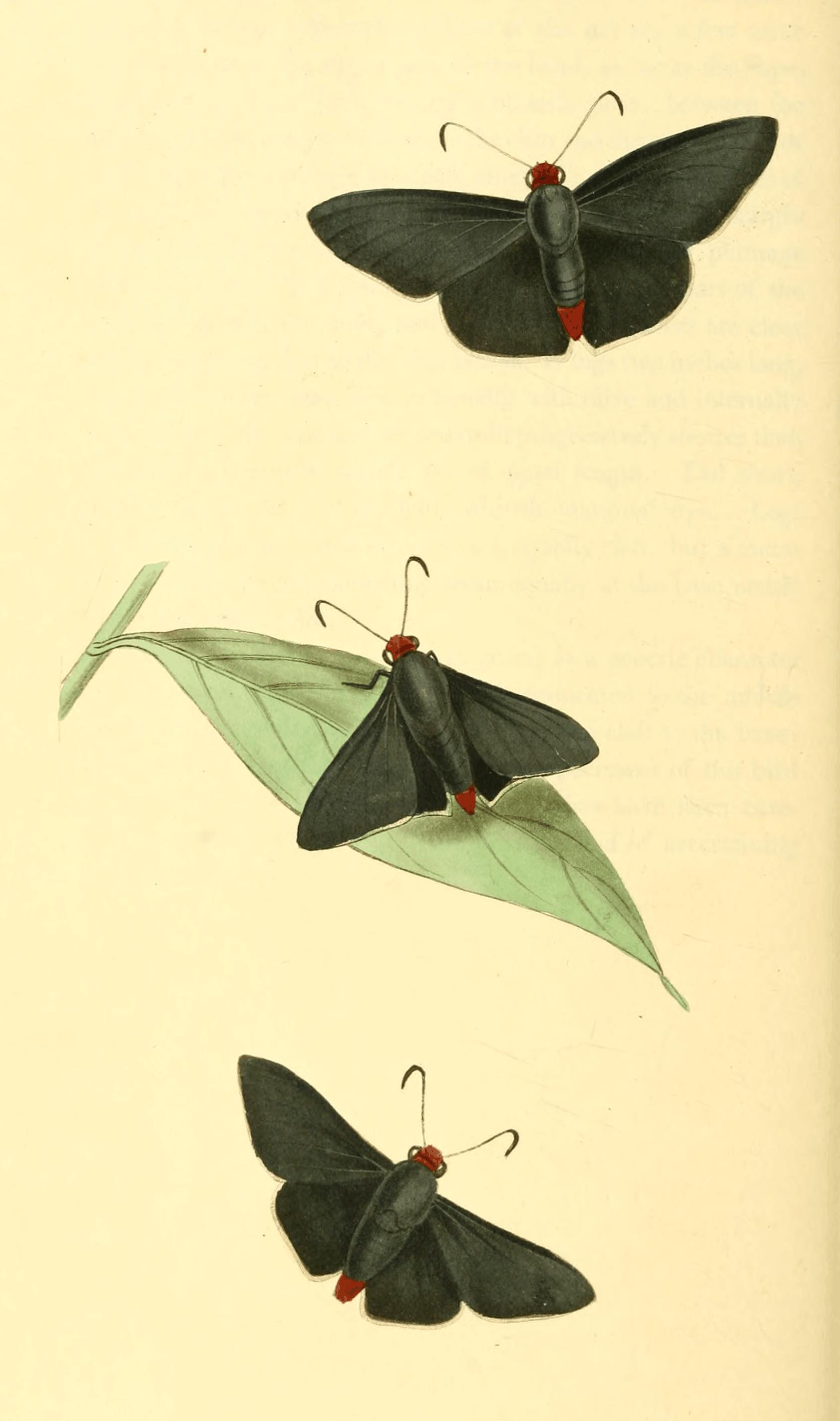
TAMYRIS Zeleucus.
Generic Character.
Antennæ arcuatæ, clava terminali, crassata, lineari, obtusa, in fœminis graciliore attenuata. Palpi in fronte convexe-compressi, supra linguam obvenientes, articulo ultimo minutissimo, crassato obtuso, approximate, proclivi. Alæ breves, sedentes horizontaliter divaricatæ.
Antennæ arcuated; the club terminal, thick, linear, obtuse; more slender and attenuated in the female. Palpi compressed convexly on the front of the head, meeting above the tongue; the last joint very minute, thick, obtuse, approximating and bent forward. Wings short, when at rest horizontally divaricated.
Specific Character, etc.
T. Alis chalybeis concoloribus, margine albo; capite apiceque corporis sanguineis.
Wings uniform blueish-black, with a slender white margin. Head and top of the body bright red.
Hesp. Zeleucus. Fab. Ent. Syst. 3. pt. 1. p. 346. no. 317.
Obs. Donovan's Indian Insects, where that author has figured it by mistake as a native of India.
This insect is the most common (although hitherto unfigured) of a striking natural group belonging to the Hesperidæ; it has therefore been selected as the best example for the genus I have now formed them into. I have not seen more than twelve or fourteen species, and these were all from different parts of South America, to which I have no doubt the genus is exclusively confined. The club of their antennæ is very thick, obtuse, and without any terminal hook. The bright red at the end of the abdomen (improperly called by Fabricius the tail) is most conspicuous in the female, which is also larger and having the wings more obtuse, of which the upper and under surfaces are both alike.
The insects of this family fly with amazing rapidity (as is shown by the thickness of their thorax, and the sharpness in the make of their wings), generally frequenting openings of thick woods and alighting on leaves where the sun strikes: I seldom saw them on flowers. Their wings when at rest are half expanded in a horizontal direction. Their metamorphosis is unknown.
This individual species is scarce in the northern parts of Brazil, but common in the southern provinces.
Pl. 34
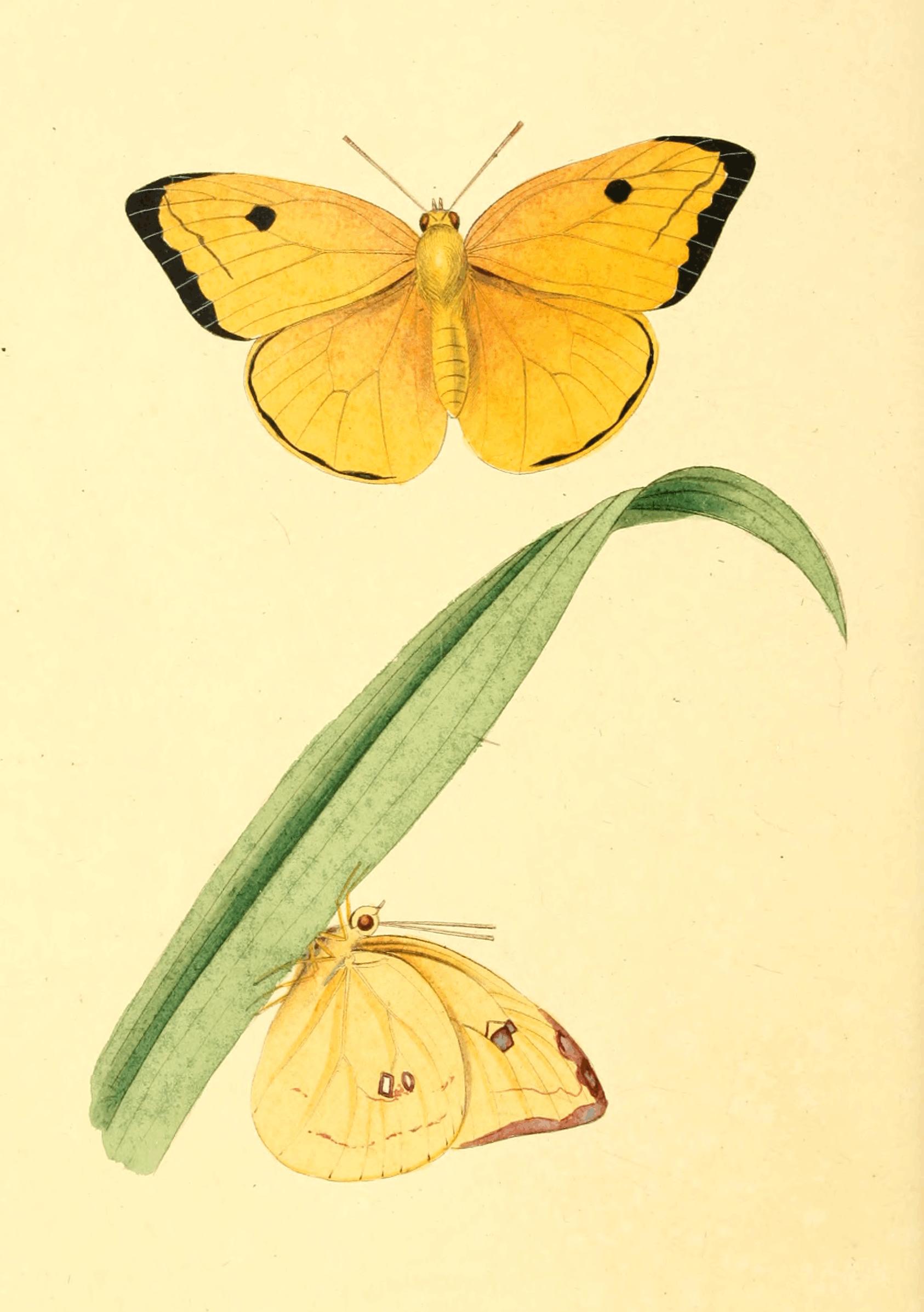
COLIAS Godartiana.
Godart's Colias.
Generic Character.—See Pl. 5.
Specific Character.
C. (Fœm.) alis flavescente-fulvis, anticis supra margine punctoque rotundato medio nigris, subtus argenteo rufo 3-fisso, posticis subtus puncto gemino argenteo margine nigro, uno quadrato; palpis productis.
(Female) Wings fulvous-yellow; anterior above with the outer margin and round central spot black, which beneath is silvery rufous and three-cleft; posterior beneath each with two silvery spots margined with black, one of which is quadrangular. Palpi lengthened.
An inspection of a vast number of insects of this genus, with the possession of nearly all the species noticed by authors, convinces me that the insect now figured is perfectly distinct from any other. It is in the cabinet of Mr. Haworth, who obligingly lent it me for comparison and description, and is the only individual I have hitherto met with. The prolongation of the palpi, which is even more obvious than in C. Statira, is alone a specific distinction; and the form of the spots both on the upper and under side differs very much in character from that insect, with which it has the most affinity. It may be the Papilio Drya of Fabr. (omitting his references); but his description, whether intended for this insect or any other, is so vague that I can see no advantage in retaining it. Of the two bright silver spots beneath, one is oval, the other larger and quadrangular.
I have named it in honour of M. Godart, the intelligent coadjutor of M. Latreille in the entomological part of the Encyclopédie Méthodique.
Pl. 35
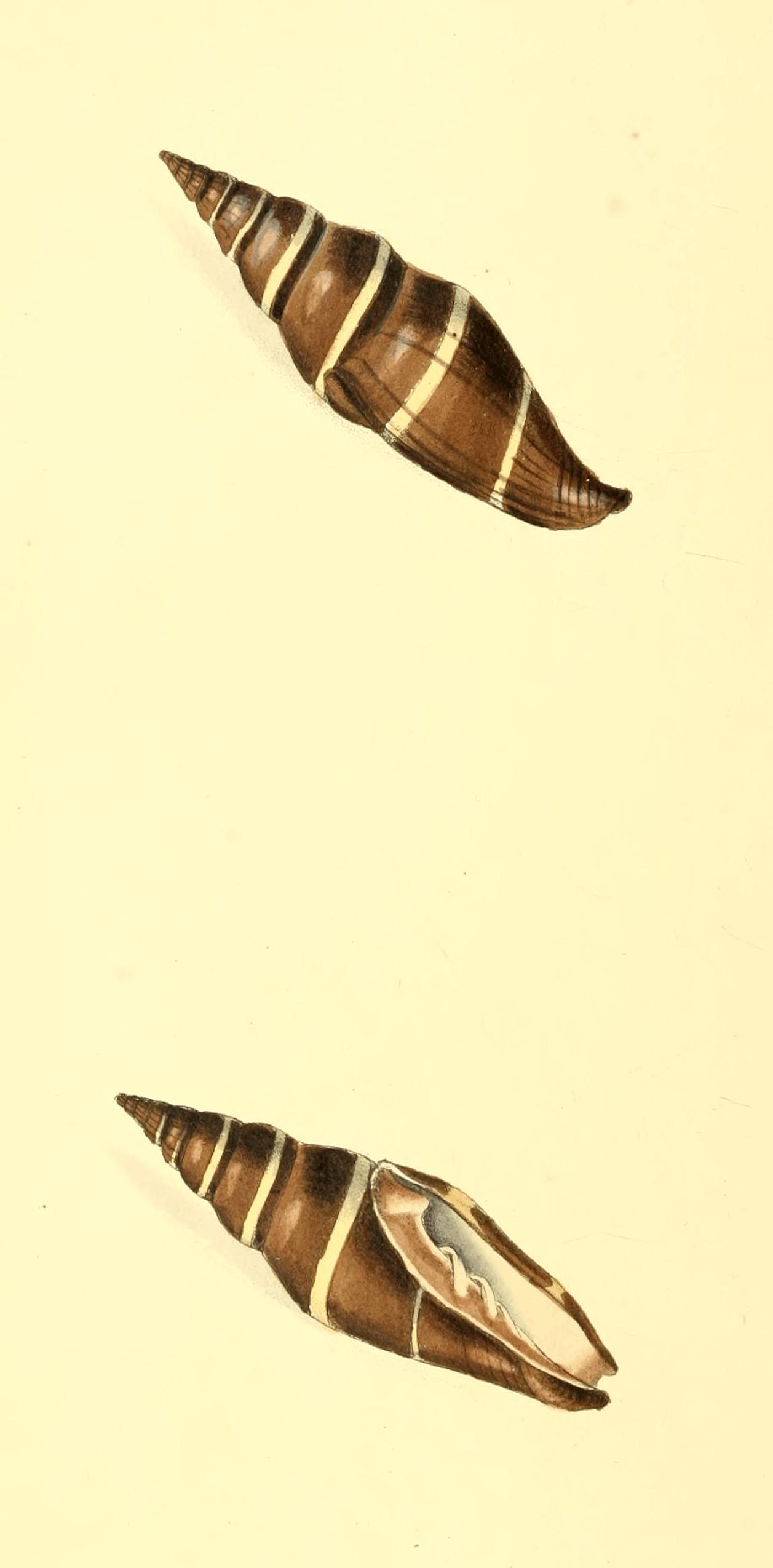
MITRA bifasciata.
Double-banded Mitre.
Generic Character.—See Pl. 23.
Specific Character.
M. (Div. 1.) testâ lævi, castaneo-fusca concolore, anfractu basali fasciis duabus angustis flavescentibus, spirâ unifasciatâ aperturâ lævi.
Shell smooth, uniform chesnut-brown, with two narrow yellowish bands on the basal whorl, and one on the spire; aperture smooth.
Voluta caffra. Martini iv. tab. 148. fig. 1369. Knorr. vol. v. tab. 19. fig. 4, 5. Seba Pl. 49. fig. 21, 22, 41.
This most elegant shell has been figured from one of the specimens that belonged to the late Mr. Jennings, who was well known to spare neither expense nor assiduity in procuring the most select and matchless specimens of every species; so much so, indeed, that such as are known to have been in his possession generally bear a higher price. One of these is now in my father's cabinet, the other in that of Mrs. Bolton, of Storr's-hall, Windermere. I have seen both, and they appear equally fine.
I cannot help considering this as a distinct species from Mitra caffra (Voluta caffra Linn.), with which it has hitherto been placed only as a variety: it is much larger, the volutions more convex, but compressed on the suture, and the whole shell (except near the point) perfectly smooth: the beak or channel likewise, which in M. caffra is short and nearly straight, is in this lengthened and recurved. The mouth is very narrow (occasioned by the outer lip being thick and slightly inflexed) and smooth within, the terminal volutions slightly plaited, and the base of the shell grooved.
The figures of Knorr and Martini are very bad, and give no correct idea of the shell, except its colour.
Pl. 36
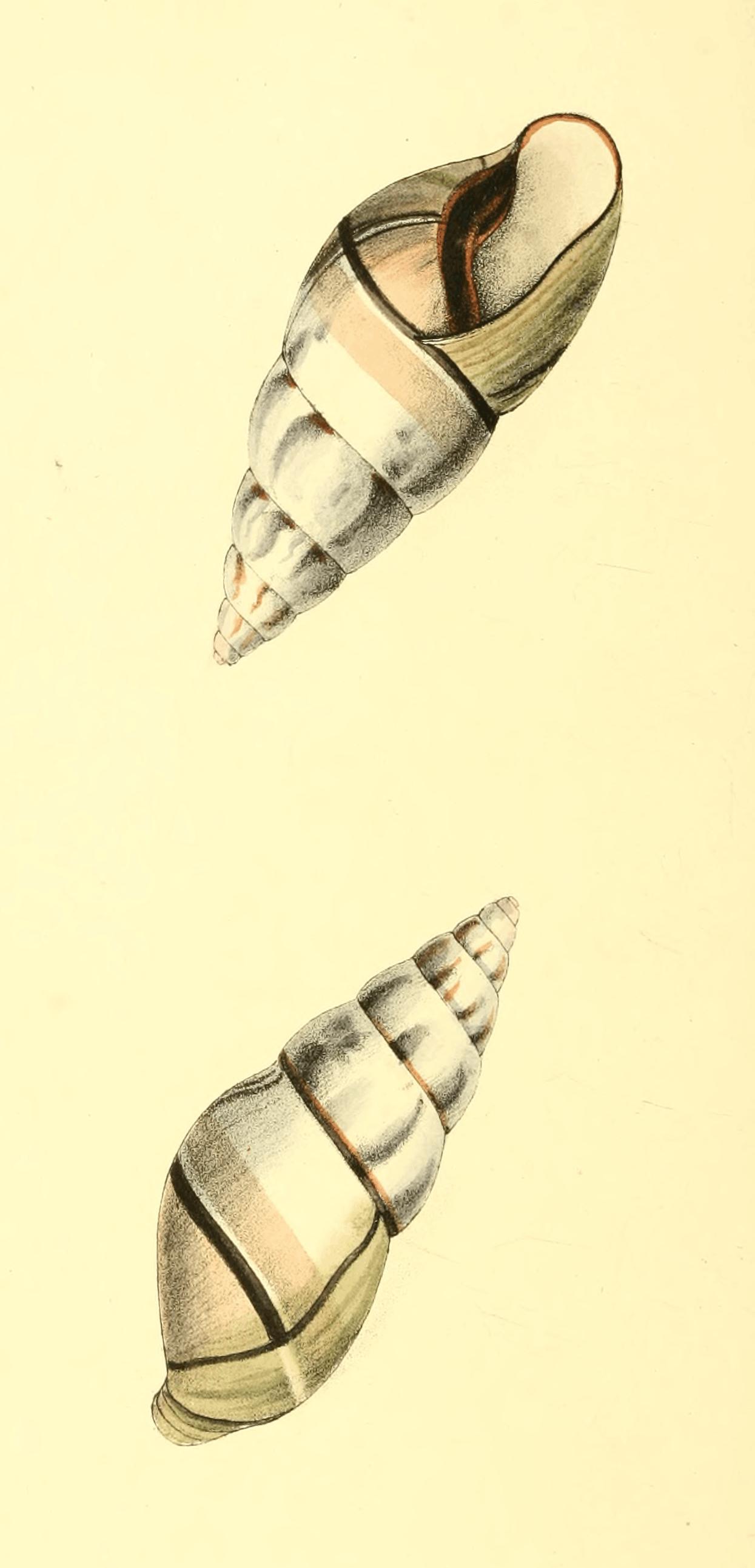
ACHATINA perversa.
Reverse Achatina.
Generic Character.—See Pl. 30.
Specific Character.
A. (Div. 2.) testâ aperturâ perversâ: spirâ productâ, 7-volutâ, apice truncato; albida strigis nebulosis cinereis; linea transversa in basali anfractu; columella margineque labii exterioris castaneis, apertura intus alba.
Aperture reversed: spire lengthened, of seven volutions, the apex truncated, whiteish with clouded cinereous stripes; central band on the basal volution, pillar, and margin of the outer lip chesnut; mouth within white.
Reverse shells, or such whose mouth when viewed in front is on the left side, are generally held in much estimation by collectors. This deviation from the usual form of shells is sometimes accidental, as in our common garden Snail and several others; while in some species it appears a constant, and therefore a specific distinction. Such I apprehend is the case with the shell now figured, a rare and very elegant species, apparently not noticed by any writer; two or three existing in the British Museum and one in my father's cabinet are all the specimens I have hitherto seen. The latter (here figured) came from Bahia in South America. The whole shell is very finely marked with longitudinal striæ, and the colouring better seen than described: the buff tinge at the base is occasioned by the remaining epidermis.
This shell belongs to the second division of the genus Achatina as mentioned at Plate 30, having the aperture much shorter than the spire and the base nearly entire. Bulla virginea of Linn. seems to connect the two divisions, having the lengthened spire of one and the truncated base of the other.
Pl. 37
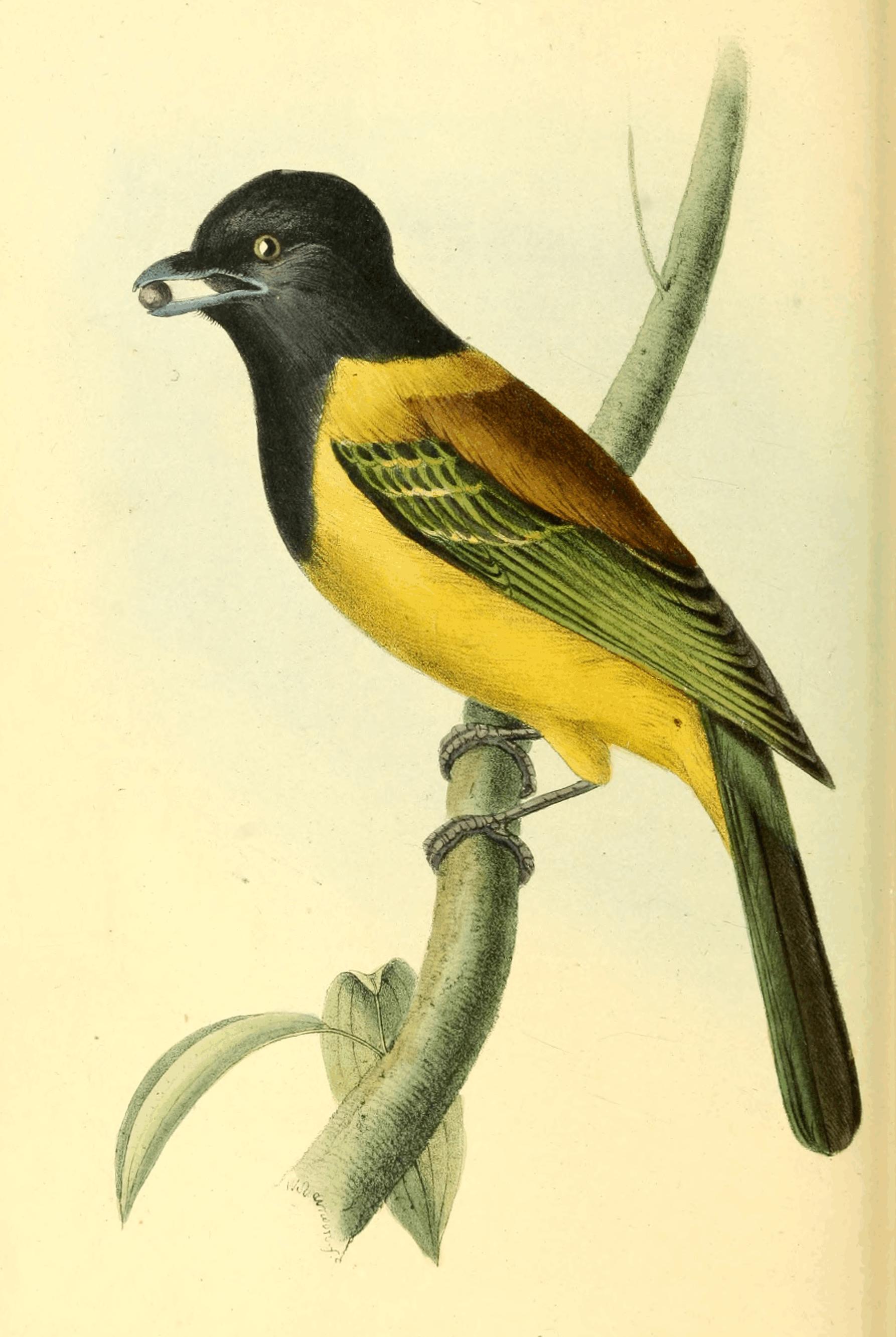
PROCNIAS cucullata.
Hooded Berry-eater.
Generic Character.—See Pl. 21.
Specific Character.
P. corpore, collo, pectore nigro cucullata; tergo fusco, alis caudaque nigris; tegminum apice, pectoris lateribus, et corpore subtus flavis; capite subcristato.
Head, neck and fore-part of the breast hooded with black; back brown, wings and tail black; tip of the wing-covers, sides of the breast and body beneath yellow; head subcrested.
I am indebted for this new bird to Miss E. Yeates, who received it with a few others from some part of Brazil: it seems to connect the genera of Ampelis and Procnias, having the bill much less dilated at the base than any of the latter; it however has a close similitude to Procnias melanocephalus (Pl. 25.), which seems further removed from the true Chatterers.
Total length eight inches and three quarters. Bill in extreme length near an inch; the colour dark cinereous; the base furnished with bristles something resembling the Chatterers: the opening of the nostrils large, round, terminal, and nearly naked; the feathers on the crown lengthened; the whole head, neck, and fore-part of the breast black, bordered above by a narrow collar of yellow; back and scapulars brown, rump olive; sides of the breast, inner covers, and under parts uniform yellow; wing-covers black margined with olive, those on the shoulders tipt with brown, the rest with yellow; quills and tail black margined with olive. Wings four inches and three-quarters long, the first quill very short, the third longer than the second. Tail four inches long.
Pl. 38
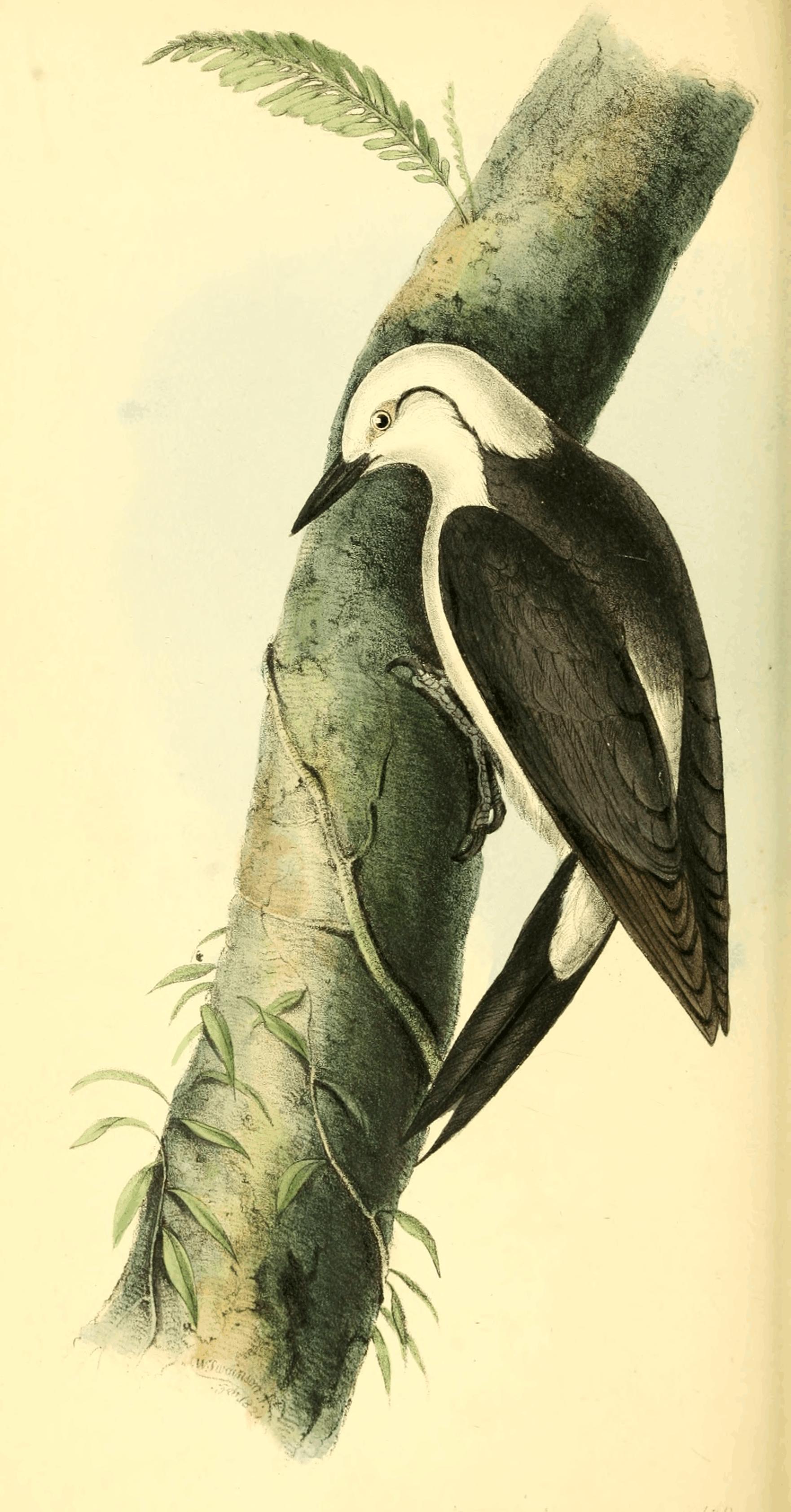
PICUS bicolor.
Black and White Woodpecker.
Generic Character.—See Pl. 14.
Specific Character.
P. albus, collo supra, tergo, alis, lineaque temporali nigris, rectricibus nigris, basi maculisque marginis interioris albis.
White: neck above, back, wings, and line from the ears to the nape, black; tail-feathers black, with their base and spots on the inner margin white.
The simplicity of colouring in the plumage of this bird will easily distinguish it from among the numerous and intricate species already known of this family. It is one of the new birds the recent investigations of Brazilian zoology have added to our museums. The individual here figured was sent me from the district of Minas Geraies.
Total length eleven inches and a half. Bill from the upper base to the tip one inch one line, and from the gape one inch four-tenths; the colour blueish-black; the upper mandible above sharply carinated and slightly curved; orbits (in the dead bird) yellowish-white; the whole of the head and nape, sides of the neck, rump and tail-covers, and all the under plumage pure white, with a tinge of yellow down the middle of the belly: a narrow black line commences at the ears, and is carried down on each side, joining the black of the upper neck; the wings and remaining upper plumage are of a uniform dark sooty black; the tips of the quills much paler and brownish. Wings six inches and a half long; the inside covers black. Tail four inches, and black banded with white at the extreme base; the two outer feathers on each side with alternate black and white bands on the inner web their whole length; feet and claws dirty-greenish: this was a female.
Pl. 39
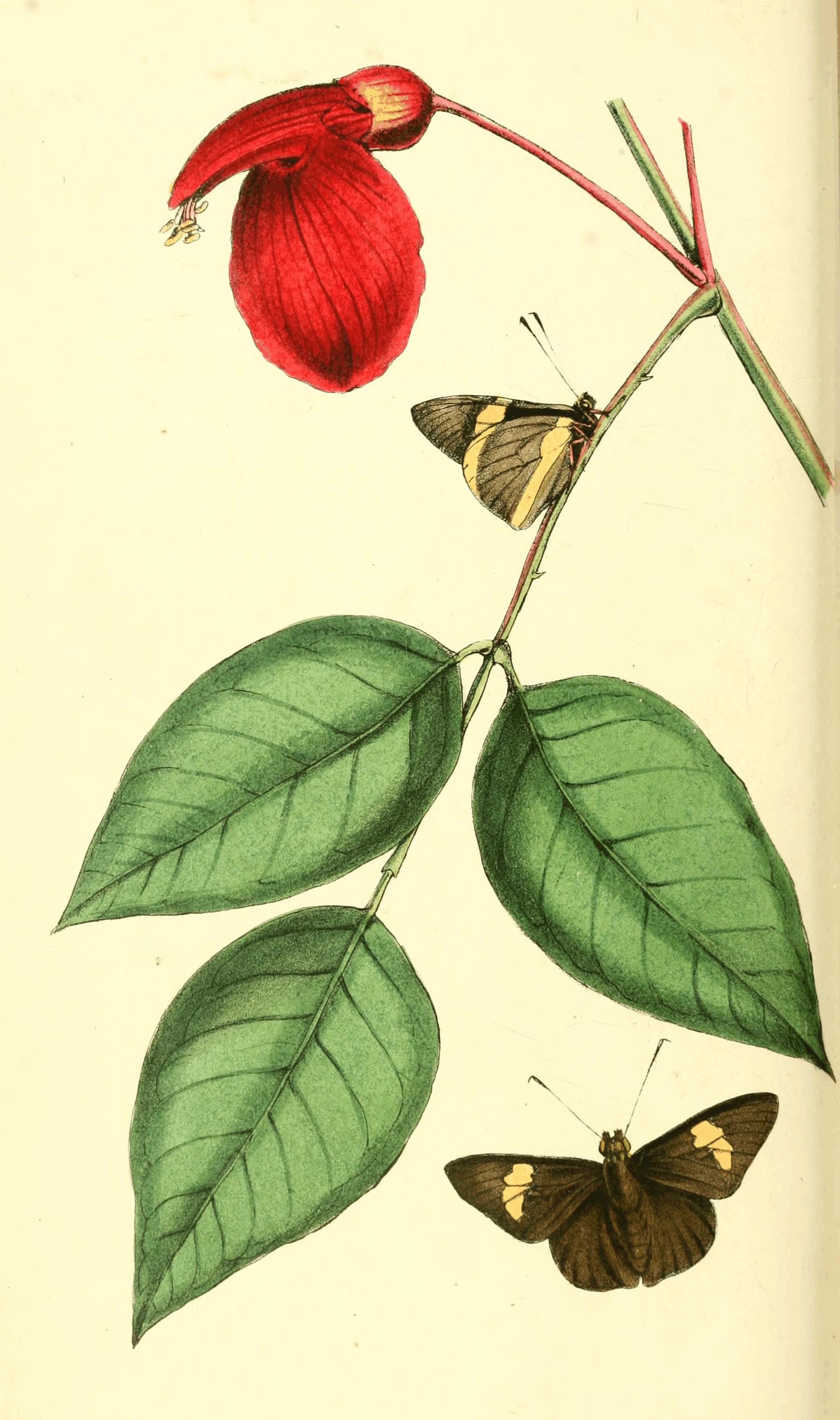
HESPERIA Itea.
Generic Character.—See Pl. 28.
Specific Character.
Hesp. (Div. 2.) alis supra nigrescente-fuscis, subtus pallidioribus basi fulvis, anticis macula flava tri-fissa, posticis subtus margine exteriore et linea longitudinali fulvis, femoribus rufis.
H. (Div. 2.) Wings above blackish-brown, beneath paler, base fulvous. Anterior with a three-cleft yellow spot. Posterior beneath with a fulvous outer margin and longitudinal line. Thighs rufous.
The descriptions left by Fabricius of this as well as many other extensive families of Lepidoptera, are in general so vague and short, that unless a figure is quoted to elucidate them, it becomes totally impossible to ascertain the precise species intended. Such is the case with the present insect, which will not agree with any described by Fabricius, or figured by Cramer.
During my travels in Brazil I never met with this species, but am indebted to my liberal friend Dr. Langdorff, Russian Consul-general at Rio de Janeiro, for the specimens I possess, as well as a number of other rare and fine insects of this family, which were then not in my own collection.
On each side of the palpi adjoining the eye are two yellowish round dots, and another behind: the posterior wings above have a narrow whitish margin, the colour beneath much paler; but the nerves on this, as well as at the tips of the anterior wings, are blackish-brown; the legs at the base and the tarsi are black.
This is a male insect; the other sex I have not seen.
Pl. 40
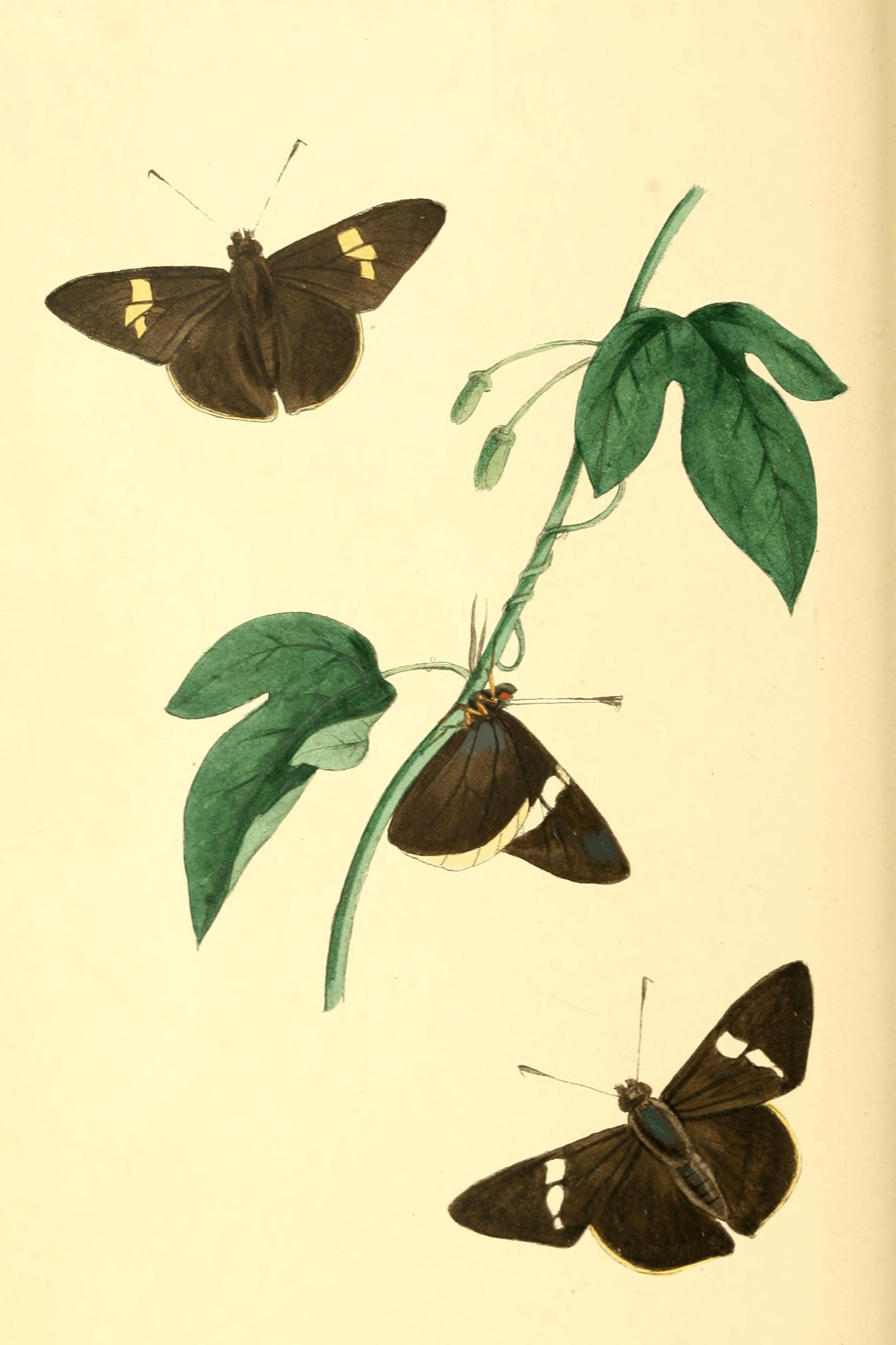
HESPERIA Cynisca.
Generic Character.—See Pl. 28.
Specific Character.
Hesp. (Div. 2.) alis nigrescente-fuscis, subtus obscurioribus; anticis supra fasciâ flavâ trifissâ (in feminis albâ); posticis subtus immaculatis, castaneo-fuscis, margine exteriore flavo.
Hesp. (Div. 2.) Wings blackish-brown; anterior above with a three-cleft yellow band, which in the female is white; posterior beneath immaculate, chesnut-brown, margined externally with yellow.
The different sexes of this insect will appear so strikingly dissimilar to those who are familiarised only with the nice distinctions that separate the species of European Lepidoptera, that this affinity by such may be doubted; nevertheless, observations in their native country, and the close examination of several specimens, will we are persuaded confirm the fact.
The male insect is distinguished (like all the Hesperidæ) by having the eyes considerably larger, and the anterior wings more narrowed than in the other sex: in this species the bands on their wings assume the form of three yellowish spots, adjoining which, on the inner side, is a semi-lunular villous mark, an almost constant indication (where it exists) of this sex. The straw-coloured border beneath the posterior wings is narrower and darker than in the female; but in both it forms a slender marginal fringe on the upper surface. Legs deep rufous; antennæ black; the club beneath and lunule round the eye straw-coloured.
Inhabits South Brazil, but is not common.
Pl. 41
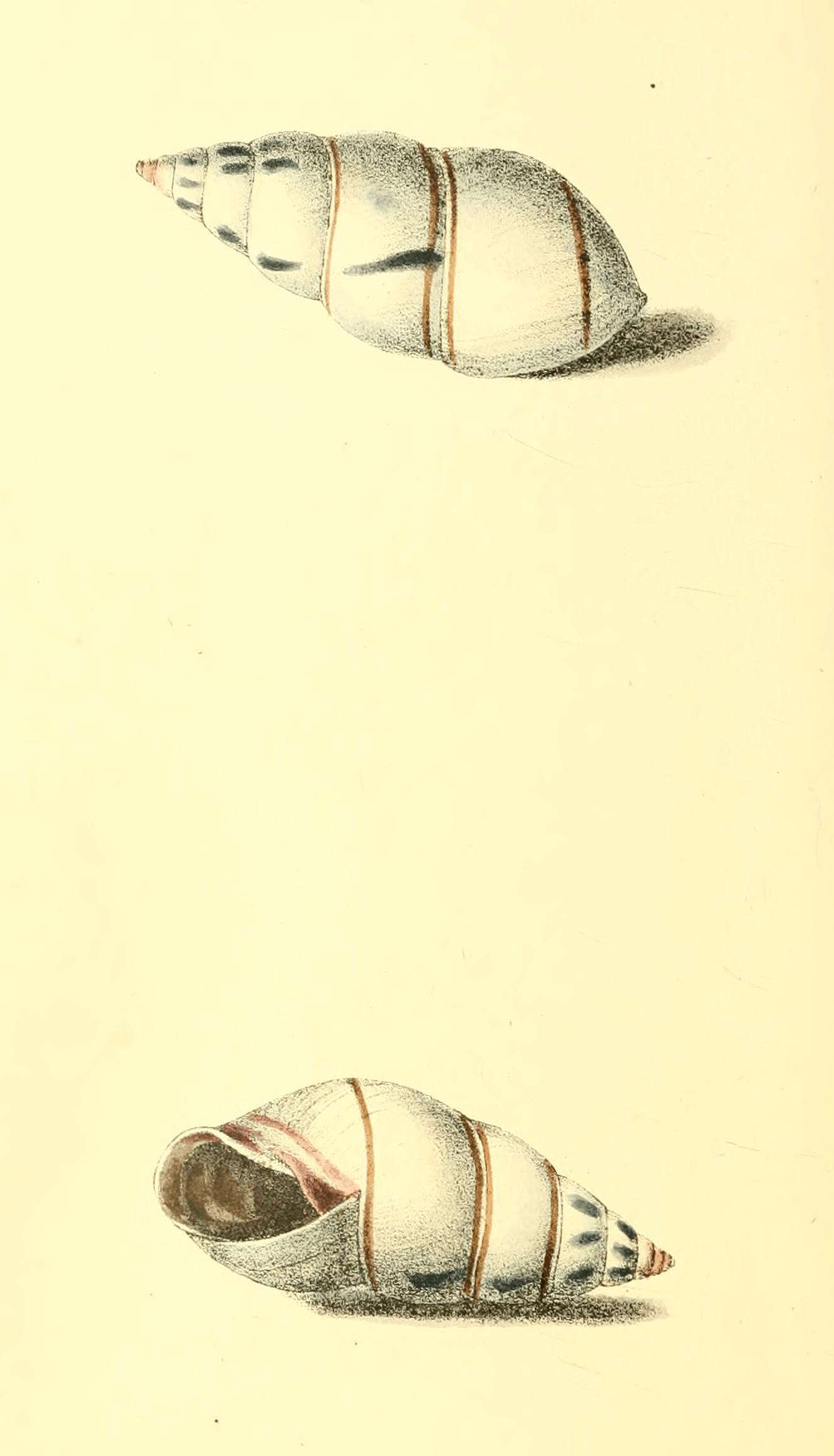
ACHATINA pallida,
Pale Achatina.
Generic Character.—See Pl. 21.
Specific Character.
A. (div. 2.) testâ cinereo-albâ, fasciis duabus angustis fuscis, spirâ elongatâ rectâ, anfractibus 7 sub-ventricosis, labio interiore roseo, columellâ basi rectâ, integrâ, aperturâ ovato-oblongâ.
A. Shell cinereous-white, with two narrow brown bands, spire elongated, straight; volutions seven, slightly ventricose, inner lip rosy, base of the columella straight, entire, aperture ovate-oblong.
Obs. another specimen of A. pallida quite agreeing with this, is in Mr. Dubois' cabinet.
The species of this and one or two other genera of land-shells are subject to such variability in their colouring, that it becomes extremely difficult to ascertain which are species and which varieties. The shell now figured might, on a cursory glance, very well pass for one of the Protean varieties of the Linnæan Bulla fasciata; but a comparison with that shell will at once point out the strong specific difference that exists between them in the formation of the mouth. In this, the lower half of the inner lip, or more properly the pillar, is nearly straight; the base entire, or without any notch or truncated appearance: whereas in the true A. fasciata, the inner lip at the base is very much curved inward, and notched before it joins the outer lip. The mouth is also short and broad: whereas in this it is much more oblong, and the base round. Other more obvious characters exist in the form of the whorls, spire, and more particularly in the colour, of these two shells; but these are in comparison of minor importance.
I regret having but one example of this shell, as it prevents me from tracing how far the characters here detailed hold good in other specimens. They are such, however, as, I think, fully to justify the propriety of considering it a species.
Its locality is unknown.
I have little doubt more than one species exist among the supposed varieties of the true Bulla fasciata of Linn., which I take to be the shell figured by Lister.
Pl. 42
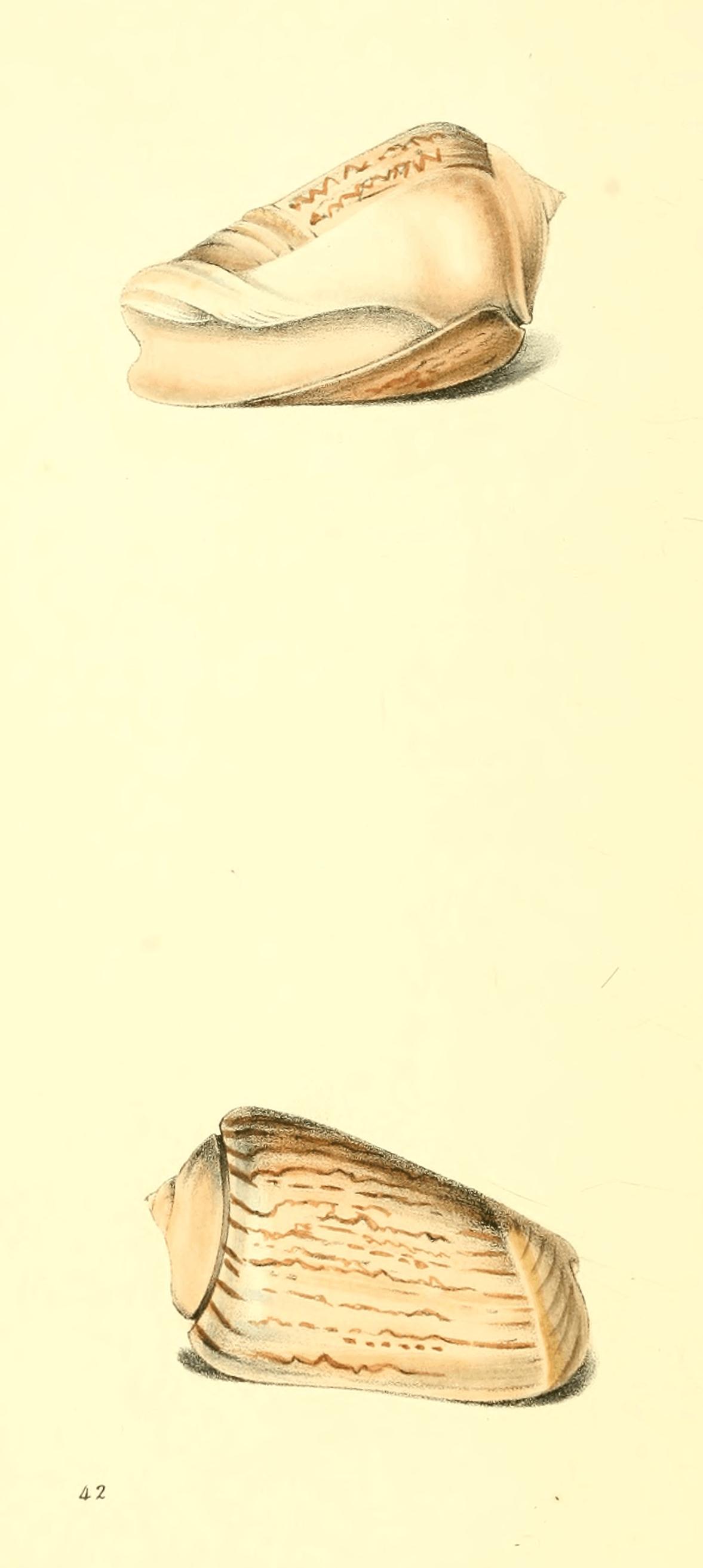
OLIVA Braziliana,
Brazilian Olive
Generic Character.
Testa cylindrica, polita; spira conica, acuminata, brevissima; labium exterius simplex, interius incrassatum, tumidum; columella plicis numerosis gracilibus; apertura basi truncata, emarginata.
Typus Genericus Voluta Porphyrea Lin.
Shell cylindrical, polished, spire conic acuminated, very short; outer lip simple, inner lip thickened, tumid, columella with numerous slender plaits, aperture at the base truncatedly emarginate.
Generic Type Voluta Porphyrea Lin.
Specific Character.
O. testâ coniformi, latâ; aperturâ effusâ, labio interiore tumidâ callositate super spiram extendente.
Shell coniform, broad; aperture effuse, tumid callosity on the inner lip large, and spreading over the spire.
Oliva Braziliensis. Martini p. 130, tab. 147 & 8, 1367 & 8.
Oliva Braziliana. Lamarck.
Voluta pinguis. Dill. 516. 36.
No family of shells possess characters more strikingly obvious to common observers than the Olives; and yet, although in our English terminology no one would ever think of calling them Volutes, we still shrink from giving them that distinguishing appellation in Latin which we every day use and acknowledge in our own language. The strict followers of Linnæus, by thus rejecting generic distinctions, which at once convey a definite idea of form and structure, contribute to render systematic arrangement less expressive of ideas than the common nomenclature of our sale catalogues: a striking proof of the pertinacity with which we cherish those particular doctrines we first imbibed, although an unbiassed reasoning and an attentive observance of nature would convince us of their fallacy.
The great Linnæus, at the time he formed that system which laid the foundation of systematic nomenclature, had not the materials for gathering and combining those natural genera which the immense discoveries made since his death have given us a knowledge of. He accordingly arranged those few shells known to him, in large, and for the most part natural, groups. That of Voluta I consider as one of these last (excepting the first division); but the great accession of species now known, and which is still increasing, has long ago induced the principal Continental writers to divide this very extensive family into the following genera: Marginella (Date shells), Oliva (Olives), Mitra (Mitres), Turbinellus (Turnip shells), Voluta (Volutes), ...; all possessing not only clear but natural characters; inasmuch as, by such an arrangement, those interesting links and ramifications that connect this family with the Bullæ, Cones, Cowries, Murices, and other genera, can be traced; and which perhaps affords the most fascinating and intellectual source of contemplation and study the science can bestow.
The peculiarity of this species will distinguish it among this numerous and intricate family. The basal suture is deeply channeled; those on the spire covered by the polished callosity which spreads from the inner lip.
Mr. Dillwyn has adopted the unpublished name of Solander, although the shell had long ago been described and named by Martini and Lamarck. I consider this as contrary to that principle of nomenclature which awards a preference to priority of publication; and I have therefore restored the name of those authors who have this undoubted claim. Mr. Dillwyn's description is very clear and good.
I cannot learn from what particular part of Brazil this species has been received.
Pl. 43
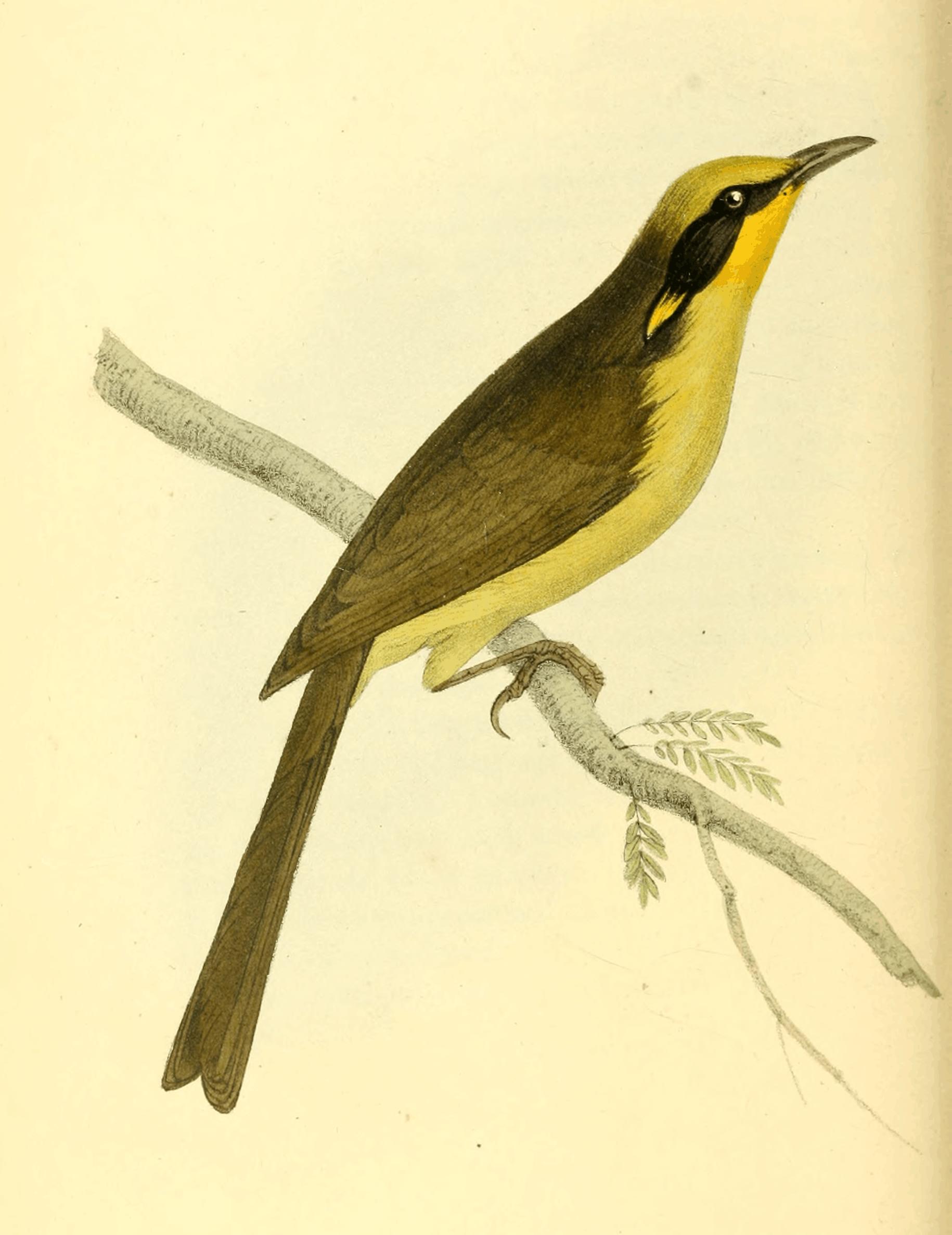
MELLIPHAGA auricomis,
Yellow-tufted Honeysucker.
Generic Character.
(Melliphaga, Lewin.)
Rostrum mediocre, capite plerumque longius, gracile, curvatum, acuminatum, attenuatum, ad basin altius quam latius, lateribus compressis; culmine carinato. Mandibula superior ad apicem emarginata; inferior lateribus compressis. Nares concavæ ad medium rostri porrectæ, membranâ tectæ, inter rictum et apicem longo fissu aperientes. Lingua longa, extensibilis, fibris cartilaginosis terminata. Pedes simplices, digito exteriore connexo, halluce pervalido.
Obs. Cauda rectricibus 12, remigibus 1 et 2 spuriis; rostri margine aliquando subtilissime dentato.
Typus Genericus Certhia Novæ Hollandiæ Lath.
Bill moderate, generally somewhat longer than the head, slender, curved, pointed and acuminated, the base higher than broad, the sides compressed, the top carinated; upper mandible notched at the tip, the under mandible laterally compressed. Nostrils concave, near half the length of the bill, covered by a membrane, opening by a long slit midway between the gape and tip. Tongue long, extensible, terminated by cartilaginous fibres. Feet simple; outer fore-toe connected; hind-toe very strong.
Obs. Tail-feathers twelve, first and second quills spurious; margin of the bill sometimes minutely toothed.
Generic Type New Holland Creeper Lath., &c.
Specific Character.
M. olivaceo fusca; vertice corporeque subtus flavescentibus; temporibus auribusque nigris; gulâ et pennis elongatis pone aures flavis.
Olive-brown: crown of the head and body beneath yellowish; temples and ear-feathers black; throat and lengthened feathers behind the ears yellow.
Muscicapa auricomis. M. olivacea, vertice corpore subtus maculaque aurium flavis, per oculos striga alba. Lath. Ind. Orn. vol. 2. Suppl. xlix. 1. Gen. Zool. 10. 2. p. 354.
Yellow-tufted Flycatcher. Lath. Suppl. 2. 215. no. 4. Gen. Zool. 10. 2. 354.
The Yellow-tufted Honeysucker, although described by Latham, has hitherto remained unfigured; and I therefore select it as an excellent example of a tribe of birds which I think are peculiar to Australasia, and which seem to hold the same situation among the birds of that vast country as the Humming-birds occupy in South America, and the Sun-birds (Cinnyris, Cuvier) in Africa and India; all of which more or less derive their sustenance from the nectar of flowers, and which they extract on the wing by means of their long tubular tongues.
It is singular, that while our first ornithological writers were distributing the numerous species of these birds in their systems, under such of the Linnæan genera as they thought most adapted for their reception, a naturalist of a remote colony should be the first who, by creating a new genus, brought them all into their proper situation in systematic arrangement; one of the many proofs that Nature, and Nature only, is to be studied; and that no system, however ingenious or however applauded, can be considered as infallible.
By an error (no doubt of the press) in the specific character of this bird in Latham's Index, the eye stripe is called white, though in the description it is termed black. Mr. Stephens has copied this error into "General Zoology;" and his description of this bird, as well as numberless others, seems merely an abridgement or alteration of Latham's; a practice highly detrimental to science; for, when an original description cannot be obtained, it is much better, and safer, to copy without disguise that of another.
How far all the birds included by Temminck in this genus really belong to it, admits of very great doubt; I have therefore constructed the generic character from those birds of New Holland only which Lewin, who founded the genus, must have had before him.
Total length seven inches and a half; bill seven-tenths, the frontal feathers advancing half its length to the nostrils; those of the ears are lengthened, but the yellow tuft behind them is much more so; the feathers of the chin are small, thick-set, and ending in fine setaceous hairs curved outwards; the breast and body pale brownish-yellow. Quills and tail dark-brown, margined with deep-yellowish; the two lateral tail-feathers tipt with dirty white; plumage above olive-brown; front and crown of the head dark brownish-yellow; bill black; legs brownish, inner-toe very deeply cleft. Tail, from the rump, three inches and a half long, and slightly rounded.
Latham, who first described this bird, says, "it makes its nest on the extreme pendent branches of low trees or shrubs, and by this means escapes the plunder of smaller quadrupeds." It appears not uncommon in New South Wales.
Pl. 44
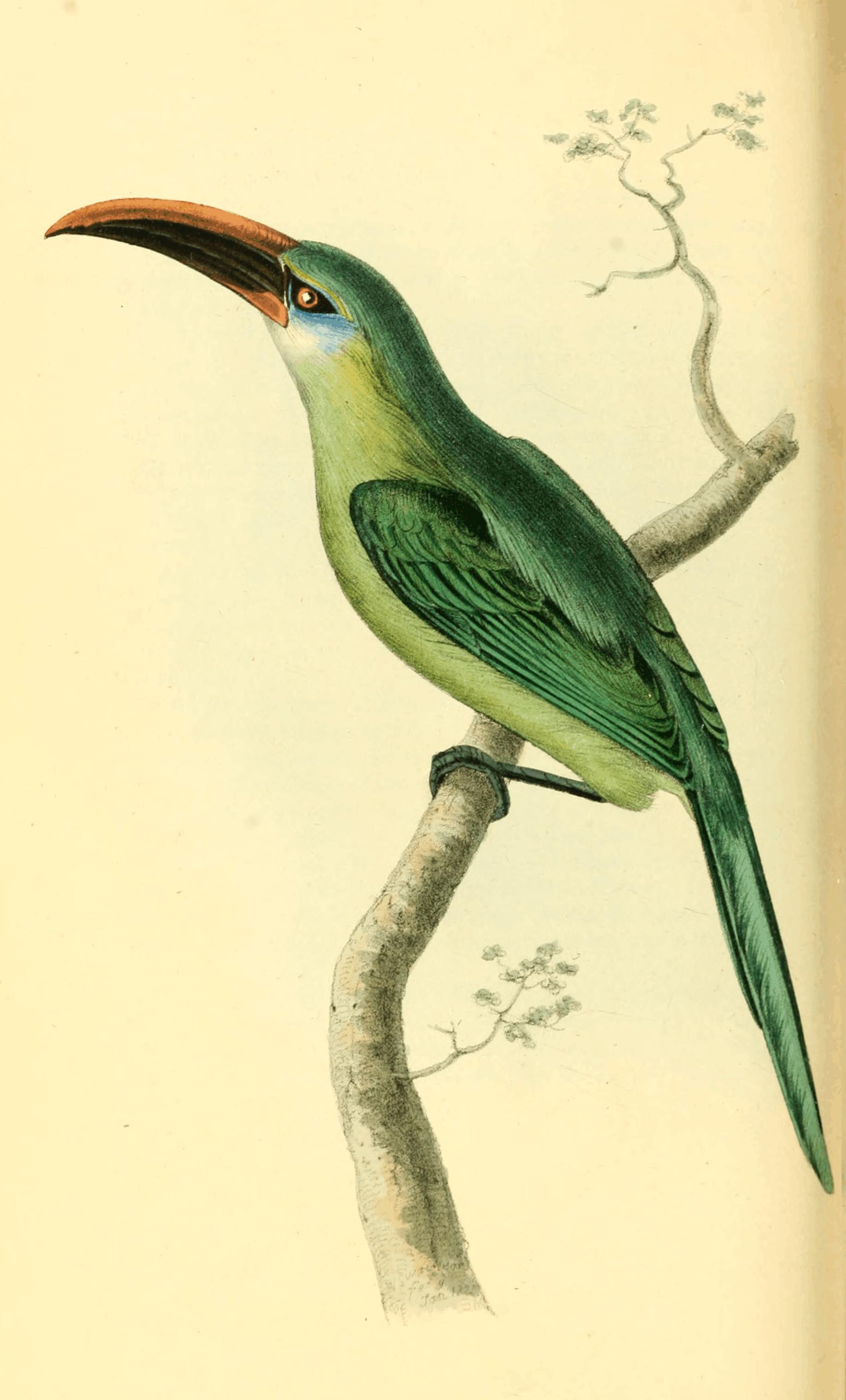
PTEROGLOSUS sulcatus,
Grooved-bill Aracari.
Generic Character.
Rostrum capite longius, crassum, inane, cultratum, basali margine incrassatum, maxillæ angulo frontali obtuso; tomia serrata: nares superæ in maxillæ basi: lingua angusta, pennacea. Cauda elongata, cuneata. Pedes scansorii. Illiger. Prod. p. 202.
Typus Genericus Ramph. Aracari Linn.
Bill longer than the head, thick, light, curved, thickened at the basal margin, the frontal angle obtuse, the margins serrated. Nostrils nearly vertical, situated on the base of the bill. Tongue long, slender, feathered. Tail elongated, cuneated. Feet scansorial.
Generic Type Aracari Toucan Lath.
Specific Character.
P. viridis, subtus pallidior; jugulo albescente, circa oculos cæruleus; rostrum duobus sulcis longitudinalibus incisum.
Green Aracari, beneath paler; throat whitish, round the orbits blue; bill with two lateral longitudinal grooves.
P. sulcatus. Swainson, in Journal of Royal Institution, vol. 9. p. 267.
All those species of the Linnæan Toucans having a long wedge-shaped tail, and the nostrils passing through the upper part of the bill, are comprehended by Illiger and other continental writers under this genus. They have been called by the French Aracari; which name I have retained as an English generic distinction. They inhabit the same country and situations as the real Toucans, which are distinguished by having a short, broad, and even tail, and the nostrils placed behind the bill.
A fine example of this very rare bird I first met with in the small collection sent to my excellent friend, E. Falkener, Esq. from the Spanish Main. I have since noticed another which was in Mr. Bullock's museum, and is now in the possession of Lord Stanley: these are the only two specimens known.
This bird was first described by me in the Journal of the Royal Institution near a year ago. When Professor Temminck was in England, I showed him the manuscript description and drawing which I had then made: he assured me he had never seen the bird before, otherwise than in Bullock's museum. A short time after, my account of it was published. I observe, however, that in the new edition of his Manuel he gives this name to a new bird of his own: no description however follows, and it is therefore impossible to say if the Professor intends it for this identical species.
We must postpone any further observations on this family, and conclude by giving the original description above alluded to.
Total length twelve inches, of which the bill in extreme length measures three. It is much curved, and more attenuated than any of the Aracaris, being thickest at the base; from which it narrows to a sharp point at the tip. The upper part is convex, and somewhat thickened; the sides are compressed, and the upper mandible has two broad slightly indented grooves on each side: the base has a few transverse wrinkles, and the serratures deep and unequal. The lower mandible half the depth of the upper, the sides concave, and the teeth less. The colour (in the dried bird) black; the base of the lower and the upper half of the superior mandible rufous, the base with a whitish marginal line. The nostrils are more lateral than usual, being placed in a line with the eye; the orbits naked and reddish brown, the feathers encircling which (particularly beneath the eye) are vivid cerulean blue. The whole upper plumage is parrot green, paler beneath, with a gloss of golden yellow on the cheeks and sides: throat dusky white. Wings short, five inches long, and rounded; inner shafts of the quills black, margined with whiteish. Tail cuneated, green, four inches and a half long, the four middle feathers equal. Legs dusky black.
Pl. 45
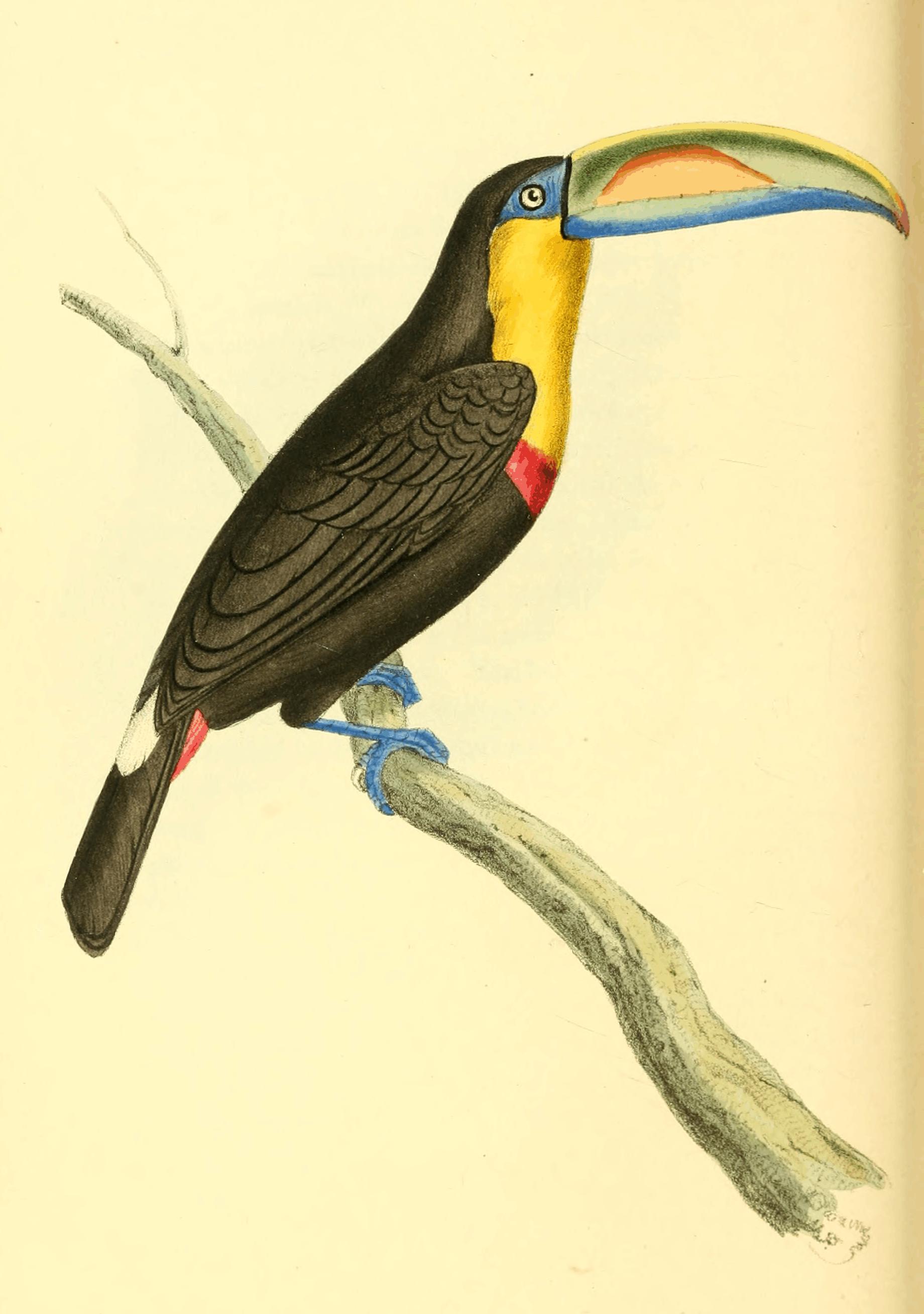
RAMPHASTOS carinatus,
Sharp-billed Toucan.
Generic Character.
Rostrum capite longius, maximum, crassum, inane, cultratum, basali margine incrassatum; maxillæ angulo frontali subtruncato transverso: Nares verticales, pone maxillæ basin sitæ; tomia serrata; lingua angusta, pennacea; cauda brevis, æqualis; pedes scansorii. Illiger. Prod, p. 212.
Typus Genericus R. erythrorynchus Lath.
Bill very large, longer than the head, thick, light, curved, and thickened at the basal margin; the frontal angle transversely sub-truncated, margins serrated. Nostrils vertical, behind the base of the bill. Tongue slender, long, and feathered. Tail short, even. Feet scansorial.
Generic Type Red-billed Toucan Lath.
Specific Character.
R. niger; gulâ flavâ; fasciâ pectorale tegminibusque inferioribus rubris; rostro viridi, apice rubro; mandibulâ superiore culmine carinato flavo, lateribus maculâ aurantiâ; inferiore cæruleo variegata.
Black; throat yellow; pectoral bar and under tail covers red; bill green, tip red; upper mandible carinated and yellow above, the sides with an orange spot; lower mandible varied with blue.
Yellow-breasted Toucan. Edwards, pl. 329.
Ramphastos Tucanus. Yellow-breasted Toucan. Gen. Zool. 8, 362, (excluding the Synonyms.)
No tribe of Birds appear so void of that symmetry of form that in general pervades the feathered creation, as the Toucans and Aracaris in the new, and the Hornbills in the old continent. A question naturally arises, why the bills of these birds should be so monstrously out of proportion, and what possible use they can be applied to. The elucidation of these questions is highly interesting, and calls for the most accurate observations to be made in their native regions. It will be sufficient for the present, however, to point out, with regard to the Linnæan Toucans, that the accurate observations and anatomical knowledge of my valued friend Dr. Traill, F.R.S.E., of Liverpool, have clearly proved that an immense number of nerves and fibres fill the cavity of these bills, all connected with the organs of smelling, which are in the highest state of development. A short notice on this subject will be found in the Linnæan Transactions; but as my learned friend is pursuing his inquiries further on the subject, I shall for the present confine my remarks to the individual here illustrated, observing that no birds are so little understood, even in regard to the species, as these.
The indefatigable Edwards appears the first who noticed this bird. His description, though in the quaint style of the day, is clear and comprehensive; and his figure strengthens it, both being made from the living bird. Yet Dr. Latham has quite overlooked it as a variety of another species; and Dr. Shaw, although he copies Edwards's account, gives references which belong to other birds. It is not in the costly work of Le Vaillant, and indeed seems (from its excessive rarity) to have escaped the notice of all modern ornithologists. The perfect bill of the bird is, however, in my possession, minutely agreeing with Edwards's account; and also an original sketch in oil of another individual, by an unknown artist, with a note stating it was done from the life at Exeter 'Change. All these testimonies put the existence of the bird beyond any doubt.
Having seen only the bill, which is well described by Edwards, I shall close this article with such part of his description as appears necessary.
"The bill is very large, compressed sideways, having a sharp ridge along the upper part; the upper mandible is green, with a long triangular spot of yellow colour on each side, and the ridge on the upper part yellow; the lower mandible is blue, with a shade of green in the middle, the point is red, it hath about five faint dusky bars, which cross the joinings of the two mandibles. The iris of the eye is a fair green colour; round the eye is a broad space of naked skin of a violet colour: the throat and breast are of a bright yellow, below which is a bar of scarlet feathers; the covert feathers of the tail are white above, beneath of a bright red; the legs and feet are all of a blue or violet colour." Edwards says it was brought from Jamaica, but doubts its being rather a native of the continent: he says they are very rarely brought home alive.
The bill is full six inches long, and the whole figure on the same scale, both in this and in Edwards.
Pl. 46
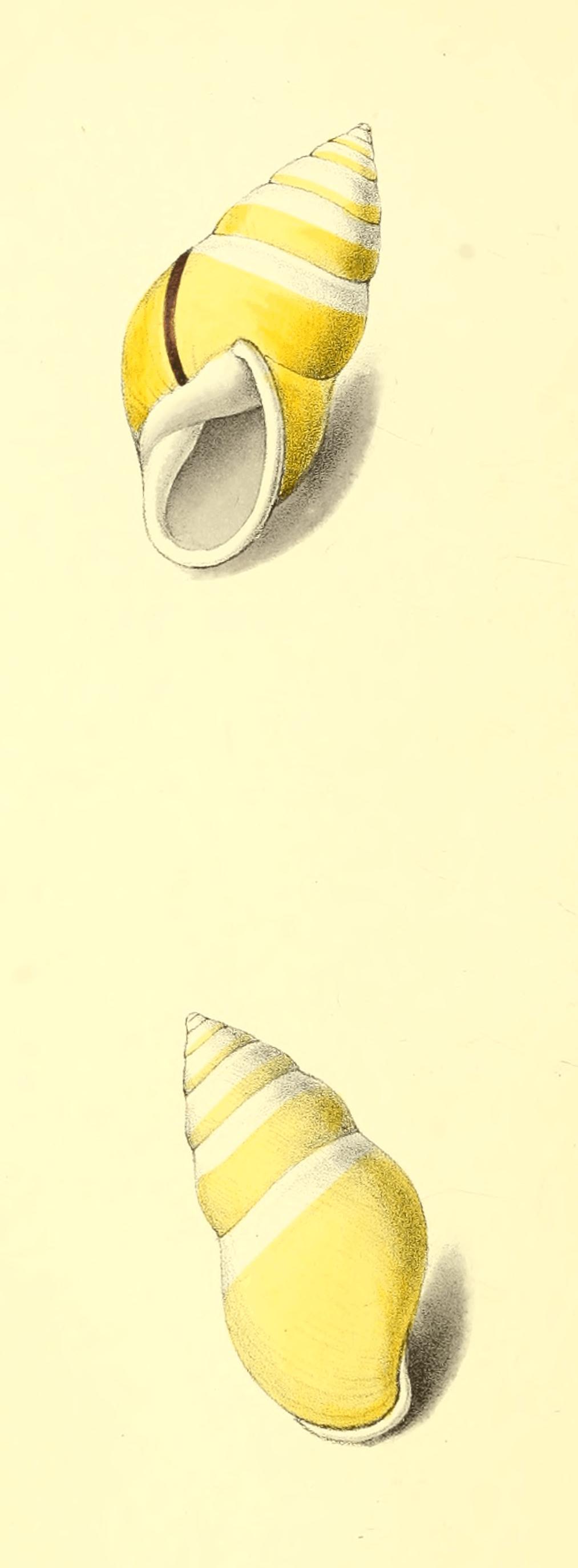
BULIMUS citrinus,
Citron Bulimus.
Generic Character.—See Pl. 4.
Specific Character.
B. testâ obovatâ; spirâ conicâ, in medio sub-crassatâ, aperturâ longiore: spirâ anfractibus 6 in suturam depressis; labio exteriore basi subcontracto; umbilico subclauso.
Shell obovate; spire conic, slightly thickened in the middle, longer than the aperture, and of six volutions depressed on the suture; outer-lip slightly contracted at the base; umbilicus nearly closed.
Bulimus citrinus, var. B. Bruguiere Encycl. Meth. 314. no. 27.
Martini 9. tab. 110. fig. 930.
This variable species is perhaps the most beautiful and delicate in its colouring of all the terrestrial snails; yet, although figured by several of the older writers, so little justice has been done it, that we make no apology for introducing it into the present work, both on this account, and for the purpose of giving such a discriminative specific character as may lead to the inquiry, how far all the numerous varieties mentioned by authors really belong to this species or not. As far as my own observation goes, I have found that the thickened spire, the depression of the whorls on the suture, and the narrowness or contraction of the mouth at the base, afford the only constant characters; for, in regard to colour and the situation of the mouth, both appear subject to great variation, the latter being as often reversed as regular. Martini's is the only figure that can be safely quoted for this variety.
I am indebted to Mrs. Bolton, of Storr's-hall, Windermere, for the loan of this and several other rare shells: it formerly belonged to Mr. Jennings, and appears an old shell, being heavy in proportion, the umbilicus thickly closed up, and the outer-lip very thick. Another I have seen at Mrs. Mawe's, and one is in the British Museum: but the finest specimen in colour and preservation is in the possession of my friend W. J. Broderip, Esq., of Lincoln's-Inn: from this it seems the spiral whorls are finely and delicately marked by transverse elevated striæ, while those on the basal volution are striated transversely, though in a less regular manner.
Bruguiere mentions that this species is generally found in the South American islands, Cayenne, and Guiana.
Mr. Dillwyn has given the new name of aurea to this shell, in addition to the five others under which different authors have described it. Such changing of names and multiplication of synonyms, without strong reasons, are very objectionable. I have retained that of Bruguiere, as being the only author who has placed it in its proper genus.
Pl. 47
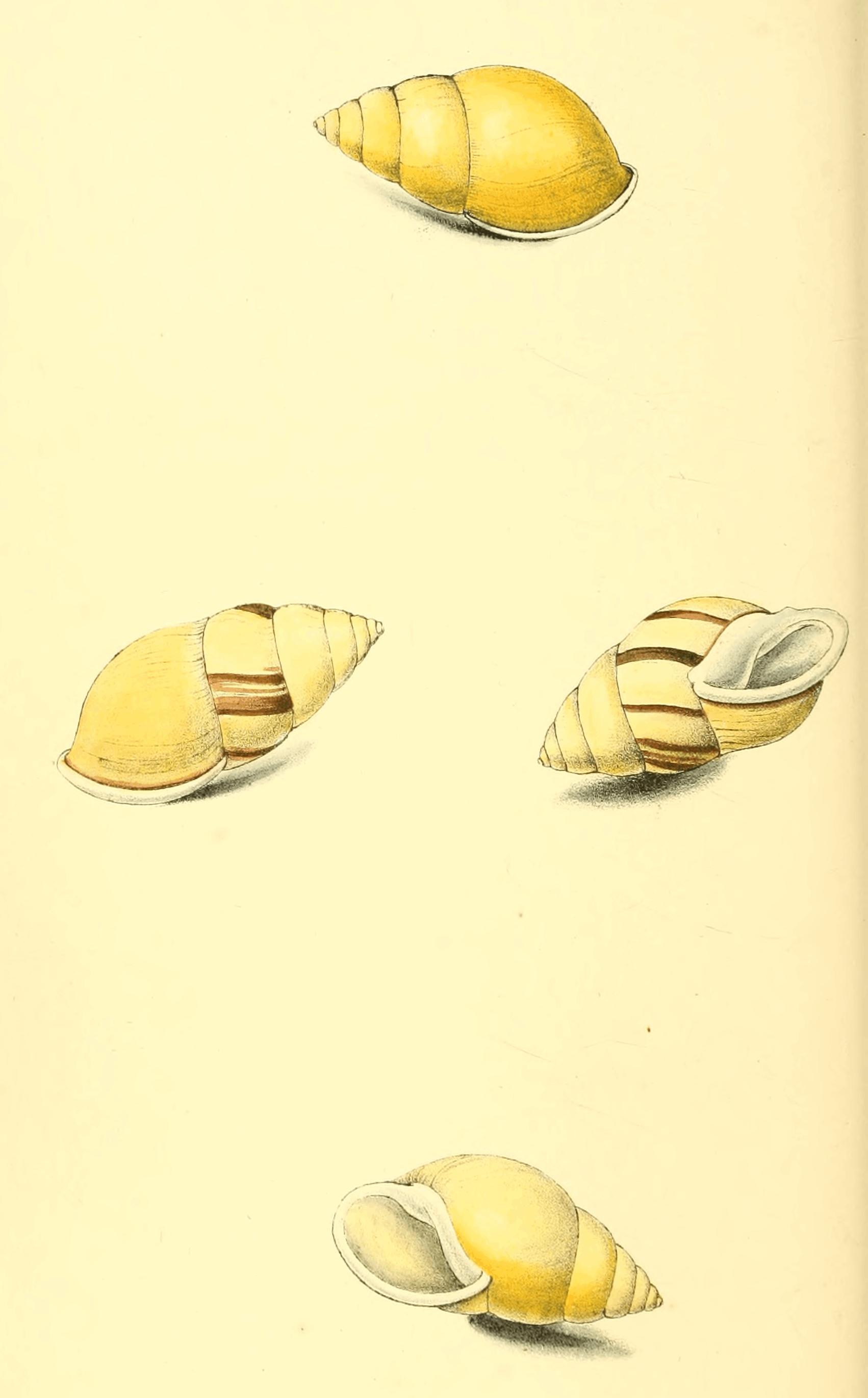
BULIMUS citrinus (var. perversu).
Reverse, banded Citron Bulimus.
Generic Character.—See Pl. 4.
Specific Character.—See Pl. 46.
Synonyms.
Martini, vol. 9. tab. 934 & 5. Knorr, 4. tab. 28. fig. 4, 5. (bad.)
Bulimus citrinus, var. B. Bruguiere, 314. 27.
A fine pair of this beautiful and rare variety is in the collection of Mr. C. Dubois, to whom I am indebted on this and many other occasions, for the facilities he has afforded me in prosecuting the present work: one of these is now figured; it differs in no respect from that in the last plate, except in being reversed and having the umbilicus not so completely closed; a character which, perhaps, exists only in very old shells. The other specimen is also reversed and banded, though in a different manner.
BULIMUS aureus.
Golden Bulimus.—upper and lower figures.
Specific Character.
B. testâ obovatâ, spirâ conicâ, anfractibus 5 convexis, suturâ simplici, umbilico aperto.
Shell obovate; spire conic, of five convex volutions; suture simple; umbilicus open.
Lister 34. 33. Martini 9. tab. 110. 928. 929?
Obs. Bulimus aureus, in Mr. Spurrett's valuable cabinet is another specimen of this shell minutely agreeing with that here described.
Having seen but a single specimen of this shell, I have placed it as a distinct species, not without some doubts, and principally for the purpose of calling the attention of conchologists to a more rigid examination of the specific distinctions of this family (unconnected with colour) than has heretofore been done. The regular convexity of the whorls, not in any degree compressed at the suture, the want of that thickened appearance on the spire, and of the contraction at the base of the mouth (all which characters I have found in the varieties of B. citrinus to be constant), afford a specific distinction which future observations must confirm or annul. Bruguiere notices a variety of B. citrinus which is entirely yellow, a most beautiful specimen of which is in the British Museum, and which possesses (as well as the excellent figure of Gualtieri) all the specific characters I have given to B. citrinus, but not of the present shell. Lister's figure, on the contrary, is rude, though very characteristic of this; and Martini's representation, here cited, also appears the same.
Mr. Dubois, in whose collection this specimen exists, is unacquainted with its locality.
Pl. 48
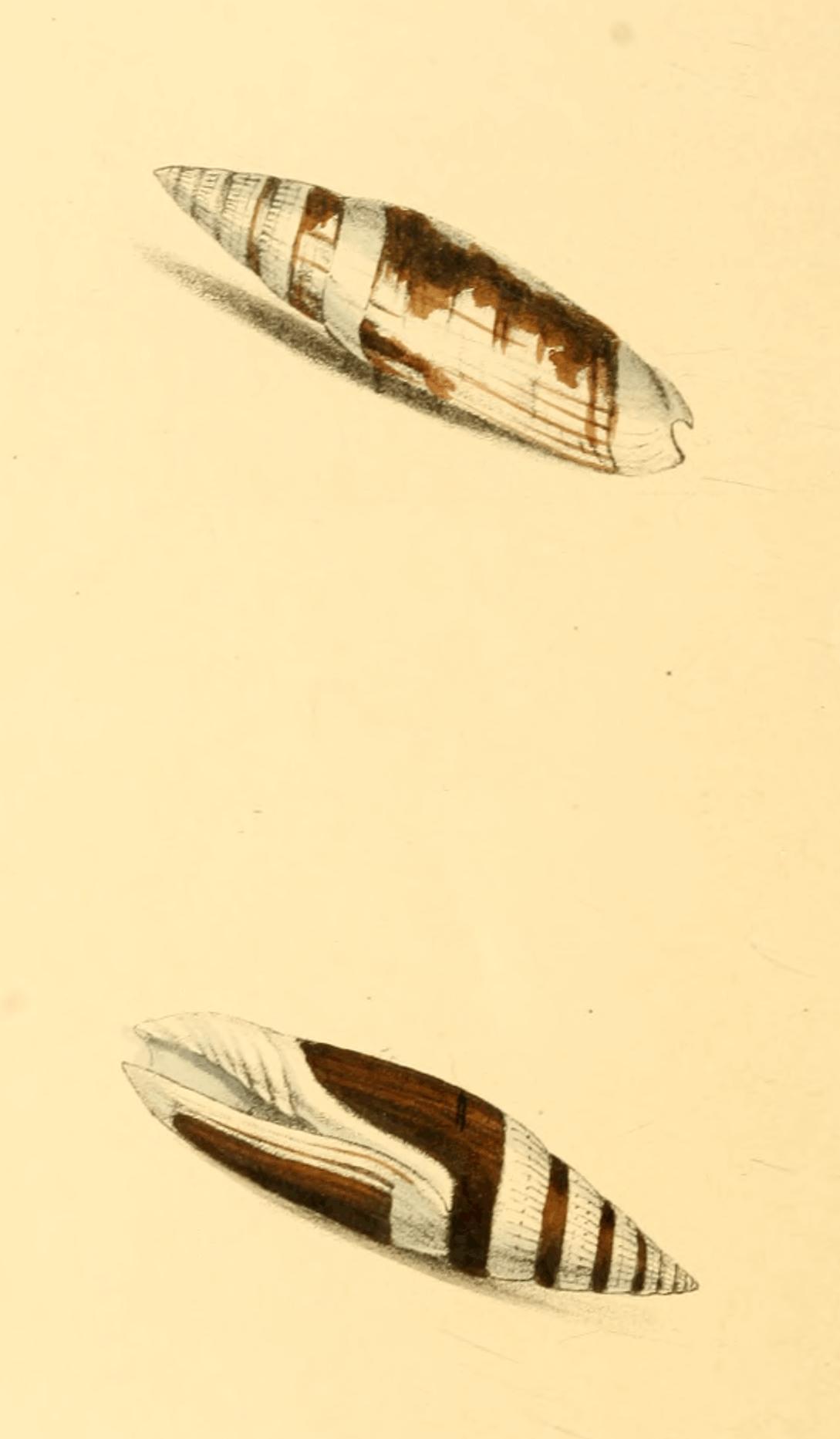
MITRA casta,
Chesnut-banded Mitre.
Generic Character.—See Pl. 23.
Specific Character.
Mitra (Div. 3.) testâ albâ, lævi, olivæformi, spirâ aperturâ breviore, anfractibus supra tenuiter reticulatis, basi epidermide castaneam fasciam formante, in anfractu basali centralem et latam.
Shell white, smooth, olive-formed, spire shorter than the aperture, the volutions finely reticulated above, the lower half with the epidermis forming a chesnut band which is central and broad on the basal whorl.
Voluta casta. Chemnitz 10, p. 138, vig. 20 C D.—figura mala.
Martyn Univ. Conch. i. tab. 20.
Dillwyn Catalogue, vol. i. p. 554, no. 127.
All the writers I have been able to consult, uniformly describe this species as having a coloured band on the white ground of the shell. In the Banksian cabinet are two fine specimens, and which have enabled me to ascertain that this brown band is nothing more than an epidermis, or external coating, with which the shell is only partially covered—a circumstance of very rare occurrence; and which, being removed, proves the real colour of the shell to be of a uniform polished white. This, together with its excessive rarity, and the opportunity of giving original figures, has induced me to include it in this work, although it exists both in those of Martini and Martyn above quoted. I have neither seen nor heard of specimens being in any other collection, besides the two above noticed; and which no doubt were collected by their late lamented possessor on some of the South Sea islands. A striking affinity exists between this and M. zonata figured at the third plate of this work.
MITRA olivæformis.
Olive-shaped Mitre.
M. testâ olivæformi, glabrâ, nitidâ, spirâ brevissimâ, longitudinaliter rugatâ, striâ centrali transversâ; columella 4-plicata.
M. Shell olive-shaped, smooth, polished, spire very short, longitudinally wrinkled, with a central transverse stria, pillar four-plaited.
I introduce the description of this diminutive and undescribed shell from its affinity with the last, and as forming a most interesting transition from the Mitres to the Olives: agreeing with the former in the structure of the pillar and the sculptured spire, and with the latter in its general form and prima facie appearance. Its perfect resemblance, in fact, to a small olive, may have occasioned its being hitherto overlooked. The spire is slightly wrinkled and striated; the teeth on the pillar very near each other, slender, and four in number. The colour pale yellowish; the mouth darker, and the tip and base purple. The whole shell is scarcely half an inch long.
It was received from the South Seas.
Pl. 49
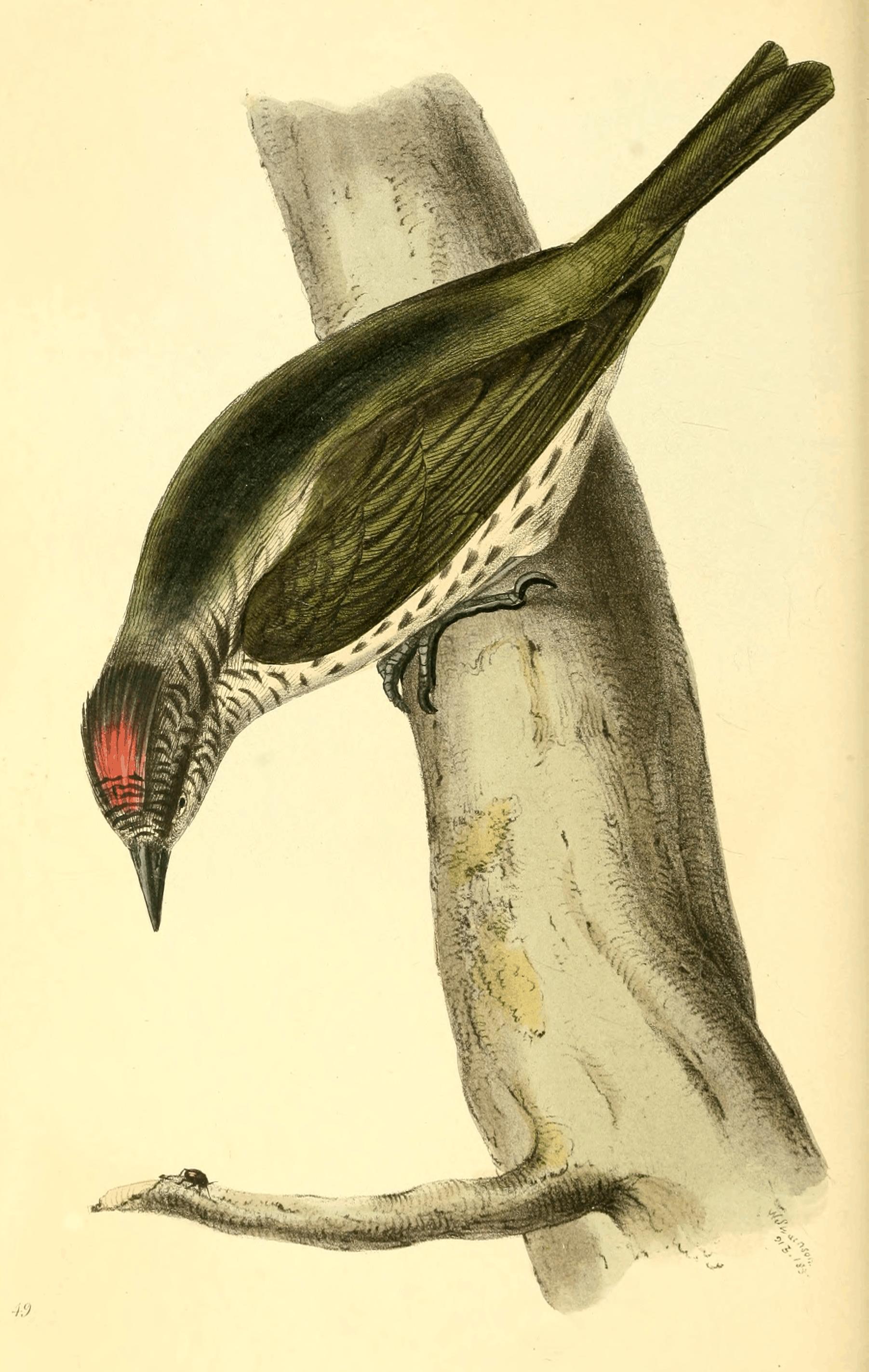
OXYRHYNCUS cristatus.
Crested Sharpbill.
Generic Character.
Oxyruncus Temminck.
Rostrum breve, rectissimum, basi trigonâ, ultra basin attenuatum, apice acutissimum; mandibulâ superiore suprà rotundatâ, utrisque integris. Nares basales, nudæ, membranâ partim tectæ, aperturâ lineari ad marginem rostri approximante. Pedes breves, validi, digito medio longiores; digitis anterioribus tribus, exteriore connexo, interiore fisso; halluce valido.
Bill short, very straight, base trigonal, beyond attenuated to a very fine point; upper mandible above rounded, both entire. Nostrils basal, naked, partially covered by a membrane; aperture linear, near the margin of the bill. Feet short, strong, a little longer than the middle toe; anterior toes three, the outer connected, the inner cleft; hind toe strong.
Specific Character.
O. suprà olivaceo-viridis, subtùs flavescente-albus, maculis nigrescentibus; capite cristâ coccineâ incumbente; capitis lateribus lineis transversis flavescente-albis.
Above olive-green, beneath yellowish-white, with blackish spots. Head with an incumbent crimson crest; sides of the head and neck with transverse yellowish-white lines.
An elegant and (to the ornithologist) a highly interesting bird, considered with much judgement by Professor Temminck as a new genus, having the perfect bill and habit of the Wryneck, but totally unlike that bird in the position of its toes, which in this are not placed in pairs. The Professor has slightly described it, in the new edition of his Manuel, without a specific, but under the generic name of Oxyruncus, the spelling of which must be presumed as an error of the press: no mention, however, is made of the beautiful crimson colour which adorns the crest.
Total length near seven inches. Bill eight-tenths in length from the gape; general colour of the bird olive-green, becoming nearly white on the under part, and on the transverse stripes on each side the neck, front and temples, where there are also obscure bands of black; crown with a concealed crest, which is vivid crimson at the base and blackish at the tips; inner margin of the covers, quills and tail blackish; inner covers yellowish; chin, neck and breast banded with blackish lines, which are broken into spots and stripes beyond.
Inhabits Brazil, but is very rare.
Pl. 50
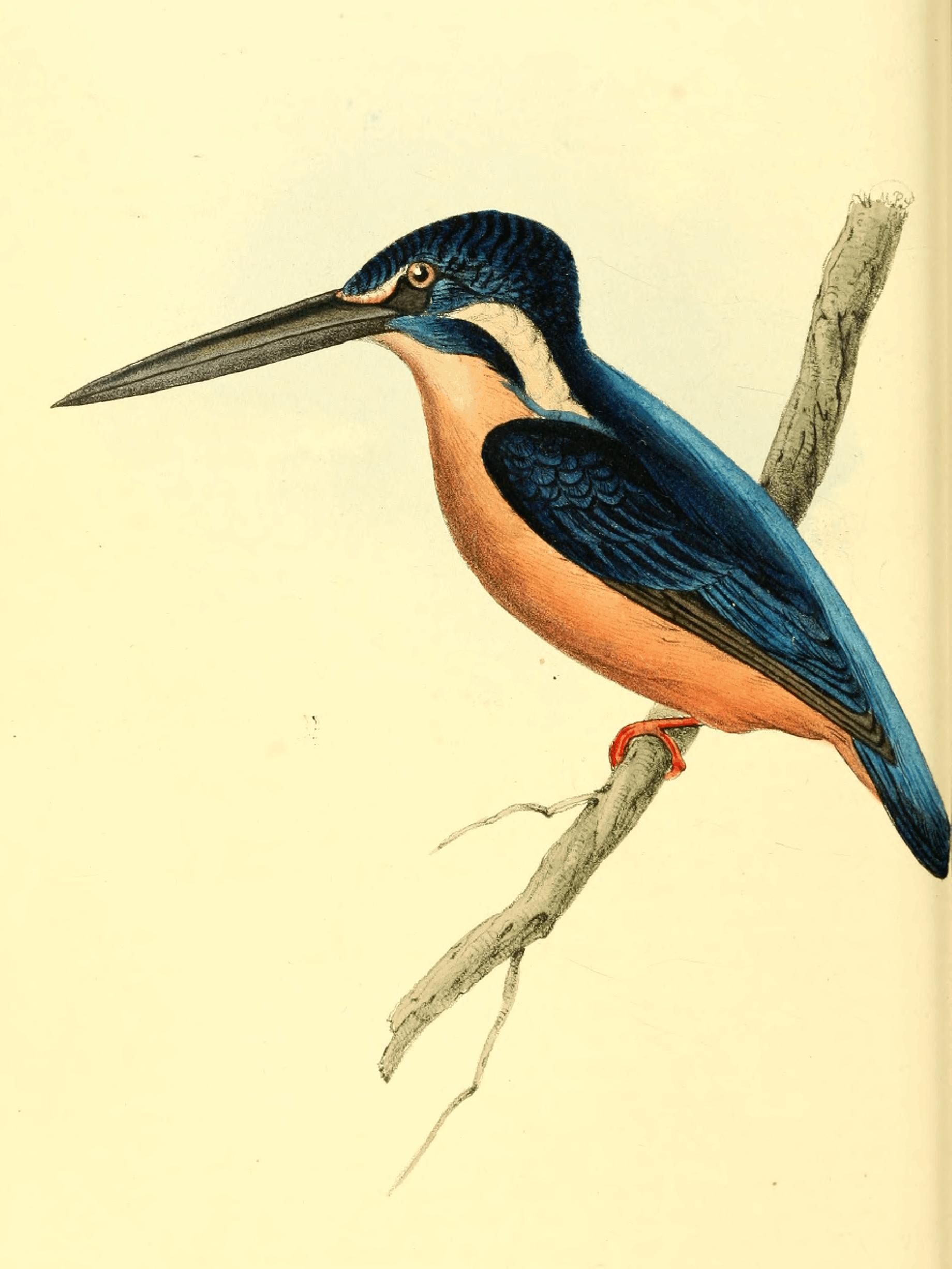
ALCEDO Asiatica.
Asiatic Kingsfisher.
Generic Character.—See Pl. 26.
Specific Character.
A. capite nigro, fasciis transversis cyaneis, posticè cristato; auribus cyaneis; mento, gulâ, strigâque laterali colli albescentibus; dorso nitidè cæruleo; corpore subtùs rufo.
Head black, transversely banded with mazarine blue, the hinder part crested; ears blueish; chin, throat, and lateral stripe on each side the neck whitish; back shining light-blue; body beneath rufous.
Obs. This bird Dr. Horsfield tells me is his Alcedo meninting described in the Linn. Transactions.
The general resemblance between this and the European Kingsfisher may have been the cause why it has remained hitherto unnoticed by ornithologists. It bears, however, on closer inspection, a strong and peculiar distinction in the crest at the back of the head, in being much smaller in size, and especially as inhabiting the hottest parts of India; while our own braves the cold of a Siberian winter.
Total length six inches, of which the bill from the angle of the mouth to the tip occupies one inch and three-quarters, and is black, with the under mandible paler; the ears and the upper part of the head and neck are blueish-black, transversely banded with somewhat crescent-shaped narrow bands of a rich deep blue, which are broken into spots on the crest and ears: from the base of the under mandible is a black stripe richly glossed with blue, and carried down on each side the neck, between which and the upper part is a whitish stripe beginning just behind the ears (this in the European species is rufous). The wing-covers, scapulars and lesser quills are blackish glossed with blue, the two former having a bright spot at the end of each feather; superior and greater quills entirely blackish; down the middle of the back, rump, and tail-covers, light and vivid blue, with a slight tinge of greenish; chin and throat cream-colour; line between the nostrils and eyes, margin of the shoulders, under wing-covers, and all the lower parts of the body, rufous; tail deep and obscure blue; legs red.
My specimen came from some part of India; I have met with others from the same place; and Dr. Horsfield has likewise observed it in Java.
Pl. 51
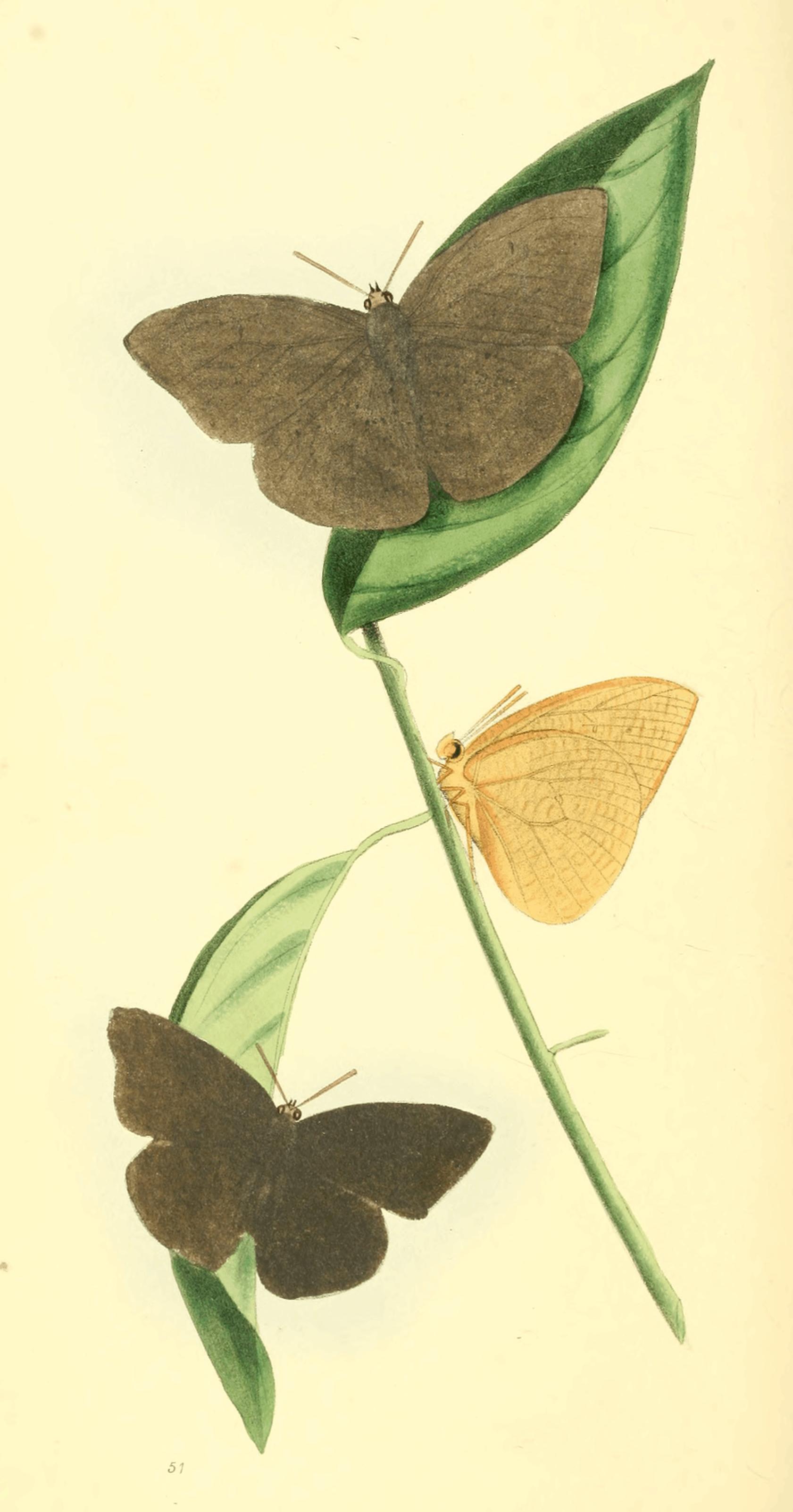
COLIAS Pyrene.
White African Colias.
Generic Character.—See Pl. 5.
Specific Character.
C. alis albis; anticis suprà punctulo nigro subcentrali oblongo ad apicem approximante; posticis margine integerrimis; singulis subtùs puncto ocellari lineisque fulvis undulatis: sexibus similibus.
Wings white; anterior with a small, nearly central, oblong, black dot nearest the tip; margin of the posterior wings very entire, beneath all with a brown ocellate spot and undulated fulvous lines: both sexes alike.
Under the head of Colias Pyranthe, M. Godart has united the three insects described by Fabricius, as, Pap. Pyranthe, Nepthe and Gnomia, all bearing in their leading colours a very near resemblance to each other. Yet as this consideration alone appears to have decided this ingenious author in uniting them, without apparently noticing the nicer but more important characters of form, proportion, and real sexual distinction, as well as geography, I cannot but consider the question still remains doubtful; and although I am not at present prepared to offer an opinion as to the actual affinity between these three insects, I have little or no doubt that the one now figured is a really distinct species from either of the above, which all inhabit various parts of India. This, on the contrary, is from the interior of the Cape of Good Hope, from whence it was brought by Mr. Burchall, among whose insects I have seen about twenty unvarying specimens, but they were all males. I discovered however three or four of both sexes, varying in size, in Mr. Haworth's cabinet, and the perfect similarity in colour of the female with the other sex is very striking: it wants of course the little tuft of hair and opaque spot within the borders of the wings, so generally found in the male Coliadæ.
The distinctions of Colias Pyrene as a species rest on the areola of the anterior wings being considerably larger in proportion than in the others allied to it, thus making the black dot (which is always placed at the outer extremity of the areola) much nearer the tip than the base: these wings are also more sharply trigonal (in the male), and have only the slightest appearance of a black margin; the hinder wings are also perfectly entire, and not obtusely undulated as in those insects, and the sexes not differing in colour. Like most of the insects of this genus, the ocellate spots beneath vary considerably; sometimes they are silvery, at other times not; the anal valves in the male are short and obtuse, and the wings in the female not so sharply pointed.
Pl. 52
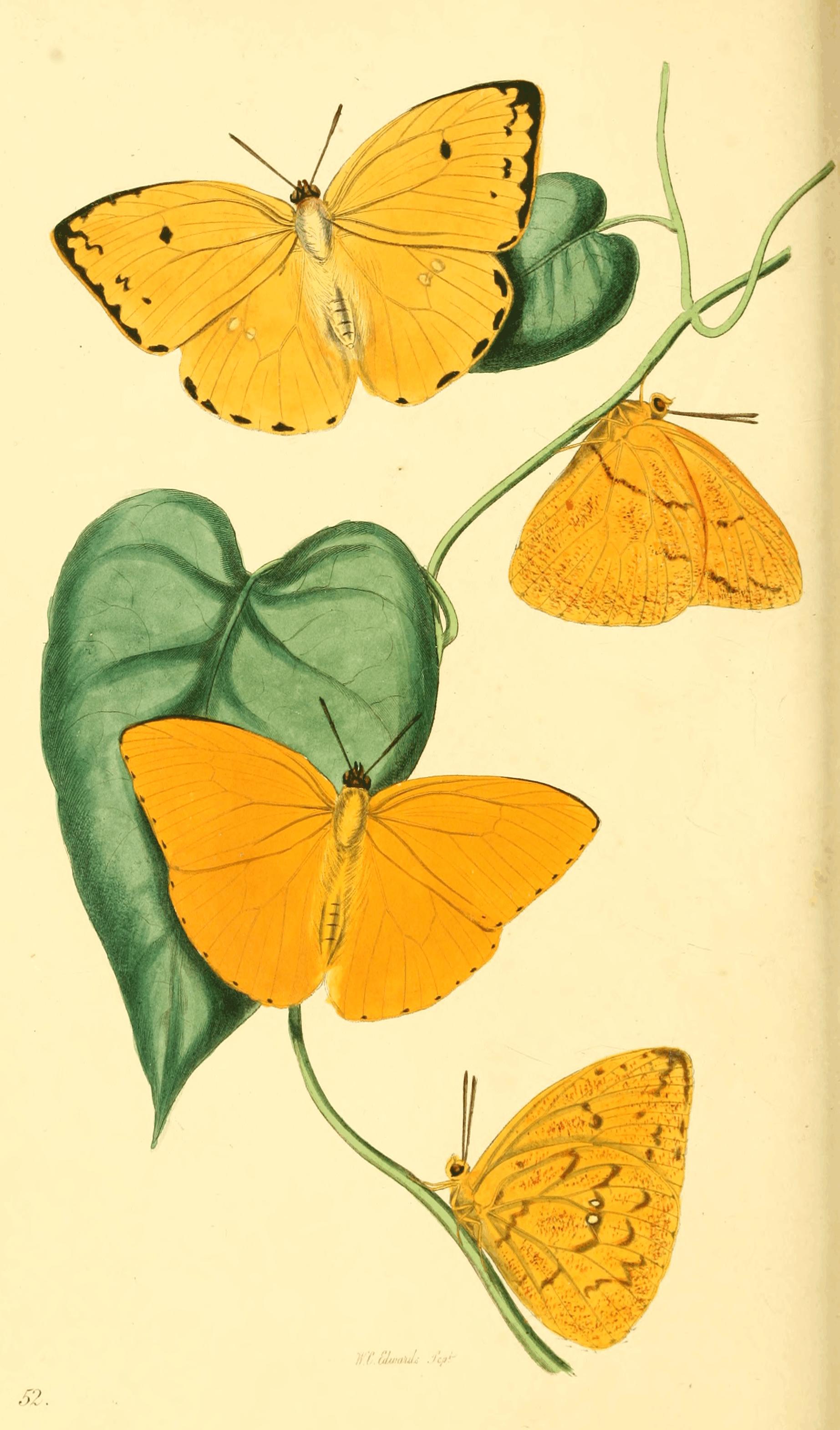
COLIAS argante.
Orange Colias.
Generic Character.—See Pl. 5.
Specific Character.
C. (Mas.) alis aurantiis, suprà immaculatis, posticis subtùs atomis ferrugineis, plerumque puncto gemino argenteo.
C. (Fœm.) alis aurantio-flavis, anticis suprà, apice punctoque medio atris; posticis subtùs, puncto gemino argenteo atomisque ferrugineis.
C. (Male.) Wings bright-orange, above immaculate; posterior beneath with minute ferruginous dots, and generally two silvery spots.
C. (Female.) Wings golden-yellow; anterior above with a central spot and black marginal tip; posterior beneath covered with ferruginous dots and two silvery spots.
(Male.) Papilio Hersilia. Cramer, pl. 173. C. D. ——— argante. Fab. Ent. Syst. iii. pt. 1. p. 189. Colias argante. Godart in Encycl. Method. 9. 92. no. 11.
(Female.) Papilio Cipris. Cramer, pl. 99. E. F. Colias Cnidia. Godart, 93. no. 14.
No two insects can present a more striking dissimilarity than the sexes of this species; and it was only after a considerable degree of attention to the subject, in their native climate, that we were at last thoroughly convinced that Colias argante and C. Cnidia were, without the least remaining doubt, the male and the female of one species. I have had the same opinion communicated to me by my friend Dr. Langsdorff, whose long residence and observations in Brazil render his opinion of no small authority.
As both insects are well known, and their distinctions given in the specific character, it will be only necessary to observe, that the under surfaces of the wings in both sexes vary much both in the density of the minute dots, and short undulated stripes that spread over their surface; and that the silvery spots in some males are strongly marked, and in others quite obsolete: there is, in very fine individuals of this sex, a faint bloom of pink spread on the orange of the upper surface, which heightens the vivid yet chaste beauty of the insect. The females are not so common. I met with them both in northern and southern Brazil, and have seen them in collections from Parà directly under the equinoctial line.
Pl. 53
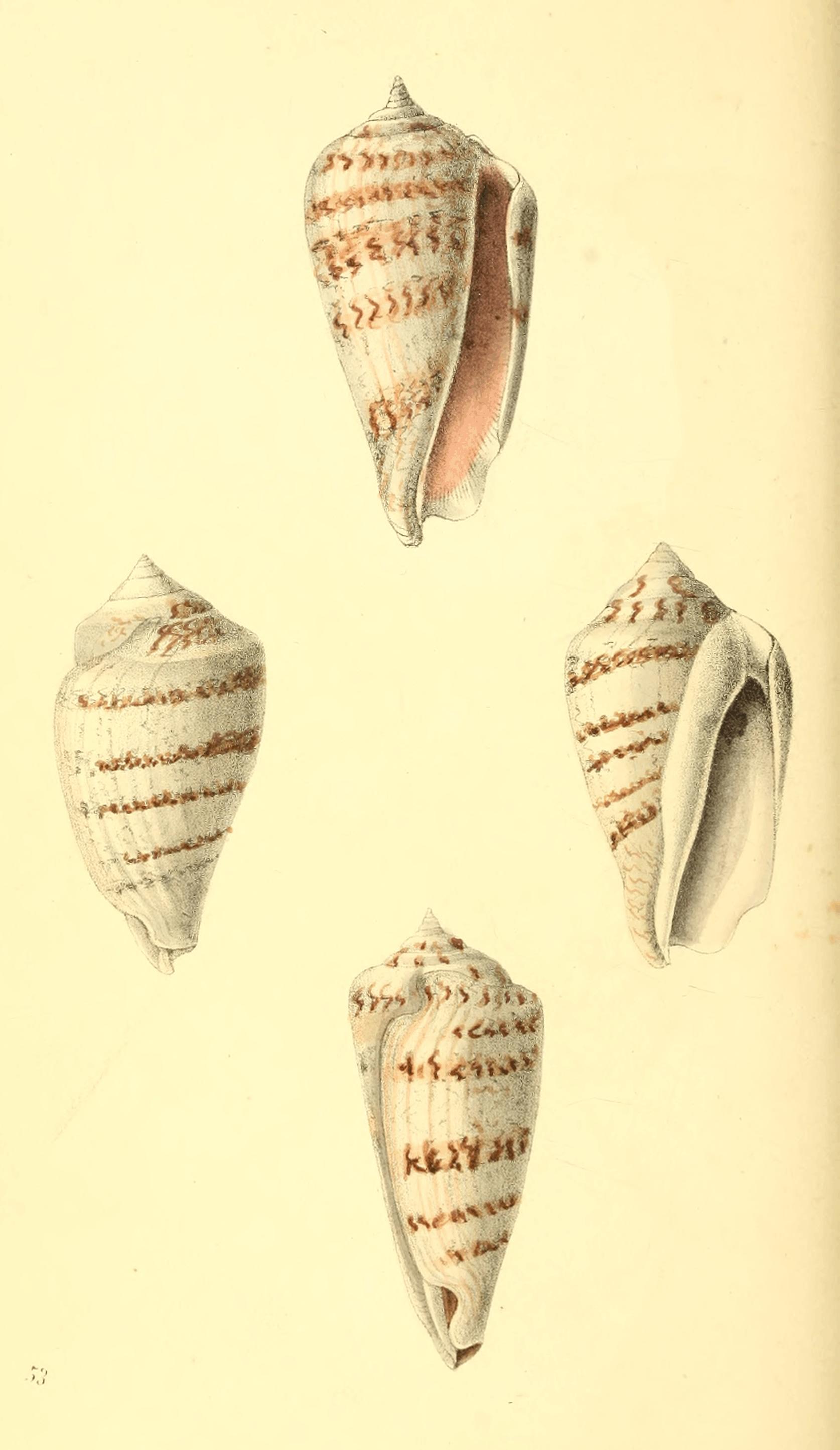
STROMBUS cylindricus.
False Scarlet-mouthed Strombus—Upper and under figures.
Generic Character.—See Pl. 10.
Specific Character.
S. testâ coniformi, spirâ brevissimâ ad basin depressâ, anfractibus convexis inæqualibus, labio exteriore suprà lobato, intùs striato; interiore sub-obsoleto, albo.
Shell coniform; spire short, depressed at the base, the whorls convex and unequal; outer lip lobed above, and internally striated; inner lip nearly obsolete, white.
Lister 850. 5. (bad.). Gualt. 31. 1. Knorr, vi. tab. 15. 3.
Strombus luhuanus Linn. Martini, x. tab. 157. 1499. 1500.
Young. Lip above entire, inside smooth, whorls tuberculated. Lister, 849. 4. a? Knorr, vi. tab. 17. 2.
We introduce this common shell for the purpose of pointing out those characters which induce us to consider it more as a distinct species than as a variety of S. Luhuanus of authors; and this consists not so much in the colour of the inner lip, as in the almost total absence of that important part, which this shell invariably exhibits through all its growths: it is therefore, I think, contradictory to the meaning of the word to term that variable which is found to be constant, particularly where the point of distinction rests on a marked difference of formation no less than of colour, though both shells are common to the Oriental seas. Minor differences exist, in the mouth of this always being pink, the inner lip white, and the outer lip but slightly lobed (or cut out) above: in S. Luhuanus the mouth is deep scarlet, inner lip black and highly polished, and the outer lip deeply notched above; the two former characters, indeed, begin to show themselves at a very early growth of the shell.
STROMBUS Persicus.
Persian Strombus—middle figures.
S. testâ sub-coniformi, brevi; spirâ conicâ, æquali; labio exteriore prominente, suprà sinuato, intùs glabro; interiore polito, albo.
Shell somewhat coniform, short; spire conic, equal. Outer lip prominent, sinuated above, smooth within; inner lip polished, white.
Allied, but sufficiently distinct from the last; the mouth is always smooth and white. It is a local species: a few received from the Persian Gulf are all I have yet seen, some were young, but no other variation was observable.
Pl. 54
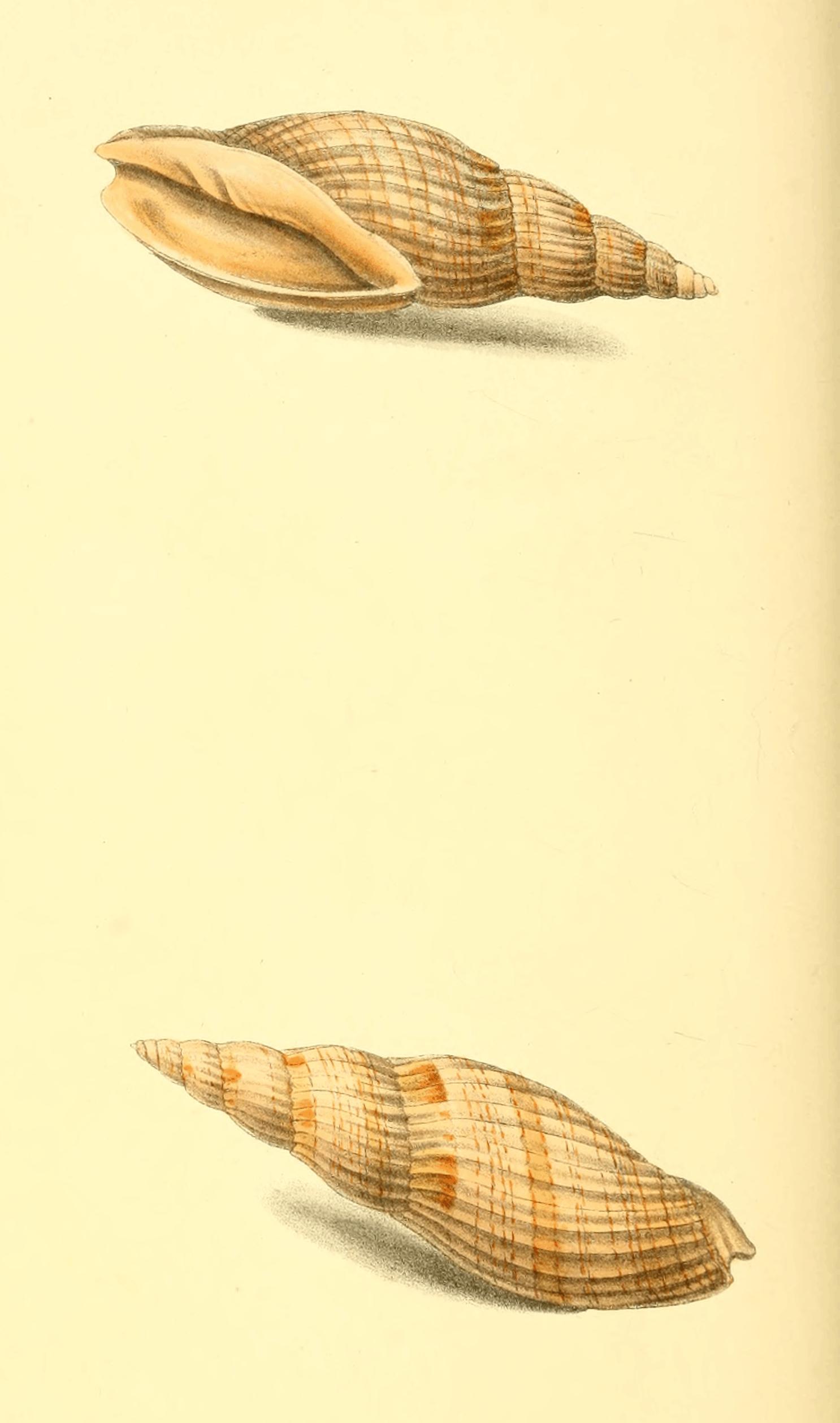
MITRA lyræformis.
Harp Mitre.
Generic Character.—See Pl. 23.
Specific Character.
M. testâ costis regularibus, carinatis, approximatibus: columellâ striatâ, juxta basin triplicatâ: spirâ subattenuatâ; apice subpapillosâ.
Shell with regular, carinated, approximating, longitudinal ribs. Pillar striated, three-plaited near the base. Spire somewhat attenuated. Apex slightly papillary.
This beautiful and highly interesting shell has been generally considered unique among the collections in this country. It was originally in the possession of the late Mr. Jennings, and, I am informed by Captain Laskey, was on first being received, in a much finer state. Mr. Jennings had it cleaned, and in so doing many of the delicate transverse striæ were partially obliterated, and the sharp ridges on the longitudinal ribs worn down, as indeed was apparent from a drawing Captain L. had made of the shell previous to this unmerciful cleaning. It however still remains a very fine shell, and is now in the cabinet of Mrs. Bolton, of Storr's-hall, to whom I am obliged for the opportunity of now publishing it.
The figure and specific character will sufficiently point out its distinctions. The body-whorl is smooth, but strongly granulated at the base; the spire delicately striated between the ribs; the two last whorls before the apex are close, thick, and somewhat papillary; the apex itself small and sharp. The upper part of the inner lip has some faint obsolete teeth, but the base has three very strong ones.
It connects in the most beautiful manner the two genera of Mitra and Voluta. Its country is unknown.
Pl. 55
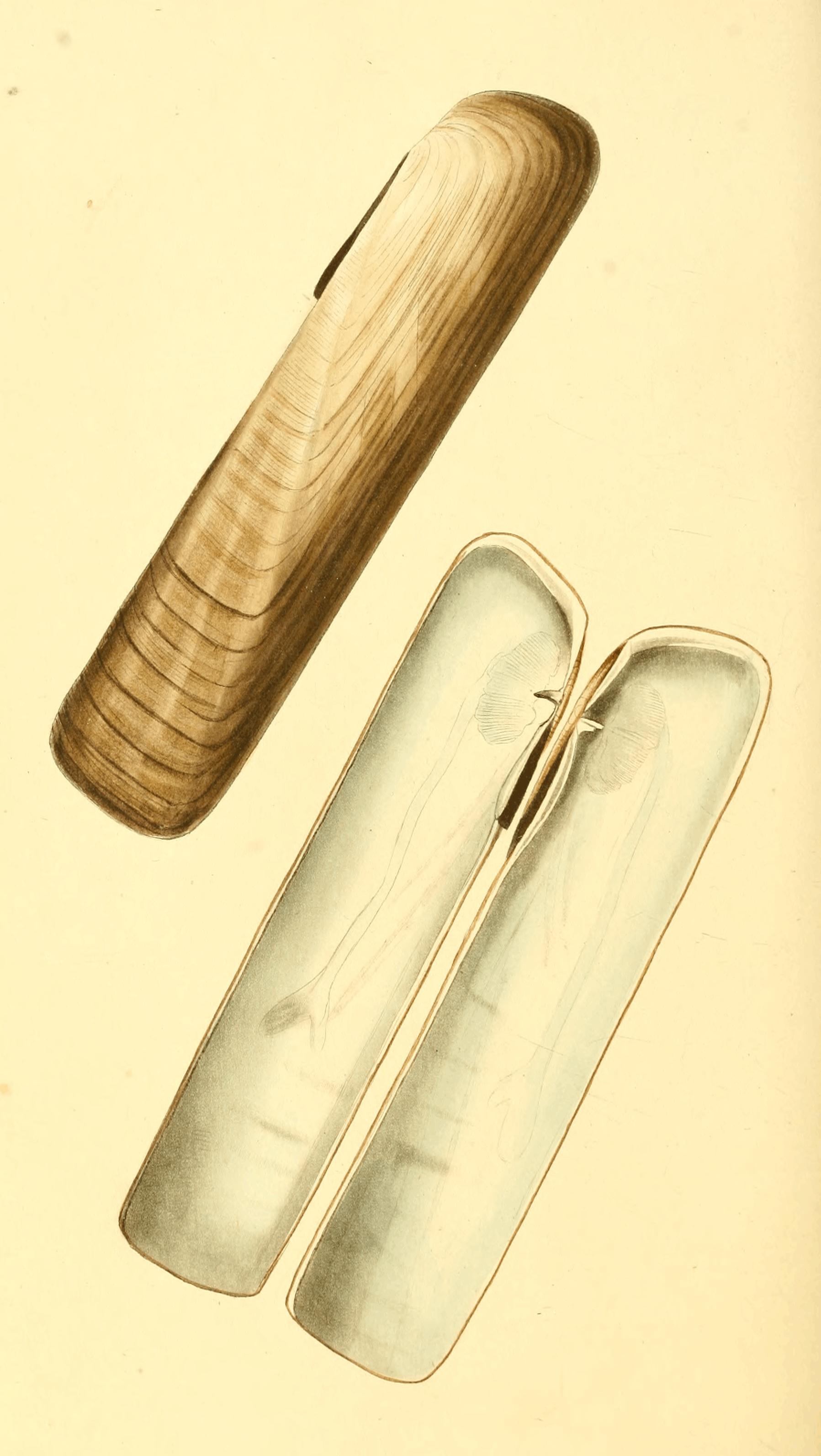
SOLEN ambiguus.
Ambiguous Solen.
Generic Character.
Testa bivalvis, æquivalvis, transversissimè elongata, utroque latere hians. Dentes cardinales parvi, fragiles, numero variabiles, rarò divaricati. Ligamentum externum; animal ad extremitatem anteriorem pede subcylindraceo; ad posteriorem siphone brevi duos alteros conjunctos continente. Lamarck.
Typus Genericus Solen Vagina Pennant.
Shell bivalve, equivalve, very transversely elongated, open at both ends. Cardinal teeth small, fragile, variable in number, and rarely divaricated. Ligament external. Animal with a sub-cylindrical foot at the anterior end, and at the other a short tube containing two others united together. Lamarck.
Generic Type Solen Vagina Pennant.
Specific Character.
S. testâ lineari, crassâ, rectâ, pallidâ, obscurè radiatâ; cardinibus unidentatis, margine anteriore sub-approximantibus.
Shell linear, strong, straight, pale, obscurely radiated. Cardinal teeth one in each valve, placed near the anterior extremity.
Solen ambiguus. Lam. Syst. vol. iii. p. 452. no. 7.
Under the genus Solen (vulgarly called Razors or Pods) are comprehended a variety of shells having the common character of both extremities open or gaping when the valves are together, yet differing materially in their form, teeth, and general appearance: some are long, slender and straight; others more or less curved; a few short and oval, or with one end only lengthened. Modern writers have, however, retained nearly all these in the genus as left by Linnæus; and this method for the present is more desirable than that of creating a multiplicity of genera. Dr. Turton, in his very useful Conchological Dictionary, enumerates thirteen species as found on the British coast, including the Solen Novacula of Montagu, which the Doctor suspects is not truly a species. The original specimens which Montagu described I have carefully inspected at the British Museum, and have no doubt in my own mind they are in reality no other than S. Siliqua with one of the cardinal teeth broken off; a circumstance which, from their fragility, frequently happens, even in opening the recent shell.
Solen ambiguus was first described by Lamarck, who says it is from North America. Two or three specimens are in my possession; but it is a rare species, much thicker, and with larger teeth than any other; the epidermis is pale-brown, and in some parts obliquely lineated.
Pl. 56
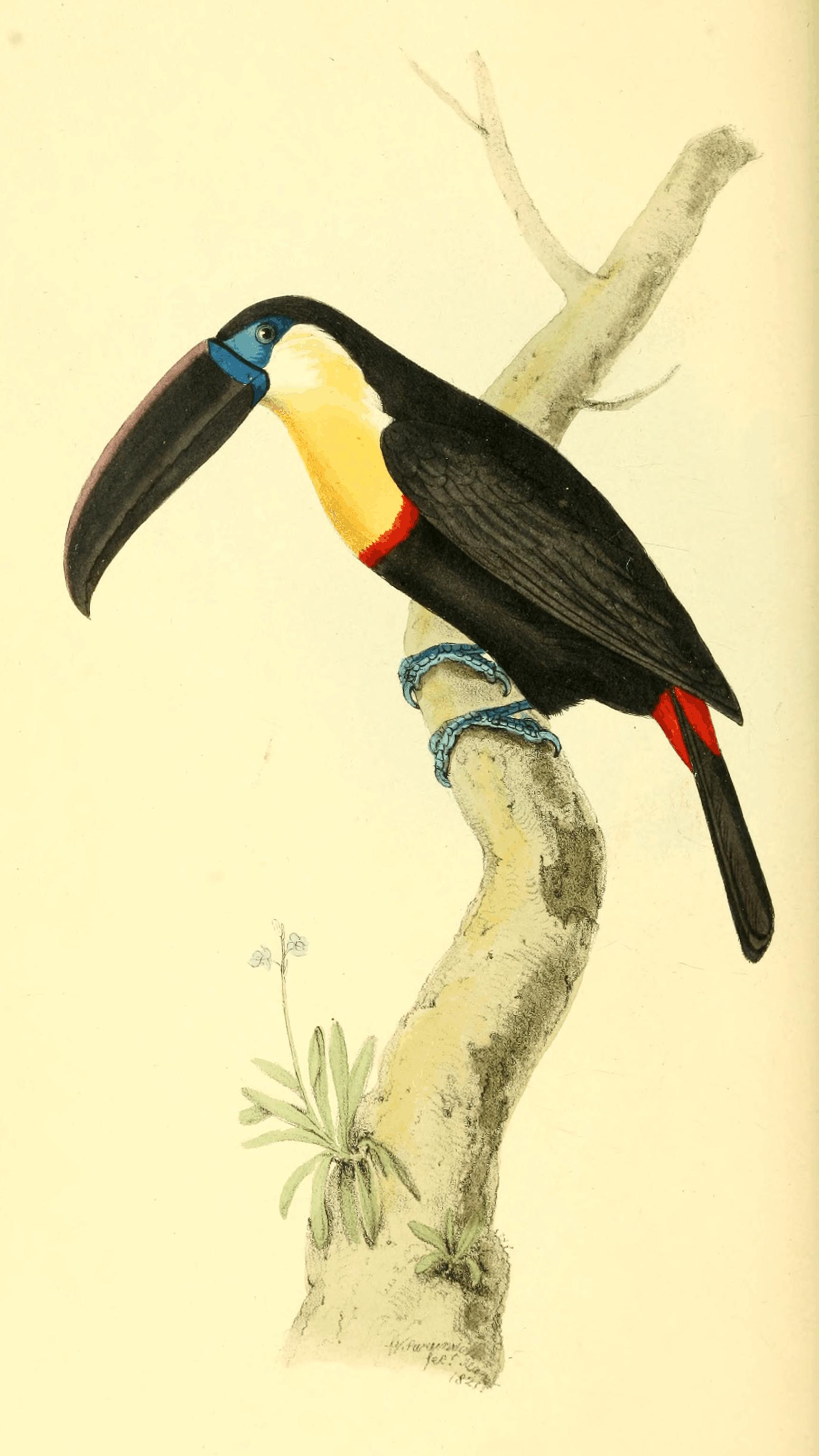
RAMPHASTOS vitellinus.
Sulphur-and-white-breasted Toucan.
Generic Character.—See Pl. 45.
Specific Character.
R. niger, gulâ flavo-aurantiâ; lateribus auribusque albis; fasciâ pectorali tegminibusque rubris; rostro nigro fasciâ basali cæruleâ, culmine subcurvato convexo, lateribus incrassatis.
Black; throat yellowish-orange; the sides and ears white; pectoral bar and tail-covers red; bill black, with a blue basal belt, the top convex and but slightly curved, the sides thickened.
R. vitellinus. Illiger ——
Le Pignancoin. Vaill. pl. 7.
Var.? Le Grand Toucan à ventre rouge. Vaill. pl. 6.
The descriptions of Dr. Latham, and the compilations of Dr. Shaw on the various species of Toucans, are so confused, and their synonyms so inaccurate, that it is quite impossible to quote them in reference to this bird; but which I am informed has already been distinguished by the celebrated Illiger as a distinct species, under the name here adopted.
Independent of colour, this differs from R. Tucanus in having the bill less curved, the top convex and obscure pink, not flat and blue. The belt at the base is always vivid blue (grey in the dead bird), not, as in R. Tucanus, of a rich yellow. This I have never met with in Brazil; the other is common from lat. 8 to 23° S. A drawing from the live bird by the late Sydenham Edwards (obligingly lent me by Lord Stanley) confirms others I have seen as to the colour of the bill, orbits, &c. It varies, however, in that of the throat, breadth of the red band, and in the tail-covers. A specimen I possess being somewhat larger, the breast is nearly white, and the upper tail-covers sulphur. In young birds the white on the sides is tinged with grey. I am inclined to consider the Grand Toucan à ventre rouge of Vaillant as a mere variety, having the red pectoral bar very broad.
In general size it is rather larger than the Brazilian Toucan. Our figure is on the exact scale of four-tenths to an inch. Its precise locality I am unacquainted with. We hope to enlarge more on this interesting genus in another publication.
Pl. 57
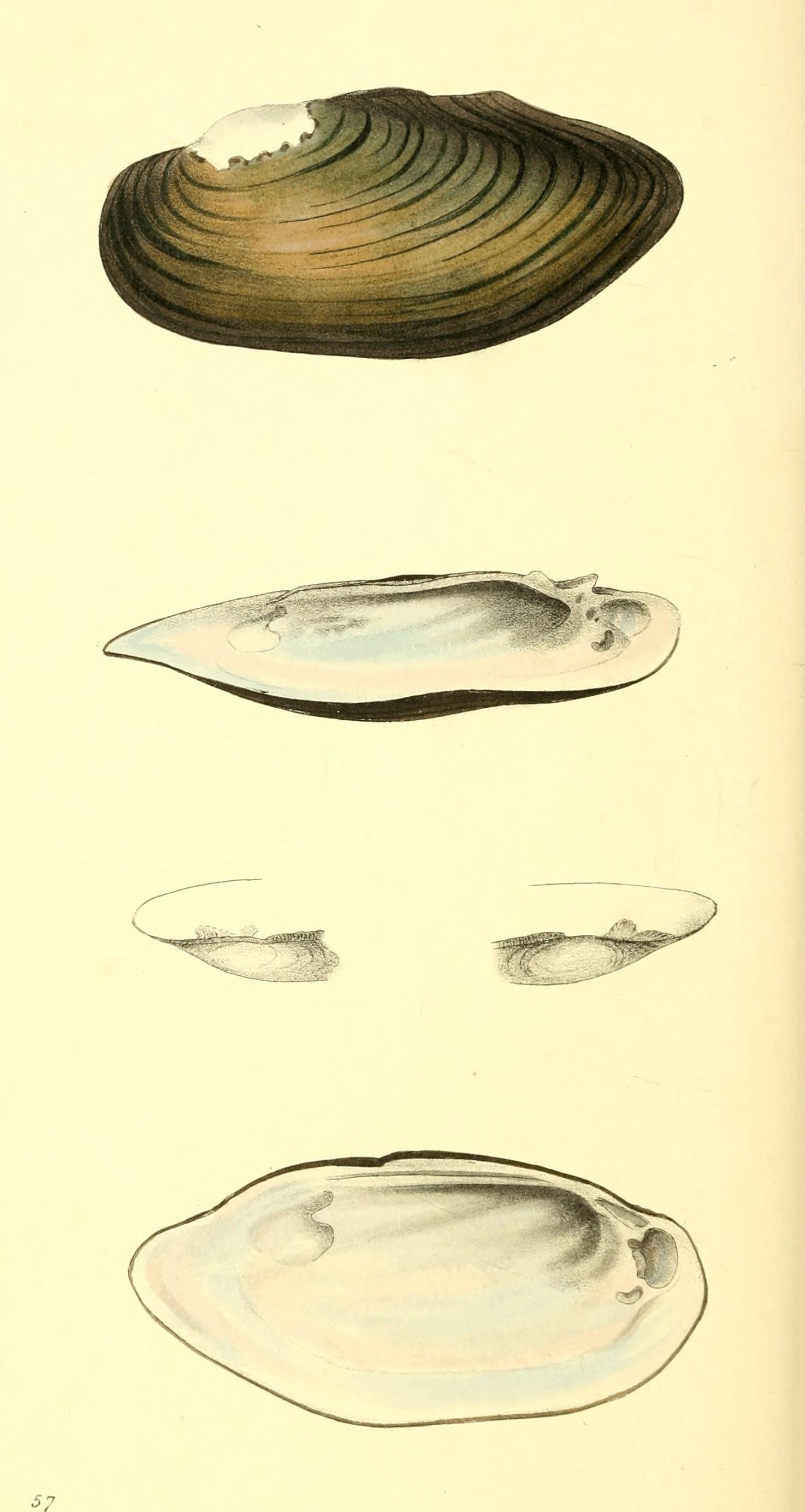
UNIO nasutus.
Rostrated River-Mussel.
Generic Character.
Testa transversa, æquivalvis, non affixa; natibus decorticatis, suberosis; impressio muscularis postica composita. Dens cardinalis unicus, brevis, irregularis, simplex aut bipartitus, substriatus; dentes laterales duo, elongati, compressi, infra pubem producti.
Typus Genericus Mya Pictorum. Linn.
Shell transverse, equivalve, not affixed, the tops decorticated. Posterior muscular depressions double. Cardinal tooth one, short, irregular, simple or double, striated; lateral teeth two, elongated, compressed, and prolonged beneath the corslet.
Generic Type Mya Pictorum. Linn.
Specific Character.
U. (Div. 2.) testâ transversim elongatâ, margine dorsi rectâ, anticè angulatâ obliquè attenuatâ, extremitate subtruncatâ.
Unio (Div. 2.). Shell transversely elongated: dorsal margin straight; anterior side angulated, obliquely attenuated, the extremity slightly truncated.
Lister, tab. 151. fig. 6.
Unio nasutus. Say in Encycl. Am. Conch. pl. iv. fig. 1.
This is one of the most natural genera in the modern systems of conchology, as it includes all fresh-water bivalves having two rough cardinal teeth in one valve and one in the other. The colours of all are more or less dark-brown, sometimes radiated with green; but the specific characters rest on the contour of the shell and the proportion of the teeth.
There can be no doubt this shell is the Unio nasutus of Say, who refers to the figure of Lister. The Unio nasuta however of Lamarck I apprehend will be found different, as he seems to think; his shell also is purple inside with short thick teeth; indeed so much uncertainty hangs on the shells of this genus, that the species can only be fixed by ample descriptions and very correct figures. The figure is from a shell in the Linnæan Society's cabinet. Mr. Say says it is common in the Delaware River, North America.
Pl. 58
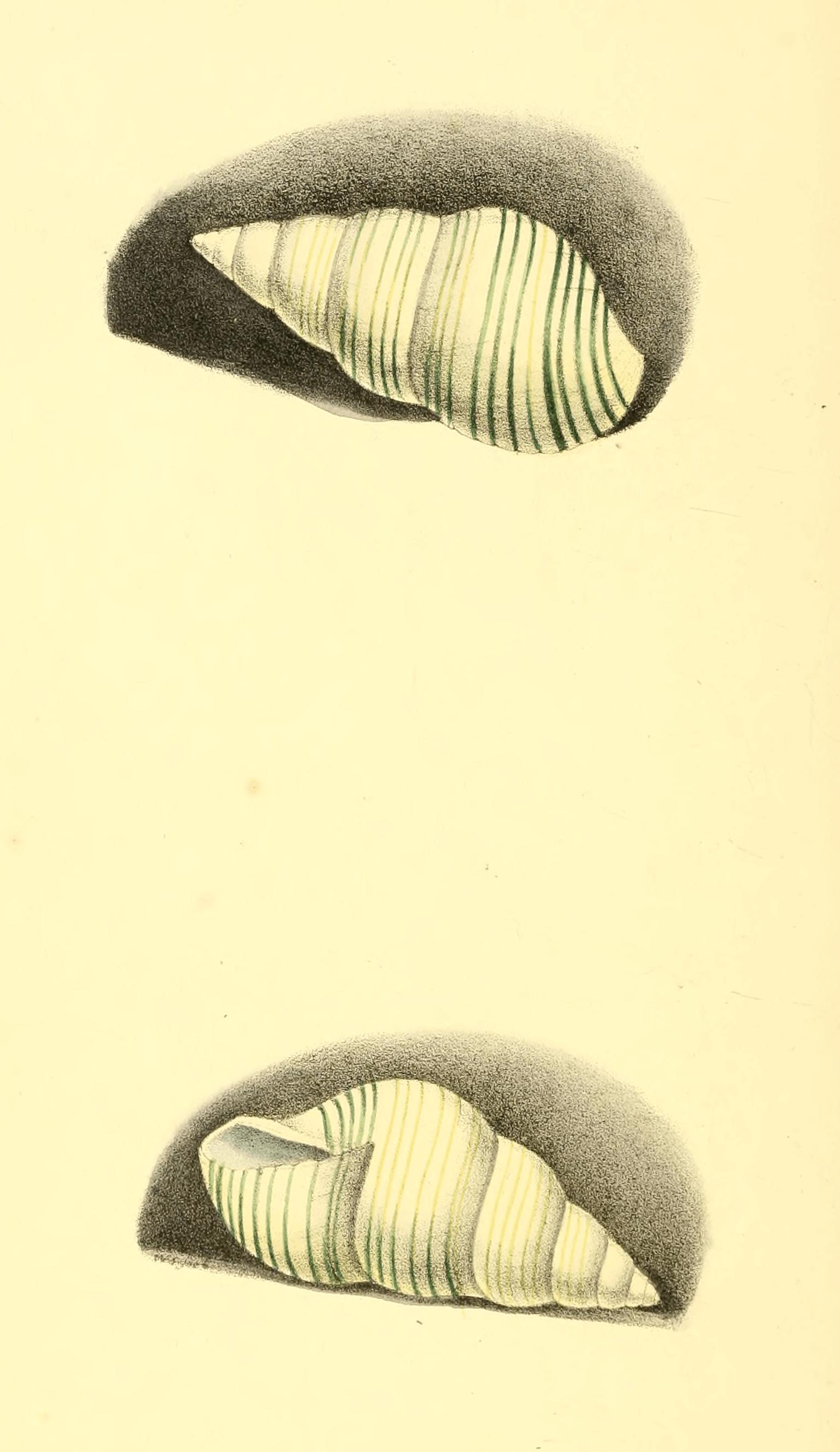
ACHATINA crenata.
Green hair-streaked Achatina.
Generic Character.—See Pl. 30.
Specific Character.
A. (Div. 2.) testâ albâ, fasciis viridibus capillaribus; spirâ elongatâ, subattenuatâ, anfractibus 6 convexis, labio exteriore crenato; basi subtruncatâ.
Shell white, with capillary green bands; spire elongated, sub-attenuated, of six convex volutions; outer lip crenated; base slightly truncate.
A few specimens of this most delicate and beautiful shell were found by my brother, Mr. J. T. Swainson, jun. in the island of Cuba; nor am I aware of its having by any other means reached our cabinets, excepting a distinct variety which occurred in Mrs. Angus's, and is now (together with a young one of the same) in Mr. Dubois's collection. This has, in addition to the green bands on the spire, a row of bead-like cinereous spots at the base of the first and second spiral whorl; and others of a longitudinal square form on those whorls nearest the tip, which, with the inner lip, is slightly tinged with pink. The form of the shell also is shorter; but the general contour, and particularly the crenated mouth, common to both, clearly proves it can be considered only as a distinct variety. The specimen we have figured agrees with all those sent at the same time, in having not the slightest appearance of spots, though in a perfect state of preservation. The little notches on the margin of the lip are always placed at the commencement of each of the green lines; the base of the column is straight, and slightly truncated before it joins the outer lip.
Pl. 59
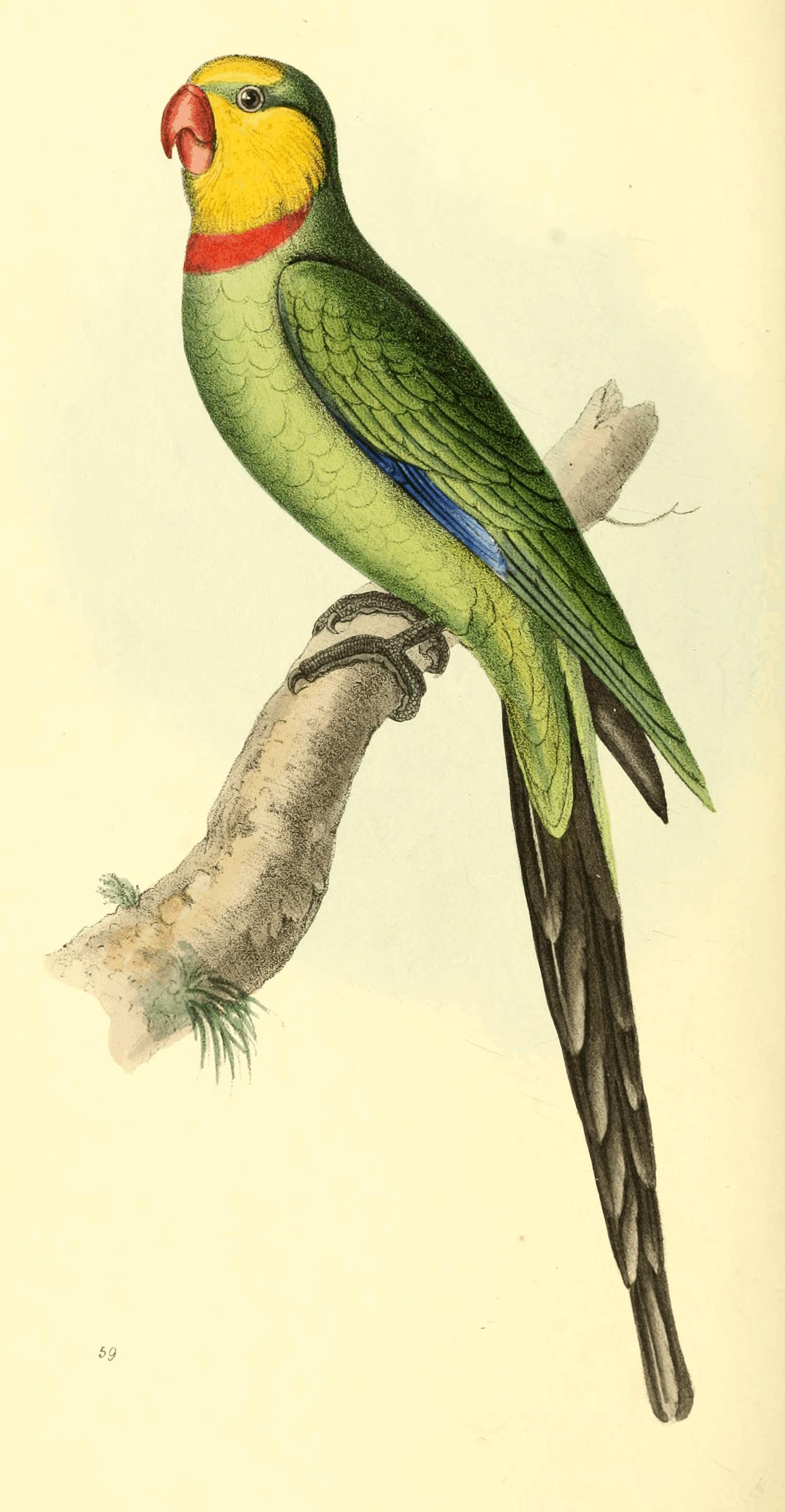
PSITTACUS Barrabandii.
Red-collared Parakeet.
Generic Character.—See Pl. 1.
Specific Character.
P. viridis, sincipite gulâque flavis; torque coccineo circa medium cervicem extendente; rostro rubro; alis spuriis cærulescentibus.
Green, fore-part of the head and throat yellow; round the middle of the neck in front an orange-red collar; bill red; spurious wings blueish.
The vast and little known region of New Holland has afforded us some of the most beautiful birds of this superb family, and among which the species now, as we believe, for the first time published, will stand conspicuous. It is from a fine skin in the possession of Mr. Leadbeater, and is named in honour of the late M. Barraband, the first ornithological painter that France or any other country has produced.
The tail is very long, measuring eight inches three quarters; the total length of the bird being near fifteen inches. The green which predominates over the plumage is bright and changeable, having a blueish tinge on the hind head, which is much darker and stronger on the outer margins of the quills and middle of the tail-feathers: the back and scapulars are tinged with an olive-brown; the spurious quills and their protecting covers are greenish-blue, appearing in some lights entirely of the latter colour; the inner margin of the quills and tail, as well as their entire under surface, deep brownish-black; but the tips of the tail-feathers beneath are much paler; the two middle feathers five inches longer than the outermost, and extending near two inches beyond any of the others; their extremities instead of being pointed are rather widened and rounded. Bill red; ears and space between the eye and bill green; fore-part of the head, chin, and half the neck, a clear orange-yellow, which is terminated by a narrow collar of a beautiful orange-red; the remaining under plumage pale-green; inner wing-covers darker. Legs black. The fourth, fifth and sixth quills notched at their tips.
Pl. 60
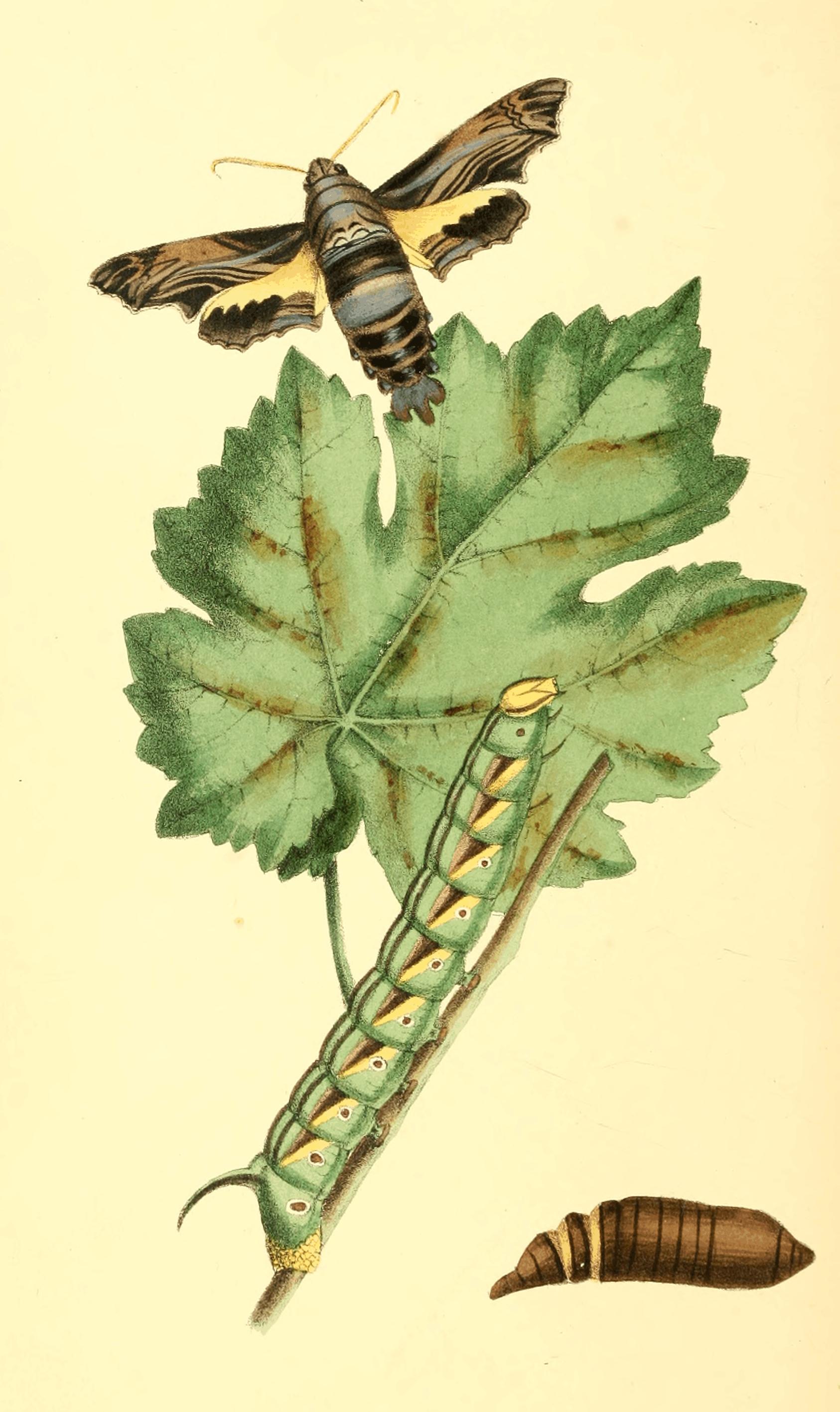
THYREUS Abbottii.
Generic Character.
(Familia Sphingidis Latreille.)
Antennæ lineares, in medio incrassatæ, in maribus extrinsecus ciliatæ, (sub-barbatæ) in fœminis simplices, filiformes, mucrone obtuso arcuato sensim terminantes. Palpi breves, obtusi, in utroque sexu similes. Alæ opacæ, angulatæ. Abdomen crassum, barbatum.
Antennæ linear, thickened in the middle, externally ciliated in the male, simple and filiform in the female, gradually ending in an arcuated, obtuse hook. Palpi short, obtuse, alike in both sexes. Wings opaque, angulated. Abdomen thick, bearded.
Specific Character.
T. alis angulatis, anticis testaceis, fusco umbratis et obliquè lineatis; posticis flavis, margine lato nigro.
T. Wings angulated; anterior testaceous, with lineated brown shades and oblique lines; posterior yellow, with a broad black border.
A lovely insect, which is unfigured, and, as far as we can ascertain, undescribed by any author. It appertains to the Linnæan genus Sphinx, which can be viewed (from the immense diversity and great number of the species) only as a family containing many and striking natural genera: in modern arrangement it is most nearly allied to the Sesiæ of Fabricius, from which, as it strikingly differs in the formation of the palpi and antennæ, I have separated it.
I have named this insect to commemorate the exertions of Mr. Abbott, well known as having furnished the materials for that beautiful work the Lepidopterous Insects of Georgia, edited by Sir James Edward Smith. And from the unpublished drawings of this zealous collector, the larva and pupa have been figured. Mr. Abbott writes that it is a rare species in Georgia, and feeds on the grape. The female differs not in colour from the male, which is here represented.
Pl. 61
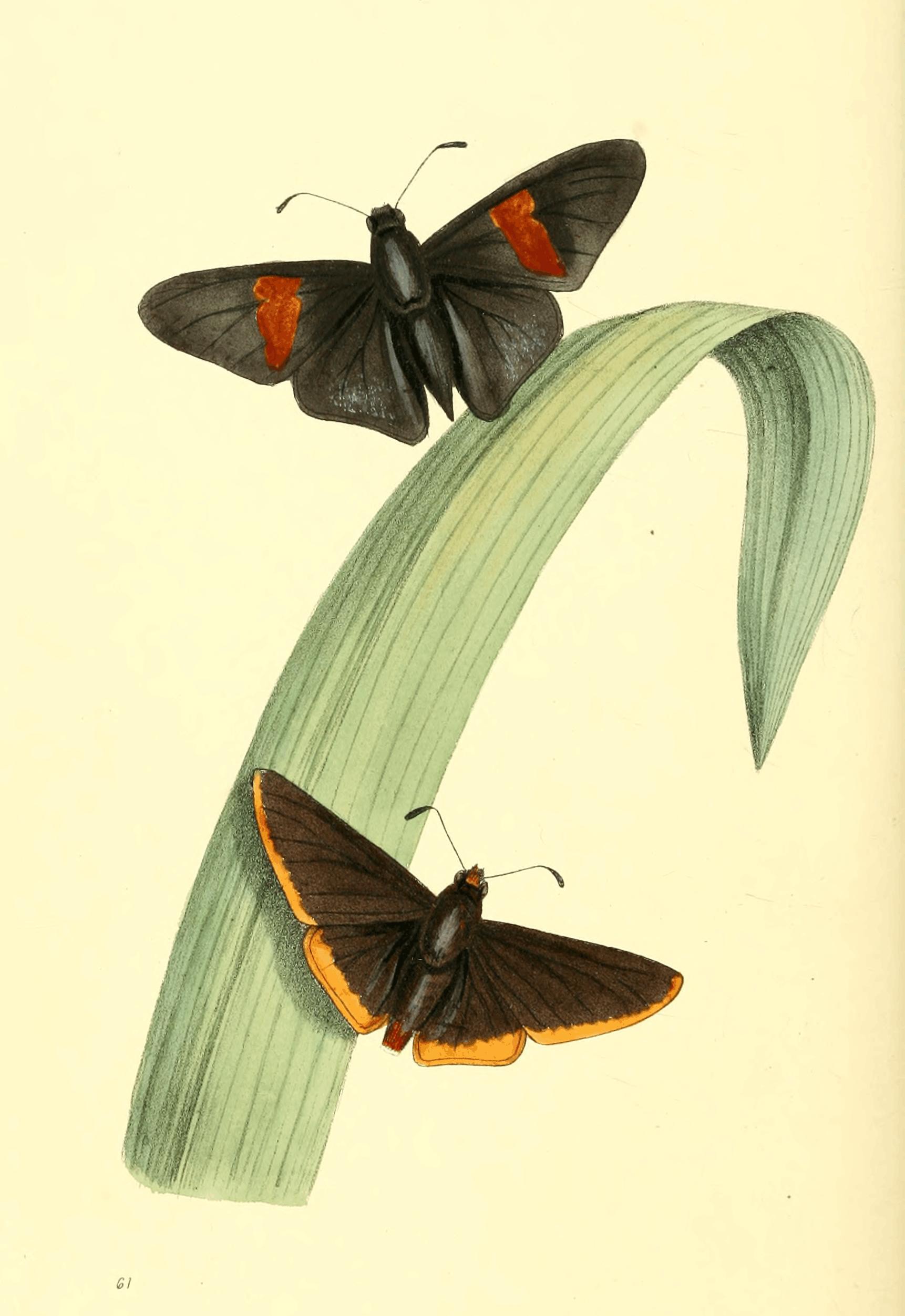
TAMYRIS Nurscia.
Generic Character.—See Pl. 33.
Specific Character.
T. alis nigris, anticis suprà fasciâ centrali rufescente, infrà punctis duobus ad basim albidis; posticis infrà cæsiis, cinereis, basi nigris lineâ obsoletâ albidâ; margine nigro.
Wings black; anterior above with a central reddish band, and two white basal dots beneath; posterior beneath grey and cinereous; base black with an obsolete white line; margin black.
The marginal fringe of the lower wings in this species has a few white dots between the nerves, and the upper surface is sprinkled or powdered in the middle with blueish-green atoms; on the under surface of the anterior wings the lower part of the band is orange, the upper bright rufous; and within the black margin of the posterior wings is a large blueish spot, and two or three whitish dots on the sides of the thorax. It seems nearest allied to Hesp. Celsus of Fabricius, which is only slightly described from Mr. Jones's unpublished drawings.
TAMYRIS Laonome.—lower figure.
Specific Character.
T. alis utrinque similibus, concoloribus fuscis, margine communi aurantiacis; capite anoque rubris.
Wings in both sexes alike, uniform brown, with a common margin of orange; head and tail red.
The under surface of this insect (a female) perfectly resembles the upper: it will approach near to Hesp. Amiatus of Fabricius, which no doubt belongs to this genus.
For both these interesting insects, not to be found in Fabricius, I am indebted to the liberality of my friend Professor Klug, Director of the Royal Museum at Berlin: no note accompanied them, I therefore conclude they are undescribed, and probably inhabiting South America.
Pl. 62
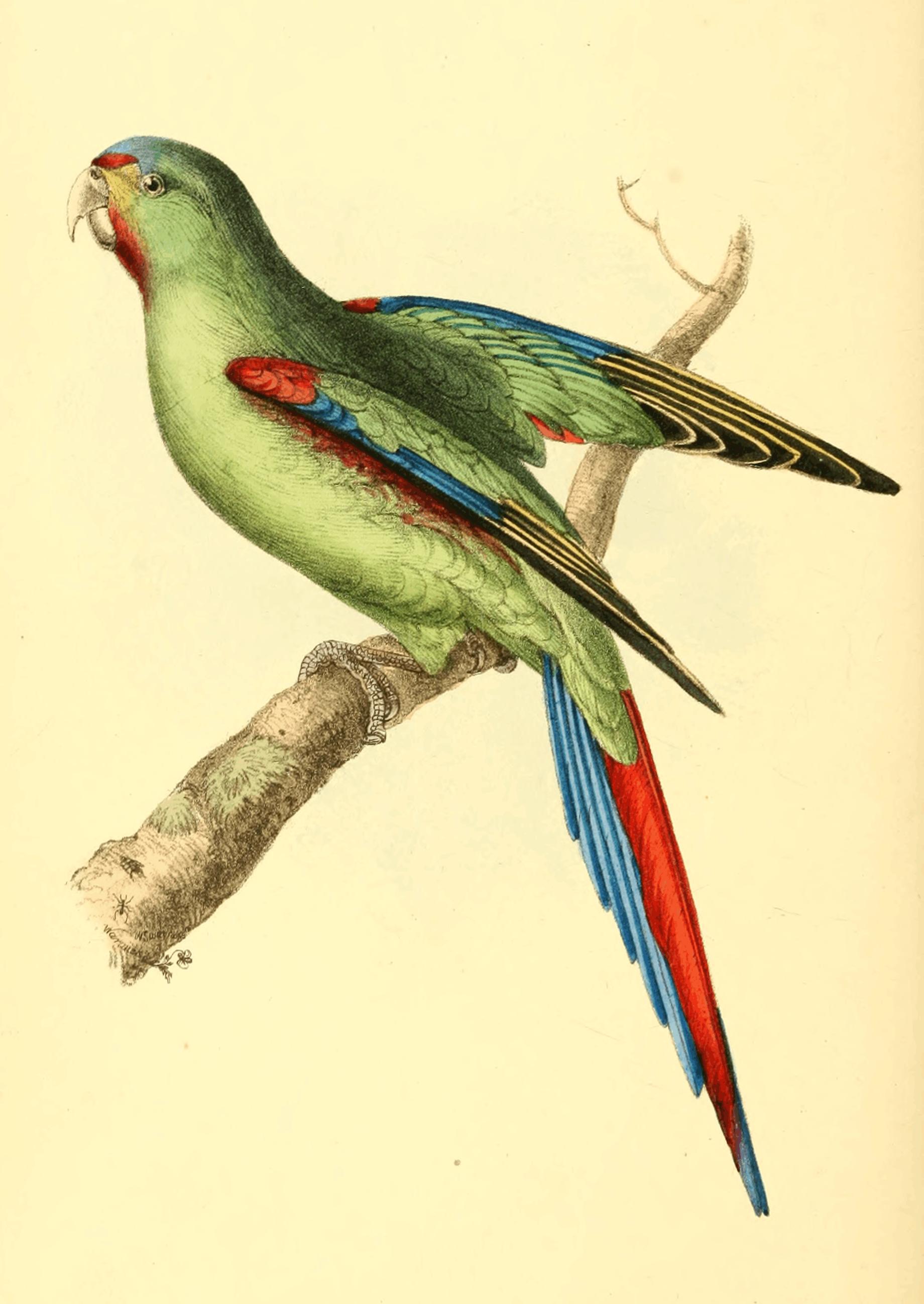
PSITTACUS discolor.
Red-shouldered Parakeet.
Generic Character.—See Pl. 1.
Specific Character.
P. viridis; fronte, mento, tegminibus inferioribus, maculâ cervicali, lateribus et scapularibus coccineis; humeris puniceis; vertice, tegminibus exterioribus remigibusque violaceis; rectricibus fulvo marginatis.
P. Green; front, chin, under wing-covers, and spots in the neck, flanks and scapulars crimson; shoulders dark-red; crown, external wing-covers, and lateral tail-feathers violet-blue; quills blueish-black margined with yellow.
P. discolor. Red-shouldered Parakeet. White's Voyage, pl. at p. 263.
La Perruche Banks. Le Vaill, pl. 50.
This is another of the splendid little Parakeets inhabiting the forests of New Holland; and vivid as the colouring may appear in our figure, it sinks into dullness when compared with the bird itself. Dr. Shaw was the first who described it in White's Voyage to New South Wales, where it is badly represented. It has been since figured by Le Vaillant, probably from a female or imperfect specimen, as the tail is represented by far too short, and the colours not quite agreeing with that in my collection.
Total length eleven inches. The upper plumage bright green, tinged with blue on the sides of the neck, lighter and yellowish beneath; the crown of the head sapphire or violet-blue, with a crimson belt in front, and a large patch of the same round the chin; paler spots of this colour are also in front of the neck, breast, flanks, and under tail-covers; the under wing-covers are deep crimson, as well as the inner shafts of some of the lesser covers outside; the shoulders dark blood-colour; the outer wing-covers deep-blue on the margin of the wings, gradually changing to a vivid blue, which blends with the green. Quills black glossed with violet, margined externally and internally with yellow. Tail near five inches long, the middle feathers dark rufous tipped with blueish; the rest more or less rufous at the base, and shining blue beyond. Bill and legs pale.
Pl. 63
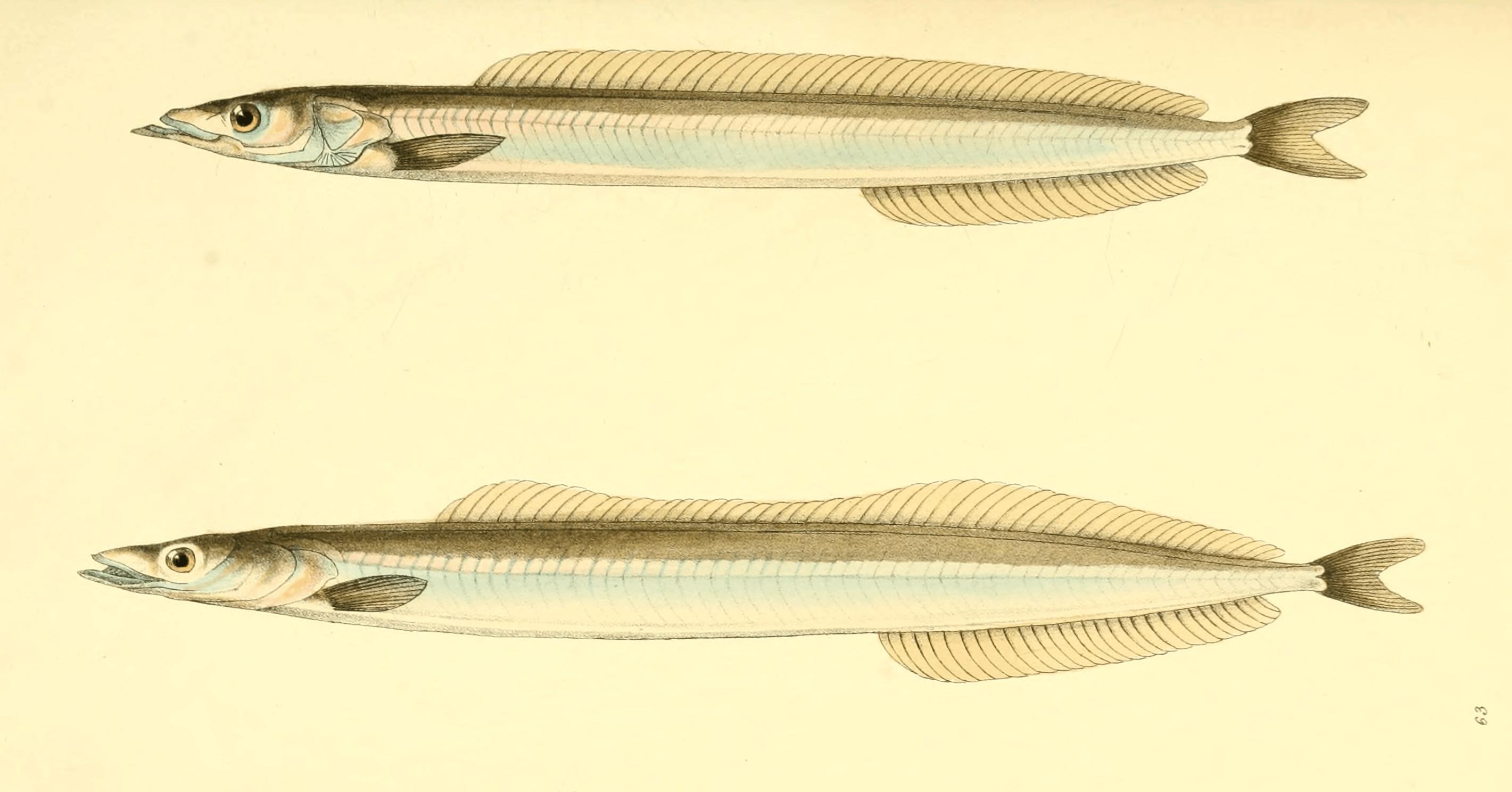
AMMODYTES.
Sand-Lance.
Generic Character.
Corpus gracile, teretiusculum, polyedrum, elongatum, squamis vix conspicuis. Labium superius duplicatum; mandibula inferior angusta, acuminata. Membrana branchiostega septem-radiata. Pinna dorsalis corpore penè æqualis, radiis simplicibus flexilibus.
Typus Genericus Ammodytes Tobianus. Linn.
Body slender, roundish, many-sided, with minute scales. Upper lip doubled; lower jaw narrow pointed. Gill membrane seven-rayed. Dorsal fin nearly as long as the body, with simple flexible rays.
Generic Type Sand-Lance. Pennant.
Obs. The Ammodytes cicerelus of my friend Professor Rafinesque must be different from A. siculus
AMMODYTES Siculus.
Sicilian Sand-Lance.
A. pinnâ dorsali sinuatâ, in medio angustatâ, pone anum altiore.
Dorsal fin sinuated, narrowed in the middle and broadest behind.
Of this genus, hitherto considered as possessing only a unique example, we were fortunate in discovering while in Sicily the new species now figured, and which early in the year visit the coasts near Palermo and Messina in prodigious quantities. There is no striking difference between this and A. Tobianus, excepting the extraordinary shape of the dorsal fin, which is invariably undulated and narrowed in the middle. It never grows to a size exceeding the figure, and is usually much less; while the British species is often found double the length. Like that, also, A. Siculus has the lateral line running close to the dorsal fin; for the fine line in the middle of the side, as Lacepede has well observed, is that only which connects the muscles. That author likewise mentions, that the jaws in A. Tobianus have minute teeth, but these I could never discover. The rays of the fins are, pect. 16; dorsal 56; anal 30.
AMMODYTES Tobianus.
Common Sand-Lance—upper figure.
A. pinnâ dorsali lineari, æquali.
Dorsal fin linear, equal.
Linn. Syst. Nat. vol. i. p. 1145. Pennant iv. pl. 28. Bloch, pl. 73. 2.
Lacepede, ii. 275. Klein Hist. Pisc. fasc. iv. tab. 12. f. 10.
This, though a very common fish, has been figured by all authors as if the rays were spined and naked at their extremity; they are, on the contrary, soft and connected.
It abounds at certain times on many parts of our coasts. The number of rays stand thus: Pectoral 12; dorsal 51; anal 27.
Pl. 64
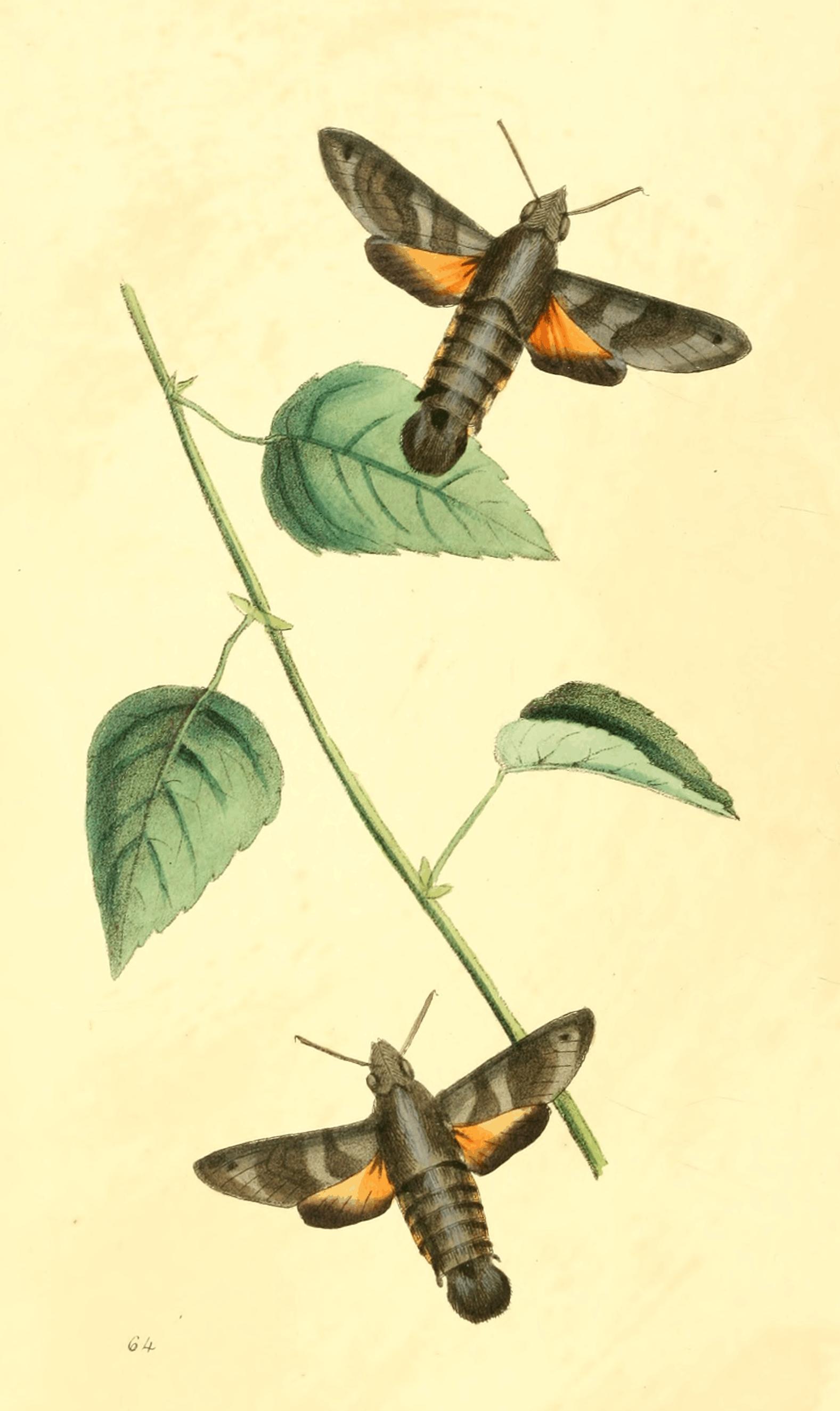
MACROGLOSSUM assimile.
Generic Character.
Antennæ subfusiformes, sursum versus sensim crassescentes, apice unco brevissimo gracili incurvato abruptè terminato, in maribus sub-barbatæ, in fœminis simplices et graciliores. Palpi porrecti, crassi, articulo ultimo acuto. Alæ opacæ, integræ. Abdomen crassum, barbatum.
Typus Genericus Sphinx stellatarum. Linn.
Antennæ subfusiform, gradually thickest towards the end, the tip abruptly terminating in a very short slender incurved hook; ciliated in the male, simple and more slender in the female. Palpi porrected, thick, the last joint pointed. Wings opaque, entire. Abdomen thick, bearded.
Generic Type Sphinx stellatarum. Linn.
Specific Character.
M. alis suprà fuscis; anticis fasciis duabus obsoletis, puncto nigrante terminali, posticis in medio, tribus maculisque lateralibus abdominis aurantiacis.
Wings brown; anterior with two darker obscure bands, and a terminal blackish dot; middle of the posterior wings, and three lateral spots on the body, orange.
This genus was instituted by Scopoli many years ago, and differs principally from Sesia by having opaque wings, and from Thyreus by the very great difference in the construction of their antennæ. Many exotic species are known, but only one is found in Europe (Sphinx stellatarum of Linn.), which likewise inhabits our own country, and to which this our insect is very nearly allied.
Though by no means uncommon in collections, I cannot find this species either figured or described, nor indeed am acquainted with its locality. The under figure is of the male; the upper of the female; which differs only in the wings being rather broader, and in having one segment in the body less than in the other sex.
Pl. 65
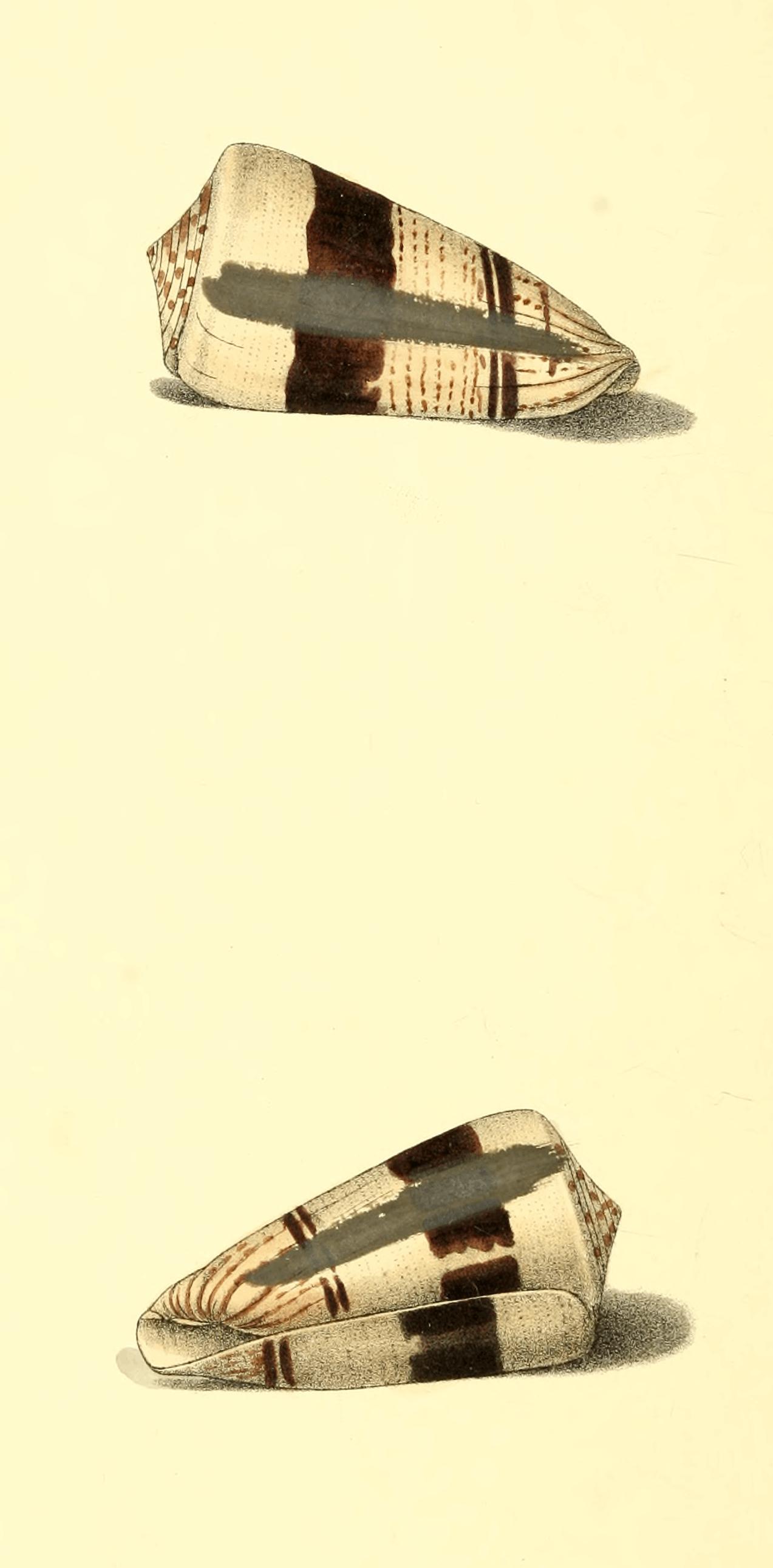
CONUS Augur.
Girdled Cone.
Generic Character.
Testa univalvis, turbinata, s. inversè conica, convoluta; apertura longitudinalis, angustata, edentata; basi effusa; spira brevissima.
Typus Genericus Conus marmoratus, &c. Linn.
Shell univalve, turbinated, inversely conic, convolute; aperture longitudinal, narrow, not toothed; base effuse; spire very short.
Generic Type Conus marmoratus, &c.
Specific Character.
C. testâ glabrâ, fulvo-albidâ, fasciis latis nigro-castaneis, lineisque transversis punctatis; spirâ obtusâ, convexâ, striatâ, depressâ.
Shell smooth, fulvous-white, with broad dark chesnut bands and transverse lines of dots; spire obtuse, convex, striated, depressed.
C. augur. Lamarck Annal. Mus. xv. 277. Encycl. Méth. 333. 6.
Conus magus. Gmelin 3392. 57. Martini ii. 58. 641.
The Girdled Cone is conspicuous among the beautiful shells of this extensive family, by the broad and rich chesnut bands, which are either two or three in number, and more or less broken into spots; in high-coloured shells the minute lines of dots between them are also of the same colour. It is not a common species, and inhabits the Asiatic ocean.
This is the Conus Magus of Gmelin and Martini, and of our sale catalogues: this error has originated from Gmelin having described two distinct shells, C. Augur and C. Magus, under the latter name.
I have not referred to Lister's figure 755. 7, being doubtful of its affinity; and those of Martini and Bruguieres are very bad.
Pl. 66
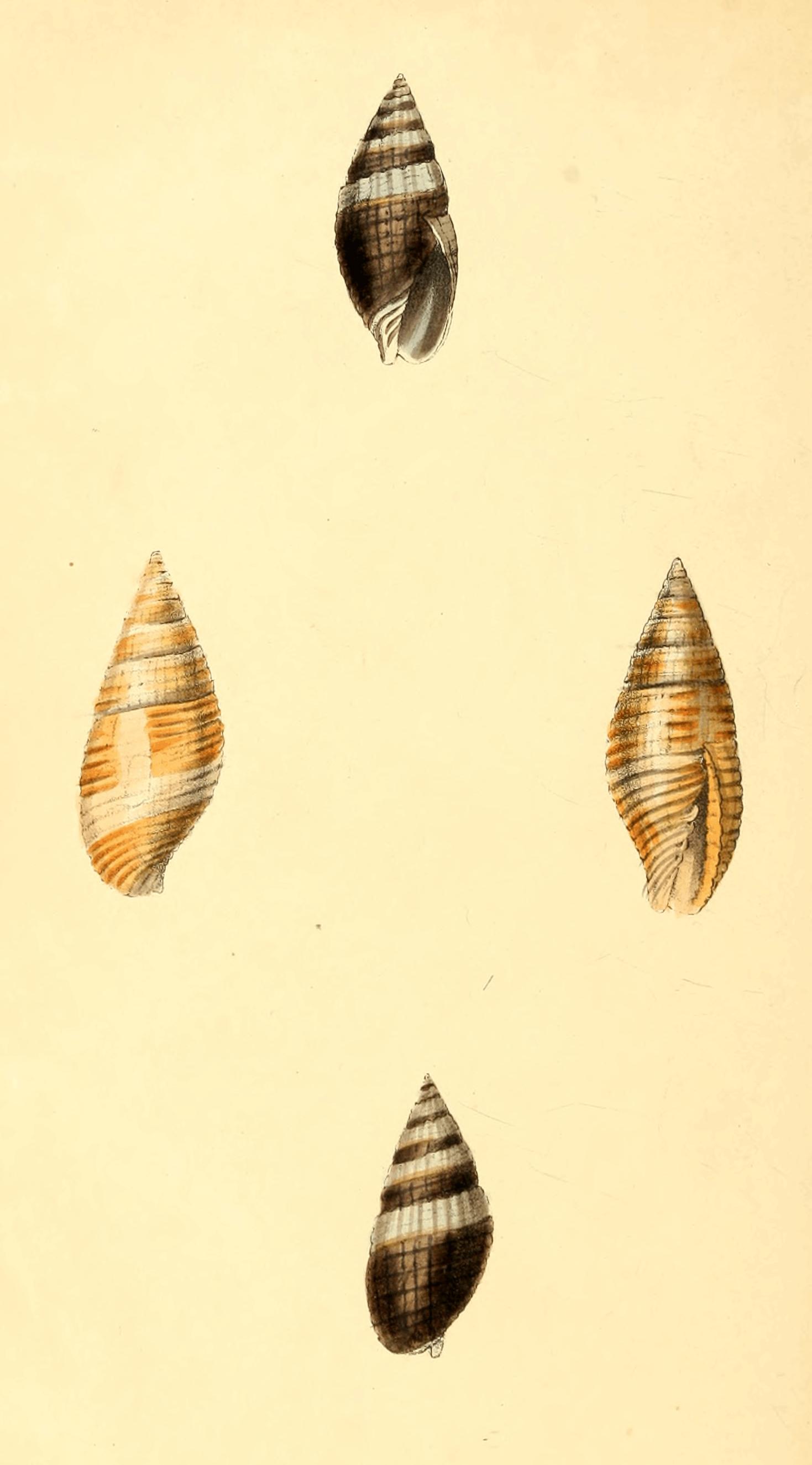
MITRA lugubris.
White-banded Mitre.
Generic Character.—See Pl. 23.
Specific Character.
M. testâ inversè pyriformi, fuscâ; sulcis transversis intus punctatis; anfractibus supernè obsoletè plicatis, fasciâque albâ ornatis; labio exteriore tenui, margine crenatâ; columellâ 4-plicatâ; basi albâ, truncatâ.
Shell inversely pear-shaped, brown, with transverse sulcated grooves, punctured within; volutions above obsoletely plaited and banded with white; outer-lip thin, margin crenated; pillar four-plaited; base white, truncated.
We have had much difficulty in the investigation of this species: for its characters cannot be reconciled with any of those contained in Lamarck's Monograph of the genus in the Annales du Museum. With regard to the unnamed figures in the old authors, it bears the closest resemblance to that of Gualtieri, tab. 32. G, which Lamarck quotes for his M. crocata; but then his description is not at all applicable to our shell; and Mr. Dillwyn's synonyms of the Linnean V. nodulosa (where he has also included M. crocata), we are satisfied comprises two or even three distinct shells.
This was named by Dr. Solander from the specimen in Mr. G. Humphrys's collection here figured: it is exceedingly rare, and its locality unknown. In form it resembles a Buccinum; the transverse grooves are broad, strongly defined, and have large and deep excavated dots within them; the upper part of each whorl has an appearance of irregular plaits, which makes the suture uneven, and takes off something from the smoothness of the lower part of the whorls, but the shell is in no way granulated.
MITRA ferruginea.
Thick-lipped Mitre.
Specific Character.
M. testâ nubilâ, maculisque ferrugineis interstinctâ; costis transversis, elevatis; labio exteriore crasso, obtusè crenato; columellâ 4-plicatâ.
Shell clouded and spotted with ferrugineous, with transverse elevated ribs; outer lip thick, obtusely crenated; pillar four-plaited.
M. ferruginea. Lam. Ann. du Mus. vol. 17. p. 200.
Young. Vol. vitulina. Dill. 553.—Martini 4. 149. 1380 & 1.
Variety more elongated. Vol. abbatis. Dill. 557. Chemnitz 11. t. 177. 1709 & 10.
This (a common shell) can be no other than the M. ferruginea of Lamarck, though neither that author nor any other has noticed its primary distinguishing character, that of the uncommon thickness of the outer lip at the margin, which is also divided into convex obtuse crenations; in young shells this is not apparent; such is Martini's figure. Mr. Dillwyn has changed Lamarck's name to Vitulina for this, and given the name of Abbatis to the variety more lengthened, figured by Chemnitz; but which, from specimens now before us, we consider with Lamarck only as a variety, possessing all the essential characters here given to both.
GENERAL INDEX
TO
VOL. I.
IN THE ORDER OF PUBLICATION.
Pl. Pl.
Psittacus Cayennensis 1 Parakeet, Cayenne gold-winged 1
Sitta frontalis 2 Blue Nuthatch 2
Mitra zonata 3 Zoned Mitre 3
Bulimus melastomus 4 Black-mouthed Bulimus 4
Colias Statira 5 Colias Statira 5
Leachiana 6 Leach's Colias 6
Carduelis cucullata 7 Hooded Seed-eater 7
Merops urica 8 Javanese Bee-eater 8
Helix auriculata 9 Eared Helix 9
Strombus minimus 10 Little Strombus 10
variabilis ib. Variable do. ib.
Drusilla Horsfieldii 11 Drusilla Horsfieldii 11
Gobius Suerii 12 Suerian Goby 12
Platyrhynchus Ceylonensis 13 Ceylonese Flatbill 13
Picus rubiginosus 14 Brown Woodpecker 14
Licinia Melite 15 Licinia Melite 15
Ismene Œdipodea 16 Ismene Œdipodea 16
Bulimus zonatus 17 Zoned Bulimus 17
Mitra contracta 18 Contracted Mitre 18
australis ib. Southern do. ib.
Tinamus Tataupa 19 Tataupa Tinamau 19
Picus Braziliensis 20 Brazilian Woodpecker 20
Procnias hirundacea 21 Swallow Berry-eater 21
Terias Elvina 22 Terias Elvina 22
Mitra vittata 23 Ribbon Mitre 23
Conœlix marmoratus 24 Marbled Conœlix 24
lineatus ib. Lineated do. ib.
punctatus ib. Punctured do. ib.
Procnias Melanocephalus 25 Black-headed Berry-eater 25
Alcedo azurea 26 Azure Kingsfisher 26
Halcyon collaris 27 Collared Crab-eater 27
Hesperia Haworthiana 28 Haworth's Hesperia 28
Mitra cancellata 29 Contracted Mitre 29
rigida ib. Ribbed do. ib.
Achatina marginata 30 Marginated Achatina 30
Phibalura cristata 31 Crested Shortbill 31
Psaris Cuvierii 32 Cuvier's Psaris 32
Tamyris Zeleucus 33 Tamyris Zeleucus 33
Colias Godartiana 34 Godart's Colias 34
Mitra bifasciata 35 Double-banded Mitre 35
Achatina perversa 36 Reverse Achatina 36
Procnias cucullata 37 Hooded Berry-eater 37
Picus bicolor 38 Black-and-white Woodpecker 38
Hesperia Itea 39 Hesperia Itea 39
Cynisca 40 Cynisca 40
Achatina pallida 41 Pale Achatina 41
Oliva Braziliana 42 Brazilian Olive 42
Melliphaga auricomis 43 Yellow-tufted Honeysucker 43
Pteroglossus sulcatus 44 Groove-billed Aracari 44
Ramphastos carinatus 45 Carinated Toucan 45
Bulimus citrinus 46 Citron Bulimus 46
citrinus, var. 47 Reverse-banded do. 47
aureus ib. Golden do. ib.
Mitra casta 48 Chesnut-banded Mitre 48
Oxyrhynchus cristatus 49 Crested Shortbill 49
Alcedo Asiatica 50 Asiatic Kingsfisher 50
Colias Pyrene 51 White African Colias 51
Argante 52 Orange Colias 52
Strombus cylindricus 53 False scarlet Strombus 53
Persicus ib. Persian do. ib.
Mitra lyræformis 54 Harp Mitre 54
Solen ambiguus 55 Ambiguous Solen 55
Ramphastos vitellinus 56 Sulphur-and-white Toucan 56
Unio nasutus 57 Rostrated River Mussel 57
Achatina crenata 58 Green hair-streaked Achatina 58
Psittacus Barrabandii 59 Red-collared Parakeet 59
Thyreus Abbottii 60 Thyreus Abbottii 60
Tamyris Nurscia 61 Tamyris Nurscia 61
Laonome ib. Laonome 61
Psittacus discolor 62 Red-shouldered Parakeet 62
Ammodytes Tobianus 63 Common Sandlance 63
Siculus ib. Sicilian Sandlance ib.
Macroglossum assimile 64 Macroglossum assimile 64
Conus Augur 65 Girdled Cone 65
Mitra lugubris 66 White-banded Mitre 66
ferruginea ib. Thick-lipped Mitre ib.