Volume 1 — CHAPTER XVIII A DREADED VISITOR
Reading edition
Nobody but the kittens knew that Polly dreaded the coming of Eleanor’s twin. She told them all about it Saturday morning as they sat in her lap, cuddled up into a warm heap under the gray shawl that Arctura had wrapped about her.
Arctura’s tooth had not quite stopped its grumbling and she had firmly declined Polly’s aid in the kitchen that morning.
“I’ve got some bothersome cooking to do,” said Arctura, without the smile which might let in a draft of air on the convalescent jaw, “and I’d best be alone, for my nerves are sort of jumpy along with a pain I’ve been enduring in my head without speaking of it, for some days. The air’s mild enough for you to sit out on the piazza and watch for Miss Hetty and Bobby, if I wrap you up well. It’s getting ready to rain again to-morrow, and then I have hopes of some fair, warm weather when it clears off finally.”
Miss Pomeroy’s rheumatism was much less troublesome than it had been for some days, and Hiram had helped her into the low basket phaeton an hour before.
“I expect she’s ’most home now,” said Polly to the kittens, with a little shiver, “and she’s bringing that boy—that Bobby—home with her. He’s going to stay till Monday morning. You needn’t be frightened, Snip and Snap, for he’s a boy that just likes to read; he wouldn’t do the things to kitties that the Higgins boys do—things with strings and spools, till the teacher stopped them. And, anyway, you’ve got lots of places to hide, where nobody could get you. But I can’t hide. I’m obliged to be right out where he can see me, and tell whether I’m like his sister Eleanor that died, and maybe change Miss Pomeroy’s mind after all, and lose Grandma Manser her ear-trumpet, and the money for the leaks and shingles and everything!”
Polly buried her face in the old shawl for a minute, and then sat up straight with a little gasp.
“I hear the phaeton!” she whispered, squeezing the kittens in her excitement. “I hear it coming over the bridge—fast!”
Snip and Snap objected to squeezing. They struggled under the shawl and dashed out over Polly’s knees, clutching wildly at the fringe. They looked up at her cannily with arched backs, and then scurried off toward the barn.
As the phaeton came around the curve of the driveway, Polly stood up, clasping her hands under the old shawl. She heard Arctura bustling out of the kitchen to the porch, and moved slowly along to stand beside her. In a moment more she found herself solemnly shaking hands with a boy who had jumped into the phaeton and then politely helped Miss Pomeroy out.
“This is my nephew Bobby,” Miss Hetty was saying. “And this is little Mary Prentiss.”
“I am very pleased to make your acquaintance,” said Polly, lifting her brown eyes to meet a pair of very large blue ones which gazed at her through spectacles.
“How d’you do?” said the boy, pleasantly. “Haven’t you got about through with my hand?”
He laughed as he said it, and so did Polly, but when the hand-shaking stopped they stood looking at each other awkwardly until Arctura broke the ice.
“You two children step out to the dining-room, while Miss Hetty goes and rests after her ride,” said Arctura, cordially. “I’ve set a tray with two tumblers of milk and some crullers on the buffet, and you can stand up and eat on to it, so’s not to scatter the crumbs. I never saw the time a boy wasn’t ready to eat, and Mary here’s got a most excellent appetite of her own. Dinner won’t be ready for nearly two hours yet.”
“Thank you,” cried Bobby. “You’re a trump!”
“Seems to me you’ve thickened up a little since last time,” said Miss Green, cautiously guarding the entrance to the cavern wherein dwelt her wisdom tooth, as she acknowledged this commendation. “I suppose you’ll drop into the kitchen along in the afternoon while Miss Hetty and Mary are taking their naps? I don’t see my way clear to sitting down at dinner for a talk with you, for I’ve been having a little neuralgy and the air in the dining-room seems kind of chilly after the kitchen.”
“Do you take a nap every day?” asked Bobby, curiously, as he and Polly drank their milk and ate the crisp crullers. “I s’pose girls like to do that kind of thing, but I’d rather read all night than waste time sleeping in the daylight. I’ve never known any girl very well except my sister. I’m afraid of them, they’re so queer.”
“Oh, they’re not half so queer as boys, I’m sure!” asserted Polly, with much decision. “I guess if you knew the Higgins boys that I’ve been to school with, you’d say so. I never could get those boys to play house with me once! They said it wasn’t any fun.”
“Well, ’tisn’t, you know,” said Bobby, without a moment’s hesitation. “Of course, nothing happens when you play house, no adventures—no accidents—no anything.”
“No accidents!” echoed Polly, in amazement. “I should think it was a pretty dreadful accident to invite four dollies to tea (cut out of a newspaper, they were, beautiful ones, Uncle Blodgett did them for me), and find you had burned up every biscuit to a crisp while you were setting the table. I mean they had burned themselves up! Don’t you like to play any make-believes?”
“Yes, I like some,” admitted the boy, frankly, “but you wouldn’t like my kind, and I call yours pretty slow.”
“What kind of make-believes do you like best?” asked Polly, as she and the dreaded guest sat together in the library at dusk. Miss Pomeroy was entertaining Marm Hackett in the parlor, much to the old woman’s rage, she having desired a talk with the newcomer, for whom she had prepared a list of searching questions.
“I like the kind of make-believes that are in books,” said the boy, staring into the fire. He sat on the hearth-rug with his legs crossed in a position of tantalizing comfort. Polly sat in a straight-backed chair and viewed him with envy. She would have liked so much to be beside him on the rug with her hands clasped over her knees and her chin resting on them. And he had not felt obliged to take any nap. She had heard him talking to Arctura while she lay on that hot bed.
“‘Treasure Island’ is a mighty good make-believe,” remarked Bobby, after a short silence. “I shouldn’t have had any objections to living that story right along.”
“I’ve never read it,” said Polly, with a little sigh. “I’ve never read much of anything till now. Is ‘Treasure Island’ as beautiful as the ‘Snow Queen’?” she asked, doubtfully. “It doesn’t seem as if it could be.”
“Beautiful isn’t the word for it,” said Bobby, turning his spectacled eyes toward her for a moment. “It’s wild, and murderous in places, and it carries you along with it. So does ‘Kidnapped.’ That’s what you want of a book. I never can make up my mind whether I’d rather have been David Balfour or Napoleon. If I had my choice, I believe I’d have to draw lots.”
“There are places in the woods where Miss Arctura and I went one day that would be splendid for make-believes, I should think,” ventured Polly, anxious to please this remarkable boy. “There are rocks that you could hide behind and jump out at me. I shouldn’t be a bit afraid—truly, I shouldn’t!”
“We’ll see,” said Bobby, “only to-morrow’s Sunday, you know, and, of course, we have to go to church—and, anyway, I couldn’t be as fierce about it as if you were a boy. I couldn’t knock a girl over, or pitch into her and wrest her sword from her grasp. That’s where the fun comes in.”
“I thought they said you didn’t care much about play,” said Polly, much surprised.
“I don’t care for ball, or marbles, or any of those things,” said Bobby, scornfully. “I’d rather read, any day. But there’s a fellow at home, George Rogers—just twelve, my age, you know—and he and I play a robber band piece that we’ve made out of different books. I can tell you it’s worth seeing. Only, I suppose, ’twould scare a girl blue.”
“It would not scare me blue.” said Polly, shaking her curls. “I should like it!”
“Eleanor never minded it,” said the boy, softly, to himself, but Polly heard him, and her heart beat high with hope as he took off his spectacles, rubbed them for a minute with a big, white handkerchief, and then adjusted them carefully to his nose, as Uncle Blodgett always did when preparing to read the newspaper.
“Perhaps he’ll think I’m something like Eleanor, after all,” said Polly in her heart. She hesitated for a moment and then leaned over until her head was almost against the boy’s shoulder, as he sat gazing into the fire.
“Do you like ‘Mary’ for a name?” she asked, scarcely breathing the words.
“Why, yes, I don’t know but I do,” said the boy, turning to face her. “But what are you whispering for? I can tell you what I don’t like—I despise ‘Bobby’ for a name! It’s just like baby talk—but I’m afraid of hurting Aunt Hetty’s feelings if I say anything about it. Next time she comes over to our house, I’m going to get grandfather just to suggest to her that it’s time to give up nicknames when a boy’s all but in his teens. He can do it all right. Maybe she’ll bring you over. I’d like to show you George Rogers, and we could do our act for you.”
“Perhaps I shall be in school then,” said Polly, feeling highly honored by this invitation, “there are only two weeks more vacation.”
“You’re not going to school next term,” said Bobby. “I know, for Aunt Hetty told me. She wants to get you more ‘chippered up,’ Arctura says. Isn’t Arctura an old dear? Did she ever tell you what the children used to sing about her nose when she was a young one? It’s funny, and she says she never minded, but I’d have soon stopped them if I’d been there.”
“She never told me,” said Polly, with a glance of admiration at the boy who spoke so valiantly while he looked so mild, “I’d like to hear it.”
“Her nose is pretty prominent, of course,” said the heir of the Pomeroys, reluctantly, “and she says it got its growth before the rest of her. And when they’d see her coming they’d sing out:
“Hark! hark! ’Tura’s bark! ’Spose her nose Came out o’ the Ark!”
“How mean!” cried Polly, indignantly.
“That’s what I say, but she laughed like everything when she told me about it,” said the boy. “She says her voice was hoarse and queer because she was always having coughs and colds. She seemed to think it was a good joke.”
“That’s because she’s so good-natured,” said little Polly.
“I say, let’s act a charade to-night and make Aunt Hetty guess it.” said the boy, after staring at the old andirons in silence for a few minutes. “I know a fine one that I’ve just thought up, and I’ll tell you how to do your part. George Rogers and I are always making them up, and then our families try to guess them.”
Polly assented with mingled joy and fear. Bobby pressed Arctura into his service to collect materials for this impromptu entertainment, and at seven o’clock Miss Pomeroy sat in the library, waiting for the first syllable. The door that led into the little porch hall was open, and Arctura and Hiram were seated side by side just over the threshold of the dining-room.
“I don’t want to sit in the library along with your aunt, for it gets het up so with that fire,” Miss Green had explained to the actors. “Hiram and I will sit outside where we can see all, and yet keep comfortable.”
The children had exchanged a glance of perfect understanding and some amusement, but loyalty to the faithful Arctura kept them silent.
A moment after the tall clock had given its seven silvery strokes, the door into the front hall burst open and in rushed a strange figure. He was wrapped in a blanket with a bright red border, tied about the waist with a blue and green plaid shawl. In this belt were two carving knives and a hammer. A feather duster waved above the boy’s head, its handle imparting a peculiar stiffness to the action of his neck. A brown calico mask was drawn over his face. In each hand was an old hatchet.
“Never you fear, Miss Hetty,” came Arctura’s voice from the porch hall, as this extraordinary figure began to caper about the room, uttering discordant yells and brandishing the hatchets, “there isn’t a weapon in his outfit that would cut a string. Mercy on us, keep away from me!” she shrieked, as the calico mask turned in her direction.
Presently Polly appeared with a little basket on her arm, walking along with eyes cast down. There was a wild whoop from the figure in the blanket, a shrill cry from Polly, and the two rushed from the room, leaving the audience to reflect upon what they had seen.
“Looked like murder to me,” said Hiram, chuckling, “but I suppose that ain’t the answer.” Just then Bobby stuck his head in the door.
“We think it’s only fair to you,” he said, bowing to his aunt, and casting a glance beyond her into the darkness where sat the Greens, “to tell you that there were three syllables to the first act—there’ll be two to this next one—and one to the last.”
“Three syllables—that settles it—murder’s only got two,” remarked Hiram, solemnly. “Well, I’ve guessed wrong the first time. Got any light on it, Miss Hetty?”
“I’m not sure, of course, Hiram,” said Miss Pomeroy, with a laugh, “but I have the glimmer of an idea.”
Hiram’s chuckle ended abruptly as the door opened to admit Polly, bearing a slate, on which was drawn an irregular-shaped object, from the top of which a long line curved off to one edge of the slate.
“I call that a pin-quishion,” said Hiram, meditatively, “or else a balloon. I don’t know which. It’s first-rate for either one.”
“It isn’t,” said Polly; then she blushed, shook her head, and ran out of the room, to be received by her partner in the hall with a good deal of reproach.
“I seem to be sinking in deeper every time,” said Hiram, in a loud voice, intended to reach the other hall. “Murder—quishion is the nearest I’ve come.”
“In this next scene you’ve got to pretend you’re all English,” said the boy, pausing on the threshold before he and Polly entered, “for that’s the only way we can make it come out right.”
“Pretty short notice for a man that’s never been thirty miles from home,” said Mr. Green, in a melancholy tone.
The actors paid no heed to him. Polly put her little right hand to her ear and assumed a listening attitude, while the boy fell prone upon his stomach, and, raising his head, began to squirm over the floor, making a strange sound suggestive of tightly-shut teeth and breath drawn in and let out with all possible force. At last he squirmed out of the door, followed by the listening Polly.
There was a sound of animated dialogue in the hall, and then just as Hiram had made the doleful announcement that all was lost as far as his guessing was concerned, in came the boy and girl, hand in hand.
“We can’t do the whole word,” announced Bobby, “for we’ve decided we don’t either of us draw well enough. But all I can say is, it’s on the map. Now, have you guessed? You have, Aunt Hetty, I know you have!”
“I’m not at all certain,” said Miss Pomeroy, cautiously. “Could it be—Indianapolis?”
“I knew you’d guess,” said the boy, delightedly. “Wasn’t it pretty good? Indian—apple—’iss. ’Twas her idea, thinking of dropping the h off hiss, because her Uncle Blodgett told her once that was the way English people talked.” He looked with appreciation at Polly, as he gave her this generous tribute. “Wasn’t it bright of her?”
“I move we clap the whole company,” said Hiram—and the entertainment closed in a burst of applause, while the two actors made their very best bows to the audience.
[TO BE CONTINUED]
“GOOD BY”
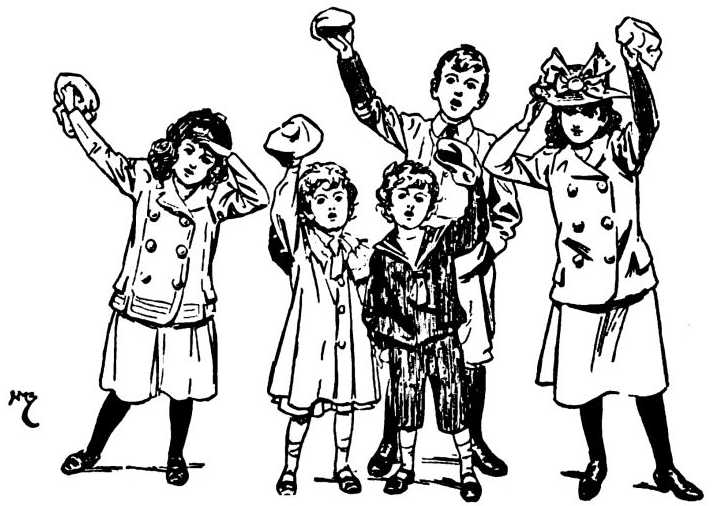
SPEEDING THE UNFORTUNATE WHOSE SCHOOL OPENS FIRST