Volume 1 — CHAPTER XVII A PERILOUS MISSION
Reading edition
To-day, after the passing of a century and a quarter, the Chester hills are much as they were on that chill winter’s day when the straggling lines of ragged, almost barefooted men marched along the old Gulph road. It is a farming country still, and although the forest has been cut away, in places the woodland is now as thickly grown as then. Here and there along the route the admiring descendants of those faithful patriots have erected monuments to their name; yonder can still faintly be defined the outlines of the Star Redoubt; there stands the house which was the headquarters of General Varnum, who commanded the Rhode Island troops; to the left of the road as one travels toward Valley Forge, is the line of breastworks running through the timber, which has been felled and grown up thrice since the axes of the Continentals rang from hill to hill.
One night they rested on the toilsome march near the old Gulph Mills, where the road passed through the deep cut between wooded heights: then on again, the various brigades separating and following different roads to the places assigned them. But the roads were, many of them, ill-defined, the timber was thick, the fields rugged. Little wonder that Baron de Kalb described the site chosen for the winter quarters of the American army as a wilderness.
Nevertheless, the situation selected for the encampment was a good one. In some of the towns, perhaps—Trenton, Lancaster, Reading, or Wilmington—there would have been shelter for the troops; but there were many objections to each place named. Had clothing and supplies been abundant, the little army might have harassed the British all winter long, and even shut them up completely in Philadelphia when the spring opened. If the officers quarreled with the commander for his obstinacy in choosing this position, the men set to in some cheerfulness to build shelters. They were not afraid of hard work, and they had suffered enough already from the cold and storms to appreciate the log cabins which went up as if by magic on hillside and in hollow.
On the bank of Valley Creek, near its junction with the Schuylkill, stood a stone cottage (as it stands to-day) of two small, low-ceiled rooms on each of its two floors. Behind it was a “lean-to” kitchen, in the floor of which was a trap which was the entrance to a secret passage which, when the house had been erected, led to the river, being a means of escape should the stone house be attacked by Indians. When Washington selected this house for his headquarters at Valley Forge the secret passage had long since been walled up and the entrance chamber was simply a prosaic potato cellar. The house itself was meagrely furnished—not at all the sort of a headquarters that Lord Howe enjoyed in Philadelphia.
Some distance up the creek, beyond the forge which lent its name to the valley, were the headquarters of big Major-General Henry Knox, of the artillery, and near him was the young French Marquis, Lafayette, but then recovering from the wound received at the battle of the Brandywine—also a Major-General, and trusted and loved by the Commander-in-Chief to a degree only equaled by the latter’s feeling for Colonel Pickering. General Woodford, of Virginia, who commanded the right of the line, was quartered at a house in the neighborhood of Knox and Lafayette.
Up on the Gulph road, the southern troops, lying nearest to Washington’s headquarters, were commanded by that Southern-Scotsman, Lachlin McIntosh, and strung along within sight of the road were Huntingdon’s Connecticut militia, Conway’s Pennsylvania troops, Varnum’s Rhode Islanders, and Muhlenberg, Weeden, Patterson, Learned, Glover, Poor, Wayne, and Scott on the extreme front of the embattled camp. Hadley Morris, still with Wayne’s division, messed with Captain Prentice, but found himself often attached to “Mad Anthony’s” personal staff in the capacity of messenger, for the Quaker general occupied a house in a most exposed quarter, some distance beyond the line of defences, and was in constant communication with the Commander-in-Chief.
Hadley, indeed, scarce knew whom he served. At first his wound had incapacitated him from participating in much of the work which fell to the lot of the rank and file, and, as he rode one of the fleetest horses in the American camp, he came to be looked upon as a sort of volunteer aide, for he had never been regularly mustered into the service. He often saw Lafe Holdness in the camp, and was not surprised, therefore, one day, when he had been sent post-haste to General Washington with some papers from Wayne, to find the Yankee in the front room of the Potts’ cottage in close conversation with His Excellency.
Hadley never entered the presence of the great man without, in a measure, feeling that sense of Washington’s superiority which he had experienced when first he saw him, and he stood at one side now, ill at ease, waiting for a chance to deliver his packet. The Commander had a way of seeing and recognizing those who entered the room without appearing to do so—if he were busily engaged at the time—and suddenly wheeling in his chair and pointing to the boy, said in a tone that made Hadley start:
“Is this the young man you want, Master Holdness?”
“I reckon he’ll do, Gin’ral—if he can be spared,” Lafe replied, with the usual queer twist to his thin lips. “He’s gettin’ more important around here than a major-gin’ral, I hear; but ef things wont go quite ter rack an’ ruin without him for a few days, I guess I’ll take him with me on this little ja’nt.”
Hadley blushed redly, but knew better than to grow angry over Lafe’s mild sarcasm. His Excellency seemed to understand both the scout and his youthful friend pretty well. “I have a high opinion of Master Morris,” he said, kindly. “Take care of him, Holdness. It is upon such young men as he that we most earnestly depend. Some of us older ones may not live to see the end of this war, and the younger generation must live to carry it on.”
Hadley did not think him austere now; his eyes were sad and his face worn and deeply lined. Not alone did the rank and file of the American army suffer physically during that awful winter; many of the officers went hungry, too, and it was whispered that often Washington’s own dinner was divided among the hollow-eyed men who guarded his person and sentineled the road leading to the little stone cottage.
Lafe nodded to the boy and they withdrew. On the road outside the scout placed his hand upon Hadley’s shoulder. “Had, that’s a great man in yonder,” said he, in his homely way. “You ’n’ I don’t know how great he is; but there’ll come folks arter us that will. He’s movin’ heaven an’ airth ter git rations for this army an’ they aint one of us suffers that he don’t feel it.”
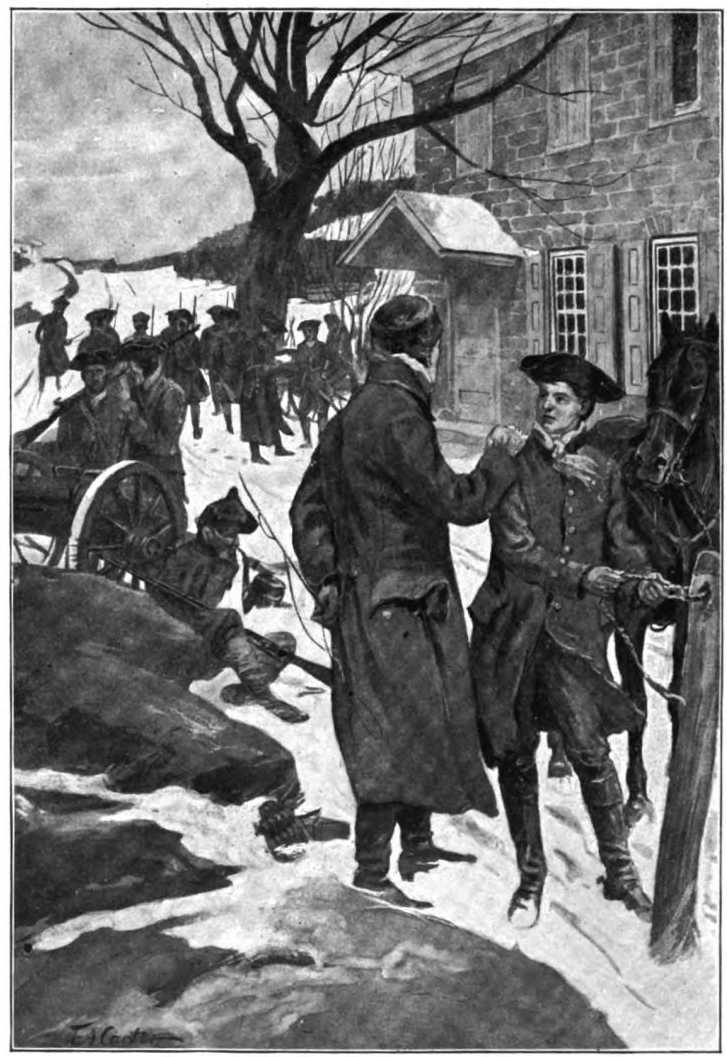
“HADLEY UNTIED HIS HORSE.”
Hadley untied his horse and they went on in silence until they came to the sheds behind an old country inn not far from headquarters. Here Holdness had left his great covered wagon and team of sturdy draught horses. Despite the condition of affairs in the territory about Philadelphia, the scout retained his character of teamster and continued to go in and come out of the city as he pleased. How he allayed the suspicions of the British was known only to himself; but, evidently, General Washington trusted him implicitly.
Hadley, as they drove slowly through the camp, gave Black Molly over into Captain Prentice’s care. Not until they were beyond the picket lines of the Americans entirely did Holdness offer any explanation of the work before them. “We’re goin’ ter stop at a place an’ take a load of grain into Philadelphy,” he began. “I ’greed ter do this last week. I aint sayin’ but I’d like ter turn about an’ cart it inter aout lines; but that can’t be. The man ’at owns it is a Tory an’ he’s shippin’ his grain inter town so as to save it from the ’Mericans. He’s got his convictions, same’s we’ve got ourn; ’taint so bad for him to sell ter them Britishers as it is for some o’ these folks ’t claim ter have the good of the cause at heart, an’ yet won’t take scrip fer their goods.”
When they came to the farmer’s in question the great wagon was heavily loaded with sacks of grain. Hadley, who had so plainly seen the need of such commodity in the American camp, suggested that they take a roundabout way and deliver the sacks of grain to their friends instead of to the British, without the Tory being any the wiser. “And spile my game?” cried Lafe, with a chuckle. “I guess not. Reckon His Excellency wouldn’t thank us for that. I’m wuth more to him takin’ the stuff into Philadelphy than the grain would be. We’re goin’ in there to git some information. Hadley, my son—this ain’t no pleasure ja’nt.”
“But what can I do?” queried the boy.
“What you’re told—and I reckon you’ve l’arned that already with Gin’ral Wayne. A boy like yeou can git ’round ’mongst folks without being suspicioned better’n me. It’s whispered, Hadley, that them Britishers contemplate making a sortie on aour camp. You know the state we’re in—God help us!—an’ if the British mean to attack we must know it and be ready for them. Every crumb of information you can pick up must be treasured. I’ll take ye to Jothan Pye an’ you can be an apprentice of his. He kin git you access to the very houses in which some o’ them big bugs is quartered. If plans are really laid for an attack, you’ll hear whispers of it. Them whispers yeou’ll give to me, sonny. D’ye understand?”
Hadley nodded. He understood what was expected of him; also he understood that the mission would be perilous. But he had been in danger before, and he did not lack some measure of confidence in himself now.
The huge wagon rumbled on toward the British lines. When they were halted, Lafe managed to give such a good account of himself that he was allowed to pass through with little questioning, for the grain was assigned to the quartermaster’s department. Hadley was simply considered a country bumpkin who had come into town to see the sights. Soon the old scout and the boy separated, Hadley making his way swiftly to the Quaker’s habitation near the Indian Queen, where good Mistress Pye welcomed him warmly.
Friend Pye was a merchant and dealt in such foreign commodities—particularly in West India goods—as were in demand among the British officers. As previously noted, the Quaker had lived so circumspectly in the city throughout the war that his loyalty to the king was considered unshaken by his Tory neighbors, and yet he was so retiring and so worthy a man that the Whigs had not considered him a dangerous enemy.
If anybody noted, during these cold days of middle winter, that Friend Pye had a new ’prentice boy, it was not particularly remarked. The gossip of the camp and, indeed, all conversation was tinged with military life and happenings. Friend Pye’s young man carried goods to the Norris house where My Lord Rawdon—that swarthy, haughty nobleman, both hated and feared by all who came in contact with him—was quartered, and even to Peter Reeves’ house on Second Street, where Lord Cornwallis held a miniature court. Hadley was, in his new duties, quick and obliging. The British officers often remarked that, for a country bumpkin, Pye’s apprentice was marvelously polite and possessed some grace and gentleness. But all the time Hadley Morris was keeping both his eyes and ears open, and when Holdness came to the Quaker’s house under cover of the night, he told him all he had heard and seen, even to details which seemed to him quite worthless.
“Ye never know how important little things may be,” Holdness had told him. “It’s the little things that sometimes turn aout ter be of th’ greatest value. Stick to it, Had.”
But, one day, Hadley experienced something of a shock—indeed, two of them. He was walking through Spruce Street, carrying a bundle with which his employer had entrusted him to deliver at an officer’s residence, when a carriage came slowly toward him. It was a very fine coach—much finer than any he had observed in Philadelphia thus far—and it was drawn by a pair of magnificent horses. The horses were bay, and before many moments the boy, with a start, recognized them. His eyes flew from the handsome team to the coachman, perched on the high seat.
The bays were the same he had seen so often while Colonel Creston Knowles was a guest at the Three Oaks Inn, and the driver was William, the silent Cockney. The coach window was wide open and Hadley could see within. There, on the silken cushions, was seated Mistress Lillian herself! The boy stared, stopping on the edge of the walk in his surprise. Of course, he might have expected to find the British officer and his daughter here, yet he was amazed, nevertheless.
But he was evidently not the only person astonished. Lillian saw him. She leaned from the carriage window and, for an instant, he thought she was about to call to him. Then she glanced up at the driver’s seat and said something to William. At once the bays began to trot and the carriage rolled swiftly past. But Hadley had looked up at the driver, too, and for the first time saw and recognized the person sitting beside William on the high perch.
William was gorgeous in a maroon livery: the person beside him was in livery, also, and evidently acted as footman. But, despite his gay apparel, Hadley recognized this footman instantly. It was Alonzo Alwood, and as he gazed after the retreating carriage, the American youth was conscious that Lon had twisted around in his seat and was staring at him with scowling visage.
[TO BE CONTINUED]