MAINTENANCE AND CARE OF CAR
Reading edition
Storage Battery
The storage battery is located under the hood on the left side. The carrier clamp bolt wing nuts should be kept finger tight but not so tight as to crack the battery case.
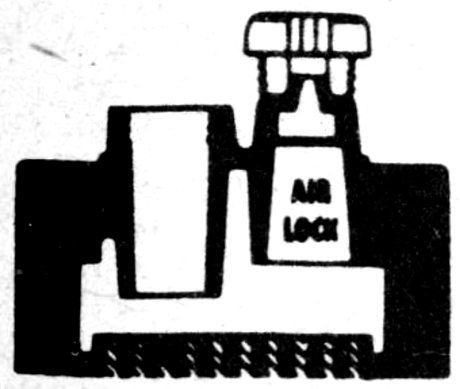
Place cap on safety-vent forming air lock in breather-chamber
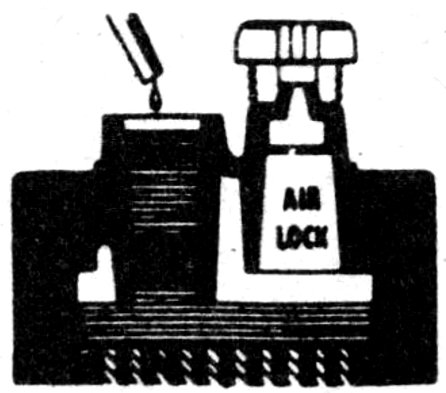
Fill well with distilled water. Air lock prevents solution rising above bottom of well.
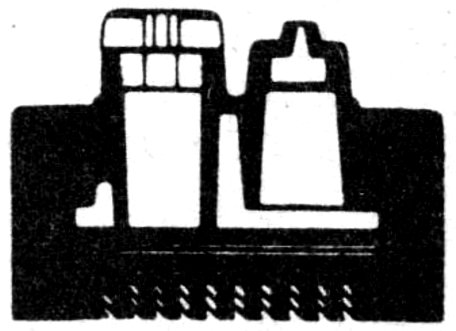
Remove cap from safety-vent and solution drops to correct level. Replace cap in filter hole.
Have the following three items checked frequently:
1. Water level—maintain at the proper height with distilled water.
2. The specific gravity of the battery solution.
3. Battery connections—should be clean and tight.
Charging Precautions It is advisable to observe the following precautions when charging a battery at home or elsewhere. During the charging and for a short time immediately thereafter, the chemical reaction in the battery gives off hydrogen gas in sufficient quantities as to be explosive. When working near a battery being charged, or just after it has been charged, it is important that no flame or spark have an opportunity to ignite the hydrogen gas. To prevent possibility of a static electricity spark’s causing such an explosion with the battery in the car, it is well to ground the car electrically by means of a metal bar or chain running from the car’s frame or 38 bumper to the ground. When the charging or recently charged battery is out of the car, it should be placed where it will not be exposed to flame, spark, or static electricity.
Minimize Oil Dilution and Sludge
The crankcase is provided with a cross ventilation system to reduce harmful dilution of the engine oil by water and fuel. Crankcase dilution is aggravated by low speed driving with frequent stops and starts because the engine does not warm up to the normal operating temperature. The driver can materially assist in preventing this condition by observing the following suggestions:
1. After starting, give the engine time to warm up before driving.
2. Keep the engine in good mechanical condition. See that the compression is good and that the ignition and carburetion systems are kept in peak condition.
3. Clean the crankcase at least once a year, preferably when winter oil is changed for summer weight oil.
4. Use the proper grade of a reputable engine oil.
5. Use a good grade of fresh gasoline.
6. Check thermostat operation.
Operating an engine at subnormal temperatures causes a much more rapid dilution of the crankcase oil than is experienced at normal temperatures.
Rust and Corrosion Inhibitor
Because of the chemical reaction between metal and the lime or other minerals in water, one U. S. pint (.833 Imperial pt., 0.47 liters) of an approved inhibitor such as 39 Studebaker Cooling System Rust Inhibitor or Resistor should be added to the cooling system of every new car and replenished as needed throughout the life of the car. This will help protect the entire cooling system (radiator, cylinder block, cylinder head, and water pump) from any chemical corrosions, rust, or calcification within the radiator core which may restrict the passages. This does not, however, dispense with the need of flushing the cooling system seasonally, spring and fall. Following each draining a pint of the inhibitor should be used unless it is included in the new coolant.
Many anti-freeze compounds do contain a rust inhibitor. Ask your dealer whether the anti-freeze you use during the winter is of this kind. If so, it will not be necessary to install a rust inhibitor in the cooling system while such an anti-freeze is in use.
CAUTION
Carbon Monoxide is a lethal gas, odorless, tasteless, and colorless, found in the exhaust fumes of all engines. Never start the engine in a closed garage. Always open garage doors wide before starting the engine and keep the doors open as long as the engine is operating.
40
Gasoline Economy
The kind of gasoline you use in your new Studebaker is an important factor in performance, economy, and service.
It is important to purchase your gasoline from a dealer selling the product of a reputable refinery in sufficient volume to assure fresh, clean gasoline which hasn’t accumulated moisture, dirt and tank settlings from lying dormant for relatively long periods.
Speed Drive at a moderate and constant speed.
Idling Shut off the engine while parked, even for a few minutes, such as waiting for long freight trains at railroad crossings. Idling, except to warm up a cold engine, is sheer waste.
Stopping Come to a gradual stop whenever possible. This saves fuel, brake lining, and tires.
Accelerating If peak economy is to be obtained, acceleration must be gradual. Rapid acceleration wastes gasoline.
Tires Keep your tires properly inflated.
Lubrication Keep both the engine and chassis well lubricated at all times. This reduces friction to a minimum.
Mechanical Condition Periodic “tuning” of the engine by your Studebaker dealer’s service department will insure maximum mechanical efficiency necessary to good gasoline mileage.
41
Tire Inflation and Care
Inflate and check tires to recommended pressures given on page 53 with the tires cold (at atmospheric temperatures), and not after a long run.
If your tires are checked immediately after a long run, do not permit the attendant to reduce the pressures by letting out air. Wait until the tires have had a chance to cool before checking pressures.
You can ensure more even wear of all tires by having your Studebaker dealer criss-cross them according to the latest factory recommendations at approximately 4000 mile (6437 km.) intervals. Have tires and wheels checked for need of balance after each criss-crossing.
Ignition Timing
For economy of fuel consumption and noiseless combustion relative to the type of gasoline used, the ignition timing may be advanced or retarded. Such an adjustment should be made by your Studebaker dealer.
Carburetor Air Cleaner
Two types of air cleaner are available for Studebaker cars. One is the “oil wetted” type for cars operated a greater part of the time over pavement and roads which are comparatively free from dust. The other is known as the “oil bath” type and is available at extra cost for cars operated where dust conditions are severe.
Dust particles, although microscopically small, are highly abrasive and tend to score and cut the smooth glasslike surfaces of working parts—increasing the rate of wear. The proper type of air cleaner installed on your 42 car, properly maintained and serviced, will increase the life of the engine, and aid in maintaining its normal efficiency.
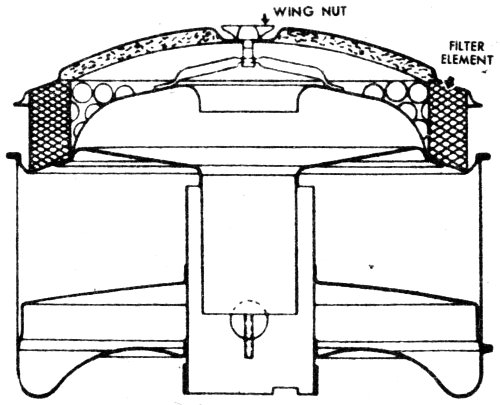
OIL WETTED AIR CLEANER
WING NUT
FILTER ELEMENT
Because local conditions alone determine the frequency of air cleaner service, it will be necessary to ask your dealer how often this should be performed.
TO SERVICE THE OIL WETTED AIR CLEANER
1. Remove the filter element, clean with kerosene, and shake out until dry.
2. When thoroughly dry submerge in a good grade of engine oil and allow excess oil to drain before reinstalling the element in the cleaner.
3. Replace filter element and wipe off all excess oil.
TO SERVICE THE OIL BATH AIR CLEANER
1. Remove the filter element, clean in kerosene, and allow to dry thoroughly.
2. Clean the oil reservoir.
3. Pour one pint of new engine oil into the reservoir. S.A.E. 50 for above 32° F. (0° C.) S.A.E. 20 for 43 below 32° F. (0° C.) is recommended for this purpose. Do not use an oil lighter than S.A.E. 20 in the cleaner at any time.
4. Reassemble element and filter unit and install on car.
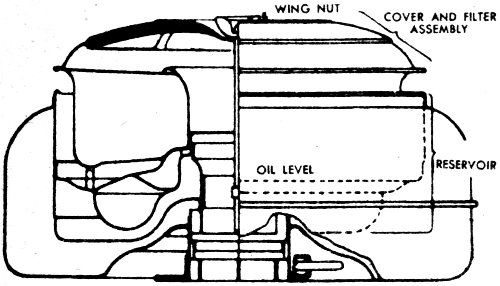
OIL BATH AIR CLEANER
WING NUT
COVER AND FILTER ASSEMBLY
OIL LEVEL
RESERVOIR
Draining The Cooling System
To drain the cooling system, drain the radiator, block, and, if car is so equipped, Climatizer and defroster.
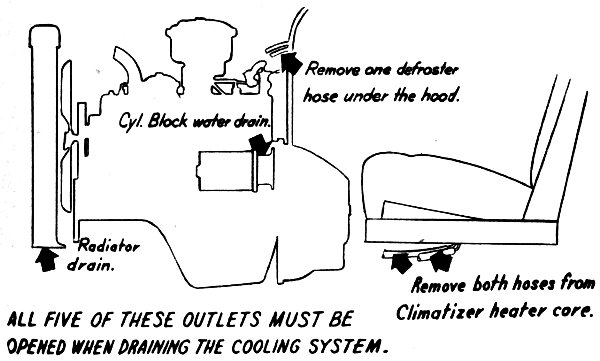
ALL FIVE OF THESE OUTLETS MUST BE OPENED WHEN DRAINING THE COOLING SYSTEM.
Remove one defroster hose under the hood.
Cyl. Block water drain.
Radiator drain.
Remove both hoses from Climatizer heater core.
44
Anti-Freeze Solutions
Either the alcohol-base or ethylene-glycol base anti-freeze is recommended for use in your Studebaker. Be sure the brand you select contains a rust inhibitor. Do not use an anti-freeze preparation which contains salt, sugar, calcium chloride, soda, or petroleum base compounds.
Reputable anti-freeze companies supply their dealers with charts showing the amount of anti-freeze to use for protection to various anticipated temperatures, depending upon cooling system capacity given on page 53.
Care of Car Finish
The high luster, hard-baked enamel finish of your new Studebaker is best retained by an application of approved Studebaker Cleaner and Polish or Cleaner and Wax after each washing. The enamel, however, should not be subjected to an application of wax of any kind during the first 60 days so that sufficient time may be provided for the finish to become fully hardened.
Approved Studebaker appearance maintenance materials are available from your Studebaker dealer. These are recommended to remove the accumulation of road scum and dullness resulting from weather or road conditions and to restore the luster of the enamel finish. Do not become alarmed when polishing or waxing if a slight amount of color appears on the cloth. This is a natural condition.
Alcohol, anti-freeze mixtures containing alcohol, and calcium chloride or other chemical mixtures used to melt 45 snow and ice or to settle dust should be flushed with water as soon as possible in order to avoid damage to the enamel finish and chromium parts.
Washing the Car
When washing the car, first saturate all foreign substances on the finish with cold water. Then use a clean sponge and running water for the removal of dirt. Dry the body with a clean, damp chamois skin, using a straight horizontal or vertical motion, rather than a circular motion. It is important that a different sponge and chamois skin be used on the body from that used on the chassis.
Chromium and nickel plated finishes are of a perishable nature and will deteriorate if not properly cared for. These parts should be kept clean and free from dirt and foreign matter. To clean chromium plated parts, use clear water and a clean cloth. To protect the finish after the parts are cleaned, apply a coating of paste-type body wax. For further details on chrome plated parts, see the card placed in the package compartment.
Care of Cloth Upholstery
Clean upholstery means not only a better looking automobile but gives longer wear and affords greater comfort and enjoyment.
The use of a vacuum cleaner and a thorough brushing of the upholstery and headlining (with the nap or pile) will usually brighten the interior noticeably. Remove the cushions from the car and brush to remove foreign particles from the fabric.
46
Studebaker Fabric Cleaner (available through Studebaker dealers) is effective in removing all types of stains and does not harm the upholstery.
Seat and side upholstery can be washed safely with soap and water. Use lukewarm water and a neutral soap. The suds should be good and frothy, not watery. Apply in moderate quantities with a damp cloth, sponge, or soft brush. Remove soap suds with a clean, damp cloth or sponge, then wipe the surface several times with a dry cloth. While the material is still damp, brush it lightly with a whisk broom or brush of medium stiffness. Permit air to circulate freely over the wet upholstery. When dry, brush again to loosen any minute matting. When brushing, always brush fabric with the lay of the pile or nap.
Cleaning Leather Upholstery
Leather upholstery may be cleaned with a soft sponge and saddle soap. Make a light suds with lukewarm water and saddle soap. This type of soap is especially suitable for cleaning leather and leaves the surface soft and pliable.
Rinse the sponge occasionally in clean water. After completing the cleaning operation, use a clean, soft cloth to polish the surface of the leather.
Cleaning Rubber Parts
Studebaker Chromium Cleaner (powder type AC-1464) is recommended for cleaning white sidewall tires. Studebaker Black Rubber Finish is recommended for black tires and all black rubber parts.
47
Care of the Convertible Fabric Top
The life of any convertible top can be materially lengthened if care is taken to lower the top only when it is dry. Never operate the top motor when the car is in motion.
Tops used on Studebaker convertible models are made of a two-ply material. The face of the black top is made of cotton and rayon. The face of the light-colored tops used on some Studebaker convertible models is made of Orlon[4] acrylic fiber and will not shrink, mildew, or stretch as a result of exposure to the elements. These facing materials are bound to a cotton backing material.
Cleaning Traffic grime and most other soiling may be removed by washing the top with a sudsy mixture of mild (neutral) soap and warm water. A soft brush may be used if necessary. Strong solvents, naphtha, or carbon tetrachloride are not recommended for cleaning this fabric.
Rear Windows of convertible tops are made of a clear plastic material. They should not be wiped while dry since the abrasive particles in the dust will tend to scratch the surface of the plastic. Clean the convertible top rear window by flooding it with cold water and wiping off the dirt with a soft cloth or sponge during the flooding process.
48