Chapter VI · A GREAT MAN’S COUNSEL
Reading edition
OFFICERS stood about in the hall of the house, as they did outside, and many spoke to Colonel Cadwalader as he led his protégé in; but he answered them but briefly. Evidently his pride had been touched by the incident of the moment before, and he was struggling to keep his temper in check. He was kindness itself to Hadley Morris, however.
“Have no fear of your reception by General Washington,” he whispered. “The dispatches you bear will be sufficient introduction.”
But Hadley was afraid. Not, perhaps, that he feared any unkind treatment; but in kind with most youth of his bringing up and station in life, he looked in actual awe upon such a great man as the Commander-in-Chief of the American forces. Nor did his fear lessen as they entered the room.
Washington sat at a little deal table, which evidently at the moment served him as a desk. In those days his headquarters were scarcely the same twenty-four hours at a time. When he glanced up, seeing Colonel Cadwalader, he arose to greet him, coming forward a pace to do this with much cordiality.
“We have great need of you, Mr. Cadwalader,” the General said, waving Hadley’s new friend to a seat near the little table. “You come from the river?”
“Aye, General. But I can give you little news of a satisfactory character, I fear. However, here is a young lad who bears something which may prove of moment.”
Washington glanced swiftly at Hadley, who stood, plainly ill at ease, and wringing his old cap in his hand. The brilliant, if travel-stained, uniforms of the officers who surrounded the general contrasted oddly with the patched and soiled garments the boy wore. He had ridden away from the Three Oaks Inn in his stable dress, and he felt the incongruity of his presence now more keenly than before.
“What does the young man bring?” asked Washington.
“Come forward, my lad,” Cadwalader urged. “Give the General your packet.”
With trembling fingers Hadley unbuttoned his coat and drew forth the sealed papers. He knew all the time that those keen eyes were looking him over. They seemed to penetrate even the wrapper of the packet.
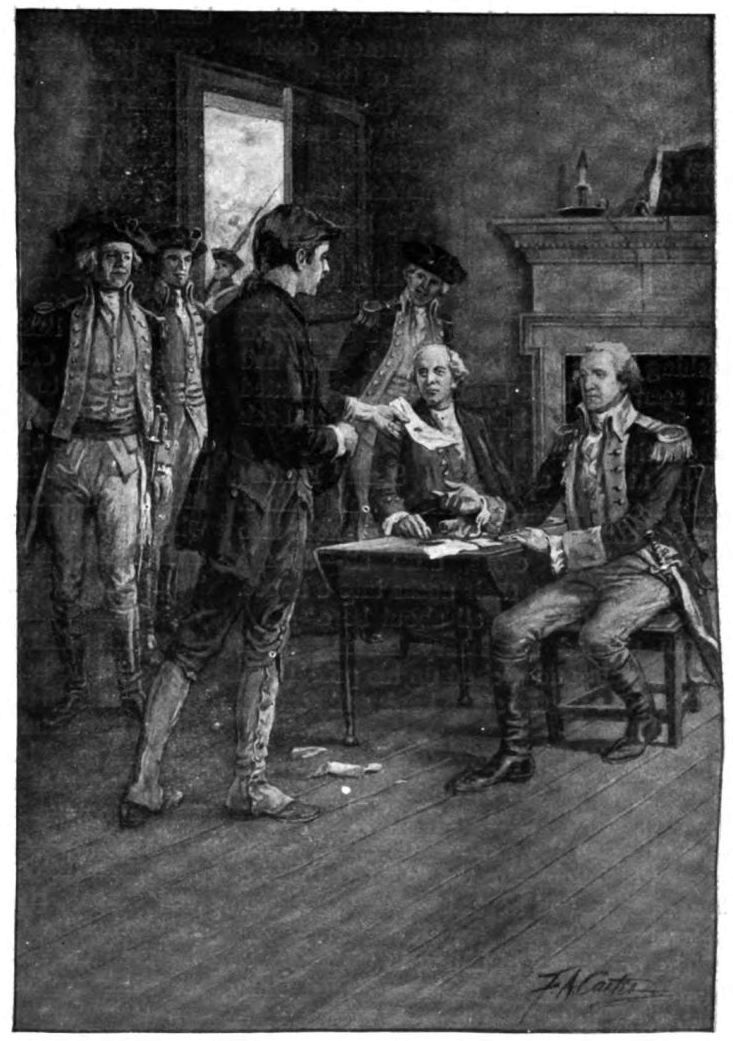
HADLEY DELIVERED THE PACKET TO WASHINGTON
“Where are you from, boy?” asked Washington.
“From—from the Three Oaks Inn,” stammered Hadley. In his own ears his voice sounded from a long way off.
“And who gave them to you?” was the next query.
Hadley stammered worse than ever in trying to tell this, and John Cadwalader took pity upon him. “So many strangers confuse the lad, General. But he’s by no means a youngster without resources. From his own story I reckon him a youth of action rather than of words,” the colonel said, smiling.
“Egad!” exclaimed one of the amused officers, under his breath, “it’s boys like him we want, then.”
Rapidly Cadwalader related the story of the injury to the dispatch bearer at the Three Oaks Inn, of Hadley’s escape from the dragoons with the papers, and of his adventures on the road; just as the boy had told it to him in the carriage. Meanwhile General Washington had slit the wrapper of the packet and unfolded the papers it contained. He nodded now and then as Cadwalader’s story progressed, but at the same time he glanced hastily over the papers.
“Ha! the boy has done us all a service,” the Commander said at length. “These matters are most important. The papers come direct from New York, gentlemen, and we have here at last a sure outline, I believe, of His Lordship Howe’s intentions. It is well, my lad,” he said, glancing again at Hadley, “that you let not the packet fall into the hands of the enemy. Our work would have been put back some days,—perhaps crippled. I must see more of you. You seem heartily in sympathy with our country’s cause. Why have you not enlisted?”
“Egad, General!” exclaimed the same subordinate who had before spoken, “I’ll set him to drilling myself if he’ll enlist. He’s a man’s stature now, if not a man’s age.”
The boy flushed and paled by turns as he listened to this. “Come, speak up, Master Morris!” exclaimed Cadwalader, encouragingly.
“I—I cannot enlist, if it please your honors,” the boy said. “My uncle will not let me.”
“And who is this precious uncle of yours who’d keep a well-set-up lad like you out of the army?” demanded the second officer.
“Ephraim Morris is his name, sir. We live hard by the Three Oaks, across the river. I work for Jonas Benson, who keeps the inn.”
“We have record of this Ephraim Morris,” said a dark-faced man in the corner, looking from under lowering brows at the boy. “As rank a Tory as there is in all Jersey. I’d not put too much trust in what the boy brings, gentlemen, if he’s Miser Morris’s nephew.”
The words stung Hadley to the quick. Unconsciously he squared his shoulders, and his eyes flashed as he looked in the direction of the last speaker. “My uncle refuses me permission to join the army, it is true,” he said, chokingly; “but he has no power to change my opinions.”
For an instant there was silence. Washington flashed a glance at Colonel Cadwalader.
“Master Morris,” Washington said, “we doubt not that you have good reasons for not enlisting. But I believe you are in sympathy with us and heed your country’s peril. You live in a community where you may be of great benefit to us in the future. You have mentioned a man named Holdness. You know him well?”
“Yes, sir.”
“Then deliver this note to him when next he passes the Three Oaks Inn. He will return on the morrow or next day, I hear. Meanwhile be always ready to serve the cause as you did last night, and, despite your uncle’s prohibition against your joining the army, we shall count you among our most useful servants. What say you, Mr. Cadwalader?”
The colonel bowed. “My mind exactly, General,” he said.
“This will pass you through the outposts,” the Commander said, handing the two papers he had written to Hadley. “The colonel tells me you have a horse not many miles from here. I wish you a safe return.”
Too disturbed to scarce know what he replied, young Morris got out of the room, and not until he reached the open highway did he take a free breath. And all the way back to the farmhouse where Molly had been left, he grew hot and cold by turns as he thought of the awkward figure he must have cut in the presence of the leader of the American cause. It was mid-afternoon ere he recovered his horse and started for the river. Molly had been refreshed and carried him swiftly over the road to the regular ferry, where he had been unable to cross the night before.
He met with no difficulty in passing the outposts and such scouting parties of the American army as he met. There was no sign of British soldiery upon this side of the river. He crossed the ferry at dark, and three hours later rode quietly into the inn yard from the rear and put Black Molly into her stall. Then he approached the house, wondering what reception he should meet if Colonel Knowles and his daughter were still sheltered there.
[TO BE CONTINUED]