Chapter V · AT POMEROY OAKS
Reading edition
“THIS is little Mary Prentiss,” said Miss Pomeroy to Arctura Green, who stood beaming down on Polly.
“Well, I’m glad enough to see you,” said Arctura, heartily, reaching out her long arm and drawing the little girl close to her side; “something young is just what we need here. We’re all growing old, Miss Hetty and Hiram and I, and Daisy and the cows and all hands; we’ve got a couple of kittens, to be sure, but they’re always busy about their own affairs and don’t talk much, so they’re no great company.”
“Why, Arctura, I don’t know when I’ve heard you make such a long speech,” said Miss Pomeroy. “I hope you have something good for dinner, for Mary and I have had a long drive and a great deal of excitement, and we shall be hungry pretty soon.”
“It’s only just turned half-past eleven,” said Arctura, releasing Polly after a good squeeze against her big checked apron, “so there’ll be an hour to wait. Where’s the little girl’s baggage, Miss Hetty?”
“It’s there in the back of the wagon,” said Miss Pomeroy; “a big black bag.”
“If you please, I can carry it, Miss Arctura,” said Polly, stepping forward to take the bag. “I’m real strong.”
“I want to know,” said Arctura, placidly. “Well, considering how many times as big as you are I am, supposing you let me lug it upstairs for you just this once. I shouldn’t know I was hefting more’n a feather’s weight,” and she swung the bag jauntily as she marched into the house after Miss Pomeroy, gently pushing the little girl before her.
Hiram stood looking into the house for a moment. His mouth had fallen open, as was its wont in times of meditation. Hiram had what his sister frankly called a “draughty countenance,” with a large-nostriled nose, big, prominent ears, and bulging eyes, but the same spirit of good-nature that illumined Arctura’s face shone from her brother’s.
“She’s a neat little piece,” remarked Hiram to Daisy, as he headed her for the barn; “a neat little piece, if ever I saw one, but she looks a mite scared, seems’s if. This is a kind of a quiet place for a young one to be set down, no mistake, and there ain’t any passing to speak of. Children like to see things a-going, even if they’re a-going by, seems’s if. She gave me a real pretty smile, say what you’ve a mind to,” he insisted, as if Daisy had expressed violent remonstrance.
The side porch led into a small, square hall; opposite the porch door was one which Arctura opened, and Polly saw that it was at the foot of a flight of stairs. Arctura and the black enamel cloth bag vanished from sight as the door closed. In the hall stood a hat-tree with curved mahogany branches, tipped with shining brass.
“Now, I hang my everyday coat and hat here,” said Miss Pomeroy, suiting the action to the word, “and you’d better do the same. What’s the matter, child?” she asked, at the sight of Polly’s face.
“These—these are not my everyday hat and jacket, Miss Pomeroy, if you please,” said Polly. “My everyday jacket is a shawl, and my everyday hat is a sunbonnet sometimes, and sometimes it isn’t—it hasn’t been anything. These are my Sunday best, and they are used to lying in a drawer on account of the dust—though I don’t believe there’s one speck of dust here,” she added, politely.
“Arctura would be pleased to hear that,” said Miss Pomeroy. “I think we may venture to leave the Sunday hat and coat here until after dinner. When you go upstairs, you will find a drawer in which you can put them, I’m sure.”
Then Miss Hetty led the way through a door at the left of the hall into a big, comfortable room, the walls of which were lined with book-cases. There was a bow window around which ran a cushioned seat; there were lounging chairs and rocking chairs, and a long sofa; a great round mahogany table covered with books and papers; and, best of all, a fireplace with a bright fire burning under the black pot which hung on the iron crane; and, guarding the fire, were two soldierly figures with stern profiles.
“These were my great-great-grandfather’s andirons,” said Miss Pomeroy, as she watched Polly’s eyes. “Suppose you sit down by the fire and get warmed through, for there was a little chill in the air, after all; and you might take a book to amuse yourself. I have to be busy with something for awhile. Would you—I suppose you wouldn’t care to look at the newspaper?” questioned Miss Pomeroy, doubtfully. “The child looks so absurdly young,” she thought, “and yet she talks as if she were fifty.”
“No’m, thank you,” said Polly; “I will just look at the fire and the books;” so Miss Pomeroy opened another door that led into the great front hall, and went out of the room. She left the door open, and Polly could hear a solemn ticking. She tiptoed to the door and, looking out into the hall, saw a tall clock with a great white face, above which there was a silvery moon in her last quarter. Polly looked at the slowly-swinging pendulum with shining eyes.
“That must be Mrs. Ramsdell’s clock,” she said, softly. “I mean her father’s. She described it just that way, and she said its like was never seen in these parts; no, it was those parts,” said Polly, correcting herself, “for it was ’way off in Connecticut. Well, then, there must have been two made alike, and Mrs. Ramsdell never knew it; I guess I won’t tell her, for she might be sorry.”
Polly stood a moment in the doorway; she could hear the sound of Miss Pomeroy’s voice in some distant part of the house. She tiptoed back into the library. The carpet was so thick and soft that Polly knelt down and rubbed it gently with her little hand; then she put her head down and pressed her cheek against the faded roses.
“It feels like Ebenezer’s fur,” said Polly. “I wonder if Ebenezer will miss me.”
Polly sat still for a moment with wistful eyes, and then hastily scrambled to her feet as the door into the side hall opened partway and Arctura stuck her head in.
“Here,” she said, dropping a struggling heap on the floor, “I thought maybe you’d like to see these two little creatures; I call ’em Snip and Snap, and I’ve had a chase to find ’em for you. There’s nothing they can break in the library, so Miss Hetty lets ’em run wild once in a while. I’ll just shut that other door.”
Arctura marched across the floor and shut the door into the front hall; then she marched back toward her own quarters. “If I were in your place,” she said, looking at the kittens instead of Polly, “I wouldn’t make a practice of sitting on the floor. I don’t know as it’s any harm, really, but a chair looks better for little girls.”
“Yes’m,” said Polly, with scarlet cheeks, as Arctura vanished with a good-humored smile. “I expect she thought I was turning somersaults, maybe,” said Polly to the kittens; “oh, dear!”
But the kittens were quite undisturbed by Arctura’s remarks. As Polly stood still for a moment, they began an acrobatic performance which always gave them keen enjoyment. Snip made a clutch for the hem of Polly’s skirt in front at the same instant that Snap sprang upon her from the rear. They secured a good hold on the pink gingham, and clambered up to Polly’s shoulder as fast as they could go. There they met and shifted positions with considerable scratching of their sharp little claws, and descended, Snap in front and Snip at the back, tumbling around Polly’s feet, and then scampering away from each other sidewise with arched backs and distended tails.
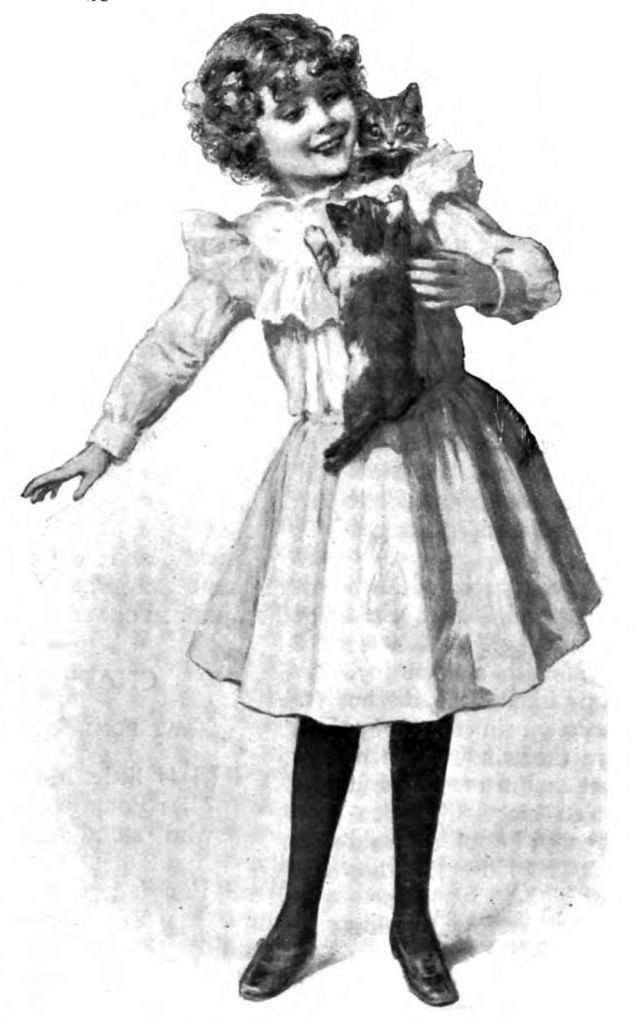
THE KITTENS CLAMBERED TO POLLY’S SHOULDERS
“Oh, you little cunnings!” cried Polly, forgetting all her troubles in a minute. To the window seats flew Snip and Snap, and there they swung back and forth on the stout curtain cords, and made dashes at each other; then they were off to the seat of an old leather-covered chair. Snip mounted to the top of the back and patted Snap on the head with a paw whose claws were politely sheathed, as often as he started to spring to his brother’s side. Over and under chairs and tables they went, and Polly, full of delight, followed them, catching up one or the other whenever she could.
At last the kittens grew tired of play, and when Miss Hetty opened the library door they were comfortably seated on Polly’s shoulders, and there was a sound in the room as of two contented little mill wheels.
[TO BE CONTINUED]