Chapter XIX · UP THE AMAZON TO BRITISH GUIANA (continued 2)
Reading edition
We returned on board, to hear the bad news that the early rains had slackened and that it would be impossible now for the smaller boat that was following us to pass through the canal and carry us on up the river. The water must be six feet higher, and as Colonel Bento Brazil put it laconically, “We may have to wait a month or two, or it may fill up from one day to another.” There were big cattle pens here, and cowboys who tended the cattle in shipment as they grazed on the campo before being jerked aboard the batelões and carried off to Manaos, which is reached in high water on the down-trip in forty-eight hours. 490Late that evening the captain began filling our barge with the maltreated brutes, which, after a hard drive across the country, were swung by a winch cable about their horns from the shore corral to the boat, often breaking a rib as they struck it and now and then a leg as they were lowered into the hold. No wonder Amazon beefsteaks are tough! Cattle for the Manaos slaughter-house are almost the only down traffic from this Rio Branco region, which produces little else, being high open campo and almost the only place in the entire State of Amazonas that can do so to advantage. Here they sold for from 60$ to 100$ a head, and in the rainy season can be transported to Manaos for about 60$. In the middle of the seventeenth century the Portuguese established cattle-breeding stations here, so that even to-day the great territory drained by the Rio Branco is known as the “Fazenda National” and is federal property.
Even here there was no definite information as to whether one could cut across through British Guiana. All I learned was that, if I could reach Boa Vista, there were two or three ways of making toward the estate of an Englishman over the boundary, but even he seemed to be more closely in touch with Brazil and Manaos than with Georgetown. In the morning there appeared on board a lively little man native to the region, whom everyone called “Antonino.” He was dressed in slippers and the modified pajamas all males find most convenient in Amazonia, had not shaved for two or three weeks, and had the general appearance of a backwoodsman with a little plot and a few cattle of his own, who might be able to write his name with difficulty. In reality, he was the owner of a large fazenda far up the river on the edge of British Guiana, the boundary being a stream at his front door. Beneath his lack of shave he knew Europe well, though little of Brazil, and had an astonishing knowledge on a wide variety of subjects. What was still more important, he was going to walk or wade the twenty-four kilometers around the cachoeira next morning to his own barge-launch waiting above the falls to take him back to his ranch. I bequeathed my steamer-chair to Captain Santos, packed my valise to the screaming point, with even my private papers and twenty pounds in gold, and handed it over to a pair of Antonino’s Indian employees in a canoe half-roofed with thatch, who rowed away into the evening toward the falls.
Next morning I was disappointed to find that Antonino had hired “horses,” as they called the wabbly, starved, and degenerate descendants of those noble beasts that awaited us, eaten by vampire bats and beaten 491stupid by their unconsciously cruel Indian-Portuguese owners. I should much rather have walked, the cruelty of getting astride such miserable animals aside, for my greatest immediate desire was physical exercise. A broad-faced, independent Indian “guide” set off with us across open, bunch-grass country, everywhere lively with birds, the long scissors-tailed tesoura most conspicuous among them. Mammoth ant-hills stood higher than horsemen above the thin, tufty grass. Soon we entered a wide road cut through a dense forest by the state government, at a cost to taxpayers of 2000 contos! Yet it had never been more than a poor clearing with a barbed wire fence on either side, and now it was half grown up to jungle again. In the mass, an Amazon forest is deadly monotonous; in detail there was an incredible mixture of species, with the same plant rarely half a dozen times in the same spot, and all showing a striking adaptability to environment. The great trees stood always erect, as if striving, like good soldiers, to touch with the crown of the head an imaginary object above them, spreading out at the top like a parasol to catch as many of the sun’s rays as possible, wasting no branches farther down, where the sunshine never penetrates. There were many rivulets and mud-holes, with a jungle not unlike that of tropical Bolivia, except that the growth was thicker and greener, with more beautiful palms. Antonino, who had chosen the best animal, got out of sight ahead, the Indian urging me to hurry; but as I saw no need for that, I spared my wreck of a horse. Suddenly, toward noon, we heard a distant boat-whistle, followed by half a dozen shots from a revolver. The Indian redoubled his urging and I strove in vain to give my miserable steed new life. Then more whistles sounded, and the Indian said dejectedly, “There, the launch is gone.”
“Impossible,” I answered. “As it belongs to Antonino it must wait for him.”
But we soon came upon the horse Antonino had ridden, tied to the rail-fence of a cattle-corral in the woods, and I concluded that my new companion had proved a true Amazonian in thinking of himself alone. After taking down several fences and putting them up again, we came out on a little nose of land above the river—and found Antonino looking hopelessly away up it.
It turned out that Antonino, loving to boast, like most Latin-Americans, really had not the slightest ownership in the boat we had hoped to catch, and here we were apparently stranded at the Bocca da Estrada, with one small, ragged, thatched roof on poles under which to wait for days, if not weeks. Anyway, the baggage we had sent by canoe had not 492arrived. Antonino professed to think that the launch had stopped just a few miles up the river to overhaul its engines, but this sounded like another bluff to save his face. I quenched my thirst with a dozen gourd-cups of yellow river water, squeezing into it the juice of wild lemons, swung my hammock, and prepared for whatever might be forthcoming. It is fatal to lose one’s temper in Amazonia. A chunk of cow that had been torn off the still palpitating animal that morning had swung unwrapped from the Indian’s saddle during all the sixteen miles. This we washed, spitted, and thrust into a fire. From it we slashed slabs still oozing blood with the Indian’s terçado, as Brazilians call a machete, and these being too tough to bite, we cut off each mouthful below the lips with the huge knife in approved South American cowboy fashion, after dipping them in coarse rock-salt, tossed handfuls of dry farinha d’agoa into our mouths with it, and washed it all down with river-water tempered with the fruit of the wild lemon tree that shaded our ragged roof. Our total resources were not enough for three meals, and how long we might have to wait no man knew. To add to the pleasure of the situation, we had struck a veritable colony of puims, as the Bolivian jejene, or tiny gnat of bulldog bite, is called in Amazonia, which quickly brought back memories of the tattooed skin with which had I emerged upon the Paraguay sixteen months before.
But, strange to say, Antonino had partly told the truth. About three o’clock the canoe arrived with our baggage and two sweat-dripping Indians, and we piled in the rest of our belongings and started on up the stream as if we really believed the tale that the launch was waiting not far above. I wished to add to our speed by paddling, but there were only three pás, and the Indians laughed at the thought of a civilized man doing so. In all Amazonia, with labor so badly needed, the man above the laboring class suffers most of all for physical exercise, and the development of the region is under the tremendous handicap of the ancient Iberian caste system. The Indians surely shoveled water behind them, however, though even so we made little headway against the swift current. If one of us spoke to them, they instantly stopped paddling to listen; hence motionless silence was our only salvation.
Then all at once we rounded a point, and there, sure enough, was the craft we were pursuing, barely a mile ahead. We quickly lost it to view again, and I waited anxiously until another bend disclosed it barely a stone’s throw away and tied to the bank! I should have been 493less worried had I known that it would not move an inch forward for another twenty-four hours.
We found her a battered old German launch attached to the most ancient wreck of a barge that I had ever seen afloat. They were anchored to a tree before the only dwelling in the vicinity, the home of a part-Indian family of countless children and innumerable hangers-on, who lived in a clearing with several primitive thatched huts. Among them was a youth who had been blind from birth, yet who went anywhere in the vicinity, through the dense forest or across the river in a dugout log, and did the same work as the rest of the men, even to splitting wood in his bare feet. Even here in the far wilderness the women were Moorish in their attitude. When a little gasoline launch, with two thatched barges on either side all but concealing it, arrived after a twenty-four hour trip around the falls with a crowd of men and women packed like sardines, these all came ashore for a full breath and to straighten out their kinks. Barely once did they speak to us men, yet when they were ready to leave, every woman and girl of the party went entirely around the circle, limply shaking hands with each of us, though we were nearly all total strangers. This courtesy is always expected in the far reaches of Amazonia, and if the traveler chances upon a party of thirty or forty, it takes an hour or more to get away.
Near the house was a fine specimen of the japuim tree, hundreds of oriole-like nests of the japuim-oro-pendula hanging from its branches. They are a noisy bird with a surprising vocabulary, black with white wings having yellow spots, and yellow from the hips down, so to speak, with a black end to the tail, and a long, whitish beak. Their nests are cleverly woven, with the entrance near the top, and every morning the birds clean them out as carefully as any New England housewife. The japuim has a saucy, noisy half-cry, half-whistle with which it keeps up a constant hubbub from daylight until dark. But the most striking of its habits is its love of company. It does not live in single nests, like our northern oriole, but hangs scores and even hundreds of them from the same tree, though there may be countless others without a nest for miles roundabout. They choose trees near houses, perhaps because the human inhabitants and their dogs scare off monkeys, snakes, bats, and other creatures that might do them harm, and like apartment dwellers in our large cities, they live so close together that the arrival or departure of one bird shakes up a dozen or more of his neighbors.
494We were to have left early next morning, but this was Brazil and we finally crawled away at four in the afternoon. The batelão was a floating sty. The hold, directly under the rotten-board deck on which we lived and where every step was precarious, sloshed with bilge-water having a strong scent of livestock, and everything made a transatlantic cattle-boat seem incredibly luxurious by comparison. I dipped my water direct from the river, but the crew bailed bilge-water out of the bottom of the barge, and then filled the drinking-water jar with the same bucket without even rinsing it. I had grown faint with hunger before a tiny cup of black coffee came to poison and deceive the stomach, and not a mouthful of food did we get until three in the afternoon. Passengers are not taken on these boats, though the man who presents himself will not be put off; but he has no rights and can make no demands. We ate, standing up at a dirty little workbench on the launch, some beef and farinha cooked and served by an Indian boy with a rotting forefinger that suggested leprosy or something worse, and who had never heard the word “wash.” There were three tin plates on board, which we took turns in using. Bread is considered an extravagance along the Amazon, and I had seen none since the first day out of Manaos. Potatoes are as unknown as cleanliness. I would have given considerable to see a moving-picture of a germ-theorist dropping dead at sight of us.
In such predicaments moderation is the only hope; eat and drink no more than is absolutely necessary, and do not worry. My legs itched and tingled from the mucuims of two days before; indeed, our whole skins were tattooed with all manner of abrasions, but there was nothing to do but play Indian and smile at anything. With perfect weather one enjoyed life, for all its drawbacks, and there was a certain satisfaction in knowing that everyone else on board was as badly off, which is more conducive to contentment than living on cattle-boat fare with the scent of first-cabin mushroom steaks in the air. Still, active rather than passive hardships would have been preferable.
The captain was a full-blooded Indian with filed teeth. Many aborigines and part-breeds along the Amazon, some of them “civilized” and living in the larger towns, file their front teeth to points. A native dentist told me that this was not due to superstition, but because it keeps them from decaying and saves people from one of the curses of wild places—toothache. While I do not recommend the custom, I was frequently assured, both by Amazonian dentists and the natives themselves, that a filed tooth never spoils. An Indian who spoke Portuguese, and who was so familiar with modern progress that he 495made no objection to my photographing him and his wife with their pointed fangs displayed, said that the work had been done when he was twelve, with a three-cornered file—though the wilder tribes chip them off—that the only hurt was a few days’ dull ache, and that the only purpose of the custom was to save the teeth and at the same time be able to cope with the tough “green” beefsteaks of Amazonia.
The owner of the barge, who sat chupando canna—“sucking” sugar-cane it was, indeed—by the light of a brilliant full moon, tried to force his cabin upon me; but I declined extra favors and swung my hammock with the others on the lower deck over the sloshing cattle-water. In the moonlight the mirror-clear river reflected every hump and turn of the banks far ahead. When I finally fell into a doze in spite of the constant hubbub on launch or barge, someone woke me and told me to take my hammock away while the crew loaded wood, which they did for some hours. Like a magnet, we seemed to pick up everything along the river and drag it with us. When daylight came we were towing the launch of a rival, which appeared to have broken down, our own clumsy old barge with some three feet of odorous water in its hold, two very large boats, roofed, and with tons of cargo, a dead gasoline launch, two large and heavily laden rowboats, two empty rowboats, four canoes, and perhaps seventy-five persons all told, some of whom had waited half a year to get this trip up the river. To say that we made speed against the swift current would be exaggerating.
We stopped for wood again during the day and I had my first swim in Amazonia, for here the danger of pirainhas was said not to be great. This savage small fish, having double rows of teeth of razor edge with which it tears the flesh even of man, is the horror of the swimmer in nearly all the waters of the Amazon basin. Let the skin show the suggestion of a wound, and whole schools of these bloodthirsty creatures dart forward to the attack with lightning-like rapidity. The river remained wide, but was now very shallow, and much of the year it is almost completely dry. On the morning of May 28 we sighted the first town since leaving Manaos. This was Boa Vista, founded forty years ago on the left-hand bank of the river, where the dense forests begin to die out into open campo. Its red-tiled roofs and other colors gave a striking and welcome contrast after an unbroken week of watching the monotonous unrolling of jungle-forested banks. There were perhaps forty houses and huts, including a church in ruins, three shops, two dentists, one of whom was also the pharmacist, and the self-complacent air of a backwoods metropolis. Boa Vista is the “capital” of the cattle 496plains of northernmost Brazil, and as such has an importance out of all keeping with its size, like many another insignificant town in a boundless wilderness. Yet it had the profound melancholy, the mournful tranquillity that is the ordinary existence of sertanejo populations, where nearly every individual is true to his relaxed and indolent environment. There was, however, really a “boa vista” for this region, a far-reaching view across the river and the grassy plains to ranges of hills purple-blue with distance.
For some days Antonino had been suffering from some violent throat infection, and he was now speechless. Everyone advised him to stay in Boa Vista, where at least there was a pharmacy and a dentist, if no doctor—and the next boat, I recalled, would probably be at least a month behind. I kept silence, however, rather than let my own convenience tempt me to advise him; but after everyone else had tried their turn at wheedling him to remain, he refused, and having had his throat sprayed, we were off once more. In the brilliant moonlight that night we passed, high up on a low hill, the snow-white chapel of the monks of São Bento, and below it on the river stood Fort São Joaquim. The old fortress was built by the Portuguese in 1775 to keep the Spaniards to the north and west from stealing Portuguese territory. It is now in ruins, but there was still a “garrison” of a dozen men living in thatched huts about it.
This was the junction of the Parima and the Takutú Rivers, which form the Rio Branco. We turned into the latter and struggled on. The last of our tows had dropped off at Boa Vista, and of passengers, there remained only Antonino, his servant, and myself. In the morning we were skirting the broad acres of the Fazenda Nacional. Across it, near the Venezuelan boundary, was the legendary Lago Dourado and Manoa del Dorado, said to have been built by Peruvians before the Conquest, where everything was reputed to be made of pure gold. Even Walter Raleigh took the existence of fabulous Manoa seriously, and planned an expedition to find and conquer it. To this day, however, it has not been discovered. The Manoas were the most numerous and valiant tribe in the Rio Branco region, but they grew weak under missionary civilization and retreated to British territory, though they left descendants in all the Amazon basin. It is the boast of many of the “best families” of the Rio Branco Valley that they are of the true aristocracy because some of their ancestors were Manoas.
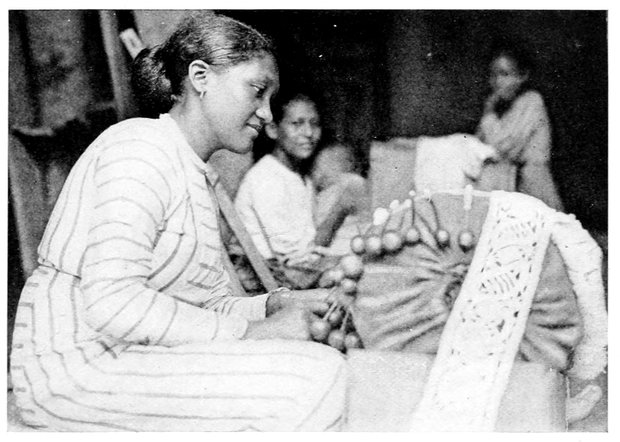
A lace maker on the Amazon
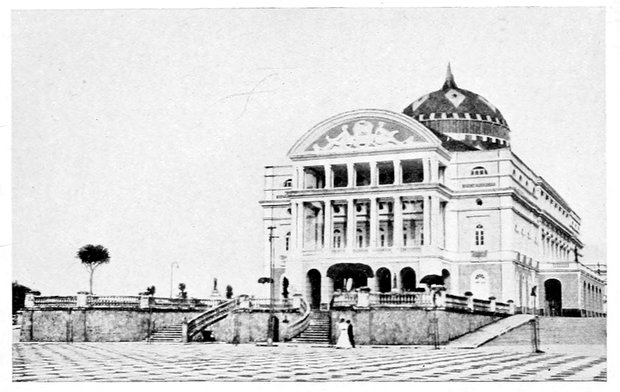
The Municipal Theater of Manaos
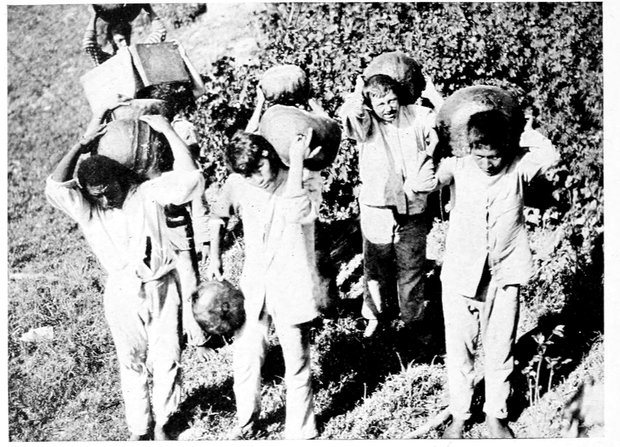
Here and there our batelão stopped to pick up a few balls of rubber
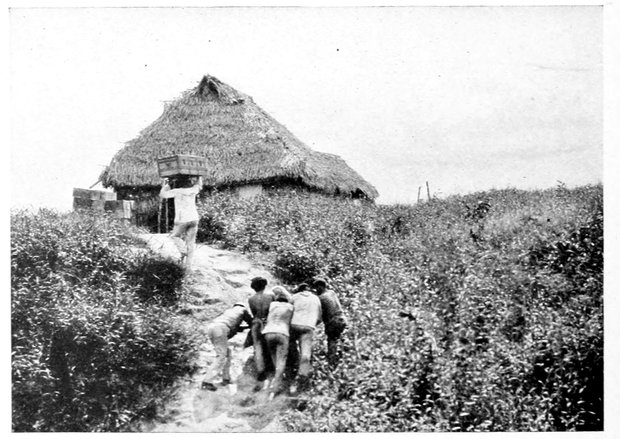
Now and then we halted to land something at one of the isolated huts along the Rio Branco
If there had been water enough, the launch would have taken us on up the Takutú to Antonino’s door, but we were lucky to be able to push 497on to the home of the captain before the water ran out. From the shallow Takutú we turned into the narrow Surumú, with barely sufficient water to float us. This the English once claimed as the frontier, but the King of Italy, as arbitrator, set it farther east. The thinly wooded banks grew ever closer together, and in mid-morning we grounded the launch—the old wreck of a batelão, had been left before the estate of its owner near the mouth of the branch—at the captain’s fazenda, “Carnauba.” In the baked-mud house we were welcomed by his good-hearted, if diffident and laconic, part-Indian wife and family. I asked the captain how much I owed him for my passage, at which he showed great surprise and after long reflection remarked that he thought twenty milreis would be generous. This was distinctly reasonable for Brazil, and especially in Amazonia, where the higher you go and the poorer accommodations become, the more exorbitant are apt to be the charges. Money is not the common medium of exchange thus far up-country, where favors are usually returned by some species of barter. Thus Antonino was welcome to ride free because he often shipped cattle by this launch and batelão, and the man who offers money is looked upon somewhat as a “tenderfoot” is on our western plains.
Eager to stretch my legs, I would have pushed on without delay. But Brazil is Brazil, even on its edges, and haste was difficult. First coffee must be served; then came talk enough to settle the terms of a treaty of peace, after which we finally packed all but the most indispensable of our baggage and sent it away by canoe with Antonino’s servant, who must descend again to the Takutú and paddle his way up it. By this time “breakfast” was ready, and we sat down to a heavy Brazilian meal of several kinds of meat, chicken included, and farinha wet in broth, ending with the unescapable black coffee. Then the nearest neighbor, from several miles away, dropped in, and the chatter went on while we lolled in capechanas sipping more black coffee. This was my first acquaintance with the typical seat of the region, a short hammock made of dried cowhides and used not as a bed by night, for which it would lack comfort and size, but as a lounging-place by day. There were six of these capechanas swinging under the veranda. Cowhide is so plentiful in these parts that stiffened ones are often set upright as walls or partitions. There was not a chair in the house, though there were two American sewing-machines and a rusty American phonograph with a hundred records, both so long maltreated that every song sounded like the squawking of the same hen in a slightly different key. The most prized product of the outside world seemed to be kerosene, used in 498everything from launch-engines to lamps, and always eagerly sought. A ten-gallon box of two cans cost 25$, say seven dollars, and for several months a year it is not obtainable at any price.
First we were to start at ten, then at noon; now we must wait until the sun was lower. A dozen horses were rounded up in the corral, where two were lassooed, and for once it looked as if I were to have a real mount. But the captain insisted on having him tried out first, and after fiercely bucking and rearing for some time, he took the Indian peon on his back for a gallop which he ended suddenly by throwing the rider over his head into a shallow pool, breaking the ancient weather-rotted leather of both saddle and bridle—which was lucky, for otherwise we might never have recovered them. I was quite willing to try my luck, if they would catch him again, but the captain insisted on choosing a substitute, which turned out to be another of those equine rats it seemed always my fate to ride in South America. Notwithstanding his unpromising appearance, however, I was no sooner astride him than he gave a splendid plea for admission to a Wild West show, bucking, jumping up into the air and coming down stiff-legged on all fours, kicking, rearing, and finally taking the cowhide “bit” in his teeth and galloping wildly away across the bushy campo. For a time I was undecided whether to stay on his back or catapult over his head, but decided that the ground was hard and that the honor of my race depended on my performance before those Amazonian gauchos. Somehow, therefore, even with the kodak over my shoulder thumping me in the back at every jump, I kept aboard and returned to the house, which astounded the natives so profoundly as to imply that every other “gringo” of their acquaintance had toppled limply off at the first jump.
Even when I got him quieted down, the animal was so ticklish that if a foot or a bush touched him, he instantly went through the impersonation of a bronco all over again, so that a dozen times that afternoon I had the same sport. Antonino in time caught up with me and we rode on together across a great plain, with scrub trees here and there, many clusters of the burity palm from the fan-like fronds of which all roofs of the region are made, and countless tepecuim, conical ant-hills from six to ten feet high. The range of hills, which I now knew to be the Kanuku Mountains in British Guiana, stood out blue, yet clear, against the far eastern horizon when, about five o’clock, we stopped at the “Fazenda Maravilha” on a bank of the Takutú River. It was a “marvel” only in its own estimation, though the part-Indian owners showed all the hospitality of the region by not only serving the 499ceremonious black coffee, but by insisting that we remain for the evening meal. Here, also, there were leather hammocks, and a sadly abused phonograph which did its best to entertain us. We were off again at dusk, meaning to take advantage of the full moon; but the clouds were thick, and even after it appeared we saw little of it. Before it rose we stumbled upon what Antonino called a “maloca,” a cluster of huts built and intermittently inhabited by more or less wild Indians. In the darkness between two of the shanties we found a pair of Indian youths, dressed in the remnants of cotton shirts and trousers and lying in their only other possession,—old hammocks swung from posts under the projecting eaves. They belonged to the Macuxy (pronounced “ma-coo-shée”) tribe scattered through the hills of the three countries about the source of the Rio Branco. My companion wanted them to go back to “Maravilha” and help row his canoe and baggage home next day, and the argument he was forced to put up resembled that of a spellbinder seeking votes. In words of one syllable—for they understood little Portuguese—and with such reasoning as one might offer a child of six, he told them at least a dozen times that he would pay them two days’ wages, either in food or money, and that they might be on their way again the following evening. Though they admitted that they had not eaten that day, that they had no water, and asked for tobacco, their unvarying reply was an indifferent monosyllable, and it was only after half an hour of pleading that they gave a grunted promise to roll up their hammocks as soon as the moon was high and be in “Maravilha” in time to start up the river at dawn.
Soon we came to a muddy igarapé that our animals refused for a long time to cross, and finally, toward what was perhaps midnight, the barking of a pack of curs drew our attention to a hut and corral and announced us to their unwashed owner. He invited us to swing our hammocks inside, gave us each a nibble of miserable native cheese, and eventually, a discussion of the news of the day having been exhausted, let us fall asleep. The chief item of interest which Antonino had brought with him was that a youth known to himself and our host had resorted to the plan, still usual in those parts, of stealing a woman, but who this time happened to be a widow. The hut-owner refused to believe it, saying in a surly grunt that “of course Pedro is old enough now to hunt him a woman, but whoever heard of stealing a widow!” The scorn in his tone is inexpressible in words. Long before daylight we saddled again, drank a glass of foaming milk still warm from the corral, and struck out across bushy campo, rather sandy and very dry. 500An unusual danger on these great savannahs is that wild horses, especially stallions, roaming the plains attack mounted animals, sometimes biting mouthfuls out of them, if not out of the rider. Several pursued us, and one big black brute would not give up his nefarious project until I had fired my revolver over his head. About seven we came upon another hut, where the usual limp handshakes and mutual inquiries as to the health of families—for, of course, Antonino knew everyone in the region—was followed by the exchange of local gossip until coffee had been made and served. An hour later there was a similar halt at a similar hut. Life in Brazil is just one black coffee after another. Here there was a branch of the Takutú, to be crossed in a canoe, swimming our horses and re-saddling them, after which a long and fairly swift trot brought us at last to the home of Antonino.
It was by no means as sumptuous a place as his choice of language had led me to picture, but at least it was more comfortable than the mud hut in which we had spent part of the night. There was a large thatched and once whitewashed adobe house standing forth on a big bare spot at the top of a slight bluff above the Takutú, and three or four smaller huts and a corral, all of which, with several hundred dry and sandy acres about them, Antonino had inherited six years before from his mother-in-law. The site was on the extreme edge of Brazil, where the Takutú makes an almost complete turn and the Mahú flows into it, and it would have been easy to throw a stone from Antonino’s door over onto British territory. I had looked upon my companion as almost a youth, yet his wife, younger than he, was already old and gray, and his daughter of thirteen was in the physical prime of life and visibly longing for a husband. These, a son, and Antonino’s brother, dying of tuberculosis, made up the household, though there was the usual swarm of Indian or half-Indian servants.
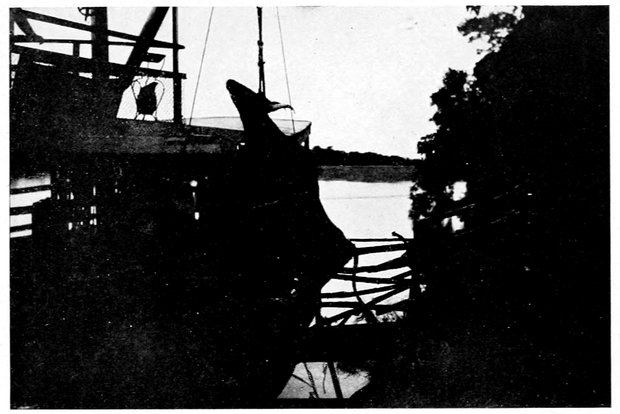
Our batelão loaded cattle at sunrise from the corrals on the banks
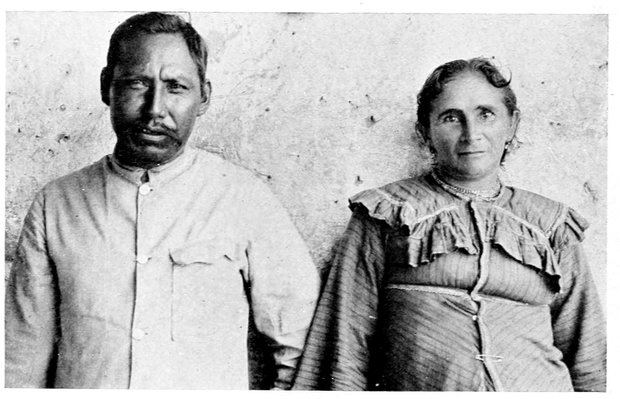
The captain of my last Brazilian batelão, and his wife
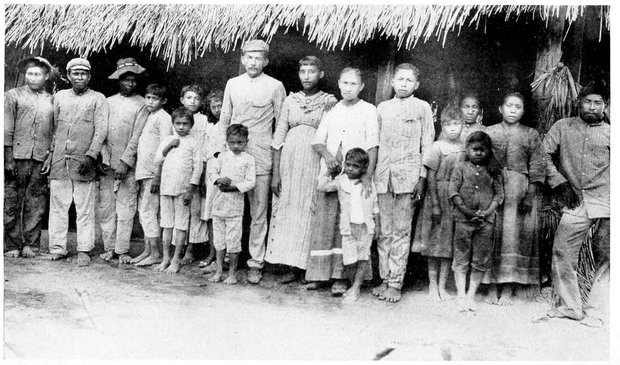
Though families are rare, there is no race suicide along the Rio Branco
After a swim in the boundary and a mammoth, though rough, dinner, I was led to the “chaletsinha,” a small mud-and-thatched hut reserved for visitors, for even here it would have been scandalous to lodge a male friend in the same house with one’s women folk. The floor was of unleveled earth and there were a dozen hammock-hooks, between two of which I napped for a couple of hours. Meanwhile the fifteen-year old son had been sent over into British Guiana to summon the “Americano.” Ever since I first met him Antonino had insisted that a compatriota of mine lived just across the boundary from his fazenda, but I had so often found in South America that men reputed to be my compatriots turned out to be Italians, Syrians, negroes, or 501something else as un-American, that I had given little attention, and no faith, to his assertion. My surprise, as well as my delight, was all the greater, therefore, when there suddenly walked in upon me a magnificently built, handsome type of outdoor American in the early prime of life and the visible pink of condition, his ruddy health in striking contrast to the chalky faces of the indoor Brazilians. He was Ben Hart from South Dakota, who had gone first to Panama, then to the Madeira-Mamoré, later had prospected for gold around Sorata, and finally had come to British Guiana eight months before with an American partner to start a cattle ranch. The partner had an English wife, however, and when the war broke out he had gone to London to enlist and left Hart alone. I was the first “white man” he had seen in half a year, and though he could not assure me that I could reach Georgetown, never having been there himself, he did “hope I would come over and stay a few weeks with him.”
On the last day of May we walked a couple of kilometers over bushy campo and dried bogs to a fringe of woods on the edge of the Mahú, across which Hart hallooed to his Indian boys about a newly thatched hut visible on the opposite bank. They soon appeared in an aged dugout, the gunwales of which were under water, but with boards nailed above them, a precarious craft that would have filled in ten minutes; but luckily the trip lasted only three. Thus I was removed bag and baggage from Brazil eleven months to a day from the time I had entered it from Uruguay. That day I was firmly convinced that nothing short of penal servitude would ever again get me back into the mammoth land of the imperial palm and political corruption; but time cures most lacerations of the skin and nothing is so disagreeable at a distance as it is close at hand. The Brazilian bubbles over with faults. As my old friend, Professor Ross, puts it, “he much prefers the lollipops of compliment to the pungent olive of truth”; yet there is something fascinating about both him and his gigantic, wasted national domain. Long after his grafting politicians and his un-trounced men and boys have become the dimmest of memories, his magnificent palms, swaying beneath peerless skies, his incomparable capital and the songs of his sabiás remain vividly etched in a crowded recollection; and when, on a dark and dreary winter day in the Puritan-weighted North, I read again some of the swinging, color-flashing lyrics of Casimiro d’Abreu, nothing but the Portuguese word saudade expresses the longing that comes over me to behold again those marvelous days and luminous nights of which he sings.
502