PART I. HUMANITIES.
Reading edition
ENGLISH LANGUAGE GENERALLY—READING, WRITING, GRAMMAR, COMPOSITION.
By Dorothea Beale.
I propose to treat in order of the different subjects of our school curriculum. The first of these is language generally.
Reading.As a branch of formal instruction, we begin with reading. A more aggravating subject of dispute can hardly be found than that which relates to the teaching of reading. The pure Fröbellian will have none of it before the child is seven years old, and occasionally children do come to school unable to read, but with the senses awakened to all sorts of other relations except that of articulate sounds to written forms. In spite of the reproaches of those who build the sepulchres of the prophets, we teach reading when a child seems ready for it, and maintain that the principles of Fröbel are best carried out when we improve on his methods, and adapt ourselves to new circumstances; we urge that the children from intellectual homes are different from the class of children with whom he had most to do.
When begun.I would not press reading upon infants, nor require the close and continuous attention that reading implies, but as soon as the appetite for any special kind of knowledge is shown, we may conclude, on Fröbellian principles, that the child is fit for it. Our order is: (1) drawing, (2) writing, (3) reading.
First lessons.The kindergarten child has learned to draw lines, straight and curved, developing into simple objects and curious patterns—rude picture-writing, it may be called. We lead on to writing in some such way as this.
Alphabet.“How did men at first send silent messages to one another when they were far off? If you wanted a doll, you might draw a picture of one and send it to mother on your birthday. A man might make a picture of a fish, and send it to a fisherman with a piece of money, and the fisherman would understand; or one might want to sell a sheep, and send a picture to his neighbour; this would be easier than sending the sheep. In fact, the first letter of the alphabet is a rude picture of the head of an ox, . People were not particular, as we see on old monuments, which way the letter stood, and so we have it sometimes topsy-turvy, sometimes sideways, ; this is like a Greek alpha, , . Beth in Hebrew was a dwelling, two tents , Gimel , the camel’s head and long neck. Delta , a door. Kappa Κ, a bird with its wings out. Rho Ρ, a man’s head. But with pictures only it is hard to make sentences; e.g., if you wanted to say, “I have found some water,” you might draw , but you would have to find some way of showing whether you meant ‘I have’ or ‘I want’; and if somebody sent you the picture of a man walking, you might not know whether you were expected to come or to go. It is hard to represent verbs by pictures, though it is so easy in speaking.”





Some pictures of Egyptian hieroglyphics and explanations will here be found to interest children much—-part of their drawing lesson might be to copy a hieroglyph alphabet. Then we might enlarge on the need for words to tell people what to do. Baby says “mamma,” “doll,” “puss,” but it wants also to say “come,” “give,” “go,” and this cannot be pictured, so people seem to have tried to represent sounds by drawing a picture of the mouth making the different sounds.
I suppose the first sound most babies make is a sort of mumbling, and if they open their mouths we get a sound like ma; now in all languages ma stands for mother, with some slight alterations. What is M like? Is it not much like a mouth shut up? and suppose you add a round shape to represent an open mouth you would get something like picture-writing ma. You might put the two side by side, a picture of a woman and ma—the Egyptians often had the two signs. The next easy sound is pa, and this stands in all languages that I know, for father. How could this be written? If you say ap you will notice a movement of the lips, which open with a sort of bursting sound. We may represent that movement by a stroke and put a round after it to stand for the open mouth P. There is another sound very like P, but not quite so sharply said. We hear it in ab. We can make the stroke as before, and put the loop lower down, to show that ba is a quieter sound than pa—so shorthand writers make a long stroke for the b and a short one for p (│b ╷p) and put no loop.
Thus we get three lip letters, but we can shut up the mouth in the middle—half shut it and we get n, which is half m. The breath will have to come of course through the nose. We can move the tongue suddenly from the teeth and get d as in ad, and write a stroke as before, but put a loop representing the open mouth behind it; the sound nearest to it which we hear in at would have the loop at the top, , as we had in pa, but in our alphabet the loop has disappeared and we have only t. In shorthand we write a long horizontal stroke for d and a short one for t. Thus we have three dentals.

We may also shut up the throat and let the breath go through the nose, as in sing, or we may make the sudden movement quite in the throat. We could take the bird shape but think of the two strokes as if pointing down the throat in Κ, and for the softer sound only one pointer Γ, this was the Greek G. We make it rounder at the bottom now. For the first of the throat sounds we have no single letter, but we write an n to show it is a nose letter, and a g to show the shutting up is to be done in the throat.
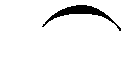
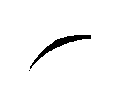
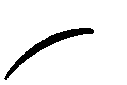
So now you see we have got nine letters—three made with the lips, three with the tongue near the middle of the mouth, three in the throat. Three are made by sending the breath through the nose, three are made by a sudden opening and sending the breath through it with force, and three by sending the breath more gently. The names given to these different sorts of letters I may now give and the shorthand signs:—[6]
Nasals. Hard. Soft.
Lip letters m p ╷ b │
Tooth letters n t ╴ d ─
Throat letters ng k ‿ g ∪
Reading books published by A. Chrysogon Beale (Sonnenschein) are perhaps the best for beginners. There are coloured pictures of the mouth; the deaf alphabet is given, and the words which are not written phonetically are gradually introduced. Sonnenschein’s books are also good, and Miss Soames’ Introduction to Phonetics.
Thus the child could be taught to observe the movements for articulation, be interested in early writings, and prepared to look intelligently at ancient monuments.
In teaching, the sounds of the letters will be given of course, not their names, and the alphabet will be from the first classified, and a basis laid for philological study. A shorthand alphabet will be learned side by side without trouble, and besides this, the pronunciation will be improved—all this without any over-pressure or giving any instructions unsuited for a small child.
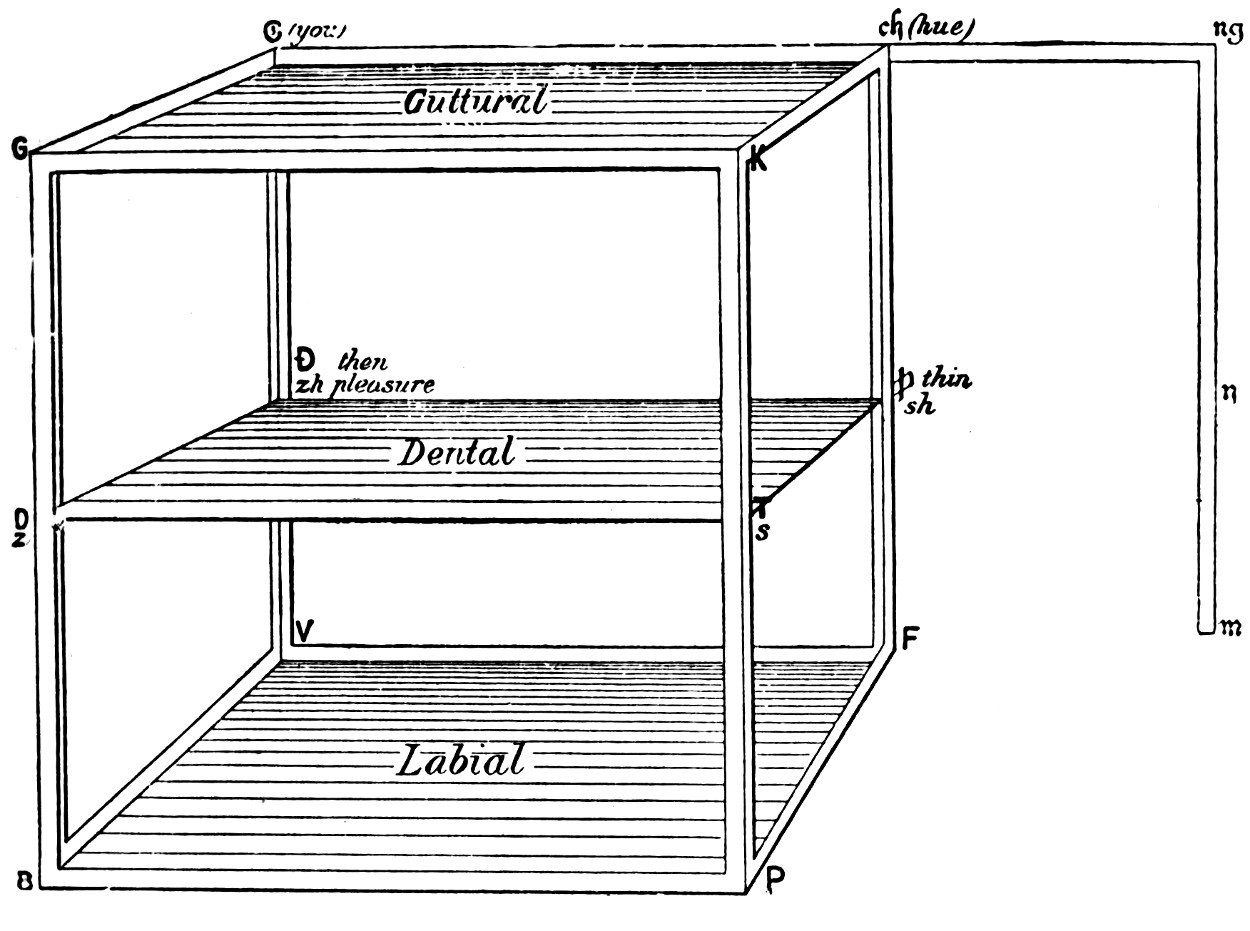
In a later lesson the meaning of an aspirate should be explained, and added to each of the mutes; we then get four varieties under the heads of labial, dental and guttural. The sibilants, which are in some respects aspirates, may be classified, and the feeble lip aspirate in when (written in old English hwen) should be noticed. The relation of palatals l and r, and the different kinds of palatals, may be dwelt on.
I give a comprehensive table, founded on one in Professor Key’s volume on the alphabet. The three horizontal planes give gutturals, dentals and labials. The front plane the sharp mutes, the back the flat mutes; the right plane the sharp aspirates, the left the flat aspirates; the sibilants are classed as dental aspirates and the nasals appended.
Other classifications are noticed in the paper on Spelling Reform.
The classification of vowels is more difficult, and it may be pointed out how easily these pass into one another. How difficult it is too for English people to sustain a pure vowel, o, without passing into u, a into ai. The vocal triangle as given in Brachet’s dictionary, adapted from Helmholtz and Brücke, is perhaps most easily understood.
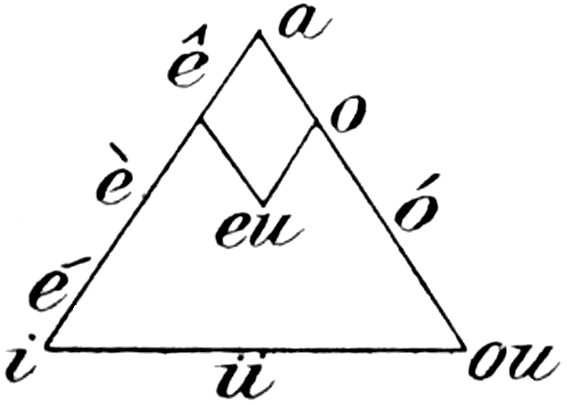
For those who do not use the alphabet of the maître phonétique, tables such as those of Larousse should be always at hand to hang on the wall, when French lessons are given. These tables enable one to draw attention to sounds which English people do not discriminate, or which offer special difficulty, e.g., ê, è, é, ais, ai, ou, u, eu, e; to the feebly nasalised vowels as in French pain, pronounced Anglice, pang; to the formation of the sound constantly changed by English people into ou, when a vowel follows, e.g., loui for lui; to the proper pronunciation of moi, mwa, not mwau; to the addition of a syllable, as in deer for di+r; to the attractive power of labial consonants, making impossible inpossible, and so on. Systematic teaching saves much time.
For older pupils it is an instructive and amusing exercise to work out the combinations of two vowels to produce a multitude of mixed or diphthongal forms; such an exercise will do much to teach delicate discrimination of sounds, and it is important early to cultivate the ear and the vocal organs. I append the diphthong table—to read it proceed from one vowel to another, following the arrow head.
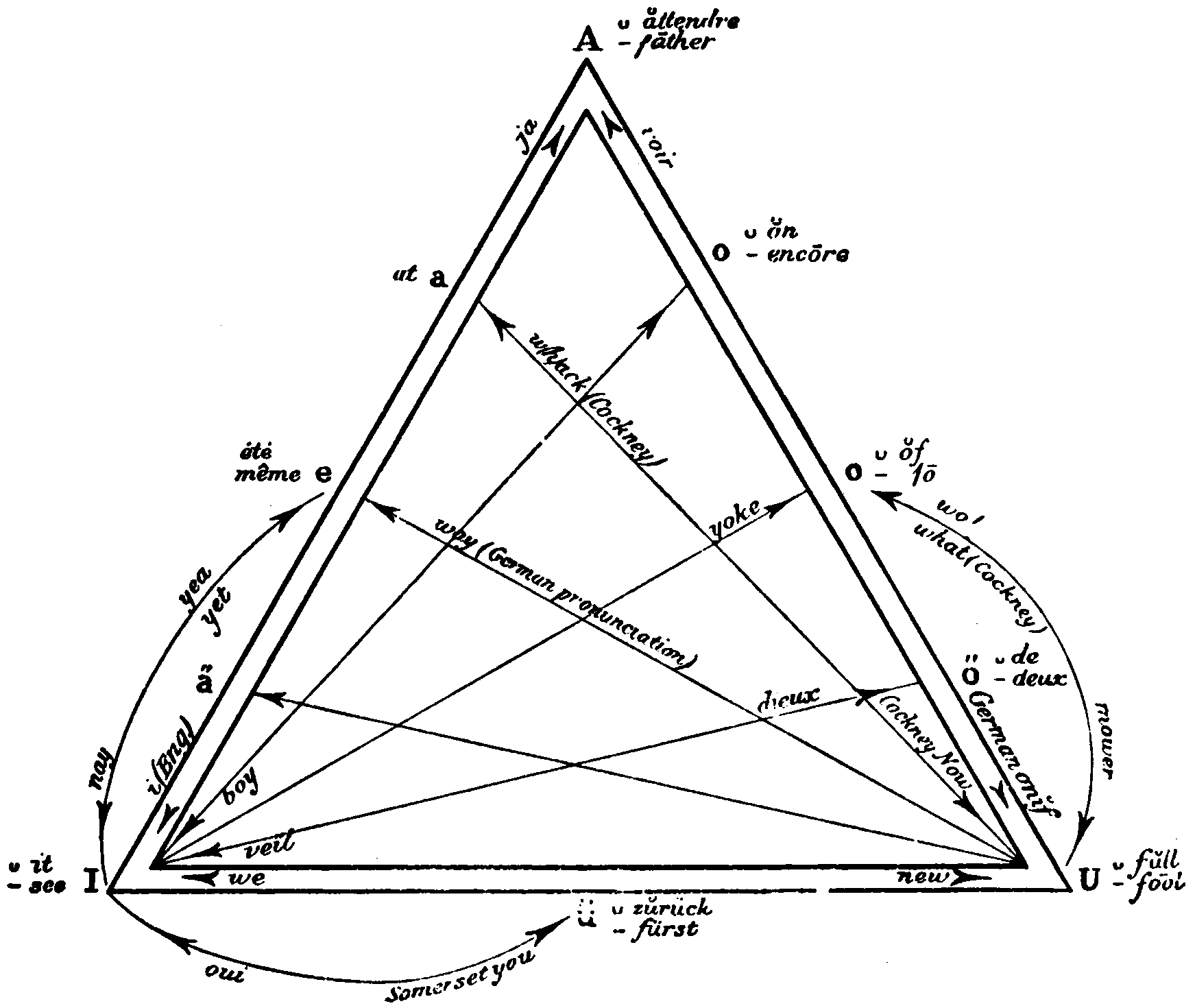
Interchange of letters.The classification of letters is of the greatest importance as the basis of linguistic study, and so the matter should early be made interesting and intelligible, not only for the sake of pronunciation, but as accounting for, and simplifying a great many rules of grammar, and enabling pupils to acquire quickly a large vocabulary, when they begin foreign tongues, by observing such laws as are expounded by Grimm and Vernier, and thus helping them later to recognise that there is such a thing as a science of language, something more than a wearisome list of empirical rules and unreasonable exceptions. Thus reading, if taught as it should be, conforms to the psychological principles (1) that we should develop the powers of observation, (2) let the child do or make something, (3) show the uses of what is produced, (4) plant some root principles which may grow up and bear fruit in later studies, (5) associate the different studies with one another. The reason why teaching is often so dull, is that teachers do not take a large view of the field of instruction, but work like day-labourers, and adopt that fatal maxim, you should “throw it all off, out of school hours”. “I am a gentleman after four o’clock,” said a schoolmaster! Now I should like those who are going to teach the alphabet to read Max Müller’s Science of Thought in their leisure hours. It is too ponderous a volume to buy—660 pages—but it should be in the Teachers’ Library. There is a most interesting chapter on the origin of roots, which he traces to imperatives. I need hardly say that the two volumes of Lectures on Language should be familiar to all, and that the teacher should work out roots for herself after the model of “Mar”. She must not, however, bury the important things under a mass of erudition; the larger her store the more should she be able to select by the discursive faculty (I ask pardon of Herbart) what is most illustrative of her subject for the special class: it is very important to know what not to say.
Melville Bell’s Visible Speech is very instructive reading, and all should be familiar with Le Mestr.: Fonetiq of Paul Passy. I abstain from recommending some of the very learned books “made in Germany”. These are not suited to persons of limited leisure, but are rather for the Grammarian who said:—
Let me know all! Prate not of most or least, Painful or easy, Even to the crumbs, I’d fain eat up the feast, Ay, nor feel queasy.
If reading is begun early, taught in the way suggested, and the sounds insisted on, to the exclusion of the absurd spelling, which pretends to produce cat from see ay tee, children seem to get on slowly at first, but the progress is rapid, when they have once mastered the signs, i.e., as rapid as is possible with our cacography.
In an excursus I have insisted on the great importance of reformed spelling. It is difficult to get people to agree, but any system, Soames’ or Pitman’s or Bell’s, would be better than our present chaos. If Government would give liberty to those who teach a phonetic system, things would improve, and children would easily read ordinary characters afterwards. All who write shorthand must spell phonetically.
Voice production.Not only right articulation needs attention, but what is called voice production. The health of many a delicate girl may be greatly strengthened by habituating her to breathe as she ought, and the whole class of what are called clergymen’s throats are in great measure, if not entirely due to the improper use of the organs of speech. There will be little difficulty later, if we, from the beginning, make children stand and breathe rightly, speak and read with due attention to stops and emphasis, and to those subtle changes of voice on which expression depends so much.
Children should never be allowed to learn a poem without preparation, or to memorise it by gabbling it over; as well might we expect them to become musicians by rattling off pieces unstudied, without regard to time and accent. At first, the poems to be learned should be repeated viva voce by the teacher to the little ones. Later, a special study should be made of anything set to a class, and it should be learned by the mind, not the ear. In France and Germany a poem is not set until it has been discussed and explained, points of importance insisted on, special beauties, etc.
A reading class should not be one in which each girl has to listen to the bad reading of another. I know no manual so good for the teacher, and for elder pupils, as Professor Meiklejohn’s Expressive Reading. There are some good remarks in a brief paper by Mr. Birrell in Barnett’s Teaching and Organisation, and I may draw attention to page 131 of Spenser’s chapters on Teaching, for all these books should be in the Teachers’ Library.
From the first, children should learn poetry by heart—poetry suited to their understanding. A child was heard to drone forth:—
Save that from yonder ivy-mantled tower The lowing herd doth to the moon complain.
The reflections of the poet were utterly uninteresting to him; he did not perceive the absurdity of cows ascending a tower.
I cannot sufficiently deprecate the setting of melodramatic pieces chosen not for their intrinsic beauty, but to show the power of execution—to borrow a musical term. The pieces learned need not be all poetry. Some of Hans Andersen’s Mährchen are excellent. Scenes in which several can take part help to give animation.
Learning by heart.Throughout their school life children should continue to store their memory, during the years in which it is easy to learn, with masterpieces in prose and poetry; because learning by heart was formerly overdone it is much neglected now. These early acquisitions are a treasure all one’s life. Familiarity with really good writers is the first thing necessary for writing well; it is good to let children write from memory passages learned instead of giving dictation.
Recitation.Looking at the higher aspects, I can hardly exaggerate the importance of getting children to speak with the understanding and right expression; for this teachers must make them enter into the meaning of the writer, realising the imagery, the feelings, the thoughts; this calls out right emotion, and thus elocution becomes of no small value as a part of moral training. Plato dwells much on the influence for good or evil upon the actor who realises the character he represents, and as Aristotle has said that through the drama one may purify the soul, so we may help our pupils to feel all the grand music of our great poets, and to enter with fuller sympathy into the teaching of the sacred scriptures of the world.
There is an excellent article in the volume of Special Reports issued by the Education Office by Mr. Dale of Merton College, from which I give extracts.
“Before the reading of Geibel’s poem on Frederick Barbarossa (the story of the sleeping kaiser who wakes to grasp the sceptre once more) a scholar was bidden to relate the fairy tale of the sleeping princess.
“The analysis of the piece into sections was given, each with a brief title indicating its subject-matter, and the exposition of their relation to one another, showing it had a distinct purpose and value.”
Oral composition.The practice of composition may begin systematically in quite early years. Mr. Dale has given an interesting account of the way in which children are taught orally, and one who attended a Ferien-Kursus at Jena has explained the matter fully to me. First, the teacher always insisted upon answers to questions being complete sentences. I quote once more from Mr. Dale, but the whole article should be read.
“The first division of the subject in the German code is ‘exercises in speaking’; and the careful and admirable training in oral expression is worthy of special attention. It is of frequent occurrence to hear a boy when called upon for an answer speak with but little hesitation for two or three minutes, using grammatical and connected language, and displaying a vocabulary which might have been supposed to be too wide for any but adults. This result is the working, primarily, of a principle which has always lain deep in the German conception of teaching, and which has been reinforced by the influence of Herbart and his followers, that in every lesson the child should take an active part. It is given as a precept to every seminar student, ‘Let the teacher speak little, the children much’.
“The teaching of composition is one of the most valuable parts of the work done in the German schools. It is begun at a very early age and practised steadily throughout the course.
“The composition is conducted by word of mouth. ‘Who,’ asks the teacher, ‘can give me a sentence to begin the first section?’ One is suggested, and criticised. ‘Can any one else give me a better?’ The others then suggest, if necessary with a little help, their variants, and finally one version is accepted. In the case of the youngest children this is written on the blackboard. The same process is pursued with each section till the piece is finished. With the older boys the blackboard is not used, save for the titles indicating the outline of each section. The class then writes it out from memory.
“The fundamental presupposition of this method is the inability of young pupils to compose and think out a series of ideas without much assistance, even though the subject be a familiar one. Their thoughts need concentration and guidance, and this help is given them by the working out of the matter in class. Yet individual liberty of expression is by no means sacrificed. The sentences are the children’s own, and for the purpose of good composition the oral method is invaluable. It proceeds on the sound principle that a child should be taught to test style by the ear and not by the eye alone. It makes short work of a lumbering period.
“On the other hand, the activity and interest of every scholar are kept up by the desire to improve on his fellows, and to have his own version accepted. Constant practice, moreover, is gained in the art of finding synonyms, and it affords an admirable opportunity of instruction in grammar and orthography. Indeed, the practising school at Jena, following a suggestion of Professor Ziller, removes grammatical explanations altogether from the reading piece, and transfers them to the child’s own composition, an expedient which avoids the fault of defacing the beauty and unity of a poem by picking it to pieces for the sake of illustration.”
Sometimes a picture is used to form a subject of conversation, questioning and explanation. Thus is the valuable power of oral composition formed, a good vocabulary obtained, taste cultivated, and that respect for the mother tongue which is so sadly wanting in many English people. Children gain a facility in writing which no dissection into different clauses, enlargements of predicates, etc., can give. Rules are introduced with the reasons for such rules, and only at last a grammar is placed in the pupil’s hands—even as a Euclid is given when it is all known. I have heard a small kindergarten boy stand up and give in a clear and quiet way quite a long story which he had studied. The habit of accurate expression will thus be formed and the thought become clear, for it is language alone which gives form and body to thought—gives it “a local habitation to a name”.
In the higher schools, Mr. Dale writes, the practice of oral composition is continued (p. 573):—
“The practice of oral paraphrase which we saw existing in the elementary schools here reaches its climax. The scholars are bidden to prepare a scene or passage of some author, or to read up some period of literary history at home. The next morning, before the lesson begins, one of them is called upon to give a summary of what he has read, a sort of short essay by word of mouth—lasting three or four minutes, and sometimes even longer. The correctness both of style and matter, with which this difficult task is performed, needs to be heard in order to be fully appreciated at its true value. It combines many of the advantages gained from a debating society with those of an essay. It cultivates readiness of speech and thought, while, like an essay, by enabling the teacher to gauge the points on which interest has centred, it lends him a proper starting-place for his lecture.”
This oral composition tells very advantageously upon the written work, and could be introduced more generally into English schools; but from quite early years children should be accustomed to write answers to questions upon their lessons, or to tell something that they know. Later, subjects may be given to be thought out or a résumé given of a lesson; and lastly the pupils of the higher class required to read up a subject, and write upon it, or compose an essay.
Grammar taught inductively.As regards the formal teaching of English grammar, I shall say but little. I may instead refer my readers to the long and interesting paper by Dr. Abbott in the volume edited by Mr. Barnett, and to his book, How to Tell the Parts of Speech. The system he recommends will form a good foundation for the acquisition of foreign tongues. Pupils are led to make their own definitions, and in part their own grammar. A class thus taught French by our present Mistress of Method were astonished and delighted to find they knew already the chief rules of their French grammar, when at length it was placed in their hands. It is impossible and unnecessary to insist upon all grammatical forms being obtained inductively; life is too short to carry it out in all its details, and so the tabulation and learning of various paradigms becomes necessary; but pupils should learn to form them. I am sure there is much less use in the old-fashioned parsing exercises than is generally supposed; parsing becomes mechanical; nine-tenths of what they have to write children know, and need not think about, and when sentences are given to parse, certain words only should be underlined for parsing. I first questioned its usefulness when I found at school that one who was so dull, that we used to regard her as somewhat of an idiot, always came to the top when we took places for parsing. What the French call analyse logique—classifying all words and phrases according to their function in the sentence—is valuable.
Logical and grammatical analysis.Mr. Blakiston in his School Management endorses this view, and recommends the teaching of logical even before grammatical parsing. Mr. Fearon in School Inspection writes: “What is wanted is to get as quickly as possible a notion of the structure of the sentence, and the logical relation of its parts. The teaching of English should be based on the analysis of sentences. Some may think the teaching of English grammar by means of logical analysis more difficult than the old method. I am perfectly convinced from observation and experience, both as a teacher and as an inspector, that this is not the case. They are not more difficult than the terms which it is necessary to use in teaching grammar on the old system. The great point is to make children have an intelligent understanding of the real things which underlie them and which they represent.”
Professor Woodward (Monographs on Education) writes: “There is need of preparatory drill in forms and language study, to bring a child to the intelligent study of construction, but this done, the analytical method of sentence-study commends itself. Intelligence is called into play, for the pupil is no longer studying words as words, but as the expression of thought; memory is subordinate and reason to the front—nouns, verbs, etc., are in some languages stamped with distinguishing marks, and can be recognised by their forms, but in English the power of any word and its influence in the sentence are rarely dependent on its form; the part of speech cannot be determined at sight, but by its connection and dependency.”
The analysis of sentences is of course very important in the study of foreign languages. Hosts of rules about conjunctions, governing moods, etc., can be discarded if once children can recognise a dependent sentence. Various models of analysis are given in all good grammars. Here is a form which has many recommendations as showing clearly the structure of a complex sentence:—
Sentence. Dependent. Principal.
1 The man - - subject of 5
2 who subj. of 3 - adjective
3 wrote pred. of 2 extension of 1
4 that letter obj. of 3
5 said predicate of 1
6 that conj.
7 he subj. of 8 - substantive object of 5
8 would return pred. of 7
9 but conj.
10 he subj. of 11
11 did not pred. of 10
Another matter which should have great attention is the use of tenses. There is nothing perhaps so difficult for foreigners to acquire as the power of discriminating tenses. Owing to the want of the present and future imperfect in French verbs, many children get an idea that imperfect means past, and few know until they learn Greek that “I have written” is a present tense. Such a table as this can be used to contrast languages:—
Indefinite. Imperfect. Perfect.
Present I write am writing have written
Past Wrote was writing had written
Future Shall write shall be writing shall have written
The authors of the Parallel Grammar Series have sought to reduce the time occupied in learning grammar. In one book the general rules only need be given, and the variations from these rules appear in other grammars. Thus the tiresome repetitions in each grammar of the letters of the alphabet—the definitions of the parts of speech of many rules regarding concords—could appear once for all.
Let me in conclusion quote a portion of the resolutions concerning the teaching of English passed by the Conference called by the Committee of Ten.[7]
“The main direct object of the teaching of English in schools is (1) to enable the pupil to understand the expressed thoughts of others and to give expression to thoughts of his own; and (2) to cultivate a taste for reading, to give the pupil some acquaintance with good literature, and to furnish him with the means of extending that acquaintance. Incidentally, other ends may be subserved, but such subsidiary interests should never be allowed to encroach on the two main purposes. Though it may be necessary to consider these separately, in practice they should never be dissociated in the mind of the teacher, and their mutual dependence should be kept constantly present to the mind of the pupils.
“If the pupil is to secure control of the language as an instrument for the expression of his thoughts, it is necessary (1) that during the period of life when imitation is the chief motive principle in education, he should be kept so far as possible away from the influence of bad models and under the influence of good models, and (2) that every thought which he expresses, whether orally or on paper, should be regarded as a proper subject for criticism as to language. Thus every lesson should become a part of the pupil’s training in English. There can be no more appropriate moment for a brief lesson in expression than the moment when the pupil has something which he is trying to express.
“In addition to this incidental training, appropriate special instruction in English should form a part of the curriculum from the beginning. This special instruction may be considered under three heads: A. Language and composition. During the first two years at school, children (under eight) may acquire some fluency of expression by reproducing orally in their own words stories told them by their teachers, and by inventing stories about objects and pictures.
“In the third school year children should begin to compose in writing; they should copy and write from dictation and from memory short and easy passages of prose and verse.
“The subjects assigned should gradually increase in difficulty. (The paraphrasing of poetry is not to be commended.) Pains should be taken to improve the child’s vocabulary by suggesting to him, for the expression of his thoughts, better words than those he may himself have chosen. He should also be trained to perceive the larger divisions of thought which are conventionally indicated by paragraphs. The teacher should bear in mind the necessity of correctness in the formation of sentences and paragraphs.
“Compositions and all other written exercises should receive careful and appropriate criticism, and the staff of instructors should be large enough to protect every teacher from an excess of this peculiarly exacting and fatiguing work.
“B. Formal or systematic grammar. Not earlier than twelve years of age the study of formal grammar, with drill in fundamental analysis, may be taken up. It should not be pursued as a separate study longer than is necessary to familiarise the pupil with the main principles. Probably a single year will be sufficient. Subsequently, although grammatical analysis may properly accompany reading and the study of composition, it should not be regarded as a separate subject in the curriculum. The teaching of formal grammar should aim principally to enable the pupil (1) to recognise the parts of speech, and (2) to analyse sentences both as to structure and as to syntax. Routine parsing should be avoided.
“With regard to the study of formal grammar the Conference wishes to lay stress on three points: (1) a student may be taught to speak and write good English without receiving any special instruction in formal grammar; (2) the study of formal grammar is valuable as training in thought, but has only an indirect bearing on the art of writing and speaking; and (3) the teaching of formal grammar should be as far as possible incidental, and should be brought into close connection with the pupil’s work in reading and composition. These principles explain the considerable reduction recommended by the Conference in the amount of time allowed to this study.
“The best results in the teaching of English in high schools cannot be secured without the aid given by the study of some other language. Latin and German are especially suited to this end.
“Every teacher, whatever his department, should feel responsible for the use of good English by his pupils.”
One would like to say much on the study of language generally, and not only of its mere formal elements—of the “fossil poetry” to be found in figures of speech; of the metaphors which express the same thought in different languages. I give the names of some useful books, but there are many other good grammars.
Name of Work. Author. Pages. Price. Publishers. Remarks.
Lectures on Language M. Müller 1100 Longmans Indispensable.
Lectures on Science of Thought M. Müller 660 Longmans Full of interest.
Philology Peile 100 1s. Macmillan Excellent. May be used as a class-book for children.
Etymological Dictionary Skeat 7s. 6d. Clarendon Press Very necessary for language teachers.
Etymological Dictionary Brachet Clarendon Press Introduction specially good. Required by all who teach French.
English Past and Present Nesfield 450 3s. 6d. Macmillan Very good for upper classes.
English Grammar Hyde Clarke 150 1s. Crosby Suggestive for the teacher. Contains much that is interesting.
Comparative Philology Sayce 400 Trübner
Primer of Phonetics Sweet 120 1s. 6d. Clarendon Press
Visible Speech Bell 80 2s. Volta Press, Washington The large book costs about four dollars.
Ecriture phonétique - Passy 1s. 6d. Firmin Didot Clear and easy.
Les sons du français
Phonétique des deutschen Victor 5s. 6d. Heelbronn Somewhat difficult.
Introduction to Phonetics Soames 280 3s. 6d. Sonnenschein A very useful introduction, adapted to English, French and German.
Expressive Reading Meiklejohn 360 Holden Very good. Contains a suitable selection.
Plea for Reformed Spelling Pitman Pitman
Spelling Reform Gladstone Pitman
How to Teach Reading Stanley Hall 40 1s. Heath
Amongst English grammars I may mention those by Morris and Mason, various books by Dr. Abbott, and the Parallel Grammar Series. There are good grammars, too numerous to mention, suitable for school use.
CLASSICAL STUDIES.
By W. H. D. Rouse, M.A., formerly Fellow of Christ’s College in Cambridge, and a Master at Rugby School.
Aim of a girl’s education.It were idle to expect that classics can be studied with the same thoroughness in girls’ schools as in boys’. Girls’ schools have grown up with other traditions; music and drawing and modern languages have so long been the staple of a girl’s education, that it is perhaps too late now to make any radical change. Nor is it clear that even if possible, it would be well to substitute classics for these subjects. If the object of girls’ education be, as many think, not so much to turn out finished scholars as to give an intelligent and sympathetic interest in life, this can be better achieved by grafting classics upon the existing curriculum, than by ousting other studies for the sake of these. Nevertheless, there will be many whose aim it is to give themselves to teaching as a profession, and some who are scholars born, and willing to spend their life in research and study. A good school must provide for these; and we have to consider how to combine the interests of both classes. The result will naturally be a compromise: the average pupil getting less than the average boy gets, while the few specialists will need to make up for lost time, and to compress their work into a shorter period than is usually given to it. The object of teaching will be the same in any case: a mastery of the matter perfect as far as it goes; and at the outset, the methods will be much the same.
Importance of Latin in all schemes of higher education.It is scarcely necessary to insist on the value of Latin for every educated man or woman. It is not only valuable as a thorough training of the mind, in close reasoning and unremitting attention; nor only as opening to the student a literature of great interest: it is actually useful in a practical way. It is the key to all the Romance languages; Latin once mastered, French and Italian, Spanish and Portuguese are brought within easy reach. Almost all that has then to be learnt is the grammar of these languages; for the body of the words is already familiar. Certainly much study and practice will be needed before these languages can be spoken; but is it nothing to be able to read? Men who are preparing for the Civil Service in India learn Sanskrit; not because the Government is interested in the training of their minds, but because this is the key to the spoken dialects of India. As this dead language is practically useful in learning Hindi or Bengali, so Latin is practically useful in learning Italian or French. Then again, the grammatical drill is much more rigid and effective in teaching Latin than in teaching French, Italian, or even German. The relation of action to object, the subordination of thought to thought, the dependence of an oblique statement, all become clear to the mind in English or French when they have been made clear to the eye by Latin. Nor must we forget that without Latin no one can really understand English, especially the English of such writers as Milton and Bacon. And besides these advantages, Latin has a direct use in several professions, which are now or may yet be open to women: in medicine, in the law, in letters; and even in business a knowledge of it, as already pointed out, will enable any one to become fit for foreign correspondence with far less difficulty than otherwise.
We will assume, then, that Latin will be begun even in girls’ schools early enough (say at thirteen or fourteen) to get through the grammar, without undue pressure, by the time the specialist will wish to begin Greek. There may be at that time a certain amount of work yet to get through which a boy of the same age would have done; but this will have to be done more quickly, that is all. It must not be slurred or neglected, certainly; but the student will probably find that the work progresses at a rather quicker rate than might be expected, because the mind is already better trained and stored than is usual at that stage of the study.
The right method of teaching a language.The right method of teaching a language may be put in a nutshell: grammar, reading, writing and conversation should go side by side. For convenience, and because of the importance of the subjects, grammar and exercises in composition will naturally have special times assigned to them; but they should never be left out of sight. No construing lesson ought to be done without some grammatical drill, or without a few sentences of conversation, which is in fact composition in brief. (1) Grammar.The importance of grammar can hardly be overestimated; and the first thing the learner must understand is that the skeleton of the language, the inflections, have to be known by heart. A knowledge of cognate languages may help, and comparative tables of forms may help both intelligence and memory, but in the end it all comes to the same thing: however the pupil may have learnt them, he must be prepared to say off his declensions and conjugations from memory in the usual tabular form. There are, in this slipshod age, those who affect to despise precise knowledge, such as geographical names and facts, historical dates, and the paradigms of a grammar. To “learn by reading” not sufficient.“Learn by reading” is their motto in language; a most false and pernicious principle, as I can testify from sad experience. It has been my lot to learn one or two languages sufficiently well to enable me to read in them, and I grieve to relate that in these I shirked the drudgery of the grammar. The result is that although a certain amount of grammar has soaked in, I cannot yet read without a manual by my side. The most such a method can do is to give the general sense of a sentence; but it often fails to do even that, inasmuch as the general sense of a sentence is made up of the precise sense of its parts. Exactness in understanding is not to be had without paying the price, and the price is an exact knowledge of grammar. The rottenness of this system is shown when it comes to writing; and the productions of these empirics might well make Quintilian stare and gasp. Thus, however the grammar may be taught to begin with, the class should always have handy some book containing just the facts of the language, arranged in the usual fashion, and not encumbered with exercises. They will need this in the end, and they may as well have it at the beginning. The most useful books of the kind are Kennedy’s Revised Latin Primer (or Postgate’s New Latin Primer, which is in some respects better, notably in the marking of quantities) and Abbott and Mansfield’s Greek Grammar. If no book of exercises is used, it is hardly necessary to say that these books cannot be learnt straight through from cover to cover. Indeed, the very first pages of both are unintelligible to beginners. In that case the teacher must himself select what is to be learnt; and the tables which follow (pp. 87-8) are meant to assist in this.
(2) Reading to be begun as soon as possible.As soon as the pupil is able to understand a simple sentence, he should begin to use some reading book. One of the most satisfactory Latin readers I have had to do with is Abbott’s Dux Latinus; some of the books err in not being simple enough in the structure of the sentences. Equally good and more easy to work with are the cheap Single Term Readers of Messrs. Rivington. The sooner the pupil can be put on to a genuine classical author, the better. Eutropius, Nepos or Phædrus is better suited for beginners than Cæsar; Cæsar will come next. Stories from Ovid may follow, and some of Cicero’s lucid and interesting narrative; the best selection is that of Walford (Clarendon Press). Virgil may be well begun in Allcroft’s Story of Æneas (Blackie). Once the pupil has attained this stage, further selection should be easy; only, be it said, too many notes spoil the scholar.
The student will be able sooner to tackle an author in Greek than in Latin, because of the greater simplicity of the language. In a very short time he ought to pass on to the excellent Clarendon Press Easy Selections from Xenophon, or some adaptation of stories from Herodotus, or parts of Lucian. He may then take one of the Rugby Scenes from Greek Plays (Rivingtons), and the easier parts of Thucydides, as edited in Rivington’s Middle Form Greek Readers.
Construing.In the construing lesson, the teacher will of course try to give each pupil a small portion to translate; and with a class of twenty-five this can easily be done in three quarters of an hour, leaving time for questions. He will then go through the passage himself, asking a question or two now and then to rivet their attention; and then one and another should be called upon to decline or conjugate as many of the words (regular as well as irregular) as can be got into the time. It is needless to insist that constant practice is necessary in grammar and parsing. In this manner the accidence will be kept fresh in the mind, and at last (it is to be hoped) firmly impressed upon it. But one most important aid to learning is so often neglected, that it will be necessary to speak about it rather fully. (3) Conversation.This is conversation. First let me say that nothing is meant resembling the method of Gouin. What may be the merits of that method in the case of French or German, it is needless to ask here; but I am confident that a syntax and accidence so elaborate as those of Greek could not possibly be taught by that method in any reasonable time, and I do not believe they could be so taught at all. Simple conversation can be begun as soon as the pupil begins to read. We will suppose the reading book contains the sentence, Post triduum Cæsar equitatum ad Labienum misit. How to be used.The teacher will ask, Quid fecit Cæsar? and the pupil must be made to answer, at first by prompting if necessary, Misit equitatum Cæsar. The next question may be, Ad quem misit equitatum? the reply, Ad Labienum misit equitatum Cæsar. Other questions may be got out of this short sentence; such as Quis misit? quid? quando? The class should be made to give always a complete sentence in reply. At first they may have the book open before them; but so soon as they are used to the sound of the words, they should be made to shut the book and answer from memory. Five minutes at the end of a lesson is not much to give, and it is surprising how this kind of thing quickens interest and memory. Its great advantages.The pupils find the advantage when they sit down to write their exercises, for now the words and constructions come quickly into the mind. Moreover, they will find that they have learnt unconsciously the difference in emphasis which position makes; for it will be observed that in the simple answers given above, the words which answer the question, and are therefore the most important, come first in the answer. The teacher should ring the changes on his reading exercise in this way, until after a term or two he will be able to begin talking to them on other subjects: such as the weather, the pictures on the walls, the pupils’ dress, their inky fingers, anything that occurs to him. He must take every opportunity of dropping in the accusative and infinitive, a phrase of purpose or consequence, or the like; and thus, without much trouble, these bugbears will be got rid of. If a pupil can answer no more than Nescio quid dicas, it is something that he uses the subjunctive in a dependent question.
But it will be asked, where are the teachers to be found who can do this? A difficulty met.The answer is, that it is perfectly easy to learn, and only needs practice. The teacher will have his own book open before him, and need not go beyond its words till he has gained confidence; then by degrees he will do it more and more easily, and in a while talking will come quite naturally to him. In more discursive conversations, it is true, some preparation will be necessary, but it is quite worth the while. There are one or two little books that teachers will find useful,[8] but they will best make their own collections. A few hours’ reading will give an ample store of colloquialisms from Plato, Aristophanes and Lucian, from Plautus, Terence, and Cicero’s letters. It is not a bad plan to compile lists of colloquial sentences, say a hundred, and make every pupil learn them by heart.
A practical test.It may be worth while saying that the writer has tested this method, and found it practicable with young and old. Moreover it has been applied, within his knowledge, to the teaching of Russian, a language hardly less difficult than Greek; and it is found possible, by combining conversation, reading, writing and learning by heart, to teach even obtuse persons how to read an ordinary novel or newspaper, to write a social or official letter, and to converse on ordinary topics, in three months, although before they began this course they knew not even the Russian alphabet.
(4) Composition.For Latin composition the teacher can hardly do better than begin with Abbott’s Via Latina; for Greek, Ritchie’s Practical Greek Method is to be recommended, though not so unreservedly. What books are best to follow up with may be seen from the lists given below. But after all, it is not books that teach, so much as the teacher; and he had better fix on the subjects that are to be taught at each stage, and select or make the exercises necessary to teach them.
Every exercise will of course be corrected, and the pupil should never pass on without having written out a correct translation of the exercise himself. Practical hints for teaching it.If it is practicable, the best thing is for him to be told his mistakes, and then to rewrite the exercise, doing it again and again until it is right. But if time permits not this, the teacher may do a good deal to encourage self-help by going round the class whilst they are writing, and underlining all mistakes, which the pupils are then to correct, if they can. As soon as possible, pieces of continuous prose should be done as well as sentences; and this can be begun quite early, in fact after a couple of terms’ work. The same plan of underlining mistakes may be followed with these; but it will be found advantageous, as the work increases in difficulty, to give more and more often fair copies of the teacher’s, or by some other competent person. In all composition it is useful to dictate the fair copy, and then to give a few minutes for the class to learn it. The class should then be called up, the copy taken away, and the English should be translated viva voce. Of course any reasonable translation will be accepted; it is not meant that only the very words of the copy given will do. Let the old pieces be done over now and again at sight; and the results cannot fail to be good.
Type-sentences to be learnt by heart.Most of the exercise books have explanations prefixed to each exercise, with examples. All such examples, or at least one of each construction, should be learnt by heart. The same should be done with the syntax rules of any grammar which may be in use. These should all be so well drilled into the pupils, that when a rule is given, or a heading, or (for beginners) the English meaning, the pupils should be able to reel off the example without hesitation. A certain portion of syntax, or of the exercise book, or both, should be set for each stage; and the classes which are studying that part of the subject must learn these, and keep up the old work. The reading book will give plenty of opportunity to ask for these quotations, and it should constantly be done. The oftener the pupil repeats his example of the instrumental ablative, or whatever it may be, the better he will know it; and he cannot know it too well. The pupil should be tested and kept up to the mark by regular grammar papers, at least twice a term.
Unseen translation.Unseen translation should be commenced as early as possible, and form part of the regular work. Beginners can try some unprepared piece out of their reading book, which they must do on paper, and without help, except that they will use the vocabulary. As soon as the pupils are far enough on to use a dictionary, some special book of unseens should be taken, such as Jerram’s Anglice Reddenda. The use of helps can be gradually discontinued, until the pupil is weaned from them altogether. This can be done by forbidding dictionaries, and giving the meanings of the more unfamiliar words, fewer and fewer by degrees.
Repetition.As soon as the pupil has begun to read a verse author, repetition should be begun, and never afterwards discontinued. Verse is easier to learn, so with verse we begin; but pieces of prose for learning should be set later. It is useful to make the repetition a part of the terminal examination, and to have every word of it written out. A Greek play and a book of Virgil should be chosen (say the Medea, or the Œdipus Tyrannus, and the IVth or VIth Æneid), together with the Heroides of Ovid, and if time allows, one of the speeches against Catiline and a Philippic of Demosthenes. These can be divided into portions, a portion for each form or class, and it should be understood that this has to be learnt during the term and kept up afterwards. The examination will simply consist in writing out all the portion learnt during the term, and all the old work, if any. As the work will always be the same, the older pupils will soon get to know it perfectly. The system here recommended has been used in one great school for perhaps a quarter of a century, and the results have been excellent.
Methods of work more advanced.We will now suppose that the accidence and syntax are fairly well known, and that the pupil is ready to read a book of Virgil or a speech of Cicero, Euripides or Demosthenes, without serious difficulty. The methods followed will not change; they will merely be applied more widely. The grammar will need to be kept fresh by the same means as before, and the study will be made more intelligent by use of the comparative and historical methods;[9] construing will be done in the same order, but some style will be expected; composition will be worked by means of correction and fair copies, but the pieces chosen will be harder, and here, too, style will be more attended to; conversation will by this time have become easy and interesting, and will cover a wider range of ideas. What is to be aimed at.The aims of the teacher at this stage must be to teach self-reliance, and to direct the student more and more to illustrative reading. It is advisable at this stage to do part of the work without the aid of notes. The class is reading, we will suppose, a book of Horace’s Odes, and one of Cicero’s speeches. He should have a complete text of Horace, and the proper volume of Cicero’s works (or the whole), with no notes at all; from this he should prepare the work for the first time of doing. Difficulties he must make out as best he can, with the aid of grammar and dictionary, some dictionary of antiquities (Rich for beginners, Smith’s large one for older students), Gow’s Companion and the pictorial Atlas of Antiquities. What is to be aimed at.For revision, he should be given notes dictated by the teacher, or some edition with printed notes in it. The class work should be done with the utmost care and exactness, and parts of the author committed to memory: side by side with this should go more discursive reading, especially for the older students. They should be encouraged (and at last expected) to read more of the author by themselves, and to bring difficulties to the teacher, who ought now and again to test their progress. Thus the curriculum of the latter part of the school work will consist of a portion of all the chief authors to be read in school, and as much more as possible of the same authors read out of school.
Illustrative works.The pupil should also be directed to illustrative works which will serve to quicken his interest in any author. The excellent series of Ancient Classics for English Readers contains an account of each author, with extracts translated; and well do I remember my interest in the Xenophon of this series, when quite a boy. Passages might be read to the class from some book of travels; On the Track of the Ten Thousand, if Xenophon be the author; Travels or Explorations in Egypt, if Herodotus; and so forth. The reader of Cicero could not fail to be interested in Boissier’s Cicero and his Friends; the Latin poets are well illustrated by Sellar’s Roman Poets of the Republic and of the Augustan Age. Symonds’ Greek Poets, Mahaffy’s literary and historical books, Champagny’s Les Césars, Girard’s Education Athénienne are only a few out of many books which make the old days live again, and add to the literary appreciation of a learner.
Translations.The elder pupils in their private reading must be taught the proper use of translations. It is not to be expected that they will do without them entirely; but they should have access to the best, in a school library or elsewhere, under some direction at first and afterwards at discretion. If they are clearly shown that it is their interest to use them only where their own honest efforts have failed, or as models in the case of books they have already done, most of them will be sensible enough not to abuse their liberty. The pupil will gain much, too, by reading some of the old translations of the sixteenth and seventeenth centuries. From North’s Plutarch, Hobbes’ Thucydides, Holland’s Livy, and other such, the learner will gain a new idea of what the English language can do, much to the advantage of his style. Nor is there the same danger in giving pupils these books as in allowing them the free use of modern translations. They reproduce the spirit rather than the letter, and are of little use as “cribs”.
Style.When the pupil has learnt how to write correct Latin or Greek, it will be time to pay some attention to style. The pieces chosen should at first be definitely historical, oratorical, philosophical, or dialogue, according to the author being at the time studied; in the last stage, these should be given one after the other, unless any weak point needs strengthening. Lectures and demonstrations.It is useful now and again to give lectures and demonstrations in composition to a class. Each will be provided with a copy of the English, and the teacher then will get to the heart of it, state its thoughts in the sequence and subordination as simply as possible, and finally translate it bit by bit, using the blackboard to record each step. Questions may be asked or anticipated, and the various renderings suggested should be weighed and discussed. In this manner the beginner sees how a trained mind works, and is helped to guide his own. Good examples of the method may be seen in Sidgwick’s Lectures on Greek Prose Composition, Postgate’s Sermo Latinus, and Sargent’s Primers.
Verse-writing.So far nothing has been said of verse composition. Much obloquy has been poured on this of late years; and it may be admitted that formerly too much time was given to it. But in spite of all that objectors can say, there is no manner of doubt that verse-writing is a practice of very great value. No one really pretends that it can make poets (the common sneer); all that is claimed for it is, that it is valuable as a mental gymnastic and in training the literary sense. Prose-writing can teach the power of words, but only verse their subtler associations; prose teaches the effect of position upon emphasis, but verse makes clear that there is such a thing as literary form. Most people never realise the rhythm of a piece of prose; its more striking faults may offend or its merits unconsciously please, but why these please or offend it would be beyond their power to say. Its value.But the dullest boy or girl who has learnt how to piece together an elegiac couplet, understands that this particular kind of composition is regulated by definite bounds, and cast in a form, the variations of which are limited. His ear becomes attuned more or less to rhythm, and this first step may be used to lead him on to the comprehension of literary form in other kinds. I do not say that he will never learn the lesson without writing verses, but that this is the easiest way to teach it; and I would apply the same principle to English or any other language. Some incidental advantages follow at the same time; not the least that the pupil understands the metre of the poets he reads. He will not learn this equally well by scanning. To have full effect the act of scanning must be unconscious; that is, the reader must take in words, meaning and rhythm at the same time without effort. So far as my experience goes, those who have not learnt how to write verses never read poetry in this way, but the scanning (if done) is done by a conscious effort, which draws off the mind from the poetry. Let the class, then, as soon as they begin to read a verse author, do a term’s work or two on elementary exercises in metre (I will not say verse-writing) from Penrose’s Latin Elegiac Verse Composition. The time will not be wasted, as has been shown, even if no more is done. Those who wish to go further in Latin verse cannot do without a skilled teacher, for no books exist which can help him much. Demonstrations on the blackboard can teach a great deal at this stage; but nothing can be done by the pupil without learning a great deal of Latin verse by heart. Greek verse is easier to compose than Latin, and may be begun quite late. Nearly all the elementary books on Greek verse are useless without a teacher, and need constant supervision and help; perhaps I may be pardoned for mentioning a little book called Damon, since this is the only one wherein the learner is led on by steps graduated close one after the other. Pupils may go straight from this book to the rendering of pieces of English verse, but both Sidgwick’s and Sargent’s books on Greek verse will always be found useful.
Pronunciation of Latin and Greek.It is necessary now to say something about the pronunciation of Latin and Greek. The reformed pronunciation is strongly to be recommended. This is simply set forth in a pamphlet published by the Cambridge University Press,[10] and for Latin is practically that given in the first pages of the Latin Primer. The sole advantage of pronouncing Latin and Greek words as if they were English, is that the learner need learn nothing new. But this is far outweighed by the disadvantages; and after all, the pupil has begun to learn French or German, and so is not struck dumb at being called upon to pronounce i as ee. The main disadvantages are these: (1) Confusion of s, c, and t, as Ceres with Seres, cedit with sedit; (2) Confusion of quantity, mensīs (abl. pl.) with mensĭs (gen. sing.), mālum (“evil”) with mălum (“apple”); (3) Difficulty of pronunciation in many words, especially in Greek, as παύω when the first syllable is made to rhyme with law; (4) Loss of much beauty in the sound of the languages.
The accent in Greek.In one point, however, I differ from the authors of this pamphlet—that is, on the question of Greek accentuation. It is generally agreed that the Greek accents must be learnt, and rightly so, for many interesting linguistic points turn on them; but it is also the invariable practice not to try to pronounce them. To be taught as far as practicable.But there is really no reason why most of them should not be pronounced. The Greek accent, as is well known, was a musical intonation; the acute[11] denoting a rise in the tone, the circumflex a rise followed by a fall, i.e., a kind of drawl. The circumflex can always be pronounced with ease; so can the acute, when final; so can the great majority of internal accents. It is just as easy to say ἐλΕΙποντο as ἐλειΠΟΝτο. The only cases of real difficulty are words like φέρηται, άνθρωπος, where a long vowel follows an accented syllable. These might be waived for beginners, but these are few compared to the rest; and even to pronounce the accent and quantity in these is not very difficult, especially with the reformed pronunciation. This plan has been tried, and found to work fairly, with young boys from twelve to sixteen.
Value of old English translations.There is a means by which the classical teacher may be greatly helped, and that is if the general course of studies in the school be so arranged, that good English translations of the classics form a fair proportion of the English authors read. Many of these translations are themselves English classics, such as Chapman’s and Pope’s Homer, North’s Plutarch, Dryden’s Virgil and Juvenal. Others there are in plenty, no less excellent than these, if less known—Phaer’s Virgil, Holland’s versions of Livy, Suetonius, Plutarch’s Morals, and many other works; Hobbes’ Thucydides, Barnard’s Terence, Echard’s Plautus—indeed there is hardly a classical author of repute who did not find a worthy translator in the Elizabethan age. A few of these are accessible in cheap reprints,[12] and if there were a demand for any of them a reprint would appear at once. By reading these the children will become familiar with the subject-matter of classical authors before they have to translate them; and they will also have made acquaintance with some fine works of literature, many of which (such as North) are interesting from association with Shakspere. When Roman or Greek history comes in the regular historical cycle, some of these books might well be read along with them.
Models and illustrations.The last thing to be mentioned is the use of models and illustrations. There is almost no limit to the number of such things that can be had; the real limit is the depth of the teacher’s purse. But the schools ought to provide these things for use; it is too much to expect that teachers should spend their sparings and savings in educational plant. Any money spent in this way is amply repaid by the interest added to the work. Classical teachers ought to have at their disposal lantern slides illustrating classical life and history, wall pictures and maps, photographs and models. Slides may be hired from the Hellenic Society, or bought through the Teachers’ Guild;[13] for wall pictures there are two excellent series, those of Cybulski and Launitz. Of photographs there are thousands. The wise teacher will travel and collect them; but for those who will not, one or two addresses of photographers are given below,[14] with the names of some useful works. The pictures can be kept in the school library, and hung up for the term when they will be useful. For the photographs, frames with movable backs are most to be recommended, as the pictures can then be changed at will. The teacher should talk about them, and question his class, and (as already suggested) they may form a topic of Latin or Greek conversation. It is astonishing how much children will learn from these things. In addition, it is highly desirable that each pupil should have his pictorial atlases as he has an atlas of geography.
Recapitulation.The writer has now pointed out what, in his opinion, is the place which Latin and Greek should take in a girl’s education, and the methods best calculated to teach them. If in these there is not much that is new, they are at all events such as experience has proved to be sound. One or two points may be indicated which are apt to be weak in girl students, and must therefore be specially guarded against. Weak points to be strengthened.They are apt to be shaky in grammar, and they seem to have less mental self-reliance than boys. As regards those who learn late, they must go over the same ground; for no teacher and no book, no not if angels wrote it, can point out a royal road to learning. These late-learners bring to the task a mind already more or less trained, and so they will get on faster; but let them beware of trying to get on too fast. They must make up their minds that grammar has to be learnt, and work at it with a will. If they have already done half of the drudgery by learning Latin, as here recommended, their task will be not easy indeed, but not beyond their powers; and even if both Latin and Greek are begun late, they need not even then despair. I have known several, both men and women, who have begun late and ended with success, even with distinction; although it must be admitted that these were persons of exceptional powers. But it is of the utmost importance that the most capable teachers should have charge of the late-learners. The greater the difficulty, the greater need for a teacher who has his subjects at the ends of his fingers, who can see a short-cut, and is able to judge how much of the preliminary work can safely be shortened, or even omitted for the time. When skill in the teacher meets with will in the taught, between them they may remove mountains.
SUGGESTED SCHEME OF WORK IN SIX PARTS.
LATIN.
Grammar. Composition.
1. Parts of speech and elements: regular nouns and adjectives: est, sunt, and how to form 3rd sing. and pl. pres. indic. first conjugation, given the infinitive present. 1. Simplest sentences: statement, question and answer.
2. Commonest pronouns: present indic. of sum, and how to form 3rd sing. and pl. of all four conjugations, given the infinitive present. 2. Cases of agent and instrument, time and place: quam with nom. and acc., abl. of comparison: a few common prolate verbs: simplest relative sentences and cum temporal.
3. Pronouns and cardinal numerals: active of the four conjugations: sum: meanings and case of a few common prepositions. 3. Ablative absolute, and a few more case usages: accusative with infinitive: use of se, suus, ipse: double questions: factitives in active, prolate verbs: relative sentences, with a hint of finals: commands and prohibitions: causal, concessive and temporal sentences.
4. Ordinal numerals: passive of the four conjugations: a few common irregular verbs. 4. Quisquam, quisque, quivis, etc. (meaning): chief case usages: factitives: common verbs with dative: dependent questions: accusative with infinitive, tenses distinguished: simple finals, pos. and negative: simple consecutives: verbs of hindering and fearing.
5 and 6. Deponents, impersonals, irregular verbs: fill up gaps (add e.g., the rest of the numerals). 5. Utor and other verbs with various cases: all case usages: gerund and gerundive: some impersonal verbs: final and consecutive sentences: conditions begun.
6. Quisquam, etc., use and idioms: participles: nunquam, etc., causal, concessive, temporal and other conjunctions: conditions: obliqua.
GREEK.
Grammar. Composition.
1. Regular nouns and adjectives: article: εστιν and εισιν: how to form 3rd sing. and pl. pres. indic. of verbs in -ω given the infinitive present. 1. Concords (including that of neuter plural): article in direct predication: simplest sentences, statement, question and answer: simplest meanings of cases: meanings of απο, εις, εν, εξ, μετα (gen.), συν.
2. Some irregular nouns: cardinal numerals: comparison of adjectives: commoner pronouns: ειμι, with active of λυω. General rules for accent in its dependence on quantity. 2. Article with demonstrative and with adjectives of position: αυτος: simplest meaning of the tenses: accusative with infinitive: some further particles of question and emphasis.
3. Numerals: ειμι, λυω: a few irregular nouns. Accent of nouns and verbs (general rules). 3. Genitive absolute: agent and instrument and other case usage: infinitive with verbs of command or request: commands, prohibitions, wishes (opt.): ἱνα and its sequence: double questions and further formulæ.
4. Contracted verbs: parts of a few irregular verbs: accent of nouns and verbs (special rules) and contracted syllables. 4. ὁπως with fut. indic. ὡστε: all final constructions: verbs of fearing: δια, νατα, μετα, παρα, προς, ὑπο.
5. Verbs in -μι: οιδα φημι: parts of commoner irregular verbs. 5. Accusative and nominative with infinitives: use of participles with certain verbs: consecutive and temporal constructions: simple indirect statement and question: the conditions begun.
6. Irregular nouns and verbs: fill gaps. Revise with Goodwin’s Grammar. 6. The cases, tenses, participles and prepositions: idioms, such as καιπερ ἁτε ὡς: conditions: all rules of obliqua.
BOOKS.[15]
The writer wishes it to be understood that this is not an exhaustive list. These books he has either tested by use, or has good grounds in the experience of others for the judgment given of them; but there are many others of the same kind, and there is often little to choose between them. The publishers whose books are given below are: Camb. Univ. Press, Clarendon Press, Blackie, Dent, Grevel, Isbister, Longmans, Macmillan, Murray, Rivingtons, Seeley, Trübner.
LATIN: GRAMMAR AND COMPOSITION.
Public School Lat. Primer (or Postgate’s New Lat. Primer, in some respects a more useful book) should be kept at hand, if only for reference and revision. Abbott, Via Latina (v), 3/6; excellent. Morris, Elementa Latina, with Tripertita as an exercise book, followed by Mansfield’s Lat. Exercise Book; a good series for very beginners, but the exercises need supplementing. Allen, Rudimenta Latina (v) 2/6; belongs to a complete series, the other books being an Elementary Latin Grammar, 2/6, a First (v), 2/6, and a Second Latin Exercise Book (v), 3/6. The last named is an excellent book for teachers, who may learn much from it, but I have found it dull and difficult for the learner. Ritchie, First Steps in Lat. (v), 1/6; also one of a series, with Ex. in Lat. Prose Comp. (v), 2/6, and Easy Continuous Lat. Prose, 2/6,[16] Latin Clause Construction, 1/6, a First Lat. Verse Book (v), 2/-, and a Reader Fabulæ Faciles (v), 2/6, with Imitative Lat. Ex. (v), 1/6, based upon it. These are good books, and I prefer them to Allen’s after using both series: the explanations are clearer, and there are more sentences. Macmillan’s Latin Course (v), two parts, 3/6 and 4/6; good. It has an advantage in the large number of exercises. England, Exx. in Latin, Syntax and Idiom (v k), 2/6; a companion to Roby’s School Latin Grammar. Rooper and Herring, Primary Lat. Exx. (v), 3/6; specially adapted to the Revised Lat. Primer. North and Hillard, Lat. Prose Comp. (v), for the middle forms, 3/6; carefully arranged and progressive from phrases and sentences to continuous prose. Champneys and Randall, Easy English Pieces for Translation into Latin Prose, 1st and 2nd series, each 1/6; excellent, and can be used with a sentence book as soon as the elements are mastered. More advanced Grammars: W. M. Lindsay, Short Historical Lat. Gr., 4/6; excellent. This is mainly philological. H. J. Roby, School Lat. Gr., 5/-; good. Not philological.
For Idiom and Construction in the higher stages:—
Bradley, Arnold’s Lat. Prose Comp. (v), 5/-, and Aids to Writing Latin Prose, 5/-, with full explanations; the former has sentences, the latter continuous prose. Abbott, Lat. Prose through Eng. Idiom, 2/6; is a most useful little book for committing to memory. This should be used with one or two forms or sets in addition to the stock books. Jerram, Latine Reddenda, 1/6; useful collection of miscellaneous sentences. Books of chosen English: Holden, Foliorum Centuriæ, 8/-, for Gr. and Lat. prose; the standard collection. Wilkins’ Manual of Lat. Prose Comp., 4/6. Sargent and Dallin, Materials and Models for Lat. Pr. Comp. (k), 6/6; with references for each piece to portions of Latin authors on similar subjects; a useful book. Potts, Passages for Transl. into Lat. Prose (k), 2/6. Nettleship, Passages for Transl. into Lat. Prose, with a valuable introduction. Postgate: see below.
Most useful for teachers, advanced students, or private students:—
J. Y. Sargent, Lat. Prose Primer (v), 2/6; most of the pieces are carefully analysed, and the steps by which the sense is mastered and then translated are shown in detail. It is a companion to Sargent’s Easy Passages for Transl. into Lat. (k), 2/6. Potts, Hints towards Lat. Pr., 3/-; perhaps the most useful of all manuals on Latin prose style. Postgate, Sermo Latinus (k), 2/6; interesting and instructive. Ramsay, Lat. Pr. Versions, with the English, 5/-; excellent models. Meissner’s Lat. Phrase Book, 3/6; phrases and quotations classified and indexed; a most useful book. Roby’s Lat. Gr., two vols., 9/- and 10/6; indispensable. W. M. Lindsay, Lat. Language, 21/-; indispensable to those who study Latin from the comparative standpoint. His Short Historical Lat. Gr. will, however, be sufficient for less advanced students.
VERSE.
Manuals by Penrose (elegiacs); Morice (same, more advanced), and Lupton (lyrics): Holden, Foliorum Silvula (the best anthology).
READERS.
There are numbers of elementary readers, and there is really little to choose between them. The most useful set seems to the writer to be Rivington’s Single Term Latin Readers, 8d. to 1/4 each. With notes, exercises and vocabularies. These are sets of three books for each of six terms, each book containing enough for a term’s work, and each set having the same standard. Others in common use are: Morice, Loculi, 2/-; Abbott, Dux Latinus, 2/-, adapted to Via Latina; Ritchie, Fabulæ Faciles; Bennett’s Easy Lat. Stories, Hardy’s Lat. Reader, etc. Teachers and private students may learn much from Abbott’s Latin Gate.
GREEK: GRAMMAR AND COMPOSITION.
Abbott and Mansfield, Primer of Gr. Gr., 2/6, or with Syntax, 3/6; is perhaps the most convenient as a collection of facts. A Primer of Gr. Ex., 3/6, has been compiled to go with it. Ritchie’s elementary exercise books can be recommended. Ritchie and Moore, Practical Gr. Method for Beginners (v k), 3/6. Ritchie, First Steps in Gr. (v), 2/-; exercises need to be supplemented. Jackson, First Steps to Greek Prose Comp. (v k), and Second Steps (v k), 1/6 and 3/6; are useful exercise books. Macmillan’s Greek course: Easy Ex. in Gr. Accidence (v), 2/-; Easy Ex. in Gr. Syntax (v), 2/6; Second Gr. Exercise Book (v), 2/6; companions to Rutherford’s Greek Grammar. They are almost exclusively exercises, and very full. Jerram, Graece Reddenda (v), 2/6; a collection of miscellaneous sentences. Sidgwick’s First Gr. Writer (v k), 3/6; easy continuous prose, may be used along with any book of sentences. Following this comes his excellent Gr. Prose Comp. (v k), 5/-, and then the pupil will be able to dispense with crutches. Both have clear and useful introductions. Arnold’s Gr. Pr. Comp. (v k), 3/6, ed. by Abbott, has useful exercises in idiom.
More advanced, and to be used as soon as the accidence is mastered, is Goodwin’s Gr. Gr., 6/-, new ed., excellent; or his School Gr. Gr., 3/6. To the advanced student Goodwin’s Gr. Moods and Tenses, second ed., 14/-, is indispensable. Much may be learnt from the Gr. Gram. of Goodwin, 6/-; Rutherford, 3/6; and Sonnenschein. Collections of chosen English: Holden, Foliorum Centuriæ; Wilkins, Manual of Gr. Prose Comp., 5/-; Sargent and Dallin, Materials and Models for Gr. Prose Comp. How to tackle a piece of English, see Sidgwick’s Lectures on Gr. Prose Comp., and Lectures on the Teaching of Composition, 4/6. Sargent’s Gr. Prose Primer (v k), 3/6, is stimulating.
VERSE.
Damon: A Manual of Gr. Iambic Verse (v k), by Williams and Rouse, 2/6. Holden’s Foliorum Silvula (the best anthology). Help may be obtained from the Greek verse books of Sidgwick and Morice (v k), (v), Sargent (v), and Kynaston (v), 4/6.
READERS.
Rivington’s Single Term Readers (v), like his Latin readers, 9d. each; recommended. Heatley, Græcula (v k), 1/6, for beginners. Sidgwick, First Gr. Reading Book (v), 2/6: 100 easy stories, with some grammar. Rushbrooke, First Gr. Reader (v), 2/6; Bell’s Second Gr. Reader, 3/-; Murray’s Fourth (specimens of dialects), 4/6, and Abbott’s Fifth (Homer and the dramatists), 4/6. Macmillan’s Gr. Reader, stories and legends, 3/-. Mayor, First Gr. Reader, 4/6. The student had better pass on as soon as possible to some such book as the following: Xenophon, Easy Selections, Philpotts and Jerram. Herodotus, Battle of Marathon in Attic Prose. Herodotus, Tales from, Atticised, Farnell, 1/6. Arrian: Selections, Walpole, 1/6. Lucian: Extracts, Bond and Walpole, 1/6. The next step will be to selections from the Attic Orators: Rivington’s Middle Form Greek Readers, 1/6 each; Plato’s Crito or Apology; Sidgwick’s Scenes from Greek Plays.
GREEK AND LATIN: UNSEEN TRANSLATION.
Jerram, Anglice Reddenda, three series, 2/6, 3/-, 3/-. Reid, Transl. at Sight, 2/6 each part. Spratt and Pretor, Transl. at Sight (k); an extremely good selection of difficult passages.
Models: Jebb, Jackson and Currie’s Translations, and Fox and Bromley, Models and Exx. in Unseen Translation.
ANTIQUITIES.
Gow, Companion to School Classics; indispensable. Schreiber, Atlas of Class. Antiq., 21/-. Anderson, Atlas to Homer, 21/-. Rouse, Atlas of Gr. and Rom. Portraits, 1/6 each part. Macmillan’s Manuals of Antiq., 5/- each. Murray, Handb. of Gr. Archæology, 18/-. J. Harrison, Mythol. and Monuments of Early Athens. Middleton, Remains of Ancient Rome. Lanciani, Ruins of Ancient Rome and other works. Schneider, Das Alte Rom. (Pictorial atlas with maps; excellent.)
COMPARATIVE PHILOLOGY AND TEXTUAL CRITICISM.
P. Giles, Manual of Phil.; the best handy manual. Henry, Comp. Gram. of Gr. and Lat. King and Cookson, Introd. to the Comp. Gram. of Gr. and Lat., 5/6. Lindsay, Short Hist. Lat. Gram., 5/6. More advanced: Brugmann, Compar. Gram. of the Indo-Germ. Languages (translated). The standard work. King and Cookson, Principles of Sound and Inflexion, 18/-. Lindsay, Lat. Language, 21/-. Prellwitz, Etymolog. Wörterb. der griech. Sprache; good. Wharton, Etyma Græca and Etyma Latina. Thompson, Gr. and Lat. Palæography, 3/6.
ILLUSTRATIVE PICTURES AND MODELS.
Cybulski, Tabulæ quibus antiquitates Græcæ et Latinæ illustrantur (Köhler, Leipzig). Wall pictures, coloured, 4/- or 5/- each. An excellent series. Launitz, Wandtafeln zur Veranschaulichung antiker Lebens und antiker Kunst. Through Deighton Bell, Cambridge. Casts: Brucciani, Covent Garden (catalogue).
Models: Inquire at Museum of Teachers’ Guild, Gower St., London.
Slides: the same. Field, Cat. of Lantern Slides for Fyffe’s History of Greece, 6d. Roman catalogue preparing. Catalogue of the slides in the Loan Collection of the Hellenic Society.
Photographs, etc.: Catalogue of English Photographic Company, S. C. Atchley, Place de la Constitution, Athens. A very full and cheap collection. Mr. Atchley is well known to the writer, and strangers need have no hesitation in writing and sending money direct. Photographs are sold by German School at Athens.
The following Greek photographers have good collections: Rhomaïdes Frères, Rue de Niké, 24; Constantin Athanasiou, Rue d’Hermès, 6. Catalogues. The Levant: Bonfils & Co., Beyrout, Syria; and local photographers at Constantinople, Smyrna, Jerusalem and Cairo. Purchases should be made through some one on the spot. Italy: Sommer e Figlio, Largo Vittoria, Napoli: photographs and models. Collezione Brogi, and the Stabilimento Fotografico Moscioni have large choice. Museums. London: Stereoscopic Company, Clarke & Sons, Mansell & Co. Berlin: the Museum publishes a few (catalogue). Paris: Girardon, 15 Rue Bonaparte. Munich: Bruckmann, Verlagsanstalt für Kunst (see below).
Publications. Denkmäler der Griech. und Röm. Skulptur: Brunn & Bruckmann, Munich. Magnificent plates. Griechische und Römische Porträts: Arndt & Bruckmann, Munich. Einzelverkauf: photographs of sculpture (Bruckmann), separately about 6d. each. Classical Sculpture Gallery: Grevel & Co. 12/- a year. Cheap reproductions of all the chief works of sculpture, ancient and modern. Bilder zur Mythologie und Geschichte der Griechen und Römern. Hoppe-Graeser, Vienna.
MODERN LANGUAGES.
By Dorothea Beale.
First a few words on the order in which languages should be taught. I do not think that we should make a change for the better as regards girls’ education, were we to substitute Latin for French, placing that subject first in order of time. It seems to me best to begin with French, a language etymologically related to our own, and having a simple grammatical structure.
Order of language teaching.Secondly I prefer to take German, the grammar of which approaches more nearly to the classical models, whilst the inflections are easier to learn than the French; its etymology too not only throws much light on our own, but is more transparent, which makes it a medium, perhaps as valuable as Greek, far more valuable than Latin, for showing the refinements of language, the poetry and philosophy fossilised in speech. Thus those only take up the classical languages who have some linguistic power. Girls who are unable to master the difficulties of the grammar will never encounter them, and as the languages gradually increase in difficulty, we can better fit the means of education to the power of the pupil. The classics form, it is true, a key to modern tongues, but on the other hand modern tongues lead up to Latin and Greek, and I believe this order is equally logical and answers better with girls; it is something to open to them the literature of France and Germany, something to teach them languages, so that they shall find the study (as they generally do) one of interest. At any rate there are four stages at which we can leave behind those unable to continue their march, and who, if we tried to bring them further, would form only a crowd of stragglers. Those who have a good knowledge of one or two modern languages will have no great difficulty in taking up Latin or Greek say at fourteen or fifteen. They will have a large etymological store, which will make it easy to acquire the vocabulary, and they will have to study only the differentia of the grammars of the different languages—may we not rather say dialects?—of the Indo-European stock.
Nearly all syntax rules will be already known, and a Latin Grammar in which the principles are brought out, may take the place of one written for young boys in whom the grammatical faculty is rudimentary—in which dogmatic rules only abound; dogma should as far as possible yield to principles, which are intelligible and interesting to elder girls, and this will help them over the necessarily considerable labour of learning the inflections. Perhaps few will attain the minute exhaustive scholarship of which some minds are capable, but many will read with keen enjoyment; some girls who have begun late have taken high places in university examinations.
Much has been recently written on the subject of modern languages; in the books edited by Mr. Barnett and Dr. Spenser, just published, to which I have frequently referred, are excellent papers. I shall therefore make my remarks on the subject very brief. In the first is an excellent paper by Mr. Storr, and Dr. Spenser has written a paper of about fifty pages, giving a full account of the modern system of teaching.
It is time that some reform took place. The Oxford Local Examiners of 1896 reported the French as phenomenally bad. In 1897 nearly half the seniors failed. I have tabulated the answers to the few questions set by me to pupils entering over twelve, and I find, taking some two hundred, that not one in ten knows the regular verbs, and scarcely any write very simple sentences without egregious faults.
Only oral teaching at first.The first teaching in modern languages should certainly be oral. In the kindergarten, French and German songs and simple sentences may be taught in the lowest forms. Supposing that children begin about seven or eight, it seems better they should not see written French at first. If they have learned the alphabet, as I have suggested in a former paper, they will take some interest in the new sounds of French and might read from a phonetic transcription.
Phonetic alphabet.There are good papers in the (August and September, 1897) Journal of Education on this subject by Mr. Ware, Mr. Kirkman and Mons. Passy, which I commend to my readers. I give a few extracts. Mr. Ware writes: “In Germany, every teacher has to render himself capable of teaching pronunciation, and results prove that he succeeds. In various German training colleges, there are courses of lectures on phonetics applied to the study of foreign languages. It was owing to the success attending the introduction of phonetics in the French teaching in certain German schools that I was finally induced to try them in the earliest stages of French teaching at Bradford. The results have exceeded my expectations.”
This is confirmed by Mr. Bearder of Nottingham. He writes: “Though I have not used the method in such a thorough and systematic manner as he has done at Bradford, still the results are such as to convince me that I am entitled to support Mr. Ware in his refutation of one argument, letting alone others, which the opponents of phonetic teaching continually bring forward, that time is wasted in learning the two modes of spelling”.
If it is not possible to get the reading taught phonetically, using the international alphabet, the use of the tables of Larousse will be a great help. In any case pieces which are learned by heart, dialogues, etc., should be repeated in the class after the French teacher, before the children see the book. Common errors.Few English people have ever learned to distinguish the sounds of the final syllable in the imperfect and passé défini or the future and the conditional or the gradual opening of the sounds as we pass through e, é, è, ê. Very few pronounce u properly when it precedes another vowel—lui is pronounced looee. Very few observe that a labial nasal before another labial is changed into a dental nasal, thus not impossible but inpossible, and nearly all say leer for lee + r. Children are taught to read so unsystematically, that if they are told these things they forget them, and waste time in repeating easy sounds, instead of working at the hard ones. Children should not be set to learn verbs, etc., without having first repeated them and practised the sounds with their teachers. When they do begin to read, the sound-table should be hanging up, and should be referred to, that they may correct their errors themselves. These pronouncing lessons should go on in a room alone, so that children may speak together in imitating the teacher; then she should single out individuals for different sounds; but the whole class should never sit round, as is the custom in some schools, and hear each of their companions read in succession a piece of French with true British accent. If they listen, their time is worse than wasted; if they do not, they get habits of inattention. The attention must not be wearied, and if two or three sounds are acquired each week, the whole will very soon be mastered, and time saved for the repetition of poetry, for viva voce composition, etc.
Translation.When children begin to read, we should spare them as much stupefying dictionary work as possible, but it is not well to let them learn the vocabularies of the book without comment, and they should be led from their past knowledge to discover the meaning, and as far as may be, get at the root meaning of unknown words, and see the underlying figure. Thorough work is much quicker in the end. Pascal’s father left his son with a Latin book, and no dictionary, to find out the translation. This may be a counsel of perfection suited only to a Pascal, but there are not many words of which children could not discover the meaning. Much more translation from French into English should be got through than is usual; children ought soon to be able to read at sight. Time need not be wasted by hearing all that has been prepared, but each could be called on to translate one sentence, and then translation go on at sight.
Vocabulary.The pupil should have a small note-book in which each new word is entered. This book should be divided into three columns: the first will contain the word in its general form; the second the root of the word with its etymological meaning, if known, or any cognate by which it may be remembered; the third column, the primary and principal secondary meanings. Every noun should have the article before it; these should be learned and repeated before the next translation lesson. The teacher may also give groups of words, derivatives of the root, and by this means a copious vocabulary will be in a short time acquired—the words once grasped will not be forgotten. The enthusiastic teacher will probably have to put a check on his zeal, for if he is led off too far into etymologies, he will get through no translation. After a little the pupil should begin to prepare alone, and to make his own word-book; every translation should begin with the inspection of this book by the teacher and by the hearing of the words.
Exercises.Since the acquisition of correct habits is the main thing in learning languages, we should before all things prevent the acquisition of wrong ones, by letting pupils speak, and write exercises before their ear and eye have been trained. They should not be allowed to speak a language carelessly, to “pick it up,” as the phrase is, incorrectly. A most pernicious practice is it to set girls to speak a foreign tongue together. The evil habits acquired cannot possibly be undone in subsequent study. I knew a master of languages who refused to give lessons to those obliged to speak thus. He could not, he said, in a few hours a week, correct the bad French learned during the remainder. Learning bad French, however, is one of the least evils connected with this practice. Anything deserving the name of conversation is banished where it is strictly enforced, and so the mind is dwarfed and stunted, and when girls leave school, they are often found unable to talk except upon trivial subjects, and unable to express themselves like rational beings in any language.
I quote from the rules of the maître phonétique:—
Re-translation.“Le maître fera étudier les phrases les plus uselles, des textes suivis, dialogues, descriptions et récits, aussi faciles, aussi naturels et aussi intéressants que possible. Il enseignera d’abord la grammaire inductivement, comme généralisation des faits observés: une étude plus systématique sera réservée pour la fin.”
The translation book must be made the basis of teaching, and the ear familiarised with the correct form by the learning of good French, the rules as far as possible being found inductively. Thus the children will observe the changes in mon frère, ma mère, mes frères et mes sœurs, and be able to make a table. Life is too short to find out all grammar, and so we shall eventually have recourse to collections of grammatical forms, but this need not be done until a good deal has been discovered by means of sentences formed for the purpose.
Easy passages should be translated into English and back into French according to Ascham’s method. This should precede the writing of exercises, which may, however, be read at sight in class. Children should repeat verbs interrogatively and negatively with pronouns in their places, so that the ear may be trained before the rule is discovered. Fassnacht’s books are good. Mrs. Bell’s books too are useful for children to learn instead of ordinary dialogues. It is impossible for them to speak in a natural way, when they are merely giving abstract sentences, but they can hold short conversations with one another in an animated way, and these can be taught viva voce in daily lessons.
Composition.Monotony should be avoided, and occasionally instead of setting an exercise, it is well for the teacher to relate a short story, and let the children repeat what they can, or write what they can remember; but in all these things we must avoid as much as possible wasting their time by making them listen to one another’s mistakes.