PART II.
Reading edition
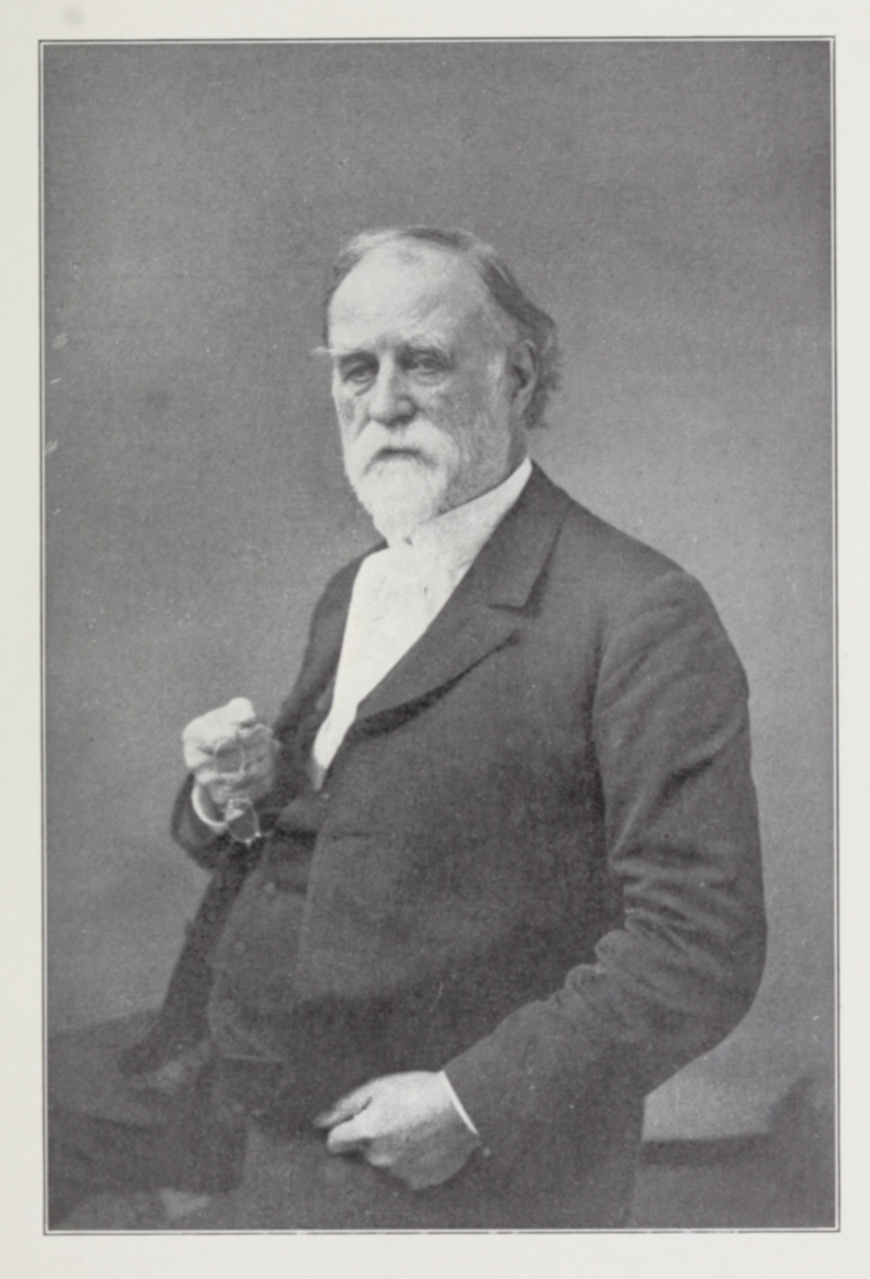
C. C. Hine In 1895. “There may have been men of greater and more beautiful character than his, but I never knew any and never read of any. I count it one of the most fortunate things of my life to have been for so many years so closely associated with him. While it (the portrait) does not do full Justice to the subject (I do not think any photograph could), it is a face I am glad to look at and it recalls some of the pleasantest memories of my whole life and some of the things which, I am sure, have been of the utmost value to me in many ways. He left nothing but a trail of good wherever he went. My memory is of a life rather than of episodes; I only wish I could describe it as it was lived. The only two absolutely unselfish people I ever knew were Mr. Hine and my own mother.”
C. C. HINE AND HIS TIMES.
This second part is intended to cover as well as may be the period of time beginning with the opening of Woodside as a residence section. During these years Mr. Charles Cole Hine took such an active interest in the welfare of the neighborhood and was so wrapped up in and identified with its best interests that its history is his biography, consequently I feel that it will be proper to give here a brief outline of his life previous to the year 1867, when he settled in Woodside.
When women could lift their little children up to “take a last look at the best friend they ever had”, as was done while the people passed by the coffin of Mr. Hine as it lay in the church, such as did not come in direct contact with the man may to some extent understand what a feeling of love he inspired in those who knew him.
For me he had a living reality that death has never removed; it was years before I could accept the situation. Concerning no one else have I ever had the same feeling. Death has removed others and I have accepted the condition as final, but for a long period after the death of my father I had a feeling amounting to momentary conviction that he had opened the office door and was coming toward me, and have looked up from my desk many a time to welcome him. This could not have been a matter of local association, for I was occupying an office which he never saw. What it was I do not know.
“Thy voice is on the rolling air,
I hear thee where the waters run;
Thou standest in the rising sun,
And in the setting thou art fair.”
CHARLES COLE HINE.
Charles Cole Hine was born in New Haven, Conn., December 21, 1825. When six years of age his parents removed to Hornellsville, N. Y. His father was a carriage builder, but of nomadic tendencies, and the boy had small opportunity for schooling, though as a matter of fact he went to school all his life; he had an instinct for acquiring knowledge that could not be suppressed, and as a result those who knew him best in after life took it for granted that he was a college-bred man.
With the versatility of many another self-made man he turned his hand to many things in his youth while finding himself. He once went on a concert tour with three other young men, driving from town to town through Ohio and western Pennsylvania. At one time he turned to art for a living and actually did support himself, after a fashion, for a brief period, painting portraits. Mr. Hine’s father moved to Massillon, Ohio, in 1837, and there the boy grew up and cast his first vote. Once when clerking in a store in Massillon, among the commodities of which was a line of books, the proprietor, who was of a kindly disposition, allowed the young man to read as he liked, and as a result he read every book in the place, including an encyclopædia, some six hundred volumes in all.
When the telegraph was young he became interested in that and established lines through parts of Ohio, Indiana and Illinois, contracting for poles and their erection, selecting the local operators and teaching them the Morse alphabet, and doing any other missionary work that was needed. That he was something more in this than ordinary is evidenced by the fact that in Reid’s “History of the Telegraph in America” Mr. Hine’s name is frequently mentioned, and always in complimentary terms. While in charge of the office in Louisville, he invented a transmitter to repeat messages in order to save the time of an operator, for in those days the electric fluid only carried a message so far, and long distance messages must needs be repeated by hand. Later some one invented and patented the same thing and made, I believe, a fortune by it.
An operator in the early days of telegraphy was a more important personage than at present. Mr. Hine has told how, when he was stationed in St. Louis, 1848-9, P. T. Barnum was taking Jenny Lind around the country and, upon reaching St. Louis, he insisted on getting inside the telegraph office and making the acquaintance of the operator. As a result he took Mr. Hine riding with him and gave him two tickets for each concert, no mean gift when tickets were selling at $20.00 each.
The year 1849 was the year of the cholera and of the “great fire” in St. Louis. “The city was a charnel house; funerals were the principal events and the chief business of the hour; hearses went on a trot when they could not go faster.” Mr. Hine was convalescing from the disease and had been carried from a room at Olive and Main streets to his boarding house. That same night the “great fire” started on the levee. Four hundred buildings in the business heart of the city, which included Olive and Main streets, were destroyed.
While living in St. Louis Mr. Hine met Mary Hazard Avery, whose parents had also removed from Connecticut, and was married to Miss Avery in that city July 4, 1853. Before that time he had established himself in New Albany, Ind., where in due course he represented the Adams Express Company, and was secretary of a plank road, notary for two banks and agent for several insurance companies, fire and life.
While living here the New Albany Theological Seminary removed to Chicago, leaving a splendid set of buildings vacant, and Mr. Hine thought he saw the opportunity of his life in the establishment of a girls’ seminary. The property was easily obtained, and he spent all the money he had and all he could borrow fitting up the place but, as he once put it, “the New Albany Female Seminary opened simultaneously with the great panic of 1857”. He lost every cent he had and came out of the crash many thousands of dollars in debt.
When Mr. Hine wished to enter active business again he bought up the outstanding notes against him in order to protect himself and, although his former creditors had no claim on him thereafter, he gradually paid back every dollar of indebtedness with interest. In this he followed the somewhat unique method of ascertaining who among his old creditors were most in need, and paying these first.
As an insurance agent Mr. Hine had represented the Ætna Insurance Company, whose western general agent had said to him: “Mr. Hine, if ever you should want to go into insurance again, please let me know first”, and after the crash Mr Hine promptly sent word to the headquarters in Cincinnati that he wanted a position and as promptly got it. Thereafter he was connected with the western office of the Ætna until he removed to New York in 1865. Mr. Hine was brought east by the offer of the secretaryship of the International Insurance Company, but the methods adopted not being to his liking he resigned. He was then practically offered the position of Superintendent of the Insurance Department of the State of New York, but preferring to be his own master and delighting in editorial work, he purchased the Insurance Monitor in March, 1868, and that became his life work.
MR. HINE IN SEARCH OF A HOME.
As soon as his work would permit he began to look about for a home, and ultimately decided on Woodside, which was then beginning to be exploited as a residence section for toilers in the city. In this connection it can do no harm to tell a little story which he often told of himself.
As a young man he spent many of his leisure hours painting, and in 1844 painted much with a certain man in Massillon, Ohio, who was something of an artist, and during this time painted the man’s portrait, but he had completely lost sight of his friend for more than twenty years.
In 1866, when looking for a home site, Mr. Hine answered, among others, an advertisement of a Mr. M., in Morrisania, and while inspecting the house saw a portrait which he recognized as that of his artist friend of 1844, and one which he had seen many times, but which the lady of the house told him was Mr. M., an entirely different name.
When the gentleman himself arrived Mr. Hine recognized him, but neither gave any indication of the recognition and an appointment was made for Mr. M. to call at the New York office of his prospective customer the next day.
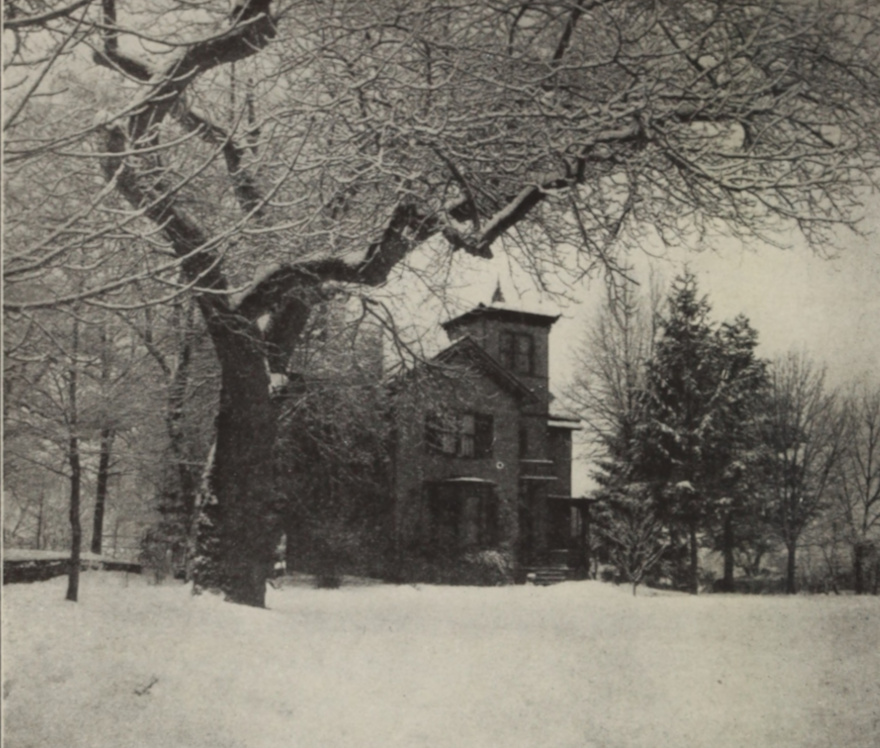
Home Of Mr. Henry J. Winser. House erected in 1866. Situated at 201 Washington Avenue. In the foreground stands the old apple tree that was used as a talking point by Mr. Ananias.
In the meantime Mr. Hine got out his old portrait of the man and placed it in his office where the caller would see it, expecting a good time in resuming the old acquaintance, but Mr. M. never came, and inquiry showed that he had disappeared suddenly, leaving no address, and that his house was vacant and in the hands of an agent.
Mr. Hine’s portrait of the man hung for many years over a door in the dining room at No. 209 Washington avenue, and he was fond of relating an entirely new supposition accounting for the mysterious disappearance of the gentleman, which was advanced by his pastor who, on a certain occasion, was dining at the house when the story was told, and who “looked up from his plate, gazed at the picture a moment, and then looking me square in the eye said, in a calm, deliberate voice: ‘Maybe he was afraid you would paint him again.’”
MR. HINE FIRST VISITS WOODSIDE.
Mr. Hine first visited Woodside in August, 1866; the house at 201 Washington avenue was for sale, having been erected by a Mr. Babbitt, who was unable to occupy it. Mr. Hine concluded it could be made to meet his requirements, and immediately closed the bargain; but it seems that Mr. Henry J. Winser had before this discovered the house and, being attracted by the great trees growing on the place, secured the refusal of the property for a few days, and it was before this time had expired that Mr. Hine made the purchase.
Here was a state of things which was unpleasant for all except Mr. Babbitt, who had his money, and he referred Mr. Winser to Mr. Hine, thus dismissing the matter so far as he was concerned. Mr. Winser as city editor of the New York Times was then investigating the Tweed Ring and could not attend to personal matters, hence it devolved on Mrs. Winser to open the negotiations which resulted in a sale to Mr. W. and the purchase of property adjoining on the north by Mr. Hine.
THE FIRST HOUSES ERECTED ON WASHINGTON AVENUE.
The Winser family moved in on September 1, 1866. At this time there were five detached houses on this (east) side of what was then Belleville avenue; these were occupied by Messrs. Winser, Best, Baldwin, Neumann and Daniel F. Tompkins. On the west side were six houses, occupied (from south to north) by Messrs. Sommer, an artist; Shannan, Mrs. Van Wyck, James Gamble, George B. Callen and John P. Contrell. Between Elwood avenue and Carteret street the foundations for four houses were laid, and on the hill above Carteret street Mr. Charles D. Morrison who, with Mr. John I. Briggs, composed the firm of Morrison & Briggs, builders, was erecting his own dwelling. Below these groups on the south there was no building until we came to the spacious house, embowered in trees, of Mr. Horace H. Nichols, and across Washington avenue from Mr. Nichols, at the point, the house built by Mr. A. P. Scharff, later occupied by Dr. MacKie, Mr. James A. C. Van Rossam and one Flavel.
THE FIRST HOUSES ERECTED ON LINCOLN AVENUE.
On what was then known as the Back road were the houses of Colonel Buck, Messrs. Samuel Royce, Miles I’Anson, E. A. Boyden, John Scharff, John C. Bennett; the first house of C. D. Morrison, present corner of May street and Summer place; the old Phillips farm house and the house of James Swinnerton, Jr., on the northeast corner of Elwood avenue, which was then Berkley street.
HOUSES ERECTED IN 1866-7.
Within the year there were built the houses of Mr. Hine, Mr. Harlan, C. D. Morrison, Miss Teel, Mr. Pratt, Mr. Palmer, Mr. Faitoute, Mrs. Jackson, Mr. F. F. Mercer, Mr. Blackwood, Mr. McDonald and Wm. Chippendale, the latter a son of Richard Chippendale, who came to this country on account of the Chartist troubles in England, and about this time the house of Mr. Horace Carter on the Gully road was built.
Several new houses were built on the River road near Grafton avenue, and were occupied by Mr. Webster, Mr. Oliver Gordon, formerly of Brooklyn, who had a large business with China and was a colleague of the Lows; and Benjamin Brigg, son-in-law of Mr. Gordon and the representative of the Brigg woolen mills in Huddersfield, England.
HOMES OF AN EARLIER PERIOD.
Of the old settlers there were the houses of Sandford, Munn, Melius, Colonel Cumming, Stimis, John McDonald, Coeyman and Weiler, on the River road; Mr. Alfred Hardwick Gibbs on the high ground north of the Gully road, known as “Thornhill”; the “Cedars”, built by Frank Forester (H. W. Herbert), which had been bought by Mr. Sanchez y Dolce, and was then occupied by him, and also a group of houses about the junction of Washington and Grafton avenues and Halleck Street, which is treated of elsewhere.
On the west side of Belleville avenue near Second river was the interesting old house occupied by Mr. and Mrs. Jonathan Bird and Mrs. Bird’s two sons by a former marriage, Lewis and George Ashmun. This was a most delightful house, and the hospitality of the Birds was renowned. Mrs. Bird was a daughter of the Rev. Dr. Strong, of Massachusetts, and inherited her gracious manner and charm of conversation from a long line of ancestors who were among the best people of New England.
They entertained with the grace of the early part of the nineteenth century, before the advent of that class of plutocrats that brought ostentatious pomp and more or less bad manners into society. Mr. Bird was a gentleman of the old school, and Mrs. Bird one of the most gracious and beautiful of women. It was always a delight to attend their evenings at home. One was sure of meeting all the charming people of the surrounding country and Newark, and there was no lack of brilliant conversation. When the gatherings were not too large and the company could assemble around the hospitable board the table-talk was sparkling with wit, while matters of graver import were freely discussed.
It is impossible to say when this old house was erected; it bears every evidence of having been a very fine place in its day. One informant recalls having heard Mrs. Bird state that the house was built before the Revolution by an Englishman who sympathized with his king and was consequently compelled to leave the country when war was declared. This information Mrs. Bird secured from a daughter of Harry Coeyman, who had received it from her father. Presumably this is Henry M. Coeyman, a son of Minard, who is said to have served in the Revolution, and the son would thus have come on the scene early enough to know the facts.
The records do not go beyond 1790. On July 5, 1790, James H. Maxwell conveyed the property to Alexander McComb who, on May 21, 1792, conveyed it to Daniel McCormick who, on July 18, 1792, conveyed to Thomas Bennett. The next transfer is a sheriff’s deed dated June 24, 1812, to Jacob Stout, and on April 9, 1825, his widow, Frances, conveyed to the President and Directors of the New Jersey Bleaching, Printing & Dyeing Company. On September 10, 1829, a sheriff’s deed conveyed to Samuel Wright et als. Then follow the names of owners as follows: Andrew Gray, Bolton et als., Edward Dwight et als., American Print Works, 1835; James K. Mills, 1853; George Bird, 1853, and Jonathan Bird, 1859.
During the time that the house was occupied by Mr. Bird the place was approached from Mill street by a bridge across Second river just above the present Washington avenue bridge.
INTRODUCING MR. ANANIAS.
After the many years of unclouded friendship that have existed between the families of Hine and Winser it is difficult to realize that there could ever have been any other state of feeling, but at the outset conditions were just the reverse and the cause of it is rather an interesting little story.
Both homesteads were situated within what was once a Stimis apple orchard and each contained several magnificent apple trees that were probably over one-hundred years old, and it was one of these trees and an unruly tongue that caused the trouble. The tree in question was a picturesque old giant that stood on the Winser premises near the street and near Mr. Hine’s line.
A neighbor of both families, whom we will call Mr. Ananias, took a dislike to Mr. Hine, even before his house was finished, and undertook to make trouble for him. Knowing that both families admired and valued the trees which adorned their places he pitched on this particular apple tree, and first called on Mr. Winser and during a conversation managed to introduce the subject of the new neighbor, incidentally remarking that Mr. Hine, who was a new-rich upstart from the west, had taken a dislike to the Winser family and, having learned of its love of trees, had announced that he was going to have that apple tree down, Winser or no Winser, under the pretense that it interfered with his view.
Having planted and properly watered the seed of discord he proceeded to sow tares in the next field by informing Mr. Hine that the Winsers had expressed themselves in a very disparaging way concerning him and his, proposing to annoy him in any way they could and, having heard of his admiration for this great apple tree, intended to cut it down to spite him.
After this it was quite natural that the families should pass by on the other side—in fact the one turned its back on the other in so pronounced a fashion that there was no overlooking it.
The Winsers saw the family move in and noted that it consisted of one gentleman, two ladies and three children, and concluded that the slender lady, who was in black, was a widow, and that the slender boy was her son. And thus matters stood until one morning there was a bad accident in the Hine kitchen and Miss Avery, the supposed widow, came over for help. The cook had been burned and Mr. Hine, in beating out the flames, had had his hands burned until the skin hung from them in shreds.
Carron oil was wanted and a doctor was wanted, and Mrs. Winser, who was home alone at the time, did all in her power to assist the distressed by sending her horse for the doctor and coming to offer personal help. When she first saw Mr. Hine he was sitting with hands extended to avoid contact with anything, and when she expressed a wish to help he gladly accepted, but voiced his surprise that, feeling as she did, the offer should be made. This led to a prompt retort, and almost before they knew it the situation was explained and the eyes of both opened, and thereafter there was a well-worn path between the two houses. During the ten days or more that Mr. Hine was confined to the house Mrs. Winser took down any matters he wished to dictate and made frequent journeys to his New York office in his behalf.
Much might be told in regard to the sayings of Mr. Ananias, but possibly one or two more of his pleasantries will suffice:—
Mrs. Winser recalls her first visit to Woodside and the swarms of mosquitoes in the horse cars that were on hand to greet her: they were the real Jersey mosquitoes of well-defined propensity. It was August, and as she and Mr. Winser alighted in front of the house, which was then building, and which later became theirs, they were met by Mr. A., and to him voiced their opinions of the pests, but he waived it off with the casual remark that Woodside only had mosquitoes for a week or ten days during the middle or latter part of August, and while they were bad then, it was only for a brief period.
In July, 1867, Mr. Winser sailed for Europe on the destroyer “Dunderburg”, built by Mr. Webb, but finished too late for use in the Civil War, and which had been purchased by the French government. The trip was considered dangerous, as the vessel had been intended merely for coast defense, and the traveler not only made his will, having been warned that he was going to a watery grave, but left the most minute written instructions to help Mrs. Winser over the rough places.
What was Mrs. Winser’s astonishment when, as soon as her husband was out of reach, “the Woe of Woodside” (our friend Ananias) came to her with a memorandum saying that Mr. Winser had pledged himself to pay $300 toward the erection of an Episcopal church in Woodside. This was news to her, and she searched the book of written instructions in which all claims and all money matters had been entered by Mr. Winser without being able to find that he had made such a pledge as was claimed.
When she made this announcement to Mr. A. he promptly answered: “Well, if this amount is not paid by you, your husband’s honor will be at stake and you will be the cause”. Imagine the feelings of this wife of fifteen months when told that she must pay this moral (!) obligation or cover her husband’s name with dishonor. Finally, without consulting any one versed in the ways of the world, Mrs. Winser paid over the money and, according to Mr. A., the name of H. J. Winser was put down on the subscription list with others, but some weeks later she learned that the name was not down among subscribers, but headed the list, and was used as a means of extracting money from other Episcopalians in the neighborhood.
The Winsers had brought their letters to Christ Church in Belleville, and had had no thought of making any change; hence, on the return of Mr. Winser, and the facts being known, he was filled with wrath. It was too late, however, to do anything. The reason for this conduct on the part of Mr. A. is supposed to have been purely monetary, as he expected to profit by the work involved in the erection of the proposed church building.
Thus when one acquainted with all the circumstances once remarked that “the church was conceived in sin and born in iniquity” the statement is thought to meet the situation with a fair degree of accuracy.
Mrs. Winser was later appointed treasurer of the church guild, and had great satisfaction in making Mr. A. toe the mark when his part of the work was not properly done.
ST. JOHN’S EPISCOPAL CHURCH.
Until the building was under cover services were held in Morrison’s Hall, Washington avenue, opposite Elliott street, and the Lenten services, morning and evening, in the Winser house; but, as I understand it, when the church was organized some of the first services were held in Mr. Hine’s house, as witness the following:—
“At the first regular meeting of the Vestry of St. John’s church of Woodside, N. J., the following resolution was offered by Mr. E. A. Condit and unanimously adopted:—
“Resolved, that the Vestry of St. John’s Church, Woodside, hereby tender their acknowledgments to C. C. Hine, Esquire, for his numerous acts of kindness and courtesy in their behalf, and especially for the free use of his house as a place of public worship during the past summer.
“Resolved, that the Secretary communicate this resolution to Mr. Hine and record the same in the minutes of the Vestry.
“E. A. CONDIT,
”Secy. of the Vsty.“
On September 15, 1868, St. John’s Church was dedicated, the church building having been in use for some time previous to this. The annals of the parish pass this service over. Bishop Odenheimer and some twenty odd clergymen were present.
Rev. Mr. Lounsbury was the first rector; he remained only a short time and Rev. Samuel Hall succeeded him in February, 1868.
The following notes are from the parish register:—
“First meeting to organize, September 2, 1867.
“Cornerstone laid, November 29, 1867.
“Rev. Samuel Hall, rector, February 8, 1868, to February 8, 1873, when he resigned to become rector of the Church of the Redeemer, Morristown.
“Rev. H. H. Barbour, rector from April 17, 1873, to November 1, 1875.
“November 1, 1874, rectory occupied. Rev. Francis A. Henry, rector from April 29, 1876, to October 2, 1876.
“Rev. I. B. Wetherell, rector from November 29, 1876, to April 18, 1877.
“Rev. I. H. McCandless, rector from April 18, 1877, to November 1, 1877.
“Rev. George C. Pennell, S. T. D., rector from January, 1878, to January 15, 1880.
“Rev. Arthur B. Conger, rector from March 28, 1880, to April 1, 1882. Resigned on account of illness.
“Rev. A. L. Wood, rector from September 11, 1882, to September 1, 1891.
“Rev. Frank Albion Sanborn, B. D., rector, September 1, 1891.”
He was followed by Rev. George W. Lincoln, who was succeeded by Rev. Rowland S. Nichols, the present incumbent.
A WOODSIDE MOLASSES JAR.
That the women of Woodside were unusually attractive there is no denying. Of one of them it is told that she found herself in Newark rather late one evening after the cars had ceased to run and, being alone and unable to secure a livery team (for Newark was as primitive in its way forty years ago as was Woodside) she applied at the police station for help and an officer was sent with her on the walk home. They evidently had a very pleasant trip, for it was not more than three days later that the officer appeared at the lady’s home, dressed in his best, only to find that she was married. An introduction to the husband somewhat cooled his ardor.
CAPT. KIDD IN THE WINSER BACK YARD.
There is a tradition that Captain Kidd buried treasure at a point in the Winser back yard where an ancient apple tree flourished when we were young, and the following facts seem to show good foundation for the belief:—
We are told that oft during the quiet of the night (this was before the day of the trolley and its outrageous roar) the sound of a pick being driven vigorously into the earth could be heard from the direction of the old tree, but when the hearers gazed out into the dark no one could be seen. Those watching with the sick frequently noted such sounds, and as there were no visible diggers and the following morning no indications that the earth had been disturbed, it seems impossible that the work could have been done by other than the shades of the departed pirates. What, indeed, is to prevent our supposing that the ghost of the pirate captain himself was on hand, superintending the work in his old burying ground?
Then there were the snakes that guarded this old apple tree—great black snakes of a peculiarly ferocious and menacing aspect—which, as is well attested by the most reliable witnesses, were known to deliberately simulate crooked sticks which, when about to be picked up by some unsuspecting human, would dart out a fiery tongue and with a terrible hissing sound drive the too venturesome explorer to the uttermost parts of the Winser lot.
MORRISON & BRIGGS.
Morrison & Briggs were the chief builders of the first Woodside houses. As nearly as can now be learned it seems probable that it was they who induced Messrs. Parker & Keasbey to purchase land here about 1865, open streets and lay out sites for residences. The builders at first had a very small shop on Berkley street (now Elwood avenue) immediately adjoining the house of Mr. Swinnerton, but it was not long before they erected a two-story woodworking establishment on Washington avenue, just north of Elliott street.
Charlie Morrison, of the firm, was a curious specimen, good natured to a degree it would appear, for he was seemingly so unwilling to disappoint any one that he would promise the impossible without a blink. His fondness for moving was epitomized by his better half (very much better) once when she remarked that if he died first she should have his coffin put on wheels, as he would never be content to rest in one place long.
Morrison & Briggs had not been exactly trained in the art of building but they managed to bungle it through in one way and another. The house at 209 Washington avenue is an example: this was built in 1866-7, and my recollection is of hearing that the cellar wall must needs be torn down twice before it would pass inspection. When the last payment on the house was due it was necessary to furnish the builders with a list (quite a long one) of those things left undone with a gentle intimation that the final check would be forthcoming when the deficiencies were supplied. There was then a very good feint at something doing, when another list, somewhat shorter than the first, was handed to the builders, and so by a gradual process of elimination, as it were, the house was pronounced complete.
THE SAD FATE OF THE WINSER HORSE.
During the winter of 1868 the Winser horse came to a bad end. It seems that a brother of a certain General S. had rented a house on Halleck street, and as the General was an old friend of Mr. Winser it was taken for granted that the Major, his brother, was of the same standing, and he was immediately taken into the Winser bosom.
About this time the Winsers, having small use for their horse, had arranged to board it for a period in Westchester County, but when the Major heard of this he suggested that he take the animal, and that then if they wanted it at any time it would be near by. This was more than agreeable to the owners, and “Nelly” was soon installed in the Major’s stable.
In the course of ten days Mr. Winser dropped in to see how his favorite was coming on, and was told by a stableman that his master had driven her to Pamrapo where he was superintending some road building. This seemed reasonable, but when a second visit some two weeks later elicited the statement that the Major had shipped “Nelly” from Pamrapo to Maryland, and it was found that the Major’s house was closed and that he would not return until January, it seemed about time to move in the matter.
The case was laid before a well-known lawyer in Newark, who would not touch it because the Major and he were on the same Republican Committee. It was then given to Mr. Runyon, later Chancellor and Ambassador to Berlin, and he, not being of the same political faith as the Major, took the case with great gusto.
The Major turned up in Newark in the course of time and the case was heard before Judge Depue. The Major said that “Nelly’s” bones were bleaching on the Eastern Shore of Maryland; that she was absolutely valueless, and that he had taken her out of pure pity to save her from ill-treatment. He had but one witness, who declared that he had driven with the Major, and had no hesitation in saying the horse was lame, half starved and not fit to be put in harness.
Mr. Runyon demolished this testimony by proving that this witness had no knowledge of the points of a horse, by showing that he was indebted to the Major for his position at that time and that he had not seen the horse until she had been in the Major’s possession for some time. The Major was inclined to be flippant with the Court and, finally, when asked how he stood in regard to certain transactions, he answered that he “stood in his shirt and trousers”. The judge warned him that he would have to answer for contempt of court.
After ten minutes’ deliberation the jury returned a verdict against the defendant for $400 for the value of the horse and also assessed the costs on him, but it is needless to say that he never paid either amount, being a politician of note. The Republican party in Newark has certainly been loaded with a hard lot of citizens, first and last.
THE OPENING OF WASHINGTON AVENUE.
It will now be necessary to go back a bit in our chronology in order to get at the beginnings of the Woodside we know.
The opening of Washington avenue, about 1865, was the beginning of a new era for the neighborhood, for then Parker and Keasbey purchased a considerable tract in the vicinity of Washington and Elwood avenues and cut it up for suburban dwelling purposes and Morrison & Briggs, contractors, appeared on the scene.
To be sure “the opening of the new highway consisted merely in setting the fences back and making a narrow cut through the hill just north of Carteret street, the earth from which was used to fill the ravine further north”. A single car track was then laid from the cemetery to Second river, and Woodside was open for business.
But it was not Woodside in those days. The first name attached to the locality, and which appears to have come into use about 1863, was Ridgewood. There was, however, a post office of this name already established in the state, and when the town was set off from Belleville the name was changed to the present form.
In 1865 this was a part of Belleville, but it was not long before efforts were made for a separation, as the following documents indicate:—
ASSEMBLY—NO. 498. STATE OF NEW JERSEY.
An Act to set off from the township of Belleville, in
the county of Essex, an election district, to be
known as Woodside.
1 1. Be it enacted by the Senate and General Assembly
2 of the State of New Jersey, That all that
3 part of said township of Belleville, lying and being
4 south of the Second river, be set off from the
5 township of Belleville, and made and constituted
6 an election district to be known and called Woodside.
1 2. And be it enacted, That Alfred Keen,
2 Charles D. Morrison, and Charles Akers be and
3 are hereby appointed inspectors of election with
4 power to elect and appoint a clerk for said election,
5 at the annual town election to be held in April
6 eighteen hundred and sixty-eight, at Woodside
7 polling district in the public hall known as Woodside
8 hall, and who are hereby required and authorized
9 to perform all duties required of inspectors
10 of election, in and for said district, and shall
11 preside at said first town meeting in said district,
12 as inspectors of election.
1 3. And be it enacted, That at the election to be
2 held in April, anno domini eighteen hundred and
3 sixty-eight, and at each succeeding April, three
4 persons shall be elected as judges of election for
5 such election district for the term of one year, who
6 shall possess the powers, be required to perform
7 the duties, and be subject to the liabilities as other
8 judges or inspectors of elections, according to the
9 general laws of the State of New Jersey, as they
10 now are or may hereafter be, and said judges so
11 elected shall act as judges of all elections to be
12 hereafter held in said district, no ballot for this
13 purpose shall contain more than two names; in
14 case more than two names are voted for, the ballot
15 shall only be void as to said judge, and the
16 three persons who receive the highest number of
17 votes shall be deemed and taken to be elected
18 judges of election, in case two persons shall have
19 received an equal number of votes, the first person
20 named on the ballot for judge of election shall be
21 elected, and the said judges and clerk shall receive
22 two dollars per day for their services, and the said
23 judges of election shall procure a proper box for
24 said district, of which place and time of holding
25 elections they shall give at least two weeks’ notice
26 in five of the most public places in said district,
27 and the said board shall have power to appoint
28 a clerk, who shall perform such duties as is
29 required in the act to which this is a supplement.
1 4. And be it enacted, That all acts or parts of
2 acts inconsistent with this act be and the same are
3 hereby repealed.
1 5. And be it enacted, That this act shall take
2 effect immediately.
ONE DOLLAR EACH.
“Woodside, 13 Mar. 1868.
“Gentlemen—At a meeting of the citizens of Woodside, held last evening to consider the matter of a new Township it was resolved that the passage of the Bill now before the Legislature was desirable and Major Sears and Mr. Alfred Keen were appointed (with power to select three associates) to proceed to Trenton and urge the passage of said Bill.
“It was also resolved that the means to defray the expenses of these gentlemen be provided by a contribution of one dollar each from the signers of the Memorial, and I was appointed to collect such contribution. It being impossible for me to spare the necessary time to call upon you all, I request that you will hand the amount to my son, the bearer.
“Respectfully yours,
”C. C. HINE,
“To Messrs. C. D. Morrison, Lorenzo Hart, Wm. A. Wauters, A. Bigelow, Edw. Carrigan, Jonathan Bird, E. Coeyman, Sam’l Royce, J. S. Gamble, Louis Dovell, T. H. Blake, E. B. Smith, Geo. W. Harlan, H. McFarlin, B. Dodd, T. A. Roberts, E. F. Higgins, P. Smith, J. P. Contrell, Dan’l F. Tompkins, N. Caughlin, Edw. Morrison, Jas. Swinnerton, Jr., J. C. McDonald, H. E. Joraleman, Geo. Ashmun, John H. Meeker, Wm. Dixon, Geo. T. Teel, A. Van Riper, J. P. Fowler, Alfred Sears, John I. Briggs, Geo. B. Callen, A. C. Neumann, W. J. Harlan, B. R. Sage, D. Evans, Geo. W. Keen, Owen Carroll, C. C. Hine, B. F. Baldwin, H. J. Winser, Wm. Jacobus, Stephen Joraleman, G. W. Cumming, E. G. Faitoute, Aaron H. Keen, Anthony Epworth, E. Charlier, Henry Farmer, Geo. W. Gore, Patrick Brady.”
If there were more names than these they were on another sheet which has been lost.
The separation was effected apparently without much difficulty, and thereafter for a brief period Woodside was independent. For the gobbling of it by Newark see the early pages of this book.
REMINISCENCES BY MR. SWINNERTON.
The following items are taken from the “Reminiscences” by Mr. James Swinnerton, which were read before the Woodside Sunday School on the occasion of its twentieth anniversary, 1887.
“At first a single stage which ran every hour was the only public conveyance between Newark and Belleville. This region was then a very primitive neighborhood. Early comers recall the fact that Washington Irving and his friends roamed over these beautiful hills and wooded vales with gun and dog. It was a veritable Sleepy Hollow, and Irving, had he been a resident, instead of an occasional visitor, might easily have rendered the Passaic and its valley as famous as he did Tarrytown and the Hudson. The hill above Carteret street through which Washington avenue was cut was then a well known spot to sportsmen, quail, ground-doves and rabbits being the chief game as now recalled.
“The infusion of new blood in Belleville quickened the old, a direct avenue to Newark was demanded and a horse railroad determined upon. Farmers and others gave their time and the use of their teams to break through the ridge north of Carteret street, and a rough pathway was made over the hills to the bluff on this side of Second river. Those traveling further north must do so on foot after descending the bluff by a steep flight of steps and crossing the river on a rickety foot bridge of logs.”
THE WOODSIDE OF 1867.
“The early settlers found a country beautiful to behold, but with the usual discomforts of a new place. There were no stores, when short of provisions neighbor must forage on neighbor; there were no schools, Sunday or secular; there were no churches, there were no Sunday horse cars—ride to church we could not. There were no sidewalks, but there was a superabundance of mud—walk, therefore, we dared not. Those who were bold enough to do so found mud over shoe and usually arrived at the church door in a state of mind. Mud in Woodside at this time came early in the fall, stayed the winter out and lingered through the spring. Goloshes were at a premium and blacking brushes at a discount.
“A Woodsider of the period has been compared to a duck standing on one foot, with the difference that the duck stands thus from instinct, the Woodsider for the reason that he had no spot on which to place his other foot.
“During the day the horse-cars ran on twenty and forty-five minutes’ headway and seldom ventured out after dark, owing largely to the peculiar facility with which they ran off the track and the difficulty of setting them in the straight and narrow way again.
“Your present get off, cross over and wait for the bob-car arrangement is an improvement on the past, decidedly; as such it may afford you some consolation and hope for the future”. (Mr. Swinnerton thus wrote in 1887 when there was loud and prolonged indignation over the “bobtail” car service furnished Woodside).
These with other discomforts made life in Woodside interesting and will serve to show the situation during the first year. We were without the bread of life—often short of the bread that perisheth.
As there were no sidewalks the middle of the road was used as a foot path by those too early for the next car. “One day”, writes Mr. Swinnerton, “in the middle of the road, and in the spring of 1867, I met and was introduced to Mr. Hine. After the usual civilities Mr. Hine declared his purpose to start a Sunday school just as soon as he had moved into the settlement. This was good news, but I wondered how the ways and means were to be provided. Many of us had spent our last dollar when moving in, and there was not a spare room in the hamlet large enough to accommodate a Sunday school.”
“Several months before this the residents met under an old apple tree before the door of a small carpenter shop (Morrison & Briggs’s) to consider church and other interests, but the carpenter shop had disappeared and the apple tree promised little comfort beyond shade.
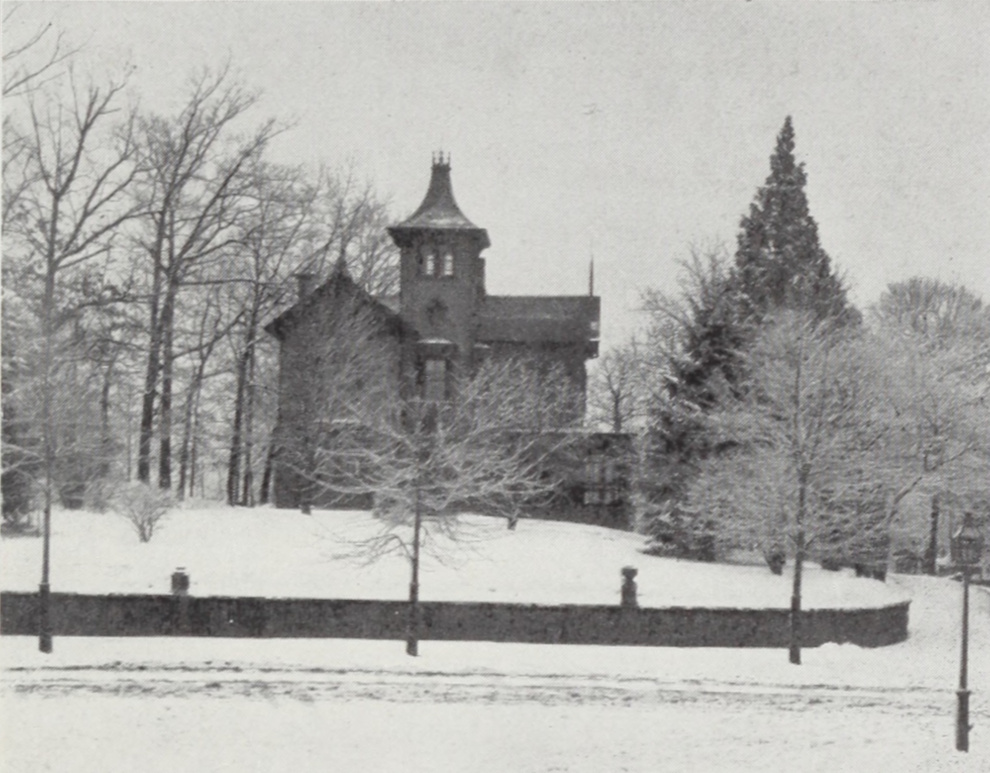
Home Of Mr. C. C. Hine, 209 Washington Avenue. In this house three churches have been organized, Presbyterian, Episcopalian and Dutch Reformed.
“When I ventured to ask ‘where?’ Mr. Hine’s reply ‘In my own house’ afforded me a new experience. The notion of any one inviting the children of a neighborhood to his home for religious instruction was novel.”
THE SUNDAY SCHOOL OF JUNE 16, 1867.
“Business engagements prevented my attendance at the first session of the school, but its praises were sung by the bairns at home and on the second Sabbath I went over, expecting to find a few scholars and a teacher or two arranged around an out-of-the-way room. To my surprise teachers and scholars in crowds were pouring into the house by the front door. On entering I saw chairs and benches in the parlor and the room occupied by the larger children; the library held the infant department, and there was provision for a Bible class in the hall.
“The school was in full swing—children singing—Mr. Hine leading and thumping a melodeon vigorously with one finger and a thumb—his practice when no five-fingered player was at hand.
“This show of life and activity was contagious. I fell into line at once by offering to fill the position of librarian. Mr. Hine’s reply to my offer, ‘we will look no further, but you must find your own library’, was characteristic of the man and the school. Money and books were in hand by the following Sunday.”
Church services were also held in the parlor of Mr. Hine’s house. The Rev. Mr. Scofield, pastor of the Central Presbyterian Church, Newark, preached the first sermon from the text, “What think ye of Christ?” Several city pastors filled the pulpit—or, rather, stood at the table, propping up the Bible with a pile of books.
Invitations to preach were frequently extended in this form: “We shall be very happy to have you come, but there will be no fee and you must bring yourself as there are no cars, and not a horse in the whole congregation.” Ministers from a distance came Saturday nights and “boarded round”. Theological students accepted invitations, bringing their first sermon, and glad enough of an opportunity to try it on a real congregation.
The following letter from Mr. Swinnerton, found among some of Mr. Hine’s old papers, is inserted here as it is interesting in this connection:—
“Newark, N. J., July 16, 1867.
“Mr. Hine:—
“Dear Sir—Send this just to let you know how we got along with the meetings on Wednesday and the Sabbath and, I am happy to say, first-rate. At the prayer meeting there was a fair attendance. Mr. and Mrs. Boyden led the singing. Messrs. Teal, Bennett, Pettit, Teal Junior and myself took part in the exercise.
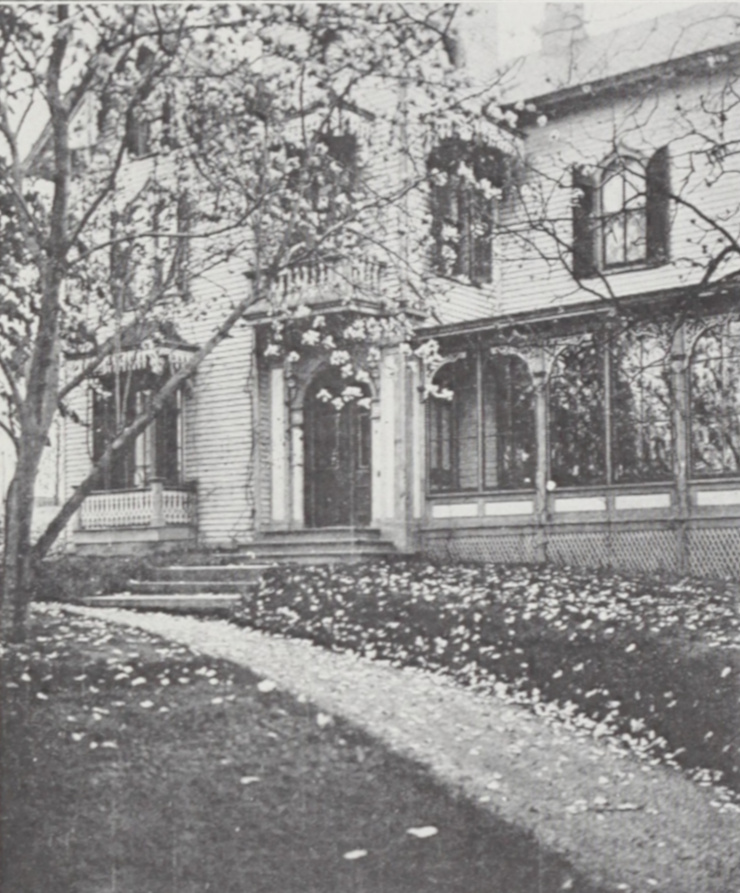
The Front Door At 209 Washington Avenue. Through which the Sunday School teachers and scholars streamed each Sabbath for eighteen months beginning with June 16, 1867.
“The Sabbath school attendance was 56 against 57 Sabbath previous. Mr. Taylor gave us a new chapter in Sunday school experience. Singing good.
“Mr. Dixon preached at night; the service very interesting; good singing. Mr. S. was not very well but remarked on Monday morning that it had done him more good to come up and preach for us and breathe the country air than if he had stayed at home. We had a full house. We filled the aisle with chairs and there were, besides, nearly a dozen persons in the hall. Mr. Pettit led on Wednesday. I report progress with books—bookcase painting.
“Shall see about preaching for next Sunday to-day.
“Yours truly,
”J. SWINNERTON.“
A CHURCH BELL IS PROCURED.
Occasionally an expected supply would fail to come, and those who gathered for the services were then disappointed. To meet this Mr. Hine purchased a bell and hung it in the tower of his house and this, by clangor or silence, gave notice to all the country side. There were no street lights, and those attending evening service on moonless nights have been likened unto swarms of fireflies as they ranged over the fields toward the house, every man with a lantern in hand.
Building up a congregation without the help a pastor can give, and raising money for a church edifice, are no light tasks. Several of the families held cherished church connections in Newark which they were loath to give up; others were indifferent.
FAIRS, CAKE SALES AND LECTURES.
The few especially interested worked with varying experiences. Fairs were held, the ladies baked cakes and gave them to the fair, the cakes were purchased by their husbands and carried home again.
In October Mr. Henry J. Winser gave a lecture for the benefit of the church in the house of Mr. Hine, his subject being his recent trip across the Atlantic in the Dunderberg. As showing the capacity of the house, a circular issued at the time states that “about 200 persons can be seated”.
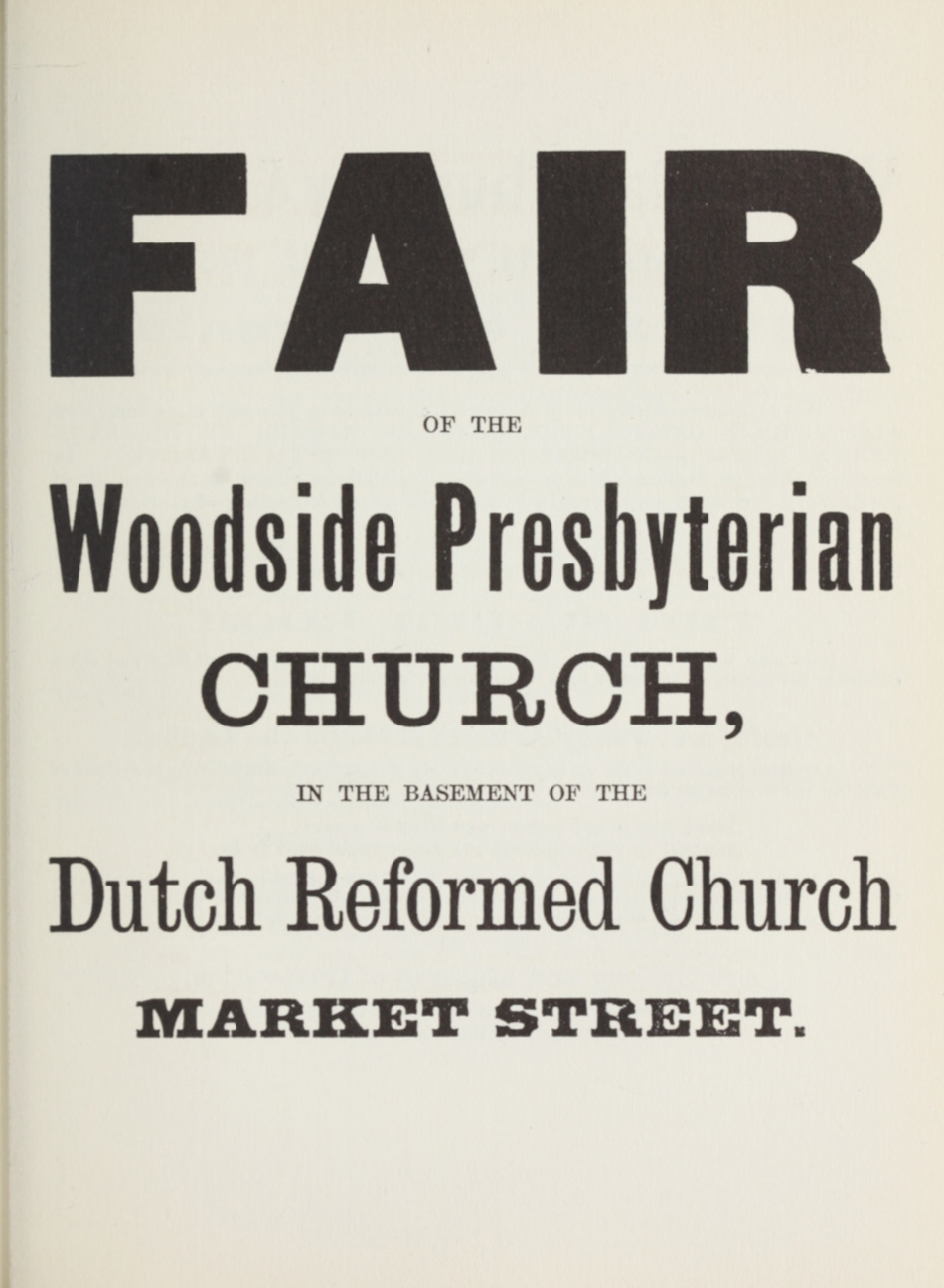
Fair Of The Woodside Presbyterian Church, In The Basement Of The Dutch Reformed Church Market Street.
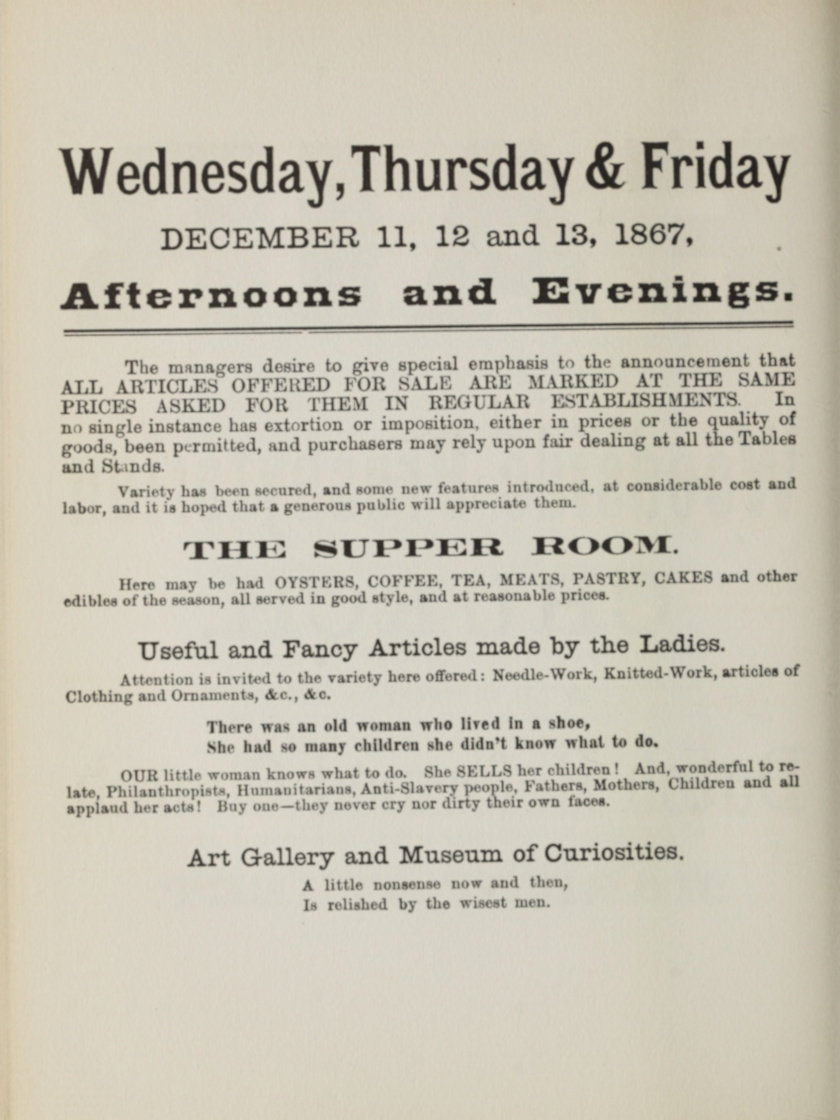
Second page of poster.
[Illustration: Second page of poster.]
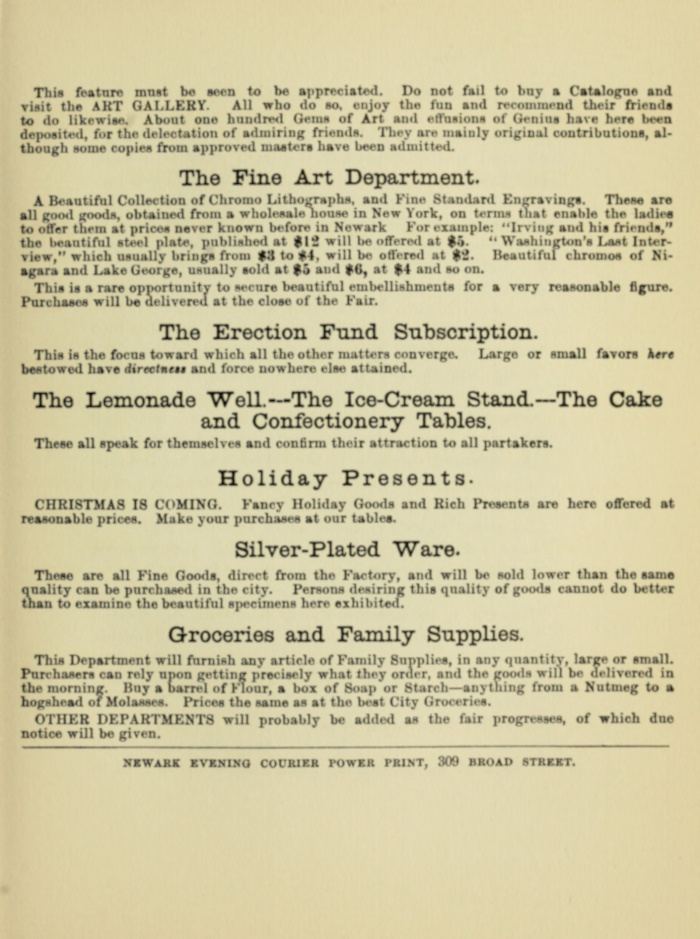
Third page of poster.
[Illustration: Third page of poster.]
The basement of a Newark church was secured for a midwinter festival (see copy of poster); we were snowed under, and with difficulty reached our firesides.
An auction of choice engravings and Prang’s chromos was attempted in the third story of a desolate building in Newark near the Market one Saturday night. Few people attended the sale and none purchased the pictures. At a similar attempt in Belleville chromos to the value of $1.25 were sold and, on counting the cash, it was found to be thirty-seven cents short.
THE RETREAT FROM BELLEVILLE.
“Moscow to Napoleon was a trifle compared to our retreat from Belleville that wintry night. Silently we carried our goods through that long-drawn-out village. Looked at through the mist of time this appears like a trifling incident, but then the giant Despair loomed above us, and it was only the splendid courage of Mr. Hine and his indomitable energy and perseverance which kept us going. Family interests he sacrificed for the common weal. To every objection there came but one reply: ‘I have enlisted for the war, and until a permanent building is erected my doors will stand open.’”
“They did stand open for eighteen months, or until January 3, 1869, when the second building erected for church and Sunday school purposes in Woodside opened its doors—the Woodside Presbyterian Church—St. John’s Church having been opened some months previous.” (Here ends Mr. Swinnerton’s very interesting paper).
THE ERIE RAILROAD.
One of the advertised inducements to settlers in Woodside was direct railroad connection with New York. The Erie had leased the Paterson, Newark & New York Railroad, which was opened in 1868 and connected with the Newark & Hudson Railroad to Jersey City, also leased to the Erie. This promised blessing was slow in coming, for at least three years elapsed before the New York connection was made, and in the meantime those whose business called them to the greater city must take the occasional horse car or walk to the D., L. & W. (which in those days stood for “Delay, Linger and Wait”).
The Erie has ever been to a Woodsider as a red rag to a bull. The extremely limited service of the “Newark Branch” and the absolute indifference of the management toward the convenience of travelers have been so pronounced as always to give the impression that the road regarded passengers as a necessary evil, to be endured but not encouraged and, as a result, hundreds in the old days turned from it in disgust and went elsewhere. It is safe to say that the Erie was the chief factor in holding the growth of this section in check, while to-day its foul breath blackens the heavens and desecrates the landscape as its engines vomit vast clouds of smudgy soft coal smoke with a villainous impudence that can nowhere be equaled. The Erie is the only railroad with more than one stop in Newark that charges more to one station than to another, and no other gives so little or so poor service. Such is its uniqueness.
THE MAKING OF A SUNDAY SCHOOL.
Mr. Hine took up his abode in Woodside on April 1, 1867. The following circular shows how prompt he was in starting the Sunday School:—
SUNDAY SCHOOL IN WOODSIDE.
There will be a Sunday School at the house of Mr. C. C. Hine, on Belleville Avenue, on Sunday June 16, 1867, at Half-past Two o’clock, p. m. All who feel an interest in this work are cordially invited to be present at that hour. Arrangements have been made for good singing and plenty of it. This SUNDAY SCHOOL is intended to be permanent.
In the Evening, at Eight o’clock, Rev. Mr. Scofield, from the Central Presbyterian Church of Newark, will preach on “THE PRECIOUSNESS OF CHRIST.”
On Wednesday Evenings, at Eight o’clock, until further notice, there will be Social Prayer Meetings.
All these Services are intended to be permanent.
A “BEFORE-THE-WAR” STORY.
Mr. Hine’s love for the Sunday school is so well known that no one will be surprised to learn that as a young man, and while traveling, he once taught a class in an Atlanta (Ga.) Sunday school.
This was before the war, and Mr. Hine used to tell as a good joke on his self-esteem, how adults gathered about his class to listen, until they outnumbered the scholars. This naturally made him feel somewhat elated until he found later that his auditors, learning that he was from the North, had gathered to ascertain whether he would inject any abolition talk into his teaching. The young man, however, was too wise to try anything of that sort, and was more than thankful that he had been when he discovered the true cause of his popularity.
THE MAKING OF A CHURCH.
Even before the Sunday school Mr. Hine had inaugurated church services in his dwelling, as is evidenced by this second circular:—
Presbyterian Church in Woodside.
Since the 9th of June public worship has been held in a private house in Woodside, the Presbyterian ministers of Newark officiating. A weekly Prayer Meeting has also been sustained since the same date. A Sunday School was organized on the 16th of June, and its roll now includes 84 names.
Application was duly made to Presbytery, and a committee of Ministers and Elders was appointed to visit Woodside and organize a Church, which duty they performed on the evening of Monday, Sept. 23d. Seventeen members united at that time, seven others have signified their intention of doing so, and it is thought the number will soon be increased to thirty.
An eligible lot of nearly a half acre has been secured, and subscriptions, sufficient to pay for it, made by the residents. An appeal is now made to the Newark Churches for means with which to build a Chapel. $4,000 or $5,000 will be needed.
The rapid growth and flattering prospects of Woodside are well known in this community, and the importance of FIRST occupying this promising field can hardly be over estimated. Generous encouragement promptly extended will, under God’s blessing, result in the speedy up-building of a much needed place of worship.
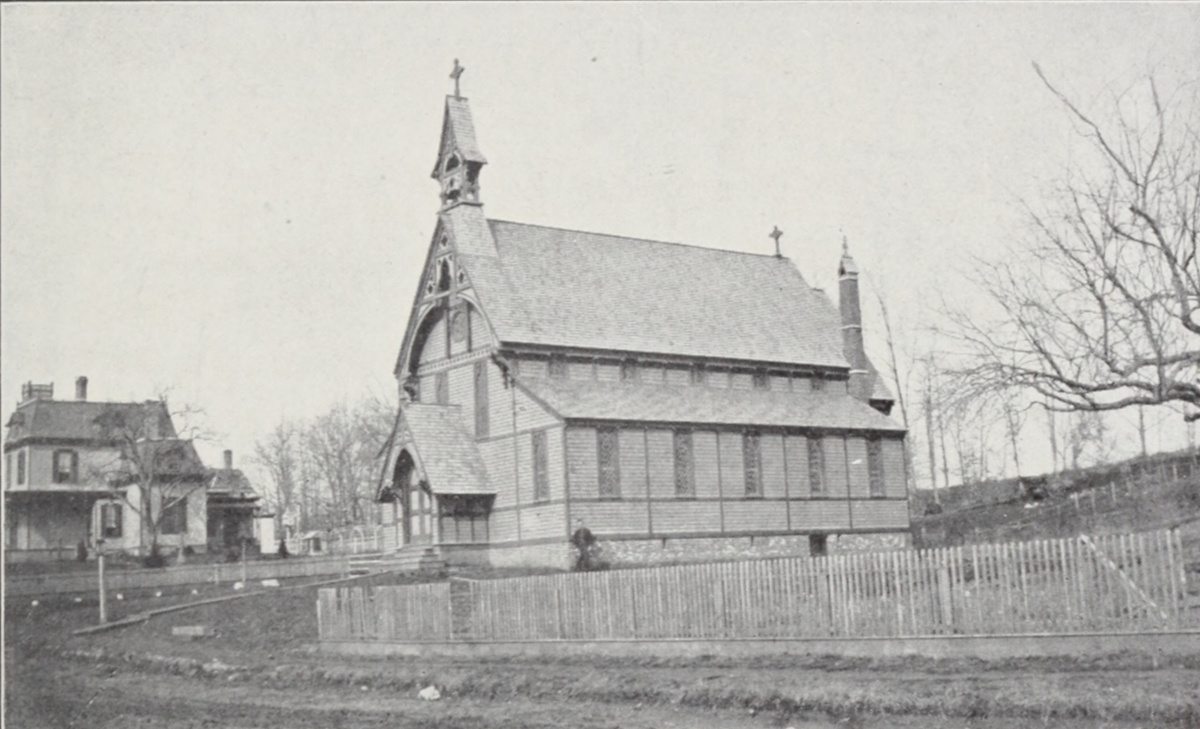
Presbyterian Church, Carteret Street.
THE FIRST CHURCH OF WOODSIDE.
The following “Annals of the First Presbyterian Church of Woodside” are copied from memoranda in Mr. Hine’s handwriting:—
“Woodside, Essex County, N. J.
“June, 1867.
“The first Public Worship held in Woodside was at 8 o’clock on the Evening of Sunday, June 9, 1867, in the house of Mr. C. C. Hine on Belleville avenue.
“Rev. Wm. C. Scofield of the Central Presbyterian Church, Newark, preached a stirring discourse from the text, ‘What think ye of Christ?’
“After the sermon it was announced that a Sunday school would be organized in the same place at 2-1/2 o’clock p. m. on the following Sabbath; and on a vote to establish and maintain a Social prayer meeting twenty hands were raised pledging attendance.
“At this date the village of Woodside is a mere suburban settlement, containing some forty houses that have all been built within the past sixteen months (this, of course, refers to the Washington avenue neighborhood). The want of Church privileges has been deeply felt, and this movement is designed to supply that want, draw the people of Christ together and build up a Church wherein and whereby He may be honored and souls saved.
“Saturday, June 8th, was a rainy day. The storm continued furious over night and until after midday Sunday. At sunset it was fair. Notice had been inserted in the Newark evening paper, and on Sunday afternoon forty-one houses were visited (by Mr. Hine himself) and personal invitation extended. About one hundred people assembled and the accommodations were crowded to their utmost capacity.
“Wednesday Evening, June 12, 1867.
“Twenty-five persons attended the first prayer meeting to-night. Messrs. Hine, Teal, Bennett and Pettit prayed—in the order written, and with singing and remarks and reading a part of Luke 12th the hour was profitably spent.”
MR. HINE’S HOUSE THE FIRST CHURCH BUILDING.
The parlor of Mr. Hine’s house was left unfurnished; it was a room 15x25 feet and the arrangement was such that the hall and the “library” across the hall could be used as an overflow. He purchased benches for the main room and placed a speaker’s table at the front end of the room, so that it commanded the hall and beyond, as well as the parlor. A bell so heavy that it shook the entire house, when in use, was hung in the tower, and his eldest, who, though young, was a husky lad, recalls with many a smile how he used to shift those long, heavy benches to meet the varying requirements of the day, displaying a species of muscular Christianity at this time which greatly pleased his sire, and how he would sit on the tower stairs and study his Sunday school lesson while he rang the bell for church or school.
But not all were of so becoming a disposition, for I am told that Mr. A. P. Scharff, who taught a class in Sunday school, called his scholars a “Band of Hope”, as that was the only thing he could do for them.
I very clearly recall being a member of the infant class—Class No. 9—under Miss Hannah Teel of blessed memory, and seating myself with other infants on the ledge of a book case in the library. If ever there was a good woman and a faithful one, it was Miss Teel, who watched over that infant class for many years, and who was wholly unconscious that she was doing anything more than her plain duty. That kindly face is indelibly impressed on the memory of many grown-ups who were once children of the infant class.
Of Miss Teal an old-time neighbor says: “Her memory is dear to all who were children in the early seventies. She was a woman of much executive ability and, in addition to her Infant Class in the Sunday school, she had a school for young children. Her sway was mild, but firm, and she delighted in teaching the little girls not alone the four necessary branches and sewing, but also many gems of poetry suitable for their young minds. In her home she was the mainstay of the household.”
Three churches were organized in this house, which can truly be called the First Church of Woodside: the Presbyterian, St. John’s Episcopal, and the Dutch Reformed, the latter being formed after a split in the Presbyterian congregation.
A SPLIT IN THE PRESBYTERIAN CONGREGATION.
In organizing the first church the majority favored the Presbyterian denomination, and funds were collected for a church building, which was duly erected on Carteret street. The first minister was one Clarence Eddy, and he proved so very unsatisfactory that he was soon invited to resign. I believe that the governing body of the Church had had occasion to censure the reverend gentleman for something, and later found that the minutes containing the censure had been tampered with. This was the last straw, and Mr. Eddy was given an easy opportunity to vacate, as the following letter indicates:—
“Woodside, N. J.
”June 15, 1870.
“Rev. Clarence Eddy.
“Dear Sir—The undersigned, members of your congregation, beg respectfully to express the belief that a dissolution of your connection with the church is, under existing circumstances, desirable.
“We, therefore, earnestly request that you will take early steps to consummate the separation; and this we do in a spirit of kindness to yourself and of regard for the church. We entertain no sentiment of personal hostility towards you and desire the separation to be made in such a manner as shall least disturb your own feelings and interests, both professional and private, and best conserve all the important relations involved.”
This letter was signed by forty-six members of the church, including the families of Messrs. Hine, Nichols, Halsey, Swinnerton, Beach, Dovell, Blackwood, Harlan, Briggs, Smith, Snowdon, McDonald, Whitehead, Coeyman, Boyden, Slater, Maclure, Carter, Snyder, Baldwin and Tompkins.
Mr. Eddy refused to accept the gentle hint and it then became necessary to take the matter before the Newark Presbytery, which held several highly spiced meetings, and which finally decided that “we must support the poor minister”, as one of the other “poor” ministers incautiously stated in public, and there was nothing left for those who had organized the church and erected the church building but to resign.
The following, taken from a newspaper clipping, shows what the separation meant to the church. The writer, who merely signs with the initial D, states that of the $5,000 already paid on the church, less than $450 were paid by those who remained, while some $4,500 were raised and paid by those “who, from self respect, have been obliged to leave it”, and more than two-thirds of the current expenses of the church were also paid by them. Personally I am just enough lacking in Christian charity to be pleased at the hole the Eddyites found themselves in, but that has long been a thing of the past and the bitter feeling then engendered is so completely forgotten that one who was in the front rank of the Eddyites can now say that “Mr. Hine was Woodside”.
A PARTISAN.
Mr. Daniel Halsey, who resided on Carteret street, at one time did business in Petersburg, Va., and it became the custom to have Mr. Halsey send to Petersburg for a colored girl when any of his neighbors desired such help; thus there was gradually formed a small colony of Southern negroes, who were usually intensely loyal to their employers. One of these, a large, husky negress named “Milly”, was employed by Rev. Mr. Eddy and thereby hangs a tale, as the story books say.
Shortly after the split in the Presbyterian Church, and when the feeling was very bitter and the entire neighborhood was divided into “Eddyites” and “Hineites”, Mr. Hine had occasion to call on Mr. Eddy for some purpose and was conducted by that gentleman upstairs to his study.
Two or three times during the interview Mr. Eddy, who was an extremely nervous man, thought he heard some one on the other side of the closed door and, excusing himself, got up to look out into the hall, but, seeing no one, resumed his seat. The conference over, Mr. Hine was shown out, and as Mr. Eddy returned to his study he saw standing in a niche near the head of the stairs his colored Milly, with a flat-iron in either hand and, as he approached she brandished her weapons, shouting as she did so: “Ah was ready for him! Ah was ready for him!” expecting, of course, there was to be a fight and recognizing her duty to her employer. Probably Mr. Hine never knew how close he came that day to a broken head.
Milly was one of the impulsive sort and, so far as her lights went, she lived up to them. Mrs. Perry tells how, when she used to stand on the corner of Lincoln and Elwood avenues, hesitating to engage the sea of mud which lay between her and home, and which was usually over shoe-top—the real, red, Jersey mud—Milly, when she happened to spy her beloved Sunday school teacher in this predicament, would rush from the Eddy back door to the corner, pick up the little woman, tuck her under her arm and carry her across the street as a child might carry a doll. It was of no use to resist; Milly was as large as a man and as strong as two.
PIONEERING IN WOODSIDE.
In these crude times many were the emergencies that arose, and much ingenuity was called into play to meet them, for between the Erie Railroad and that farce known as the street car, Woodside was almost as isolated as an island in mid ocean. Thus the making of a mistake that in these days would be a trifle was sometimes momentous in its consequences.
This gave a certain pioneer flavor to the situation and made of the community one great family where neighbor was dependent on neighbor, and thus brought out and developed character that the present easy times do not call out, and men and women loomed large or small as they actually deserved.
One of the small-sized emergencies which arose had to do with a certain Sunday morning communion service in the Presbyterian Church, and the situation was like this:—
Mrs. Cumming had made objection to the use of wine at the communion, claiming that its very smell was intoxicating and its influence bad, and the discussion that followed led to a resolve to try unfermented wine, which was then just beginning to be introduced. As a consequence Mr. John Maclure, at whose house the vessels used in the service were kept, and who had charge of the preparations for the service, made a special journey to New York to purchase a bottle of the unfermented wine.
Mrs. Margaret Perry, a daughter of Mr. Maclure, tells how on the Sunday morning of this particular communion service, while she was practising the morning’s music on the church organ and her father was preparing the communion table, she heard an exclamation of surprise, and looked up to ascertain the trouble.
Mr. Maclure was a Scotch Presbyterian, and was necessarily limited in his Sunday morning vocabulary, and there he stood in a momentary daze, and wholly unable to fit words to the situation, with a quart bottle in his hand which, instead of containing, as he had supposed, unfermented wine, was full of Carter’s best black ink. The clerk in New York had wrapped up the wrong bottle.
Imagine the desolation of the situation when, after inquiring of Mr. Hall, rector of St. John’s, it was learned that he had only just enough for his own communion service, and there was no other where to turn, for there was probably not a bottle of wine of any sort in the small community.
But here was demonstrated the pioneer readiness to meet and conquer the unexpected. Mr. Maclure gathered his family about him and all repaired to his garden, where the grapes were just beginning to ripen, and while some gathered others pressed the fruit, and by straining the mass through cheesecloth enough “unfermented wine” was secured to meet the situation and save the day.
PASTORS OF THE PRESBYTERIAN CHURCH.
Following Mr. Eddy came Dr. James Evans, who served for five or six years; then the Rev. James A. Trimmer, four to five years; the Rev. Jos. W. Porter, five to six years; the Rev. Henry C. Van der Beek, who served nineteen years; during his pastorate the church was moved to Forest Hill. The present incumbent is the Rev. Frederick W. Lewis.
SUNDAY SCHOOL IN THE ELLIOTT STREET SCHOOLHOUSE.
Mr. Swinnerton writes that Mr. Hine did not favor the suggestion that another Sunday school be started when the subject was first proposed, as he was not willing to do anything that would appear like opposition or that might cause damage to his first love, but there were sixty-odd children among the families that had left the Presbyterian Church, and they were soon clamoring for Mr. Hine. In the meantime the trustees of the public school which had just been erected on Cottage, now Elliott, street, Messrs. Albert Beach, John C. Bennett and James Swinnerton, offered the use of the building for Sunday school purposes, and though Mr. Hine hesitated, they kept on with the work of organization and, when he fully appreciated the feeling, he yielded and, once his mind was made up, took hold in good earnest.
FORMATION OF CHRIST CHURCH OF WOODSIDE.
The Sunday school was naturally followed by a church organization, and the services of the Rev. John M. Macauley, who was then living in Belleville, were secured, Mr. Hine and Mr. E. A. Boyden being appointed a committee for this purpose. As a burned child dreads the fire, it was but natural that the first thought was for a church organization independent of all denominational control but, this not appearing feasible, it was later decided that the Reformed Dutch Church would satisfy the larger number, and that denomination was adopted.
The following, taken from the church books, shows the method of procedure and gives the names of those who were active:—
“Woodside, N. J., May 16, 1871.
“At a meeting held at the house of Mr. Charles C. Hine, and composed of representatives from thirteen families of the neighborhood, it was resolved to organize a Church Society.
“After reading of the scriptures and prayer being offered by Revd. Dr. Macauley and Messrs. C. C. Hine and H. H. Nichols, the meeting was formally organized by the election of Horace H. Nichols as Chairman and Jas. Swinnerton, Jr., as Secretary.
“It was then voted to organize without a denominational name or connection, and on the standard of belief of the Presbyterian Church, and it was also decided, by a full vote, to call the Society ‘Christ Church of Woodside’.
“A committee composed of H. H. Nichols, C. C. Hine, E. A. Boyden and Jas. Swinnerton, Jr., was appointed to post the legal notice and arrange a meeting for the election of officers, etc.
“The meeting then closed with prayer by Dr. Macauley.
“The persons present at the above meeting were:
“Revd. Dr. Macauley,
“Mr. and Mrs. C. C. Hine,
“Mr. and Mrs. H. H. Nichols,
“Mr. and Mrs. A. Beach,
“Mrs. Callen,
“Mr. L. Dovell,
“Mr. Stent,
“Mr. Warnock,
“Mr. and Mrs. E. F. Higgins,
“Mr. and Mrs. E. A. Boyden,
“Mr. and Mrs. B. G. Blackwood,
“Mr. Jno. I. Briggs,
“Mrs. Miller,
“Mr. Dowling,
“Jas. Swinnerton, Jr.
“JAS. SWINNERTON, Jr., Secretary.
“The following is a copy of a notice posted pursuant to vote of meeting held the 16th inst.:—
“NOTICE!
“Notice is hereby given that a meeting will be held at 8 o’clock on the evening of Tuesday, May 30, 1871, at the house of Mr. Chas. C. Hine, in Newark, Essex Co., N. J., to complete the organization of a church to be known as ‘Christ Church of Woodside’, and to elect officers for the same and to transact such other business in connection therewith as may be necessary. Persons desirous of uniting are requested to present their letters at that meeting.
“H. H. NICHOLS,
”C. C. HINE,
“JAS. SWINNERTON, JR.,
”E. A. BOYDEN,
“Committee.
“Woodside, May 18, 1871.
“Woodside, May 30, 1871.
“Pursuant to notice given, a meeting was held at 8 o’clock p. m. this day at the house of C. C. Hine, Esq.
“After prayer by Rev. Dr. Macauley, the meeting organized by the election of Mr. H. H. Nichols as Chairman and E. F. Higgins as Secretary.
“The notice calling the meeting was then read by the Secretary and, after some discussion, a paper was drawn up and signed by those persons present willing to unite in the proposed Church organization.
“The following is a copy of said paper and signatures:—
“We, the Undersigned, hereby organize ourselves as a Christian Church, to be known as ‘Christ Church of Woodside’, Essex Co., N. J., to be governed by such standards and regulations as may be hereafter adopted. (Signed by)—
“H. H. NICHOLS,
”MARY C. NICHOLS,
“AMELIA F. NICHOLS,
”C. C. HINE,
“MARY H. HINE,
”JANE A. AVERY,
“B. G. BLACKWOOD,
”R. T. BLACKWOOD,
“E. A. BOYDEN,
”JANE D. BOYDEN,
“LOUIS DOVELL,
”MRS. LOUIS DOVELL,
“ALBERT BEACH,
”MARIA A. BEACH,
“MRS. G. B. CALLEN,
”JAS. SWINNERTON, JR.,
“ELIZABETH E. SWINNERTON.
“Messrs. C. C. Hine and E. A. Boyden were appointed a committee to secure additional signatures.
“It being thought desirable not to proceed further in the organization until the report of the committee had been received, the meeting adjourned to meet at the same hour and place on Tuesday evening, the 6th day of June, 1871,
“ELMER F. HIGGINS,
“Woodside, June 6, 1871.
“An adjourned meeting was held at 8 o’clock p. m. at Mr. Hine’s house and, after prayer by Rev. Dr. Macauley, the officers of the last meeting presiding, the minutes of the first and second meetings were read by the secretary and approved.
“Mr. Nichols reported having conferred with the Gentlemen interested in the Reformed Church, who stated that they did not intend to locate in Woodside.
“Mr. Boyden for Committee to secure additional signatures, reported having seen several persons who stated that they would attend this meeting if possible, and that some were present.
“Mr. Hine then read a form of covenant which was referred to a committee of three, consisting of Dr. Macauley and Messrs. Beach and Blackwood, for revision or amendment, who at once retired and, after about fifteen minutes, returned.
“Dr. Macauley reported that the committee thought the paper remarkably well drawn up, but that they would suggest that the clause reading ‘that repentance to-ward God, faith in the Lord Jesus Christ and assistance from the Holy Ghost are sufficient to cleanse us from our sins and restore us to fellowship with our God’, be altered slightly in its phraseology, which alteration would not materially effect or change the meaning, as follows: ‘That through repentance towards God, and faith in our Lord Jesus Christ, by the grace of the Holy Ghost, we may be cleansed from our sins and restored to fellowship with our God’, which amendment being accepted by Mr. Hine, this paper as amended was adopted and reads as follows:—
“In the fear of God and with a sincere desire to promote the cause of Christ and our own growth in the divine life, we do now enter into covenant with God and with one another in the formation of a Church to be known as ‘Christ Church of Woodside’, the following being a brief summary of our belief. We take the scriptures of the Old and New Testament as the only rule of faith and practice; we avouch the Lord Jehovah to be our God and portion and the object of our supreme love and delight; the Lord Jesus Christ to be our Saviour from sin and death, our Prophet to instruct us, our Priest to atone and intercede for us, and our King to rule over, project and enrich us, and the Holy Ghost to be our Sanctifier, Comforter and Guide.
“Unto this Triune God—Father, Son and Holy Ghost—we do without reserve and in a covenant never to be revoked, give ourselves to be his willing servants forever, and in humble reliance on the Lord Jesus Christ we promise to discharge our several duties, in the closet, in the family and in the community, and also to attend upon the stated means of Grace, the preaching of the Word and the ordinances of Baptism and the Lord’s Supper.
“We do humbly confess the total depravity of our natures, the enmity of our hearts against God and the manifold transgressions of our lives, but we believe, nevertheless, that through repentance toward God and faith in our Lord Jesus Christ, by the grace of the Holy Ghost, we may be cleansed from our sins and restored to fellowship with our God; and as a further expression of our faith and belief we adopt the creed commonly known as the Apostle’s Creed.
“We do bind ourselves by covenant to this Church, to watch over it in the Lord, to seek its peace and edification, to submit to the discipline of Christ as here administered and to strive together for the support and spread of the gospel of our Saviour in all ways as opportunity may be given us, relying only upon Him who is able to keep us from falling and to present us faultless before the presence of his glory with exceeding joy.
“On motion of Mr. Beach, Messrs. H. H. Nichols, C. C. Hine and B. G. Blackwood were elected as Elders for one year.
“Messrs. A. Beach, E. A. Boyden, E. F. Higgins, Jas. Swinnerton, Jr., and L. Dovell were elected as Trustees for one year.
“After prayer by Dr. Macauley the meeting adjourned.
“ELMER F. HIGGINS,
”Secretary.
“Christ Church, Woodside, Newark, N. J., from which the First Reformed Church of that place was organized, held its first service of public worship in the schoolhouse on the corner of the old Belleville road and Cottage street, on the 19th of February, 1871, Rev. John M. Macauley, D. D., officiating. In the following month—March 12, 1871—Dr. Ray Palmer and Rev. Mr. Strieby preached; with this single exception Dr. Macauley continued to preach there for two years. During this time a call, signed by every member of the church not absent from home at the time, was tendered to Dr. Macauley to become the regular pastor of the church.
“In September, 1872, the question of a denominational connection was decided in favor of the Reformed (Dutch) Church and application was made to the classis of Newark for admission. This application met favorable consideration and a committee consisting of Revs. E. P. Terhune, D. D., J. P. Strong, D. D., C. E. Hart, and Elders A. C. Wheaton, James Browe, was appointed to visit Woodside and organize the church in accordance with the regulations of classis.
“Woodside, October 30, 1872.
“The committee appointed by classis to organize a Reformed Church at Woodside assembled for that purpose Wednesday evening, October 30th, at the schoolhouse. The exercises were opened by religious services. Rev. Dr. J. P. Strong preached a sermon from Psalm lxxxvii., 3d verse.
“After these services the committee proceeded to receive the members, thirty-two in number, applying to be organized as a church.
“The organization was completed by the election of Horace H. Nichols, Charles C. Hine and Baxter G. Blackwood as Elders, and James Swinnerton, Jr., Louis Dovell and E. A. Boyden as Deacons.
“The following resolutions were adopted:—
“Resolved, That the ordination of officers take place on Sabbath, November 17, 1872.
“Resolved, That the title of the church be ‘Christ Church, The First Reformed Church, Woodside’.
“November 17, 1872, after morning service, and in pursuance of previous action, the ordination of the officers elected October 30th was taken up, Dr. Macauley officiating. Mr. Boyden having declined to act as Deacon, Messrs. Dovell and Swinnerton were duly ordained to that office, and Messrs. Blackwood, Nichols and Hine as Elders.”
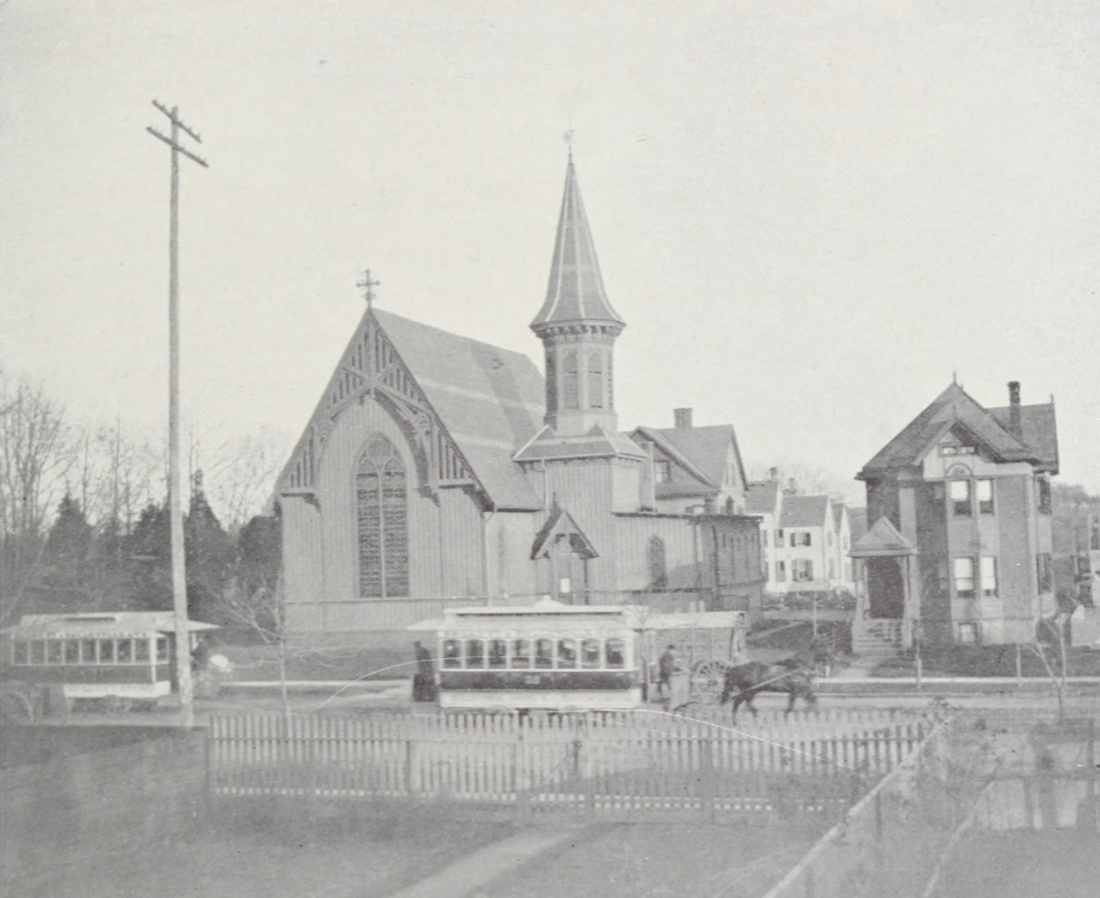
Christ’s Church, Washington And Delevan Avenues. The first building of this congregation and the third church to be organized in the house of Mr. C. C. Hine. Note the horse cars.
During the summer of 1872 arrangements had been made for the erection of a neat chapel on an elevated piece of ground on Washington avenue and work on the same commenced. The building was completed during the following Spring and worship was begun therein on the 2d day of March, 1873. The house was dedicated shortly afterward (March 9th), Revs. Terhune, Strong, Abeel, Hart and the pastor, Dr. Macauley, taking part in the services. The stained glass used in this building was a Woodside production, made by George Laerter in a small place in the neighborhood of Washington avenue and Halleck street.
DR. MACAULEY THE FIRST PASTOR OF CHRIST CHURCH.
On the 5th of March, 1873, at a meeting attended by all the elders and deacons, it was resolved to repeat the call to Dr. John M. Macauley, to become the settled pastor of the church. A committee was then appointed and instructed to proceed with that duty in conformity with the usages of the Reformed Church. The call was duly drawn up and, on the 31st of December, 1873, a meeting, moderated by Rev. Dr. J. P. Strong, of Belleville, was held, at which the instrument was completed and signed and ordered to be placed in Dr. Macauley’s hands for approval prior to presentation at the next regular meeting of classis.
DR. JOHN M. MACAULEY.
On May 3, 1874, Dr. Macauley was installed pastor of the church. The Doctor was a man of rare education, a delightful companion with a brilliant mind and a forceful and graceful method of speaking; a pulpit orator of the old school, trained in gesture, word and manner as well as mind. Will Cumming, of the River road, then a young man studying law, and himself unusually clever, used to come regularly to the Sunday morning service in order to study the Doctor’s polished manner and language. The Doctor was one of the very few who could preach a long sermon and hold the close attention of his audience to the last word.
TWO UNMENTIONABLES.
After the Doctor came two who covered a period extending from 1881 to 1894, and concerning whom little that is agreeable can be recorded. However a search of the church records shows that on December 8, 1888, a bill for fertilizing the church lawn was submitted by the pastor and ordered paid; thus we see that his labors were not all in vain. During this period the church building was moved from No. 215 Washington avenue to the present location and a parsonage was erected in the rear.
REV. ISAAC VAN WART SCHENCK.
As is well known it is easier to get an old man of the sea on one’s back than to get rid of him, but the spell was finally broken when, on August 13, 1894, a call was extended to the Rev. Isaac Van Wart Schenck, who proved to be the opposite in every respect of his two predecessors. Mr. Schenck was a whole-souled man who always gave his best to the church and he was greatly beloved by Mr. Hine.
It is interesting to note that the first trolley car ran through Woodside on the first Sunday that Mr. Schenck preached in the church.
REV. HENRY MERLE MELLEN.
Mr. Schenck was succeeded by the Rev. Henry Merle Mellen in September, 1900, and, under his administration, the present church edifice was erected, the success of this enterprise being largely due to Mr. Mellen’s exertions.
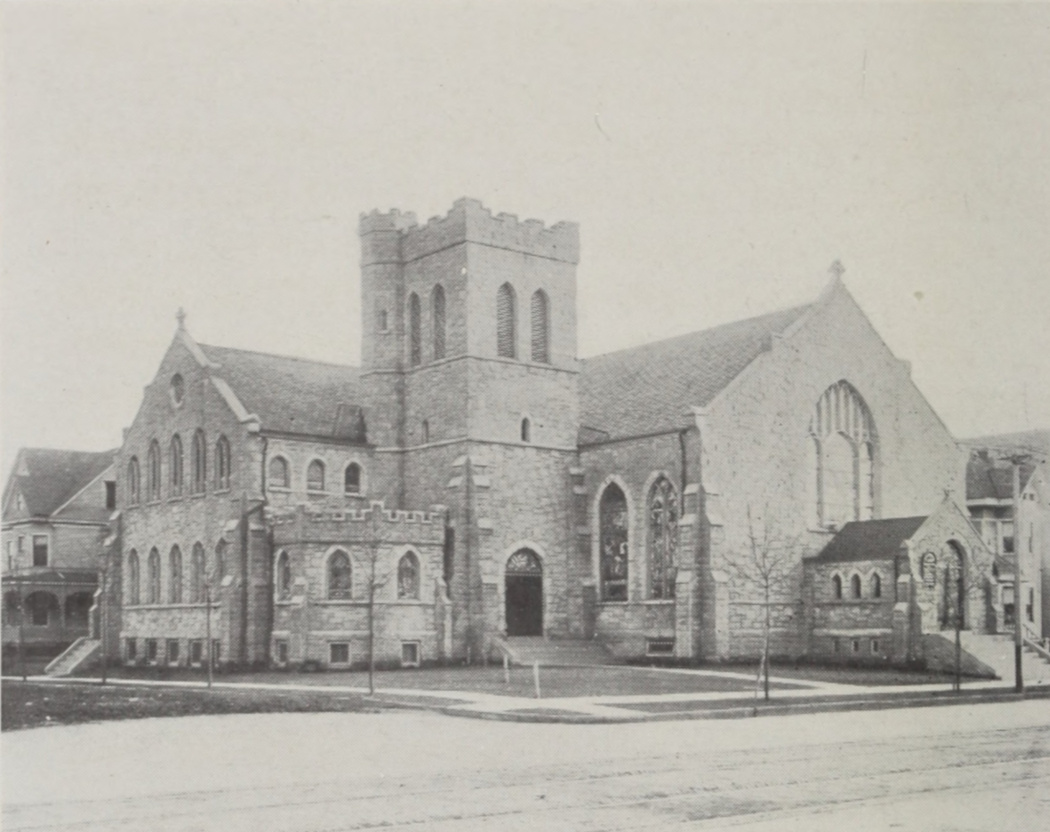
Christ’s Church, Washington And Delevan Avenues. The second church edifice of this congregation. Erected 1906-7.
On December 6, 1903, the mortgage of $1,900 on the old church property was burned and the church cleared of all indebtedness.
February 4, 1904, the question of erecting a new church edifice was publicly discussed by the congregation, and the minister was instructed to appoint a building committee of twenty members.
March 10, 1904, the building committee met and organized with Judge Alfred F. Skinner as chairman, William B. Abbey as secretary, and George S. Bruen as treasurer. It was decided to limit the cost of building and furnishings to $25,000.
April 29, 1905, Charles G. Jones of Belleville was selected as architect.
March 20, 1906, it was decided to move the old building to the back of the lot.
April 12, 1906, ground was broken for the new building.
June 14, 1906, the corner stone was laid under the auspices of the Classis of Newark.
January 20, 1907, the new church was opened for worship.
January 21, 1907, the building was dedicated.
Memorial windows to the memory of Mr. C. C. Hine and Mrs. Mary H. Hine, to Mrs. Anna W. Hine and to the parents of Mr. Mellen, the minister, were placed in the building.
The cost of the new church complete was a trifle over $46,000.
This brief outline by no means tells the story. As before stated, the inception of the church is due to the Rev. Henry Merle Mellen, and the raising of money was also largely due to Mr. Mellen’s activity and unselfish devotion to the cause. The building committee was more than fortunate in its chairman and members, and the result of their work is an ornament to the locality.
INCIDENTS OF THE EARLY DAYS OF THE CHURCH.
During the very early days of the church on the hill, sexton Budd introduced his patent gasoline lamps for lighting purposes, and no doubt was proud of his accomplishment, but why the crazy things did not blow up the first time they were lighted is the chief mystery of the situation. As nearly as we can recall the outfit consisted of the ordinary glass font with a small metal tube at the top through which the vapor arose, which gave light when a match was applied. These did not stay long, for Mr. Hine, who was an insurance man, very shortly discovered their possibilities.
The lighting of Christ Church was first accomplished with kerosene lamps, there being no gas in the neighborhood then, except that made on the premises of Mr. Hine for his own house. It occurred to that gentleman that he could attach the church (which then stood on the lot adjoining his home) to that same gas machine, and thus do away with the dim and troublesome kerosene burners.
The idea was good, but the pumping machinery which forced the flow of gas through the pipes was inadequate for the extra work and, as a result, the pump must be wound up by hand two or three times during a Sunday evening. This usually fell to the lot of the small boys who did not go to evening service, they being strictly charged to visit the cellar every thirty minutes or so and do the necessary work; but small boys had a way of getting sleepy in those days, and there is a tradition that Mr. Hine, being warned by the gradual dimming of the lights, had to leave the church in a great hurry occasionally and operate the pump himself.
THE CHURCH CHOIR.
Mr. Hine was musical to his finger tips and found great enjoyment in the practice of the art. In his youth he composed a number of songs and ballads which were published in St. Louis. Naturally he had charge of the church music, and among the pleasantest experiences of his life were the choir rehearsals, and particularly was this the case when Mr. Jay Ten Eyck presided at the organ and the quartet choir consisted of Mrs. F. W. Schmidt, Mrs. Dr. J. E. Janes, Mr. Harrison I. Norton and Mr. Hine. One who knew him well at that time has said that “he was just like a boy going to a ball game when he came down to the church on choir rehearsal nights”, such was his enthusiasm.
The selection and preparation of special music for Easter and other occasions gave him the most keen delight. At such times he would come home with an armful of carols and spend evening after evening trying them, usually with his flute, his daughter-in-law being at the piano. The possibilities were then taken up by the choir and the resulting music was reasonably good, though considerable good natured fun was poked at the choir-master on one occasion, at least, when, after having labored earnestly over a long Easter Sunday anthem the domine immediately began his prayer with, “Oh, Lord, we thank Thee that it is finished”.
Mr. Hine was notably successful with the Sunday school music, having a peculiar faculty for arousing the enthusiasm of children. His “Now, children!” brought prompt and complete attention from all, and he was so absorbed himself in the work and was so much a part of it that the children abandoned themselves to his sway and responded with a gusto that made the singing of the school a great feature.
WOODSIDE, 1868-9.
Woodside was set off from Belleville in 1868 and lasted as an independent town just about two years. Again I fall back on Mr. Swinnerton, who was town clerk both years, for details. He says:—
“When the new element came it found a lot of old-timers, very glad to welcome us and to benefit by the church and Sunday school privileges, but unwilling to spend any money for street or sidewalk betterment. Belleville contained many of the same sort, but there were some there who helped us secure our set-off into a township.”
WOODSIDE TOWNSHIP.
UNION TICKET.
For Judges of Election,
CHARLES AKERS,
EDWARD P. SNOWDEN,
HORACE B. NICHOLS.
For Assessor,
NATHANIEL J. CRANE.
For Collector,
JAMES S. GAMBLE.
For Town Clerk,
JAMES SWINNERTON, JR.
For Justice of the Peace,
ELIAS OSBORN.
For Town Committee,
CHARLES AKERS,
MILES I’ANSON,
JOSEPH I. DOWLING,
HORACE CARTER,
JOHN McMULLEN.
For Commissioners of Appeal,
JOHN C. BENNETT,
EDWARD G. FAITOUTE,
JOHN I. BRIGGS.
For Chosen Freeholder,
CHARLES AKERS,
HORACE H. NICHOLS.
For Constables,
JOHN BURKE,
BETHUEL MUNN,
PHINEAS M. SMITH.
For Surveyors of Highways,
TRUMAN H. ALDRICH,
GEORGE K. HARRISON,
JOHN C. BENNETT.
For Pound Keepers,
NATHANIEL J. CRANE,
JOHN C. BENNETT,
JOHN I. BRIGGS,
JOHN McDONALD,
GEORGE K. HARRISON.
Road Tax $4,000 00
School Tax, per child 3 00
Poor Tax 500 00
Dog Tax, as the law allows.
Incidental Expenses 500 00
“The village had scarce gained its independence, however, when it was saddled with a heavy debt in the shape of bonds for the Midland (now Greenwood Lake) Railroad. This made it imprudent to attempt the raising of money for local improvements, but the year Mr. Hine was on the Town Committee $4,000 was raised for street improvements and divided between the five districts of River road, Washington avenue, Back road, Bloomfield road and the cross road in Woodside. Mr. Hine spent $600 in making a gravel walk from the cemetery to Carteret street, and gave the remaining $200 to General Cumming for use on the Gully road.
“Our portion went to Soho (which appears to have been then a part of Woodside). The others stirred the ground a little, leaving the mud as deep as ever.” Woodside was an awful mud-hole in wet weather.
The Town Committee met at night, usually in the house of Mr. Swinnerton, Town Clerk; none but the town officers attended these meetings. The two annual town meetings were held in a small hall on Washington avenue, opposite the Morrison & Briggs carpenter shop; this hall burned later. Two or three informal meetings were held in a small carpenter shop standing in Mr. Swinnerton’s yard, on the northeast corner of Elwood and Lincoln avenues (this was the first Morrison & Briggs shop). Here Woodside was given its present name.
So far as can now be recalled the Town Committeemen were General Cumming, for the River road; Mr. Hine, for Washington avenue; either Mr. Phillips or Mr. Faitoute, for Lincoln avenue; Charles Akers, for the Bloomfield road; “a fine, old Irish gentleman for Soho”, and Joseph Dowling for the cross street. James S. Gamble was Treasurer.
A WOODSIDE TRAGEDY.
Possibly the only tragedy connected with Woodside was the shooting of Albert D. Richardson on December 2, 1869. Mr. Richardson was a celebrated newspaper correspondent and an author of some note. He had traveled over a large part of the United States and had settled in Woodside because of its rural beauty, having purchased the house built by Miles I’Anson, which now stands on Summer avenue, facing Chester.
A Mrs. McFarland, who was later known to literature as Abbie Sage Richardson, and who came of a good Boston family, married Daniel McFarland, the black sheep of a prominent New York family, and, after supporting him for a reasonable length of time, she secured a divorce. Mr. Richardson assisted her in establishing herself, and about this time McFarland, while under the influence of liquor, met him in the office of the Tribune and shot him down. Richardson was removed to the Astor House and lived for a week. He was a widower with three young children and, desiring Mrs. McFarland to look after them, he married her while on his deathbed.
WOODSIDE AND THE STREET CAR.
From the beginning and up to comparatively recent times Woodside has been compelled to make a continuous fight for proper street car service.
The first car track laid extended from the cemetery to Orange street, where it met the track which had been laid in 1862 from Market street. There was but one car, and that was pivoted on the trucks so that, a king bolt being drawn, the body of the car was swung around while the trucks remained on the track—this instead of reversing the horses to the other end of the car, as was done later. About 1865 the tracks were extended north through Woodside to Second river, to what was then known as “Flanigan’s station”, and for six years they went no further.
It was many years before the Woodside section was treated as part of the main line, all sorts of bob-tail excuses being offered us. Cars would come as far as the “Pump” (cemetery), and there passengers could wait for the “bob-tail” or walk as they saw fit. There was no shelter against the winter’s storm or shade from the summer sun. “Old Mose”, who watered the horses at the pump, which stood just about where the Washington avenue sidewalk on the west now ends, was possessed of a movable bench which followed the shadows of the trees as the sun made its daily progress through the heavens, and this was the only spot whereon to rest our weary bones while waiting. Mose was a good natured old soul whom every one liked, and was as much of an institution as was the old West-farm pump from which he drew the water for the horses. His “Now, William, let her propel”, when it was time for a car to start, became a by-word.