PART II. (continued 2)
Reading edition
Naturally those living in Woodside were always grumbling at the poor car service furnished, and there was a constant fight with Mr. Battin, and later with Mr Barr, and many a delegation descended on the Board of Aldermen, and almost invariably its head and front was Mr. Hine who, while he loved peace, did not believe in peace at any price. The company’s charter required that all cars should run to the city line (Second river), and Mr. Hine, with his wonted energy, at once inaugurated an active campaign by writing to the papers as well as stirring up the City Fathers, and by dint of his “sticktoitiveness”, as he called it, he won his point and the octopus was forced to loose his tentacles and be subject to the law governing its agreements.
In this connection a friend writes concerning Mr. Hine: “I remember, of course, his prominence in our town meetings and meetings after Woodside became annexed to Newark. He was the best speaker by far in our section, and better versed in parliamentary rules, so that he kept the meetings in better order than they would otherwise have been. He had a great faculty of leading people to state their views, thus getting a subject well ventilated and adding much interest to a meeting. In consequence of his great ability for speaking he was always chosen leader of our citizens’ delegations whether to the City Fathers for better horse car facilities, or to the Erie Railroad officials for improvements on that ‘system’.”
NOTES ON MR. HINE’S CHARACTER.
Mr. Hine’s character was of a grade not often met with. I was with him probably more than any one else, as for many years we came and went together morning and night and were closely associated during business hours, and I can in all truth say that never once have I heard him utter a word, even by implication, that could not have been uttered in any presence, nor did I ever hear him gossip of his neighbors nor offer a criticism of any one not present except once, and that was so gentle that, had it come from another, it would have passed unnoticed. In this one case he referred to an erratic genius who played the church organ for many years, and who sorely tried his patience.
But it must not be supposed that because of his gentle ways Mr. Hine could not fight. Nothing could stop him when a sense of duty impelled; not even the fear of death—if he ever had any such fear. As an instance: When traveling for the Ætna Insurance Company Mr. Hine, shortly after his marriage, and when a wife and baby were dependent on him, was sent to a town in Arkansas to establish an agency for the company, being instructed to select a certain man if he was found to qualify.
They met and Mr. Hine, being satisfied, gave the man his commission as agent, but during the following evening he discovered that his new appointee had celebrated by getting drunk, and immediately concluded to take up the agency. Those acquainted with the man, however, insisted that he do nothing of the sort, stating that his agent was a fire eater, who would accept it as a personal insult and would shoot.
Mr. Hine believed that only a coward carried arms and never did so himself, though he had been much in the Southwest and recognized the small value put on life (this was about 1857 or 8). However he saw what he believed was his duty and, while admitting later that he faced the man with considerable fear of the consequences, he did face him, and as briefly and with as little sting as possible, stated his reasons for withdrawing the commission. Strange to say the “fire-eater” acknowledged the justice of the move and expressed himself as sincerely sorry at the outcome. Only the highest class of courage can compel a man to face such a situation.
I once by chance heard him tell an individual himself that he was either a knave or a fool, but neither knew that the remark was overheard, and Mr. Hine never again spoke of the matter so far as I know. He could tell the man himself, if necessity demanded it, but would never speak of it to others.
His contempt for money, except for the good it could be made to do, was genuine and deep seated. His charities, considering his limited income, were boundless, as evidenced by his check stubs after his death. An examination of these showed merely that the $50 or $100 had gone to “an old friend”, or were marked with the one word “charity”. While in many cases money thus handed out was ostensibly loaned, Mr. Hine early learned never to expect its return, and he was seldom disappointed. One of his pet aphorisms, “gratitude is a lively sense of favors to come”, was frequently applied to this situation.
The fact that he was imposed on and defrauded by charity fakirs time and again never made any difference; the next time he would take chances rather than run the risk of not helping where help was needed. He often said that “he could swallow anything he could get through his shirt collar”, and his shirt collar was a mighty easy affair, as many “a friend in need” discovered.
On the other hand, no matter how much it might curtail his income by antagonizing a customer, he would hit every head in sight if he thought it deserved it, and he knew how to hit—none better. He had a way of grasping a situation and clarifying its follies or crooked features that was at times merciless.
As before stated, Mr. Hine’s opportunities for school education were limited in his youth. On the other hand, his knowledge was almost universal. How he kept abreast of the times as he did was a mystery, even to his own family, for he had no time to read, beyond his morning and evening paper between home and office. His evenings, when not filled with church matters, were largely taken up by those who were ever calling on him for help and who never went away without receiving the best he had to give, whether they were young or old, or the poorest of the poor. He would explain a matter to a child with as much courtesy and patience as to an adult.
On one occasion when he was confined to the house with some slight indisposition a small girl appeared at the back door with a straggling bunch of field flowers in her hand and handed it in with the simple message, “Tell Mr. Hine that I love him”. Hardly anything could have touched the recipient more deeply, and yet that small girl voiced a sentiment that was almost universal among those who knew him best.
Mr. Hine was as punctilious in doing for his own boys as for the church, and while he believed in making them earn those things they desired, that they might the more fully appreciate them, he always stood by his agreements, not only in letter but in spirit. His idea seems to have been to make the boy feel satisfied that he had been given a square deal. Possibly one or two small instances will do no harm here:—
One of the boys once saw a velocipede in a Newark store that he thought he wanted, and began to save his money for that purpose. As I recollect it, the machine was to cost $12. In the meantime the father saw one in New York for $10 that looked to him just as good, and told the youngster about it, and announced that he would bring it out. On arrival it proved to be a size or two smaller—a $10 size—and the boy was disappointed, but instead of telling him it was just as good, he seemed to get down to the lad’s level and appreciate that it was a matter of importance to him, and he made good without a hint of grumble at the extra trouble involved in taking the machine back and bringing out the larger one, and he paid the added $2 himself. He had said he could get one just as good for less money. He seemed to expect no particular thanks, merely giving the impression that he was only doing what he had agreed to do.
Mr. Hine’s eldest was probably born with a streak of tar in his composition, for he has been an ancient mariner ever since I first knew him. No sooner was the boy large enough to run around a bit than he wanted a row boat on the river; but his father promptly responded to such a proposition with, “No, young man; not until you can swim across the river”, evidently in the belief that this was still some seasons off. But the lad wanted the boat, and the moment he could stand the temperature he was in the river, and generally several times a day (his mother never suspected how often), and by hard work and much persistence he managed to get the hang of the thing long before the summer was out, and one day announced that he could swim across the river and wanted the boat.
Naturally his father was a bit incredulous, but they went to the water’s edge, and while the elder hired a boat at the Point House, the son retired to the privacy of the Melius dock and stripped for the ordeal. His clothes were put in the boat and the two started, and you can be sure that the father kept close by in case of accident, but there was none, and the boy got across all right. Then his father asked if he could swim back, and he said he would try, and did.
No sooner were his clothes on again than he said: “Now, can I have that boat?” and quite as promptly came the answer, “Yes; we will go down town now and get it”. There was no quibbling or hesitation or delay, and no matter how the father may have felt in allowing his small son to have a boat, he had given his word and that settled it, and within the hour the lad was rowing up the river in his own boat, as proud as any small boy could be and without any idea of the situation except that both parties to the bargain had lived up to it.
His methods of punishment were usually well fitted to the occasion. I still recall one instance with a clarity of vision that omits no detail. Mr. Hine was left in charge of the Winser premises during the absence of that family in Europe and, during that portion of the year when “sling shots” are in vogue, a group of young highwaymen, of which the younger two hopefuls of the Hine family were members, thought it was fine fun to sling stones between the blinds of the Winser house, then vacant, and hear the glass smash. But one day Mr. Hine discovered what was going on, and appointed himself a committee of one to investigate. He made no fuss whatever—just said we would have to replace the glass. It made no difference that others besides ourselves had helped in the mischief; if the others would help to pay for it that was all right, but none of his affair. Of course few of the other boys could see the thing from our point of view, and it took just about all of our little hoard, which had almost reached the point where we could purchase a greatly desired printing press, to pay for the damage. It was a cruel blow, but we never broke any more glass.
Mr. Hine, just as a matter of course, did any little thing he could for friend or neighbor; it never occurred to him to hesitate when he saw the opportunity.
When the matter of a station agent was first being agitated for the Woodside stop on the Newark branch of the Erie, one who thought he wanted the job fixed up a petition and went to the depot one morning to secure the signatures of such commuters as he knew. Seeing Mr. Hine and hoping for his name to head the list, he offered the paper to him, asking that he sign it if he approved. After reading Mr. Hine not only signed, but himself took the paper to every man present and insisted that each one sign, responding to those who objected that they did not know the young man, that he did, and had known him almost all his life, and knew he was safe to indorse. The result was that twice as many signatures were secured from that group as were hoped for. It was a small thing, but the prompt and hearty way in which it was done made it a benediction, and that man still thinks of Mr. Hine with pleasure and likes to tell why.
MRS. MARY HAZARD AVERY HINE.
Mrs. Mary Hazard Avery Hine was born in Westport, Conn., January 29, 1821. Her parents removed to the West when she was a young woman, and she met Mr. Hine in St. Louis, Mo., and there married him. Mrs. Hine was educated in New Haven, receiving the best schooling which that city could give a girl eighty odd years ago, and she grew up under favoring circumstances. She was a woman of fine mind and great breadth and strength of character, and a recognized leader.
Mrs. Hine was the third president of the Y. W. C. A. of Newark, and remained at its head through the many trying years of its youth, and when it was a very different institution from the present and very differently managed. She was also for many years president of the New Jersey branch of the Women’s Indian Association, and one of its most active members.
Nearer home she organized and conducted a Zenana Mission Band which, in itself, would have been considered work enough by most women and, in addition, she carried on a large Bible class in the Sunday school—all this without interfering in the least with her household duties, which she was slow to delegate to others.
THE ZENANA MISSION BAND.
The Zenana Mission Band, which was started by Mrs. Hine, became quite an institution, with its bi-weekly meetings and annual fair, which were held in the home at 209 Washington avenue. Just when it was begun, or how, I am unable to state, but it was many years ago, and the meetings were only stopped when advancing years compelled Mrs. Hine to give up the responsibility.
The meetings began early in the fall and lasted the day out. These continued until a fair was given during the following May or June, at which time the entire lower floor of the house was stripped of its furniture and devoted to the event. Tables and booths for the sale of all manner of articles, from embroidery to ice cream, being erected in every available corner.
Mrs. Hine designed the embroidery patterns used and both she and Miss Avery, being expert with the needle, began the pieces and set the pace for the others, they having been brought up at a time when household duties and the finer uses of the needle were a part of every girl’s education. Some of those with whom I have talked look on the educational value to those who came to these meetings as possibly the more important feature, believing that many of the young women who attended would never otherwise have had their taste and skill for such work developed, for the embroidery was most rich and elaborate, requiring exceedingly careful manipulation.
When the fair fell on rainy times and the fancy goods did not go off as desired Miss Avery would take a bundle of the best to New York and there dispose of the articles among her friends, for just about so much money was wanted to send out to India each year, and if it did not come it must be gone after.
MISS JANE A. AVERY.
In this connection I cannot forbear from a brief word concerning Miss J. A. Avery, Mrs. Hine’s sister and aid in all good works. Miss Avery was one of the most lovable persons I have ever met, her self-sacrificing spirit and constant thought of others being most marked. And with a saintly spirit she had an attractive personality quite beyond the ordinary.
She has been compared to a bit of delicate Sevres china, and possibly that is as good a comparison showing her daintiness as could be made, but Miss Avery was something more than merely attractive; her devotion to any duty in hand was such that she never had a thought of fear, nor did she allow the discomfort of pain to interfere. Before the day of trained nurses she was caring for an uncle—Judge Edward Avery of Massillon, Ohio—who required constant attention, and while so engaged the bones of one foot were crushed by the falling of a heavy iron. The doctor insisted that she must not stand on this foot, but this injunction she felt it was impossible to obey, and made that same doctor whittle out a thin board and bind it to the injured foot, and thus she hobbled about in constant pain, but giving the unremitting attention required by her patient.
One who knew Miss Avery well for many years writes that she “was one of those rare characters whose mission it is to bring comfort and cheer to their fellows. She was one of those large natures of whom Goethe says, ‘They impress not by what they do, but by what they are’.
“Wherever she went she was welcome; she had the remarkable faculty of seeing at a glance what was needed, and without a word doing the right thing, the wonderful gift of tact which, with a loving nature, makes the possessor a tower of strength. So winning was her personality that she made friends wherever she went, and always said laughingly that she could travel all over Europe with only her mother-tongue.”
It is impossible at this date to go into details concerning all those who were active during the early days of this period, but there are a few in regard to whom I have been able to secure some bits of information.
MR. HORACE H. NICHOLS.
Mr. Horace H. Nichols was a man who left his impress on all those who came in contact with him. Mr. Nichols was a carpenter and builder in Newark before his removal to Woodside. He secured the contract for fencing the cemetery and that brought him this way, and the beauties of the country gave him a longing to turn farmer, and so he bought a considerable tract here in 1846, and in 1852 built the white house which still stands back from the road. Here he started the growing of fruit, and was very successful, as many of us can testify.
Mr. Nichols had the character of a saint and, while not an aggressive man, was always ready “to dig down in his jeans” whenever the church called for help, and was ever looking for the opportunity to do his share—rather an unusual trait.
REMINISCENCES OF MR. HENRY J. WINSER.
Mr. Henry J. Winser was not with us during much of the very early period, owing to his appointment as consul at Sonneberg, Germany, during the eight years when Grant was President, and also through the term of President Hayes, and he had little opportunity for local activity.
Mr. Winser’s earliest experience in the War of the Rebellion was as military secretary (with the rank of first lieutenant) to Col. Elmer E. Ellsworth, whose blood was the first shed in the war.
The friendship with Ellsworth began in 1855 when he came to New York, a youth of seventeen, from his home in Saratoga County, hoping to be appointed as cadet to West Point. In this, however, he was disappointed, as the politicians desired the places for their friends’ sons.
He then began the study of law in Chicago, but also kept up his study of the art of war and, becoming impressed with the tactics of the French Zouaves during the Crimean War, and being well known in military circles in Chicago, it was an easy matter for him to form a company. This was organized as the Ellsworth Zouaves, and was composed of the flower of the youth of Chicago.
The fame of the “Chicago Zouaves” had become so widespread that a year or two before the war Ellsworth was asked to bring his men East, and so great was the enthusiasm over their exhibition that Colonel Ellsworth’s methods were soon widely copied.
At the time of Mr. Lincoln’s election to the Presidency, Ellsworth was employed in his law office. He accompanied him to Washington and remained near the President during the unsettled period which followed the inauguration. He was among the first to obtain a military commission from President Lincoln, and was sent to New York with instructions to form a regiment from the ranks of the Volunteer Fire Department of the city in the shortest possible time.
Mr. Winser was impressed into the service on this occasion. In a very short time Ellsworth had twelve-hundred men enlisted and mustered into the service of the United States under the call for three months’ volunteers, and in the extraordinarily brief period of three weeks from the time he arrived in New York he marched at the head of a thousand well-equipped men to the steamship at the foot of Canal street. On reaching Washington this body of raw recruits was at first given quarters in the Capitol building, owing to lack of camp equipage.
There were many anomalous things connected with the organization of the volunteer forces in the early stages of the war, and not the least anomalous was the fact that Ellsworth appointed Mr. Winser his military secretary, with the rank and uniform of first lieutenant.
The advance into Virginia had been determined upon and instructions were given to embark at two o’clock in the morning for Alexandria. Ellsworth then entered the tent which he and Mr. Winser shared and asked the latter to get some sleep while he finished his final arrangements. Then it was that he wrote that brief, but pathetic letter to his parents which drew tears from many unaccustomed eyes after it was published. The letter is in an old scrapbook of Mr. Winser’s, and reads as follows:—
“Headquarters First Zouaves,
”Camp Lincoln, Washington, May 23, 1861.
“My dear Father and Mother:—
“The regiment is ordered to move across the river to-night. We have no means of knowing what reception we shall meet with. I am inclined to the opinion that our entrance to the city of Alexandria will be hotly contested, as I am just informed that a large force has arrived there to-day. Should this happen, my dear parents, it may be my lot to be injured in some manner. Whatever may happen, cherish the consolation that I was engaged in the performance of a sacred duty, and to-night, thinking over the probabilities of the morrow and the occurrences of the past, I am perfectly content to accept whatever my fortune may be, confident that He who noteth the fall of a sparrow will have some purpose even in the fate of one like me. My darling and ever-loved parents, good-bye. God bless, protect and care for you.
ELMER.“
Just as daylight was breaking on the morning of the twenty-fourth of May, the steamers carrying the Ellsworth Zouaves arrived at Alexandria. The commander of the sloop-of-war Pawnee, which lay off Alexandria, had already proposed terms of submission which had been accepted by the city, and it was supposed that there would be no resistance to the occupation of the town.
The following is Mr. Winser’s account of what occurred:—
“Ellsworth was the first to land, and then Company E, Captain Leveridge, formed upon the wharf. Without waiting for the remainder of the regiment to disembark the Colonel gave some hurried instructions for interrupting the railroad communication and, calling to me, said: ‘Winser, come with me to the telegraph office. It is important to cut the wires.’ Mr. E. H. House, correspondent of the New York Tribune, had accompanied the expedition, and he and the Rev. E. W. Dodge, chaplain of the regiment, who were standing near, asked if they might go with us. We had gone only a few paces when I suggested to Ellsworth that perhaps it would be well to take a squad of men as an escort. He assented at once and I soon overtook him with a sergeant and four men from Company A. We ran up the street for about two blocks on a double-quick in the supposed direction of the telegraph office, meeting a few sleepy-looking people on the way. The Colonel at this moment caught sight of a large Confederate flag which had just been raised above the roof of a building apparently two or three blocks distant to the left. He at once said: ‘Boys, we must have that flag!’ and told the sergeant to go back and tell Captain Coyle to follow us with his entire company.
“Not heeding the mission to the telegraph office for the moment, we pushed on toward the building with the flag flying over it and found it was the Marshall House, an hotel of second-class grade. As we rushed into the open door the Colonel called out to a man in shirt and trousers who was entering the hallway from the opposite side: ‘What flag is that over the roof?’ The fellow looked neither surprised nor alarmed at the irruption of armed men, and answered, doggedly as I thought: ‘I don’t know anything about it; I am only a boarder here.’ Without further parley the Colonel ran up the long winding stairway to the topmost story, the rest of us following closely. It did not take long to find the attic room, whence opened a skylight with the flagstaff within easy reach, and the large flag was soon upon our heads.
“I passed it down to the men below, and as I got off the ladder I saw the Zouaves tearing off pieces as mementos of the exploit. This I stopped, saying that the flag must not be mutilated, but must be preserved as a trophy. The entire occurrence could not have occupied more than a couple of minutes. I was busy rolling the long flag over my arm when Ellsworth turned to the stairway holding one end of the flag. He was preceded by Private Francis E. Brownell, of Company A. Mr. House and Chaplain Dodge were close beside him, and I was a few steps behind, still rolling the flag on my arm as compactly as possible. There were two men in the attic room whom we had not noticed at first in our eagerness to get down the flag. They arose in great bewilderment to witness our deed and were almost fully dressed. They had, however, no connection with the tragic event.
“In the order I have mentioned we began our descent of the broad, winding stairway. My attention was too much occupied in managing the bulky flag to know by actual observation precisely what happened in the first instant of the lamentable tragedy. I heard the clash of weapons and at the same moment the report of two guns, with so imperceptible an interval between that it might have been taken for a single shot. I saw Ellsworth fall forward at the foot of the first flight of stairs, and I saw Brownell, standing on the landing near the turn to the second flight, make a thrust with his bayonet at the tottering form of a man which fell headlong down half the second flight of stairs. No explanation of what had happened was needed. As Brownell reached the first landing place, after the descent of a dozen steps, a man rushed out and, without noticing the private soldier, leveled a double-barreled gun squarely at Ellsworth’s breast. Brownell said that he made a quick pass to turn the gun aside, but was not successful, and the contents of both barrels, slugs or buckshot, entered the Colonel’s heart, killing him instantly. He was on the third step above the landing when he received the shot, and he fell forward in that helpless, heavy manner which showed that every spark of life had left his body ere he reached the floor. The murderer’s fingers had scarcely pressed the triggers of his weapon when Brownell’s rifle was discharged full in the centre of his face, and as he staggered to his fall the shot was followed by a bayonet thrust of such force that it sent the man backward down the upper section of the second flight of stairs, where he lay for hours afterward with his face to the floor and his rifle beneath him. This man proved to be James T. Jackson proprietor of the Marshall House, and I fully recognized him as the person we had met as we entered the house.
“We were dazed for a few seconds at the shocking calamity, but we rallied, not knowing how soon we should be called upon to defend our own lives. There were only seven of us, and Mr. House was unarmed. The noise and confusion of the last few moments had aroused the sleepy household, and we saw that in point of numbers we were in a small minority. I stationed the three Zouaves at points commanding the approaches to the passages converging on the stairway where we stood, and directed that the first man who showed himself in the passages should be shot down. The occupants of the rooms in our immediate vicinity were gathered together in a single apartment and Brownell, who had reloaded his rifle, was placed as guard over them with instructions to shoot the first man who should evince a hostile disposition. The Chaplain and I searched the story above, finding only the two men whom I have before mentioned as being in the attic room when the flag was cut down; these we led down and put in Brownell’s custody. Mr. House, meanwhile, had kept watch that no one approached us from the story below. These defensive measures were only the work of a minute or two.
“We next turned our attention to our dear friend, the Colonel, whose life-blood had literally deluged the hallway. If we had not been too sadly sure that he was beyond the reach of any aid we could offer there would not have been even the slight delay there was ere we raised him from the floor. Mr. House and I lifted him up tenderly and laid him upon the bed in a room that was vacant. His uniform was so drenched with blood that it was almost impossible to discover the exact location of his wound. Unfastening his belt and unbuttoning his coat we found that the murderous charge had penetrated his left breast, taking into the wound much of the clothing, making a cavity almost large enough to insert a clenched hand. Poor fellow! We washed the stains from his face, which was beautiful in death—the expression of the handsome features not at all changed, except by the pallor, from that which his friends knew so well in life, and we composed his body, over which we laid the Confederate flag which had so long waved in defiance within sight of the White House, feeling that its use in this way purified it.”
The sword which Ellsworth wore at the time of his murder was given to Mr. Winser and is still in the possession of the family.
Mr. Winser was at the battle of Cold Harbor and had his horse shot under him. After the battle, during the night, a rifle ball lodged in the tent pole directly over his head, so low down that it must almost have passed through his hair, but so exhausted was he that he was all unconscious that death had been so near. During the Draft Riots in New York, in July, 1863, Mr. Winser was in command of the battery which protected Printing House Square. He also did effective work in communicating with the authorities on Governor’s Island, and although he was a marked man owing to his connection with the New York Times, he went fearlessly about the city looking after his friends in the sections where a reign of terror had set in.
Mr. Winser was once made prisoner of war by Gen. Thomas W. Sherman, who was in command at Beaufort, S. C. Mr. Winser had criticised his methods in a letter to the Times. This so angered the General that he caused his arrest, sending him on board the Arago, which was just leaving for New York, without permitting him to communicate with any of his friends. The publication of the affair resulted in Mr. Winser’s reinstatement at headquarters in South Carolina.
Mr. Winser was with Farragut at New Orleans, as a representative of the Times. In those days the means of communication were exceedingly slow, and Mr. Winser, recognizing the value to his paper of such a “scoop” as the first news of this important event would be, rowed down the Mississippi from Fort Jackson to the Gulf, where he found a schooner bound for Key West. This he boarded, and reached his destination a few hours ahead of the steamer from Havana, Cuba, which touched here for mail and passengers on its way to New York.
Thus the New York Times had an account of the bombardment and surrender of Forts Jackson and Phillip three days in advance of any other journal. This was considered the greatest “beat” ever known in the history of journalism. It was not only the means of giving the news to the country, but was also the first intimation that the government itself received of the success of the fleet. Mr. Winser returned to New Orleans and was there during the Butler regime and chronicled the General’s achievements for his paper.
Mr. Winser was also present at the meeting of Grant and Lee under the famous apple tree to arrange for the surrender of the Confederate Army.
He was one of the commissioners for the exchange of prisoners from Andersonville, and his reports of the condition of the men were most harrowing.
When the famous Butler-Porter controversy occurred in 1889, it was Mr. Winser who was able to prove that Butler’s charges against Porter were untrue.
When Mr. Winser sent his report of Farragut’s passage of the forts below New Orleans (as narrated elsewhere), fearing there might be a miscarriage, he wrote a second account which was forwarded by the same steamer that carried the letters of other newspaper correspondents. This latter manuscript was returned to him and hence, when Admiral Porter wrote, asking him if he remembered the circumstances of the sudden order from Captain Porter to the flotilla to cease firing and return, Mr. Winser was able to give a transcript of the affair from his manuscript letter.
It was a great grief to Mr. Winser that General Butler should have placed himself in so unpleasant a position, for he had valued him as a friend and soldier, and was most reluctantly brought into the controversy.
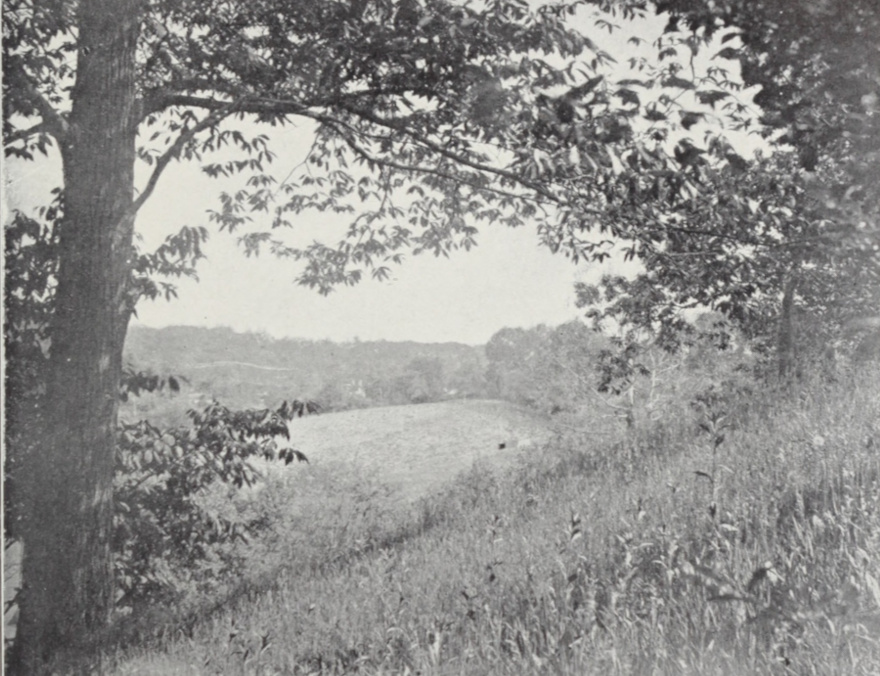
Woodside As God Made It. Picture taken about 1885 from a Washington Avenue back yard. Looking south across the fields toward the Passaic.
When he settled in Woodside Mr. Winser was city editor of the Times and was deep in the investigation of the Tweed Ring. This work was so exacting that he had no time even to attend to his own private affairs, and paid little attention to Woodside politics, except in one instance.
During the first year of Woodside’s independence there were no politics; no salaries attached to any of the offices, and consequently the good men were allowed to fill them. But by the time the second annual election approached there were a few soreheads who joined themselves unto the scattering Democrats and the house was divided against itself.
This necessitated some electioneering, which was undertaken by Mr. Winser and Mr. Theodore G. Palmer, who went the rounds of the district canvassing for votes. The result was overwhelmingly Republican and eminently satisfactory.
Mr. Winser broke down in January, 1869, and was told by the doctors that he must stop night work. He was advised by a friend to apply to General Grant for a consular position, and Sonneberg was suggested for its beauty of location and the wide field it offered for consular and other work, as it was the largest consulate in Germany.
Mr. H. J. Raymond, of the New York Times, was bitterly opposed to this and refused to help in any way, declining even to write introductions to his political friends in Washington or to request their aid in the appointment. Mr. R. said: “I do not want you to leave the Times and I shall in no way help you in your desire.”
But after Grant’s inauguration Mr. Winser wrote, asking for the Sonneberg post, and his was the first appointment made after March 4, 1869.
Secretary of State Hamilton Fish was a friend of Dr. Cox, father-in-law of Mr. Winser, and knew his (Mr. Winser’s) record as a journalist, and this doubtless was a help. Mr. Winser’s appointment was regarded as most remarkable, in that politics and pressure had nothing to do with it. Grant made it because he was a personal friend and the State Department probably sanctioned it because, in the application, Mr. W. said that he spoke three languages and referred to his Times editorials upon political matters.
While consul at Sonneberg Mr. Winser was appointed by the United States Government, Commissioner to the World’s Fair at Vienna in 1873.
When Mr. Winser returned from Sonneberg in 1873, intending to resign, Mr. Fish urged him to reconsider his decision and return to his post to go on with the work he had done for the government.
Mr. Winser was the first American officer to look into the emigration from Germany. He stopped the deportation of criminals from Germany to this country. He was the first man to study the forestry system in Germany, the consulate being in the centre of the forestry department of the country. Knowing the language thoroughly and being persona grata in high official circles he had access to all departments.
He wrote a most exhaustive report on the “Forests and Forest Culture of Thuringia”, which was sent to the State Department on November 28, 1873, and is in the “Commercial Relations” of 1873. So valuable was this report deemed by the State Department that it was printed as a separate pamphlet and sent to every newspaper in the country. In his report Mr. W. urged upon this country the necessity of cultivating and preserving its forests, as the time would come when care would be needed for their conservation from an economic point of view, for the supply of timber and for the effect they produced upon the climate, rainfall, etc.
The press of this country, one and all, hailed the report with derision, it being regarded as ridiculous that this great country with its primeval forests and its vast area of timber land could ever be depleted. Even the Times feared that Mr. Winser’s four years’ residence in a little country like Germany had dwarfed his ideas.
Twenty years later when the country became alarmed concerning the fearful devastation then going on throughout its forests men were rushed to Germany to learn its art of forestry.
Mr. Winser sent the government the first translation of the new German tariff. It was received from the Coburg Minister of State within an hour after he received it from the Imperial Government, and permission to keep it for twenty-four hours was given. At 9 a. m. Mr. and Mrs. W. sat down, after giving directions that they were not to be disturbed, and at 8 p. m. the work was finished, they dividing the pamphlet book in half and each working independently of the other. This feat created a sensation at the State Department and at the Consulate General at Frankfort. Mr. Winser had taken the precaution to notify the State Department that the voluminous matter had left Coburg on a certain date. He also wrote the Consul General, through whose office all documents were forwarded, that he had done this, so that no detention could be possible on the way. It was a fortunate thing that this was done, as the Consul General wrote he was sorry that he could not keep the document for a few days that he might get “some points”. He wanted to know how it was possible for Mr. W. to obtain the law before it had been given to the public.
Mr. Winser also sent the first translation of the new laws concerning the Rinderpest to the government.
On Mr. Winser’s return from Germany he was appointed, by Mr. Henry Villard, Chief of the Bureau of Information of the Northern Pacific Railway. In this capacity he inspected all the country tributary to the railroad, writing many pamphlets on the resources of the far West. He also wrote concerning the Yellowstone Park and its wonders.
He was in charge of the foreign guests at the celebration of driving the last spike of the railroad. Later he became assistant editor of the Commercial Advertiser, and then became managing editor of the Newark Daily Advertiser. Just before his death he prepared the history of Trinity Church, Newark, on the occasion of the sesqui-centennial celebration. For nine years he was clerk of the vestry.
Mr. Winser was one of the charter members of the “Monks of the Passaic”, a literary organization affiliated with the “Monks of the Meerschaum” in Philadelphia.
Mr. Winser, Mr. Noah Brooks and Prof. Byron Matthews organized “The Wednesday Club”, which has become one of the best-known literary clubs of Newark. He was a life member of the New Jersey Historical Society.
Mr. Winser’s church and other connections in Woodside are referred to elsewhere.
MR. JAMES SWINNERTON.
Mr. James Swinnerton, to whom I owe more than to any other one man for material covering this period, was a member of Swinnerton Bros., manufacturing jewelers in Newark. He removed to Woodside in 1866, being one of the very first of the new element.
Mr. Swinnerton immediately assumed a prominent place in the community, being town clerk during both the years of local independence and taking a foremost position in church and Sunday school development. So well satisfied were the voters with his work as town clerk that, when the second annual election was held, and an opposition ticket was put in the field, he received 185 of the 192 votes cast for that office.
Mr. Swinnerton has a natural antiquarian bent and, as a consequence, has preserved many memorials and a vivid memory of the past, and such of these as relate to Woodside he has freely put at my disposal, throwing light into many a dark corner.
MR. ALBERT BEACH.
Mr. Albert Beach was born in Newark and moved to the Bartholf farm on the old Bloomfield road about 1865. He was a kindly man and had a number of boys who were always ready to help along any mischief in which we were interested, and as Mr. Beach himself was much interested in the church we were quite neighborly, boy and man. And then all boys appreciated Mrs. Beach, who was one of those who sensed the fact that a boy’s heart lay next his stomach, and who immediately established close relations with both. The Beach house was overrun with boys a goodly portion of the time, and they were not all Beach boys, either.
GEN. GILBERT W. CUMMING.
General Gilbert W. Cumming lived on the River road in the old Stimis house. The General’s property came down to the swamp where we boys learned to skate, and his rail fence was a great temptation when a fire was wanted, which was mostly all the time. It is still well remembered how, on such occasions he would come charging down the hill “spitting blue sparks”. The General’s habit of language was acquired in the army, apparently, and it generally sounded as though the army was in Flanders at the time; certainly it was of the pyrotechnic order, and no one could well blame him with such an inciting firebrand as his rail fence became. He was a thoroughly good man, however, and while he had the reputation of being somewhat crusty and quick tempered, he could be quite genial when all things worked together for peace. “He was an old-fashioned lawyer of the Abe Lincoln school.”
The General was born March 12, 1817, of Scotch parents, at Stamford, N. Y. He was admitted to the bar in New York, but removed to Chicago in 1858. When the Civil War broke out he offered his services and was appointed Colonel of the 51st Illinois Volunteers, which he was largely instrumental in raising.
Under General Pope he participated in the battle of New Madrid, Mo., and while in charge of a brigade on the way to Tiptonville his capture of Island No. 10 against great odds brought him prominently to the front. For this he was made a brigadier-general for “gallant and meritorious services at Island No. 10”.
Proceeding to Tiptonville he assisted in the capture of 6,000 Southern soldiers and later took part with his brigade in the attack on Fort Pillow. He was also at Corinth and Shiloh and was brought home from the latter on a cot, his breakdown being due to hard work and exposure. During a long rainy period he regarded himself as fortunate if he had a brush heap to sleep on, such a thing as a tent or any form of shelter being out of the question. He never fully recovered from a mild form of paralysis induced by these hardships.
During one period of his service he was placed as a guard over a Southern home occupied by its mistress. The General applied to her for permission to sleep on the porch of the house, but she promptly responded that no “Yankee” could sleep on her porch, and he was compelled to wait until all were asleep before he could venture to seek its shelter. Being a polite man, the General did not fail to thank the lady on the following morning.
He used to tell how the Yankees, after stewing their coffee again and again until there was nothing left to extract, would sell the grounds to their opponents for a dollar a pound. Johnny Reb must have been in straits for coffee.
In spite of all he went through the General was a strong temperance man, never drinking liquor, even in the army, where good drinking water was often impossible to find. The General was always to be found on the side of law and order and was the one to whom Mr. Hine went in the early days of Woodside to stop the Sunday horse cars. Ideas have changed greatly during the past forty years in regard to the observance of the Sabbath, and it may seem strange to some that a serious effort was once made to disconnect this rural settlement from the rest of the world on that day, but such is the fact. The General did get out an injunction and the peace of the neighborhood was complete for a time, but the street car people, as usual, had their way in the end.
MR. JOHN MORRIS PHILLIPS.
Mr. John Morris Phillips belonged to that generation which was the last to be born in the old farm house now standing on Summer avenue, and he appears to have been the first to break away from the traditions of the farm.
Mr. Phillips was born November 4, 1817, and early showed an inclination for mechanics. He was apprenticed to the pattern making business under Mr. Horace T. Poinier, and later found employment under the noted Seth Boyden; afterward he worked for the West Point foundry and from there came to the Novelty Iron Works, New York City, and all this time was learning and perfecting himself in every detail for future activity. His memory was so phenomenal that when he had examined a piece of mechanism its details never passed from his mind, and he could duplicate it without again referring to the original. This, of course, was a tremendous help in after life.
In the fall of 1845 the Hewes & Phillips Iron Works were started in a small way at 60 Vesey street, New York, but the following year the business was moved to Newark. The concern grew rapidly to large proportions, and by the time the Civil War broke out was one of the foremost establishments of the kind in the country and during the war it did an immense amount of work for the government.
All the turret machinery for the first “Monitor”—the one which saved the day in Hampton Roads—was made here, as was that for the five succeeding monitors including the Modoc, Cohoes, etc. That the Monitor’s machinery was well made the action at Hampton Roads amply proved.
Over 200,000 stand of arms were manufactured at the Hewes & Phillips Works, and here the government also sent 12,000 flint-lock muskets to be modernized. These, it is said, were part of a gift to the country made during the Revolution by LaFayette, which had not been used at that time.
Mr. James E. Coombes, an expert on American military small arms, writes that Hewes & Phillips did alter a number of flint-lock muskets to percussion, but he doubts if they were such obsolete weapons as those brought over by LaFayette. Mr. Coombes says: “It was the policy of the government to use only the later models of flint-locks for this purpose, as there was a vast quantity of them on hand. I have seen a number of these guns. They were stamped ‘H & P’ on the nipple lug—in fact, have two in my collection, but they are all late models.”
Mr. Coombes’s opinion is accepted by military authorities generally, but in spite of this I am inclined to think that the story is correct, because it appears to have come so straight from Mr. John M. Phillips himself.
Hewes & Phillips also altered 8,000 flint-locks for the state of New Jersey, asking nothing more in return from the state than the actual expense of the work. The machinery for the first Holland submarine was made here during the Civil War.
Owing to threats made by Copperheads during the latter part of the war that the factory would be destroyed, the place was guarded day and night by a company of infantry. At that time Mr. Phillips lived on Bridge street and his back yard adjoined the machine works, and he could step from his house to his shop without exposing himself to possible danger from the disaffected element.
Of the seventy boys and men who went out from this factory to enlist in the army every one came back, and not one received a scratch to show for his service. All apprentices who enlisted before their time was up were put to work on their return at journeymen’s wages, while serving the remainder of their time as apprentices. Thus did the firm at its own expense recognize the services rendered by these young men to their country.
That Mr. Phillips was a broad-minded and far-seeing man is not alone proven by the business foundation he laid, but also by the monument he left in beautifully embowered Lincoln avenue. His love for trees was almost as great as for human beings, and because of this Lincoln avenue is to-day as beautiful as is the traditional New England village green.
When the city saw fit to improve Lincoln avenue it did so by cutting down all its shade trees and transforming it into a dreary desolation. Mr. Phillips had in front of his house a row of cherry trees which were his pride and admiration and were also, alas, a source of considerable friction between himself and the neighborhood small boy, for the boys found it comparatively easy to adapt themselves to the Phillips cherries. I believe that their owner finally discovered that a generous coat of fresh tar on the tree trunks was as good a small boy preventive as it is in the case of certain insects. There is a tale of an expressman who took one of these tarred tree trunks to his bosom before he discovered the error of his ways, and the manner in which he blessed his tarry top-lights—so to speak—is one of the traditions of the neighborhood.
These cherry trees went with the rest, and when the destruction had been so complete that there was no further job for the contractor-friend of the politicians that functionary went elsewhere. Then Mr. Phillips called on his neighbors in an effort to enlist them in a plan to rehabilitate their street by the planting of trees but, finding most of them indifferent, he planted trees on both sides of the way, from the cemetery to Phillips Park, a double row one-half mile long, and it is these trees which to-day shelter the avenue from the summer’s sun. The trees were procured from a nursery on his own property located about where Delavan ends in Summer avenue.
MR. DAVID MACLURE.
“The memory of him is sweet and pleasant”, more than one of his former scholars testifies. Mr. Maclure is a round peg in a round hole, although he happened into his present line of work in rather an accidental manner.
He was the first clerk that the Prudential Insurance Company ever employed, but earning his bread and butter by such uncongenial drudgery soon wearied him, and he gave up the position with the idea of turning to art or to the ministry for his life work; but while in this somewhat uncertain state of mind the fates decided otherwise.
At this time he was living at the home of his parents on Lincoln avenue, and, when it was learned that the school at Montgomery was closed for lack of a teacher, a friend fairly pushed him into the opportunity thus opened. He shortly became popular with old and young, and fitted so snugly into the position that vaulting ambition has never since troubled him.
From the Montgomery school he came to the Elliott Street School in Woodside, was next transferred to the Eighth Ward School, and from there to the Chestnut Street School, where he has been principal for many years. Mr. Maclure has a way of making study attractive to children and stimulating them to strive the more to reach that promised land which he pictures so pleasantly—that those who have once been his scholars remember the days spent under his care with unmixed pleasure. “Beyond the Alps lies Italy”, is the way he sometimes put it to them.
The following verse is not offered as an evidence of Mr. Maclure’s literary skill, but rather to show the personal interest which he takes in the children, and as one of the many ways in which he attaches them to him:—
“To Annie E. Bennett, March 27, 1883.
“‘Dear Anna, on your natal day,
A word of wisdom let me say:
Grow up, my blithe and little lass,
So that, as years and seasons pass,
You’ll still be found as pure and good
As on this day of bright childhood.
Remember this, my little maid,
That youth and beauty soon will fade;
But truth and honor ne’er decay,
But live to bless life’s closing day.’
“Written expressly for you on your eleventh birthday
by your friend and teacher,
“David Maclure.”
Mr. Maclure is a many-sided man: A painter of pictures—good pictures—a writer of books and magazine articles, and a designer and maker of fine furniture. His home is full of his handiwork, which is the more to be praised because “the kitchen is his work-shop”.
A book of poems entitled “Thoughts on Life”, and two novels, “David Todd” and “Kennedy of Glen Haugh”, have brought him fame in the literary world, and he is also the author of several school text-books.
COL. SAMUEL L. BUCK.
Col. Samuel L. Buck, according to the dry records of the Adjutant-General’s office at Trenton, was commissioned Major in the Second Regiment, Infantry, New Jersey Volunteers, on the twenty-second day of May, 1861, and was mustered into the United States service as such for the period of three years. He was promoted Lieutenant-Colonel January 20, 1862; Colonel, July 1, 1862; and was honorably discharged July 21, 1864, during the War of the Rebellion. The official record goes no further.
He was at Chickahominy June 27, 1862, when of the twenty-eight hundred men in the Second Regiment only nine hundred and sixty-five answered at roll-call the following day. He commanded the regiment at Crampton’s Gap, where it met Longstreet. He was wounded at Chancellorsville, and was in many engagements.
The Colonel delivered a lecture on his recollections of army life in the Woodside Presbyterian Church, April 3, 1879, which was later published in pamphlet form, but he was so extremely modest as regards his own part in the fighting that it furnishes no data for my purpose. Many recall that he had a fine record for bravery and efficiency, but I have found no one who could tell the story.
MR. DANIEL F. TOMPKINS.
Mr. Daniel F. Tompkins was an antiquarian whose researches brought to light and preserved much that was interesting concerning the local history of Woodside. He discovered a number of Revolutionary relics in the “Anthony Wayne camp ground” west of Summer avenue in the Carteret street neighborhood and his inquiries among the old inhabitants resulted in the preservation of valuable and interesting matter that would otherwise have been lost.
Mr. Tompkins was a somewhat eccentric man and had some rather odd fads—possibly the best known of which was his large flock of goats, which was a prominent feature of the Washington avenue landscape for many years. Another, which was possibly not so well known, was a fondness for choice toilet soaps, of which he is said to have kept a large quantity in his house. We all know that cleanliness is next to Godliness.
That he was public spirited and alive to the value of a park system there is no doubt, in fact he might almost be called the father of the Essex County park system of to-day. Mr. Tompkins owned property around the Boiling Spring, which has been a boundary mark from time immemorial and one of the corners of Woodside, and he was the first to suggest a park in that region, offering to give his land if the city would purchase more and make the whole into a public park, and while his offer was not taken, there is little doubt but that he helped to start the agitation which resulted in the present system of breathing places for the people.
JOHN F. DRYDEN.
The history of the man who has made a success of this life is always interesting. Starting with nothing but a willingness to work and an ability to think and having faith enough in himself and his ideas to hold to his purpose through all set-backs and discouragements, he is reasonably sure to reach the top.
When or where Mr. Dryden was born I do not know, but he may have come from the land of wooden nutmegs, as he was a graduate of Yale. I do know that he came to Woodside in the early seventies a poor man; so poor, if his old neighbors remember rightly, that he did not even possess an overcoat to keep out the chill of winter.
One cold, cheerless day a gentleman and lady with two children were seen to enter a vacant house on Lincoln avenue, just below Elwood. Those living nearby noted that the gentleman made frequent excursions to the front gate, evidently looking for that load of furniture which did not come. After considerable persuasion he was induced to accept an invitation from a neighbor to spend the waiting time in that neighbor’s house.
Such was Mr. Dryden’s introduction to Woodside, but even then he was dreaming of industrial insurance, and his constant companions and most intimate friends were mortality tables and dry statistics, and it was not long before he became acquainted with certain gentlemen who succumbed to his persuasive tongue and furnished the capital with which the Prudential was started.
At first the company consisted of Mr. Dryden and an office boy, and occupied a corner of somebody’s store on Broad street, Mr. Dryden’s salary at this time being $10 per week but growth was rapid, and soon Col. Samuel L. Buck was installed as assistant, and it was not long before the office became a hive of Woodside men and boys, many of whom have grown up with it and still remain in its employ.
It is not necessary to follow Mr. Dryden through his many successes. He long ago became too great for Woodside, and removed to other surroundings, but he is part of the early history of this region.
“One with a flash begins and ends in smoke;
The other out of smoke brings glorious light,
And (without raising expectation high)
Surprises us with dazzling miracles.”
THE “COUNT”.
No stronger contrast to Mr. Dryden could be shown than in the person of “Count” Whitehead, a debonair gentleman who began with a flash and ended in smoke. For a brief period our friend was the glass of fashion and the mould of form for Woodside; he had some money and an ability to “blow it in” that was notable. During this period he drove tandem and clothed his Adonis-like figure in a way that held all eyes. When last heard of the “Count” was a ticket chopper in the Pennsylvania ferry house.
LIEUT.-COL. W. E. BLEWETT.
In the spring of 1861, Mr. Blewett became active in organizing a company of volunteers, the men being recruited principally from Belleville. This company of 101 men subsequently formed Company F of the Second Regiment of New Jersey (three-year volunteers). They were mustered in at Trenton May 1st, 1861, as part of the First New Jersey Brigade, reporting on May 6th at Washington, being the first fully organized brigade to arrive for the defense of the National Capital. A few days later the brigade crossed the Potomac, and was the first regiment of three-year volunteers to enter the state of Virginia.
At the Battle of Bull Run, July 21st, 1861, the Brigade (4th Division under General Runyon) was held as a reserve, but not engaged. They, however, were of service in covering the retreat of our army to Centerville. Later the Second was attached to the First Brigade (Kearny’s), Franklin Division; afterward to the First Brigade, First Division, First Army Corps. After much service and a most brilliant career, on the expiration of its term, the Brigade returned to New Jersey for muster out.
The Second New Jersey was pre-eminently a fighting regiment.
On June 12th, 1861, Mr. Blewett was mustered in as Second Lieutenant of Company F; June 4th, 1862, received commission as First Lieutenant, and April 16th, 1862, by command of Brigadier General Kearny, was detailed to take command of the Provost and Artillery Guards. Of this command he was very proud, owing to the fact that the appointment came direct from General Kearny, a much coveted honor.
Friday, June 27th, 1862, the First New Jersey Brigade was ordered to Woodbury’s Bridge over the Chickahominy, there to meet Gen. Porter’s Division. (Six companies of the Second, under Lieut.-Col. Samuel L. Buck, were at that time on picket duty, and therefore took no part in this action.) Colonel Tucker led out the remaining four companies, including Lieutenant Blewett’s command with the rest of the Brigade. From Woodbury’s Bridge this Brigade, with others, was sent to engage the enemy near Gaines’s Mills and was soon in the thick of the fight. Porter’s Division, in hand-to-hand conflict, held their position against overwhelming odds until reinforcements, long delayed, arrived, but owing to the fact that their position was unfavorable and to the superiority of the enemy in numbers, the Union troops were compelled to retire. (The Confederate forces numbered perhaps 56,000; the Union troops, 33,000. The Union loss was 6,000 killed and wounded, besides nearly 2,000 prisoners. The Confederate loss was placed at 9,000 killed and wounded.) The Second Regiment had the right of line, and though outnumbered and flanked by the enemy, they were the last to leave their station in the field. In this fight the regiment lost its colonel, Isaac M. Tucker, Capt. Charles Danforth, Color Sergeant Thomas Stevens of Belleville, and many others. The flags taken at this time were returned by a North Carolina regiment many years after. On the afternoon of June 27th Lieutenant Blewett was shot in the right breast. The ball took a downward course, and remained lodged in his side. While working his way to the hospital a fragment of a bursting shell cut his belt and accoutrements from his side. Upon arriving at Gaines’s Mills, then used as a hospital, Dr. Oakley dressed his wound and advised him to stop there, but fearing capture he continued on. This was fortunate, as later all the wounded at that hospital were taken prisoners. Aided by his colored servant he reached home in Belleville, July 4th, 1862. Owing to the fact that the ball could not be located the wound was long in healing. This incapacitated him for active service, and while stationed in Washington, September 9th, 1862, he resigned. Later Lieutenant Blewett became active in the National Guard of this state, was commissioned Captain Company H, Second Regiment, New Jersey Rifle Corps, September 19th, 1866; Captain Company H, Second Regiment National Guard, April 14th, ’69; Major and Quartermaster on the staff of Joseph W. Plume, Brigadier-General First Brigade, October 27th, ’69; Lieutenant-Colonel and Brigade Inspector, November 27th, ’71; resigned November 30th, ’74.
MR. THOMAS W. KINSEY.
Mr. Thomas W. Kinsey comes from a long line of warriors, and has lived up to the traditions of the family.
Four brothers of the name came to this country in the Mayflower: two settled in Connecticut and two in New Jersey. An early ancestor, John Kinsey, was speaker of the New Jersey House of Representatives. The grandfather of Thomas W., Joel Kinsey, fought in the Revolution; his son, Joel, Jr., volunteered for the war of 1812, and his grandson, Thomas W., above, when fifteen years of age, enlisted for three years at the beginning of the Civil War and, when his time had expired, re-enlisted on the field for three more, or until the end of the war, putting in four years and seven months of fighting.
During this time he received four wounds and two furloughs, one of ten days for bravery on the field of battle and one of thirty days after serving three years in the ranks. And Mr. Kinsey says he “had no special adventures—just plenty of fighting”.
By the time his mother had given her consent to his enlistment all the New Jersey regiments were full, so this fifteen-year-old boy went to New York and enlisted at Fort Schuyler in the First Long Island Regiment, which was principally raised through the efforts of Henry Ward Beecher, whose brother was chaplain to the regiment and whose son was a lieutenant therein. This regiment was later known as the 67th N. Y., and when its members became decimated by slaughter it was merged in the 65th N. Y.
Mr. Kinsey was in all the principal engagements of the Army of the Potomac except that at Winchester. During the Battle of the Wilderness he received a bullet in his leg which he carries yet. At the Seven Days’ Battle, under Brigadier General Abercrombie, his regiment could see nothing in front because of fields of tall grain, and he alone volunteered to scout, keeping a couple of hundred yards more or less in advance of the line, climbing trees and exposing himself in other ways, and it was for this exhibition of bravery that he received the ten days’ furlough referred to above.
He was promoted to the sergeancy of Company C, 67th N. Y.; was shot in the head while before Petersburg, a “minie” ball, which is about the size of one’s thumb, passing through his cheek and out of the back of his head at the base of the brain. Because of this wound he was in the Fairfax Seminary, which had been turned into a hospital, when Lincoln was shot, but through the efforts of Governor Ward was transferred to Newark, and was here in the hospital some three months, being mustered out while still a patient, on August 8, 1865.
Mr. Kinsey came to Woodside in 1867 and has ever since resided at the northeast corner of Summer place and May street, in the first house erected by Morrison & Briggs.
DR. J. E. JANES.
Dr. J. E. Janes is worth a good word if for no other reason than because of the good he did. The Doctor never refused to go when a call came, no matter what the night, or if he knew that there was no money compensation for him. He was endowed with that good Samaritan disposition that is so typical of our associations with all that is best in the old-fashioned country doctor—everybody’s friend and at the service of all. When the Doctor found it necessary to remove his family to the balm of the southern California coast Woodside lost a man.
MR. PETER WEILER.
Mr. Peter Weiler of the River road is spoken of as a man of large stature and determination and, withal, not easily bluffed. When the Paterson & Newark Railroad (now the Newark Branch of the Erie) was put through, the railroad people made every effort to avoid adequate payment for the land taken, and in many cases they succeeded in securing the property for little or nothing, but such an arrangement did not at all meet with the views of Mr. Weiler, and when they attempted to rush his place he built a rail fence across the proposed line of track and mounted guard with a shotgun, and the railroaders, like Davy Crocket’s coon, came down.
BELLARS.
One of the queer sticks of the times was Bellars, the church organist. No one ever called him “Mr.” Bellars—he was just plain Bellars—an odd combination of ignorance and musical genius. He could not read the simplest Sunday school music but, once he heard a tune, nothing could drive it out of his head.
When it came to new music he was a trying proposition and grievously tormented Mr. Hine’s patience. Occasionally there were stormy scenes about the organ loft, and at least once Mr. Hine threatened to dismiss him if there was not an immediate improvement, winding up his peroration with “It’s a short horse and it’s soon curried”.
During the latter years of the Bellars reign Mr. Hine owned a house on Cottage street, opposite the school house, which he allowed the former to occupy rent free as compensation for his weekly performance on the organ, and somehow the organist got it into his twisted noddle that the house had been given to him for work done, and it became necessary for the court to pass on the matter.
Bellars employed Will Cumming as his attorney, and the latter showed considerable genius in handling the case, for he led his forlorn hope in such fashion that he almost prevailed against the facts, and as Mr. Hine’s lawyer was as lame as Will was active, the case actually looked serious at one time because of the ease with which the young man whipped the elder around the legal stump.
Bellars was the music teacher of the neighborhood at a time when my benighted parents conceived the notion that I should learn to play the piano. Now, while Mr. Hine was very musical, my mother’s one standard of music was the speed at which it was performed, and one could play to her on a Sunday such a secular composition as “Yankee Doodle”, if only it were played slow and solemnly, and she would accept it as orthodox without hesitation, and I am my mother’s son when it comes to musical matters; hence I call my parents benighted for casting their money before Bellars.
So far as can be judged, at this distance, Bellars’s chief notion of the teacher’s function was to receive the dollar, or whatever the lesson cost. Thus we can readily comprehend what the result must have been when such a teacher and such a pupil got together. The gentleman was a ventriloquist, or said he was, and he would cause little birds to sing up the chimney or under the piano, and sometimes a cat would meow or a dog bark in the far corner of the room. All this served to pass the hour devoted to the weekly lesson.
The last time I saw Bellars was some years after his departure from Woodside, on an occasion when he was gawking down Broadway with a carpet bag that must have long lain dormant in some neglected corner, a picture that would have done a Puck artist a world of good, with his lean figure and excruciatingly thin visage. What was his latter end I know not, but I verily believe that he dried up and blew away.
BOATING DAYS ON THE PASSAIC.
During the eighties and early nineties the Passaic river, where it skirted Woodside, was one of the most celebrated rowing courses in the country, and here assembled well-known oarsmen from far and near, including such men as Courtney, Hanlon, Oomes, Ten Eyck, Edward Phillips and George Lee.
So far as known, the Rev. Mr. Sherman, rector of Christ Church, Belleville, was the first to use a racing shell on the river. Closely following Mr. Sherman came Mr. James S. Taylor, whose earliest recollections are of the river and its ways. Mr. Taylor grew up on the water and was one of its first boatmen.
Probably the first boat club was the Woodside Rowing Club; but this was more of a social organization with rowing as a side issue. John Eastwood, a leading member, later joined the Tritons and became Commodore of the Passaic River Rowing Association. The Passaic Boat Club is considered the first. Its original house was situated about opposite Centre street, but it was not long before the Club moved to Woodside and established itself just below the Point House.
The Triton Boat Club, the third to be organized, soon out-distanced the others, and became the social as well as the boating centre of the Passaic. It was really born in 1868, in Phil. Bower’s boathouse, where certain oarsmen stored their boats, but was not officially organized until 1873, when the members met in the office of the Newark Lime & Cement Company. Twelve men attended this meeting, but only six names are given as organizers of the club: Frederick Townley, Henry C. Rommel, Truman Miller, Samuel A. Smith, Frederick Earl and Sidney Ogden. The other six seceded and organized the Eureka Boat Club.
About 1875 the club built its first house at the foot of the Gully road, and the following year the first regatta was held. The Passaic offered a beautiful course to oarsmen, but it did not come prominently before the country until the Eurekas rowed in the races held at Philadelphia during the Centennial. This called attention to the Passaic and resulted in the first National Regatta on its waters, 1878. A moonlight race between the Tritons and the Viking Boat Club of Elizabeth, which was pulled off in October, 1879, is remembered as one of the notable events.
Both Edward and Frank Phillips were prominent as oarsmen of the club, the former so much so that he, with Henry Rommel, was sent to the National Regatta held at Saratoga in 1881 or 1882. Henry Rommel, by the way, is probably the most “be-medaled” member of the club. George Small was another well-known Triton, as was George Lee who was brought out by the club and sent by it to England.
Those enthusiastic members who had no time for meals, recall Ed. Holt’s “Floating Palace” with its cargo of pie and soft drinks as a welcome haven of refuge, and they also indorse the statement that the place was entirely respectable.
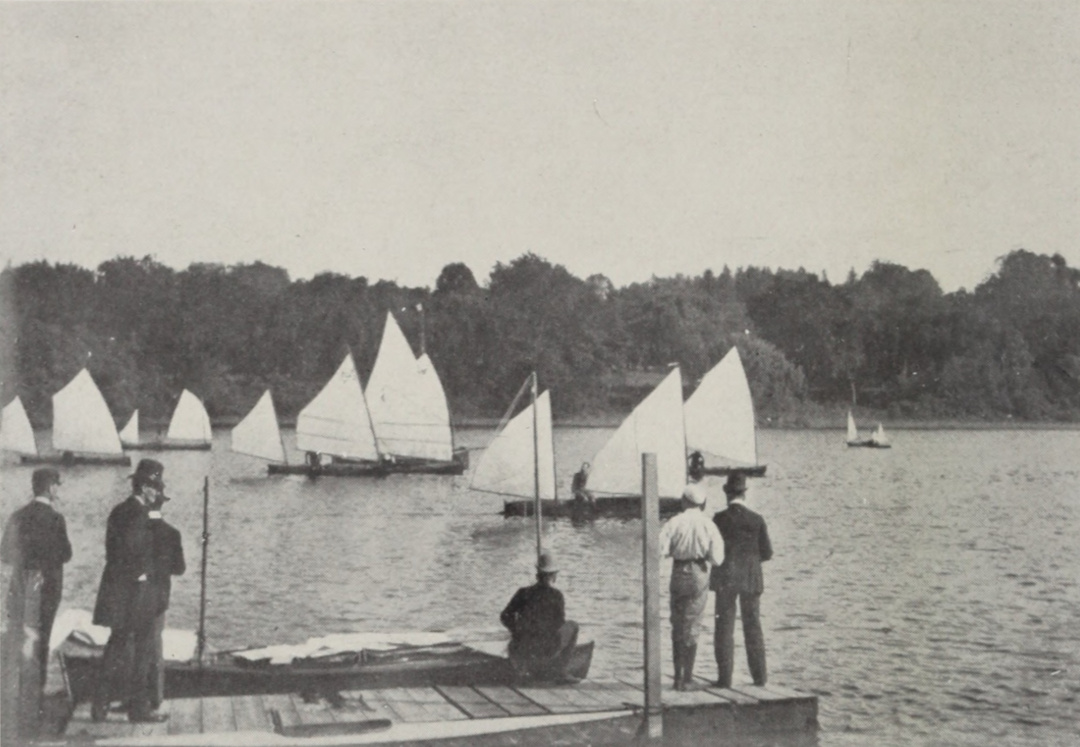
A Canoe Regatta On The Passaic. As seen from the float of the Ianthe Canoe Club.
It is still a matter of common remark by oarsmen of other localities that the Passaic was the finest river on which they ever rowed.
The Triton organization still exists in the hope that some day the river will be restored to its old-time purity and again be in condition for aquatic sports, but all it does at present is to eat a dinner once each year. It is rather a remarkable fact that the club has never lost an active member by death, except in one case of suicide.
Possibly the first racing boat other than a single shell owned by the Triton Club, was one fitted for three pairs of oars and a coxswain, which was originally purchased by a well-known group of gentlemen that resided on the banks of the Passaic. John Rutherfurd was one of these, and the boat was kept for a long time on the lawn in front of his dwelling.
One of the familiar figures of early days was Doctor Lauterborn, of Mulberry street who, after walking to the Passaic boathouse, thought nothing of rowing to the city of Passaic and back, finishing his afternoon by walking home.
CANOEING RECOLLECTIONS.
The history of the Ianthe Canoe Club, and of canoeing in general on the Passaic river, dates back to a certain mysterious green canvas canoe that, in 1880, appeared from no one knows where. Presumably it was constructed by some budding genius in the loft of his father’s barn, but all that we know definitely now is that its discovery was made by Will McDonald.
This green canoe was the inspiration which set others at work and during the winter of ’80-1 a second canvas canoe, painted black, was built in the cellar of 77 Lincoln avenue, by “Lin” Palmer, who, as he won the first canoe race ever paddled on the Passaic and launched the first white man’s canoe on our beautiful stream, so far as is known, is entitled to a central position in the limelight.
The black Palmer was launched with much circumstance in the following spring, and was at that time the only canoe on the river, as its green progenitor was not baptized until some time later, when Will McDonald purchased her.
In 1881 a group of six boys, consisting of Lincoln B. Palmer, Robert M. and Albert Phillips, Will McDonald, John Russell and one other, formed the Ianthe Canoe Club. John Russell was boy in a drug store at the corner of Belleville and Bloomfield avenues, and he brought to the meeting a soda water fountain catalogue, which contained many pretty names, and from this the name of the club was selected, the lady appearing therein as a particularly attractive water sprite. George P. Douglass, who became a factor in canoeing circles about 1887, was a later acquisition to the club.
The old Woodside Rowing Club’s building was standing idle. It belonged to the Messers. Hendricks, and a visit to these gentlemen resulted in an arrangement whereby the club was to have the building rent free, provided it kept the place in repair.
The club grew and prospered and in August, 1882, its members were invited by the Triton Boat Club to participate in the first canoe race ever held on the river. It seems that one Hussey, a member of the Triton Club owned a canoe and had a reputation as a paddler, and it was because there was no one else to play with that the boys were asked to enter the race. There was no thought but that Hussey would win; he had been in races before and was the star of the occasion. “Lin” Palmer beat him quite handily and there was gloom in the home of the Tritons. And thus ended the first canoe race, which was participated in by “Walt” and Will McDougall, as well as by “Lin” Palmer and —— Hussey.
During the following five years the club prospered greatly, but no events of importance are recorded. In 1887 John Pierson, of Bloomfield, and “Lin” Palmer, were sent as the first representatives from the Passaic river to an American Canoe Association meet, which this year was held on Lake Champlain. Neither of these representatives had ever been on such an expedition before, and their outfit was primitive in the extreme—so much so that they were shortly dubbed “the frying pan cruisers” by those who traveled with more elaborate and cumbersome outfits. But from now on the Ianthe moved up into the front rank of canoeists, as its members acquired the habit of capturing prizes, and held this position until the condition of the river drove all boating from its surface.
A LAST WORD IN REGARD TO MR. HINE.
We have about come to the end of this somewhat peculiar narrative, but before closing it I wish to say a final word in regard to Mr. Hine: I have interviewed very many who had to do with the early days of Woodside, without reference as to whether they were personal friends or not, and have heard but one opinion expressed, and universally expressed, in a manner too sincere to admit of any doubt. Each one recalls the man with a vividness and interest that time seemingly cannot dull, and each impression is but a repetition in one form or another of a great heart and a pure, clean minded man.
It is given to few to be remembered as is Mr. Hine, and though he has been dead more than twelve years (April 16, 1897), the memory of him and the impression he left are as distinct and clear as though his departure were but yesterday. The abundant tears which were shed over his bier came from hundreds who felt that they had lost a personal friend and helper.