Appendix.
Reading edition
HOW TO DISTINGUISH THE DIFFERENT KINDS OF WOOD.*
By B. E. Fernow and Filibert Roth.
The carpenter or other artisan who handles different woods, becomes familiar with those he employs frequently, and learns to distinguish them thru this familiarity, without usually being able to state the points of distinction. If a wood comes before him with which he is not familiar, he has, of course, no means of determining what it is, and it is possible to select pieces even of those with which he is well acquainted, different in appearance from the general run, that will make him doubtful as to their identification. Furthermore, he may distinguish between hard and soft pines, between oak and ash, or between maple and birch, which are characteristically different; but when it comes to distinguishing between the several species of pine or oak or ash or birch, the absence of readily recognizable characters is such that but few practitioners can be relied upon to do it. Hence, in the market we find many species mixed and sold indiscriminately.
To identify the different woods it is necessary to have a knowledge of the definite, invariable differences in their structure, besides that of the often variable differences in their appearance. These structural differences may either be readily visible to the naked eye or with a magnifier, or they may require a microscopical examination. In some cases such an examination can not be dispensed with, if we would make absolutely sure. There are instances, as in the pines, where even our knowledge of the minute anatomical structure is not yet sufficient to make a sure identification.
In the following key an attempt has been made—the first, so far as we know, in English literature—to give a synoptical view of the distinctive features of the commoner woods of the United States, which are found in the markets or are used in the arts. It will be observed that the distinction has been carried in most instances no further than to genera or classes of woods, since the distinction of species can hardly be accomplished without elaborate microscopic study, and also that, as far as possible, reliance has been placed only on such characteristics as can be distinguished with the naked eye or a simple magnifying glass, in order to make the key useful to the largest number. Recourse has also been taken for the same reason to the less reliable and more variable general external appearance, color, taste, smell, weight, etc.
The user of the key must, however, realize that external appearance, such, for example, as color, is not only very variable but also very difficult to describe, individual observers differing especially in seeing and describing shades of color. The same is true of statements of size, when relative, and not accurately measured, while weight and hardness can perhaps be more readily approximated. Whether any feature is distinctly or only indistinctly seen will also depend somewhat on individual eyesight, opinion, or practice. In some cases the resemblance of different species is so close that only one other expedient will make distinction possible, namely, a knowledge of the region from which the wood has come. We know, for instance, that no longleaf pine grows in Arkansas and that no white pine can come from Alabama, and we can separate the white cedar, giant arbor vitæ of the West and the arbor vitæ of the Northeast, only by the difference of the locality from which the specimen comes. With all these limitations properly appreciated, the key will be found helpful toward greater familiarity with the woods which are more commonly met with.
The features which have been utilized in the key and with which—their names as well as their appearance—therefore, the reader must familiarize himself before attempting to use the key, are mostly described as they appear in cross-section. They are:
(1) Sap-wood and heart-wood (see p. 17), the former being the wood from the outer and the latter from the inner part of the tree. In some cases they differ only in shade, and in others in kind of color, the heart-wood exhibiting either a darker shade or a pronounced color. Since one can not always have the two together, or be certain whether he has sap-wood or heart-wood, reliance upon this feature is, to be sure, unsatisfactory, yet sometimes it is the only general characteristic that can be relied upon. If further assurance is desired, microscopic structure must be examined; in such cases reference has been made to the presence or absence of tracheids in pith rays and the structure of their walls, especially projections and spirals.
(2) Annual rings, their formation having been described on page 19. (See also Figs. 128-130.) They are more or less distinctly marked, and by such marking a classification of three great groups of wood is possible.
(3) Spring wood and summer wood, the former being the interior (first formed wood of the year), the latter the exterior (last formed) part of the ring. The proportion of each and the manner in which the one merges into the other are sometimes used, but more frequently the manner in which the pores appear distributed in either.
(4) Pores, which are vessels cut thru, appearing as holes in cross-section, in longitudinal section as channels, scratches, or identifications. (See p. 23 and Figs. 129 and 130.) They appear only in the broad-leaved, so called, hard woods; their relative size (large, medium, small, minute, and indistinct when they cease to be visible individually by the naked eye) and manner of distribution in the ring being of much importance, and especially in the summer wood, where they appear singly, in groups, or short broken lines, in continuous concentric, often wavy lines, or in radial branching lines.
(5) Resin ducts (see p. 26 and Fig. 128) which appear very much like pores in cross-section, namely, as holes or lighter or darker colored dots, but much more scattered. They occur only in coniferous woods, and their presence or absence, size, number, and distribution are an important distinction in these woods.
(6) Pith rays (see p. 21 and Figs. 129 and 130), which in cross-section appear as radial lines, and in radial section as interrupted bands of varying breadth, impart a peculiar luster to that section in some woods. They are most readily visible with the naked eye or with a magnifier in the broad-leaved woods. In coniferous woods they are usually so fine and closely packed that to the casual observer they do not appear. Their breadth and their greater or less distinctness are used as distinguishing marks, being styled fine, broad, distinct, very distinct, conspicuous, and indistinct when no longer visible by the naked (strong) eye.
(7) Concentric lines, appearing in the summer wood of certain species more or less distinct, resembling distantly the lines of pores but much finer and not consisting of pores. (See Fig. 129.)
Of microscopic features, the following only have been referred to:
(8) Tracheids, a description of which is to be found on page 28.
(9) Pits, simple and bordered, especially the number of simple pits in the cells of the pith rays, which lead into each of the adjoining tracheids.
For standards of weight, consult table on pages 55 and 192; for standards of hardness, table on page 195.
Unless otherwise stated the color refers always to the fresh cross-section of a piece of dry wood; sometimes distinct kinds of color, sometimes only shades, and often only general color effects appear.
* From Forestry Bulletin No. 10, U. S. Department of Agriculture.
HOW TO USE THE KEY.
Nobody need expect to be able to use successfully any key for the distinction of woods or of any other class of natural objects without some practice. This is especially true with regard to woods, which are apt to vary much, and when the key is based on such meager general data as the present. The best course to adopt is to supply one's self with a small sample collection of woods, accurately named. Small, polished tablets are of little use for this purpose. The pieces should be large enough, if possible, to include pith and bark, and of sufficient width to permit ready inspection of the cross-section. By examining these with the aid of the key, beginning with the better-known woods, one will soon learn to see the features described and to form an idea of the relative standards which the maker of the key had in mind. To aid in this, the accompanying illustrations will be of advantage. When the reader becomes familiar with the key, the work of identifying any given piece will be comparatively easy. The material to be examined must, of course, be suitably prepared. It should be moistened; all cuts should be made with a very sharp knife or razor and be clean and smooth, for a bruised surface reveals but little structure. The most useful cut may be made along one of the edges. Instructive, thin, small sections may be made with a sharp penknife or razor, and when placed on a piece of thin glass, moistened and covered with another piece of glass, they may be examined by holding them toward the light.
Finding, on examination with the magnifier, that it contains pores, we know it is not coniferous or non-porous. Finding no pores collected in the spring-wood portion of the annual ring, but all scattered (diffused) thru the ring, we turn at once to the class of "Diffuse-porous woods." We now note the size and manner in which the pores are distributed thru the ring. Finding them very small and neither conspicuously grouped, nor larger nor more abundant in the spring-wood, we turn to the third group of this class. We now note the pith rays, and finding them neither broad nor conspicuous, but difficult to distinguish, even with the magnifier, we at once exclude the wood from the first two sections of this group and place it in the third, which is represented by only one kind, cottonwood. Finding the wood very soft, white, and on the longitudinal section with a silky luster, we are further assured that our determination is correct. We may now turn to the list of woods and obtain further information regarding the occurrence, qualities, and uses of the wood.
Sometimes our progress is not so easy; we may waver in what group or section to place the wood before us. In such cases we may try each of the doubtful roads until we reach a point where we find ourselves entirely wrong and then return and take up another line; or we may anticipate some of the later mentioned features and finding them apply to our specimen, gain additional assurance of the direction we ought to travel. Color will often help us to arrive at a speedy decision. In many cases, especially with conifers, which are rather difficult to distinguish, a knowledge of the locality from which the specimen comes is at once decisive. Thus, northern white cedar, and bald cypress, and the cedar of the Pacific will be identified, even without the somewhat indefinite criteria given in the key.
KEY TO THE MORE IMPORTANT WOODS OF NORTH AMERICA.
I. Non-porous woods—Pores not visible or conspicuous on cross-section, even with magnifier. Annual rings distinct by denser (dark colored) bands of summer wood (Fig. 128).
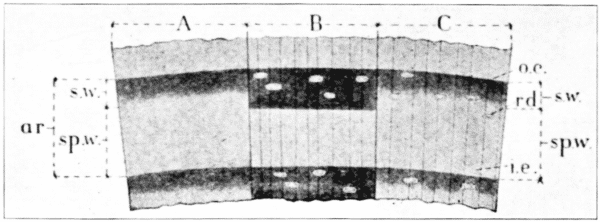
Fig. 128. "Non-porous" Woods. A, fir; B, "hard" pine; C, soft pine; ar, annual ring; o.e., outer edge of ring; i.e., inner edge of ring; s.w., summer wood; sp.w., spring wood; rd., resin ducts.
II. Ring-porous woods—Pores numerous, usually visible on cross-section without magnifier. Annual rings distinct by a zone of large pores collected in the spring wood, alternating with the denser summer wood (Fig. 129).
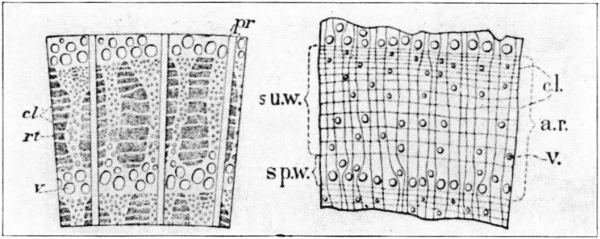
Fig. 129. "Ring-porous" Woods White Oak and Hickory. a. r., annual ring; su. w., summer wood; sp. w., spring wood; v, vessels or pores; c. l., "concentric" lines; rt, darker tracts of hard fibers forming the firm part of oak wood; pr, pith rays.
III. Diffuse-porous woods—Pores numerous, usually not plainly visible on cross-section without magnifier. Annual rings distinct by a fine line of denser summer wood cells, often quite indistinct; pores scattered thru annual ring, no zone of collected pores in spring wood (Fig. 130).
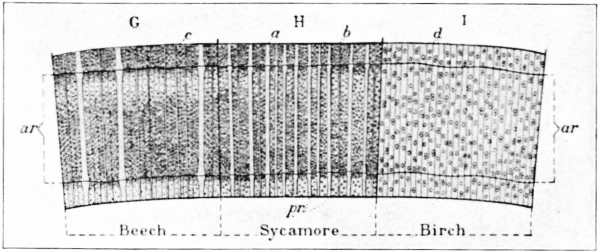
Fig. 130. "Diffuse-porous" Woods. ar, annual ring; pr, pith rays which are "broad" at a, "fine" at b, "indistinct" at d.
Note.—The above described three groups are exogenous, i.e., they grow by adding annually wood on their circumference. A fourth group is formed by the endogenous woods, like yuccas and palms, which do not grow by such additions.
I.—Non-Porous Woods.
(Includes all coniferous woods.)
A. Resin ducts wanting.1
1. No distinct heart-wood.
a. Color effect yellowish white; summer wood darker yellowish (under microscope pith ray without tracheids) Firs.
b. Color effect reddish (roseate) (under microscope pith ray with tracheids) Hemlock.
2. Heart-wood present, color decidedly different in kind from sap-wood.
a. Heart-wood light orange red; sap-wood, pale lemon; wood, heavy and hard. Yew.
b. Heartwood purplish to brownish red; sap-wood yellowish white; wood soft to medium hard, light, usually with aromatic odor. Red Cedar.
c. Heart-wood maroon to terra cotta or deep brownish red; sap-wood light orange to dark amber, very soft and light, no odor; pith rays very distinct, specially pronounced on radial section. Redwood.
3. Heart-wood present, color only different in shade from sap-wood, dingy-yellowish brown.
a. Odorless and tasteless. Bald Cypress.
b. Wood with mild resinous odor, but tasteless. White Cedar.
c. Wood with strong resinous odor and peppery taste when freshly cut. Incense Cedar.
B. Resin ducts present.
1. No distinct heartwood; color white, resin ducts very small, not numerous. Spruce.
2. Distinct heart-wood present.
a. Resin ducts numerous, evenly scattered thru the ring.
a'. Transition from spring wood to summer wood gradual; annual ring distinguished by a fine line of dense summer-wood cells; color, white to yellowish red; wood soft and light. Soft Pines.2
b'. Transition from spring wood to summer wood more or less abrupt; broad bands of dark-colored summer wood; color from light to deep orange; wood medium hard and heavy. Hard Pines.2
b. Resin ducts not numerous nor evenly distributed.
a'. Color of heart-wood orange-reddish, sap-wood yellowish (same as hard pine); resin ducts frequently combined in groups of 8 to 30, forming lines on the cross-section (tracheids with spirals). Douglas Spruce.
b'. Color of heart-wood light russet brown; of sap-wood yellowish brown; resin ducts very few, irregularly scattered (tracheids without spirals). Tamarack.
ADDITIONAL NOTES FOR DISTINCTIONS IN THE GROUP.
Spruce is hardly distinguishable from fir, except by the existence of the resin ducts, and microscopically by the presence of tracheids in the medullary rays. Spruce may also be confounded with soft pine, except for the heart-wood color of the latter and the larger, more frequent, and more readily visible resin ducts.
In the lumber yard, hemlock is usually recognized by color and the silvery character of its surface. Western hemlocks partake of this last character to a less degree.
Microscopically the white pine can be distinguished by having usually only one large pit, while spruce shows three to five very small pits in the parenchyma cells of the pith ray communicating with the tracheid.
The distinction of the pines is possible only by microscopic examination. The following distinctive features may assist in recognizing, when in the log or lumber pile, those usually found in the market:
The light, straw color, combined with great lightness and softness, distinguishes the white pines (white pine and sugar pine) from the hard pines (all others in the market), which may also be recognized by the gradual change of spring wood into summer wood. This change in hard pines is abrupt, making the summer wood appear as a sharply defined and more or less broad band.
The Norway pine, which may be confounded with the shortleaf pine, can be distinguished by being much lighter and softer. It may also, but more rarely, be confounded with heavier white pine, but for the sharper definition of the annual ring, weight, and hardness.
The longleaf pine is strikingly heavy, hard, and resinous, and usually very regular and narrow ringed, showing little sap-wood, and differing in this respect from the shortleaf pine and loblolly pine, which usually have wider rings and more sap-wood, the latter excelling in that respect.
The following convenient and useful classification of pines into four groups, proposed by Dr. H. Mayr, is based on the appearance of the pith ray as seen in a radial section of the spring wood of any ring:
Section I. Walls of the tracheids of the pith ray with dentate projections.
a. One to two large, simple pits to each tracheid on the radial walls of the cells of the pith ray.—Group 1. Represented in this country only by P. resinosa.
b. Three to six simple pits to each tracheid, on the walls of the cells of the pith ray.—Group 2. P. taeda, palustris, etc., including most of our "hard" and "yellow" pines.
Section II. Walls of tracheids of pith ray smooth, without dentate projections.
a. One or two large pits to each tracheid on the radial walls of each cell of the pith ray.—Group 3. P. strobus, lambertiana, and other true white pines.
b. Three to six small pits on the radial walls of each cell of the pith ray. Group 4. P. parryana, and other nut pines, including also P. balfouriana.
II.—Ring-Porous Woods.
(Some of Group D and cedar elm imperfectly ring-porous.)
A. Pores in the summer wood minute, scattered singly or in groups, or in short broken lines, the course of which is never radial.
1. Pith rays minute, scarcely distinct.
a. Wood heavy and hard; pores in the summer wood not in clusters.
a'. Color of radial section not yellow. Ash.
b'. Color of radial section light yellow; by which, together with its hardness and weight, this species is easily recognized. Osage Orange.
b. Wood light and soft; pores in the summer wood in clusters of 10 to 30. Catalpa.
2. Pith rays very fine, yet distinct; pores in summer wood usually single or in short lines; color of heart-wood reddish brown; of sap-wood yellowish white; peculiar odor on fresh section. Sassafras.
3. Pith rays fine, but distinct.
a. Very heavy and hard; heart-wood yellowish brown. Black Locust.
b. Heavy; medium hard to hard.
a'. Pores in summer wood very minute, usually in small clusters of 3 to 8; heart-wood light orange brown. Red Mulberry.
b'. Pores in summer wood small to minute, usually isolated; heart-wood cherry red. Coffee Tree.
4. Pith rays fine but very conspicuous, even without magnifier. Color of heart-wood red; of sap-wood pale lemon. Honey Locust.
B. Pores of summer wood minute or small, in concentric wavy and sometimes branching lines, appearing as finely-feathered hatchings on tangential section.
1. Pith rays fine, but very distinct; color greenish white. Heart-wood absent or imperfectly developed. Hackberry.
2. Pith rays indistinct; color of heart-wood reddish brown; sap-wood grayish to reddish white. Elms.
C. Pores of summer wood arranged in radial branching lines (when very crowded radial arrangement somewhat obscured).
1. Pith rays very minute, hardly visible. Chestnut.
2. Pith rays very broad and conspicuous. Oak.
D. Pores of summer wood mostly but little smaller than those of the spring wood, isolated and scattered; very heavy and hard woods. The pores of the spring wood sometimes form but an imperfect zone. (Some diffuse-porous woods of groups A and B may seem to belong here.)
1. Fine concentric lines (not of pores) as distinct, or nearly so, as the very fine pith rays; outer summer wood with a tinge of red; heart-wood light reddish brown. Hickory.
2. Fine concentric lines, much finer than the pith rays; no reddish tinge in summer wood; sap-wood white; heart-wood blackish. Persimmon.
ADDITIONAL NOTES FOR DISTINCTIONS IN THE GROUP.
Sassafras and mulberry may be confounded but for the greater weight and hardness and the absence of odor in the mulberry; the radial section of mulberry also shows the pith rays conspicuously.
Honey locust, coffee tree, and black locust are also very similar in appearance. The honey locust stands out by the conspicuousness of the pith rays, especially on radial sections, on account of their height, while the black locust is distinguished by the extremely great weight and hardness, together with its darker brown color.
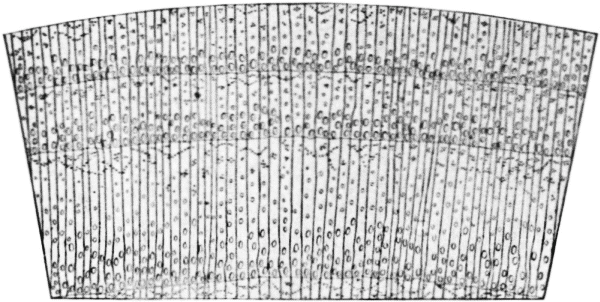
Fig. 131. Wood of Coffee Tree.
The ashes, elms, hickories, and oaks may, on casual observation, appear to resemble one another on account of the pronounced zone of porous spring wood. (Figs. 129, 132, 135.) The sharply defined large pith rays of the oak exclude these at once; the wavy lines of pores in the summer wood, appearing as conspicuous finely-feathered hatchings on tangential section, distinguish the elms; while the ashes differ from the hickory by the very conspicuously defined zone of spring wood pores, which in hickory appear more or less interrupted. The reddish hue of the hickory and the more or less brown hue of the ash may also aid in ready recognition. The smooth, radial surface of split hickory will readily separate it from the rest.
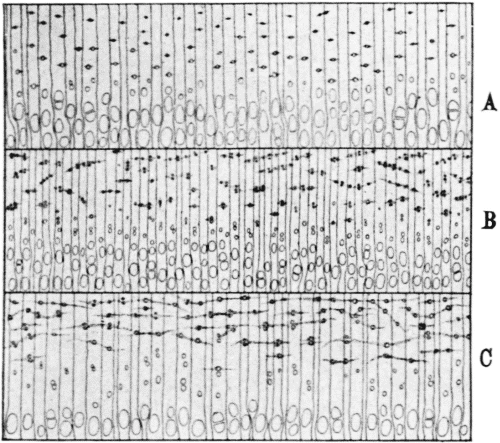
Fig. 132. A, black ash; B, white ash; C, green ash.
The different species of ash may be identified as follows (Fig. 132):
1. Pores in the summer wood more or less united into lines.
a. The lines short and broken, occurring mostly near the limit of the ring. White Ash.
b. The lines quite long and conspicuous in most parts of the summer wood. Green Ash.
2. Pores in the summer wood not united into lines, or rarely so.
a. Heart-wood reddish brown and very firm. Red Ash.
b. Heart-wood grayish brown, and much more porous. Black Ash.
In the oaks, two groups can be readily distinguished by the manner in which the pores are distributed in the summer wood. (Fig. 133.) In the white oaks the pores are very fine and numerous and crowded in the outer part of the summer wood, while in the black or red oaks the pores are larger, few in number, and mostly isolated. The live oaks, as far as structure is concerned, belong to the black oaks, but are much less porous, and are exceedingly heavy and hard.
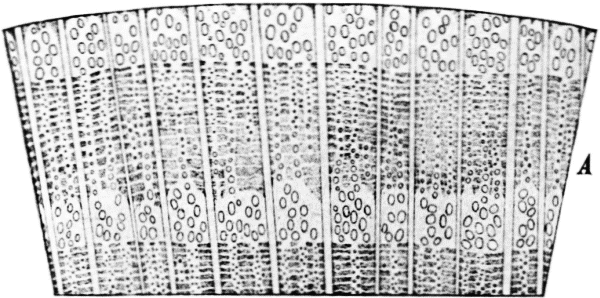
Fig. 133. Wood of Red Oak. (For white oak see fig. 129, p. 294.)
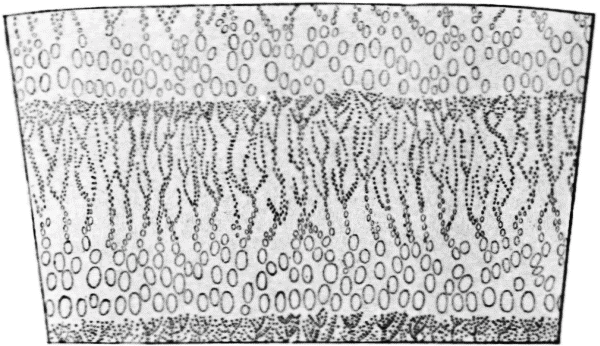
Fig. 134. Wood of Chestnut.
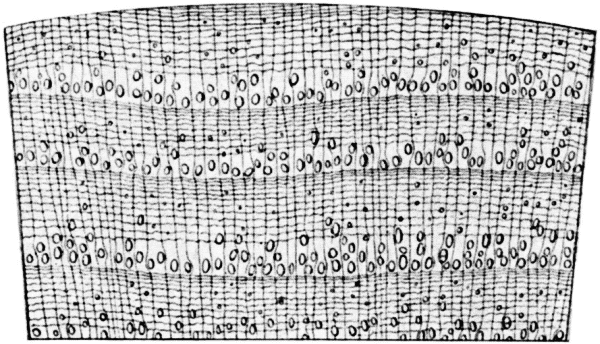
Fig. 135. Wood of Hickory.
III.—Diffuse-Porous Woods.
(A few indistinctly ring-porous woods of Group II, D, and cedar elm may seem to belong here.)
A. Pores varying in size from large to minute; largest in spring wood, thereby giving sometimes the appearance of a ring-porous arrangement.
1. Heavy and hard; color of heart-wood (especially on longitudinal section) chocolate brown. Black Walnut.
2. Light and soft; color of heart-wood light reddish brown. Butternut.
B. Pores all minute and indistinct; most numerous in spring wood, giving rise to a lighter colored zone or line (especially on longitudinal section), thereby appearing sometimes ring-porous; wood hard, heart-wood vinous reddish; pith rays very fine, but very distinct. (See also the sometimes indistinct ring-porous cedar elm, and occasionally winged elm, which are readily distinguished by the concentric wavy lines of pores in the summer wood). Cherry.
C. Pores minute or indistinct, neither conspicuously larger nor more numerous in the spring wood and evenly distributed.
1. Broad pith rays present.
a. All or most pith rays broad, numerous, and crowded, especially on tangential sections, medium heavy and hard, difficult to split. Sycamore.
b. Only part of the pith rays broad.
a'. Broad pith rays well defined, quite numerous; wood reddish white to reddish. Beech.
b'. Broad pith rays not sharply defined, made up of many small rays, not numerous. Stem furrowed, and therefore the periphery of section, and with it the annual rings sinuous, bending in and out, and the large pith rays generally limited to the furrows or concave portions. Wood white, not reddish. Blue Beech.
2. No broad pith rays present.
a. Pith rays small to very small, but quite distinct.
a'. Wood hard.
a". Color reddish white, with dark reddish tinge in outer summer wood. Maple.
b". Color white, without reddish tinge. Holly.
b'. Wood soft to very soft.
a". Pores crowded, occupying nearly all the space between pith rays.
a'". Color yellowish white, often with a greenish tinge in heart-wood. Tulip Poplar.
Cucumber Tree.
b.'" Color of sap-wood grayish, of heart-wood light to dark reddish brown. Sweet Gum.
b". Pores not crowded, occupying not over one-third the space between pith rays; heart-wood brownish white to very light brown. Basswood.
b. Pith rays scarcely distinct, yet if viewed with ordinary magnifier, plainly visible.
a'. Pores indistinct to the naked eye.
a". Color uniform pale yellow; pith rays not conspicuous even on the radial section. Buckeye.
b". Sap-wood yellowish gray, heart-wood grayish brown; pith rays conspicuous on the radial section. Sour Gum.
b'. Pores scarcely distinct, but mostly visible as grayish specks on the cross-section; sap-wood whitish, heart-wood reddish Birch.
D. Pith rays not visible or else indistinct, even if viewed with magnifier.
1. Wood very soft, white, or in shades of brown, usually with a silky luster. Cottonwood (Poplar).
ADDITIONAL NOTES FOR DISTINCTIONS IN THE GROUP.
Cherry and birch are sometimes confounded, the high pith rays on the cherry on radial sections readily distinguishes it; distinct pores on birch and spring wood zone in cherry as well as the darker vinous-brown color of the latter will prove helpful.
Two groups of birches can be readily distinguished, tho specific distinction is not always possible.
1. Pith rays fairly distinct, the pores rather few and not more abundant in the spring wood: wood heavy, usually darker. Cherry Birch and Yellow Birch.
2. Pith rays barely distinct, pores more numerous and commonly forming a more porous spring wood zone; wood of medium weight. Canoe or Paper Birch.
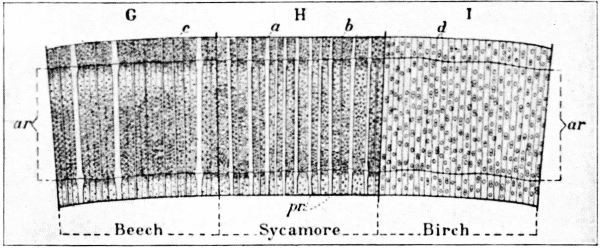
Fig. 136. Wood of Beech, Sycamore and Birch.
The species of maple may be distinguished as follows:
1. Most of the pith rays broader than the pores and very conspicuous. Sugar Maple.
2. Pith rays not or rarely broader than the pores, fine but conspicuous.
a. Wood heavy and hard, usually of darker reddish color and commonly spotted on cross-section. Red Maple.
b. Wood of medium weight and hardness, usually light colored. Silver Maple.
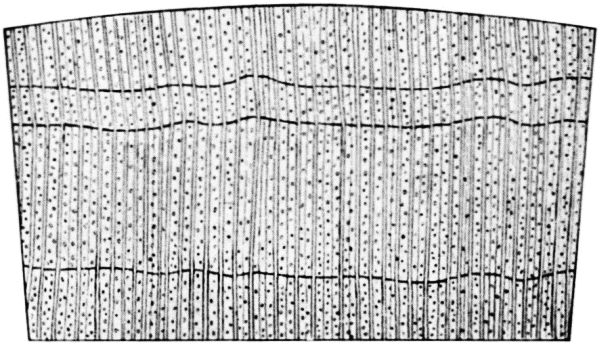
Fig. 137. Wood of Maple.
Red maple is not always safely distinguished from soft maple. In box elder the pores are finer and more numerous than in soft maple. The various species of elm may be distinguished as follows:
1. Pores of spring wood form a broad band of several rows; easy splitting, dark brown heart. Red Elm.
2. Pores of spring wood usually in a single row, or nearly so.
a. Pores of spring wood large, conspicuously so. White Elm.
b. Pores of spring wood small to minute.
a'. Lines of pores in summer wood fine, not as wide as the intermediate spaces, giving rise to very compact grain. Rock Elm.
b'. Lines of pores broad, commonly as wide as the intermediate spaces. Winged Elm.
c. Pores in spring wood indistinct, and therefore hardly a ring-porous wood. Cedar Elm.
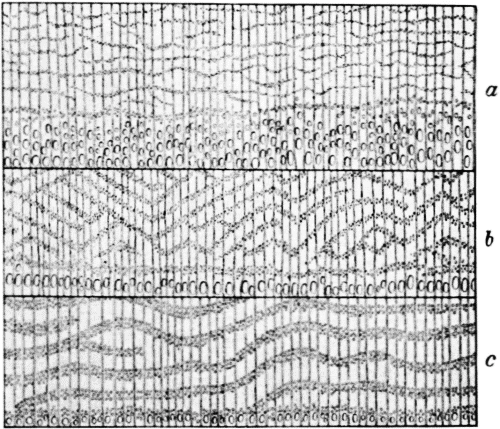
Fig. 138. Wood of Elm. a red elm; b, white elm; c, winged elm.
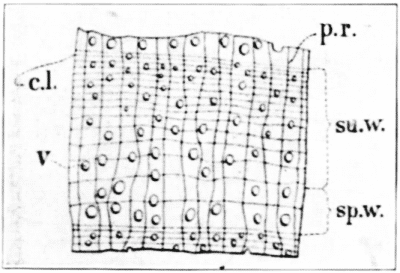
Fig. 139. Walnut. p.r., pith rays; c.l., concentric lines; v, vessels or pores; su. w., summer wood; sp. w., spring wood.
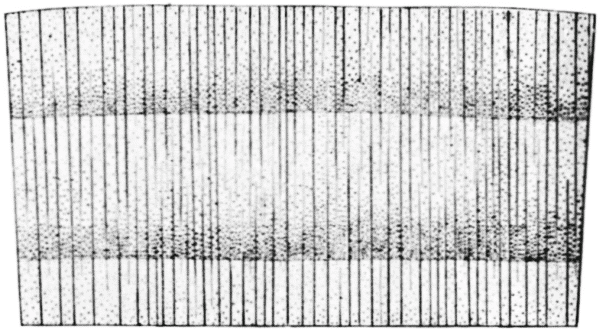
Fig. 140. Wood of Cherry.