WOMEN OF HISTORY. (continued 3)
Reading edition

Near seven years did this arduous wooing continue. Temple appears to have kept up a very active correspondence with his mistress. We would willingly learn more of the loves of these two. In the seventeenth century, to be sure, Louis XIV. was a much more important person than Temple's sweetheart. But death and time equalise all things. Neither the great king nor the beauty of Bedfordshire, neither the gorgeous paradise of Marli nor Mrs Osborne's favourite walk "in the common that lay hard by the house, where a great many young wenches used to keep sheep and cows, and sit in the shade singing of ballads," is anything to us. Louis and Dorothy are alike dust. A cotton-mill stands on the ruins of Marli, and the Osbornes have ceased to dwell under the ancient roof of Chicksands.
When at last the constancy of the lovers triumphed over all the obstacles which kinsmen and rivals could oppose to their union, a yet more serious calamity befell them. Poor Mrs Osborne fell ill of the small-pox, and though she escaped with life, lost all her beauty. To this most severe trial, the affection and honour of the lovers of that age was not unfrequently subjected. Our readers will probably remember what Mrs Hutchinson tells us of herself. The lofty Cornelia-like spirit of the aged matron seems to melt into a long forgotten softness when she relates how her beloved Colonel "married her as soon as she was able to quit the chamber, when the priest and all that saw her were affrighted to look on her. But God," she adds, with a not ungraceful vanity, "recompensed his justice and constancy by restoring her as well as before." Temple showed on this occasion the same justice and constancy which did so much honour to Colonel Hutchinson. The date of the marriage is not exactly known. But Mr Courtenay supposes it to have taken place about the year 1654. From this time we lose Dorothy, and are reduced to form our opinion of the terms on which she and her husband were, from very slight indications, which may easily mislead us.

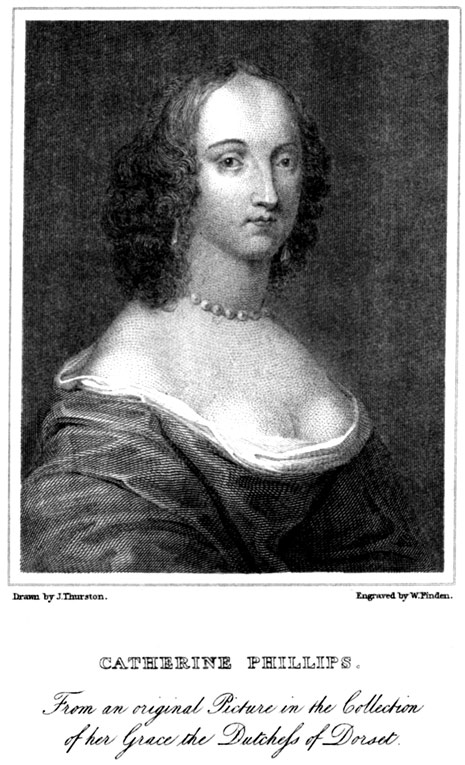
Drawn by J. Thurston. Engraved by W. Finden. CATHERINE PHILLIPS. From an original Picture in the Collection of her Grace the Dutchess of Dorset.
CATHERINE PHILIPS.
[BORN 1631. DIED 1664.] BALLARD.
HE celebrated Orinda was the daughter of John Fowler of Bucklersbury. Her improvement was so early, that whoever reads the account given of her by M. Aubrey, will look upon all her succeeding progress in learning to be no more than what might justly be expected. He tells us that she was very apt to learn, and made verses when she was at school; that she devoted herself to religious duties when she was very young; that she would then pray by herself an hour together; that she had read the Bible through before she was full four years old; that she could say by heart many chapters and passages of Scripture, was a frequent hearer of sermons, which she would bring away entire in her memory, and would take sermons verbatim when she was but ten years old.

She became afterwards a perfect mistress of the French tongue, and learned the Italian under the tuition of her ingenious and worthy friend Sir Charles Cottrell. Born with a genius for poetry, she began to improve it early in life, and composed many poems, upon various occasions, for her own amusement, in her recess at Cardigan and retirement elsewhere. These being dispersed among her friends and acquaintances, were by an unknown hand collected together and published in 1663, without her knowledge and consent,—an ungenteel and ungenerous treatment, which proved so oppressive to her great modesty, that it gave her a severe fit of illness. She poured forth her complaints in a long letter to Sir Charles Cottrell, in which she laments, in a most affecting manner, the misfortune and injury which had been done to her by this surreptitious edition of her poems.
Her remarkable humility, good nature, and agreeable conversation, greatly endeared her to all her acquaintances, and her ingenious and elegant writings procured her the friendship and correspondence of many learned and eminent men, and of persons of the first rank in England. Upon her going to Ireland with the Viscountess of Dungannon, to transact her husband's affairs there, her great merit soon made her known to, and esteemed by, those illustrious persons,—Ormond, Orrery, Roscommon, and many other persons of distinction,—who paid a great deference to her worth and abilities, and showed her singular marks of their esteem.
While in Ireland, she was very happy in carrying on a former intimacy with the famous Dr Jeremy Taylor, the worthy Bishop of Down and Conner, who addressed to her "A Discourse of the Nature, Offices, and Measures of Friendship." It is possible that his acquaintance with Mrs Philips might contribute much towards the good opinion he entertained of the female sex. It is certain that he was a great admirer of them. "But, by the way, madam," he says, "you may see how much I differ from the morosity of those cynics who would not admit your sex into the communities of a noble friendship. I believe some wives have been the best friends in the world, and few stories can outdo the nobleness and piety of that lady that sucked the poisoned purulent matter from the wound of our brave prince in the holy land, when an assassin had pierced him with a venomed arrow. And if it be told that women cannot return counsel, and therefore can be no brave friends, I can best confute them by the story of Portia. I cannot say that women are capable of all those excellences by which men can oblige the world; and therefore a female friend, in some cases, is not so good a counsellor as a wise man, and cannot so well defend my honour, nor dispose of reliefs and assistances, if she be under the power of another; but a woman can love as passionately, and converse as pleasantly, and retain a secret as faithfully, and be useful in her proper ministries, and she can die for her friend as well as the bravest Roman knight. A man is the best friend in trouble, but a woman may be equal to him in the days of joy; a woman can as well increase our comforts, but cannot so well lessen our sorrows, and therefore we do not carry women with us when we go to fight; but, in peaceful cities and times, virtuous women are the beauties of society and the prettinesses of friendship."
Mrs Philips went for a time into a sort of melancholy retirement, occasioned, perhaps, by the bad success of her husband's affairs; and, going to London in order to relieve her oppressed spirits with the conversation of her friends there, she was seized by the small-pox, and died in her thirty-third year. Mr Aubrey observes that her person was of a middle stature, pretty fat, and ruddy complexion.
MADAME DE MAINTENON.
[BORN 1635. DIED 1719.] ST SIMON.
ORN in a prison of America, whither her father had gone as a needy adventurer, and where he died, Francis d'Aubigné returned to France a poor orphan. At Rochelle, where she landed, she was taken pity upon by Madame de Nuillant, an old miser, who degraded the friendless girl by making her keep the key of the granary, and deal out the corn to the horses. Going afterwards to Paris, her beauty, wit, and propriety of conduct procured her friends, and subsequently she married the famous poet Scarron, then a deformed old man. It was the custom for people who loved letters, among whom were many courtiers, to repair to Scarron's house, where they tasted of that wit and fancy which may be discovered in his works. In all this Madame Scarron participated, making many acquaintances, whose friendship, after Scarron's death, did not save her from being a burden on the parish. She afterwards found her way into the Hotel d'Albret, and that of Richelieu, where she acted as a kind of upper servant, calling the other domestics, and reporting when such a one's carriage had arrived. From one thing to another she changed, till she succeeded in so charming King Louis the Fourteenth's mistress, Madame de Montespan, that she engaged her to take the charge of her children. In this office she was in the habit of often meeting the king, who soon saw how much she excelled, in learning and good sense the other women who had been devoted to his pleasure. Finally she was privately married to him.

A woman of strong understanding, Madame Maintenon had learnt, from the various conditions in which she had been, the art of pleasing, insinuation, complaisance, and the use of intrigue; an incomparable grace, an air of perfect ease and self-possession, accompanied by a reservation and show of respect, which was the consequence of her humble birth, and so far natural to her, wrought in unison with a soft speech, the choice of appropriate words, and a species of eloquence kept within bounds. The prior times in which she had lived were those of precision and affectation, qualities which she retained, and in some degree elevated, by an air of dignity and importance, and which, being favourable to devotion, first inspired in her that feeling, and were latterly submerged in it.
Yet, withal, the real character of her mind was that of ambition. She aspired continually after new acquaintances and friends, as well as new modes of amusement, excepting only some old confidantes whom time had rendered necessary to her. This inequality in her temper produced many evils. Easily elevated, she rose to an excess of feeling; as easily depressed, she relapsed into satiety and even disgust, without being able to render a reason for the change even to herself. After overcoming the difficulty of getting into her presence, one had to experience a volubility resulting from something which happened to please her, and presently a relapse into indifference, or something worse, so that it was a task for the visitor to know whether he was in grace or disgrace. She possessed also the weakness to be regulated by confidences and confessions, and to submit to be made the dupe of religious societies. The time absorbed by her visits to convents was incredible. She believed herself to be a kind of universal abbess, and concerned herself with the endless details of numerous convents. She even figured herself to be the mother of the Church, weighing and estimating the merits or demerits of ecclesiastical officials, not less than those of the female heads of convents. She was thus plunged in a sea of occupations, frivolous, deceitful, and painful; of letters and answers to letters, directions to choice friends, and all sorts of puerilities, which resulted ordinarily in nothing. [Yet, for thirty years of her life, she played her part so well that she was the king's most confidential adviser, and shared in the obloquy of some of his worst acts, such as the revocation of the edict of Nantes. She was a virtuous woman, a devout and bigoted Catholic, ambitious and resolute, yet disinterested and charitable. Her published letters demand for her a creditable place in French literature.]
COUNTESS DE GRAMMONT.
[1641.] COUNT A. HAMILTON.
ISS Hamilton, the eldest daughter of Sir George Hamilton, and born in 1641, was at the happy age when the charms of the fair sex begin to bloom; she had the finest shape, the loveliest neck, and most beautiful arms in the world; she was majestic and graceful in her movements, and she was the original after which all the ladies copied in their taste and air of dress. Her forehead was open, white, and smooth; her hair was well set, and fell with ease into that natural order which it is so difficult to imitate. Her complexion was possessed of a certain freshness not to be equalled by borrowed colours; her eyes were not large, but they were lively, and capable of expressing whatever she pleased; her mouth was full of graces, and her contour uncommonly perfect; nor was her nose, which was small, delicate, and retroussé, the least ornament of so lovely a face.

Her mind was a proper companion for such a form. She did not endeavour to shine in conversation by those sprightly sallies which only puzzle, and, with still greater care, she avoided that affected solemnity in her discourse which produces stupidity; but, without any eagerness to talk, she just said what she ought and no more. She had an admirable discernment in distinguishing between solid and false wit; and, far from making an ostentatious display of her abilities, she was reserved, though very just, in her decisions. Her sentiments were always noble, and even lofty to the highest extent, when there was occasion; nevertheless, she was less prepossessed with her own merit than is usually the case with those who have so much. Formed as we have described, she could not fail of commanding love; but so far was she from courting it, that she was scrupulously nice with respect to those whose merit might enable them to cherish any pretensions to her.
[Such a portrait (says Mr Davenport Adams) makes one in love with the woman it professes to represent, and envy might be tempted to conclude that it was rather the ideal of some poetic Diana, than a transcript of a veritable flesh and blood beauty. Undoubtedly, the natural partiality of the brother and the pride of the husband (Count de Grammont), whose united skill has been exerted to produce so agreeable an ensemble, have filled in the outline with too flattering colours, and heightened the charms of nature by the graces of art. But when, for this fond exaggeration, due allowance shall have been made, there will still remain enough to justify us in regarding Elizabeth Hamilton as one of the most fascinating women of her age or nation.
The highest in rank, and the most important of her lovers, was the Duke of York, who had been captivated by a glance at her portrait in Lely's studio. His proposals, however, being neither flattering nor honourable, were haughtily rejected. The Duke of Richmond, a gamester and a drunkard; the heir of Norfolk, a wealthy simpleton; the brave and handsome Falmouth, who afterwards died a hero's death in one of the great sea-fights with the Dutch; the two Russels, uncle and nephew; and the invincible Henry Jermyn, in succession acknowledged the power of her charms, and offered her their hands. They were refused. The Count de Grammont next presented himself, and was more successful, though in moral character he was not superior to his predecessors, and in fortune was their inferior.
This celebrated wit, who has become so celebrated to us through the graphic pages of Count Hamilton's Memoirs, was born in 1621. Having been banished from France by Louis XIV., for entering himself against that monarch in the lists of love with Mademoiselle La Motte Howdencourt, he repaired to the court of Charles II., where he immediately became "the observed of all observers." He was handsome, graceful, and accomplished; his manners possessed an indescribable fascination; his address was polished and easy, his conversation light and amusing. But his enemies accused him of being treacherous in his friendships, cruel in his jealousies, and trifling in his loves. He was assuredly a man of unprincipled character, and as false towards a friend as he was fickle to a mistress; but an undefinable brilliancy of manners, which dazzled every eye, imposed on the judgment of all whom he came in contact with; and it was only those whom he had defrauded or betrayed that could distinguish the clinquant from the pure metal.
After several years of wooing, the fickle Count de Grammont became the husband of the beautiful Hamilton. But, notwithstanding the apparent warmth and duration of his addresses, it is doubtful whether he really intended them seriously; and his marriage is said to have been forced upon him. Having made his peace with Louis XIV., he had received permission to return to France. In all haste he set out on his journey, and, it is said, without bringing matters to a proper conclusion with Miss Hamilton. Her brothers immediately pursued him, and came up with him near Dover, resolved to extort from him an explanation, or to obtain satisfaction with their swords. "Chevalier de Grammont," they exclaimed, "have you forgotten nothing in London?" "Excuse me," he rejoined, with his accustomed self-possession, "I forgot to marry your sister." He returned with them to London, and espoused the fair lady, Charles II. honouring the nuptials with his presence.... Grammont died at the age of eighty-six, and his wife survived him but one year.]
MADEMOISELLE DE LA VALLIERE.
[BORN 1644. DIED 1710.] DAVENPORT ADAMS.
T must be acknowledged that Louis XIV., in his amours more refined than his contemporary Charles II. of England, sought for mental gifts no less than personal charms, and, if caught at first by the eye and the lip, the bloom of the cheek and the lustre of the hair, could only be held by the surer and more exquisite fascination of a clear judgment and a lively wit. He was not content with a dumb Venus. Beauty was required to wear the robe of Pallas, and to borrow some, at least, of the magical spells of the Graces. Criminal as were his attachments, and fatal to the heart and soul of his people by the general levity of manners and morals which they necessarily seemed to justify, they were clothed with a pomp and refinement that concealed their most hideous features.

The most romantic of Louis' attachments was that which he professed for Mademoiselle de la Valliere, born in 1664 of a noble family, which had been long established in Touraine. While yet a child, she lost her father, and was brought up at Blois, in the household of Gaston of Orleans. "Her features," as we learn from Elizabeth of Bavaria, Duchess of Orleans, "had an inexpressible attraction; her figure was beautiful, her appearance modest; she limped a little, but this did not ill become her." Her forehead was smooth and white, and on each side of it clustered abundant curls of a glossy auburn. The soft languishing eyes, the straight nose, the exquisite mouth and the dimpled chin, with a certain eloquent air of love and gentleness, made up a most fascinating countenance. All the figure was firm and plump—not one of your angular forms, that bristle with sharp points, but the shape of a Venus, rich in graceful curves, and softly rounded. There was a peculiar charm in her conversation; it so sparkled with that light, effervescing humour, which in the mouth of a pretty woman is accounted wit, while it breathed an air of refinement that indicated a graceful and accomplished mind. A sweet temper and a gentle disposition won the affection of all her companions. She was capable of a passionate love, a deep and unalterable love, devoted to its object, and utterly regardless of itself. She was not ambitious, except of being loved; and that is an ambition which a man willingly forgives to beauty. Envy and jealousy shrunk afar from her generous soul. Finally, La Valliere had all the softness if she lacked the purity of Imogen, the self-abandonment of Juliet, the passionate fidelity of Ophelia; but nature had rendered it impossible for her to play the part of a Cleopatra. She was formed to yield, to obey, to suffer in silence; and the secret of her power lay in the simplicity of her devotion.
The beautiful La Valliere is still the heroine of the people. Her story is a tale of passion, of guilt, sorrow, and penitence; it has had peculiar attractions for the popular mind; and, while it has contributed poem, romance, and history to French literature, it has not been neglected by the English writer. It certainly possesses the most striking features of romance. Consider the quality of the actors—a powerful sovereign in the flush of youthful pride, contrasted with a young and simple maid of honour. Consider the startling variety of the passions—ardent and aspiring love, triumphant possession; satiety on the one side, and sorrow on the other, remorse, and a long repentance. Consider the picturesque character of the scenes—the glittering pomp of a palace, the austere simplicity of a convent. And then there is thrown over the whole the bewildering atmosphere of splendour; nobles and pages, statesmen and beauties, priests and councillors,—music and flowers, and the glow of a thousand lights,—the fall of powerful ministers, the intrigues of subtle courtiers,—all blend in the exciting movement of this passionate and fantastic drama. And yet it is an old, old story,—the brief madness of love, the prolonged penitence of remorse. It is a fine commentary on the exultant sin,—this dreary old age of shattered hopes that closes all.
MADAME DACIER.
[BORN 1654. DIED 1720.] HALLAM.
NE whom Bentley calls the most learned of women, Tanaquil Faber, thus better known than by his real name, Tanneguy le Fevre, a man learned, animated, acquired a considerable name among French critics by several editions, as well as by other writings in philology. But none of his literary productions were so celebrated as those of his daughter, Anne le Fevre, afterwards Madame Dacier.
The knowledge of Greek, though once not very uncommon in a woman, had become prodigious in the days of Louis XIV.; and when this distinguished lady taught Homer and Sappho to speak French prose, she appeared a phœnix in the eyes of her countrymen. She was undoubtedly a person of very rare talents and estimable character; her translations are numerous, and reputed to be correct, though Niceron has observed that she did not raise Homer in the eyes of those who were not prejudiced in his favour. Her husband was a scholar of kindred mind and the same pursuits. Their union was facetiously called the wedding of Latin and Greek. But each of this learned couple was skilled in both languages. Dacier was a great translator: his Horace is perhaps the best known of his versions; but the Poetics of Aristotle have done him most honour.
The Daciers had to fight the battle of antiquity against a generation both ignorant and vainglorious, yet keen-sighted in the detection of blemishes, and disposed to avenge the wrongs of their fathers, who had been trampled upon by pedants, with the help of a new pedantry, that of the court and the mode. With great learning, they had a competent share of good sense, but not, perhaps, a sufficiently discerning taste or liveliness enough of style to maintain a cause that had so many prejudices of the world now enlisted against it.
LADY MASHAM.
[1658.] BALLARD.
AMARIS, Lady Masham, the daughter of the famous Dr Cudworth, and second wife of Sir Thomas Masham of Oates, in Essex, was born in 1658. Her father, who soon perceived the bent of her genius, took particular care in her tuition, and she applied herself with great diligence to the study of divinity and philosophy, under the direction of the celebrated Mr Locke, who was a domestic in her family for many years, and at length died in her house at Oates.

Soon after she was married, the fame of her learning, piety, and ingenuity, induced the celebrated Mr Norris to address and inscribe to her, by way of letter, his "Reflections upon the Conduct of Human Life." This began a friendship between them, which, having its foundation in religion, seemed very likely to be firm and lasting; but it seems to have been in a great measure dissolved before it had been of any long continuance, occasioned by this lady's contracting an indissoluble friendship with Mr Locke, whose divinity and philosophy is well known to have differed from that of Mr Norris. Not long after, the latter, in certain published letters, maintained the proposition, that "mankind are obliged strictly, as their duty, to love with desire nothing but God only;" and Lady Masham published, without her name, her "Discourse concerning the Love of God," wherein she applied herself to the examination of Mr Norris's scheme, which included the proposition, that every degree of love of any creature is sinful; a proposition defended by him on the ground (borrowed from Father Malebranche) that God, not the creature, is the efficient cause of our sensations. Mrs Masham examined this hypothesis with great accuracy and ingenuity, and represented in a strong light the evil consequences resulting from it. About the year 1700, Lady Masham also wrote a treatise, "Occasional Thoughts in reference to a Virtuous and Christian Life," the principal design of which was to improve religion and virtue; and, indeed, it is so full of excellent instruction, that, if carefully perused by both sexes, it could not fail of obtaining much of its desired end. She complains much of the too great neglect of religious duties, occasioned, as she believed, by the want of being better acquainted with the fundamentals of religion; and very justly reprehends and reproaches persons of quality for so scandalously permitting their daughters to pass that part of their youth, in which the mind is most ductile and susceptible of good impressions, in a ridiculous circle of diversions, which is generally thought the proper business of young ladies, and which so generally engrosses them that they can find no spare hours wherein to make any improvement in their understandings.
As Mrs Masham owed much to the care of Mr Locke for her acquired endowments and skill in arithmetic, geography, chronology, history, philosophy, and divinity, so, as he was a domestic in her family, she returned the obligation with singular benevolence and gratitude, always treating him with the utmost generosity—her friendship for him being inviolable. It is recorded that, as she sat by Mr Locke's side the night before he died, he exhorted her to regard this world only as a state of preparation for a better; that she desired to sit up with him that night, but he would not permit her. The next day, as she was reading the Psalms in a low tone by him in his room, he desired her to read aloud. She did so, and he appeared very attentive till the approach of death prevented him. He then desired her ladyship to break off, and in a few minutes afterwards expired. As a testimony of her gratitude to Mr Locke's memory, she drew up that account of him which is printed in the great Historical Dictionary.
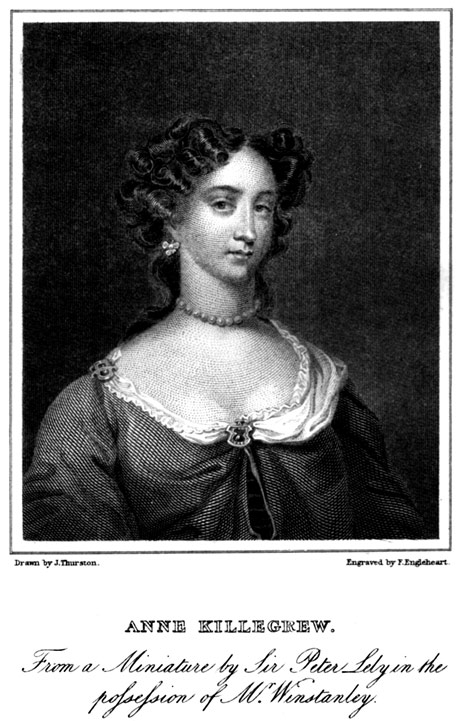
Drawn by J. Thurston. Engraved by F. Engleheart. ANNE KILLEGREW. From a Miniature by Sir Peter Lely in the possession of Mr. Winstanley.
ANNE KILLIGREW.
[BORN 1660. DIED 1685.] BALLARD.
HE daughter of Dr Henry Killigrew, prebendary of Westminster, became eminent in the arts of poetry and painting; and had it pleased Providence to protract her life, she might probably have excelled most of the professors in both. She was the Orinda of Mr Dryden, who seems quite lavish in her commendation; but as we are assured by a writer of great probity [Wood's "Athenæ"] that she was equal to, if not superior to that praise, let him be my voucher for her skill in poetry.
"Art she had none, yet wanted none, For Nature did that want supply; So rich in treasures of her own, She might our boasted stores defy; Such noble vigour did her verse adorn, That it seemed borrowed where 'twas only born."
The great poet is pleased to attribute to her every excellence in that science; but if she has failed of some of its excellences, still should we have great reason to commend her for having avoided those faults by which some have derived a reflection on the science itself, as well as on themselves. Speaking of the purity and charity of her compositions, he bestows on them this commendation,—
"Her Arethusian stream remains unsoiled, Unmixed with foreign filth, and undefiled; Her wit was more than man, her innocence a child."
She was also a great proficient in the art of painting, and drew King James II. and his queen, which pieces are highly applauded by Mr Dryden. These engaging and polite accomplishments were the least of her perfections, for she crowned all with an exemplary piety towards God in a due observance of the duties of religion, which she began to practise in the early part of her life. But as her uncommon virtues are enumerated on her monument-inscription, I shall only observe that she was one of the maids of honour to the Duchess of York, and that she died of the small-pox in the flower of her age, to the unspeakable grief of her relations and all others who were acquainted with her excellences, in her father's lodgings, within the cloister of Westminster Abbey, on the 16th day of June 1685, in her twenty-fifth year.
Mr Dryden's muse put on the mourning habit on this sad occasion, and lamented the death of our ingenious poetess in very moving strains, in a long ode, from whence I shall take the liberty of transcribing the eighth stanza; and the rather as it does honour to another female character.
"Now all those charms that blooming grace The well-proportioned shape and beauteous face, Shall never more be seen by mortal eyes; In earth the much-lamented virgin lies! Not wit nor poetry could fate prevent, Nor was the cruel destiny content To finish all the murder at a blow, To sweep at once her life and beauty too; But, like a hardened felon, took a pride, To work more mischievously slow, And plundered first, and then destroyed. O, double sacrifice, as things divine, To rob the relique and deface the shrine! But thus Orinda died: Heaven by the same disease did both translate; As equal were their souls, so equal was their fate."
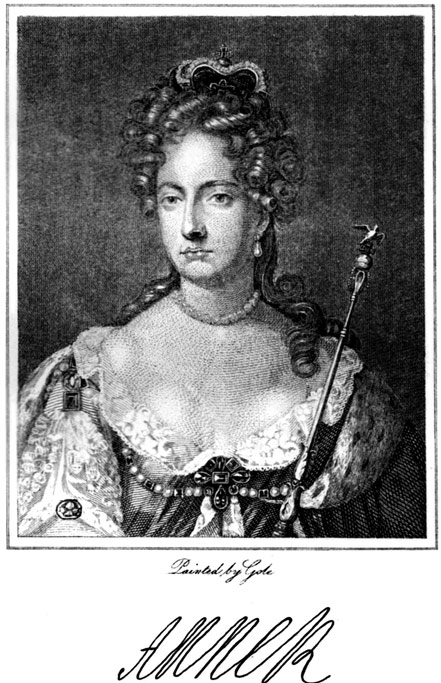
Painted by Gole
QUEEN ANNE.
[BORN 1664. DIED 1714.] MISS STRICKLAND.
UEEN Anne "had a person and appearance not at all ungraceful, till she grew exceeding gross and corpulent. There was something of majesty in her look, but mixed with a sullen and constant frown, that plainly betrayed a gloominess of soul and cloudiness of disposition within. She seemed to inherit a good deal of her father's moroseness, which naturally produced in her the same sort of stubborn positiveness in many cases, both ordinary and extraordinary, and the same sort of bigotry in religion." This passage, being written for insertion in a party work, appeals to vulgar opinion. The slight contraction in the queen's eyes, the writer perfectly well knew, had been occasioned by violent inflammation in her childhood, and was not connected with temper. The Duchess of Marlborough likewise well knew, and had experienced, that excessive indulgence, and not moroseness, in his family circle, was the fault of the unhappy James II., her own early benefactor. However, this libel was to have been published under Bishop Burnet's mask. Thus does the creature of the bounty of those she maligns pursue her theme: "Queen Anne's memory was exceeding great, almost to a wonder, and had these two peculiarities very remarkable,—that she could, when she pleased, forget what others would have thought themselves bound by truth and honour to remember, while she remembered all such things as others would have thought it a happiness to forget. Indeed, she chose to exercise it in very little besides ceremonies and customs of courts, and such-like insignificant trifles. So that her conversation, which otherwise might have been enlivened by so great a memory, was only made more empty and trifling by its chiefly turning upon fashions and rules of precedence, or some such poor topics. Upon which account, it was a sort of misfortune to her that she loved to have a great crowd come to her, having little to say to them, but 'that the weather was either hot or cold;' and little to inquire of them, but 'how long they had been in town?' or the like weighty matters. She never discovered any readiness of parts, either in asking questions or in giving answers. In matters of ordinary moment, her discourse had nothing of brightness or wit; in weightier matters, she never spoke but in a hurry, and had a certain knack of sticking to what had been dictated to her to a degree often very disagreeable, and without the least sign of understanding or judgment." As the duchess was considered the queen's "dictator" for thirty years, she had ample opportunity of speaking on this trait of her character; but it only became apparent to her when the dictatorship was transferred for a few years to another person. "The queen's letters," she continues, "were very indifferent, both in sense and spelling, unless they were generally enlivened with a few passionate expressions, sometimes pretty enough, but repeated over and over again, without the mixture either of diversion or instruction."

Now turn the medal, and read the reverse:—"Queen Anne had a person and appearance very graceful; something of majesty in her look. She was religious without affectation, and certainly meant to do everything that was just. She had no ambition, which appeared by her being so easy in letting King William come before her to the crown, after the king, her father, had followed such counsels as made the nation see they could not be safe in their liberty and lives without coming to the extremities they did; and she thought it more for her honour to be easy in it, than to make a dispute who should have the crown first that was taken from her father. And it was a great trouble to her to be forced to act such a part against him, even for security, which was truly the case; and she thought those that showed the least ambition had the best character. Her journey to Nottingham was purely accidental, never concerted, but occasioned by the great fright she was in when King James returned from Salisbury; upon which she said she would rather jump out of the window than stay and see her father."
Those who have read the previous character drawn of Queen Anne by the same person must think the contradictions between the two truly monstrous, and the emanation of a bewildered brain. Some candid persons, disposed to sentimentalise on the fierce duchess, have supposed that, after a lapse of time, her mind had softened towards her benefactress, and that she wrote the last character as a reparation for the first. But such inferences vanish before the fact that the duchess herself favours the world with her motives, in raising a statue at Blenheim to her former royal mistress, and adorning it with the laudatory inscription, the whole being avowedly not to do justice to Queen Anne, but to vex and spite Queen Caroline, the consort of George II. Here are her words: "This character of Queen Anne is so much the reverse of Queen Caroline, that I think it will not be liked at court." In the middle of the last century, the Duchess of Marlborough hated Queen Caroline more than she did Queen Anne. Such is the real explanation of these discrepancies.
Other contemporary authors have mentioned traits of Queen Anne, according to their knowledge. When all are collected and examined, certain contradictions occur; for they do not enough distinguish between the actions of Anne in her youth, as an uneducated and self-indulgent woman, and the undeniable improvement in her character. Even the awful responsibility of a reigning sovereign, whose practical duties were at that era by no means clearly defined, awoke her conscience to trembling anxiety for the welfare of her people. Much permanent good she assuredly did, and no evil, as queen-regent, notwithstanding the ill-natured sarcasms of a Whig politician, who, when mentioning her demise at an opportune juncture for the Hanoverian succession, declared that "Queen Anne died like a Roman, for the good of her country." But no sovereign was ever more deeply regretted by the people. The office of regality was, there is no doubt, a painful occupation to her; for her constant complaint was, observes Tindal, "that she was only a crowned slave," the originality of which expression savours not of the dulness generally attributed to this queen.
Her person is represented differently by those who saw her daily. "Her complexion was ruddy and sanguine; the luxuriance of her chestnut hair has already been mentioned. Her face was round and comely, her features strong and regular; and the only blemish in it was that defluxion which had fallen on her eyes in her childhood, had contracted the lids, and given a cloudiness to her countenance." Thus the frown that the Duchess of Marlborough dwells on malevolently did not arise from ill-nature, but from defect of vision. The duchess has likewise given a malignant turn to a trifling incident arising from Anne's near-sightedness, quoted in her early life. "Queen Anne was of a middle stature," observes another contemporary; "not so personable and majestic as her sister, Queen Mary. Her face was rather comely than handsome; it seemed to have a tincture of sourness in it, and, for some years before she died, was rubicund and bloated. Her bones were small, her hands extremely beautiful, her voice most melodious, and her ear for music exquisite. She was brought up in High Church principles, but changed her parties according to her interest. She was a scrupulous observer of the outward and visible forms of godliness and humility in public service; as, for instance, she reproved once the minister of Windsor Castle for offering her the Sacrament before the clergy present had communicated;" thus forgetting her position and dignity as head of the church.
ESTHER JOHNSON.
[BORN 1684. DIED 1728.] JEFFREY.
STHER Johnson, better known to the reader of Swift's works by the name of Stella, was the child of a London merchant, who died in her infancy, when she went with her mother, who was a friend of Sir William Temple's sister, to reside at Moorpark, where Swift was then domesticated. Some part of the charge of her education devolved upon him, and, though he was twenty years her senior, the interest with which he regarded her appears to have ripened into something as much like affection as could find a place in his selfish bosom. Soon after Sir William Temple's death he got his Irish livings, besides a considerable legacy; and as she had a small independence of her own, it is obvious that there was nothing to prevent their honourable and immediate union. Some cold-blooded vanity or ambition, however, or some politic anticipation of his own possible inconstancy, deterred him from this outward and open course, and led him to an arrangement which was dishonourable and absurd in the beginning, and in the end productive of the most accumulated misery.

He prevailed upon her to remove her residence from the bosom of her own family in England to his immediate neighbourhood in Ireland, where she took lodgings with an elderly companion of the name of Mrs Dingley—avowedly for the sake of his society and protection, and on a footing of intimacy so very strange and unprecedented, that, whenever he left his parsonage-house for England or Dublin, these ladies immediately took possession and occupied it till he came back. A situation so extraordinary and undefined was liable, of course, to a thousand misconstructions, and must have been felt as degrading by any woman of spirit and delicacy; and, accordingly, though the master of this Platonic seraglio seems to have used all manner of paltry and insulting practices to protect a reputation which he had no right to bring into question,—by never seeing her except in the presence of Mrs Dingley, and never sleeping under the same roof with her,—it is certain both that the connection was regarded as indecorous by persons of her own sex, and that she herself felt it to be humiliating and improper.
Accordingly, within two years after her settlement in Ireland, it appears that she encouraged the addresses of a clergyman of the name of Tisdal, between whom and Swift there was a considerable intimacy, and that she would have married him, and thus sacrificed her earliest attachment to her freedom and her honour, had she not been prevented by the private dissuasions of that false friend who did not choose to give up his own claims to her, although he had not the heart or the honour to make her lawfully his own. She was then a blooming beauty of little more than twenty, with fine black hair, delicate features, and a playful and affectionate character. It seems doubtful to us whether she originally felt for Swift anything that could properly be called love; and her willingness to marry another in the first days of their connection, seems almost decisive on the subject; but the ascendancy he had acquired over her mind, and her long habit of submitting her own judgment and inclinations to his, gave him at last an equal power over her, and moulded her pliant affections into too deep and exclusive a devotion.
Even before his appointment to the deanery of St Patrick's, it is utterly impossible to devise any apology for his not marrying her, or allowing her to marry another; the only one he ever appears to have stated himself, viz., the want of a sufficient fortune to sustain the expenses of matrimony, being palpably absurd in the mouth of a man born to nothing, and already more wealthy than nine-tenths of his order; but after he obtained that additional preferment, and was thus ranked among the well-beneficed dignitaries of the Establishment, it was plainly an insult upon common sense to pretend that it was the want of money that prevented him from fulfilling his engagement. Stella was then twenty-six, and he near forty-five, and both had hitherto lived very far within an income that was now more than doubled. That she now expected to be made his wife appears from the care he took in the Journal indirectly to destroy that expectation; and though the awe in which he continually kept her probably prevented her either from complaining or inquiring into the cause, it is now certain that a new attachment, as heartless, as unprincipled, and as fatal in its consequences as either of the others, was at the bottom of this cruel and unpardonable proceeding.
During his residence in London, from 1710 to 1712, regardless of the ties that bound him to Stella, he allowed himself to be engaged by the amiable qualities of Miss Esther Vanhomrigh; and, without explaining the nature of those ties to his new idol, strove by his assiduities to obtain a return of affection, while he studiously concealed from the unhappy Stella the wrong he was consciously doing her. [The consequences of this double connection form one of the most tragic stories in our language—the formal ceremony by which he made Stella his wife, under the cloud of secrecy, and still keeping her from the enjoyment of her rights; the death of Miss Vanhomrigh of a broken heart, and the miserable fate of Stella.] Vanessa (so he called Miss Vanhomrigh) was now dead. The grave had heaped its tranquillising mould on her agitated heart, and given her tormentor assurance that he should no more suffer from her reproaches on earth; and yet, though with her the last pretext was extinguished for refusing to acknowledge the wife he had so infamously abused, we find him, with this dreadful example before his eyes, persisting to withhold from his remaining victim that late and imperfect justice to which her claim was so apparent, and from the denial of which she was sinking before his eyes in sickness and sorrow to the grave. For the sake of avoiding some small awkwardness or inconvenience to himself,—to be secured from the idle talking of those who might wonder why, since they were to marry, they did not marry before, or perhaps merely to retain the object of his regard in more complete subjection and dependence,—he could bear to see her pining year after year in solitude and degradation, and sinking at last to an untimely grave, prepared by his hard and unrelenting refusal to clear her honour to the world even at her dying hour.

ESTHER VANHOMRIGH.
[1723.] SIR WALTER SCOTT.
HIS unfortunate lady, when she first became acquainted with Swift, was in her twentieth year, and joined to all the attractions of youth, fashion, and elegance, the still more dangerous gifts of a lively imagination, a confiding temper, and a capacity of strong and permanent affection. Conscious of the pleasure which Swift received from her society, and of the advantages of youth and fortune which she possessed, and ignorant of the peculiar circumstances in which he stood with respect to another, naturally (and surely without offence either to reason or virtue) Miss Vanhomrigh gave way to the hope of forming a union with a man whose talents had first attracted her admiration, and whose attentions, in the course of their mutual studies, had by degrees gained her affections, and seemed to warrant his own. The friends continued to use the language of friendship, but with the assiduity and earnestness of a warmer passion, until Vanessa (the poetical name bestowed upon her by him) rent asunder the veil, by intimating to Swift the state of her affections; and in this, as she conceived, she was justified by her favourite, though dangerous maxim, of doing that which seems in itself right, without respect to the common opinion of the world. We cannot doubt that he actually felt the "shame, disappointment, guilt, surprise," expressed in his celebrated poem, though he had not courage to take the open and manly course of avowing those engagements with Stella, or other impediments which prevented him from accepting the hand and fortune of her rival. Without therefore making this painful but just confession, he answered the avowal of Vanessa's passion in raillery, and afterwards by an offer of devoted and everlasting friendship, founded on the basis of virtuous esteem. Vanessa seems neither to have been contented nor silenced by the result of her declaration, but to the very close of her life persisted in endeavouring, by entreaties and arguments, to extort a more lively return to her passion than this cold proffer was calculated to afford.
Upon Swift's return to Ireland, we may guess at the disturbed state of his feelings, wounded at once by ungratified ambition, and harrassed by his affection being divided between two objects, each worthy of his attachment, and each having great claims upon him, while neither was likely to remain contented with the limited return of friendship in exchange for love, and that friendship, too, divided by a rival. Time wore on. Mrs Vanhomrigh was now dead. Her two sons survived her but a short time; and the circumstances of the young ladies were so embarrassed by inconsiderate expenses, as gave them a handsome excuse for retiring to Ireland, where their father had left a small property near Celbridge. The arrival of Vanessa in Dublin excited the apprehensions of Swift and the jealousy of Stella. She importuned him with complaints of neglect and cruelty; and it was obvious that any decisive measure to break their correspondence would be attended with some such tragic consequence as, though late, at length concluded their story.
About the year 1717, she retired from Dublin to her house and property near Celbridge, to nurse her hopeless passion in seclusion from the world. Swift seems to have foreseen and warned her against the consequences of this step. His letters uniformly exhort her to seek general society, to take exercise, and divert as much as possible the current of her thoughts from the unfortunate subject which was preying upon her spirits. Until the year 1720, he never appears to have visited her at Celbridge; they only met when she was occasionally in Dublin. But in that year, and down to the time of her death, Swift came repeatedly to Celbridge.
But Miss Vanhomrigh, irritated at the situation in which she found herself, determined on bringing to a crisis those expectations of an union with the object of her affections, to the hope of which she had clung amid every vicissitude of his conduct towards her. The most probable bar was his undefined connection with Mrs Johnson, which, as it must have been perfectly known to her, had doubtless long excited her secret jealousy; although only a single hint to that purpose is to be found in their correspondence, and that so early as 1713, when she writes to him, then in Ireland, "If you are very happy, it is ill-natured of you not to tell me so, except 'tis what is inconsistent with mine." Her silence and patience under this state of uncertainty for no less than eight years, must have been partly owing to her awe for Swift, and partly perhaps to the weak state of her rival's health, which from year to year seemed to announce speedy dissolution. At length, however, Vanessa's impatience prevailed, and she ventured on the decisive step of writing to Mrs Johnson herself, requesting to know the nature of that connection. Stella, in reply, informed her of her marriage with the dean; and, full of the highest resentment against Swift for having given another female such a right on him as Miss Vanhomrigh's inquiries implied, she sent to him her rival's letter of interrogation, and, without seeing him or awaiting his reply, retired to the house of Mr Ford, near Dublin. Every reader knows the consequence. Swift, in one of those paroxysms of fury to which he was liable, both from temper and disease, rode instantly to Marley Abbey. As he entered the apartment, the sternness of his countenance, which was peculiarly formed to express the fiercer passions, struck the unfortunate Vanessa with such terror that she could scarce ask whether he would not sit down. He answered by flinging a letter upon the table, and, instantly leaving the house, mounted his horse and returned to Dublin. When Vanessa opened the packet, she only found her own letter to Stella. It was her death-warrant; she sunk at once under the disappointment of the delayed yet cherished hopes which had so long sickened her heart, and beneath the unrestrained wrath of him for whose sake she had indulged them. How long she survived this last interview is uncertain, but the time does not seem to have exceeded a few weeks.
MARY ASTELL.
[BORN 1668. DIED 1731.] BALLARD.
HIS great ornament of her sex, the daughter of a merchant in Newcastle, and born about the year 1668, was taught all the accomplishments which were usually learned by young women of her station; and although she proceeded no further in the languages at that time than the learning of the French tongue, yet she afterwards gained some knowledge of the Latin. And having a piercing wit, a solid judgment, and tenacious memory, she made herself a complete mistress of everything she attempted to learn with the greatest ease imaginable. At about twenty years of age she left Newcastle and went to London, where, and at Chelsea, she spent the remaining part of her life, and where she prosecuted her studies very assiduously, and in a little time made great acquisitions in the sciences.
The learning and knowledge which she had gained, together with her great benevolence and generosity of temper, taught her to observe and lament the loss of it in those of her own sex, the want of which, as she justly observed, was the principal cause of their plunging themselves into so many follies and inconveniences. To redress this evil as much as lay in her power, she wrote and published the two parts of her ingenious treatise, entitled, "A Serious Proposal to the Ladies." Afterwards came her "Letters, concerning the Love of God, between the author of the Proposal to the Ladies and Mr John Norris." Notwithstanding her great care to conceal herself, her name was soon discovered and made known to several learned persons, whose restless curiosity would hardly otherwise have been satisfied. These letters have been much applauded for their good sense, sublime thoughts, and fine language.
Afterwards she acquired a more complete knowledge of many classic authors,—Xenophon, Plato, Hierocles, Tully, Seneca, Epictetus, and Antoninus. In 1700 she published her "Reflections on Marriage," which was followed by her book against the sectaries, "Moderation truly Stated,"—a work of which, notwithstanding all the arts she used to conceal herself, she was soon discovered to be the author. Afterwards came her "Religion of a Church of England Woman;" and her "Enquiry into the Causes of Rebellion and Civil War."
As her notions and sentiments of religion, piety, charity, humility, friendship, and all the other graces which adorn the good Christian, were most refined and sublime, so she possessed these rare and excellent virtues in a degree which would have made her admired and distinguished in an age less degenerate and profane; and though from the very flower of her age she lived and conversed with the fashionable world, amidst all the gaiety, pomp, and pageantry of the great city, yet she well knew how to resist and shun those infatuating snares. To know God, and to be like Him, was her first and great endeavour. Though easy and affable to others, to herself she was often over-severe. In abstinence, few or none ever surpassed her; for she would live like a hermit a considerable time together, with a crust of bread and water, with a little small beer. And at the time of her highest living, she very rarely eat any dinner till night, and then it was by the strictest rules of temperance.
She seemed to enjoy an uninterrupted state of health till a few years before her death, when, having one of her breasts cut off, it so much impaired her constitution that she did not long survive it. This was occasioned by a cancer, which she had concealed from the world in such a manner that even few of her most intimate acquaintances knew anything at all of the matter. She dressed and managed it herself, till she plainly perceived there was an absolute necessity for its being cut off; and then, with the most intrepid resolution and courage, she went to the Rev. Mr Johnson, a gentleman very eminent for his skill in surgery (with only one person to attend her), entreating him to take it off in the most private manner imaginable, and would hardly allow him to have persons whom necessity required to be at the operation. She seemed so regardless of the sufferings or pain she was to undergo, that she refused to have her hands held, and did not discover the least timidity or impatience, but went through the operation without the least struggling or resistance, or even so much as giving a groan or a sigh. Soon after this her health and strength declined apace; and at length, by a gradual decay of nature, being confined to bed, and finding the time of her dissolution drawing nigh, she ordered her coffin and shroud to be made and brought to her bedside, and there to remain in her view as a constant memento to her of her approaching fate, and that her mind might not deviate or stray one moment from God, its proper object.
MADAME DES URSINS.
[BORN 1640. DIED 1722.] ST SIMON.
HEN this extraordinary woman was appointed camarera-mayor to the queen of Philip V. of Spain, she was a widow without children. No one could have been better suited for the post. A lady of the French court would not have done: a Spanish lady was not to be depended on, and might have easily disgusted the queen. The Princess des Ursins appeared to be a middle term. She was French, had been in Spain, and she passed a great part of her life at Rome and in Italy. She was of the house of Tremoille,—Anne Maria de la Tremoille. She first married M. Talleyrand, who called himself Prince de Chalais. She followed her husband to Spain, where he died. Her second husband was chief of the house of Ursins, a grandee of Spain, and Prince of the Soglio.

Age and health were also appropriate, and likewise her appearance. She was rather tall than otherwise; a brunette, with blue eyes of the most varied expression; in figure perfect, with a most exquisite bosom; her face, without being beautiful, was charming. She was extremely noble in air, very majestic in demeanour, full of graces so natural and continual in everything, that I have never seen any one approach her either in form or mind. Her wit was copious, and of all kinds; she was flattering, caressing, insinuating, moderate, wishing to please for pleasing' sake, with charms irresistible when she strove to persuade and win over; accompanying all this, she had a grandeur that encouraged instead of frightening; a delicious conversation, inexhaustible and very amusing, for she had seen many countries and persons; a voice and way of speaking extremely agreeable, and full of sweetness. She knew how to choose the best society, how to receive them, and could even have held a court; was polite, distingué, and, above all, was careful never to take a step in advance without dignity and discretion. She was eminently fitted for intrigue, in which, from taste, she had passed her life in Rome; with much ambition, but of that vast kind far above her sex and the common run of men—a desire to occupy a great position, and to govern. A love for gallantry and personal vanity were her foibles, and these clung to her until her latest day; consequently, she dressed in a way that no longer became her, and, as she advanced in life, removed further from propriety in this particular. She was an ardent and excellent friend—of a friendship that time and absence never enfeebled, and, consequently, an implacable enemy, pursuing her hatred to the infernal regions. While caring little for the means by which she gained her ends, she tried as much as possible to reach them by honest means. Secret not only for herself but for her friends, she was yet of a decorous gaiety, and so governed her humours, that at all times and in every thing she was mistress of herself.
From the first moment on which she entered the service of the Queen of Spain, it became her desire to govern not only the queen but the king, and by this means the realm itself. Such a grand project had need of support from our king [Louis XIV.], who, at the commencement, ruled the court of Spain as much as his own court, with entire influence over all other matters.
The young Queen of Spain had been not less carefully educated than her sister, the Duchesse de Bourgogne. She had even, when so young, much intelligence and firmness, without being incapable of restraint. Indeed, she became a divinity among the Spaniards, and, to their affection for her, Philip V. was more than once indebted for his crown. Madame des Ursins soon managed to obtain the entire confidence of this queen, and, during the absence of Philip V. in Italy, assisted her in the administration of all public offices. She even accompanied her to the junta, it not being thought proper that the queen should be alone amidst such an assemblage of men. In this way she became acquainted with everything that was passing, and knew all the affairs of the government.
This step gained, it will be imagined that the Princess des Ursins did not forget to pay her court most assiduously to our king and Madame de Maintenon. Little by little she introduced into her letters details respecting public affairs, without, however, conveying a suspicion of her own ambition. She next began to flatter Madame de Maintenon, and to hint that she might rule over Spain even more firmly than she ruled over France, if she would entrust her commands to Madame des Ursins. Madame de Maintenon was enchanted by the siren, and embraced the proposition with avidity. It was next necessary to draw the King of Spain into the same net—not a very arduous task. Soon the junta became a mere show. Everything was brought before the king in private, and he gave no decision until the queen and Madame des Ursins passed theirs.
[This rule Madame des Ursins continued for many years. Ultimately, a quarrel with Madame de Maintenon, the death of the Queen of Spain, and the second marriage of the king, with the cabals of enemies, forced her in her old age into a retreat at Rome.] She was not long there before she attached herself to the King and Queen of England (the Pretender and his wife), and soon governed them openly. What a poor resource! But it was courtly, and had a flavour of occupation for a woman who could not exist without movement. She finished her life there, remarkably healthy in mind and body, and in a prodigious opulence, which was not without its use in that deplorable court. She had the pleasure of seeing Madame de Maintenon forgotten and annihilated at St Cyr, of surviving her, of seeing at Rome her two enemies, Guidice and Alberoni, as profoundly disgraced as she. Her death, which a few years before would have resounded through all Europe, made not the least sensation.
LADY GRIZEL JERVISWOODE.
[1665.] ANDERSON.
RIZEL Hume, born in 1665, was daughter of Patrick Hume, Baron of Polwarth, and became the wife of George Baillie of Jerviswoode. She began her life during the troubles of the Scottish persecution. At the time of her father's liberation from prison, she was little more than ten years of age; and, soon after, those romantic incidents occur in her life which have given her a historical celebrity. From the tact and activity with which, far beyond one of her years, she accomplished whatever she was entrusted with, her parents sent her on confidential missions, which she executed with singular fidelity and success. In the summer of that same year, when Robert Baillie of Jerviswoode, the early and intimate friend of her father, was imprisoned for rescuing his brother-in-law, Mr James Kirkton, from a wicked persecutor, Captain William Carstairs, she was sent by her father from his country-house to Edinburgh, a long road, to try if from her age she could get admittance into the prison unsuspected, and slip a letter of information and advice into his hand, and bring back from him what intelligence she could. Proceeding on her journey, she succeeded in getting access to Baillie, though we are not informed in what way. But in whatever way young Grizel got access to Baillie, and whatever were the circumstances of their interview, she successfully accomplished the purpose of her mission. It is also to be observed, that it was in the prison on this occasion that she first saw Mr Baillie's son, and that then and there originated that intimacy and attachment between him and her which afterwards issued in their happy marriage.

When, in October 1683, Robert Baillie was apprehended in London and sent down a prisoner to Scotland, her father, who was implicated in the same patriotic measures for preventing a popish successor to the British throne, for which Baillie was arrested, had too good ground to be alarmed for his own personal safety. But he was allowed, it would appear, to remain undisturbed in his own house till the month of September next year, when orders were issued by the government for his apprehension; and a party of troops had come to his house on two different occasions for that purpose, though they failed in getting hold of him. Upon this he found it necessary to withdraw from home, and to keep himself in concealment till he got an opportunity of going over to the Continent. The spot to which he betook himself for shelter was the family burying-place, a vault under ground at Polwarth Church, at the distance of a mile from the house. Where he was no person knew but Lady Grizel Hume, and one man, James Winter, a carpenter, who used to work in the house, and of whose fidelity they were not disappointed. The frequent examinations to which servants were at that time subjected, and the oaths by which it was attempted to extort discoveries from them, made Grizel and her mother afraid to commit the secret to any of these. By the assistance of James Winter, they got a bed and bed-clothes carried during the night to his hiding-place; and there he was concealed for a month, during which time the only light he had was that admitted by means of a chink at one end, through which nobody on the outside could see who or what was in the interior. While he abode in this receptacle of the dead, Grizel, with the most exemplary filial tenderness, and with the most vigilant precaution, ministered to his temporal wants and comforts. Regularly at midnight, when men were sunk in sleep, she went alone to this dreary vault, carrying to him a supply of food and drink, and to bear him company. She stayed as long as she could, taking care to get home before day, to prevent discovery. She had a great deal of humour in telling a story; and during her stay she took a delight in telling him, nor was he less delighted in hearing her tell him, such incidents at home as had amused herself and the rest of the family, and these were often the cause of much mirth and laughter to them both.
[Grizel's adventures were continued into Holland, whither her father retired, and where she showed her natural traits of sagacity, those marks of genius for which she has been celebrated. She wrote many pieces of poetry, and one in particular, "Werna my heart licht I would dee," which has been praised as simple, lively, and tender. Her personal appearance is thus described by her daughter, Lady Murray: "She was middle-sized, well made, clever, in her person very handsome, with a life and sweetness in her eyes very uncommon, and great delicacy in all her features; her hair was chestnut; and to her last she had the finest complexion, with the clearest red in her cheeks and lips that could be seen in any one of fifteen, which, added to her natural constitution, might be owing to the great moderation she had in her diet throughout her whole life.... Pottage and milk were her greatest feast, and by choice she preferred them to everything, though nothing came wrong to her that others could eat. Water she preferred to any liquor; and though often obliged to take a glass of wine, she always did it unwillingly, thinking it hurt her, and did not like it."]
MADAME DE PONTCHARTRAIN.
[1660.] ST SIMON.
AS the daughter of Maupeon, president of one of the Chambers of Inquest, and, though far from being rich, was an acquisition to Pontchartrain, who was farther. One could scarcely be more plain in appearance than Madame; but then, to make up, she was a big woman, with something of a grand air, which was not only imposing, but had a certain refinement about it. No wife of a minister, or any other, possessed more of the art of managing an establishment, of combining order with ease and magnificence, of adroitly warding off inconveniences by looking forward without showing solicitude, of making dignity harmonise with politeness—a politeness so measured and advised as put all the world at ease. She had a great deal of spirit, without any ambition to show it, and a complaisance which was devoid of hollowness or duplicity. If she happened to make a mistake, it was surprising with what quietness she could repair the error; but she possessed also great good sense, which enabled her to make a just estimate of people, and a general sagacity as regards things and conduct, which few men of the time could boast of. Every one wondered that a woman de la robe, who had never seen the world but in Brittany, could in so short a time accommodate herself to the manners, spirit, and language of the court, becoming one of the best counsellors which one could find in cases of difficulty. True, she had too long imbibed the manners of the people not to show some small evidence of the contagion; but then it was all but unnoticed amidst the gallantry of a refined and charming spirit, which seemed always welling naturally from its source, accompanied by such grace of action that every one was delighted.
No person understood so well as Madame Pontchartrain the art of giving fêtes. She had all the taste required, and all the invention, with a sumptuosity, too, on all sides; yet she never gave without reason and a good purpose, and she did all with an air perfectly simple and tranquil, without forgetting her age, her place, her state, her modesty. She was helpful to her relations; a trustworthy friend, effective, useful, true in all points, and pure at heart; delicious in the freedom of the country, dangerous at table in fixing you there, often very amusing without saying a word out of joint; always gay, though sometimes not exempt from humour. The virtue and the piety which she had exhibited throughout all her life increased as her fortune increased. What she gave in pensions well merited, what marriages she procured for poor girls, what she did for poor nuns when well assured of their vocation, what she deprived herself of to enable her to enable others to live, will never be known.
ELIZABETH HALKETT.
[1677.] CONOLLY.
ORN in 1677, the authoress of the celebrated ballad of "Hardyknute" was the second daughter of Sir Charles Halkett of Pitferrane. At the age of nineteen she married Sir Henry Wardlaw of Pitreavie in Fife, to whom she bore four daughters and a son.
She at first attempted to pass off the ballad of "Hardyknute" as a genuine fragment of an ancient poem, and caused her brother-in-law, Sir John Bruce of Kinross, to communicate the manuscript to Lord Binning, himself a poet, as a copy of a manuscript found in an old vault of Dunfermline.
The poem of "Hardyknute" was first published in 1719, and it was afterwards admitted by Ramsay into the "Evergreen," and for many years was received as an old ballad [a circumstance which has been founded on by some modern writers as sufficient to invalidate the claims of many of our "old ballads" to an origin beyond that of the date of Lady Halkett's successful literary fraud. Nay, several of these have been ascribed to this lady chiefly upon the internal evidence of identical words; but it seems to have been overlooked by these inquirers that Lady Halkett would naturally imitate the old ballads; and no doubt she did; so that the supposed proof may be successfully turned against the new theory.] The real authorship of "Hardyknute" was first disclosed by Bishop Percy in his "Reliques," published in 1755, and has since been established beyond a doubt [but there is no evidence beyond what has been mentioned that she wrote "Sir Patrick Spens," or any other of our so-called old Scotch ballads].
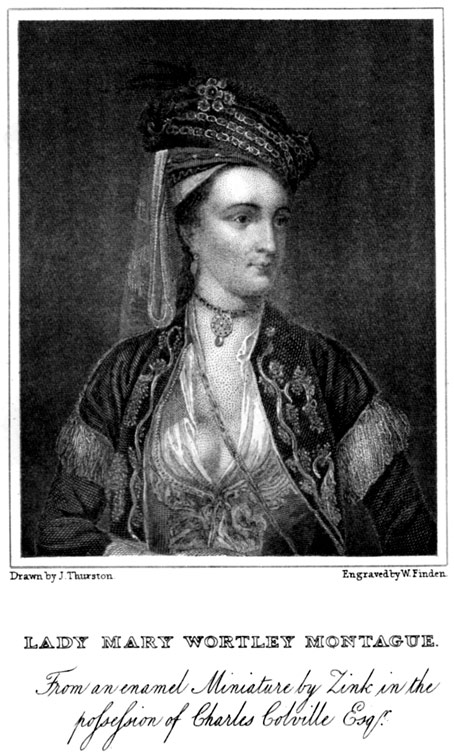
Drawn by J. Thurston. Engraved by W. Finden. LADY MARY WORTLEY MONTAGUE. From an enamel Miniature by Zink in the possession of Charles Colville Esqr.
LADY MARY WORTLEY MONTAGU.
[BORN 1690. DIED 1762.] JEFFREY.
ADY Mary Pierrepoint, eldest daughter of the Duke of Kingston, was born in 1690, and gave, in her early youth, such indications of a studious disposition, that she was initiated into the rudiments of the learned languages along with her brother. Her first years appear to have been spent in retirement, and yet her first letters indicate a great relish for that talent and power of observation, by which she afterwards became so famous and so formidable. These letters were addressed to Mrs Wortley, the mother of her future husband, and, along with a good deal of girlish flattery and affectation, display such a degree of easy humour and sound penetration, as is not often to be met with in a damsel of nineteen, even in this age of precocity. "My knight-errantry," she says, "is at an end, and I believe I shall henceforth think freeing of galley-slaves and knocking down windmills more laudable undertakings than the defence of any woman's reputation whatever. To say truth, I have never had any great esteem for the generality of the fair sex, and my only consolation for being of that gender has been the assurance it gave me of never being married to any one among them." But, in the course of this correspondence with the mother, she appears to have conceived a very favourable opinion of the son. Her ladyship, though endowed with a very lively imagination, seems not to have been very susceptible of violent or tender emotions, and to have imbibed a very decided contempt for sentimental and romantic nonsense, at an age which is commonly more indulgent.

Married to Mr Wortley in 1712, she entered upon a gay life; but she does not appear to have been happy. We have no desire to revive forgotten scandals, but it is a fact which cannot be omitted, that her ladyship went abroad without her husband, on account of bad health, in 1739, and did not return to England till she heard of his death in 1761. Whatever was the cause of their separation, there was no open rupture, and she seems to have corresponded with him very regularly for the first ten years of her absence; but her letters were cold without being formal, and were gloomy and constrained when compared with those that were spontaneously written to show her wit or her affection to her correspondents.
A little spoiled by flattery, and not altogether "undebauched by the world," Lady Mary seems to have possessed a masculine solidity of understanding, great liveliness of fancy, and such powers of observation and discrimination of character, as to give her opinions great authority on all the ordinary subjects of practical manners and conduct. After her marriage, she seems to have abandoned all idea of laborious or regular study, and to have been raised to the station of a literary character merely by her vivacity and love of amusement and anecdote. The great charm of her letters is certainly the extreme ease and facility with which everything is expressed, the brevity and rapidity of her representations, and the elegant simplicity of her diction. While they unite almost all the qualities of a good style, there is nothing of the professed author in them; nothing that seems to have been composed, or to have engaged the admiration of the writer. She appears to be quite unconscious either of merit or of exertion in what she is doing, and never stops to bring out a thought, or to turn an expression, with the cunning of a practised rhetorician. Her letters from Turkey will probably continue to be more universally read than any of the others, because the subject commands a wider and more permanent interest than the personalities and unconnected remarks with which the rest of her correspondence is filled. At the same time, the love of scandal and private history is so great, that these letters will be highly relished as long as the names they contain are remembered, and then they will become curious and interesting, as exhibiting a truer picture of the manners and fashions of the time, than is to be found in most other publications.
Poetry, at least the polite and witty sort which Lady Mary has attempted, is much more of an art than prose writing. We are trained to the latter by the conversation of good society, but the former seems always to require a good deal of patient labour and application. This her ladyship appears to have disdained; and, accordingly, her poetry, though abounding in lively conceptions, is already consigned to that oblivion in which mediocrity is destined by an irrevocable sentence to slumber till the end of the world. Her essays are extremely insignificant, and have no other merit that we can discover, but that they are very few and very short.
Of Lady Mary's friendship and subsequent rupture with Pope, we have not thought it necessary to say anything, both because we are of opinion that no new light has been latterly thrown upon it, and because we have no desire to awaken forgotten scandals by so idle a controversy. Pope was undoubtedly a flatterer, and was undoubtedly sufficiently irritable and vindictive; but whether his rancour was stimulated upon this occasion by anything but caprice or jealousy, and whether he was the inventor or the echo of the imputations to which he has given notoriety, we do not pretend to determine. Lady Mary's character was certainly deficient in that cautious delicacy which is the best guardian of female reputation; and there seems to have been in her conduct something of that intrepidity which naturally gives rise to misconstruction, by setting at defiance the maxims of ordinary discretion.
MADAME DU DEFFAND.
[BORN 1697. DIED 1780.] JEFFREY.
lady who was left a widow, with a moderate fortune and a great reputation for wit, about 1750, and soon after gave up her hotel and retired to apartments in the Convent de St Joseph, where she continued to receive almost every evening whoever was most distinguished in Paris for rank, talent, or accomplishment. Having become almost blind in a few years, she found she required the attendance of some intelligent young woman who might read and write for her, and assist in doing the honours of her conversazione. For this purpose she cast her eyes on Mademoiselle Lespinasse, the illegitimate daughter of a man of rank who had been boarded in the same convent, and was for some time delighted with her selection. By-and-by, however, she found that her young companion began to engross more of the notice of her visitors than she thought suitable, and parted from her with violent, ungenerous, and implacable displeasure. Mademoiselle de Lespinasse, however, carried with her the admiration of the greater part of her patroness's circle; and having obtained a small pension from government, opened her own doors to a society no less brilliant than that into which she had been initiated by Madame du Deffand. The fatigue however, which she had undergone in reading the old marchioness asleep had irreparably injured her health, which was still more impaired by the agitations of her own inflammable and ambitious spirit; and she died before she had attained middle age, about 1776, leaving on the minds of all the most eminent men of France, an impression of talent, and of ardour of imagination, which seems to have been considered as without example. Madame du Deffand continued to preside in her circle till a period of extreme old age, and died in 1780, in full possession of her faculties.

Madame du Deffand was the wittiest, the most selfish, and the most ennuyé of the whole party. Her wit, to be sure, is very enviable and very entertaining; but it is really consolatory to common mortals to find how little it could amuse its possessor. This did not proceed in her, however, from the fastidiousness which is sometimes supposed to arise from a long familiarity with excellence, so much as from a long habit of selfishness, or rather from a radical want of heart or affection. La Harpe says of her, that it was "difficult for any one to have less sensibility and more egotism." With all this, she was greatly given to gallantry in her youth, though her attachments, it would seem, were of a kind not very likely to interfere with her peace of mind. The very evening her first lover died, after an intimacy of twenty years, La Harpe assures us "that she came to supper at a grand company at Madame de Marchius's, where I was; and that, speaking of the loss she had sustained, she said, 'Alas, he died at six o'clock, otherwise you would not have seen me here.'" She is also recorded to have frequently declared that she could never bring herself to love anything, though, in order to take every possible chance, she had several times attempted to become devote with no great success. This, we have no doubt, is the secret of her ennui; and a fine example it is of the utter worthlessness of all talent, accomplishment, and glory, when disconnected with those feelings of kindness and generosity which are of themselves sufficient for happiness. Madame du Deffand, however, must have been delightful to those who sought only for amusement. Her tone is admirable, her wit flowing and natural; and though a little given to detraction, and not a little importunate and exigeante towards those on whose complaisance she had claims, there is always an air of politeness in her raillery, and of knowledge of the world in her murmurs, that prevents them from being either wearisome or offensive.
PHŒBE BENTLEY.
[1700.] CUMBERLAND.
HE youngest daughter of the illustrious Dr Bentley was the Phœbe of Byron's Pastoral. She was a woman of extraordinary accomplishments, and was the mother of the well-known Richard Cumberland, the most valuable part of whose early education was due to the taste and intelligence of this excellent woman. "It was," according to his account, "in these intervals from school that she began to form both my taste and my ear for poetry, by employing me every evening to read to her, of which art she was a very able mistress. Our readings were, with very few exceptions, confined to the chosen plays of Shakespeare, whom she both admired and understood in the true spirit and sense of the author. With all her father's (Dr Bentley's) critical acumen, she could trace and teach me to unravel all the meanders of Shakespeare's metaphors, and point out where it illuminated or where it only loaded or obscured the meaning."
These were happy hours and interesting lectures to Richard Cumberland; and the effect was a sort of drama produced at twelve years, called "Shakespeare in the Shades," and composed almost entirely of passages from that great writer, strung together and assorted with no despicable ingenuity.
MARQUISE DU CHATELET.
[BORN 1706. DIED 1749.] PROFESSOR CRAIK.
T the head of the list of scientific ladies stands Gabrielle Emilie le Tonnelier de Breteuil, Marquise du Châtelet, the French translator of Newton's "Principia." She was the daughter of the Baron de Breteuil, was born in 1706, and was married to the Marquis de Chastelet, or Châtelet, when very young. Voltaire became acquainted with her in 1733, and he has described what he found her to be in the memoir which he has left us of a part of her life. Her father, he says, had caused her to be taught Latin, and she knew that language as well as Madame Dacier. She had by heart the finest passages of Horace, Virgil, and Lucretius; all the philosophical writings of Cicero were familiar to her. But her predominating taste was for the mathematics and metaphysics. There had rarely been united in any one more correctness of judgment, with more taste and ardour for the acquisition of knowledge; nor was she for all this the less attached to the world, and to all the amusements proper to her age and sex.
Yet she had given up everything to go and bury herself in an old dilapidated château, situated in a barren and wretched country, on the borders of Champagne and Lorraine. She had, however, made this country house at Cirey an agreeable retreat for study and philosophical intercourse. Pleasant gardens, with which the marchioness had embellished it, a good collection of philosophical instruments which Voltaire formed, and an extensive library, enabled Maupertius, John Bernouilli, and other distinguished literary and scientific visitors, who sometimes came to spend a few weeks or months, both to enjoy themselves and to pass their time not unprofitably. Voltaire resided here for about six years. He taught the marchioness English, and, he says, at the end of three months she knew the language as well as himself, and was equally able to read Locke, Newton, and Pope. Italian she acquired with the same facility; Voltaire and she read several of the Italian poets together; and when Francesco Algarotti came to Cirey to finish his work, entitled "Newtonianismo par le Dame"—"Newtonianism for the Ladies"—she was able to converse with him in his own tongue, and to give him many valuable suggestions.
"We sought for nothing," continues Voltaire, "in this delicious retreat, except to cultivate our understandings, without taking any trouble to inform ourselves about what was passing in the rest of the world. Our chief attention for a long time was given to Leibnitz and Newton. Madame du Châtelet at first attached herself to Leibnitz, and gave an explanation of a part of his system in a work written with great ability, which she called 'Institutions de Physique.' She did not seek to decorate this philosophy with ornaments foreign to its nature; no such affectation belonged to the character of her mind, which was masculine and true. Clearness, precision, and elegance were the constituents of her style. If it has ever been found possible to give any plausibility to the notions of Leibnitz, it is in that book that it has been done." The "Institutions de Physique" has received high commendation from the most competent authorities as well as from Voltaire. It is described as "a series of letters, in which the systems of Leibnitz and Newton are explained in a familiar style, and with a degree of knowledge of the history of the several opinions, and of sound language and ideas in their discussion, which we read with surprise, remembering that they were the production of a Frenchwoman, thirty years of age, written very few years after the introduction of the Newtonian philosophy into France. She takes that intermediate view between the refusal to admit the hypothesis of attraction and the assertion of it as a primary quality of matter, from which very few who consider the subject would now dissent. At the end of the work is an epistolary discussion with M. de Mairan, on the principle of vis viva—the vital energy, the metaphysical part of which then created much controversy." Her translation of Newton's "Principia" was published at Paris in 1759. It stands so high that it has been used by Delambre in his "History of Astronomy," whenever he has to make a quotation from Newton. Madame du Châtelet had been dead for ten years when the work appeared. Her life is supposed to have been shortened by her close application in preparing it, and she died at the age of forty-three.

LADY HUNTINGDON.
[BORN 1707. DIED 1791.] ISAAC TAYLOR.
HE broad facts of this noble lady's history afford ground enough for the repute she has enjoyed as a woman of much tact and ability, of great energy, and of a munificent temper; while the use she made of her influence and fortune for the promotion of the Methodistic movement, that is to say, of Christianity itself, sufficiently attests her piety and zeal. It must also be inferred, from the circumstance of her having retained the friendship and regard of many among the leading persons of her time through a long period of years, that she possessed qualities of mind and attractions of manner that were of no ordinary sort; for it is certain that those who ridiculed, or even hated her Methodism, still yielded themselves, in frequent instances, to her personal influence. So far, an idea of Lady Huntingdon may be gathered from facts that are beyond doubt. There is, however, so little that is discriminative in the extant eulogies of her friends and correspondents, or of her biographers, and there is so little that bears a clearly-marked individuality in her own letters, that a distinct image of her mind and temper is not easy to obtain.
As to the position assigned to her among the founders of Methodism, it is due to her rather on the ground of what she did for it as its patroness, which was almost immeasurable, than because she imprinted upon it any characteristics of her own mind. Calvinistic Methodism was not her creation. In the centre of the brilliant company of her pious relatives and noble friends, and with a numerous attendance of educated and Episcopally-ordained ministers, and, beyond this inner circle, a broad penumbra of lay preachers chosen by herself, and educated, maintained, and employed at her cost, and acting under her immediate direction, she seems to sit as a queen. Something of the regal style, something of the air of the autocrat, was natural to one who, with the consciousness of rank, and with the habitude of one accustomed to the highest society, was gifted with a peculiar governing ability, and was actually wielding an extensive influence over men and things. It would have been wonderful indeed if nothing of the sort had been perceptible in her manner and style; yet, that her main intention was pure and beneficent, and that ambition was not her passion, will be felt and confessed by every candid reader of her letters.
Her letters indicate much business-like ability, and they show always a pertinent adherence to the matter in hand. They are, therefore, more determinate by far than Whitefield's, and indeed are little less so than Wesley's, whose letters are eminent examples of succinct determinativeness; they bespeak an unvarying and genuine fervour, and a simple-hearted onward tendency toward the one purpose of her life—the spread of the gospel, and the honour of her Saviour. Lady Huntingdon's are, moreover, marked by often-repeated, but not to be questioned, professions of the deep sense she had of her own unworthiness and unprofitableness. Such are the ingredients, few and perpetually recurrent, of these compositions: a severe monotony—not severe in the sense of harshness—is their characteristic. Yet Lady Huntingdon was always the object of a warm personal affection with those who were nearest to her. With them it is always "Our dear Lady Huntingdon;" and putting out of view formal eulogies, it is unquestionable that, if she governed her connection as having a right to rule it, her style and behaviour, like Wesley's, indicated the purest motives and the most entire simplicity of purpose. This, in truth, may be said to have been the common characteristic of the founders of Methodism, especially of the two Wesleys—a devotedness to the service and glory of the Saviour Christ, which none who saw and conversed with them could question.
MARIA THERESA.
[BORN 1717. DIED 1780.] CARLYLE.
ARIA Theresa, in high spirits about her English subsidy and the bright aspects, left Vienna for Presburg, and is celebrating her coronation there as Queen of Hungary in a very sublime manner. Sunday, 25th June, 1741, that is the day of putting on your crown—iron crown of St Stephen, as readers know. The chivalry of Hungary, from Palfy and Esterhazy downward, and all the world, are there shining in loyalty and barbaric gold and pearl. A truly beautiful young woman, beautiful to soul and eye,—devout, too, and noble, though ill formed in political or other science,—is in the middle of it, and makes the scene still more noticeable to us. "See, at the finish of the ceremonies, she has mounted a high swift horse, sword girt to her side,—a great rider always this young queen,—and gallops, Hungary following like a comet's tail, to the Konigsberg, to the top of the Konigsberg; there draws sword, and cuts grandly, flourishing to the four quarters of the heavens: 'Let any mortal, from whatever quarter coming, meddle with Hungary if he dare!' Chivalrous Hungary bursts into passionate acclaim; old Palfy, I could fancy, into tears; and all the world murmurs to itself, with moist gleaming eyes, Rex Noster."
As for this brave young Queen of Hungary, my admiration goes with all the world—not in the language of flattery, but of evident fact: the royal qualities abound in that high young lady; had they left the world and grown to mere costume elsewhere, you might find certain of them again here. Most brave, high, and pious-minded; beautiful, too, as I have said, and radiant with good nature, though of temper that will easily catch fire; there is perhaps no nobler woman there living; and she fronts the roaring elements in a truly grand feminine manner, as if heaven itself, and the voice of duty, called her. "The inheritances which my father left me, we will not part with these. Death, if it so must be, but not dishonour; listen not to that thief in the night." Maria Theresa has not studied at all the history of the Silesian Duchies. She knows only that her father and grandfather peaceably held them; it was not she that sent out Seckendorf to ride two thousand five hundred miles, or broke the heart of Frederick-William and his household. Pity she had not complied with Frederick, and saved such rivers of bitterness to herself and mankind!
Her husband, the Grand Duke, an inert but good-tempered and well-conditioned duke after his sort, goes with her. Him we shall see trying various things, and at length take to banking and merchandise, and even meal-dealing on the great scale. "Our armies had most part of their meal circuitously from him," says Frederick of times long subsequent. Now, as always, he follows loyally his wife's lead, never she his. Wife being intrinsically, as well as extrinsically, the better man, what other can he do?
At one time she seriously thought of taking "the command of her armies," says a good witness. "Her husband has been with the armies once, twice, but never to much purpose; and this is about the last time, or last but one, this in winter 1742. She loves her husband thoroughly all along, but gives him no share in business, finding he understands nothing except banking. It is certain she chiefly was the reformer of her army" in years coming; "she athwart many impediments. An ardent rider, often on horseback at paces furiously swift, her beautiful face tanned by the weather. Honest to the bone, athwart all her prejudices. Since our own Elizabeth, no woman, and hardly one man, is worth being named beside her as a sovereign ruler. 'She is a living contradiction of the Salic law,' say her admirers."
META MOLLER.
[1750.] LETTERS.
LOPSTOCK first beheld Meta Möller in passing through Hamburg in April 1751. In a letter to one of his friends, written soon after this, he describes her as mistress of the French, English, and Italian languages, and even conversant with Greek and Latin literature. She was then in her twenty-fourth year, he in his twenty-seventh. Their marriage took place about three years afterwards. Here is Meta's own narrative of the rise and course of their true love, given in one of her letters to Richardson, a narrative which will bear a hundred readings, and a hundred more after that, and still be as fresh and as touching as ever:—