WOMEN OF HISTORY. (continued 2)
Reading edition

The sight of so much beauty in affliction strongly affected the amorous Edward. Love stole insensibly into his heart under the guise of compassion, and her sorrow so becoming a virtuous matron, made his esteem and regard quickly correspond to his affection. He raised her from the ground with assurances of favour. He found his passion increase every moment by the conversation of the amiable object, and he was soon reduced in his turn to the posture and style of a supplicant at the feet of Elizabeth. But the lady, either averse to dishonourable love from a sense of duty, or perceiving that the impression which she had made was so deep as to give her hopes of obtaining the highest elevation, refused to gratify his passion; and all the endearments, caresses, and importunities of the young and amiable Edward, proved fruitless against her rigid and inflexible virtue.
His passion, irritated by opposition, and increased by his veneration for such honourable sentiments, carried him at last beyond all bounds of reason, and he offered to share his throne as well as his heart with the woman whose beauty of person and dignity of character seemed so well to entitle her to both. The marriage was privately celebrated at Grafton. The secret was carefully kept for some time. No one suspected that so libertine a prince could sacrifice so much to a romantic passion; and there were in particular strong reasons which at that time rendered this step to the highest degree dangerous and imprudent.
JOAN OF ARC.
[BORN 1412. DIED 1431.] DE QUINCEY.
HAT is to be thought of her? What is to be thought of the poor shepherd girl from the hills and forests of Lorraine, that, like the Hebrew shepherd boy from the hills and forests of Judea, rose suddenly out of the quiet, out of the safety, out of the religious inspiration, rooted in deep pastoral solitudes, to a station in the van of armies, and to the more perilous station at the right-hand of kings? Daughter of Domrémy, when the gratitude of thy king shall awaken, thou wilt be sleeping the sleep of the dead. Call her, king of France, but she will not hear thee. Cite her by thy apparitors to come and receive a robe of honour, but she will be found en contumace. When the thunders of universal France, as even yet may happen, shall proclaim the grandeur of the poor shepherd girl that gave up all for her country, thy ear, young shepherd girl, will have been deaf for five centuries. To suffer and to do, that was thy portion in this life; that was thy destiny; and not for a moment was it hidden from thyself. Life, thou saidst, is short; and the sleep which is in the grave is long! This pure creature—pure from every suspicion of even a visionary self-interest, even as she was pure in senses more obvious—never once did this holy child, as regarded herself, relax from the belief in the darkness that was travelling to meet her.

Joanna, as we in England should call her, but, according to her own statement, Jeanne (or, as M. Michelet asserts, Jean) D'Arc, was born at Domrémy, a village on the marshes of Lorraine and Champagne, and dependent upon the town of Vancouleurs. The situation, locally, of Joanna was full of profound suggestions to a heart that listened for the stealthy steps of change and fear that too surely were in motion. But, if the place were grand, the time, the burden of the time, was far more so. The air overhead, in its upper chambers, was hurtling with the obscure sound; was dark with sullen fermenting of storms that had been gathering for a hundred and thirty years. The battle of Agincourt, in Joanna's childhood, had re-opened the wounds of France. The famines, the extraordinary diseases, the insurrections of the peasantry up and down Europe—these were chords struck from the mysterious harp of the time; but these were transitory chords. By her own internal schisms, the church was rehearsing, as in still earlier forms she had already rehearsed, those vast rents in her foundations which no man should ever heal. It was not wonderful that in such a haunted solitude, with such a haunted heart, Joanna should see angelic visions, and hear angelic voices. These voices whispered to her for ever the duty, self-imposed, of delivering France. Five years she listened to these monitory voices with internal struggles. At length she could resist no longer. Doubt gave way, and she left her home for ever, in order to present herself at the dauphin's court.
It is not requisite for the honour of Joan, nor is there, in this place, room to pursue her brief career of action. That, though wonderful, forms the earthly part of her story; the spiritual part is the saintly passion of her imprisonment, trial, and execution. The noble girl had achieved, as by a rapture of motion, the capital end of clearing out a free space around her sovereign, giving him the power to move his arms with effect; and, secondly, the inappreciable end of winning for that sovereign what seemed to all France the heavenly ratification of his rights, by crowning him with the ancient solemnities.
But she, the child that at nineteen had wrought wonders so great for France, was she not elated? Did she not lose, as men so often have lost, all sobriety of mind, when standing on the pinnacle of success so giddy? Let her enemies declare. During the progress of her movement, and in the centre of ferocious struggles, she had manifested the temper of her feelings, by the pity which she had everywhere expressed for the suffering enemy. She forwarded to the English leaders a touching invitation to unite with the French, as brothers, in a common crusade against infidels, thus opening the road for a soldierly retreat. She interposed to protect the captive or the wounded; she mourned over the excesses of her countrymen; she threw herself off her horse to kneel by the dying English soldier, and to comfort him with such ministrations, physical or spiritual, as his situation allowed. She sheltered the English that invoked her aid in her own quarters. She wept as she beheld, stretched on the field of battle, so many brave enemies that had died without confession. And, as regarded herself, her elation expressed itself thus:—On the day when she had finished her work, she wept; for she knew that, when her triumphal task was done, her end must be approaching.
Next came her trial. Never from the foundations of the earth was there such a trial as this, if it were laid open in all its beauty of defence, and all its hellishness of attack. Oh, child of France, shepherdess, peasant girl! trodden under foot by all around thee, how I honour thy flashing intellect, quick as God's lightning, and true as God's lightning to its mark, that ran before France and laggard Europe by many a century, confounding the malice of the ensnarer, and making dumb the oracles of falsehood! Woman, sister, there are some things which you do not execute as well as your brother, man; no, nor ever will; but I acknowledge you can do one thing as well as the best of us men—a greater thing than even Milton is known to have done, or Michael Angelo—you can die grandly, and as goddesses would die, were goddesses mortal. The executioner had been directed to apply his torch from below. He did so. The fiery smoke rose upwards in billowing volumes. A Dominican monk was then standing almost at her side. Wrapped up in his sublime office, he saw not the danger, but still persisted in his prayers. Even then, when the last enemy was racing up the fiery stairs to seize her, even at that moment did this noblest of girls think only for him, the one friend that would not forsake her, and not for herself; bidding him, with her last breath, to care for his own preservation, but to leave her to God.

JANE SHORE.
[1460.] HUME.
HIS lady was born of reputable parents in London, was well educated, and married to a substantial citizen; but, unhappily, views of interest more than the maid's inclinations had been consulted in the match, and her mind, though framed for virtue, had proved unable to resist the allurements of Edward [the Fifth], who solicited her favours. But while seduced from her duty by this gay and amorous monarch, she still made herself respectable by her other virtues; and the ascendant which her charms and vivacity long maintained over him, was all employed in acts of beneficence and humanity. She was still forward to oppose calumny, to protect the oppressed, to relieve the indigent; and her good offices, the genuine dictates of her heart, never waited the solicitations of presents or the hopes of reciprocal services.

But she lived not only to feel the bitterness of shame imposed on her by this tyrant, but to experience in old age and poverty the ingratitude of those courtiers who had long solicited her friendship, and been protected by her credit. No one among the great multitudes whom she had obliged had the humanity to bring her consolation or relief; she languished out her life in solitude and indigence; and, amidst a court inured to the most atrocious crimes, the frailties of this woman justified all violations of friendship towards her, and all neglect of former obligations.
[Such is the picture of Jane Shore. Her misfortunes were partly due to the cruelty of the protector Gloster. The same author says:] The protector asked the council what punishment those deserved that had plotted against his life, who was so nearly related to the king, and was entrusted with the administration of government. Hastings replied, that they merited the punishment of traitors. These traitors, cried the protector, are the sorceress, my brother's wife, and Jane Shore, his mistress, with others, their associates. See to what a condition they have reduced me by their incantations and witchcraft; upon which he laid bare his arm all shrivelled and decayed. But the councillors, who knew that this infirmity had attended him from his birth, looked on each other with amazement; and, above all, Lord Hastings, who, as he had since Edward's death engaged in an intrigue with Jane Shore, was naturally anxious concerning the issue of these extraordinary proceedings. Certainly, my Lord, said he, if they be guilty of their crimes they deserve the severest punishment. And do you reply to me, exclaimed the protector, with your if's and your and's? You are the chief abettor of that witch Shore. You are yourself a traitor, and I swear by St Paul that I will not die before your head be brought me. He struck the table with his hand. Armed men rushed in. The councillors were thrown into the utmost confusion. Hastings was seized, was hurried away, and hastily beheaded on a timber-log which lay in the court of the Tower. Two hours after a proclamation, well penned and fairly written, was read to the citizens of London, enumerating his offences and apologising to them, from the suddenness of the discovery, for the sudden execution of that nobleman, who was very popular among them. But the saying of a merchant was much talked of on the occasion, who remarked that the proclamation was certainly drawn from the spirit of prophecy. And the protector, in order to carry on the farce of his accusation, ordered the goods of Jane Shore to be seized, and he summoned her to answer before the council for sorcery and witchcraft. But as no proofs that could be received even in that ignorant age were produced against her, he directed her to be tried in the spiritual court for her adulteries and lewdness, and she did penance in a white sheet at St Paul's before the whole people.
CATHARINE OF ARRAGON.
[BORN 1483. DIED 1536.] TYTLER.
AS first married to Henry VIII.'s elder brother, Arthur, who died before he concluded his sixteenth year. Henry VII., divided between his policy and his conscience, first contracted her to his son Henry; and afterwards, when the latter reached his fourteenth year, becoming alarmed, insisted on his formally renouncing the engagement. Yet, strange as it may appear, this renunciation was not communicated to her father, nor to the princess, for whose marriage with Henry a papal dispensation had been procured. Meanwhile, Henry's heart became touched by the amiable qualities of Catharine, who showed no disinclination to the match; and on the 3d of June, about six weeks after his father's death, the marriage took place, which was afterwards the cause of such important changes. It was followed by the ceremony of the coronation, performed at an excessive cost, and with great magnificence. The age was one of feudal splendour; and the pageant, as it has been abridged by an amiable modern historian, presents us with a lively and peculiar picture of the times.
On the day preceding the solemnity, the king and queen went from the Tower to Westminster, through the tapestried streets, lined with the city companies in their best display. Beneath a robe of crimson velvet, furred with ermine, the king wore a coat of raised gold, with a tabard shining with rubies, emeralds, great pearls, and diamonds. Nine children of honour, on great coursers, and dressed in blue velvet, powdered with fleur-de-lis in gold, represented the nine kingdoms which he governed or claimed,—England, France, Gascony, Guienne, Normandy, Anjou, Cornwall, Wales, and Ireland. Following her richly-dressed retinue, the queen was seen seated on a magnificent litter or chariot, borne by two milk-white palfreys. Her person was clothed in embroidered satin, with her hair hanging down her back at great length, beautiful and goodly to behold, and on her head a coronal, set with many rich and orient stones. After the procession and coronation had terminated, the jousts and tournaments succeeded, and were peculiarly magnificent. The king and queen were stationed on a rich edifice made within the palace of Westminster, where, from a fountain and its cascades, at many places red, white, and claret wine poured out of the mouths of various animals. The trumpets sounded to the field; and the young gallants and noblemen, gorgeously apparelled, entered it, taking up their ground, checking their horses, and throwing them on their haunches; and they afterwards tourneyed together.
Time passed. It was now five years since Henry had separated himself from the society of his queen, and solicited a divorce; and for three years he had lived in such familiar intercourse with Anne Boleyn, that no doubt could be entertained regarding the nature of the connection between them. The situation of the Marchioness of Pembroke at length confirmed this in the most unequivocal manner; and the king, becoming alarmed for the legitimacy of his expected offspring, determined to make her his wife. The marriage was performed, the parties separated as quietly as they had assembled; and Viscount Rochfort was despatched to communicate the event to the king of France, and request him to send a confidential minister to England.
The divorce from Catharine was accomplished for the king by the ingenuity of his councillors. Intimation was now sent to Catharine that she must in future be contented with the style of dowager Princess of Wales; all persons were prohibited from giving her the title of queen, and her income was reduced to the sum settled upon her by Prince Arthur, her first husband. The ungrateful intelligence was conveyed to her personally by the Duke of Suffolk; and, considering the general mildness of her deportment, was received with unwonted indignation. She declared that she was, and ever would remain, the queen; and that before she would renounce that title, she would be hewn in pieces. As to her removal to any other residence, where she was to have a new household, and commence a new life as princess dowager, she peremptorily refused to give her consent. "They might bind her with ropes, but willingly she would never go."

ANNE BOLEYN.
[BORN 1507. DIED 1536.] TYTLER.
ISTRESS Anne Boleyn was the daughter of Sir Thomas Boleyn. She returned from France in 1527, under circumstances which were favourable not only to the acquisition of all elegant accomplishments, but to the strengthening of her understanding, and the improvement of her mind. As early as 1515, she had been sent over to that kingdom to be attendant on the Princess Mary, the wife of Louis XII. On the death of this monarch, and the return of his widow to England, Anne entered the household of Queen Claude, in whose palace she remained till she was seventeen. At this time Margaret, Duchess of Alençon, the sister of Francis, became deeply attached to her, and on the demise of the queen she was taken into her family. Here she probably remained till the marriage of that princess with the King of Navarre in 1527, an event which, as it took her protectress from Paris, seems to have occasioned her recall to England, where she immediately became one of the maids of honour to Catharine.

It has been the fashion of many writers of the Roman Church to represent Anne Boleyn as having led a singularly profligate life in her early youth, but there appears no ground for so slanderous an attack. That the education of a youthful and beautiful female in one of the most corrupted courts of Europe should produce austere or reserved manners was not to be suspected, but no evidence deserving of a moment's credit has been adduced to prove the slightest impurity of life; the tales against her being evidently the after-coinage of those misguided zealots who, by destroying her reputation, imagined they were performing a service to religion.
When she first appeared in court she was a lovely young woman in her twentieth year. She is described as possessing a rare and admirable beauty, clear and fresh, with a noble presence and most perfect shape. Her personal graces were enhanced by a cheerfulness and sweetness of temper which never forsook her, and her education had secured to her all those female accomplishments which were fitted to dazzle and delight a court. She danced with uncommon grace, sung sweetly, and, by the remarkable vivacity and wit of her conversation, retained the admiration of those who had at first been only attracted by her beauty. On her arrival at court, Anne was welcomed by the homage and adulation which her youth, her loveliness, and accomplishments inspired; and there seems some ground for believing that Henry became enamoured of her almost immediately. But he concealed, it is even said he struggled with, his incipient passion.
Dissimulation, however, with his majesty was now at an end. Henry had never been taught to restrain his passions; his past life, though outwardly decent, had not been remarkable for constancy; his love of pleasure, and his frequent opportunities of meeting the beautiful Anne at court, exposed him to perpetual temptation; and he at length declared himself, with the confidence of a monarch who felt that he had only to make known his predilection, to be accepted as a lover. But in this he was mistaken; for, although compelled to listen to his solicitations, the lady fell upon her knees and made the following answer: "I deem, most noble king, that your majesty speaks these words in mirth to prove me; if not, I beseech your highness earnestly to take this answer in good part, and I speak it from the bottom of my soul. Believe me, I would rather lose my life than give encouragement to your addresses." Henry, however, in the common jargon of the libertine, declared that he would live in hope; when his perseverance in insult drew forth this spirited reply: "I understand not, mighty king, how you should entertain any such hope. Your wife I cannot be, both in respect of my own unworthiness, and also because you have a queen already. Your mistress, be assured, I will never be."
[The subsequent history of this unfortunate lady, her marriage with Henry after the divorce of Catharine, the false charges brought against her, her unhappy death under the axe, the reader will remember, along with the legend yet preserved in Epping Forest.] On the morning of the day which was to be her last, Henry went to hunt in that district, and as he breakfasted surrounded by his train and his hounds under a spreading oak which is yet shown, he listened from time to time with a look of intense anxiety; at length the sound of a distant gun boomed through the wood. It was a preconcerted signal, and marked the moment when the execution was completed. "Ah ha, it is done!" said he, starting up; "the business is done; uncouple the dogs, and let us follow the sport." On the succeeding morning he was married to Jane Seymour.
MARGARET ROPER.
[DIED 1544.] BALLARD.
HE learned, ingenious, and virtuous daughter of the famous Sir Thomas More, who intended his daughters to be such invaluable wives as he has described: "May you meet with a wife who is not always stupidly silent, nor always prattling nonsense; may she be learned, if possible, or at least capable of being made so. A woman thus accomplished will be always drawing sentences and maxims of virtue out of the best maxims of antiquity. She will be herself in all changes of fortune, neither blown up in prosperity, nor broken with adversity. You will find in her an ever-cheerful, good-humoured friend, and an agreeable companion for life. She will infuse knowledge into your children with their milk, and, from their infancy, train them up to wisdom. Whatever company you may be engaged in, you will long to be at home, and retire with delight from the society of men into the bosom of one who is so dear, so knowing, and so amiable. If she touches her lute, or sings to it any of her own compositions, her voice will soothe you in your solitudes, and sound more sweetly in your ear than that of the nightingale. You will spend with pleasure whole days and nights in her conversation, and be ever finding out new beauties in her discourse. She will keep your mind in perpetual serenity, restrain its mirth from being dissolute, and prevent its melancholy from being painful."
As Margaret had, in the early part of her life, by an unwearied application and industry, made herself well acquainted with the learned languages, so she seems afterwards to have been as eagerly bent on the prosecution of the studies of philosophy, astronomy, physic, and the Holy Scriptures, the two last of which were recommended by her father as the employments of the remaining part of her life; so that one might imagine from hence that the chief of her learned and most admired compositions were wrote at that time when her thoughts were free from all uneasiness and perplexities of temporal affairs. But soon after this the scene was changed, when her principal delights and enjoyments seemed to have their period in the untimely loss of her invaluable father. Upon the oath of supremacy being tendered to Sir Thomas, and his refusal to take it, he was sent to the Tower, to the inexpressible affliction of Margaret [Mrs Roper], who, by her incessant entreaties, at last got leave to pay him a visit there, where she made use of all the arguments, reason, and eloquence she was mistress of, to have brought him to a compliance with the oath; but all proved ineffectual, his conscience being dearer to him than all worldly considerations whatsoever, even that of his favourite daughter's peace and happiness. I shall add, from Dr Knight's "Life of Erasmus," that "after sentence was passed upon Sir Thomas, as he was going back to the Tower, she rushed through the guards and crowds of the people, and came pressing towards him. At such a sight, as courageous as he was, he could hardly bear up under the surprise his passionate affection for her raised in him; for she fell upon his neck, and held him fast in the most endearing embraces, but could not speak one word to him; great griefs having that stupifying quality of making the most eloquent dumb. The guards, though justly reputed an unrelenting crew, were much moved at this sight, and were, therefore, more willing to give Sir Thomas leave to speak to her, which he did in these few words: 'My dear Margaret, hear with patience, nor do not any longer grieve for me. It is the will of God, and therefore must be submitted to.' And he then gave her a parting kiss. But after she was withdrawn ten or a dozen feet off, she comes running to him again, and falls upon his neck; but grief again stopped her mouth. Her father looked wistfully upon her, but said nothing, the tears trickling down his cheeks—a language too well understood by his distressed daughter, though he bore all this without the least change of countenance. But just when he was to take his final leave of her, he begged her prayers to God for him, and took his farewell of her. The officers and soldiers, as rocky as they were, melted at this sight; and no wonder, when even the very beasts are under the power of natural affections, and often show them." "Good God," adds the same elegant writer, "what a shocking trial must this be to the poor man! How could he be attacked in a more tender part?"
After Sir Thomas was beheaded, she took care for the burial of his body, and afterwards bought his head, when it was to have been thrown into the river. She likewise felt the fury of the king's displeasure upon her father's score, being herself confined to prison; but after a short confinement, and after they had in vain endeavoured to terrify her with menaces she was released, and sent to her husband.
ELIZABETH LUCAS.
[BORN 1510. DIED 1537.] BALLARD.
HE daughter of Mr Paul Withypoll, was born in London in the year 1510. She had a very polite and liberal education given her by her father; and, having an excellent genius, she became exquisitely skilful in all kinds of needlework; was a curious caligrapher; very knowing in arithmetic; an adept in several sorts of music; and she was a complete mistress in the Latin, Italian, and Spanish tongues; all which attainments were acquired at the age of twenty-six.
I can say nothing more concerning her than what her monument-inscription informs me, which, though a rude composition, I will here exhibit, as it was engraved on a plate of brass in the south aisle of the parish church of St Michael in Crooked Lane, London, being unwilling to omit anything that may preserve the memory of so ingenious a person.
"She wrought all needle-works that women exercise With pin, frame, or stool; all pictures artificial; Curious knots, or trailes, what fancy could devise; Beasts, birds, or flowers, even as things natural; Three manner of hands could she write them fair all; To speak of algorism or accounts in every fashion, Of women, few like (I think) in all this nation. "Dame Cunning her gave a gift right excellent, The goodly practice of her science musical, In diverse tongues to sing and play with instrument, Both viol, and lute, and also virginall, Not only upon one, but excellent in all; For all other virtues belonging to nature, God her appointed a very perfect creeture. "Latin, and Spanish, and also Italian She spake, writ, and read with perfect utterance; And for the English she the garland wan In Dame Prudence' school by grace's purveyance, Which clothed her with virtues from naked ignorance Reading the Scriptures to judge light from dark, Directing her faith to Christ, the only marke."

GASPARA STAMPA.
[1500.] HALLAM.
HE was a lady of the Paduan territory, living near the small river Anaso, from which she adopted the poetical name of Anasilla. This stream bathes the foot of certain lofty hills, from which a distinguished family, the counts of Collalto, took their appellation. The representative of this house, himself a poet as well as soldier—and, if we believe his fond admirer, endowed with every virtue except constancy—was loved by Gaspara with enthusiastic passion. Unhappily she learned, only by sad experience, the want of generosity too common to man; and sacrificing, not the honour, but the pride of her sex, by submissive affection, and finally by querulous importunity, she estranged a heart never so susceptible as her own. Her sonnets, which seem arranged nearly in order, begin with the delirium of sanguine love. They are extravagant effusions of admiration, mingled with joy and hope; but soon the sense of Collalto's coldness glides in and overpowers her bliss. After three years of expectation of seeing his promise fulfilled, and when he had already caused alarm by his indifference, she was compelled to endure the pangs of absence, by his entering the service of France. This does not seem to have been of long continuance; but his letters were infrequent, and her complaints, always vented in a sonnet, become more fretful. He returns, and Anasilla exults with tenderness, but still timid in the midst of her joy.

But jealousy, not groundless, soon intruded, and we find her doubly miserable. Collalto became more harsh, avowed his indifference, forbade her to importune him with her complaints, and in a few months espoused another woman. It is said by the historian of Italian literature, that the broken heart of Gaspara sunk very soon under these accumulated sorrows into the grave; and such, no doubt, is what my readers expect, and, at least the gentler of them, wish to find. But inexorable truth, to whom I am the sworn vassal, compels me to say that the poems of the lady herself contain unequivocal proofs that she avenged herself better on Collalto by falling in love again. We find the acknowledgment of another incipient passion, which speedily comes to maturity; and while declaring that her present flame is much stronger than the last, she dismisses her faithless lover with the handsome compliment, that it was her destiny always to fix her affections on a noble object. The name of her second choice does not appear in her poems, nor has any one hitherto, it would seem, made the very easy discovery of his existence. It is true that she died young, but not of love.
The style of Gaspara Stampa is clear, simple, graceful. The Italian critics find something to censure in the versification. In purity of taste I should incline to set her above Bernardino Rota, though she has less vigour of imagination. Corniano has applied to her the well-known lines of Horace upon Sappho. But the fires of guilt and shame that glow along the strings of the Æolian lyre ill resemble the pure sorrows of the tender Anasilla. Her passion for Collalto, ardent and undisguised, was ever virtuous; the sense of gentle birth, though so inferior to his as perhaps to make a proud man fear disparagement, sustained her against dishonourable submission. But, not less in elevation of genius than in dignity of character, she is very inferior to Vittoria Colonna, or even to Veronica Gambara, a poetess who, without equalling Vittoria, had much of her nobleness and purity. We pity the Gasparas. We should worship, if we could find them the Vittorias.
ANNE ASKEW.
[BORN 1529. DIED 1546.] HUME.
NNE Askew, a young woman of merit as well as beauty, who had great connections with the chief ladies at court, and with the queen herself, was accused of dogmatising on that delicate article [the presence of the body of Christ in the sacrament]; and Henry (the Eight), in place of showing indulgence to the weakness of her sex and age, was but the more provoked that a woman should dare to oppose his theological sentiments. She was prevailed upon by Bonner's menaces to make a seeming recantation; but she qualified it with some reserves which did not satisfy that zealous prelate. She was thrown into prison; and she, therefore, employed herself in composing prayers and discourses, by which she fortified her resolution to endure the utmost extremity, rather than relinquish her religious principles. She even wrote to the king, and told him that, as to the Lord's Supper, she believed as much as Christ Himself had said of it, and as much of His divine doctrine as the Catholic Church had required. But, while she could not be brought to acknowledge an assent to the king's explications, this declaration availed her nothing, and was rather regarded as a fresh insult.

The chancellor Wriothesley, who had succeeded Audley, and who was much attached to the Catholic party, was sent to examine her, with regard to her patrons at court, and the great ladies who were in correspondence with her; but she maintained a laudable fidelity to her friends, and would confess nothing. She was put to the torture in the most barbarous manner, and continued still resolute in preserving secrecy. Some authors [Fox, Speed, Baker] add a most extraordinary circumstance: That the chancellor, who stood by, ordered the lieutenant of the Tower to stretch the rack still further, but that officer refused compliance. The chancellor menaced him, but met with a new refusal. Upon which, that magistrate, who was otherwise a person of merit, but intoxicated with religious zeal, put his own hand to the rack, and drew it so violently, that he almost tore her body asunder. Her constancy still surpassed the barbarity of her persecutors, and they found all their efforts to be baffled. She was then condemned to be burned alive; and, being so dislocated by the rack that she could not stand, she was carried to the stake in a chair.
Together with her were conducted Nicholas Belenian, a priest; John Lassels, of the king's household; and John Adams, a tailor, who had been condemned for the same crime to the same punishment. They were all tied to the stake; and, in that dreadful situation, the chancellor sent to inform them that their pardon was ready drawn and signed, and should instantly be given them, if they would merit it by a recantation. They only regarded this offer as a new ornament to their crown of martyrdom; and they saw with tranquillity the executioner kindle the flames which consumed them. Wriothesley did not consider that this public and noted situation interested their honour the more to maintain a steady perseverance.
[While Anne Askew was in Newgate, she made what she called a ballad, which began thus:—
"Like as the armed knight Appointed to the field, With this world will I fight. And Faith shall be my shield."
And having recounted her bitter conflicts, and firm trust in God, the only comfort she had in her affliction, she concludes with these charitable and truly Christian lines—
"Yet, Lord, I Thee desire, For that they do to me; Let them not taste the hire Of their iniquity."
The whole ballad is published by Bale.]
QUEEN ELIZABETH.
[BORN 1533. DIED 1603.] HUME—MACAULAY.
HERE are few great persons in history who have been more exposed to the calumny of enemies and the adulation of friends than Queen Elizabeth, and yet there scarcely is any whose reputation has been more certainly determined by the unanimous consent of posterity. The unusual length of her administration, and the strong features of her character, were able to overcome all prejudices; and, obliging her detractors to abate much of their invectives, and her admirers somewhat of their panegyrics, have at last, in spite of political factions, and, what is more, of religious animosities, produced a uniform judgment in regard to her conduct.
Her vigour, her constancy, her magnanimity, her penetration, vigilance, and address, are allowed to merit the highest praises, and appear not to have been surpassed by any person that ever filled a throne. A conduct less rigorous, less imperious, more sincere, more indulgent to her people, would have been requisite to form a perfect character. By the force of her mind she controlled all her more active and stronger qualities, and prevented them from running into excess. Her heroism was exempt from temerity, her frugality from avarice, her friendship from partiality, her enterprise from turbulency and a vain ambition: she guarded not herself with equal care or equal success from lesser infirmities—the rivalship of beauty, the desire of admiration, the jealousy of love, and the sallies of anger.
Her singular talents for government were founded equally on her temper and on her capacity. Endowed with a great command over herself, she soon obtained an uncontrolled ascendant over her people; and while she merited all their esteem by her real virtues, she also engaged their affection by her pretended ones. Few sovereigns of England succeeded to the throne in more difficult circumstances, and none ever conducted the government with such uniform success and felicity. Though unacquainted with the practice of toleration, the true secret for managing religious factions, she preserved her people, by her superior prudence, from those confusions in which religious controversy had involved all the neighbouring nations; and though her enemies were the most powerful princes of Europe,—the most active, the most enterprising, the least scrupulous,—she was able, by her vigour, to make deep impressions on their states. Her own greatness remained, meanwhile, untouched and unimpaired.
The wise ministers and brave warriors who flourished under her reign, share the praise of her success; but instead of lessening the applause due to her, they make a great addition to it. They owed, all of them, their advancement to her choice; they were supported by her constancy; and, with all their abilities, they were never able to acquire any undue ascendant over her. In her family, in her court, in her kingdom, she remained equally mistress: the force of the tender passions was great over her, but the force of her mind was still superior; and the combat which the victory visibly cost her, serves only to display the firmness of her resolution and the loftiness of her ambitious sentiments.
The fame of this princess, though it has surmounted the prejudices both of faction and of bigotry, yet lies still exposed to another prejudice, which is more durable, because more natural, and which, according to the different views in which we survey her, is capable either of exalting beyond measure, or diminishing the lustre of her character. This prejudice is founded on the consideration of her sex. When we contemplate her as a woman, we are apt to be struck with the highest admiration of her great qualities and extensive capacity; but we are also apt to require some more softness of disposition, some greater lenity of temper, some of those amiable weaknesses by which her sex is distinguished. But the true method of estimating her merit is to lay aside all these considerations, and to consider her merely as a rational being placed in authority, and entrusted with the government of mankind. We may find it difficult to reconcile our fancy to her as a wife or a mistress; but her qualities as a sovereign, though with some considerable exceptions, are the object of undisputed applause and approbation.
(MACAULAY.)
Of all the sovereigns who exercised a power which was seemingly absolute, but which, in fact, depended for support on the love and confidence of their subjects, Elizabeth was by far the most illustrious. It has often been alleged as an excuse for the misgovernment of her successors, that they only followed her example; that precedents might be found in the transactions of her reign for persecuting the Puritans; for levying money without the sanction of the House of Commons, for confining men without bringing them to trial, for interfering with the liberty of Parliamentary debate. All this may be true. But it is no good plea for her successors, and for this plain reason, that they were her successors. She governed one generation—they governed another. It was not by looking at the particular measures which Elizabeth had adopted, but by looking at the great general principles of her government, that those who followed her were likely to learn the art of managing untractable subjects. If, instead of searching the records of her reign for precedents which might seem to vindicate the mutilation of Prynne and the imprisonment of Eliot, the Stuarts had attempted to discover the fundamental rules which guided her conduct in all her dealings with her people, they would have perceived that their policy was then most unlike to hers, when, to a superficial observer, it would have seemed most to resemble hers. Firm, haughty, sometimes unjust and cruel in her proceedings towards individuals, or towards small parties, she avoided with care, or retracted with speed, every measure which seemed likely to alienate the great mass of the people. She gained more honour and more love by the manner in which she repaired her errors than she would have gained by never committing errors.
If such a man as Charles I. had been in her place when the whole nation was crying out against the monopolies, he would have refused all redress. He would have dissolved the Parliament and imprisoned the most popular members. He would have called another Parliament. He would have given some vague and delusive promises of relief in return for subsidies. When entreated to fulfil his promises, he would have again dissolved the Parliament, and again imprisoned his leading opponents. The country would have become more agitated than before. The next House of Commons would have been more unmanageable than that which preceded it. The tyrant would have agreed to all that the nation demanded. He would have solemnly ratified an act abolishing monopolies for ever. He would have received a large supply in return for this concession, and, within half a year, new patents, more oppressive than those which had been cancelled, would have been issued by scores. Such was the policy which brought the heir of a long line of kings, in early youth the darling of his country, to a prison and a scaffold.
Elizabeth, before the House of Commons could address her, took out of their mouths the words they were about to utter in the name of the nation. Her promises went beyond their desires, and their performance followed close upon her promises. She did not treat the nation as an adverse party, as a party who had an interest opposed to hers, as a party to which she was to grant as few advantages as possible. Her benefits were given, not sold, and when once given, they were never withdrawn. She gave them, too, with a frankness, an effusion of heart, a princely dignity, a motherly tenderness, which enhanced their value. They were received by the sturdy country gentlemen, who had come up to Westminster full of resentment, with tears of joy, and shouts of God save the Queen.
LADY JANE GREY.
[BORN 1537. DIED 1554.] HUME.
HE grand-daughter of Mary Tudor, sister of Henry VIII., and of Charles Branden, Duke of Suffolk, and daughter of Henry Grey, Marquis of Dorset, was a lady of an amiable person, an engaging disposition, and accomplished parts; and being of an equal age with the late king [Edward VI.], she had received all her education with him, and seemed to possess greater facility in acquiring every part of manly and polite literature. She had attained a similar knowledge of the Roman and Greek languages, besides modern tongues; had passed most of her time in an application to learning, and expressed a great indifference for other occupations and amusements usual with her sex and station. Roger Ascham, tutor to the Lady Elizabeth, having one day paid her a visit, found her employed in reading Plato, while the rest of the party were engaged hunting in the park; and on his admiring the singularity of her choice, she told him that she received more pleasure from that author than the others could reap from all their sport and gaiety.
Her heart, full of this passion for literature and the elegant arts, and of tenderness towards her husband [Lord Guildford], who was deserving of her affections, had never opened itself to the flattering allurements of ambition, and the intelligence of her elevation to the throne was nowise agreeable to her. She even refused to accept of the present; pleaded the preferable title of the two princesses; expressed her dread of the consequences attending an enterprise so dangerous, not to say criminal; and desired to remain in the private station in which she was born. Overcome at length by the entreaties rather than the reasons of her father and father-in-law, and above all of her husband, she submitted to their will, and was prevailed on to relinquish her own judgment.
It was then usual for the kings of England, after their accession, to pass their first days in the Tower, and Northumberland thither conveyed the new sovereign. All the councillors were obliged to attend her to that fortress, and by this means became in reality prisoners in the hands of Northumberland, whose will they were necessitated to obey. Orders were given by the council to proclaim Jane throughout the kingdom, but their orders were executed only in London and the neighbourhood. No applause ensued. The people heard the proclamation with silence and concern; some even expressed their scorn and contempt; and one Pot, a vintner's apprentice, was severely punished for this offence. The Protestant teachers themselves, who were employed to convince the people of Jane's title, found their eloquence fruitless; and Ridley, Bishop of London, preached a sermon to that purpose, which wrought no effect upon his audience.
After the defeat of Northumberland's and another rebellion, warning was given the Lady Jane to prepare for death—a doom which she had long expected, and which the innocence of her life, as well as the misfortunes to which she had been exposed, rendered nowise unwelcome to her. The queen's zeal, under colour of tender mercy to the prisoner's soul, induced her to send divines, who harassed her with perpetual disputations; and even a reprieve for three days was granted, in hopes that she should be persuaded during that time to pay, by a timely conversion, some regard to her eternal welfare. The Lady Jane had presence of mind in those melancholy circumstances not only to defend her religion by all the topics then in use, but also to write a letter to her sister in the Greek language, in which, besides sending her a copy of the Scriptures in that tongue, she exhorted her to maintain in every feature a like steady perseverance.
It had been intended to execute the Lady Jane and Lord Guildford together on the same scaffold at Tower Hill; but the council, dreading the compassion of the people for their youth, beauty, innocence, and noble birth, changed their orders, and gave directions that she should be beheaded within the verge of the Tower. She saw her husband led to execution, and, having given him from the window some token of remembrance, she waited with tranquillity till her own appointed hour should bring her to a like fate. She even saw his headless body carried back in a cart, and found herself more confirmed by the reports which she heard of the constancy of his end, than shaken by so tender and melancholy a spectacle. Sir John Gage, constable of the Tower, when he led her to execution, desired her to bestow on him some small present which he might keep as a perpetual memorial of her. She gave him her table-book, on which she had just written three sentences on seeing her husband's dead body—one in Greek, another in Latin, a third in English. On the scaffold she made a speech to the bystanders, in which the mildness of her disposition led her to take the blame wholly on herself, without uttering one complaint against the severity with which she had been treated; that she justly deserved this punishment for being made the instrument, though the unwilling instrument, of the ambition of others; and that the story of her life, she hoped, might at least be useful, by proving that innocence excuses not great misdeeds, if they tend anywise to the destruction of the commonwealth. After uttering these words, she caused herself to be disrobed by her women, and, with a steady serene countenance, submitted herself to the executioner.
TARQUINIA MOLZA.
[1600.] HILARION DE COSTE.
AMILLAS Molza, Knight of the Order of St James in Spain, who was son of the great Frances Maria Molza of Modena, orator and excellent poet, having remarked from her early years the bounty and excellence of her spirit, sent her with her brothers to learn the principles of grammar. John Politian, a native of Modena, very learned in all the sciences, very virtuous, and of holy life, became her master. She apprehended also the humane letters, learned to write well, and to compose correctly, under the care of Lazarus Labadini, a celebrated grammarian of the time, reducing his instruction to practice in elegant compositions in prose and verse. She became well versed in the rhetoric of Aristotle under Camillus Corcapini. The mathematician Antonio Guarini taught her the knowledge of the sphere. She became intimately acquainted with poetry under the famous philosopher Patricio, with logic and general philosophy under P. Latoni, and also attained to an entire and perfect knowledge of the Greek tongue. Rabi Abraham taught her the principles of the Hebrew language, as her uncle had taught her before; the consequence of all which was that, with her inclination to study so well observed by these great men, she made such notable progress, that it became easy for her to solve the most subtle questions in theology.

Nor did she stop here. John Maria Barbier, a man of great knowledge and judgment, introduced her to the refinements of the Tuscan language, in which she not only composed many elegant verses, but also many letters and other works, much esteemed by the most accomplished and learned men of Italy. With her more peculiar inventions, she mixed up a quantity of translations of Greek and Latin works, in which she expressed so happily and properly the thoughts of the authors, that she reduced the reader to doubt whether she had not a better knowledge of these languages than of her own. She afterwards applied herself to music, to entertain her and divert her from more serious studies, and soon surpassed all the dames who had been in use to sing with great applause, and to ravish the ears with admiration. She acquired the conduct of her voice by the true rules of books of the best authors, of whom many had the ambition to show her something rare; and, while playing on instruments, she could join her voice with such address and science as could not be equalled. And so much did she excel in this, that Alfonso, the second Duke of Ferrara, a judicious prince, and who had an extreme passion for all fair and good things, was ravished with admiration, having found more of the marvellous in this dame than he had looked for. A little afterwards she instituted the celebrated concert of dames, who did her so much honour, that they always called her into their company, that, by her presence, she might perfect the choir she had formed.
[Having lost her husband, says Bayle, this admirable woman, though left without children and still young, wished to remain unmarried; while her grief was so remarkable, that she might have been compared to Artemisia. She was by the senate and Roman people honoured with the title of Incomparable, and invested by patent with the right of a Roman citizen,—a privilege extended to the whole house of Molza.]
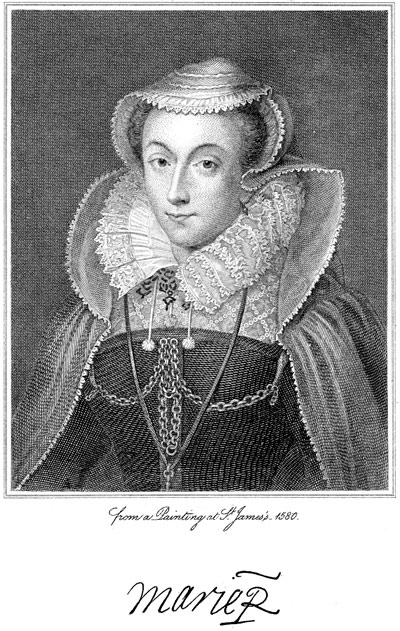
From a Painting at St. James's. 1580.
MARY, QUEEN OF SCOTS.
[BORN 1542. DIED 1587.] ROBERTSON.
O all the charms of beauty and the utmost elegance of external form, Mary added those accomplishments which render their impression irresistible. Polite, affable, insinuating, sprightly, and capable of speaking and writing with equal ease and dignity. Sudden, however, and violent in all her attachments, because her heart was warm and unsuspicious. Impatient of contradiction, because she had been accustomed from her infancy to be treated as a queen. No stranger, on some occasions, to dissimulation, which in that perfidious court where she received her education was reckoned among the necessary arts of government. Not insensible to flattery, or unconscious of that pleasure with which almost every woman beholds the influence of her own beauty. Formed with the qualities which we love, not with the talents that we admire, she was an agreeable woman rather than an illustrious queen. The vivacity of her spirit, not sufficiently tempered with sound judgment, and the warmth of her heart, which was not at all times under the restraint of discretion, betrayed her both into errors and into crimes. To say that she was always unfortunate will not account for that long and almost uninterrupted succession of calamities which befell her; we must likewise add, that she was often imprudent. Her passion for Darnley was rash, youthful, and excessive; and though the sudden transition to the opposite extreme was the natural effect of her ill-requited love, and of his ingratitude, insolence, and brutality, yet neither these nor Bothwell's artful address and important services can justify her attachments to that nobleman. Even the manners of the age, licentious as they were, are no apology for this unhappy passion; nor can they induce us to look on that tragical and infamous scene which followed upon it with less abhorrence.
Humanity will draw a veil over this part of her character which it cannot approve, and may perhaps prompt some to impute her actions to her situation more than to her dispositions; and to lament the unhappiness of the former, rather than accuse the perverseness of the latter. Mary's sufferings exceed, both in degree and duration, those tragical distresses which fancy has feigned to excite sorrow and commiseration; and while we survey them, we are apt altogether to forget her frailties: we think of her faults with less indignation, and approve of our tears, as if they were shed for a person who had attained much nearer to pure virtue.
With regard to the queen's person, a circumstance not to be omitted in writing the history of a female reign, all contemporary authors agree in ascribing to Mary the utmost beauty of countenance and elegance of shape of which the human form is capable. Her hair was black, although, according to the fashion of that age, she frequently wore borrowed locks, and of different colours. Her eyes were a dark grey, her complexion was exquisitely fine, and her hands and arms remarkably delicate, both as to shape and colour. Her stature was of an height that rose to the majestic. She danced, walked, and rode with equal grace. Her taste for music was just; and she both sung and played upon the lute with uncommon skill. Towards the end of her life, long confinement, and the coldness of the houses in which she had been imprisoned, brought on a rheumatism which often deprived her of the use of her limbs. No man, says Brantome, ever beheld her person without admiration and love, or will read her history without sorrow.

GABRIELLE D'ESTREES.
[1576.] DAVENPORT ADAMS.
HE most famous of the beauties of France, and whose renown is inseparably associated with the glory of the most popular of the French monarchs, was born at the Château de Cœuvres, near Soissons, in the year 1576. Her father was a gallant soldier, who had deserved well of his country, Antoine D'Estrees, Marquis de Cœuvres. At an early age Gabrielle gave promise of a remarkable beauty, when time should have developed the fair proportions, rounded the slender figure, and lent expression to the radiant face. Though her mother was notorious for the looseness of her life, the daughter showed a high sense of purity, and her reserve was the despair of all the young nobles in her neighbourhood. She reached the age of seventeen without knowing what it was to love, and her heart was as innocent as her loveliness was without blemish.
Shortly after the accession of Henri Quatre to his precarious throne, he despatched on a mission to Monsieur D'Estrees the first gentleman of his chamber, the handsome and accomplished Duke de Bellegarde. This brilliant courtier gazed with wonder on the beauty so long concealed in the obscurity of a feudal castle. Her tresses glowed with burnished gold; her blue eyes sparkled with a dazzling fire, her complexion was radiantly fair, her nose well shaped and aquiline, her mouth was well fitted with pearly teeth, and her lips resembled the all-compelling bow of the god of love. A stately throat, a gently swelling bust, a rounded arm and slender hand—these completed the charms which a fascinating address and natural elegance of movement rendered still more irresistible.
Bellegarde saw and loved; nor was his evident devotion unpleasing to Mademoiselle D'Estrees, who had never before encountered a cavalier so handsome, so gallant, and so chivalrous. The course of true love seemed with this fortunate twain to run most smoothly; for though Gabrielle had been betrothed from her childhood to Andre de Brancas Sieur de Villars, brother of the Marquis de Villars, who had married her elder sister Juliette, the Marquis de Cœuvres could not resist his daughter's entreaties, and consented to affiance her to the Duke de Bellegarde. He was not, indeed, insensible to the advantages of an alliance with a noble so powerful and wealthy, and who stood so high in the favour of King Henry. The lovers exchanged rings in his presence; the duke presented his lady-love with his portrait, and then returned to his duties at court, where his engagement to an unknown beauty excited great astonishment.
At this time Henri Quatre was holding his court at Mantes, and relieving the sterner toils of empire by sharing in the banquet and the song. The dames and demoiselles of Mantes were often the themes of the merry talk of the jocund monarch and his courtiers, and much surprise was expressed at the indifference with which the Duke de Bellegarde conducted himself among them. They could not conceive that a country maiden could be any worthy rival of the dazzling dames de la cour. The duke replied that not one of them could hope to equal la dame des ses pensees, the beautiful Gabrielle D'Estrees. Henry laughed at the lover's infatuation. Bellegarde, piqued at his incredulity, invited him to accompany him to the Château de Cœuvres. The king promised; and thus, as Mademoiselle de Guise sagely observes, "the hopeful lover became the artificer of his own misfortunes," for it was due to that ill-omened visit that he perilled his happiness, and lost the favour of the king.
As the château was at no great distance from Senlis, where Henry afterwards was, he and the courtiers rode hastily forward. Henry was received with the welcome due to so brave a king; and the beautiful Gabrielle did homage to him by kissing his hand, and proffered the winecup for his refreshment. Her loveliness burst upon the astonished monarch, as the glories of the new world broke on the dazzled eyes of Columbus. Fresh, and pure, and unsophisticated, it took captive the royal heart, and the memories of all former loves paled before the fervency of this new passion. When he retired to Senlis, he summoned thither the Marquis de Cœuvres and his daughter, under pretext that the marquis might take his oaths as a member of the royal council. The summons was most unacceptable to Gabrielle, who complained bitterly that Henry's attentions sullied her maiden fame, while she grieved at the popular rumour that her lover Bellegarde had been ensnared by the charms of Mademoiselle de Guise. On her arrival at Senlis, she offered Bellegarde to consent to a private marriage as the only means of evading the "evil designs" of his majesty; but the duke was not chivalrous enough to dare the royal wrath. The king persisted in demanding Bellegarde's submission. He visited the beauty in the hope of soothing her disappointment and moderating her anger; but she wept continually, and, flinging herself on her knees, implored him to restore to her her affianced husband. When she found him immovable, she rose and abruptly left the apartment, and during the night quitted Senlis, and returned to her father's castle.
Meanwhile, engaged in war, Henry joined his principal officers at La Fêre. It was at this epoch that he resolved on the most romantic and adventurous passage of his romantic and adventurous life. He set out from La Fêre early in the dim, misty morning of the 18th November, accompanied by twelve cavaliers. At a village about nine miles from Cœuvres he quitted his attendants, and prosecuted his journey on foot, in the disguise of a peasant. To complete the transformation he carried a sack of straw on his head. It was difficult for even the invincible Gabrielle to resist so surprising a proof of her royal lover's devotion. She did not allow herself, however, to succumb too quickly. The reception was cold and ungracious. Mademoiselle professed to be disgusted with the coarse, rude garb assumed by the royal adventurer; but a brief conversation having followed, a visible relenting on the part of the flattered beauty so cheered the enamoured Henry, that, on taking leave, he said to Madame Villars, "I have now a good heart that nothing will go wrong with me, but all things prosper. I am going to pursue the enemy, and in a day or two ma belle will hear what gallant exploits I have accomplished for love of her."
The king's visit to the château was not attended by any disastrous consequences. He returned to La Fêre in safety, and his devotion to the lady became well known all over France; but her father was determined to save her honour by a method not unusual in those days. He chose a husband for his daughter, and intimated that no option would be allowed her. This was Monsieur de Liancourt, who was many years her senior, and a widower, with nine children,—wealthy, ignorant, weak in mind, and disagreeable in person. In vain Gabrielle appealed to the king against a marriage which was little better than "a living death." Henry was well pleased with an event which he foresaw would vanquish the beauty's last lingering reluctance. He said "he would cause her to be carried away within one hour of the celebration of her espousals." Her marriage took place at Cœuvres in January 1591, and she made her preparations to escape immediately from the bridegroom she loathed to the gallant Henry. The following day a royal order exiled Monsieur de Liancourt. Thenceforth Gabrielle reigned supreme in the heart of Henri Quatre.
ANNE, DUCHESS OF PEMBROKE.
[1589.] BISHOP RAINBOW.
HIS lady was daughter of George Clifford, Earl of Cumberland, and born in 1589. She was first married to the Earl of Dorset, and secondly to the Earl of Pembroke. She had a clear soul shining through a vivid body; her body was durable and healthful, her soul sprightful, of great understanding and judgment, faithful memory, and ready wit. She had early gained knowledge as of the best things; so an ability to discourse in all commendable arts and sciences, as well as in those things which belong to persons of her birth and sex to know. For she could discourse with virtuosos, travellers, scholars, merchants, divines, statesmen, and with good housewives, in any kind; in so much that a prime and elegant wit, Dr Donne, well seen in all human learning, and afterwards devoted to the study of divinity, is reported to have said of this lady in her younger years, "that she knew well how to discourse of all things, from predestination to slea-silk." Although she knew wool and flax, fine linen and silk, things appertaining to the spindle and distaff, yet "she could open her mouth with wisdom," knowledge of the best and highest things. If she had sought fame rather than wisdom, possibly she might have been ranked among those wits and learned of that sex of whom Pythagoras, or Plutarch, or any of the ancients, have made such honourable mention.
Authors of several kinds of learning, some of controversies very abstruse, were not unknown to her. She much commended one book, William Barclay's dispute with Bellarmine, both, as she knew, of the Popish persuasion; but the former less papal, and, she said, had well stated a main point, and opposed that learned cardinal for giving too much power even in temporals to the pope over kings and secular princes, which she seemed to think the main thing aimed at by the followers of that court; to pretend to claim only to govern directly in spirituals, but to intend chiefly, though indirectly, to hook in temporals, and in them to gain power, dominion, and tribute; money and rule being gods to which the Roman courtiers and their partisans chiefly sacrifice.
As she had been a most critical searcher into her own life, so she had been a diligent inquirer into the lives, fortunes, and characters of many of her ancestors for many years. Some of them she has left particularly described, and the exact annals of diverse passages, which were most remarkable in her own life ever since it was wholly at her own disposal, that is, since the death of her last lord and husband, Philip, Earl of Pembroke, which was for the space of twenty-six or twenty-seven years.
From this her great diligence, as her posterity may find in reading those abstracts of occurrences in her own life, being added to her heroic fathers' and pious mothers' lives, dictated by herself, so they may reap greater fruits of her diligence in finding the honours, descents, pedigrees, estates, and the titles and claims of their progenitors to them, comprised historically and methodically in three volumes of the larger size, and each of them three or four times fairly written over; which, although they were said to have been collected and digested in some parts by one or more learned heads, yet were they wholly directed by herself, and attested in the most parts by her own hand.
ESTHER INGLIS.
[1600.] BALLARD.
EMARKABLE for her caligraphy, the chief thing I have to mention concerning her. All that see her writing are astonished at it, upon the account of its exactness, its fineness, and variety; and many are of opinion that nothing can be more exquisite. Gazius, Ascham, Davies, Gething, Lyte, and many others, have been celebrated for their extraordinary talents this way; but this lady has excelled them all, what she has done being almost incredible. One of the many delicate pieces she wrote was in the custody of Mr Samuel Kello, her great-grandson, in 1711. Others are remaining at the Castle of Edinburgh. Mr Hearne saw one in the hands of Philip Harcourt, Esq., entitled, "Historiæ Memorabiles Genesis, per Estheram Inglis, Edinburgi. Anno 1600."

In the archives of Christ's Church, in Oxford, are the Psalms of David, written in French with her own hand, and presented to Queen Elizabeth by Mrs Inglis herself; and were by that princess given to this library. In the archives in Bodley's Library are two more of her manuscripts, preserved with great care. One of them is entitled "Les Six Vingts et Six Quartains de Guy de Faur Sieur de Pybrae, escrits Esther Inglis, pour sin dernier adieu ce 21 jour de June 1617." In the second leaf this in capital letters: "To the Right Worshipfull my very singular friende, Joseph Hall, Doctor of Divinity and Dean of Worchester, Esther Inglis wisheth all increase of true happiness, Junii 21, 1616." In third leaf, her head, painted on a card, and pasted upon the leaf.
The title of the other book is "Les Proverbes de Solomon, escrites in diverses sortes des Lettres, par Esther Anglois, Francoise. A Lislebourge en Escosse, 1599." This delicate performance gains the admiration of all who see it; every chapter is wrote in a different hand, as is the dedication, and some other things at the beginning of the book, which makes near forty several sorts of hands. The beginnings and endings of the chapters are adorned with most beautiful head and tail pieces, and the margins are elegantly decorated with the pen, in imitation, I suppose, of the elegant old manuscripts. The book is dedicated to the Earl of Essex, Queen Elizabeth's great favourite. At the beginning are his arms, neatly drawn, with all its quarterings, in number fifty-six. In the fifth leaf is her own picture, done with the pen, in the habit of that time. In her right hand a pen, the left resting upon a book opened, in one of the leaves of which is written, "Del eternal le bien. De moi le mal, ou rien." On the table before her there is likewise a music-book lying open, which perhaps intimates that she had some skill in that art. Under the picture is an epigram in Latin, written by Andrew Melvin, and, in the next page, another composed by the same author in Latin, of which the following is a translation:—
"One hand Dame Nature's mimic does express Her larger figures, to the life in less; In the rich border of her work do stand Afresh, created by her curious hand, The various signs and planets of the sky, Which seem to move and twinkle in our eye; Much we the work, much more the hand admire, Her fancy guiding this does raise our wonder higher."
It appears that she lived unmarried till she was about forty; and then, I find by a memorandum made by my late friend Mr Hearne, in a spare leaf at the beginning of her manuscript of the Proverbs of Solomon, that she was married to Mr Bartholomew Kello [Kelly?], a Scotchman, by whom she had a son, named Samuel Kello, who was educated in Christ Church College, Oxon.
MARGARET, DUCHESS OF NEWCASTLE.
[1620.] BALLARD.
HE youngest daughter of Sir Charles Lucas, and the wife of the Marquis of Newcastle, had, from her infancy, a natural inclination to learning, and spent so much of her time in study and writing, that it is much to be lamented she had not the advantage of an acquaintance with the learned languages, which would have extended her knowledge, refined her genius, and have been of infinite service to her in the many compositions and productions of her pen.
In 1643, she obtained leave of her mother to go to Oxford, where the court then resided, and was made one of the maids of honour to Henrietta Maria, the royal consort of King Charles I.; and when the queen, by her rebellious subjects, was unhappily forced to leave England and go to her native country, she attended her thither. At Paris she met with the Marquis of Newcastle, then a widower, who, admiring her person, disposition, and ingenuity, was married to her in that place in the year 1645. She was said to be the most voluminous dramatic writer of our female poets, that she had a great deal of wit, and a more than ordinary propensity to dramatic poetry. Mr Langbaine tells us that all the language and plots of her plays were her own, which is a commendation preferable to fame built on other people's foundation, and will very well atone for some faults in her numerous productions. [A catalogue of this lady's works, "tragicomical, poetical, romancical, philosophical, and historical," both in prose and verse, would occupy pages.]
Her person was very graceful, her temper naturally reserved, and she seldom said much in company, especially among strangers. She was most indefatigable in her studies and contemplations; truly pious, charitable, and generous; an excellent economist; very kind to her servants, and a perfect pattern of conjugal love and duty.
LADY PAKINGTON.
[1679.] BALLARD.
AUGHTER of Thomas, Lord Coventry, Keeper of the Great Seal, and wife of Sir John Pakington, was well known to, and celebrated by, the best and most learned divines of her time. Yet hardly my pen will be thought capable of adding to the reputation her own has procured to her, if it shall appear that she was the author of a work which is not more an honour to the writer than a universal benefit to mankind.

The work I mean is, "The Whole Duty of Man;" her title to which has been so well ascertained, that the general concealment it has lain under will only reflect a lustre upon all her other excellences by showing that she had no honour in view but that of her Creator, which, I suppose, she might think best promoted by this concealment. [The claims of other authors are not difficult to be disposed of.] If I were a Roman Catholic, I would summon tradition as an evidence for me upon this occasion, which has constantly attributed this performance to a lady. And a late celebrated writer observes, that "there are many probable arguments in 'The Whole Duty of Man' to back a current report that it was written by a lady." And any one who reads "The Lady's Calling," may observe a great number of passages which clearly indicate a female hand.
That vulgar prejudice of the supposed incapacity of the female sex, is what these memoirs in general may possibly remove. And as I have had frequent occasion to take notice of it, I should not now enter again upon that subject, had not this been made use of as an argument to invalidate Lady Pakington's title to those performances. It may not be amiss, therefore, to transcribe two or three passages from the treatise I have just now mentioned. "But waiving these reflections, I shall fix only on the personal accomplishments of the sex, and peculiarly that which is the most principal endowment of the rational nature—I mean the understanding—where it will be a little hard to pronounce that they are naturally inferior to men, when it is considered how much of intrinsic weight is put in the balance to turn it to the men's side. Men have their parts cultivated and improved by education, refined and subtilised by learning and arts; are like a piece of a common, which, by industry and husbandry, becomes a different thing from the rest, though the natural turf owned no such inequality. We may therefore conclude, that whatever vicious impotence women are under, it is acquired, not natural; nor derived from any illiberality of God's, but from the ill managery of His bounty. Let them not charge God foolishly, or think that by making them women He necessitated them to be proud or wanton, vain or peevish; since it is manifest He made them to better purpose, was not partial to the other sex; but that having, as the prophet speaks, 'abundance of spirit,' He equally dispensed it, and gave the feeblest woman as large and capacious a soul as that of the greatest hero. Nay, give me leave to say farther, that, as to an eternal well-being, He seems to have placed them in more advantageous circumstances than He has done men. He has implanted in them some native propensions which do much facilitate the operations of grace upon them."
And having made good this assertion, she interrogates thus: "How many women do we read of in the gospel, who in all the duties of assiduous attendance on Christ, liberalities of love and respect, nay, even in zeal and courage, surpassed even the apostles themselves? We find His cross surrounded, His passion celebrated by the avowed tears and lamentations of devout women, when the most sanguine of His disciples had denied, yea, forswore, and all had forsaken Him. Nay, even death itself could not extinguish their love. We find the devout Maries designing a laborious, chargeable, and perhaps hazardous respect to His corpse, and, accordingly, it is a memorable attestation Christ gives to their piety by making them the first witnesses of His resurrection, the prime evangelists to proclaim those glad tidings, and, as a learned man speaks, apostles to the apostles."
There are many works of this lady, besides "The Whole Duty of Man," enumerated in her biographies.

NOOR MAHAL.
[1512.] JAMES MILL.
NE of the circumstances which had the greatest influence on the events and character of the reign of Jehangire, was his marriage with the wife of one of the omrahs of his empire, whose assassination, like that of Uriah, cleared the way for the gratification of the monarch. The history of this female is dressed in romantic colours by the writers of the East. Khaja Aiass, her father, was a Tartar, who left poverty and his native country to seek the gifts of fortune in Hindustan. The inadequate provision he could make for so great a journey failed him before its conclusion. To add to his trials, his wife, advanced in pregnancy, was seized with the pains of labour in the desert, and delivered of a daughter. All hope of conducting the child alive to any place of relief forsook the exhausted parents, and they agreed to leave her. So long as the tree, at the foot of which the infant had been deposited, remained in view, the mother supported her resolution; but when the tree vanished from sight, she sank upon the ground, and refused to proceed without her. The father returned, but what he beheld was a huge black snake convolved about the body of the infant, and extending his dreadful jaws to devour her. A shriek of anguish burst from the father's breast; and the snake, being alarmed, hastily unwound himself from the body of the infant, and glided away to his retreat. The miracle animated the parents to maintain the struggle; and before their strength entirely failed, they were joined by other travellers, who relieved their necessities.

Aiass, having arrived in Hindustan, was taken into the service of an omrah of the court; attracted after a time the notice of Akbar himself; and, by his abilities and prudence, rose to be treasurer of the empire. The infant who had been so nearly lost in the desert was now grown a woman of exquisite beauty; and, by the attention of Aiass to her education, was accomplished beyond the measure of female attainments in the East. She was seen by Sultan Selim, and kindled in his bosom the fire of love. But she was betrothed to a Turkman omrah, and Akbar forbade the contract to be infringed. When Selim mounted the throne, justice and shame were a slight protection to the man whose life was a bar to the enjoyments of the king. By some caprice, however, not unnatural to minds pampered and trained up like his, he abstained from seeing her for some years after she was placed in his seraglio, and even refused an adequate appointment for her maintenance. She turned her faculties to account; employed herself in the exquisite works of the needle and painting, in which she excelled; and her productions were disposed of in the shops and markets, and thence procured the means of adorning her apartments with all the elegancies which suited her condition and taste. The fame of her productions reached the ear and excited the curiosity of the emperor. A visit was all that was wanting to rekindle the flame in his heart; and Noor Mahal (such was the name she assumed) exercised from that moment an unbounded sway over the prince and his empire. Through the influence of the favourite sultana, the vizirit was bestowed on her father; her two brothers were raised to the first rank of omrahs, by the titles of Aetibad Khan and Asopha Jah; but their modesty and virtues reconciled all men to their sudden elevation. And though the emperor, naturally voluptuous, was now withdrawn from business by the charms of his wife, the affairs of the empire were conducted with vigilance, prudence, and success; and the administration of Khaja Aiass was long remembered in India as a period of justice and prosperity.
POCAHONTAS.
[BORN 1594. DIED 1617.] DR HUGH MURRAY.
N a signal from their leader, they, the natives of Virginia, laid down their bows and arrows, and led Captain Smith [of the Expedition, 1607] under strict guard to their capital. He was there exhibited to the women and children, and a wild war-dance was performed round him in fantastic measures, and with frightful yells and contortions. He was then shut up in a long house, and supplied at every meal with as much bread and venison as would have dined twenty men; but receiving no other sign of kindness, he began to dread that they were fattening in order to eat him. At last he was led to Pamunkey, the residence of Powhatan, the king. It was here his doom was sealed. The chief received him in pomp, wrapped in a spacious robe of racoon skins, with all the tails hanging down. Behind appeared two long lines of men and women, with faces painted red, heads decked with white down, and necks quite encircled with chains of beads. A lady of rank presented water to wash his hands, another a bunch of feathers to dry them. A long deliberation was then held, and the result proved fatal. Two large stones were placed before Powhatan, and, by the united efforts of the attendants, Smith was dragged to the spot, his head laid on one of them, and the mighty club was raised, a few blows of which were to terminate his life. In this last extremity, when every hope seemed past, a very unexpected interposition took place. Pocahontas, the youthful and favourite daughter of this savage chief, was seized with those tender emotions which form the ornament of her sex. Advancing to her father, she in the most earnest terms supplicated mercy for the stranger; and though all her entreaties were lost on that savage heart, her zeal only redoubled. She ran to Smith, took his head in her arms, laid her own upon it, and declared that the first death-blow must fall upon her. The barbarian's breast was at length softened, and the life of the Englishman was spared.
Smith was afterwards liberated and sent to Jamestown, where he was installed as president. As Powhatan's favour was to be courted, there had been sent handsome presents, with materials to crown him with splendour, in the European style. With only four companions he courageously repaired to the residence of the monarch, inviting him to come and be crowned at Jamestown. The party were extremely well received, though once they heard in the adjoining wood outcries so hideous as made them flee to their arms; but Pocahontas assured them they had nothing to fear. Subsequently, Smith was repeatedly in danger; and again, on one occasion, was saved by a second interposition of Pocahontas, who, at the risk of her father's displeasure, ran through the woods on a dark night to give him warning. But the kindness of this princess was ill repaid by the English, to whom she was so much attached; for Argall, an enterprising naval commander, afterwards contrived, through an Indian who had become his sworn friend, to inveigle on board his vessel the fair Pocahontas. Regardless of her tears and entreaties he conveyed her to Jamestown, where she was well treated; but in a negotiation for her ransom, exorbitant terms were demanded, which her father indignantly rejected, and the breach seemed only widened. Happily, the chains of the princess's captivity were lightened by others of a more pleasing nature. Mr John Rolfe, a respectable young man, was smitten with her dignified demeanour, and found no difficulty in gaining her affections. They were afterwards married, and she was converted and baptised under the name of Rebecca, to which the English prefixed the title of Lady, and her subsequent conduct is said to have adorned her profession.
Soon after, in company with her husband, she visited England; and Captain Smith wrote a letter to his majesty, recounting her good deeds, declaring that she had a great spirit though a low stature, and beseeching for her a reception corresponding to her rank and merits. She was accordingly introduced at court, and into the circles of fashion, where, as a novelty, she was for some time the leading object, and is said to have deported herself with suitable grace and dignity. Purchas mentions his meeting with her at the table of his patron, Dr King, Bishop of London, where she was entertained with "festival and pomp." The king took an absurd apprehension that Rolfe, on the ground of his wife's birth, might advance a claim to the crown of Virginia. This idea being at length driven out of his mind, he appointed him secretary and recorder-general of the colony. The princess, early in 1617, went to embark at Gravesend, but Providence had not destined that she would revisit her native shore. She was there seized with an illness which carried her off in a few days, and her last hours are said to have extremely edified the spectators, being full of Christian resignation and hope. She had left a son in the colony, whose offspring, carefully traced, is now numerous; and this descent is the boast of many Virginian families.
LUCY HUTCHINSON.
[BORN 1620. DIED 1659.] JEFFREY.
HE daughter of Sir Allan Apsley, Lieutenant of the Tower of London, and wife of Colonel Hutchinson, so well known in the Civil War, was in all respects a remarkable woman. If it were allowable to take the portrait she has given of herself as a just representation of her fair contemporaries, we should form a most exalted notion of the Republican matrons of England. Making a slight deduction for a few traits of austerity borrowed from the bigotry of the age, we do not know where to look for a more noble and engaging character than that under which this lady presents herself to her readers; nor do we believe that any age of the world has produced so worthy a counterpart to the Valerias and Portias of antiquity. With a highminded feeling of patriotism and public honour, she seems to have been possessed by the most beautiful and devoted attachment to her husband, and to have combined a taste for learning and the arts with the most active kindness and munificent hospitality to all who came within the sphere of her bounty.
To a quick perception of character, she appears to have united a masculine force of understanding and a singular capacity for affairs, and to have possessed and exercised all those talents without affecting any superiority over the rest of her sex, or abandoning for a single instant the delicacy and reserve which were then its most indispensable ornaments. Education is certainly far more diffused in our days, and accomplishments infinitely more common; but the perusal of this lady's Memoirs has taught us to doubt whether the better sort of women were not fashioned of old by a better and more exalted standard, and whether the most eminent female of the present day would not appear to disadvantage by the side of Mrs Hutchinson. There is for the most part something intriguing, and profligate, and theatrical in the clever women of this generation; and if men are dazzled by their brilliancy and delighted with their talent, we can scarcely even guard against some distrust of their judgment, or some suspicion of their purity. There is something, in short, in the domestic virtue, and the calm and commanding mind of our English matron, that makes the Corinnas and Heloises appear small and insignificant.
The admirers of modern talent will not accuse us of choosing an ignoble competitor if we desire them to weigh the merits of Mrs Hutchinson against those of Madame Roland. The English revolutionist did not, indeed, compose weekly pamphlets and addresses to the municipalities, because it was not the fashion of her day to print every thing that entered into the heads of politicians. But she shut herself up with her husband in the garrison with which he was entrusted, and shared his counsels as well as his hazards. She encouraged the troops by her cheerfulness and heroism, ministered to the sick, and dressed with her own hands the wounds of the captives as well as of the victors. When her husband was imprisoned on groundless suspicions, she laboured without ceasing for his deliverance, confounded his oppressors by her eloquence and arguments, tended him with unshaken fortitude in sickness and in solitude, and after his decease dedicated herself to form his children to the example of his virtues, and drew up the memorial, which is now before us, of his worth and her own genius and affection. All this, too, she did without stepping beyond the province of a private woman, without hunting after compliments to her own genius or beauty, without sneering at the dulness or murmuring at the coldness of her husband, without hazarding the fate of her country on the dictates of her own enthusiasm, or fancying for a moment that she was born with talents to enchant and regenerate the world. With equal power of discriminating character, with equal candour, and eloquence, and zeal for the general good, she is elevated beyond her French competitor by superior prudence and modesty, and by a certain simplicity and purity of character, of which it appears to us that the other was unable to form a conception.
England, we should think, should be proud of having given birth to Mrs Hutchinson and her husband; and chiefly because their characters are truly and peculiarly English, according to the standard of their times, in which national characters were most distinguishable. Not exempt, certainly, from errors and defects, they yet seem to us to hold out a lofty example of substantial dignity and virtue, and to possess most of those talents and principles by which public life is made honourable, and privacy delightful. Bigotry must at all times debase, and civil dissension embitter our existence; but, in the ordinary course of events, we may safely venture to assert, that a nation which produces many such wives and mothers as Mrs Lucy Hutchinson, must be both great and happy.
LADY FANSHAWE.
[BORN 1625. DIED 1680.] JEFFREY.
ADY Fanshawe was, as is generally known, the wife of a distinguished cavalier, in the heroic age of the Civil Wars and the Protectorate, and survived till long after the Restoration. Her husband was a person of no mean figure in those great transactions; and she, who adhered to him with the most devoted attachment, and participated not unworthily in all his fortunes and designs, was consequently in continual contact with the movements that then agitated society. Since it may be said with some show of reason that Lady Hutchinson and her husband had too many elegant tastes and accomplishments to be taken as fair specimens of the austere and godly republicans, it certainly may be retorted, with at least equal justice, that the chaste and decorous Lady Fanshawe, and her sober, diplomatic lord, shadow out rather too favourably the general manners and morals of the cavaliers.

Lady Fanshawe seems to have followed, like a good wife and daughter, where her parents or her husband led her, and to have adopted their opinions with a dutiful and implicit confidence, but without being very deeply moved by the principles or passions which actuated those from whom they were derived; while Lady Hutchinson not only threw her whole heart and soul into the cause of her party, but, like Lady Macbeth or Madame Roland, imparted her own fire to her own phlegmatic helpmate; "chastened him," when necessary, "with the valour of her tongue," and cheered him on, by the encouragement of her high example, to all the ventures and sacrifices, the triumphs or the martyrdoms, that lay visibly across their daring and lofty course. The Lady Fanshawe, we take it, was of a less passionate temperament. She begins in her Memoirs, no doubt, with a good deal of love and domestic devotion, and even echoes from that sanctuary certain notes of loyalty; but, in very truth, is chiefly occupied, for the best part of her life, with the sage and serious business of some nineteen or twenty accouchements, which are happily accomplished in different parts of Europe, and seems at last to be wholly engrossed in the ceremonial of diplomatic presentations, the description of court dresses, state coaches, liveries, and jewellery, the solemnity of processions and receptions by sovereign princes, and the due interchange of presents and compliments with persons of worship and dignity. But in her Memoirs there is enough, both of heart and sense and observation, at once to repay gentle and intelligent readers for the trouble of perusing them, and to stamp a character of amiableness and respectability on the memory of their author.

DOROTHY OSBORNE.
[1620.] MACAULAY.
NE who, for constancy in love against temptations to change, deserves commemoration. Dorothy Osborne was twenty-one. She is said to have been handsome, and there remains abundant proof that she possessed an ample share of the dexterity, the vivacity, and the tenderness of her sex. Sir William Temple soon became, in the phrase of that time, her servant, and she returned his regard. But difficulties as great as ever expanded a novel to the fifth volume opposed their wishes. When the courtship commenced, the father of the hero was sitting in the Long Parliament; the father of the heroine was commanding in Guernsey for King Charles. Even when the war ended, and Sir Peter Osborne returned to his seat at Chicksands, the prospects of the lovers were scarcely less gloomy. Sir John Temple had a more advantageous alliance in view for his son. Dorothy Osborne was in the meantime besieged by as many suitors as were drawn to Belmont by the fame of Portia. The most distinguished on the list was Henry Cromwell. Destitute of the capacity, the energy, the magnanimity of his illustrious father, destitute also of the meek and placid virtues of his elder brother, this young man was perhaps a more formidable rival than either of them would have been. Mrs Hutchinson, speaking the sentiments of the grave and aged, calls him an "insolent foole," and "a debauched ungodly cavalier." These expressions probably mean that he was one who, among young and dissipated people, would pass for a fine gentleman. Dorothy was fond of dogs of larger and more formidable breed than those which lie on modern hearthrugs, and Henry Cromwell promised that the highest functionaries in Dublin should be set to work to procure for her a fine Irish greyhound. She seems to have felt his attentions as very flattering, though his father was then only Lord General, and not yet Protector. Love, however, triumphed over ambition, and the young lady appears never to have regretted her decision; though in a letter written just at the time when all England was ringing with the news of the violent dissolution of the Long Parliament, she could not refrain from reminding Temple, with pardonable vanity, "how great she might have been if she had been so wise as to have taken hold of the offer of Henry Cromwell."