SALADS AND SANDWICHES (continued 3)
Reading edition
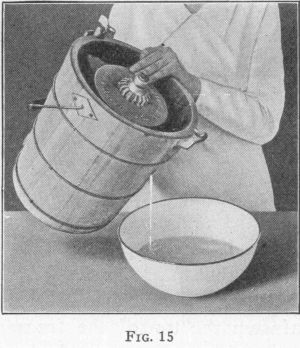
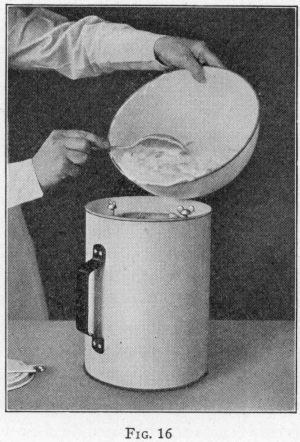
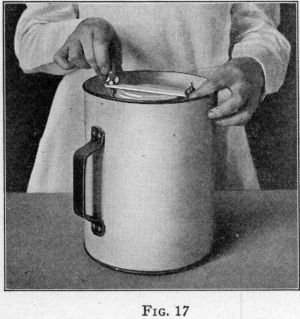
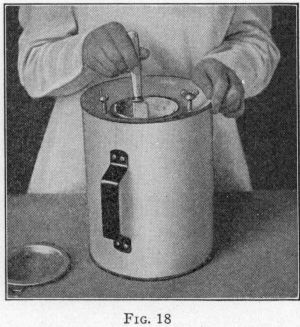
69. When a vacuum freezer is to be used, turn it upside down and insert the ice-and-salt mixture through the opening in the bottom. Then close it tight, turn it right side up, and with the top open, pour in the mixture as shown in Fig, 16. Screw the top on tightly in the manner shown in Fig. 17, just as the bottom is screwed on, and set the freezer aside. After the mixture has stood for about 15 minutes, open the freezer from the top and stir the contents down from the sides with a knife or a spoon, as in Fig. 18. Then replace the cover and allow the freezing to continue for 10 minutes more. At the end of this time, open the freezer again, repeat the stirring, refasten the cover, and continue the freezing for another 5 minutes. The mixture should then be ready to serve.
RECIPES FOR FROZEN DESSERTS
ICE CREAMS
70. PHILADELPHIA ICE CREAM.--Perhaps the simplest of frozen desserts to make is Philadelphia ice cream, but it requires cream in order that its texture be good. For this reason, it is not so economical as some of those which are a trifle more complicated to prepare. It consists of cream sweetened, flavored, and then frozen. This is a particularly attractive way in which to make ice cream when strawberries, red raspberries, or peaches are in season, as these fresh fruits may be crushed and added to the cream, instead of plain flavoring.
The recipe here given for the preparation of Philadelphia ice cream contains vanilla as the flavoring, but fresh fruit of any desirable kind may be added, this recipe being used merely as a basis. Usually 1 1/2 cupfuls of crushed fruit is required for a quart of cream. It is necessary, however, to vary the quantity of sugar with the nature of the fruit used. For instance, if fresh strawberries are used, more sugar will be required than if canned ones are used, because sugar has already been added to these. The best plan is to test the mixture before freezing it, remembering always that more sugar is required for a frozen dessert than would be necessary if the mixture were not to be frozen.
PHILADELPHIA ICE CREAM
(
Sufficient to Serve Six
)
1 qt. cream
1 Tb. vanilla
1 c. sugar
Scald the cream in a double boiler, add the sugar and the vanilla, and cool. If desired, add 1 1/2 cupfuls of crushed fruit. If pineapple is used, it may be grated or shredded instead of being crushed. Place in a freezer and freeze according to the directions previously given.
71. VANILLA ICE CREAM.--Plain ice cream is usually made from ingredients that are somewhat cheaper than those used to make Philadelphia ice cream. It consists usually of a custard foundation, to which are added flavoring, sometimes fruit, and usually thin cream. The custard foundation is often made with corn starch and a small amount of raw egg. The same rules must be observed in the preparation of this foundation for ice cream as have been learned in the making of custards. Frequently some starchy material, such as flour or corn starch, is used for thickening in the preparation of this dessert. Some persons prefer flour, as they believe that the presence of flour cannot be detected so easily as that of corn starch; however, a recipe using each is given. The mixtures used for this ice cream should not be boiled, but cooked in a double boiler. If desired, fruits, either cooked or raw, or nuts may be added to the ice cream for variety.
VANILLA ICE CREAM No. 1
(
Sufficient to Serve Six
)
4 Tb. flour
1 c. sugar
1/4 tsp. salt
4 c. milk
2 c. thin cream
2 eggs
2 Tb. vanilla
Mix the flour, sugar, and salt with sufficient cold liquid to moisten well. Add this to the remainder of the milk and the cream heated in a double boiler. Stir until thickened, and cook for about 20 minutes. Beat the eggs and add slowly to the mixture, stirring rapidly to prevent curding. Cook until the egg has thickened, strain, add the vanilla, cool, and freeze.
VANILLA ICE CREAM No. 2
(
Sufficient to Serve Six
)
1 qt. milk
3 Tb. corn starch
1-1/2 c. sugar
2 eggs
1 pt. cream
1 Tb. vanilla
Scald the milk and stir into it the corn starch mixed with half the sugar. Stir constantly until thickened, and cook for 15 to 20 minutes. Beat the eggs, add the remaining sugar, mix with a little of the hot mixture, and stir into the double boiler. Remove from the heat, add the cream, strain, cool, add the flavoring, and freeze.
72. CHOCOLATE ICE CREAM.--Next to vanilla ice cream, chocolate seems to be the most desired. Some persons think this variety is difficult to make, but if the accompanying directions are carefully followed, no difficulty will be experienced and a delicious dessert will be the result.
CHOCOLATE ICE CREAM
(
Sufficient to Serve Six
)
2 c. sugar
1/2 tsp. salt
1/2 c. water
4 Tb. flour
3 sq. melted chocolate
2 eggs
5 c. milk
4 tsp. vanilla
2 c. thin cream
Mix the sugar and water and cook until a sirup forms. Add this to the melted chocolate and cook together until the two are well blended. Add this mixture to the heated milk and cream, which have been seasoned with the salt and thickened with the flour. Beat the eggs and add to the hot mixture, stirring rapidly to prevent curding. Remove from the heat, cool, add the vanilla, strain, and freeze.
73. MOCHA ICE CREAM.--As the flavor of coffee is usually well liked, Mocha ice cream, which has coffee for its flavoring, is a dessert that often finds a place in the meal. It is especially nice to serve in the hot weather when hot coffee is omitted from the meal.
MOCHA ICE CREAM
(
Sufficient to Serve Six
)
1 c. water
1-1/4 c. sugar
1/3 3 c. ground coffee
1/4 tsp. salt
1-1/2 c. milk
1 qt. cream
2 eggs
1 tsp. vanilla
Heat the water and add it to the coffee. Allow this to stand on the back of the stove for about 1/2 hour, and then strain through cheesecloth. Heat the milk in a double boiler, and to it add the strained coffee. Beat the eggs and add the sugar and salt to them. Stir into this a spoonful of the hot milk and coffee and then add to the mixture in the double boiler. Cook until the eggs have thickened, stirring constantly to prevent curding. Remove from the heat, cool, add the cream and vanilla, strain through a fine sieve, and freeze.
74. CARAMEL ICE CREAM.--No more delicious ice cream can be made than that flavored with caramel. It is usually very fine in texture and rich in flavor.
CARAMEL ICE CREAM
(
Sufficient to Serve Six
)
1-1/2 c. sugar
1 egg
1/2 c. water
1/4 tsp. salt
2 c. milk
1 qt. thin cream
2 Tb. flour
1 Tb. vanilla
Caramelize 1/2 of the sugar and add the water. Cook to a sirup. Prepare a custard with the milk, remaining sugar, flour, egg, and salt. Remove from the heat, add the caramel and the cream, strain, add the vanilla, cool, and freeze.
75. JUNKET ICE CREAM WITH PEACHES.--An attractive frozen dessert can be made by freezing junket and serving it with canned peaches and peach sirup. This may be made into a mold and the mold garnished with the peaches, or it may be served on individual plates and a half of a peach put on each plate.
JUNKET ICE CREAM WITH PEACHES
(
Sufficient to Serve Six
)
1 c. cream
1 Tb. cold water
1-1/2 qt. milk
1 Tb. vanilla
1-1/2 c. sugar
1 tsp. almond extract
1/4 tsp. salt
Green coloring
2 junket tablets
Canned peaches
Mix the cream and milk, add the sugar and salt, and heat in a double boiler until lukewarm. Dissolve the junket tablets in the cold water and add to the lukewarm milk. Add the flavoring and the green coloring, making the junket a pale green, and stand in a warm place until set. Turn into a freezer and freeze. If desired, mold and garnish the mold with the peaches. Add sugar to the peach juice and cook until a thick sirup is formed. Pour this over the whole and serve. If it is desired not to mold the ice cream, serve it with a peach on individual serving plates and pour a spoonful of peach sirup over each portion.
76. FRENCH ICE CREAM.--No more delicious ice cream can be made than that given in the accompanying recipe and known as French ice cream. It is especially nice for serving when something very attractive is desired, as at a dainty luncheon or an afternoon or evening party.
FRENCH ICE CREAM
(
Sufficient to Serve Six
)
1 pt. milk
1 qt. cream
1 c. sugar
1 Tb. vanilla
Yolks of 8 eggs
1 tsp. lemon
Heat the milk and add the sugar and beaten yolks of the eggs. Cook until the mixture thickens, remove from the fire, add the cream, vanilla, and lemon. Cool and freeze.
FROZEN CUSTARDS
77. Frozen custard makes a very desirable kind of frozen dessert. If properly made, the result is a delightfully rich dessert of smooth texture. It may be frozen without turning or in the usual way. A similar mixture is used in some of the recipes of the more complicated frozen desserts given later. Fruits and nuts may be used in the preparation of frozen custard to procure variety. During the season when eggs are expensive, this dessert is a rather extravagant one, so that from the standpoint of economy it should be made in the spring and summer.
78. PLAIN FROZEN CUSTARD.--If a frozen dessert that is easily made is desired, plain frozen custard should be tried. The accompanying recipe gives directions for custard of this kind.
PLAIN FROZEN CUSTARD
(
Sufficient to Serve Six
)
1-1/2 qt. milk
1/4 tsp. salt
6 eggs
1 Tb. vanilla
1-1/4 c. sugar
1 tsp. lemon extract
Heat the milk in a double boiler. Separate the eggs, beat the yolks, and add the sugar and salt to them. Add this to the hot milk, stirring rapidly until the mixture thickens. Remove from the heat, beat the egg whites, and fold them into the mixture. Add the vanilla and lemon extract, cool, and freeze.
79. FROZEN CUSTARD WITH NUTS.--Plain frozen custard can be greatly improved by the addition of nuts. The nuts used may be blanched almonds roasted in the oven until they are brown, hickory nuts, English walnuts, pecans, black walnuts, or a mixture of any of these. They should not be put through a grinder, but should be put into a chopping bowl and chopped fine with a chopping knife. Prepare the mixture and freeze to a mush, then open the freezer, add a cupful of chopped nuts, close the freezer, and complete the freezing.
80. FROZEN CUSTARD WITH RAISINS.--Frozen custard is also delicious when maple sirup is used in its preparation and raisins are added before the freezing is complete.
FROZEN CUSTARD WITH RAISINS
(
Sufficient to Serve Six
)
1 c. sultana raisins
1-1/2 c. maple sirup
1 qt. milk
1 pt. thin cream
6 eggs
1 Tb. vanilla
Steam the raisins until they are soft. Heat the milk in a double boiler. Beat the eggs, add the maple sirup, and add this to the milk. Cook until the mixture has thickened, remove from the heat, and stir in the cream and vanilla. Cool and freeze to a mush; then add the raisins and continue freezing until stiff. Serve.
81. TUTTI-FRUTTI FROZEN CUSTARD.--A very rich dessert can be made by adding chopped nuts and several kinds of fruit to custard and then freezing it to make tutti-frutti custard. Such a dessert is high in food value and is suitable for a meal in which other rich food is not served.
TUTTI-FRUTTI FROZEN CUSTARD
(
Sufficient to Serve Six
)
1 qt. milk
6 egg yolks
1 c. sugar
1/8 tsp. salt
1 Tb. vanilla
1/4 c. chopped citron
2 Tb. maraschino juice
1/4 c. chopped maraschino cherries
1/2 c. chopped nuts
1/4 c. chopped candied pineapple
1/2 c. shredded coconut
Heat the milk in a double boiler. Beat the egg yolks and add the sugar and salt. Add this to the hot milk and stir until the custard has thickened. Cool, add the vanilla, chopped citron, maraschino juice, cherries, nuts, pineapple, and coconut. Place in a freezer and freeze until stiff. Pack and let stand until time to serve.
ICES
82. Ices are simple mixtures of fruit juice and sugar diluted with water and then frozen. They are expected to be somewhat sour, and, as a rule, lemon juice is relied on to assist in obtaining this flavor. In addition, lemon juice also helps to bring out the flavor of the fruit used as the basis of the ice.
As a rule, a very smooth texture is not desired in this dessert; consequently, ice is frozen quite rapidly and, as will be noted in Table I, with a high proportion of salt. Unless the fruit used in an ice is expensive, this is probably the cheapest frozen dessert that can be made, for it seldom contains any other ingredients than those mentioned. It is usually clear, but occasionally the fruit pulp is used in addition to the fruit juice. When this is done, the mixture should not be frozen too hard, as the fruit is apt to become icy. Fresh, canned, or preserved fruit may be used. The sugar used for ices is usually cooked with the water to form a sirup. Otherwise, the sugar often fails to dissolve and remains granular, preventing the ice from being as sweet as it should be for the amount of sugar used.
83. LEMON ICE.--The ice most frequently made is that flavored with lemon. It is very refreshing when served plain, but it can be improved by the addition of fruit. A very delightful way in which to serve it is to place a large spoonful in a sherbet glass, pour over this a spoonful or two of the sirup from maraschino cherries, and then garnish with diced bananas.
LEMON ICE
(
Sufficient to Serve Six
)
4 c. water
2-1/2 c. sugar
3/4 c. lemon juice
Mix the water and sugar, bring to a boil, and cool. Add the lemon juice, turn into a freezer, and freeze. Serve in any desired way.
84. ORANGE ICE.--Persons fond of oranges generally welcome orange ice as a dessert. As orange ice is somewhat bland in flavor, it is improved by the addition of a little lemon juice.
ORANGE ICE
(
Sufficient to Serve Six
)
2 c. sugar
4 c. water
2 c. orange juice
1/2 c. lemon juice
Cook the sugar and water until a thin sirup is formed, add the lemon and orange juice, and freeze.
85. FRUIT ICE.--No more refreshing dessert for warm weather can be made than fruit ice. Orange and lemon juice are used as the foundation, and grated pineapple and crushed strawberries are added for flavoring.
FRUIT ICE
(
Sufficient to Serve Six
)
1-1/2 c. sugar
2 c. water
3 oranges
3 lemons
1 c. grated pineapple
1 c. crushed strawberries
Cook the sugar and water until a thin sirup is formed, and then cool. Add the juice of the oranges and lemons, the grated pineapple, fresh if possible, and the crushed strawberries. Freeze and serve.
86. FROZEN SPICED PUNCH.--Something entirely different in the way of a frozen dessert can be made by making frozen spiced punch according to the accompanying directions. A dessert of this kind is a fitting conclusion to a meal that is somewhat hearty and varied in its nature.
FROZEN SPICED PUNCH
(
Sufficient to Serve Six
)
6 cloves
2-in. stick cinnamon
1 qt. water
2 c. sugar
1/2 c. pineapple juice
1/2 c. orange juice
1/2 c. lemon juice
4 drops wintergreen oil
Put the cloves and cinnamon into the water, place over the fire, bring to the boiling point, and then add the sugar. Cook together for a few minutes, remove from the fire, and cool. Add the pineapple, orange, and lemon juice, strain, add the wintergreen oil, and freeze.
87. MINT PUNCH.--When meals containing rich meats and other rich foods are served, it will be found that mint punch adds just what is needed to balance them. It is an easy dessert to make, as will be seen from the accompanying recipe.
MINT PUNCH
(
Sufficient to Serve Six
)
1 c. sugar
1 qt. water
3 lemons
1 bunch fresh mint
4 drops peppermint oil
Green coloring
Cook the sugar and water until a thin sirup is formed. Cool and add the juice of the lemons. Wash and chop the leaves of the mint into small pieces, and add these to the liquid. Add the peppermint oil and sufficient coloring to make it a pale green. Freeze. The fresh mint leaves may be omitted if desired.
FRAPPÉS
88. FRAPPÉS, in composition, are very similar to ices, consisting usually of crushed fruit or fruit juice, water, and sugar. They are granular when frozen, and, as they are never frozen as hard as ice cream and ices, they are of a mushy consistency. They are more often used for serving with a heavy course in a dinner or between two courses than as a dessert. The freezing of frappés is accomplished rapidly, for, as will be observed from Table I, the proportion of ice and salt used is 1 to 1. This, together with the fact that the mixture contains a large proportion of water, accounts for the granular nature of frappés. Any desirable fruit may be used in the preparation of this dessert. If it is a rather bland fruit, such as peaches, raspberries, etc., lemon juice should be added in order to give a sour taste and the mixture will need to be sweetened accordingly.
89. CRANBERRY FRAPPÉ.--To the dinner course of a meal in which chicken, turkey, duck, or other fowl is served, cranberry frappé is often added. It may be used in place of the cranberry jelly and will be found to be a delightful change.
CRANBERRY FRAPPÉ
(
Sufficient to Serve Six
)
1 qt. cranberries
3 c. water
2 c. sugar
2 lemons
Put the cranberries to cook with the water. When all the berries have become soft, force them through a colander, add the sugar, and put over the fire to cook until the sugar is completely dissolved. Remove from the fire and cool, add the juice of the lemons, and freeze.
90. CIDER FRAPPÉ.--A delightful addition to a Thanksgiving dinner is cider frappé. It should be served with the dinner course rather than as a dessert.
CIDER FRAPPÉ
(
Sufficient to Serve Six
)
1/4 c. water
1/2 c. sugar
1 qt. cider
2 lemons
Place the water and sugar over the fire and cook until the sugar is dissolved. Cool and then add the sirup to the cider and the juice of the lemons. Freeze.
91. CHERRY FRAPPÉ.--No more attractive frappé can be served than that flavored with cherries and colored with a pink coloring. It is very refreshing and adds much to the meal in which it is served.
CHERRY FRAPPÉ
(
Sufficient to Serve Six
)
1 c. sugar
1 c. water
2 lemons
1 c. cherries, chopped
1-1/2 c. juice from canned sour cherries
Pink coloring
Add the sugar to the water and cook until the sugar is dissolved. Cool, add the juice of the lemons, the chopped cherries, cherry juice, and sufficient pink coloring to make the mixture a pale pink. Freeze.
SHERBETS
92. SHERBETS, according to definition, are flavored water ices, but as they are now commonly understood, they have come to have a different meaning. Desserts now regarded as sherbets are ices to which are added egg whites, gelatine, milk, or any combination of these things. The addition of such ingredients improves the texture very much, for sherbets are less likely to be granular than ices.
Sherbets may be made from fruits or fruit juices of any kind, and these may be either canned or fresh. Some mixtures of fruits are more agreeable than others, and an effort should be made to combine the fruits that make the best mixtures. When a bland fruit is used as the basis for a sherbet, a more acid one should be added to improve the flavor.
93. MILK SHERBET.--The accompanying recipe for milk sherbet may be made as here given, or any desired kind of crushed fruit and fruit juice may be added to it to give a distinctive fruit flavor. The quantity of lemon used may be decreased slightly, especially if the fruit added is sour. If a large amount of unsweetened fruit is added, it may be necessary to increase the quantity of sugar. This point should be looked after carefully before freezing.
MILK SHERBET
(
Sufficient to Serve Six
)
1-1/2 c. sugar
1 qt. milk
3 lemons
Mix the sugar, milk, and juice of the lemons. Stir until the sugar is dissolved. The milk, of course, will curd, but when it is frozen the curd will have disappeared entirely. Place in a freezer and freeze until firm.
94. RASPBERRY SHERBET.--If a delightful dessert is desired, raspberry sherbet should be made. Fresh raspberries are preferred in a dessert of this kind, but canned raspberries may be used if it is made out of the raspberry season.
RASPBERRY SHERBET
(
Sufficient to Serve Six
)
3 c. milk
2 c. crushed red raspberries
1 lemon
2 c. sugar
Mix the milk, raspberries, juice of the lemon, and sugar. Stir until the sugar is dissolved. Freeze.
95. PEAR SHERBET.--Pear juice is, of course, rather bland in flavor, but it makes a very appetizing sherbet if it is combined with lemon juice.
PEAR SHERBET
(
Sufficient to Serve Six
)
2 c. pear juice
Juice of 3 lemons
2 c. water
1 c. sugar
1 Tb. gelatine
1 egg white
Mix the fruit juices and water and add the sugar. Soak the gelatine in a little cold water and add sufficient boiling water to dissolve it. Pour this into the mixture. Freeze until of a mushy consistency. Add the beaten egg white and continue to freeze until stiff.
96. STRAWBERRY SHERBET.--As nearly every one is fond of strawberries, a sherbet in which this fruit is used will always be appreciated. Fresh strawberries are required in the accompanying recipe, and so this dessert must be made during strawberry season.
STRAWBERRY SHERBET
(
Sufficient to Serve Six
)
2 c. fresh crushed strawberries
1 lemon
2 c. sugar
1 qt. milk
2 egg whites
Crush the strawberries, add them with the juice of the lemon and sugar to the milk. Stir until the sugar is dissolved. Freeze to a mush, add the beaten egg whites, and continue to freeze until the sherbet is solid.
97. GRAPE SHERBET.--Sherbet in which grape juice is used for flavoring makes a change from the usual kind of frozen desserts. A little lemon juice is used with the grape juice to make it more tart.
GRAPE SHERBET
(
Sufficient to Serve Six
)
2 c. grape juice
2 c. water
2 c. milk
1 Tb. gelatine
2 c. sugar
1 lemon
Mix the grape juice, water, and milk. Soak the gelatine in a little cold water and add sufficient boiling water to dissolve. Pour this into the liquid and add the sugar and the juice of the lemon. Stir until the sugar is dissolved. Place in a freezer and freeze.
MOUSSES, PARFAITS, AND BISCUITS
98. Nature of Mousses, Parfaits, and Biscuits. Mousses, parfaits, and biscuits differ from other frozen desserts in that they are frozen in molds rather than in a freezer. Mousses and parfaits are similar in nature, and still there is a slight distinction between them. Mousses nearly always contain gelatine and are frequently made without eggs, while parfaits are composed largely of sirup, eggs, and cream. Biscuits are usually made of a mixture similar to mousses and parfaits, but are molded in individual molds.
Since the desserts are frozen without being turned, they must be of a heavy, smooth texture, so that they will not be granular when they are frozen, as would be the case if a fine mixture were packed in a mold and frozen without turning. In many of them, whipped cream and beaten eggs are folded in to give lightness. In the ordinary manner of freezing, this lightness would be lost, but it is retained in this method because the mixture is undisturbed during the freezing process. Considerable time is required to freeze these heavy mixtures; in fact, if a mousse contains too large a proportion of gelatine, there is difficulty in freezing it at all.
99. MOLDING: MOUSSES, PARFAITS, AND BISCUITS.--The molding of mousses, parfaits, and biscuits, while different from the freezing of other frozen desserts, is not a difficult matter. They are usually put in a mold of some kind and the mold is then covered with a mixture of ice and salt. After the mixture is prepared, crack the ice as previously explained, and mix it with salt in the proportion of 2 to 1. As a rule, a very large dish pan or other utensil that will hold a sufficient quantity of ice to cover the mold well is used for freezing the packed mold. Set the mold in the pan of ice and salt until it is thoroughly cooled, and then fill it with the mixture to be frozen. Often, to improve the appearance, the mold is first lined with a frappé or an ice and then filled with the heavier mixture. Such an arrangement provides an opportunity for a color scheme and at the same time facilitates the removal of the dessert from the mold.
With the mold filled in the desired way, wrap several layers of oiled paper in a band around the edge and press the cover down tightly to prevent the entrance of any salt water. Then pack the closed mold in the pan of ice and salt, being careful to have it completely covered. It may be necessary to pour off the water and repack with ice and salt once during the freezing. Care should be taken not to freeze the mixture too long, for, at best, it is hard to remove these desserts from the mold and this difficulty is increased if they are frozen too hard.
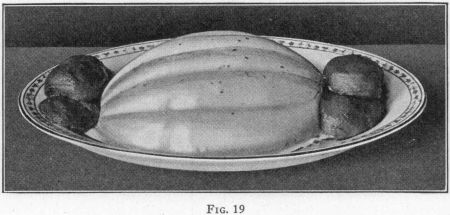
100. CARAMEL MOUSSE.--A melon mold makes a very attractive dessert when used for the molding of caramel mousse. After being turned out of the mold on a platter and garnished with peaches, this dessert will appear as in Fig. 19. In addition to being attractive, caramel mousse is so delicious that it appeals to practically every one.
CARAMEL MOUSSE
(
Sufficient to Serve Six
)
3/4 c. sugar
1/2 c. water
1 c. evaporated milk
2 tsp. gelatine
1/4 c. water
1 egg white
2 tsp. vanilla
1/4 tsp. salt
Make 1/2 cupful of the sugar and the 1/2 cupful of water into caramel. Place the can of evaporated milk into a pan of warm water, allow it to come to a boil over the flame, and then cool the can in the refrigerator. Soften the gelatine with the 1/4 cupful of water and then dissolve in the caramel while it is boiling hot. Pour the cold milk into a bowl, add the egg white, and beat together vigorously. When the gelatine and caramel have become cool and have started to set, gradually add the mixture to the milk and egg white, beating constantly. If it is desired to hasten the thickening process, set the bowl in which the mixture is being made into a pan of ice. Add the rest of the sugar, the vanilla, and the salt, and continue beating until the whole begins to thicken. Place in a mold and freeze in a pan of ice and salt. When frozen, turn from the mold onto a platter and garnish with canned peaches in the manner shown. Over each serving, pour some of the peach juice, which has been boiled down into a thick sirup.
101. CHOCOLATE MOUSSE.--If persons to be served are fond of chocolate desserts, chocolate mousse should be prepared. This may be packed in a mold of any desired kind.
CHOCOLATE MOUSSE
(
Sufficient to Serve Six
)
2 sq. unsweetened chocolate
1-1/4 c. sugar
1 c. water
2 tsp. granulated gelatine
3 c. thin cream
1 tsp. vanilla
1 c. whipping cream
Melt the chocolate in a double boiler. Add the sugar and half of the water. Cook over the flame until the mixture is thick and smooth. Soften the gelatine in 1/4 cupful of water, bring the remaining 1/4 cupful of water to the boiling point, and dissolve the gelatine in it. Add this to the cooked chocolate and sugar, heat the thin cream in a double boiler, and mix the two. Add the vanilla, strain, and cool in a pan of ice water. When the mixture begins to thicken, whip the heavy cream and fold it in. Mold, pack in ice and salt, and freeze.
102. BANANA-AND-APRICOT MOUSSE.--Mousses are sometimes made of fruits, but when this is done, the proper combination should be secured. Bananas and apricots combine very well. An excellent dessert will therefore result if the directions given in the accompanying recipe are carefully followed.
BANANA-AND-APRICOT MOUSSE
(
Sufficient to Serve Six
)
1 c. banana purée
1 c. apricot purée
Juice of 1 lemon
1 c. water
1 c. sugar
2 tsp. gelatine
1 pt. heavy cream
Force ripe bananas through a sieve to make the banana purée. Soak and stew dried apricots and force these through a sieve to make apricot purée. Mix the two and add the lemon juice. Add 1/2 cupful of the water to the sugar and cook until a thick sirup is formed. Add this to the fruit purée. Soften the gelatine in 1/4 cupful of cold water, heat the remaining 1/4 cupful to the boiling point, and dissolve the gelatine. Add the gelatine to the fruit mixture and place in a pan of ice water to cool. Whip the cream until it is stiff and fold this into the fruit mixture when it begins to thicken. Mold, pack in ice, and freeze.
103. MAPLE PARFAIT.--Maple sirup may be combined with eggs and whipped cream to make maple parfait. As may be judged from the ingredients used, this is a very rich dessert; therefore, it should not be used in a meal in which the other dishes are hearty. Maple parfait makes an excellent dish to serve with cake that is not very rich as refreshments for a party.
MAPLE PARFAIT
(
Sufficient to Serve Six
)
4 eggs
1 c. maple sirup
1 pt. heavy cream
Beat the eggs. Cook the maple sirup for a few minutes only and pour this slowly over them. Stir constantly to prevent the curding of the eggs. Place in a double boiler and cook until the mixture thickens. Cool in a pan of ice water. Whip the cream until it is stiff and fold this into the mixture. Mold, pack in ice and salt, and freeze.
104. CAFÉ PARFAIT.--Coffee used to flavor parfait makes a dessert that appeals to many. When hot coffee is not included in the meal on a warm day, this beverage need not be omitted altogether, for it may be used to flavor the dessert.
CAFÉ PARFAIT
(
Sufficient to Serve Six
)
1/4 c. ground coffee
1 c. milk
1 c. sugar
3 c. thin cream
3 eggs
1 c. heavy cream
Scald the coffee and milk together for about 20 minutes, strain, and add the sugar and thin cream. Stir until the sugar dissolves. Beat the eggs and add them to the warm mixture. Cook together until the eggs have thickened and then cool. Whip the heavy cream, fold this into the custard, and freeze. Serve with sweetened whipped cream.
105. STRAWBERRY ANGEL PARFAIT.--As the name implies, strawberry angel parfait is a very dainty dessert. Nothing more delightful can be made during the season when fresh strawberries can be obtained. It is suitable for serving at the conclusion of a meal, but it is especially satisfactory for a party or other social affair.
STRAWBERRY ANGEL PARFAIT
(
Sufficient to Serve Six
)
1 c. sugar
1 c. boiling water
Whites of 2 eggs
1 pt. whipping cream
1 c. crushed strawberries
2 tsp. vanilla
Boil the sugar and water until the sirup threads. Beat the egg whites and pour the hot sirup over them, beating rapidly. Cool. Whip the cream and fold it in, add the crushed strawberries and vanilla, and freeze in a mold.
106. CANTON PARFAIT.--Preserved Canton ginger is used for the flavoring of Canton parfait. The sirup that comes with the ginger is also used in the preparation of this dessert. Canton parfait is somewhat of a departure from the ordinary dessert, but is favored by many persons.
CANTON PARFAIT
(
Sufficient to Serve Six
)
1 c. sugar
1/2 c. water
4 eggs
2 c. thin cream
1/2 c. preserved Canton ginger
1/4 c. sirup from ginger
1 tsp. vanilla
2 Tb. lemon juice
1 c. whipping cream
Cook the sugar and water together until they form a thin sirup. Beat the eggs, pour the hot sirup over them, and add the thin cream. Cook in a double boiler until the eggs have thickened. Cool, add the ginger chopped into small pieces, the ginger sirup, vanilla, and lemon juice. Fold into this the heavy cream whipped until it is stiff. Freeze in a mold.
107. BISCUIT TORTONI.--Something entirely different in the nature of a frozen dessert can be had by preparing biscuit tortoni. This is frozen in a mold as are parfaits and mousses, but instead of the entire mold being served, it is packed in paper cases, and one of these served to each person. Macaroons are used to flavor this dessert, and a layer of the crumbs is sprinkled over the top of each serving.
BISCUIT TORTONI
(
Sufficient to Serve Six
)
1 c. sugar
1/2 c. boiling water
3 eggs
1 pt. thin cream
1 c. heavy cream
1 c. macaroon crumbs
1 tsp. vanilla
Cook the sugar and water until it threads. Beat the eggs and add the sirup to the beaten eggs. Then add the thin cream, return to the fire, and cook until the mixture thickens. Set aside to cool. Beat the heavy cream until it is stiff, and fold this into the custard. Make macaroon crumbs by drying macaroons and beating them until they are quite fine. Add 1 cupful of these crumbs and the vanilla to the parfait mixture, place in a mold and freeze. When frozen, remove from the mold, pack in paper cases, cover with a layer of macaroon crumbs, and serve.
MOLDING FROZEN DESSERTS
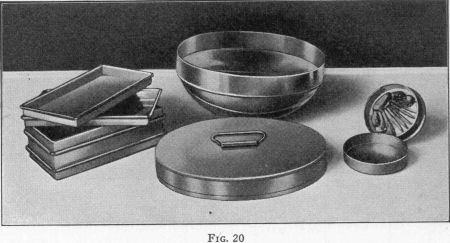
108. After desserts have been frozen in the various ways that have been explained, they are often molded and then allowed to stand in ice and salt until they are well set. In this way, many attractive desserts can be made and numerous color schemes carried out. Some of the molds that are used for this purpose are shown in Fig. 20. The one in the center is known as a melon mold, and it is the one used in the preparation of the caramel mousse shown in Fig. 19. It may also be used for the molding of desserts that are already frozen. The mold to the left is known as a brick mold, and is much used for Neapolitan ice cream, while the small one to the right is an individual mold used for individual serving. Both the top and the bottom of the brick mold are in the form of covers that are removable. Directions for the molding of several desserts of this kind are here given and other frozen mixtures may be molded in a similar way.
109. NEAPOLITAN ICE CREAM.--A combination of an ice and two kinds of ice cream, usually of different colors, makes what is known as Neapolitan ice cream. Various ways of combining these are in practice; for instance, chocolate ice cream and strawberry ice cream may be combined with lemon ice, or strawberry and vanilla ice cream and orange ice may be used together. The ice creams and ices must, of course, be thoroughly frozen before they are packed in the mold.
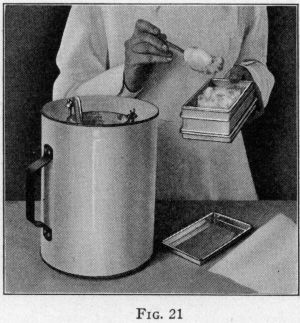
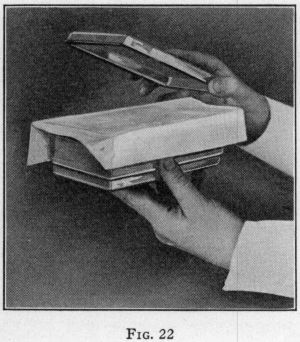
Prepare the mold by placing a piece of oiled paper over the bottom cover and setting the mold in this. Then put a layer of ice cream of one color into the mold, as shown in Fig. 21, pack on top of this the second color of ice cream, and put the ice on top, or pack the ice between the two kinds of ice cream. Pack each layer tight and push the frozen mixtures well into the corners so that there will be no holes. Cover the top well with another piece of oiled paper, as shown in Fig. 22, place the cover on, and pack the mold into ice and salt, using a proportion of 2 to 1. Allow this to stand until it is well set. To serve, remove from the mold, cut slices from the brick, and place on plates, preferably those covered with paper doilies.
110. BOMBE GLACÉ.--A combination of an ice and a mousse or parfait mixture makes a delightful dessert known as Bombe glacé. Contrasting colors should be used if possible in order to make a beautiful dessert. This is usually made in a melon-shaped mold, but it may be made in a round mold, such as a tin can, if the can is perfectly water-tight.
Line the mold with an ice and fill the center with a mousse or a parfait. Place in a mixture of ice and salt and freeze. When it has become solid, turn out the entire mold on a suitable dish and serve it at the table.
SERVING FROZEN DESSERTS
111. Frozen desserts offer an opportunity for variety in serving, because they occur in so many different forms. The method of serving depends, of course, on the nature of the frozen dessert, but any one of them that may be served from a large plate or dish is always attractive. This may be done, as has been explained, if the frozen mixtures are molded either as a single kind or as a combination of two or more kinds.
112. To remove a molded dessert from the mold before serving, first clean the mold thoroughly of ice and salt and wipe it dry with a cloth. Then remove the cover and allow it to stand for a few minutes in a warm place. This treatment will cause the outside of the frozen mixture to melt slightly and permit it to slip easily from the mold. A warm cloth or warm water is sometimes used to melt the surface, and it accomplishes the work more quickly; but when the mold is so treated it is likely not to look so well. As soon as the surface is a trifle soft, turn the mold out on a dish and serve it immediately.
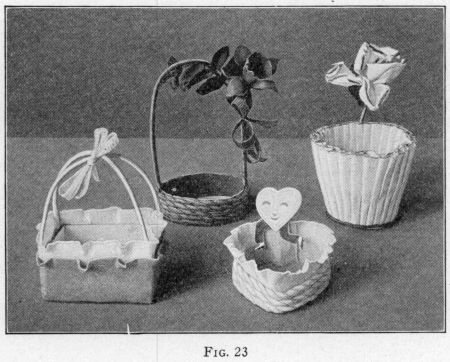
113. Receptacles of numerous kinds are in use for individual servings of frozen desserts. Slices of ice cream cut from a brick mold and individual molds are usually served on a small plate about the size of a bread-and-butter plate. It may be placed directly on the plate, or a paper doily of the proper size may be put on the plate and the frozen dessert set on this. Sherbet glasses are much used for individual portions and are very attractive for this purpose, especially when they have long stems. Paper cases, such as those shown in Fig. 23, also make excellent receptacles for individual servings. They may be plain or fancy and are generally used to carry out a color scheme or a decorative idea. Meringues having the bottom removed and the center scooped out are sometimes used as cases in which to serve ice cream. These are made of egg white and sugar and baked in the oven. They are not difficult to prepare, as the recipes for them in Cakes, Cookies, and Puddings, Part 2, explain, and they are often garnished with whipped cream. All such receptacles are placed on a small plate either with or without a paper doily of the right size.
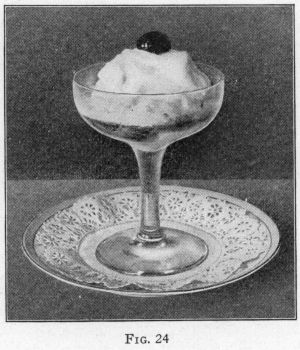
114. It is a little more difficult to serve desserts frozen in a freezer than those which an molded. However, there are numerous ways of garnishing and serving such desserts to add to their attractiveness. Candied fruits, such as cherries and pineapple, candied violet, mint, and rose leaves, maraschino and crème-de-menthe cherries, fresh strawberries, preserved cherries, strawberries, and other fruits, sliced peaches or bananas, whipped cream, toasted coconut, chopped nuts of different kinds, and various kinds of fruit sirups may all be used to advantage with these desserts. Fig. 24 shows ice cream served in a stemmed sherbet glass with grape juice and garnished with whipped cream and a maraschino cherry. Then, too, a chocolate sirup made by cooking sugar, water, and chocolate or sugar, milk, and chocolate may be served hot or cold over ice cream and similar desserts. Another excellent dip is made of any kind of fruit juice thickened with sugar. The marshmallow whip explained in Art. 54 may be made in any desirable color and then used alone or with a dip as a garnish for ice cream.
COLD AND FROZEN DESSERTS
EXAMINATION QUESTIONS
(1) Discuss briefly the value of desserts with meals.
(2) What points should be considered in the selection of desserts?
(3) What is the value of an attractive appearance in a dessert?
(4) (a) How do the general rules of cookery apply in the preparation of desserts? (b) Give an example.
(5) Of what value to desserts is: (a) a bland sauce? (b) a highly seasoned sauce?
(6) (a) Mention the proportion of eggs and milk for a custard. (b) Describe the method of making and baking plain custard.
(7) (a) Give a common test for determining when baked custard is done. (b) Give the test for soft custard.
(8) (a) How should pearl tapioca be prepared for cooking? (b) What should be its appearance when it has been cooked?
(9) How is gelatine prepared when it is to be used for desserts?
(10) Give the theory for the freezing of desserts.
(11) Give the proportion of ice to salt for: (a) ice cream; (b) sherbets; (c) ices; (d) frappés; (e) frozen punch; (f) frozen desserts that are packed and not turned to freeze.
(12) Describe the procedure in getting a mixture ready to freeze.
(13) To what is the increase in quantity during the freezing of a mixture due?
(14) How does the rate of speed in turning the dasher affect the freezing of a dessert?
(15) How can you determine when the mixture in a freezer is sufficiently frozen?
(16) What should be done in making a frozen dessert when the freezing has been completed?
(17) State the advantages and disadvantages of a vacuum freezer.
(18) What are: (a) ices? (b) sherbets?
(19) How is a mold of ice cream packed?
(20) Describe an original way of serving ice cream.