CAKES, COOKIES, AND PUDDINGS (PART 2)
Reading edition
SMALL CAKES
VARIETIES OF SMALL CAKES
1. Under the heading Small Cakes are included numerous varieties of cakes made of many different kinds of materials and baked in various shapes and sizes. Some of them, such as meringues and kisses, contain nothing except eggs and sugar and consequently are almost confections. On the other hand, many of them, including cookies of all kinds, drop cakes, ladyfingers, etc., are merely the usual sponge and butter-cake mixtures altered in such ways as may be desired. In addition, there are cream puffs and éclairs, the various kinds of cakes made with yeast, and doughnuts and crullers, all of which, while not exactly cake mixtures, are similar enough to small cakes in preparation and use to be discussed in connection with them.
2. NATURE OF MIXTURES FOR SMALL CAKES.--The mixtures used for small cakes are made into batters and doughs of various thicknesses. For instance, the batter used for cup cakes is as thin as that for layer cake; that for drop cakes must be stiff enough to hold its shape when it is dropped on a flat sheet; while cookies require a dough that is stiff enough to be rolled out in a thin layer and then cut into various shapes with cutters. The mixing of cakes of this kind differs in no way from that of large cakes, the greater thickness being obtained merely by the addition of flour.
3. BAKING SMALL CAKES.--Small cakes bake more quickly than large ones; consequently, a hotter oven is required for them. Cookies will bake in 10 to 15 minutes. They should rise and start to brown in 1/2 of this time, and should finish browning and shrink slightly in the remaining half. Drop cakes require a little more time than cookies. They should rise during the first third of the time, brown slightly during the second, and finish browning and shrink during the last third. Cup cakes being larger require from 15 to 25 minutes to bake, depending on their size. They should rise and brown in the same way as drop cakes. The baking of most of the other varieties demands special attention and is discussed in connection with the cakes themselves.
When the majority of small cakes, including cookies, are put into the oven to bake, they should be set on the lower rack. Then, when the browning has started, they should be changed to the upper rack, where they will brown more quickly. This transfer may also be necessary in the case of the larger sized cup cakes.
Small cakes baked in muffin pans should be allowed to stand for several minutes after being removed from the oven in order to cool. Then a knife or a spatula should be run around the edge to loosen each cake from the pan. If the pan is then turned upside down and tapped lightly once or twice, the cakes will, as a rule, come out in good condition. Cookies and drop cakes should be taken from their pans or sheets while warm and then allowed to cool on a cake cooler or on clean towels spread on a table.
PREPARATION OF SMALL CAKES
CUP AND DROP CAKES
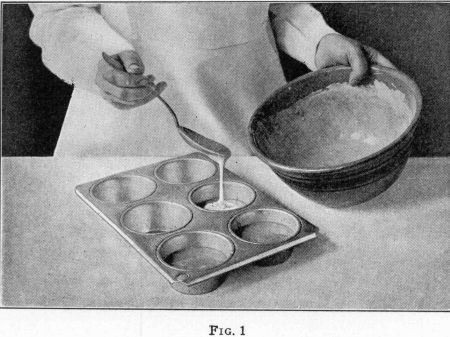
4. NATURE OF CUP AND DROP CAKES.--CUP CAKES are a variety of small cakes baked in muffin pans. Many of the mixtures used for large cakes may be made into cup cakes by baking them in pans of this kind. Instead of pouring the mixture into the pans from the bowl, as is done in the case of large cakes, it is put into them by means of a spoon, as shown in Fig. 1. The pans should be filled only about half full in order to give the mixture an opportunity to rise. When the cakes are baked, they usually reach the top of the pans.
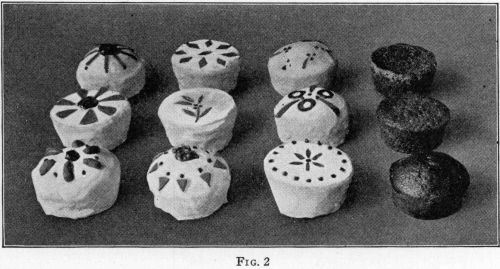
5. Cup cakes may be served plain or they may be iced in any desired way. Fig. 2 shows a group of cakes of this kind, the three on the right being cup cakes without any icing or decoration and the rest, cup cakes iced and then decorated in a variety of ways. As will be observed, cup cakes lend themselves well to decoration. The materials used here for the decorating are chiefly citron and maraschino cherries, both of which may be cut into a variety of shapes. The cakes are first covered with a white icing for a foundation, and the decorative materials are applied before it becomes dry. Other materials may, of course, be used for decorating cup cakes, and original designs may be worked out in a number of attractive ways.
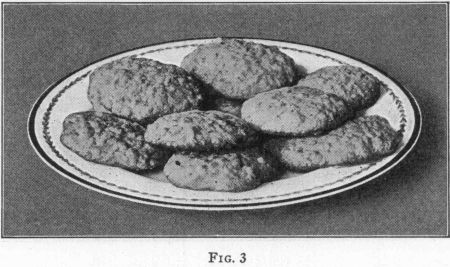
6. DROP CAKES differ from cup cakes in that a stiffer batter is used and the mixture is then dropped from a spoon on a greased and floured cooky sheet. As shown in Fig. 3, which illustrates a plate of drop cakes ready to serve, cakes of this kind are not generally iced. However, the mixture used for them often contains fruits and nuts.
7. RECIPES FOR CUP AND DROP CAKES.--Several recipes for cup cakes and drop cakes are here given. No difficulty will be experienced in carrying out any of them if the suggestions already given are applied. With each recipe is mentioned the approximate number of cakes the recipe will make. The exact number it will produce will depend, of course, on the size of the cakes; the smaller they are the greater will be their number.
CUP CAKES
(
Sufficient for 1-1/2 Dozen Cakes
)
2/3 c. butter
2 c. sugar
4 eggs
3-1/4 c. flour
4 tsp. baking powder
1/4 tsp. mace
1 c. milk
1 tsp. vanilla
Cream the butter and add the sugar. Beat the eggs and add them. Sift the flour, baking powder, and mace together, and add alternately with the milk. Flavor with the vanilla, put into greased and floured muffin pans, and bake. Cover with chocolate icing and serve.
BROWNIES
(
Sufficient for 1 Dozen Cakes
)
1/3 c. butter
1/3 c. sugar
1/3 c. molasses
1 egg
1-1/4 c. flour
1 tsp. baking powder
1/3 tsp. soda
1/2 c. chopped nut meats
Cream the butter, add the sugar and molasses, beat the egg and add it. Mix the flour, baking powder, and soda together, and sift into the mixture. Fold in the chopped nut meats, put in thin layers into muffin pans, and bake in a hot oven until done. Remove from the pans, cool, and serve.
CINNAMON CUP CAKES
(
Sufficient for 1 Dozen Cakes
)
1/2 c. butter
1 c. sugar
2 eggs
4 tsp. baking powder
2 c. flour
1 Tb. cinnamon
1/2 c. milk
Cream the butter and add the sugar. Beat the eggs and add them. Sift the baking powder, flour, and cinnamon together, and add alternately with the milk. Put into greased and floured muffin pans and bake.
COCOA CUP CAKES
(
Sufficient for 1-1/2 Dozen Cakes
)
1/3 c. shortening
1-1/4 c. sugar
2 eggs
2 c. flour
1/2 c. cocoa
1/8 tsp. soda
3 tsp. baking powder
3/4 c. milk
1 tsp. vanilla
Cream the shortening and add the sugar. Beat the eggs and add them. Sift the flour, cocoa, soda, and baking powder together and add alternately with the milk. Flavor with the vanilla, put into greased and floured muffin pans, and bake in a hot oven. Remove from the pans, cool, and serve. If desired, these cakes may be iced with white icing and sprinkled with coconut.
ROXBURY CAKES
(
Sufficient for 1 Dozen Cakes
)
1/4 c. butter
1/2 c. sugar
2 eggs
1/2 c. molasses
1/2 c. milk
1-3/4 c. flour
1/2 tsp. nutmeg
1/2 tsp. cinnamon
1/2 tsp. ground cloves
1-1/2 tsp. baking powder
1/2 tsp. soda
3/4 c. raisins
1/2 c. English walnut meats
Cream the butter and add the sugar gradually. Beat the eggs and add them. Add the molasses and milk. Mix and sift the dry ingredients and stir these into the first mixture. Fold in the finely chopped raisins and nuts. Bake in a moderate oven and ice with white icing.
APPLE-SAUCE CAKES
(
Sufficient for 1-1/2 Dozen Cakes
)
1/4 c. butter
1 c. sugar
2 c. flour
1/2 tsp. soda
2 tsp. baking powder
1-1/2 tsp. cinnamon
1/4 tsp. cloves
1 tsp. nutmeg
1 c. apple sauce
1 c. raisins
Cream the butter and add the sugar gradually. Sift the dry ingredients together and add alternately with the apple sauce made according to the following directions. Stir in the raisins dredged with a little of the flour. Bake in muffin pans in a moderate oven for about 15 minutes.
APPLE SAUCE
1 qt. apples
1/2 c. sugar
1 c. water
Peel and quarter the apples. Put them to cook in the water. When soft, force through a sieve, add the sugar, and return to the fire until the sugar is dissolved. Cool and use for the cakes.
SOUR-MILK DROP CAKES
(
Sufficient for 3 Dozen Cakes
)
1/3 c. butter
1 c. sugar
1 egg
1/2 c. sour milk
2-1/2 c. flour
1/2 tsp. soda
1 tsp. baking powder
1/2 c. nut meats
1/2 c. raisins
Cream the butter and add the sugar, the beaten egg, and the milk. Sift the flour, soda, and baking powder together and add them. Fold in the nuts and raisins. Drop by spoonfuls on a greased and floured cake sheet. Bake rather slowly, remove from the sheet, cool, and serve.
FRUIT DROP CAKES
(
Sufficient for 2 Dozen Cakes
)
1/3 c. shortening
2/3 c. sugar
1 egg
1/4 c. milk
1-3/4 c. flour
2 tsp. baking powder
1 tsp. cinnamon
1/4 tsp. cloves
1/2 tsp. nutmeg
1/2 c. raisins
Cream the shortening and add the sugar, egg, and milk. Sift the flour, baking powder, and spices together. Sift these dry ingredients into the mixture and add the raisins. Drop by spoonfuls on a greased and floured cake sheet and bake in a hot oven until light brown.
OAT-FLAKE DROP CAKES
(
Sufficient for 2 Dozen Cakes
)
1/2 c. shortening
1 c. sugar
1 egg
2 c. oat flakes
1 tsp. vanilla
2 c. flour
1/2 tsp. salt
3 tsp. baking powder
1 tsp. cinnamon
1/2 c. milk
Cream the shortening and add the sugar. Beat the egg and add to the mixture. Add the oat flakes and vanilla. Sift the flour, salt, baking powder, and cinnamon together and add alternately with the milk. Drop on greased pans to bake.
GINGER DROP CAKES
(
Sufficient for 2 Dozen Cakes
)
1/2 c. shortening
1/2 c. brown sugar
1 egg
2-1/2 c. flour
1/2 tsp. soda
1/2 tsp. salt
1/2 Tb. ginger
1/2 c. sour milk
1/2 c. molasses
Cream the shortening, add the sugar, and mix well. Beat the egg and add it. Sift the dry ingredients and add alternately with the milk and molasses. Drop on greased sheets and bake in a moderate oven for about 15 or 20 minutes.
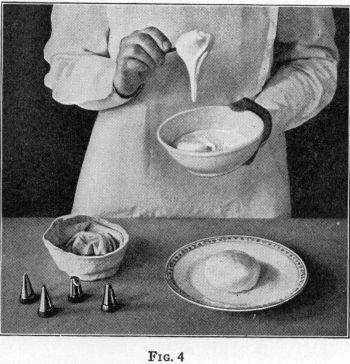
8. APPLYING ORNAMENTAL ICING TO CUP CAKES.--Sometimes it is desired to put icing on cup cakes in an ornamental way. In such an event, an uncooked icing is used and it is usually applied by means of a pastry tube, although certain simple designs can be made with a small paper cornucopia. When icing is to be used for this purpose, it should be of the consistency shown in Fig. 4; that is, it should be so heavy that a large quantity of it will cling to the spoon, and when it drops it will fall in a mass rather than run off.
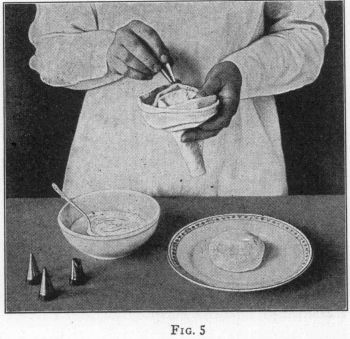
Have the pastry bag clean and dry, and make it ready for use by slipping the pastry tube inside of the bag, as shown in Fig. 5. The point of the tube should protrude from the narrow end of the bag, which is too small to allow the top of the tube to be pushed through. The cakes to be decorated with the aid of a pastry tube are usually prepared, as the cake in the illustration shows, by covering it with a perfectly smooth coating of uncooked icing of some kind.
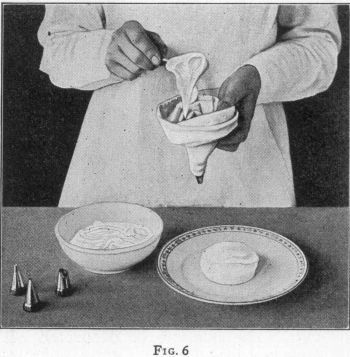
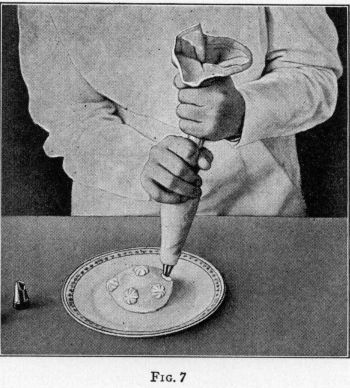
With the tube inserted and the cake coated, the work of decorating may be taken up. Roll the top of the bag down, as shown in Fig. 6, and into it put as much of the icing as is desired. See that the icing is pushed as far down into the end of the bag as possible. Then, as in Fig. 7, hold the top of the bag shut with one hand and with the other grasp it at the place where the contents end. When the hands have been so placed, press down on the bag so that the icing will be forced from the point of the tube. To make the decorations most satisfactorily, have the point of the tube pressed tightly against the surface of the cake and raise it very slowly as the icing comes out. Otherwise the shape of the design will not be good, as a little experimenting will prove. The rosette tube is used to make the decorations here shown, but if a different form of decoration is desired, one of the other tubes may be selected.
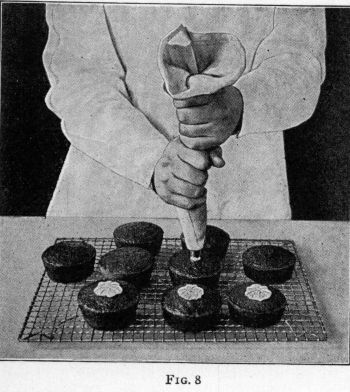
9. With cakes of this kind, it is often desired to have a simple decoration without first applying the foundation icing. This can be done, as shown in Fig. 8, by pressing icing through a pastry bag containing the rosette tube and placing the decoration merely on the center of each cake. This is suggested as an economical use of icing and a decoration a little out of the ordinary. The points of the pastry tube should be bent toward the center in order to produce the rosettes in the manner here shown. In fact, the shape of a rosette can often be changed to some extent by opening or closing these points a trifle.
COOKIES
10. CLASSES OF COOKIES.--Cookies are of two general classes: those which are made thick and are expected to be soft when they are served and those which are made thin and are intended to be crisp and brittle when eaten. Thin, crisp cookies are usually known as wafers or snaps. Soft cookies are made from a dough that contains a little more liquid than that used for brittle cookies. The dough of which both varieties are made should be thick enough to remove from the mixing bowl in a lump and roll out on a board. After being rolled until it is the desired thickness, it is cut into pieces of any desired size and shape and baked in the oven on large flat pans.
11. INGREDIENTS IN COOKIES.--The ingredients used in the making of cookies are similar to those used for drop cakes, with the exception of the amount of flour. In fact, any cooky mixture that is made a little more moist by omitting some of the flour may be used for drop cakes. More flour is needed in cooky mixtures because they must be of a certain thickness in order to be rolled out successfully. The amount of flour needed varies with the kind that is used, more of some varieties of this ingredient being required than of others. It is usually advisable to add the last cup of flour with caution. If the mixture seems to be getting stiff before all the flour is added, what is not needed should be omitted; but if it does not become stiff enough to handle, more should be added.
12. Considerable variety exists in the shortening that may be used in cooky mixtures. If desired, butter may be used, but for most cookies it is not at all necessary that the shortening consist entirely of butter, and for some no butter at all is required. Other fats and oils, such as lard, Crisco, lard compound, Mazola, cottoline, butterine, and any other tasteless shortening, may be substituted for all or part of the butter. Any of the following cooky recipes that contain butter do so because that particular cooky or cake is better when made with butter, but, if desired, some other fat may be used for a part or all of it. In case merely shortening is mentioned, any fat or mixture of fats preferred may be used.
13. PROCEDURE IN MAKING COOKIES.--The combining of the ingredients in cooky mixtures need give the housewife very little concern, for it is accomplished in much the same way as for cup and drop cakes. When all of them have been combined, a dough that is stiff enough to handle and still not so stiff that it is tough should be formed. The chief precaution to be taken in the making of all kinds of cookies is to avoid getting too much flour into the mixture. To produce the best results, the mixture should be so soft that it is difficult to handle. A good plan is to allow it to become very cold, for then it will be much stiffer and may be handled more easily. Therefore, after the dough has been mixed, it is well to set it in a refrigerator or some other cool place and let it stand for several hours before attempting to roll it. In fact, a cooky mixture may be made in the evening and allowed to stand until the next morning before being rolled out and baked. As can readily be understood, such procedure is possible with a stiff mixture like that for cookies, while it would not be practicable with a thin mixture, such as cake batter, because the gas that is formed by the leavening agent would escape from a mixture that is not thick and the cake, after being baked, would have no lightness.
14. With the dough ready to be rolled, divide it into amounts of a size that can be handled conveniently at one time. Take one of these from the mixing bowl and place it on a well-floured board. Work it with the fingers into a flat, round piece, using a little flour on the fingers during this process. Dust the top lightly with flour and, by means of a rolling pin, roll the dough into a flat piece that is as nearly round as possible. Continue rolling with a short, light stroke until the dough is as thin as desired. Remember that light, careful handling is always necessary when any kind of dough mixture is rolled on the board, and that as little handling as possible is advisable. Skill in this respect will come with practice, so the housewife need not be discouraged if she has difficulty at first. For cookies, 1/4 inch is the usual thickness of the dough after it is rolled; but for snaps or wafers the dough should be rolled as thin as possible. If the dough is as moist as it should be, it may be necessary, from time to time, to dust the top with flour as the rolling continues. However, no more flour should be used than is needed to keep the rolling pin from sticking; otherwise, the dough will become too thick and the cookies will be tough and dry.
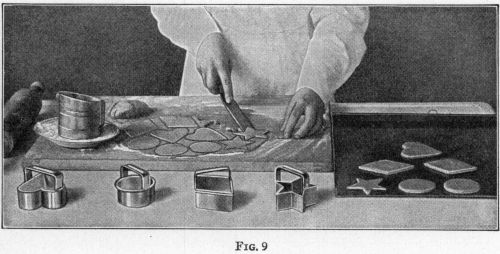
15. When the dough has been rolled until it is of the right thickness, cut it in the manner shown in Fig. 9, using cooky cutters of any desired size and shape. The four cutters shown, which are heart, round, diamond, and star shapes, are the ones that are most commonly used. They are merely strips of tin bent into a particular shape and attached to a handle for convenience in using. In cutting the dough, try to cut it to the best possible advantage, leaving as little space between the cookies as possible. Very often, as, for instance, when diamond-shaped cookies are being cut, the line of one may be the exact line of the one next to it and thus no dough need be left between the cookies.
16. However, as Fig. 9 shows, a certain amount of dough necessarily remains after all the cookies that can be made out of a piece of rolled dough have been cut. Put these scraps together and set them aside until all the fresh dough has been rolled. Then put them together carefully, roll them out again, and cut the piece thus formed into cookies just as the others were cut. Some persons are in the habit of working these scraps in with the next piece of dough that is rolled out, but this is not good practice, for by the time they are rolled on the board a second time, more flour will be worked into them than into the dough with which they were put and the texture will not be the same.
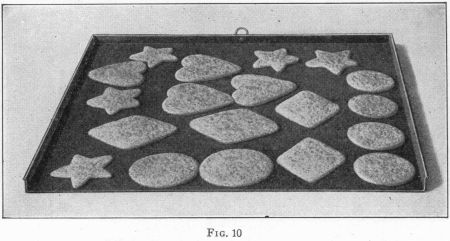
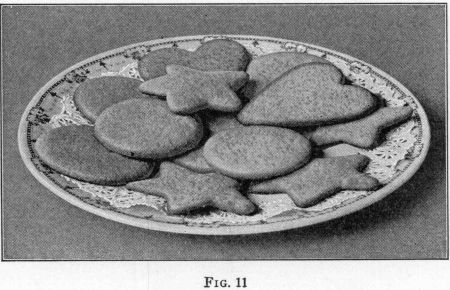
17. BAKING COOKIES.--Have a cooky sheet or other large shallow pan greased and floured, and as soon as all the cookies are cut from a piece of dough, pick them up with the aid of a spatula, as in Fig. 9, and arrange them on the pan. Do not place them too close together, or upon baking they will stick to one another and lose their shape. As soon as a pan is filled, set it in the oven, either directly on the bottom or on a low rack. If the temperature of the oven is correct, the cookies should begin to rise within 2 or 3 minutes after they are put into the oven. After they have baked on the bottom and have risen as much as they will, they will appear as shown in Fig. 10. At this point, set them on a higher rack to brown on top. In this browning, they will shrink to some extent, so that the finished cookies will not have so smooth an appearance as when they are placed on the top rack. When done, they should be slightly brown, and if it is found that they are too brown on top, it may be known that the oven temperature was a little too high or perhaps that they should have had a little less time on this rack. Molasses cookies require special care to prevent them from burning, for, as is explained in Hot Breads, any food containing molasses burns readily. A comparatively short time is necessary for the baking of cookies, but they should be left in the oven long enough to be thoroughly baked when removed. When ready to serve, properly baked cookies should appear as in Fig. 11.
18. RECIPES FOR COOKIES.--With the principles of cooky making well understood, the housewife is fully qualified to try any of the recipes that follow. As will be noted, a number of recipes are here given and so a pleasing variety may be had. Some of them are suitable for certain occasions and some for others. For instance, barley-molasses cookies are very good with coffee for breakfast, while filled cookies make an excellent cake for picnic lunches. Cream cookies or vanilla wafers could be served at an afternoon tea, while sand tarts make a very good accompaniment for ice cream or some other dainty dessert. The nature of the cooky will enable the housewife to determine when it should be served.
GINGER SNAPS
(
Sufficient for 4 Dozen Snaps
)
1 c. molasses
1/3 c. lard or other shortening
1/4 c. butter
3-1/4 c. flour
1/2 tsp. soda
1 Tb. ginger
1 tsp. salt
Heat the molasses to boiling and pour over the shortening. Sift the dry ingredients together and add these. Cool the mixture until it is stiff and cold, roll as thin as possible, cut with a small round cutter, and bake in a quick oven, being careful not to burn.
CREAM COOKIES
(
Sufficient for 3 Dozen Cookies
)
1/3 c. butter
1 c. sugar
2 eggs
1/2 c. thin cream
1 tsp. vanilla
4 tsp. baking powder
1 tsp. salt
1/2 tsp. mace
3 c. flour
Cream the butter, add the sugar, eggs, the cream, and vanilla. Sift the baking powder, salt, mace, and flour together and add these to the mixture. Roll about 1/4 inch thick and cut. Bake in a hot oven.
VANILLA WAFERS
(
Sufficient for 6 Dozen Wafers
)
1/3 c. shortening
1 c. sugar
1 egg
1/4 c. milk
2 tsp. vanilla
2 c. flour
3 tsp. baking powder
1/2 tsp. salt
Cream the shortening, add the sugar and egg, and continue beating. Pour in the milk and add the vanilla. Sift the flour, baking powder, and salt into the mixture. Roll out as thin as possible, cut with a small round cutter, and bake in a hot oven. These wafers should be crisp and thin when finished.
BARLEY-MOLASSES COOKIES
(
Sufficient for 3 Dozen Cookies
)
1 c. molasses
1/2 c. shortening
1/4 c. milk
2 c. wheat flour
1 c. barley flour
2 tsp. ginger
1 tsp. soda
1/2 tsp. salt
Heat the molasses, pour it over the shortening, and add the milk. Sift the dry ingredients together, and add to the mixture. Cool, roll about 1/4 inch thick, cut, and bake in a quick oven, being careful not to burn.
OATMEAL COOKIES
(
Sufficient for 3-1/2 Dozen Cookies
)
1 egg
1/2 c. sugar
1/4 c. thin cream
1/4 c. milk
1/2 c. oatmeal
2 c. flour
2 tsp. baking powder
1 tsp. salt
4 Tb. melted butter
Beat the egg and add the sugar, cream, and milk. Run the oatmeal through a food chopper, and mix with the flour, baking powder, and salt. Stir all into the mixture, add the melted butter, and mix thoroughly. Roll thin, cut, and bake in a quick oven.
SAND TARTS
(
Sufficient for 6 Dozen Tarts
)
1/2 c. shortening
1 c. sugar
1 egg
1-3/4 c. flour
2 tsp. baking powder
1/4 tsp. cinnamon
1 egg white
Blanched almonds
Cream the shortening and add the sugar and the egg. Sift together the flour, baking powder, and cinnamon, and add these to the mixture. Fold in the beaten egg white. Roll as thin as possible and cut. Split blanched almonds, and after putting the cookies on the cooky sheet, place several halves of almonds in any desirable position on the cookies. Bake in a quick oven until light brown.
HIGHLAND DAINTIES
(
Sufficient for 3 Dozen Cookies
)
2 c. flour
1/2 c. brown sugar
3/4 c. butter
1 egg yolk
Mix and sift the flour and sugar and work in the butter with the fingers. Roll out about 1/3 inch thick and cut into any desirable shape with small cutters. Brush with the egg yolk to which has been added 1 teaspoonful of water. Bake in a slow oven until light brown.
FILLED COOKIES
(
Sufficient for 1-1/2 Dozen Cookies
)
1 c. shortening
1 c. sugar
1 egg
1/2 c. milk
3 c. flour
3 tsp. baking powder
1/2 tsp. salt
2 tsp. vanilla
Cream the shortening and add the sugar gradually. Next add the beaten egg and the milk. Sift the flour, baking powder, and salt together and add to the mixture. Add the vanilla. Roll very thin and cut into small round, square, or diamond shapes. Spread one cooky with the following filling, cover with a second, press the edges together, and bake in a quick oven.
FILLING FOR COOKIES
1 c. sugar
1 Tb. flour
1/2 c. boiling water
1-1/4 c. chopped raisins
3/4 c. nut meats
Mix the sugar and flour and stir them into the boiling water. Add the raisins and let cook until thick enough to spread on the cookies. Remove from the fire and add the nut meats. Cool slightly and spread. Figs or dates may be used in place of the raisins.
If it is not desired to prepare a filling for the cookies, jam makes a very good substitute.
SOUR-CREAM COOKIES
(
Sufficient for 3 Dozen Cookies
)
1/2 c. butter
1 c. sugar
2 eggs
1/2 pt. thick sour cream
1/2 tsp. soda
1 tsp. baking powder
3-1/2 c. flour
1/2 tsp. lemon extract
Cream the butter and sugar, add the eggs, and beat thoroughly. Add the cream. Sift the soda, baking powder, and flour and add to the first mixture. Add the lemon extract, roll out thick, and sprinkle with sugar. Cut with a round cutter, place on greased and floured tins, and bake.
KISSES AND MACAROONS
19. NATURE OF KISSES AND MACAROONS.--The varieties of small cakes known as kisses and macaroons are undoubtedly the daintiest ones that are made. Composed almost entirely of sugar, egg whites, and flavoring, they are very delicate in texture and are practically confections. Kisses do not contain any flour, but macaroons need a small amount of this ingredient and some varieties of them contain the yolks, as well as the whites, of eggs. Chopped or ground nuts, coconut, and various kinds of dried or candied fruits are added to these cakes to give them variety.
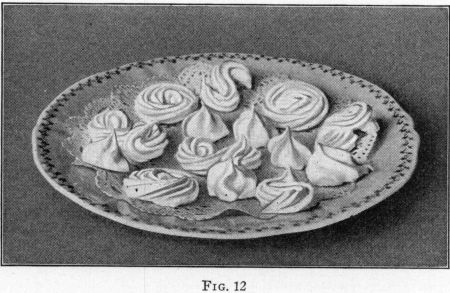
20. The mixtures of which these cakes are made are either dropped by spoonfuls or forced through a pastry bag into little mounds or rosettes on an inverted pan or a cooky sheet and then baked in a very slow oven. An oven of this kind is necessary, for the mixtures must be practically dried out in the baking. Meringues, although made of a mixture similar to that used for kisses, are usually made in rather large, round, flat shapes, whereas kisses are smaller and are for the most part made in the shape of rosettes. Fig. 12 shows a plate of kisses ready to serve.
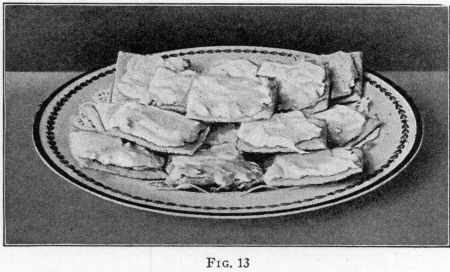
21. Marguerites, while not exactly the same as either kisses or macaroons, are given in this connection because the mixture used for them is similar to that for kisses. These, as shown in Fig. 13, are in reality saltines covered with a mixture of egg and sugar to which nuts, coconut, flavoring, etc. may be added for variety. After the sugar covering has been applied, the saltines are set in the oven and baked until slightly brown on top. This variety of small cakes, as well as kisses and meringues, is excellent for serving with afternoon tea, or with ice cream at a party that is to be very dainty.
22. RECIPES FOR KISSES AND MACAROONS.--One recipe for kisses, several recipes for macaroons, and directions for the preparation of marguerites follow. If meringues are desired, the recipe for kisses may be followed and the mixture then dropped by spoonfuls, instead of being forced through a pastry tube.
KISSES OR MERINGUES
(
Sufficient for 1 to 2 Dozen Cakes
)
1/2 c. fine granulated sugar, or 1/2 c. and 2 Tb. powdered sugar
2 egg whites
1/2 tsp. vanilla
Fine granulated or powdered sugar may be used for these cakes. If powdered sugar is selected, a little more will be required than of granulated. Only fresh eggs should be employed. Separate them and beat the whites with an egg whip, beating slowly at first and more rapidly as the eggs grow stiff. When they have become very stiff, add a tablespoonful of the sugar and continue the beating. When this has been beaten thoroughly, add another tablespoonful, and continue to add sugar in small amounts and to beat until all has been worked in. Add the vanilla. Moisten with cold water a board that is about 1 inch thick, place over it some heavy white paper, and force the mixture through a pastry bag or drop by spoonfuls on the paper. Place the board containing the kisses in a very slow oven, one so slow that instead of baking the kisses it will really dry them. If the oven is too warm, open the oven door slightly to prevent the temperature from rising too high. Bake until the kisses are dry and then remove them from the oven.
If desired, the inside of the meringues, which is soft, may be removed and the shell filled with a filling of some kind. Plain whipped cream or whipped cream to which fresh strawberries and sugar are added makes an excellent filling for this purpose. In fact, meringues filled and garnished with whipped cream make a very delightful dessert.
PECAN MACAROONS
(
Sufficient for 1-1/2 Dozen Cakes
)
1 egg white
1 c. brown sugar
1 c. pecan meats
1/4 tsp. salt
Beat the egg white until stiff and add the sugar gradually, beating constantly. Fold in the nut meats, add the salt, and then drop from the tip of a spoon 1 or 2 inches apart on a cooky sheet covered with buttered paper. Bake in a moderate oven until delicately browned.
ALMOND MACAROONS
(
Sufficient for 1-1/2 Dozen Cakes
)
1/2 lb. almonds
1 c. powdered sugar
2 egg whites
Blanch the almonds and force them through a food chopper. Mix the ground almonds and powdered sugar, and gradually add the beaten egg whites until a mixture of the consistency of a stiff dough is formed. Force through a pastry bag or drop with a spoon on a cooky sheet covered with buttered paper. The macaroon mixture spreads during the baking, so space will have to be left between the cakes. Bake in a very slow oven. After removing from the oven, cover for a few minutes with a moist cloth in order to loosen the macaroons.
COCONUT MACAROONS
(
Sufficient for 1-1/2 Dozen Cakes
)
1 c. powdered sugar
1 c. shredded coconut
2 egg whites
Mix the sugar and coconut. Beat the egg whites and fold into the coconut and sugar. Drop by spoonfuls on a cooky sheet covered with waxed paper and bake in a slow oven.
OATMEAL-FRUIT MACAROONS
(
Sufficient for 3 Dozen Cakes
)
2 eggs
1/2 c. sugar
1/4 c. corn sirup
1 Tb. melted shortening
1/2 c. raisins, cut in small pieces
2-1/2 c. rolled oats
1/2 tsp. salt
Beat the eggs, add the sugar, sirup, and shortening. Fold in the fruit, rolled oats, and salt. Drop by spoonfuls on a greased cooky sheet and bake in a moderate oven.
MARGUERITES
(
Sufficient for 3 Dozen Cakes
)
3/4 c. sugar
1/3 c. water
1 egg white
1/4 c. shredded coconut
1/4 c. chopped nuts
Cook the sugar and water until it forms a hard ball when tested in cold water or threads from a spoon. Beat the egg white until stiff, pour the hot sirup into it, and continue beating until the mixture is stiff enough not to run. Add the coconut and chopped nuts and spread a thick layer on saltines. Place in a moderate oven and bake until slightly browned.
LADYFINGERS AND SPONGE DROPS
23. The mixture used for ladyfingers is in reality a sponge-cake mixture, but it is baked in a certain oblong shape known as a ladyfinger shape. Shallow pans that will bake the mixture in the required shape can be purchased, but these need not be secured, for much more satisfactory results can be obtained with a pastry bag and tube after a little practice. The same mixture may be dropped by spoonfuls and baked in small round cakes known as sponge drops. Both ladyfingers and sponge drops, after being baked, are put together in twos by means of a simple sugar icing. Care should be exercised in their baking to prevent them from burning.
Small cakes of these varieties are very satisfactory to serve with a rich gelatine or cream dessert. Then, again, such cakes, especially ladyfingers, are sometimes molded into a frozen dessert or placed in a mold in which a gelatine dessert is solidified. Often they are served with sweetened and flavored whipped cream; in fact, no matter how stale or fresh they may be, they help to make very delicious desserts.
LADYFINGERS No. 1
(
Sufficient for 1-1/2 Dozen Cakes
)
3 egg whites
1/3 c. powdered sugar
2 egg yolks
1/4 tsp. vanilla
1/3 c. flour
1/8 tsp. salt
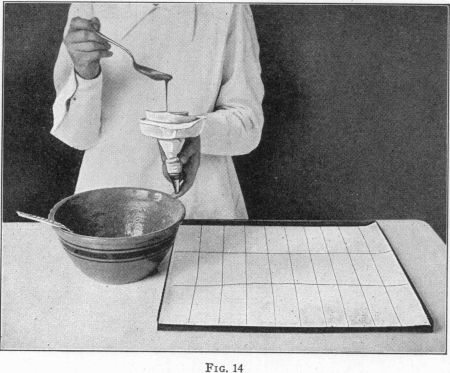
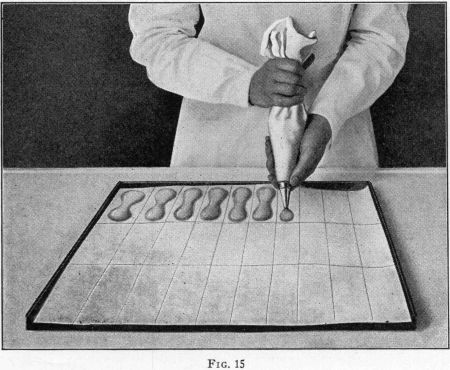
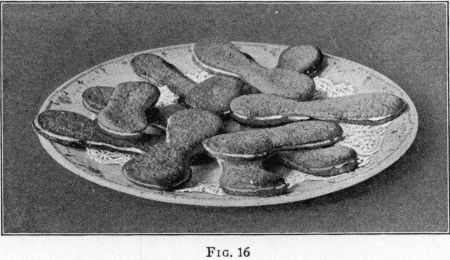
Beat the egg whites until they are stiff and dry. Add the sugar gradually and continue beating. Beat the two egg yolks until they are thick and lemon-colored and add them. Add the flavoring and fold in the flour mixed and sifted with the salt. Cover a cooky sheet with light wrapping paper that is perfectly smooth and marked into spaces 4-1/2 in. long by 1-1/2 in. wide, as shown in Fig. 14. With the aid of a spoon, as illustrated, fill the ladyfinger mixture into a pastry bag containing a plain pastry tube. Then, from the pastry tube, squeeze the cake mixture onto the marked spaces, as shown in Fig. 15, making the mass slightly narrower in the center than at the ends. When all the spaces have been filled, set the pan containing the sheet in a slow oven and bake until dry. Remove from the oven and take from the paper by slipping a sharp knife under each ladyfinger. If the ladyfingers are to be used for cake, they must be put together in pairs with the following simple filling, and they will then appear as in Fig. 16.
FILLING FOR LADYFINGERS
Juice of 1 orange
Sufficient sugar to spread
Beat the orange juice and sugar together until smooth. Place a layer of the mixture between each two ladyfingers.
LADYFINGERS No. 2
(
Sufficient for 3 Dozen Cakes
)
6 eggs
1-1/4 c. powdered sugar
1 c. flour
Juice of half a lemon
Separate the eggs and beat the whites with an egg whip until stiff. Sift the sugar and flour together several times, add a little to the eggs, and continue beating. Continue to add the sugar and flour, a little at a time, until all has been added. Beat the egg yolks until they are light and lemon-colored and then beat them into the mixture. Add the lemon juice and force the mixture through a pastry tube in the same way as described in the preceding recipe. Bake in a slow oven. When cool, put together with the orange filling.
CAKES MADE WITH YEAST
24. A few varieties of cake are made light by means of yeast instead of being leavened with eggs or chemical leavening agents. These cakes are, of course, similar to bread in many respects, but they are sweeter and richer than bread and contain eggs. For this reason they are not economical mixtures and should not be made if economy must be practiced. Because of the sugar, butter, and eggs used in them, the action of the yeast is slow; consequently, the processes involved in making these mixtures are neither short nor simple. Often, after they have been baked in a mold, the center is removed and the shells are then filled with different mixtures to make a variety of desserts.
BRIOCHE
1 c. milk
1-1/2 yeast cakes
1/2 c. sugar
2/3 c. butter
4-1/2 c. flour
3 egg yolks
3 whole eggs
1/2 tsp. lemon extract
Scald the milk, cool until lukewarm, and then add the yeast cakes. When they are thoroughly dissolved, add the sugar, the butter, which has been softened but not melted, and half of the flour. Add the egg yolks and beat with the hands. Add the eggs one at a time and when all have been beaten in thoroughly, continue to add more flour. After all of the flour and also the lemon extract have been added and the mixture is of a consistency to knead, allow it to rise for 6 hours. Punch down and place in the ice box or some other cool place overnight. In the morning, the mixture will be ready to bake in whatever shape is desirable.
The four recipes that follow show various ways in which the brioche may be used to make attractive as well as appetizing desserts.
COFFEE CAKES
Roll the brioche mixture into a long rectangular piece about 1/4 inch thick. Spread with softened butter, fold one-third of the side over the center and the opposite side on top of that, making three layers. Cut this into strips about 3/4 inch wide, cover, and let rise. When light, twist the ends of each piece in the opposite direction, coil, and bring the ends together on the top of the cake. Let rise in pans for 20 minutes, and bake in a moderate oven for about 20 minutes. Upon removing from the oven, brush with confectioner's sugar moistened with enough water to allow it to spread.
BRIOCHE BUNS
Work 1/2 cupful of raisins and 1/2 cupful of chopped nut meats into half of the brioche mixture. Shape into balls about the size of a walnut, and then place close together in a buttered pan. Brush over the top with 1 tablespoonful of sugar dissolved in 2 tablespoonfuls of milk. Bake in a moderate oven for about 25 minutes. Brush a second time with the sugar-and-milk mixture and allow the buns to remain in the oven until they are well browned.
BRIOCHE DESSERT
Fill muffin pans about 1/2 full with the brioche mixture. Allow it to rise nearly to the top, bake in a slow oven, remove when sufficiently baked, and cool. Remove the center from each mold, leaving a shell. The centers may be toasted and served separately. Put a teaspoonful or two of any desirable preserves or marmalade into the shells, fill with sweetened and flavored whipped cream, and over the top sprinkle chopped nuts. This dessert should be prepared just before serving.
BRIOCHE PUDDING
Take enough of the brioche sponge to fill a good-sized mold two-thirds full. Work into this 1/2 cupful of raisins cut into small pieces, 1/4 cupful of candied cherries, 1/2 cupful of chopped nuts, and 1/4 cupful of coconut. Place in a mold and allow it to rise until the mold is nearly full. Bake from 45 minutes to 1 hour, turn out of the mold, and allow to become cold. Cut into thick slices with a knife that has been heated in the flame, and serve with apricot or pineapple sauce.
APPLE CAKE
(
Sufficient for Three Good-Sized Cakes
)
2 c. milk
1 yeast cake
1 tsp. salt
1/2 c. sugar
3/4 c. butter
8-1/2 c. flour
3 eggs
Apples
Scald the milk and cool it to lukewarm. Add the yeast, salt, sugar, and butter, which has been softened but not melted. Add half of the flour and beat in the eggs. When all has been mixed thoroughly, add sufficient flour to make a stiff dough. Knead for a short time and place in a bowl to rise. When risen until double in bulk, roll a piece of the dough 1/2 inch thick to fit a rectangular pan. Allow this to rise until it is light. Peel apples, cut into halves and then into thick slices, and rub them with lemon so they will not discolor. When the bread mixture is light, place the apples on the top in rows. Sprinkle with sugar and cinnamon and bake in a quick oven. Serve with butter or sugar and cream.
SWEDISH TEA RING
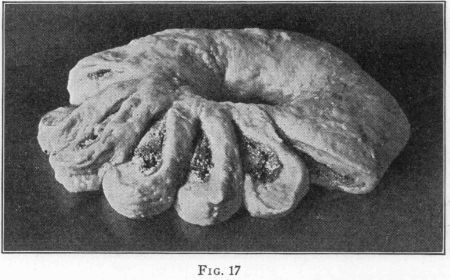
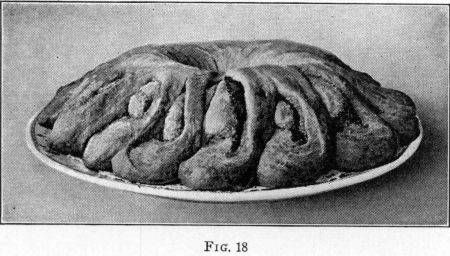
Roll a large piece of the mixture used for apple cake into a rectangular shape from 1/4 to 1/2 inch thick, brush with butter, sprinkle with sugar and cinnamon and, if desired, with raisins or chopped nuts. Roll like a jelly roll, and place the two ends together on a cooky sheet so as to form a ring. Try, if possible, to conceal the joining by fastening the ends together carefully. The best way to do this is to cut a slice from each end before joining. Then, with a scissors, cut through the edge of the ring nearly to the center and slightly at a slant, as in Fig. 17. Make the cuts about 1 inch apart and turn the cut slices over so as to show the layers of dough. Brush with milk, dredge with sugar, and bake for about 1/2 hour. When baked, this cake should appear as shown in Fig. 18.
CREAM PUFFS AND ÉCLAIRS
25. A delicious form of dessert that is usually classed with small cakes includes cream puffs and éclairs. They are made of a special kind of paste that, when baked, becomes hollow in the center, very much as popovers do. The inside is then filled with a mixture similar to a custard mixture or with sweetened and flavored whipped cream. Many persons have an idea that these mixtures are very difficult to make, but the fact is that they may be easily made if the directions for preparing them are carefully followed.
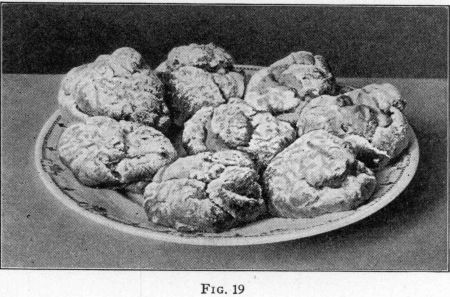
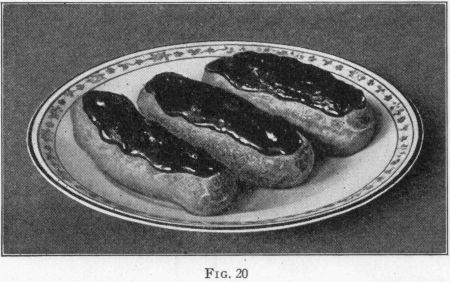
26. After the paste has been mixed, the way it is to be treated will depend on whether cream puffs or éclairs are to be made. For cream puffs, which are shown in Fig. 19, it is dropped by spoonfuls on a cooky sheet or a large pan, while in the case of éclairs, several of which are shown in Fig. 20, it is forced through a large round pastry tube so as to form long strips. The shapes are then baked in a hot oven, and during this process they puff up and become hollow in the center. If, upon attempting to fill the shells thus made, the centers are found to contain a little moist, doughy material, this may be removed. The filling may then be introduced either by cutting a slit in the side and putting it in with a spoon or by inserting the end of a pastry tube into the shell and forcing it in with a pastry bag and tube. In addition to being filled with a filling of some kind, éclairs are covered, as here shown, with an icing that usually corresponds in flavor with the filling. For instance, chocolate éclairs are filled with a chocolate filling and covered with a chocolate icing, while coffee éclairs have a coffee filling and a coffee icing.
Very small cream puffs are attractive and are often served with small cakes for an afternoon tea or a buffet luncheon. These may be made by dropping the paste with a teaspoon on a cooky sheet, baking it until done, and then filling the shells with any desired paste.
CREAM PUFFS
(
Sufficient for 1 Dozen Cream Puffs
)
1/2 c. butter
1 C. boiling water
1 c. flour
4 eggs
Boil the butter and water together until the butter is melted. Add the flour by pouring it all in at one time. Stir rapidly and cook until the mass does not stick to the sides of the pan. Continue the stirring so that it does not burn. Remove from the fire and cool, so as not to cook the eggs when they are added. Add one egg at a time and mix thoroughly with the mixture before adding another. Drop by spoonfuls on a greased cooky sheet, place close to the floor of the oven, and bake in a hot oven for about 30 minutes or until the puffs are dry and can be lifted from the sheet. Allow them to cool and then fill with whipped cream or a custard filling. Before serving, sprinkle powdered sugar over the top of each.
ÉCLAIRS
When éclairs are desired, make the paste as for cream puffs. Then through a large, round pastry tube, one having a diameter of at least 1/2 inch, force this paste in strips 3-1/2 or 4 inches long, putting the paste on a cooky sheet or some other large pan. Bake in a hot oven in the same way as cream puffs. When cool, fill with a custard mixture of any desired flavoring and cover with an icing of the same flavor.
ROYAL ÉCLAIRS
Royal éclairs are especially delicious and make a very agreeable change from the usual variety. To make these, bake éclairs in the usual shape and set aside to cool. Cut canned peaches into pieces, add sugar to them, and cook down until the sirup becomes thick. Fill each éclair with several spoonfuls of this mixture and, if desired, serve with whipped cream over the top.
CREAM FILLING FOR CREAM PUFFS
1/3 c. flour
2 c. milk
1 egg
3/4 c. sugar
1/8 tsp. salt
2 tsp. butter
1 tsp. vanilla
Moisten the flour with a little cold milk. Heat the remainder of the milk and add the moistened flour. Cook in a double boiler for 10 or 15 minutes. Beat the egg, add the sugar and salt, and pour this into the hot mixture, stirring rapidly. Cook until the egg is thickened, and then add the butter and vanilla. Remove from the fire, cool, and fill into the cream puffs.
CHOCOLATE FILLING FOR ÉCLAIRS
1 sq. chocolate
3/4 c. sugar
1 c. water
1/3 c. flour
1 c. milk
1 Tb. butter
1 tsp. vanilla
Cook the chocolate, sugar, and water over the flame until they are well blended. Mix the flour and milk and add to the hot mixture. Cook until the flour has thickened. Add the butter and vanilla. Cool and fill into the éclairs. Cover the tops with a plain chocolate icing.
COFFEE FILLING FOR ÉCLAIRS
1/3 c. ground coffee
2 c. milk
1/3 c. flour
3/4 c. sugar
1 Tb. butter
1 tsp. vanilla
Steep the coffee in the milk for 15 minutes. Strain and add the flour and sugar, which have been thoroughly mixed. Cook until the mixture is thickened, stirring constantly to prevent lumps from forming. Add the butter and vanilla, cool, and fill into the éclairs. Cover the top of the éclairs with icing made by thickening a little strong coffee with pulverized sugar.
CARAMEL FILLING FOR ÉCLAIRS
1 c. sugar
1-1/4 c. boiling water
1/3 c. flour
1 c. milk
1 Tb. butter
1 tsp. vanilla
Caramelize 1/2 cupful of the sugar, add the water, and cook until the caramel has dissolved. Mix the remainder of the sugar with the flour and moisten with the milk. Add this to the caramel and cook until the flour thickens completely, stirring constantly to prevent the formation of lumps. Add the butter and vanilla. Cool and fill into the éclairs. Cover the tops with a plain caramel icing.
DOUGHNUTS AND CRULLERS
27. NATURE OF DOUGHNUTS AND CRULLERS.--Some kinds of doughnuts and crullers are made of bread dough, and for this reason really belong to breakfast breads instead of to cakes. However, most of the recipes for these two foods include sugar, shortening, milk, eggs, and leavening, making doughnuts and crullers so similar to cake in their composition that they are usually regarded as cake mixtures. The shortening, which is in smaller amounts than is required for most cakes, is supplied largely by the method of preparation peculiar to these cakes; that is, by their being fried in deep fat. Consequently, some of the same conditions apply in their preparation as in the making of other foods that are cooked in this way. As has already been learned, such foods must either contain a sufficient amount of protein material, such as egg, for instance, or be coated with enough material of this kind to prevent the absorption of fat. In the case of doughnuts, this material is supplied as an ingredient.
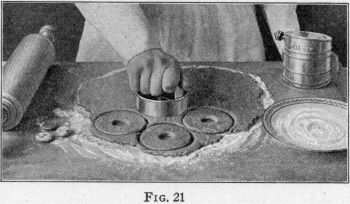
28. SHAPING DOUGHNUTS AND CRULLERS.--The ingredients used in the making of doughnuts are combined in much the same way as those used in other cake mixtures. A point to remember is that the mixture, like that for cookies, must be stiff enough to handle and roll out, but care should be taken not to use too much flour, for then the doughnuts are likely to be tough. Divide the dough into amounts of a convenient size, place one of these on a well-floured board, and roll out with a rolling pin until about 1/4 inch thick. Then, with a doughnut cutter, as shown in Fig. 21, cut as many doughnuts as possible from the rolled dough. If a regular doughnut cutter is not in supply, a round cookie cutter may be used and then a thimble or some other small round cutter applied to remove the center of the pieces thus cut. As here shown, a plate or some other small dish containing flour should be kept handy and the cutter dipped into this occasionally during the cutting to prevent it from sticking to the dough and marring the appearance of the doughnuts. Collect the centers and scraps that remain after the doughnuts have been cut from a piece and set these aside until all the fresh dough has been used. These may then be rolled out again and cut into doughnuts. If desired, however, the centers may be fried.
29. While doughnuts are usually round and have a hole in the center, they may, for variety, be made in other shapes. For instance, after the dough is rolled out, it is sometimes cut with a sharp knife Into rectangular pieces about 4 inches long and 2-1/2 inches wide and each one of these pieces then cut lengthwise into three strips attached at one end. When cut in this way, the strips are braided and then pinched together at the loose end. Or, the pieces may be made 4 inches long and 2 inches wide, cut into two strips attached at one end, and the strips then twisted around each other and pinched together at the loose end.
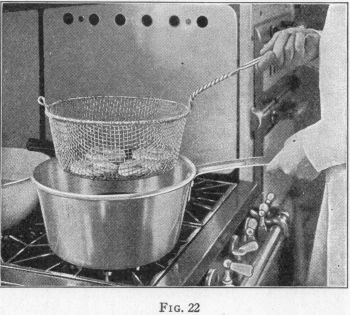
30. FRYING DOUGHNUTS AND CRULLERS.--After the doughnuts have been cut in the desired shape, the next step is to fry them. The equipment required for this process consists of a pan or a kettle into which the fat is put, a long-handled frying basket into which the doughnuts are placed, and a receptacle containing hot water into which the doughnuts can be dipped after being fried. Put into the kettle a sufficient amount of fat, which may be any vegetable fat or oil, to cover the doughnuts well, allow it to become hot enough to brown an inch cube of bread in 40 seconds, place several doughnuts in the bottom of the basket, as shown in Fig. 22, and then lower the basket into the hot fat, when it will be found that the doughnuts will rise quickly to the top of the fat. Allow them to brown on one side and then turn them over with a fork and let them brown on the other side. Be careful not to let the fat become too hot during the frying, or the doughnuts will become darker than is desirable before the inside is cooked. If it is found that the fat is getting too hot, turn off some of the heat or remove the deep-fat kettle from the excessive heat.
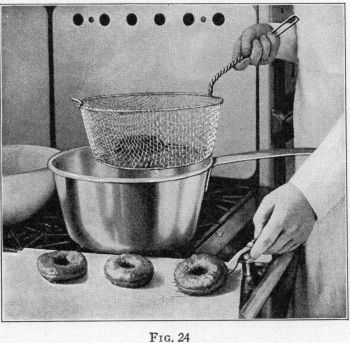
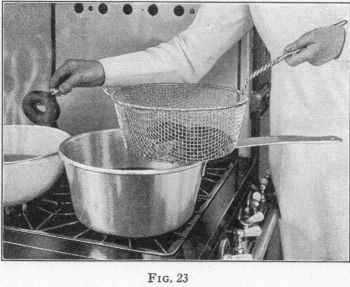
31. As soon as the doughnuts have become an even brown on both sides and have fried through thoroughly, lift the basket out of the fat and rest it on the edge of the frying kettle. Then, as shown in Fig. 23, remove the doughnuts one at a time from the basket with a fork and dip quickly into the pan of boiling water and remove again at once. Dipping the doughnuts into boiling water removes any excessive fat that may remain on the surface. Upon taking them from the water, place them, as in Fig. 24, on a piece of paper that will absorb as much of the remaining fat as possible. When these precautions are taken, the doughnuts will be found to be less greasy and not so likely to disagree with the persons who eat them. After the surface has become dried, the doughnuts may be improved by sprinkling them with pulverized or granulated sugar.
32. If a large number of doughnuts are made and the hot-water method of drying them is adopted, it will be found that considerable fat will remain in the water. It will therefore pay to allow the fat to become cool and remove it from the surface of the water. Fat in which doughnuts and crullers are fried, after being poured from the dregs that collect in the bottom and reheated, may be clarified by adding several slices of raw potato to it and allowing these to become brown in it. This treatment will remove any foreign taste that the fat may have and make it possible to use the fat again for frying purposes. Fat in which croquettes have been fried may be treated in the same way and used the second time.
33. RECIPES FOR DOUGHNUTS.--A variety of doughnuts that are made light by means of chemical leavening can be prepared, as the following recipes indicate. Sometimes yeast doughnuts are preferred, so a recipe for doughnuts of this kind is also given. If the directions previously given are carefully applied in carrying out any of these recipes, excellent results may be expected. Some persons are prejudiced against the use of doughnuts, claiming that they are indigestible. While this may be true of doughnuts improperly made, those made of good materials and by correct methods are always a favorite and justly so.
DOUGHNUTS
(
Sufficient for 2 Dozen Doughnuts
)
3 Tb. butter
1 c. sugar
3 eggs
1 c. milk
4-1/2 c. flour
6 tsp. baking powder
1 tsp. salt
1/4 tsp. nutmeg
1/4 tsp. cinnamon
Cream the butter, add the sugar and then the eggs, and beat thoroughly. Pour in the milk and sift the dry ingredients into this mixture. Divide into amounts that can be handled conveniently, roll out, cut, and fry in deep fat.
POTATO-AND-BARLEY DOUGHNUTS
(
Sufficient for 2 Dozen Doughnuts
)
2 eggs
1/2 c. sugar
1/2 c. mashed potatoes
1 Tb. fat
1/3 c. sour milk
1/2 c. barley flour
1-1/2 c. wheat flour
1/2 tsp. salt
1/2 tsp. mace
1/4 tsp. soda
2 tsp. baking powder
Beat the eggs and add the sugar and mashed potatoes. If solid shortening is used, melt it and add to the other ingredients. Pour in the sour milk, mix and sift the barley and wheat flour, salt, mace, soda, and baking powder, and add these to the mixture. Turn the dough out on a board in a quantity that can be handled at one time and knead for a little before rolling it for cutting. Cut and fry in deep fat.
SOUR-MILK DOUGHNUTS
(
Sufficient for 3 Dozen Doughnuts
)
4 c. flour
1-1/2 tsp. salt
1/2 tsp. soda
4 tsp. baking powder
1/2 tsp. grated nutmeg
1 c. sugar
1 Tb. butter
1 egg
1-1/4 c. sour milk
Mix and sift the dry ingredients and chop in the butter. Beat the egg, add the milk, and stir these into the dry ingredients. After mixing thoroughly, roll about 1/4 inch thick on a board, cut in the desired shape, and fry in deep fat.
DROP DOUGHNUTS
(
Sufficient for 2 Dozen Doughnuts
)
2 c. flour
3 tsp. baking powder
1/2 tsp. salt
1/4 tsp. nutmeg
1/4 tsp. cinnamon
1/2 c. sugar
1 egg
1/2 c. milk
1 Tb. melted fat
Mix and sift the dry ingredients. Beat the egg, add the milk to it, and pour the liquid into the dry ingredients. Add the melted fat. Drop by teaspoonfuls into hot fat and fry the same as for doughnuts.
YEAST DOUGHNUTS
(
Sufficient for 3 Dozen Doughnuts
)
1 c. milk
1 yeast cake
5 c. flour
2 eggs
1/2 c. sugar
1/4 c. melted butter
1/2 tsp. salt
1/2 tsp. mace
Scald the milk and cool to lukewarm. Dissolve the yeast cake and add it to the milk and a sufficient amount of the flour to make a sponge. Allow this to rise until double in bulk. Then add the eggs, sugar, melted butter, salt, and mace. Beat thoroughly and add enough flour to make a dough. Knead this until it is smooth and elastic and let it rise until double in bulk. Roll out on a board into a sheet about 3/4 inch thick. Cut into long strips about 3/4 inch wide, twist, stretch, and shape like a figure 8. Let these stand on the board or in a pan until they are light and then fry in deep fat.
PUDDINGS AND PUDDING SAUCES
NATURE OF PUDDINGS
34. Many kinds of puddings are used for desserts. Some of them closely resemble cake mixtures, while others are similar to custards, but are thickened with a cooked or a raw starchy material. Formerly, puddings were always boiled in a bag, but now desserts of this kind are prepared by boiling, steaming, or baking. To improve the flavor of puddings, sauces of a contrasting flavor are usually served with them.
35. Puddings are often considered to be rather indigestible foods and in many cases this is true. For this reason, it is not wise to include them to any great extent in the diet of children. Because of the ingredients used in them, they are a heavy food and are usually high in food value. Consequently, some thought should be given to their selection so that they may be suitable for the rest of the meal in which they are served. It seems to be the custom to serve a rich dessert with a heavy meal, but, as is well known, it is less proper with such a meal than with a light meal. A little attention given to this matter will enable the housewife to prepare menus that will provide the family with a properly balanced meal.
36. The time of day and the season of the year for the serving of puddings are also matters that should receive consideration. It is much better to serve desserts of this kind with a noon meal than with an evening meal. Then, too, warm puddings with sauce will be found much more appetizing in the cool season of the year than in warm weather. On the other hand, cool desserts or fruits served as desserts are very much more acceptable in warm weather than during the cold seasons.
PUDDING SAUCES
37. The sauces served with puddings deserve just as much attention as to selection and preparation as the puddings themselves. For instance, a sour sauce that is not rich, such as lemon sauce, should be served with a rich, sweet pudding, while a rich, hard sauce or perhaps a chocolate sauce is the proper kind to serve with a bland, flavorless pudding.
So that the housewife may be perfectly familiar with a variety of sauces and thus know the nature of the sauces mentioned in connection with the puddings themselves, a number of recipes for pudding sauces are given. Some of these are intended to be served hot and others cold, while a few may be served either hot or cold, as preferred. Selection may be made from these for any pudding that is accompanied by a sauce when served. Care should be taken to have the sauce appropriate for the pudding and to follow explicitly the directions given for making it.
LEMON SAUCE NO. 1
1/2 c. sugar
1 Tb. corn starch
Few grains of salt
1 c. boiling water
2 Tb. butter
2 Tb. lemon juice
Mix the sugar, corn starch, and salt, and add the water gradually, stirring constantly. Boil 5 minutes, remove from the fire, add the butter and lemon juice, and serve.
LEMON SAUCE NO. 2
1/3 c.
1 c. sugar
3 egg yolks
1/3 c. boiling water
3 Tb. lemon juice
Few gratings of lemon rind
Cream the butter, add the sugar gradually, and stir in the yolks of the eggs slightly beaten. Then add the water and cook over boiling water until the mixture thickens. Add the lemon juice and rind and serve at once.
VANILLA SAUCE
1/3 c. butter
1 c. sugar
3 egg yolks
1/3 c. boiling water
Few gratings of nutmeg
1 tsp. vanilla
Cream the butter, add the sugar gradually, and stir in the egg yolks beaten slightly. Add the water and cook over boiling water until the mixture thickens. Add the nutmeg and vanilla and serve at once.
HARD SAUCE
1/3 c. butter
1 c. powdered sugar
1/3 tsp. lemon extract
2/3 tsp. vanilla
Cream the butter, add the sugar gradually, and then add the flavoring. Beat until the sauce is light and creamy.
STERLING SAUCE
1/4 c. butter
1 c. brown sugar
4 Tb. cream or milk
1 tsp. vanilla
Cream the butter and add the sugar gradually. Add the milk and flavoring, drop by drop, to prevent separation. Beat until fluffy and smooth. Chill and serve.
CHOCOLATE SAUCE
1 c. milk
1/2 sq. chocolate
1/2 c. sugar
2 Tb. flour
1 Tb. butter
1/2 tsp. vanilla
Heat the milk and in it melt the chocolate. Mix the sugar and flour and stir into the mixture rapidly to prevent the formation of lumps. Cook until the sauce thickens, add the butter, and cook for a few minutes longer. Add the vanilla and serve either hot or cold, as desired.
FRUIT SAUCE
1 c. fruit juice
1/4 c. sugar
1-1/2 Tb. corn starch
2 Tb. lemon juice
Heat the fruit juice, which may be any left-over fruit juice. Mix the sugar and corn starch, add to the hot fruit juice, and cook until the corn starch thickens, stirring constantly to prevent the formation of lumps. Add the lemon juice. Remove from the heat and, if the sauce is desired to be more acid, add lemon juice to suit the taste.
APRICOT SAUCE
3/4 c. apricot pulp
3/4 c. whipping cream
Pulverized sugar
Prepare apricot pulp by forcing cooked apricots through a sieve. Whip the cream and fold the apricot pulp into it. Add pulverized sugar to suit the taste.
PINEAPPLE SAUCE
Half c. sugar
1-1/2 c. water
1 c. grated pineapple
1 Tb. corn starch
Add the sugar to the water and bring to the boiling point. Add the pineapple and cook until it is tender. If canned pineapple is used, omit 1/2 cupful of the water. Moisten the corn starch with a little water and add it. Cook until it thickens, stirring to prevent lumps.
ORANGE SAUCE
1/4 c. orange juice
1 Tb. lemon juice
Powdered sugar
Into the fruit juices, beat the powdered sugar until the sauce is as sweet as desired.
MARASCHINO SAUCE
1/4 c. maraschino juice
1 Tb. lemon juice
6 cherries, chopped
Powdered sugar
Mix the fruit juices and chopped cherries, add the sugar, beat well, and serve.
CUSTARD SAUCE
2 c. milk
1 Tb. corn starch
1/3 c. sugar
1/2 tsp. vanilla
1/2 tsp. lemon extract
Pinch of salt
Heat the milk in a double boiler. Mix the corn starch and sugar and add to the milk, stirring so as to prevent the formation of lumps. Continue stirring until the corn starch has thickened and then cook for about 15 minutes longer. Beat the egg, add it to the mixture, and cook for a few minutes longer. Add the vanilla, lemon, and salt. Serve hot or cold.
COCONUT SAUCE
2 c. milk
1/2 c. shredded coconut
1/3 c. sugar
1-1/2 Tb. corn starch
Pinch of salt
1 egg white
1/2 tsp. vanilla
Heat the milk in a double boiler with the coconut. Mix the sugar and corn starch and add to the hot milk and coconut. Stir until the corn starch has thickened and cook for 15 minutes. Add the salt to the egg white and beat until it is stiff. Pour the hot mixture over the egg white and continue beating until thoroughly blended. Add the vanilla and serve either hot or cold.
JELLY SAUCE
2 tsp. corn starch or arrowroot
1 c. boiling water
1/2 c. jelly or jam
Juice of 1/2 lemon
Cook the corn starch or arrowroot diluted with cold water, in the boiling water for 5 minutes. Add the jelly or jam, beaten smooth, and let simmer for 3 or 4 minutes. Add sugar, if needed, and the lemon juice. Strain and serve.
PUDDINGS
PREPARATION OF PUDDINGS
38. As has already been learned, puddings are cooked by being boiled, steamed, or baked. No different utensils from those used in the making of custards and cakes need be provided for the making of puddings except, perhaps, a steamer. A utensil of this kind, which is required for steamed puddings, consists of a large pan, which sets directly over the flame and into which the water is poured; a second pan, which fits closely into the first one and into which the pudding is put; and a spout, into which the water may be poured. The steamer must be very closely covered in order that all the steam, which does the cooking, may be retained. An apparatus that will answer the purpose of a steamer may be improvised, however, if there are in the supply of household utensils a pan, a colander, and a cover that will fit tight enough to retain the steam; or, instead of putting the pudding directly in the second pan of the steamer, it may be put into individual molds or a pan that will hold a sufficient quantity to serve just the desired number of persons and these then set in the second pan to cook.
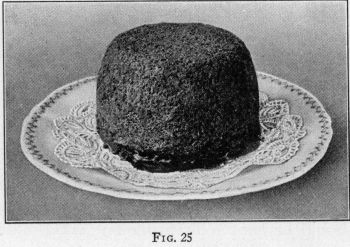
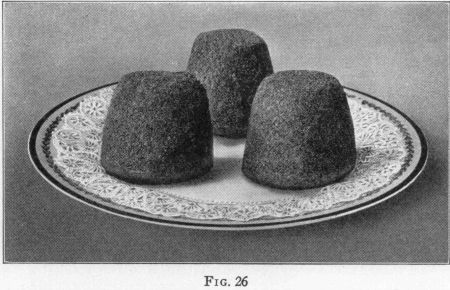
39. Steamed puddings ready to serve are shown in Figs. 25 and 26. The pudding in Fig. 25 shows how a pudding that has been steamed in one large mold will appear. The mold used may be just large enough for the number of persons to be served or it may be larger and what remains used for another meal. Fig. 26 shows a pudding that has been steamed in individual molds. Whichever one of these two methods of preparing steamed puddings is preferred may be adopted.
When puddings are cooked by steaming, it should be remembered that the steaming process must be continuous. Therefore, if water must be added during the cooking, boiling water should be used so as not to lower the temperature and stop the formation of steam. After being steamed sufficiently, puddings of this kind are often placed in the oven for a short time in order to dry the surface.
40. The baking of puddings is so similar to the baking of cakes and custards that the same directions apply. A few points, however, should be kept well in mind if good puddings would be the result. The utensil in which a pudding that is to be baked is put may be of any desired shape, but it should always be greased. This also holds true in the case of puddings that are to be steamed. Puddings that contain an egg-and-milk mixture, as, for instance, bread pudding, must necessarily, as with custards, be baked at a temperature low enough to prevent them from curding.
RECIPES FOR PUDDINGS
41. In the preparation of many puddings here considered, left-over materials, such as bread, rolls, stale cake, cookies, etc., may be utilized to advantage. Consequently, when the housewife is making desserts, she should endeavor to make good use of all such things in case they cannot be used by themselves.
42. INDIAN PUDDING.--As corn meal is the chief ingredient in the pudding given in the accompanying recipe, it is called Indian pudding, corn meal being a product of Indian corn. For persons who like food containing corn meal, this pudding will prove satisfactory. It has the advantage over other puddings in that it is inexpensive.
INDIAN PUDDING
(
Sufficient to Serve Eight
)
1/3 c. corn meal
5 c. milk
1/2 c. molasses
1/2 tsp. salt
1 tsp. cinnamon
Mix the corn meal with some of the milk, scald the remainder in a double boiler, and add the moistened corn meal to it. Pour in the molasses, salt, and cinnamon, cook for 15 or 20 minutes in a double boiler, and then pour into a buttered baking dish. Bake in a very slow oven for about 2 hours. Serve with cream or custard sauce.
43. BROWN BETTY.--A baked pudding that always meets with favor among both old and young is Brown Betty. The flavor imparted by the apples and other ingredients to the bread crumbs is delightful, especially when the pudding is prepared according to the accompanying directions.
BROWN BETTY
(
Sufficient to Serve Eight
)
1 qt. stale bread crumbs
1 qt. sliced apples
1/2 c. brown sugar
1/2 c. sugar
1/4 tsp. nutmeg
1 tsp. cinnamon
1/4 c. butter
1/2 to 1 c. water
Juice and rind of 1/2 lemon
Butter a baking dish. Make coarse crumbs of the stale bread and place a layer on the bottom of the baking dish. Place on top of this a layer of half the sliced apples and sprinkle with 1/2 of the sugar, to which have been added the nutmeg and cinnamon. Dot with butter, sprinkle with another layer of crumbs, add the remaining apples, sugar, and spices, and dot again with butter. Cover with the remaining crumbs and dot this with the remaining butter. Pour over this the water, lemon juice, and the grated lemon rind. Bake in a moderate oven for about 45 minutes, covering the dish for the first half of the time and removing the cover for the latter part of the baking. Serve with cream, lemon sauce, or hard sauce. The quantity of water necessary depends on the dryness of the crumbs and the juiciness of the apples.
44. BREAD PUDDING.--For utilizing bits of bread that might otherwise be wasted, there is no better plan than to make a bread pudding. This dessert may be used with any dinner or luncheon, as jams, jellies, and practically all kinds of sauce may be served with it to impart a suitable flavor.
BREAD PUDDING
(
Sufficient to Serve Eight
)
1 qt. milk
2 c. stale bread crumbs
2 eggs
1/2 c. sugar
1 tsp. vanilla
Heat the milk and pour it over the bread crumbs. Allow them to soak until they are soft. Beat the eggs, add the sugar and vanilla to them, and stir this into the mixture of crumbs and milk. Mix thoroughly, pour into a buttered baking dish, and bake in a moderate oven for about 45 minutes. If desired, jelly or jam may be served with the bread pudding or any desirable sauce, such as lemon, vanilla, or custard, may be used and the pudding may be served either hot or cold.
45. MAIZE PUDDING.--A pudding that has both corn starch and corn meal as its basis provides variety. This pudding, called maize pudding, is prepared in a double boiler and then turned into a mold to cool. Either raisins or dates may be added to it to increase its palatability.
MAIZE PUDDING
(
Sufficient to Serve Eight
)
3-1/2 c. milk
2 Tb. corn starch
1/2 c. white corn meal
1/2 tsp. salt
1/3 c. sugar
1/2 tsp. cinnamon
3/4 c. raisins or dates
Scald the milk in a double boiler, mix the corn starch, corn meal, salt, sugar, and cinnamon, and add this to the hot milk, stirring rapidly to prevent the formation of lumps. Continue to stir and cook directly over the fire until the mixture thickens. Then return to the double boiler and cook for about 2 hours. Fifteen minutes before removing from the fire, add the raisins or chopped dates, turn into a mold, and serve either hot or cold with custard sauce.
46. PIERROT PUDDING.--A steamed pudding made of simple ingredients is often desired for serving with an elaborate meal. In such a case, Pierrot pudding will answer very well.
PIERROT PUDDING
(
Sufficient to Serve Six
)
1/2 c. butter
1 c. sugar
3/4 c. milk
2-1/2 c. flour
5 tsp. baking powder
2 egg whites
1 tsp. vanilla
Cream the butter and add the sugar gradually. Then add the milk alternately with the flour, to which has been added the baking powder. Beat the whites of the eggs until they are stiff and fold them into the mixture. Add the vanilla. Butter baking-powder cans or other molds, fill them half full with the mixture, adjust the covers, which should also be buttered, and place in a kettle of boiling water. Raise them from the bottom of the kettle by means of a rack, have the water come half way up around the molds, and cover closely. If small molds are used, steam them only 1 hour. If a large mold is used, steam from 1-1/2 to 2 hours, never allowing the water to get below the boiling point. Remove from the molds and serve with hot chocolate sauce.
47. STEAMED GINGER PUDDING.--A steamed pudding in which the flavor of ginger predominates is given in the accompanying recipe. This kind of pudding is very popular among persons who like such flavor.
STEAMED GINGER PUDDING
(
Sufficient to Serve Eight
)
1/2 c. shortening
1/2 c. sugar
2 eggs
2-1/2 c. flour
4 tsp. baking powder
1/4 tsp. salt
1 tsp. ginger
1 c. milk
Cream the shortening and add the sugar and the beaten eggs. Sift the dry ingredients with the flour and add alternately with the milk. Turn into a buttered mold and steam for about 2 hours. Remove from the mold and serve with sweetened whipped cream or any desired sauce.
48. RAISIN PUFF.--Raisins always increase the food value of a meal, and they are especially good when combined with the ingredients required for the dessert known as raisin puff. This steamed pudding is rather rich and should not, of course, be served with a meal in which the other foods are rich.
RAISIN PUFF
(
Sufficient to Serve Eight
)
1/2 c. shortening
1/2 c. sugar
1 egg
2-1/4 c. flour
4 tsp. baking powder
1 tsp. cinnamon
1/4 tsp. salt
1 c. milk
1 c. raisins
Cream the shortening and add the sugar gradually and the beaten egg. Sift the dry ingredients with the flour and add alternately with the milk. Chop the raisins and fold them into the mixture. Turn into a buttered mold, cover, and steam for 1-1/2 or 2 hours. Remove from the mold and serve hot with whipped cream or any desired sauce.
49. SUET-FRUIT PUDDING.--Steamed puddings in which suet and fruit form two of the ingredients are excellent cold-weather desserts. Such puddings are usually made around the holidays, and under proper conditions will keep for a long time. The accompanying recipe gives directions for making an excellent pudding of this kind.
SUET-FRUIT PUDDING
(
Sufficient to Serve Eight
)
3/4 c. suet
2-1/2 stale bread crumbs
2 egg yolks
1/4 c. milk
1 c. brown sugar
Grated rind of 1 lemon
1 Tb. lemon juice
1-1/2 c. raisins
1/2 c. molasses
1/2 tsp. salt
1 tsp. cinnamon
1/2 tsp. grated nutmeg
1/4 tsp. cloves
1/2 tsp. soda
1/2 c. flour
2 egg whites
Force the suet through a food chopper or chop very fine. Then work it with the hands until it is creamy and to it add the bread crumbs. Beat the egg yolks until they are light and add them to the suet and bread crumbs. Add the milk. Add the sugar, grated lemon rind, lemon juice, the raisins, cut into pieces, the molasses, and milk. Sift together the salt, spices, soda, and flour, and sift these into the mixture. Mix thoroughly, fold in the whites of the eggs beaten until they are stiff, turn into a buttered mold, adjust the cover, and steam for about 3 hours. Serve with any desired sauce.
50. CHRISTMAS PUDDING.--A pudding much used during the holiday season is Christmas pudding. The ingredients for this dessert are similar to those for suet-fruit pudding. In fact, both may be used for the same purpose. Christmas pudding is especially good when served with hard sauce, although other sauce may be used with it.
CHRISTMAS PUDDING
(
Sufficient to Serve Twelve
)
2-1/2 c. stale bread crumbs
1/2 c. milk
1 c. beef suet
1/2 c. sugar
1/2 c. molasses
2 eggs
1 c. chopped raisins
1/2 c. chopped citron
1/2 c. chopped nuts
1 c. flour
1/2 tsp. soda
1 tsp. baking powder
1 tsp. salt
1/3 c. fruit juice
Soak the bread crumbs in the milk. Work the suet with the hands until it is creamy, and to it add the sugar, molasses, and well-beaten eggs. Mix with the milk and bread crumbs, and add the fruit and nuts. Mix the dry ingredients and sift them into the mixture. Add the fruit juice, turn into a buttered mold, and steam for 3 hours. Serve hot with hard sauce or any other desired sauce.
51. POCONO PUDDING.--Directions for still another steamed pudding in which suet is used are given in the accompanying recipe for Pocono pudding. This dessert does not require so many ingredients as suet-fruit or Christmas pudding, and in many cases will answer the same purpose.
POCONO PUDDING
(
Sufficient to Serve Eight
)
3/4 c. suet
2 c. apples
2 c. stale bread crumbs
3 eggs
3/4 c. brown sugar
1/2 c. milk
1 tsp. salt
Rind and juice of 1 lemon
1/2 c. raisins
Put the suet, apples, peeled and cored, and the bread crumbs through the food chopper. Beat the yolks of the eggs and add these with the sugar, milk, salt, and grated rind and juice of the lemon. Chop the raisins and add to the mixture. Beat the egg whites and fold these into the mixture. Pour the mixture into buttered molds and steam for 3 to 4 hours. Serve with any desired sauce.
52. STEAMED FIG PUDDING.--A steamed pudding made according to the recipe here given never fails to please. As the name, steamed fig pudding, indicates, it is supposed to have chopped figs added to it, although raisins will answer if figs cannot be obtained.
STEAMED FIG PUDDING
(
Sufficient to Serve Twelve
)
1/2 c. butter
1/4 c. sugar
1 c. molasses
1 c. milk
2-1/2 c. flour
1/2 tsp. cinnamon
1/4 tsp. nutmeg
1/2 tsp. soda
3 tsp. baking powder
1/2 c. chopped figs or raisins
Cream the butter and add the sugar, molasses, and milk. Mix and sift the dry ingredients and stir these into the mixture. Fold in the chopped figs or raisins and steam in buttered molds for 2 to 3 hours, depending on the size of the molds. Serve hot with any desired sauce.
53. FRESH FRUIT PUDDING.--During berry or cherry season fresh-fruit pudding is an excellent one to make. This pudding is prepared in much the same way as a cake mixture, is combined with the fruit selected, and is then either steamed or baked.
FRESH-FRUIT PUDDING
(
Sufficient to Serve Six
)
1/4 c. butter
1/4 c. sugar
2 c. flour
1/4 tsp. salt
3 tsp. baking powder
1-1/4 c. milk
2 egg whites
1 c. berries or stoned cherries
Cream the butter and add the sugar. Sift together the dry ingredients and add these alternately with the milk. Beat the egg whites and fold these in. Place a layer of dough in the bottom of a buttered baking dish, put a layer of fruit on top of this, add dough next and then fruit, and have a final layer of dough on top. Cover tight and steam for 1-1/2 or 2 hours or bake without the cover in a moderate oven for about 45 minutes. Serve with a fruit or a hard sauce.
54. COCONUT PUFF.--A light pudding to which shredded coconut is added to give flavor is a satisfactory dessert for a heavy meal. As it is baked in muffin pans, it may be served in a dainty manner.
COCONUT PUFF
(
Sufficient to Serve Eight
)
1/2 c. butter
1 c. sugar
2 eggs
2 c. flour
1/2 tsp. soda
2 tsp. baking powder
1 c. sour milk
1/2 c. shredded coconut
Cream the butter and add the sugar. Beat the yolks of the eggs and add them. Sift the dry ingredients with the flour and add alternately with the milk. Fold in the coconut. Beat the egg whites until stiff and fold them in. Bake in buttered muffin pans in a quick oven for 20 minutes. Serve with coconut or any desired sauce.
55. COTTAGE PUDDING.--When a simple baked pudding is desired, the housewife almost instinctively turns to cottage pudding. This pudding has been a favorite in the household for years and may be eaten by young or old. It is not very rich, and so should be served with an appetizing sauce.
COTTAGE PUDDING
(
Sufficient to Serve Eight
)
1/4 c. butter
1/2 c. sugar
1 egg, well beaten
1 1/2 c. flour
3 tsp. baking powder
1/2 c. milk
1 tsp. vanilla
Cream the butter, add the sugar, and beat the egg and add it. Sift the flour and baking powder together and add alternately with the milk. Add the vanilla. Bake in a loaf-cake pan and serve hot with lemon, fruit, or chocolate sauce.
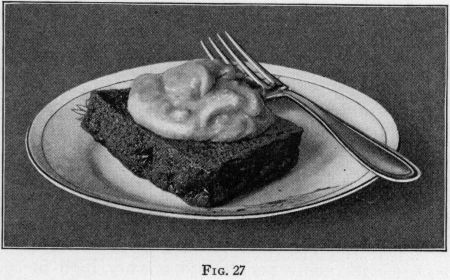
56. CHOCOLATE BREAD PUDDING.--To the majority of persons the flavor of chocolate is always pleasing. In chocolate bread pudding, this flavor is well blended with the ingredients. This pudding, when baked, may be cut into slices, as shown in Fig. 27, and then daintily served with either hard or custard sauce.
CHOCOLATE BREAD PUDDING
(
Sufficient to Serve Eight
)
2 c. stale bread crumbs
4 c. milk
1 sq. unsweetened chocolate
1/2 c. sugar
2 eggs
1/4 tsp. salt
1 tsp. vanilla
Soak the bread crumbs in 3 cupfuls of the milk. Melt the chocolate in a saucepan and add the sugar and the remaining cup of milk. Cook until the mixture is smooth and add this to the bread and milk. Beat the eggs and add them. Add the salt and vanilla. Pour into a buttered baking dish and bake for about 45 minutes in a moderate oven. Cut into slices and serve with hard or custard sauce.
57. CHOCOLATE PUDDING.--Baked chocolate pudding provides another way in which to serve a dessert in which chocolate flavor predominates. This pudding, because of its food value and the pleasing way in which it may be served, is sure to answer for any meal in which a pudding dessert is desired.
CHOCOLATE PUDDING
(
Sufficient to Serve Eight
)
1/4 c. butter
3/4 c. sugar
2 eggs
1/2 c. milk
1-1/2 c. flour
3 tsp. baking powder
1/4 tsp. soda
1-1/4 sq. unsweetened chocolate
1-1/2 tsp. vanilla
Cream the butter, add the sugar, and beat the yolks of the eggs and add them. Add the milk alternately with the flour, which has been mixed and sifted with the baking powder and soda. Melt the chocolate in a saucepan and add. Beat the whites of the eggs until stiff and fold them into the mixture. Flavor with the vanilla. Bake in a pan that will leave a space in the center. It will require about 45 minutes to 1 hour for the baking. Remove from the pan, fill the center with whipped cream, and serve with chocolate sauce.
58. BOSTON CREAM PIE.--Boston cream pie is a dessert that can be made up with some of the recipes already given. It is a favorite dessert with many people and is very high in food value.
To make Boston cream pie, first bake two layers, each about 1 inch thick, in round pans, using the plain-cake or cottage-pudding recipe. Then, between these layers, put a filling about 1/2 inch thick. This filling should preferably be the one used for cream puffs, although any similar filling stiff enough to stand up well may be used instead. Cover the top layer with 1/2 to 1 inch of slightly sweetened and flavored whipped cream. The cake should not be put together until both the layers and the filling have cooled.
EXAMINATION QUESTIONS
(1) In what general way does the thickness of the dough mixture for large cakes differ from that for small cakes other than cup cakes?
(2) (a) In baking small cakes, how does the oven temperature required compare with that required for large cakes? (b) How does the length of time required for baking large and small cakes differ?
(3) If the time for baking small cakes is divided into halves, what should occur in the second half?
(4) Where should the pans for the baking of small cakes be placed in the oven?
(5) Describe an original way of decorating cup cakes.
(6) Describe two classes of cookies.
(7) What precaution must be taken with regard to the flour used in the mixing of cakes?
(8) How thick should the dough be rolled for: (a) cookies? (b) ginger snaps?
(9) Describe the baking of cookies.
(10) Describe the frying of doughnuts and crullers.
(11) Describe a method of removing the excess fat from the surface of doughnuts after they are fried.
(12) By what methods may puddings be cooked?
(13) With what kind of meal and during what kind of weather should heavy, rich pudding be served?
(J4) Of what value are pudding sauces?
(15) (a) Describe the method of steaming pudding. (b) How may the surface of steamed puddings be made dry?