Volume 3 — FISH AND SHELL FISH
Reading edition
FISH
FISH IN THE DIET
1. FISH provides another class of high-protein or tissue-building food. As this term is generally understood, it includes both vertebrate fish--that is, fish having a backbone, such as salmon, cod, shad, etc.--and many other water animals, such as lobsters, crabs, shrimp, oysters, and clams. A distinction, however, is generally made between these two groups, those having bones being regarded properly as fish and those partly or entirely encased in shells, as shell fish. It is according to this distinction that this class of foods is considered in this Section. Because all the varieties of both fish and shell fish are in many respects similar, the term sea food is often applied to them, but, as a rule, this term is restricted to designate salt-water products as distinguished from fresh-water fish.
2. Fish can usually be purchased at a lower price than meat, and for this reason possesses an economic advantage over it. Besides the price, the substitution of fish for meat makes for economy in a number of ways to which consideration is not usually given. These will become clearly evident when it is remembered that nearly all land animals that furnish meat live on many agricultural products that might be used for human food. Then, too, other foods fed to animals, although not actually human foods, require in their raising the use of soil that might otherwise be utilized for the raising of food for human beings. This is not true in the case of fish. They consume the vegetation that grows in lakes, streams, and the ocean, as well as various kinds of insects, small fish, etc., which cannot be used as human food and which do not require the use of the soil. In addition, much of the food that animals, which are warm-blooded, take into their bodies is required to maintain a constant temperature above that of their surroundings, so that not all of what they eat is used in building up the tissues of their bodies. With fish, however, it is different. As they are cold-blooded and actually receive heat from their surroundings, they do not require food for bodily warmth. Practically all that they take into the body is built up into a supply of flesh that may be used as food for human beings.
3. With fish, as with other foods, some varieties are sought more than others, the popularity of certain kinds depending on the individual taste or the preference of the people in a particular locality. Such popularity, however, is often a disadvantage to the purchaser, because a large demand for certain varieties has a tendency to cause a rise in price. The increased price does not indicate that the fish is of more value to the consumer than some other fish that may be cheaper because it is less popular, although quite as valuable from a food standpoint. The preference for particular kinds of fish and the persistent disregard of others that are edible is for the most part due to prejudice. In certain localities, one kind of fish may be extremely popular while in others the same fish may not be used for food at all. Such prejudice should be overcome, for, as a matter of fact, practically every fish taken from pure water is fit to eat, in the sense that it furnishes food and is not injurious to health.
In addition, any edible fish should be eaten in the locality where it is caught. The transportation of this food is a rather difficult matter, and, besides, it adds to the cost. It is therefore an excellent plan to make use of the kind of fish that is most plentiful, as such practice will insure both better quality and a lower market price.
4. As is well known, fish is an extremely perishable food. Therefore, when it is caught in quantities too great to be used at one time, it is preserved in various ways. The preservation methods that have proved to be the most satisfactory are canning, salting and drying, smoking, and preserving in various kinds of brine and pickle. As such methods are usually carried out in the locality where the fish is caught, many varieties of fish can be conveniently stored for long periods of time and so distributed as to meet the requirements of the consumer. This plan enables persons far removed from the Source of supply to procure fish frequently.
COMPOSITION AND FOOD VALUE OF FISH
COMPOSITION OF FISH
5. COMPARISON OF FISH WITH MEAT.--In general, the composition of fish is similar to that of meat, for both of them are high-protein foods. However, some varieties of fish contain large quantities of fat and others contain very little of this substance, so the food value of the different kinds varies greatly. As in the case of meat, fish is lacking in carbohydrate. Because of the close similarity between these two foods, fish is a very desirable substitute for meat. In fact, fish is in some respects a better food than meat, but it cannot be used so continuously as meat without becoming monotonous; that is to say, a person will grow tired of fish much more quickly than of most meats. The similarity between the composition of fish and that of meat has much to do with regulating the price of these protein foods, which, as has already been learned, are the highest priced foods on the market.
6. PROTEIN IN FISH.--In fish, as well as in shell fish, a very large proportion of the food substances present is protein. This proportion varies with the quantity of water, bone, and refuse that the particular food contains, and with the physical structure of the food. In fresh fish, the percentage of this material varies from 6 to 17 per cent. The structure of fish is very similar to that of meat, as the flesh is composed of tiny hollow fibers containing extractives, in which are dissolved mineral salts and various other materials. The quantity of extractives found in these foods, however, is less than that found in meat. Fish extracts of any kind, such as clam juice, oyster juice, etc., are similar in their composition to any of the extractives of meat, differing only in the kind and proportions. In addition to the muscle fibers of fish, which are, of course, composed of protein, fish contains a small quantity of albumin, just as meat does. It is the protein material in fish, as well as in shell fish, that is responsible for its very rapid decomposition.
The application of heat has the same effect on the protein of fish as it has on that of meat, fowl, and other animal tissues. Consequently, the same principles of cookery apply to both the retention and the extraction of flavor.
7. FAT IN FISH.--The percentage of fat in fish varies from less than 1 per cent. in some cases to a trifle more than 14 per cent. in others, but this high percentage is rare, as the average fish probably does not exceed from 3 to 6 or 7 per cent. of fat. This variation affects the total food value proportionately. The varieties of fish that contain the most fat deteriorate most rapidly and withstand transportation the least well, so that when these are secured in large quantities they are usually canned or preserved in some manner. Fish containing a large amount of fat, such as salmon, turbot, eel, herring, halibut, mackerel, mullet, butterfish, and lake trout, have a more moist quality than those which are without fat, such as cod. Therefore, as it is difficult to cook fish that is lacking in fat and keep it from becoming dry, a fat fish makes a more palatable food than a lean fish. The fat of fish is very strongly flavored; consequently, any that cooks out of fish in its preparation is not suitable for use in the cooking of other foods.
8. CARBOHYDRATE IN FISH.--Like meat, fish does not contain carbohydrate in any appreciable quantity. In fact, the small amount that is found in the tissue, and that compares to the glycogen found in animal tissues, is not present in sufficient quantities to merit consideration.
9. MINERAL MATTER IN FISH.--In fish, mineral matter is quite as prevalent as in meat. Through a notion that fish contains large proportions of phosphorus, and because this mineral is also present in the brain, the idea that fish is a brain food has become widespread. It has been determined, however, that this belief has no foundation.
FOOD VALUE OF FISH
10. FACTORS DETERMINING FOOD VALUE.--The total food value of fish, as has been shown, is high or low, varying with the food substances it contains. Therefore, since, weight for weight, the food value of fat is much higher than that of protein, it follows that the fish containing the most fat has the highest food value. Fat and protein, as is well known, do not serve the same function in the body, but each has its purpose and is valuable and necessary in the diet. Some varieties of fish contain fat that is strong in flavor, and from these the fat should be removed before cooking, especially if the flavor is disagreeable. This procedure of course reduces the total food value of the fish, but it should be done if it increases the palatability.
11. RELATIVE NUTRITIVE VALUE OF FISH AND MEAT.--When fish and meat are compared, it will be observed that some kinds of fish have a higher food value than meat, particularly if the fish contains much fat and the meat is lean. When the average of each of these foods is compared, however, meat will be found to have a higher food value than fish. To show how fish compares with meat and fowl, the composition and food value of several varieties of each food are given in Table I, which is taken from a United States government bulletin.
TABLE I COMPARISON OF COMPOSITION AND FOOD VALUE OF FISH AND MEAT
Edible Portion Composition Total Food Value per Pound Calories Food Value per Pound Due to Protein Calories
Protein Per Cent.Fat Per Cent.
Fish:
Bass, black20.61.7443373
Bluefish19.41.2401352
Carp17.42.6421315
Catfish14.420.61,102262
Halibut steak18.65.2550337
Lake trout17.81.0363323
Red snapper19.21.0389348
Salmon (canned)21.812.1888396
Whitefish22.96.5680415
Meat:
Beef, round, medium fat20.313.6895368
Chicken, broilers21.52.5492390
Fowl19.316.31,016350
Lamb, leg19.216.5870348
Pork chops16.630.11,455301
12. A study of this table will show that on the whole the percentage of protein in the various kinds of fish is as much as that in meat, while in a few instances, it is greater. This proves that so far as the quantity of protein is concerned, these two foods are equally valuable in their tissue-forming and tissue-building qualities. It will be seen also that the percentage of fat in fish varies greatly, some varieties containing more than meat, but most of them containing less. Furthermore, the total food value per pound, in calories, is for the most part greater in meat than in fish, whereas the food value per pound due to protein is equivalent in most cases, but higher in some of the fish than in the meat.
13. It must also be remembered that the drying or preserving of fish does not in any way decrease its food value. In fact, pound for pound, dried fish, both smoked and salt, contains more nutritive value than fresh fish, because the water, which decreases the food value of fresh fish, is driven off in drying. However, when prepared for eating, dried fish in all probability has more food value than fresh fish, because water or moisture of some sort must be supplied in its preparation.
14. The method of preparing dried or preserved fish, as well as fresh fish, has much to do with the food value obtained from it. Just as nutritive value is lost in the cooking of meat by certain methods, so it may be lost in the preparation of fish if the proper methods are not applied. To obtain as much food value from fish as possible, the various points that are involved in its cookery must be thoroughly understood. Certain facts concerning the buying of fish must also be kept in mind. For instance, in canned fish, almost all the bones, skin, and other inedible parts, except the tails, heads, and fins of very small fish, have been removed before packing, indicating that practically all the material purchased is edible. In the case of fresh fish, a large percentage of what is bought must be wasted in preparation and in eating, the percentage of waste varying from 5 to 45 per cent.
15. DIGESTIBILITY OF FISH.--The food value of any food is an important item when its usefulness as a food is taken into account, but of equal importance is the manner in which the body uses the food; that is, whether it digests the food with ease or with difficulty. Therefore, when the value of fish as a food is to be determined, its digestibility must receive definite consideration. As has already been explained, much depends on the cooking of the food in question. On the whole, fish is found to be more easily digested than meat, with the exception perhaps of a few kinds or certain cuts. That physicians recognize this characteristic is evidenced by the fact that fish is often used in the feeding of invalids or sick people when meat is not permitted.
16. The ease with which fish is digested is influenced largely by the quantity of fat it contains, for this fat, acting in identically the same way as the fat of meat, has the effect of slowing the digestion that is carried on in the stomach. It follows, then, that with possibly one or two exceptions the kinds of fish most easily digested are those which are lean.
17. In addition to the correct cooking of fish and the presence of fat, a factor that largely influences the digestibility of this food is the length of the fibers of the flesh. It will be remembered that the parts of an animal having long fibers are tougher and less easily digested than those having short fibers. This applies with equal force in the case of fish. Its truth is evident when it is known that cod, a lean fish, is digested with greater difficulty than some of the fat fish because of the length and toughness of its fibers. This, however, is comparative, and it must not be thought that fish on the whole is digested with difficulty.
18. Another factor that influences the digestibility of fish is the salting of it. Whether fish is salted dry or in brine, the salt hardens the fibers and tissues. While the salt acts as a preservative in causing this hardening, it, at the same time, makes the fish preserved in this manner a little more difficult to digest. This slight difference need scarcely be considered so far as the normal adult is concerned, but in case of children or persons whose digestion is not entirely normal its effect is likely to be felt.
TABLE II NAMES, SEASONS, AND USES OF FRESH FISH
NAME OF FISHSEASONMETHOD OF COOKERY
Bass, blackAll theFried, baked
Bass, seaAll the yearBaked, broiled, fried
Bass, stripedAll the yearBaked, broiled, fried
Bass, lakeJune 1 to January 1Baked, broiled, fried
BluefishMay 1 to November 1Baked, broiled
ButterfishOctober 1 to May 1Fried, sautéd
CarpJuly 1 to November 1Baked, broiled, fried
CatfishAll the yearFried, sautéd
CodfishAll the yearBoiled, fried, sautéd, baked, broiled
EelsAll the yearFried, boiled, baked
FlounderAll the yearSautéd, fried, baked
HaddockAll the yearSteamed, boiled, fried
HalibutAll the yearBoiled, fried, creamed
HerringOctober 1 to May 1Sautéd, fried, broiled
KingfishMay 1 to November 1Boiled, steamed, baked
MackerelApril 1 to October 1Baked, broiled, boiled, fried
Perch, fresh waterSeptember 1 to June 1Fried, broiled
Pike, or pickerel, fresh waterJune 1 to January 1Fried, broiled, baked
Porgies, salt waterJune 15 to October 15Fried, sautéd
Red snapperOctober 1 to April 1Boiled, steamed
Salmon, KennebecJune 1 to October 1Broiled, baked, boiled
Salmon, OregonOctober 1 to June 1Broiled, baked, boiled
ShadJanuary 1 to June 1Baked, broiled, fried
Shad roeJanuary 1 to June 1Broiled, fried
SheepsheadJune 1 to September 15Boiled, fried
SmeltsAugust 15 to April 15Fried, sautéd
Sole, EnglishNovember 1 to May 1Baked, broiled, fried
SunfishMay 1 to December 1Fried, sautéd
Trout, fresh waterApril 1 to September 1Baked, broiled, fried, boiled, sautéd
Weakfish, or sea troutMay 15 to October 15Baked, broiled
WhitebaitMay 1 to April 1Fried, sautéd
Whitefish, fresh waterNovember 1 to March 1Baked, fried, sautéd, broiled
PURCHASE AND CARE OF FISH
19. PURCHASE OF FISH.--The housewife has much to do with the market price of fish and the varieties that are offered for sale, for these are governed by the demand created by her. The fisherman's catch depends on weather conditions, the season, and other uncertain factors. If the kinds of fish he secures are not what the housewife demands, they either will not be sent to market or will go begging on the market for want of purchasers. Such a state of affairs should not exist, and it would not if every housewife were to buy the kind of fish that is plentiful in her home market. So that she may become familiar with the varieties that the market affords, she should carefully study Tables II and III, which give the names, seasons, and uses of both fresh fish and salt and smoked fish. With the information given in these tables well in mind, she will be able not only to select the kind she wants, but to cooperate better with dealers.
TABLE III NAMES, SEASONS, AND USES OF SALT AND SMOKED FISH
NAME OF FISHSEASONMETHOD OF COOKERY
SALT FISH
AnchoviesAll the yearServed as a relish, stuffed with various highly seasoned mixtures, used as flavor for sauce
Codfish, driedAll the yearCreamed, balls
Herring, pickledAll the yearSautéd
MackerelAll the yearBroiled, fried, sautéd
Salmon, saltAll the yearFried, broiled, boiled
SMOKED FISH
Haddock, or finnan haddieOctober 15 to April 1Broiled, baked, creamed
HalibutOctober 1 to April 1Baked, broiled, fried
HerringAll the yearServed as a relish without cooking
MackerelOctober 1 to November 1Baked, boiled, fried
Smoked salmonAll the yearBaked, boiled, fried
ShadOctober 1 to May 1Baked, boiled, fried
SturgeonOctober 1 to May 1Baked, boiled, fried
WhitefishOctober 1 to May 1Baked, boiled, fried
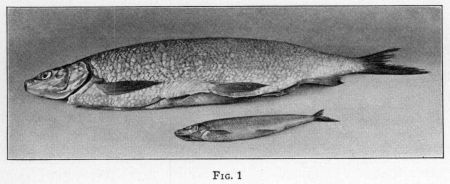
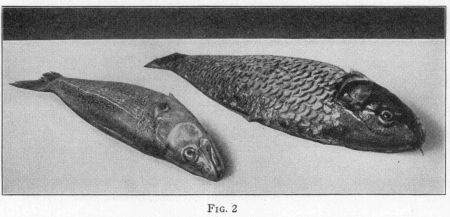
20. Another point to be considered in the purchase of fish is the size. Some fish, such as halibut and salmon, are so large that they must usually be cut into slices or steaks to permit the housewife to purchase the quantity she requires for immediate use. Other fish are of such size that one is sufficient for a meal, and others are so small that several must be purchased to meet the requirements. An idea or the difference in the size of fish can be gained from Figs. 1 and 2. The larger fish in Fig. 1 is a medium-sized whitefish and the smaller one is a smelt. Fish about the size of smelts lend themselves readily to frying and sautéing, whereas the larger kinds, like whitefish, may be prepared to better advantage by baking either with or without suitable stuffing. The larger fish in Fig. 2 is a carp and the smaller one is a pike. Much use is made of pike, but carp has been more shunned than sought after. However, when carp is properly cooked, it is a very palatable food, and, besides, it possesses high food value.
21. In the purchase of fish, the housewife, provided she is not obliged to have fish for a particular day, will do well also to get away from the one-day-a-week purchasing of fish; that is, if she is not obliged to serve fish on Friday, she should endeavor to serve it on some other day. Even twice a week is not too often. If such a plan were followed out, fishermen would be able to market their catch when it is procured and the waste of fish or the necessity for keeping it until a particular day would be overcome.
22. Another way in which the housewife can help herself in the selection of fish is to become familiar with all the varieties of edible fish caught in or near her community. When she has done this, it will be a splendid plan for her to give those with which she is unfamiliar a trial. She will be surprised at the many excellent varieties that are obtained in her locality and consequently come to her fresher than fish that has to be shipped long distances.
23. FRESHNESS OF FISH.--In the purchase of fish, the housewife should not permit herself to be influenced by any prejudice she may have as to the name or the appearance of the fish. However, too much attention cannot be paid to its freshness.
Several tests can be applied to fish to determine whether or not it is fresh; therefore, when a housewife is in doubt, she should make an effort to apply them. Fish should not give off any offensive odor. The eyes should be bright and clear, not dull nor sunken. The gills should have a bright-red color, and there should be no blubber showing. The flesh should be so firm that no dent will be made when it is touched with the finger. Fish may also be tested for freshness by placing it in a pan of water; if it sinks, it may be known to be fresh, but if it floats it is not fit for use.
24. CARE OF FISH IN THE HOME.--If fish is purchased in good condition, and every effort should be made to see that it is, the responsibility of its care in the home until it is presented to the family as a cooked dish rests on the housewife. If, upon reaching the housewife, it has not been cleaned, it should be cleaned at once. In case it has been cleaned either by the fish dealer or the housewife and cannot be cooked at once, it should be looked over carefully, immediately washed in cold water, salted slightly inside and out, placed in a covered enamel or porcelain dish, and then put where it will keep as cold as possible. If a refrigerator is used, the fish should be put in the compartment from which odors cannot be carried to foods in the other compartments. In cold weather, an excellent plan is to put the fish out of doors instead of in the refrigerator, for there it will remain sufficiently cold without the use of ice. However, the best and safest way is to cook the fish at once, so that storing it for any length of time after its delivery will not be necessary.
Salt and smoked fish do not, of course, require the same care as fresh fish. However, as many of these varieties are strong in flavor, it is well to weaken their flavor before cooking them by soaking them or, if possible, by parboiling them.
PREPARATION OF FISH FOR COOKING
CLEANING FISH
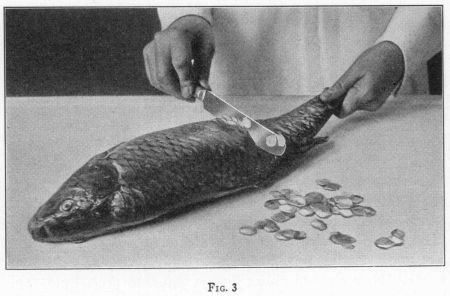
25. CLEANING FISH.--Fish is usually prepared for cooking at the market where it is purchased, but frequently a fish comes into the home just as it has been caught. In order to prepare such a fish properly for cooking, the housewife must understand how to clean it. The various steps in cleaning fish are illustrated in Figs. 3 to 6. The first step consists in removing the scales. To do this, place the fish on its side, as shown in Fig. 3, grasp it firmly by the tail, and [Illustration: FIG. 3] then with the cutting edge of a knife, preferably a dull one, scrape off the scales by quick motions of the knife toward the head of the fish. When one side has been scraped clean, or scaled, as this operation is called, turn the fish over and scale the other side.
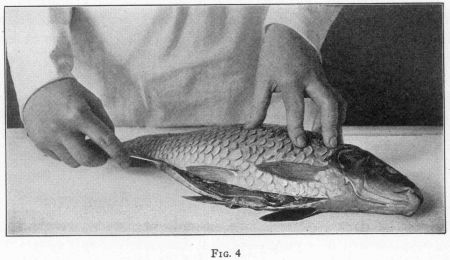
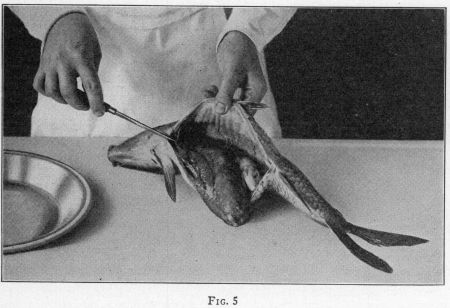
With the fish scaled, proceed to remove the entrails. As shown in Fig. 4, cut a slit in the belly from the head end to the vent, using a sharp knife. Run the opening up well toward the head, as Fig. 5 shows, and then through the opening formed draw out the entrails with the fingers.
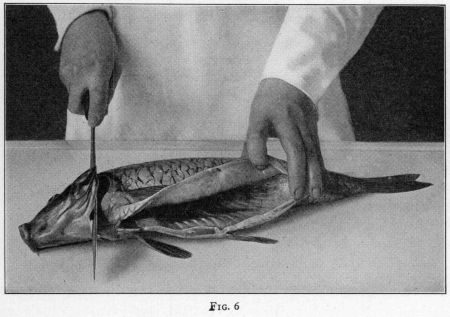
If the head is to be removed, it should be cut off at this time. When a fish is to be baked or prepared in some other way in which the head may be retained, it is allowed to remain on, but it is kept more for an ornament than for any other reason. To remove the head, slip a sharp knife under the gills as far as possible, as Fig. 6 shows, and then cut it off in such a way as not to remove with it any of the body of the fish.
Whether the head is removed or not, make sure that the cavity formed by taking out the entrails is perfectly clean. Then wash the fish with cold water and, if desired, cut off the fins and tail, although this is not usually done. The fish, which is now properly prepared, may be cooked at once or placed in the refrigerator until time for cooking.
BONING FISH
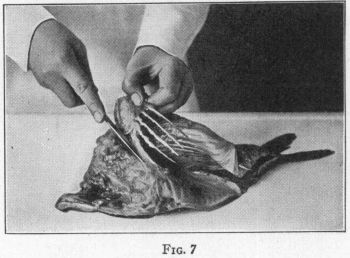
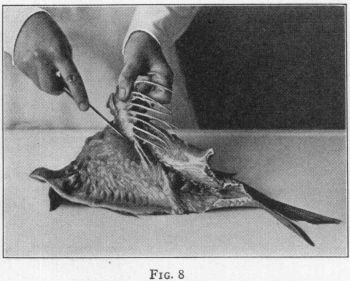
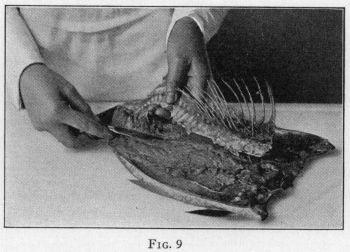
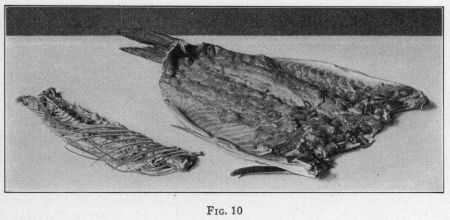
26. BONING FISH.--In the preparation of some kinds of fish, it is often desired to bone the fish; that is, to remove the backbone and the ribs. Figs. 7 to 10 show the various steps in the process of boning. After the fish has been thoroughly cleaned, insert a sharp-pointed knife in the back where it is cut from the head, as shown in Fig. 7, and loosen the backbone at this place. Then, as in Fig. 8, slip the knife along the ribs away from the backbone on both sides. After getting the bone well loosened at the end, cut it from the flesh all the way down to the tail, as shown in Fig. 9. When thus separated from the flesh, the backbone and the ribs, which comprise practically all the bones in a fish, may be lifted out intact, as is shown in Fig. 10.
SKINNING FISH
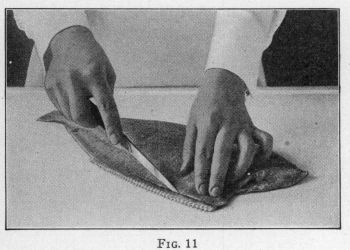
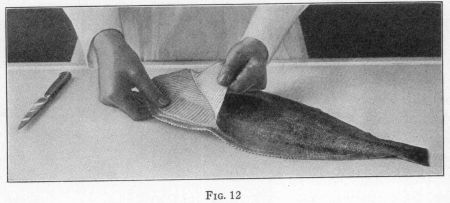
27. SKINNING FISH.--Some kinds of fish, especially those having no scales, such as flounder, catfish, and eels, are made more palatable by being skinned. To skin a fish, cut a narrow strip of the skin along the spine from the head to the tail, as shown in Fig. 11. At this opening, loosen the skin on one side where it is fastened to the bony part of the fish and then, as in Fig. 12, draw it off around toward the belly, working carefully so as not to tear the flesh. Sometimes it is a good plan to use a knife for this purpose, working the skin loose from the flesh with the knife and at the same time pulling the skin with the other hand. After removing the skin from one side, turn the fish and take off the skin from the other side in the same way. Care should be taken to clean the fish properly before attempting to skin it. If the fish is frozen, it should first be thawed in cold water.
FILLETING FISH
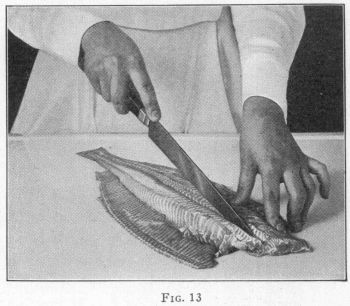
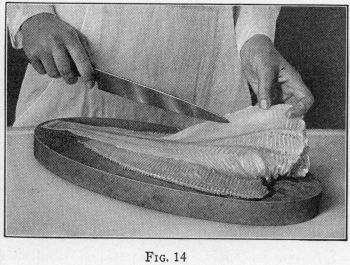
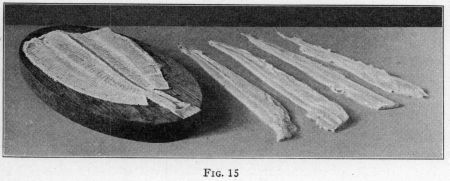
28. FILLETING FISH.--As many recipes require fish to be cut into fillets, that is, thick, flat slices from which the bone is removed, it is well for the housewife to understand just how to accomplish this part of the preparation. Figs. 13 to 15 show the filleting of a flounder. While this process varies somewhat in the different varieties of fish, the usual steps are the ones here outlined. After thoroughly cleaning the flounder and removing the skin, lay the fish out flat and cut the flesh down through the center from the head end to the tail, as shown in Fig. 13. Then, with a knife, work each half of the flesh loose from the bones, as in Fig. 14. With these two pieces removed, turn the fish over, cut the flesh down through the center, and separate it from the bones in the same manner as before. If a meat board is on hand, it is a good plan to place the fish on such a board before removing the flesh. At the end of the filleting process, the flounder should appear as shown in Fig. 15, the long, narrow strips on the right being the flesh and that remaining on the board being the bones intact. The strips thus produced may be cut into pieces of any preferred size.
RECIPES FOR FISH AND FISH ACCOMPANIMENTS
METHODS OF COOKING FISH
29. As Tables II and III show, practically all methods of cookery are applicable in the cooking of fish. For instance, fish may be boiled, steamed, baked, fried, broiled, sautéd, and, in addition, used for various kinds of bisques, chowders, and numerous other made dishes. The effect of these different methods is exactly the same on fish as on meat, since the two foods are the same in general construction. The cookery method to select depends largely on the size, kind, quality, and flavor of the fish. Just as an old chicken with well-developed muscles is not suitable for broiling, so a very large fish should not be broiled unless it can be cut into slices, steaks, or thin pieces. Cook cutting fish with knife. Such a fish is usually either stuffed and baked or baked without stuffing, but when it is cut into slices, the slices may be sautéd, fried, broiled, or steamed.
Some varieties of fish are more or less tasteless. These should be prepared by a cookery method that will improve their flavor, or if the cooking fails to add flavor, a highly seasoned or highly flavored sauce should be served with them. The acid of vinegar or lemon seems to assist in bringing out the flavor of fish, so when a sauce is not used, a slice of lemon is often served with the fish.
RECIPES FOR FISH SAUCES AND STUFFINGS
30. As many of the recipes for fish call for sauce and stuffing, recipes for these accompaniments are taken up before the methods of cooking fish are considered. This plan will make it possible for the beginner to become thoroughly familiar with these accompaniments and thus be better prepared to carry out the recipes for cooking fish.
31. SAUCES FOR FISH.--Sauces are generally served with fish to improve their flavor and increase their nutritive value. Some kinds of fish, such as salmon, shad, butterfish, Spanish mackerel, etc., contain more than 6 per cent. of fat, but as many of the fish that are used for food contain less than this, they are somewhat dry and are improved considerably by the addition of a well-seasoned and highly flavored sauce. Then, too, some fish contain very few extractives, which, when present, as has been learned, are the source of flavor in food. As some of the methods of cooking, boiling in particular, dissolve the few extractives that fish contain and cause the loss of much of the nutritive material, it becomes almost necessary to serve a sauce with fish so prepared, if a tasty dish is to be the result.
32. The sauces that may be used with fish are numerous, and the one to select depends somewhat on the cookery method employed and the preference of those to whom the fish is served. Among the recipes that follow will be found sauces suitable for any method that may be used in the preparation of fish. A little experience with them will enable the housewife to determine the ones that are most satisfactory as to both flavor and nutritive value for the different varieties of fish she uses and the methods of cookery she employs.
LEMON CREAM SAUCE
2 Tb. butter
2 Tb. flour
1 c. thin cream
Salt and pepper
Juice of 1 lemon or 1 Tb. vinegar
Melt the butter in a saucepan, stir in the flour, and continue stirring until the two are well mixed. Add to this the thin cream and stir until the mixture is thick and boils. Season with salt, pepper, and the juice of the lemon or the vinegar.
SPANISH SAUCE
2 Tb. butter
1 slice of onion
2 Tb. flour
1 tsp. salt
1/8 tsp. pepper
1 c. milk
1/4 c. tomato purée
1/4 c. chopped pimiento
Brown the butter with the onion, add the flour, salt, and pepper, and stir until well blended. Add the milk and allow the mixture to cook until it thickens. To this add the tomato and pimiento. Heat thoroughly and serve.
NUT SAUCE
1 Tb. butter
2 Tb. flour
2 Tb. peanut butter
1/2 tsp. salt
1/8 tsp. pepper
1 c. meat stock
Melt the butter and add the flour and peanut butter. When they are well mixed, allow them to brown slightly. Add the salt and pepper to this mixture and pour into it the meat stock. Bring to the boiling point and serve.
HORSERADISH SAUCE
1/2 c. cream
1/4 c. boiled salad dressing
2 Tb. grated horseradish
1/2 tsp. salt
1/4 tsp. paprika
1/4 tsp. mustard
Whip the cream until stiff; then add the salad dressing, horseradish, salt, paprika, and mustard. When well blended, the sauce is ready to serve.
EGG SAUCE
2 Tb. butter
2 Tb. flour
3/4 c. milk
/2 tsp. salt
1/8 tsp. pepper
2 Tb. vinegar
1 egg
1 Tb. chopped parsley
Melt the butter, add the flour, and stir until well blended. Add the milk, salt, and pepper, and cook until the mixture thickens. To this add the vinegar, the egg chopped fine, and the chopped parsley. Heat thoroughly and serve.
TOMATO SAUCE
2 c. tomato purée
1 small onion, sliced
1 bay leaf
6 cloves
2 Tb. butter
2 Tb. flour
1 tsp. salt
1/8 tsp. pepper
Strain stewed tomato to make the purée. Put this over the fire in a saucepan with the sliced onion, the bay leaf, and the cloves. Cook slowly for about 10 minutes. Strain to remove the onion, bay leaf, and cloves. Melt the butter, add the flour, salt, and pepper, and into this pour the hot tomato. Cook until it thickens and serve.
MUSHROOM SAUCE
2 Tb. butter
1 slice of carrot
1 slice of onion
Sprig of parsley
1/2 tsp. salt
1/8 tsp. pepper
2 Tb. flour
1 c. meat stock
1/2 c. mushrooms
2 tsp. lemon juice
Put the butter in a frying pan with the carrot, onion, parsley, salt, and pepper, and cook together until brown. Remove the onion, carrot, and parsley. Stir in the flour, brown it slightly, and then add the meat stock. Cook together until thickened. Just before removing from the fire, add the mushrooms, chopped into fine pieces, and the lemon juice. Allow it to heat thoroughly and then serve.
DRAWN-BUTTER SAUCE
1/4 c. butter
2 Tb. flour
1/2 tsp. salt
1/8 tsp. pepper
1-1/2 c. hot water
2 hard-cooked eggs
Melt the butter, and add the flour, salt, and pepper. Pour into this the hot water, and cook until the mixture thickens. Slice the eggs into 1/4-inch slices and add these to the sauce just before removing from the stove.
33. STUFFING FOR FISH.--As has been mentioned, fish that is to be baked is often stuffed before it is put into the oven. The stuffing not only helps to preserve the shape of the fish, but also provides a means of extending the flavor of the fish to a starchy food, for bread or cracker crumbs are used in the preparation of most stuffings. Three recipes for fish stuffing are here given, the first being made of bread crumbs and having hot water for the liquid, the second of cracker crumbs and having milk for the liquid, and the third of bread crumbs and having stewed tomato for the liquid.
FISH STUFFING No. 1
1/4 c. butter
1/2 c. hot water
1/2 tsp. salt
1/8 tsp. pepper
1 tsp. onion juice
1 Tb. chopped parsley
2 c. fine bread crumbs
Melt the butter in the hot water, add the salt, pepper, onion juice, and parsley, and pour over the crumbs. Mix thoroughly and use to stuff the fish.
FISH STUFFING No. 2
1/2 c. milk
2 c. cracker crumbs
1/2 tsp. salt
1/8 tsp. pepper
1/4 c. melted butter
1 Tb. chopped parsley
1 egg
Warm the milk and add it to the crumbs, together with the salt, pepper, melted butter, and parsley. To this mixture, add the beaten egg. When well mixed, use as stuffing for fish.
FISH STUFFING No. 3
2 Tb. butter
1 Tb. finely chopped onion
1 Tb. chopped parsley
1/2 tsp. salt
1/8 tsp. pepper
1 Tb. chopped sour pickles
1/2 c. stewed tomato
2 c. stale bread crumbs
Melt the butter and add the onion, parsley, salt, pepper, pickles, and tomato. Pour this mixture over the crumbs, mix all thoroughly, and use to stuff the fish. If the dressing seems to require more liquid than the stewed tomato, add a little water.
RECIPES FOR FRESH FISH
34. BOILED FISH.--Boiling extracts flavor and, to some extent, nutriment from the food to which this cookery method is applied. Therefore, unless the fish to be cooked is one that has a very strong flavor and that will be improved by the loss of flavor, it should not be boiled. Much care should be exercised in boiling fish, because the meat is usually so tender that it is likely to boil to pieces or to fall apart.
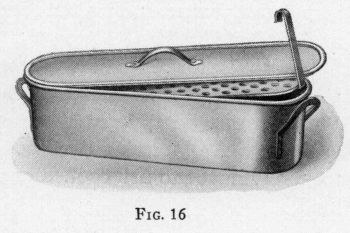
35. A utensil in which fish can be boiled or steamed very satisfactorily is shown in Fig. 16. This fish boiler, as it is called, is a long, narrow, deep pan with a cover and a rack on which the fish is placed. Attached to each end of the rack is an upright strip, or handle, that permits the rack containing the fish to be lifted out of the pan and the fish thus removed without breaking. To assist further in holding the fish together while it is cooking, a piece of gauze or cheesecloth may be wrapped around the fish before it is put into the pan.
36. When a fish is to be boiled, clean it and, if desired, remove the head. Pour sufficient boiling water to cover the fish well into the vessel in which it is to be cooked, and add salt in the proportion of 1 teaspoonful to each quart of water. Tie the fish in a strip of cheesecloth or gauze if necessary, and lower it into the vessel of slowly boiling water. Allow the fish to boil until it may be easily pierced with a fork; then take it out of the water and remove the cloth, provided one is used. Serve with a well-seasoned sauce, such as lemon cream, horseradish, etc.
37. BOILED COD.--A fish that lends itself well to boiling is fresh cod. In fact, codfish prepared according to this method and served with a sauce makes a very appetizing dish.
Scale, clean, and skin a fresh cod and wrap it in a single layer of gauze or cheesecloth. Place it in a kettle or a pan of freshly boiling water to which has been added 1 teaspoonful of salt to each quart of water. Boil until the fish may be easily pierced with a fork, take from the water, and remove the gauze or cheesecloth carefully so as to keep the fish intact. Serve with sauce and slices of lemon.
38. STEAMED FISH.--The preparation of fish by steaming is practically the same as that by boiling, and produces a dish similar to boiled fish. The only difference is that steamed fish is suspended over the water and is cooked by the steam that rises instead of being cooked directly in the water. Because the fish is not surrounded by water, it does not lose its nutriment and flavor so readily as does boiled fish.
If fish is to be cooked by steaming, first clean it thoroughly. Wrap in a strip of gauze or cheesecloth and place in a steamer. Steam until tender, and then remove the cloth and place the fish on a platter. As steaming does not add flavor, it is usually necessary to supply flavor to fish cooked in this way by adding a sauce of some kind.
39. BROILED FISH.--The best way in which to cook small fish, thin strips of fish, or even good-sized fish that are comparatively thin when they are split open is to broil them. Since in this method of cooking the flavor is entirely retained, it is especially desirable for any fish of delicate flavor.
To broil fish, sear them quickly over a very hot fire and then cook them more slowly until they are done, turning frequently to prevent burning. As most fish, and particularly the small ones used for broiling, contain almost no fat, it is necessary to supply fat for successful broiling and improvement of flavor. It is difficult to add fat to the fish while it is broiling, so, as a rule, the fat is spread over the surface of the fish after it has been removed from the broiler. The fat may consist of broiled strips of bacon or salt pork, or it may be merely melted butter or other fat.
40. BROILED SCROD WITH POTATO BORDER.--Young cod that is split down the back and that has had the backbone removed with the exception of a small portion near the tail is known as scrod. Such fish is nearly always broiled, it may be served plain, but it is much more attractive when potatoes are combined with it in the form of an artistic border.
To prepare this dish, broil the scrod according to the directions given in Art. 39. Then place it on a hot platter and spread butter over it. Boil the desired number of potatoes until they are tender, and then force them through a ricer or mash them until they are perfectly fine. Season with salt, pepper, and butter, and add sufficient milk to make a paste that is a trifle stiffer than for mashed potatoes. If desired, raw eggs may also be beaten into the potatoes to serve as a part of the moisture. Fill a pastry bag with the potatoes thus prepared and press them through a rosette tube in any desired design on the platter around the fish. Bake in a hot oven until the potatoes are thoroughly heated and are browned slightly on the top.
41. BROILED FRESH MACKEREL.--Probably no fish lends itself better to broiling than fresh mackerel, as the flesh of this fish is tender and contains sufficient fat to have a good flavor. To improve the flavor, however, strips of bacon are usually placed over the fish and allowed to broil with it.
Clean and skin a fresh mackerel. Place the fish thus prepared in a broiler, and broil first on one side and then on the other. When seared all over, place strips of bacon over the fish and continue to broil until it is done. Remove from the broiler, season with salt and pepper, and serve.
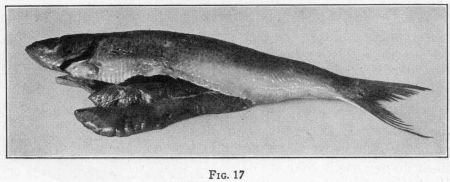
42. BROILED SHAD ROE.--The mass of eggs found in shad, as shown in Fig. 17, is known as the roe of shad. Roe may be purchased separately, when it is found in the markets from January 1 to June 1, or it may be procured from the fish itself. It makes a delicious dish when broiled, especially when it is rolled in fat and bread crumbs.
Wash the roe that is to be used and dry it carefully between towels. Roll it in bacon fat or melted butter and then in fine crumbs. Place in a broiler, broil until completely done on one side, turn and then broil until entirely cooked on the other side. Remove from the broiler and pour melted butter over each piece. Sprinkle with salt and pepper, and serve hot.
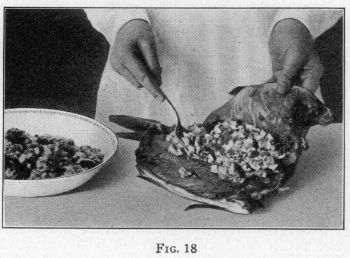
43. BAKED FISH.--Good-sized fish, that is, fish weighing 4 or 5 pounds, are usually baked. When prepared by this method, fish are very satisfactory if they are spread out on a pan, flesh side up, and baked in a very hot oven with sufficient fat to flavor them well. A fish of large size, however, is especially delicious if its cavity is filled with a stuffing before it is baked.
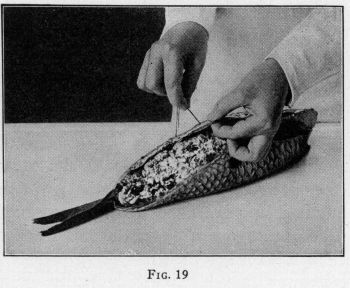
When a fish is to be stuffed, any desired stuffing is prepared and then filled into the fish in the manner shown in Fig. 18. With the cavity well filled, the edges of the fish are drawn together over the stuffing and sewed with a coarse needle and thread, as Fig. 19 shows.
Whether the fish is stuffed or not, the same principles apply in its baking as apply in the roasting of meat; that is, the heat of a quick, hot oven sears the flesh, keeps in the juices, and prevents the loss of flavor, while that of a slow oven causes the loss of much of the flavor and moisture and produces a less tender dish.
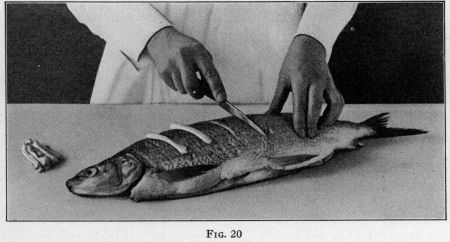
44. Often, in the baking of fish, it is necessary to add fat. This may be done by putting fat of some kind into the pan with the fish, by spreading strips of bacon over the fish, or by larding it. In the dry varieties of fish, larding, which is illustrated in Fig. 20, proves very satisfactory, for it supplies the substance in which the fish is most lacking. As will be observed, larding is done by inserting strips of bacon or salt pork that are about 3 inches long and 1/4 inch thick into gashes cut into the sides of the fish.
45. BAKED HADDOCK.--As haddock is a good-sized fish, it is an especially suitable one for baking. However, it is a dry fish, so fat should be added to it to improve its flavor. Any of the methods suggested in Art. 44 may be used to supply the fat that this fish needs.
When haddock is to be baked, select a 4 or 5-pound fish, clean it thoroughly, boning it if desired, and sprinkle it inside and out with salt. Fill the cavity with any desired stuffing and sew up. Place in a dripping pan, and add some bacon fat or a piece of salt pork, or place several slices of bacon around it. Bake in a hot oven for about 1 hour. After it has been in the oven for about 15 minutes, baste with the fat that will be found in the bottom of the pan and continue to baste every 10 minutes until the fish is done. Remove from the pan to a platter, garnish with parsley and slices of broiled bacon, and serve with any desired sauce.
46. BAKED HALIBUT.--Because of its size, halibut is cut into slices and sold in the form of steaks. It is probably one of the most economical varieties of fish to buy, for very little bone is contained in a slice and the money that the housewife expends goes for almost solid meat. Halibut slices are often sautéd, but they make a delicious dish when baked with tomatoes and flavored with onion, lemon, and bay leaf, as described in the accompanying recipe.
BAKED HALIBUT
(
Sufficient to Serve Six
)
2 c. tomatoes
Few slices onion
1 bay leaf
1 tsp. salt
1/8 tsp. pepper
2 thin slices bacon
1 Tb. flour
2 lb. halibut steak
Heat the tomatoes, onion, and bay leaf in water. Add the salt and pepper and cook for a few minutes. Cut the bacon into small squares, try it out in a pan, and into this fat stir the flour. Pour this into the hot mixture, remove the bay leaf, and cook until the mixture thickens. Put the steaks into a baking dish, pour the sauce over them, and bake in a slow oven for about 45 minutes. Remove with the sauce to a hot platter and serve.
47. BAKED FILLETS OF WHITEFISH.--When whitefish of medium size can be secured, it is very often stuffed and baked whole, but variety can be had by cutting it into fillets before baking it. Besides producing a delicious dish, this method of preparation eliminates carving at the table, for the pieces can be cut the desired size for serving.
Prepare fillets of whitefish according to the directions for filleting fish in Art. 28. Sprinkle each one with salt and pepper, and dip it first into beaten egg and then into bread crumbs. Brown some butter in a pan, place the fish into it, and set the pan in a hot oven. Bake until the fillets are a light brown, or about 30 minutes. Remove to a hot dish, garnish with parsley and serve with any desired sauce.
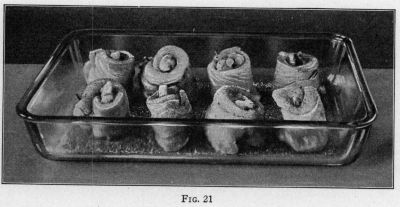
48. FILLET OF FLOUNDER.--In appearance, flounder is not so attractive as many other fish, but it is a source of excellent flesh and is therefore much used. A very appetizing way in which to prepare flounder is to fillet it and prepare it according to the accompanying recipe, when it will appear as in Fig. 21.
Secure a flounder and fillet it in the manner explained in Art. 28. Cut each fillet into halves, making eight pieces from one flounder. Cut small strips of salt pork or bacon, roll the pieces of flounder around these, and fasten with a toothpick. Place in a baking dish with a small quantity of water, and bake in a hot oven until a good brown. Serve hot.
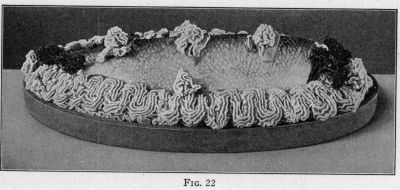
49. PLANKED FISH.--Like planked steak, planked fish, which is illustrated in Fig. 22, is a dish that appeals to the eye and pleases the taste. The fish is baked on the plank and then surrounded with a border of potatoes, the fish and potatoes making an excellent food.
To prepare planked fish, thoroughly clean and bone a medium-size whitefish, shad, haddock, or any desired fish. Grease a plank and place the fish on it. Lay some strips of bacon across the top of the fish, place in a hot oven, and bake for about 30 minutes or a little longer if necessary. Boil potatoes and prepare them for piping by mashing them, using 4 tablespoonfuls of milk, 1 tablespoonful of butter, and one egg to each 2 cupfuls of potato. Then, with a rosette pastry tube, pipe a border of potatoes around the edge of the plank, so that it will appear as in Fig. 22. Likewise, pipe rosettes of potatoes on the strips of bacon placed on top of the fish. Then replace the plank with the fish and potatoes in the oven, and bake until the potatoes are brown. Garnish with parsley and serve.
50. FRIED FISH.--Very small fish or slices of larger fish are often fried in deep fat. When they are prepared in this way, they are first dipped into beaten egg and then into crumbs or corn meal to form a coating that will cling to their surface. Coated with such a material, they are fried in deep fat until the surface is nicely browned. After being removed from the fat, they should be drained well before serving.
51. FRIED PERCH.--When fried in deep fat, perch is found to be very appetizing. To prepare it in this way, secure a perch and scale and clean it. Cut it crosswise into 2-inch strips, roll each piece in flour, and fry in deep fat until nicely browned. Serve hot with lemon or with a sauce of some kind.
52. FRIED EEL.--If an appetizing way to cook eel is desired, it will be found advisable to fry it in deep fat. When it is to be cooked in this way, skin and clean the eel and cut it into thick slices. Pour some vinegar over the slices, sprinkle them with salt and pepper, and allow them to stand for several hours. Remove the pieces from the vinegar, dip each one into slightly beaten egg and then into flour, and fry in deep fat until well browned. Serve plain or with a sauce.
53. SAUTÉD FISH.--Without doubt, the most popular way to prepare fish is to sauté them. This method may be applied to practically the same kinds of fish that are fried or broiled, and it is especially desirable for the more tasteless varieties. It consists in browning the fish well in a small quantity of fat, first on one side and then on the other. If fat of good flavor is used, such as bacon or ham fat, the flavor of the fish will be very much improved. Before sautéing, the fish or pieces of fish are often dipped into slightly beaten egg and then rolled in flour, very fine cracker crumbs, or corn meal, or the egg is omitted and they are merely covered with the dry, starchy material. The effect of this method of cooking is very similar to that of deep-fat frying, except that the outside tissues are apt to become, very hard from the application of the hot fat because of the coating that is generally used. Since most fish breaks very easily, it is necessary that it be handled carefully in this method in order that the pieces may be kept whole.
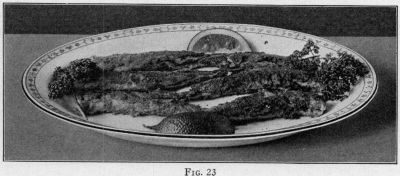
54. SAUTÉD SMELTS.--To be most satisfactory, smelts are generally sautéd, as shown in Fig. 23. Fish of this kind are prepared for cooking by cutting off the heads and removing the entrails through the opening thus made; or, if it is desired to leave the heads on, the entrails may be removed through the gill or a small slit cut below the mouth. At any rate, these fish are not cut open as are most other fish.
With the fish thus prepared, roll them in fine cracker crumbs and sauté them in melted butter until they are nicely browned. Serve with slices of lemon.
55. SAUTÉD HALIBUT STEAK.--Slices of halibut, when firm in texture and cut about 3/4 inch thick, lend themselves very well to sautéing. Secure the required number of such slices and sprinkle each with salt and pepper. Then spread melted butter over each steak, and roll it in fine crumbs. Place fat in a frying pan, allow it to become hot, and sauté the halibut in this until well browned.
56. SAUTÉD PICKEREL.--A variety of fresh-water fish that finds favor with most persons is pickerel. When this fish is to be sautéd, scale and clean it and cut it crosswise into 2-inch strips. Then roll each piece in flour, sprinkle it with salt and pepper, and sauté the slices in hot fat. When one side is sufficiently brown, turn and brown on the other side.
57. STEWED FISH.--Like boiling, stewing extracts flavor and nutriment from fish. The process differs, however, in that the fish is cooked gently by simmering. This cookery method is employed for fish that is inclined to be tough. Usually, vegetables, such as carrots and onions, are cooked with the fish in order to impart flavor. To prevent the fish from falling apart, it may be wrapped in cheesecloth or gauze.
58. STEWED FRESH HERRING.--When fresh herring can be obtained, it can be made into a delicious dish by stewing it with onions, parsley, and carrots. In this method of preparation, the herring should not be permitted to stew rapidly; it will become more tender if it simmers gently. As herring are rather small fish, weighing only about 1/2 pound, it will usually be necessary to obtain more than one for a meal.
Clean the required number of fresh herring, place them in a saucepan, and sprinkle them with salt and pepper. Brown some slices of onion in butter, and add the same number of slices of carrots and a generous quantity of parsley. Add enough boiling water to these vegetables to cover them and the fish, and pour both over the fish. Place all on the fire and simmer gently until the fish is tender. Remove the fish from the water and serve. The vegetables are used merely to add flavor, and they will have practically boiled away by the time the fish is cooked.
59. STEWED EEL.--Eel is delicious when stewed. When allowed to simmer slowly with several slices of onion and a little parsley, it becomes both tasty and tender.
Skin and clean the eel that is to be stewed, remove all the fat, and cut into pieces about 2 inches long. Season well with salt and pepper and place in a saucepan with several slices of onion, 1 tablespoonful of chopped parsley, and 2 tablespoonfuls of butter. Add enough cold water to cover well, and allow the eel to simmer gently until it is tender enough to be pierced with a fork. Remove from the water and serve hot.
RECIPES FOR SALT AND SMOKED FISH
60. PLACE OF SALT AND SMOKED FISH IN THE DIET.--In regions where fresh fish cannot be obtained or in seasons when they are scarce everywhere, the housewife will do well to use salt and smoked fish. These varieties of fish not only will give her a chance to vary the diet, but will enable her to provide at a more economical price, food that, pound for pound, contains more nutriment than the same fish when fresh. While some of the varieties of smoked and salt fish may not be obtainable in all communities, the housewife will do much toward bringing the supply to her community by requesting them from the dealer. When a dealer knows that there is a demand for certain kinds, he will make an effort to secure the varieties wanted.
61. FRESHENING SALT AND SMOKED FISH.--The cooking of salt and smoked fish is not a difficult matter, but it always involves the freshening of the fish before any cooking method can be applied. This consists in placing the fish in a large quantity of water and allowing it to stand until enough of the salt has been extracted to suit the taste. Some kinds of fish are so salty that they require considerable soaking, whereas others require only a little freshening. However, it is usually advisable to change the water several times. If it is desired to hasten the extraction of the salt, the fish should be raised above the bottom of the vessel by means of a wire rack or several clean sticks. In the case of very thick fish, several gashes may be cut into the flesh to permit the salt to pass out more readily.
62. CREAMED CODFISH.--Since codfish is a rather dry fish, containing little fat, it is usually combined with some other food to make it more appetizing. In the case of creamed codfish, the cream sauce supplies the food substances in which the fish is lacking and at the same time provides a very palatable dish. When codfish is prepared in this way, boiled potatoes are usually served with it.
To make creamed codfish, freshen the required amount of codfish by pouring lukewarm water over it. Shred the fish by breaking it into small pieces with the fingers. Pour off the water, add fresh warm water, and allow the fish to stand until it is not too salty. When it is sufficiently freshened, drain off all the water. Melt a little butter in a frying pan, add the fish, and sauté until slightly browned. Make a medium white sauce and pour it over the codfish. Serve hot with boiled potatoes.
63. CODFISH BALLS.--Another excellent way in which to serve codfish is to combine it with mashed potatoes, make these into balls, and fry them in deep fat. These give variety to meals and also afford an opportunity to serve a nutritious food.
Freshen the codfish as explained in Art. 61, and then mince it very fine. Add an equal amount of freshly cooked hot potato that has been put through a potato ricer or mashed fine. Mix thoroughly and, if necessary, season with salt and pepper. Shape into balls and fry in deep fat. Drain well and serve hot.
64. SAUTÉD SALT MACKEREL.--When an extremely tasty dish that will afford a change from the usual daily routine of meals is desired, sautéd salt mackerel will be found very satisfactory.
Freshen salt mackerel that is to be sautéd by putting it into a saucepan and covering it with cold water. Place this over the fire, and allow the water to heat to almost the boiling point. Pour off the water, and sauté the fish in butter or other fat until nicely browned. If desired, pour a small amount of thin cream over the mackerel just before removing it from the pan, allow this to heat, and serve it as a sauce with the mackerel.
65. BAKED FINNAN HADDIE.--When haddock is cured by smoking, it is known as finnan haddie. As fish of this kind has considerable thick flesh, it is very good for baking. Other methods of cookery may, of course, be applied to it, but none is more satisfactory than baking.
To bake a finnan haddie, wash it in warm water and put it to soak in fresh warm water. After it has soaked for 1/2 hour, allow it to come gradually to nearly the boiling point and then pour off the water. Place the fish in a baking pan, add a piece of butter, sprinkle with pepper, and pour a little water over it. Bake in a hot oven until it is nicely browned. Serve hot.
66. CREAMED FINNAN HADDIE.--The flavor of finnan haddie is such that this fish becomes very appetizing when prepared with a cream sauce. If, after combining the sauce with the fish, the fish is baked in the oven, an especially palatable dish is the result.
To prepare creamed finnan haddie, freshen the fish and shred it into small pieces. Then measure the fish, put it into a baking dish, and pour an equal amount of white sauce over it. Sprinkle generously with crumbs and bake in a hot oven until the crumbs are browned. Serve hot.
67. BOILED SALMON.--When smoked salmon can be secured, it makes a splendid fish for boiling. If it is cooked until tender and then served with a well-seasoned sauce, it will find favor with most persons.
Freshen smoked salmon in warm water as much as seems necessary, remembering that the cooking to which it will be subjected will remove a large amount of the superfluous salt. Cover the salmon with hot water, and simmer slowly until it becomes tender. Remove from the water, pour a little melted butter over it, and serve with any desired sauce.
RECIPES FOR CANNED FISH
68. CANNED FISH IN THE DIET.--As a rule, canned fish is a comparatively cheap food and there is no reason why the economical housewife should not make frequent use of the various kinds. It should be bought, however, from a reputable firm, in order that the greatest value may be obtained for the money spent. In addition, it should be used as soon as possible after the can has been opened; if all of it cannot be utilized at one time, it should be placed in a covered receptacle--not a metal one--and kept cold to prevent it from spoiling. Often canned fish can be served without any further preparation than removing it from the can. However, as some varieties, particularly salmon and tuna fish, are much used in the preparation of both cold and cooked dishes, several recipes are here given for these varieties.
69. CREAMED TUNA FISH.--Combining tuna fish with a cream sauce and serving it over toast makes a dish that is both delicate and palatable--one that will prove very satisfactory when something to take the place of meat in a light meal is desired.
CREAMED TUNA FISH
(
Sufficient to Serve Six
)
3 Tb. butter
3 Tb. flour
1/2 tsp. salt
1/8 tsp. pepper
1/8 tsp. paprika
1-1/2 c. hot milk
1-1/2 c. tuna fish
1 egg
Melt the butter in a saucepan and add the flour, salt, pepper, and paprika. Stir well, pour in the milk, and when this has thickened add the tuna fish. Allow this to heat thoroughly in the sauce. Just before serving, add the slightly beaten egg and cook until this has thickened. Pour over toast and serve.
70. SALMON MOLD.--A change from the usual way of serving salmon can be had by making a salmon mold such as is illustrated in Fig. 24. Besides being a delicious dish and providing variety in the diet, salmon mold is very attractive.
SALMON MOLD
(
Sufficient to Serve Six
)
2 c. salmon
2 Tb. vinegar
1/2 tsp. salt
1/8 tsp. pepper
1 Tb. gelatine
1-1/2 c. boiling water
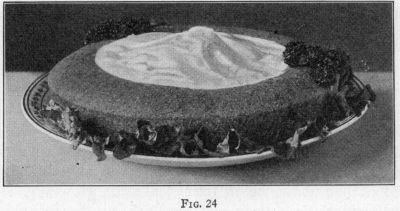
Remove all skin and bones from the salmon when it is taken from the can, and mince it thoroughly with a fork. Add the vinegar, salt, and pepper. Prepare the gelatine by dissolving it in the boiling water. Add the seasoned salmon to the prepared gelatine. With cold water, wet a ring-shaped mold having an open space in the center. Pour the salmon-and-gelatine mixture into this mold, and allow it to stand until it solidifies. Arrange a bed of lettuce leaves on a chop plate, turn the mold out on this, and fill the center with dressing. Serve at once. A very desirable dressing for this purpose is made as follows:
DRESSING FOR SALMON MOLD
1 c. cream
2 Tb. vinegar
1/2 tsp. salt
2 Tb. sugar
1 c. finely chopped cucumber
Whip the cream until it is stiff, and add the vinegar, salt, and sugar. Fold into this the finely chopped cucumber.
71. SALMON PATTIES.--Delicious patties can be made from salmon by combining it with bread crumbs and using a thick white sauce to hold the ingredients together. These may be either sautéd in shallow fat or fried in deep fat.
SALMON PATTIES
(
Sufficient to Serve Eight
)
2 c. finely minced salmon
1 c. fresh bread crumbs
1 c. thick white sauce
1/2 tsp. salt
1/8 tsp. pepper
Dry bread crumbs
With the salmon, mix the fresh bread crumbs and the white sauce. Season with salt and pepper. Shape into round patties, roll in the dry bread crumbs, and fry in deep fat or sauté in shallow fat. Serve hot with or without sauce.
72. CREAMED SALMON WITH RICE.--A creamed protein dish is always more satisfactory if it is served on some other food, particularly one high in carbohydrate. When this is done, a better balanced dish is the result. Creamed salmon and rice make a very nutritious and appetizing combination.
CREAMED SALMON WITH RICE
(
Sufficient to Serve Six
)
1 c. salmon
1 c. medium white sauce
Steamed rice
Break the salmon into moderately small pieces and carefully fold these into the hot white sauce. Serve this on a mound of hot steamed rice.
RECIPES FOR LEFT-OVER FISH
73. So as not to waste any food material, it is necessary that all left-over fish be utilized in some way. This is not so simple a matter as in the case of meat, because fish is one of the foods that are not popular as a left-over dish. Still fish left-overs can be used if a little thought is given to the matter. Of course, it is a wise plan to prepare only the quantity of fish that can be consumed at the meal for which it is cooked, but should any remain it should not be thrown away, for some use can be made of it. A point to remember, however, is that fish is not satisfactory in soup of any kind except a fish soup; therefore, bits of left-over fish may be added to only such soups as clam chowder or other fish chowder.
Whether the fish has been boiled, steamed, baked, fried, sautéd, or prepared in any other way, it may always be made into croquettes. When used for this purpose, all the bones should be carefully removed. These may be easily taken out after the fish has become cold. If the fish has been stuffed and part of the stuffing remains, it may be broken into pieces and used with the flesh of the fish. A recipe for croquettes in which fish is combined with rice follows.
74. FISH CROQUETTES.--If any quantity of left-over fish is on hand, it may be combined with rice to make very tasty croquettes.
FISH CROQUETTES
(
Sufficient to Serve Six
)
1-1/2 c. cold fish
1 c. cold steamed rice
1 c. thick white sauce
Salt and pepper
1 egg
Crumbs
Mince the fish into small pieces, mix with the rice, and add the white sauce. Season with salt and pepper and shape into croquettes. Dip into slightly beaten egg, roll in crumbs, and fry in deep fat. Drain and serve with any desired sauce.
75. CREAMED FISH IN POTATO NEST.--Fish may also be combined with mashed potato to produce a most appetizing dish. Line a baking dish with hot mashed potato, leaving a good-sized hollow in the center. Into this pour creamed fish made by mixing equal proportions of left-over cold fish and white sauce. Season well with salt and pepper, sprinkle with crumbs, and dot the top with butter. Bake until the crumbs are brown. Serve hot.
SHELL FISH
NATURE, VARIETIES, AND USE OF SHELL FISH
76. Besides the varieties of fish that have already been considered, the general term fish also includes SHELL FISH. Fish of this kind are different in structure from bony fish, for they are acquatic animals that are entirely or partly encased in shells. They include mollusks, or bivalves, such as oysters, clams, and scallops, and crustaceans, such as lobsters, crabs, and shrimp.
77. The popularity of the edible varieties of mollusks and crustaceans mentioned depends largely on whether they can be easily obtained and whether they are pleasing to the local or individual taste. As they are found in salt rivers, bays, and other shallow salt-water sources, their greatest use is among people living near the seashore, but they are much favored where they can be procured in edible condition. They are not so cheap as many other fish foods; that is, a certain amount of money will not purchase so great a quantity of shell fish, lobster for instance, as some of the well-known varieties of fish proper, such as halibut or whitefish. Lobsters and crabs are usually more expensive than oysters and clams; consequently, they are used more often to provide a delicacy or to supply something more or less uncommon for a special meal.
78. Several precautions should be observed in purchasing shell fish. For instance, crabs and lobsters should be purchased alive. They are usually shipped on ice so that they will remain in this condition for some time, and they are displayed on ice in the markets for the same reason. Such shell fish should be kept alive until they are plunged into boiling water to cook. Oysters and clams bought in the shell must also be alive when purchased. A tightly closed shell indicates that they are alive, whereas a slightly open shell proves that they are dead. If these two varieties are bought out of the shells, the fish themselves should not be accompanied by a great quantity of liquid. Considerable liquid is an indication that the oysters or clams have been adulterated by the addition of water. Formerly it was the custom to keep oysters in fresh water, as the water they absorb bloats or fattens them. This practice, however, has fallen into disfavor.
79. Shell fish lend themselves admirably to a large variety of dishes, including soups, entrees, salads, and substitutes for meat dishes. They possess a great deal of distinctive flavor, their food value is comparatively high, and, provided they are in good condition and are properly prepared, they are healthful and easily digested. It can therefore be seen that shell fish have much to recommend their use. There is considerable danger, however, in using any varieties that are not perfectly fresh or freshly cooked. In the case of mollusks, or bivalves, much harm has resulted from the use of those which have been grown or bred in unsanitary surroundings. Because of these facts, it is of the utmost importance that great care be exercised in selecting and preparing shell fish.
80. COMPOSITION AND FOOD VALUE OF SHELL FISH.--In composition, the varieties of fish included under shell fish do not differ greatly from fish proper. Most of them, however, contain more waste and less of the food substances than fish, so that their food value is somewhat lower. Table IV will serve to give a good idea of the composition and food value of the several varieties of shell fish, and in studying it, a good plan will be to compare it with Table I, which gives the food value of fish. As will be observed, protein forms a very large proportion of the food substance of shell fish. Also, they contain more carbohydrates than fish, the amount ranging from .4 to 5.2 per cent., which is in the form of sugar. Although this amount is too small to warrant much consideration as a supply of carbohydrates, it is mentioned because it is an interesting fact.
TABLE IV COMPOSITION AND FOOD VALUE OF SHELL FISH
Name of FishWaterProteinFatTotal CarbohydratesAshFood Value Per Pound Calories
Clams, removed from shell80.810.61.15.22.3340
Crabs, whole77.116.62.01.23.1415
Lobsters, whole79.216.41.8.42.2390
Oysters, in shell86.96.21.23.72.0235
Scallops80.314.8.13.41.4345
TABLE V SEASONS FOR SHELL FISH
NAME OF FISHSEASON
Clams, hard shelledAll the year
Clams, soft shelledMay 1 to October 15
Crabs, hard shelledAll the year
Crabs, soft shelledMarch 1 to October 15
LobstersAll the year
OystersSeptember 1 to May 1
ScallopsSeptember 15 to April 1
ShrimpMarch 15 to June 1, and September 15 to October 15
81. SEASONS FOR SHELL FISH.--With the exception of clams and lobster, which can be obtained all the year around, shell fish have particular seasons; that is, there is a certain time of the year when they are not suitable for food. It is very important that every housewife know just what these seasons are, so that she will not include the foods in the diet of her family when they should not be used. Table V, which will furnish her with the information she needs, should therefore be carefully studied.
OYSTERS, CLAMS, AND SCALLOPS
OYSTERS AND THEIR PREPARATION
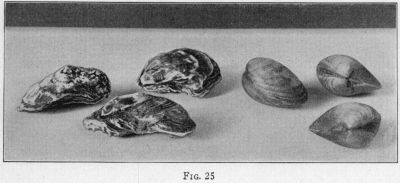
82. OYSTERS, CLAMS, and SCALLOPS are salt-water fish that belong to the family of mollusks, or soft-bodied animals. They are entirely encased in hard shells, which, though of the same general shape, differ somewhat from each other in appearance. Fig. 25 shows a group of oysters and clams, the three on the left being oysters and the three on the right, clams. Oysters are larger than clams and have a rough, uneven shell, whereas clams have a smooth, roundish shell. The three varieties of mollusks are closely related in their composition and in their use as food, but as oysters are probably used more commonly than the others they are considered first.
83. COMPOSITION OF OYSTERS.--Oysters occupy a prominent place among animal foods, because they are comparatively high in protein. In addition, they contain a substance that most flesh foods lack in any quantity, namely, carbohydrate in the form of glycogen, and for this reason are said to resemble milk closely in composition. A comparison of the following figures will show how these foods resemble each other:
WATERPROTEINFATCARBOHYDRATEMINERAL SALTS
Milk87.03.34.05.00.7
Oysters86.96.21.23.72.0
Oysters, as will be observed, contain only a small quantity of fat, and for this reason their total food value is somewhat lower than that of milk. A pint of milk has a value of 325 calories, while the same quantity of oysters has an approximate value of only 250 calories. Because of the difference in the cost of these two foods, oysters costing several times as much as milk, the use of oysters is not so cheap a way of supplying food material.
84. DIGESTIBILITY OF OYSTERS.--When merely the ability of the digestive tract to handle oysters is taken into consideration, they are said to be easily digested if they are served raw or are properly prepared. This is due to the fact that when taken as a food they are disposed of in a comparatively short time by the stomach. In addition, their absorption from the alimentary tract is quite complete; that is, they contain little or no waste material. But, just as cooking has much to do with the digestibility of other protein foods, so it has with oysters. For this reason, the housewife who wishes to feed her family this food in its most digestible form must thoroughly understand all phases of its cooking.
85. HEALTHFULNESS OF OYSTERS.--Much illness has been attributed to oysters, and without doubt they have been the cause of some typhoid and some ptomaine poisoning. A knowledge of the reason for these diseases has done much to eliminate them. It is now definitely known that much of the typhoid caused from eating oysters was due to the conditions under which they were grown. In their growth, oysters fasten themselves to stationary things, such as rocks or piles driven into the ground underneath the water, and they obtain their food by simply opening the shell and making use of minute particles of plant and animal life that they are able to extract from the water. When the water was not clean or when sewage was turned into it, typhoid germs were transmitted to persons who took oysters as food. At present, there is scarcely any danger from such causes, for more care is now given to the conditions under which oysters grow. Ptomaine poisoning from oysters was caused by eating them when they had been improperly cared for in storage or had been taken from the shells after they were dead. Unless persons handling oysters know how to take care of them, this danger is still likely to exist.
86. PURCHASING OYSTERS.--To be able to purchase oysters intelligently, the housewife should be familiar with the names of the various kinds. These names are dependent on the locality from which the oysters come, and include Blue Points, Cape Cods, Cotuits, Lynn Havens, and numerous other varieties. It should be remembered that the varieties raised in different localities are quite distinctive, differing to some extent in both size and appearance. Unless the purchaser is familiar with the different varieties, almost any of the small oysters are likely to be sold to her for one of the small varieties and, likewise, any of the large oysters for one of the large varieties. While this is of small consequence, provided the quality is satisfactory and the price is right, it is well for every housewife to familiarize herself with the names of the various kinds, so that she may know just what variety she is purchasing.
87. When oysters are bought in the shell, they should be alive, a fact that can be determined by the tightly closed shell, as has already been stated. If the shells are not closed or can be easily pried apart, it may be known that the oysters are not good and that they should be rejected. When it is possible to procure them, oysters that have been removed from the shells immediately after being taken from the beds are preferable to those which have not been removed from the shells before shipping. When purchased out of the shells, oysters should be grayish in color, should have no disagreeable odor, and should contain no excess water or liquid. After being purchased, oysters should be kept on ice unless they can be cooked at once.
The season for oysters is from September to April, inclusive. While in some localities they can be purchased at other times during the year, they are not likely to be so good. In fact, it is not safe to use oysters during the warm months.
88. IMPORTANT POINTS IN COOKING OYSTERS.--The protein of oysters, like that found in other foods, is coagulated by heat. Long heat, provided it is sufficiently intense, makes oysters tough, and in this condition they are neither agreeable to eat nor readily digested. When they are to be cooked at a high temperature, therefore, the cooking should be done quickly. If they are to be cooked at a temperature below the boiling point, they may be subjected to heat for a longer time without becoming so tough as when a high temperature is used. Cooking quickly at a high temperature, however, is preferable in most cases to long, slow cooking. For example, in the preparation of oyster stew, long cooking produces no better flavor than short cooking at a high temperature and renders oysters far less digestible.
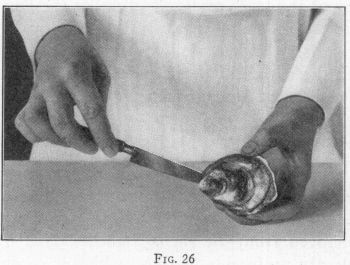
89. OPENING OYSTERS.--Unless oysters are bought already opened, it becomes necessary to open them in the home before they can be served raw or cooked. To open oysters is not difficult, and with a little experience the work can be done with ease. It will be well to note that the two shells of an oyster, which are called valves, are held together by a single muscle, known as the adductor muscle, that lies near the center, and that this muscle must be cut before the shell will open readily. Before attempting to open oysters, however, they should be scrubbed with clean water, so as to remove any sand that may be on the shells. When the oysters are cleaned, proceed to open them in the manner shown in Figs. 26 and 27. First, as in Fig. 26, insert the point of a knife into the hinged, or pointed, end and push the blade between the valves until they appear to separate, when it will be known that the muscle has been cut. Then, as in Fig. 27, lay the valves open and loosen the oyster from the shell by slipping the knife under it.
If the oysters that are being opened are to be cooked before serving, simply drop them with their liquid into a suitable vessel and discard the shells. Before using the oysters, remove them from the liquid, look them over carefully to see that no small particles of shells cling to them, and wash them in clean, cold water to remove any sand that may be present. Also, strain the liquid through a cloth, so that it will be free from sand when used in the preparation of the dish for which the oysters are to be used or for the making of soup or broth.
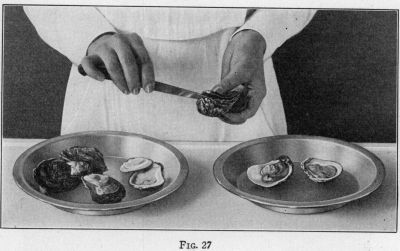
Oysters that are to be eaten raw are frequently served on the half shell. Therefore, if they are to be used in this way, place each oyster, as it is loosened in the process of opening, into the deeper shell, as Fig. 27 shows, and discard the other one. Very often good-looking oyster shells are saved in order that they may be used from time to time in serving raw oysters that are bought already opened.
90. RAW OYSTERS.--When an appetizer is desired in a meal that is to consist of several courses, raw oysters are often used for the first course. Oysters that are to be eaten raw may be served in the shells or removed from them. They are bland in flavor, however, and require some sharp, highly seasoned sauce in order to give them sufficient snap. The sauces commonly used for this purpose include cocktail sauce, chilli sauce, catsup, horseradish, and tobasco sauce. Sometimes, though, lemon juice or vinegar and pepper and salt are preferred to sauce. As a rule, crisp crackers, small squares of toast, or wafers and butter accompany raw oysters in any form, and sometimes celery and radishes are served, too.
91. When a cocktail sauce is served with raw oysters, they are generally referred to as OYSTER COCKTAILS. Two methods of serving these are in practice. In one, as shown in Fig. 28, the cocktail sauce is put into a small glass placed in the center of a soup plate filled with cracked ice, and the oysters, usually six in half shells, are arranged around the glass, on the ice. In the other, as shown in Fig. 29, the desired number of oysters that have been removed from the shells are dropped into a stemmed glass containing the cocktail sauce, and the glass is placed in a bowl of cracked ice. An oyster fork, which is a small, three-pronged fork, is always served with raw oysters, and usually a piece of lemon is supplied in addition to the cocktail sauce.
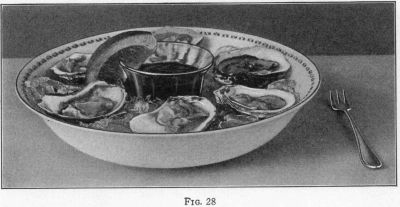
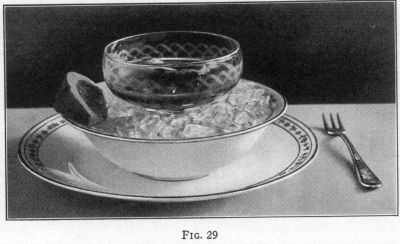
92. OYSTER STEW.--If an extremely nutritious way of preparing oysters is desired, oyster stew should be selected. This is perhaps the simplest way in which to cook oysters, and yet care must be exercised in making this dish, for the oysters should not be cooked too long and the milk, which must be brought to the boiling point, should not be allowed to burn. Oyster stew makes an excellent dish for lunch. It should not be served as the first course of a heavy meal because of the large amount of nutriment it contains.
OYSTER STEW
(
Sufficient to Serve Six
)
1 qt. oysters
1 qt. milk
2 Tb. butter
1 tsp. salt
1/8 tsp. pepper
Pour 1 cupful of water over the oysters, look them over carefully, and remove any pieces of shell that may cling to the oysters, making sure that any particles of sand are washed off. Heat this liquid to the boiling point and then strain it through a cloth. Put the milk on the fire to heat, and when hot, add the butter, salt, and pepper, and strained liquid. After the whole mixture has come to the boiling point, pour in the oysters and cook until they look plump and the edges begin to curl. Remove from the heat and serve with crisp crackers.
93. CREAMED OYSTERS.--Another nutritious way in which to prepare oysters and at the same time produce a dish that is pleasing to most persons is to cream them. After being creamed, oysters may be served over toast or in timbale cases.
CREAMED OYSTERS
(
Sufficient to Serve Six
)
2 Tb. butter
24 oysters
1-1/2 c. medium white sauce
Salt and pepper
6 slices toast or 6 timbale cases
Melt the butter in a frying pan, add the oysters, and heat them in the butter until the edges begin to curl slightly. Pour the hot oysters into the hot white sauce, season to taste with salt and pepper, and serve over toast or in timbale cases.
94. SCALLOPED OYSTERS.--No food makes a more palatable scalloped dish than oysters. Oysters so prepared are liked by nearly every one, and the ingredients with which they are combined help to give such a dish balance so far as the food substances are concerned. Care should be taken, however, in the baking of scalloped oysters, for they are likely to become tough if they are cooked too long.
SCALLOPED OYSTERS
(
Sufficient to Serve Six
)
1 c. bread crumbs
2 Tb. butter
1 c. cracker crumbs
1 pt. oysters
Salt and pepper
1 c. milk
Butter the bread crumbs with the butter, and then mix them with the cracker crumbs. Sprinkle the bottom of a greased baking dish with one-fourth of the crumbs, and over this put a layer of oysters that have been previously cleaned. Sprinkle with salt and pepper and add one-fourth more of the crumbs. Add another layer of oysters, sprinkle with salt and pepper, and place the remainder of the crumbs on top. Strain the liquid from the oysters through a piece of cloth, mix this with the milk, and pour over the dish thus prepared. Place in a hot oven, and bake until the mixture is thoroughly heated and the top is brown.
95. FRIED OYSTERS.--Of all the dishes prepared from oysters, fried oysters undoubtedly find favor with the greatest number of persons. However, unless care is taken in frying the oysters, they are likely to be somewhat indigestible. Deep fat should be used for this purpose, and it should be hot enough to brown a 1-inch cube of bread a golden brown in 40 seconds.
FRIED OYSTERS
(
Sufficient to Serve Six
)
24 large oysters
1 egg
1/4 c. milk
Fine cracker crumbs
Salt
Pepper
Thoroughly dry the oysters by laying them on one end of a soft cloth and patting them with the other. Beat the egg and add the milk to it. Dip the oysters into the cracker crumbs, then into the egg-and-milk mixture, and again into the crumbs. Fry in deep fat until brown. Remove from the fat, drain well, and place on oiled paper. Sprinkle with salt and pepper and serve hot.
96. OYSTER PIE.--Baking oysters into a pie is another means of combining a protein food with foods that are high in other food substances. As oyster pie is somewhat hearty, it may be used as the main dish of a heavy meal.
OYSTER PIE
(
Sufficient to Serve Six
)
1 pt. oysters
1 c. medium white sauce
Salt and pepper
Baking-powder biscuit dough
Cut each of the oysters into three or four pieces, and place them in a greased baking dish. Pour over them the hot white sauce and the juice from the oysters. Season with salt and pepper. Over the top, place a layer of the biscuit dough rolled about 1/4 inch thick. Set in a hot oven and bake until the crust is brown.
97. PIGS IN BLANKETS.--When something entirely different in the way of oysters is desired, pigs in blankets should be tried. This is a very good name for the dish given in the accompanying recipe, for the oysters are rolled up in a strip of bacon, which serves as a blanket. They are especially suitable for a light meal, such as luncheon or a dainty lunch that is to be served to company.
PIGS IN BLANKETS
(
Sufficient to Serve Six
)
18 large oysters
18 thin strips of bacon
After the oysters have been cleaned, roll each one in a strip of bacon. Fasten the bacon where the edges meet by running a toothpick through at this point. Place in a broiler and broil on one side until brown; then turn them and broil until the other side is brown. Serve hot.
98. OYSTER FRITTERS.--Variety may also be secured in the use of oysters by making oyster fritters. When such fritters are nicely browned and served with an appetizing sauce, an attractive as well as a tasty dish is the result.
OYSTER FRITTERS
(
Sufficient to Serve Six
)
1 pt. oysters
1 egg muffin batter
Clean the oysters and cut each into four or five pieces. Make a one-egg muffin batter and to it add the cut oysters. Drop the mixture by spoonfuls into deep fat and fry until brown. Remove from the fat, drain, and sprinkle with salt and pepper. Serve with a desired sauce.
CLAMS AND THEIR PREPARATION
99. NATURE AND DIGESTIBILITY OF CLAMS.--Clams are bivalves similar to oysters in both form and composition. Because of the similarity in composition, they are utilized in much the same ways as oysters, being used extensively for food in parts of the country where the supply is large. There are numerous varieties of clams, and some of them differ slightly from each other in appearance, color, and flavor. Preference for the different varieties is largely a matter of individual taste.
Clams may be purchased loose or in the shell and they may be served in or out of the shell. However, when bought in the shell, they must be purchased alive and must be subjected to the same tests as are oysters. As in the case of oysters, they may be eaten raw or cooked. Their preparation for cooking is similar to that of oysters. In the raw state, they are easily digested, but upon the application of heat they become tough, and the longer they are cooked, the tougher they become. It can therefore be seen that the digestibility of clams is influenced very much by cooking.
100. OPENING CLAMS.--If clams are to be opened in the home, the method illustrated in Fig. 30 may be employed. First wash the clams to remove the sand, and then place a clam on a hard surface so that the pointed edge is up. Insert the thin edge of a knife into the very slight groove between the shells, or valves, and with a heavy utensil of some kind strike the top of the knife several times so as to separate the valves. Then, as in opening oysters, spread the shells apart, as shown, and loosen the clam from the shell it adheres to.
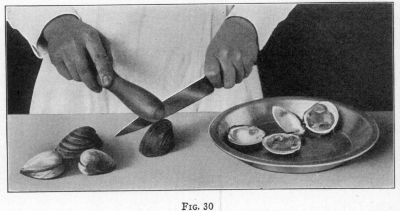
101. RAW CLAMS.--Like oysters, raw clams are generally served as a cocktail, or an appetizer, at the beginning of a meal. If they are to be served in the half shell, place them in a dish of cracked ice; if they are to be served without the shells, place the required number in a stemmed glass that is set in a dish of cracked ice. In either case, lemon or a suitable sauce, or both, should be supplied.
102. STEAMED CLAMS.--Steaming is the method generally adopted when clams in large numbers are cooked for a "clam bake," but there is no reason why it cannot be used by the housewife when she wishes to cook only enough for her family. When large quantities are to be steamed, use is generally made of a steamer, but the housewife will find that she can steam a few clams very satisfactorily in a saucepan or a similar vessel.
To prepare steamed clams, scrub the shells of the clams until they are perfectly clean. Place the desired number thus cleaned in a saucepan and add enough water to cover the bottom of the pan about 1 inch. Allow this to cook until the shells of the clams open. Remove the clams from the pan and serve them in the shells. Provide each person with a small dish of melted butter into which to dip the clams as they are removed from the shells to be eaten. The liquid found in the clams may be poured from the shell before the clams are served, and after being well seasoned may be served as clam broth.
103. BAKED CLAMS.--Another very appetizing way in which to prepare clams is to combine them with bread crumbs, season them well, and then bake them until they are well browned. Select several good-sized clams for each person to be served. Scrub the shells well and open them. Remove the clams and chop them into small pieces. To each cupful of chopped clams, add 2 cupfuls of buttered bread crumbs, 1 tablespoonful of chopped parsley, 1 tablespoonful of chopped pimiento, and 1 tablespoonful of onion juice. Season the mixture with salt and pepper and fill the shells with it. Place these in a shallow pan and bake in a very hot oven until the crumbs are well browned on top. Serve hot.
104. FRIED CLAMS.--As oysters make a very desirable dish when fried in deep fat, so clams may be treated in this way, too. Remove the desired number of clams from the shells, wash them thoroughly, and dry them on a clean towel. Dip them into beaten egg, and finally into the crumbs. Fry in deep fat until they are a golden brown. Serve with slices of lemon.