Volume 1 — CEREALS (continued 2)
Reading edition
92. MACARONI WITH TOMATO AND BACON.--Macaroni alone is somewhat tasteless, so that, as has been pointed out, something is usually added to give this food a more appetizing flavor. In the recipe here given, tomatoes and bacon are used for this purpose. Besides improving the flavor, the bacon supplies the macaroni with fat, a food substance in which it is low.
MACARONI WITH TOMATO AND BACON
(
Sufficient to Serve Six
)
1 c. macaroni
2 qt. boiling water
2 tsp. salt
2 c. canned tomatoes
8 thin slices bacon
Break the macaroni into inch lengths and cook it in the boiling salted water until it is tender. Place a layer of the cooked macaroni on the bottom of a baking dish; over this layer put 1 cupful of the tomatoes, and on top of them spread four slices of bacon. Then add another layer of the macaroni, the other cupful of tomatoes, and a third layer of macaroni. On top of this layer, place the remaining four slices of bacon, and then bake the food for one half hour in a slow oven. Serve hot.
93. MACARONI WITH CHEESE.--Cheese is combined with macaroni probably more often than any other food. It supplies considerable flavor to the macaroni and at the same time provides fat and additional protein. The cooking operation is practically the same as that just given for macaroni with tomatoes and bacon.
MACARONI WITH CHEESE
(
Sufficient to Serve Six
)
1-1/2 c. macaroni
3 qt. boiling water
3 tsp. salt
1-1/2 Tb. butter
1-1/2 Tb. flour
1 tsp. salt
1/8 tsp. pepper
1/8 tsp. paprika
1-1/2 c. milk
1 c. grated or finely cut cheese
1/4 c. crumbs
Break the macaroni into inch lengths and cook it until it is tender in the 3 quarts of boiling water to which 3 teaspoonfuls of salt has been added. Melt the butter in a saucepan, add the flour, the 1 teaspoonful of salt, the pepper, and the paprika, stir until smooth, and then gradually add the milk, which should be hot. Allow to cook until it thickens. Arrange the cooked macaroni in layers, pouring the sauce and sprinkling salt and cheese over each layer. Then cover the top layer with the crumbs and bake the food in a moderate oven for one half hour. Serve hot.
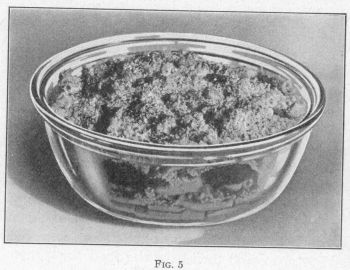
94. MACARONI WITH CHEESE AND TOMATO.--Although the food combinations given are very satisfactory, a dish that is extremely appetizing to many persons may be made by combining both cheese and tomato with macaroni. Such a nutritious combination, which is illustrated in Fig. 5, can be used as the principal dish of a heavy meal.
MACARONI WITH CHEESE AND TOMATO
(
Sufficient to Serve Six
)
1 c. macaroni
1 c. grated cheese
2 qt. boiling water
2 Tb. butter
2 tsp. salt
1/8 tsp. pepper
1 1/2 c. canned tomatoes
1 tsp. salt
Break the macaroni into inch lengths and cook it until it is tender in the boiling water to which 2 teaspoonfuls of salt has been added. Put a layer of the cooked macaroni on the bottom of a baking dish, pour one-half of the tomatoes and one-third of the cheese over it, dot with butter, and sprinkle with salt and pepper. Then add another layer of macaroni, the remainder of the tomatoes, one-third more of the cheese, butter, salt, and pepper. Finally, arrange another layer of macaroni, put the remaining cheese and some butter on top of it, and bake the food for 1/2 hour in a moderate oven. Serve hot.
95. MACARONI ITALIAN STYLE.--If small quantities of fried or boiled ham remain after a meal, they can be used with macaroni to make a very tasty dish known as macaroni Italian style. As ham is a highly seasoned meat, it improves the flavor of the macaroni and at the same time adds nutrition to the dish.
MACARONI ITALIAN STYLE
(
Sufficient to Serve Six
)
1 c. macaroni
2 qt. boiling water
2 tsp. salt
2 Tb. butter
2 Tb. flour
1-1/2 c. scalded milk
2/3 c. grated cheese
1 tsp. salt
1/2 tsp. paprika
1/2 c. finely chopped, cold boiled ham
1/4 c. crumbs
Break the macaroni into inch lengths and cook it in the boiling water to which has been added 2 teaspoonfuls of salt. Drain, and then reheat it in a white sauce made of the butter, flour, and milk. Add the cheese and season with salt and paprika. Arrange in layers in a baking dish, placing the cold ham between each two layers of macaroni and having the top layer of macaroni, sprinkle the crumbs on top of the upper layer, and bake the food until the crumbs are brown. Garnish with parsley and serve.
96. MACARONI AND KIDNEY BEANS.--The combination of canned kidney beans and macaroni is a rather unusual one, but it makes a very appetizing dish, especially when canned tomatoes are added, as in the recipe here given.
MACARONI AND KIDNEY BEANS
(
Sufficient to Serve Eight
)
1 c. macaroni
2 qt. water
2 tsp. salt
2 Tb. butter
2 Tb. flour
3/4 c. hot milk
1/2 c. canned tomatoes
1 tsp. salt
1/4 tsp. pepper
1 c. canned kidney beans
Cook the macaroni in the salted water until it is tender and then drain it. Prepare the sauce by melting the butter in a saucepan, rubbing the flour into it until a smooth paste is formed, and then adding slowly the hot milk. Cook this sauce for 5 minutes. Force the tomato through a sieve, turn it into the hot sauce, and season all with salt and pepper. Pour the sauce over the macaroni and the kidney beans, and then heat all together. When the food is thoroughly heated, turn it into a dish and serve.
97. SPAGHETTI WITH CHEESE AND TOMATO SAUCE.--The accompanying recipe for spaghetti with cheese and tomato sauce will serve to illustrate that this form of Italian paste may be prepared in the same manner as macaroni; that is, to show how simple it is to substitute one kind of Italian paste for another. Any of these pastes, as has been mentioned, is especially appetizing when prepared with cheese and tomato.
SPAGHETTI WITH CHEESE AND TOMATO SAUCE
(
Sufficient to Serve Six
)
1 c. spaghetti
2 Tb. butter
2 qt. boiling water
2 Tb. flour
2 tsp. salt
1/2 c. grated cheese
1 can tomatoes
1 tsp. salt
1 small onion, chopped
1/4 tsp. pepper
1/2 c. water
Boil the spaghetti in the 2 quarts of boiling water to which has been added 2 teaspoonfuls of salt, and after it is tender drain off the water. Then proceed to make the sauce. Boil the tomatoes and the chopped onion in the 1/2 cupful of water for 10 minutes. Strain this mixture and to it add the butter and the flour, which should first be mixed with a little cold water. Cook this until it thickens and then add the cheese, 1 teaspoonful of salt, and the pepper. Pour the entire mixture over the cooked spaghetti, reheat, and serve.
98. LEFT-OVER ITALIAN PASTES.--No cooked Italian paste of any kind should ever be wasted. Any left-over macaroni, spaghetti, or vermicelli can be reheated and served as it was originally or it can be used in soups. If a sufficient amount is left after a meal, a good plan is to utilize it in croquettes. To make such croquettes, chop the left-over food fine and hold it together with a thick white sauce or with raw eggs. Then form it into croquettes of the desired shape, roll these in bread or cracker crumbs, and brown them in butter.
BREAKFAST MENU
99. A well-planned breakfast menu is here given, with the intention that it be prepared and used. This menu, as will be observed, calls for at least one of the dishes that have been described, as well as some that have not. Directions for the latter, however, are given, so that no difficulty will be experienced in preparing the menu. After the recipes have been followed out carefully, it will be necessary to report on the success that is had with each dish and to send this report in with the answers to the Examination Questions at the end of this Section. The recipes are intended to serve six persons, but they may be changed if the family consists of fewer or more persons by merely regulating the amounts to suit the required number, as is explained elsewhere.
MENU
Berries and Cream or Oranges
Cream of Wheat or Rolled Oats and Cream
Scrambled Eggs
Buttered Toast
Cocoa or Coffee
SCRAMBLED EGGS
5 eggs
1/2 c. milk
1/2 tsp. salt
2 Tb. butter
1/8 tsp. pepper
Beat the eggs slightly and add the salt, pepper, and milk. Heat a pan, put in the butter, and, when it is melted, turn in the mixture. Cook this mixture until it thickens as much as desired, being careful to stir it and to scrape it from the bottom of the pan, so that it will not burn. Remove from the pan and serve hot.
BUTTERED TOAST
Bread for toasting should as a rule be 48 hours or more old. Cut the desired number of slices, making each about 1/4 to 1/2 inch thick. Place the slices on a toaster over a bed of clear coals or on a broiler under a slow gas flame. Turn the bread frequently until it assumes an even light brown on both sides. Remove from the heat, spread each slice with butter, and serve while hot and crisp.
COCOA
2 c. scalded milk
3 Tb. cocoa
3 Tb. sugar
1/4 tsp. salt
2-1/2 c. boiling water
Scald the milk in a double boiler. Mix the cocoa, sugar, and salt. Stir the boiling water into this mixture gradually, and let it boil for several minutes over the fire. Then turn the mixture into the hot milk in the double boiler, and beat all with an egg beater for several minutes. A drop of vanilla added to the cocoa just before serving adds to its flavor.
BOILED COFFEE
Scald a clean coffee pot, and into it put 12 level tablespoonfuls of ground coffee. Add several crushed egg shells or the white of one egg, pour in 1 cupful of cold water, and shake until the whole is well mixed. Add 5 cupfuls of freshly boiling water and put over the fire to boil. After the coffee has boiled for 5 minutes, pour 1/4 cupful of cold water down the spout. Allow it to stand for a few minutes where it will keep hot and then serve.
CEREALS
EXAMINATION QUESTIONS
(1) (a) Mention the eight cereals that are used for food. (b) How may the universal consumption of cereals be accounted for?
(2) (a) Explain why cereals and cereal products are economical foods. (b) What factors should be considered in the selection of cereals?
(3) (a) Why are cereals not easily contaminated? (b) What care in storage should be given to both prepared and unprepared cereals?
(4) (a) Explain briefly the composition of cereals. (b) Describe the structure of cereal grains.
(5) What food substance is found in the greatest proportion in cereals?
(6) What characteristics of cereals make them valuable in the diet?
(7) What material, besides the food substances, is always present in cereals, and what are its purposes?
(8) What is the purpose of cooking cereals?
(9) (a) What occurs when starch is cooked in a liquid? (b) Describe the process of setting a cereal.
(10) (a) Mention the various methods of cooking cereals, (b) What are the advantages of the double-boiler method?
(11) (a) What influences the proportion of water required and the length of time necessary to cook cereals? (b) Is it an advantage to cook cereals for a long time? Tell why.
(12) Mention the cereals that you would use in winter and tell why you would use them.
(13) (a) Of what advantage is it to add dates to cream of wheat? (b) Mention some of the ways in which left-over wheat cereals may be utilized.
(14) (a) Explain the three methods of cooking rice, giving the proportion of water to rice in each one. (b) How should rice grains look when they are properly cooked?
(15) Mention several ways in which to utilize left-over rolled oats.
(16) (a) What advantages have ready-to-eat cereals over unprepared ones? (b) Tell why cereals that have been toasted are said to be predigested.
(17) (a) What is the advantage of serving milk or cream with cereals? (b) How may variety be secured in the serving of cereals?
(18) (a) How are Italian pastes made? (b) Mention and describe the three principal varieties of Italian paste, (c) What tests can be applied to judge the quality of these foods?
(19) (a) Explain the first steps in cooking macaroni, (b) How much does macaroni increase upon being boiled?
(20) (a) Why may macaroni be substituted for meat in the diet? (b) What foods used in the preparation of macaroni make it a better meat substitute?
REPORT ON MENU
After trying out the breakfast menu given in the text, send with your answers to the Examination Questions a report of your success. In making out your report, simply write the name of the food and describe its condition by means of the terms specified in the following list?
Cream of Wheat: thin? thick? lumpy? smooth? salty? well flavored?
Rolled Oats: thin? thick? lumpy? smooth? salty? well flavored?
Scrambled Eggs: dry? moist? watery? salty? well flavored?
Buttered Toast: thin? thick? crisp? soggy? browned? not sufficiently toasted? unevenly browned?
Cocoa: smooth? strong? weak? thick? scum formed on top?
Coffee: strong? weak? muddy? clear?