Volume 1 — BREAD (continued 2)
Reading edition
SALT-RISING BREAD
(
Sufficient for Two Loaves
)
1 c. fresh milk
1/4 c. corn meal
1 tsp. salt
2 tsp. sugar
2 c. lukewarm water
7 c. white flour
1/2 c. white flour additional for kneading
Scald the milk and pour it over the corn meal, salt, and sugar. Allow this mixture to stand in a warm place for several hours or overnight, when it should be light. To this batter add the warm water and enough flour to make a drop batter. Allow this to stand in a warm place until it is light; and then add the remainder of the flour so as to make a dough, and knead. Allow this to rise, shape it into loaves, put it in pans, let it rise again, and bake.
RECIPES FOR ROLLS, BUNS, AND BISCUITS
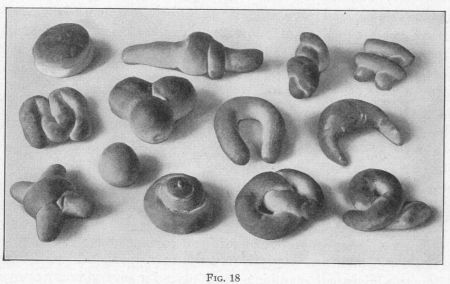
83. While the preceding recipes call for bread in the form of loaves, it should be understood that bread may be made up in other forms, such as rolls, buns, and biscuits. These forms of bread may be made from any of the bread recipes by adding to the mixture shortening, sugar, eggs, fruit, nuts, spices, flavoring, or anything else desirable. Since these things in any quantity retard the rising of the sponge or dough, they should be added after it has risen at least once. Rolls, buns, and biscuits may be made in various shapes, as is shown in Fig. 18. To shape them, the dough may be rolled thin and then cut with cutters, or the pieces used for them may be pinched or cut from the dough and shaped with the hands. After they are shaped, they should be allowed to rise until they double in bulk. To give them a glazed appearance, the surface of each may be brushed before baking with milk, with white of egg and water, or with sugar and water. Butter is also desirable for this purpose, as it produces a crust that is more tender and less likely to be tough. Rolls, buns, or biscuits may be baked in an oven that has a higher temperature than that required for bread in the form of loaves, as is indicated in Fig. 4, and only 15 to 20 minutes is needed for baking them. If such forms of bread are desired with a crust covering the entire surface, they must be placed far enough apart so that the edges will not touch when they are baking.
So that experience may be had in the preparation of rolls, buns, and biscuits there are given here several recipes that can be worked out to advantage, especially after proficiency in bread making has been attained.
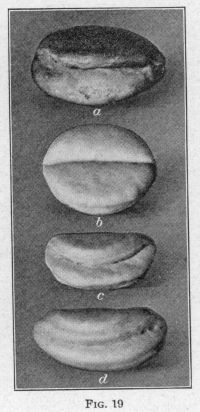
84. PARKER HOUSE ROLLS.--Of the various kinds of rolls, perhaps none meets with greater favor than the so-called Parker House rolls, one of which is shown at a, Fig. 19. Such rolls may be used in almost any kind of meal, and since they are brushed with butter before they are baked, they may be served without butter, if desired, in a meal that includes gravy or fat meat.
PARKER HOUSE ROLLS
(
Sufficient for 3 Dozen Rolls
)
1 cake compressed yeast
1 pt. lukewarm milk
4 Tb. fat
2 Tb. sugar
1 tsp. salt
3 pt. white flour
1 c. white flour additional for kneading
Dissolve the yeast in some of the lukewarm milk. Pour the remainder of the warm milk over the fat, sugar, salt, and dissolved yeast, all of which should first be put in a mixing bowl. Stir into these ingredients half of the flour, and beat until smooth. Cover this sponge and let it rise until it is light. Add the remainder of the flour, and knead until the dough is smooth and does not stick to the board. Place the dough in a greased bowl, and let it rise again until it doubles in bulk. Roll the dough on a molding board until it is about 1/4 inch thick. Then cut the rolled dough with a round cutter; brush each piece with soft butter; mark it through the center, as at b, Fig. 19, with the dull edge of a kitchen knife; and fold it over, as at c. Place the pieces of dough thus prepared in shallow pans, about 1 inch apart, and let them rise until they are light, when each roll will appear like that shown at d. Then bake them in a hot oven for about 15 minutes.
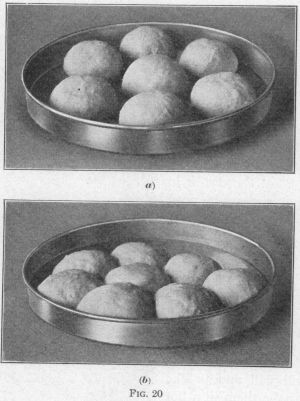
85. DINNER ROLLS.--As their name implies, dinner rolls are an especially desirable kind of roll to serve with a dinner. They should be made small enough to be dainty, and as an even, brown crust all over the rolls is desirable they should be placed far enough apart in the pans to prevent them from touching one another, as shown in Fig. 20 (a). If they are placed as in (b), that is, close together, only part of the crust will be brown. When made according to the accompanying recipe, dinner rolls are very palatable.
DINNER ROLLS
(
Sufficient for 1-1/2 Dozen Rolls
)
1 cake compressed yeast
1 c. lukewarm milk
2 Tb. sugar
2 Tb. fat
1 tsp. salt
3 c. white flour
1 egg white
1/2 c. white flour additional for kneading
Dissolve the yeast in some of the lukewarm milk. Put the sugar, fat, salt, and dissolved yeast in the mixing bowl, and pour the remainder of the milk over these ingredients. Stir half of the flour into this mixture and allow the sponge to rise. When it is light, add the egg white, which should first be beaten, and the remainder of the flour, and then knead the dough. Let the dough rise until it doubles in bulk. Roll out the dough until it is 1/2 inch thick, and then cut out the rolls with a small round cutter. Place these in a shallow pan and let them rise until they are light. Then glaze each one with the white of egg to which is added a little water and bake them in a hot oven for about 15 minutes.
86. LUNCHEON ROLLS.--If rolls smaller than dinner rolls are desired, luncheon rolls will undoubtedly be just what is wanted. Since these are very small, they become thoroughly baked and are therefore likely to be even more digestible than bread or biscuit dough baked in a loaf. For rolls of this kind, the following recipe will prove satisfactory:
LUNCHEON ROLLS
(
Sufficient for 2 Dozen Rolls
)
1 cake compressed yeast
1-1/4 c. lukewarm milk
2 Tb. sugar
2 Tb. fat
1 tsp. salt
4 c. white flour
1 egg white
1/2 c. white flour additional for kneading
Combine the ingredients in the manner directed for making dinner rolls. Shape the dough into biscuits the size of a small walnut, place them in a shallow pan, spacing them a short distance apart, and let them rise until they are light. Next, brush the tops of them with melted butter, and then bake them in a hot oven for about 15 minutes.
87. WHOLE-WHEAT ROLLS.--Rolls made of whole-wheat flour are not so common as those made of white flour, and for this reason they appeal to the appetite more than ordinary rolls. Whole-wheat rolls have the same advantage as bread made of whole-wheat flour, and if they are well baked they have a crust that adds to their palatableness.
WHOLE-WHEAT ROLLS
(
Sufficient for 3 Dozen Rolls
)
1 pt. lukewarm milk
1 cake compressed yeast
1 tsp. salt
3 Tb. sugar
4 Tb. fat
2 c. white flour
4 c. whole-wheat flour
1/2 c. white flour additional for kneading
Set a sponge with the lukewarm milk, in which are put the yeast cake, salt, sugar, fat, and white flour. Allow this to become very light, and then add the whole-wheat flour. Knead this dough and allow it to double in bulk. Then shape it into rolls, allow them to rise, and bake for 15 to 20 minutes.
88. GRAHAM NUT BUNS.--Buns made of graham flour and containing nuts are not only especially delightful in flavour, but highly nutritious. Because they are high in food value, they may be served with a light meal, such as lunch or supper, to add nutrition to it. The recipe here given will result in excellent buns if it is followed closely.
GRAHAM NUT BUNS
(
Sufficient for 3 Dozen Buns
)
1 cake compressed yeast
2 c. lukewarm milk
4 Tb. brown sugar
2 tsp. salt
2 Tb. fat
2-1/2 c. white flour
1 egg
1 c. chopped nuts
3-1/2 c. graham flour
1 c. white flour additional for kneading
Dissolve the yeast in a little of the lukewarm milk. Place the sugar, salt, fat, and dissolved yeast in the mixing bowl and add the remainder of the warm milk. Stir in the white flour and let the sponge thus formed rise. Then add the egg, which should first be beaten, the nuts, and the graham flour. Knead the dough and shape it into buns. Let these rise and then bake them in a hot oven for about 15 minutes.
89. NUT OR FRUIT BUNS.--Nuts or fruit added to buns made of white flour provide more mineral salts and bulk, substances in which white flour is lacking. Buns containing either of these ingredients, therefore, are especially valuable in the diet. Besides increasing the food value of the buns, nuts and fruit improve the flavour and make a very palatable form of bun. Buns of this kind are made as follows:
NUT OR FRUIT BUNS
(
Sufficient for 2 Dozen Buns
)
4 Tb. sugar
1 Tb. fat
1 tsp. salt
1 cake compressed yeast
1 c. lukewarm milk
3 c. white flour
3/4 c. chopped nuts or raisins
1 c. white flour additional for kneading
Add the sugar, fat, and salt to the yeast dissolved in a little of the milk. Then stir in the remainder of the milk and half of the flour. Allow this sponge to rise until it is very light, and then add the remainder of the flour and the nuts or the raisins. Knead at once and form into buns. Let these rise until they are light. Then moisten them with milk and sprinkle sugar over them before placing them in the oven. Bake for about 15 minutes.
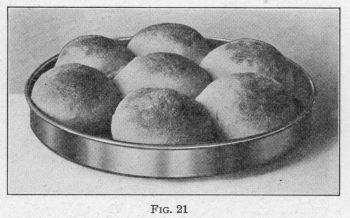
90. SWEET BUNS.--Persons who prefer a sweet bun will find buns like those shown in Fig. 21 and made according to the following recipe very much to their taste. The sweetening, eggs, and lemon extract used in this recipe give to the white buns a delightful flavour and help to lend variety to the usual kind of bun.
SWEET BUNS
(
Sufficient for 1-1/3 Dozen Buns
)
1 cake compressed yeast
1 c. lukewarm scalded milk
1/4 c. sugar
2 Tb. fat 1 tsp.
1 tsp. salt
3-1/2 c. white flour
2 eggs
1 tsp. lemon extract
1 c. white flour additional for kneading
Dissolve the yeast in a small amount of the lukewarm milk and add it to the sugar, fat, salt, and remaining milk in the mixing bowl. Stir into this mixture half of the flour, beat well, and let the sponge rise until it is light. Add the eggs, which should first be beaten, the lemon extract, and the remaining flour. Knead until the dough is smooth. Let the dough rise again and then shape it into rolls. Allow these to rise, and then bake them in a hot oven for about 15 minutes.
91. COFFEE CAKE.--When an especially good kind of biscuit that can be served for breakfast and eaten with coffee is desired, coffee cake made according to the following recipe should be used. Cinnamon sprinkled over the top of such cake imparts a very pleasing flavour, but if more of this flavour is preferred 1 teaspoonful of cinnamon may be mixed with the dough.
COFFEE CAKE
(
Sufficient for One Cake
)
1 cake compressed yeast
1/2 c. lukewarm milk
1 Tb. sugar
1/2 tsp. salt
2 c. white flour
1 egg
2 Tb. fat
1/4 c. brown sugar
1/2 c. white flour additional for kneading
Dissolve the yeast in the lukewarm milk and add the sugar and the salt. Stir in 1 cupful of flour and let the mixture rise. When the sponge is light, add the beaten egg, the fat and the brown sugar creamed, and the remaining flour. Knead until the dough is smooth and allow it to rise until it is double in bulk. Then roll the dough until it is 1/2 inch thick, place it in a shallow pan, and let it rise until it is light. Brush the top with 1 tablespoonful of melted butter and sprinkle it with 3 teaspoonfuls of cinnamon and 3 tablespoonfuls of sugar. Bake 10 to 15 minutes in a moderately hot oven.
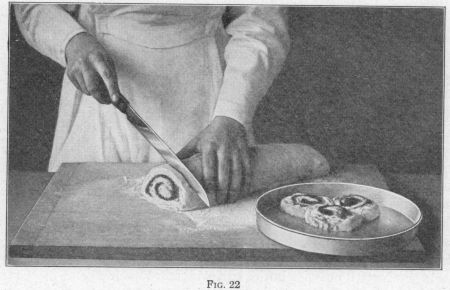
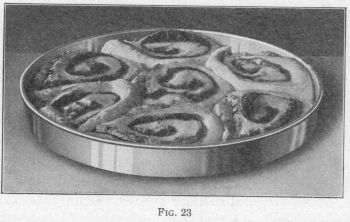
92. CINNAMON ROLLS.--To make cinnamon rolls, which are preferred by some persons to coffee cake, use may be made of the preceding coffee-cake recipe. However, instead of rolling the dough 1/2 inch thick, roll it 1/4 inch thick and brush it with melted butter. Then sprinkle it with 1 tablespoonful of cinnamon, 1/2 cupful of light-brown sugar, and 1/2 cupful of chopped raisins. Next, roll this as a jelly roll and cut the roll into 1/2-inch slices, as shown in Fig. 22. Place these slices close together in a shallow pan and let them rise until they are light, as in Fig. 23. Then bake them in a hot oven for about 15 minutes.
TOAST
93. As every one knows, TOAST is sliced bread browned by means of heat. To make toast is not a difficult process, but a certain amount of care must be exercised if good results are desired. The slices used for toast may be cut thick or thin, depending on whether the persons for whom the toast is made prefer a soft or a dry toast and whether the digestibility of the toast is to be taken into consideration. If thick slices are used and they are toasted the usual length of time necessary to make the surfaces brown, the centre of the slices will remain soft. Toast made of thin slices and toasted over a slow fire becomes dry and crisp during the process of browning and is more digestible than that which is moist. Such toast will not lose its crispness unless the pieces are piled in a heap while they are hot and are allowed to soften from the moisture that collects. While toast is usually served in the form of slices, just as they are cut from the loaf, the pieces may be cut into shapes of various kinds; in fact, toast becomes more attractive if it is cut in unusual shapes. The crust of toast may be trimmed off or left on, as desired.
94. If the best results are desired in the making of toast, considerable attention must be given to the heat that is to produce the toast. Whatever kind is employed, it should be steady and without flame. Before a coal or a coke fire is used for this purpose, it should be allowed to burn down until the flame is gone and the coals are hot enough to reflect the heat for toasting. If a gas toaster is used, the gas should be turned sufficiently low for the bread to brown slowly. Very good results are obtained from the use of an electric toaster, also. This device has become a rather common household article where electricity is used in the home, and by means of it the toast can be made on the table and served while it is fresh and hot. In whatever way toast is made, it will lose much of its attractiveness unless it is served while it is fresh and before it loses its heat. If toast becomes burned, either from a flame that is too hot or from inattention on the part of the person who is preparing it, it may be made fit for use by scraping it lightly with a knife or by rubbing it across a grater, so as to remove the burned portion.
95. MILK TOAST.--Milk and toast make a combination that is liked by many persons, and when these two foods are combined the result is known as milk toast. To make milk toast, simply pour over the toast rich milk that has been heated and seasoned with salt, a little sugar, and a little butter. Thin white sauce may also be used for this purpose if desired.
96. FRENCH TOAST.--Possibly no dish in which toast is used is better known than the so-called French toast. Both milk and egg are used in making this dish, and these of course add to the food value of the bread. French toast made according to the following recipe will prove very satisfactory.
FRENCH TOAST
(
Sufficient to Serve Eight
)
1 egg
1 c. milk
2 tsp. sugar
8 slices of bread
1/2 tsp. salt
Beat the egg and add it to the milk, salt, and sugar. Dip each slice of bread into this liquid, turn it quickly, and then remove it. Place the bread thus dipped in a hot frying pan and sauté it until the under side is brown; then turn it and brown the other side. Serve hot with sirup or jelly.
LEFT-OVER BREAD
97. Bread that has become stale need not be wasted, for there are many uses to which it may be put. As such bread has lost much of its moisture, it is desirable for toast, for it browns more quickly and makes crisper toast than fresh bread. Thick slices of it may also be cut into cubes or long, narrow strips and then toasted on all sides, to be served with soup instead of crackers. Still another use that can be made of stale bread is to toast it and then cut it into triangular pieces to be served with creamed dishes or used as a garnish for meats, eggs, and various entrées. Left-over toast may also be cut in this way and used for these purposes.
98. The ends of loaves, crusts trimmed from bread used for sandwiches, or stale bread or rolls that cannot be used for the purposes that have been mentioned can also be utilised, so none of them need be thrown away. If such pieces are saved and allowed to dry thoroughly in the warming oven or in an oven that is not very hot, they may be broken into crumbs by putting them through a food chopper or rolling them with a rolling pin. After the crumbs are obtained, they should be put through a coarse sieve in order to separate the coarse ones from the fine ones. Such crumbs, both coarse and fine, may be kept for some time if they are put into jars or cans.
It is a very good plan to keep a supply of bread crumbs on hand, for there are numerous dishes that require the use of bread in this form. For instance, bread crumbs are used for all kinds of scalloped dishes; for making puddings, such as bread pudding, brown Betty, etc.; for stuffing fish, fowl, and such vegetables as tomatoes and peppers; for covering the top of baked dishes, such as various egg and cheese dishes; for breading steaks and chops; and for covering croquettes or oysters that are to be fried. They may also be added to muffins, griddle cakes, and even yeast-bread dough. With so many uses to which bread crumbs can be put, no housewife need be at a loss to know how to utilise any scraps of bread that are not, for some reason, suitable for the table.
BREAD
EXAMINATION QUESTIONS
(1) Mention the ingredients required for bread making.
(2) From what kind of wheat is bread flour usually made?
(3) (a) What is gluten? (b) Why is it necessary for the making of bread?
(4) (a) What is meant by a blend flour? (b) When is its use indicated?
(5) How may the kind and quality of flour be judged in purchasing it?
(6) (a) What is yeast? (b) What things are necessary for its growth? (c) What temperature is best for its growth?
(7) (a) What is produced by the growth of yeast? (b) What part does this play in bread making?
(8) What determines the quantity of yeast to use in bread making?
(9) (a) What will hasten the bread-making process? (b) What will retard it?
(10) Give the general proportions of the main ingredients used for making a loaf of bread.
(11) What are the advantages of: (a) the long process of bread making? (b) the quick process?
(12) What is: (a) a sponge? (b) a dough?
(13) (a) Why must bread dough be kneaded? (b) How is it possible to tell when dough has been kneaded sufficiently?
(14) At what temperature should bread be kneaded?
(15) How should bread be cared for after it is removed from the oven?
(16) What points are considered in the scoring of bread?
(17) What part of bread making may be done in a bread mixer?
(18) What are the differences in time and oven temperatures in baking rolls and bread?
(19) Mention briefly the procedure in making rolls, buns, and biscuits.
(20) Score a loaf of bread you have made and submit the points as you have scored it.