Front matter (continued 3)
Reading edition
"Great luck, wasn't it!" began the pitcher, eagerly.
"The greatest luck was that McGuffy held that fly," Rob answered with more coolness. With all his interest in the trying-out process, habit and experience kept him philosophical. "I didn't believe he'd do it."
"He may be better than he looks," said Patterson.
Rob had no answer for this. "How's your arm?" he said.
"All right. I can give you a little more speed if you want it."
"We shall have to be careful about Durand. The rest ought to be easy."
Smart returned to the bench, having surrendered his place at the bat to Peacock. Owen took a seat beside McGuffy. "You understand that you are to cover second if a man on first tries to steal, don't you?"
"Of course!" answered McGuffy, indignantly.
"I simply want to avoid a misunderstanding," retorted Owen. "I don't care to throw to centre field."
Peacock hit to Hayes, the shortstop, and was thrown out. Fletcher reached first base on balls, but was left there when Patterson sent a fly to Durand. The First team came in to bat once more.
Patterson put the first one over, and Durand met it, driving a grounder to Smart. The shortstop fumbled, and then, when it was too late to catch the fleet runner, threw wide and low to first. How Ames managed to get his mitt on the ball was hard to understand, but the mitt was there and the ball stopped. A new batsman came up, Peters, the right fielder; and Rob, glancing at the pair at first base, made up his mind that Durand was going to steal. So he signalled for a high out, and Peters whacked at it, though it was beyond his reach. Even as the ball struck in the pocket of his mitt, Rob's fingers clutched it; his right leg went out and his arm came back simultaneously; like a flash the arm returned, the wrist snapped forward, and the ball shot straight and swift in a line for second. But alas! there was no one on second to receive it! McGuffy was on the way there, but although he arrived before Durand, the ball was already spinning toward centre field. Fletcher let it slip between his ankles, and Durand jogged easily home.
This was poor work. Rob pounded his fist into the hole of his mitt, disgusted and indignant. But Patterson was waiting for the signal, and there was no chance to give to McGuffy the few forcible suggestions which Rob felt that he ought to be privileged to make. Patterson settled Peters with two high ones in succession; the first a poor one which he struck at, the second a good one which he did not recognize. Then Hayes hit to Patterson and was thrown out; and Borland, after two fouls, was caught on a swift jump ball and retired, muttering hard things at the umpire.
And now Rob had another opportunity at the bat. He still felt the sore spot on his back where O'Connell had potted him on his first appearance, but he stood up to the plate just as courageously as before, confident that O'Connell would not repeat the offence. The pitcher gave two balls, then put one squarely over, which Rob was fortunate enough to hit "on the nose." It sped away in a line over the third baseman's head out into the debatable ground, bounced just inside the foul line, then out, and rolled away into the far corner of the field. Rob raced past first and second, and reached third in safety just before the ball bounded into Durand's hands. Here he stayed while Allis went out on a hit to the second baseman, and Rorbach, waiting patiently, heard two strikes and three balls called. O'Connell dreaded a record of many bases on balls more than an additional run; so he tried to satisfy the umpire by putting one directly over, and Rorbach cracked it whizzing by O'Connell's head out over second base. Rob came home at his leisure. Then stubby McGuffy turned his freckled face toward the pitcher, and by hitting to O'Connell unintentionally sacrificed Rorbach to second; and big Ames, with his woodchopper's swing, drove another long hit into right field and brought Rorbach in. Smart, with the resignation of a fatalist, struck out.
The tail end of the school batting list now appeared at the plate, Weaver, first baseman, and O'Connell. Neither proved a hard problem for the Second battery to solve. Weaver hit a pop foul which Ames caught, and O'Connell struck three times ingloriously. McPherson, sending a long fly to Allis, made the last out. So the third inning ended with the score four to one against the school.
Peacock, Fletcher, and Patterson all went out in the fourth on feeble infield hits, and Poole came to bat a second time, manifestly disturbed by the course of events. It was not merely the fact that the Second hit O'Connell that worried him, but the failure of the First to hit Patterson. It seemed hardly possible that a man who had so little experience in actual play should prove so clever in the balls he used, and so effective in holding off old batsmen. Poole could not or would not understand it. He came up fiercely eager, determined to turn Patterson's luck.
The first pitch he let go by, and had the satisfaction of hearing it called a ball. The second—a straight one—he struck under and fouled. "One strike!" The third came hot, just at the level of his breast, but lifted with a sudden break as his bat swung beneath it. The fourth was obviously a ball, the fifth just as obviously ditto, but it slanted in over the corner, and from the umpire's sharp "Strike three!" there was no appeal, even for Captain Poole.
Sudbury followed, and after balls and strikes, tipped a kindergarten bounder to McGuffy, who, with the air of Little Jack Horner, stopped it and threw it within Ames's long reach. Durand profited by a fumble of Smart's to reach first, but he was caught here a minute later by Owen's quick snap to Ames—and the fourth inning was over.
In the fifth, by an error, a base on balls, and a hit, another run was added to the Second's score. The First too gained a run on a hit by Hayes and errors. But the end came when Borland drove the ball right into Ames's hands; and Weaver, after slashing twice in vain, dropped a fair ball in front of the plate, and found Ames holding it when he reached first.
The game was over. The spectators drifted moodily down toward the school buildings, exchanging sarcastic and pessimistic comments on the work of the school nine and its prospects: "A lot of duffers;" "Couldn't hit a balloon;" "The only players on the field were the Second;" "The Clippers wouldn't have done a thing to 'em;" "Worst exhibition of baseball ever seen." Some, especially Patterson's surprised classmates, looked at the matter from a different point of view and vowed that all the trouble was due to Patterson, who was too good a pitcher for the school batters. Poole had a short talk with Lyford, and then called Patterson aside and thanked him for his good work; he must take good care of himself, for he would certainly be used frequently in the box. Lyford followed with similar compliments, and a troop of others followed Lyford. Even O'Connell came heroically with his meed of praise; and while offering congratulations on his rival's success contrived to explain that he himself had not felt at his best that day, and that it always took time for him to get his arm into shape in the spring. Unquestionably Patterson was the hero of the day.
And what of Owen? He, too, had his share of attention. Lyford assured him that he had played a good game, Poole informed him that he had hit well, some one else spoke of his throwing. But this was all. No one held him in any sense responsible for the pitching, not even those to whom Patterson protested that the credit belonged to Owen. Such statements were to be expected from a modest, reticent fellow like Patterson, who had kept his light hidden under a bushel all the year.
CHAPTER XVIII
DISAPPOINTMENTS
It was "Patterson, Patterson," all over the locker rooms while the ball men were dressing, with frequent mention of Ames, who had especially pleased the crowd, and an occasional word for Owen. The disappointment caused by the poor work of the First glorified by contrast the success of the Second. Rob had many questions to answer or evade. Wasn't he surprised at the way Patterson showed up? Was the pitcher really as good as he seemed? Could he hold his own against a strong nine? How was it that nobody knew anything about him before to-day? Before he escaped from the gymnasium Rob had replied to the same question a dozen times.
Patterson was a good man—he told the questioners—who might always be trusted to give a good account of himself if he had a fair show. Rob did not explain that a fair show involved a suggestive and resourceful catcher, one who could guide and cheer the pitcher, as well as hold the ball and throw to bases. That would have been tantamount to asserting that Patterson's success had been due to his catcher, and Rob would never have taken this attitude even in his secret thoughts. Patterson certainly had the skill and the power; the difficulty was that he didn't understand how to use them.
Outside the gymnasium Owen was hailed by Poole and Lyford.
"You fellows gave us a shock to-day," said Poole. "I didn't enjoy it myself, but it's going to do us a lot of good. Lyford and I have talked things over and have agreed that we've got to make a place for you on the nine."
Rob's heart was fluttering with a delightful anticipation which was reflected in his face. Were they really going to recognize the merit of his work?
"Did you ever play in the outfield?" continued Poole.
From joyful expectation to hopelessness, Rob's plunge was sudden and cruel. Only by a strong effort of will and by turning his head quickly away could he prevent his face from betraying him.
"No, never. I've always caught or played first."
"Well, you see, we've got a good catcher in Borland, who's had lots of experience and is a mighty steady man in a game; and with Weaver, who played first last year, and big Ames, who showed up so well in the game to-day, we're pretty well fixed for first basemen. So the only way seems to be to work you in somewhere in the outfield—say at right—as a regular thing; and then use you when necessary for substitute catcher."
"You'd better take Rorbach," said Owen, almost sullenly. "He hits well and is used to the job."
"We will, if he turns out to be better," returned Poole, with a smile, "but we'll try you first anyway. We shall have to ask you to turn Patterson over to Borland. If he gets on well with Patterson, we may want you to see what you can do with O'Connell."
"If you could help him along as you did Patterson," said the coach, "you might make a good deal of him."
Rob pressed his lips tight together, with a firmness that pursed them out and left wrinkles in the corners. It was a habit of his when angered, as some boys grow red, and others white, and still others gape and glare. On this occasion his set lips served him well, for they kept back the retort which in cooler moments he must have regretted. What he did not say but wanted to was that it would be many moons before any one would find him wasting himself on a mule like O'Connell, and that he didn't propose to train pitchers for Borland to use. So he said nothing, but merely nodded a rather ungracious adieu as the coach and captain left him and went on down to the basement floor of the gymnasium. On the way in, Poole remarked that Owen had a queer streak in him, but was a good fellow all right; and the coach, that the boy seemed rather sullen. It was too bad, for he was evidently a ball player.
Rob stamped up to his room and flung himself down into his Morris chair. There, stretched out, with his hands in his pockets and his cap slipping down over his nose, he gave himself a prey to most disagreeable reflections. So they were bound to make him play in the outfield! He could do it, he supposed, as well as the next man, but it was like taking a fellow who had always played quarter-back and setting him to play end. He must learn an entirely new game, crowd out a better man—Rorbach could field the position twice as well as he could—and in the end probably do the poorest work of the lot. And to take away Patterson, who had practised with him all winter and really owed to his catcher his whole improvement as a pitcher, to take away Patterson and give him to Borland, who had never done a thing for anybody, was outrageous. Why couldn't Poole give him as fair a show as he did Borland? Hadn't he caught just as good a game that afternoon? The details of the record were still vivid in his memory: against Borland one passed ball, two missed third strikes, one high throw to second; for himself not an error, and two as good snaps to bases as he had ever made in his life, even if that chump, McGuffy, didn't cover! Good work evidently went for nothing in this place.
And then he fell to thinking of Patterson and his point of view. Would Pat throw him over without a protest, as Carle had done, when the chance came to pose as first string pitcher with last year's catcher to back him? Not if he knew Patterson! Patterson knew where his strength lay. Pat would be loyal to his catcher to the end. But this, after all, wasn't the worst feature in the prospect. Supposing they should make him pitch to Borland against his will, and Borland shouldn't know how to manage him, and just at the time when encouragement and guidance and right method were especially important, Pat should slump, would he be able to recover his courage and speed and skill again? Rob had his doubts. Pat needed careful nursing.
A knock at the door broke in on these dismal thoughts.
"Come in!" sang out the dejected one from the chair, without troubling himself to remove his hands from his pockets or lift the cap from his nose. It was Laughlin's big body that filled the doorway.
"Hello! Seen anything of Lindsay?"
Rob straightened up and brushed off his cap. "No, not since he left the campus. He spoke to me after the game. Come in, won't you?"
"I guess not," replied the football man. And then, having verbally declined, he contradicted himself by entering and planting his back against the door. "I wanted to see him about that debate between the Laurel Leaf and the Soule Society. You know we're on a committee to arrange it. Tell him I tried to find him, won't you, when he comes in?"
"Yes, I usually see him after dinner."
"I went up to see your game for a little while this afternoon," went on Laughlin, settling down into a stout arm-chair opposite Rob. "I couldn't stay long, for I had a job; but I saw some good back-stop work the little while I was there."
Rob waited expectant, his eyes on the floor. His pulse was beating a trifle faster, while under the pleasing warmth that stole into his heart the morbid depression had fled. Laughlin was not a baseball authority, but he was a man looked up to and respected and followed not more for his achievement as captain of a winning eleven than for the strength of his personal character. His good opinion was in itself a compliment, all the more desirable as he was known to be a close friend of Poole.
"I thought both you and Borland caught well," continued Laughlin; "but while I was there it seemed to me that you were having the best of it. That throw of yours that Reddy was too slow for just took me. Why, the ball looked as if it was shooting along a wire! And how quickly you got it off, too! I don't see how you manage it."
"Oh, I don't always do as well as that," protested Owen, beaming with delight, "though I'm usually fairly good at getting a man at second. There's a knack in it, you know, and I've had considerable practice."
"Patterson is a kind of dark horse, isn't he? I hadn't heard anything about him until lately."
"He's been working with me in the cage all winter," replied Rob, with some complacency. "I knew he was good, but no one else seemed to get on to him. He's improved a lot."
"Well, I hope he'll go right on improving. Perhaps it's you two who are going to win the Hillbury game for us!"
Alas for the catcher's self-complacency! This grouping of Owen and Patterson and the Hillbury game brought Rob suddenly back from the delightful vision of what might have been to the reality of the present. It wasn't to be Patterson and Owen now, but Patterson and Borland. Owen was relegated to right field, and to catching O'Connell! The sunlight suddenly disappeared from Rob's ingenuous face, and black discouragement replaced it. Laughlin observed him with curiosity.
"Only it'll be Patterson and Borland in the Hillbury game," Rob said, regaining his smile by main force. "Poole's going to have Patterson pitch to Borland after this."
"How's that?" demanded Laughlin. And Rob explained with an explanation which suggested a question, and the question in turn produced an answer involving another question, and so there developed a chain of questions and answers linked together like the mathematical series Laughlin had been studying that week in his advanced algebra, but unlike them in having a definite limit and result. This result was that Rob threw aside his reserve and told the whole story of his ambition and disappointment, from the first weeks of the fall when Carle forgot him, through the months of independent cage work with Patterson, to the disheartening issue of that afternoon's game.
"It isn't that I'm such a wonder," he concluded, "or that I want to play whether I'm better than Borland or not; but I don't think it's right for 'em to assume that I'm no good, and pay no attention to what I do. And then to take Patterson away from me just when I've got him into shape, when he wouldn't be worth a cent if I hadn't coached him all winter—I call that dirty mean!"
Laughlin rose and went to the window, where he stood for a brief time gazing across the way at the village urchins noisily romping before their schoolhouse. Then he turned: "It does seem hard luck, but I've found out that things usually turn out right if you're right yourself. I, for one, was glad to hear that Carle had gone. He isn't the stuff good men are made of. If he had stayed, he'd have played us some worse trick. Poole doesn't think so, but Poole doesn't know such fellows as well as I do. Another thing Poole doesn't know is that you're really a better catcher than Borland. It's up to you to go straight ahead and play your game as well as you can, and he'll see what you are before the season's over. When he does see, he'll chuck Borland in a minute. Poole is as straight a fellow as ever breathed, but he makes mistakes like the rest of us. I know from my own experience as captain that it's hard always to pick out the best man. There was Wolcott Lindsay last fall playing on the second eleven up to two weeks of the Hillbury game; and in the game, light as he was, he turned out the best guard on the field. Take my advice: just hold on, play your best game all the time, and keep your courage up."
They stood confronting each other—Laughlin, a square, powerful figure with sincerity and earnestness apparent in every tone of his voice and every line of his rugged face; Owen, with eyes aflame and cheeks flushed, eagerly drinking in his visitor's words. It was appreciation like this that he had been pining for; it gladdened him and at the same time thrilled him through and through.
"There's another thing you can learn from Lindsay's experience," the football man went on. "It pays to work up. The best athletes in the school have almost always been those who had to make a place for themselves. The fellows who come with reputations and condescend to play usually slump early."
He held out his hand. "I must be going; well, good luck to you!"
"Thank you a lot," rejoined Owen, eagerly grasping the big, thick fist. "You won't say anything to Poole about this, will you?"
"Of course not; you've got to work your own way out."
Laughlin was just reaching for the door-knob, when a scurry of feet was heard from across the hall, and the door burst open to admit Simmons, who rushed into the room in a flurry of excitement most unusual in the quiet little student.
CHAPTER XIX
A MISFIT BATTERY
The moment his foot touched the threshold Simmons began to exclaim: "It was perfectly great! I'm awfully glad I went! He's got a peach of a canoe, and what he doesn't know about animals and reptiles and birds—" He stopped suddenly as he caught sight of the massive form of the venerated Laughlin looming behind the door. "Oh, excuse me, I didn't know any one was here."
"No one but me," said the visitor, "and though I'm big, I'm not dangerous. Who's got the peach of a canoe?"
"Payner," answered Simmons, throwing a questioning look at Owen.
"That's the fellow that's been working the plagues on the Pecks, isn't it?"
"Yes," replied Simmons, eagerly. "How did you know about it?"
"Oh, everybody knows something about it," returned Laughlin, with a grin. "I suppose he was after material. What number has he reached now?"
"I think he's getting ready for Number Six," said Simmons, gravely. "He didn't say what it was to be, but he told me all sorts of things he might do. If he does everything he talks about he'll have to put them three at a time to keep within ten. He showed me where he got the newts he put in the clothes-bag, and where he used to catch turtles and water-snakes, and the old stumps where he dug out salamanders. He says that below the falls, on Salt River, you can catch all sorts of things when the tide's out—dip up young eels by the pailful. They'd do to put in the water pitchers."
"I shouldn't care for them in mine," observed Laughlin.
"When it gets warmer there are going to be more things," Simmons continued, growing more confidential and serious as he proceeded. "All sorts of bugs, for example, and hornets' nests that you can take off in the night and throw in through the windows. It's easy to get half a pint of ants from any big ant hill if you only know how, and the brown-tail moth caterpillars they talk so much about—the hairs fly and are poisonous, you know—it wouldn't be at all hard to find a nest with the caterpillars just in the right stage outside the town somewhere. Then he took me into his room and showed me an enormous spider he had in a bottle—he got it from home—and asked me how I thought the Pecks would like it to find such a thing in their pajamas some night. Isn't it awful!"
Simmons stopped for breath, and looked horror-struck from face to face.
"What's it all for, anyway?" asked Laughlin.
"Why, the Pecks ripped up his room, and spoiled some of his specimens," explained Rob. "He wants them to apologize and agree to let him alone. They won't do it."
"Oh, I remember now," Laughlin said. "One of them came to me about a month ago, and asked me what to do. I gave him a raking down for playing such fool tricks, and told him to go and apologize and try to patch it up with Payner. I don't know which it was. I never could tell 'em apart."
"It was Duncan," said Owen. "I gave him the same advice. He's willing to do the right thing, but the other one keeps him back."
"Well, let them suffer then, that's all I've got to say," remarked Laughlin. "I've no sympathy to waste on fools or fellows who won't own up when they're in the wrong."
The senior departed, leaving Owen comforted and reassured. He could afford to wait, he told himself after his caller had gone. Let them give Patterson to Borland if they wished. Borland couldn't manage him, Rob was convinced, and when the new combination failed, Patterson would come back to him, and the pair could start again and work up together. Then it would be clear which was the better catcher, and which battery was the more useful to the school. Yes, Laughlin was right; it was better to work one's way up than to claim a high place at the outset and afterward have to change to the lowest, like the man in the parable who was bidden to a feast. But it was hard on Pat!
In the meantime Simmons had disappeared. He came in again soon, and rather shamefacedly confessed that he had been laboring with the Pecks.
"What luck?" asked Rob; "did they bluff you?"
"That's just what they did. Duncan laughed at me and Donald said he wasn't afraid of anything Payner could produce, either fresh or canned. I told them I merely wanted to warn them of what was before them, and Donald said the chief thing before them was to wipe up the ground with Payner. Then I said they'd better look out, for Payner had a gun, and Donald said he'd need it. I didn't seem to be getting on, so I cleared out."
Owen laughed. "You may as well let them alone. They're looking for trouble, and if they find it it's their own fault."
That evening Duncan stopped Simmons on the way out to Front Street and thanked him for coming to warn them. "I didn't say anything while you were there," he added, "because I knew Don and I'd have a big row about it, and I thought our rows ought to be private. And we did have it after you went, red hot. I'll tell you on the fair, I'm dead sick of the whole thing; it's got on to my nerves and spoils all my fun. We have to keep the door locked all the time, we don't dare open the windows, some one has to be here when the chambermaid comes in, and we're always scared that something's going to happen,—that there'll be some crawly thing in the bed, or under it, or hidden in our pajamas, or tucked into our shoes, or coming down the chimney. I never open a bureau drawer without standing back as far as I can, for fear of something jumping in my face. It's terrible. The sword of Damocles was nothing to it. If Payner'd be satisfied with my apology, I'd go in a minute!"
"He wouldn't be," answered Simmons, with a sad shake of his head. The burden of anxiety for peace in the dormitory lay heavy on poor Simmons's shoulders!
Does some one ask why the teachers are not called in to adjudicate such differences, or how a feud like this could go on undetected by Dr. Mann on the floor below, and Mrs. Gray, the matron, making her daily rounds among the rooms? To such be it explained that except in story books and school circulars, or where small children are concerned, teachers and pupils live in two distinct worlds, between which there is lawful communication only by regular channels. No self-respecting boy above the primary age seeks faculty help against his fellows. He may consult a trusted teacher about his own affairs, his studies, his health, his morals, his religion; about his relations with other boys he may sometimes ask advice, but assistance never. In the school life he must fight fair, and the first rule of fair fighting is: No intervention, no tale-bearing, keep it among ourselves!
Rob's thoughts did not linger on the affairs of the Pecks. The first real game was coming on Wednesday with the N——University nine. Rob's whole attention in the two practice days before was concentrated on learning about the play of his new position from Poole and Lyford—in fact from any one who could give him information. He knew, of course, that in theory a fielder while running for a batted ball is supposed to keep in mind the positions of the base runners and anticipate their movements so that when the ball is at last in his hands he need waste no time in sending it to the right place. In putting this obvious theory into practice, though suffering from lack of experience, Rob had the advantage of his catcher's training in watching bases. In throwing in from the field, however, this catcher's training was distinctly a handicap, for the short-line throws across the diamond are very different from the long returns from the outfield. Rob could catch flies as well as any one, but he despaired of ever feeling at home in right field.
Patterson took the change of catchers still more to heart. When Poole informed him of the new arrangement, he stood aghast, too much astonished to protest. But he immediately made full speed for Rob's room, and there he vowed that he should not, could not, would not pitch to Borland or any one else but Owen; they might drop him if they chose. Here Rob's newly acquired courage served him in good stead. He explained that Poole was promoting Patterson to a better catcher, that he had no reason to think that Borland would not do for him quite as much as Owen could, and that in any case they must both obey orders and work for the success of the nine. Patterson listened, was half convinced, and yielded.
So it happened that when the game with N——University opened, there were two players on the Seaton nine, the pitcher and the right-fielder, who felt ill at ease in their positions. The Seatonians were in the field. Big Ames was at first, in place of Weaver. Patterson, seeking to make up for lack of confidence by enforced deliberateness, slowly raised his arm and shot in the first ball. The batsman let it go and the umpire called a strike. Then came a ball and a strike in succession; and then, following Borland's signal, Patterson threw a drop, the batsman hit the ball on the upper side, sending a slow grounder toward third. Durand ran up to meet it and flung it hastily and wide to first, where Ames, stretching to his full awkward length, held it and saved an error. The next man went out on strikes, the third on an easy fly to Owen. The Seatonians came in to bat, and went out as easily as their predecessors.
Then in the second inning came trouble. The first man up sent a fly to Poole, and of course was out. The second was given a straight, swift ball which was called a strike; Borland signalled to repeat, but the batsman was ready this time and drove the ball out into centre field so far that he had no difficulty in taking second. The next man bunted and beat Borland's throw to first. Worried by this, Patterson sent the third man to first, on balls, and the bases were full. The batter following fouled out to Durand, and the spectators felt better.
Two men out and the bases full! The new batsman came up, recognizing his opportunity clearly. The first ball looked poor, and he let it pass—a strike! The second he struck at but did not hit. Patterson held the ball and watched his catcher's signal—Straight over. It was risky, he saw plainly, and contrary to the principles laid down by Owen; but Borland was supposed to know, and it would really be a feather in his cap to strike out the third man with the bases full. And he put it straight over.
Crack! sounded the bat. With a start Patterson wheeled about and watched the ball soar over Sudbury's head and bound far away in the tennis nets. The batsman raced around the bases, touching the plate just as the ball reached Patterson once more. Four men had scored on the hit!
The next man went easily out, but Patterson was not to be comforted. He blamed himself; but of this he was sure, if Owen had been behind the plate the thing would never have happened.
"Never take chances with the bases full," Owen had always preached, and Patterson, as he sat scowling on the bench, thought of his four spare balls and groaned in bitterness of spirit. Durand got a hit, Owen went to first on balls, and Ames brought one of them in, but Patterson was not encouraged. In the next inning he let his opponents make three hits that yielded two runs, and at the beginning of the fourth O'Connell appeared in his place in the pitcher's box.
How it happened that Seaton won that game in spite of the handicap of five runs at the fourth inning was explained in various ways. Some said O'Connell's pitching had held the enemy down; others that luck and good fielding by Seaton and bad errors on the part of the visitors were the chief causes. All agreed that the nine had shown an encouraging ability to hit the ball and play an uphill game.
Such consolation as Owen was able to give during their intermittent presence together on the bench, Patterson received with stolidity and monosyllables. He was meditating a radical move. After the game was over he sought out Poole.
"Borland told me to pitch that ball," he said abruptly to the captain. "I could have struck that man out."
"I'm sorry you didn't, then," replied the captain, good-naturedly. "I don't count it against you. You'll have better luck next time. Besides, when you've had more practice with Borland you'll understand each other better."
"I'm not going to have any more practice with Borland," replied Patterson, quietly. "If you ever want me to pitch again, you must give me Owen to catch me. I'll pitch to no one else."
CHAPTER XX
A SUB-SEATONIAN
Let it not be supposed that the pleasures and pains of the Pecks, or Owen's ambition to become recognized as a catcher, or the affairs of the middle entry of Hale, represent the chief happenings of the season at Seaton. From the opening of the spring term baseball is indeed the most absorbing subject of student conversation, and the nearer the Hillbury game approaches, the more widely discussed are the prospects of the nine and the more general is the interest in it. But on the morning of every week-day throughout the school year the seven-forty-five chapel bell calls together four hundred boys. From eight to six, with intermission for luncheon, changing squads are crowding hourly in and out of the recitation rooms, where strenuous teachers crack their pedagogical whips in mock fury over the heads of their victims. Each of these four hundred has his own ambitions and interests; each serves and enjoys the school in his own way. They group themselves in scores of combinations. There are state clubs, debating clubs, musical clubs, modern language clubs, college clubs, fraternities. Boys are laboring for scholarships, for prizes of all kinds, for positions on school papers and athletic teams, for honors at graduation, for offices, for entrance to college, for the plain privilege of staying at school. While Payner is catching bugs, Woodford is shooting clay pigeons, Thornton playing a mandolin, Ford running the Assembly Club, Allen preparing to beat the Harvard Freshmen at debate, and Smith plugging away at Cicero and Homer and history with the resignation of a holy man of Tibet walled up in a cave. And many there are who go to and fro in obscurity, mere names on class lists or voices on the cheering benches. Yet who would venture to assert that among these insignificants some distinguished man of the future may not be hidden?
Among the episodes of the year entirely unconnected with baseball was that of the delayed senior dinner and the presence thereat of the little thirteen-year-old townie who sat in state at the right of the toastmaster and consumed ice cream and cake in quantities quite out of proportion to his size. Robert Owen had nothing to do with the affair, except to hear of it at first hand from Wolcott Lindsay and Durand, when the pair came exulting home late at night, eager to find an upper middler to inform and gloat over. So Rob was routed out and sat in pajamas blinking at the lamp while the seniors narrated. When at last it became clear that they had ceased to narrate, and were merely jeering, Rob rallied his forces, vowed that they were interfering with his baseball training, and drove them out. Their tale, with the necessary introductions, is as follows:—
Class rivalry at Seaton is a matter of years and circumstances. At the time of the class football games in the fall, when the lower middlers combined with the seniors to rush the field after the senior-upper middle game, and stole away the ball which the upper middlers had won, Rob's classmates had indulged in violent talk of retribution. On the week after, however, had occurred the Hillbury game in which several members of the offending class had won new laurels for the school. The feeling of complacency and brotherhood engendered by the victory was fatal to the spirit of civil strife. The plots for vengeance apparently died a natural death with no likelihood of revival.
So at least it seemed to the school at large. A few rash spirits, whose pretended resentment was but an excuse for a lark, thought otherwise. Acting on the principle that it is easiest to strike when the foe is least expectant, they prepared for war in the midst of peace. Poole, who was president of the class, was expected to preside at the senior dinner. This, of course, the conspirators knew; they likewise knew his habits and companions. He usually went from his room outside the yard to the post-office for the evening mail, and thence either to the school recreation room at Merrill Hall or to some friend's or to his fraternity house, to spend the hour before evening study began. On the night of the dinner he would be likely to make his visit to the post-office somewhat earlier. If he could be caught alone on the way thither, or while answering some fictitious summons, he might be seized, crammed into a hack, and driven to a place of security. If he should mysteriously disappear before the dinner took place, and stay disappeared a reasonable length of time, the dinner would be spoiled. For even if the seniors ultimately proceeded without their president, the feast must have lost much of its savor through delay, and how could the encomiums on the class be anything but flat with the proof of its inferiority so crushingly evident?
As Payner and Simmons came paddling down the river again that afternoon, they overhauled young Wally Sedgwick in his canoe voyaging homeward. Payner knew Wally, having run across him more than once on these expeditions, and found him possessed of much local information of a varied character.
"Hello!" shouted Payner, "been swimming?"
"Nope," answered Wally, poising his paddle. "My mother made me promise not to till it gets warmer. Have you?"
"Yes," lied Payner; "the water is great."
But Wally either didn't believe him or didn't care. "Say, did you see those fellows back there on the bank? What were they doing?"
"Oh, I don't know!" replied Payner, ungraciously. He had seen among them the Pecks and Milliken and Barclay, and that was enough. "Up to mischief, probably. Come on, we'll race you down."
"Thank you," returned the boy; "I guess I'm in no hurry."
Sloper Stevens, who lay outstretched in the bow, dragging his hands in the water, was in no hurry either, so, as the students passed out of sight around the next bend in the river, Wally turned the nose of his canoe up stream again. The suggestion that the knot of students he had lately passed were up to something wrong whetted his curiosity. What crime could they commit here? They weren't stealing wood or cutting trees.
The students appeared on the river bank beneath some tall pines, and looked up and down the wood road and pointed at the river and at some place behind them in the woods. Wally watched them in half concealment in the shelter of an old stump which projected into the river. They disappeared now and presently came out into view again farther up, where they again pointed and surveyed. Such conduct was incomprehensible, and therefore interesting to Wally, who had seen students up the river before and knew their ways. They usually came by twos and threes in boats or canoes, sometimes seriously with books, more often sprawling on the seats, laughing, singing, innocently engaged in killing time. If they went ashore they stretched themselves on their backs under the trees, or stripped and went swimming. These fellows were different; they seemed to be in search of something.
"Going to stay here all night?" demanded Sloper. "'Cause if you are I'm going to get out and walk."
"I'm going," answered Wally, swinging the bow again down-stream. He also had recognized Milliken and Barclay and the two Pecks, the first because he was the great back in the school eleven, known to every boy in town, the second as the captain of the upper middle eleven, and the Pecks—well, just because they were "the two Pecks." Wally's sympathies were not with the upper middle class. Next fall he was to be a junior himself, and as a junior would side with upper middlers against lower middlers and seniors. The present upper middlers would be the seniors of next year—hence his natural foes. Wally knew where his allegiance lay.
That night at supper Wally was subdued and meditative. Mr. Sedgwick asked him first if he were tired, and then if he had been swimming, both of which questions Wally answered with an indignant negative. The maternal suggestions were that it was too hard for him in the High School and that he didn't go to bed early enough. These explanations also displeased Master Wally, for he did not wish his work in the High School to be too closely investigated, and no boy likes to be sent early to bed. So he cut his dessert short—he didn't care much for that dessert anyway—and got excused to go to the post-office.
On the way he still wrestled with the problem of the students under the pines. At the supper table he had decided that they must be preparing for an initiation. On further reflection, however, this theory appeared untenable. The members of the fraternities wear flat gray hats with bands of special stripes. Wally had seen two different fraternity hatbands among the crowd. Besides, the fraternity fellows belong to different classes, and these were all upper middlers.
He took the letters from the box at the office, pushed them into his coat pocket, and sauntered up the lane and through the Academy yard. If he could only run across Eddy, now, or John Somes or French, all students of his acquaintance, he would ask them. It was just growing dusk. As he passed through the gate at the upper end he saw a hack drawn up beside the road. The driver, with his back to the street, seemed to be very busy with the harness. In the vehicle a man with gray hair and spectacles sat crowded into a corner.
Ahead Wally caught sight of the familiar figure of the baseball captain hurrying down the street toward him. He knew Poole, of course, as did every urchin in town; but he had the advantage of the other urchins in the fact that Poole knew him. Poole had made Wally's acquaintance at the birthday party of Wally's older sister. Since that time the baseball captain had never failed to recognize the boy. To-night, however, either from preoccupation or because he was hastening to meet an appointment, Poole passed him by without a word.
The disappointed boy turned and gazed after the retreating senior. The latter had gone but a few steps when he was apparently summoned by the occupant of the hack. Wally saw him turn to the carriage door and lean in as if to hear the words of the old man inside. Then two figures crept out from the yard of the house near by, stole up behind the unsuspicious Poole, seized him, threw him into the carriage, tumbled in themselves, and pulled the door to and the curtain down. Wally stood with bulging eyes, hearing the throttled yell and the sound of struggle within the hack, and seeing the driver whip his horses into a sudden gallop.
"Barclay and Milliken as sure as guns!" thought Master Wally. "They're running off with Poole!" and forthwith Wally began to run, after the hack and homeward where the letters must be delivered and where his bicycle still stood leaning against the fence, as he had left it when he came from school at one o'clock. As he plied his legs, his thoughts also were nimble, and he marked well the direction the hack was taking. That morning on the way to school Jack Sanders had told him that the seniors were to have a dinner to-night, and asked him if he remembered the time two years before when the middlers tried to bribe Shorty McDougal to sneak into the hotel kitchen and pinch the ice cream. Milliken and Barclay! It wasn't hard to guess now what those fellows were doing up river!
Wally threw his letters on the hall table—fortunately without meeting any inconvenient member of the family—and dashed out again. The entrance to the river road was through the Gilman farm across the bridge. The hack had gone down Elm Street, evidently taking a circuitous route to avoid passing through the centre of the town. If he sprinted, he could beat it to the Gilmans' yet!
Panting from his efforts, trembling with eagerness, Wally leaned his bicycle against a tree, scrambled behind a stone wall, and crouched on the ground. He was none too soon. Almost immediately came the sound of wheels on the highway, and a hack turned into the lane and swept by him down the incline to the river. At the gate by the lower barn it stopped, and the sound of voices came back, as of greetings and exclamations. Then the gate was opened and shut again; and the tread of horses' hoofs and the rumble of wheels died away in the river mists.
CHAPTER XXI
PLAYING INDIANS
Wally's first impulse had been to get to the scene of excitement at the earliest possible moment, in order to lose nothing of the spectacle. Like most boys, he regarded himself as unfairly treated if fun was going on in which he had no share. But here he had met an obstacle. He was alone—and, as everybody knows, a boy can have no fun alone. Moreover, when he came to think of it, he had really done nothing and seen nothing. He had no tale to tell the boys the next morning that would not be met with "Then what did you do?" Close on the heels of these impressions followed the reflection that it was a dirty trick to play on the captain of the nine in the baseball season, that Poole was a friend of his, and that the kidnappers belonged to a class to which by all rules of tradition and custom his own class was to be antagonistic. Poole's predicament appealed to his sympathy. When he imagined the insolent delight of the captors at the success of their raid, they seemed in some way his own enemies, striking at him. Would the seniors find their president and bring him back? He sincerely hoped they might.
Wally mounted his bicycle and rode homeward. As he went a great purpose gradually swelled his heart and put force into his pedal strokes. He left the bicycle at the usual place, but avoided the front door as too perilous and crept in through the kitchen and up the backstairs to his room. There he pulled on a dark jersey, slipped into his pocket the flash lamp which Uncle Joe had given him at Christmas, and crept out by the kitchen door again to his faithful wheel.
Ten minutes later Wally sat in his canoe, paddling vigorously up the river. Dusk had faded into darkness, but the stars gave appreciable light, and the river was familiar to him. He knew every turn and shallow in the stream, every clump of bushes on the banks, every group of trees, every leaning stump. He passed the wide mouth of Little River, lying silent at the foot of the new Playing Field, and entered the straight stretch beside the Park, where the tall, overhanging trees on either side and the sluggish, murky water beneath formed a gloomy tunnel through which the wind blew, chill and dispiriting. But Wally was not one to be frightened by the bugaboo of darkness; the mysterious depths had no terrors for him. His work kept him warm, despite the wind, while the strip of stars above his head cheered with their friendly presence. He could see, too, on the water, not clearly but well enough to make his course; and his thoughts, set eagerly on his destination, were unaffected by the perils of the way.
So the little craft pushed its nose steadily upward against wind and current, while the gurgle of water from the paddle was hardly audible above the sighing of the wind through the naked branches.
And now he was abreast of the entrance to the cove, a broad inlet stretching deep into the woods, and crossed midway by a causeway and bridge. Over the bridge led the forest road along which the kidnappers had taken their victim. It came out close to the river again beyond the next point, and Wally, fearful that hostile eyes might peer at him from the darkness, put into practice the trick of silent paddling he had learned the summer before,—dipping the blade vertically into the water and lifting it cautiously at the end of the stroke. Another bend would bring him in sight of his goal!
The sound of voices and of laughter reached his ears and set his heart beating hard. Some one was thrashing about in the undergrowth, sticks were being broken; as he advanced the glint of fire flashed occasionally past the tree trunks. They were there! As he rounded the last point, the scene was partially revealed. He worked his way still farther along the bank to a tree which sagged over the river, affording a protecting shadow. From here he had a satisfactory view.
They had built a fire near the bank. Some one—it looked like Barclay—was piling fuel on. Around were standing or moving a dozen fellows, while against a big oak in the background, standing as if his hands were tied behind him, was Poole. The flames, flaring up through a fresh armful of brush, threw a bright light on the faces of those beyond, behind whose moving figures Poole's form was alternately eclipsed and revealed. The whole scene reminded Wally of an incident in one of his favorite Indian tales, in which young braves dance around their camp-fire and jeer at their captive bound to a tree.
When Wally played Indians with his boy friends he always chose the part of the white man taken captive rather than of the Indian captors. He chose the same part now. Over behind Poole's tree was a clump of spruces in which he and another boy had once hidden for an hour, while the Indians vainly searched the woods all about them. A big rock was there, with side sloping outward in an overhang and a group of young spruces growing close against the edge. If Poole could escape like the white captive in the story, what an elegant hiding-place lay ready at hand! Wally slipped his moorings and let his canoe drift back around the point. Then he made fast the painter to a root, and went cautiously ashore.
Poole had obeyed the false summons to the telephone office without a suspicion. Even when the elderly stranger in the hack had beckoned to him, he had hesitated only from reluctance to waste time already pledged to other uses, not from any fear of treachery. When, therefore, he felt himself precipitated into the carriage, he was for the moment too much surprised by the sudden attack to reason about the situation. Instinctively he turned to strike back at the fellows who were amusing themselves in this cheap way by shoving him into a carriage. As he fell, he brought down the old man's beard, and the old man's very muscular arms folded about him, while Milliken and Barclay came diving in upon them both. Then when it was too late the true explanation flashed upon him.
They held him securely pinioned, with Milliken's big hand covering his mouth, and all three urging continuously their great regret at being compelled to use such rough measures, the folly of any attempt to escape or make outcry, and the wisdom of submitting calmly to the inevitable, during the rapid but somewhat roundabout drive to the Gilman barn. Once out of hearing of the street they stopped the hack, got out with their burden, and took the remainder of the way on foot, the exulting company surrounding the captive in a mock bodyguard and paying sarcastic homage. Puzzle his brains as he would, Poole could see no chance of escape. His only hope was that his classmates would not wait long for his appearance.
Among the pines, while some prepared material for the fire, others argued with the prisoner. If he would give his word not to escape, they would leave him unbound. But Poole was not to be persuaded. He was there by force, and force alone should keep him. He would make no promises; they must take full responsibility for their action. So they tied his hands behind him and fastened him to the oak tree by a stout rope. After this they danced about the fire, and made sarcastic comments on the course which the dinner was probably taking, and facetiously invited him to partake of certain dishes which were presumably being served. Soon, however, chilled by Poole's silence and show of dignity, the kidnappers abandoned this form of baiting also, and devoted themselves to keeping up the fire, to smoking and lively chatter.
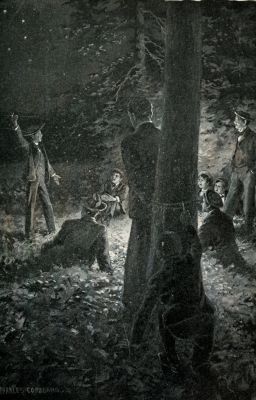
He felt the bonds that held him to the tree loosen. Page 231.
A half-hour may have passed when Poole heard a low, softly repeated hiss behind the tree, which evidently was not made by the wind. He turned his head slightly and hissed in return. Then a low, boyish voice which Poole did not recognize whispered: "I'm going to cut the rope; sneak round the tree and come with me. Don't say anything."
Poole's heart leaped with joy at this sudden offer of aid, unknown though the source; but he tried hard to make no movement and show no change of expression. He felt the bonds that held him to the tree loosen. He did not start, because Barclay's eyes were resting on him from across the fire, and he wanted the advantage of the second or two which he should gain by slipping away when the attention was elsewhere. Presently Duncan Peck offered an impersonation of Reddy McGuffy speaking from the floor in a debate at the Laurel Leaf. This drew all eyes, and was accompanied by such running fire of laughter and comment that no one noticed the slight rustle made by their prisoner as he detached himself from the tree and crept around it.
A small boy rose before him and led the way straight through the shadow of the tree into the deeper darkness of the woods. Poole followed blindly, hampered by his tied hands, fearing to run lest he fall and flounder, expecting at every step to hear behind the shout and plunge of swift pursuers.
"We're almost there!" whispered the guide. "Hurry!"
Where there was Poole had no idea, but he found out a dozen steps farther on, for just as a frightful yell rose from the camp, his guide suddenly whispered, "Wait a second!" and disappeared, apparently swallowed by the earth.
But before Poole could move, a momentary flash of the pocket light behind a rock showed him a hole toward which he threw himself and wriggled in.
"Turn over and I'll cut the rope," the boy breathed in his ear. Poole obeyed. "Gee, here they come!" whispered the unknown with a giggle of joyful excitement.
The pursuers had at first flocked to the oak, hoping to find their victim close at hand. Then for a moment they stood dazed.
"Perhaps he's up the tree," suggested Robins.
"Why, his hands are tied, you fool," retorted Milliken. "He can't climb and he can't run; he's lying somewhere on the ground. Spread out and find him!"
So they spread out, yelling, scolding, groping, stumbling. The fugitives heard them brushing by. One fellow tripped over the edge of their sheltering rock and picked himself up, muttering imprecations. Wally strove to suppress a giggle, but Poole nerved himself for a dash in case he was discovered. His hands were free now and he felt ready to take any chance.
"Let's sneak for the cove bridge," whispered Poole. "We can get by them in the woods."
"Not on your life! They've got two guys watching down there. Wait a little longer. I've got a canoe here on the river."
"Come back! Come back!" shouted in unison a trio of wiser heads who perceived that their search in the darkness was both useless and dangerous. The rest came scrambling back, each demanding eagerly as he came: "Have you got him?" "Where is he?" "Who found him?"
"Nobody's found him," said Milliken, "but we don't want to lose the rest of you. Let him stay in the woods all night if he wants to. As long as he don't get to the dinner, what do we care? What we've got to do is to watch the bridge and the road from here to High Street, and see that he doesn't sneak round us and get out."
"Why, he couldn't do it if he tried all night," said Brown. "It's a mile round the cove, through the worst kind of woods and swamp, and high-water too. He never could do it."
"That's what I say," replied Milliken. "If we guard the cove bridge and the two bridges in town we've got him anyway."
The squad took the one lantern they had brought with them and marched off to guard duty, making their first halt at the cove bridge. The fire had died down; silence reigned under the pines. Wally crept out to reconnoitre, and returned with the news that the coast was clear. He thought with some uneasiness of the anxiety his absence might be producing at home. He devoutly hoped they wouldn't worry; perhaps they supposed he was at the library. At any rate, he was eager to get away. Poole, of course, was no less eager.
They reached the canoe without mishap. Each took a paddle and, with the spring current to help them, pushed rapidly down. As they slid past the entrance to the cove they looked across and chuckled to see the gleam of the lantern at the cove bridge.
"Let 'em stay there all night," said Poole. "I shan't trouble 'em."
A few minutes later Wally swung the bow in toward his landing and together they carried the canoe up, turned it over, and left it for the night. Wally took his bicycle and started for home, divided in his mind between delight at the adventure and fear of the parental reception which he was to face. Poole ran beside him until they reached the Squamscott, and, when they parted, showered upon his head such expressions of gratitude as no little townie had ever received from a baseball captain since ever baseball captains existed.
Wally's account of his adventures was the only excuse he had to offer for his absence to his reproachful parents. He had been over the whole narrative once, and was explaining more in detail about his hiding-place beside the rock, when a committee from the dining seniors appeared and craved the pleasure of Master Wally's company at the banquet. Mamma, of course, demurred, but Mr. Sedgwick opined that he might as well make a night of it, and the seniors bore him away in triumph. They planted him beside the recovered president, fed him royally on ice cream and cake, mentioned him in their speeches, and sent him home with a cheer at ten o'clock.
On the morrow Wally had no great appetite for breakfast, and he found his legs somewhat heavy as he trotted down to school—but he had great things to tell the boys!
CHAPTER XXII
A FAIR CHANCE
Patterson's resolution to pitch no more except to Owen was speedily known in school and variously judged. Poole himself said little about it, thinking that the pitcher's rebellious attitude was caused by a temporary fit of discouragement which would soon pass away. Others were less charitable, particularly Borland's friends, who declared that Patterson was trying to shift upon Borland's shoulders the responsibility for his own poor work. Rob, likewise disapproving, upbraided him most frankly for disloyalty and insubordination; it was rank treason to refuse to do what one could for the cause just because the authorities did not select the team to suit him. Wasn't Rob himself playing in an entirely strange position because they wanted him there?
But Pat remained politely obdurate. "I suppose I'm all wrong," he concluded stubbornly after Rob had instructed him in his duty with great emphasis and detail; "but if I am, it can't be helped, for I'm going to do what I said I would and nothing else. Either you catch me or I don't pitch. I don't see what treason there is in that. You know you're a better catcher than Borland, now, don't you?"
"No, I don't," retorted Owen, hotly. "If I were, they'd take me without your forcing them into it. You're just making a fool of me."
At this Patterson merely smiled and said nothing, and acted as if the judges had given a unanimous verdict in his favor. What can you do with a fellow who listens and grins like an idiot and won't argue, and yet refuses to be convinced? Rob gave him up.
But neither Poole nor Lyford could forget that first game in which the second team had so easily and so completely trounced the first. Explain it as they might,—as a freak of chance, as due to lucky hitting by two or three of the second, to temporary blindness of the batting eye on the part of the first, to O'Connell's wildness,—the fact still remained that Patterson had pitched an excellent game and might do so again. Lyford therefore was inclined to yield a point; let Patterson practise with Owen, if he cherished the fancy that Owen was necessary to him. After a time they would try the pair in a game, and then, when it was shown that Owen did no better for him than Borland had done, he would drop the notion that he must depend on his catchers, and learn to depend on himself. So Owen continued to catch Patterson in practice, while Borland caught O'Connell and threw to bases; and after his catching practice Rob would go out and try his new position at right field.
The Dartmouth nine stopped at Seaton on its way to Boston and gave the schoolboys a game. It was early in the season for both teams, and neither was satisfied with the score. O'Connell was not hit hard by the collegians, but he gave several bases on balls; and when a Dartmouth runner got to first he had little difficulty in reaching second and third. The college players seemed to hit at necessary times, and when the base-runner tried to steal a base, either Borland received the ball in bad position to throw, or the throw went high and wide; the runner was usually safe. The Seatonians, on the other hand, though they made nearly as many hits, were far behind in runs. Rob played at right field and accepted one easy chance; he also satisfied the authorities by making two hits. They were not so well satisfied with the six at the foot of the Seaton error column, and Lyford, at least, was not blind to the mistakes in judgment shown by the battery. But the school, which expected defeat from the college team, criticised leniently. They felt somewhat different two mornings later, when the papers reported the Dartmouth-Hillbury game, which the Hillburyites all but won.
Another week of training passed. Rob occasionally relieved Borland in throwing to bases now, and a new party had arisen on the bleachers, a party which asked persistently, "Why doesn't Owen catch?" The party was small, but its strength was considerably augmented by the cautious support of the four or five players of the infield whose duty it was to receive the catcher's throws. When Borland threw to second, he stepped back with one foot, at the same time pulling back his arm, and with a violent swing of arm and body drove the ball down, as if it were thrown by a catapult. If it struck fair it struck hard, and fortunate was the baseman if he was braced to receive it. Rob's throw was different. He stepped forward instead of back, and his throw was with the arm alone, a quick, hard snap which ended with the wrist forward. The ball thus got an upward twist which lifted it just enough to counteract the force of gravity and to keep it parallel with the ground. A throw like this carries well and lands in the hands like a feather.
Hayes the shortstop and McPherson, who played at second, discovered immediately this difference between the balls thrown by the two catchers. After experience with Owen's easily taken snaps it was hard to go back to Borland's cannon balls.
"They are twice as easy to handle as Borland's," said Hayes, as he walked down with McPherson after the practice; "and you don't lose your balance trying to hold 'em, either."
"And as far as I can see they travel just as fast," replied the second baseman, "or else he gets them off a lot quicker."
Lyford and Poole also noticed Owen's throwing and recognized his skill.
"He may beat Borland out after all," said the coach.
"There's a good deal more to catching than throwing to bases," Poole returned thoughtfully. "Borland has a lot of good points. He's a good backstop, is sure on fouls, and doesn't rattle; and he's used to our game. He was good last year and ought to be better this. I won't throw him over until I find some one surely better."
"I shouldn't, either," said the coach; "though, to tell the truth, I never thought him remarkable in inside work.[1] With green pitchers this year, a good deal will depend on what the catcher gets out of them."
The truth of this last remark was so obvious that no reply could be made to it except to assent, or perhaps to add as a corollary that, other things being equal, the best catcher was the one who could get the most out of the pitcher. Poole was an excellent ball player and a just captain. To put an inferior man on the nine because he was a friend or a fraternity mate would have been impossible for him. But Poole had a way of planning things in advance, and then trying hard to make his plans succeed. In this he was almost obstinate. Carle and Borland as the school battery had been an important part of his plan. When this scheme miscarried, he had fixed on O'Connell and Borland, or Patterson and Borland—always Borland. Owen, he had decided, should go to right field to make a part of the heavy-hitting outfield which he had dreamed of producing. The suggestion that Borland's strategy was faulty did not please him, because it interfered with his plans. At the same time, if there was some one better he wanted to know it.
"Well, let us try the other battery," said the coach, at last. And the captain agreed.
The opportunity came soon. After the Dartmouth game O'Connell complained of a lame arm and asked for a rest. Borland was laid off with him. Patterson and Owen were slated for the next game.
The Fryeburg school was on the schedule for Saturday, and Poole was eager to win the game. The year before the manager had induced this team to come to Seaton to substitute for a nine which had been obliged to cancel its game. In the spirit of superiority which the boys of Seaton and Hillbury often assume toward the athletic teams of other schools, the Seaton manager had seen fit to urge upon the Fryeburg captain that he bring up his best team and give the Academy nine a good game. The Fryeburger had responded by bringing up so excellent a team, and giving the Seatonians so stiff a game, that the latter were supremely thankful for the base on balls, the three-base hit, and the muffed fly which yielded them their two runs to match against the seven which the visitors achieved. Seaton doesn't easily forget that kind of a surprise. Next to the great Hillbury contest, the climax of the athletic year, there was no game in the schedule which captain and school desired so ardently to win. This year these fellows must be soundly thrashed!
To his men Poole appeared most confident as he ordered them to their places for the opening of the game. He tried to persuade himself that he really felt all the hopefulness he showed, but it was harder to deceive himself than to encourage other people. If there was another whose manner and words helped to stay the captain's courage, it was the new catcher. Owen had long ago learned that as the catcher's every movement is watched by the eight men before him in the field, so his whole bearing and his work are both in a marked degree either encouraging or discouraging to the rest of the nine. He must never show faint-heartedness or uncertainty. He must do hard things as if they were easy, must keep the whole play always before his eyes, direct the pitcher, watch the base-runner, throw instantly when necessary, take hard knocks with indifference, sprint for sudden fouls,—this and more is involved in the work of his position; but above all and everywhere he must have courage and inspire it.
Rob could do this because he had done it many times before, and because he trusted his infield. He had arranged with Ames at first for the throwing signal, with Hayes, the shortstop, and McPherson, second, as to covering second base; they were trusty men. Patterson was in good condition, asking nothing better than to follow the catcher's directions. Poole had given him from his last year's note-book certain facts about the Fryeburg hitters. It was just such an opportunity as this that Rob had longed for. Why shouldn't he feel confidence?
The three Fryeburg batters were soon disposed of, one striking out, one putting up a pop foul, which Durand found easy to handle, and the third catching a wide out on the end of his bat and rolling a grounder to Ames. When Seaton came to the bat, McPherson, perceiving that Simms, the Fryeburg pitcher, was nervous, waited patiently and went to first on balls; and Poole, a little later, put a clean hit over the shortstop's head. With two men on bases things seemed promising, but Sudbury struck out, Durand forced McPherson by a hit to third base, and Owen, to his great disappointment, sent a long fly into the centre fielder's hands.
In the second inning nothing was accomplished by either side. In the third a Fryeburger got first, only to be caught napping there on the first pitch by a sharp throw from the catcher, which called out from the well-filled benches the clear staccato "individual" cheer, "Owen, rah! Owen, rah! rah, rah, rah, Owen!" Rob might have appreciated the compliment if he had not been so intent on his work. A ball close in by a timid batsman drove him away from the plate; the next starting in apparently the same course, curved over; the third was the swift jump which Patterson threw as naturally as a left-hander throws an inshoot; the fourth, a teasing slow ball which made the third strike. Then with an easy fly to Rorbach, who was taking Owen's place in right field, the side was out.
McPherson came to the bat again and sent a liner over second base. Poole, who was an experienced bunter, tapped a weak bounder along the line to third, and, being a left-hander and quick, beat the ball to first. Sudbury struck out again. Durand drove a ball toward the second baseman which that fielder found too hot to manage, and the bases were full. Owen waited patiently until three balls were called, and then cracked another out into the field between right and centre, and two men came home. Ames hit a long fly to centre field, on which Durand scored. Then Hayes and Patterson went meekly out.
In the first half of the fourth Fryeburg got a run on a hit and errors by Durand and Patterson. From then until the eighth no more runs were made. Fryeburg reached first base thrice and second but once, and Seaton fared little better. After Larkin, the Fryeburg shortstop, essaying to steal second, ran into the ball in McPherson's hands a good three yards from the base, the Fryeburg base-runner clung to first if once he reached there, and waited for some one else to help him along. Patterson was following his catcher's signals like clockwork. Pitchers have days when the ball works with them, and this was Patterson's day. His jump balls really jumped; his inside ones cut the corners of the plate; into the straight, swift balls he put a powerful body swing. The fellows on the benches, the anxious captain, the critical coach, all felt the spirit that prevailed, perceived that the men were playing a game worth while, and were elated.
Then in the eighth came the events that caused the sympathetic spectators first to grieve, then to revile their foolish optimism, and finally in one big howl, that carried fully half a mile, to pour forth their new emotions. It happened in this wise.
Lufkin, the first Fryeburg batsman, hit a long fly to Sudbury, who dropped it, thus presenting the runner with a two-base hit. Morris, who followed him, hit the ball in a low arch over third baseman's head, and reached first. The next Fryeburger hit to Hayes, who, in overhaste, threw home, while Lufkin stayed at third. No one out and the bases full! Poole stamped his spikes into the ground, rubbed his bare hand nervously into his glove, and asked himself with sinking heart whether Patterson wasn't going up in the air.
"One ball!" cried the umpire on the next pitch. Owen walked toward the pitcher's box and said a few words to Patterson as he tossed him the ball at short range. Patterson nodded and went back. Owen stooped on the plate and tied his shoe, readjusted his glove, and took his position once more. The batsman struck, lifting the ball in a low pop foul hardly a dozen feet above the catcher's head.
"Over your head!" shouted Patterson.
In an instant Rob had turned, flipped the mask from his head, looked up and caught sight of the ball. It was already falling, two yards ahead of him! He leaped, as a football player makes a flying tackle, and clutched the falling object hardly a foot from the ground.
One out! but the three bases were still full. Patterson had calmed down. Ross, the Fryeburg catcher, usually struck over the ball; Patterson sent him a low one. The bat clipped the top of the ball and drove it into Patterson's hands.
"Here!" cried Rob, standing on the plate. Patterson threw, Rob received the ball, turned and cut it to Ames at first, where it beat the runner by ten feet. Not till they saw Rob toss aside his mitt and Ames and Patterson start in, did the crowd realize that Lufkin had been forced at the plate and Ross thrown out at first. After that the game was no longer in danger—nor the battery's reputation. In the ninth the Seatonians made a rally and batted in four runs. So that the final score of seven to one represented a very fair vengeance for the defeat of the preceding year.
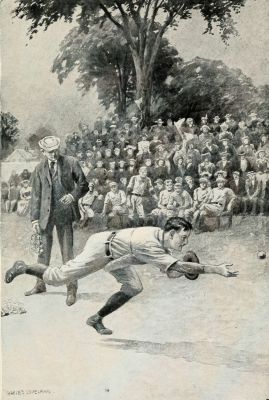
He leaped and clutched the ball hardly a foot from the ground.—Page 250.
CHAPTER XXIII
A TIE GAME
Robert Owen received many attentions from enthusiastic schoolmates that afternoon. They hovered around him while he was dressing; they dropped in on him after he reached his room. But it was Patterson who got the credit for the pitching performance; and Rob, you may be sure, let fall no hint that would lessen the pitcher's glory. It was encouragement that Pat needed to bring out the best that was in him; he was getting it now in full measure.
But after all, the voluble flatteries of the ignorant were of little value to Rob compared with the opinions of captain and coach. They accosted him on his way up from the gymnasium, just where he had met them three weeks earlier, after the game between the First and Second.
"Well, Owen," began the coach, "it was a great game you caught to-day."
Rob's modest smile and quiet "Thank you" represented but poorly the delight he felt.
"I really was surprised at Patterson's work," went on Lyford. "I didn't imagine he could do so well. It looked as though he was going up in the eighth, but you pulled him down handily. You played in luck there, too, for it isn't often that a man is forced at the plate."
"How much of that pitching did Patterson really do?" demanded Poole, abruptly.
Rob glanced keenly at the captain. "All of it," he answered quickly. "It was good pitching, too. The ball came right where it was wanted."
"But you ran the thing, didn't you?"
"Why, yes, in a way. When I called for a ball he put it over as I wanted it unless he had something better. He usually took my suggestions."
Lyford nodded agreement. "There should be but one head in a battery," he said, "and it's my opinion that if you've got a good, wideawake catcher, it's better to let him do the head-work."
"We've decided to keep Rorbach at right," said Poole. "You're too valuable a man to waste in the outfield. And you may as well go on catching Patterson."
Rob scampered ecstatically up to his room. There is nothing like a victory which you have worked and waited and longed for through months of discouragement, and, finally, in spite of every obstacle, actually won. This day's work had brought the authorities over to his side. After this there could be no more taking for granted that the old catcher must be the best catcher, and that experience elsewhere must be inferior to that acquired at Seaton. Borland was on the defensive now; if he would hold his place, he must prove his claim to it. And to do that he must accomplish something more than make a steady backstop and occasionally catch a man at second. Rob chuckled aloud as he recalled Poole's question about running the pitcher. Twice only in the game had Patterson ventured to pitch a ball different from what his catcher had called for. One of these had been fouled close to the line; and the other—a straight over after two strikes and a ball, which Pat had tried in hopes of a quick strike-out—the batter had smashed to centre field for two bases. As a strategist, Patterson could be improved upon, but it certainly was not the catcher's business to say so, especially as Pat had vowed that afternoon after the two-bagger that he'd never interfere again.
Then the congratulating friends began to drop in—Lindsay, Laughlin, Duncan Peck, Strong, Ware, Hendry, Salter. Simmons appeared in the midst of the bustle and retired shyly into a corner, whence he looked on at the demonstration with smiling but silent approval. He evidently had something on his mind. Duncan Peck also showed himself unusually subdued; and though he had that day been permitted to remove from his door the hateful inscription "Duncan Peck, Study Hours, 8-1, 4-6, 8 P.M.—" which had adorned it these four months, he yet manifested no exuberance of joy at his freedom.
The visitors went their ways before dinner-time, leaving to Simmons his opportunity. "I didn't go to the game—" he began, as if about to excuse himself for disloyalty.
"Up the river again with Payner?" asked Rob, smiling.
Simmons nodded.
"Have a good time?"
"Fine! Up the river, Payner's very different from what he is here. He's as jolly as can be, and tells you lots of things."
"Well, what's the matter, then? What makes you look glum?"
"I'll tell you. When we got home he took me into his room to show me a new specimen. Then he asked me what the Pecks were going to do about the plagues, and I told him that there wasn't any change so far as I'd heard. At that he looked fierce, and said they'd get the full number then; they'd better look out, for he'd put them to the bad before he got through with them. Then he asked me if I didn't want to see what the next one was going to be. I said Yes, and he unlocked the closet door and let me look in. What do you think I saw?"
Simmons paused and gazed at Owen with big, horrified eyes.
"Well, what was it?" demanded the ball player. "I'm not going to guess through the whole zoölogy. Spit it out, can't you?"
"In the back of the closet was a kind of wire-levered box like a big rat trap, and in the box was an awfully big, shiny, black snake, all coiled up!"
"Dead?" asked Owen.
"Alive!"
"How did you know?"
"I saw it move its head, and the eyes shone, and there was food for it sticking through the wires."
"That's about the limit!" exclaimed Rob. "What then?"
"He pulled me out and locked the door, and said, as quietly as if he were talking about a common bug, that he was going to wait a day or two and see if they were coming round. If they didn't, he'd give 'em the snake; he didn't know how yet, but they'd surely get it. Then he wanted me to promise not to let on about it to any one."
"Did you promise?"
Simmons straightened up. "No, I didn't," he declared proudly. "I just let him know what I thought of him and cleared out!"
"You told Duncan about it, didn't you?" asked Rob.
"Yes; how did you know?"
"I could see it in his face when he was here a few minutes ago. You'd better not worry over it. Payner wouldn't put a snake like that into their room."
"Oh, yes, he would," answered Simmons, wisely, with a doleful shake of his head. "You don't know that fellow. He's all right if you let him alone; but when he's mad, he's terrible. Why, he doesn't care any more for a snake like that than I do for an angleworm!"
It was nearly time for dinner, and as both preferred to be on hand at Alumni when the doors were opened, the conversation came to an end. Rob half resolved to have a serious talk with the Pecks that evening and see if he could not induce them to put an end to the unseemly feud. But after dinner he was unexpectedly called to a baseball meeting, and after that there were two lessons to prepare; so it happened that with his work and his natural weariness from the game, and the excitement of his new prospects, he forgot completely the Pecks and Payner and the snake.
But Duncan did not forget. He was thoroughly sick of the whole affair. Of what use was it to be off study hours, if one must forever be watching and dodging and locking up, never free from fear and never able to placate the enemy? Why must he suffer because Don was a mule? And the big snake! He shuddered at the thought of the coiling, crawling thing. He began to see it in the dark corners, to hear it in the rustle of papers on the floor. It was like a waking nightmare.
By evening he was ready for a decisive step. He went resolutely to Payner's room and made a complete apology. Payner listened and nodded approval. "I thought it was about time you fellows came down off your perch," he said. "Next time perhaps you won't be in such a hurry to roughhouse a new fellow. It's all right now as far as you've gone; but where's the other one of you?"
"My apology will do for both, won't it?"
"No, sir!" returned Payner, with decision. "You've both got to toe the scratch and say your little pieces, or it's no go. Two or nothing. Send along your brother with the same story, and then mebbe I'll call off the dogs."
"I will if I can," replied Duncan, dismally.
It was a badly discouraged lad who sneaked back to the Peck quarters and threw himself on his couch. It was no use. Don would never yield. He might fight, or get up a counter demonstration, but apologize—never. Duncan lay for some time on his back, throwing his knife into the air and catching it again. This process always had a soothing effect. It also served to clarify his thoughts and stir his imagination. After half an hour's practice with mind and hand, a new idea dawned upon him.
Pocketing his knife with a slap, Duncan pulled open the closet door and fumbled among the garments hung thick upon the crowded hooks. Yes, there was Donald's variegated waistcoat which he had been sporting of late, and which, in the excitement of the morning's scramble for breakfast and chapel, he had mourned his inability to find. Duncan stowed it away in a corner under a box, where only a thorough overhauling of the contents of the closet could bring it to light; then much easier in mind he took up the work of the evening.
On the next morning there was another burst of sputtering on the part of Donald, for this time his flat-topped gray hat, adorned with the hatband of the fraternity which he had recently joined, had likewise disappeared. He could find it nowhere, although he stole four minutes for the search from the short allowance for breakfast, and notwithstanding Duncan's remarkably unselfish assistance. A cap was near at hand, however, and taking this, Donald at length hurried over to the dining hall, vowing to complain to Dr. Mann downstairs that Lady Jane was swiping his things.
For two hours at least he could not execute his threat, for at eight came Greek, and at nine Rushers' Math. Duncan, who was in the Flunkers' section, recited an hour later, and thus was free between nine and ten. Once the "nine o'clocks" were well under way, Duncan arrayed himself in his brother's favorite necktie, donned the resplendent waistcoat, fished out the flat-topped hat with its striking hatband from beneath his bureau, and giving to the brim the rakish tilt which Donald affected, put it carefully upon his head. Thus panoplied he rapped confidently on Payner's door.
"I've come to see you about that room business," began Duncan, looking down at the hat which he held in front of him, and yet in such a way that the waistcoat was largely visible.
Payner had risen from his chair. "So you're the other one, are you? Well, what do you want?"
"Didn't you send for me?" asked the visitor.
"No, I didn't," retorted Payner, sharply. "I said I wouldn't receive any apology until you both came."
"Well, I'm ready to apologize," announced the Peck. "I'm very sorry we did it."
This was a true word if Duncan had ever spoken such! His tones were likewise sincere. Payner, who at present sought victory rather than vengeance, and was not at heart bloodthirsty, felt immediately mollified. "How did you happen to do it?" he asked. "I'd never done anything to you fellows."
"Well, you see, you put the Moons wise about their room, and we thought you'd no business to butt in. We didn't hurt the Moons any. It did them lots of good."
"It didn't do me any good," replied Payner, significantly.
"Nor us," said Duncan, with his eyes on the floor.
There was a brief silence which the visitor found most irksome. "Is that enough?" he asked.
"I guess so," responded Payner. "I don't believe you'll be troubled by any more plagues."
"Thank you," said Duncan, humbly; "and I hope you won't say much about the affair. It would be pretty tough to have all the fellows guying us."
Payner grinned. "That's a good deal to ask, but I shan't talk about it if you don't."
Five seconds later, with the door of his own room safely closed behind him, Duncan was laughing and capering and tossing his brother's show hat into the air, and rolling on the couch in the gorgeous waistcoat. Presently, however, he bethought himself that time was passing, threw the hat under the sofa, hung the waistcoat in the closet under Donald's light overcoat, and returned the borrowed necktie to the drawer. Then, after resuming his regular costume, he stole forth to waylay Donald after the latter's recitation and inform him that a hat which looked like his was lying under the sofa, and that if he would take the trouble to remove the top layer of garments in the closet he might find his vest. It was with real regret that he refrained from rehearsing certain events of the morning, but the usually appreciative twin was the last person of whom in this case he could make a confidant.
Toward noon Duncan, who was bursting with his secret, espied Owen coming up the stairs, and forthwith haled him into his room. "I say, Bobby, what do you think has happened?" he demanded eagerly.
Rob glanced around the room. "Another plague, I suppose," he said, "though I don't see any signs of it. You look pretty happy for a fellow who's been seeing snakes."
"No snakes and no more plagues!" cried Duncan, gleefully.
"How's that?" demanded Owen.
"We've come to terms. From now on Mr. Payner and we are friends. He's a great fellow for bugs, but when you really want help in time of need, just call on old Odysseus!" Whereupon he slapped himself on the chest and his visitor on the back and danced around the table. Later, after trying to exact a pledge of secrecy, he told his story with much detail and scroll-work; and finally he stuck his thumbs in the armholes of his waistcoat and strutted up and down before his visitor, declaring that if he was not as great as Cicero who saved a state, he was at least the equal of the infant Hercules who killed a snake, and certainly greater than Laocoön, who let the snakes do him up. The sudden arrival of Donald threw the actor into some confusion.
An hour later Rob sat at his table staring vacantly at an open book, and musing on the adventures of the Peck family. A knock at the door was followed by the appearance of Payner on the threshold.
"Simmons out?" asked the caller, laconically.
"Yes," Rob replied. "What's up?"
"Oh, nothing. I just wanted to tell him he needn't worry any more about that snake. I suppose he told you about it?" he added with a shrewd grin.
"Yes, he did."
"I knew he would. And he told the Pecks too?"
Rob laughed but said nothing.
"Oh, he told them all right. You needn't pretend he didn't. I knew he would, or I shouldn't have shown him the thing. I meant him to tell them."
"You really wouldn't have put that snake in their room!" said Rob, severely.
"Why not? It wasn't alive."
"A dead snake wouldn't be much better than a live one."
"It wasn't dead either," chuckled Payner. "It was made of an old black necktie stuffed, with glass eyes, and its head worked with a string. I got it up to scare the Pecks through Simmons. I knew he'd go and tell them just as soon as he saw it, and I thought that would bring 'em round. You see, the plague business was playing out, anyway. The last time I tried it the housekeeper came pretty near getting on to it, and I didn't dare take any more risks. And yet if I stopped without getting the apology, they'd have me beaten! So I tried this scheme, and won out. They've both apologized."
"I see," said Rob. As a matter of fact, he did not see, for he was trying to determine for himself who had outwitted the other.
"Just tell Simmons I've given up my plan of the snake, won't you?" said Payner, turning to go with the air of a victor. "And don't let on about the rest of it. I shouldn't want it to get back to the Pecks."