Front matter (continued 2)
Reading edition
"That's what you want to prove, isn't it? Well, this is the way it's done."
At the end of a minute Rob stood with the slip of paper in his hand blushing to think that he had made so much of a simple matter, while Salter was calmly replacing his block and pen in his pockets.
"You're in for it, all right. Of course, you know, I don't mean that you're sure of the team, but you've got a mighty good show, unless something unusual happens. There's Strong now."
Strong stopped just long enough to congratulate Owen on his trial, and to tell him he had a good show for a position. The captain was followed by the trainer. When Rob emerged from the gymnasium a few minutes later he carried in his hand Salter's notes, and in his mind certain regular practice appointments with Collins. Startlingly sudden as had been his precipitation into the ranks of the relay men, he felt less elation on this account than amazement at the quickness with which the senior had opened a rift in the obscurity of the geometry. How could a fellow like Salter, who didn't look remarkably clever and certainly hadn't studied geometry for at least six months, give an impromptu demonstration like that! Was that the way in which originals were to be solved? If so, Rob Owen might as well get accustomed to a back seat; such feats were hopelessly beyond his slow powers!
Unreconciled to the notion that an hour of his time was not equivalent to a minute of another's, he stopped at Lindsay's room to ask for information.
"Salter? Of course I know him,—a good fellow he is, a perfect shark at lessons. You couldn't expect a man of his build to be athletic. What do you want to know about him?"
Rob told his tale, adding rather shamefacedly that he suspected there was some trick about it.
Lindsay laughed. "Not a bit of it. That's just the thing he can do. He's got a kind of X-ray mind for mathematics; he can see in a flash through all sorts of obstacles that we have to take a lot of time to work around. You can imagine what an awfully discouraging fellow he is to be in a class with. Why, he'll short-circuit a solution that a teacher's got out of a key, and find an easier way to do it."
Owen felt relieved. He evidently wasn't such a fool after all.
"Salter's best in mathematics, but he's good in everything. Last year he made a complete card catalogue of all the places and definitions in ancient history, with abstracts and dates and all that sort of thing written out on about three hundred separate cards in the neatest kind of a hand. He might have made a small fortune renting it out the fortnight before the examination, but he just let it go round, and of course some fellow was mean enough to take it off with him."
Owen had his hand on the door-knob. "They've roped me in for that relay business. Strong says I've a show to make the team. Do you think it's worth while? I can play ball a little, and I'd like to make the nine, but I don't care for running."
"If Collins wants you, I'd run," advised the senior. "He knows what he's about. It won't hurt your chances for baseball, and it's worth a lot to beat Hillbury at anything. They have mighty pretty prizes for that meet, too. Oh, have you seen what the school gave the football men?"
It was a little engraved football of gold, bearing Lindsay's name. Rob handled it with reverence and yearning. How he would like to earn a thing like that!
"It's pretty," said Lindsay, "but as I don't wear a watch charm, it's hardly useful. If it were a medal, now, I could put it up somewhere."
Rob's eyes were resting on the mantel. Two silver cups were there which he had never seen before. Lindsay's gaze followed Rob's while his words anticipated the visitor's question.
"I brought those two back with me when I went home last week. Got them both last summer. The two-handled one was for a yacht race, the small one I got in a swimming match."
"What a beauty!" exclaimed Owen, taking up the heavy, ornate cup by one of its handles.
"All the same I prefer the other," returned Lindsay, "for I won that all by myself. Anybody with a fast yacht can win a sailing prize. I had to beat seven men to win that little swimming cup. Two cups don't amount to much anyway. It's the running fellows that make the collections."
"Strong must have a lot," sighed Owen, in the tone a poor man might use in speaking of a neighbor's millions.
"It takes a college crack to pile them up," Lindsay observed. "Poole has been in Dickinson's room at Harvard, and he says Dickinson has a velvet shield two feet square, just thatched with medals, to say nothing of the cups all around. Just imagine what it must be to go to a great meet like the intercollegiate, and know in advance you're going to beat every one of the hundred men in your event! That's what Dickinson's been doing for the last two years."
Rob tried his imagination, but it would not serve. It was like seeking to conceive stellar distances!
"I must be getting back to work," he said. "I suppose I may as well go in for the relay, even if I don't accomplish anything."
He said good-by, and returned to his desk for another attack on the original. Salter's notes proved an Ariadne's thread for the labyrinth; in ten minutes he was writing Q.E.D. at the foot of his sheet of paper with a satisfaction dimmed only by the fact that the demonstration was not wholly of his own making.
A rattle at the door now announced that he in turn was to be visited. He knew the rattle, for it always heralded the coming of a Peck; but to-day he fancied it lacking in assurance, and he looked up at the door in a momentary thrill of curiosity. There were two Pecks this time, both unusually grave in aspect. One carried in his hand a covered pasteboard box.
"More eels?" asked Owen, giving way frankly to the snicker which would come.
The bearer of the box, whom Rob had provisionally fixed upon as Duncan, grinned sheepishly and answered: "No; guinea pigs this time."
"Guinea pigs! Where?"
"In the desk drawer, two of 'em," went on Duncan, trying hard to be jocose. "They are really quite—quite sweet. Want to see 'em?"
Duncan raised the lid of the box a finger's width and Rob peeped in.
"Pretty, aren't they!" observed the grinning Owen. "What are you going to do with them? I thought animals weren't allowed in the dormitories."
"That's just where the chump's meanness comes in!" burst out Donald. "We couldn't throw the things out alive, of course, and we couldn't kill 'em. Lady Jane" (the matron) "came in on us while we had 'em on the table,—caught us with the goods on us, she thought,—and jawed us like a stepmother for defying the school rules. When we said some one put 'em in the desk drawer, she thought we were lying and threatened to have us fired for breaking the rules and not showing her proper respect. I call it a low-down trick!"
"Here's what we found with them," interrupted Duncan. "What does it mean?"
Rob took the slip of paper on which was written in print: "The Second Plague."
"I suppose it means what it says," he remarked.
"And there are more plagues to follow?"
"Yes."
"How many?"
"How many do you suppose!" exclaimed Rob, derisively. "How many plagues of Egypt were there?"
"That's the question," replied Duncan. "I say there were three, and Don says there were seven. Which is it now?"
Owen sniffed. "You fellows had better join Dr. Norton's Bible class, and learn something."
He took down a Bible from his bookcase and fluttered the leaves to the chapters in Exodus in which the plagues are described. "The first was turning the river into blood, so that the fish died, the second frogs, the third lice, the fourth flies, the fifth—"
"Oh, ring off!" shouted the impatient Donald. "Don't harrow our feelings with all that. How many were there, can't you tell us? or don't you know yourself?"
"Ten," answered Rob, curtly, replacing the book.
The brothers stared at each other blankly, each seeking comfort and finding none.
"You don't really think Payner'd be mean enough to put all those on us, do you?" Duncan asked after an impressive period of silence.
"There's a whole menagerie to draw from, if he's cussed enough," growled Donald.
"Who was cussed enough to rip up his room?" Rob's visitors sought information, not judicial criticism; but the opportunity was one that he could not resist.
"How does he know that we stacked his room?" For the moment Donald was like an unfortunate victim of circumstances pleading "not guilty" to a false charge.
"How do you know that he is sending the plagues?" Owen replied quietly.
"He's got you there, Don," said Duncan. "We're up against it all right. There's no use trying to squirm."
"Who's trying to squirm?" retorted Donald. "Let him bring on his plagues—a bunch of mummies if he wants to. He won't feaze me."
With this the pair departed to continue their analysis of the situation in their own quarters, and later to endeavor to sell the guinea pigs to a drug-store man to display in his window.
CHAPTER X
MR. CARLE WANTS TO KNOW
The winter was wearing away. The third battery was plodding steadily along at its task in the cage, with few critical spectators and almost no interference from superiors. A more eager, trusting pupil than Patterson no teacher ever had. So ready was the pitcher to take the suggestion of his catcher as a maxim, that Rob had to set a watch upon himself, that he might not overload the docile learner with useless or questionable directions. He kept to a simple system of coaching, told Patterson nothing of which he was not himself sure, trusted him to throw his curves in his own way, but held him inexorably to accuracy. Owen never would allow practice to begin unless with plate in position and pitcher's distance well marked; he made his pitcher warm up thoroughly before he began with curves; he would not permit a pitch without a distinct understanding as to what the ball was to be.
At the beginning Patterson had but a single ball of which he was sure,—which he could deliver as he wanted it, and when it was wanted. On two or three others he was uncertain, sometimes successful, more often wild. Owen's task was to construct out of these possibilities the "three bread and butter balls" which form the chief stock in trade of the good pitcher. Stated thus simply the task would seem simple; in fact, it was most difficult, although Patterson's implicit confidence in his catcher and absolute eagerness to take his advice smoothed many obstacles from the path.
Few boys are willing to believe that the great pitchers achieve their greatest success through the clever manipulation and variation of a very small number of curves. When Owen repeated McLennan's assertion that three or four good balls, with brains, were enough for any pitcher to use, Patterson believed him and strove for the three good balls; when Owen explained that the most deceptive ball for a good batsman is not a new one with an unexpected curve, but a familiar one with speed disguised, Patterson set to work to acquire a change of pace with the same apparent method of delivery. In the beginning Owen would hold his hands where the ball was to come, and hold them there again and again until the right ball did come. When a certain accuracy with the three bread and butters was attained, the catcher would place his hands over the plate shoulder high, and require a certain ball to be thrown at them, repeating the exercise a foot to the right and to the left at the same height, and in the three corresponding positions just above the level of the knee. Sometimes he got in a batter to add distraction to the problem. Having early discovered that Patterson could throw a very good jump ball, he made him practise on the "initial cutter," a ball which just skims the breast of the batsman, and which even an expert is frequently tempted to strike at, though he knows he cannot hit it safely.
The mere fact of Patterson's implicit dependence would have been enough to impress Rob with a sense of responsibility. As the weeks went by, however, another fact which gradually forced itself into recognition added seriously to this feeling. Patterson was splendid raw material, which the catcher was either developing or spoiling in the course of his lessons. To become a superior pitcher, one must be physically capable of applying great power suddenly and convulsively. This ability may be expected only in an intensely nervous temperament, in which muscles are doubly powerful under excitement, or in one of absolutely cold blood, which grows colder and more tense and more silently fierce as the strain of the contest increases. Patterson was of the former class, quick and snappy in movement, with concentrated impulse and muscles answering instantly to stimulus. In addition to the right temperament he was blessed with the ability to "get up," that is, to start the ball with a full arm swing which makes it possible to bring the body into the movement and increase greatly the radius of the throwing arc. His curves, moreover, came easily, and his arm did not readily lame.
Over against these excellences were to be set lack of experience in the field, and an inclination to nervousness and faint-heartedness which only a series of unquestioned successes or the quiet support of a trusted battery mate would be likely to dispel.
While the third string battery was thus busy with its serious but unregarded work, Carle was riding hard along the road of popularity. He was rarely by himself these days, except when he slept. He loafed away many study hours in other fellows' rooms, spoke contemptuously of serious work, trotted his lessons whenever possible, loved to show himself in the company of supposed swells, was frequently seen lounging in druggists' windows or standing in a group of noisy fellows at the crossings with hands bulging the pockets of his wide trousers, talking loudly and swaggering. Though Carle as a scholarship man was expressly debarred from smoking, Poole neither by admonition nor exhortation could succeed in keeping the cigarette wholly from the pitcher's lips—and why indeed? Did not most of the great professionals smoke even in their playing season!
"He's a dead sport, that Carle!" remarked Duncan Peck one day during an interval between plagues. "I don't see how he can pitch."
"But he can," replied Owen, to whom the remark was made, "or at least he could last year."
"Oh, I know he can," Duncan made haste to reply. "Haven't I seen him do stunts in the cage. It's great, but he doesn't seem quite the kind of fellow that makes a fine athlete, like Laughlin, for example, or Lindsay, or Strong, or any of those fellows."
Owen did not reply. He held no brief for his townsman. Carle had long since ceased to manifest any desire for Owen's society, and Owen, in natural pique, would make no advances on the basis of their old friendship. Their ways seemed destined to lie apart.
One day early in March a letter was delivered at Rob's room, addressed in an unfamiliar hand, yet bearing the well-known postmark "Terryville, Pa." He had just come in from the gymnasium, where Strong had announced to him the final decision as to the make-up of the relay team which was to compete in Boston on the following Saturday. Owen was the choice for fourth man over Jacobson, who, though perhaps no slower, had been adjudged less capable of holding up under strain. With thoughts fluttering excitedly under a variety of emotions, among which half-hearted regret and a sort of dread had place with elation, Rob gazed at the address on the envelope, and vaguely wondered who could be the sender. He felt for the moment actual resentment at being compelled to exchange the temporarily glorified Seaton atmosphere for the uninteresting common air of Terryville. The letter, however, had much more to do with Seaton than with Terryville. It ran as follows:—
"Dear Robert,—
"Is anything the matter with Ned? We are worried about him. I have just had a letter from the secretary of Seaton saying he has been put on study hours, whatever that is, for unexcused absences and for neglecting his work. The dining hall also sent me another notice that the last bill had not been paid. I sent Ned the money for it more than two weeks ago. He keeps writing for money, but don't say much about himself, and can't seem to answer any questions at all. We've lived awful close this winter to keep Ned away to school, and the last money I had to take from the bank, which I really hadn't ought to do. What makes the school cost so much more than they said it was going to? Are they sticking us, or ain't Ned doing right? I've talked with your father, but he don't seem to know. I wish you'd talk with Ned and put him straight if there's anything the matter. He thinks a lot of you. When he was home Christmas everything was fine; but there's been a change somewhere. I'm a poor man, and can't do for him like your father does for you, so I wish you'd be careful not to put him up to being extravagant. He's free-handed and easy led, and likes to do the same as his friends. Now, Robert, just remember his ma and me kind of hold you responsible for the boy, and try to help him and us.
"Yours truly," John H. Carle.
Throwing the letter with a violent snap into the corner of the room, Rob rested his elbows on the table, dropped his chin into his two hands, and contemplated the rows of books in the case with eyes that saw nothing and a mind upheaved in indignant protest. Relay team and baseball were forgotten, and along with them the French verbs which he had failed on at the last exercise, and the appointment for an English conference which it was hazardous to miss. Vehement thoughts like his insist on sole possession. He tempt Carle to extravagance, have influence with him, be responsible for him! What an utterly false and unfair assumption! What right had Mr. Carle to send him that kind of a letter, or suppose any such thing, when for two months Ned had done no more than nod to him when they chanced to meet in the street? It was outrageous! It would be better to write the father plainly the facts in the case, incredible as they might appear, rather than suffer longer under the unjust imputation.
To this the feeling of loyalty, strongest and most unreasoning of all healthy student instincts, interposed its veto. He could not write the father of the shortcomings of the son, any more than he could declare them to the school authorities. Indeed, it was not necessary to do so. He had given Mr. Owen in his yesterday's letter a tolerably full account of conditions, and his father might tell Mr. Carle as much as he chose. It was tough business for Mr. Carle.
Rob rose and went to the window, his thoughts now diverted from his own side of the matter to the sacrifice and disappointment of the Carles. It was certainly hard on the parents; he felt sincerely sorry for them. How could Ned play them so false!
Rob turned from the window, picked up the crumpled letter, took his hat, and went out. Mr. Carle had asked him to have a talk with Ned. He hated above all things to do it, but sooner or later his conscience would drive him to it, and it was better to have the disagreeable task over at once than to worry for days and then do it.—Besides, there was very little probability that Carle would be at home.
Haynes White was just coming out of Carter 13 as Rob approached. White was a clever senior who did tutoring in upper middle subjects. The query flashed into Rob's mind, as he knocked at the door, whether White was there to help Carle get ready for the history examination which was due on the following day. There was nothing wrong in this, to be sure, though it was hardly to be expected that scholarship men would have money to spend in tutoring.
Carle greeted him with politeness and visible surprise; then waited to learn the reason of his visit. Rob also, suddenly confronted by the necessity of putting his plea into fitting words, stood for some seconds speechless, unable to think of any diplomatic way of broaching an unpleasant subject. The constraint at last grew too painful to be endured. Abandoning all hope of devising a proper opening, he held out Mr. Carle's letter and said: "Read it!"
In silence, but with flushed face and a defiant hardening at the corners of his mouth, as if he expected reproof, Ned took the letter and read it through. When he had finished, the flush was deeper, and anger as well as defiance displayed itself in his face.
"What does he want to write you all that stuff for! I don't see what business it is of yours."
"He seems to hold me responsible."
"The old man is all off; I should think you'd know enough to let the thing alone."
"But, Ned, he isn't all off," answered Rob, sailing blindly in. "He's wrong if he thinks you're following my lead, but he's right about the main thing. You're living the wrong kind of a life here. A fellow in your place can't run with the fast gang you're going with. You simply can't do it; you'll ruin yourself trying to."
"That's easy enough for you to say," retorted Carle, hotly, "when you can have whatever money you want, and aren't in with anybody. If you're in the swim you've got to spend something. My old man ought to have kept me at home if he didn't mean to give me what's necessary. I'm no long-haired grind."
"But he can't give you more; he says so in the letter. He hasn't it to give."
This was an unfortunate fact against which argument was as powerless as acid against oil.
"Is that all you've got to say?" asked Carle, sullenly, after a brief period of silence. "Because if it is, I've got something I'd like to do."
Yes, that was all. Owen could think of nothing else to say, and took his dismissal willingly. It had been an unpleasant scene, but brief; he had tried to do his duty in the matter, and even if he hadn't been wholly skilful, he felt relieved that it was all behind him. Poor Mr. Carle!
CHAPTER XI
THE RELAY RACE
Only the actual competitors were allowed to leave town for the Boston meet, so unless he could contrive to receive mandatory invitations from friends to spend Sunday in Boston, or devise especial business to call him peremptorily to the city, the average student must abandon all hope of seeing the contest. Wolcott Lindsay, who lived in Boston, went home for the Sunday, and got an invitation for Durand. One boy had to visit his dentist, another his guardian, a third a doctor, a fourth to buy absolutely necessary clothes which could not be procured at Seaton. The twins, who took an extraordinary interest in the event from the moment they learned that their neighbor was on the team, canvassed at great length the prospects of getting away. Duncan was on study hours and could hope for no favors, but he persuaded his brother that the only fair way was that Donald, whose scholarship usually secured him the favor of teachers, should ask permission on certain plausible grounds, and the two then draw lots for the privilege of going, the one left behind in any case to represent Duncan. Unfortunately for the scheme, when Donald applied for his permission he was obliged to confess that he had received no specific invitation to visit his aunt in Brookline, and that in the whole course of his stay in Seaton he had never, until this particular Saturday, felt the serious nature of his family obligation. So the scheme came to naught, and the Pecks stayed at home.
The huge space of the Mechanics Building on Huntington Avenue was circled by deep fringes of spectators packed in double galleries and crowded close to the outer edge of the thirteen-lap track. Here were phalanxes of boys from Boston schools, straining their throats in crying up the courage of their schoolmates; college youths in rival camps, their emulous cheers varying through a wide range, from the staccato spelling of some college name to the "three long Harvards" of the Cambridge men; women and girls who brought to the contest tense interest and strong sympathy, if not expert knowledge; men who loved athletics for their own sake, who, if they did not "delight in the strength of a horse," certainly "took pleasure in the legs of a man." It was like a dozen tournaments and a dozen audiences crowded into one.
Saturated with the feeling that the Seaton-Hillbury struggle was the event of the day, and new to the whole medley of many institutions contesting in ceaseless uproar, Owen was at first both bewildered and discouraged. In the terrific din the crack of the starter's pistol and the bellowing of announcers were well-nigh drowned by the blare of band music, the cheers of untiring supporters, and the recurring waves of general applause. He watched the Harvard-Pennsylvania relay match, in which veterans ran like blooded race horses amid tremendous excitement, and felt still more disheartened. The place seemed so vast, the interests of contestants so diverse, the big college teams so all-important, that the Seaton-Hillbury race could hardly prove more than one of the minor details of the meet,—in fact, might be carelessly managed or neglected. And yet, as he knew well, to the impatient waiters for a telegram at Seaton, there was but one contest in the day's programme; and no explanation that it was but a small part of a great performance would be accepted in palliation of defeat.
There seemed no end of contests and no beginning, but just one long series of overlapping performances. In the area belted by the big wooden track a cloud of contestants had been engaged in running off interminable heats in the forty-five yards dash. Jeffrey, the Seaton representative, did not reach the semi-finals. Meantime, giants of many medals and astonishing records, gathered by invitation from all points of the compass, were tossing the sixteen-pound shot in the space reserved for that amusement. The six hundred yards handicap men were strung out, according to the privileges they had received from the handicapper, a third of the way round the track; but near the starting-line they were herded like cattle and sent off in a drove. Rob's courage was at its lowest ebb as he witnessed the wild scramble at the first corner, where one unfortunate fell against the legs of another, and put three men out of position. It was hard to obtain a fair chance under these conditions.
But Rhines of Seaton got a place at the finish, and the waiting relay man felt better. Immediately afterward, he was pursuing with breathless attention a fiercely fought contest between two rival Boston schools, in which the leadership shifted with every lap, and the victor passed his competitor within ten feet of the finish line. The announcer shouted out the time, which proved to be but a trifle slower than the college men had made, the crowd roared, the camp of supporters of the victorious team just opposite yelled and threw their blue banners in the air,—oh, no, the big teams weren't the whole thing by any means!
"Good, wasn't it!" said a fat man, beaming at his friend in the corner of a seat near where Rob was standing. "But if you want to see two teams fight for their lives, you just wait for the Seaton-Hillbury race. They're terribly scrappy fellows."
It may not have been a compliment, but Rob took it as such, and held up his head; yet how he longed to have the whole thing successfully over, or at least for the return of the old sense of individual security which he had always felt on the ball field, even under the most untoward circumstances.
The Seaton-Hillbury men were called. Away over in the distant corner, a little knot of spectators became suddenly excited; a tall, broad-shouldered fellow stood forth and swung his arms. Before him were the boys who had had to visit their tailors, their dentists, their doctors, their guardians, their dear relatives in city or suburbs. The familiar Seaton cheers rang out, feeble and far away, yet filled with a message of confidence and support. Rob felt the thrill of gratitude as he recognized Wolcott Lindsay leading the cheering, and saw the little group swelled by recruits from Seatonians in college, who pressed in about the nucleus. The team was not friendless in the great hall.
The pistol cracked and the first pair were off, Rohrer of Seaton and Leyland of Hillbury. Neck and neck they ran to the first turn, where the Hillbury man got the inside and kept it for a whole lap, with Rohrer close at his heels and just outside. As they flashed by, Rob counted excitedly one, and followed them with his eyes as they swung round on the second circle. On the back stretch Rohrer tried to pass, but was crowded out at the turn and for the second time the pair swept by. This time Rohrer reached the curve even with his man, clung to him as he rounded the end, and once more on the back stretch drove himself to gain the inside at the turn. In his intense interest in the contest Rob had forgotten that his own labor was just about to begin; but Collins, faithful, watchful Collins, put him on his guard; and as the exhausted pair came straining in, like horses lashed across the finish line, Rob stood ready with yearning muscles and quivering nerves to touch hands with Rohrer and speed away. Rohrer gave him a lead of three good yards.
Could he keep this lead? For the first hundred yards, yes, or for a long stretch in which endurance was of equal value with speed; but for the intermediate distance, for the three hundred ninety yards which was the length of course he had to run with Kurtz, he had no confidence in his powers. One thing, however, he was determined on. Whether Kurtz was ahead or behind, whether he was gaining or losing, he would run his stretch to the limit of his powers.
Around the first curve he was safe. On the back stretch Kurtz was gaining,—he knew it from the roars of the crowd,—but he still kept the pole at the second curve and crossed the starting line still ahead. Then Kurtz appeared at his elbow, passed by, swung into the curve just before him, gained on the back stretch, and passed the starting line at the end of the second lap ten yards ahead. Strong panted and quivered as he saw the distance grow, and Collins set his lips together and clenched his hands; but neither had a word of blame for the runner as he passed them on his last lap. "After him!" cried Collins. "Run it out!" screamed Strong. And Rob, hopeless but game to the end, dug his spikes into the track and drove himself steadily forward.
Yes, Kurtz was faster, but—not stronger. At the turn they were still ten yards apart, on the straightaway beyond but seven separated the contestants. Around the last curve Rob steadily plodding gained three more on his weakening antagonist. When some seconds later, Strong, trembling with eagerness, touched his hand and darted away like a wild animal after its prey, Hillbury was but three yards ahead.
"I lost it!" gasped Rob, on Collins' shoulder.
"Not a bit of it!" retorted Collins. "You've done all I meant you to do. Kurtz was their best man. Look at Strong beat the stuffing out of that Hapgood!"
It was even so. Strong was trying Kurtz's trick of rushing by his antagonist with a burst of high speed, and trusting then to discouragement to keep the Hillbury man behind. When he crossed the starting line for the first time he had a lead of five yards; at the end of the second lap his margin was twelve. When Benton took up the race for the final heat, he was indebted to his captain for a ten yards' start.
And here, to the joy of the crowd and the fright of the Seatonians, came an unexpected development. Royce of Hillbury went at his task with startling vigor. On the first round he gained four yards, on the second three, on the back stretch of the third he was close at Benton's elbow, but Benton still held the inside as they rounded the curve; and the yard lost on the outside run the plucky Hillburyite could not make up. He was still a yard in the rear when Benton breasted the tape at the finish line.
It was Rob's first and last race. Delighted yet regretful, trembling in every limb, and suddenly deprived of his strength like Samson under Delilah's shears, he dragged himself into the dressing rooms for his bath and rub down. Here he was congratulated and thanked by Lindsay and Durand and others of the thin cheering line. Here they brought him his prize, which he received with joy tempered with humility. If Strong and Rohrer had not done better than himself and Benton, the prizes would now be in other hands.
CHAPTER XII
AN INTERRUPTED EVENING
The lustre of the victory over Hillbury rested on the quartette about forty-eight hours. Had Royce got beyond Benton on that last curve, as he had almost succeeded in doing, and Seaton's portion been defeat instead of victory, there would have been a cloud over the school for a much longer period. Owen, having never felt the change in atmosphere which defeat brings, did not appreciate his escape. The victory seemed an unimportant matter, taken lightly, soon forgotten. The school looked up, smiled, and went about its daily routine. Rob put his prize in his desk drawer, and followed the school's example.
One of his unconfessed ambitions had been to win a prize for composition. Wolcott Lindsay had put the idea into his head, not by any direct suggestion, but by the respect with which he spoke of some of the fellows who had succeeded. Lindsay himself was on the Seatonian, but Owen felt no ambition to enter into competition before his schoolmates for a position on that paper. The composition was comparatively secret. If he tried and failed, nobody need know the fact but the judges who read the compositions.
Owen's production on—let us not say what—was nearly ready to hand in. He had built no elaborate hopes upon it, but he would have liked sincerely to surprise his father with some achievement which Mr. Owen would value. Prowess in athletics was to Mr. Owen but superiority in play, often shared with the idle and the vicious. In scholarship Rob could never hope to rank above a low B; he had no gift for public speaking; no one ever urged him for office. In the composition, perhaps, he might win some place; it was at least worth trying.
He was busy with this effort one evening after the rest of his work was done, when his attention was suddenly distracted by a hubbub which arose at that end of the corridor where lay the abiding-place of the Pecks. He knew they were both on study hours, Donald having just been put on along with French and Jacobson, as the result of a series of petty and apparently accidental annoyances in poor Mr. Payne's recitation room. It was hardly conceivable, therefore, that the twins would have attempted any noisy demonstration on their own initiative. Owen remembered the plagues, and hastened forth to have a part in the spectacle.
Others were also curious. He noticed, as he hurried past, that Payner's door was just ajar; and through the six-inch crack to which Smith cautiously limited the opening of his door, his lank, narrow-shouldered form was silhouetted against the light of the study lamp in the background, while curious eyes, doubly protected by glasses and a study shield, peered wonderingly forth.
Owen knocked at the Pecks' door, but received no response. Instead came the sound of blows struck with some hard object, of running, jumping feet, and of heated exclamations, some inarticulate, some distinct but mysterious, mingled in rapid exchange. "There he goes!" "Look out!" "I hit him then!" "Never touched him!" "Where is he?" Then more whacks, more jumps, and more exclamations. Rob pushed the door open a few inches, and perceived a Peck armed with a golf club sweeping it beneath the sofa. The wielder of the club seemed to be successful in his search, for he jumped suddenly back, smote the floor savagely with the brassey, and catching sight of a face peering in through the crack, shouted to his twin: "Shut the door, can't you? Lock it!" A command which was obeyed so promptly that had Owen's nose been longer, or his disposition more pushing, he must inevitably have suffered personal injury. While he stood irresolute, uncertain whether to accept the indignity as deserved, or threaten reprisal, he heard steps ascending the stairs with labored celerity, and the face of Dr. Mann, swollen with indignation, appeared at the corner.
"Owen, what is the meaning of this disturbance?" the teacher demanded.
"I don't know, sir," replied Rob. "They seem to be hunting something in there."
Dr. Mann knocked, but as one of the inmates was at that moment thrashing wildly at an object in a corner, and the other was vociferating advice and encouragement, naturally no heed was given to the summons.
"Open the door!" commanded Dr. Mann. Still no answer. The noise of blows ceased. Favored by the lull, the teacher again lifted up a voice of sternness.
"It is I, Dr. Mann. I demand that you open the door instantly!"
At last he had made himself heard. "Coming, sir!" shouted one within, and the door was thrown open. Dr. Mann strode in, followed by Owen. Duncan was mopping up ink on the floor with a towel.
"Will you be good enough to explain this outrageous disturbance!" began the teacher. "Why is it that I am compelled to come up here to secure for my guests below the privilege of ordinary peace and quiet? And you are both on study hours!"
Rob turned abruptly away and grinned discreetly at the Indian's head over the fireplace. Those guests made the case doubly hard for the rioters. Dr. Mann could not allow his colleagues to suppose that he was accustomed to put up with such disorder. The ill-starred Pecks were evidently up against it!
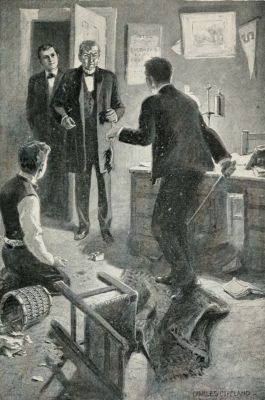
"There's the rat, sir," said Duncan.—Page 127.
"We're very sorry, sir, that you were disturbed," Donald was saying, "but it really wasn't our fault. Some one threw a live rat in at the door and we've been hunting it. We didn't mean to make any disturbance."
"Incredible!" exclaimed Dr. Mann.
"There's the rat, sir," said Duncan, holding up by the tail the unfortunate cause of all the trouble. "You can see it yourself."
Dr. Mann could see it. There was unquestionably a dead rat; and the ink spilled on the floor, the jar knocked from the mantel, the disordered furniture, scattered books, and the excited faces of the boys attested the fact that the poor animal had not been an expected guest.
"Who could have played such a contemptible trick!" exclaimed the teacher, in disgust. "Did you see who threw it in?"
"No, we were studying at the desk, and some one opened the door so quietly we didn't notice it, and chucked the thing right at us."
"Strange!" mused Dr. Mann. Strange, indeed! Yet after all not so strange to one who possessed the key. Rob held rolled in his hand a slip of paper which he had taken from the floor during the discussion. He glanced at it furtively as he stood listening, and smiled an involuntary and promptly extinguished smile as he read the expected legend, "The Third Plague." Even Dr. Mann might have formed a fairly accurate suspicion if he had considered the manner of the twins. Here was no wondering indignation, no loud invective against an unknown perpetrator, but the sullen bitterness of those who nourish a personal spite. But Dr. Mann, learned in ancient lore, had but slight knowledge of boys.
"I can't understand it," he said at length. "The matter must be looked into. It shows a sad misunderstanding of the Seaton spirit. One of you will please carry the animal to some proper place, and then perhaps we may have quiet again."
Duncan volunteered for this duty, and Dr. Mann and Owen retired. The latter reappeared, however, as soon as he heard Duncan's step on the stairs, in order to deliver the paper which he had secured.
"Oh, you had it!" exclaimed Duncan, as he read the label. "I thought it must be somewhere. Seven more! Gee whiz! I don't believe I can stand it."
"You'd better come to terms with him," said Owen.
"I wish we could," sighed Duncan, "but Don's got his back up and he will never give in. This living in perpetual fear of your life is wearing. I always pull my bed to pieces every night to make sure there isn't anything there, and I never can get it together tight again. Go and see him, won't you, and see what he says."
Owen grinned. The prospect of acting as intermediary pleased him. "All right," he said cheerfully. "What terms do you offer?"
"None," replied Duncan. "Just sound him and get his terms. And don't say we sent you."
Duncan returned to his room and Owen knocked at Payner's door.
"Who's there?" demanded the cautious inmate.
"Owen."
"Any one with you?"
"No."
The door was unlocked to admit Rob, the catch being immediately snapped behind him.
"'Fraid of burglars?" asked Rob, facetiously.
"'Fraid of something, sure enough," replied Payner, quietly. "You can't be any too careful in this place."
"Payner, how long are you going to keep this thing up?" asked Rob, coming with most undiplomatic directness straight to his point.
"What up?"
"Oh, all this plague business,—eels and guinea pigs and rats."
Payner snickered. "Did they send you?"
"No, they didn't. That is, not really and officially. I'm just making inquiries in the general interest of peace."
Payner sniffed. "What business is it of yours?"
Owen hesitated. "Oh, I'd like to help both sides. I don't want to see either suffer."
"I'm not suffering, I can tell you that. I didn't begin this thing, and I'm not going to cry baby. Those fellows attacked me without any kind of provocation, sneaked into my room, ripped it up, and damaged a lot of valuable specimens. If they've had enough, the least they can do is to come here and apologize and promise to behave."
"And you'll agree to apologize, too?" asked the mediator.
"Apologize nothing! I'll tell 'em what I'll do, when they come."
Feeling somewhat humble over the failure of his mission, and at the same time more or less persuaded of the justice of Payner's cause, Owen returned to Number 7 and called the Pecks to the door.
"Apologize!" cried Donald, when Owen finished his report; "apologize for having eels put in your bed and rats thrown at you? Never!"
"We did begin it," observed Duncan, in a less violent tone.
"We didn't; he began it," returned Donald. "Didn't he butt in about the Moons' room?"
Owen turned away in annoyance. "Do as you please," he said, "but you're fools not to patch up with him some way."
Rob sat down at his desk, less disposed to find excuse for the Pecks than ever before. "It's that pig-headed Donald that causes the trouble," he was thinking. "Duncan would settle the thing right off, but he's scared of his brother;" and while his mind was rebelliously following the affairs of the Pecks, and refusing to apply itself on the composition, a knock was heard at the door, and the unfinished work was again shoved into a drawer out of sight.
"Hello, Ned!" cried Owen, looking up in surprise as Carle appeared. "Glad to see you," he added cordially; "sit down."
His first impression at sight of Carle's serious face was that the pitcher had reconsidered the interview of last week and come to make amends. Otherwise I am afraid his greeting would have been less cordial.
"Is your room-mate in?" Carle asked, looking toward the bedroom door.
"He's getting his Greek with a fellow downstairs. Do you want him?"
"No, I want you. Can you lend me twenty dollars?"
Rob knew that he had not twenty dollars on hand, or half that sum, but instead of saying so, he answered by a question:—
"What for?"
"I've got to have twenty to settle with a man before to-morrow morning. If I don't ante up he's going to see Graham, and I'll be fired sure."
"I'm short," said Owen, wondering what this trouble was about. "I might let you have five."
"That isn't enough," replied Carle, evidently disappointed, turning toward the door. "I've got to have twenty anyway. I'll try some one else. Good night."
And before Owen had time for further questions, the door closed behind his visitor, and Rob was left alone.
And now more time was wasted in considering Carle's case, and guessing at the cause of his urgent need. The composition at last came out, but not until Simmons had returned with his Greek books under his arm, and the lessons for the morning packed away in complete order in his little brain. Presently another knock was heard, and the literary work was definitely abandoned.
"Hello, Owen," said Poole, rushing in. "Can I see you a minute?"
Simmons obligingly retired to his bedroom, and Poole began:—
"I've just been talking with Mr. Lovering about Carle. He says the faculty are very much dissatisfied with him and he's very likely to lose his scholarship. I heard yesterday that he owed a lot of different fellows. What are we going to do about it?"
Owen shook his head. "I don't know. I can't do anything with him. His father wrote me last week, asking me to talk with Ned. I tried it, but it didn't amount to anything."
"But we must do something," persisted Poole. "A good pitcher is half the nine, and we haven't any one else within sight of him. I don't believe O'Connell will come to anything."
"But Patterson will," was on Owen's lips. He checked the words, however, before they were uttered, and said instead: "Carle was here just before you came in, trying to borrow some money. He said he must have twenty dollars before tomorrow morning. I couldn't lend him anything."
"Where did he go?"
"After some one who could get him the money."
"And he's on study hours. What a fool!" cried Poole, as he clapped on his hat and started for the door. "He acts as if he'd set his heart on getting fired. Good night!"
Owen echoed the salutation with emphasis, and got himself ready for bed. It was depressing to spend so much time on other people's affairs, and yet be of no apparent use. Then he bethought himself of Patterson, and felt better. There was one fellow who took his advice!
CHAPTER XIII
A WANING STAR
The next morning, when Rob saw Carle swinging merrily off after chapel with a pair of irresponsible cronies, he judged that the twenty dollars had been found and the crisis averted. This was true. Unfortunately, however, the first successful effort, under spur of special necessity, to override the school decree as to study hours encouraged him to repeat the act of contempt a few days later. This time he made the most of the glamour of heroism attached by some boys to the reckless defier of authority. His triumph was short-lived. It is a peculiarity of this unsubstantial tribute of admiration that it is given, not for breaking the rules, but for daring to break them and for escaping unscathed. The maladroit who tries the heroic and is detected meets only contempt and derision. Carle was detected and put on special probation—the last stage on the outward way.
It is not impossible for a boy, even at this dangerous point, to take a new grip and by steady pulling draw himself gradually back to a position of safety. This thought was Poole's only comfort, who now, desperately anxious for his pitcher, was ready to undergo any sacrifice if it would but avail to save his man. All forces possible were brought to bear on Carle himself and his surroundings. His friends were urged to try to stiffen him up. Mr. Graham's counsel and assistance were sought. The Principal gladly gave the encouragement to Poole that he would have given to any boy interested in steadying another in the right way; but at the same time he suggested that fellows whose moral energy needs to be bolstered up by extraneous means almost always prove a poor reliance on the athletic field. He did not say, as he might have done, that no amount of skill can make up for lack of grit and determination and honest effort; and that the sooner a trifler is disposed of, the less the ultimate disappointment will be. Poole, though himself above reproach, was not ready for such a doctrine. He saw only that the nine must have a pitcher, and that Carle was a star who must be kept in school by all fair means. To all other considerations the captain was blind.
Owen, among the rest, was pressed into this crusade, though as Carle took very little notice of him, it was hard to see of what use he could be to the cause. In spite of his pity for Mr. Carle, he could not arouse himself to the desired pitch either of personal interest or of patriotic feeling. He knew Ned too well to cherish any delusion about his character; after four months of drifting in self-indulgence with the current, it was quite unlikely that Carle would have the strength to reverse his course and force his way inflexibly against it. And as for the school's need of a pitcher, Rob had, as we know, his own reason for regarding Carle as not indispensable.
So the last fortnight of the winter term crept by, with Carle under watch and ward to prevent critical offence. He was coached in his lessons, guarded from undesirable visitors, showered abundantly with moral advice, earnestly admonished of his loyal obligations to the school. Flattering as this distinction was, it had its unpleasant side. In the first place Carle had to work—and work had become for him the least attractive way of spending his time. Secondly, a dreary prospect stretched before him: he must continue to work like a man pumping for his life; for if he slackened pace or relapsed into his old habits, special probation became immediately "severed connection." Thirdly, there was no fun in it, and no likelihood of fun. His disgust with the position grew more intense as the days dragged painfully along.
The events of these days which especially concern this narrative may be briefly enumerated.
Another plague visited the Pecks. Number four was chemical, not zoölogical in its character, and while its effect lasted it seemed more severe than any of its predecessors. If you wish to know what it was like,—I advise strongly against the experiment,—pour two ounces of sulphuretted hydrogen into an open dish in a closed room. As Duncan reported sadly to Owen the next day, "It smelt like the concentrated essence of rotten eggs, as if a whole car-load of 'em had been stewed down into a spoonful." After this Duncan openly declared for peace, but Donald hardened his heart. Owen, once more appealed to, approached Payner again, but the avenger was obdurate. He would not take the apology of one for both, and he would not undertake to distinguish between two indistinguishables; they were both bad until both were good.
The names of the prize winners in composition were read aloud in chapel. Two were awarded prizes and one received honorable mention. When Mr. Graham announced that he was about to read the names, Rob felt a thrill of sudden emotion, and, dropping his eyes like a timid girl abashed at public praise, listened expectant, half convinced that the next moment the glances of his neighbors would be aimed at him. And when the names of the fortunate were read, with no Robert Owen among them, and the applause burst forth about him, he kept his gaze still fixed upon the floor, penetrated through and through with shame at his presumption. In a moment, however, he held up his head and joined in the clapping with a vehemence that added a second or two to its length. Why should he care? He had as much right to try for the prize as any one. Nobody knew he had tried anyway, except Simmons, and Simmons would keep quiet.
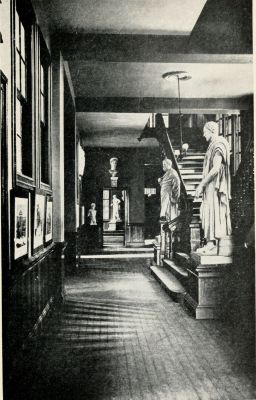
The Chapel Stairs.
So Rob jostled his way downstairs with the crowd, and strove to think no more of his disappointment. It kept recurring, however, in heavy moments during the Greek recitation, and once he was almost caught napping by a stray question as he dwelt longingly on the satisfaction he might have had in making the announcement to his father. A prize for an essay would have been an antidote for a whole season of parental objections to baseball!
That morning was blue all through. Simmons's well-meant commiseration buried him still deeper in the dumps. He brooded in unreasonable discouragement over the fancied failures of the year. The relay prize, his only success, had come to him in defeat through the efforts of another. In baseball he was to be numbered among the substitutes; his scholarship was mediocre; he possessed none of the qualities which bring popularity. Then he bethought himself of Carle, and the dangers of popularity and success as exemplified in the career of that youth, and felt some comfort. Mediocrity was at least safe.
Meanwhile Carle was losing interest in the cause. He was often sullen, and gave small and sometimes ungracious coöperation to those who were trying to help him. The glories of school life were no less attractive to him; he was as ambitious as ever to be the shining light of the baseball season, but the seriousness of the obstacles was growing clearer. To turn square about, work hard, shun extravagant friends, husband the pennies, do without every luxury,—this was his prospective life if he held on at Seaton. Was it worth while, even for the sake of the baseball? Carle, who was possessed of nothing resembling Spartan fortitude, had his doubts.
During the last week a further change set in. He became secretive where he had been confidential, and shy where he had formerly courted attention. He received important letters from his father without giving a hint of their contents; he had two interviews with the Principal, as to which the baseball people could get no information. A dealer in second-hand furniture called on him by appointment when his room-mate was absent. He cashed a check and paid certain bills.
The school broke up for the short spring recess on Tuesday morning early enough to permit those fortunate ones who lived at accessible points to catch the eleven o'clock train out of town. The candidates for the nine remained behind to take advantage of the recess for practice. Comans, Carle's room-mate, who lived in Massachusetts, got off on the first train. In the afternoon Carle had his usual practice with Borland.
On Wednesday the first mail brought to Robert Owen a letter from one of his correspondents in Terryville, which contained one short passage more interesting than all the rest: "They say Ned Carle is coming home to stay. His father says he's disappointed in the school; it's too expensive and they don't make the boys work as they ought to."
Could it be true? Was Carle really going to leave? The baseball crowd surely knew nothing of any such plan.
Rob jammed his hat on his head and hurried over to Carter 13. The door was locked; his knocks roused only hollow echoes. He ran downstairs and stampeded across the yard. At the gate he met Poole.
"I was coming to see you," Rob began eagerly. "I've just had a letter from a friend of mine at home. There's something in it that'll interest you." He read the passage aloud. "What do you think of that?" he asked, lifting his eyes in serious question to the captain's face.
"Rot!" exclaimed Poole, contemptuously. "I don't believe a word of it. Why, he was pitching to Borland yesterday afternoon!"
"But I couldn't raise him this morning," said Rob, his eagerness somewhat chilled.
"Oh, he wouldn't sneak off like that without a peep. Let's hunt him up and see what he says about it."
They crossed the yard in silence and ascended the stairs in Carter; Rob ashamed of his credulity, Poole clinging to his assurance, yet secretly agitated at the frightful possibility. As they neared Room 13, Poole, who was ahead, perceived that the door was ajar, and turned about with a triumphant smile.
"It's all right; he's here," he called, giving a whack at the door that opened it wide.
But inside stood revealed, not Carle, but Jenks, the second-hand furniture man. The visitors gaped at him for a moment in speechless astonishment.
"Where's Carle?" demanded Poole, recovering himself.
"On his way home, I expect. He was going by the early train this morning."
Rob threw at his companion a significant glance, but Poole was gazing at the speaker with staring eyes and open mouth.
"Has he sold his things to you?" asked Rob.
"All he didn't take with him. He arranged with me to call for 'em this morning. He ain't coming back, you know."
CHAPTER XIV
A CAPTAIN'S TROUBLES
Poole stood in the middle of the room, his lips still parted, his eyes staring. His expression, as Owen saw it, and as it would have appeared if reproduced by instantaneous photography, was almost idiotic, so stunned was he by the incredible news. In a moment, however, intelligence returned.
"Do you mean to say that Carle has sneaked off home for good, and sold his things to you?" he demanded fiercely, taking a threatening step forward upon poor Jenks, as if the dealer were to be held responsible for Carle's disappearance.
Mr. Jenks edged away. "I dunno about sneakin'," he replied resentfully; "I said he'd gone home for good and sold his things to me. I s'pose he's got a right to go if he wants to."
"Did he tell you he wasn't coming back?"
"Yes, he did, three days ago, right in this very room. He didn't want me to come for the stuff till to-day, because he said the boys would bother him with questions. I'm going to send him the money as soon as I get the things down to the store."
Poole stood silent, but his eyes, angrily snapping, remained fixed upon the furniture dealer, and his lips, tightly shut, twitched at the corners. Mr. Jenks looked puzzled; suddenly a ray of intelligence flashed over his face. "None of the furniture was yours, was it?" he asked eagerly, thinking to have found the reason for Poole's emotion. "He said it was all his except what belonged to his room-mate."
"None of it's mine," returned Poole, turning abruptly on his heel. "Come on, Owen!"
He went plunging down the stairs, with Owen following closely. At the outside door he turned on his companion.
"What do you think of that?" he demanded hotly. "That's a fine trick to play us, isn't it!"
"If his father sent for him I suppose he had to go," remarked Owen, thinking for the moment rather of Mr. Carle's plight than of that of the school.
"Why did he have to go?" shouted Poole, whose wrath, already at the boiling-point, bubbled furiously over at the suggestion of excuse for Carle's defection. "Why did he have to go? Why couldn't he stay here and earn his way as well as Laughlin and Jeffrey and White and Barrington, and lots of other fellows that are better than he is? Why did he have to join that Standard Oil crowd and play the sport, when he knew, and everybody knew, that he had no money to spend? Why couldn't he live within his means, like any decent fellow? Think of his knowing for a week that he was going to clear out, and letting us tend him and tutor him and guard him like a confounded little prince! Why, he was in the cage with Borland yesterday afternoon!"
These were obviously rhetorical questions, to which answers were not expected. But Rob, though he felt no temptation to undertake the defence of Carle, could not refrain from remarking: "You fellows were partly responsible. You've done nothing but flatter him and pet him since he came."
There was some truth in this charge, and Poole was honest enough to recognize it. He passed abruptly from vituperation to lament:—
"But he could pitch—you know he could. I never saw a fellow in the cage like him—and he's let us waste all the winter on him, the beggar, and now crawls off just when we rely on him most. What's O'Connell or that green Patterson compared with him? Borland's simply thrown his winter away."
The references to Patterson and Borland were not pleasing to Owen; the first, because he knew that the contemptuous opinion was not deserved, the second, because it emphasized once more the contrast between his own position and that of Borland. It had apparently not occurred to Poole that Patterson might have developed under Owen's tuition.
"I call Patterson a very promising man," he blurted out, stung by the captain's slur, and regardless of his secret.
Poole shot a quick glance at his companion.
"Better than Carle, perhaps," he said with a mocking smile.
"Better than Carle two years from now, if not better to-day," Owen retorted hotly. "I've caught them both and I ought to know something about it."
Poole sniffed,—in pity rather than contempt. That a fellow who evidently had seen good ball, and who usually showed common sense, should group Carle and Patterson together as equals, or likely to be equals, seemed unaccountable. "He'll do me a heap of good two years from now, won't he? I want some one for now." And then, after a few moments of silence, during which he kicked away at the marble entrance step, while his thoughts dwelt gloomily on the desperate situation, he added in discouraged tones: "I suppose the first thing to do is to ask Grim whether the chap has really gone for good, though I haven't any doubt about it myself."
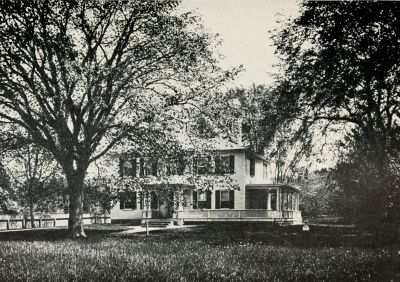
The Principal's House.
So they parted, Poole to visit the Principal and receive confirmation of Jenks's story, Owen to return to his room and upbraid himself for boasting about Patterson. He felt all the confidence in his protégé that his words implied, but he had no desire to see his pitcher taken from his hands and turned over to Borland as Carle had been. When Patterson was tried out he wanted to be on hand to support him and keep him up to his best; likewise to receive a just share of the glory of the achievement, should the achievement prove glorious—but of this he tried not to think.
Borland's task during the short spring recess was not what he had imagined it when he had said good-by to his admiring friends, sharing sincerely in their belief that he was to constitute at least one-half of the best battery that the school had ever possessed. Instead, he found himself doomed to partake of the disgrace of O'Connell's failures. And alas! it was the same old O'Connell, conceited, obstinate, uncertain as a primitive blunderbuss! He did indeed take seriously the new responsibility devolving upon him through the departure of Carle; he really meant to do everything within his power to "make good." He laid aside the airs of superiority and self-satisfaction which had been so offensive to Owen; he was not unwilling to consider Borland's advice; he endeavored to keep his inflammable temper well shielded from stray sparks. Unfortunately, however, he was not by nature teachable, nor was Borland a wise instructor. When two drops in succession landed on the plate, Borland would protest and O'Connell promise to do better. When, a little later, O'Connell would persist in shooting his high ones at the batsman's head, or throwing ridiculous outs that showed themselves clearly wide long before they came within reach of the bat, Borland would reprove sharply, O'Connell retort with asperity, Borland sputter and growl, O'Connell drop all fire protection and let his temper blaze away! Whether peace was patched up immediately or not, that day's practice was ruined.
To say that the captain was discouraged would be an understatement of poor Poole's condition. He was desperate. Laughlin cheered him somewhat by assuring him on general principles that the opportunity usually produces the man, and so some one would probably be found to fill Carle's place, if not better than the renegade, at least as good. But Laughlin knew nothing of baseball, and Poole had little faith in general principles. He took the first chance that offered to watch Patterson and Owen at their practice, hoping to find substantial reason for Owen's assurance. But Owen, obstinately true to his purpose never to show off his man, kept Patterson working away on the morning's task,—a slow ball which was to be thrown with the exact motions used in throwing a swift one, but about ten feet slower,—and disregarded the spectator. The captain had at last to ask for something different, and was of course obeyed. Though what he saw would hardly represent Patterson's possibilities as a pitcher, Poole left the cage with the feeling that Patterson was, after all, not so bad.
"Ten feet slower!" he said to himself as he strolled back to his room. "That's drawing things pretty fine! If it's too slow it's bad, of course, for a man gets ready to hit, stops himself, makes a fresh start, and very likely catches it squarely and drives it out. It's got to be slower than a swift one, and not too slow; but how does Owen know that the difference is just ten feet? The chap understands handling a pitched ball all right, and Patterson minds him as a Japanese soldier minds his officer, but I don't believe that he's so mighty wise that he knows the difference to a foot between a swift ball and a slow one."
Poole resolved to see the whole of the next pitching practice. But, unhappily, Patterson was called home the next day because his family were unwilling to forego the pleasure of his society during the few days of liberty that the school offered,—so there was no practice to watch except that of O'Connell and Borland, who quarrelled daily, and daily made up under the pressure of their joint responsibility, each blaming the other for lack of progress. It was not pure joy to be captain of the Seaton nine!
CHAPTER XV
OUTDOORS AT LAST
The boys came rushing back for the final lap of the school year. Already on the train most of them had heard the startling news: "Carle isn't going to pitch! Carle has left school!" These brief statements of undeniable truth were not all they heard; there were additions through wild rumors and bold surmises transformed to positive facts in the repeating: Carle left because he wasn't allowed to play ball; Carle was proved a professional and had to go; Carle was fired because he left town without permission, because he cut chapel too often, because he didn't do any work, because he had a row with a teacher, because he was a scholarship man and smoked, because he had been drinking, because he played poker. For two whole days Owen was kept busy denying these rumors. Then the tongues gradually ceased to wag; and Carle faded ingloriously away into the limbo of the suddenly departed, whose names when mentioned in the Seatonian always bear the significant "ex" before the numeral of the class which once claimed them.
With the returning boys, to Poole's great relief, came the baseball coach, Mr. Lyford. The ground on the upper campus was already hard enough for practice; the regular diamond was drying. Cutting though the winds and raw and chill the atmosphere, Rob yet found it an immense relief to escape from the confining walls of the little cage into the open, where there was room to throw, and honest, abundant daylight. He had never taken kindly to the practice in the cage. When he tried to bat there, he had always been awkwardly conscious of those close lines of netted wall pressing upon him, of the low ceiling, of the treacherous shadows, of the impossibility of driving the ball anywhere, of the whole sham of the situation compared with the open field, where the sunlight pours down through fifty miles of atmosphere, and the wide horizon challenges the batsman to his hardest drive. Perhaps this feeling was responsible for his lack of success as a cage batsman; perhaps he hated the cage because he couldn't hit there. At any rate, the facts were connected, and he welcomed his release with the heartiness of the landlubber when, after his first voyage, he exchanges the narrow, malodorous, unsteady forecastle for solid, familiar earth.
Not so poor Patterson. He felt as a timid pupil would if snatched suddenly from a gentle tutor's care and thrust into a lively school, where independence must be fought for and honors won unaided. His courage failed him; he dreaded to go forth into public view and face the test, with eager batters trying for real base hits, and every error of judgment or delivery counting in the score. The cage was familiar ground to Patterson. Here he had acquired whatever skill he possessed. With Owen behind the plate to explain just what to throw and how to throw it, with no one else at hand to molest or make afraid, he could handle the ball as well as another. His wrist had the master snap that yields sharp curves; his shoulder the sweeping swing that makes speed. But outside—alas! outside was a strange land in which he feared to trust himself.
"Foolishness!" laughed Owen, when Patterson frankly confided to him these misgivings. "You'll do better outside. There's all the inspiration of the game to spur you on, and the fun of working your man,—putting your wits against his, you know, and making him do things he doesn't want to do."
"But I don't feel as if I had any wits," said Patterson, "or shouldn't have any if I got into a close, hard game."
Owen stopped short in his walk and fixed his eyes disapprovingly on his companion's face. "Look here, Pat," he said sternly, "you've got to cut that kind of talk and that kind of thinking too. We're going out to play ball, not to help fight a battle or swim for our lives or anything like that, but just play ball. There's absolutely nothing to worry about; we aren't the captain or the coach. We'll do as well as we can, and if our best is good enough, we'll make the nine. If we don't make it, it'll be because there are others better, and we shan't have any responsibility. So there's nothing to worry about in either case. But if you're all the time scared that you'll do something wrong, you'll never do anything right. That's as sure as the multiplication table."
Patterson did not answer.
"Isn't that good sense?" demanded Owen.
Patterson drew a long breath. "It's good sense all right, but I don't know whether I can do it."
Owen snorted. "You can if you've a mind to. Just settle it that you'll do your best and be satisfied with whatever turns up. Why can't you let Poole and Lyford do the worrying?"
"I suppose I can," said Patterson, humbly.
"I should hope you could! I tell you, man, you've got the goods! You have speed and good control and all the curves you need. If you give yourself half a chance they'll recognize it. If they don't, what do you care? There are other teams in the country, and this isn't the only year you're going to play. Just stop thinking, and play your game, and be satisfied if you make the second!"
"That's all I expect to do," answered Patterson, nettled. He felt for the moment angry with himself and vexed with Owen, but the talk did him good. He faced the first practice with an outward show of composure that did very good duty for confidence.
The coach made no significant comment on the batteries. He had kept in touch with the work of the winter through Poole's letters, and doubtless shared the captain's view that with Carle eliminated from the list, O'Connell must be the chief reliance of the season. At all events, on the first rally of forces in the open, he spent most of his time on Borland and his mate. O'Connell did better than usual, having got at least this measure of good from Borland's browbeating, that he was more cautious in his delivery, and made better aim for the plate.
Owen exerted himself on the occasion to put his pitcher through his paces, and give the coach some inkling of what he fondly believed to be Patterson's great promise. But unfortunately, either from the novelty of the new conditions or from nervousness, the pitcher was slow in steadying down; and by the time he was delivering the balls as the catcher expected, Poole called Owen away to join the outfielders, who were catching flies, and put Foxcroft in his place. And Foxcroft blighted the pitcher's inspiration as a hoar-frost blights a hothouse plant.
"How did it go?" asked Owen, coming in some time later for a brief batting practice before the net.
Patterson gave a doleful shake of the head. "To pieces," he answered laconically. "I never could pitch to that fellow!"
"What did Lyford say?"
"Nothing. He didn't need to say anything."
"Owen!" called Poole, and Rob, picking up his bat, took the place before the net which Peacock had just vacated. He felt disappointed and irritated; disappointed because, having made Patterson's cause his own, he was himself hurt by the failure; irritated because he was sure that if Poole had only left him alone another ten minutes he could have pulled his friend safely through. He stood at the plate with his jaw set, and his eyes shining bright, ready to hit and hit hard. O'Connell was pitching for the batsmen, and O'Connell asked nothing better than the privilege of striking out this arrogant freshie, who had presumed to offer instruction to him in the cage, and had dropped him so contemptuously for not receiving it. So he tried a deceiver in the shape of a hot outcurve—O'Connell's strongest card—which starts wide and swings over the plate. Owen felt savage, but not savage enough to lose his wits. He had learned long since from McLennan that the great batsmen study the pitcher's motive and try to guess in advance the ball that he will pitch. Knowing O'Connell's strong and weak points, he had no difficulty in recognizing the ball that came spinning threateningly toward him. So he waited unmoved, and swung at it as it broke over the plate as if the ball itself were the animate cause of his disappointment.
Bat and ball met squarely with a crash; the ball sped away, not in a high parabola that gives the lazy outfielder an easy put out, nor in the regular sharp bounds which a clever baseman may handle, but well above the reach of any infielder, and striking the ground too soon and with too hot a pace to be held by the outfield. A hard hit like this, if it passes between the outfielders on a deep, smooth field, rolls forever.
"A bully hit!" exclaimed Durand, as Owen, his frown transformed into a smirk of satisfaction, took his place with the rest. "That's good for three bases sure."
"I don't know about that," Owen replied modestly, mentally resolving, however, that if he ever made such a hit in a real game he wouldn't stop to look round till he had passed third.
"Too hard," was the comment of the coach to Poole, "but good form."
"I'm hoping to get a good hitting outfielder out of him," replied Poole. "Carle told me Owen's batting average was always high. I suppose Borland will do all our catching."
Patterson came up for his trial. O'Connell, angry with himself for having let Owen get a long drive out of him, set himself to fool the pitcher at least.
"Don't try for big hits!" warned the coach. "Just watch the ball and make sure you hit it. Wait for the good ones!"
And Patterson watched the ball and waited, letting the good ones go by and striking at the poor ones. He finally succeeded in poking a feeble bounder over to the pitcher's position, and thus obtained the privilege of retiring. Altogether Patterson's first day out gave little promise that his ambitions would ever be realized.
CHAPTER XVI
THEORIES AND PLANS
"Going to get into the game to-day?" asked Wolcott Lindsay, on the Saturday morning following the first outdoor practice, as he met Owen coming out of the Pecks' room. "I understand they've got about twenty men on the batting list."
Rob laughed constrainedly. "Yes, Sudbury and Tom Riley and I are all going to play centre field."
"I thought you were down for second base."
Rob shook his head. "They tried me there yesterday, but I didn't make good, so I've gone further out."
"Well, I hope you'll make good there. Durand says you're a slugger."
"I'm not!" answered Rob, sharply. He had his own opinions as to men who are always trying for home runs. "I'm no great fielder either," he added more moderately, "as you'll see if you come up. Who are these Seaton Clippers anyway?"
"Oh, just a team made up of townies. We always play the opening game with the Clippers to try out the men."
They parted, Rob going into his room, where Simmons sat in the corner of the window-seat, doubled up over a book.
"Poole's been here to see you," said Simmons, looking up. "He says the Clippers have gone back on him—they couldn't get their pitcher—so he's going to have a five-inning game between two nines. He wants you and Patterson as battery for the second. Game starts at three. You're to be up there as soon after two as possible for preliminary practice. I told him I'd tell you."
Simmons recited his message as he would a well-studied theorem in geometry, and, having recited it, buried himself again in his book. He was a most accurate little person,—tiresomely accurate, Rob sometimes thought. On this occasion, however, Rob's face lighted up at his roommate's words; and though he opened his mouth to ask a question, he closed it immediately with the question unasked. The message was complete. It was also welcome; if he had planned an arrangement that would give Pat the best chance to show his powers it couldn't have been better. And now the opportunity had come unsought! If they did well, the credit was wholly theirs; if they failed, no hopes would be disappointed but their own.
"I'm going over to see Pat," he said, clapping on his hat again. There were some uncertainties about signals which must be cleared up before the afternoon. Then a new thought came to him, and he dropped into a chair by his desk to jot down several memoranda on a blank sheet. When he looked up, he found Simmons's eyes fixed upon him with the discouraged expression which sometimes haunted them, particularly after a visit home. Simmons was a most conscientious student, an excellent scholar in languages, and personally quite unassuming and inoffensive. But he was not strong physically, and in occasional times of weakness or weariness was likely to dwell morbidly on the contrast between his own situation and that of his more robust, lively, and popular associates. Rob understood at a glance that this was one of Simmons's homesick days, so he tucked his notes away in his pocket and turned to his apathetic little chum.
"Going to the game?" he asked in a hearty tone.
"No," replied Simmons, dropping his eyes again to the page before him. "I don't care anything about baseball."
"Why don't you go up the river, then? You ought to be outdoors somewhere on a day like this."
"I'd rather stay here. Payner asked me to go up with him, but I don't think I should enjoy his society."
"Payner!" exclaimed Owen, staring at his companion with an interest no longer forced. Then he threw back his head and laughed aloud.
Simmons put down his book. "I don't see anything so funny in that. Why shouldn't he invite me if he wants to?"
"He should, and if I were invited I'd go, if I had to cut ball practice to do it."
Simmons looked his astonishment, but said nothing.
"You might find out where he gets the things that he bestows on the Pecks," continued Owen.
"Have they had another?" cried Simmons, eagerly, jumping to his feet and planting himself in front of Owen. "Tell me, have they had another? What was it?"
Owen grinned and nodded. "Some queer little olive-green lizards, about three inches long, with small red spots all over them. I didn't know the things."
"How did it come? They've kept their door locked for a long time, and they hardly dare open a window."
"In the laundry bag," chuckled Owen. "It was left outside their door, and the lizards just went to sleep in it. There was the usual ticket tied to one of their tails, 'The Fifth Plague.'"
"I don't think that's so awfully bad," said Simmons, after some reflection. "A lizard wouldn't scare me much."
"That's what Don said," replied Rob, smiling as he recalled the scene. "He thought it showed Payner was about at the end of his resources. But Duncan said the season was just opening, and half the plagues were yet to come, always supposing that Payner would be content with the biblical number. When I left them they were still arguing—well, I've got to get over to see Patterson."
Owen took up his hat again. Simmons was standing by the window. The boy turned around as Owen approached the door, and said apologetically: "I think I'll go in and tell Payner I've changed my mind. I may as well go with him after all."
"That's right!" called Owen, from the door. "And be sure you tell me all about it."
And he ran downstairs with a light heart, eager to see Patterson and plan the signal service for the afternoon.
Half an hour afterward he was still sitting at one side of Patterson's table, with the pitcher on the other and the notes between them. The conversation, however, was no longer concerned with signals.
"I tell you it's so," Owen was declaring. "One of the first two balls pitched has got to be put over. If not, you're in a hole."
"I don't see that," said Patterson.
"Well, I can prove it to you," said Owen, confidently. "Look here, now. When you start in with a batter, the chances are four to three in favor of the pitcher, aren't they? He has four balls to give away, and the batter has three chances to strike. Really the odds in favor of the pitcher are much greater, because even if you give the batter a ball that he can hit, there are eight men lying in wait for it, and one of 'em is likely to get it."
Patterson nodded.
"Now, as long as you can keep the batter uncertain whether the ball that's coming is good or bad, you have him at a disadvantage, haven't you? But when you're so fixed that you must put 'em over, he's got you at a disadvantage."
"I can see that," said Patterson.
"Well, if you give two balls right off, you've changed the chances from four to three in your favor, to three to two in his; and he feels pretty certain that the next one will be over, because you've got to begin to get strikes. After that, if you get a single ball, you must put every one over, and the batter knows it. So to get two balls at the start is to put yourself in a hole."
"Then the first ball to pitch to a man is either one that he'll strike at, thinking it's a good one, or a really good one that he can't hit, or doesn't think of offering at."
"That's the theory," said Owen. "As a matter of fact, most of these fellows couldn't hit a straight ball more than half the time, if you told them where it was coming. McLennan says you can fool most amateurs with speed alone. He's coached college teams and ought to know."
"And if you can get two strikes on him early, you have him worrying," mused Patterson.
"Yes, but it won't do to let 'em think that's your only method. The idea is, never get into a position where you've got to give a strike. Always keep them guessing."
Rob batted to the infield of the Second nine before the game, and came to the conclusion that Patterson would receive little help from the men behind him. At second base was a short, round, red-headed lad rejoicing in the name of McGuffy, who fumbled every other grounder, as if alternation were a rule of the game. At short played another fatty, most inaptly named Smart, who always threw either over the first baseman's head or at one side of his feet, and seemed quite ignorant of the very elementary rule that shortstop covers second on hits to the pitcher's left. Peacock at third combined the faults of his two neighbors. The one redeeming feature in the near landscape was Ames, the tall, raw-boned, awkward junior who crouched on his long legs like a grasshopper at first base, and flung out his big hands to incredible distances for the poor throws served up to him by the trio of incompetents around the diamond. Rob grinned with amusement as he watched the fellow gathering in the balls, hopelessly clumsy and inelegant from finger ends to tips of toes. The spectators on the benches laughed and jeered, until Poole shut them up by a peremptory message. Long Ames paid no attention to them; he was too busy scooping Peacock's short bounds out of the dust, and pulling down high sailers that Smart had started on their way to the bleachers.
Allis at left field was made captain of the Second. It was he who arranged the batting order, at the head of which Owen was placed, evidently on account of his success at the net during the two days of outdoor practice. Allis himself came next, then Rorbach, then Reddy McGuffy and his antipode Ames. Poole took his team into the field, and Rob faced O'Connell for the first test of strength. Were he and Patterson to prove in a class with McGuffy and Peacock? A few innings would show.
CHAPTER XVII
A SET-BACK FOR O'CONNELL
Absorbed as he was in one phase of the game,—the success of the second battery,—Rob felt no anxiety at all as to his own personal record with the bat. He wanted to hit O'Connell, of course, but the chief thing after all was that Patterson should not be hit. So he stood coolly at the plate, ready for anything that O'Connell might send in, but unworried and more than half expecting to get his base on balls. The first one was high, the second he had to dodge, the third was a called strike, the fourth a drop that dropped too far, the fifth an unmanageable in, that hit him in the small of the back as he squirmed away from it, and gave him the desirable gift of first base and the undesirable one of a painful bruise.
Allis strode up, pounded the plate with his bat, and squared himself, with legs apart, for a mighty deed. While Rob knew nothing of Allis's powers, he did not like this form; and not wishing to be cut off at second by an infield hit, he determined to make a dash at the first pitch, when a steal would hardly be expected. So off he scampered at the first movement of O'Connell's arm, and covered his distance so well in spite of his bruise that when he slid safely to the bag, McPherson was in the air taking Borland's high throw. In other respects also the venture proved a lucky one, for Allis hit two fouls and then struck out, and Rorbach made a scratch hit to short that would certainly have cut Owen off at second if he had clung to first base. As it was, Rorbach was safe at first, and Rob reached third before the ball got back across the diamond. Then Reddy McGuffy sent up a little pop fly to the first baseman, and long Ames appeared beside the plate, swinging his bat like an axe.
The lads on the seats made merry as Ames smote terribly and in vain at the first one over. The next he let go by; it was a ball. At the third he smote again, this time with effect. The ball shot out over first baseman's head, bounced hard on the running track, and made full speed for the corner of the field.
Then for some seconds the onlookers saw lively running. Peters in right field sprinted for the ball, the second baseman ran out to support him, Rob trotted home, Rorbach fled along two bags behind him, and still farther behind came Ames, galloping like a cart horse and constantly twisting his head backward to make sure that the ball was not close at hand. The fellows who had been jeering were now stamping and yelling, the players of the Second were running up and down the lines, brandishing their arms and shouting contradictory directions. Ames rounded third base at full speed, saw the ball bounce into Borland's hands, stopped, turned,—and was touched ignominiously out by Durand two feet from third. And then the spectators hooted and jeered more violently than ever.
"If it keeps up like this, there'll be more fun than practice," thought Rob, as he buckled on his protector. And to Patterson, as the latter started for the box, he said: "Don't worry about the bases; I'll throw to them when it's necessary. Just try your hardest to put 'em where I want 'em, and don't worry. If a batter's slow or timid, give him full speed. And don't think because one happens to hit you they all will."
McPherson led off for the First nine. Patterson fixed the ball in his two fingers and drove it hard and straight over the inner corner of the plate just below the shoulder line. It struck with a resounding clap in Owen's big mitt, and as it struck, McPherson realized that he had lost a chance. As the next one looked exactly like the first, McPherson whacked valiantly at it, but just before it reached the plate the ball broke and lifted, while the bat swept the air beneath it. Two strikes!
"It's all his way now," thought McPherson. "This'll be a ball,"—and it would have been if it had kept its first course. Unfortunately for the batsman, however, it slanted down and in instead of down and out, and the umpire called it a strike.
"Astonishing how a man loses his batting eye during the winter!" thought Poole, as he took McPherson's place at the plate. "If I can't hit that fellow I must be blind."
Now the captain was considered the best batter in school, and deservedly so. In the fatal Hillbury game of the year before he had proved almost the only Seaton man whom the Hillbury pitcher could not deceive, and he and McPherson were responsible for all the hits the defeated team had made. He had an excellent eye, watched the ball closely, and was a patient waiter. All this Owen knew. He also knew that a waist ball was the kind Poole always longed for, that he was wary on high ones, and often hit a low one in a long fly. Patterson's first attempt was clearly wide of the plate; his second was low. Poole offered at neither, and both were called balls. By the next ball, the same full-speed straight one which had fooled McPherson, Poole was caught napping, and the sharp "Strike one!" of the umpire gave comfort to both members of the battery. Rob now signalled for the slow ball, at which Poole struck too soon. With two balls and two strikes, Patterson put a low one over the outside of the plate, hoping to finish with the captain immediately; but Poole caught it on the end of his bat and sent it in a long arch to centre field, where Rorbach gathered it in. Sudbury, who came next, struck at the first pitched ball and raised a pop fly, which the second baseman, to Owen's surprise and McGuffy's own immense satisfaction, managed to hold. Reddy tossed the ball over to the pitcher's box with the best air of a professional, and strutted complacently in. The first inning had ended with the score two to nothing in favor of the scrub.
O'Connell pitched six times to strike out Smart. Meanwhile, Owen and Patterson discussed the situation.