IX.
Reading edition
MENTONE.
The union of bold grandeur with soft loveliness in the Mentone landscape, arrest and powerfully strike the eye upon arrival. Familiarity with its scenery, after a residence of months, scarcely dims the first impression. We had heard much in a general way regarding it even before leaving home, but every expectation was at once far exceeded by the reality. We had just left Cannes and Nice, and witnessed them both in their brightest aspects; but Mentone in its natural features, and seeing it, as we did, for the first time, in glorious sunshine, threw them both into the shade. It was an agreeable surprise, and made us instantly feel that a more beautiful spot for winter residence could not have been chosen.
Originally the town of Mentone consisted simply of a collection of high old houses, rising ridge upon ridge like so many terraces resting upon the steep slope of a hill, the crest of which was at one time crowned by a castle or palace of the old feudal lords, now converted into a picturesquely-situated cemetery. This hill or ridge, with its curious old houses,—among or above which the cathedral and other churches stand, from which there rise two elegant minaret-like spires, one taller than the other, conspicuous from every quarter round,—forms a very striking object, especially when seen from the east, and from that side may be said in miniature to resemble a little, though of a different character, the old town of Edinburgh, which, however, is far more lofty and extends at least ten times farther. The harbour or port of Mentone lies at the bottom of the seaward end of this ridge. Curious old high houses, resting upon odd long-shaped water-worn rocks, the terminals of the hill, abut and hem in the harbour on the north or land side; while on the south side, a long breakwater is in course of formation for protection from the ocean waves, which, coursing over the whole width of the Mediterranean Sea without interruption, occasionally, under the pressure of a south-west wind, dash up and over with great vigour. An old building, at one time a small castle, standing at the end of the original pier, makes an object in the landscape, and perhaps could tell some tales. The water in the port is extremely shallow, so that the anchorage is only adapted for vessels of a small size, of which there are always a few moored to the quays. The hill ridge, with the projecting pier, form, similarly to Cannes, the dividing line between what are termed the east and west bays.
The books which have been recently written on Mentone, particularly those of Dr. Bennett and of Mr. William Chambers, but more than any book, the good reports of visitors, have induced such an influx of winter dwellers from distant lands as to have created a new town in both bays. Rather, it may be said that the hotels extend in both directions, for in reality the newer parts of Mentone are made up chiefly of lines of large hotels, the street or shop part of the town being only a necessary sequence. From the ridge eastward to the gaping gorge of St. Louis, which is now the boundary line between France and Italy, the distance by road is about two miles. Hotels line upon one side nearly the first mile, the other side being open to the sea, and villas dot the remainder of the way. From the gorge, south or seaward, a mountain called Belinda (1702 feet) springs up, and from its shoulder a promontory juts out to the sea and forms the termination of the east projecting arm of the bays. From the north side of the gorge a mountain range rises more loftily into the majestic Berceau and Grande Montagne, and, stretching away to the north and north-west, form the great shield to Mentone from the east and north-east winds. These mountains attain an elevation of about (more or less) 4000 feet,—the Grande Montagne being stated by one authority to be 4525 feet,—and show themselves boldly and almost perpendicularly in some parts like enormous colossal walls of bare rock. Due north from Mentone, and from two to three miles distant from it, another chain of mountains lies almost at right angles right across from east to west—St. Agnes in the centre, and behind it the high and sharply-pointed Aigle (4232 feet high)—affording shelter from the north winds; while the Agel (3730 feet high), and some other lesser mountains, terminated by the long promontory of Cape Martin, all lying from north to south, afford shelter from the west and north-west winds, and particularly the cold mistral. Within these greater mountain chains, a series of high ridges or hills standing in front, or issuing out of them like huge tumuli, all covered with olives in terraces, afford additional shelter; so that were it possible for the wind to blow down the outer rampart, it would be withstood by this inner wall or circle of lesser heights, some of which are 1000 feet high. In the distance on the other side of the great mountains, but invisible from Mentone, the Maritime Alps rise to a height of from 5000 to 9000 feet. It will thus be seen that the configuration of the mountains is that of a great semicircle, and that on every side save the south or sunny side, open to the sea, Mentone has protection from the cold winds which in reality blow over the tops of these great walls and strike at some distance away,—the north or prevailing winter wind reaching the sea some miles out. It cannot be said that the cold of the winds is not felt, but it is so greatly averted or modified that Mentone is practically sheltered; and hence it is that, coupled with the long continuance during the winter of dry open sunny weather and the absorption and radiation of the sun’s heat in and from the limestone rocks, it becomes so admirable a place for the invalid.
Our quarters were in the west bay, considered to be more bracing and less relaxing than the other, which is said to be three degrees warmer, and, from being so, and more enclosed and protected, better suited to the extremely delicate. The hotels and houses in the west bay—in which is also situated the new or shop portion of the town—extend, though not continuously, about a mile; and there has been formed in front, by the border of the sea, a roadway called the Promenade du Midi,—a good and fairly-wide pleasant road for foot-passengers and carriages,—which is, in the early part of the forenoon, the great resort of invalids and other strangers, who here meet their friends, and can view the sea uninterruptedly in their walks, or enjoy a book or a newspaper on one of the many seats provided for the weary or lazy. A low stone-built bulwark protects the promenade from being washed away by the sea, which sometimes, though very rarely, sweeps up forcibly in heavy waves, and even occasionally in a storm, so as to dash over the road. But when the wind is from the north, the sea retires under its pressure 60 to 100 feet from the bulwark, and there is scarcely a ripple upon the water, which then looks like one sheet of blue glass. And this is its predominating or normal condition during the winter. When the waves come, they trundle over monotonously, without gaining or losing a step. It is the great drawback of the Mediterranean that it has no tide, or a tide that is all but imperceptible. The difference between high and low water at Mentone is only from two to three feet. The consequence is, that the sea does not carry away sufficiently the impurities which are conveyed to it; and there is wanting that interesting feature of a tidal beach, the change from hour to hour of the appearance of the shore. It is only right, however, to add, that Mentone enjoys comparative immunity from the noisome influence of exposed drainage. Small drains only empty into the west bay; and they are not particularly offensive, though they might be improved by carrying pipes down into the water,—only the likelihood is, that the first storm would sweep them away. Another empties in the east bay, at the corner formed by the junction of the old town at its north end with the shore. This is at all times disagreeable to passers-by, and must be insalubrious to those residing in its neighbourhood. But it seems difficult to understand how Mentone is drained, unless the east pipe conveys the great bulk of the sewerage to the sea; although, so far as the old town is concerned, it has been explained that the natives collect all manure to carry it off to the country, thus combining thrift with cleanliness. That the town is not as yet so disagreeable as Cannes, may arise from the population being greatly smaller. When Mentone increases much, as it is threatening to do, it may be quite as discernible.
I have never seen any place so strikingly enclosed as Mentone is by its semicircle of mountains and the minor hill ridges. The higher parts of the mountains are steep, rocky, and bare; but all over the ridges, and far up away into the mountains, the olive tree is cultivated in terraces built for their reception. The orange and lemon trees mingle with the olives at a lower elevation, and in some, especially the higher parts, pine trees furnish a deep green covering. But all combined add a rich beauty to the imposing grandeur of the scene. Some of the buildings also contribute materially to the effect. On the summit of a lofty ridge, between the Carrei and Boirigo valleys, a monastery conspicuously rears its head. On the other heights there are houses of peculiar construction, curiously painted; and the whole place is dotted over with bright-coloured villas, of all tints and shades of white and yellow, relieved by the almost invariable roofing of red tiles, and the usual gay greens of the outside venetian jalousies. But next to the mountain heights, the most marked lineaments of the Mentone scenery are its valley depths or ravines between the various ridges, and in which rivers find their beds, although in the dry weather which generally prevails they are but trickling streams, and in some cases usually almost dry. The greater valleys are three—or rather, it may be said, four—in number, consisting of two larger, with their torrent beds, the Carrei and Boirigo; a third, containing a smaller river course, the Gorbio; and a fourth, the Mentone valley and streamlet, the smallest of all, but obtaining its name from, or giving it to, the old town, at the bottom of which, or underneath the streets, the rivulet passes. The valleys, three of them of considerable width, in which these rivers run, form beautiful adjuncts to the town; and the torrent beds, which are not so long or so wide as those at Nice, are striking without being distasteful to the eye.
Such are the general outlines of the landscape. I shall have to recur to some of them hereafter. To those who can appreciate scenery, the tout ensemble cannot fail to produce a feeling of intense admiration; but added to all, there is that which lends its peculiar charm to Mentone. This is its rurality. While it contains many large hotels, which do not contribute much to the adornment of the scene,—though year by year becoming more essential to meet the demands for accommodation,—none of the buildings in Mentone possess the palatial appearance of those at Nice, neither in the large hotels nor in the street buildings. Indeed, with regard to the latter, there is only one street proper in Mentone, not half a mile long. On issuing from the railway station, which stands on high ground, the town is, or was, hid from view by a curtain of trees, which afford a beautiful fringe to the ocean, seen lying placidly beyond. The road to town is along an avenue of tall plane trees by the bank of the Carrei, one of the torrent beds. The road on the other side of the Carrei is also flanked by trees, as yet young. On arriving at the main road, which crosses the river bed by a wooden suspension bridge, there is a piece of ground, not large, on either side, laid out as a public garden. From this point, the road each way, east and west, continues to be lined with plane trees. The villas passed on the way are built in gardens, wherein orange, lemon, pepper, and palm trees grow; and so it is everywhere, except in the heart of the town. I fear much that, from year to year, as people continue to flock to Mentone, and more lodging-room becomes requisite (for in sixteen or eighteen years Mentone has risen from being, so far as strangers are concerned, a mere wayside stopping-place to its present ample dimensions, embracing a native population of above 5000, besides a stranger population of probably 3000 more), and as land becomes in consequence more valuable, this peculiar charm of rurality will disappear; and though, mainly from the impossibility of its becoming a great seaport, it will never be a large commercial town like Nice; and although it will always continue to possess natural features which no buildings can obliterate, and which neither Nice nor any other town wanting them can secure, yet it may in time rival in towny aspect such a place as Cannes, which is at present very considerably larger.
As the first duty of the visitor is to see to his quarters, it is only right here to make some observations relative to the hotels such as they were during our stay. They were then reckoned, in 1877, to amount to forty-four in number; but the number is year by year increasing, and at least one large hotel (the National) has been built since we left, although the advertisements do not disclose its whereabouts. The hotels are found either fronting the sea or back from it, and either in the west or the east bay; and as the question of locale is not unimportant, invalids should endeavour in this respect to suit their particular case, noting, too, that, like every other place, some hotels are more expensive than others.
It is not unusual for those who have not been previously in Mentone, or who have not secured apartments before arriving, to take rooms for a night in the Hotel Mediterranée or the Hotel Royal, or some other hotel in the town (of which there are several), and then look about. At the beginning of the season there is abundance of choice; but if the visit be delayed, as so often is the case, till after Christmas, it is not unlikely to be discovered that the best rooms have, for the most part, been taken; and it is much more difficult to secure what is suitable, and especially good south or sun-visited rooms. When such delay is unavoidable, the better course is, if possible, to write to a friend in Mentone previously to make inquiries and engage rooms. In the spring, many migrate from Cannes and Nice on to Mentone, en route a little later for Italy. As proximity to the sea air, or to be within hearing of the monotonous noise of the waves, does not suit some persons, while the proximity may benefit others, and as the temperature of the east and west bays differs considerably, it is not inadvisable for those in delicate health to consult a medical man, who should decide which part of Mentone is best suited to the particular case. There are about twenty doctors practising in Mentone. Of these, the English doctors are, I believe, the following:—In the west bay, Drs. Siordet, Marriott, Gent, and Sparks; and in the east bay, Dr. Bennett. It is also well to know that the fees of the resident English medical men are high, and are paid at each visit. If the visit be to two persons of the same party, two fees, I have been told, are charged or expected. The fees of the French medical men are greatly less. It would seem, on some points, the doctors of the two countries differ,—as, for example, English doctors advocate sitting in the sun, and foreign doctors, sitting in the shade; and knowing how foreigners abhor their friend the sun, I can well believe they do.
In viewing the hotels in order to make a selection, it will be observed that some are more sheltered than others, and a certain preference may be given to those which seem to be the better protected from the north wind, which in winter months, especially during December and January, prevails and blows sometimes with a piercing cold during night and in the morning. I am afraid this is a circumstance but seldom studied by the builders of the hotels, for I suspect there are few houses—particularly on the Promenade du Midi—which are not exposed to cold in consequence of having doors opening to the north side. This of itself is not desirable, and perhaps in most cases is unavoidable; but the evil is increased when such door is in direct communication with the staircase without outer porch and lobby, or if a corridor connect it with an entrance on the other or south side. Considering, also, how important it is for invalids that the temperature in-doors should be maintained throughout the house at a proper degree, I have been surprised to find that means are not universally taken to heat the staircases and lobbies, delicate people being very apt to suffer great harm by passing out of heated rooms into cold corridors. So far as I am aware, there is but one hotel in Mentone which fully attends to this important particular—the Hotel des Îles Britanniques. Possibly, however, there may be others. If not, this may be taken as a valuable hint.[19]
The rate of pension varies according to the hotel and to the floor, and runs from 8 to 16 francs per day, exclusive of wine, candles, and firewood.
To those who prefer taking either a furnished house or rooms in a lodging-house, choice of villas or rooms can be had in abundance at very varying rates, but generally, like the hotels, high. The number of villas is constantly on the increase. When last in Mentone, there were no fewer than about 250. During a bad season, many remain unlet. Lists of houses can be had from the house-agents, of whom the principal apparently was M. Amarante, Avenue Victor Emanuele.
An institution maintained by subscription, and called Helvetia, provides at a small rate of board (£1 per week), a home for, I believe, fifteen invalid ladies, who are not in circumstances to incur the much heavier expense of boarding at a hotel.
Six Roman Catholic churches supply the wants of the Roman worshippers in Mentone.
There are two English Episcopal churches. One, in the west bay, succeeds in obtaining good music and good congregations. The chaplain of this church was till recently the Rev. W. Barber, who, after officiating for many years, died on 24th February 1878, and was succeeded by his assistant, the Rev. Henry Sidebottom. One of Mr. Barber’s sons was the able organist and choirmaster. The other and earlier church in the east bay, built in 1863, is more simple in its services, and, I fear, was therefore not so much in favour as the more fashionable chapel in the west bay, to which, notwithstanding the distance, many of the east bay visitors resorted. The regular minister was Mr. Morant Brock. But last winter (1877-78) his place was supplied by Mr. Boudillon, the author of some books, and a good old man.
The Free Church of Scotland has Presbyterian service in a room of a villa in the east bay; but, whether owing to the distant and elevated situation, or to not having a church building, or to the paucity of Scotch people, it was generally attended by only a few, though the small room was filled when the preacher was popular.
There were also a German church and a French Protestant church, the latter being under the pastoral care of M. Delapierre. The Scotch church had no afternoon service, while that held in the French church in the afternoon was usually poorly attended. A good arrangement might be, were the Scotch to give up their room, for which they pay £30 per annum, and to have the use of the French church for one service in the afternoon; and the second French service might, with advantage in that case, be held in the evening.
Having had occasion to make inquiry for a good school, we found most highly recommended an excellent French school kept by M. and Mme. Arnulf in a house adjoining the Hotel Bristol, and which was attended by young ladies from several of the principal hotels. The teachers are Roman Catholics; but many of their pupils being Protestants, they made a point of avoiding any allusion to religion in their classes. The school was mainly intended for girls, but M. Arnulf had a class for boys. French, music, and the ordinary elementary branches of education, including a little English, were taught, the pupils receiving tuition also in drawing from M. Bouché, who paints pretty little pictures of Mentone, which are occasionally seen in book-shop windows for sale, and which are valuable to purchasers as agreeable reminiscences of their visit. The charge for all branches, music included, for the hours from 9 till 12 (lunch hour), six days per week, was 90 francs per month; if lunch and additional hour’s tuition were taken, then so much more. Mme. Arnulf, a most pleasing French lady, had an excellent mode of retaining the interest of the pupils by giving a donkey excursion party (which all the young people could attend) about once a month. This was looked forward to by all the scholars with great glee, and sad was the disappointment if any unexpected sickness seemed likely to disable one of them from being of the cavalcade. In their daily walks, the young people were freely allowed to play after getting out of town, showing a great amount of good sense in the management of children, of which in other parts of France, I have seen it stated, teachers are in this respect innocent.
Young ladies and others can likewise obtain lessons in Italian, music, and other branches from resident masters and governesses. Young men who are not invalids are scarce in Mentone, and I doubt whether, in the midst of so much else to attract, their ardour for study is intense.
A botany class was successfully formed during the winter of 1877-78 by Mr. Henry Robertson, a visitor. The study of botany is very suitable for the Riviera.
Pianofortes can be hired for the season, though not by the month; but the charge made is usually high—from 150 to 300 francs.
There is, besides a public library, a small museum of natural history, etc., in the Hotel de Ville, consisting principally of flint implements found in the caves of the Rochers Rouges, and of specimens of snakes, fishes, and other animals caught in the neighbourhood.
A theatre exists, but the performances seem to be rare. I never was in it.
In an open place or square, there is what is called the Cercle Philharmonique, or Club, admission to which is by ballot and subscription (annual, monthly, or by the season). Here are held concerts, dances, and occasional dramatic entertainments, while newspapers lie in the reading-room.
Two newspapers are published in Mentone—the Avenir and Le Mentonnais; but newspapers from Marseilles, Nice, and other places are brought by train daily, and are procurable at the railway station, shops, and a kiosk, or covered round stall in the middle of the Place Nationale.
Having given this general description of Mentone, and noted some of the institutions which are of the nature of essentials to the visitor’s comfort, and being now settled down in the place for the winter, the natural wish is to know what is to be seen which will help to make residence agreeable.
There are various guide-books[20] which may be bought and consulted for this purpose, and it is no part of my plan in these pages to take their place or to describe after their manner. One of them, titled, The Splendide Hotel Handbook to Mentone and its Environs, would be more useful were it less of a puff of the Splendide Hotel, which really does not require any puffing. This book, in tagging and dragging the unhappy hotel into almost every paragraph, reminds one of De Foe’s puff of Drelincourt on Death, which he brought or endeavoured to bring into notice by repeated mention of it in his remarkable Vision of Mrs. Veal. The author of the guide—(who doubtless laughs in his own sleeve and not that of De Foe)—mentions that there are fifty-nine excursions from Mentone, all of which he describes shortly, and I would refer to the book for its recital. Fifty-nine is a tolerably large number, and will, in any view, afford constant employment to those who are of an exploring disposition. However, people cannot always be on the trot, more especially if they be not in strong, good health. Much less will suffice for ordinary existence, and if all be accomplished in three or four winters, these winters will not have witnessed inactive lives. The number, however, is an odd one; and to make it even, I must add one which the writer fails to describe. It fell to my lot the very first night.
I was impatient to look about me, and on the evening of my first day took, with a young Scotch gentleman residing in the hotel, a walk as far as the gorge of St. Louis. It is the evening aspect of Mentone which I regard as my first and the additional excursion, and it is one of, if it be not, the most lovely. The moon was full and shining brightly. Now, the moonlight at Mentone is so clear and strong that everything comes out sharply, and all objects on which it rests are seen with almost the same distinctness as in daylight. Even quarter moon illuminates surprisingly. The great orb of night sheds her effulgence upon the grand, steep, abrupt mountains, upon the rugged rocks, upon the glittering trees, upon the hill-tops, upon the white houses, upon all I have already attempted to depict as contributing to the magnificence of the landscape. Bold and varied as everything looks, as usually seen when the sun is in the heavens, the soft, wondrous silvering on the parts which are moonlit, set in contrast against the deep, sombre, unrelieved blackness of the parts which are cast into shade, developes the features of the panorama, with an impressive chiaro oscuro effect which can never be observed or attained in the broad light of day; while, turning round and looking upon the ocean below, we see the waves roll softly ashore in lambent lines of dazzling light, and the yielding water is dancing and glancing with the restrained restlessness of girlish glee, and tossing up little flickering tongues of fire, which cover the sea in the moonlight gleam as with thousands of short-lived electric sparks, darting up to snatch a kiss from their pale but glorious mother, and expiring in the vain and feeble effort. We had not far to go for this lovely tableau, which, when beheld for the first time, produces the sensation of being in the presence of a scene of enchantment.
But the scene is scarcely less beautiful, though different, when, the sky being clear, and especially on those evenings which are slightly touched by frost, the moon averts her face; for then the stars assemble with a twofold brilliancy, sparkling with a lustre which is unknown in our dull and foggy northern clime. Venus first of all appears like a great lamp in the west. We have had simultaneously other planets shining brightly, and particularly Jupiter, Saturn, and Mars, the last two having been in the winter of 1877-78 in close conjunction, but ruddy Mars not being so full as we had at Interlachen seen it some months before, when it was nearer the earth. The sky glows with constellations, chief among which stands prominently out Orion, which rises from the sea in the south-east, and passes slowly and majestically over the firmament to the north-west, every star in it, with generous but governed emulation, stinting not its oil and burning with redoubled energy. Then, almost right below Orion’s belt, Sirius, the largest and most beautiful star visible from earth, radiates in full intensity, shining and scintillating with a luminous green splendour which has emanated from that grand orb twenty-two years previously—a light so strong that it casts a streak or tail across the Mediterranean like that of the moon, though fainter and less. Then overhead are galaxies of glory, in the midst of which the Milky Way, the nearest of the nebulæ (for it is that to which we ourselves belong), stretches over the great expanse its belt of pearly sheen, the dwelling-place of countless myriads of starry habitants whose light as now seen dates back to a period anterior to the creation of man—all of them far too distant to be discernible by the unassisted eye. Cold though the evenings sometimes were, I was often tempted to turn out and see the matchless sight. The promenade was close by, and there all was open to the view.
Visitors, however, are no sooner settled in a place than, according to immemorial usage, it seems to be their paramount duty to escape out of it and see its environs, and perhaps I shall best illustrate the locality by describing some of our excursions.
Besides the main road which leads in one direction to Monaco and Nice, and in the other to San Remo and Genoa, and another road up the Carrei valley to Turin, and roads which go a short way up the Boirigo and Gorbio valleys, there is not much opportunity for varied driving; but the mountains which connect themselves by their ridgy tentacula with the very coast, afford innumerable excursions on foot and on donkeys, and parties, often large in number, are daily in good weather to be seen starting on such expeditions. The donkeys are patient, sure-footed, know every inch of the way, and require little encouragement by means of the whip. There are many roads or paths constructed expressly for them up and over the ridges, although rather intended for the rural traffic than for excursionizing. The animals are let out for hire at 5 francs per day, or 2½ francs for the half day, the day being considered divided by the lunch or dinner hour of twelve, and detention of half an hour beyond twelve reckoned as a whole day. Girls or boys, sometimes women or even men, attend the donkeys and act as guides, expecting a trifle of a fee to themselves—generally half a franc per donkey per day, and half that for half a day. There are plenty of carriages of all kinds, but principally light basket-carriages with one or more horses. The only other mode of conveyance is the railway. Steamboats do not touch at the port, and boating is not much indulged in, the open sea not being particularly safe, although near shore usually placid, and offering imposing views towards the land.
A few days after our arrival, we joined a party of friends for Castellar, which is about three miles distant. We started after lunch, about half-past one, having six donkeys for those who rode. It was the 2d of December, and the day was overpoweringly hot. The ascent commences at once from the town, and the mounting was almost continuous, diversified, however, by stretches of level path. For protection of the road, which would otherwise be soon worn away, it is, like most other donkey paths, in its steeper parts paved sometimes with the small round stones commonly called petrified kidneys, which are very trying to the feet of the walkers, at least till they get accustomed to them. After we had gone up a short way, we obtained the shelter of trees, which lessened the fatigue. It was a lovely walk the whole way, the views at every turn being so fine; the sky overhead, bright, clear, blue, against which the bold outlines of the adjacent mountains broke in most picturesque lines; while, whether we looked down the thickly-covered slopes below or across the ravines to the wooded slopes of the Berceau above, or to the hill ridges fringed with trees or capped by picturesque buildings, it was a scene of grandeur and beauty blended; while the silver-lined blue-green of the olive leaf, mingling with the dark green of the pines, and the grass and the wild shrubbery, combined with the bright glitter of the sun through the branches to make it fairy-land. Notwithstanding the shade afforded by the trees, I felt the ascent very hot work, and perspired at every pore. At last, in about an hour and a half, we reached Castellar, perched upon the summit of the rock or acclivity, which is 1200 feet above the level of the sea. We found it a very curious old Italian village—a type, however, of others which we subsequently saw. It consists of two long narrow streets, and of three ranges of miserable old houses, offering wretched uncomfortable holes for the inhabitants, the wretchedness being probably to some extent redeemed by the natural purity of the air. On the outside walls, the windows, where they exist, stand high, and are small (in many places merely loopholes for guns), the town being so built as to afford some protection against the roving expeditions of the Moors. Poor and miserable as the place looks, it has, like all such villages, a grand church—that is, grand in comparison with the dwellings and with the apparent poverty of the people. The church is adorned by the usual spire, which forms a feature of the little town or village, which, though picturesque at a short distance, does not afford as much scope for the pencil of the artist as some other similar villages. From the platform on which the town stands, we obtained a splendid view of the mountains of Mentone and of the bay below. After halting a very brief time, the party descended, to be back before sunset—a precaution essentially needful to be attended to by those who are subject to any weakness in the chest, and by no means to be neglected even by those in robust health, as just before sunset, and for an hour afterwards, a cold clammy air descends or envelopes these regions. Going and returning occupied altogether about three hours. We returned highly satisfied with this our first expedition. On the way down, the graceful towers of the churches at several points came prominently into view.
After this hot day, we had two continuously wet days. The rain poured heavily, the wind blew violently from the south-west, and the torrent beds of the rivers were filled to an extent I never saw subsequently. The rain was no doubt very beneficial to a country which gets so little, while the flood must have proved useful in clearing out the bed of the river, with all its accumulations of dirt, soapy washings, and olive refuse. As the stream in flood brings down with it soil from the mountains, on this and on other similar occasions, the rivers, by carrying out what they hold in solution to the sea, discolour the water, and the sea was a deeply-marked brown for a considerable distance on and along the coast. The waves were high, and dashed grandly on the shore, and broke beautifully over the pier. Only on one occasion during this winter were they so violent as to dash over the promenade. We were informed it was a good sign that the winter should commence, as it had done, with heavy rain, as it generally ensured a long continuance of fine weather further on in the season. There were a few wet days in November and December, and all January and February we had it, nearly continuously, fine, dry, and open. The clearness of the atmosphere of Mentone is one of its great recommendations. There are no fogs such as we have at home, though what seemed to be the mistral produces an approach to them; but there are occasional cloudy days, and when the sun gets behind a cloud, the air is cold, sometimes keenly so. Wet days, however, are exceedingly useful to the visitor for keeping up correspondence, which the attractions out of doors tempt him to neglect in fine weather.
During one of the days of the week upon which it did not rain, I took a walk with a friend to the gorge of St. Louis. The road was very muddy, in consequence of the rain which had fallen; indeed, it is very seldom this road is in an agreeable condition. It is laid with soft limestone, which is ground down by heavy carts laden with enormous stones which are being conveyed from the rocks from which they are blasted to the breakwater. The dust so formed lies about three inches deep upon the road. Every horse, carriage, and cart which passes raises a cloud; but when the wind blows, it becomes insufferable, and there is hardly any possibility of brushing the dust out of one’s clothes. Rain converts the dust into mud, and when the mud has obtained a consistency by being baked in the sun, it forms into hard ruts trying to the pedestrian.
The gorge was fully two miles distant from our hotel, and was a frequent point to which we subsequently walked or drove. To reach it from the west end we may pass through the Avenue Victor Emanuele, where the shops are, and its continuation, the Rue St. Michael. The road then skirts the water by the Quai Bonaparte (so called after Napoleon I., who constructed the Corniche road, of which this is a part), and looking up, we saw the old town with its ridge upon ridge of high old dingy houses, like so many terraces one over the other—a very hanging garden (though garden is anything but the suitable word) of old roofs and chimney-tops; while, looking over the parapet wall, the water lying 15 or 20 feet below, a fine view of the bay and little harbour is had. But this part of the road is always under shade after twelve o’clock, and is exceedingly trying to invalids. I have often thought that the municipal authorities might effect a vast improvement if they would construct a diagonal road across from its commencement at the well to the Hotel de la Paix. The water is very shallow, apparently only a few feet deep; and though it would be a work of time and would require much material, it would really be of vast importance to Mentone, as then the invalid could walk or drive either to or from the east bay at any time of day without danger. The space intervening between the embankment so to be formed and the Quai Bonaparte, might afterwards be filled up and converted into a large public garden. The operation, however, would be costly, although the stone for forming it is at hand. But taking things as they are, the road continues in front of the various hotels I have already mentioned. Whether it was that the air here is more confined than in the west bay, I know not, but we never could walk along this long dusty stretch without a feeling of languor such as was not experienced in other and much longer walks, so that we were always ready to take rest on one of the seats placed by the roadside. After proceeding a good way, the road at the east bend of the bay divides, and one fork winds up to the gorge and on to Italy. The other fork turns aside into a promenade (now in course of formation), as yet short, by the margin of the sea and along the rocks of the coast, which will, when completed, become, as even now to some extent it is, a very agreeable accession to the amenity of the east bay, where there are not so many nice walks as are in the neighbourhood of the west bay. Reaching the gorge, which forms a dividing ravine between the mountains of the Berceau and Belinda, and is crossed by a bridge, conspicuous from most parts of Mentone, standing about 200 feet above the stream below, and a good deal more below the rocks towering above, we can at the north end of the bridge place one foot in France and the other in Italy. The Italian douaniers have a station-house a little beyond, perched prominently on the summit of the rock. The French douaniers have theirs on the road near to the junction of the above-mentioned two roads, the two houses being stationed considerably apart, as if to prevent the possibility of quarrel.
The view from the bridge is remarkably fine, and should be seen in the morning, as when the sun gets round to the west or south-west, it throws much of the scene into the shade, and is, besides, too dazzling to behold. The harbour lies under us, a good mile off, with its few ships and boats, and the picturesque old town; beyond it, the west bay, Cape Martin, and all the panorama of mountains which stretch to the north and north-west of Mentone, the aspect of whose outlines and rugged tops, being so near, changes at every different point of view.
In the afternoon of the same day, we took a walk up one of the valleys. These valleys are all favourite walks to those residing in the west bay. The views from the bridges which span them at the mouths of the river or rivers, supposed to run below them, are each different from the other, and are exceedingly picturesque. The one next to us was the Carrei or Turin valley. The torrent bed of this river course is confined from its mouth, where it is narrowed (speaking from recollection) to about 60 or 80 feet, and for a considerable way up and beyond the railway viaduct, by sloping bulwarks of masonry. After this the bed, no longer so confined, widens very considerably, and about a mile from the mouth gets broad and bare; farther up still, it narrows again, and becomes the rocky bed of what sometimes may be called a river, but usually is nothing but a small stream. Within Mentone the bed is crossed by two wooden foot bridges, one wooden suspension bridge for carriages and foot passengers, and a railway viaduct. Looking up and northward from the wooden foot bridge which spans the river course at its mouth, and placed for the purpose of connecting two portions of the promenade, one of the grandest views in Mentone is had.[21] On either side of the spectator the Eucalyptus and Spanish fig trees, the flowering aloes and other trees of the public gardens, offer a leafy inclosure; and carrying the eye along upon the left side up the right bank of the Carrei to the railway viaduct, and beyond it, we observe the tall plane trees of the avenue leading to the railway station casting their shadows over the road, and in the afternoon over the river course, giving the aspect of agreeable shelter from the sun. On the right side, like theatrical side scenes run in one behind the other, bright-looking villas with their coloured jalousies and red-tiled roofs, diversified by an occasional one in blue lead and French roof, project out of gardens,—the Hotel du Louvre and the Hotel des Îles Britanniques, in the rear of all, being by a bend of the river scarcely visible from this bridge. Then a mountain ridge within half a mile from the bridge crosses the view above 1000 feet high, and crowned by a monastery (St. Annunciata), and with slopes here concealed by olive, lemon, and orange trees, in regular terraces, and there broken and exposed by rock and steep earthy-looking sides, as if washed away, and dotted elsewhere by coloured houses, and with straggling pine trees bristling up from the immediate background; while behind all this, as a grand back scene, rising boldly out of rounded, verdant, or stony slopes, mingled and varying in aspect each hour with the course of the sun, which throws the shadows in the morning westward and the afternoon eastward, and sometimes bathes them in light, and sometimes veils them in shade, the rocky, rugged heights of the mountains (seen here in part only), some of them only two to three miles distant, tower up, thrown, in lines clear and strong, upon the limpid blue sky tying cloudless and serene above. The subject is one which frequently engages the pencil or the brush of the amateur; but the situation is public, and one cannot attempt a sketch without inviting inquisitive looks by crowds of those who are too polite to stop and hang over one’s head in heaps, like the wondering and intently watchful, concerned, and admiring gamins of the street, but who are rude enough sometimes to pass repeatedly back and forward, shaking the bridge with every footfall, and jostling each other and the artist for a look over the shoulder as they pass. The scene is one which I never could tire of beholding. It has been photographed, but photographs never give a mountain view with the clearness and effect of a good drawing.
But leaving the bridge and proceeding to the Avenue de la Gare, we find on inquiry that this is the commencement of the road to Turin, which is nearly 100 miles off, although about half way it is met by a railway from Cuneo to Turin, and is now all but superseded for traffic by the coast railway towards Genoa, the direct line to Turin branching off at Savona, making a distance by rail of about, according to my calculation, 183 miles. This road is the only one up the valleys which can be traversed for any distance. A strong current of air frequently blows down the valley and renders it occasionally in its shady parts a cold walk for the invalid, who must in winter months carry wraps for use when either he gets out of sunshine or the sun retires behind a cloud. This current is, I presume, the cause of the west bay being cooler than the east. It is, however, a charming walk up the road, level for nearly two miles, and the greater part of the way—indeed, almost the whole of it—being fringed with trees. For a little distance after passing under the railway viaduct, pretty houses, in gardens full of orange and lemon trees covered with fruit, are seen on both sides of the river; and in spring, women are constantly met bearing on their heads to town immense basketfuls of lemons and oranges. Farther on, and on emerging from the shade of the monastery hill, a curious range of oil-mills has been placed like steps one over the other on the slope of the hill, driven each by a separate water wheel of large diameter—the same water, apparently, by an economical arrangement, driving the wheels successively as it falls. Some way beyond these mills, the road begins to ascend and to wind, and, as the valley closes in, thickly planted with trees on both sides, seems to become more and more inviting; while peeps are had of Castellar, high overhead, on the right, embosomed among olive groves. Rocky mountains, bold and bluff, oppose themselves nearer and nearer to the spectator; the small village of Monti and its white church and long spire is attained, and after some miles by a zig-zag road, the summit, upwards of 2000 feet high, and three miles from the sea, is won. An excellent excursion by carriage along this road is to the picturesque village of Sospello, 22 kilometres, or about 14 miles distant from Mentone, passing and visiting by the way the curious old town of Castiglione, which lies perched up among the mountains (inaccessible by carriage) at a height, it is said, of over 2500 feet above the sea.[22]
ill191
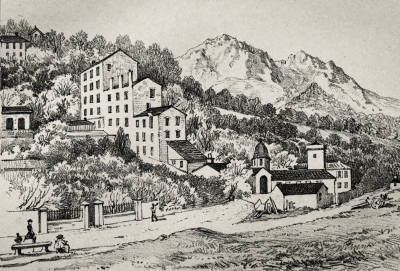
OIL MILLS CARREI VALLEY, MENTONE.
The valley of Carrei, partly from its proximity to our hotel, was with us a favourite walk, and could be visited also by a more sunny road for a short way on the east bank of the river course. Here, as elsewhere, the municipality have placed wooden seats, which are very acceptable to pedestrians. Sometimes a whiff of cold air blowing down the valley proves too trying to allow of sitting long; but one scarcely tires of the bright glad sun, or the view of the hill slopes and verdure with which they are covered all the year through, or of the bold mountains, on the foremost central one of which may be discovered—particularly with the aid of a glass, for it is at first hardly distinguishable by the eye from the rocks on which it rests—the ruined castle of Ste. Agnese, elevated like an eagle’s eyrie high up on the apparently inaccessible summit.
A trip to Ste. Agnese is generally taken by all who are not infirm. Though not so arduous as the ascent of the Berceau, of the Grand Mont, or of Mont Agel, which all command extensive views, but can only be undertaken by the able-bodied, it is a somewhat fatiguing excursion, and most people perform the ascent on donkey back. On the 13th December, the morning and day being fine, we started, a party of twelve, with eight donkeys and two donkey-drivers. To reach the point from which the ascent begins, we proceeded along the Nice road westward to the Boirigo valley. The view from the bridge across this valley was then (even still is, notwithstanding the erection of buildings on each side, some of them lofty and uninteresting, has somewhat contracted the view) much more open and extensive than that from the Carrei bridge. It took in west, north, and east, the whole panorama of mountain, twenty-eight peaks and pinnacles, enumerated in Giordan’s little Mentone Guide (1877), being counted from the bridge. A road runs up each side of the river course, which is hemmed in like the Carrei by bulwarks of masonry. The road upon the left bank does not proceed above a mile, when—at a picturesquely-situated olive-oil mill, embosomed among olive and lemon trees, and bordered by a pretty stretch of the channel of the river, lying at the bottom of a dell closed in by wooded hills on both sides—it is shut in and becomes a donkey path buried among the trees of the valley, the river in the ravine below meantime narrowing correspondingly. The walk by this delightful path through the woods arrives at an old stone bridge leading to the village of Cabriole, whence by a steep ascent Ste. Agnese may be taken. The road upon the right bank terminates more speedily, entering at a large pottery upon ‘the primrose valley,’ the river course of which, delightfully shut in by high banks, is usually all but dry. Up both valleys we have had many pleasant strolls. On the present occasion, proceeding only a short way beyond the railway viaduct, we left the last-mentioned road, and, ascending by a steep donkey path, gradually gained the top of a ridge, along which, at a gradient gently inclining upward, a walk lies, protected, like that to Castellar, by trees, and looking down on the Gorbio valley—on the one side, its great plain thickly planted with olive trees, and terminated at its north end by the town of Gorbio, as if resting on an island peak; and on the other, on the Boirigo valley and the monastery heights. It took us some time to reach the base of the mountains, when the path became rough with loose stones, and steep and toilsome. Nearly three hours elapsed from the time of our leaving the hotel till we reached one of the mountain roadside chapels, with which the country abounds, constructed not only to point religious feelings, but as covered places of refuge from a storm. As usual, a cross stood by it, bent to the north-east, indicating that south-west were the violent and prevailing winds. This chapel, which could easily have held all our party and more in a storm, was a short way below the town of Ste. Agnese, and afforded a convenient resting-place ere proceeding farther. We had from it a good view of Ste. Agnese, which, being placed back on the north side of the mountain, is not visible from Mentone. It stands about 2100 or 2200 feet above the level of the sea. The castle, now in ruins, on the summit, is above 300 feet higher. As a stronghold it was no doubt almost unassailable; for on one side the rock may be said to be perpendicular, and the other sides are, as I learnt from the ascent, very steep. The town of Ste. Agnese, which we had yet a good pull to arrive at, is another of those curious villages which are seen in the Riviera. From a little distance it has a deserted, ruinous look, and the place does not improve upon nearer acquaintance. Of course, notwithstanding the apparent poverty of the inhabitants, it has a grand church with a spire to it, and we had chanced to light upon a fête day; for, as we were sitting on the rocks beyond it at lunch (brought with us as usual on such excursions, and forming no unacceptable part of their enjoyment),[23] we cast our eyes down upon the steep hillside below, and there we saw winding up, quite a number of priests and people with images, banners, and other insignia. On reaching the plateau on which we were, they halted to rest, and then formed into procession, one priest bearing in front a large crucifix with a figure of our Saviour on it, life-size; and all chanting, proceeded to the church.
Resting some time, a few of us ventured to climb to the castle. An interesting legend (fully narrated in Pemberton’s Monaco, p. 351) attaches to it. During the latter half of the tenth century, Haroun, a bold African chief, in command of a formidable fleet, was cruelly ravaging the coast and carrying off captives, among whom was a maiden of Provence called Anna, of illustrious birth and marvellous beauty. The vessel bearing her to Spain had been taken after a bloody battle, in which her father and two brothers were killed. Haroun had first pitied and protected her, and then fell violently in love with her. His jealous wife, divining the fact from his altered demeanour, gave orders to bind her and have her by night cast into the sea. Discovering this in time, he saved Anna’s life, and in his rage caused his wife to be strangled. Arriving opposite Ste. Agnese, and struck by the advantage of the position, he landed with 100 men and his captives, the natives flying before him, ascended the mountain, and built the fort. Here he importuned the disconsolate maid to renounce Christianity and marry him, but in vain; till, finding her one day praying for him, he was overcome, embraced Christianity himself, and fled with her and all his treasure to Marseilles, where they were joyfully received and were married.
The return took rather shorter time than the ascent; but the expedition occupied nearly the whole day from breakfast-time till dark. We might have descended by two or three different routes, but chose the way by which we had come. One of the other routes would have been by going round the mountain and descending upon the east side; but I believe it is very steep, and not much approved by the guides or donkey people. Another route would have been by diverging from the road by which we had ascended and coming down another ridge, called the Arbutus Walk (from the circumstance that it is filled with arbutus trees, with their brilliant scarlet and gold flower and fruit, so tempting and attractive to young people), and terminating in the Madonna Hill, a very favourite walk from Mentone. All in the hotel who had not taken part were eager to hear about our expedition, and we became for the nonce heroes, as famous as if we had made the ascent of Mont Blanc.
If one were to ascend simply to obtain a view, that from Ste. Agnese, or even from the castle on the top, would scarcely repay the fatigue of the ascent. It is dominated by a chain of rocky mountains, which surround it on every side except that to the sea; and the view towards the sea—that is, towards Mentone—is not more extensive than what may be obtained from many lower points upon which we there look down, and among others the monastery of Annunciata, which seems a long way immediately below, although it stands high, and is a prominent object from Mentone.
To this monastery we paid several visits. It stands on the ridge between the Carrei and Boirigo valleys, and is said at one time—by no means, looking to its position, unlikely—to have been the former site of Mentone and of a castle. The plateau on which now the chapel and monastery are built is above 1000 feet high, and is attained by another of those donkey paths of which there are so many on the hills. In fact, various such paths, more or less steep, conduct up to it from different parts. The main ascent from the Carrei valley is sharp and steep enough, and has the usual allowance of twelve or fifteen chapels or stations by the way—little places like sentry-boxes, in which sometimes objects of worship are placed. A small church or chapel forms an adjunct to the monastery. Its walls are covered over with votive pictures in commemoration of miraculous escapes from great dangers, but of the rudest description. They depict the danger escaped, and the Virgin opportunely appearing in the clouds to interpose and save, and are very singular specimens of art, drawn by the merest tyros—or rather babes—in art. It is surprising how those in charge of the church could allow it to be desecrated by such trashy attempts at the pictorial. The thing, however, is to be seen in many other such churches. Our first visit to this spot was at Christmas-time (29th Dec.), when the monks dress up a little crypt below the chapel in a very curious way, so as to represent the Nativity of our Lord. On a raised platform a country-side is seen, with rocks, and plains, and rustic bridges, studded over by little puppet figures or dolls about a foot high, others in the distance smaller, personating different characters—kings, Roman soldiers, shepherds with some woolly sheep, and Joseph and Mary standing in the midst of all. Near them a little babe lies on the ground, and kneeling before and adoring it a figure, I suppose, representing one of the Magi. Nor are angels wanting to complete the representation; while in a recess in the distant vista a toy Noah’s Ark is set, supposed to be resting on Ararat, satisfactorily proving by ocular demonstration that Noah’s Ark was, at the time of the Nativity, visible. The figures are evidently carved, by the hands of the monks, as the faces differ entirely from those of ordinary dolls, and from each other. It must cost the monks a good deal of labour to make the arrangements; but they have, I presume, little else to do, and it no doubt furnishes an agreeable occupation, which doubtless they grievously want. At stated hours of the day they may be heard with sepulchral voices chanting service; and as they seem to have nothing else to do, I suppose it may literally be said their vocation is, ‘Vox et preterea nihil.’
The most westerly of the valleys is that of Gorbio, which in some respects is the most beautiful, as it is the most secluded of all the three. It has no broad torrent bed like those of the Carrei and Boirigo, and in fact the river can scarcely be seen between its entrance to the sea and a long way up the valley, the road between these points lying at some distance from the river, in a ravine below, winding its course over rocks and among trees which hide it from sight. The valley, everywhere wooded, and river derive their name from the town of Gorbio, which crests a lofty conical-shaped rock or height 1400 feet high, about three miles distant from Mentone. The olive-covered ridges rise also on either side the valley pretty steeply, and hem it in.
On 14th February a party was made up from our hotel to go to Gorbio, sixteen in number, with nine donkeys and three donkey attendants. We left at half-past nine in the morning and got back at five o’clock. There is now a good carriage road for a considerable distance up the valley; but at that time it was only in course of formation, and was very rough. Where the road ceases, the ascent, hitherto gentle, becomes more perceptible; and on arriving at a point below the height on which Gorbio stands, we had to look up to it far above on the summit of its bold abrupt rock. It looked magnificent, and the sketchers of the party longed exceedingly to take it from that point; but the donkeys, or their drivers or riders, had no compassion, and, as it was not desirable to separate on such excursions, the chance on this occasion was lost, though, by starting a little earlier than the party, I got it on a subsequent visit.
The ascent to the top was steep by a donkey path, but the town was very curious. It has been, I believe, the scene of many battles. After inspecting it amidst the gazing of a crowd of idle inhabitants, we adjourned to a grassy bank a little outside, where we enjoyed our lunch, and the four sketchers were recompensed by obtaining a view of the town from an excellent point. As Gorbio is an excursion frequently made, we were surrounded by children, who kept us in a state of siege for coppers, which they are led by the injudiciousness of visitors to expect, and it was no easy matter to shake them off. We had still a great deal before us to do; so, as soon, as possible, the donkeys were remounted, and we proceeded along a mountain path, gradually reaching an elevation several hundred feet above Gorbio, on which we then looked down. All along this path we had splendid views, including one of the village of Ste. Agnese and the mountain on which it stands, which, from that point presenting its edge to us, appeared like a sharp Swiss aiguille. After a long circuit, we reached a point, at which the party dismounted and walked to the top of a hill commanding the valley; and then began the descent by a rough, stony, mountainous path to Rochebrune, about two miles off. Some of our party, keeping too high up, had to descend the mountain so perpendicularly that they could only liken the declivity to the side or face of a house.
Rochebrune rests upon the slope of a hill looking westward, down upon the Corniche road, on Monaco and the sea, between 600 and 800 feet below. The ruins of a castle stand upon a rock, which is said to have slipped down from a cliff 200 or 300 feet above. This, if true, would be a remarkable and unique circumstance. The town itself, which is about three or four miles from Mentone, from which it is a favourite excursion, is very picturesque, and affords many choice bits for the artist, I think more so than any similar town in the neighbourhood. One of our party jocularly proposed to come and spend a fortnight there, and take sketches; but to any civilised person it would be just as agreeable to spend the time, if that were possible, in a rabbit warren, to which another compared it. The view towards Monaco and the hills beyond it is very fine, but requires to be seen before the afternoon sun comes round. There are two ways of reaching Mentone from Rochebrune—one, by going down to the Corniche road a little below; and the other, by descending through terraces of fine old olive trees, one of which, in the pathway leading out of the village, is of immense girth, and must be of great age. It is said that some of the olive trees in this neighbourhood are considered to be nearly two thousand years old. The trunks of these olives are often very curious, from the mode in which they divide or split up and twist about. By either way to Mentone, splendid views are obtained, and the usual course on an excursion to Rochebrune is to go by one route and return by the other. In going by the road, we skirt the tongue of land called Cape Martin.
One of the most interesting and most usual walks or drives from Mentone is to this Cape Martin—to the point it is above two miles distant; and it is at present, or was while we were there, reached either by the rough, stony beach, disagreeable for the feet, but the shorter way, and pleasant, as passing by the ocean and having the view open to the scenes around. In time, it is expected that the promenade will be extended all along the coast to the cape, which will make approach to it by the shore a most agreeable walk. The other access, much longer, is by proceeding along the dusty high road leading to Monaco to some distance beyond the Hôtel? du Pavillon, and passing under a railway viaduct which crosses the road to a rough side road or avenue which diverges to the left and winds through a delicious plantation of fine old olive trees, with knotted, and gnarled, and divided trunks, and long, vigorous branches which stretch fantastically overhead and interlace; while the sun glinting through them here casts alternate lights and shadows on the white limestone road, and there shoots in streaks through the openings, speckling the forest with glancing radiance, shifting and changing as the olive boughs wave, and their tender leaves turning now their silver breasts and now their green backs to the breeze, shimmer in the light; while the carpet of grass is spread underneath, dotted over with violet and anemone; and the distance is dark, shut out by the thicket of trees, and the background of shrubs, and banks, and hill. As the road proceeds, it again passes under another railway bridge, the trains over which whistle and whirl on, scaring the passers-by, and breaking incongruously on the quiet of the scene, as if winged demons had escaped and in a state of fright rushed in hot and fiery to disturb the tranquillity of the land and break its peace. Then walled gardens are passed, closely planted with orange trees, laden in bunches with their tempting fruit. Still keeping on this rustic road amidst more olive trees, we at last arrive upon an open part, and behold a church of curious design on the one hand, and the blue Mediterranean on the other, and before us the avenue along the margin of the promontory. Here it had unhappily been intended to have built a town, and as a commencement three villas have been erected; but the situation is not only too distant from Mentone, but is on the wrong side of the hill, seeing the sun leaves it in cold shade soon after noon; and thus, though commanding a splendid view all along the coast eastward, they have not found favour, and stand silent and all but deserted. Beyond these villas, and at the entrance to the wooded hill, the carcass of an unfinished Roman arch, intended no doubt as a grand portal to the projected new town, spans the road, which, proceeding by the border of the promontory, and overhanging it, looks down through the trees and rocks to the lovely sea sporting about in little pools, or surging and breaking on its natural bulwarks, while the slopes of the hill above on the right hand side are densely overspread with wood. At the end of the avenue, where the shelter of the hill terminates, the strength and usual lie of the wind are manifested in the bent and twisted forms of the trees, most of which are inclined, curved, or in some cases doubled down, as if bowing in lowly obeisance towards Mentone in the north-east, the south-west winds blowing fiercely across the ocean when they come. The walks through the forest and up to the semaphore on the top are charming, and make Cape Martin one of the most enjoyable of the easy excursions from Mentone, so that the visitors have great cause to congratulate themselves that the building speculation came to nought. If building be ever resumed, it is to be hoped the forest will be spared to the public, and that any houses will be placed on the west or sunny side; although it would be a mistake there too, as it is wholly without shelter from the west. It is not unusual for large parties to come to picnic in the woods and enjoy the scene, bringing their lunch with them. Some houses were commenced on a level plateau at the point, one of them suspiciously like an incipient restaurant, but, no doubt, being found to be too much exposed, were abandoned, and what little was put up is now going to wreck and ruin. It is to be hoped that Cape Martin will never be desecrated by any such concern in the future. Here, at and round the point, the land is surrounded by a belting of rocks and sharp pinnacles, worn so by the breaking of the waves, and upon these pinnacles the sea is continually breaking. In stormy weather, it is beautiful to observe the waves rolling in and striking the rocks with great violence, and dashing high into the air, shivering into millions of shining particles, forming spray, which spreads and scatters in brilliant showers all round. Nor is it less beautiful, when the breeze is gentle, to watch the waves rolling majestically in, the hot sun shining through the long well-dressed line as if it were through purest glass of the brightest sea-green, and then to observe the rearing crests tumbling grandly over as they charge to the death and deliver themselves one after another on the rocky beach, which with a calm steadiness receives the shock.
From Cape Martin fine views are had of Monte Carlo, Monaco, with the more distant Antibes, and even the Estrelles; while north-eastward, as if in long white robes, the young Mentone lies nestling or cradled in at the foot of the high range of mountains which, like gigantic Titans, in mute serenity hang over, and watch and guard with placid pride the smiling, sleepy little town to which they have given birth. With scenery so romantic, the point of the cape has become a very favourite haunt of the artist. It is seldom a visit is paid to it in which, if the weather be fine (for in cold weather one cannot sit long), persons are not to be seen taking sketches or elaborating more finished pictures, for which a capital foreground is furnished by the bent and distorted trees.
But it would be endless to describe or even to enumerate all the many walks and excursions which are possible from Mentone. These are principally from the western side; but we had occasionally walks in the other direction. I have already mentioned the walk to the gorge of St. Louis. There is another walk which we sometimes had to the rocks below and beyond the gorge, called ‘Les Rochers rouges’ from their red colour. These derive a peculiar interest from their containing certain caves or fissures in the rock, disclosed or opened up by the formation of the railway, out of one of which was exhumed the skeleton, or what is called the fossil skeleton, of a man. This, of course, is held up as evidencing the existence of man anterior to the creation of Adam, by those who believe in the existence of Preadamites. The skeleton is in Paris, and I have seen neither it nor the brochure of Dr. Rivière describing the discovery; but I noticed that the sides of the cave—as it at present stands, after the excavations for the railway—are not more than 20 feet apart at the bottom, the cave extending probably 40 feet inward, and about 50 or 60 feet high; but these eye measurements are sometimes deceptive. It is of very soft limestone, and in other parts of the rocks there are huge stalactites depending. It may therefore be very safely said that stalactite would at an early period form with great rapidity, and speedily cover up what the cave contained. I was informed, however, that the skeleton was found about 9 feet below the surface, in the midst of debris. In these caves, and elsewhere round about, many flint implements have been found, and some of them are collected in the Natural History Museum in the Hotel de Ville at Mentone. The workmen finding them sell them to strangers for a few pence.
Dr. Bennet’s and Mr. Hanbury’s gardens both lie in this direction—Dr. Bennet’s, on the rocks above the Italian douane station; Mr. Hanbury’s, about a mile and a half farther on the road to Ventimiglia. They may properly be called hanging gardens, and are not laid out as gardens are with ourselves. Many tropical plants are growing in them in the open air.
Our best excursion in this direction was that to the top of Belinda. We started on 31st January 1877, a party of eleven, with six donkeys. The walkers drove to Pont St. Louis, where they were overtaken by those on donkeys. All then proceeded a little beyond the bridge and the station of the Italian douane, and ascended by very steep paths to the village of Grimaldi, about 700 feet above the sea, on the slope or shoulder of Belinda, and seen from Mentone picturesquely buried among the olive trees. This is another of those curious old towns with the usual appendage of a church and spire. The slope on which it is built is all but perpendicular, so that house rises over house, and the back base of a house is greatly higher than the front. Clovelly in North Devon is nothing to it. Roads are impossibilities. There are no streets, only narrow paths, or at best donkey tracks, through it. By one of these paths, winding upward, we were led to a point right above the gorge of St. Louis. From this dizzy height, the party, halting, looked down upon the precipitous yawning gulf below, and then across the bay towards Mentone, and upward towards the mountains, which this new position threw into shapes different from any observable from other points. Having taken in this striking view, we are urged to proceed by a very rough path, some parts of which are so uncommonly steep that those riding were compelled to dismount from their donkeys, and manage the ascent, like the others, as best they could; and so, alternately scrambling up pretty nearly perpendicular parts, and alternately winding up and jogging on by gentle ascents, where the donkeys were remounted, and through a forest of young trees, we, in about two hours and a half from the time of leaving the hotel, inclusive of a halt of half an hour at Grimaldi, attained the top of Belinda.
ill-205
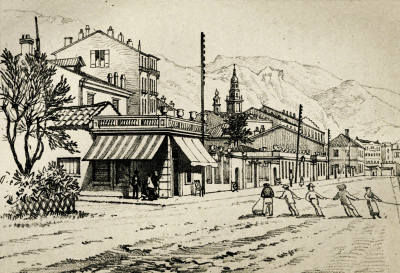
PROMENADE DU MIDI, MENTONE.
This mountain is, as already stated, 1702 feet high, and the view from the top of it is very extensive. We fancied we saw westward along the French coast, beyond the Estrelles, as far as the Îles d’Or off Hyères. If so, this would be a distance of fully ninety miles. On the east side, we could not see along the Italian coast beyond Bordighera, as the mountains rise and shut out further view in that direction. The huge rocky Berceau towered up in close proximity, to the north; and behind it, away to the eastward, we saw the tops of the snowy Maritime Alps peering up in magnificent white drapery; while between them and the coast lay a peculiar species of high, barren, bleak, desolate-looking mountains, intersected by wild and bare river courses; and more immediately below us, portions of the ramparts of Ventimiglia; and beyond, the long arm of Bordighera, appearing, from this point of view, stunted and different from its aspect at Mentone. The wind was blowing piercingly cold from the north-east at the top, so that we could not gaze at the scene in this direction above a few minutes; but just below the top, on the western slope, we found shelter and sun warmth, and enjoyed our lunch and the splendid prospect. On returning, we descended by a different path, which in many parts might well be termed a mauvais pas. It was often so bad and so precipitous that the riders, in dread of their necks, were soon obliged to leave their saddles and walk. At last we reached the Corniche road, near to Mr. Hanbury’s garden, and by this road returned home. From the heights we had seen a cloud of dust hanging over the road to Mentone, in consequence of the wind having risen to a gale. We now were under the necessity of encountering this dust, and, barring the chill blast on the hill-top, it formed the only obstacle to a thorough enjoyment of this most delightful excursion, which occupied altogether between seven and eight hours.
Although Mentone thus possesses so many walks and excursions in its neighbourhood, of which only a few have been touched upon, there are some people who, going there, fancy that it is an unattractive place. The fact is, that these people do nothing but walk up and down the promenade, perhaps also proceeding a short way up one or two of the valleys, and in all likelihood never even so much as venturing through the obstructions to the pier or the breakwater wall in course of formation, and now extending some length, from which one of the best views of the mountain range is to be had. It may be imagined, therefore, that a monotonous perambulation up and down the same road, however attractive in itself, may in time become tiresome, even if we put out of consideration those numerous dullards upon whom fine scenery or the charms of nature are altogether lost. In reality, however, it is one of the most captivating promenades to be found anywhere; and I always felt it to be in itself a very cheerful scene, whether when gay with its moving crowds in a morning, or when in the quiet repose of still life. But although preferring a quieter time, it is when thronged and all ‘the world’ of Mentone is there that seemingly to most people it is most inviting; and between the hours of 10 A.M. and 12, the Promenade du Midi is alive with promenaders, for the earlier part of the day is considered to be the best period for so walking. Twelve o’clock is the general lunch or early dinner hour, and after that, or even before, the wind sometimes rises; but before 12, it is usually warm—nay, hot; and many men as well as women walk out with white parasols (lined with green), and many with blue goggle spectacles, to protect their precious eyes from the white glitter of the road. Although the glistering blaze of the sun upon the water, if caught direct, is too dazzling to abide, I never personally found either the heat or the general glare so oppressive as to require these protections, and it rather appeared to me that it was beneficial to accustom the eyes to the light. On certain days a band of music plays in the gardens in the afternoon (at other times playing at the cirque, or at the new gardens at the East End), but we seldom heard it, except by accident, as we devoted the afternoon to more distant walks. To some people, however, the music was evidently an unfailing attraction, although, so far as I could judge, the audiences were mainly confined to French and Germans, and other continentals, who, with some excellent exceptions, never seem to have any enjoyment beyond occasionally a little light reading, a good deal of idle smoking, or an endless elaborate thrumming on pianos, and on whom, therefore, time hangs heavily. English people, women especially, have generally an occupation of some kind. In reading, writing, sketching, and other occupations, I was never myself without employment, and sometimes was pressed enough for time.
On the promenade one sees a good deal of the peculiarities of the different countries represented in Mentone, especially in the matter of dress; and on this account, if for no other reason, it affords opportunities for observation not without their interest. Let us take a walk. It is, we shall suppose, the 21st December, the shortest day, cold and shivery in the north, and verging to eleven o’clock of the forenoon. The fishing operations of the morning are over, and the boats engaged in it have been drawn up upon the beach. The water carts, small wooden boxes drawn by men, have performed their rounds, and the roadway is moist, but is rapidly drying up under the burning beams of the hot sun; but the dust is laid. The sea is tranquil—not a ripple disturbs it, except at the very edge, where it lazily turns over in the tiniest of waves, as if the exertion implied far too much fatigue for this melting day. A ship has ventured out of the harbour, spreading its white sails in vain attempt to catch a breeze. A flock of gulls are resting, in quiet happiness and contemplation, their snowy bosoms on the glassy water. In the distance, bright Bordighera is stretching its long green sleeve far into the blue sea, its fair hand lighted by the sun; while its cathedral window, like a jewel on the finger, catches and glistens with a blazing ray. Nearer, the fortifications of Ventimiglia are peering round from behind a jutting hill. Belinda, high and verdant; the gorge of St. Louis, deep in the shade; and the lofty Berceau, just emerging into the solar beams, fill up the near background, against which is cast the pier, terminated by its old castle, and half concealing the little sheaf of masts which it girdles, and bounded landward by a line of tall picturesque old buildings, out of and above which the minarets of the town churches gracefully rise. Then down along the promenade, on the one side, rests the irregular and diversified line of hotels and houses and gardens, partly filled with low trees, refreshing to the sight; while a low, scrubby, ill-kept belt of evergreens, dusty and withered, strives at some parts to guard the frontier on the other side against a careless tumble down the bulwarks bordering the beach; and all along this level road, common to man and to beast (for there is no footway), a crowd of people is streaming. In the view of so much that is grand in nature, we are at first hardly conscious of the concourse. We begin to move down the promenade,—’cric-crac,’—turn the shoulder suddenly, and find a voiture has almost run us down. Neither man nor horse apologizes. They pass on unheeding our well-merited indignation; and, as we cast a fierce look and waste an English word, down comes another at full speed with angry ‘crack, crack.’ Glad, like others, to jump unscathed away, we are about to sit down upon one of the many wooden seats or forms which the providence of Mentone has placed here and there to lessen the lassitude of the human frame. In the very nick of time we luckily discover a warning label, and are thankful we have not become for the day men of mark; for the bright green seat, so delightfully clean and pretty and enticing, has just been repainted. We look out for another, for the sun is hot, and our limbs are getting jaded, and fortunately detect one to which the attention of the municipal adorners of Mentone has not as yet been directed.
And now pass in review before us all the inhabitants—no, not all the inhabitants, but a considerable section of the visitors, intermingled with a few of the residents of this remarkable place. Here comes a short Cockney, broiling in a long Noah’s Ark Ulster—the young man has no other upper coat, and, besides, it adds a span to his stature. Then follow him in a row, three or four tall, lanky young Dutchmen in their dapper little coatees. Then a party of German ladies, plump in figure and peculiar in their body-gear and head-dress, their good looks set off by a most comfortable-looking ruff or frill about the neck. They are accompanied by a fair German gentleman in gold spectacles. As they pass, their ‘Yahs’ and their ‘Achs’ betray their origin. Close after saunters along a pleasant-looking clergyman, who, far from official cares, wisely doffs official costume, and is accompanied by two blooming English daughters. Near to him follows meditatively a priest without daughters, whose bluish-black cheeks and chin disclose it to be three days off from last shaving night. Now we must feel nervous and think and shake about our misdeeds, for who should follow in the full dignity of office but an imposing gendarme with fierce moustache, and in cocked hat and hot blue cloth clothing, adorned by yards of twisted cord, and swinging a murderous sword by his side. The little boys could see him a mile off. We breathe more freely when he is past—this terrible man of office. But nothing afraid, three women of Mentone are close upon his heels, perhaps in gaping admiration. Two of them bear on their heads each a large basket of dirty clothes they are taking to some dirty pool to wash. The third leads a child, and wears a broad Mentone flat hat, 16 inches wide at the very least. All are sturdy, and their carriage is erect. The little child wears a red hood, which tightly fits the round bullet head, and descends upon the neck and shoulders. The women wear short woollen jackets reaching to the waist, their lower drapery decently short. Another woman is behind, dressed similarly, except that, instead of hat, she, in common with most other native women, ties a coloured handkerchief round her head, and thus with a presumable thickness of bone beneath becomes proof against solar heat. Then succeed rows or groups of unmistakeable English in all varieties of home costume, suitable or unsuitable, though occasionally a damsel will glory in French attire, possibly a little Anglified. Then other groups of equally unmistakeable French. Here and there a solitary Frenchman steps out in full Parisian costume, with trig kid gloves, high chimney-pot hat, and smart cane or white parasol. And now and then a pale-looking young man, tended by an anxious sister or still more anxious mother, walks slowly past. He has come too late to obtain good. Had he come a year sooner, he might ere this, had it been the Divine will, have regained his strength. All health resorts abound with clergymen, particularly English and Scotch clergy—men of all denominations, whose ministerial exertions seem to necessitate occasional ‘retreats.’ Mentone is a favourite gathering-place for them. Here comes one, with a broad, low-crowned wide-awake (clerical undress), with white choker and lengthy surtout, his round face red and jovial, and beaming with laughing jollity; and alongside of him stalks a younger man of a sad and sallow countenance, whose greater length of coat proves more veritable descent from the apostles. He has just arrived from London, and is on his route to the great city of the Italian king—perhaps hopes to have a secret meeting with the Pope. ‘I can’t linger here,’ he says; ‘I am on my way to Rome.’ ‘Ay,’ replies the older one, ‘so I see. I am content to remain here; half way, you know—ha! ha!’ They stop a moment, shake hands, and as the younger one turns carelessly to go, he nearly upsets an old fisherman with a coil of ropes in his hand, a pending striped cowl on his head, and clothed in a short wrought woollen coat and indescribable trousers, patched, like the famous Delphian Boat, till no trace of the original remains. One trouser leg is down, the other is drawn to the top, and discloses a long, bare, dirty-looking, unwashed, hairy leg. The feet are shoeless, the body spare, and the face pinched, as if he saw more work than victuals, and browned, as if he handled more fish than savon—in all likelihood the very personification of the fisherman of Cæsar’s time. And now a nursery-maid with three lively little English children toddle along, the young ones attired in Mentone hats of narrow diameter, prettily decorated in worsted, but rather difficult articles to attach to the head. Fortunately the wind does not blow. And now jauntily trot up two riders—a young Englishman on a milk-white steed and lady on a chestnut. They are off for a canter along the road to Cape Martin. And then, as if in mockery, immediately follow an ass with panniers, in each of which will be found planted a fat, chubby, small child, looking dreamily contented or ignorantly happy, attended by donkey-driver, pleased attentive nurse, proud mother, and a big little brother with toy whip in hand astride another donkey. But here walks up an old friend, a divinity professor, presumably of the Broad Church; for is not the brim of his wide-awake broad enough to drive a coach and four round it? We must rise and shake hands, the more especially as we see stealthily approaching the lean painter, casting hungry looks at the seat, as much as to say, ‘By your leave;’ and feeling really desirous of being regarded blacker than we might be painted, we quit, join our friend, and move on. All this time we have been revolving the peculiarities of French female attire; for, generally speaking, we could tell a French woman by her long sack-like cloak. According to the fashion then prevailing, which may most likely be now changed, this sack hung down from the shoulders, tapering outwards as it descended to the bottom without any waist; for it seems to be the practice of the French for the men all to dress so as to give them the appearance of a wasp-like waist, and for the women all to dress as if waist they had none. Nor can I say, having had no opportunities of knowing, unless in observing the specimens of Mentone women walking about, whose conformation, unaltered by dress, is striking, and apt to convey this idea, being broad at the shoulders, broader still at the waist, and broadest at the haunches. Then all the French ladies, in defiance of surgical laws, wear high heels upon their shoes—sometimes no less than three inches high; and perhaps I am not far wrong in saying that, with few exceptions, every one of them in consequence walks badly, with a short hobbling step. To crown all, there is often stuck upon the head a bonnet like the hat of a typical Irishman, resembling an inverted flowerpot, with a brim, if brim it be, no broader than that of the article from which it is copied. Often, too, one sees a long gown tail flourishing in the dust, which next morning is shaken vehemently by the owner outside her room, and is brushed assiduously by the maid on the staircase; so that out of the deposits from this stupid fashion, the wearers do not positively kill their neighbours, but thoughtlessly compel them to bite the dust. The picture of French women, therefore, is not particularly inviting, though there is often a spicy jauntiness about the mode and ornamentation of their costume which is peculiarly taking. Upon a Sunday or fête day, young French children are habited in the gayest of attire, sometimes smart and pretty, but at all times to our eyes Frenchy, and frequently with alarmingly short, expanded petticoats, and long, lanky, bare legs. In every case, these children must be dressed out of all proportion to their position in life. Occasionally a child dressed entirely in white, denoting its dedication to the Virgin, will be seen. English young ladies may be at once distinguished from French, inasmuch as they usually exhibit a most disquieting tightening of the waist. Real wasps, however, in nothing but the waist, it is truth to say they carry the palm in appearance and good looks over the representatives of every other land.
One of those customs which Sterne could hardly have said were better ordered in France, is the French mode of passing people when walking. Instead of doing so upon the right hand, they pass upon the left, which certainly does not appear to British people to be nearly so natural as their own mode; and till the English stranger becomes habituated to the foreign custom, it is not inapt to produce a startling, if not a striking, method of seeing eye to eye. Similarly, a contrary rule exists as regards horses and vehicles. It would be well if there were one general system observed all over the world for walking and driving. In sailing, I think there is already a universal rule. In saluting, foreigners always lift the hat, be it to man or woman of their acquaintance, making a very ceremonious swing of the chapeau, but little inclination of the body, and no movement whatever of the countenance, thus imparting the impression of a very superficial, heartless politeness. Perhaps there may be more kindliness in the practice, at Mentone and elsewhere, of every man or woman met in the mornings in the hotel saluting you and expecting you to salute them with a ‘Bon jour.’ At home in some rural districts a similar usage is occasionally encountered.
I have not observed many beggars in France, but in Mentone, so close upon Italy, there are some professional or regular mendicants always hunting the promenade and other parts; while all the native children have been taught a very evil custom, which many men and women also practise, of coming up to visitors, holding out the hand and saying, ‘Donnez moi un sou,’ or simply, ‘Un sou’ (Give me a halfpenny); and some visitors, unconscious of doing harm, give them sous. An American gentleman told me he had given away 8 sous in a single forenoon, being all that he had about him. The children do not require them, and it teaches them a very bad lesson, sapping their independence. Sometimes the method is varied by presenting bunches of wild-flowers, or by lying in wait and tossing the bouquet into passing carriages; for which, of course, they expect, if accepted, to be recompensed.