IX. (continued 2)
Reading edition
An excursion to Monte Carlo and Monaco is one which even the most inveterate promenade walkers will at times take; and it is, indeed, a very favourite one with most Mentone visitors, many going weekly, and even oftener. The distance to Monte Carlo is about six or eight miles, and young people occasionally walk it. Driving by carriage is undoubtedly a most enjoyable mode of going. The road, after passing some elegant villas, including the palace of the Carnoles family, the former residence at Mentone of the princes of Monaco, for great part of the way is bordered by olive and other trees, embosomed in the midst of which, here and there, are brightly-painted houses and large villas with a grand background of lofty mountains. Glorious views are had by the way not merely of the mountain scenery, but of the bays, of Cape Martin, of Rochebrune, of white-terraced Monte Carlo, and of the singular projecting rock of Monaco with its castellated walls and buildings, and overtopping it, rising with great abruptness, the mountain called Tête de Chien, resembling very much in shape Salisbury Crags at home, only three times as high, the height being stated to be 1810 feet. Just below Rochebrune, the road, keeping by the coast to Monte Carlo, diverges from the Corniche road, which slowly ascends and surmounts the Tête de Chien.
The railway is a more rapid means of conveyance, but its hours do not always fit in with the visitor’s time.
The famous gambling tables at Monte Carlo, established in 1856, are, I believe, the only thing of the kind now left in Central Europe. The French Government, it is thought, would fain acquire the principality, so as to put down this pernicious institution; but I presume it would be too costly, at least in present circumstances, to arrange. To attract visitors to the place, the grounds have been laid out in beautiful terraces flanked by elegant white balustrades, the borders being filled with palm and other exotic trees and shrubbery. The main attraction, however, is contained in the Casino, which is a long handsome building, in which are a spacious concert room, a reading room with newspapers, and the gambling rooms. A first-class instrumental band, numbering between seventy and eighty performers, attached to the establishment, plays gratuitously to the visitors every afternoon and evening, and on Thursdays gives a selection from classic music. This daily concert, to which dramatic and other entertainments are sometimes added, forms an excellent excuse to many for going to Monte Carlo; and I have seen persons whom I would not have suspected of passionate fondness for music, visiting it day after day—the real moving cause being, no doubt, the hazard table. To see the mode of operation, I once entered the room where the gambling is carried on. For this purpose, application must be made, in a room off the hall, for a ticket of admission, which specifies the length of time, say a month or two months, during which the holder desires to use it. Upon presenting a visiting card, and stating residence and country to which the applicant belongs, the admission card is at once filled up and handed over; but it is refused to natives of Monaco, nor are young people allowed to enter the room. The roulette tables are divided into squares, and corresponding numbers from O to 36. The gamesters place their money stakes upon the squares, or, if they desire to spread their chances, upon the lines which divide them. A revolving wheel and a small ball are then simultaneously set in motion, and both circulate many times before they stop. According to the divisional number of the wheel into which the ball eventually falls, the fate of the stakers is determined. The table has the advantage of 1 in 36 in its favour, so that in the long run it always gains. If the gambler stake upon a number into which the ball rolls, he gets thirty-five times the amount of his stake; if upon the line between two numbers, and the ball fall upon one of them, he gets only half; if staked at the junction of four lines, correspondingly less. If O (zero) turn up, nobody gets anything, unless zero have been staked on, and the player then gets thirty-six times his stake. I do not profess either to describe the rules or even to know them, and state these facts, possibly inaccurate, merely upon casual information. The roulette stakes are not less than 5-franc pieces, and are often gold; but the highest amount which can be staked at one adventure is 6,000 francs, £240. It is astonishing with what rapidity the game is renewed and carried on. The sums are laid down by the eager onlookers, and as soon as the table is formed, which it takes a very short time to do, round goes the wheel; and when the ball falls into one of the spaces marked on the wheel, one of the men stationed at the table calls out the number, rapidly pulls in the losing money, and shovels out with equal rapidity the sums which are gained. Not a moment is lost; the table is again formed, and the ball again decides the fate of those who peril their money on its uncertain movements. There are three such tables in the rooms, at each of which there are three or four men in charge; and each table is always surrounded by a crowd of onlookers and players, many of whom are persons who evidently cannot afford to lose money. There is a fourth table, at which the lottery is decided by a foolish game at cards, called ‘trente et quarante.’ The stakes here are always in gold, and the play is for much higher sums than at roulette, the lowest stakes being 20 francs, and the highest 12,000 francs (£480). I believe that most people not withheld by principle, upon visiting the rooms, try their luck; and some visit the neighbourhood with a given sum, which they risk from time to time till all be lost,—a species of ‘limited liability’ which is better than total want of restraint. Whether a first loss always is the least, or often withholds from further play, I do not know; but I fear that, in general, a spirit of infatuation seizes upon people, tempting them either by failure to retrieve loss, or by success to go on further and lose all. Most of the habitual players watch the turning of the wheel, and form their own ideas or calculations as to what numbers or combinations of numbers are fortunate, and act accordingly. It is a sad temptation to silly young men, who are often led on from bad to worse, till they lose all they possess. The consequences are sometimes distressing. At Mentone we heard that in one week, while we were there, two young men, visitors, had committed suicide; but such occurrences do not reach the newspapers.
It was pleasant to leave this gay though sad scene of a vicious institution to stroll into the tasteful little shops permitted outside, in which enticing fine-art wares in choice variety are displayed, or wander about the gardens and terraces, sitting in the sunshine under shelter of the trees from the air, which is often cold at Monte Carlo when mild at Mentone, and looking at the lovely scenes around. But there is, out of doors, one object suggestive of any feeling but that of admiration; it is the pigeon palace, upon and around which, unconscious of their fate, the poor pigeons are seen in crowds, bred to become marks for the would-be sportsmen. The shooting of these gentle birds is one of the most barbarous descriptions of pastime; it has not even the recommendation of sport. The shooters might as well fire at barn-door fowls.
The drive from Monte Carlo to Monaco is down a decline of little more than half a mile. The Palace of Monaco is visible upon Saturdays, and to see it specially, we devoted a forenoon. After ascending by a long fortified or walled road within the castle, the flat summit of the rock was reached; and here we found a large open space, or esplanade, or place d’armes, facing the palace and between it and the town. The palace, however, was not open to the public till one o’clock; so that we first visited the town, which of course is a small one, limited to the size of the rock, but possessing a population of about 1500. It is intersected by narrow streets, outside of which there are shady walks upon the south and west margins or edges of the rocks, among which we rambled, and at parts could look down to the water, more than 200 feet below. As the rock projects so far into the ocean, it is withdrawn from the shelter of the mountains, and is exposed to the mistral as well as to the north wind; so that the town itself, inhabited solely by the native population, is no doubt often a cold residence during winter. The principality, whose independence was recognised by the Treaty of Paris of 1815, used to extend on the mainland fifteen miles in greatest length by six in greatest breadth. In 1860, the Mentone portion was ceded to the Emperor of the French for £12,000. Monaco is now, therefore, greatly shorn; but the revenues are said to be 350,000 francs, or £14,000 yearly. The palace, a large one for a prince whose territory is now so circumscribed, is square, with a courtyard in the centre, round which the buildings are placed, and on one side of which a handsome outside marble staircase leads to a splendid suite of state rooms. We were shown through these rooms, each of which is hung and decorated in a uniform tint or hanging, but each room differing from the others. It was interesting, a sort of Versailles in miniature. We were also conducted through the adjoining gardens at the extreme north and more sheltered end of the rock, which, though small, are filled with palm and other trees and plants growing luxuriantly, forming a pleasant retreat to the inhabitants of the palace.
Monaco is a place of great antiquity, its origin having been traced back as far as 1700 years B.C. Its history has been most eventful, and is set forth in full detail in Pemberton’s History of Monaco, where the oppression suffered by the people at the hands of its princes, and the spirited resistance made, especially by the Mentonnais, who ultimately succeeded, without violence, in throwing off the yoke, will be found narrated.
The villas about Mentone are, as already mentioned, like the generality in the Riviera, painted in lively colours, and surmounted by tidy-looking red-tiled roofs. Slate is unknown, though sometimes roofs are covered with what appears to be lead or zinc, imparting a little variety. The windows of all the houses have outside jalousies, generally painted green. These Riviera houses resemble somewhat in colouring the houses in a German box of toys, or one of those vividly-coloured dolls’ houses sold in toyshops. They give a remarkable brightness to the landscape, more especially where the hills are covered extensively and monotonously with the sombre olive tree. All houses are painted, and sometimes very fantastically, in imitation of shaped stones, carvings, projections, and other architectural features, and even of roofs, and they are so cleverly executed that a stranger has often to approach close to them to detect the illusion. So far is this sometimes carried, that I have seen a good substantial house painted to represent it in a state of decay—an odd freak; at other times, painted as if vegetation were, under neglect or abandonment, springing out of chinks between the painted layers of stones. The houses are built—with a certain amount of substantiality, though with wonderful rapidity—of a species of rubble, which is plastered over and sometimes neatly ornamented with stucco mouldings. Internally, they are in general nicely finished with abundance of decoration, particularly at the painter’s hands; though one is sometimes annoyed to find that the plaster work is of such inferior quality as to be full of cracks, and even to give way and tumble down. The paintings on the ceilings are certainly wonderful specimens of art. Accustomed as people so often are at home to paper ornamentation, they are apt to suppose at first that these ceilings must simply be stained paper pieces pasted on; but on examination, it is found that they are, with some occasional imitations, all hand-painted. And although there are many coarse specimens of this style of decoration, they are frequently finished with great delicacy. The rooms we ourselves had in Mentone were in this respect, as well as in others, finished with good taste and skill; and although the ceilings were prettily painted, they were light and suitable. Sometimes the decoration of houses is carried the length of painting cleverly outside garden walls with scenic views, imitation staircases and theatrical trees, fountains, grottoes, etc. Marble is used in abundance in the houses, in chimney-pieces, staircases (outside sometimes as well as inside), and other portions of the buildings. Proximity to Italy renders cheap the carriage of the rough marble, which is wrought up according to requirement at local marble workshops. Windows are all constructed on the French fashion of opening up the centre—a method which is suitable to the climate, although, not being so close-fitting as our window-sashes, it would not answer in our own sterner climate. They are fastened by a bolt, the working of which the inhabitant requires to understand, as, if not properly fastened, a window may blow open, as it once did to us in a gale at Marseilles during the night; and in ignorance of the way of turning the bolt, much trouble will be occasioned in the dark. Nearly all rooms open into those adjoining, on both sides, by a door, sometimes two-leaved. The consequence is, especially when the partition walls are thin, that all that goes on in your neighbour’s apartment is overheard. To remedy this inconvenience, in part, as well as to add to the warmth of the chambers, the doors are in first-class houses double, for which a certain degree of thickness of walls is necessary. Terraces and balconies are common adjuncts, and enable the inhabitants in many cases to enjoy the air and the views without leaving their houses, or scarcely their rooms.
The gardens attached to villas are usually planted with orange, lemon, and red pepper trees, with aloes, and the ever-green, and health-producing, rapid-growing Eucalyptus, besides other trees and plants, natives of a warm climate.
At Cannes we were taken by a French gentleman through a large villa he had just built for his own occupation. Upon the first floor (what we would term the street floor), above the ground floor, or that occupied by the offices and servants’ accommodation, and opening out of a large hall, there was a suite of public rooms, consisting of dining-room and drawing-room, with intermediate ante-drawing-room—all looking to the sun, and of a library and another room upon the north or non-sunny side of the house. On the floor above, there were six bed-rooms, separate sleeping chambers being devoted to the husband and wife. The south windows opened out on each floor to a broad terrace, looking down upon a large garden, beyond which fine views were had of the sea and Estrelles. Every room was finished in the best style.
As I have already said, there is only in reality one street in Mentone occupied with shops. This is in the heart of the town, and the shops are few in number, some of them evidently having a struggle to exist; but coupled with a vegetable and fruit market, they are abundantly sufficient, if not more than sufficient, for the wants of the inhabitants and visitors. None of the shops can be said to be of any size—except, perhaps, one of the bazaars, of which there are several, and in which almost every description of ware except eatables is sold. And at Christmas-time they are packed with purchasers in quest of nicknacks for presents—toys, photographs, woodwork, and ornaments of divers descriptions, many of which are marked with the letters ‘Mentone;’ for it is curious that the old Italian name is thus preserved in preference to the French Menton, which is not so euphonious. Things are generally dear in the shops; in fact, nearly every description of article is dearer than at home, unless, perhaps, it may be French writing-paper, which is sold at a moderate price. All articles of household consumption are dear; sugar, for instance, is 8d. or 10d. per lb., showing the French people themselves do not benefit by their system of bounty on sugar enjoyed by their refiners. Many things, however, have to be brought from a great distance,—butter, I believe, comes from Milan, and is good; fish, from Bordeaux and other distant ports; books, from Paris and London,—and a large percentage is added to the price. I have been told, but cannot say from experience, that shopkeepers follow the Italian custom of asking more than they will take or than the goods are worth, and that the disagreeable custom of bargaining is necessary. But the things we have bought have generally been such that there could be little room for difference of price. However, it is extremely likely that, in the market, bargaining is absolutely needful, and possibly also in some shops. A lady said to me that at Nice they had to bargain about dress.
The booksellers have circulating libraries, in which are many English books, including a quantity of Tauchnitz editions; but the collections are principally of works of fiction and light reading, and for our second winter at Mentone I thought it advisable to have a box of selected books from home.
If asked to say what is the great industrial occupation of the inhabitants of Mentone, I think I could not be far wrong in naming that for women as consisting in the washing of clothes. In fact, all along the Riviera, as well as in other parts of France, washing of clothes seems to the women portion of the working population the sole vocation of life; although it is difficult to comprehend from whom all the clothes to fill their hands and baskets come, unless France be the washing field of the world. At Mentone, go where one might, women were washing clothes, and that in a manner most disgusting and repulsive to English notions. Instead of washing them in some rural part with pure hot water and soap, wringing out the water and bleaching on the grass, these women will walk to any spot where a drop of water can be had, no matter how foul, or whence it comes, or what are its surroundings. Thus at Mentone they haunt the rivulets, which are full of olive juice sent down from the olive mills, the water passing over, as it trickles down, beds thick with the deposited accumulations of months of olive refuse, mud, and other dirt; and then, ensconcing themselves in the baskets in which the clothes are brought, and on their knees, they stoop down, put the clothes into the filthy water, and with a wooden roller-pin beat the unfortunate articles till one might suppose they were beat into a jelly, or at least into a thousand holes.[24] The clothes are thereupon hung up or spread on stones to dry, all in the view of the population, and along the beach and elsewhere. There was, indeed—for it is now disused, in consequence of the remonstrance made as after mentioned—one public washing-place, constructed for the purpose of washing in; but this was nothing but one long continuous stone trough, for the use of which, I presume, a small charge was made. Here I have counted fifty-two women washing at one time, as close as they could be packed, upon both sides of this trough, which seemed about sixty feet long and three or four feet wide. All the garments were washed in one water, which, I presume, could scarcely be said to have been changed oftener than once a day at best, although a trickle of new water might ooze through it. The washing in this trough, however, was purity itself compared with what took place elsewhere. I have seen women washing at one pool of dirty water for weeks together, any fresh water which could possibly percolate through it being utterly unable to carry off the soap and dirt of the washings which stuck to the sides and bottom. Nor was this the worst. At one narrow aqueduct, full of the blackest dirt, and with the veriest drop of water struggling through it, little more than an inch deep, and only secured by damming it up, and only changed when a flood unexpectedly came, women were to be seen constantly engaged, it is to be hoped only on their own clothes.
So offensive has this custom been considered by the English, that a representation was made to the civic authorities, and some change for the better was promised; but whether it has been or will be such as will adequately meet and remove all the evil complained of, or whether it will simply remove them out of sight, I cannot say. It is most uncomfortable to think, were there no other objection, that one’s clothes may be washed in the same water as that in which, it may be, the clothes of those who have been suffering from disease are being soaked. Towels and sheets have, when fresh, a most disagreeable soapy smell. Linen articles of wearing apparel, however, seem to come home remarkably pure, and it is to be hoped that they are, after the first bleaching, put through clean water. Buttons, however, soon get loose after the violent treatment to which linens are subjected.[25]
Another grand pursuit of the Mentonnais is that of fishing. Two or more fishing boats are engaged almost every morning in this occupation. A boat takes out the net a long distance, when it is dropped in the water. By two long lines the nets are then laboriously drawn in upon the shore by from twelve to twenty men or women. A great deal of this labour might easily be saved by the use of windlasses. When the net comes near the shore, a crowd of visitors and other idle persons surround the fishermen to witness the result. Often I have seen the net pulled up without a single fish in it; at other times, a small basketful of little fish which they call sardines. Sometimes a few larger fish, a dozen or half a dozen mackerel, may be taken; but at other times I have seen little more brought up after all this waste of exertion and time than a quantity of minute fry about an inch or so long, the young of fish which might otherwise have attained maturity. The result is miserable, and one could wish not merely that the men were better employed, but that there might be some stoppage put to a mode of catching which must prove so injurious to the fishings. Is it not likely that a deep-sea line, baited with so many hooks (such as our fishermen use), would take large fish and leave the young to develop? But the fishermen have no doubt fished for two thousand years or more in the same way, and could not possibly take in the thought of any novelty; and, patient as they are, one would wish to see this patience change to enterprising and inventive vigour. It is, however, to be kept in view that the sardines for which they lay their snares may apparently be caught only on the surface, as when there is a surf falling on the shore I have seen the nets dragged into the boats upon the sea, and many sardines thereby caught. In stormy weather, a rare occurrence, the fishing is altogether stopped. Judging from what I have seen, I should say it was unlikely that the fishermen earn more than the merest pittance (a few pence a day) by their calling, in pursuing which they dress in their worst clothes; and it is well they do so. I have seen an active young man knocked over and sucked in by the surf, disappear for a moment, and come out dripping.
But wretched as this occupation is, there is a still more pitiable phase of the fishing life, consisting in grown men—not one alone, but many—angling the whole day with a long reed rod and a hook baited with chewed bread. After enduring hours of waiting, during which their hearts may have been rejoiced by glorious nibbles, they will entrap some unfortunate little fish—generally a small sardine, only fit to be tossed back into its element; while around the noble fisher, various idle spectators are congregated, watching his float and deeply interested in his success.
Another pursuit, curious in its mode, is that of the shepherd. Hardly a morning passed but we saw an Italian shepherd standing about, singularly attired in shaggy coat and rough knee-breeches, and a species of stocking leggings, with a short, tawny-coloured Italian cloak on his shoulder, and a long, conical, Italian wide-awake on his head, the whole suit bearing traits of the wear of a lifetime. Sometimes he was accompanied by a boy, a representation or copy in miniature of the same; the copper-brown complexion and bright dark eyes of both revealing them to be children of the sun. Near to them on the hard stony beach, a flock of thin small sheep as gaunt-looking as their herds were hobbling about on the stones and picking up dried leaves and anything that once was green which they could find in this, to them, barren land. He moves, and they follow. No dog scares them, or collects or pursues them. They hear his voice and, as if affectionately attached, obey. When they have traversed the beach, he produces a sack and spreads upon the ground what looks like sawdust, but is probably bran, which they eagerly devour. It would seem as if the sheep never had a chance of browsing on the hillside, for I do not recollect ever seeing a sheep upon the grass. Whence they come I know not, but their food by the road is just the fallen leaves.
A better occupation than the fishing, although it is dependent on the weather, is that of letting out donkeys. What we would regard as great fortunes cannot, of course, be made out of the small remuneration which the donkey people receive, but it seems enough to enable them to appear respectable.
Some employment is also had in the making of wooden inlaid articles for sale in the shops, generally with the word ‘Mentone’ on them. The articles sell well; but it is said that many of them come from Sorrento, which is the headquarters of this description of work, and where it is carried to the highest perfection, or at least to its largest extent. The prices asked at Mentone are sometimes double what are asked for similar work at Sorrento; while the same variety and beauty of work cannot, I think, be procured, although a Mentone workman laboured to make me believe his modus operandi was superior.
The great mass of the Mentone men, however, seem to be occupied in the various trades connected with house-building—in quarrying stones; and upon the works of the town, such as metalling and watering the roads forming the promenades, etc.; and I must say that the men appear to be industrious and steady in their application to their appointed tasks, as well as sober, for during all the time we were in Mentone, I never witnessed but once a case of drunkenness, and it was that of two men who apparently were not of the town, but from the rural parts. Not that they do not drink, for even the women carry to their work a huge litre bottle, but their drinking must be in great moderation and of a weak quality of wine. It is, however, very desirable to have some saving of human fatigue effected. For example, instead of lifting large stones by means of cranes, three or four men may be seen tediously and laboriously moving them by means of levers, keeping time to an unearthly sound ejaculated by the foreman or leader of the group. Labour is no doubt cheap. I suppose that wages do not exceed 2 francs per day, but the employment of so many men unnecessarily must add to the expense of public improvements. I suspect, however, that in this also, as in other things, there is a conservative clinging to old habits and customs, and fear of innovations, which it is very difficult to eradicate, and that men follow in their fathers’ ways just because their fathers had always done so before them.
Necessarily the visitors bring with them employment to the inhabitants, such as in dressmaking and the various other requirements of life; and if one be passing along the main street of Mentone after the sun has reached the meridian, for no public clock strikes or bell sounds, he will find it crowded with girls and men leaving work and going to dinner.
The rural population is mainly occupied with the cultivation of the olive and the gathering of the olive berries, which are beaten off the trees by long rods, and picked off the ground by women and girls; and also, but to a much more limited extent, with the cultivation of the lemon and orange trees, and the gathering of their fruit, which is borne off by the women in large baskets on their heads. There appear to be few vines about Mentone, although there are a good many kitchen gardens to supply the needful vegetables for the population. Connected with the olive cultivation, is the employment of building terraces on the sides of the hills for the planting of trees. These are very neatly executed with a smooth facing of stone. The crushing of the olives in the olive mills also affords employment to a small class of men; while the building of water reservoirs or tanks in connection with the terraces, in order to secure supplies of water for the trees, gives further occupation. These reservoirs, and the conduits which are found running all over the hill-slopes to supply them, or to turn the mill wheels, are scattered everywhere: the tanks look ugly places to tumble into.
The wages of agricultural labourers, I believe, do not exceed from 1 to 2 francs per day.
Assisting the operations of labourers of different kinds, there are horses, mules, and asses. Frequently a cart will be drawn by a combination of all the three, a small ass leading the van, followed by the larger mule, the rear being brought up by a horse yoked within the shafts of the cart. The carts are, as a rule, laden far beyond the strength of the animals drawing them, and it would be well that the police could sometimes interfere. The horses are willing, though it is sad to see them occasionally brutally beaten, to urge them to efforts under which every muscle is strained to the utmost. But the mountaineers depend mainly on the ass. On this animal they throw the burden of carrying up and down the steep and rough hill paths, stones, barrels, bags, wood, and agricultural produce, etc., and patiently and intelligently do they perform their work.
One sees here and there poultry, but few comparatively to the number which are requisite to meet the daily consumption at the hotels.
Small wild birds are scarcely ever seen. I have counted up six sparrows fluttering about or chirping in the trees; but a sparrow, like every other small bird, is in France a rara avis. Three broad-shouldered men, dressed in blouses like labourers, go out daily with guns to shoot them. One could almost wish a visitation upon France of the Colorado beetle, or if birds do not feed on it, of some other insect plague, to open the eyes of the French to the impolicy of allowing these small birds to be shot. One of the most pleasing diversions in Mentone is to sit and watch the flock (perhaps now only two or three hundred in number) of sea-gulls which frequent its shores. While you are witnessing the joyful flights of these beautiful birds, suddenly you hear a shot fired, and the whole flight rises and skims away, leaving perhaps a distressed comrade, who has probably had its wing broken by a bullet. It is making frantic attempts to rise or to get out to sea. With right good-will could one pitch into the fellow who had done this wanton, cruel harm. I believe that the consequence of the shooting is that the poor birds find their muster roll greatly reduced, and they may in time disappear or migrate to some safer locality.
There is one animal which everybody could more readily wish to disappear, and that is the mosquito. I have previously mentioned that we did not find this plague so great at Mentone as at Cannes and Hyères. This may partly have arisen from our having visited these other places earlier in the winter; but I think a good deal also is due to Mentone being better drained, or at least to the drains not being so offensive.
At Cannes we were also more plagued than at Mentone with flies. These little animals are very impudent. They walk over your face and hands, nibbling as they go, and play at hide-and-seek in your hair. They are not to be deterred by the most stringent prohibitions; and while one has no mercy on mosquitoes, you hesitate to inflict the extreme penalty of the law upon a fly—nay, rather help your tormentors out of their scrapes when they tumble into water, milk, treacle, or the like.
It is commonly thought that it must be a disagreeable feature of Mentone that visitors encounter in their walks so many invalids there. No doubt there are a good many invalids at Mentone, and some of them have all the appearance of being so, but they do not predominate by any means. Many of them keep their rooms, and those who go out seldom go beyond the promenade, except for a drive. It is indeed painful sometimes to see some delicate invalids who are hopelessly beyond recovery, and particularly young men, thin, gaunt, and white, well wrapped up, even on sunny days; but they are never so numerous as to make Mentone a painful residence. The English people, as a rule, are wiser than the Continental. They come at an early stage of their complaint, and get rapidly cured; while it is said, on the other hand, that people of other nations come when they are incurable. Of course, some of these invalids succumb, and from time to time a death occurs; but a funeral is seldom or never seen. When a death happens, the hotel people keep it as long quiet as possible. The authorities take charge of the burial, and the body, which must lie unburied twenty-four hours after death, is removed in a coffin after dark to the mortuary adjoining the cemetery, where the relations assemble usually on the following day, and it is buried. The expense of burial is said to be moderate, the charges varying according to circumstances. But there is one repellent fact connected with this subject which I have heard exists. It is, that some of the hotels put up a notice in the printed bills of charges, which are hung in the bedrooms, that a death occurring in the house will be charged so much. This is no doubt done to prevent disputes, and there is fairly reason for a charge, seeing that the bedding on which the dead person lay is burnt or otherwise destroyed, the room is unoccupied for a short time, and it is against the hotel; but the making of this prominent notification shocks one’s feelings, and may sometimes be injurious to the invalid. I have not personally seen it.
The cemetery of Mentone, surmounting the hill, on the ridge and slopes of which the old town is built, has a picturesque look from below. As usual abroad, the Protestant ground is separated from the Roman Catholic; the Catholics, by the narrow feeling of religious exclusiveness, refusing Protestants burial in the same ground with themselves. But it collects the strangers the more together, and it is painful to walk round and think of the many who are buried so far away from their homes and friends. We have seen at different places one or two funerals, when the English service was performed, but at Cannes had the opportunity of witnessing a funeral service conducted by the French Protestant clergyman. He was a remarkably fine-looking old gentleman, and in place of a formal service, or perhaps in addition to it, for we had not arrived at the commencement, he made a very touching address to the relations and others present, and offered a simple earnest prayer. We could not help thinking that it was so very much more appropriate than the formal service of the Church of England, however stately and beautiful, which so often is rattled over without much appearance of feeling, and is uniformly the same to all.
We were three months in Mentone during our first winter there, and, as may be gathered from what I have previously said, we had ample means of spending the days pleasantly. Perhaps the evenings, though pleasant, had too much of the public life about them, living so much in family with others. We occasionally longed for the quietness of home life, which could not be said to be had by simply retreating to our rooms. Sometimes the evening was varied, as I have elsewhere mentioned, by little entertainments, such as conjurors with their tricks. But we had, even amidst all the pleasant days we spent there, some peculiarly red letter days, embracing our more extensive excursions, and days to be noted.
Of these, the first was Christmas day. Among the English people this was maintained in the usual manner; but we had heard that there would be a grand service according to the Roman Catholic form in the cathedral or parish church, and we went thither. The Church of St. Michael, a large one, dating back, it is said, to the thirteenth century, was draped with crimson cloth, and a profusion of gold or gilt articles was displayed at the altar, which was lighted up with an immense quantity of candles. The place was crammed with people, the crowd even extending a good way outside the door. After the usual service and chanting, the great event of the day took place. Several priests, preceded by a tall janitor in cocked hat and uniform and halberd, in humble imitation of the grand man of the Madeleine, commenced parading through the church, one of them bearing in his arms a wax doll, baby size, as if new born, which he held out to be kissed; and every one, even respectable-looking people, pressed forward as they slowly progressed to kiss the doll’s foot. When he came our length, the priest, a jolly fat man, who, whatever he may have felt at the absurdity of the scene, contrived to keep his countenance, quietly, seeing at a glance we were Protestants, or what was the same thing, ‘Anglais,’ presented it to others, and did not give us a chance. A priest behind him took up the collection. Each person, besides, had to pay for the use of a chair, some paying for two, one being used to kneel on.
New Year’s day is, however, the great day among the native population; and gifts among the foreigners are usually then exchanged, in place of, as with the English, on Christmas day. A very common form of such gifts is that of a large bouquet of flowers, generally more than a foot in diameter, laid out in circular symmetrical rows, the flowers on short stalks being supported by wires. They look pretty, but stiff, and do not last so long as our assorted bouquets with their long stalks. On occasion of a birthday, the heroine of the day, if popular, and the event were known, would often get three or four such sent to her.
On the 3d of February we saw bands of young men parading the streets in an uproarious manner, with flags, and preceded by drummers beating the usual rat-tat-tat. We could not imagine what this meant, until informed that it was the day upon which the young men drew lots for the selection of those who were to serve as conscripts in the French army. The noise and merriment were, like the tom-tom at a Hindoo suttee funeral pile, doubtless intended to hide the agony and to drive away thought, if they any had, from the ‘chosen few.’
ill235
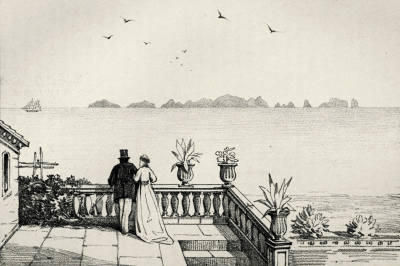
CORSICA AS SEEN BEFORE SUNRISE. MENTONE.
A week later witnessed the grandest event of the season, for on 10th February the keeping of the Carnival commenced. For some days previously, the shops were full of false faces, wire gauze masks, strange dresses, and confetti; and cars were in course of decoration for the event, which necessarily, in a small place like Mentone, could only be upon a small scale. The coming affair was the grand talk of the town, and we had even some masquerading before it came. At last the eventful morning dawned. It was a complete holiday. Every one turned into the streets, or took possession of windows, balconies, and other salient points; while the promenade was ornamented with long venetian decorated poles, such as we had planted in the streets of Edinburgh when the Queen came to unveil the Prince Consort’s statue in 1876. Balconies were draped, flags were everywhere fluttering in the breeze, and the Cercle where prizes were to be distributed was gaily dressed with evergreens and coloured calico. At mid-day the procession was expected to move; but it was much too important to move off so early, and did not commence till two o’clock. Meantime the streets were filled with people in the oddest and most comical attire, with masks on their faces, rendering them unrecognisable by their friends. One of these figures was absurdly dressed in feathers as a huge cock, while another represented a still larger eagle. All this time the people were peppering each other with confetti, small round chalk pellets smaller than peas. But the grand peppering was reserved for the procession, which at last hove in sight. It was preceded by a car filled with musicians in carnival costume, who did not play, being probably afraid lest their instruments might suffer damage. Then a long row of fancy soldiers ambled forward on horseback, two and two, dressed in a uniform of blue coat and white trousers, looking very gay. Then various cars were dragged slowly or staggeringly along in odd devices, one of which was the representation of a gigantic lobster pie filled with men dressed out in red as boiled lobsters, while the horses had vast coverings as black or unboiled lobsters. Another car personified classical statuary, the men and women being chalked or painted over in white, and intended to be motionless, but as taken being well shaken, not always succeeding in preserving either rigidity or composure. Various other cars, besides walking figures, and people in carriages, all disguised, completed the procession, which, like a stage army, to make up for the want of numbers, passed round the circle and repassed repeatedly. All this time, the people in the street, or on the balconies or scaffoldings erected for the occasion, and in the carriages and cars, continued to fire away at each other a copious shower of confetti. These were discharged with a right good-will; but all, except the improvident, being protected by masks and calico garments, no damage was suffered, except when a man audaciously appeared in a good hat, which hat was battered by discharges of confetti without mercy. Young men and young ladies adopted the novel method of flirting by vigorously pelting each other, and wicked men would quietly and furtively slip a handful of confetti down a woman’s open neck. This tomfoolery was begun upon the Saturday and continued upon the Monday, but was not practised upon the Sunday at Mentone. At Nice, however, where the English do not preponderate, the Carnival, which was there upon a larger scale, was kept up on the Sunday, and about twenty of the visitors (foreigners, of course) at our hotel went to Nice to see it. On the Monday night the promenade was lighted up by means of paper Chinese lanterns, and there was an exhibition of fireworks, concluding with setting in blaze a giant figure representing ‘the Mentone man,’ well stuffed with tar. The streets on the following day, as well as previously, were covered with the chalk pellets, and it was some time before they were swept and restored to their ordinary condition.
Of a different sort were other days regarded as eventful in so quiet a place as Mentone. A fall of snow was an event, the discovery of ice in the river, even a rainy day was to be noted. But of all days of this description, those in which Corsica was visible were the greatest, and the query when friends met on such days always was, ‘Have you seen Corsica this morning?’ It was only in peculiar states of the atmosphere that this distant island became visible, and it happened perhaps six times in the winter. Just before sunrise,—generally from a quarter to half an hour before, if the atmosphere was particularly clear, and especially if frosty,—the sun rising behind Corsica revealed the tops of mountains from 90 to 130 miles off, and from 6000 to 9000 feet high: the vision remained till the sun rose to the horizon, when it disappeared. I was always on the watch on likely mornings, and succeeded in taking a sketch of the view, which, by verifying at each successive appearance, I rendered exact. The engraving opposite is a little more than half that of the original sketch, which was just as seen. Only on one occasion was Corsica visible during the day. This happened in the second winter, on 26th November 1877. I had seen it in the morning, and was incredulous when informed in the forenoon that it was then visible. Seeing was believing, however; for there it was, and it remained in sight the whole day till four o’clock, the sun throughout shining brightly on it instead of behind it, so that this appearance was quite different from what was seen in the morning. I looked upon it as the harbinger of wet weather, and accordingly for some days afterwards we had rain.
By the end of February we began to prepare for leaving Mentone to travel in Italy. During December we had five days, during January two days, and during February three days with more or less rain—eleven days altogether out of ninety. Besides these days, which were also cold, we had as many more days which were cold or stormy without being wet. All the other days, even with the north or east winds blowing, were fine and sunny. There were very few days in which an invalid could not venture out. In fact, more than three-fourths of the weather was fine and sunny, and often as hot as a hot day in July at home. On 27th February, however, we had an eclipse of the moon, which was total. It must, I think, have had a serious effect upon the temperature, for immediately afterwards it became extremely cold; so much so that there was ice for the first time on the river, and it was needful at last to don our winter attire. We had planned to leave upon the 2d March, but the day was such as to necessitate postponing our departure till the morrow. We proceeded by carriage to San Remo.
ITALY.
——◆——