"Winter Adventures of Three Boys" (continued 6)
Reading edition
“I fancy,” said Alec, “that some of the things we can also tell them about the cunning and cleverness of the wild animals we have been hunting, or seeing the Indians hunt, will open their eyes.”
“After all,” said Frank, “the cleverness of the Indian guides in finding their way through the pathless forests, day or night, where there was not the least vestige of a trail, sometimes for hundreds of miles, and often when blizzard storms howled around them for days together, was to me as wonderful and unaccountable as anything I have witnessed.”
“Yes,” said Mr Ross, “that is indeed wonderful. I have been studying it all my life, and am just as much puzzled to-day as I was at first with these first-class guides. They are not all thus gifted, but there are some who never blunder, or even hesitate, under the most difficult circumstances. The sky may be leaden with clouds all day, and an ordinary person get so bewildered that he does not know north from south, or east from west, but the guide never hesitates for an instant, but on and on, with unerring accuracy, he pushes day after day, or even night after night.”
“That is wonderful indeed,” replied Alec, “but the cleverness with which the wolves tried to get ahead of me by cutting across the necks of land in the river, and their other deviltries, are what I will never forget.”
Here this most interesting conversation was ended by the arrival of Paulette and Mustagan, with the word that the melting snow had exposed the houses of the muskrats, and that they were off on a hunting excursion to a great pondlike swamp where these animals were known to be very numerous. At once it was decided that a party would be made up to join them at a designated spot in the forest on the edge of this great swamp. The distance was between twenty and thirty miles, and as the greater part of the route would be on the ice, it was decided not to start until the chill of the evening had hardened the snow, which now nearly every day softened in the midday sun. Travelling with dog-trains in half-melted snow, or even when it is just soft enough to stick, is very heavy, laborious work. However, as soon as the sun ceases to shine upon it, at this season, it hardens up again very quickly.
Arrangements were made for a three or four days’ trip, so a regular camp outfit was taken along on the dog-sleds. In addition to their guns the boys were each supplied with a long, lancelike barbed spear for effective use when securing the muskrats. Two or three Indians were taken along by Mr Ross, who remarked to the boys, when he decided to accompany them himself, that perhaps this was the last hunting trip of the season with the dogs, with perhaps the exception of the one to the goose hunt, which would not be long distant.
The whole party left Sagasta-weekee about sundown, and as it was a crisp, cold, beautiful moonlight night, everybody enjoyed the trip exceedingly. The boys, however, could not help remarking the great change in the temperature from midday. Then the sun was so hot that the snow was melting at a marvellous rate; now everything was as hard and firm as though it were still January. Through the portages and over the frozen ice expanses they hurried, and some time before midnight they reached a splendid camp already prepared for them by Paulette and Mustagan. A great roaring fire looked very attractive to all, even to the boys, as they had become quite accustomed to these wintry resting places when the heavy day’s work was done. Kettles were quickly filled and a late supper was eaten, and then all lay down to sleep. Nothing disturbed their rest except the distant mournful screeches of the wild cats and some other wild animals, that were already, now that spring was coming, like themselves, on the lookout for muskrats.
In the morning, after an early breakfast, the whole party set off for the great pondlike morass that extended for miles. Numerous tracks of wild animals were seen, and Mustagan pointed out to the boys not only those of some wild cats, but also a number of those made by the great feet of the wolverines, as these latter animals are as fond of muskrats as are any other. When the edge of the shore was reached the boys were surprised to see how rapidly the snow had disappeared from the surface of this lakelike pond. On it they noticed a large number of what seemed like bundles of straw, as though a farmer in a great loaded wagon had driven over the surface and had here and there in many places pitched out large forkfuls and left them to decay.
“It looks,” said Sam, “as though some farmer hereabouts had been drawing out the contents of his barnyard to enrich his fields.”
“Just what I thought,” said Alec.
“All those little hillocks of marsh hay and reeds are muskrat nests,” explained Mr Ross. “They were made last summer on the little mossy hillocks that everywhere abound in all of these great marshes. Being then entirely surrounded by water, they are fairly safe from the prowling wild animals that hunt them as their prey, as wolverines and wild cats dislike the water. Then in the winter they are completely covered by the deep snow, and so are as safe as beavers’ kitchens. But in the early spring, when the snow melts off the ice, they are at the mercy of their foes. The ice remains solid for another month or so, and on its hard surface these water-hating enemies travel and tear open these nests and devour those that have not deep enough burrowings in which to hide themselves away. Of course, as soon as open water comes they are safe, as they are thoroughly amphibious animals.”
The boys were each armed with long, lancelike spears, while the Indians had in addition to these some axes and guns. At the first nest the boys found that the wild cats and wolverines had been there before them and had cleared out every muskrat. However, as under the guidance of the Indians they pushed out further on the ice, they found many nests or little houses undisturbed. A few blows with the axes knocked the house to pieces, and then there was quick work in spearing the almost helpless animals. In the houses near the channel of the stream, or where there was deep water, very often the clever muskrats had a channel dug from their little straw houses to the water. These “runs,” as they are called, serve as a line of retreat whenever their home is attacked. In other places the muskrats contented themselves with merely having a well-like place under their little houses. While some of them were deep enough to save them from the wild cats or wolverines, they were not sufficient to save them from the spears of our boys and Indians. It seemed at first cruel to thus stab the helpless animals, but their flesh was food for the natives, and their furs were sold to the traders for things essential to the Indians’ comfort. So numerous were the nests in this extensive morass that there was work enough for the hunters for days. The boys, however, soon became tired of killing the poor muskrats, and so only remained at the work with the Indians for the one forenoon. After that they left their long spears at the camp, and taking a dog or two with them, and their guns, had some good sport among the partridges, which were fairly numerous.
The second morning the boys were aroused very early by a couple of the Indians who had been on the watch during the night guarding the now large pile of muskrats and skins. Paulette and Mustagan were too clever to let their game be stolen from them, as were some beavers earlier in the winter from other hunters, as we have described elsewhere.
“Get ready soon, and get your guns and come with us, and we will show you something that will please you.”
It did not take them long to respond, and so they were soon on the trail with Mr Ross, while the two old Indians noiselessly led the way. The other Indians had orders to remain in the camp and keep the dogs with them, and as quiet as possible. They had not travelled more than half a mile before the boys heard the most discordant screeches. Still they had not the slightest idea of what sort of an experience was before them. Louder and louder were these sounds, as they came directly with the wind toward them. When they reached a little depression in the trail they found that Mustagan and Paulette had stopped and were awaiting their arrival. It was now so light in the eastern sky that the boys could see as they approached that the Indians were making signs for perfect quiet. So, as noiselessly as possible they, with Mr Ross, joined them. Then they were informed that just over the brow of the steep hill before them a couple of wolverines had chased a couple of wild cats up into a large tree. The cats had each captured a muskrat, and were making off with them when the wolverines came along and tried to rob them of their prey. However, the wild cats had succeeded in getting up into this solitary large tree with their game, and although the wolverines can climb trees they did not like to do so to attack these fierce cats, as their being already above them in the tree would give them such an advantage.
Very distinctly now could be heard the growls of the wolverines, and then the defiant snarls of the cats. With their guns loaded with ball, they all began the cautious crawl up the hillside, with the Indians in the advance. Fortunately for them, the top of the hill was studded with short, stunted spruce trees. By each person keeping one of these well in front of him, they were all able to crawl up to positions where they could distinctly see the tree with the wild cats ensconced on its large branches and the wolverines at the foot of it. The tree was not an evergreen, and so every branch was distinctly visible. For a time they watched the various manoeuvres of the animals. They noticed that when the wolverines were not active in their movements the wild cats kept eating bits off the muskrats. This seemed to anger the furious brutes on the ground, and so they would one after another make the attempt to get up the hard, smooth trunk. How the cats had succeeded was a mystery to the boys. Wolverines are fairly good tree climbers, but they had no show at all here, for when one of them succeeded in getting well up the almost smooth, bare trunk, a fierce blow from the unencumbered paw of one of the wild cats, securely seated on the large lowest limb, which ran out almost parallel from the trunk of the tree, quickly caused him to loose his grip and fall helplessly to the ground. Then, with apparent satisfaction, the wild cat would take another bite or two of his muskrat. Several times, as though on purpose, the wild cats dropped small bits of meat or half-picked bones to the ground. The taste or smell of these fairly drove the wolverines furious, and so they would desperately make fresh attempts to get at their enemies, but without success.
It was fortunate for our party that the wind was blowing toward then, and also that the air was so thoroughly tainted with the musky smell of the muskrats. Under ordinary circumstances they would have been detected long ere they had reached the top of the hill. So, unsuspected, they watched the strange antics of these animals, until suddenly the reports of a couple of guns rang out, and then up sprang both Mustagan and Paulette and dashed down to the foot of the tree, loudly calling to the rest of the party to quickly follow. Following Mr Ross, the boys speedily obeyed, and when they reached the tree they found that one wolverine was dead and the other was hobbling off, as speedily as he could, on three legs. The other had been broken by the ball of one of the Indians. The frightened wild cats had dropped what was left of the muskrats, which was not much, and had found their way much higher up in the large tree, where they vainly tried to hide themselves by stretching out on a couple of large branches. Quickly loading his gun again, Paulette hurried off after the wounded wolverine, that, in spite of his broken leg, was rapidly making for the distant dense forest. But vain were all his efforts, for behind him was an Indian who, although now well up in years, was one of the fleetest runners in the tribe. Soon the gun rang out and another wolverine was dead.
It was decided that the boys should have the work of shooting the wild cats. So close and flat did they crawl down on the big branches that the boys had to move back to a considerable distance from the tree to get a good aim. Sam and Alec were to fire first, and if either cat failed to drop, then Frank was to bring it down. Mr Ross and Mustagan with loaded guns stood ready for any emergency, for wild cats are uncertain animals, and are not to be trifled with. They are very fierce, and will sometimes, when thus treed, if furious with hunger, or driven from their young, spring down into the midst of the hunters and fight like tigers. When the boys had secured a good position, and each knew which wild cat he was expected to kill, Mustagan gave the signal, and together the reports of their guns rang out. The cat at which Sam had fired at once dropped to the ground, stone dead. The other did not move, much to the chagrin of Alec, who could not understand how he should have missed him. Just as Frank raised his gun to fire Mustagan’s quick eye saw what the boys did not, and so before Frank could fire he stopped him by saying:
“That cat is dead; do not waste another bullet on it. You only more injure his skin.”
And so it was; when the body was at length obtained it was found that Alec’s bullet had hit him squarely behind the fore shoulder and had gone clean through his body, of course killing him so suddenly that there was not even that muscular quiver which generally causes animals, when thus killed, to fall to the ground. This was what actually happened to the one that Sam shot.
Paulette soon after made his appearance, dragging the wolverine. They were all delighted with the morning’s work. Mr Ross and the boys hurried back to the camp and speedily dispatched an Indian with a dog-train and empty sled for the game. While some skinned these animals, others spent the day in killing additional muskrats, and then after supper, as soon as the snow had frozen hard again and the glorious moon was well up in the heavens, the home trip was commenced. Loaded down as they were, they did not travel as fast as they had done in the outward trip, and so it was about daybreak when they reached Sagasta-weekee.
Chapter Twenty Two.
Niskepesim, the Goose Moon—Excitement Among the Indians—The First Goose—Their Northern Migrations—Feeding Grounds—Methods of Hunting them—Nests—Decoys—Our Boys off with the Indians—The Shooting Grounds—Their Camp—Great Success—Frank’s Queer Accident—Hit by a Dead Goose—Sam’s Comments—Laden with Spoils.
Not many days after the return from the muskrat hunt the weather became, for that land, decidedly warmer. This created so much excitement among the generally stoical Indians that the boys could not but observe it. So one day, when a number of them were at Sagasta-weekee, Sam asked Mustagan the cause of it. The old man answered but one word, and that was:
“Niskepesim.” (“The goose moon.”)
“Yes,” said Kinesasis, who had just come in, “it has surely come. Some passing hunters saw some wild geese near the mouth of the river, at Lake Winnipeg, and others who were out spearing muskrats said that they heard flocks of them passing over during the night.”
Great indeed was the excitement everywhere at this news. It rapidly flew from Sagasta-weekee to the fort, and then on to the mission. As though by some mysterious telegraphy, it passed from one Indian settlement to another, yea, from wigwam to wigwam, until the cry everywhere was, “Niskepesim! Niskepesim!” (“The goose moon! The goose moon!”)
Why there should be such commotion among these northern Indians about the arrival of the wild geese has long been a puzzle to outsiders who happen to be among them at the time. Nevertheless such is the case. The fact that this moon is really the beginning of spring, which is so welcome, after the long and dreary winter, may have something to do with this general excitement and gladness. It is really the first month that the family have a flitting out from the close, confined houses or wigwams in which they have passed the cold, dreary months. Then it brings them a welcome change of diet, which is much prized after the long six months’ dining twenty-one times a week on frozen whitefish, with only the variation of a little venison, muskrat, or beaver.
At Sagasta-weekee the excitement was as great as anywhere else. Mr Ross had to exert a good deal of authority to keep some of his men at work after they had seen a great flock of these splendid grey geese fly over their heads. Over at the mission Mr Hurlburt had failed completely in holding his men. He had been for some time urging them to clear up and put under cultivation what ground they had around their village that was good and fertile. At a good deal of expense he had secured a fine supply of axes, hoes, spades, and other necessary implements, as well as seeds, to help them. For some days they had worked industriously and well, and there was every prospect of a large portion of the ground being prepared and planted. One day, when Mr Hurlburt had about thirty men hard at work in the fields, what should come flying along on the south wind but a great flock of geese? They were in broken ranks, not more than fifty feet above the ground, and evidently tired and looking for a feeding place. The sight was too much for the hunting instinct of the Indians, and so every axe, hoe, and spade was instantly dropped, and away they rushed for their guns. The missionary did not see one of them again for two weeks.
The wild geese are of various varieties. The first to arrive are the great grey ones. They seem to come up from Central America, Mexico, and Southern California, where they have spent the winter months. Then follow the brants, wavey, or laughing geese, which are all smaller varieties. When on their long migrations the geese all fly very high, and generally in long lines or triangles. But when they reach the north country, where they hope to spend the summer, they fly low over the ground. They seem to be then on the lookout for feeding grounds and suitable locations for nest building. If undisturbed, they speedily break up in pairs. They arrive very hungry, and so spend some days in heavy feeding on the peculiar many-jointed grass, called goose grass, the Indian name of which is Niskeanuskwa.
At Sagasta-weekee the boys had heard so much about the goose hunt that they were full of curiosity and excitement as the time of its expected arrival drew near. White suits and white caps had already been made for them, and the guns were all freshly cleaned and oiled. Camping outfits were all ready, and the boys observed that in addition to the winter’s supplies there were added large heavy oilcloths, like tarpaulins. The next morning, after Kinesasis had reported the words of the passing Indians, there came in another hunter, and he had with him the first goose of the season. He was delighted to be the first, as a handsome reward is given to the one who is fortunate enough to kill and bring in this kind of first fruits of the harvest of these great birds. The sight of this goose was all that was necessary to have all arrangements completed, and it was decided that on the next morning all who could go should be off to the great goose hunt.
The point selected for the camp was on the border of one of these great swampy plains, from which the greater part of the snow had been melted by the warm south wind, leaving exposed, over hundreds of acres, vast quantities of this jointed grass on which the geese feed with such avidity. The frost was still in the ground, and so there was no difficulty on the part of the hunters in arranging their shooting nests and decoys as they desired. The camp was made very similar to those already described. There were a few changes, however. The soft snow was all cleared away, and a deep layer of fine balsam boughs were evenly spread out over the cleared place. Then over this a couple of tarpaulins were spread, and on these the usual camp beds of robes and blankets were arranged as elsewhere described. A great log fire was built up in front, and numerous logs were cut for use when required. A number of good stiff long poles were also cut and placed where they could be quickly utilised, if needed, to erect a roof or barrier against a storm of sleet or rain which might unexpectedly come up.
While the camp was thus being prepared by some of the party, in this cozy elevated place, back among the trees, where it would not frighten the geese, others were equally hard at work making the nests out on the great open meadowlike place where the goose grass was most abundant. These nests were built up of dry grass and dead brush, and made so that they looked just as their names would indicate—like great nests. Each of them was large enough to comfortably hold two hunters, who could easily move around, and thus be able to fire in any direction. They were about four feet high, and so constructed that when the hunters inside were crouching down they were quite invisible to the passing geese. Some Indians used to pile lumps of snow here and there on the edge of the nest to help the disguise. It is a peculiarity of wild geese that white objects never frighten them. This was the reason why the hunters all wore white suits and white caps. Then a number of decoys were made. They were rather rude affairs. The bodies were hewn out of logs about the size of a goose. A couple of sticks were driven in for legs; then the heads and necks, which had been prepared beforehand out of crooked roots, were fastened in their places. They were poor affairs, but seemed quite sufficient to attract the simple geese. A number of these decoys were assigned to each nest, and the hunter had to arrange his own according to his own judgment. The direction of the wind had much to do in rightly placing them. Care had to be exercised in arranging the nests so that the occupants of one would not be in danger from the firing from another, as in the excitement of the settling down of a large flock, or in their circling completely around a nest, a person is apt to forget everything but his anxiety to shoot as many as possible.
As soon as the sleds were unloaded they were all sent back to Sagasta-weekee, as not a dog must be allowed at the camp. No geese will come where there are barking dogs. For the first day or two there was nothing but anxious watching. The southern horizon was eagerly scanned for the oncoming lines of grey geese that were so eagerly anticipated but seemed to be so late in arriving. During the second night the wind, which had been blowing from the north-east, suddenly veered round to the south-west. This was noticed at once by the old, experienced men, Mustagan, Big Tom, Memotas, and Kinesasis, who had been invited by Mr Ross to join his party. They were convinced that this wind would bring the geese, and so, dark as it was, they proceeded to make all arrangements for the next day’s shooting. They first went out and arranged all the decoys in the right position, so as to attract the geese coming with such a wind. Then they carried the guns and arranged them four apiece in each nest, with the ammunition.
Before this work had been completed the geese could be heard flying over their heads. Some of the flocks were so low that the vibrations of the air could be easily felt. When they returned to the camp, although it was still starlight, they called up Mr Ross and the boys. Breakfast was quickly prepared, and while it was being eaten the rush and calls of the rapidly increasing flocks could be distinctly heard. Then Mustagan and Frank, each taking a white blanket with him, hurried off to the most distant nest, which was almost north from the camp. There they cozily ensconced themselves and anxiously waited for the first blush of morning. Alec and Big Tom took possession of the nest on their left, about two hundred yards away. Sam and Memotas were assigned to the nest about the same distance south of them, while Mr Ross and Kinesasis took possession of the one about three hundred yards distant on the right. All were in white suits, and had in addition their white blankets, as a protection against the cold. While one or two men were left to take care of the camp, the others went off to different places where they thought they could get successful shots.
It was not long before the morning star showed up above the eastern horizon, and then the first dawning of the day appeared.
“Chist!” (“Listen!”) said Memotas to Sam, and quickly they were on the alert. The Indian’s quick ear had detected a low-flying flock, and so, before they were seen in the dim morning light, they were heard. On they came, little dreaming of danger now that they were so far away from civilisation, and so they flew not a hundred feet above this hidden place of their enemies.
Bang! bang! went the two guns into their midst, and soon bang! bang! went the other two barrels. With loud, discordant cries, those that were uninjured veered off to right and left. Memotas then threw down his empty gun and quickly seized his loaded one, but did not attempt to fire it. Sam also quickly picked up his extra loaded one, and was about to fire at the now rapidly retreating geese. Memotas, however, stopped him, and showed him that his gun was pointed exactly in the direction in which was the nest where Alec and Big Tom were stationed. Sam was frightened at what might have been the consequences if he had fired, and gratefully thanked Memotas for his caution. Memotas, who was busily engaged in reloading the guns, only said:
“Soon daylight; then you will see better.”
In the meantime the others had heard the firing and were on the alert, and so when the divided flock turned to the right and left some of the geese came close to the nest of Alec and Big Tom, and the rest were not very far from that of Mr Ross and Kinesasis. There was firing from both parties, but their success was not very much, as the darkness was still too great, and the geese were not so close to them as they had been to Sam’s nest. Memotas went out and found a couple of geese which he brought into the nest. He and Sam were quite proud of having killed the first. In the meantime, with the increase of the wind there was an increase in the number of the passing flocks. And now soon they began to be distinctly visible, and the firing became quite frequent. Of course, a good many shots were lost, as it is no easy matter to hit a flying goose, large as it is. No experienced hunter thinks of firing directly at a goose that is flying by him, or even overhead. He has to calculate for at least a foot ahead for, say, each hundred feet the goose is away from him, and it takes a quick eye and good judgment to correctly estimate the distance. Sam said he liked best to fire at them when there was a string of them in line. Then by blazing away at the first he generally brought down the third or fourth.
It was now full daylight, and so it was necessary for the hunters to be much more wary and keep themselves well down in their nests and very quiet. When they were perfectly still the geese took them for lumps of snow. This was the reason why there was nothing but white in their dress. Even the belts they had tied around them were pure white. Soon the Indians began calling, to bring the geese within range. The rude decoys were placed as though they were having a glorious time feasting on the rich goose grass. The calls of the Indians were exact imitations of the geese calling to their fellows. Sometimes these cries sounded like “Honk! honk! honk!” Then they seemed to be more like “Uk! uk! uk!” Then sometimes they were like the calls that the ordinary barnyard geese make when well satisfied with food. It was interesting to the boys to notice how quickly a far-away flock caught these sounds. Marvellously acute was their hearing. Then they acted so differently. Some were very wary and shy, and at once began to endeavour, as it were, to climb up higher and higher in the sky. This, however, was a difficult task just then, as the wind was behind them. When geese, as a general thing, wish to quickly rise up high in the air, they turn and go against the wind. In some way or other it speedily seems to lift them up. Other flocks, as soon as they thought they heard some of their comrades having such a good time, came right on and were close to the decoys and nests before they were aware of their blunder. Then the firing was rapid and destructive. Some of the flocks had dropped down so low that in order to rise up again they had to circle round and go back against the wind. Then there was double sport for the hunters. Often a flock would come in on the left side, and just as it was about to light among the decoys the guns would ring out and do their deadly work. The survivors were so low down that they could not go on with any advantage, and so had to turn sharp to the right and try to get away by going back against the wind. This movement brought them now on the right side of the nest, and as they passed more of the guns were fired and more victims fell dead to the ground.
Such were the positions of the nests in reference to the wind, that Sam and Memotas had, by all odds, the best place that day. Generally, after they had fired, the flock broke in two, and Alec and Big Tom got part, while the other portion generally found Mr Ross and Kinesasis. However, when a great flock pushed on unbroken, it generally went directly over, and very near, the nest where Frank and Mustagan had their quarters. Then there was some fine shooting, as each had two double-barrelled guns and Frank had become quite famous as a shot. Many of the geese dropped at once to the ground when shot. Others, although mortally wounded, only fell when quite a distance beyond, as the momentum of their rapid flight seemed to carry them on. Some fell when they were only shot through one wing. During the lull after the firing, when the boys went out from the nests to bring in the spoils, there were some additional battles to be fought ere some of the geese were conquered. Especially was this the case with those that were injured in only one wing. When these were approached they instantly stood on the defensive and struck out most viciously with the unwounded wing. Some of the boys had had some experience in this line, and so were now on their guard, and thus escaped feeling the tremendous power of a goose’s wing. Others viciously used their bills and made lively work for the boys ere they were conquered. Others, unwounded in their legs, made off as rapidly as possible, and then there was great fun in the work of running them down. Those that could use even their wounded wing, or wings, to help them in their movements made capital time, and while most of then were captured, others succeeded in getting away altogether. Doubtless they would be picked up by alert Indian hunters, who were, or would be in a day or so, literally swarming over every place where a goose was likely to be obtained.
When noon arrived they nearly all returned to the camp, where dinner already awaited them. Twenty-seven geese were the results of the shooting in the four nests. Other Indians came in with their bags. Some had done on the average better than this, and some not so well. As the wind remained steady in the one direction the flocks of geese were very numerous. There was hardly a period of ten minutes’ time when some were not visible. Of course, the great majority of the flocks were high up in the air. On and on they flew, their eyes fixed on a point further north, perhaps a thousand miles beyond. No call from the hunters reached them, no ball even from a rifle pierced the thin air of that exalted region in which, at perhaps a rate of a hundred miles an hour, on they flew. The Indians say that the same geese come back, when possible, to their old feeding grounds year after year.
After dinner the sport was resumed. When no flocks were near, the boys would jump out of their nests and, by some racing and frolicking on the ice, keep themselves warm, as there was much of winter still in the air. The cry of “Niskuk! niskuk!” (“Geese! geese!”) would send them racing back to their respective nests, and it was often as much as they could do to reach their retreats ere the geese were upon them.
A queer accident happened to Frank. As a small flock passed over the nest in which Sam and Memotas were sitting Sam blazed away with his last barrel, just as the geese had gone by. He struck one of them and mortally wounded it, but it had vitality enough left to keep itself up until it reached the nest where Frank and Mustagan were crouched down, watching another flock that was approaching from the other side. Without any warning the goose suddenly dropped dead with a whack on top of Frank, knocking him over most thoroughly and causing his gun to suddenly go off, but fortunately without hitting his Indian companion. A great grey goose weighs something, and so the whack from this dead one nearly knocked Frank senseless. The inmates of the other nests quickly came to his assistance. He was so dazed with the blow that it was decided that he and Sam, who had had about enough of goose-killing to suit them, should go to the camp for the rest of the afternoon. It was wisely thought that Sam’s irrepressible fun and good nature would be the best medicine for Frank for the time being.
That evening, when the shooting was over and all were seated on their comfortable robes around the bright camp fire, there was a lot of talk about Frank’s queer accident. All were thankful that the blow did no more serious harm. Mustagan said that he had shot geese flying over the ice where they had fallen with such force that they had broken clean through ice so strong that men could walk over it with safety.
“What do you think about it, Sam?” said Alec.
“Think about it, do you ask me?” replied Sam. “I have done a deal of thinking about it. I’ve been thinking that was the queerest weapon of offence I ever heard or dreamed of. I have heard of arrows and bullets and darts and clubs and shillalahs and tomahawks and boomerangs, and even thunderbolts, but the idea of hitting a poor, defenceless English lad with a dead goose! it beats me hollow! Sure I can hardly believe my senses. I’ll be denying the whole thing to-morrow, although I saw the complete performance to-day.”
The next morning Frank was fully recovered from this queer blow, and just as eager as ever to take his place in his nest with Mustagan. The wind veered around to the south-east, and so all of the decoys had to be changed. The shooting was good all day, but not equal to the previous one. The Indians were very clever in even calling some flocks back that had been fired into with deadly results. The explanation the Indians gave for the returning of these flocks was that although they still kept together in great numbers the geese had selected their mates, and the shooting of one or other of these pairs had caused the whole flock to return to look them up, in response to the cries of the bereaved survivors.
Sam said that he thought that the elegant voices of the Indians as they cried “Honk! honk!” had more to do with it than any affection in the heart or gizzard of an old goose. This remark of Sam’s was at once challenged, and a number of stories were related to prove that even the despised goose was worthy of a much better record than was generally given her.
Thus, with varied success, several days were spent at the goose grounds. Two or three times the boys succeeded in each bringing down four geese with the four barrels of the two guns. This was considered very clever shooting on the part of young fellows on their first spring’s hunt.
In due time the dog-trains returned from Sagasta-weekee. The last visits to the nests were made, and the closing two hours of the goose hunt were voted by all to have been the best, as the geese were so numerous that at times the guns were hot with the rapid work. The boys would have liked to remain longer, but Mr Ross stated that they had already shot as many geese as they could eat at home or could give away, and that it would not be right to kill any more of such valuable birds. The true hunter thinks not only of present needs, but of the years to come. In times of plenty he remembers there are days and years ahead. This was a satisfactory explanation to all.
The loading up of the geese on the extra sleds was soon accomplished. A good warm supper was eaten, and then at about ten o’clock at night, when the frost had again hardened up the snow that had been so soft and slushy a few hours before, the home journey was begun, and among “the wee small hours beyond the twelve,” the welcome lights in Sagasta-weekee were seen, and the happy, tired excursionists were glad to hurry off and half bury themselves in the beds and pillows filled with the downy feathers of geese killed at the spring hunts of years before.
Chapter Twenty Three.
Sudden Transition from Winter to Spring—Interesting Phenomena—Sam’s Last Great Run with his Dogs—His Unique Adventure—The Open Water—His Novel Raft—Successful Crossing—Frank and Alec’s Duck-shooting Trip—The Mighty Nelson—A Hunter’s Paradise—Returning under Difficulties—One more Shot at the Wild Geese—Frank and Rumours—The Fair Visitants at Sagasta-weekee.
Very rapid indeed is the transformation from one season to another in the high latitudes. When the long, steady winter breaks it does so with a suddenness that is startling to a person who observes it for the first time. The snow disappears with a marvellous rapidity. The ice, that was like granite in hardness and several feet thick on the great lakes, becomes dark and porous, and in spots literally seems to rot away. Then along the great cracks, where it had burst by the power of the terrible frost some months before, it now opens, and soon great fields of it become floating masses on the waters. Under the action of the brilliant rays of the sun it becomes disintegrated, and falls away in crystals that are of various sizes and as long as the ice is thick. This crystallisation begins early, and makes the ice very dangerous and uncertain. The Indians call this slivering of the ice, candling.
Sam had a narrow escape from drowning on account of this rapid transformation of the ice. He had harnessed his dogs and gone out on the shining lake for a run. The snow had all disappeared from the land, and so the great icy expanse was all that was left for an invigorating run with the dogs. The frost had been keen in the night, and so everything was firm and hard when he left in the morning. The day was an ideal April one. The sun was full of brightness, and the south winds were full of warmth. For miles and miles Sam recklessly dashed along with his splendid dogs. He was sorry at the thought that he was so soon to forever leave them behind in that North Land. Soon some pools of water on the ice into which his dogs splashed brought him to his senses, and he turned for the home run to Sagasta-weekee, now perhaps twenty miles away.
“Rip Van Winkle,” said Sam; “sure. I am that same old fellow, to judge by the change since I travelled over this icy lake.”
Great indeed was the transformation which the sun and south wind had made. While there was still plenty of good ice, there were many dark, treacherous spots all around, which had so crystallised by the sun’s rays that, although the ice there was still three or four feet thick, it was unsafe for dogs or boy. Fortunately, dogs become very wise in this matter, and so Spitfire carefully wended his way among these dangerous places, cautiously keeping where the ice was firm and solid. Rapid travelling was in some places impossible, for fear of running into a bit of rotten ice.
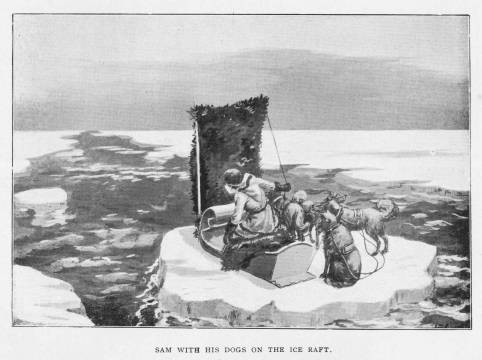
Suddenly Sam was stopped by coming to a long stretch of open water. It was a place where, during one of the coldest nights, the ice had suddenly burst open with a report like a great cannon. The crack then made was about twenty or thirty feet wide and some miles in length. So intense was the cold that the ice in a few hours formed again on the water which was in this great opening. But when these great breaks in the thick ice occur, toward the end of the winter, the new ice that forms is never so thick as is the rest, and so when the spring warmth comes it is the first to disappear. It was to one of these open seams that Sam had now come. In the early hours of the morning it had been covered with ice sufficiently strong to hold him, but now it was full of broken fragments that rose and fell on the water that was stirred up by the strong south wind. As far as the eye could reach north and south extended this open channel. Sam was perplexed, and hardly knew what to do. To drive across was impossible, as the seam was much wider than his cariole was long. To wait until the night frost again froze up the water was a risk, as to judge by the warm south wind then blowing, if it so continued there would be no freezing of any consequence. Thus Sam was troubled and annoyed at having allowed himself to be thus caught, especially as he and the other boys had heard Mr Ross and the Indians refer to just such experiences. With his vexation at having thus had his trail so suddenly broken, there flashed into his memory the stories of how some of the Indians, when in just such dangerous places, had escaped by making great rafts of the ice and on them floating across the open water. No sooner had this thought come to Sam than he fairly shouted out:
“This is my plan. Now I will have a story to tell that will sound well in dear, darling Dublin.”
It was well for him that an axe and ice chisel, which he had been using in cutting a hole in the ice the day before, were still lying in his cariole. With these in his possession there came a feeling of elation in his heart, and he fairly shouted with delight at the position in which he found himself. With great zeal he set to work, and having placed his dogs in what he imagined was a safe position, he first carefully marked out around them a line to indicate where he was to chop. Industriously he set to work. But, O dear!—well, it was hard work. Soon off came his outer coat, then he threw down his mittens, and his fur cap followed next. Bravely he toiled, until his hands were about blistered and his back sore. To his great disgust he found out that not one tenth part of the task was accomplished, and yet he was about tired out. He had selected the firmest ice he could find, in order that his raft might be perfectly safe. While this was a wise thing to do, and would have been all right if there had been sufficient strength available to cut it out, it was a mistake on the part of Sam, and so he realised when he had toiled until weary. But he was not disheartened, and so resolved to try and find a place where the sun’s rays could be utilised. Straightening out his dogs, he drove along the ice for a mile or so before he reached a place that seemed to suit him. When he had found what he thought would do he set to work at once, for the day was now advancing.
The spot selected was a solid-looking piece of ice not much longer or wider each way than his dogs and cariole. It projected somewhat into the water, and on the icy side were several dark places where the ice was rotten, on account of its crystallisation by the sun’s rays. Here Sam with renewed vigour set to work. He made rapid progress, and found that all he had to do was to cut the firm ice that lay between these different dark spots where the ice had lost all of its cohesive power Sam found ere he had finished that his dogs were getting strangely nervous, and to keep them from rushing off he had to turn the train around and tie them to the cariole. While doing this he discovered the cause of their fear, and was also thankful that he was with them in the middle of his now floating raft. The strong wind blowing directly up the channel, narrow though it was, had so agitated the water that there was a good deal of force in it, and so now, even before Sam had completely severed the ice from the main body, the water had begun to cause it to slightly move. Dogs are more sensitive than human beings, and so they had noticed it before Sam had, and while he was trying to quiet them the whole thing broke loose and began slowly to move north.
As this novel raft broke loose it was quite unsteady for a few minutes, and Sam saw with disgust his axe slide into the water and disappear. However, he still had the ice chisel, with its strong handle, which was about eight feet in length. At first he had all he could do to quiet his excited dogs. They acted as though they would plunge into the water in spite of all his efforts. Some soothing words, and also some vigorous kicks, quieted those of different temperaments, and they settled down at last and seemed to say: “Well, if our master can stand this, surely we ought to be able to.” Not until Sam felt that he had his dogs well under control did he make any effort to get his novel raft across the channel. But when they all lay still and quiet he took up his ice chisel and was ready for work. He vigorously pushed against the icy shore from which he had broken loose, but his strength did not at first seem to make much impression, as the wind was somewhat against him, and so his raft at times ground roughly against the side from which he had broken away. However, he was slowly working north, and he was not discouraged. Sam was always an observant lad. When on shipboard he had been interested in watching the sailors shift the sails to catch the changing winds. So now an idea came to him, and he resolved to see what could be done with an improvised sail, even if it were only made out of a large buffalo robe. Lashing one side of the robe to the pole of his ice chisel, he then firmly fastened one end of it to the head of his cariole. Cutting two holes in the outer corners of the robe, he there tied a couple of strong deerskin strings. Then, taking his place in his cariole, he pulled his sail up against the wind and awaited the result.
He was not very sure just how to manage to get across the channel, but he had no anxiety about getting further off, as that was an impossibility, as he was now jammed up against the ice. So he pulled in his sail and then let it out, until at length he found the right angle for the brisk wind to cause him to gradually draw away from the side he had been on. When in the middle of the channel so pleased was he with his novel craft that he let out his sail, and for a time sped along north between the two icy shores. Then, observing an indenture in the ice to the east sufficiently large to serve for a harbour for his queer vessel, he steered for it and safely ran in, but struck the icy landing place with such a crash that his raft was split in the middle under him. However, all he had to do was to hang on to his cariole and straighten out his dogs by the calls they well understood. In an instant they sprang ashore, and easily dragged Sam and the cariole after them. Facing toward the distant home, the dogs required no special urging, and so rapidly, yet carefully watching against the treacherous places, they hurried on, and about sundown home was reached.
Mr and Mrs Ross had begun to feel anxious about him, and so were not only relieved by his return, but very much amused by the characteristic account he gave of his adventure on the ice raft.
In the meantime, although it was not quite dark, there was no word as yet from Frank and Alec, who with some Indians had gone off early in the morning on a duck-shooting excursion.
Following the geese, the hunting of which has been so fully described in a previous chapter, came the ducks in great flocks. They could be seen in great multitudes during every hour of the day, and the whistling sounds that accompany their rapid flights could be heard every hour of the night. They seemed to be of about every known variety, from the great grey ducks down to the smallest teals. The Indians were after them incessantly, and killed great numbers of them. They resorted to no such elaborate preparations in hunting them as they did at the goose huntings, but shot them at the various points along which they seemed to crowd, and in the many pieces of open water on the marshy shores, where they tried to find some favourite food. The boys were out almost every day, either with Mr Ross or some trusted Indians, and had some capital sport.
The morning that Sam had prepared to have a good long final run with his dogs Frank and Alec had gone to what was called the Old Fort, where the mighty Nelson, gathering in Lake Winnipeg the waters of many rivers, begins in its full strength its fierce, rapid, onward career, that ends only when it reaches the Hudson Bay. This has been for generations a favourite shooting ground of the Indians, and here for the day the two lads and their Indian attendants came. They had made the journey very early in the morning, and so their dogs had had no trouble with the ice, which in the night frost had quickly become firm and hard. In the friendly shelter of some trees they had secured their dog-trains. Here building a fire, their Indian cook had a second breakfast soon ready for them. While eating it they could hear the cries of many wild birds, that the now strong south wind was bringing over them. Flocks of wild geese, principally the waveys, a very much smaller variety than the great grey geese, were quite numerous, as well as an occasional one of the larger kinds. Swans flew by in straight lines with such rapidity that many a shot was lost in trying to shoot them. Pelicans were also there in great numbers, and the boys were intensely interested in their awkward, and at times comical, movements. As they are not good for food, only one or two were shot, as curiosities. Cranes stalked along on their long, slender legs in the marshy places, while snipe and many similar birds ran rapidly along the sandy shores. The ducks were everywhere, and so the shooting was everything that our enthusiastic hunters could desire.
The Indians, toward noon, began to get uneasy about the return trip, on account of the effects of the sun’s rays and the south winds on the ice. They suggested an early start, but so fascinated had the boys become in the shooting that they kept putting it off from hour to hour. However, the return trip was at length begun, and then the boys saw the wisdom of the Indians’ suggestion for an earlier start, and heartily wished they had agreed to it. Playgreen Lake, which in the morning seemed still one great mass of glittering ice, now appeared half broken up. Wherever the ice had burst in the winter, and there frozen up again, now there were long channels of open water. Suspicious-looking pools of water were on the ice in many places, and so the outlook for the return trip was anything but pleasant. Frank’s train was the first to come to grief. His heavy dogs in passing over a dark-looking patch of ice broke through, and were with much difficulty pulled out. What amazed him and Alec was that the ice was still over two feet thick where the accident occurred, but under the effects of the rays of the sun it had simply disintegrated into long icy crystals that had no cohesiveness, and so when they were trodden upon they afforded little more support than so much water.
The dripping dogs were no sooner hauled out, and once more started, than the appearance of a flock of geese, in one of the open stretches of water, was too great a temptation to be resisted. The trains were halted, and Frank and Alec took their guns and crept round to an icy hillock from which they would be able to get a capital shot. In a few minutes the guns rang out their reports, and up rose the great flocks of geese, as well as many ducks and other birds. Frank and Alec had both been successful, and so speedily they dashed over the ice to attempt to secure their geese, which seemed to be only badly wounded. As the Indians, who were in charge of the dogs, saw them thus recklessly dashing straight for the open water they instantly started the dog-trains toward them. They were none too soon, for the boys, apparently seeing only their splendid game struggling in the narrow channel, noticed not the dangerous black spots on the ice. Poor Frank, who was a little in advance, almost suddenly disappeared. Down he went, and that so quickly that he had not time even to throw from him his gun, which speedily sank.
He had all he could do to save himself as he sank in the icy crystals that sounded around him like the smashing of scores of panes of glass. Alec, alarmed at Frank’s sad plight, madly rushed to his rescue, but ere he had gone a dozen yards he too found himself, as he afterward expressed it, like a person dropping into a well. Fortunately, he was holding his gun crossways to his body, and as the hole of rotten ice into which he so speedily dropped was but a small one the gun struck solid ice each side, and as he had held on securely to it he did not fall in as completely as did poor Frank. His plight was, however, a very awkward one, as the hole was so small and the firm, jagged ice so gripped him that unaided he would have had some difficulty in extricating himself.
Well was it that the Indians had been on the alert, and so it was but a few minutes ere they were on the spot, and at once set about the work of rescue. Alec was the first reached and was speedily pulled out, although it required some effort to do so on account of his being so wedged in so small a hole with the sharp, jagged ice. His ribs were sore for many days. In the meantime Frank’s position was much more dangerous. The speed with which he was running, when he so suddenly tumbled in, caused him to go completely under the ice. He was, however, a good swimmer, and had presence of mind enough to know that for his own safety he must come up in the same place where he had gone down, as all around was solid ice. He was sorry to have to drop his gun, but there was no hope for it if life was to be saved. He found the sensation of trying to swim up through a mass of ice crystals that seemed to be two or three feet long, and no larger in size than pencils, a unique experience. As he bravely struggled through them they broke in thousands of pieces, some of them cutting his face like glass. When he was able to get his head above them he found that only a few strokes were necessary to take him to the strong ice, as this bad spot, in which he had fallen, was not more than twenty feet across. Getting out of such a hole on the slippery ice is no easy matter, and so, as he could see that help was near, after a few efforts he was content to wait until strong arms came to his assistance and rescue.
Speedily were some of the outer garments of the boys pulled off, and as much of the water as could be rubbed off from those remaining on them. Two of the Indians pulled off their dry coats, and, with these on, the boys were well wrapped up in their carioles, out of which many ducks were thrown, and then at once, with the swiftest and yet most cautious Indian on ahead as a guide for the safe places, the rapid race to Sagasta-weekee began. It was no easy matter for the Indian in front when darkness began to hide the dangerous places. More than once the rotten, treacherous ice gave way under him, and only by a sudden throwing of himself forward did he escape going through into the water.
The distant lights in the windows of Sagasta-weekee, well called the house full of sunshine, were indeed welcome sights. Mr and Mrs Ross and Sam had been long on the lookout for them, and were shocked and frightened at the sad plight of the two boys. Frank and Alec, however, tried to make light of it, but neither had the slightest objection to offer to the hot baths at once prepared, and then their suppers, taken that night in bed. They were both badly shaken up. Frank felt worse in his mind, because he had lost such a valuable gun, while Alec’s ribs were the spots that were for some days his tenderest places.
All sorts of rumours went out in reference to the accident. The story had so enlarged that when it reached the mission house it was that the boys had been rescued in a dying condition and were still very low, and so there was great sorrow over there, even so much that it was said that two sweet young ladies refused to be comforted. When Mrs Ross heard this her motherly heart was touched, and so, as the wind had changed and the cold north wind had again made the ice safe for experienced Indian drivers, two carioles were dispatched to the mission for the aforesaid young ladies to come and spend a week or two at Sagasta-weekee. The missionary, with his dog-train in charge of an experienced driver, also came over at the same time as did his daughters. Ere they arrived the boys were up and dressed in moccasins and dressing gowns, and so were able to receive their very welcome visitors. Mr Hurlburt only remained to a very early tea, and then after an earnest prayer, in which there was a great deal of thanksgiving for their deliverance, he, with Martin Papanekis, the driver, returned to his home.
Of that happy week that followed we confess our inability to write. That it was a very delightful one was evident to all. The only sorrow that tinged its brightness and bliss was the fact that soon the ice would be all gone, the boats would be arriving, and then the home trip of these three boys would begin.
Chapter Twenty Four.
The Arrival of the Spring Packet—Welcome Letters—Arrangements for the Home-flitting—Sam’s Raillery—Rachel and Winnie at Sagasta-weekee—Happy Hours—Canoeing Excursions—The Cyclone—Young Excursionists Exposed to its Awful Power—The Narrow Escape—The Refuge of the Rock—Napoleon, the Tame Bear, in Possession—Gun Signals—The Happy Rescue.
The arrival of the spring packet was, and still is, an interesting event to the dwellers in those remote northern regions. Not a letter or paper had reached Sagasta-weekee since the Christmas packet, and now it was June. And so when the first boats of the Hudson Bay Company arrived from Red River and Fort Garry, with supplies and great bundles of letters and periodicals, there was great excitement. A swift canoe was in readiness at the fort, and so it was not long ere the large number directed to Sagasta-weekee were hurried over to the expectant ones. They were quickly assorted, and then each person with his own rushed off to fairly devour the contents.
“Faith,” said Sam, as he eagerly seized his bundle, “the sight of my blessed mother’s handwriting puts sand in my eyes and a lump in my throat. Blessings on the darling! May she live a thousand years!”
Frank and Alec were equally as much interested, but they controlled their feelings and left to the more demonstrative Sam these joyous ebullitions, that were as natural as it was for him to breathe.
After Mr Ross had perused a number of his letters he quietly signalled to Mrs Ross, and immediately they both left the room. He had received a letter from Liverpool which informed him that a very serious disease had begun to undermine the constitution of Frank’s father, and while no immediate fatal results were expected, it was thought best that Frank should return by the speediest route possible. In Frank’s own letters from home all that had been mentioned in reference to the matter was that, “father was not quite up to his usual health, and they would all be glad to have him return as speedily as possible.” Neither Mr nor Mrs Ross said anything to the boys in reference to the matter of their return until after the evening meal, when they were all in the cozy study discussing the various events that had been occurring in the outside world during the last six months, and of which they had all been in profound ignorance until that day.
Each boy had read his letters to the others, and together they had been delighted with all the news received, except that concerning Frank’s father. Then, for the first time, the matter of the return home was seriously discussed. So happy had been the months since their arrival, nearly a year before, that even the discussion of the return trip had been kept in the background as much as possible. But now they were face to face with it, and sharp and quick must be their decision if they would avail themselves of the first opportunity for their departure. This would be by the return of these Hudson Bay Company’s boats to Red River. In them they could travel as far as to Fort Garry. From that point they would take the overland trail on the great plains to St. Paul, and there, boarding the flat-bottomed steamers on the Mississippi, would once more begin travelling in a civilised manner.
This plan was the one on which they finally settled. It would be much more expeditious than the long waiting for the sailing ship at York Factory, and then returning by the Hudson Bay and North Atlantic route. This decided, the next question was how to make the best of the ten days that would elapse ere the journey would begin.
“I’ll wager my dog-whip against a pair of moccasins,” said Sam, “that I know where a good part of the time will be spent if a couple of young gentlemen friends of mine can have their own way.”
“All right,” quickly responded Mrs Ross, “for although I consider a wager, at best, is but a fool’s argument, and so you may keep your whip, I will accept your challenge and say that I know that here at Sagasta-weekee is the spot where the two young gentlemen you have in your mind will prefer to spend the time until the home journey is commenced.”
The sudden extinguishment of Sam’s pet phrases of “I’ll wager” and “I’ll bet” by the gentle Mrs Ross was much relished by Frank and Alec, who well knew that they were the young gentlemen to whom he referred, and on whom he was about to turn his raillery. Generous, good-natured Sam was quick to acknowledge the error of his ways, in the use of those expressions from the betting world that had, he hardly knew how, found their way into his vocabulary. Still, as he gracefully apologised to Mrs Ross, there was a half-comical, half-perplexed look in his face, and so, as he never could keep even his thoughts to himself, amidst the laughter of all he blurted out:
“Sure I was thinking of the young ladies over the way there at the mission, and that it would be in their sweet smiles my two chums would wish to be basking.”
“We have been thinking of them also,” said Mrs Ross, “and before this, I imagine, the canoe has reached the mission, with a cordial invitation for both of them to come over, with as many others of the family as can leave, and spend the time with us until the boats start for Red River.”
“Hurrah!” shouted Frank and Alec in chorus, and ere they seemed aware of what they were doing, in the exuberance of their boyish delight, they had hold of Mrs Ross and were gyrating with her around the room, to the great amusement of all, especially of Roderick and Wenonah, who speedily joined in the sport.
This being settled, the next thing was to talk over the preparations essential for the return trip. So many and varied were the trophies of the chase, as well as Indian curios that each of the boys wished to take back to the home land, that orders were at once given to the carpenters for the requisite number of large cassettes. This is the name given in that region to water-tight boxes made out of the spruce lumber of the country. Indian women also were engaged to prepare the requisite travelling outfits for both the water and prairie routes. Then they all settled down to a loving talk over the happy months of the past and the outlook of the future. Speaking for the three boys, Frank said:
“We can never sufficiently thank Mr and Mrs Ross for this memorable year. It has been an education to us all that will, we are sure, be helpful to us in years to come. We shall not only, in the many trophies of these happy and sometimes exciting days, have before us in our different homes the tangible reminders of our glorious sports and adventures, but engraved in our memories will be the many remembrances of the unfailing love and indulgent sympathy you have ever shown toward us. We are all very grateful to you both, and, while naturally pleased at the prospect of soon being with our loved ones across the sea, we are very sorry that we shall soon have to say good-bye.”
This touching and nicely worded speech of Frank’s was too much for tender-hearted Wenonah and Roderick, and so they burst out into weeping and hurriedly left the room. Sam seemed to be suddenly attacked with a bad cold and blew his nose vigorously, and for once had nothing to say. Alec, more able to control himself, added a few kindly, grateful words to these so well put by Frank.
Mr and Mrs Ross were deeply stirred, and in reply stated the happiness that had come to them in having had within their home three young gentlemen who had ever been a source of pleasure and inspiration to them. Kindly were the words of counsel given them for their guidance in the harder battles of life before them—to be manly, self-reliant, and ever honest and true. “Remember this,” added Mr Ross, “upright, honest boys will make the true men the world needs.”
The memory of that evening long lingered with them, and in after years, in some fierce moral conflicts, in which they each had to wear a face as of flint against temptation, the words of wisdom there heard, enabled them to triumph against the fiercest attacks. “A word in season, how good it is!”
Early the next morning the boys were up, and after breakfast and prayers they began assorting their various collections gathered, for skillful Indian hands to carefully pack up for the long, rough journey that lay between them and their distant homes. A month or so before this they had parted with their dogs. Kinesasis had taken them all out to the distant island, where in idleness they could spend the few brilliant summer months, ere another winter would call them back to their work again. The boys had found it hard to part with the faithful animals. Alec especially, who had, in his Scottish nature, formed a great attachment to his gallant four that had found a warm place in his heart by the way they had secured for him his victory in that memorable race, was almost disconsolate. Two or three times had he secured a couple of Indians and a good canoe, and had gone over to the island for a romp with them.
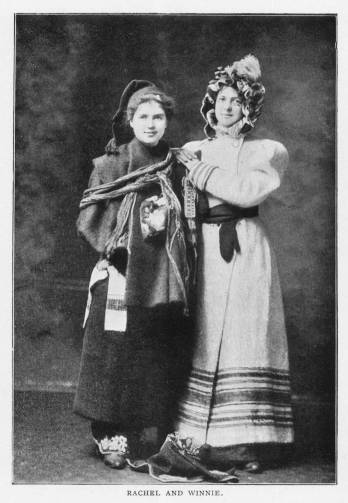
The friends from the mission arrived in the afternoon, and were cordially welcomed. They had accepted Mrs Ross’s invitation in the spirit in which it had been so genuinely given. In such a land there is but little of the artificial and conventional. Friendship is true and genuine, and loving words have but one meaning. Frank and Alec greeted Rachel and Winnie in Oo-che-me-ke-se-gou fashion. They did not know whether to be pleased or sorry when they saw tears in the bright eyes of these young ladies, when the news was told them of the speedy departure of the three young gentlemen to their distant homes across the sea. Alec said he was rather proud of seeing the tears in Winnie’s eyes, as it made him more than ever think that she did really think something of him, and he would try by hard and steady effort in the coming years to prove himself worthy of her love. Frank, more open and impulsive, when he saw the tears in the eyes of his beloved Rachel, could not restrain his own, and was visibly affected. Sam, who had been an interested spectator of the arrival and the various greetings, must of course make a few remarks.
“Look at Alec there,” said he. “The self-opinionated young Scotchman! He thinks so much of himself that he is pleased to see a sweet young lady shedding some tears for him.”
This was rather severe on the part of Sam, but he could not bear to see anyone in tears, and so he was a little extra-critical just now. His keen eyes had also narrowly watched Frank, and as he saw the tears in his eyes and noticed his visible emotion, even fun-loving Sam was touched, and he impulsively exclaimed:
“Frank, my darling, I love you for your great big heart. But my feelings are all mixed, for why should a young gentleman, who has just kissed his sweetheart, be after weeping and giving redness of eyes to the rest of us?”
Then, with a merry laugh, he roused himself out of these dumps, as he called them, and exclaimed:
“Frank, my boy, here is a conundrum for you: Of which of the venerable men of the past does your conduct remind me?”
Various guesses were made, but none were considered satisfactory, and so Sam was called upon to solve his own riddle. His answer was clever and characteristic. “Well,” said he, “when reading the blessed book my mother gave me I found a portion which said, ‘And Jacob kissed Rachel, and lifted up his voice, and wept.’ Why he should have shed any tears at such an interesting transaction bothered me. But now I think I get a glimmering idea in reference to it, since I have seen the events of to-day.”
“Sam, Sam,” said Mrs Ross, who had heard this quaint reference to the old patriarch, “why do you thus bring in such names in your pleasantries?”
“I don’t know,” replied the irrepressible Sam, “unless it is that it is in my blood; for one of the last things I heard my mother say, ere I left home, was that, to judge by the thinness of the milk furnished by the farmer who supplied us, he much reminded her of Pharaoh’s daughter, as he took a profit out of the water!”
“Chestnuts,” said Alec. “I have heard that before.”
It was new to the majority, and the droll way in which Sam gave it put everybody in a good humour, and a very happy, delightful time was spent by them all.
Rapidly sped on the few days that intervened between the arrival of the packet and the return trip of the boats to Red River. These Hudson Bay Company’s boats had come loaded with furs caught the previous winter, which would be sent down to York Factory with vast quantities from other parts of the great country, and from that fort shipped to England. Then, loaded with goods for the next winter’s trade, the boats would return to the different posts from which they had come. With the exception of canoes, they afforded the only means of travel in the summer time in those regions.
Mr Ross had gone over to the fort at Norway House, and had obtained from the gentlemen there in charge permission to send Frank, Alec, and Sam in these boats as far as Fort Garry. He also decided to accompany them that far in their journey, and see that everything was secured necessary for their long trip across the prairies to St. Paul.
As the weather had now become very pleasant for canoeing, several very delightful outings were arranged by Mr and Mrs Ross for the young folks. The boys had become expert canoeists, and in the long gloamings of the lengthened days in June in those high north lands, they had many memorable excursions.
As the Indian women and maidens are all experts in handling the paddle, so it becomes a point of honour among the ladies, young and old, in the Hudson Bay fort and mission to be able to, at least in a measure, imitate the dusky, bronzed maidens of the wigwams. Mr Hurlburt had wisely trained his daughters in this accomplishment. Living as they did, where there were really no walks except the trails that immediately led into the primeval forests, where lurking wild beasts were at times so bold that they came up close to the dwellings of the villagers, it was really dangerous to go far from home. Canoeing thus became the great summer recreation and amusement. And for the upper part of the body there is no better exercise. The result was that Rachel and Winnie were both skillful and fearless canoeists, and very much enjoyed this, which has well been called “the poetry of motion.”
Mr Ross prided himself on his beautiful, graceful canoes for the summer time, about as much as he loved his dogs in the long winter months. The Indians, knowing his love for their graceful canoes, had presented him with some great beauties, on which they had exercised all their ingenuity and skill in construction, and their artistic taste in ornamentation. These were all now in much demand, and merry and happy indeed was the whole party, as perhaps in six or eight canoes they started from the little land-locked harbour of Sagasta-weekee. Frank and Rachel were company enough for one of the prettiest canoes, while the same could be said of Alec and Winnie in another not less handsome.
To the last, Sam’s joy was to have with him the little children, Wenonah and Roderick. To him was assigned a large, safe canoe, and a couple of trusty Indians to aid in the paddling. The rest of the party went out more or less frequently, as it best suited them. So much had to be done to complete the arrangements for the journey that often the young folks went out alone on their joyous trips.
One afternoon Mr Ross was a little troubled, and at first seemed inclined to ask all to give up their excursions on the water for that day and amuse themselves at home. His trusty barometer, that had stood so steady for fine settled weather for days, was now acting in a most erratic manner. A change of some kind was evident, and so Sam and the children did not venture out. Still, as the sky was cloudless and the blue waters of the island-studded lake looked so peaceful and quiet, he did not prevent Frank and Alec, with the young ladies, from venturing out, but gave them some words of caution and then let the happy canoeists embark, and saw them strike out in unison as away they glided over the little sun-kissed waves. For a little while the music of their laughter and song fell on the ears of those who had gone to see them off. When they had disappeared among the beautiful fir-clad islands the spectators returned to the house, and were soon busy in their various duties.
Crash! Boom! What is that?
Too well was it known by Mr Ross and those who had lived in that land. It was a dreadful thunderbolt, the precursor of the fierce cyclone, the sudden storm that is coming upon them at the rate of something near a hundred miles an hour. Worst of all, four young people are out in it, in a couple of frail canoes, and who can tell what may happen to them when in its full fury it bursts upon them?
And how fares it with the young folks about whom there is now naturally so much anxiety at Sagasta-weekee? With laughter and song we saw them dash away, as under their skillful strokes their light canoes, like sea birds, glided along over the peaceful waters. Now, drenched and half dazed by the blinding glare of the terrific storm, they are battling for life in a very maelstrom of waters. Suddenly had the storm struck them. They had remarked the strange actions and the frightened cries of the birds, that all seemed hurrying in one direction. Then they had observed the dead calm that had settled down on everything. Even the aspen leaves on the trees, on the islands along which they glided, for once were ominously still. Every wavelet on the waters hushed itself asleep, and the whole surface of the lake was as a sea of polished glass.
Rachel was the first to take alarm from this deadly calm, and she exclaimed:
“This is unnatural, and means danger. Let us return at once.”
Quickly they turned their canoes, and now only a few yards apart they began the race before the coming storm, although as yet it had not revealed itself. The first intimation they had of its approach was the rapidly rising wind, which fortunately arose directly behind them. It was at first different from any ordinary breeze. It seemed to come along like a thing of life, now catching up a handful of water and scattering it like sand, then bounding up in wanton sport, and then once more trailing on the waters and making it ripple in lines or lanes, as in mad sport it now more rapidly hurried along.
Then, as they looked back over their shoulders to the north-west, they saw coming up the cyclonic cloud. It was dark as midnight, ragged at its edges, and above it was a rim of sky so green and so unnatural that our brave young people for a moment almost recoiled with terror at the sight.
“Paddle for that island!” shouted Rachel. “No canoe can live in such a storm as will soon be on us.”
Hardly had she uttered these words ere there shot out a thunderbolt so vivid that they were all nearly blinded by its intense brightness. It seemed to fill the whole heavens around them with its dazzling whiteness, and then as suddenly it was gone.
“One, two, three, four,” began Rachel, who, although paddling with wondrous effectiveness, was calm and collected.
“O, don’t stop to count,” called Winnie, who was like the rest desperately yet cautiously using her paddle. “It would be better to pray than do that.”
“We’ll do that shortly, but paddle for dear life now, and don’t interrupt the count. Where was I? Ten, eleven, twelve—” and at eighteen there came the crash of the thunder of that lightning flash that had so nearly blinded them. It was as though a thousand great cannon had simultaneously been fired.
“Hurrah!” shouted the brave girl the instant it died away. “We have two minutes and a half yet ere the cyclone reaches us. In two minutes we must reach the other side of that high rocky point, and in the remaining half minute we must get on the lee side of the great sheltering rocks. Courage all, and let every stroke tell!”
And there was need for courage, for already the white caps were around them, and behind them the waters hissed and shrieked like demons let loose and howling for their victims. The heavens were rapidly being overwhelmed with the blackness of darkness. But here is the point! Skillfully the two girls, who were in the stern of the canoes, steered them sharply around, and the strong strokes of Frank and Alec did the rest, and they were in the shelter of the rock. But it would only be safe for an instant.
“Now all spring for your lives!” again cried Rachel; “and let everything go, Frank, but your gun and some cartridges.”
“Can we not save the canoes?” shouted Alec.
“No, no!” cried Rachel. “It is our lives here only that we must think about, for the sake of those who even now, perhaps, are mourning us as dead.”
The shelter of the rocks was within a few flying bounds, and they were safe. It was an enormous rock that towered up some scores of feet, and on the lee side, where our young folks had found shelter, hung over for perhaps twenty feet. Fortunate indeed were they to have reached such a refuge.
A few seconds later, when, with backs against the mighty rock, they were in a measure recovering from the violent exertion of that fearful struggle, Winnie cried out, “O, where are the canoes?”
Not a vestige of them was ever after seen. They had been caught up in that cyclone that came thundering on so close behind that in the brief seconds in which the young people had run from them to the rock they had been picked up and whirled into oblivion.
“It is well,” said Alec, “I did not stop to try and save the one I was in. But why, Rachel, did you ask Frank to bring along his gun and ammunition?”
“You will soon see,” said the brave, thoughtful girl, “that they will be worth more to us and our anxious friends than the canoes.”
In the meantime, the storm in passing the point had spread out over the whole place, and the rain, which was now descending in torrents, began to be very uncomfortable. A rim of light was still in the distance, and with the now almost incessant flashings of the lightning it was possible to grope around for a dry and more sheltered spot under the great rock. Alec, who had volunteered to go out and try to find a drier place, and who was now groping along in one direction as the lightning lit up his path, was heard to suddenly let out a cry of alarm and then almost immediately after burst into a hearty peal of laughter.
“What in the world have you found in such a place to cause you to act like this?” said Frank, who was really annoyed at the merriment of Alec after such a narrow escape.
“Come here and you will see,” was the only reply they could secure from Alec, who was acting in a manner so strange and unaccountable.
So, waiting for the lightning flashes to enable them to pick their way over the rough stones under the sheltered place, they cautiously moved toward him. As they came within a few feet and were now in the gloom, waiting for another flash to light up the way, Alec said: “Don’t be frightened at what you will see. It is only old Napoleon, and he is as frightened as he can be, and seems glad to have me with him.”
The sight that met them as the next vivid flash blazed out was indeed enough to try older and stronger nerves, for there was Alec with his back against the dry rock and one of his arms around the neck of an enormous bear.
“Don’t be alarmed,” shouted Alec. “It is old Napoleon, and he is more frightened by the cyclone than any of us.”
“How do you know it is Napoleon?” asked Winnie, who was noted for her extreme cautiousness.
“Know him? Why, of course I know him, and he was as pleased as an affectionate dog to see me. And see, here are the two brass rings I put in his little round ears last winter at the fort, some time before Christmas.”
This was convincing proof that their comrade was a tame, harmless bear, and so without any more alarm they all crowded into what proved to be a dry and safe retreat from the fearful storm that still raged outside.
“Bears know a thing or two,” said Alec, “and so old Nap in selecting this spot was quite confident that it could stand a cyclone.”
Meantime the storm continued to rage with awful fury, but sheltered by the rocks they were safe from its ravages. All they could do was to patiently wait until its fury was spent. So they sang some sweet hymns, and the girls gave some reminiscences of previous storms and adventures.
As soon as the storm began to abate Rachel said, “I think, Frank, it is time you began to use your gun.”
“What, would you have him shoot this affectionate old bear?” asked Alec.
A merry laugh burst from the lips of both of the girls, and Winnie asked him if he had any idea of the reason why Rachel so urged Frank to save his gun and ammunition, even if everything else should be lost.
“Not the slightest idea,” was his answer.
“Well,” replied Rachel, “as the fury of the storm is about spent, it is time to be beginning to explain the mystery. And so now suppose you take the gun and go out on the beach and fire three times in quick succession.”
Frank and Alec at once comprehended the riddle, and laughed at their own stupidity. The firing of the gun would bring their rescuers speedily to them.
Unfortunately for these young people, their retreat was too distant from Sagasta-weekee for the report of their gun to reach that place. However, just as soon as Mr Ross saw the storm approaching he summoned every available man, and had boats in readiness to begin the search as soon as it was possible to risk the angry waves which a cyclone of this description stirs up. For at least three hours they had to wait ere they could make a start. Then in the still angry waters they shoved out their boats, and in different directions started on the search.
In the meantime let us again go back to the young people in their strange place of refuge. Noting the increasing brightness, as the black clouds were now rapidly rolling away, Rachel suggested that three more shots be fired. In a few minutes more they were repeated, and soon after, as the rain had now nearly ceased, the whole party came out from their gloomy cave retreat. On every side were evidences of the terrific power of the cyclone. Great trees had been torn up by the roots, while others had been snapped off, leaving the stumps standing from twenty to fifty feet high.
Apart from the sad evidences of the storm, everything was soon simply delightful. In those high latitudes the June evenings are very long. Here was now one of wondrous beauty. The angry waves were quickly dying away into pleasant ripples. The sun was setting behind some lovely clouds of gold and crimson, and the air, purified by the cyclone, seemed exhilarating in the extreme.
“Keep up your firing, Frank,” said Rachel, “for doubtless there are boats out long ere this, looking for what is left of us.”
“Listen!” said Winnie, who, being wonderfully gifted in hearing, had been the first to detect an answering gun. “One, two, three, four. Fire again!” she cried. “They have heard, but are uncertain as to the direction.”
Again the three reports of the gun sounded in quick succession, and soon there was the answer of two guns, which meant, “We hear you now and will soon be with you.”
To Mr Ross’s great relief and satisfaction, it was the boat, manned by four oarsmen, of which he himself had charge that was the first to hear the firing of Frank’s gun. Some of his Indian crew had detected reports before he had, but nothing would satisfy him until the welcome sound fell on his own ears.
“Pull, men!” he fairly shouted, “and let us see how many of those loved ones have survived that storm. If any of them are drowned, you need not take me home.”
Not a man in that boat, white or Indian, needed any urging. Such was the love they all had for those young people that gladly would any one of them have risked his own life for theirs.
Around the next point, now not far away, again rang out the three reports, and soon a most welcome sight greeted the eyes of Mr Ross and his crew. For there, distinctly visible on the shore, were four happy young people waving their welcomes.
“Thank God,” reverently said Mr Ross. “They are all safe.” And, strong man that he was, he wept like a child. Other eyes than his were moist also. With an effort he checked his deep emotion, and was so able to control himself that ere the shore was reached he was calm and collected.
When within hailing distance hearty words of congratulation rapidly passed back and forward. Such was the nature of the shore that a good place where they could step into the boat from the shore was not easily found, and so the men at the oars rowed up on the sandy beach as far as they could, and then, running out three oars, made a walk that answered very well.
Good Mr Ross was so wild with delight at the fact of the preservation of these young folks, whom he loved so well, that he was the first to rush out and try and gather them all in his arms.
In the excitement of the rescue Napoleon, the tame bear, had been quite forgotten, but now he acted as though he had been doing his share of thinking, and had come to the conclusion that, if his liberty was to be associated with cyclones, he had had enough of it; and so, just as Mr Ross and the young people were about to go on board the boat, he deliberately came marching out of the cave and, carefully balancing himself, walked up on the oars and took a comfortable position in the boat.