"Winter Adventures of Three Boys" (continued 3)
Reading edition
By twelve o’clock the most successful examination of the school, up to that time, was over. The prizes were distributed, and while all the white people, as was customary, accepted the missionary’s invitation and dined at the parsonage, the Indians sped away home for a brief dinner, and were then soon all back again, to compete in or to witness the sports.
The first races were run by some little girls. The distance was only a few hundred yards and back. These races caused a lot of fun and enjoyment. The prizes were little handkerchiefs, strings of beads, and other trifling things in which little Indian girls rejoice, and of course every little competitor must have a prize. Then there were races for little boys. It was great fun to see the sturdy little fellows so gallantly strive for victory. Meanwhile arrangements were being made for the more important races of the day. The courses had been marked out previously with flags, and so every class knew its course and ran accordingly. The fleetness and endurance of some of even the small boys were wonderful, and great was the interest, and even intense at times the excitement, when several well-matched competitors gamely struggled on for victory. In the races open to all comers the larger Indian boys were disappointed that none of the whites had entered, as they were anxious to test their own speed against them. There were races worth going across a continent to witness, and genuine and hearty was the applause that greeted the winners, who came in at such a rate that the white boys, while cheering as heartily as the others, saw how wise they had been in declining to put themselves against such runners as White Antelope or Spotted Deer, the winners.
When the skating matches were called, Frank promptly entered the lists. His appearance was received with applause. Even the quiet Indian lads tried to make a noise to show their pleasure in greeting the handsome, manly fellow whose splendid gift had gone to Kepastick, the one-armed lad. Two or three young clerks or fur traders also entered for the race, one of them being the young man who had so abruptly left Alec the night of his fearful race with the wolves. The route marked out for the skaters covered in all about ten or twelve miles. It, however, so twisted in and out among the islands on the frozen lake, that many of the competitors would be in sight nearly all of the time. That the intending skaters might thoroughly understand the route, it had been marked out a week or ten days before the race, and it had been thoroughly understood that any of the competitors were at perfect liberty to skate over the grounds and get familiar with the different turning places, marked by little red flags.
Frank, with Alec as a companion and trainer, accompanied by one of Mr Ross’s servants, who was also a splendid skater, had gone over the route two or three times, and so was quite familiar with it. A little before the race began he was quite surprised to have this Indian skater call him aside and tell him to be careful and keep his eye on the correct route, and also to guard himself against that young white man who had deserted Alec. He then added:
“Watch the Indian with one arm; his heart is good toward you.”
Then, putting his fingers to his lips as a sign of caution, the Indian quickly slipped away among the crowd. This very much perplexed and bothered Frank, especially when Mr Ross said to him:
“Keep your eyes on the lookout for the flags—the Indian lads are so familiar with the route that they will not bother to notice them; and look out for tricks from those whose faces, like your own, are white.”
There were perhaps twenty competitors in the great race. As the distance was so long it was not very essential that they should get off at the same instant. There would doubtless be those who depended on rapid bursts of speed to carry them to the front, and so a second or two made but little difference at first. At the report of a gun away they flew. They had all sorts of skates and all kinds of styles. With ten or twelve miles’ work before them, none, except some of the younger lads, tried to do their very best at first. Frank naturally wished to skate in company with his white companions, but they sullenly refused the offered society. Insulted and annoyed at this conduct, and remembering the warning words of Mr Ross, and also of his faithful servant, he just made up his mind to be on the alert, and if it were possible he would be in the first of the palefaces. On and on they sped, until a couple of miles at least were covered. Then they had reached a spot where the route lay between two rocky islands not a hundred feet apart. The ice here was beautifully smooth, and being well-sheltered was as clear as glass. With a wild whoop the Indians dashed on across it, and at the same time, rather to Frank’s surprise, one of the clerks, putting on a rapid burst of speed, dashed directly in front of him, in the centre of this narrow place. Frank, with his suspicions all aroused, keenly watched him, and to his astonishment saw him deliberately but cautiously let slowly trickle from his hands fine streams of the white crystal quartz sand of that country. To have skated over it would have so dulled his keen-edged skates that anything like victory would have been impossible. There are times when the mind works rapidly, and so it did here with Frank. The first thought was to shout out and expose the villainy. The next was to evade the trap and for the present say nothing about it, and see what trick would next he tried. So, quickly veering to the windward side sufficiently to make it sure that he would escape the sand, he rapidly sped along, humiliated and indignant that a white man would try a trick that an Indian would scorn to do.
On and on they flew. The route turned and twisted, and in several of the windings it brought them in fair view of the excited group on the mission hill who watched their progress, for now more than one half of the route was covered. They were now entering a kind of a maze among the islands, where persons not thoroughly acquainted with the route required to keep a vigilant eye on the different flags. In the front group was Frank, and closely edging beside him, he noticed with pleasure, was Kepastick, the one-armed lad, with his beautiful new skates, now serving him grandly and well.
“Chist!” said the Indian lad quickly, and Frank knew by the way that this word, which means “look,” was uttered that there was something meant. Letting the boy glide just ahead of him, Frank caught the meaning of his words, though uttered in broken English:
“Some bad hearts change flags to bother Frank. Frank keep near Kepastick. He knows the trail.”
These friendly words were uttered none too soon, for Frank saw at once that even some of the Indians, trusting to the flags, were perplexed and some had gone hopelessly astray. With a rush and a jeer of triumph a white clerk made an attempt to fly by, for once out of that labyrinth of crooked icy channels the home stretch was as straight as an arrow. Frank was for responding to his spurt with an effort equally desperate, when Kepastick checked him with:
“One Indian, good heart, meet clerk’s bad heart; all right yet.”
Frank, now completely bewildered, yielded himself implicitly to the guidance of Kepastick, who moved on with all confidence and paid not the slightest attention to the flags.
Look! Away beyond the islands, in the distance, shining in the sunlight, is the steeple of the mission church. Just a few more windings in these tortuous channels, and then the two miles’ dash for home. Most of the Indians—for their skates were poor—have fallen in the rear. The one white man whom Frank despises is perhaps a hundred yards ahead, and not far behind him are his companions. With intense interest Kepastick is watching them.
“Chist!” he cries again, and his dark eyes flashed with excitement; “the trail is ours!”
It seems that there ran out from that place two channels that looked very much alike. The correct one had been flagged several days before, but the previous evening the clerk had skated over and had flagged the wrong channel. Sharp eyes had been on him and had discovered his trick, and these misplaced flags had been replaced at their proper positions, while the others had been left as the villain had placed them. Thus thrown off his guard, he blindly dashed into the wrong channel. The rocky shores were high and abrupt, and so Kepastick and Frank shot by the trap and into the correct channel, and were hundreds of yards out on the now open lake, with their faces toward home, ere the plotters discovered, to their dismay, how they had been completely foiled. As rapidly as possible they turned, but the distance could not be made up, and so to their chagrin they not only found that Frank and Kepastick had tied first, but that six or seven Indians, some with home-made skates, had wholly beaten them.
As the miserable trickster passed Frank on the shore some time after, in the presence of the chief factor, Mr Ross, and several others, Frank sternly looked at him and uttered the one word “Sand”. None but the two then knew what was meant, but the guilty rascal paled, and so trembled that it seemed as though he would fall to the ground. Very soon was he out of that company. Next day he asked to be transferred to another post, which request was cheerfully granted. It was a long time before Frank told of his contemptible conduct. When Mr Ross at length heard of it he communicated at once with the head officers of the Hudson Bay Company in reference to conduct so dishonourable, and the result was that the poor fellow, who had not improved over such actions in other places, was ignominiously expelled from the service.
Meanwhile the other sports were progressing finely. The football teams crowned themselves with many honours. The games were not fought on any strict Rugby rules. The goals were set in the ice, about four or five times as distant from each other as is the case in civilisation. Then two captains were named, and they selected their men and boys alternately, until all who wished to play were chosen. Then each side was lined up at their own goal. The ball was placed away out in the centre between them. At the firing of a gun there was a wild rush, and the side that had the fleetest runners thus secured the first kick. The ball was not to be thrown or carried. It was to be kicked, and could be struck with the hand or head. The game was fast and furious while it lasted. It was always in ground, and there was no hold up until it went between the poles of one or the other side. The cries of “Foul” were never heard, and umpires were only needed at the poles to shout out when a goal was won. It was a jolly, lively, easily understood game of football, enjoyed by all. Generally five wins in nine plays was the rule.
The hockey games were like those played by men and boys in civilised lands, only here everybody who wished to play was paired with somebody else, so as to keep the sides even. Everybody not otherwise engaged enthusiastically took a hand in it, and the fun was very great. Mr Hurlburt, Mr Ross, Hudson Bay officers, as well as all down to the smallest Indian lad who could handle a crooked stick, had a share in this game. The day was so cold, and the smooth ice expanse so great, that the vigorous exercise did everybody good.
The tobogganing games were given over entirely to the girls to compete in, and skillfully and well did they acquit themselves. The other minor games also gave great satisfaction, and afforded any amount of amusement.
We reserve for the next chapter the story of the great race of the rival dog-trains, which for long years after was talked about in many a wigwam and at many a camp fire.
Chapter Ten.
The Great Race with the Dog-trains—Careful Preparations by Alec—The Different Breathing Places—The Treacherous Half-breeds—Their Signal Failure—Alec’s Triumph.
And now for the races with the dogs. These were looked forward to with the greatest interest. All sorts of rumours were afloat of some wonderful surprises in store. Fortunately for all parties concerned, including the dogs, there had been a great abundance of fish during the last few years, and so every Indian wigwam and house fairly swarmed with dogs, of all sizes and degree. In other years, when fish failed and the herd of reindeer came not, as a last resort against starvation the dogs went into the soup pot. But they had fared better lately, and so now they were all in the finest trim, and the trained ones were as eager here for the races as were their masters.
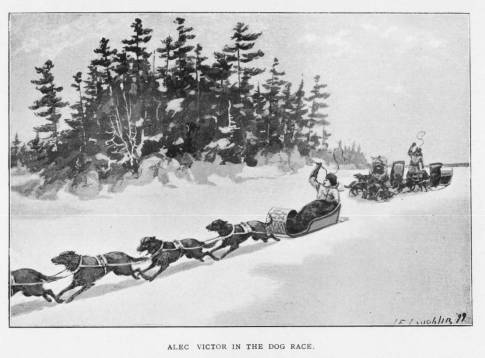
There were about a dozen trains that contended for the victory in this next race. There were to be four prizes given. Alec, with his splendid houndlike dogs, seemed a certain victor. However, as from different parts the dogs came into position and were eagerly scanned by those present, it was seen that there were many trains that would make a gallant race ere they or their magnificently developed drivers would even take a second place. Alec and a young clerk were the only whites in the race. Then there were three half-breed fur traders, and the rest of the competitors were pure Indians.
The Indian carpenter at Sagasta-weekee had made for Alec a splendid birch toboggan-like sled for this race. It was very light, and so the maker had sewed and re-sewed it, and so stiffened it with the sinews of the reindeer that it was as strong as a piece of steel. He had fastened a seat in it so cleverly that if the sled went over the seat collapsed like a rubber ball and as quickly resumed its position when the sled was righted. Old Memotas had especially manufactured the harnesses for this event. He made them out of the softest and lightest mooseskin that Mr Ross could buy for him. It took Memotas a long time to get the right kind of traces to satisfy his experienced eye. After testing a good deal of leather he settled down on a set of very long ones, that would not at all interfere with the long, springy movements of these beautiful houndlike dogs.
The start was to be from the foot of the mission hill on the ice. The route marked out, and along which Indians had now been stationed, was first to be the trading post, a distance of two and a half miles. Here each train would be detained exactly five minutes. At the expiration of the five minutes the next part of the race would begin. This was to Sagasta-weekee, a distance of perhaps five miles. Here there was to be a compulsory wait of ten minutes for each train, and then the dash back by the straight route to the mission, a distance, say, of six miles. Some of the Indians wanted the distance to be at least doubled, but this could not be allowed. These races and prizes were only designed to encourage the Indians to be kind and careful with their dogs, as only by such treatment could they be brought to be of the highest use to them in that land where they are so much needed.
Amid a good deal of barking, and some growls from some of the more quarrelsome dogs, the cry of “Marche!” was shouted, and they were off. Some especially clever Indian trains were the first to respond to the call and sprang to the front. Some of the drivers were going to run; others, like Alec, intended to ride, while perhaps the greater number would ride or run as they judged best in the excitement of the race. Each driver, Alec included, had a splendid dog-whip, but it was a long time since a dog of Alec’s was struck. Indeed, the first one to receive a powerful blow was the leader dog of a train beside which Alec was running. As Bruce came alongside, and was slowly forging ahead, the vicious brute made a spring at him. Quick as it was, it was observed by his Indian master, who, although more than twelve feet from him in the rear, sent out so speedily and accurately that long, heavy, snake-like whiplash that it caught the brute on the nose with such force that, with a howl of pain, he turned to the front before any damage had been done. A few seconds later Alec and this Indian driver sped on right and left of a couple of trains mixed-up in terrible confusion, while their drivers, a white man and a half-breed, were in anything but a pleasant mood. On and on they fairly flew. Alec had been warned to guard against running into some of the vicious dog-trains, as some of them had teeth like wolves, and one fierce attack might easily disable one of his lighter dogs.
Without mishap Alec reached the fort, and found that five trains were there ahead of him. In a minute or two most of the others arrived. Even those tangled up had speedily unloosened, and had not lost more than a couple of minutes by their collision. Exactly as each train’s five minutes expired, away they flew for a long run for Sagasta-weekee. The ice was in fairly good condition for travelling, although there were long stretches where it was so absolutely smooth and glassy that some of the dogs would slip and slide in spite of their best efforts to the contrary. On this smooth ice the Eskimos and the mongrels had the advantage, as they had such hard feet that they very seldom slipped. The feet of Alec’s dogs were perhaps the worse for these smooth icy places, and so he found that it was necessary, where the travelling was good, for him to urge his dogs more than he had intended, to make up for what he lost in the glassy places. Thus on they sped, and when Sagasta-weekee was reached Alec found three trains ahead of him and a couple alongside of his own and others close behind him. Ten minutes was the time allotted for the rest here. The instant Alec had arrived Memotas was at his side, and with him at once examined his dogs and compared his train with those that had thus far kept ahead. Memotas was delighted with the inspection, for, while the other trains seemed about exhausted at the terrific rate their drivers had pushed them, Alec’s were as playful and lively as though the race had only begun. So, barring accident or foul play, there seemed to be no reason why Alec should not win with flying colours. Two of the half-breeds with very vicious trains now pushed on with four minutes of a start. An Indian followed two minutes after, and then in four minutes more Alec and those who had arrived at the same time as he did were again ready for the final run of the six-mile home stretch. Just as Alec was leaving faithful, alert Memotas said to him, as he tucked him in:
“Be on your guard against those two half-breeds and their vicious dogs. Try and not pass them in a narrow place. There is mischief in their hearts. Be wise.”
“Marche!” and he was off.
For the first time now his blood began to tingle, and he entered into the wild, joyous enthusiasm of the race. He had become an expert in the use of his whip over the backs of his splendid dogs. Skillfully he whirled it, and its pistol-like report rang out over them, but not once did it inflict a stinging blow.
“Ho! ho! my gallants! With Scotland’s best staghound’s blood in your veins, and Scotland’s names, my bonny dogs, for Scotland win the day!”
He must needs hurry now, for fleet trains are around him and some ahead of him, with drivers just as keen and eager to win as he, and every one of them accustomed to dog-driving for years. Victors are some of them in previous contests, and not one of them is disposed to see a white lad from across the sea come and wrest their honour from them. Whips are flying now in earnest, and the dogs of other trains are waking up to realise that there is fire in their masters’ eyes and strength in their arms and a burning sting at the end of the heavy lash. With terrific rushes they make their desperate efforts to forge to the front. Alec, excited now to the highest pitch, calls as never before to his dogs:
“Marche! Bruce, up! Up, Wallace! and you Gelert, and my bonny Lorne. Ho! ho! Away, away, my bonny dogs! Away! away!”
Grandly did they respond. They too have caught the enthusiasm of the hour, and as in clock-like unison in those long, light traces they stretched themselves out and fairly flew over the icy surface, they seemed to lift the light sled and its driver as a thing of naught.
Steady, Alec! Keep well balanced now. You have shaken off every sled that started in this last dash with you, but there are stubborn competitors ahead, and there are rough places where an upset at such a speed means disaster as well as defeat. But he thinks naught of these things; his Scottish caution has gone to the winds, and with dauntless courage he keeps up his cheering cries. Rapidly does he gain on a powerful train ahead of him, and just as he begins to fly past it the vicious leader turns and springs at Bruce. He fails in his attempt on account of the slippery ice, and falls directly in front of the oncoming train.
“Marche! Bruce!” shouts Alec, and with a mighty bound the gallant fellow responds and springs directly over his prostrate assailant. Quickly follow Wallace, Gelert, and Lorne. With a stunning blow Alec’s sled hits the still struggling brute. Well now is it for Alec that the cautious builder of that light sled had strengthened it with deerskin sinews till it was tough and strong. And so it stood that fierce shock, and, with its sturdy occupant unseated, over the great dog, with undiminished speed, it goes. Before him now are the two great trains of the half-breeds. These are the men and trains about which Memotas whispered his words of caution. And well is it for Alec that he was put on his guard. Before them for a mile or so is the narrowest part of the route. The good ice in places did not average more than from fifty to a hundred feet across. Plenty of room, anyone might say, for three dog-trains to rush by (it) at the same time. Yes, if all are fair and honourable, but not wide enough for the safety of the third if the other two are determined to stop him at all hazards.
If there was one thing more than another in which Alec had carefully trained his dogs it was for them to respond to his voice, and quickly move to the right or left, as he spoke to them. Like some other drivers, he had them so well-trained that no horse responds to the pull on the reins more promptly than did his dogs to his voice. As Alec rapidly gained on these trains he observed that they were running about parallel to each other, and that the width of the ice was about the same between them and each shore. This so equally divided the ice that it made it difficult to decide whether to try and pass between them, or on one side or the other. Alec’s first wish was to see if they were really working together against him, and so he shouted to his dogs as though he would clash in between them. At once they began to close up from each side to block his way. Quickly checking his dogs before there was a collision, he then tried the call to the right hand, and here the same plan was again pursued. It was evident, seeing that they would both be beaten in a fair race, they were resolved, by sacrificing one train, that the other should win at any cost from this white lad. Their dogs were large and fierce, and at one word from their master, if a collision occurred, would fasten on the lighter and younger dogs of Alec, with disastrous results. So Alec, who saw the plan, resolved that there should be no collision with his train if he could help it. All this time the speed was fairly kept up, and alert and watchful was each driver, although not a word was spoken among them. After a little more manoeuvring from side to side Alec observed that his dogs were quicker to respond to his voice than were theirs, and so he resolved to try and confuse them and throw them off their guard. In this he at length succeeded. When, with a great show, it appeared that he was going to dash between them he suddenly checked his dogs just as the other two trains closed in to block his way. Quickly they saw their danger, and tried to avert it, but they were too late. Their own fierce, excited dogs sprang at each other as they met, and ere their masters could separate them Alec had skillfully veered to the right and was by them. The coast was clear now, but fleet trains were close behind. The blocking of the way had necessarily somewhat lessened the speed, and swift trains had come up dangerously near. But what now cared Alec? Springing to his feet, he swings his whip and calls to his gallant dogs. The distance is now only a couple of miles, and direct is the route. How those beautiful dogs do go! In perfect unison they spring together, while Alec’s cheering voice rings out:
“Marche! Bruce, my hero, my leader! and you, Wallace, true to the end, and Gelert the avenger, and Lorne the fortunate! Gallant Scots ye are, and this is our Bannockburn!”
Thus on he drives; and now before him in the distance is the expectant crowd, who, having finished all their other sports, have gathered on the sloping banks to watch the return of the dog-trains. The day is drawing to a close, but there is one of those marvellous gloamings of the Great Lone Land, and so the whole scene is as visible as at noonday. The speed at which Alec travels soon brings him near, and as the sharp eyes of many tell them that he is the victor, and far in advance of any other train, there is, for an Indian crowd, a great deal of cheering, or rather a shouting of what sounds like “Hi! Hi! Ho! Ho!” from many a dusky Indian’s lungs. For Alec is very popular among them, and they rejoice at his victory. The few whites are also very much interested, and add their full share to the noise and excitement that tell of Alec’s triumph. Of course, Frank and Sam were wild with delight—so much so that they could not even shout. Sam in describing their feelings afterward said:
“We could only yell, but that we did in right good earnest.”
As Alec dashed into the midst of the cheering crowd warm indeed was his welcome. Stalwart arms seized him, and hoisted him up on the shoulders of a couple of gigantic Indians, who at once began their march to the front of the mission house, where amid the cheering of the crowd a blue ribbon was pinned upon the breast of his coat by the trembling fingers of an equally happy maiden, and her name was Winnie.
Chapter Eleven.
Pasche disappears—The Search—Big Tom and Mustagan—The Whisky Jacks—Pasche found in a Hollow Tree—Chased by an Angry Moose Bull—Pasche rescued—His Quaint Account of his Adventures.
There was great excitement at Sagasta-weekee one morning when word came in that the stableman who looked after the cows was missing. In fact, he had not been around for three days, and the boy who helped him in the stables was scolded for not having reported his absence. The name of the missing man was Pasche. He was a French half-breed who had come up from the Indian settlement near Montreal, several years before, in one of the canoes of the famous Iroquois brigades that annually made the trip up the Ottawa and other rivers into Lake Superior to Thunder Bay, and from thence by Lake of the Woods and still other rivers until they reached Lake Winnipeg.
Poor Pasche was ignominiously discharged by the despotic governor of the Hudson Bay Company, as being unfit for the laborious work of a canoeman in one of those large canoes. The fact was that it was only the most vigorous and muscular men who could perform the tremendous task assigned them by that tyrannical man, who drove his men on and on with all the cruel, callous persistency of a slave-driver. No wonder poor, weak Pasche gave out where many a stalwart man has also failed. He had been a sailor for some years on the St. Lawrence, and had the agility of a monkey in climbing up to the top of the masts. The unfortunate fellow was left stranded in that wild country, and so, out of sympathy for the poor exile, Mr Ross had given him work and a home, until he could return to his own people. The kindness of his new master made him quite contented where he was, and so year after year he had remained, and to him had come the care of the cows both in the summer and winter.
Now he was missing, and had been for three days. The family was alarmed, as it was such an unusual thing for Pasche ever to be away over a night. Mr Ross at once called into the kitchen all who had lately seen him or knew anything of his latest fads. Of these the poor fellow had quite a number, and while some of them were sensible, others of them were generally laughed at by his friends. The latest one was that he imagined himself a great hunter, and had secured some traps and had set them in the woods in various places, most of them several miles away. The last time he was seen by the stable-boy was when he had finished the morning work at the stable. Then he had taken his gun and axe and started off to visit some of his traps. When Mr Ross chided the boy, who had industriously attended to all the stable duties alone, he said that Pasche had made him promise to say nothing about his huntings, for fear he would be laughed at.
A heavy fall of snow had completely obliterated all tracks, and so there was no possibility of following him up in that way. A messenger was sent for old Mustagan and Big Tom, both famous Indian guides, and a consultation was held with them. They smoked their stone pipes and talked the matter over, and then went out. After closely questioning the stable-boy they returned to the Indian village. Here they secured a couple of sharp, bright little beaver dogs. With them they returned to the stables, and there, showing the dogs a coat that Pasche was in the habit of wearing, and making them thoroughly smell it, they tried to get them on his trail. All, however, the dogs would do was to get back out of the deep snow as quickly as possible and into the shelter of the stables. The plan was not a success. These dogs were too small for the deep snow, and soon the old Indians gave up this plan in disgust. Then they strapped on their snowshoes and made a long circuit around the place, and thus tried to find out some clue or trace of the missing man. Failing in this, they returned to the house, and after a hearty meal they equipped themselves to find that lost man. They had but little to work on, as Pasche had never revealed to anyone the whereabouts of his traps. However, Indian eyes are sharp, and so, unknown to him, keen hunters had observed his doings, and could tell the locality of every one of his traps and snares. Those who had any knowledge in this direction were summoned, and then, with the information thus obtained, the two old men set off on their snowshoes. It was not long ere they reached his first trap, but the snow covered everything there. Then on to his next resort, still no success; and thus it was throughout the whole round.
The Indians were puzzled and perplexed, and as they had now been on the go for hours they kindled a fire and awaited the arrival of some of the sleds with supplies that were to meet them here at this designated spot. The boys, who were equally grieved and excited with the rest at the loss of Pasche, with whom they had had a lot of innocent fun, had harnessed up their dog-trains and joined the party who brought out the supplies. The meal was quickly prepared on the big, roaring fire, and vigorous appetites made heavy inroads on the abundant supplies which Mrs Ross had sent. They all noticed, while at the meal, the unusual number of whisky jacks, the Indian’s sacred bird, that were at once attracted by the fire. They were all very noisy, and seemed unusually excited. The Indians are quick to notice the actions of even the most insignificant birds when on their hunting or warlike excursions. Many a lurking warrior, securely hid from the keenest human eye, has been given away by a noisy blue jay or a suspicious cawing crow, and has thus failed in his attempt to surprise his enemy, and has been obliged to make a hasty retreat.
In answer to Frank’s question, Big Tom told the boys how some of the wild animals are warned by the birds of the approach of the hunters, and are thus the more difficult to reach. So here the whisky jacks, noisy at any time, but unusually so now, attracted the curiosity of those alert, watchful old Indians, as well as much amused the boys with their saucy ways. The birds, as usual, clamoured around the fire, and as long as a crumb or bit of anything could be obtained were very saucy and persistent in their begging. It was great fun for the boys to feed them, and to even catch some of them by their feet, so bold and venturesome were they. They were all, however, speedily liberated, as Mustagan and Big Tom were anxious, if possible, to learn something from them. So the remains of the meal were speedily scattered, and while the boys wrapped robes around themselves and sat near the fire to keep warm, the Indians, lighting their pipes, sat down on a log near the fire to watch the actions of the birds. For a time they fluttered around and scolded in their pert, boisterous manner. Then, seeing there was nothing more forthcoming, they began flying about in the woods, but occasionally came back to see if the next meal was being prepared. Seeing no signs of it, they flew further and further away, and now principally in one direction.
After a while the quick ears of Mustagan detected a series of unusual cries of the birds. He at once called Big Tom’s attention to it, and they both decided that there was something unusual to cause them thus to act. Not knowing but it might be a wolverine or a wild cat at which the birds seemed to be so angrily scolding, while the boys and the rest of the party remained near the fire they took their guns and carefully made their way through the woods to a spot where, without being seen themselves, they could observe the birds. To their keenest investigation nothing unusual was visible. The new, trackless snow was as yet unmarked by step of man or beast. Still excitedly the birds acted, and incessantly scolded. Soon the two men noticed that the centre of their whirlings was a large dead trunk of a tree that had been broken off between thirty and forty feet from the ground. Around this stub of a tree the birds whirled and scolded, and occasionally some of them would light on the rough, jagged edge of the top, and seemed to be peeping down into the heart of the dead tree. The curiosity of the men was aroused, and they wondered what animal the birds had there discovered. Immediately they started for it, keeping their guns in readiness to fire if it, whatever it was, should attempt to escape. When they reached the spot there was not a track visible of any animal. The birds whirled around if possible more noisily than ever, and so it was evident to the men that there was something in that tree. Drawing his axe from his belt, Big Tom made ready to pound against the side while Mustagan, with pointed gun, was on the alert to shoot any animal that the noise should disturb and cause to attempt to escape. With lusty vigour Big Tom pounded away at the old tree, while carefully Mustagan watched the top. In an instant after there were two very much amazed Indians. For from the interior of that old tree thus vigorously assailed there came the faint cry of a human being! What his first words were neither man was particular to inquire. It was enough for their quick wits to tell them that they had found the lost man for whom they were seeking, and that he was still alive!
At once they lifted up their voices and shouted words of cheer and encouragement to the imprisoned Pasche. Then they called to the rest of the party who were at the fire to hasten to them. Neither the boys nor the men required a second call. They were speedily at the side of the two old Indians who, for such people, were very perceptibly excited.
At first the boys could hardly take in the situation, but quickly it dawned on them that here was an imprisoned, half-starved man who must be helped out of his dangerous predicament. What had best be done was the question that Mustagan, Big Tom, and the other Indians were discussing. Some suggested cutting down the big tree at once. This was discouraged by some, who said that the blows of the axe on the dead tree would dislodge so much dry, dusty, rotten wood that it would about smother the imprisoned man. So it was quickly decided that he must be pulled out of the top where, it was quite evident, he had fallen in. At once the tail-ropes of the sleds and the packing and tie lines, which are also made of leather, were fastened together, and an effort was made to get one end to the poor fellow inside. In the meantime, while these preparations were being made by the Indians, the boys endeavoured to hold some kind of conversation with the imprisoned Pasche.
“Arrah, my man,” shouted Sam, “and what are ye doing inside there?”
“I fell in,” faintly came back to the listeners.
“Were ye looking for the cows?” persisted the irrepressible Sam, who was a great favourite with Pasche, although he often unmercifully chaffed him.
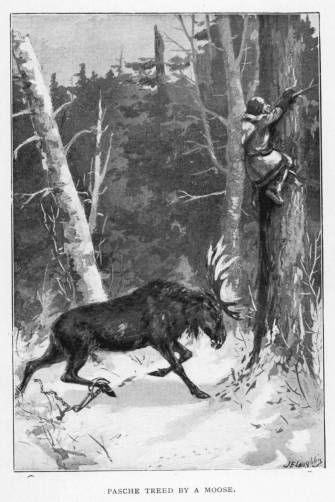
“No, but a moose bull was looking for me.”
This answer was the explanation that told the whole story; but, while the old Indians were able to now understand at once the whole matter, they left it for Pasche, when rescued, to tell his story. So in the meantime the question was how to liberate him as speedily as possible without injury. They first tried by fastening a stone to one end of their improvised leather rope to so throw it up that it would drop into the hollow tree as into a chimney. But although they succeeded several times in getting the stone to fall in, yet so jagged was the edge of the broken wood that the rope would not slide down. This plan failing, the next one tried was to cut down as large a young tree as the whole party could handle, and then carry it and lean it up against the hollow tree in which was the imprisoned man. Alec, who was a daring climber, at once volunteered to climb this, and thus carry up one end of the rope, which could then be easily lowered down to Pasche. Ere he started Mustagan handed him a ball of deerskin twine, and told him to put that into his pocket, as he might need it before he came down again. Taking off his overcoat, and tightly fastening his leather coat around him with his sash belt, Alec gallantly began his difficult task. It was no easy work, as the tree was in some places quite icy and it was hard to grip with his hands, which soon began to feel the effects of the cold. But he gallantly persevered, and, cheered and encouraged by Sam and Frank, he at length succeeded in reaching the top. Here for a time, after a cheery shout to Pasche, he rested, while he warmed his nearly frozen hands in his warm mittens, which he had stuck in his sash belt. Then, hauling up sufficient length of line, he carefully dropped it down to the poor fellow at the bottom. But now another difficulty presented itself to him. He alone could not haul out the imprisoned man, and the men below could be of little service, as the rope if pulled on would surely get caught in the ragged edge of the rotten tree. It was now that Alec saw the value of Mustagan’s forethought in giving him that ball of deerskin twine.
Calling up to him Mustagan said:
“Hold on to the end of that twine, and let the ball drop to me.”
This Alec at once did. Then Mustagan fastened a good solid green birch stick about four feet long and five or six inches in diameter to the string, and then said to Alec:
“Now draw it up and lay it across the top of the tree, where it will rest firm and strong.”
This was quickly done. Then calling to Pasche to tie the end let down to him about his waist, and then to hold on, he placed the rope over the strong, smooth green stick he had pulled up, and then gave the word to the men below to haul away. No second order was necessary, and soon Pasche was pulled up to the top. He had no difficulty in slipping down the inclined tree, weak as he was. Alec also safely reached the ground. Poor Pasche was quickly placed on a dog-sled, and they all hurried back to the fire, where some tea and food were hastily prepared for the hungry, half-frozen man. He was so weak and exhausted that it was thought best not to trouble him to tell his story until they had all returned to Sagasta-weekee.
The journey home was soon made, and there was great rejoicing at the recovery of the poor fellow. The following is his quaint story of his adventures:
“Well, you see, I was emulous. Les garçons—the boys—they succeed. They capture le renard—the fox—the wild cat, and other animals. And still they not natives. So I think it over when I milk la vache, and Sam he pushed open la porte and he show me fine cross-fox he caught, and that make me emulous. So I take my wage le maître he give, and exchange for the traps. When my work is done, en avant, on I go to the great woods. Aller à pied—I walk—I carry my traps, I set them with much bait. I get nothing. Le chien—the dog—he follows, he gets in the traps. Then I try again. I go far away this time. I set my traps, I await with tranquillity. It is far in the woods. I wait trois days. Then I go to see if le renard, like Sam’s, is in my trap. Aussitôt que possible—as soon as possible—I reach my traps. There is no renard. So I return home. Il fait nuit—it is night. Then I say, A quoi bon?—What good is it?—and stay with my cows. But Sam he comes again and he say great things about la chasse—the hunting—and so I say, I try again; and this time I take the great wolf trap that hang in the stable, and start early, and go far in the woods, and set my traps, and put the big one, the wolf trap, set with a log made fast to the chain, and then I retourner—return—to my duties. Three days pass, then I advance again in the woods. It is far. Il fait de la neige—it is snowing—when I draw near. I hear a great noise. I draw nearer still. I see the great moose bull, with his hind foot in the wolf trap. He also sees me. I raise a great shout. A quoi bon?—What good is it? He comes for me. Voulez-vous?—I say. So I fire my fusil—gun—at him. Still he comes, for now I remember I only had shot for partridge in that gun. J’ai chaud—I am hot. He makes me so, he looks so fierce. His great ears, his long face, all his hair point toward me. I turn, I run. So does he run, but it is toward me. Still he comes. He has still the wolf trap on his foot. The log is fastened to the chain, so it troubles him. Still on he comes. I can keep ahead, on account of the log, but the log slips off the chain. So now he comes faster. I run, I fly. I see him draw near. He looks diabolical. I despair. I see this tree like the mast broken off in the storm. I learn to climb well when I sail on the ship. I rush to the tree with the moose bull close behind me. I drop my mittens, I seize hold of the rough bark, I climb up just as that animal, like le diable—the devil—he rush up, and he strike his great horns against the tree where I was, but I not there, I just above, out of his reach. I dare not go back. So up and up I climb like the sailor as I was, and when I get to the top I find plenty of sticks there, where some time ago the crows they make the nest, and it seem strong, and as I could not hold on at the sides of the tree I pull myself up and try to stand on those sticks, and they break sudden and I drop, I fall, I sink down into the tree. I throw out my arms to catch hold, but the tree is rotten wood inside, so I lose my grip. The wood it come down with me. I sink into the depths, and there I was. The rotten wood made a great dust as down I slide. It nearly choke me. I cannot call out; my mouth, my eyes, my throat all full. There I stay. I could not climb out, the place too small. I could not work up my knees, so there I stay. My heart gets very sad soon. Il fait nuit—it is night. I am lost. Good-bye, I say, to all. I weep and then I sleep, I wake up with a start, then I sleep again. When I wake again, il fait clair—it is light—above and rejoice. The dust is all out of my eyes and mouth. I can move back my head enough to look up and see the blue sky. Then I call aloud, but there is no response. I then remember I have some food in my pocket. It is difficile to get at it, but I succeed. I eat it, it is very good. Then I find I have my knife in my pocket. I call again and again. I think I hear a reply; but it is only the birds, the whisky jacks. They fly across my vision at the top; they look at me, they scream, they mock me. Never mind, I have my knife; so I will hope to cut my way out. It is easy cutting in the rotten wood. But the dust affects me, I cough much. I can work but little. I have to wait for the dust to settle. The air is bad. When I get to the hard outside wood I can do nothing, my strength is gone. It is hard to breathe when I keep still. It is worse when I try to work. So I give myself up to die. I call out at times, and try to think of my friends, and try to pray, and that comforts me best of all. Thus passes this second day, and now I am very faint. I can just easily move round in my prison, but I cannot sit down or lie down. I am very tired. Still I call, and more and more the whisky jacks come and mock me. They seem angry I have nothing for them, and so they scold, as they do at the camp fire when we feed them nothing. To-day for a time they left me, and then they came back and seemed to laugh at me, and then I heard Mustagan and Big Tom call, and was rescued.
“Je suis fâché—I am sorry—I went hunting. I will go no more. Sam may continue.”
Chapter Twelve.
Kinesasis’s Wonderful Story—How he wooed Shakoona—Their Youthful Days—Miskoodell rescued from the Bear—Oosahmekoo with his Gold—Kinesasis’s Successful Hunt—His Furs Stolen—Marries Shakoona—Conflict with the Old Warrior.
The romantic and thoroughly characteristic Indian way in which Kinesasis had obtained his Indian wife was one that had very much interested Mr and Mrs Ross. They had known him for many years, and had ever been pleased with the kindly, helpful way in which he had always treated his wife, whom he called Shakoona. “Shakoona” means “the snow-white one,” and those who knew her well, and studied her quiet, gentle manner, said she was well named. The terrible loss of her children had been such a shock that her once black, luxuriant tresses had become as white as the snow, making her name more impressive than ever before.
The story of how he had obtained his wife Kinesasis was induced to tell one evening at Sagasta-weekee, when fierce winds were howling around the place and at times seemed to strike with such fury against the house that they appeared like wild beasts shrieking for their prey. As a general thing Kinesasis was not very communicative on matters relating to himself, but as Mrs Ross, who had some knowledge of how he had obtained his wife—indeed, her mother had a little to do with its consummation—had asked him to tell it for the pleasure of the boys and some good friends who had come over for a day or two from the mission, he could not refuse.
The great log fire roared in the large fireplace in the dining room, while round it gathered the expectant listeners. Mrs Ross had sent over to Kinesasis’s little home and had brought from thence Shakoona, his wife. She was now, like Kinesasis, getting up in years, yet she was the same shy, clever, modest, retiring woman she had ever been, and yet, as will be seen, there was that latent courage in her that mother’s love can best bring out. The inevitable pipe had to be produced and gravely smoked by Kinesasis, and those who would smoke with him, ere the talking could begin. When this ceremony was over Kinesasis, looking kindly at Shakoona, began:
“We had been children together in the forest. Our fathers’ wigwams were not far apart. With other Indian children we had played in the wild woods, among the rocks and on the shores of the great lakes. When large enough to help I had to go and try my skill in setting snares for the rabbits and partridges and other small game. The trail along which I used to travel each morning, as I visited my snares and traps, was the one in which I often found little Shakoona getting sticks for the fire in her father’s wigwam. He was a stern man and cruel, and very fond of gain.
“The years rolled on, and I was now a hunter, and could use the bow and arrows of my forefathers, as well as the gun of the white man, which was now being brought into the country. Shakoona was now grown up, and was no longer a child. We often met, and let it be known that we loved each other. Shakoona’s mother and the other members of her family were my friends, and they all had good reason to be my friends, for one summer, some years before, when Miskoodell was a little child, I saved her from the paws of a bear. Her mother had gone out to gather moss and dry it for the winter use. She had Miskoodell strapped in her moss-bag cradle, with its board at the back. While the mother was at work she left her little baby girl in her cradle standing up against a tree. As the moss was not very good just around that spot the mother wandered off quite a distance to find where it was better. While she was thus hard at work a large black bear came along from the opposite direction. I happened to be out in the woods with my bow and arrows shooting partridges and what other small game I could find, for I was then only a boy.
“Where this moss grows the ground is very damp, and it is easy to walk very still. I came along, not being far behind the bear, and there the first thing I saw was that big bear with that baby, cradle and all, in his forearms. He was standing up on his hind legs and holding it awkwardly, like a man does.”
This last remark created quite a laugh at Kinesasis’s expense; but Mrs Ross came to his rescue, and declared that the expression was correct. “For a man,” she said, “always awkwardly holds a young baby—the first one, anyway,” she added, as she saw her amused husband laughing at her.
“Go on, Kinesasis. You said last that the bear was standing on his hind legs, and awkwardly holding the baby, as a man does,” said Mrs Ross.
Thus encouraged by the lady whom he so greatly respected, he went on, and only modified his statement by saying:
“Indian men do, anyway. Well, there I was, not very far behind and well hid behind the trees, and watched that bear, and think if I had been a white boy I would have laughed. Strange to say, the baby did not cry, but seemed pleased to have some one lift it up in the cradle. The bear would put his big nose in the baby’s face very gently, and it seemed to like to feel this cold nose. All at once I saw by the fine bead work in the cradle that it was the child of the mother of Shakoona, whom I loved, the little Miskoodell. Then I thought the mother of the child must be near, and while the bear is kind to the child, as bears of that kind always are, it will surely attack the mother when she comes. So, boylike, I resolved, in my great love for Shakoona, to try and kill that bear. It was well for me that I had some steel-pointed arrowheads, obtained at the traders’ shop. These I had not been using, as they were too valuable to risk losing in shooting small game. However, here was game big enough. So I at once removed the flints from three of my best arrows, and quickly lashed on these long steel points with sinew.
“All this time the bear was still fooling with that child. He would turn it round and round, and then sometimes he would set it down, as though he wanted it to walk off with him. At length, after failing in this, it seemed to me as if he were going to start off and carry the child with him. When I saw this I knew that I must now try and shoot him. So I crawled along on the mossy ground, and dodged from tree to tree until I was very near him. Once or twice I was going to shoot, but I was afraid of hitting the child. All at once I saw him drop the cradle and straighten himself up and listen. He had heard something that startled him. It was the mother coming back. Now in the distance I, too, could see her coming. She had a large bundle of moss on her head which she was supporting with both hands. She had neither gun nor knife.
“I could wait no longer. I drew my arrow to the head of my bow and, as the bear was standing up with his side toward me, and his paws were well up, I aimed for his side, just under the leg, and sent the arrow with all the force I could. I was perhaps twelve years old, but I well knew, like Indian boys, how to use the bow. My arrow struck just where I wanted it to. It entered his side near the heart. With a savage growl he jumped, but he had not seen or heard me. He only saw and felt the arrow, and so that was his only enemy, he thought. That is the advantage of hunting with the bow over the gun. If you can keep hidden, with bow and arrows the animals are not alarmed at your presence, but with a noisy gun the animal knows where you are and comes for you. So it was in this case; the bear only tried to get hold of the arrow that was sticking into his side. He twisted himself round and round and tried to pull it out with his paw on the opposite side, but I had sent it with such force that he could not succeed. The more he worked at it the more the blood poured out of the wound. He seemed to have forgotten now all about the child and the coming mother, so I was sure he was badly hurt. But he was far from dead, and very angry at the arrow, so I thought I would give him another one. This one I sent into the other side, as he was moving round and round. When this second one struck him he seemed to think that he was in the wrong place, and had better start for his den; and so off he hurried, coming right by where I was hid. I still had one steel-pointed arrow. With this one ready to shoot I sprang up before him. I was going to try and shoot him between the eyes, but at the sight of me he threw up his head, and so I shot the arrow into his throat. He gave one great spring at me, but it was his last, and there he lay quite dead. When we opened him we found that one of my arrows had entered into his heart, and when he made that last spring at me it did its work. The mother of Shakoona picked up the cradle in which was Miskoodell, and found her child uninjured. She was of our race, and therefore did not say much, but I knew that I had made a friend.
“Some years went by, and brought my presents and asked the father of Shakoona for her to be my wife, but he was stern and cruel, and appeared to have forgotten that I had rescued Miskoodell. Indeed, when told the story he only said. ‘It was only a girl, anyway, that was rescued.’ Since we have become Christians, thanks to the missionaries, we now think as much of the girls as of the boys. But Wahbunoo, for that was his name, spurned my few gifts, for he was very selfish, and said that he that would receive Shakoona must bring many gifts, and even the ‘Keche Shuneou,’ the gold of the white man, ere he could have her. This was bad news, but I saw he was strong in his mind, and so I gathered up my gifts, which with all Indian ceremony I had laid at his feet, and without a word I left his wigwam. That night Shakoona and met for a short time, and we gave our promise to each other, and vowed to be true to each other, no matter what might happen.
“As I saw it was a large price Wahbunoo wanted, I plunged that fall into the forest with my traps and plenty of weapons. My object was to hunt very hard, and so be able in the springtime to bring in so many skins of the silver and black foxes, with beaver, mink, otter, marten, and other rich furs, that I could change them for rich presents, or even for gold, with the traders, and thus cause to look kindly on my gifts and grant me my wish. To carry out this purpose I went far away, where I was told by hunters that but few ever hunted and that the game I was after was very plentiful. The reason why it was so little visited by hunters was that it was reported that great Windegoos, man-eaters, there haunted the deep forests, and that many hunters had mysteriously disappeared. They had gone there with great hopes of success, but had never returned. The man-eating Windegoos, that were so great and high that they could brush the trees aside as they walked along, they said, had devoured them. So it was said and believed by many. So great was my love for Shakoona that I cared for none of these stories, and was willing to run all risks for her sake; and so I made the many days’ journey and reached those hunting grounds. All winter I worked hard, and met with good success.
“But while I was far away things were going on at the spot where dwelt Shakoona that were to my hurt. One day there walked into her father’s tent a great chief having on his face and body the scars of many battles. But while he was surely a brave warrior he was a man of fierce temper, and some of the wives he already had showed the marks of his fierce anger. The top of the head of one of them was hard and dry, for Oosahmekoo—that was his name—had in his anger, because she had not quickly prepared his dinner, rushed at her and, circling the spot with his knife, had torn away the scalp; and still she lived. This Oosahmekoo was the man who came with his gifts to buy from Wahbunoo the beautiful young Shakoona. He had gone off with another tribe in the south, called the Sioux and in one of their warlike excursions they had attacked a band of white people passing over the prairies. They had crawled up to them in the darkness of night, and as the watchers had gone to sleep they had killed them all. Among the pillage and plunder was a bag of gold. The Sioux then knew not of its worth, so they gave it to Oosahmekoo, and as he had been much among the fur traders he knew it was valuable and carefully kept it. He had seen Shakoona as she industriously did her work, and wanted her for another wife. When he entered the wigwam his manner was so proud and unceremonious that even Wahbunoo’s temper got the mastery over his love for gold, and he refused to let Shakoona be the sixth wife of a man who had no more respect for the custom of the tribe, and would thus act before the father whose girl he wished to buy. So he had to pick up his bag of gold and leave the wigwam. His having to leave in this way gave great joy to the mother of Shakoona, and to her brothers and sisters, especially Miskoodell, who was now a bright young girl herself.
“But old Oosahmekoo, although repulsed this time, was not to be easily put off. He saw that he had broken the usages of his tribe in the way that he had acted, and so, pretending to hide his anger, he found times to meet the father of Shakoona and offer his gold for her. Without letting him know the reason of their so doing, his family all seemed very indignant that Oosahmekoo should have so insulted the old father, and so they kept him in such a state that he refused the chief’s offer, but not in such a way as to discourage him from persisting in his efforts.
“The winter passed away, and I prepared to return with my heavy pack of rich furs. On the trail of many days I reached the hunting lodges of some of our people, who, being near, had frequently gone to the village. There they had learned about the efforts of Oosahmekoo to buy my Indian maiden, and of it they told me. When I heard it my heart got hot, and clutched my knife and said something, but my friends urged me to be wise and careful, for the old chief was cruel and powerful. Some of them with lighter loads hurried on, and one who was my true friend went fast and quietly told Shakoona that I was coming on the trail. And some one else had told Oosahmekoo, and had also told him that I was the favourite hunter of Shakoona, and that I was bringing home sufficient rich furs to more than equal his gold in value, to lay at the feet of Wahbunoo. The news given to Shakoona filled her heart with joy, while that given to the old chief made him furious and eager to destroy me. With the help of her mother, who remembered how I had killed the bear, and thus likely saved her life, Shakoona was able to get away, and met me on the trail long before I entered the village. From her I heard all there was to know. She put her arms around my neck and kissed me, and said she would die before she would be the sixth wife of such a man. There we promised that we would rather die than be separated. We saw that we would have to be very wise and careful, as my friends had said. I was glad to learn that all my maiden’s family were friendly to me. Only a little while dare Shakoona stay with me. If her stern father missed her there would be trouble, even if his love for her was only what she, by her sale, could bring to him. Before she left me I told her that in due form to-morrow I would enter her father’s wigwam and open my pack of rich furs before him, and by their value would win his consent. Then she kissed me and quickly hurried back again. That night following was a bad night for me.”
For a time Kinesasis paused in his narrative, and seemed, Indian though he was, to be deeply moved, while his aged wife buried her head in her blanket and bowed to the floor. Mr Ross, who knew his story, respected the old man’s feelings, and for a short time said and did nothing; then he filled the calumet and gave it to him. The tobacco and the rest quieted his perturbed spirits, and handing back the pipe he continued his most fascinating story:
“Yes, that night I entered the village was indeed a bad night for me. Evil eyes had been on Shakoona. Cunning steps had followed her, and sharp ears had heard enough of our story to find out what I was going to do next day with my valuable furs that I had been eight long moons in hunting. As I entered the outskirts of the village I was met by a young Indian with the word that the wigwam of my relatives was cold and empty, as they had not yet returned from their hunting grounds, which were in an opposite direction from the way in which I had come. Very cordial seemed the invitation of that man for me to rest that night in his wigwam, which was a large one, being made of many dressed buffalo skins sewed together.
“Without any distrust I accepted his invitation, as was the manner of our people, and was glad to unstrap my heavy load of furs, as well as my gun and traps and blanket. With much more attention than is generally shown to one thus coming in, this Indian helped me in various ways. With a good deal of show he hung up my gun and traps for me, and placed my pack of furs tightly back against the leather wall of the wigwam. In the meantime fish and venison were brought in, and a good supper was prepared and eaten. Afterward we smoked and talked for some time, and then prepared to sleep. Noticing that the wind outside was rising, he showed me a place where I could spread my blanket where there would be no draft, but it was away from my pack of furs. At first I thought I would bring my furs from the place where they had been put and place them at my head, but this I saw would give offence, and now as some young children were lying down to sleep near them, there was not enough room for me. Still a little fearful, I made an excuse and stepped out of the wigwam for a minute. There I saw that the snow was well piled up against the leather wall all around. This quieted my fears, and so I returned into the wigwam, and being very weary was soon fast asleep. In the morning my furs were gone! A thief in the night had cut through the leather, making a hole so large that he could easily and noiselessly lift out my pack of furs. He had left the upper part uncut, so that as quickly as he had obtained the pack he could let the leather down again and thus cover up the hole. For fear the wind should get in and disturb the inmates, he had quietly laid a large deerskin over the whole place on the outside. I was in a sad state the next morning, but I kept my lips closed and said but little. The Indian family were much excited and angry at the theft. The young Indian who had invited me in made a greater ado than anyone. I suspected him at once of being the one who had robbed me, but I had then no evidence, and so carefully held my tongue. But I thought a great deal, and in time I found out that he was in the plot.
“What to do I knew not. However, refusing to again eat under the wigwam where I had been so robbed, I took my gun, blanket, and traps and pushed on to the wigwam of my friends, and to my surprise found them in it, and there they had been for some days. Then I knew that that young Indian was an enemy. To my friends I told of my success, and of my loss. We set about the recovery of them at once. Runners were sent to every trading post describing the contents of the packs and telling the traders the circumstances of the robbery. There was great indignation. Such robberies are very rare. If the thieves are found out they are generally quickly poisoned by the conjurers of the tribe. That is one of the things they are expected to do. A robber of traps or furs is soon poisoned. Then the traders themselves are down on these things. So the story of the theft was soon known, but the furs were not recovered until a long time after.
“Wahbunoo was very cold and repellent. He would not believe my story, and so refused to have me come to his wigwam. So Shakoona and I had to meet when we could, and that was not often, for the father was cruel and Oosahmekoo had many spies. Still, we had many friends. Miskoodell, the little sister, was sharp and shrewd, and helped us greatly by warning us of danger. So did her brother, Netahwatee. He was a good hunter, and had friends who had seen the furs. He had been on the alert, and had found out that the young Indian who had invited me into his wigwam had, during the winter, hung around the tent and had asked Shakoona to be his wife. She had repelled him with scorn, and Netahwatee had told him that she was fond of Kinesasis, and that even now he was away in the forest hunting, to bring in sufficient rich furs to buy the consent of their father. At this news from Netahwatee, he arose and left the tent, but he ground his teeth as he went out. After that he was often seen in earnest talk with Oosahmekoo, the old chief, and it was the belief of many that they had been the ones who had planned the stealing of the furs. But they were cunning, and so covered up the tracks that a long time passed ere the truth came out. But, although some of the family were friendly toward me, the father of Shakoona turned more and more against us. The gold of the old chief was offered again and again, and at length I heard that there was a likelihood that he would yield, although Shakoona still declared that she would throw herself from the cliff into the lake rather than marry him. And this I think she would have done, for we loved each other, and do still.”
Here the old man stooped over and, tenderly lifting up the head of his aged wife, kissed her on the forehead.
“One day some little boys out hunting rabbits among the great rocks overheard some earnest talking. At first they were frightened, and were about running home when one of them, who was Shakoona’s youngest brother, proposed that they creep to the top of the rocks and try and see who the talkers were on the other side. Noiselessly they crawled to the top, and then as they peeked over whom should they see but Wahbunoo and Oosahmekoo in earnest talk? They saw the chief with a fire bag that seemed heavy and saw him offer it to Wahbunoo, who took it and held it. Then the little boys slid down the rocks and returned to the tents. Netahwatee’s little brother told what he had seen, and the brother told his mother and Miskoodell. They talked it over, and Miskoodell was sent to warn us of what was being done.
“So that very night we quietly left the and hurried to a place where Netahwatee, who had gone on some hours before, met us with a white man, a missionary. He was pleased to hear from Netahwatee that there was an Indian couple who wanted to be married by the Book, in the Christian way, and not in the old pagan Indian manner; but,” said Kinesasis, with a bit of a twinkle in his eye, “he did think it was a queer idea of ours that we wanted to be married out there in the forest by moonlight. However, as we had with us what he called witnesses, he married us. We did not then return to the village, but went off with some friendly relatives at a trading post where the Indians were all Christians. Netahwatee and the others who had been with us went back at once and told how we had met the missionary and had been married with the Book. Strange to say, when Wahbunoo heard this he said he did not care, and would not oppose us as we were married by the Book. He was very superstitious, and was afraid that evil would come to him if he seemed to be angry with anyone who had had anything to do with the Book.
“It was very different, however, with Oosahmekoo, the old chief. He was wild with anger. He made many threats. He was not as cunning as he generally was, and so he told his plans to get revenge. He was going to waylay me and kill me on the trail. Some of my friends overheard his threats, and a swift runner put me on my guard. I felt that my youth was a match for his years, and then I had won my loved Shakoona. So I had no fear. I left my wife among friends, and started on the return trail. We met in conflict, and I was not hurt. He was quietly buried the next day.”
Here Kinesasis ceased. He could say no more that night, the memory of the battle came up so vividly before him, although many years had passed away since it had occurred. Since then he and his old wife had become Christians. He paused for an instant, and then went over to the place where on the floor the heroine of his story, his true little wife, had sat during the long recital. Then tucking her arm in his, as lovingly and as affectionately as any white man could have done, they quickly slipped out of the house and returned to their own little dwelling place.
Chapter Thirteen.
Comments on Kinesasis’s Wonderful Story—The Pack of Furs Recovered—Honesty of Indians—Their Different Hunting Grounds—The Golden Rule—The Dishonest Foreign Indian—His Sudden Death.
The next morning the wonderful story of Kinesasis, which had produced such a deep impression on all, was thoroughly discussed. During its recital some one had quietly turned down the lamps, and thus the lights from the bright fireplace had full play upon him. This seemed to add to the effect of the scene, as frequently Kinesasis, in his intense earnestness and few but strong movements, stood in the bright light or turned into a shadowy place. As the story was light and shadowy itself, so also seemed in appearance this dramatic old Indian so eloquent with his theme. He had deeply stirred and excited the boys as he had moved along in his story; and not only this, but he had changed their ideas concerning him. This complete revulsion of feeling had come at the close, when the old Indian, whom they had thought was so cold and destitute of sentiment, had stooped down and kissed his wife, as he had also done before during the recital of the story. It was done in a way that was so real and genuine that it completely broke them down. They declared that morning that they would not quickly judge anyone again. They had thought him phlegmatic and unlovable, and now here had come out from the heart of this Indian, of such a rugged exterior, a story and an exhibition of love and devotion more genuine and beautiful than any that had ever been revealed to them in song or story.
“And for very many years,” said Mrs Ross, “he has been kind and true to that quiet, industrious little wife, who as a young maiden was so true to him and would undoubtedly have died rather than marry that chief.”
“What about his pack of furs?” said Frank. “And did they find out the thief and put the conjurers after him?”
“I am glad you have mentioned it,” said Mr Ross. “I have heard Kinesasis tell the story of their recovery, and will give you his version of it. As regards the actual transgressors, they must have been the old chief who was killed and the young Indian whom Shakoona had refused. When the old chief was killed the young fellow disappeared and was never heard of afterward. When the leather wigwam that had been cut into was carefully examined it was found that the knife had been used on the inside, and that the great pack of furs had been handed out, so there must have been at least two persons engaged in the robbery. Weeks later some women out snaring rabbits in a dense swampy place found the pack cached up among the branches of a great spruce tree. It was so completely hidden in the close branches that it was a wonder that they ever discovered it. The only clue they had was that a great wolverine came tumbling out of the tree and hurried away into the dense forest. The women, like the men, knew what clever animals these wolverines are to find out where venison or other game has been hid away until needed. So, as their curiosity was excited, they carefully searched the tree, which was a very large one, and there in among the dense branches they found the pack of Kinesasis. They were not able to reach it, but reported their discovery when they returned to the village. Kinesasis and others were soon after it. It was well that they found it when they did, as the wolverine had cut through the outer coverings of deerskin, and had already ruined several valuable furs. In an hour more there would have been nothing worth taking away, so terribly destructive are these animals when they thus find anything of fur or game.
“Strange to say, old Wahbunoo would not accept anything from Kinesasis. The death of the old chief had very much disturbed him, and it also gave him such an idea of Kinesasis’s prowess that he had to respect him. The bag of gold also disappeared, and to this day none knows what became of it. Kinesasis carried his furs to the Hudson Bay Company’s store, and received enough for them to make him and Shakoona comfortable for many a day.”
“I have always heard that Indians were so honest with each other about their furs and traps,” said Alec; “but this stealing of Kinesasis’s whole pack seems to knock that idea over. What are we to believe about it?”
“What you have heard about the honesty of the Indians is the truth,” said Mr Ross. “This stealing of the furs of Kinesasis was not an ordinary theft for gain. The object of it was to prevent him from having sufficient gifts to satisfy the father of the maiden of his choice. The fact that the furs were hid away as they were showed this. They could not bury them, as the ground was frozen like granite; they dare not burn them for fear of detection; and the ice was too thick on the rivers or lakes to be quickly cut through. It was very evident that they did not try to sell them.”
“But did not the thieves hide them there so that they could go and get them, and sell them when the excitement of their loss had passed over?” said Alec, who was a boy who had a habit of seeing things from different sides and liked to have all the difficulties cleared up.
Mr Ross admired this trait in Alec’s character, and always endeavoured to meet it in a way that was helpful to the lad. So to this last question his answer was:
“No Indian who wished to preserve anything of value for future use would think of putting it up in such a place. They all know the thievish, destructive habits of the wolverines, and other animals of that kind, that quickly detect and destroy everything destructible if placed in a tree in the manner in which this was done. The wonder was that this was not found out much sooner and completely destroyed.”
“Tell us, please,” said Sam, “how the hunters act toward each other in regard to their hunting grounds and furs. Have they any titles to the different places where they hunt year after year?”
“They have no written titles,” said Mr Ross, “but for generations the same families have hunted in the same localities. Then some Indians, generation after generation, are noted as famous hunters of certain animals. For example, Big Tom is noted as a successful moose hunter, and so were his immediate ancestors. Others made a speciality of the beavers, others of the otter, and thus it went. These Indian families naturally had localities where these different animals abounded, although there were seasons when other varieties of fur-bearing animals swarmed through these regions, and for a time were really more numerous than the ones there generally hunted. As might have been expected, the hunters of the moose, reindeer, black bears, and other large animals that wander over immense districts had the right of following them in any direction. The hunters and trappers of the rich fur-bearing animals, however, generally kept in certain regions year after year. Sometimes a hunter in order to reach his own grounds had to pass through what we might call the preserves of three or four different families. I once accompanied a hunter to his grounds, and we saw no less than seventy traps of other Indians on the trail as we passed along mile after mile. In one of them was a beautiful mink. My Indian companion at once stopped, and, putting his pack off his back, opened it and cut off some of his bait. Then he took the mink out of the trap and reset it, supplying it with his own bait. The mink he tied to the top of a young sapling, which he bent down for the purpose. When he let go of the young tree it sprang up so that the mink hung in the air, about fifteen feet from the ground. Here it was safe from the prowling wolverines and other animals. Then the Indian made some peculiar marks upon the tree with his axe. His pack was then again shouldered, and we proceeded on our way. I was very much interested in his proceedings, and so when he had completed his work I asked him if that trap belonged to his brother or some relative.
“‘No,’ he replied, ‘I do not yet know whose hunting ground this is, but my duty is to do as you have seen me act. Perhaps when that hunter comes along to-morrow or next day he will find another mink in that trap. Then with two instead of one he will be the more pleased.’”
“Well done, honest Indian!” shouted the boys, when they heard this. “There is a lesson for many a white man.”
“And boys, too,” added Sam.
Continuing, Mr Ross said: “This was the understood custom. It might seem a little burdensome on the man who had the farthest to go, and quite a tax on his supply of bait. But then he had the advantage when he reached his hunting grounds, in that there were fewer human footsteps, and, in all probability, correspondingly more game.”
“Were there no exceptions—none who would take a mink or otter if they had a chance from a neighbour’s trap, if they thought they could escape detection?” asked Alec.
“I only remember of one case occurring in many years,” said Mr Ross, “and there was soon a dead man at the end of it. It was the winter after the great flood in Red River. A number of Indians who lived near its mouth were driven out by the great flood. Some of them came into this North country. The most of them were industrious and worked hard. By fishing, shooting, and hunting where no persons specially claimed the localities they did well, and got on as did the others. There were a few among them who apparently did nothing, but lounged about and lived on the industrious ones. No notice was taken of these. There was one man, however, who soon began to be talked about. He was not known to have any traps, nor was he ever seen to make any dead falls or other things to catch the fur-bearing animals. Yet he often sauntered into the trading post and brought out from under his coat a fine mink or marten, and sometimes even a splendid otter. Soon some of the hunters began to speak about strange tracks about their traps. One hunter told of how he had visited one of his otter traps and had found a quantity of hairs of an otter on the teeth, and yet the trap was set. He had also observed where somebody who chewed tobacco had been spitting on the snow near this same otter trap. Now, while these northern Indians are great smokers, they never chew tobacco, but this suspected man, who had in the Red River country been much with the whites, was nearly always chewing and spitting. Then there was the suspicious circumstance that a few days after, he was offering at the Company’s store a fine otter skin for sale. The Indians then were nearly all pagans, and there was no law in the land but their own tribal one. A secret council was held, and it was decided to put a watch on this man. Two or three of the cleverest Indians were appointed to watch his steps. Cunning though he was, they were too clever for him, and they so well followed him up that they saw him take a mink out of a trap. Then, resetting the trap, he hid the mink under his coat, and rapidly disappeared in the forest. The detectives did not rush out and capture him. They did not even let him know of their presence. As quietly as they had followed him, so they did return. The secret council was again summoned. A message was sent to a noted conjurer of the tribe, famous for his deadly poisons. Two days after a big Indian lay dead in the birch wigwam of one of the Red River Indian families. The burial was very quick and quiet. Not much was said. Indians do not, on some subjects, talk much, but it was observed for long years after that no hunter ever complained of his traps being robbed.”
“I cannot see,” said Frank, “why any honest person could complain of any such laws as those. They were certain that he was guilty, and then they quickly punished him.”
“Yes,” said Mr Ross; “to some it may seem severe that he had to be killed, but the severity in this case crushed out the crime. None dare imitate him for fear of suffering his doom.”
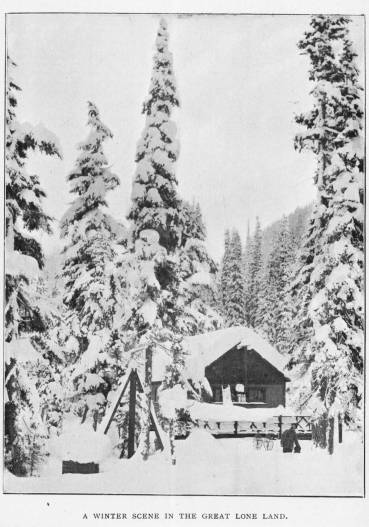
Chapter Fourteen.
Home Amusements and Studies—Happy Days at Sagasta-weekee—Stories of the Early Hunters—Methods of Hunting before the Introduction of Firearms—Wolves more Dreaded then—Story of two of Kinesasis’s Children—Killed by Wolves—Shakoona’s Sorrow—Saved by the Caresses of Little Children.
Sagasta-Weekee was at all times a cozy, homelike place, but never did it seem more inviting and comfortable than when blizzard storms roared round it, or when fierce snowstorms seemed to make their mightiest efforts to see if they could not bury it in their enormous drifts of whitest snow. These terrific wintry gales sometimes made the house tremble on its foundations, and occasionally so shook the building that pictures hung on the wall would swing, and spoons in a tumbler on the mantelpiece would perceptibly jingle. But, in spite of the war of the elements outside, all was brightness and bliss within. There were endless resources of innocent amusement or work for all. A splendid, useful course of readings had been marked out for the boys, and Mr Ross saw that this, as well as the books prescribed by their teachers at home, were faithfully read and studied. Then the rest of the time was devoted to recreation and work. A capital workshop, well supplied with tools, including a complete turning lathe, as well as fine saws for delicate fretwork, was always open to them, and in it many a pleasant and useful hour was spent.
Frank excelled as the mechanical genius of the trio, and so generally to him was assigned the work of making any difficult repairs needed on the dog-sleds or harness, for it was a point of honour among the boys to keep their own outfits in perfect condition themselves.
Sam excelled, as might have been expected from his nationality, as a reader and reciter, and during the long evenings added much to the profit and diversion of the household.
Alec had a sweet, well-cultivated voice for one so young, and particularly excelled in singing the sweet songs and ballads of old Scotland. Often amidst the hush of a still, quiet night, or even in the lulls between the roar of the blizzard or tempest, might have been heard the sweet notes of “Auld Lang Syne,” “Annie Laurie,” “Comin’ Through the Rye,” “John Anderson, My Jo,” and many others that brought up happy memories of home, and touched for good all listening hearts. Another source of interest to the boys was for Mr Ross to invite in some intelligent old Indian, like Memotas, Big Tom, Mustagan, Kinesasis, or Paulette, to tell some remarkable incident of his life, either as a hunter or traveller. Then, as there were living at the village not far away a number of Indians who had gone out with great Arctic adventurers or explorers, and had been gone for years, some of them had very remarkable stories to tell.
As Kinesasis had had charge of the dogs during the summer, and was still much employed by Mr Ross on various jobs about the place, the boys became very well acquainted with him. He was a thorough Indian in his actions and modes of thought, and only saw things from his own stand-point. He was very observant, and had been quietly studying these three young “palefaces,” whom his master, the Ookemou, Mr Ross, had brought across the great sea. At first their active, demonstrative ways, so different from the quiet and taciturn manners of young Indians, tried him considerably. Yet he soon became accustomed to them. Then their grit and courage and perseverance under difficulties soon won his admiration. They had their mishaps, and, of course, in their endless sports and adventures they had to take their share of knocks, but under them all they were so good-natured and resourceful, as well as resolute and fearless, that the old Indian talked much about them among his own people, and said: “It was no wonder that the palefaces succeeded, if all their boys were like these three.” But what completely made him their friend was Alec’s terrible adventure with the wolves, and his signal triumph over their instinct and cunning by his resourceful tact and splendid endurance. Poor Kinesasis had reason to rejoice over every victory obtained over these fierce northern wolves. Some years before this they had during his absence broken into his wigwam and devoured two of his children. Some time later Mr Ross told the story to the boys as he had heard it from Kinesasis himself. It was as follows: